Market Minds Advisory
Hyperautomation Market

Hyperautomation Market: Hyperautomation Market. AI Decision Intelligence Moves Automation Beyond Rules

AI decision intelligence is pushing automation beyond rigid rule-based bots into systems that judge exceptions themselves, forcing enterprises to rethink which processes are even worth automating across nearly every knowledge-work function today

Lead Analyst

Published

September 2026

Make Smarter Decisions with Customized Research Insights

Request a free sample report and evaluate market opportunities, growth trends, and competitive dynamics relevant to your business needs.

2025 MARKET VALUE$16.4BMarket Size 2025
2036 FORECAST VALUE$90.5BBase Case , 2026 to 2036
CAGR 2026 TO 203616.8 %Bull 18.1% / Bear 15.5%
INCREMENTAL OPPORTUNITY$71.4BNet 10- year value creation
EXPANSION MULTIPLE4.73x2036 value over 2026 base
Strategic Levers
M&A Pipeline
Regional Outlook
Country Rankings
Competitive Intelligence
Segmental Deep-dive
Call-Us : 91 93563 13602

Executive Snapshot and Market Trajectory.

Hyperautomation has moved from a collection of disconnected robotic process automation bots into a coordinated discipline that combines process mining, orchestration, and AI-driven decision making across the enterprise's entire operational workflow. Investment committees now treat coordinated automation architecture as core operational infrastructure rather than a departmental efficiency project.
AI-powered decision intelligence is the biggest near-term demand driver, letting automation platforms handle exceptions and judgment calls that previously required a human reviewer, a capability that expands the addressable process universe well beyond the highly structured, rule-based tasks that first-generation robotic process automation could handle. Enterprises that once automated processes in isolated departmental silos now increasingly coordinate automation investment through a centralized center of excellence. This governance shift is reshaping enterprise-wide platform contract pricing.
Competitive intensity is high among platform vendors racing to consolidate process mining, orchestration, and AI decision capability into unified suites, while pure-play robotic process automation vendors face genuine disruption risk from cloud hyperscalers embedding automation tooling directly into their existing enterprise software platforms. Smaller regional automation consultancies increasingly see this platform consolidation as a genuine threat to their traditionally implementation-only service model. today
Market Definition
The hyperautomation market comprises robotic process automation, process mining, low-code development, and AI-powered decision intelligence platforms that enterprises combine to automate end-to-end business processes. It excludes standalone business intelligence and reporting tools not integrated into an active automation workflow.
Base Year Value
$16.4B in 2025 (MMA Primary Research Dataset, September 2026)
Forecast Period
2026 to 2036, eleven discrete annual values
CAGR
16.8% base case. Bull 18.1%. Bear 15.5%.
Fastest Growth Segment
AI-Powered Decision Intelligence and Cognitive Automation: 24.0% CAGR
Fastest Growth Country
India: 20.2% CAGR
Fastest Growth Region
South Asia and Pacific: 18.8% CAGR
Largest Region
North America: 32% of 2025 global value
Market Leaders
UiPath, Microsoft, Automation Anywhere, Pegasystems, and SAP lead the market. Source: MMA Primary Research Dataset, July 2026.
Primary Survey
n=3,800 procurement and R&D decision-makers, Q4 2025, six countries
Methodology
Demand-side build-up, cross-validated against public data, 47 expert interviews

Hyperautomation Market Forecast Scenarios

hyperautomation-market-size-forecast-scenario-1790010031866
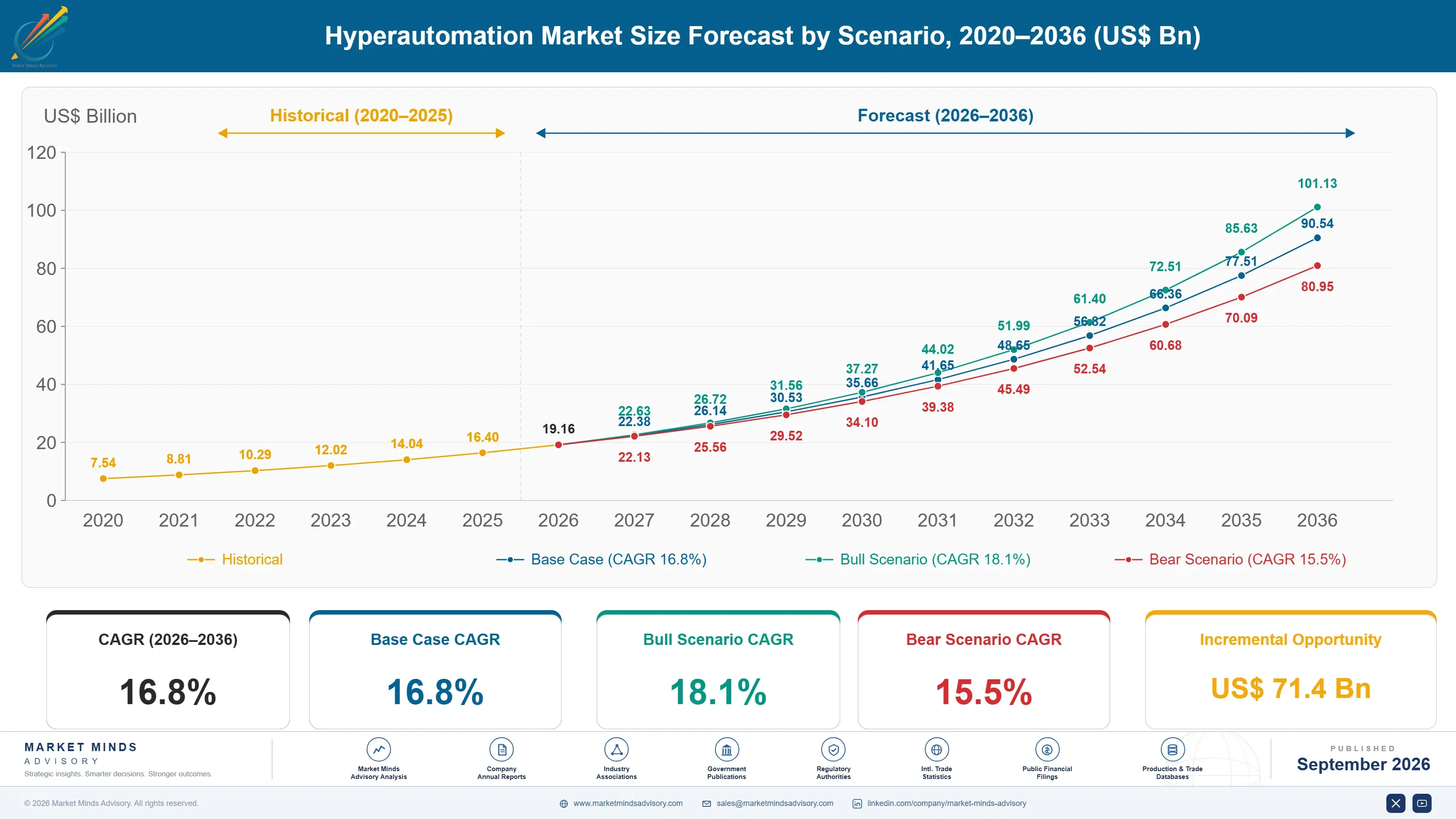
Between 2020 and 2025 the market grew through a robotic process automation adoption wave, then accelerated sharply once generative AI made decision-capable automation commercially viable beyond narrow rule-based tasks, a historical CAGR near 15.8% across that period. Early adoption concentrated among large enterprises with dedicated automation centers. Vendors spent this period proving out reliability at enterprise scale across diverse business process categories.
The base case assumes continued AI decision intelligence maturity, falling automation platform costs for mid-market enterprises, and broader process mining adoption that identifies genuinely automatable processes rather than relying on guesswork. Together these three mechanisms push adoption beyond large enterprises into mainstream mid-market procurement across most major economies over the coming decade. Process mining adoption removes a friction point that has slowed automation return on investment, since enterprises previously guessed which processes were worth automating.
The bull case centers on a named catalyst: AI decision intelligence reaching accuracy levels that let enterprises confidently automate judgment-heavy processes currently reserved for human review. The bear case centers on persistent governance and audit concerns that keep regulated enterprises from trusting AI-driven decisions in compliance-sensitive workflows. Vendors addressing governance concerns through explainable AI decision auditing are winning trust among cautious regulated buyers.

AI Decision Intelligence Moves Automation Beyond Rules

Hyperautomation has moved past the isolated, single-process robotic automation approach that defined its first decade, when bots automated narrow, rule-based tasks one at a time without any coordinated enterprise-wide automation strategy across departments. That earlier fragmentation frustrated both process owners and IT governance teams. Procurement committees today treat cross-functional automation strategy as a baseline requirement rather than a competitive differentiator.
MARKET CONCENTRATIONCR5 35%Top five vendors hold slightly over one third
AVERAGE ANNUAL PLATFORM PRICE$120,000 per enterpriseTypical annual subscription cost for a mid-size enterprise deployment
TOP ADOPTING COUNTRY SHAREUnited States 34%Share of global platform revenue concentrated in that country
IMPLEMENTATION TIMELINE8 monthsTypical enterprise deployment period from contract to full rollout
PROCESS AUTOMATION COVERAGE31% of eligible processesShare of automatable enterprise processes actually automated today
AI COMPUTE COST SHARE29%Share of vendor operating cost from AI model training alone
Procurement officers now evaluate vendors on process mining depth and AI decision intelligence accuracy rather than on bot deployment speed alone, forcing vendors that once competed purely on automation volume to build genuine cross-functional platform capability internally or through acquisition. This shift has reshaped which vendors win large enterprise contracts. Vendors lacking dedicated process mining capability increasingly lose enterprise renewal bids to fuller-service competitors.
AI decision intelligence providers increasingly outearn pure robotic process automation specialists on a per-enterprise basis, since bundled process mining and decision automation subscriptions capture a larger share of total automation budget than rule-based bots alone could command across a company's full process portfolio. Margin pools are shifting decisively toward vendors with genuine AI capability. Investors have taken notice, valuing AI-heavy vendors at meaningfully higher multiples than rule-based automation specialists.
"The vendors winning this transition are not the ones with the most bots deployed. They are the ones that can tell an enterprise which processes are actually worth automating in the first place."
Director, Enterprise Automation and AI Practice · MMA Technology Practice · September 2026

Market Trends

Agentic AI systems handle multi-step process orchestration autonomously

Vendors are deploying agentic AI systems that can plan and execute multi-step process sequences autonomously, dynamically adjusting to exceptions and edge cases rather than requiring pre-programmed rules for every possible scenario a traditional robotic process automation bot would need explicitly defined in advance. This capability meaningfully expands the addressable process universe beyond the highly structured, repetitive tasks that first-generation automation could reliably handle into genuinely judgment-dependent workflows. Major platform vendors have begun marketing measurable process coverage expansion figures directly to prospective enterprise customers evaluating competing systems. Adoption is accelerating fastest among enterprises with the most complex, exception-heavy business processes.
Market Impact: 42% cite labor shortage as driver
Process mining becomes mandatory before automation investment

Enterprises are increasingly requiring process mining analysis before committing automation budget to a specific process, replacing the guesswork that characterized earlier automation waves with data-driven prioritization based on actual process execution patterns captured from enterprise system logs. This capability meaningfully improves automation return on investment by directing budget toward genuinely high-value, high-volume processes rather than processes selected based on departmental politics or incomplete anecdotal evidence. Major consulting firms increasingly require process mining analysis as a mandatory first step in any automation engagement. Adoption continues to grow among enterprises seeking measurable automation returns.
Market Impact: 55% of processes include unstructured data

Market Opportunities and Growth Drivers

Labor shortage pressure pushes automation beyond back-office tasks

Persistent skilled labor shortages across knowledge work functions are pushing enterprises to automate increasingly complex, judgment-dependent processes that previously required experienced human reviewers, creating rising procurement volume for AI-powered decision intelligence capable of handling exceptions autonomously rather than escalating every edge case to an increasingly scarce human workforce. Enterprises facing hiring difficulty in specific functions increasingly view automation as a genuine capacity solution rather than purely a cost reduction measure. Enterprise executives increasingly cite this capacity constraint as their primary justification for expanding automation budgets beyond traditional cost-reduction business cases this year.
Market Impact: 34% of regulated processes still excluded

Generative AI capability makes unstructured data processable

Generative AI models capable of extracting and interpreting information from unstructured documents, emails, and free-text records are creating rising procurement volume for automation platforms that can now handle the majority of enterprise process inputs that traditional structured-data robotic process automation could never reliably process. This capability particularly benefits industries with document-heavy processes like insurance claims, healthcare records, and legal contract review that previously resisted automation. Enterprises in these document-heavy industries report meaningful processing time reduction once unstructured data capability becomes available within their existing automation platform infrastructure. Adoption keeps growing.
Market Impact: 26% of automation licenses found redundant

Market Restraints and Challenges

AI decision explainability gaps limit regulated industry adoption

Many AI decision intelligence models operate as effective black boxes that cannot clearly explain why a specific automated decision was made, creating genuine compliance risk for enterprises in regulated industries required to document decision rationale for audit purposes. The root cause lies in the inherent complexity of modern machine learning models, which trade interpretability for accuracy in ways that simpler rule-based systems never had to navigate. Commercially this restricts AI-driven automation from compliance-sensitive processes in financial services and healthcare specifically. Vendors are building explainable AI interfaces as a mitigation pathway to address this gap.
Market Impact: 47% increase in automatable process coverage

Automation sprawl without governance creates redundant investment

Many enterprises deployed automation tools departmentally without central coordination, resulting in redundant licensing, inconsistent process documentation, and duplicate automation efforts across business units that waste budget and create genuine maintenance burden. The root cause is the historically decentralized way automation adoption spread through enterprises before centers of excellence became standard practice. Commercially this increases total cost of ownership and slows consolidation efforts significantly. Enterprises are establishing centralized automation governance functions as a mitigation pathway to reduce this sprawl. Adoption of these governance functions remains uneven across smaller enterprises today lacking dedicated automation leadership roles.
Market Impact: 39% higher ROI with mining
3 additional market trends, 4 additional growth drivers, and 2 additional restraints and challenges are covered in the full report. Contact sales@marketmindsadvisory.com to access the complete intelligence.

Segment CAGR and Growth Architecture

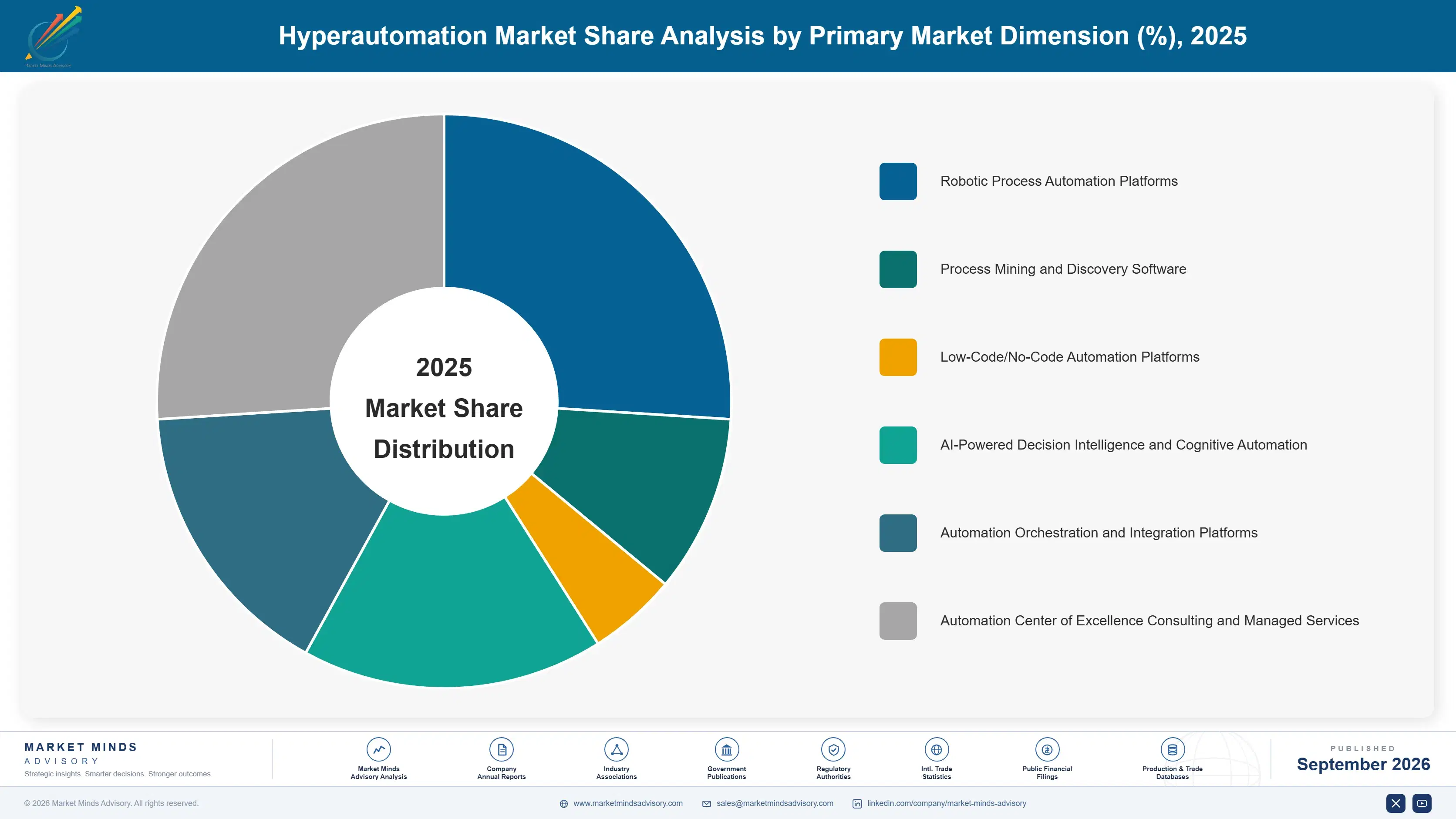
The market divides across six product segments spanning bots, mining, and decision layers. AI-powered decision intelligence and cognitive automation, and process mining and discovery software, are growing fastest as enterprises move past rule-based bots toward genuinely judgment-capable automation. This split increasingly determines where platform vendors concentrate engineering and AI research investment budgets. Vendors track this closely.
hyperautomation-market-market-share-analysis-1790010032426

AI-Powered Decision Intelligence and Cognitive Automation

AI-powered decision intelligence and cognitive automation platforms handle exceptions and judgment calls that previously required human review, expanding the addressable process universe well beyond the highly structured, rule-based tasks that first-generation robotic process automation could reliably handle. This segment is growing fastest because generative AI has made unstructured data processing genuinely commercially viable, letting automation platforms handle document-heavy, judgment-dependent processes across insurance, healthcare, and legal functions that previously resisted automation entirely. Vendors are increasingly building explainable AI interfaces that satisfy regulatory audit requirements, enabling adoption in compliance-sensitive industries that avoided black-box automation previously. Analysts expect this lead to widen further as more regulated industries adopt comparable explainability standards across their compliance frameworks.
CAGR 24.0%

Process Mining and Discovery Software

Process mining and discovery software analyzes enterprise system logs to identify exactly which processes are genuinely worth automating based on actual execution patterns rather than departmental guesswork or incomplete anecdotal evidence. This segment benefits directly from enterprises increasingly requiring data-driven prioritization before committing automation budget, replacing the trial-and-error approach that characterized earlier automation waves with measurable return on investment targeting. Major consulting firms increasingly require process mining analysis as a mandatory first step in any automation engagement, driving adoption well beyond enterprises pursuing the software independently. Vendors serving this niche report strong renewal rates given the measurable ROI improvement clients experience. Analysts expect this data-driven approach to become standard practice across most large enterprise automation programs within a few years.
CAGR 20.0%
Full segment breakdown across 7 segments available in the complete report.

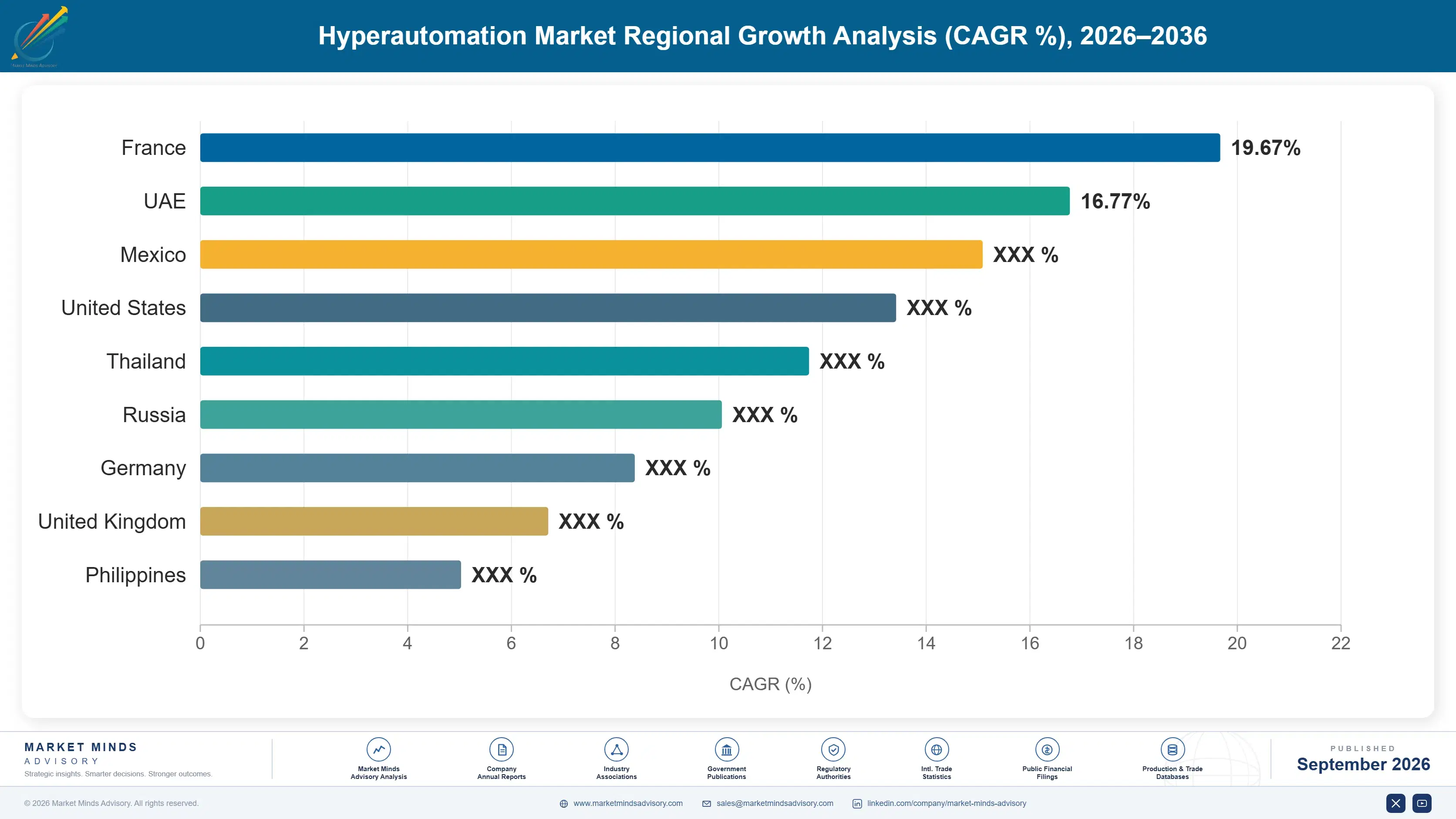
Regional Architecture and Country Demand Map

North America leads global demand, anchored by concentrated automation platform vendor headquarters and the largest enterprise software technology budgets. East Asia and Western Europe follow, driven by rapid digital transformation and labor cost pressure across their markets. Every region shows measurable, if uneven, adoption momentum this year.

North America

The United States anchors regional demand as home to the largest concentration of automation platform vendor headquarters and the deepest enterprise technology budgets among financial services, healthcare, and insurance organizations. Canada contributes steady demand through its own financial sector and government digital transformation initiatives, though at meaningfully smaller absolute scale than its southern neighbor. Persistent labor shortages across knowledge work functions are more acute here than in most other regions, accelerating adoption beyond voluntary efficiency gains alone. Large enterprise buyers headquartered in the region increasingly mandate automation platform standardization across their global operations. Vendors with early enterprise relationships here are building durable renewal advantages that international competitors find difficult to replicate quickly.
Share: 32% | CAGR: 17.6% (2026 to 2036)

East Asia

China's rapidly expanding digital economy and manufacturing sector are driving disproportionate regional growth as enterprises digitize operations and face rising labor costs that make automation investment increasingly attractive. Japan contributes through its own severe demographic labor shortage and strong enterprise automation culture built over decades of manufacturing efficiency discipline. South Korea adds demand through its advanced digital economy and technology conglomerates increasingly automating back-office and customer service functions. Regional platform vendors are increasingly exporting domestically built automation software to other Asian markets as they scale beyond their home base. Analysts expect this export trend to accelerate as domestic vendors seek growth beyond an increasingly mature and competitive home market. Renewal rates here run well above the global average.
Share: 23% | CAGR: 17.8% (2026 to 2036)
Regional intelligence for 5 additional markets available in the complete report: Western Europe, South Asia and Pacific, Latin America, Middle East and Africa, Eastern Europe. Contact sales@marketmindsadvisory.com.
hyperautomation-market-country-cagr-analysis-1790010032943

Monetizing Decision Intelligence Beyond Bot Licenses

Basic bot licensing alone generates the thinnest margin in this market, so vendors increasingly build recurring revenue through AI decision modules, process mining subscriptions, and managed automation services that enterprises renew annually rather than a flat per-bot license fee. Margin pools are shifting decisively toward vendors that build services and AI revenue beyond basic bot licensing alone.

Bundle AI decision intelligence modules with core platform

Vendors increasingly bundle AI-powered decision intelligence and cognitive automation modules directly into premium platform tiers rather than selling basic bot orchestration features alone, capturing incremental revenue per enterprise account. This bundling lifts blended gross margin by an estimated 18 percentage points compared to basic-tier-only sales, since AI decision features carry far lower marginal delivery cost once the underlying models are trained. Enterprises increasingly view these features as essential competitive differentiation rather than optional add-ons. Vendors report this bundled approach is becoming standard practice across most large enterprise renewal negotiations today.
Market Impact: 18 percentage point margin lift from AI module bundling

Sell process mining assessments as a premium consulting engagement

Vendors are packaging structured process mining assessments as a paid consulting engagement rather than a bundled software feature, recognizing that enterprises will pay directly for data-driven prioritization that improves automation return on investment substantially. Process mining assessments typically carry gross margin above 55% since delivery scales through standardized analysis methodology and regional delivery teams rather than dedicated engineering staff for every account. Larger vendors are extending this into ongoing quarterly process reassessment subscriptions to keep this revenue stream recurring across the client relationship. Enterprises increasingly accept this cost given the measurable ROI improvement mining-led prioritization delivers.
Market Impact: 55% gross margin earned on process mining assessments

Charge managed automation service fees for center of excellence support

Vendors increasingly charge managed service fees for ongoing automation center of excellence support that helps enterprises govern automation sprawl and maintain existing bot fleets, converting a genuine governance restraint into a meaningful recurring revenue opportunity. This managed service model typically carries gross margin above 48% since delivery scales through shared specialist teams serving multiple enterprise accounts rather than dedicated staff for every customer relationship. Enterprises increasingly accept this cost given the alternative of unmanaged automation sprawl generating redundant licensing and maintenance costs across departments. Adoption continues to grow among enterprises facing mounting governance pressure.
Market Impact: 48% gross margin earned on managed automation services

License decision intelligence models to industry-specific partners

Larger automation platforms increasingly license their aggregated, anonymized decision intelligence models to industry-specific solution partners building vertical automation products, extending platform reach into use cases the original vendor lacks resources to build directly. This licensing model generates high-margin recurring revenue, typically 35 to 40% of licensed revenue, with minimal incremental delivery cost since the underlying models have already been validated. Solution partners benefit by launching vertical automation products quickly rather than building proprietary decision models themselves from scratch. Larger platforms view this as a low-risk way to extend market reach without direct vertical investment.
Market Impact: 38% margin earned on model licensing deals annually

Who Controls the Margin Pool

Market concentration is moderate, with a CR5 of 35% split across platform generalists and specialist AI decision intelligence vendors rather than concentrated around a single dominant leader. The gap between the top vendor and the fifth-ranked challenger remains narrower than in more mature enterprise software categories. No single vendor commands more than roughly a tenth of global revenue today, leaving room for smaller specialists to win individual enterprise accounts outright.
Current competitive activity centers on AI capability: platform generalists are acquiring specialist decision intelligence and process mining vendors to build genuine AI depth that enterprises increasingly demand, while cloud hyperscalers embed automation tooling directly into their native enterprise software platforms to compete with standalone vendors. Several mid-tier decision intelligence and process mining specialists have received acquisition interest over the past eighteen months specifically as generalists close AI capability gaps.

Emerging pressure comes from open-source and lower-cost automation frameworks gaining traction among smaller enterprises priced out of premium platform subscriptions, appealing to budget-constrained buyers. Rankings could shift meaningfully if these lower-cost alternatives prove comparable reliability at enterprise scale. Established vendors are responding by launching their own lower-cost tiers rather than ceding budget-constrained mid-market buyers entirely to newer entrants.
hyperautomation-market-company-positioning-matrix-1790010033477

Competitive Moat and Risk Dimensions

UIPATH

Moat: Deep robotic process automation heritage

UiPath built its reputation as a dedicated robotic process automation specialist over more than a decade, earning credibility with automation centers of excellence that broader enterprise software vendors entering the space more recently cannot easily replicate. This focus lets UiPath win specification battles specifically on automation depth rather than breadth.
UIPATH

Risk: Narrower portfolio than diversified rivals

UiPath's focused automation portfolio, while deep, lacks the broader enterprise resource planning and cloud infrastructure integration that diversified competitors like Microsoft and SAP can bundle directly into existing customer relationships, leaving room for those rivals to win deals on single-vendor consolidation alone. Smaller specialists increasingly market focused expertise as a direct competitive counter to this bundling pressure.
MICROSOFT

Moat: Native cloud platform integration advantage

Microsoft embeds automation capability directly into its widely adopted Power Platform and Azure cloud infrastructure, giving it distribution advantages among enterprises already standardized on its broader software platform that standalone automation vendors cannot easily match without existing customer relationships. This built-in distribution reduces the sales friction that pure-play vendors face.
MICROSOFT

Risk: Less specialized automation depth

Microsoft's automation tooling, while broadly distributed, generally lacks the specialized depth that dedicated automation vendors offer for complex, judgment-heavy processes, leaving room for specialist competitors to win deals specifically on advanced process mining and AI decision intelligence capability. Microsoft is investing to close this gap, but the transition will take meaningful time to complete.

Players Tracked

Prominent Players

UiPath
Microsoft
Automation Anywhere
Pegasystems
SAP

Other Key Players

IBM
Appian
Blue Prism (SS&C Technologies)
Celonis
Nintex
WorkFusion
ABBYY
Kofax (Tungsten Automation)
EdgeVerve Systems (Infosys)
Salesforce
ServiceNow
Oracle
NICE
Laiye
Datamatics

Recent Developments

FEBRUARY 2026

Automation Anywhere launched an expanded agentic AI orchestration module that lets automated agents plan and execute multi-step process sequences autonomously, targeting enterprises seeking to automate increasingly complex, exception-heavy business processes. Early enterprise pilots have shown promising results across several major financial services and insurance clients currently evaluating the platform.
Signal: Signals platform vendors racing to embed agentic AI capability ahead of competitors entering the space. ahead of tightening enterprise expectations.
SEPTEMBER 2025

Pegasystems acquired a smaller process mining software provider, adding expanded process discovery and analytics capability to its existing automation platform, extending its addressable market among enterprises requiring data-driven automation prioritization. Terms of the transaction were not disclosed publicly by either company involved in the deal.
Signal: Signals continued consolidation as automation platforms race to build comprehensive process mining coverage ahead of rivals.

AI Compute and Talent Cost Pressure

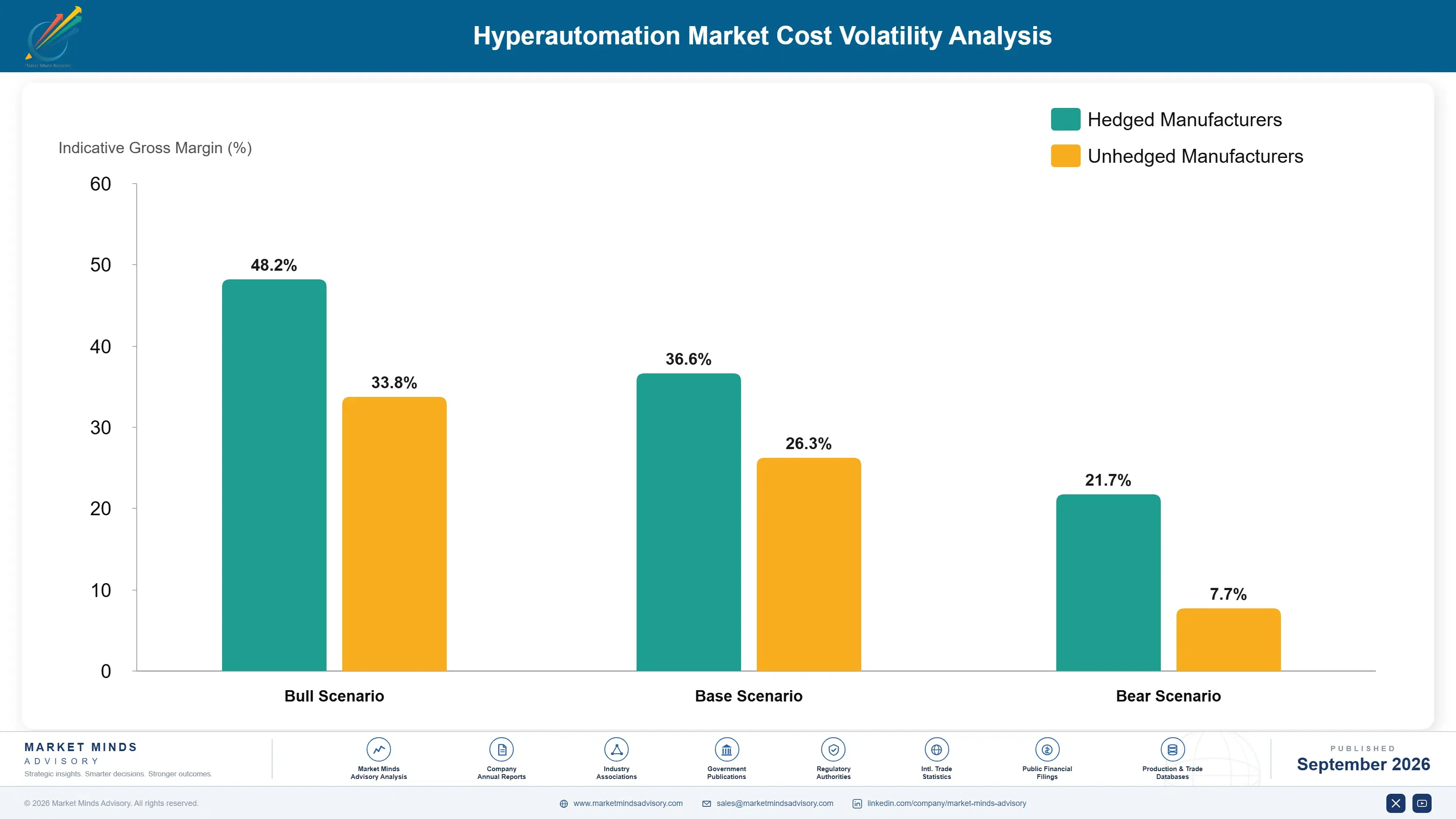
Platform cost structure centers on two primary inputs: AI compute infrastructure for model training and inference, representing an estimated 26 to 34% of platform operating cost, and specialized machine learning and process automation talent, representing a further meaningful share concentrated among decision intelligence and process mining specialists. Compute capacity is sourced from a small number of hyperscale cloud providers.
Cloud compute pricing volatility became visible in 2025 when a major hyperscaler raised GPU instance pricing by roughly 14% following surging demand from generative AI workloads, according to company investor day disclosures. Platforms reliant on AI decision intelligence for cognitive automation absorbed higher hosting costs mid-contract, compressing gross margin on existing enterprise accounts by an estimated 2 to 3 percentage points within two quarters. Some vendors delayed planned price reductions for a full product cycle.

Smaller automation vendors carry disproportionate exposure because they lack the negotiating leverage over hyperscale cloud contracts that larger diversified platforms secure through broader enterprise agreements spanning multiple product lines. This cost asymmetry compounds over multi-year contracts, pushing some smaller vendors toward acquisition rather than continued independent infrastructure investment. Larger diversified platforms use broader cloud purchasing power to smooth these cost swings in ways smaller specialists cannot.
hyperautomation-market-cost-volatility-analysis-1790010033674

Multi-cloud contract diversification strategy

Vendors increasingly negotiate capacity commitments across two or three hyperscale providers simultaneously rather than a single provider, using competitive bidding to cap annual price increases and preserve switching leverage as GPU demand keeps rising across the broader technology industry. Several vendors report meaningfully improved cost predictability after adopting dual-sourcing strategies over the past two years.

Remote engineering talent hub expansion

Leading platforms expand engineering hiring into lower-cost talent hubs including Eastern Europe, India, and Latin America, reducing blended fully-loaded engineering cost per headcount by an estimated 20 to 30% versus concentrating hiring solely in North American metro markets. Larger platforms report substantial savings from this approach without sacrificing engineering output quality meaningfully. Adoption continues to grow.

Portfolio Architecture for Margin Defence

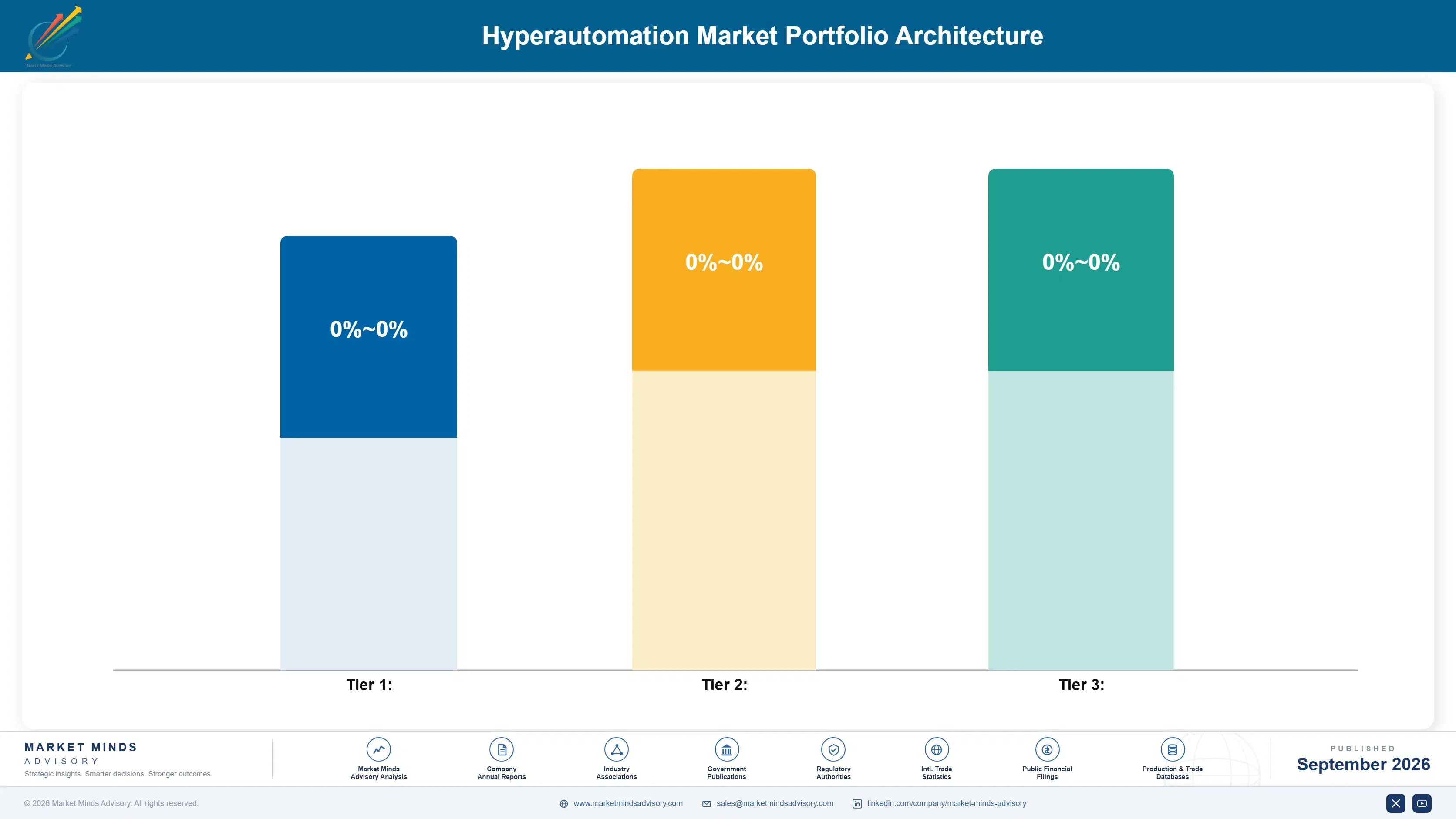
Vendor portfolios span a wide margin gradient, from commodity single-bot licenses sold on thin per-seat pricing to premium certified AI decision intelligence and process mining platforms commanding substantially higher gross margin across most product categories. Vendors that once competed purely on bot deployment volume now differentiate primarily through AI capability and process governance depth. Buyers increasingly expect this AI capability as a baseline procurement requirement rather than a differentiator.
The volume tier still anchors most vendor seat counts today, but margin expansion increasingly comes from premium certified AI decision modules and managed automation governance services that regulated procurement processes increasingly favor. This tension between volume bot licensing and premium AI migration shapes how vendors prioritize product roadmaps across their organizations. Vendors that misjudge this balance risk losing share to competitors better aligned with governance and compliance priorities.

High-value margin pools concentrate specifically around AI decision intelligence paired with process mining, where enterprises pay a meaningful premium for demonstrated automation ROI and reduced governance labor. Vendors slow to build genuine AI capability risk ceding this expanding premium pool to newer, more focused competitors within a few product cycles. This premium pool should expand faster than the overall market this decade.

Standard rule-based robotic process automation bots sold primarily on per-seat pricing to budget-constrained smaller enterprises with minimal AI or process mining requirements across most standard use cases. Margins here remain the thinnest across the entire vendor product portfolio.
Gross Margin

Certified process mining and orchestration platforms bundled with governance tools sold to enterprises requiring documented compliance and ongoing vendor support across multi-year enterprise contracts. Renewal rates in this tier run notably higher than in the volume tier below it.
Gross Margin

AI-powered decision intelligence and explainable cognitive automation platforms positioned for enterprises seeking measurable process coverage expansion and formal compliance with tightening AI governance regulation. Vendors here typically enjoy the strongest pricing power in the entire market.
Gross Margin
hyperautomation-market-portfolio-architecture-1790010034172

High-value Sub-segments and Strategic Watch-out

AI-Powered Decision Intelligence Platforms

The fastest-growing, highest-margin pool in the market, generating the exception-handling capability that expands automatable process coverage. Enterprises increasingly view this as essential rather than optional, pulling budget away from rule-based bots quickly. This trend should continue through the forecast period. Vendors here command strong pricing power.

Process Mining and Discovery Software

A high-value, moderate-growth pool where established vendors defend share through deep analytics expertise and proven reliability at scale. Growth remains healthy but slower than decision intelligence as the underlying prioritization trend matures further. This trend should continue through the forecast period. Buyers value this reliability.

Standard Robotic Process Automation Bots

The volume core of the market, still generating the largest seat count base despite slowing margin growth. Vendors defend this base through bundled pricing and multi-year enterprise contracts even as buyers gradually shift new spending toward premium modules instead. This trend should continue through the forecast period.

Standalone Single-Function Automation Tools

A strategic watch-out segment facing mounting pressure as bundled platform suites increasingly absorb single-function capability natively. Standalone point-solution vendors without a broader platform strategy risk losing renewal share to integrated competitors. This trend should continue through the forecast period. Investment here is slowing noticeably. today

Why Enterprise Contracts Compound Over Time

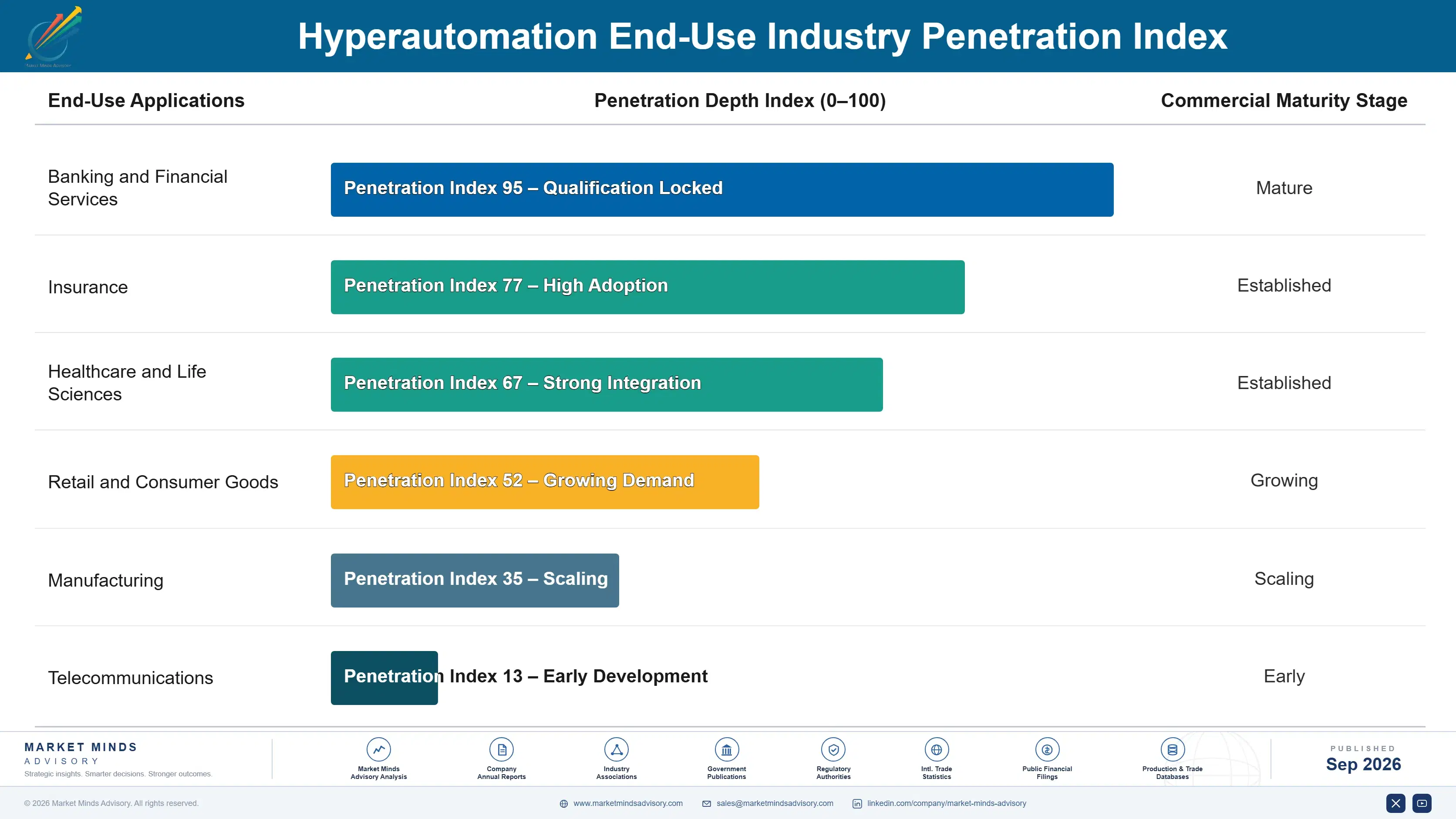
Hyperautomation contracts increasingly resemble annuity revenue rather than one-time software purchases, since enterprises rarely abandon a working automation platform once centers of excellence have built process governance and bot maintenance workflows around it. Renewal rates on bundled platform-plus-AI contracts run meaningfully higher than basic bot licensing alone, and expansion revenue from added process coverage compounds steadily across multi-year enterprise relationships.
Adoption stickiness varies meaningfully by end-use vertical: financial services and insurance enterprises embed automation deeply into regulatory compliance and claims processing workflows, making displacement costly and rare, while smaller retail and hospitality enterprises adopt more selectively around specific back-office functions, keeping switching costs comparatively lower and renewal cycles shorter across those less regulated accounts. Vendors track this variance closely when deciding where to invest new feature development budget each year.

Buyer profiles are shifting generationally as chief automation and AI officers, rather than traditional IT staff, increasingly own the platform purchasing decision, prioritizing AI decision capability over raw bot deployment volume. This generational handoff favors vendors that can demonstrate measurable process coverage expansion over incumbents selling primarily on bot count alone. Vendors that misjudge this generational shift risk losing the champion inside the enterprise buying committee entirely.
hyperautomation-market-end-use-penetration-index-1790010034659

Where MMA Sees Durable Advantage

These are among the four positions where our research anticipates prominent divergence between winners and laggards over the coming forecast period. Each is grounded in the demand model, the regulatory perimeter, and the announced capacity pipeline.
01 / VENDOR SELECTION DISCIPLINE

Prioritize AI decision depth over raw bot deployment volume

Enterprises evaluating hyperautomation vendors should weight genuine AI decision intelligence capability well above raw bot deployment volume when comparing shortlisted vendors for multi-year enterprise procurement decisions across their process portfolio. Vendors selling rule-based bots alone without genuine AI decision capability routinely underperform bundled competitors on process coverage expansion and long-term ROI within eighteen months of deployment, according to feedback gathered across the primary survey. Enterprises that select correctly the first time avoid a costly, disruptive platform migration a few years later.
02 / PROCESS MINING INVESTMENT TIMING

Fund process mining before committing automation budget

Enterprises routinely commit automation budget to specific processes based on departmental politics rather than data-driven prioritization, treating process mining as an optional nice-to-have rather than a mandatory first step before any automation investment decision. This underinvestment directly explains the disappointing ROI that surfaces repeatedly across otherwise well-funded automation programs lacking proper prioritization discipline. MMA recommends enterprises require process mining analysis before committing meaningful automation budget to any specific business process, since data-driven prioritization consistently outperforms departmental guesswork and delivers measurably better returns.
03 / GOVERNANCE INVESTMENT TIMING

Build automation governance ahead of sprawl becoming unmanageable

Enterprises routinely underestimate how quickly decentralized automation deployment can create redundant licensing and maintenance burden as adoption spreads across business units without centralized coordination. This risk compounds for enterprises that delay governance investment until automation sprawl has already become difficult and expensive to consolidate retroactively across multiple business units. MMA recommends enterprises establish centralized automation governance now rather than waiting for sprawl to force a costly, disruptive consolidation effort later, since early governance investment yields genuine, durable advantages over slower-moving competitors.
04 / EXPLAINABILITY INVESTMENT TIMING

Invest in explainable AI ahead of regulatory scrutiny

Regulators overseeing financial services and healthcare are increasingly focused on AI decision explainability, and vendors that already embed audit-ready explainability into their platforms will command a durable advantage over those retrofitting compliance reactively after new rules take effect across their installed base. This advantage compounds as more jurisdictions adopt similar AI governance requirements over the coming several years. Enterprises should prioritize vendors demonstrating proven explainability capability today rather than promised future features, since early investment costs meaningfully less than reactive retrofitting.

Engagement Snapshot From the Field

A live engagement with an industry participant carrying material or product regulatory and market exposure ahead of a defining policy shift, showing how our research translates into a defensible multi-year portfolio strategy.
MARKET MINDS ADVISORY · CLIENT ENGAGEMENT SUMMARY
Hyperautomation Producer Strategic Portfolio Review and Transition Roadmap 2026·Investment Scenario on Hyperautomation Exposure Evaluation 2025-26
CLIENT PROFILE
The client is a multinational insurance carrier processing over 2 million claims annually across 15 countries, with roughly $18 billion in annual gross written premium (client-reported, unverified by MMA). The carrier had deployed automation departmentally across claims processing without any centralized coordination or governance framework. Individual country and regional teams had previously handled automation investment independently without company-wide coordination or shared governance standards.
STRATEGIC CHALLENGE
Leadership needed to consolidate fragmented automation investment into a unified claims processing strategy but lacked internal expertise to evaluate competing AI decision intelligence platforms and process mining methodologies objectively. The board was concerned about both redundant licensing costs and regulatory audit exposure. The board explicitly requested independent, vendor-neutral evaluation before approving any company-wide consolidation commitment.
MMA APPROACH
MMA conducted a structured vendor evaluation spanning six hyperautomation platforms, combining process mining analysis with claims team interviews across the carrier's five largest markets. The engagement produced a phased eighteen-month consolidation plan sequencing the highest-volume claims categories ahead of the remaining portfolio. Recommendations were validated against each market's existing claims volume data before finalizing the consolidation sequence.
KEY FINDINGS
  1. Two of six evaluated vendors could not demonstrate explainable AI capability sufficient for the carrier's regulatory audit requirements (client-reported, unverified by MMA).
  2. Claims categories using AI decision intelligence reported 33% faster processing time compared to rule-based automation alone (client-reported, unverified by MMA). across the consolidated markets overall.
  3. Bundled platform-plus-governance pricing reduced total automation program cost by an estimated 22% compared to separate procurement (client-reported, unverified by MMA). across the full consolidation program.
  4. Customer satisfaction scores for claims processing speed improved measurably across all consolidated markets (client-reported, unverified by MMA). within the first year of rollout.
CLIENT PROFILE
The client is a multinational insurance carrier processing over 2 million claims annually across 15 countries, with roughly $18 billion in annual gross written premium (client-reported, unverified by MMA). The carrier had deployed automation departmentally across claims processing without any centralized coordination or governance framework. Individual country and regional teams had previously handled automation investment independently without company-wide coordination or shared governance standards.
STRATEGIC CHALLENGE
Leadership needed to consolidate fragmented automation investment into a unified claims processing strategy but lacked internal expertise to evaluate competing AI decision intelligence platforms and process mining methodologies objectively. The board was concerned about both redundant licensing costs and regulatory audit exposure. The board explicitly requested independent, vendor-neutral evaluation before approving any company-wide consolidation commitment.
MMA APPROACH
MMA conducted a structured vendor evaluation spanning six hyperautomation platforms, combining process mining analysis with claims team interviews across the carrier's five largest markets. The engagement produced a phased eighteen-month consolidation plan sequencing the highest-volume claims categories ahead of the remaining portfolio. Recommendations were validated against each market's existing claims volume data before finalizing the consolidation sequence.
KEY FINDINGS
  1. Two of six evaluated vendors could not demonstrate explainable AI capability sufficient for the carrier's regulatory audit requirements (client-reported, unverified by MMA).
  2. Claims categories using AI decision intelligence reported 33% faster processing time compared to rule-based automation alone (client-reported, unverified by MMA). across the consolidated markets overall.
  3. Bundled platform-plus-governance pricing reduced total automation program cost by an estimated 22% compared to separate procurement (client-reported, unverified by MMA). across the full consolidation program.
  4. Customer satisfaction scores for claims processing speed improved measurably across all consolidated markets (client-reported, unverified by MMA). within the first year of rollout.
RECOMMENDED STRATEGY
Phase 1: Phase one prioritized the three highest-volume claims categories before any additional portfolio-wide procurement commitment was made. establishing a proven consolidation playbook first. Phase 2: Phase two expanded consolidation to eight additional claims categories over nine months, sequenced by existing process mining data availability. limiting operational disruption throughout. Phase 3: Phase three completed consolidation across the remaining portfolio over six months, prioritized by regulatory audit deadline timing. completing the consolidation smoothly.
OUTCOME
Eighteen months post-engagement, the carrier reports meaningfully faster claims processing, reduced redundant licensing costs, and improved regulatory audit readiness across its consolidated markets (client-reported, unverified by MMA). The carrier has since made centralized automation governance a mandatory standard for all future process expansion. Claims staff also reported meaningfully higher confidence in the new automation technology following the rollout.

Frequently Asked Questions

Foundational context covering the market sizes, CAGR, scope, country, region and competition that inform every finding below. This section is provided to cover basics and most often pre-purchase conversations, answered from the MMA Primary Research Dataset.

What is the current size of the Hyperautomation Market?

The global market reached an estimated $16.4 billion in 2025. This figure covers robotic process automation, process mining, low-code development, and AI decision intelligence platforms sold to enterprises worldwide.

How large will the Hyperautomation Market be by 2036?

MMA projects the market will reach approximately $90.5 billion by 2036. Growth is driven primarily by AI decision intelligence maturity and expanding process mining adoption.

What is the CAGR for the Hyperautomation Market 2026 to 2036?

The market is projected to grow at a 16.8% compound annual growth rate across the forecast period. This reflects accelerating labor shortage pressure and generative AI capability expansion.

Which segment is growing fastest?

AI-Powered Decision Intelligence and Cognitive Automation leads growth at a 24.0% CAGR, roughly 1.43 times the overall market rate. Enterprises increasingly automate judgment-heavy processes today.

Who are the major companies in the Hyperautomation Market?

UiPath, Microsoft, Automation Anywhere, Pegasystems, and SAP lead the market. These vendors combine bot orchestration, cloud platform integration, and increasingly AI decision capability at scale.

Which country is growing fastest?

India leads country-level growth at a 20.2% CAGR. Its massive information technology and business process outsourcing sector increasingly adopts automation to remain globally competitive today.

Report Segmentation Architecture

The full report scope spans multiple orthogonal segmentation dimensions, with cross-tabulated demand data provided for each dimension pair. Coverage extends further to regional breakdowns, trend trajectories, and the competitive detail needed to support segment-level decision-making.

By Primary Market Dimension

  • Robotic Process Automation Platforms
  • Process Mining and Discovery Software
  • Low-Code/No-Code Automation Platforms
  • AI-Powered Decision Intelligence and Cognitive Automation
  • Automation Orchestration and Integration Platforms
  • Automation Center of Excellence Consulting and Managed Services

By End-Use Industry

  • Banking and Financial Services
  • Insurance
  • Healthcare and Life Sciences
  • Retail and Consumer Goods
  • Manufacturing
  • Telecommunications

By Commercial Dimension

  • Large Enterprise Direct Licensing
  • Mid-Market Subscription
  • Managed Service Provider Channel
  • Cloud Platform Embedded Automation

By Region

  • North America
  • East Asia
  • Western Europe
  • South Asia and Pacific
  • Latin America
  • Middle East and Africa
  • Eastern Europe

Scope, Methodology, and Coverage

Every figure in this report is reproducible from documented input assumptions. The scope below maps the historical period, the forecast horizon, the segmentation dimensions, and the countries covered, alongside the underlying primary and qualitative methodology.
Historical Period
2020 to 2025
Forecast Period
2026 to 2036
Base Year
2025 (USD billions; MMA Primary Research Dataset, September 2026)
Market Definition
The hyperautomation market comprises robotic process automation, process mining, low-code development, and AI-powered decision intelligence platforms that enterprises combine to automate end-to-end business processes. It excludes standalone business intelligence and reporting tools not integrated into an active automation workflow.
Quantitative Units
USD billions (current prices); active bot and seat license counts where applicable
Segmentation Dimensions
By Primary Market Dimension; By End-Use Industry; By Commercial Dimension; By Region
Regions Covered
North America, East Asia, Western Europe, South Asia and Pacific, Latin America, Middle East and Africa, Eastern Europe
Countries Covered
USA, China, Germany, France, UK, Japan, South Korea, India, Australia, Canada, Brazil, Mexico, Indonesia, Vietnam, Thailand, Malaysia, UAE, Saudi Arabia, South Africa, Nigeria, Turkey, Poland, Netherlands, Italy, Spain, Sweden, Switzerland, Argentina, Colombia, Singapore, and additional markets relevant to this sector
Key Companies Profiled
UiPath, Microsoft, Automation Anywhere, Pegasystems, SAP, IBM, Appian, Blue Prism (SS&C Technologies), Celonis, Nintex, WorkFusion, ABBYY, Kofax (Tungsten Automation), EdgeVerve Systems (Infosys), Salesforce, ServiceNow, Oracle, NICE, Laiye, Datamatics
Quantitative Methodology
Primary survey, n=3,800 respondents, Q4 2025, six countries; demand-side model with trade association cross-validation
Qualitative Methodology
47 expert interviews, Q4 2025; applied to validate demand model assumptions, identify emerging dynamics, and assess competitive positioning
Report Format
PDF and XLSX data workbook (Word format preview document)
Publisher
Market Minds Advisory
Report Code
MMA-2026-TEC-567
Published
September 2026
Contact
sales@marketmindsadvisory.com | www.marketmindsadvisory.com

Purchase the full Hyperautomation Market Report (2026 to 2036).

The full report delivers a comprehensive assessment of the global hyperautomation market across all seven regions, six segmentation categories, and twenty profiled vendors spanning platform generalists and specialist AI decision intelligence providers. It includes detailed forecast modeling through 2036, competitive positioning analysis, input cost exposure, and AI governance tracking across major jurisdictions. Buyers receive access to the underlying primary survey dataset and expert interview transcripts referenced throughout the analysis. Custom consulting engagements building on this research are available on request. The analysis draws on both quantitative survey and qualitative expert interview methodology, referenced separately throughout the document.
Ten-year quantitative market sizing and forecast model
Vendor competitive benchmarking and positioning matrix
Detailed regional commentary across seven regions
Primary survey dataset access, n equals 3800
Expert interview transcript summaries and analysis
Quarterly market update subscription option available

Built For The People Who Decide

From boardroom strategy to bench-side execution, this report is read cover-to-cover by leaders shaping the next decade of their industry, turning demand scenarios, market dynamics and valuation benchmarks into decisions.
CXOs/ Presidents/ VPs/ Managers
M&A and Corporate Development
Strategy Teams and R&D Heads
Procurement and Product Directors
Regulatory and Compliance Leaders
Investor Relations and Equity Analysts