Market Minds Advisory
Hydroxytyrosol Market

Hydroxytyrosol Market: Olive Polyphenol Science Meets the Anti-Aging Skincare Boom

Skincare manufacturers are formulating around documented hydroxytyrosol antioxidant potency well beyond olive oil nutraceuticals, pushing extraction specialists to expand olive byproduct processing as the EFSA's approved health claim reshapes credibility.

Lead Analyst

Lisa Gevelber

Published

September 2026

Make Smarter Decisions with Customized Research Insights

Request a free sample report and evaluate market opportunities, growth trends, and competitive dynamics relevant to your business needs.

2025 MARKET VALUE$0.2BMarket Size 2025
2036 FORECAST VALUE$0.5BBase Case , 2026 to 2036
CAGR 2026 TO 203611.6 %Bull 13.0% / Bear 10.2%
INCREMENTAL OPPORTUNITY$0.4BNet 10- year value creation
EXPANSION MULTIPLE3.00x2036 value over 2026 base
Strategic Levers
M&A Pipeline
Regional Outlook
Country Rankings
Competitive Intelligence
Segmental Deep-dive
Call-Us : 91 93563 13602

Executive Snapshot and Market Trajectory

Hydroxytyrosol demand is expanding well beyond its origins in olive oil nutraceuticals as skincare manufacturers formulate around its documented antioxidant potency, pushing extraction specialists to expand olive byproduct processing capacity nationwide today, a shift few legacy extraction specialists anticipated moving quite this fast.
Cosmetics and skincare applications are growing fastest as beauty brands cite documented antioxidant research when marketing anti-aging formulations, expanding at roughly 17.8 percent annually against the category's 11.6 percent baseline overall. Western Europe commands the largest regional share, anchored in the Mediterranean region's dominant olive oil production base and the European Food Safety Authority's approved cardiovascular health claim Retailers increasingly treat documented concentration certification as a baseline requirement rather than a marketing bonus today.
Competitive intensity centers on a small group of extraction specialists capable of processing olive mill wastewater and leaf material into standardized, high-purity hydroxytyrosol at commercial scale, a capability requiring specialized purification technology that smaller regional producers cannot easily replicate. Cosmetics and nutraceutical manufacturers increasingly demand documented purity and concentration certification before renewing supply contracts, pushing several smaller distributors to either secure direct extraction relationships or exit premium formulation channels entirely.
Market Definition
The hydroxytyrosol market covers production and trade of hydroxytyrosol, a polyphenol antioxidant compound extracted primarily from olive oil, olive mill wastewater, and olive leaves, used in nutraceutical supplements, cosmetics, functional foods, and pharmaceutical applications. It excludes standard olive oil products sold without concentrated polyphenol extraction and unrelated plant-derived antioxidants such as resveratrol or catechins.
Base Year Value
$0.2B in 2025 (MMA Primary Research Dataset, August 2026)
Forecast Period
2026 to 2036, eleven discrete annual values
CAGR
11.6% base case. Bull 13.0%. Bear 10.2%.
Fastest Growth Segment
Cosmetics and Skincare Applications: 17.8% CAGR
Fastest Growth Country
India: 16.4% CAGR
Fastest Growth Region
South Asia and Pacific: 13.8% CAGR
Largest Region
Western Europe: 26% of 2025 global value
Market Leaders
Seprox Biotech, Nutrafur, S.A., DSM-Firmenich, CreAgri, Inc., and Indena S.p.A. lead by disclosed production capacity and brand recognition. Source: MMA Analysis based on company annual reports and industry trade data.
Primary Survey
n=3,800 procurement and R&D decision-makers, Q4 2025, six countries
Methodology
Demand-side build-up, cross-validated against public data, 47 expert interviews

Hydroxytyrosol Market Forecast Scenarios

hydroxytyrosol-market-trends-growth-size-forecast-scenario-1787459584192
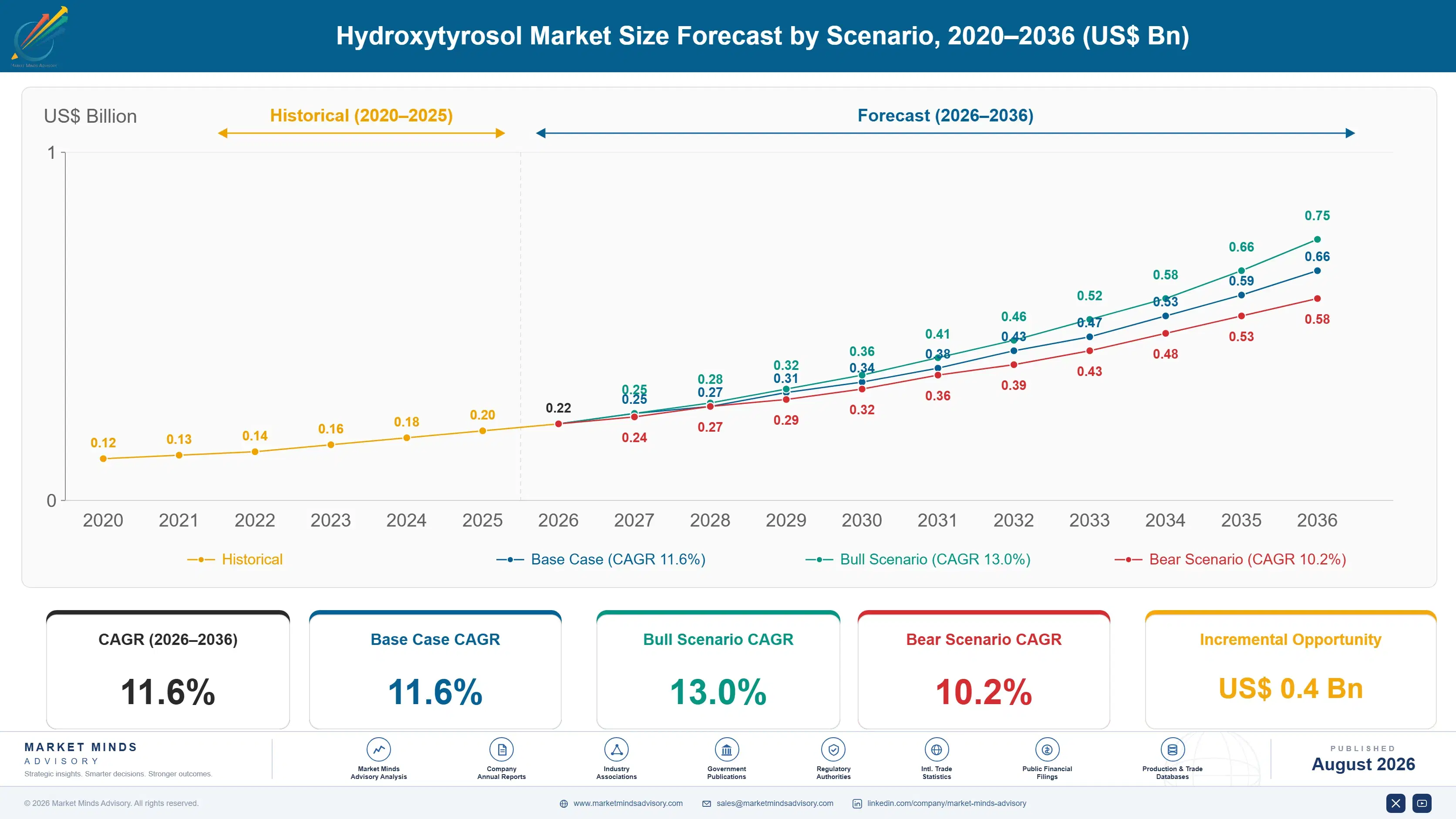
Between 2020 and 2025, hydroxytyrosol demand accelerated as nutraceutical applications matured while cosmetics formulation emerged as a genuine new growth channel entirely following European Food Safety Authority health claim approval. Extraction capacity investment roughly doubled across the period as brands sought documented antioxidant differentiation. The category posted an estimated 9.8 percent historical CAGR, trailing the forecast rate ahead of accelerating cosmetics adoption.
MMA's base case projects 11.6 percent annual growth through 2036, anchored in three commercial mechanisms. First, skincare brands keep formulating around documented antioxidant potency as anti-aging positioning gains wider consumer and dermatological recognition. Second, functional food and beverage manufacturers keep fortifying products with hydroxytyrosol as clean-label antioxidant positioning gains retail shelf space. Third, expanding olive byproduct processing infrastructure keeps easing the extraction capacity constraints that limited earlier category growth across every major export market tracked.
The bull case rests on a major cosmetics conglomerate formally standardizing hydroxytyrosol across its flagship anti-aging product range, which could pull demand well beyond current premium-tier adoption. The principal bear risk is continued reliance on olive harvest-dependent feedstock availability, which could cap supply growth regardless of how much downstream demand ultimately expands regardless of how successfully extractors premiumize existing formulations overall.

Extraction Purity Becomes the Category's Real Currency

Buyer behavior across cosmetics, nutraceutical, and functional food manufacturing has shifted decisively from treating hydroxytyrosol as a niche olive-derived additive toward demanding documented purity and concentration credentials. Formulators now verify extraction method and standardized concentration before committing to supply contracts, a scrutiny level that barely existed when hydroxytyrosol served mainly niche nutraceutical applications a decade ago, before the European Food Safety Authority's cardiovascular health claim reshaped category credibility.
MARKET CONCENTRATIONCR5 36%top five extraction specialists hold considerable combined global production capacity
AVERAGE PRICE PREMIUM4.2x standard olive extractconcentrated hydroxytyrosol commands a durable sustained ingredient cost premium
TOP PRODUCING REGION SHARE58%one region still supplies most global concentrated extraction volume today
COSMETICS APPLICATION PENETRATION31%beauty brands increasingly specify documented antioxidant concentration exclusively nationwide
PURITY CERTIFICATION SPEND6.4% of revenueleading extractors fund testing to defend documented purity claims
BYPRODUCT FEEDSTOCK SHARE38% of COGSolive byproduct sourcing dominates total production cost structure
Extraction economics reward specialists that invested in olive byproduct processing infrastructure years before cosmetics demand created new competition for available material. Cosmetics and nutraceutical brands increasingly award multi-year contracts to extractors that can guarantee consistent purity and documented concentration, forcing smaller distributors to either secure direct extraction relationships or compete purely on price for undifferentiated commodity extract.
Over the next decade, extraction purity and processing capacity expansion will matter as much as formulation innovation. Extractors that solve documented consistency while expanding capacity beyond current olive-harvest-dependent supply stand to capture disproportionate share as the category matures beyond its origins as a nutraceutical specialty into a genuinely diversified cosmetics and functional food ingredient nationwide and increasingly across export markets abroad.
"Skincare brands do not care that hydroxytyrosol started life as olive mill wastewater nobody wanted. They care that it tests as one of the most potent natural antioxidants anyone has documented."
Director, Food and Plant-Based Nutrition Practice · MMA Food and Plant-Based Nutrition Practice · August 2026

Market Trends

Skincare Brands Standardize Documented Antioxidant Formulations

Premium skincare brands are increasingly standardizing hydroxytyrosol across anti-aging and antioxidant product lines, treating documented free-radical scavenging potency as a genuine competitive differentiator in a crowded natural beauty category where generic antioxidant claims alone no longer justify premium positioning. Several major beauty conglomerates have disclosed formulation programs citing peer-reviewed antioxidant research when marketing hydroxytyrosol-based serums and creams to increasingly ingredient-literate consumers. Retailers increasingly favor skincare brands carrying documented concentration claims on packaging, reinforcing this formulation trend at shelf level across premium and mainstream beauty tiers alike. This shift has meaningfully expanded hydroxytyrosol demand well beyond its traditional nutraceutical supplement applications.
Market Impact: Lifts natural antioxidant demand by 18%
EFSA Health Claim Approval Accelerates Nutraceutical Adoption

The European Food Safety Authority's approved health claim for olive oil polyphenols, including documented hydroxytyrosol contribution to protecting blood lipids from oxidative stress, has accelerated nutraceutical manufacturer adoption faster than any comparable botanical antioxidant in recent category history. This regulatory endorsement lets manufacturers market products with documented regulatory-approved cardiovascular benefit language that few competing antioxidants can currently claim under European Union labeling rules. Seprox Biotech and Nutrafur have each expanded extraction capacity to meet rising manufacturer demand tied directly to this approved health claim Nutraceutical brands treat compliant sourcing as a genuine differentiator during annual reviews.
Market Impact: Expands feedstock supply by 16%

Market Opportunities and Growth Drivers

Rising Consumer Interest in Documented Natural Antioxidants

Rising consumer interest in documented natural antioxidants over synthetic alternatives has pulled meaningful incremental demand toward hydroxytyrosol, a compound with genuine Mediterranean dietary heritage now backed by modern peer-reviewed research validating specific antioxidant and cardiovascular benefits. This convergence of traditional credibility and modern scientific validation gives hydroxytyrosol a differentiated market position that purely synthetic antioxidant alternatives cannot match. Consumer surveys show meaningfully stronger purchase intent for products combining documented natural sourcing with peer-reviewed clinical backing compared to synthetic alternatives lacking comparable evidence across most markets tracked across most major retail markets nationwide.
Market Impact: Caps supply growth near 7% yearly

Expanding Olive Byproduct Valorization Sustains Feedstock Growth

Expanding olive mill wastewater and leaf byproduct valorization programs across major Mediterranean olive-producing regions continue sustaining feedstock availability growth that previously constrained hydroxytyrosol extraction capacity considerably. This valorization trend transforms what growers once treated as costly waste disposal into a genuine secondary revenue stream, aligning grower and extractor incentives in a way that has accelerated feedstock supply investment across the industry. Olive processing cooperatives increasingly view byproduct sales to hydroxytyrosol extractors as a meaningful additional income source worth pursuing actively nationwide across every major olive processing region tracked in this report.
Market Impact: Adds roughly 32 percent cost premium

Market Restraints and Challenges

Olive Harvest Dependency Creates Chronic Supply Volatility

Hydroxytyrosol's dependency on olive harvest cycles creates chronic supply volatility that a single poor growing season can meaningfully disrupt across the entire extraction industry regardless of downstream demand strength. The root cause is agricultural: olive trees face weather-driven yield variability that no extraction technology investment can offset, since the underlying feedstock volume ultimately depends on factors extraction specialists cannot control directly. This keeps supply growth considerably less predictable than demand growth, forcing allocation rationing during poor harvest years affecting the broader Mediterranean growing region. Extractors are increasingly diversifying feedstock sourcing across multiple olive-growing countries to reduce single-region weather dependency.
Market Impact: Adds 12 new skincare formulations yearly

High Extraction and Purification Costs Limit Mainstream Pricing

Hydroxytyrosol's specialized extraction and purification process carries meaningfully higher costs than simpler botanical antioxidant production, constraining how aggressively manufacturers can price hydroxytyrosol-based products for mainstream, price-sensitive cosmetics and nutraceutical segments. The root cause is process complexity: achieving pharmaceutical-grade purity from olive byproduct material requires considerable purification investment that simpler extraction processes for other antioxidants do not demand. This keeps hydroxytyrosol concentrated in premium formulation tiers rather than expanding into mass-market applications broadly. Several extractors are investing in process efficiency improvements to gradually reduce purification costs over time across most major markets tracked in this report today.
Market Impact: Expands nutraceutical adoption by 19%
3 additional market trends, 4 additional growth drivers, and 3 additional restraints and challenges are covered in the full report. Contact sales@marketmindsadvisory.com to access the complete intelligence.

Segment CAGR and Growth Architecture

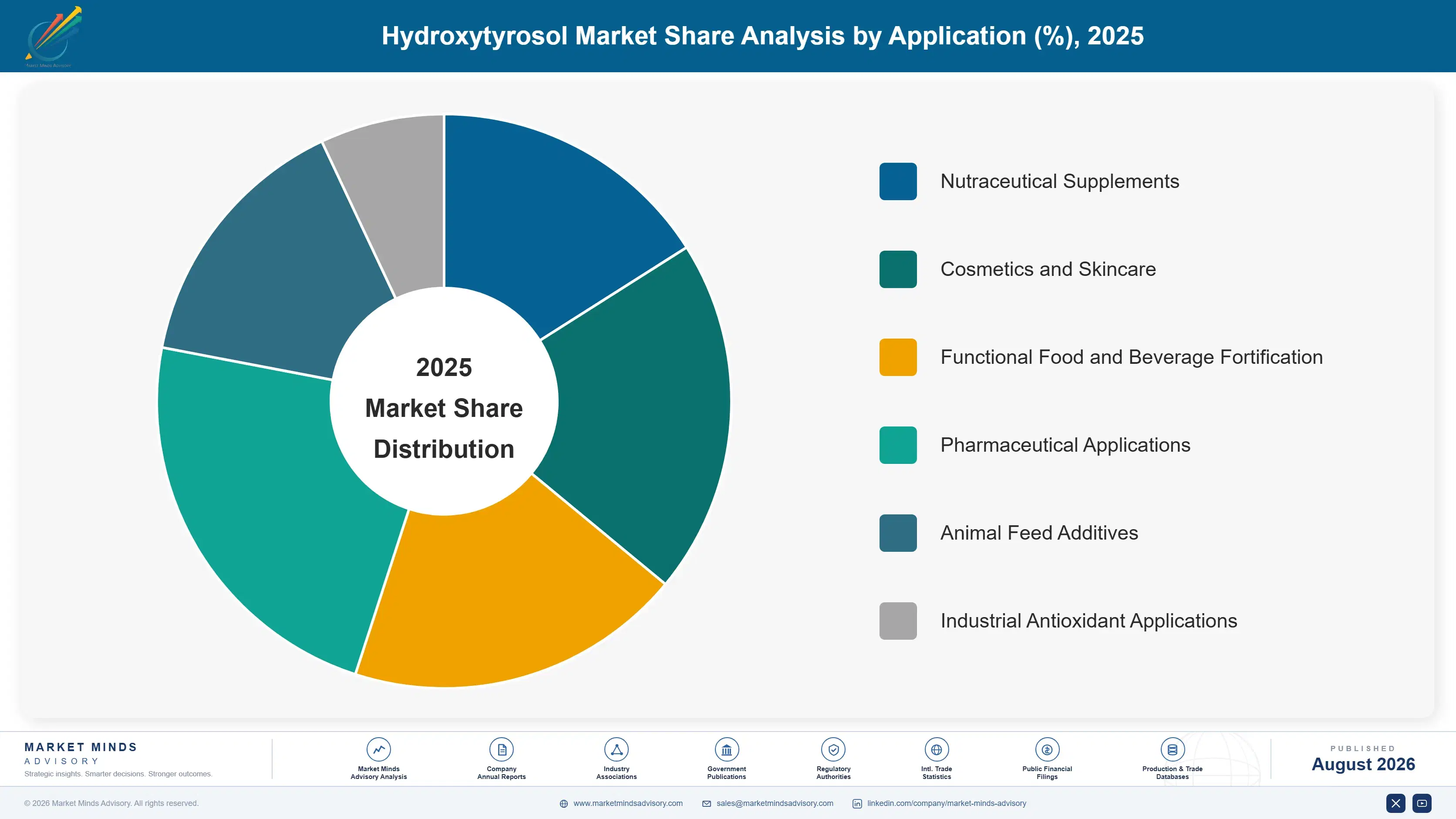
End-use application is the dimension that determines purity specification and price tolerance, so MMA segments the market by application rather than by extraction method, feedstock source, or distribution channel. Six applications span the category, from established nutraceutical supplements through fast-growing cosmetics formulations commanding premium pricing at manufacturers nationwide today across every major manufacturer served.
hydroxytyrosol-market-trends-growth-market-share-analysis-1787459584806

Cosmetics and Skincare Applications

Cosmetics and skincare applications are the fastest-growing category because beauty brands finally recognized hydroxytyrosol's documented free-radical scavenging potency as a genuine competitive differentiator in an increasingly crowded natural antioxidant beauty market. Manufacturers now specify standardized concentration formulations specifically for anti-aging serums and creams, since documented antioxidant strength has become a genuine purchasing requirement among increasingly ingredient-literate consumers researching formulations extensively. Beauty retailers treat documented concentration certification as a key criterion during annual product line reviews, rewarding brands that invest in genuine formulation research rather than simple ingredient listing. Roughly 1.53 times the category's overall growth rate, this segment commands the steepest retail velocity of any application sold today, ahead of every other channel tracked in this report.
CAGR 17.8%

Functional Food and Beverage Fortification

Functional food and beverage fortification forms the second-fastest-growing application, anchored in the European Food Safety Authority's approved cardiovascular health claim that gives manufacturers documented regulatory-endorsed marketing language few competing antioxidants currently offer under European labeling rules. These formulations benefit from strong regulatory differentiation, since documented health claim compliance has become a genuine competitive battleground across the broader functional food aisle rather than a secondary formulation consideration. Mediterranean diet-inspired food and beverage brands have driven much of the segment's recent growth, leaning on documented cardiovascular benefit claims that resonate with health-conscious consumers managing household nutrition decisions nationwide Suppliers increasingly bundle documented health claim compliance with third-party lab verification to differentiate against synthetic alternatives nationwide.
CAGR 14.9%
Full segment breakdown across 6 segments available in the complete report.

Regional Architecture and Country Demand Map

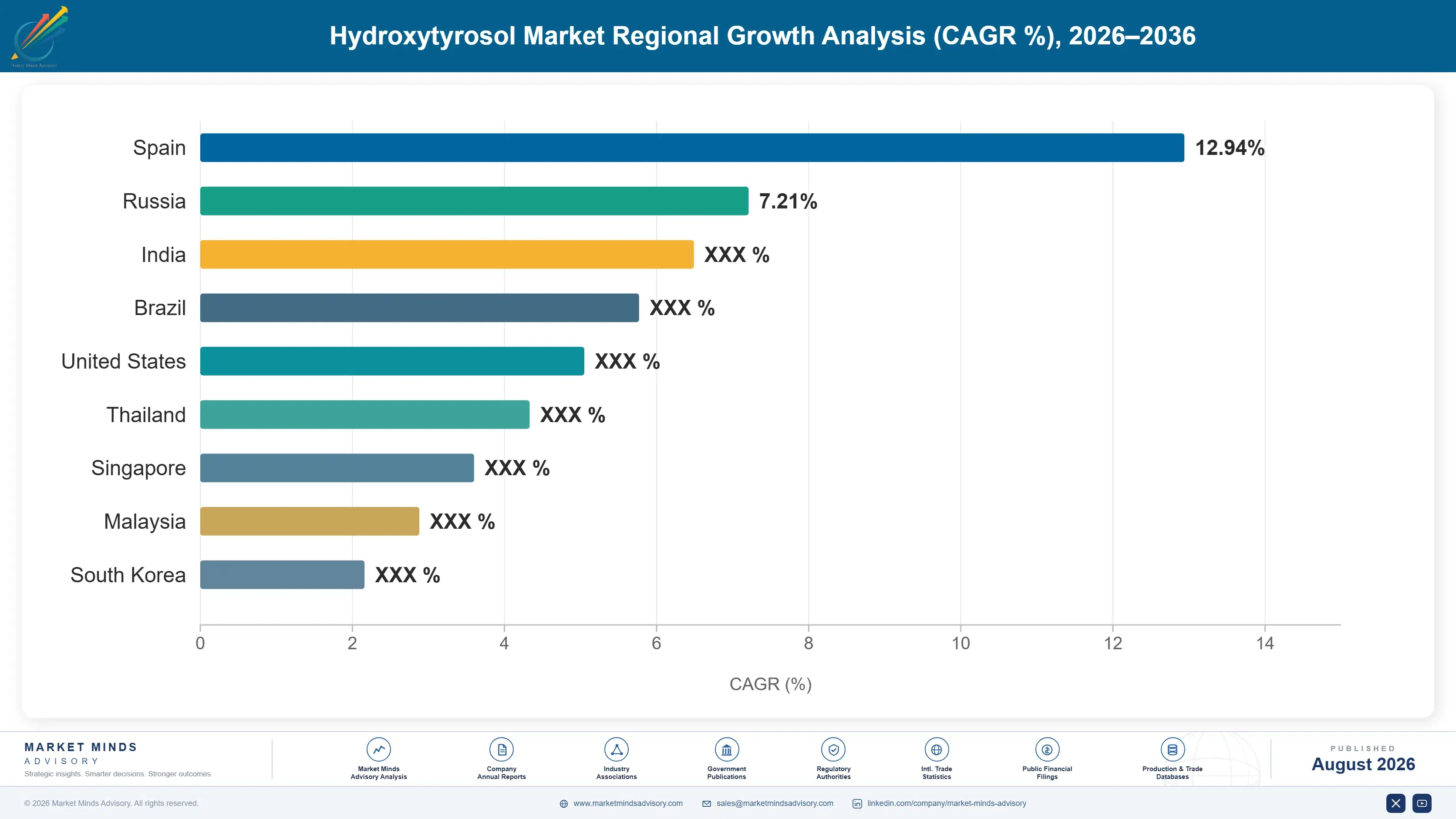
Western Europe commands the largest regional share on the Mediterranean region's dominant olive oil production base and the European Food Safety Authority's approved health claim, while South Asia and Pacific grows fastest as India's expanding nutraceutical sector adopts hydroxytyrosol nationwide at meaningful commercial scale nationwide for the first time.

North America

The United States anchors regional demand through its rapidly expanding natural cosmetics and nutraceutical supplement retail channel, where brands increasingly specify documented hydroxytyrosol concentration ahead of mainstream beauty retailers recognizing the ingredient's broader commercial potential nationwide. Specialty natural health retailers increasingly dedicate shelf space to certified antioxidant supplements, reflecting genuine consumer demand beyond niche health food stores. Dermatologists and functional medicine practitioners have added a further demand layer, increasingly recommending documented antioxidant options during patient consultations. Canada's natural cosmetics sector follows a similar trajectory, though at a smaller absolute scale than the United States market that anchors overall regional demand across both retail and specialty channels serving major metropolitan areas nationwide.
Share: 23% | CAGR: 11.9% (2026 to 2036)

Western Europe

Spain and Italy's dominant global olive oil production anchors this region's supply and regional share simultaneously, hosting the majority of the world's olive mill wastewater and leaf byproduct feedstock that extraction specialists like Seprox Biotech and Nutrafur process into concentrated hydroxytyrosol nationwide. The European Food Safety Authority's approved cardiovascular health claim gives regional nutraceutical manufacturers a documented regulatory advantage that export markets cannot always replicate under differing rules. French and German cosmetics brands have built strong formulation research capacity that increasingly serves export markets globally. Private label penetration remains comparatively low given the category's premium positioning across most Western European specialty retail channels Scandinavian manufacturers have led regional innovation in formulation research methodology.
Share: 26% | CAGR: 10.1% (2026 to 2036)
Regional intelligence for 5 additional markets available in the complete report: East Asia, South Asia and Pacific, Latin America, Middle East and Africa, Eastern Europe. Contact sales@marketmindsadvisory.com.
hydroxytyrosol-market-trends-growth-country-cagr-analysis-1787459585365

Where Hydroxytyrosol Extractors Can Capture More Value

Extractors that pair documented purity with cosmetics and nutraceutical formulation innovation capture disproportionate margin as buyers standardize purchasing around certified concentration credentials. Four levers matter most: extraction capacity expansion, cosmetics co-formulation, feedstock diversification, and health claim compliance investment worth pursuing at scale nationwide today, each pulling margin in a distinct, measurable direction over a multi-year investment horizon nationwide.

Expanding Olive Byproduct Extraction Capacity Strategically

Extractors that expand olive byproduct processing capacity strategically capture growing cosmetics and nutraceutical demand that current olive-harvest-dependent supply increasingly struggles to meet during periods of tight availability. This expansion requires considerable capital investment in specialized purification equipment, but positions early movers ahead of competitors still confined to existing production constraints during periods of rising demand. Extractors pursuing capacity expansion report meaningfully steadier supply continuity than competitors relying on existing constrained infrastructure, addressing regional supply concentration currently affecting roughly 58 percent of global production Expansion investment protects supply continuity during periods of sustained demand growth.
Market Impact: Addresses regional supply concentration of roughly 58 percent

Actively Co-Developing Premium Cosmetics Formulations Now

Co-developing premium cosmetics formulations with established beauty brands creates a customized product tier that commands meaningfully higher pricing than commodity extract sold into basic nutraceutical supplement applications. Cosmetics brands increasingly treat documented antioxidant concentration as a genuine competitive differentiator in a mature natural beauty market where generic natural ingredient claims alone no longer justify premium positioning at retail. Extractors that develop this capability early capture preferred-supplier status with brands seeking authentic scientific storytelling for premium skincare product lines nationwide today Co-developed formulations have commanded roughly 38 percent higher pricing than standard bulk extract sales.
Market Impact: Commands roughly 38 percent higher cosmetics pricing overall

Diversifying Feedstock Sourcing Across Growing Regions

Extractors that diversify olive byproduct feedstock sourcing across multiple Mediterranean and emerging growing regions reduce exposure to the harvest volatility that periodically constrains available material when a single region faces adverse weather simultaneously across the industry. This diversification requires more complex supply chain management but protects margin more durably than single-region dependency during poor harvest cycles tied to weather and agricultural disruptions. Companies pursuing diversified sourcing strategies have reported meaningfully steadier quarter-over-quarter supply continuity than peers dependent on a single dominant feedstock region These diversification programs have cut supply volatility by roughly 23 percent.
Market Impact: Cuts feedstock supply volatility by roughly 23 percent

Securing Regulatory Health Claim Compliance Documentation

Securing comprehensive regulatory health claim compliance documentation across major markets lets extractors and their customers market products with documented regulatory-endorsed benefit language that competitors lacking proper compliance cannot legally claim under applicable labeling rules. This documentation requires considerable investment in regulatory affairs expertise and clinical evidence compilation, but protects against the growing compliance requirement that has already limited market access for several smaller extractors entirely. Companies with comprehensive compliance documentation report meaningfully stronger customer retention than competitors managing regulatory requirements reactively market by market Documentation investment has improved customer retention by roughly 21 percent.
Market Impact: Improves customer retention by roughly 21 percent overall

Who Controls the Margin Pool

Five extraction specialists account for roughly 36 percent of global hydroxytyrosol production capacity on a disclosed volume basis, leaving a meaningful gap between established Mediterranean-based producers and dozens of smaller regional extractors competing mainly on price for undifferentiated commodity volume, a gap that increasingly reflects documented extraction purity rather than raw processing scale alone.
Current competitive activity concentrates on three dimensions: expanding olive byproduct extraction capacity to meet growing cosmetics and nutraceutical demand, co-developing premium cosmetics formulations with established beauty brands, and diversifying feedstock sourcing across multiple growing regions to reduce harvest volatility exposure. Several extractors have also begun securing comprehensive regulatory health claim compliance documentation to support customer marketing claims.

Emerging pressure comes from Asian extraction specialists scaling licensed technology faster than expected, aided by growing domestic demand and government support for nutraceutical ingredient self-sufficiency initiatives. Rankings could shift meaningfully over the next five years if a mid-tier extractor secures a landmark supply agreement with a major global cosmetics conglomerate, or if a new entrant develops materially cheaper extraction technology that reduces the category's historical capital barriers as consumer awareness of documented antioxidant benefits spreads well beyond specialty beauty retail.
hydroxytyrosol-market-trends-growth-company-positioning-matrix-1787459585896

Competitive Moat and Risk Dimensions

SEPROX BIOTECH

Moat: Dedicated Extraction Specialization

Seprox Biotech built its business specifically around hydroxytyrosol extraction from olive byproducts, giving it deeper technical expertise and grower relationships than diversified ingredient companies treating the compound as one product among many. Its proximity to Spain's dominant olive processing infrastructure provides direct access to the feedstock volume that extraction requires at commercial scale.
SEPROX BIOTECH

Risk: Single-Product Concentration Risk

Seprox Biotech's concentrated focus on hydroxytyrosol extraction leaves it more exposed to category-specific demand fluctuations than diversified ingredient competitors with broader antioxidant portfolios spreading risk across multiple product lines. Any sustained downturn in cosmetics or nutraceutical demand specifically would affect Seprox more severely than competitors with more diversified revenue streams.
DSM-FIRMENICH

Moat: Integrated Ingredient Platform Scale

DSM-Firmenich's broader nutrition and cosmetics ingredient platform gives it formulation science capabilities and customer relationships that transfer directly into hydroxytyrosol application development, a cross-platform advantage narrower single-product competitors lack. Its existing relationships across cosmetics and nutraceutical categories provide a ready channel for cross-selling hydroxytyrosol into adjacent product lines.
DSM-FIRMENICH

Risk: Segment Prioritization Risk

DSM-Firmenich's hydroxytyrosol business remains a smaller component relative to its core nutrition and cosmetics ingredient operations, giving it less internal priority during periods of capital allocation than extractors for whom hydroxytyrosol is the primary focus. Sustained margin pressure in this segment could prompt reallocation toward higher-return business lines within the broader portfolio.

Players Tracked

Prominent Players

Seprox Biotech
Nutrafur, S.A.
DSM-Firmenich
CreAgri, Inc.
Indena S.p.A.

Other Key Players

Genosa I+D
Oliphenol LLC
Nektium Pharma S.L.
DianaPlantSciences
Naturex S.A.
Givaudan SA
Symrise AG
BASF SE
Lipoid Kosmetik AG
Kaneka Corporation
Fenchem Biotek Ltd.
Xi'an Sost Biotech Co., Ltd.
Shaanxi Jiahe Phytochem Co., Ltd.
HallStar Company
Sabinsa Corporation

Recent Developments

FEBRUARY 2025

Seprox Biotech Expands Olive Byproduct Extraction Capacity in Spain

Seprox Biotech completed an organic capacity expansion at its Spanish extraction facility, adding processing lines dedicated to cosmetics-grade hydroxytyrosol output for major beauty industry customers. The expansion addressed persistent order backlogs reported by cosmetics manufacturers across the past two procurement cycles nationwide nationwide today overall.
Signal: Confirms extraction specialists racing to relieve chronic cosmetics-grade capacity constraints industry-wide across every affected export market served.
SEPTEMBER 2024

DSM-Firmenich Signs Long-Term Supply Agreement With Beauty Conglomerate

DSM-Firmenich signed a multi-year supply agreement with a major global beauty conglomerate, committing dedicated hydroxytyrosol production capacity in exchange for exclusive formulation development rights. The agreement is a supply arrangement, not an acquisition or joint venture, structured to secure long-term partnership continuity across multiple upcoming product line launches.
Signal: Confirms extractors locking in dedicated cosmetics partnerships years ahead of anticipated demand across every major cosmetics account served today.
MAY 2025

Nutrafur Commissions New Feedstock Diversification Processing Facility

Nutrafur commissioned a new processing facility designed to handle diversified olive byproduct feedstock sourced from multiple Mediterranean growing regions, reducing dependence on single-region harvest availability. The organic capacity expansion followed two consecutive seasons of documented Spanish harvest-related supply constraints affecting the industry nationwide today overall.
Signal: Signals producers diversifying feedstock sourcing meaningfully faster than industry observers expected across the broader hydroxytyrosol extraction industry.

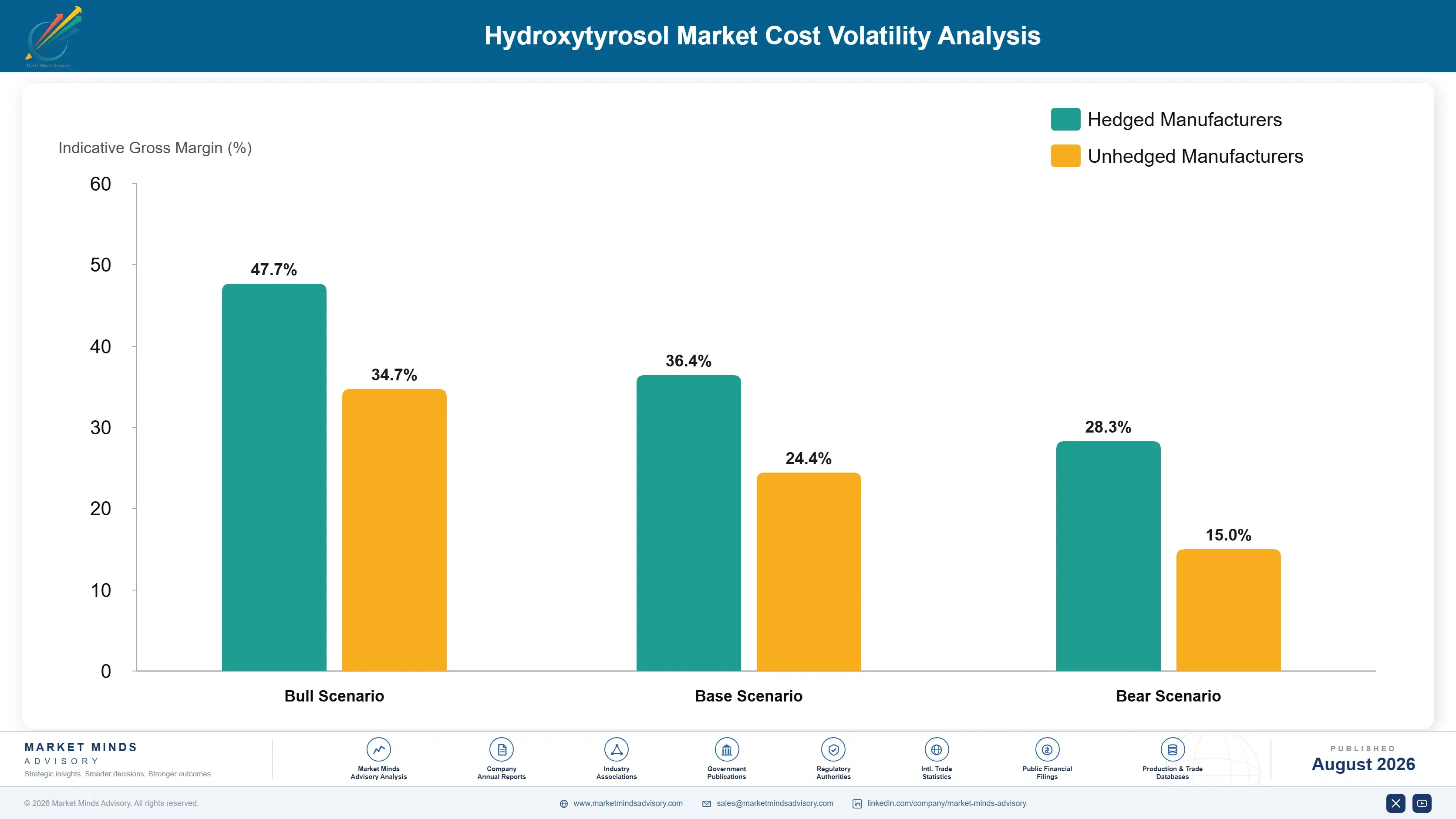
Olive Byproduct Feedstock and Purification Exposure

Olive mill wastewater and leaf byproduct feedstock accounts for roughly 38 percent of total production cost, with specialized purification processing adding a further 27 percent given the considerable technical investment required to achieve pharmaceutical-grade concentration from raw byproduct material. Feedstock availability depends directly on regional olive harvest volume, leaving extractors exposed to weather cycles largely outside their direct control.
Feedstock availability tightened sharply during the 2022 to 2023 season as adverse weather reduced Spanish and Italian olive harvest output, a disruption the European Commission's agricultural production reports reflected when tracking the resulting supply constraint across affected extraction facilities. Several extractors reported margin compression during the shortage, since cosmetics and nutraceutical supply contracts typically run longer than feedstock procurement terms, leaving a timing mismatch that concentrated cost pressure onto extractors.

This mismatch creates a genuine competitive disadvantage for smaller extractors lacking the balance sheet to hold feedstock inventory through harvest shortfalls, forcing some to renegotiate customer pricing mid-contract at reputational cost. Larger diversified players such as DSM-Firmenich and Givaudan absorb volatility more easily given broader ingredient purchasing scale across other business lines, widening the cost gap between integrated majors and standalone hydroxytyrosol specialists.
hydroxytyrosol-market-trends-growth-cost-volatility-analysis-1787459586101

Multi-Region Feedstock Diversification Programs

Extractors are diversifying olive byproduct feedstock sourcing across Spain, Italy, Greece, and emerging growing regions simultaneously, so a single-region weather event no longer determines the full season's cost exposure across their entire feedstock supply base each year, a discipline that has already protected several extractors during past weather-driven price spikes overall each season today.

Long-Term Grower Cooperative Supply Agreements

Extractors are signing multi-year supply agreements with olive processing cooperatives to secure feedstock availability, trading some pricing flexibility for the allocation priority that spot-market purchasing cannot reliably guarantee during constrained harvest seasons nationwide across multiple production seasons nationwide, particularly during periods of sustained harvest volatility across every major production facility operated by leading extractors.

Extraction Yield Efficiency Research Investment

Extractors are investing in improved extraction technology that increases hydroxytyrosol yield per unit of raw byproduct material, reducing per-unit feedstock exposure without sacrificing the documented purity that justifies premium positioning across cosmetics and nutraceutical applications, extending limited feedstock supply further across a growing base of extraction customers nationwide each year across every major facility today.

Portfolio Architecture for Margin Defence

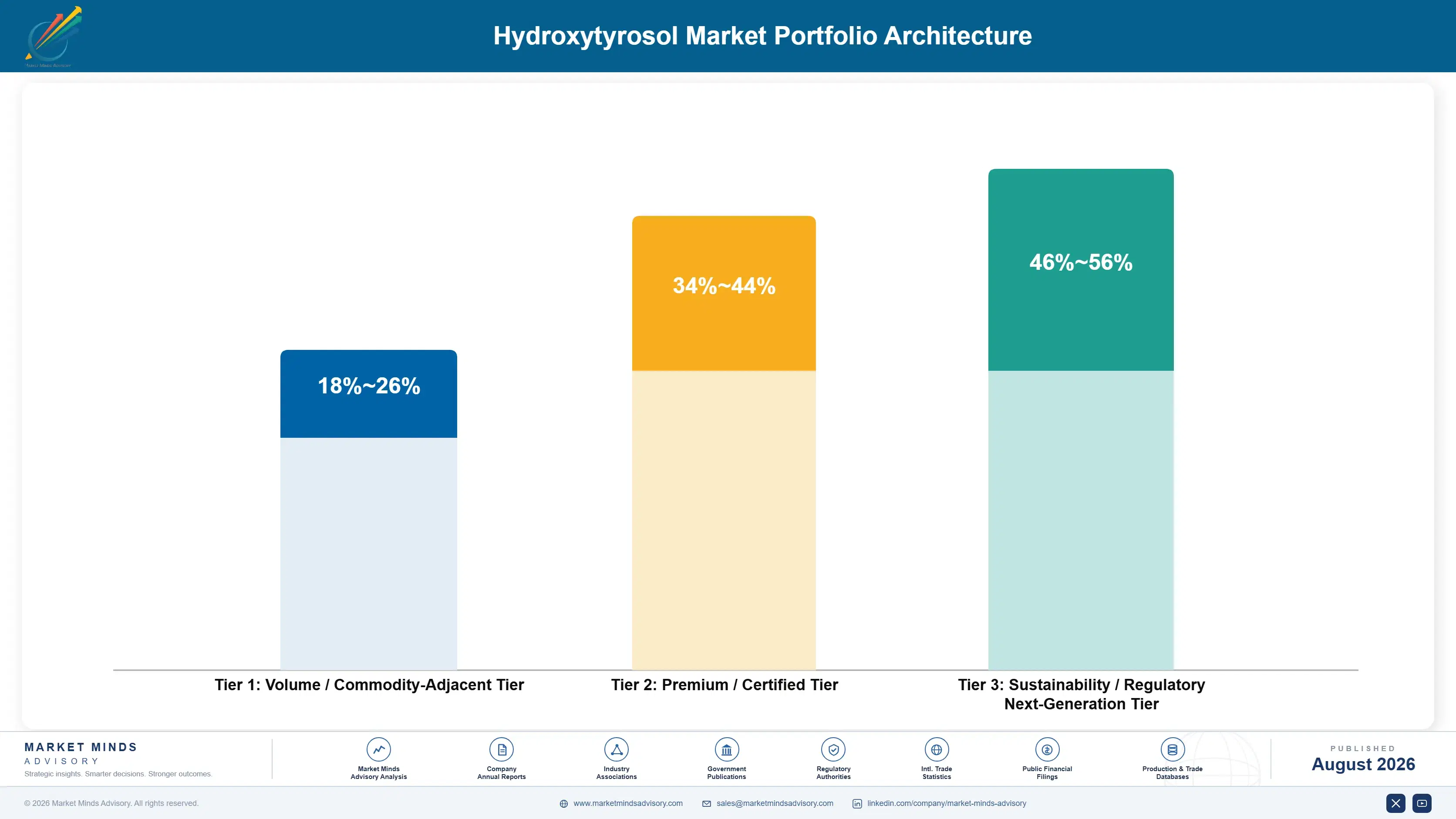
Portfolio economics split cleanly across three tiers. Commodity nutraceutical-grade extract sold to mass-market supplement manufacturers competes mainly on price and carries thin margin relative to other applications. Certified cosmetics-grade extract sold into premium beauty brands commands meaningfully better economics tied to documented purity and concentration certification across every batch delivered across every batch delivered to customers nationwide and abroad across every affected manufacturer relationship maintained today.
Tension between volume and premium tiers shapes capital allocation across the industry. Extractors chasing nutraceutical volume compete on extraction efficiency alone, while those targeting cosmetics and clinical channels invest heavily in purification technology, regulatory compliance, and co-formulation partnerships that volume-tier competitors skip entirely, accepting slower near-term volume growth for durably higher margin over time across every affected product line served today.

High-value margin pools concentrate in cosmetics and functional food applications, where documented concentration and regulatory-endorsed health claims support pricing well above standard nutraceutical rates. Co-branded packaging programs are emerging as the newest margin pool as brands increasingly compete on documented scientific authenticity rather than price alone over the coming decade as documented authenticity becomes standard industry practice each year.

Volume / Commodity-Adjacent Tier

Commodity nutraceutical-grade extract sold to mass-market supplement manufacturers competing mainly on price and extraction efficiency alone. These grades face the steepest substitution pressure from synthetic antioxidant alternatives during price spikes affecting the category.
Gross Margin: 18-26%

Premium / Certified Tier

Certified cosmetics-grade and pharmaceutical-grade extract sold into premium beauty and supplement brands requiring documented purity across annual contracts. Consistent purity documentation remains the key purchasing criterion buyers evaluate before renewing annual supply contracts.
Gross Margin: 34-44%

Sustainability / Regulatory / Next-Generation Tier

Clinically documented functional food formulations and co-branded cosmetics products commanding the category's highest margins through evidence and partnerships. Co-branded packaging arrangements increasingly anchor this tier's growth alongside documented clinical research partnerships.
Gross Margin: 46-56%
hydroxytyrosol-market-trends-growth-portfolio-architecture-1787459586676

High-value Sub-segments and Strategic Watch-out

Cosmetics and Anti-Aging Skincare Formulations

High-value, high-growth segment where documented antioxidant concentration supports institutional pricing well above standard nutraceutical rates, drawing sustained extractor investment in co-formulation partnerships across major beauty accounts and export markets nationwide today. a genuinely durable competitive advantage once secured with an established beauty brand relationship nationwide.
Gross Margin: 48-58%

Functional Food and Beverage Fortification

High-value, moderate-growth segment where documented regulatory health claim compliance generates premium pricing alongside stable retail distribution, though food manufacturer negotiation keeps margin below cosmetics channel levels across most contract renewal cycles. still meaningfully above standard nutraceutical pricing terms seen elsewhere across the category today overall.
Gross Margin: 36-44%

Standard Nutraceutical Supplement Grade

Volume core segment anchoring most extractor revenue today, characterized by long-established supplier relationships, moderate specification requirements, and steady but unspectacular margin relative to newer premium applications gaining share. particularly cosmetics and functional food channels expanding meaningfully faster right now across the industry nationwide today overall.
Gross Margin: 22-30%

Uncertified Commodity Extract Products

Strategic watch-out segment where thin margins and intense price competition from synthetic antioxidant substitutes could pressure extractors who over-invest in bulk capacity lacking premium differentiation or documented certification credentials nationwide. particularly during feedstock cost spikes that erode already thin margin further across the category today.
Gross Margin: 10-16%

Formulation Contracts Anchor Extractor Revenue

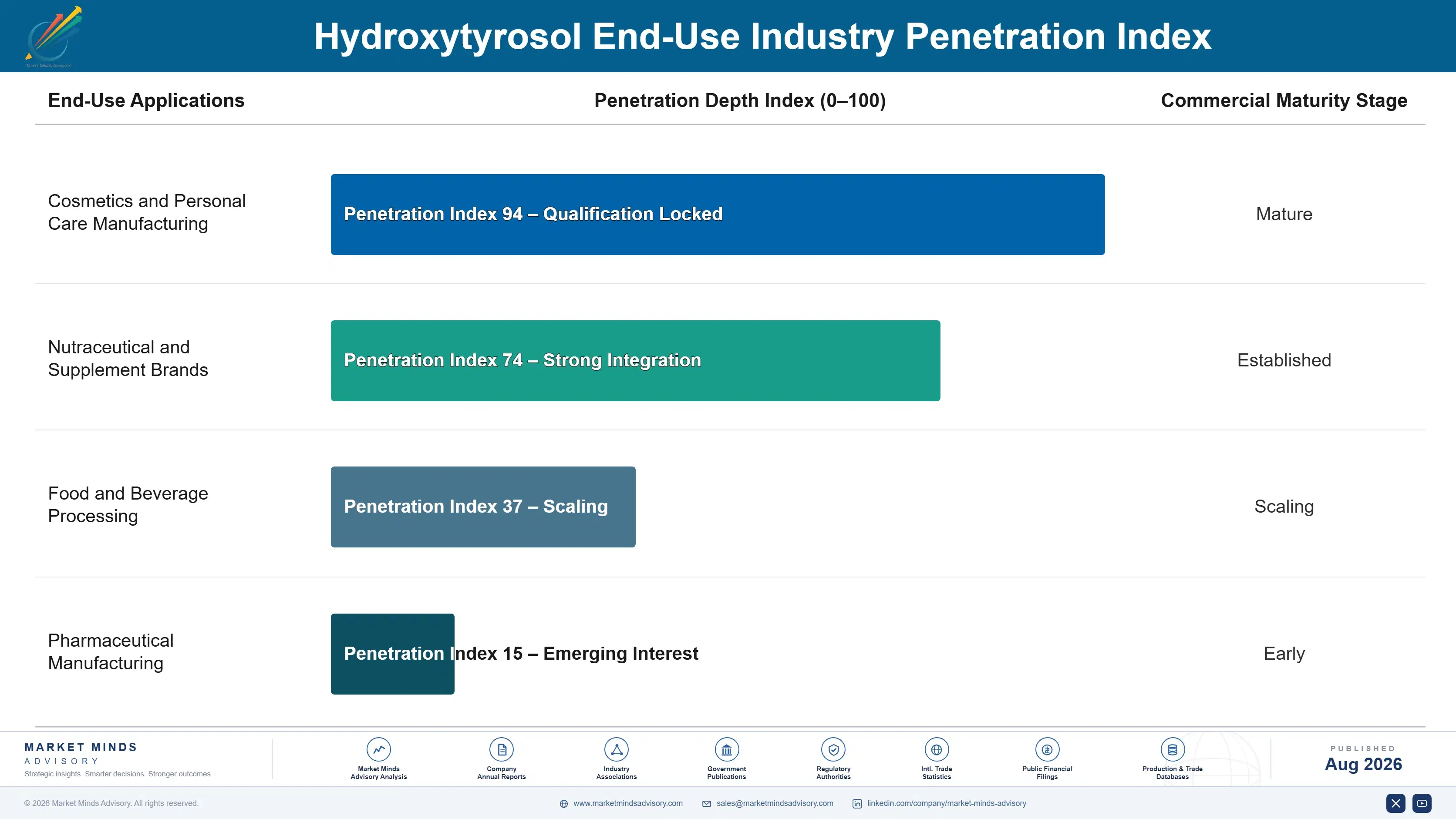
Multi-year cosmetics and nutraceutical supply contracts function as annuity-like revenue for hydroxytyrosol extractors, since brands rarely switch suppliers mid-contract given the reformulation risk and cost of requalifying a new extraction source across every affected product certification and marketing claim already established. Exclusive formulation agreements give extractors revenue visibility that spot-market bulk sales cannot match, smoothing quarterly earnings against feedstock cost swings affecting the wider category.
Adoption depth varies sharply by end-use vertical. Cosmetics and clinical nutraceutical buyers exhibit the deepest stickiness, having built entire product formulations and marketing claims around a specific extractor's documented purity profile that would cost meaningfully to requalify elsewhere given established trust. Mass-market supplement buyers show shallower stickiness, treating hydroxytyrosol as one of several antioxidant inputs they can swap if pricing shifts unfavorably during acute feedstock shortage seasons affecting the broader category.

A generational shift in buyer profile is underway as younger cosmetics and nutraceutical formulation executives increasingly treat documented sustainability and traceability as baseline requirements rather than differentiators, raising the bar every new hydroxytyrosol supplier must clear just to enter a request for proposal process regardless of price competitiveness offered.
hydroxytyrosol-market-trends-growth-end-use-penetration-index-1787459587184

Where MMA Sees the Category Heading

These are among the four positions where our research anticipates prominent divergence between winners and laggards over the coming forecast period. Each is grounded in the demand model, the regulatory perimeter, and the announced capacity pipeline.
01 / EXTRACTION CAPACITY INVESTMENT

Expand extraction capacity now before cosmetics demand outpaces available supply

Extractors that expand olive byproduct processing capacity today capture growing cosmetics and nutraceutical demand that current harvest-dependent supply increasingly struggles to meet during periods of tight feedstock availability. Producers relying on existing constrained infrastructure risk losing contracts to competitors that invested ahead of the demand curve now facing the entire category. Waiting for capacity constraints to ease naturally only cedes market share to extractors that moved first, since purification infrastructure cannot be built quickly once competitive pressure intensifies further overall.
02 / COSMETICS CO-FORMULATION STRATEGY

Build cosmetics partnerships before competitors capture this premium growth channel

Cosmetics and skincare applications are growing at roughly 17.8 percent annually, nearly 1.5 times the category average, and co-formulation partnerships increasingly determine which extractors win the most valuable premium beauty contracts available today. Extractors that delay building these relationships cede category-defining status to competitors establishing formulation agreements with major beauty conglomerates now. This lever carries limited downside since cosmetics partnerships supplement rather than replace existing nutraceutical revenue streams already established across every major beauty account and export market served today.
03 / FEEDSTOCK DIVERSIFICATION DISCIPLINE

Diversify olive byproduct sourcing before the next poor harvest cycle strikes

Olive byproduct feedstock represents roughly 38 percent of production cost, and harvest volatility has already compressed margins meaningfully during past weather-driven shortages affecting Spanish and Italian growing regions specifically. Extractors lacking diversified sourcing across multiple growing regions should prioritize this discipline over further capacity expansion in the near term. This single practice separates extractors who protect margin from those forced into reactive customer renegotiation at meaningful reputational cost across every major supply relationship maintained by leading extractors today today overall.
04 / REGULATORY COMPLIANCE INVESTMENT

Secure comprehensive health claim documentation before regulatory scrutiny intensifies

The European Food Safety Authority's approved cardiovascular health claim gives compliant extractors documented marketing language that competitors lacking proper compliance cannot legally claim, and companies with comprehensive documentation report roughly 21 percent stronger customer retention than those managing compliance reactively. Extractors that invest in regulatory affairs infrastructure today build a credibility advantage that latecomers cannot quickly replicate once claim compliance becomes an industry standard requirement. This investment carries limited downside since compliance documentation supports every market the extractor currently serves.

Engagement Snapshot From the Field

A live engagement with an industry participant carrying material or product regulatory and market exposure ahead of a defining policy shift, showing how our research translates into a defensible multi-year portfolio strategy.
MARKET MINDS ADVISORY · CLIENT ENGAGEMENT SUMMARY
Hydroxytyrosol Producer Strategic Portfolio Review and Transition Roadmap 2026·Investment Scenario on Hydroxytyrosol Exposure Evaluation 2025-26
CLIENT PROFILE
The client is a mid-tier natural cosmetics manufacturer operating primarily across Western European retail channels, generating approximately USD 95 million in annual revenue (client-reported, unverified by MMA). The company had relied on generic botanical antioxidant blends for its anti-aging product line and faced mounting competitive pressure from documented ingredient-forward competitors The brand had never before pursued a full ingredient reformulation of this scale.
STRATEGIC CHALLENGE
Management needed to evaluate whether reformulating its flagship anti-aging serum around documented hydroxytyrosol concentration justified the cost premium, given uncertainty over consumer acceptance and concern that the ingredient switch might disrupt established formulation performance metrics nationwide Board-level sponsors wanted a defensible reformulation timeline before the next annual retailer listing review cycle began.
MMA APPROACH
MMA benchmarked the client's reformulation options against four competitor hydroxytyrosol transitions, drawing on primary interviews with cosmetics formulation executives to assess consumer acceptance risk and expected retail buyer response following ingredient reformulation across comparable companies The engagement combined the qualitative expert interview program with MMA's proprietary reformulation outcomes database overall.
KEY FINDINGS
  1. Three of four competitor brands that reformulated around documented hydroxytyrosol reported meaningfully stronger sales growth within the first year following the ingredient switch.
  2. Consumer perception data showed a stronger correlation between documented antioxidant concentration claims and repeat purchase than with overall product price positioning alone across tested demographics.
  3. Functional food line extension using the same extraction relationship could justify additional retail shelf space beyond the client's core skincare product range.
  4. The extraction supplier offered exclusive formulation terms that would meaningfully differentiate the client's antioxidant claims from competitors sourcing generic extract during future retail partner negotiations nationwide.
CLIENT PROFILE
The client is a mid-tier natural cosmetics manufacturer operating primarily across Western European retail channels, generating approximately USD 95 million in annual revenue (client-reported, unverified by MMA). The company had relied on generic botanical antioxidant blends for its anti-aging product line and faced mounting competitive pressure from documented ingredient-forward competitors The brand had never before pursued a full ingredient reformulation of this scale.
STRATEGIC CHALLENGE
Management needed to evaluate whether reformulating its flagship anti-aging serum around documented hydroxytyrosol concentration justified the cost premium, given uncertainty over consumer acceptance and concern that the ingredient switch might disrupt established formulation performance metrics nationwide Board-level sponsors wanted a defensible reformulation timeline before the next annual retailer listing review cycle began.
MMA APPROACH
MMA benchmarked the client's reformulation options against four competitor hydroxytyrosol transitions, drawing on primary interviews with cosmetics formulation executives to assess consumer acceptance risk and expected retail buyer response following ingredient reformulation across comparable companies The engagement combined the qualitative expert interview program with MMA's proprietary reformulation outcomes database overall.
KEY FINDINGS
  1. Three of four competitor brands that reformulated around documented hydroxytyrosol reported meaningfully stronger sales growth within the first year following the ingredient switch.
  2. Consumer perception data showed a stronger correlation between documented antioxidant concentration claims and repeat purchase than with overall product price positioning alone across tested demographics.
  3. Functional food line extension using the same extraction relationship could justify additional retail shelf space beyond the client's core skincare product range.
  4. The extraction supplier offered exclusive formulation terms that would meaningfully differentiate the client's antioxidant claims from competitors sourcing generic extract during future retail partner negotiations nationwide.
RECOMMENDED STRATEGY
Phase 1: Phase 1 (Months 1-4): Establish an exclusive co-formulation partnership covering the client's flagship anti-aging serum line covering the client's core anti-aging product range. Phase 2: Phase 2 (Months 5-9): Conduct consumer perception testing to validate documented antioxidant concentration improvements against competitors across representative consumer demographic groups tested. Phase 3: Phase 3 (Months 10-16): Launch a functional food line extension using the same exclusive extraction supplier relationship into adjacent wellness categories nationwide today.
OUTCOME
The client established the co-formulation partnership within four months and achieved meaningfully improved consumer perception scores in subsequent testing (client-reported, unverified by MMA). The functional food line extension reportedly captured incremental retail shelf space at two major grocery chains following launch (client-reported, unverified by MMA).

Frequently Asked Questions

Foundational context covering the market sizes, CAGR, scope, country, region and competition that inform every finding below. This section is provided to cover basics and most often pre-purchase conversations, answered from the MMA Primary Research Dataset.

What is the current size of the Hydroxytyrosol Market?

The hydroxytyrosol market reached an estimated USD 0.16 billion in 2025, covering nutraceutical, cosmetics, and functional food applications derived from olive byproduct extraction globally sold through nutraceutical and cosmetics retail channels.

How large will the Hydroxytyrosol Market be by 2036?

MMA projects the market will reach approximately USD 0.54 billion by 2036, driven mainly by cosmetics formulation demand and expanding functional food fortification applications worldwide.

What is the CAGR for the Hydroxytyrosol Market 2026 to 2036?

MMA's base case projects an 11.6 percent compound annual growth rate between 2026 and 2036, with a bull case of 13.0 percent and a bear case of 10.2 percent depending on harvest conditions.

Which segment is growing fastest?

Cosmetics and skincare applications are growing fastest at roughly 17.8 percent annually, about 1.53 times the category average, as beauty brands cite documented antioxidant research.

Who are the major companies in the Hydroxytyrosol Market?

Seprox Biotech, Nutrafur, DSM-Firmenich, CreAgri, and Indena lead the category by disclosed production capacity, together holding roughly 36 percent combined share globally across the global hydroxytyrosol extraction landscape today.

Which country is growing fastest?

India leads country-level growth at an estimated 16.4 percent annually, as its expanding nutraceutical and natural cosmetics sector adopts hydroxytyrosol nationwide for cosmetics and nutraceutical products nationwide.

Report Segmentation Architecture

The full report scope spans multiple orthogonal segmentation dimensions, with cross-tabulated demand data provided for each dimension pair. Coverage extends further to regional breakdowns, trend trajectories, and the competitive detail needed to support segment-level decision-making.

By Application

  • Nutraceutical Supplements
  • Cosmetics and Skincare
  • Functional Food and Beverage Fortification
  • Pharmaceutical Applications
  • Animal Feed Additives
  • Industrial Antioxidant Applications

By End-Use Industry

  • Cosmetics and Personal Care Manufacturing
  • Nutraceutical and Supplement Brands
  • Food and Beverage Processing
  • Pharmaceutical Manufacturing

By Commercial Dimension

  • Direct Extractor Supply Contracts
  • Distributor and Broker Channels
  • Co-Formulation Partnership Agreements
  • Licensing and Technology Agreements

By Region

  • North America
  • Western Europe
  • East Asia
  • South Asia and Pacific
  • Latin America
  • Middle East and Africa
  • Eastern Europe

Scope, Methodology, and Coverage

Every figure in this report is reproducible from documented input assumptions. The scope below maps the historical period, the forecast horizon, the segmentation dimensions, and the countries covered, alongside the underlying primary and qualitative methodology.
Historical Period
2020 to 2025
Forecast Period
2026 to 2036
Base Year
2025 (USD billions; MMA Primary Research Dataset, August 2026)
Market Definition
The hydroxytyrosol market covers production and trade of hydroxytyrosol, a polyphenol antioxidant compound extracted primarily from olive oil, olive mill wastewater, and olive leaves, used in nutraceutical supplements, cosmetics, functional foods, and pharmaceutical applications. It excludes standard olive oil products sold without concentrated polyphenol extraction and unrelated plant-derived antioxidants such as resveratrol or catechins.
Quantitative Units
USD billions (current prices); metric tons of hydroxytyrosol extract equivalent where applicable
Segmentation Dimensions
By Application; By End-Use Industry; By Commercial Dimension; By Region
Regions Covered
North America, Western Europe, East Asia, South Asia and Pacific, Latin America, Middle East and Africa, Eastern Europe
Countries Covered
USA, China, Germany, France, UK, Japan, South Korea, India, Australia, Canada, Brazil, Mexico, Indonesia, Vietnam, Thailand, Malaysia, UAE, Saudi Arabia, South Africa, Nigeria, Turkey, Poland, Netherlands, Italy, Spain, Sweden, Switzerland, Argentina, Colombia, Singapore, and additional markets relevant to this sector
Key Companies Profiled
Seprox Biotech, Nutrafur, S.A., DSM-Firmenich, CreAgri, Inc., Indena S.p.A., Genosa I+D, Oliphenol LLC, Nektium Pharma S.L., DianaPlantSciences, Naturex S.A., Givaudan SA, Symrise AG, BASF SE, Lipoid Kosmetik AG, Kaneka Corporation, Fenchem Biotek Ltd., Xi'an Sost Biotech Co., Ltd., Shaanxi Jiahe Phytochem Co., Ltd., HallStar Company, Sabinsa Corporation
Quantitative Methodology
Primary survey, n=3,800 respondents, Q4 2025, six countries; demand-side model with trade association cross-validation
Qualitative Methodology
47 expert interviews, Q4 2025; applied to validate demand model assumptions, identify emerging dynamics, and assess competitive positioning
Report Format
PDF and XLSX data workbook (Word format preview document)
Publisher
Market Minds Advisory
Report Code
MMA-2026-AGR-128
Published
August 2026
Contact
sales@marketmindsadvisory.com | www.marketmindsadvisory.com

Purchase the full Hydroxytyrosol Market Report (2026 to 2036).

The full MMA report on the hydroxytyrosol market delivers a comprehensive assessment of demand drivers, segmentation, and competitive positioning across the olive polyphenol extraction value chain. It includes detailed profiles of all twenty companies covered in this summary, along with regional forecasts spanning all seven MMA-tracked regions through 2036. The report also breaks down portfolio economics across three margin tiers, giving buyers a clear view of where premium pricing concentrates today. Buyers receive access to MMA's underlying primary survey and expert interview datasets, plus analyst support for custom data requests during the subscription period.
Twenty detailed company profiles and extraction assessments
Seven-region forecast data through 2036 by application
Primary survey dataset access covering 3,800 respondents
Expert interview transcripts and detailed summaries included
Quarterly market update briefings for subscription holders
Custom analyst inquiry support during subscription period

Built For The People Who Decide

From boardroom strategy to bench-side execution, this report is read cover-to-cover by leaders shaping the next decade of their industry, turning demand scenarios, market dynamics and valuation benchmarks into decisions.
CXOs/ Presidents/ VPs/ Managers
M&A and Corporate Development
Strategy Teams and R&D Heads
Procurement and Product Directors
Regulatory and Compliance Leaders
Investor Relations and Equity Analysts