Market Minds Advisory
Hydroxypropyl Distarch Phosphate Market

Hydroxypropyl Distarch Phosphate Market: Texture Stability and the Clean-Label Reformulation Pressure

Frozen food, dairy, and infant formula manufacturers keep specifying hydroxypropyl distarch phosphate for freeze-thaw and shear stability, even as clean-label reformulation pressure and corn price swings push processors toward native starch substitutes.

Lead Analyst

Bilal Shaikh

Published

September 2026

Make Smarter Decisions with Customized Research Insights

Request a free sample report and evaluate market opportunities, growth trends, and competitive dynamics relevant to your business needs.

2025 MARKET VALUE$1.8BMarket Size 2025
2036 FORECAST VALUE$3.6BBase Case , 2026 to 2036
CAGR 2026 TO 20366.6 %Bull 7.9% / Bear 5.3%
INCREMENTAL OPPORTUNITY$1.7BNet 10- year value creation
EXPANSION MULTIPLE1.90x2036 value over 2026 base
Strategic Levers
M&A Pipeline
Regional Outlook
Country Rankings
Competitive Intelligence
Segmental Deep-dive
Call-Us : 91 93563 13602

Executive Snapshot and Market Trajectory

Food processors keep specifying hydroxypropyl distarch phosphate in frozen, dairy, and retort applications for its freeze-thaw and shear stability, even where clean-label pressure pushes formulators toward native starch substitutes that cost meaningfully less per tonne. a trade-off many manufacturers accept only after a failed reformulation attempt.
Frozen ready meals and dairy dessert reformulation are driving the fastest-growing demand pool, while tapioca-based grades grow fastest at roughly nine percent annually as manufacturers value their neutral flavour and freeze-thaw performance over corn-based alternatives. East Asia holds the largest share of global demand on its processed food manufacturing base, and Thailand now posts the fastest national growth of any country tracked in this report. a pattern showing no sign of reversing across the forecast.
Competitive intensity centers on feedstock integration and regulatory compliance depth rather than raw commodity supply, since major food manufacturers require lengthy formulation approval cycles that lock in incumbents for years. Tightening clean-label labelling pressure across the European Union and North America is accelerating demand for lower-dose, higher-functionality grades, and several producers are now qualifying enzymatically modified alternatives to reduce exposure to E-number labelling backlash.
Market Definition
The hydroxypropyl distarch phosphate market covers the chemically modified starch ingredient produced by hydroxypropylation and phosphate cross-linking of corn, tapioca, potato, wheat, waxy maize, or rice starch, used as a thickener, stabiliser, and texturiser in food and select pharmaceutical applications. It includes production and technical formulation support sold together. Native and unmodified starches, and modified starches used solely in paper or textile applications, are excluded.
Base Year Value
$1.8B in 2025 (MMA Primary Research Dataset, August 2026)
Forecast Period
2026 to 2036, eleven discrete annual values
CAGR
6.6% base case. Bull 7.9%. Bear 5.3%.
Fastest Growth Segment
Tapioca-Based Hydroxypropyl Distarch Phosphate: 8.9% CAGR
Fastest Growth Country
Thailand: 10.2% CAGR
Fastest Growth Region
South Asia and Pacific: 8.7% CAGR
Largest Region
East Asia: 27% of 2025 global value
Market Leaders
Ingredion Incorporated, Cargill Incorporated, Archer-Daniels-Midland Company, Tate & Lyle PLC, Roquette Frères. Source: MMA Analysis based on company annual reports.
Primary Survey
n=3,800 procurement and R&D decision-makers, Q4 2025, six countries
Methodology
Demand-side build-up, cross-validated against public data, 47 expert interviews

Hydroxypropyl Distarch Phosphate Market Forecast Scenarios

hydroxypropyl-distarch-phosphate-market-size-forecast-scenario-1787553852849
Hydroxypropyl distarch phosphate demand grew at a 5.9% historical rate between 2020 and 2025, held back early by pandemic-driven foodservice closures and later by a wave of clean-label reformulation that shifted some volume toward native starch. Recovery accelerated from 2022 as frozen food demand surged and dairy dessert manufacturers returned to modified starch for the freeze-thaw stability native alternatives could not reliably match.
Three mechanisms carry the base case to 6.6%. First, frozen ready meal and dairy dessert manufacturing keeps generating specification volume independent of broader processed food growth cycles. Second, infant formula and clinical nutrition manufacturers are expanding use of pharmaceutical-grade modified starch for its documented viscosity stability across a product's shelf life. Third, clean-label reformulation pressure is pushing some manufacturers toward native starch substitutes even where the switch degrades freeze-thaw and shear performance meaningfully.
The bull case at 7.9% assumes frozen food and dairy dessert demand accelerates faster than currently scheduled and clean-label reformulation pressure eases as regulatory clarity improves. The bear case at 5.3% assumes clean-label substitution accelerates faster than expected across North America and Western Europe, stretching specification volume and pushing some manufacturers toward native starch blends earlier in the forecast period.

Formulation Stability Economics and Reformulation Risk

Three forces converge on the hydroxypropyl distarch phosphate market. Frozen and dairy dessert manufacturers need freeze-thaw and shear stability that native starch cannot reliably deliver, infant formula and clinical nutrition manufacturers need first-fit specification for documented viscosity stability, and clean-label labelling pressure is pushing some formulators toward substitutes that cost less but perform less reliably across a product's shelf life. Buyers increasingly treat starch selection as a formulation risk decision rather than a routine ingredient purchase.
MARKET CONCENTRATIONCR5 48%Moderately concentrated field led by global grain processors
NATIVE STARCH PRICE PREMIUM1.8x to 2.6xModification cost and functionality justify a durable premium
TOP PRODUCING COUNTRY SHAREUSA 19%Domestic corn wet milling capacity anchors national output
CAPACITY UTILISATION74%Producers run below ceiling outside peak processing seasons
FEEDSTOCK SHARE OF COGS40% to 50%Raw starch and modification reagents dominate finished cost
TYPICAL FORMULATION APPROVAL CYCLE9 to 18 monthsApproval timelines vary sharply by manufacturer and application
Commercially, the market behaves like a specialty ingredient qualification business rather than a commodity feedstock trade. Buyers select on freeze-thaw performance, shear stability, and regulatory labelling compatibility more than on unit price, and switching a qualified starch grade in an established formulation is rare once a manufacturer has validated performance against its own shelf-life testing protocol.
Over the next decade the defining forces are clean-label reformulation pressure, corn and tapioca feedstock cost exposure, and the pace at which tapioca-based grades gain share over corn-based alternatives in applications where flavour neutrality matters most. Producers that solve both the labelling and the feedstock cost problem simultaneously will set the pace of the market's next decade.
"Clean label sounds like a threat until you realise most reformulation projects fail their own freeze-thaw testing and quietly go back to modified starch. That failure rate is the whole market's floor."
Director, Food Ingredients and Texture Systems Practice · MMA Agriculture and Food Ingredients Practice · August 2026

Market Trends

Frozen Ready Meal Growth Sustains Freeze-Thaw Specification

Frozen ready meal and sauce manufacturers continue specifying hydroxypropyl distarch phosphate over native starch, since freeze-thaw cycling during distribution and storage causes native starch to weep and separate in ways that damage texture and shelf appeal on the retail shelf. Nestlé, Conagra, and several major private-label frozen food manufacturers have expanded frozen meal production capacity since 2023, each new line requiring qualified freeze-thaw-stable starch systems from first commissioning. Ingredion and Cargill have both expanded modified starch production capacity since 2024 to meet a widening order backlog tied directly to frozen food capital spending committed through the decade.
Market Impact: Adds USD 95 million demand
Infant Formula Manufacturers Expand Pharmaceutical-Grade Use

Infant formula and clinical nutrition manufacturers increasingly specify pharmaceutical-grade hydroxypropyl distarch phosphate for its documented viscosity stability across a product's full shelf life, a property that matters more in this category than almost any other food application given strict regulatory scrutiny. Regulatory bodies including the FDA and European Commission have tightened infant formula manufacturing standards in recent years, pushing formulators toward ingredients with the most extensively documented safety and performance data available. Roquette and Tate & Lyle have both expanded pharmaceutical-grade production lines since 2024 to support this qualification-intensive customer segment directly.
Market Impact: Lifts retort specification by 5 points

Market Opportunities and Growth Drivers

Dairy Dessert Reformulation Drives Waxy Maize Demand

Dairy dessert and yoghurt manufacturers across North America and Western Europe have expanded product lines requiring shear-stable texture through high-speed filling equipment, and waxy maize-based hydroxypropyl distarch phosphate delivers that stability more reliably than native starch or gum-based alternatives at comparable dosage. Every new dairy dessert product launch requiring extended shelf life and shear stability effectively requires a qualified modified starch system from first formulation. This creates specification demand largely independent of broader dairy category growth, and starch suppliers report formulation requests continuing to rise even during periods when overall dairy dessert volume growth has slowed considerably.
Market Impact: Shifts 8% of volume toward substitutes

Retort and Shelf-Stable Food Growth Lifts Specification

Retort pouch and shelf-stable meal manufacturers increasingly specify hydroxypropyl distarch phosphate for its ability to withstand high-temperature sterilisation without breaking down, a property standard native starch and many other modified starches cannot reliably match across an extended shelf life. The USDA and equivalent food safety agencies across Asia have both encouraged shelf-stable format growth as a food waste reduction measure, indirectly lifting demand for ingredients capable of surviving the required thermal processing. Compliance and reformulation costs fall hardest on smaller regional processors lacking testing infrastructure, accelerating consolidation toward larger qualified ingredient suppliers.
Market Impact: Raises feedstock cost by 14%

Market Restraints and Challenges

Clean-Label Pressure Pushes Reformulation Toward Native Starch

Consumer and retailer pressure for shorter, more recognisable ingredient lists has pushed a meaningful share of food manufacturers to evaluate replacing E-numbered modified starches with native or enzymatically modified alternatives, even where the substitute performs measurably worse on freeze-thaw and shear stability testing. The root cause is consumer perception rather than any documented safety concern, since hydroxypropyl distarch phosphate carries regulatory approval across every major market this report tracks. Some producers are responding by developing physically modified and enzymatically treated starches that avoid E-number labelling while approximating chemically modified starch performance in many applications.
Market Impact: Adds 1.9 points to segment CAGR

Corn and Tapioca Price Volatility Squeezes Producer Margins

Modified starch cost tracks raw corn and cassava commodity pricing closely, since starch feedstock represents a substantial share of finished cost, and producers cannot pass through sudden price spikes to food manufacturers locked into fixed-price supply agreements. The root cause is agricultural commodity exposure inherent to starch, meaning weather, export policy, and biofuel demand all move input cost independent of food demand fundamentals. The commercial impact falls hardest on smaller regional producers without feedstock hedging programmes or vertically integrated grain sourcing. Several larger producers are now diversifying feedstock sourcing across corn, tapioca, and potato to reduce single-crop exposure.
Market Impact: Lifts infant formula 4 points
3 additional market trends, 4 additional growth drivers, and 3 additional restraints and challenges are covered in the full report. Contact sales@marketmindsadvisory.com to access the complete intelligence.

Segment CAGR and Growth Architecture

Segmentation follows starch feedstock source, a single agricultural and commercial logic, since flavour neutrality, gelatinisation temperature, and regional supply availability vary by crop origin rather than by the food category a formulation serves. Every feedstock below competes on a shared functionality benchmark. so classification stays grounded in crop origin and processing chemistry rather than downstream application context.
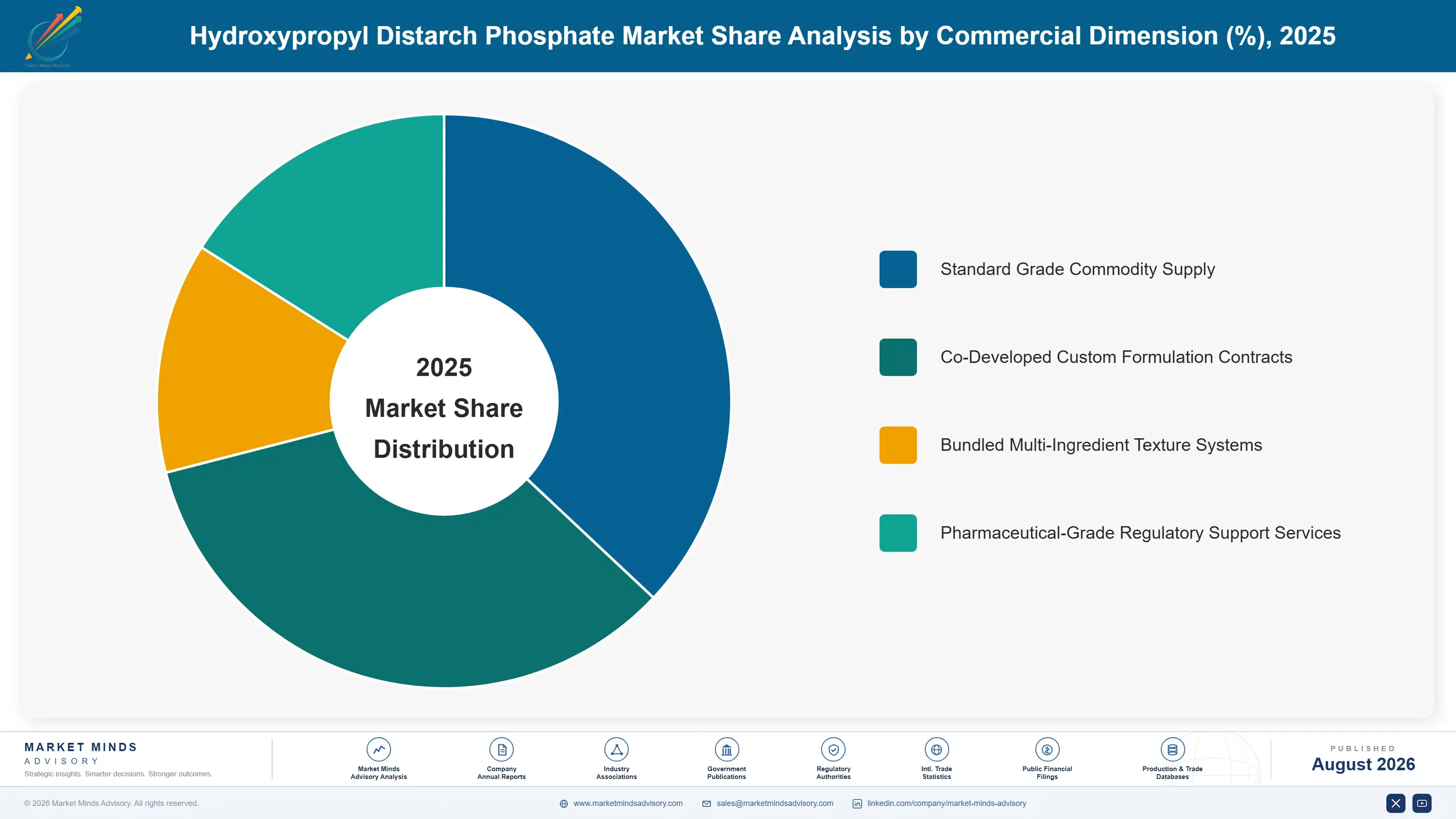
hydroxypropyl-distarch-phosphate-market-market-share-analysis-1787553853385

Tapioca-Based Hydroxypropyl Distarch Phosphate

Tapioca-based hydroxypropyl distarch phosphate grows fastest at 8.9%, about 1.35 times the overall 6.6% rate, as manufacturers value its neutral flavour, clarity, and freeze-thaw performance over corn-based alternatives in premium frozen and sauce applications. Food-grade and pharmaceutical-grade tapioca variants each serve slightly different applications, but both compete for the same expanding Southeast Asian processing base. Demand concentrates in premium frozen food and sauce reformulation across North America and Western Europe, where manufacturers increasingly favour tapioca's clean flavour profile over corn-based grades. Ingredion, Cargill, and several Thai processors supply the bulk of qualified tapioca-based systems, and order backlogs now stretch past eight months at several major converters. Technical service intensity runs higher for tapioca formulations, since flavour and clarity specifications vary.
CAGR 8.9%

Waxy Maize-Based Hydroxypropyl Distarch Phosphate

Waxy maize-based hydroxypropyl distarch phosphate grows at 7.8%, the second-fastest feedstock, as dairy dessert and sauce manufacturers specify its shear stability through high-speed filling equipment, a property standard corn or wheat-based grades cannot always match at comparable dosage. High-viscosity and low-viscosity waxy maize grades serve different application needs, with high-viscosity variants commanding a premium for spoonable dairy dessert formats. North America and Western Europe drive the bulk of specification as dairy manufacturers in both regions expand shelf-stable and extended-life product lines. Ingredion and ADM both expanded waxy maize processing capacity during 2024 and 2025 to meet rising dairy sector specification demand. Technical service depth matters here too, since filling line compatibility testing varies by manufacturer equipment configuration.
CAGR 7.8%
Full segment breakdown across 6 segments available in the complete report.

Regional Architecture and Country Demand Map

East Asia leads on processed food manufacturing scale, North America follows on corn wet milling capacity and dairy dessert demand, and South Asia and Pacific posts the fastest growth as Southeast Asian tapioca processing and food manufacturing expand together. while Western Europe manages the sharpest clean-label reformulation pressure.

North America

United States corn wet milling capacity and a large dairy dessert and frozen food manufacturing base anchor North American demand, where Ingredion, Cargill, and ADM operate integrated corn-to-starch production that gives domestic manufacturers a cost and logistics advantage over imported grades. Canadian frozen food manufacturing adds a smaller but steady secondary demand pool tied to its own processed food export industry. The region's 24% share and 6.9% growth rate reflect a mature but technically demanding formulation base rather than volume-driven demand, since clean-label reformulation pressure runs stronger here than in most other regions. Infant formula manufacturing investment is adding a distinct, faster-growing demand pool as domestic production capacity expands. a pool insulated from clean-label pressure given strict regulatory requirements.
Share: 24% | CAGR: 6.9% (2026 to 2036)

Western Europe

Clean-label reformulation pressure, more than new capacity, defines demand across Western Europe, where retailer private-label programmes and consumer advocacy have pushed hydroxypropyl distarch phosphate substitution further than in any other region tracked in this report. Germany, France, and the Netherlands hold the largest processed food manufacturing base in Europe, sustaining steady but slower-growing demand for Roquette, Tate & Lyle, and Avebe on European soil. The region's 18% share sits below East Asia's despite a comparable processed food manufacturing base, reflecting a decade of clean-label substitution eroding modified starch volume share. Growth of 5.1%, the slowest of the seven regions, reflects an industry managing reformulation pressure rather than expanding freely. Retailers here move faster on ingredient simplification than anywhere else tracked.
Share: 18% | CAGR: 5.1% (2026 to 2036)
Regional intelligence for 5 additional markets available in the complete report: East Asia, South Asia and Pacific, Latin America, Middle East and Africa, Eastern Europe. Contact sales@marketmindsadvisory.com.
hydroxypropyl-distarch-phosphate-market-country-cagr-analysis-1787553853909

Where Starch Producers Can Defend Margin

Four moves separate hydroxypropyl distarch phosphate producers earning premium margin from those competing purely on price per tonne, each targeting a point where food manufacturers pay for formulation certainty rather than commodity feedstock alone, since a texture failure on the retail shelf costs far more than any starch saved on the original purchase. at every negotiation.

Co-Develop Clean-Label-Adjacent Alternative Grades With Key Accounts

Producers that co-develop physically modified or enzymatically treated starch alternatives directly with major food manufacturers, positioning them as a bridge between clean-label pressure and chemically modified performance, convert a defensive reformulation threat into a new premium product category. Early movers report formulation conversion rates well above producers offering only standard modified starch, since a manufacturer that co-invested in development rarely reverts to a competitor's grade afterward. Ingredion and Tate & Lyle have both expanded clean-label-adjacent development programmes since 2024, tying formulation roadmaps directly to named retailer private-label requirements. deepening account entrenchment well beyond what standard commodity selling could achieve.
Market Impact: Lifts co-developed contract margin by 6 to 10 points

Diversify Feedstock Sourcing Across Corn and Tapioca

Producers that build flexible manufacturing capable of processing both corn and tapioca feedstock reduce exposure to any single crop's price volatility while offering food manufacturers a documented supply security story that increasingly matters during multi-year supply negotiations. This also addresses a genuine operational challenge directly, since switching feedstock requires reformulation and requalification against customer performance specifications. Cargill and Roquette have both disclosed feedstock diversification investments in their 2024 annual reports, targeting reduced single-crop dependence across their modified starch product lines. a shift that increasingly matters to customers managing their own supply chain and commodity price risk.
Market Impact: Cuts single-crop dependence by roughly 20% by 2028

Build Regional Technical Support Near Processing Hubs

Producers that place application specialists and testing laboratories directly at major frozen food and dairy manufacturing hubs, rather than serving them remotely, can offer customers faster formulation support that commands a premium during new product development, when texture performance issues carry the highest reformulation cost. Building this local presence takes years of relationship development and technical credibility, creating a durable advantage once established. Ingredion and Cargill have both disclosed regional technical centre investments since 2024 targeting major food manufacturing accounts directly. a commitment competitors serving customers remotely will find increasingly difficult to match on responsiveness.
Market Impact: Commands a 4 to 8% technical service premium

Offer Combined Starch and Hydrocolloid System Bundles

Producers that bundle modified starch with compatible hydrocolloids and stabiliser systems on a single formulated solution capture more of the total texture systems budget than producers offering starch alone, since manufacturers increasingly prefer a single accountable supplier for chemically compatible texture ingredients across a whole formulation. This also deepens the technical relationship, since bundled formulation requires close collaboration on interaction effects between ingredients. Tate & Lyle and Cargill have both expanded bundled product lines since 2024, reporting order values meaningfully higher than single-ingredient agreements. a pattern likely to keep strengthening as formulation complexity increases across categories.
Market Impact: Raises average contract value by about 17% per bundle

Who Controls the Margin Pool

Concentration sits at a moderate CR5 of 48%, with the gap between Ingredion and Cargill, the two largest producers, and smaller regional formulators measured in feedstock integration and regulatory documentation depth rather than manufacturing scale alone. All participants here are assessed on one basis, annual modified starch manufacturing and technical formulation services revenue.
Competitive activity runs along three lines. Feedstock integration and regulatory documentation depth remain the primary differentiator, since qualification cycles reward suppliers with the most extensively documented safety and performance data on a specific application. Clean-label-adjacent product development is becoming a genuine competitive advantage as retailer reformulation pressure persists. And co-development partnerships are shifting several producers from commodity ingredient sales toward long-term technical relationships that lock in manufacturer accounts for the life of a product formulation.

Pressure is building from regional Southeast Asian tapioca processors who lack the global technical service reach of Western majors but compete aggressively on price and feedstock proximity within their own regional processed food base. Rankings will shift toward producers who combine feedstock diversification with regulatory documentation depth, since both are becoming harder to build from a standing start as clean-label pressure and commodity volatility both increase simultaneously.
hydroxypropyl-distarch-phosphate-market-company-positioning-matrix-1787553854434

Competitive Moat and Risk Dimensions

INGREDION INCORPORATED

Moat: Broadest multi-feedstock production portfolio

Ingredion manufactures modified starch across corn, tapioca, and potato feedstocks and maintains qualified formulations across frozen, dairy, and infant formula applications simultaneously, letting it win specification regardless of which feedstock a customer ultimately prefers. Its global technical service network and decades of regulatory documentation give it credibility newer entrants struggle to match on complex reformulation programmes.
INGREDION INCORPORATED

Risk: Clean-label substitution exposure

Ingredion's core modified starch business faces direct exposure to clean-label reformulation pressure across its largest markets, and sustained retailer-driven substitution toward native or enzymatically modified alternatives could erode volume in its highest-margin product categories even as the company invests in clean-label-adjacent alternatives of its own.
CARGILL INCORPORATED

Moat: Deep vertically integrated grain sourcing

Cargill's ownership of grain origination, transport, and processing infrastructure gives it a cost and supply security advantage in corn and waxy maize-based starch that formulators without integrated sourcing cannot easily replicate. That integration also lets Cargill absorb commodity price volatility more effectively than smaller competitors buying feedstock on the open market.
CARGILL INCORPORATED

Risk: Diversified conglomerate capital competition

Cargill's modified starch business competes internally for capital against a much larger and more diversified agricultural trading and protein business, and sustained strength elsewhere in the conglomerate could deprioritise investment in a comparatively small specialty starch segment even where the segment itself performs well on its own merits.

Players Tracked

Prominent Players

Ingredion Incorporated
Cargill Incorporated
Archer-Daniels-Midland Company
Tate & Lyle PLC
Roquette Frères

Other Key Players

KMC Kartoffelmelcentralen
Grain Processing Corporation
Tereos Starch & Sweeteners
Agrana Beteiligungs-AG
Avebe U.A.
Emsland Group
Thai Wah Public Company Limited
Sanstar Ltd
Gulshan Polyols Limited
Global Bio-chem Technology Group
Manildra Group
Südstärke GmbH
Zhucheng Xingmao Corn Developing Co Ltd
Guangxi Tianyi Starch Co Ltd
National Starch Food Innovation

Recent Developments

MARCH 2025

Ingredion Expands Modified Starch Capacity in Thailand

Ingredion commissioned expanded tapioca-based modified starch production capacity at its Thai facility, adding dedicated lines to serve growing demand for premium frozen and sauce applications. The expansion reduces lead times for customers across Asia and export markets who previously drew allocation from Ingredion's other regional facilities.
Signal: Building tapioca capacity in Thailand confirms premium frozen food demand for flavour-neutral starch is a durable trend.
AUGUST 2025

Cargill Signs Dairy Sector Waxy Maize Supply Agreement

Cargill signed a multi-year supply agreement with a major dairy processor for waxy maize-based hydroxypropyl distarch phosphate used across yoghurt and dairy dessert formulations. The agreement was a commercial supply contract, not a joint venture or equity arrangement, and includes committed volume through the customer's product line expansion.
Signal: Long-term supply agreements tied to single dairy customers show how concentrated premium waxy maize demand has become.
DECEMBER 2025

Tate & Lyle Acquires Clean-Label Starch Technology Company

Tate & Lyle acquired a specialty developer of physically modified and enzymatically treated clean-label starch technology, broadening its texturising portfolio beyond chemically modified grades. The acquisition brings proprietary clean-label formulation technology and existing customer relationships rather than new manufacturing capacity. across multiple global food categories.
Signal: Buying clean-label technology rather than building it internally shows how seriously incumbents now take reformulation pressure.

Feedstock and Reagent Cost Exposure

Raw corn, tapioca, or potato starch feedstock runs 40% to 50% of finished cost, tied directly to agricultural commodity pricing that moves independently of food demand. Propylene oxide used in hydroxypropylation accounts for 20% to 28% of cost, while phosphate cross-linking reagents and processing energy add 18% to 25% depending on grade specification. Wheat and rice-based grades follow a similar cost structure with modest regional variation.
The clearest recent volatility event came in 2022, when Russia's invasion of Ukraine disrupted global grain export flows, pushing corn prices to multi-year highs across most import-dependent markets. USDA data recorded sharp increases in corn futures pricing through mid-2022, and Ingredion's 2022 Annual Report disclosed higher feedstock input costs following the disruption, with several producers reporting delivery delays stretching past eight weeks during the peak of the disruption.

Exposure varies sharply by player type. Vertically integrated producers with direct grain origination, like Cargill and ADM, absorbed the 2022 disruption with far less margin damage than smaller regional formulators buying starch feedstock on the spot market. Geography compounds the gap further, since tapioca-based producers in Southeast Asia faced a different volatility profile than corn-dependent producers in North America and Europe during the same period.
hydroxypropyl-distarch-phosphate-market-cost-volatility-analysis-1787553854631

Diversify Feedstock Across Corn, Tapioca, and Potato

Producers that build flexible manufacturing capable of switching between corn, tapioca, and potato feedstock reduce exposure to any single crop's price volatility. Reformulation across feedstocks takes time to requalify against customer performance specifications, but once complete it becomes a durable advantage that single-feedstock competitors cannot replicate quickly during the next commodity shock. Several major producers have already begun this diversification.

Lock Multi-Year Grain Supply Agreements Ahead of Disruption

Fixed-formula, multi-year corn and tapioca supply agreements protect producers from spot-price spikes during commodity disruptions at the cost of some pricing flexibility during periods of oversupply. Buyers with committed volume also receive priority allocation when total available feedstock tightens across the industry during a supply shock. That trade-off favours producers serving customers who cannot tolerate an unplanned feedstock shortage.

Reduce Dosage Through Higher-Functionality Formulations

Producers developing higher-functionality grades that achieve required texture performance at lower dosage reduce overall feedstock exposure per unit of finished food product. This shift also supports clean-label positioning by lowering the modified starch percentage on an ingredient label, giving producers a second commercial reason to pursue the same reformulation. Several producers now report steady gains from this approach.

Portfolio Architecture for Margin Defence

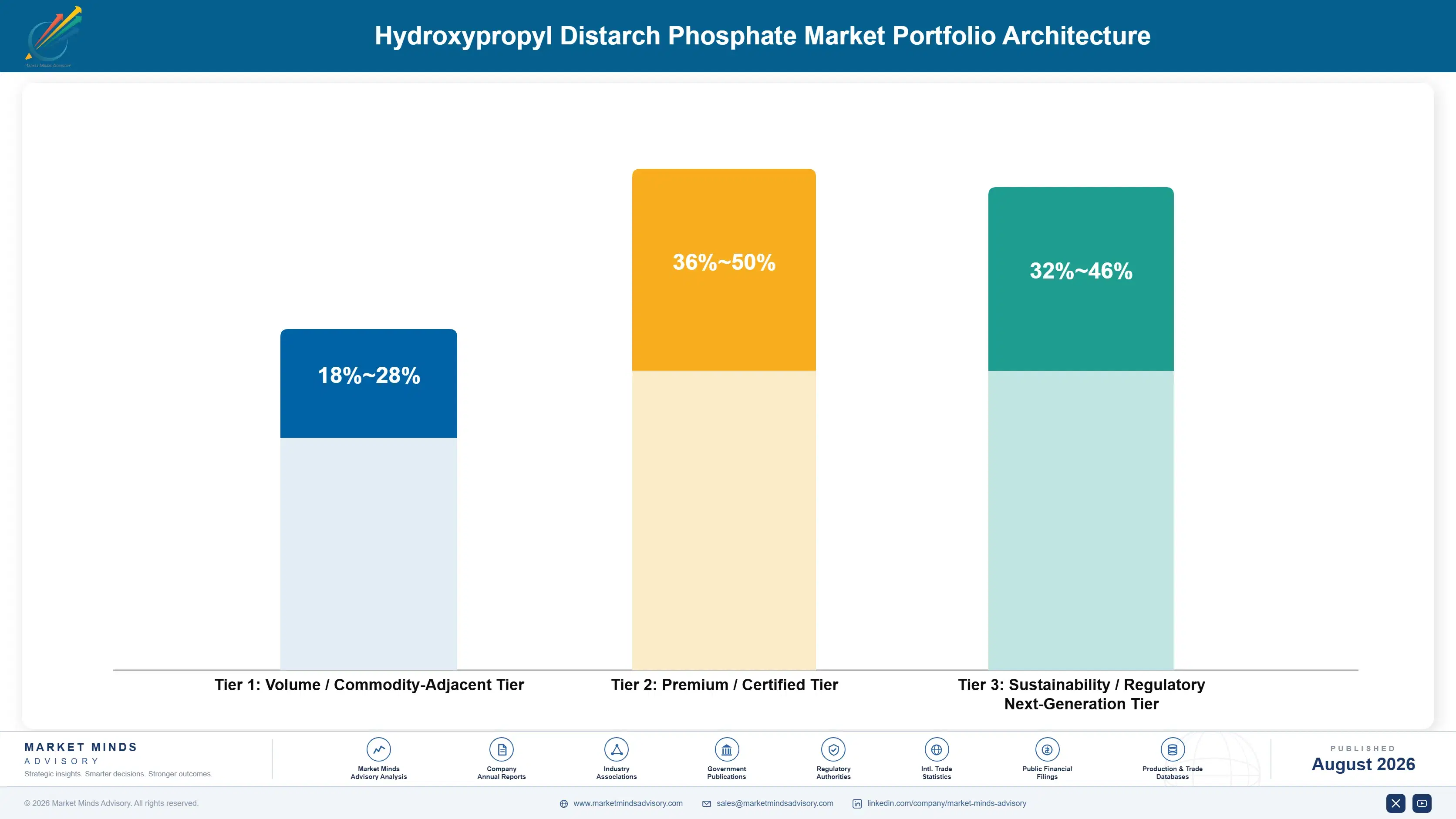
The portfolio splits into three tiers with real margin separation. Standard corn-based grades for general food applications compete on price per tonne and earn modest but steady margin. Tapioca and waxy maize-based premium grades earn considerably more, since manufacturers pay for flavour neutrality and shear stability rather than commodity feedstock alone. Clean-label-adjacent and pharmaceutical-grade formulations sit in a growing third tier where documentation and functionality, not feedstock cost, set the price.
The tension between volume and premium work is real. Standard corn-based grades generate the steadiest cash flow and fund the regulatory documentation infrastructure that premium tapioca work later depends on, yet they offer limited margin upside as regional Southeast Asian and Chinese producers compete aggressively on price. Tapioca and pharmaceutical-grade premium work carries far better margin but requires proprietary formulation and documentation that takes years to build and cannot be replicated quickly by new entrants.

High-value margin pools concentrate in infant formula and clinical nutrition pharmaceutical-grade specification, where regulatory documentation requirements rule out lower-cost competition entirely, and in premium tapioca-based frozen and sauce applications, where flavour neutrality and freeze-thaw performance lock manufacturers into their qualified supplier for the life of a product line.

Volume / Commodity-Adjacent Tier

Standard corn-based grades for general food applications, priced on cost per tonne against many qualified regional and global producers competing on price., where margin stays thin because corn-based chemistry is well understood and widely replicated across many qualified producers globally.
Gross Margin: 18-28%

Premium / Certified Tier

Tapioca and waxy maize-based grades for premium frozen, sauce, and dairy applications, priced on flavour neutrality, shear stability, and documented performance., commanding a durable premium wherever flavour purity and freeze-thaw reliability matter more than raw material cost.
Gross Margin: 36-50%

Sustainability / Regulatory / Next-Generation Tier

Clean-label-adjacent and pharmaceutical-grade formulations sold against regulatory documentation and reformulation resistance needs, commanding compliance-based pricing. that rewards documented safety and functional performance data over raw feedstock cost, particularly among manufacturers facing retailer reformulation pressure.
Gross Margin: 32-46%
hydroxypropyl-distarch-phosphate-market-portfolio-architecture-1787553855134

High-value Sub-segments and Strategic Watch-out

Tapioca-Based Hydroxypropyl Distarch Phosphate

High value and the fastest-growing segment at 8.9%, driven by premium frozen and sauce demand for flavour-neutral, freeze-thaw-stable performance. Margin runs highest here, and order backlogs already stretch past eight months at several converters. Southeast Asian processing capacity expansion gives suppliers a durable regional cost advantage.
Gross Margin: 38-50%

Waxy Maize-Based Hydroxypropyl Distarch Phosphate

High value with strong growth near 7.8%, anchored in dairy dessert and sauce applications where shear stability through high-speed filling equipment justifies a durable premium over corn-based alternatives. High-viscosity grades increasingly win share as spoonable dessert formats gain popularity across major global retail markets today.
Gross Margin: 34-46%

Corn-Based Hydroxypropyl Distarch Phosphate

The volume core, covering general food applications across every region. Steady but thin margin, competing on price per tonne against a fragmented field of regional and global producers. Volume stays resilient because general food applications rarely pause, even as premium feedstocks gain share in specialty categories.
Gross Margin: 20-30%

Rice-Based Hydroxypropyl Distarch Phosphate

The strategic watch-out. A niche, allergen-conscious chemistry facing limited growth as broader clean-label pressure constrains category expansion, with growth slowing to 4.3% as demand stays narrowly concentrated. Producers still leaning on rice-based volume should diversify toward tapioca or waxy maize chemistry before growth stalls further across core accounts.
Gross Margin: 22-32%

Why Formulation Approval Locks In Suppliers

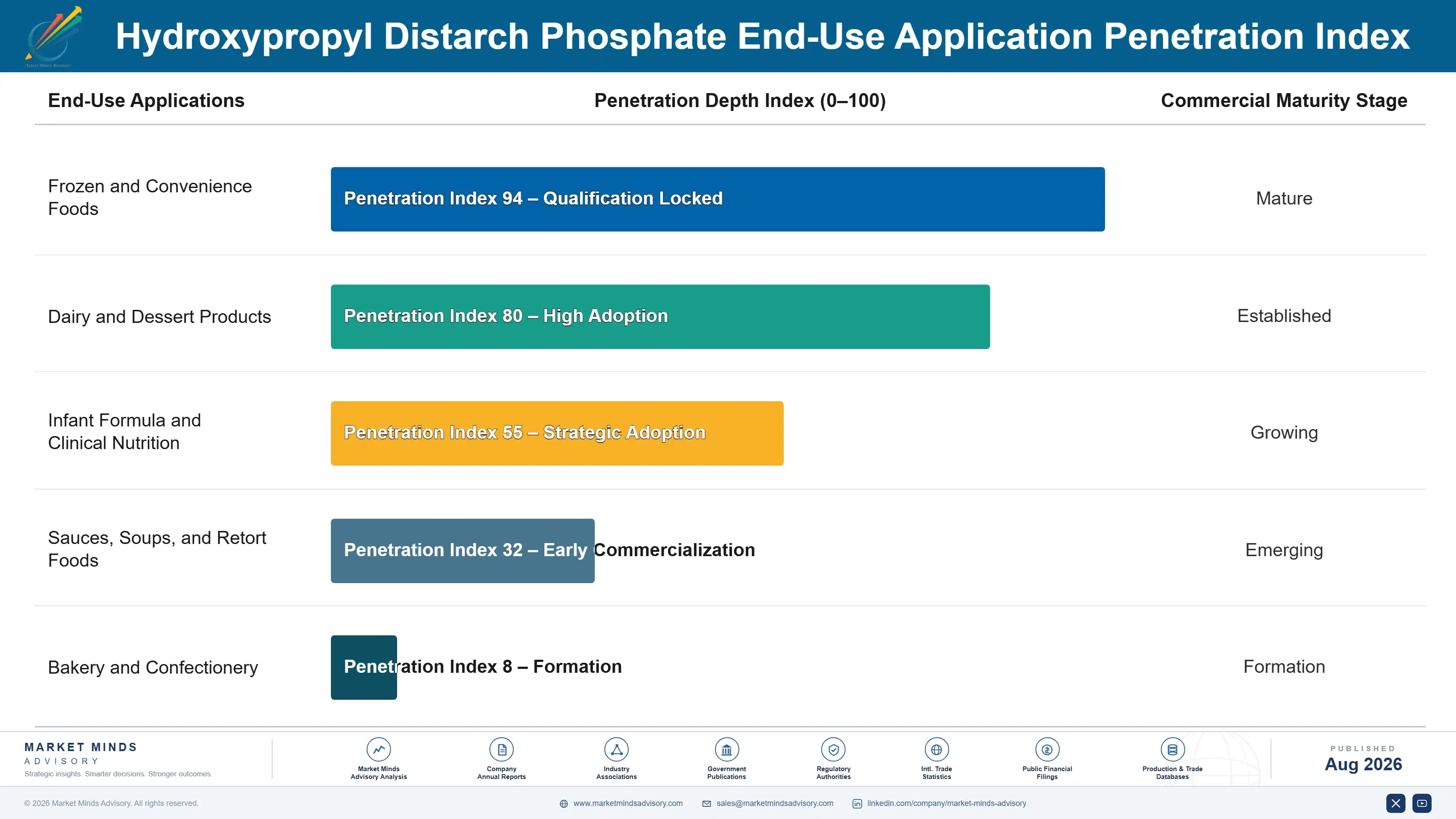
Starch demand behaves like an annuity once a manufacturer validates a grade against its own shelf-life and texture standard, since requalifying an alternate supplier means repeating costly shelf-life testing that most manufacturers avoid unless the incumbent's performance deteriorates. A product formulation running a validated starch grade will typically keep sourcing from the same supplier for the life of the product, even as annual volumes fluctuate with sales performance.
Adoption depth varies sharply by end-use vertical. Infant formula and pharmaceutical buyers show almost total loyalty to their qualified supplier, since switching after regulatory approval means repeating extensive documentation that programme managers avoid whenever possible. General food and beverage buyers show more willingness to switch suppliers between product reformulations, since starch performance is judged mainly on delivered texture and price rather than any regulatory qualification requirement.

Buyer profiles are shifting generationally as procurement moves from food technologists who select on long-standing supplier relationships toward centralised corporate procurement functions that weigh total reformulation risk and clean-label positioning more heavily. Younger product developers increasingly push for documented consumer testing data before committing to a formulation change, a habit less common among the retiring generation of food technologists.
hydroxypropyl-distarch-phosphate-market-end-use-penetration-index-1787553855624

Where the Next Decade Gets Decided

These are among the four positions where our research anticipates prominent divergence between winners and laggards over the coming forecast period. Each is grounded in the demand model, the regulatory perimeter, and the announced capacity pipeline.
01 / TAPIOCA CAPACITY POSITIONING

Build tapioca-based production capacity ahead of premium demand

Tapioca-based hydroxypropyl distarch phosphate is growing at 8.9%, well above every other feedstock, and order backlogs already stretch past eight months at several major converters serving premium frozen food customers. Producers that expand tapioca capacity now will capture disproportionate share as premium frozen and sauce reformulation keeps converting toward flavour-neutral grades across North America and Western Europe. Waiting for demand to fully materialise before investing in capacity means arriving after formulation programmes are already awarded to competitors who moved first and locked in multi-year supply relationships.
02 / CLEAN-LABEL ALTERNATIVE DEVELOPMENT

Build clean-label-adjacent alternatives before reformulation pressure peaks

Clean-label reformulation pressure has already shifted roughly eight percent of volume toward substitutes across the industry, and producers still selling only chemically modified starch are ceding ground to competitors developing physically modified alternatives that approximate the same performance. Early movers including Ingredion and Tate & Lyle are already tying formulation roadmaps to named retailer private-label requirements, deepening relationships that pure chemically modified competitors cannot replicate. Producers that delay this shift risk losing their most reformulation-conscious accounts to competitors already offering credible clean-label bridges.
03 / FEEDSTOCK DIVERSIFICATION STRATEGY

Diversify feedstock sourcing before the next commodity shock

The 2022 corn price spike showed how directly agricultural commodity exposure can damage producer margin industry-wide, and grain price volatility has not meaningfully declined since then given continued weather and geopolitical uncertainty. Producers that diversify feedstock sourcing across corn, tapioca, and potato now will hold a durable cost advantage during the next disruption, while competitors dependent on a single crop face renewed delivery and pricing risk. Diversification takes years to qualify, so the window to begin is now, not after the next shock forces a costly scramble.
04 / EAST ASIA MARKET COMMITMENT

Prioritise East Asian technical presence despite reformulation risk

East Asia holds 27% of global hydroxypropyl distarch phosphate value and grows at 7.6%, ahead of every other mature region, driven by processed food manufacturing investment that shows no sign of slowing through the forecast period. Producers without meaningful East Asian technical presence are ceding the largest and fastest-growing regional pool to competitors who already hold food manufacturer relationships. Clean-label pressure remains lower in this region than in North America or Western Europe, but the alternative to committing now is permanent exclusion from the market's highest-value growth pool.

Engagement Snapshot From the Field

A live engagement with an industry participant carrying material or product regulatory and market exposure ahead of a defining policy shift, showing how our research translates into a defensible multi-year portfolio strategy.
MARKET MINDS ADVISORY · CLIENT ENGAGEMENT SUMMARY
Hydroxypropyl Distarch Phosphate Producer Strategic Portfolio Review and Transition Roadmap 2026·Investment Scenario on Hydroxypropyl Distarch Phosphate Exposure Evaluation 2025-26
CLIENT PROFILE
A multinational dairy dessert manufacturer selling across North America and Western Europe approached MMA while facing retailer pressure to reformulate its flagship product line away from E-numbered modified starch. The client reported annual dairy dessert revenue near USD 1.1 billion, with the flagged product line representing a meaningful share of category volume across its largest retail accounts (client-reported, unverified by MMA).
STRATEGIC CHALLENGE
Marketing wanted an immediate clean-label reformulation to satisfy retailer demands, while product development warned that native starch alternatives had failed internal shear stability testing on the exact filling equipment the client used commercially. Nobody had modelled the actual consumer-facing quality risk of a botched reformulation against the marketing value of a clean-label claim.
MMA APPROACH
MMA built a shear-stability-to-consumer-risk model comparing the incumbent modified starch against native, enzymatically modified, and physically modified alternatives on the client's own filling line specifications. We benchmarked reformulation timelines across candidate suppliers and modelled retail return and complaint risk using the client's own historical quality data to make the comparison concrete for the board.
KEY FINDINGS
  1. Native starch alternatives failed shear stability testing on the client's high-speed filling equipment, producing visible texture defects in a meaningful share of trial batches.
  2. An enzymatically modified alternative from a specialty supplier matched incumbent performance closely enough to pass internal testing, avoiding E-number labelling while preserving texture quality.
  3. Reformulation and requalification timelines across candidate suppliers ranged from eight to fifteen months, meaning the client's original marketing timeline required a phased rather than immediate rollout.
  4. Retail complaint risk modelling showed a botched reformulation could damage the flagship product line's reputation far more than any short-term delay in the clean-label claim (client-reported, unverified by MMA).
CLIENT PROFILE
A multinational dairy dessert manufacturer selling across North America and Western Europe approached MMA while facing retailer pressure to reformulate its flagship product line away from E-numbered modified starch. The client reported annual dairy dessert revenue near USD 1.1 billion, with the flagged product line representing a meaningful share of category volume across its largest retail accounts (client-reported, unverified by MMA).
STRATEGIC CHALLENGE
Marketing wanted an immediate clean-label reformulation to satisfy retailer demands, while product development warned that native starch alternatives had failed internal shear stability testing on the exact filling equipment the client used commercially. Nobody had modelled the actual consumer-facing quality risk of a botched reformulation against the marketing value of a clean-label claim.
MMA APPROACH
MMA built a shear-stability-to-consumer-risk model comparing the incumbent modified starch against native, enzymatically modified, and physically modified alternatives on the client's own filling line specifications. We benchmarked reformulation timelines across candidate suppliers and modelled retail return and complaint risk using the client's own historical quality data to make the comparison concrete for the board.
KEY FINDINGS
  1. Native starch alternatives failed shear stability testing on the client's high-speed filling equipment, producing visible texture defects in a meaningful share of trial batches.
  2. An enzymatically modified alternative from a specialty supplier matched incumbent performance closely enough to pass internal testing, avoiding E-number labelling while preserving texture quality.
  3. Reformulation and requalification timelines across candidate suppliers ranged from eight to fifteen months, meaning the client's original marketing timeline required a phased rather than immediate rollout.
  4. Retail complaint risk modelling showed a botched reformulation could damage the flagship product line's reputation far more than any short-term delay in the clean-label claim (client-reported, unverified by MMA).
RECOMMENDED STRATEGY
Phase 1: Phase 1 (0 to 6 months): Begin parallel qualification of the enzymatically modified alternative on one production line. at the flagship facility. Phase 2: Phase 2 (6 to 15 months): Expand qualified reformulation across remaining lines once trial performance confirms the initial modelling holds. Phase 3: Phase 3 (15 to 30 months): Launch the clean-label claim publicly only once full-scale production has run without quality incidents.
OUTCOME
The client completed the phased reformulation within the modelled timeline and launched its clean-label claim without a single shear stability complaint reported through the following year of production. Ingredient cost per unit rose by a reported low single-digit percentage, well below the reputational cost a rushed reformulation would likely have caused (client-reported, unverified by MMA).

Frequently Asked Questions

Foundational context covering the market sizes, CAGR, scope, country, region and competition that inform every finding below. This section is provided to cover basics and most often pre-purchase conversations, answered from the MMA Primary Research Dataset.

What is the current size of the Hydroxypropyl Distarch Phosphate Market?

The hydroxypropyl distarch phosphate market reached USD 1.8 billion in 2025, spanning corn, tapioca, potato, wheat, waxy maize, and rice-based grades used across food and pharmaceutical applications.

How large will the Hydroxypropyl Distarch Phosphate Market be by 2036?

MMA forecasts the market will reach roughly USD 3.6 billion by 2036, up from about USD 1.9 billion in 2026, as frozen food and infant formula demand continue driving specification.

What is the CAGR for the Hydroxypropyl Distarch Phosphate Market 2026 to 2036?

The base case CAGR is 6.6% for 2026 to 2036, with a bull case of 7.9% and a bear case of 5.3% depending on clean-label reformulation pace.

Which segment is growing fastest?

Tapioca-based grades grow fastest at 8.9% CAGR, about 1.35 times the overall market rate, driven by premium frozen food demand. Waxy maize-based grades follow close behind at 7.8%.

Who are the major companies in the Hydroxypropyl Distarch Phosphate Market?

Ingredion, Cargill, ADM, Tate & Lyle, and Roquette lead the field, assessed on combined manufacturing and technical formulation services revenue. Fifteen additional players compete across regional and feedstock-specific niches.

Which country is growing fastest?

Thailand posts the fastest national growth at 10.2% CAGR, driven by expanding tapioca processing capacity serving both domestic and export demand for premium starch grades.

Report Segmentation Architecture

The full report scope spans multiple orthogonal segmentation dimensions, with cross-tabulated demand data provided for each dimension pair. Coverage extends further to regional breakdowns, trend trajectories, and the competitive detail needed to support segment-level decision-making.

By Starch Feedstock Source

  • Tapioca-Based
  • Waxy Maize-Based
  • Corn-Based
  • Potato-Based
  • Wheat-Based
  • Rice-Based

By End-Use Application

  • Frozen and Convenience Foods
  • Dairy and Dessert Products
  • Infant Formula and Clinical Nutrition
  • Sauces, Soups, and Retort Foods
  • Bakery and Confectionery

By Commercial Dimension

  • Standard Grade Commodity Supply
  • Co-Developed Custom Formulation Contracts
  • Bundled Multi-Ingredient Texture Systems
  • Pharmaceutical-Grade Regulatory Support Services

By Region

  • North America
  • Western Europe
  • East Asia
  • South Asia and Pacific
  • Latin America
  • Middle East and Africa
  • Eastern Europe

Scope, Methodology, and Coverage

Every figure in this report is reproducible from documented input assumptions. The scope below maps the historical period, the forecast horizon, the segmentation dimensions, and the countries covered, alongside the underlying primary and qualitative methodology.
Historical Period
2020 to 2025
Forecast Period
2026 to 2036
Base Year
2025 (USD billions; MMA Primary Research Dataset, August 2026)
Market Definition
The hydroxypropyl distarch phosphate market comprises the chemically modified starch ingredient produced through hydroxypropylation and phosphate cross-linking of corn, tapioca, potato, wheat, waxy maize, or rice starch, together with associated technical formulation support. It spans food-grade and pharmaceutical-grade applications used as a thickener, stabiliser, and texturiser. Native and unmodified starches, and modified starches used solely in paper, textile, or industrial non-food applications, are excluded.
Quantitative Units
USD billions (current prices); metric tonnes of finished starch supplied where applicable
Segmentation Dimensions
By Starch Feedstock Source; By End-Use Application; By Commercial Dimension; By Region
Regions Covered
North America, Western Europe, East Asia, South Asia and Pacific, Latin America, Middle East and Africa, Eastern Europe
Countries Covered
USA, China, Germany, France, UK, Japan, South Korea, India, Australia, Canada, Brazil, Mexico, Indonesia, Vietnam, Thailand, Malaysia, UAE, Saudi Arabia, South Africa, Nigeria, Turkey, Poland, Netherlands, Italy, Spain, Sweden, Switzerland, Argentina, Colombia, Singapore, and additional markets relevant to this sector
Key Companies Profiled
Ingredion Incorporated, Cargill Incorporated, Archer-Daniels-Midland Company, Tate & Lyle PLC, Roquette Frères, KMC Kartoffelmelcentralen, Grain Processing Corporation, Tereos Starch & Sweeteners, Agrana Beteiligungs-AG, Avebe U.A., Emsland Group, Thai Wah Public Company Limited, Sanstar Ltd, Gulshan Polyols Limited, Global Bio-chem Technology Group, Manildra Group, Südstärke GmbH, Zhucheng Xingmao Corn Developing Co Ltd, Guangxi Tianyi Starch Co Ltd, National Starch Food Innovation
Quantitative Methodology
Primary survey, n=3,800 respondents, Q4 2025, six countries; demand-side model with trade association cross-validation
Qualitative Methodology
47 expert interviews, Q4 2025; applied to validate demand model assumptions, identify emerging dynamics, and assess competitive positioning
Report Format
PDF and XLSX data workbook (Word format preview document)
Publisher
Market Minds Advisory
Report Code
MMA-2026-AGR-101
Published
August 2026
Contact
sales@marketmindsadvisory.com | www.marketmindsadvisory.com

Purchase the full Hydroxypropyl Distarch Phosphate Market Report (2026 to 2036).

The full MMA Hydroxypropyl Distarch Phosphate Market report sizes demand across six starch feedstocks, five end-use applications, four commercial dimensions, and seven regions through 2036. It profiles twenty participants on a consistent basis of annual manufacturing and technical formulation services revenue, scoring each on feedstock integration, regulatory documentation depth, and clean-label readiness. Scenario models quantify how clean-label reformulation, premium frozen food demand, and corn price volatility move both demand and realised pricing. The report also includes delivered-cost modelling by feedstock, a clean-label substitution risk screen, and a formulation approval cycle benchmarking tool built for procurement, strategy, and investment teams.
Six-feedstock demand and margin model across the forecast
Seven-region growth, share, and demand breakdown for 2036
Twenty-company competitive benchmarking across feedstock and application
Clean-label substitution risk screen and volume tracker
Formulation approval cycle benchmarking by application type
Ten-year revenue, margin, and volume forecast

Built For The People Who Decide

From boardroom strategy to bench-side execution, this report is read cover-to-cover by leaders shaping the next decade of their industry, turning demand scenarios, market dynamics and valuation benchmarks into decisions.
CXOs/ Presidents/ VPs/ Managers
M&A and Corporate Development
Strategy Teams and R&D Heads
Procurement and Product Directors
Regulatory and Compliance Leaders
Investor Relations and Equity Analysts