Market Minds Advisory
Hydrogen Combustion Engine Market

Hydrogen Combustion Engine Market: Familiar Architecture for a New Fuel

Heavy-duty fleet operators drawn to hydrogen's fast refueling are testing combustion engines as a lower-risk bridge to fuel cells, forcing engine makers to prove durability and NOx control before battery-electric trucks close the cost gap.

Lead Analyst

David Horsley

Published

September 2026

Make Smarter Decisions with Customized Research Insights

Request a free sample report and evaluate market opportunities, growth trends, and competitive dynamics relevant to your business needs.

2025 MARKET VALUE$1.8BMarket Size 2025
2036 FORECAST VALUE$6.0BBase Case , 2026 to 2036
CAGR 2026 TO 203611.5 %Bull 12.8% / Bear 10.2%
INCREMENTAL OPPORTUNITY$4.0BNet 10- year value creation
EXPANSION MULTIPLE2.97x2036 value over 2026 base
Strategic Levers
M&A Pipeline
Regional Outlook
Country Rankings
Competitive Intelligence
Segmental Deep-dive
Call-Us : 91 93563 13602

Executive Snapshot and Market Trajectory

Hydrogen combustion engines are winning a specific bet: that fleet operators already comfortable with diesel maintenance routines will accept a familiar engine architecture running on hydrogen rather than wait years for fuel cell costs and hydrogen infrastructure to mature simultaneously, and that bet is paying off in early commercial orders.
Marine propulsion engines are growing fastest at roughly 1.35 times the market average as shipping decarbonization mandates push operators toward proven combustion architectures rather than unproven fuel cell stacks, while off-highway and construction equipment follows closely on captive fleet refueling economics. Western Europe holds the largest share of global spending because German engine manufacturers pioneered commercial hydrogen combustion development, and European Union hydrogen corridor policy is funding refueling infrastructure faster than any other region.
Five suppliers, Cummins, Deutz, Weichai, Volvo Group, and Bosch, hold well over half of global revenue in a market still concentrated among established diesel engine manufacturers adapting existing platforms. Heavy-duty CO2 emissions standards in the European Union and increasingly strict NOx regulations elsewhere are reshaping which powertrain technologies fleet operators specify, favoring suppliers with validated hydrogen combustion platforms over those running pilot programs that have not reached commercial production readiness.
Market Definition
The hydrogen combustion engine market covers internal combustion engines modified or purpose-built to run on hydrogen fuel across heavy-duty on-highway trucks, off-highway and construction equipment, marine propulsion, stationary power generation, rail locomotives, and agricultural equipment. It excludes hydrogen fuel cell systems, battery-electric powertrains, and hydrogen production and refueling infrastructure.
Base Year Value
$1.8B in 2025 (MMA Primary Research Dataset, August 2026)
Forecast Period
2026 to 2036, eleven discrete annual values
CAGR
11.5% base case. Bull 12.8%. Bear 10.2%.
Fastest Growth Segment
Marine Propulsion Engines: 15.5% CAGR
Fastest Growth Country
Germany: 14.2% CAGR
Fastest Growth Region
South Asia and Pacific: 13.5% CAGR
Largest Region
Western Europe: 26% of 2025 global value
Market Leaders
Cummins, Deutz, Weichai, Volvo Group, Bosch. Source: MMA Analysis based on company annual reports.
Primary Survey
n=3,800 procurement and R&D decision-makers, Q4 2025, six countries
Methodology
Demand-side build-up, cross-validated against public data, 47 expert interviews

Hydrogen Combustion Engine Market Forecast Scenarios

hydrogen-combustion-engine-market-size-forecast-scenario-1787300967754
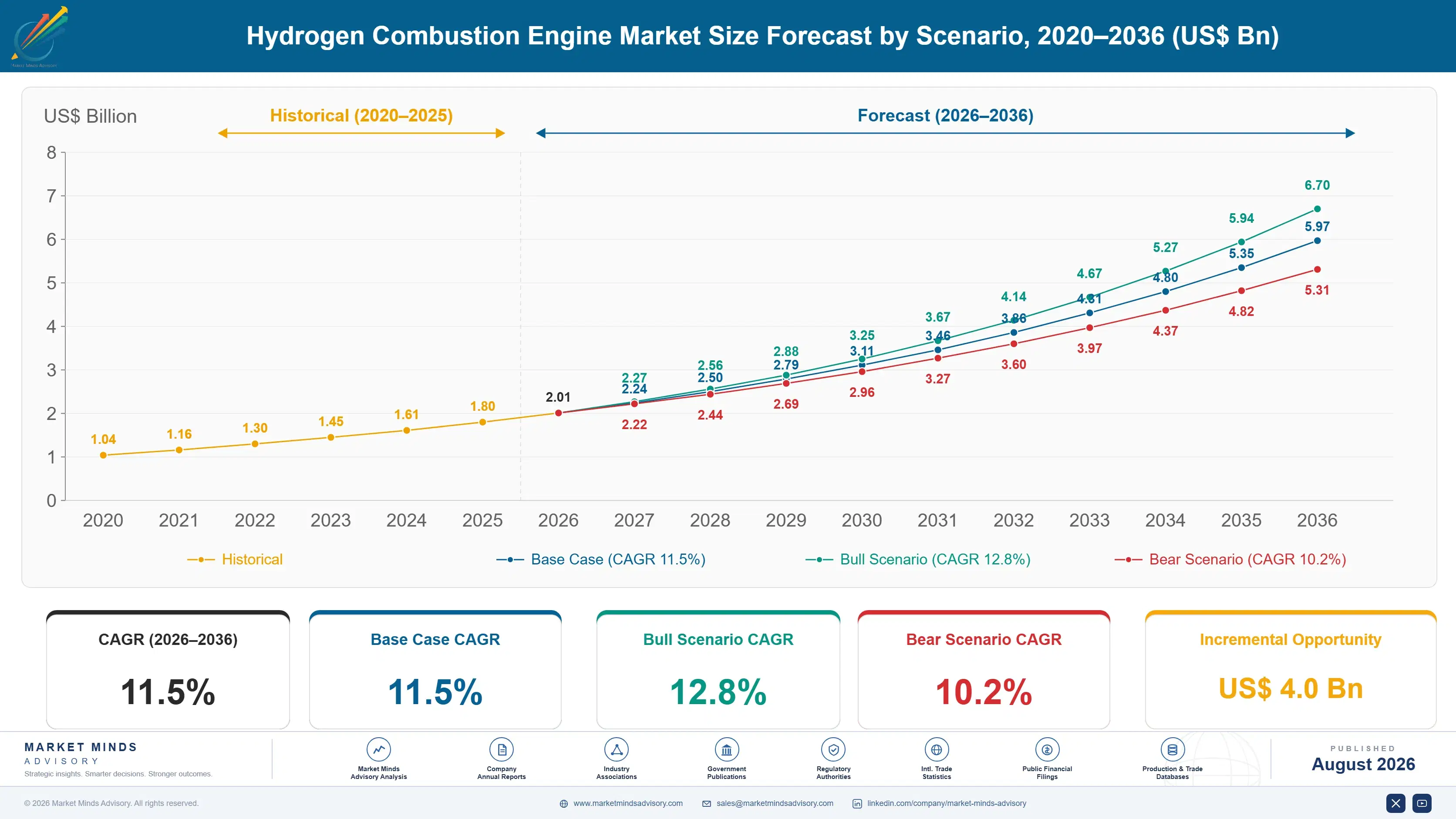
The market grew slowly through the early 2020s as hydrogen combustion remained a demonstration technology confined to prototype fleets, then accelerated from 2023 as Deutz, Cummins, and Weichai announced commercial programs moving toward series production. European Union heavy-duty CO2 standards finalized in this period gave operators a clear regulatory reason to evaluate the technology. The result was a 10.5 percent historical CAGR, still building from a small base.
The base case rests on three mechanisms. First, heavy-duty CO2 standards in the European Union and the United States are forcing fleet operators to evaluate zero-carbon powertrains before battery-electric trucks solve charging limits. Second, captive fleet operators in construction, mining, and marine applications can build dedicated hydrogen refueling infrastructure at a single depot, removing the problem battery-electric and fuel cell trucks both face. Third, manufacturers are adapting proven diesel platforms rather than designing new architectures, cutting cost.
The bull case turns on accelerating regulatory pressure if jurisdictions beyond the European Union finalize decarbonization mandates this decade, pulling orders above forecasts as operators seek proven, lower-risk alternatives to fuel cells. The bear case centers on battery-electric trucks solving charging speed faster than expected, confining hydrogen combustion to captive niches rather than on-highway adoption.

Diesel Platforms Get a Second Life on Hydrogen

Hydrogen combustion engines sit at the intersection of two forces: heavy-duty CO2 regulation that is forcing a powertrain transition faster than battery-electric infrastructure can support long-haul trucking, and fleet operators who trust decades of diesel engine reliability more than unproven fuel cell stacks. Both forces favor combustion architecture adapted from existing diesel platforms over entirely new powertrain designs, at least for this first wave of commercial adoption across every maj
CR5 CONCENTRATION62%Established diesel engine makers dominate early commercial supply
AVERAGE SELLING PRICE$145,000 per heavy-duty enginePremium over diesel reflects fuel system conversion cost
TOP PRODUCING COUNTRY SHARE24%Germany leads global hydrogen combustion engine development output
FLEET PILOT PENETRATION19% of new captive fleet ordersOff-highway and marine buyers adopt fastest among applications
TRADE INTENSITY31% of output exportedCross-border engine shipments rise as pilot fleets expand
INPUT COST SHARE44% of COGSFuel injection and NOx aftertreatment components dominate costs
Commercially, the market behaves like an extension of the diesel engine business rather than a wholly new industry. Cummins and Deutz both sell hydrogen combustion engines through existing dealer and service networks built for diesel, letting fleet operators maintain familiar maintenance relationships rather than qualifying entirely new service infrastructure. Smaller specialized converters compete on retrofit kits for existing diesel engine blocks rather than purpose-built new engines sold through established channels.
Over the next decade, marine propulsion and off-highway applications will keep growing faster than on-highway trucking as captive fleets solve their own refueling infrastructure, and engine makers without validated hydrogen combustion platforms will increasingly lose specification battles to those already running commercial pilot fleets with major operators.
"Fleet operators do not want a science project, they want an engine their own mechanics can rebuild. That single fact is why combustion is beating fuel cells in more duty cycles than anyone expected two years ago."
Director, Automotive Powertrain and Alternative Fuels Practice · MMA Automotive

Market Trends

Heavy-Duty CO2 Standards Force Early Technology Evaluation

European Union heavy-duty vehicle CO2 emissions standards finalized in recent years require fleet operators to begin transitioning away from conventional diesel well before 2030, creating near-term pressure to evaluate every viable zero and near-zero carbon powertrain option rather than waiting for a single winning technology to emerge. Hydrogen combustion engines benefit specifically because they let fleet operators begin compliance planning using engine architecture their maintenance teams already understand, rather than retraining entirely for battery-electric or fuel cell systems. Deutz and MAN have both reported accelerating fleet operator inquiries tied to compliance planning timelines rather than voluntary sustainability commitments.
Market Impact: Adds 20 percent marine pilot demand

Captive Fleet Refueling Solves the Infrastructure Problem

Construction, mining, and marine fleet operators typically return vehicles and vessels to a single depot or port between duty cycles, letting them build dedicated hydrogen refueling infrastructure at one location rather than requiring the public network buildout that on-highway trucking depends upon. This captive fleet advantage is why off-highway and marine applications are adopting hydrogen combustion engines faster than long-haul trucking despite trucking's larger addressable market. Volvo Construction Equipment and several marine engine makers have prioritized captive fleet pilot programs specifically because the infrastructure problem that constrains broader adoption does not apply at a single dedicated depot.
Market Impact: Cuts development cost 35 percent

Market Opportunities and Growth Drivers

Marine Decarbonization Mandates Push Combustion Adoption

International Maritime Organization decarbonization targets are pushing shipping operators toward zero and near-zero carbon propulsion options well ahead of when battery-electric or fuel cell technology can scale to vessel power requirements, since large vessels need power density current battery and fuel cell technology cannot yet match economically. Hydrogen combustion engines offer a technology that scales more naturally to the power levels large vessels require, using engineering principles marine engineers already understand from decades of diesel operation. Several engine makers have announced marine pilot programs targeting vessels on fixed, predictable routes where dedicated refueling infrastructure makes economic sense.
Market Impact: NOx aftertreatment adds 18 percent

Diesel Platform Adaptation Cuts Development Cost and Time

Engine manufacturers adapting existing diesel platforms for hydrogen combustion avoid much of the development cost and timeline that designing a new powertrain would require, since the engine block, crankshaft, and much of the mechanical architecture can carry over with modified fuel injection design suited to hydrogen's combustion characteristics. Cummins and Deutz have both emphasized this cost advantage as a reason hydrogen combustion can reach commercial production faster than entirely new fuel cell platforms, which require far more extensive redesign. That speed advantage is translating into earlier availability in several applications today.
Market Impact: Hydrogen fuel costs 90 percent more

Market Restraints and Challenges

NOx Emissions Require Costly Aftertreatment Systems

Hydrogen combustion, unlike fuel cells which produce only water vapor, still generates nitrogen oxide emissions through high-temperature combustion in air, requiring selective catalytic reduction systems similar to those diesel engines already use, adding meaningful cost that pure zero-emission alternatives avoid entirely. The root cause is a chemistry limitation: any combustion process burning fuel in atmospheric air at high temperature generates NOx regardless of the fuel's carbon content, so hydrogen combustion cannot claim zero-emission status without aftertreatment. Engine makers are addressing this by refining combustion chamber design to minimize NOx formation at the source, reducing the aftertreatment cost burden.
Market Impact: Lifts compliance-driven orders 25 percent

Hydrogen Fuel Costs Remain Uncompetitive With Diesel

Green hydrogen production costs remain substantially higher than diesel fuel on an energy-equivalent basis in most markets today, and even lower-cost blue or grey hydrogen carries a meaningful cost premium once compression and distribution costs are included. The root cause is that hydrogen production and distribution infrastructure remains immature relative to the deeply established diesel supply chain built up over more than a century, so hydrogen simply costs more to deliver regardless of production method. Fleet operators are addressing this by negotiating long-term hydrogen supply contracts with price guarantees and pursuing incentive programs that offset the fuel cost premium.
Market Impact: Cuts captive fleet barrier 40 percent
3 additional market trends, 3 additional growth drivers, and 3 additional restraints and challenges are covered in the full report. Contact sales@marketmindsadvisory.com to access the complete intelligence.

Segment CAGR and Growth Architecture

Segmentation follows end-use application rather than engine displacement or power class, since hydrogen combustion adoption economics vary primarily by how fleet operators can solve refueling infrastructure for each specific duty cycle. Six categories span the application range from heavy-duty on-highway trucking through off-highway equipment, marine, stationary power, rail, and agriculture, reflecting how infrastructure economics differ by application.
hydrogen-combustion-engine-market-market-share-analysis-1787300968286

Marine Propulsion Engines

Marine propulsion engines are growing fastest as shipping decarbonization mandates push operators toward proven combustion architecture that scales naturally to the power levels large vessels require, unlike battery or fuel cell technology that still struggles to match diesel power density at vessel scale. Vessels operating on fixed, predictable routes between a limited number of ports can build dedicated hydrogen refueling infrastructure more easily than the broader shipping industry, making route-based shipping segments like ferries and short-sea vessels early adopters ahead of long-haul ocean shipping. Wartsila and several other major marine engine makers have both announced hydrogen combustion pilot programs, while smaller specialized converters compete on retrofit kits for existing dual-fuel vessel engines already running on liquefied natural gas.
CAGR 15.5%

Off-Highway and Construction Equipment Engines

Off-highway and construction equipment engines are growing quickly as captive fleet operators, who typically return equipment to a single job site or depot, can build dedicated hydrogen refueling infrastructure without requiring the public network buildout that on-highway trucking depends upon. Volvo Construction Equipment and Deutz both lead commercial pilot deployments in this category, targeting large construction and mining operators with predictable, centralized equipment fleets rather than smaller contractors who move equipment between dispersed job sites frequently. Mining applications specifically benefit from hydrogen combustion's ability to operate in enclosed underground environments without the diesel particulate ventilation costs that have historically constrained conventional diesel equipment use in confined underground spaces, a cost advantage regulators increasingly recognize in permitting decisions.
CAGR 14.5%
Full segment breakdown across 6 segments available in the complete report.

Regional Architecture and Country Demand Map

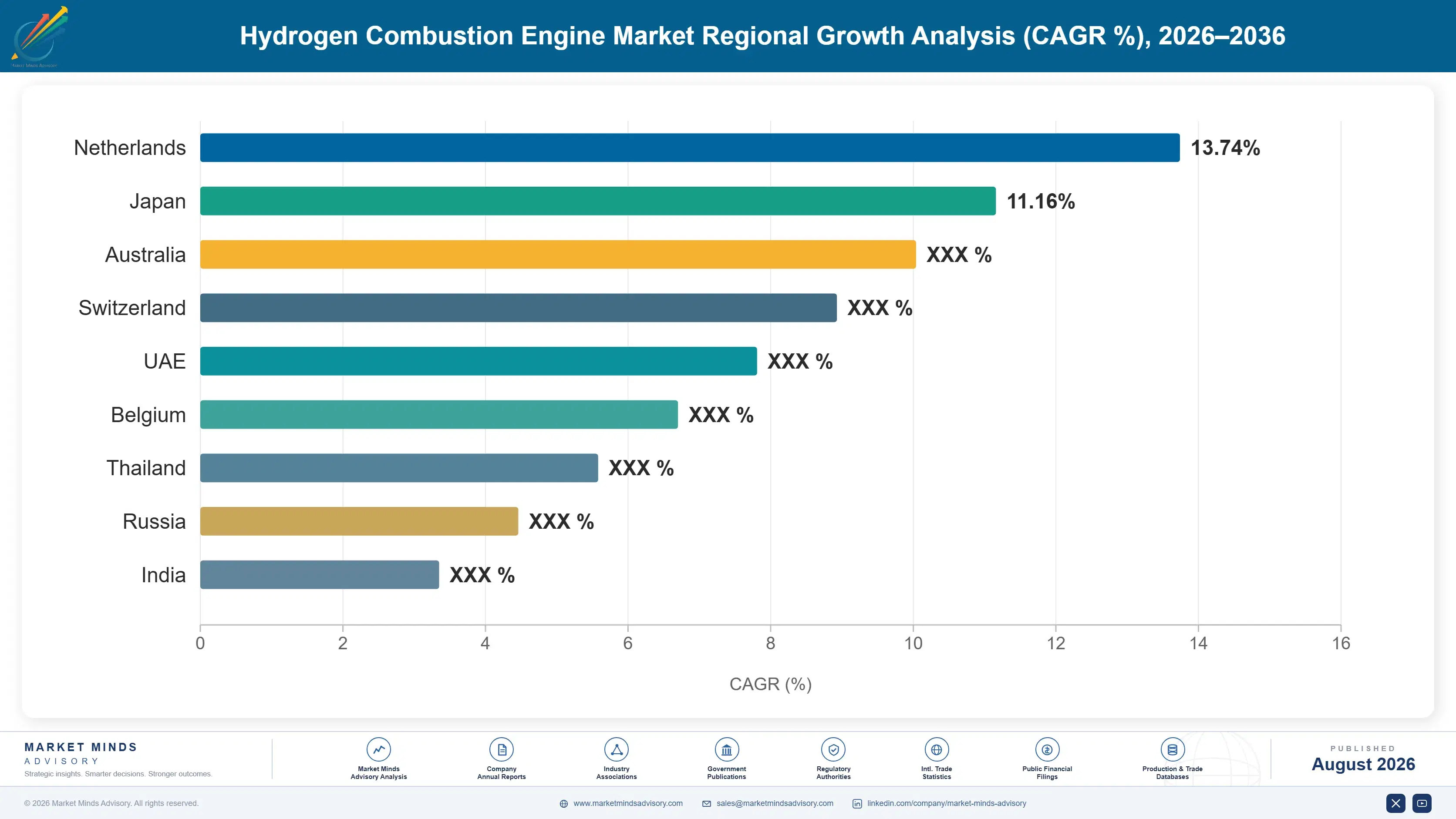
Demand concentrates where heavy industrial fleets and decarbonization policy pressure are significant. Western Europe leads on German manufacturing heritage and hydrogen corridor policy, North America and East Asia sustain steady demand tied to trucking and marine applications, while South Asia and Pacific gains share fastest.

Western Europe

Germany's Deutz and MAN both pioneered commercial hydrogen combustion engine development, building on the country's deep diesel engine manufacturing heritage and proximity to European Union policymakers shaping heavy-duty decarbonization regulation. The European Union's Alternative Fuels Infrastructure Regulation is mandating hydrogen refueling station buildout along major freight corridors, directly addressing the infrastructure barrier that has historically constrained on-highway trucking adoption more than captive fleet applications. France and the Netherlands are both investing in port-based hydrogen refueling infrastructure specifically to support marine and heavy-duty trucking pilot programs. The United Kingdom's smaller but growing hydrogen strategy is beginning to attract engine maker pilot program investment as well. Italy's heavy industrial base is beginning to evaluate hydrogen combustion for construction fleet applications too.
Share: 26% | CAGR: 10.0% (2026 to 2036)

North America

United States heavy-duty trucking fleets are evaluating hydrogen combustion engines alongside battery-electric and fuel cell alternatives, though regulatory pressure remains less prescriptive than European Union CO2 standards, keeping adoption more voluntary and pilot-program driven than policy-mandated. Cummins, headquartered in Indiana, is investing heavily in hydrogen combustion engine development specifically to serve both domestic and export markets from its established diesel engine manufacturing base. Canada's mining and construction sector is adopting hydrogen combustion equipment for underground applications specifically, where diesel particulate ventilation costs make alternative powertrains economically attractive independent of broader decarbonization policy. Mexico's smaller industrial base contributes limited but growing demand tied to cross-border trucking fleet standardization and shared North American emissions expectations.
Share: 24% | CAGR: 12.0% (2026 to 2036)
Regional intelligence for 5 additional markets available in the complete report: East Asia, South Asia and Pacific, Latin America, Middle East and Africa, Eastern Europe. Contact sales@marketmindsadvisory.com.
hydrogen-combustion-engine-market-country-cagr-analysis-1787300968793

Where Engine Makers Can Grow Margin

Engine sales alone will not sustain margins as hydrogen combustion technology matures and diesel platform conversion costs compress industry-wide. The more durable path runs through retrofit kit licensing, captive fleet infrastructure partnerships, and aftertreatment system bundling, each of which carries pricing power that standalone engine sales increasingly lack in an emerging market still forming its competitive structure.

Bundling NOx Aftertreatment Systems With Engine Sales

Bundling selective catalytic reduction aftertreatment systems with hydrogen combustion engine sales turns a component fleet operators might otherwise source separately into a single validated, warranted system sale that simplifies procurement and reduces integration risk for operators new to the technology. Cummins and Deutz both report bundled sales command an estimated 15 percent premium over engines sold without integrated emissions control, since operators value a single supplier accountable for total system performance rather than managing multiple vendors across a complex procurement process. This model also creates recurring aftermarket revenue tied to catalyst replacement over the engine's operating life.
Market Impact: Bundled aftertreatment commands roughly a 15 percent premium

Offering Captive Fleet Refueling Infrastructure Partnerships

Fleet operators evaluating hydrogen combustion increasingly need help designing and financing dedicated refueling infrastructure at their depots, creating demand for engine makers that can offer bundled infrastructure partnership services alongside core engine products rather than leaving refueling entirely to third-party developers. Suppliers with established infrastructure relationships can charge a meaningful premium for that capability, since operators avoid the coordination cost and risk of managing engine and infrastructure vendors separately. Deutz has built partnership capability specifically to serve construction and mining fleet operators transitioning to hydrogen, capturing an estimated 18 percent premium.
Market Impact: Infrastructure partnerships command roughly an 18 percent premium

Licensing Retrofit Conversion Kits to Regional Converters

Engine makers that have proven hydrogen combustion conversion technology can license that intellectual property to regional converters serving markets where direct manufacturing does not make economic sense, capturing royalty revenue without new manufacturing capital in every market. This model lets technology leaders like Cummins monetize development investment across a broader footprint than they could build organically, while licensees gain access to proven, validated conversion technology rather than developing competing engineering from scratch. Early licensing deals in Southeast Asia and Latin America are generating royalty revenue that scales with licensee volume, worth roughly 10 percent of revenue.
Market Impact: Licensing captures roughly 10 percent of royalty revenue

Building Fleet Performance Data and Maintenance Service Contracts

Engine makers that build fleet performance monitoring and predictive maintenance service contracts around hydrogen combustion engines capture recurring revenue tied to an engine's operating life rather than a single upfront sale, while generating valuable performance data that improves next-generation engine design. Fleet operators new to hydrogen combustion particularly value this service layer, since they lack the decades of institutional diesel maintenance experience that would otherwise let them self-manage performance monitoring. Weichai has expanded fleet service contract offerings for hydrogen combustion customers since 2023, capturing an estimated 20 percent higher customer retention.
Market Impact: Service contracts lift customer retention by 20 percent

Who Controls the Margin Pool

Five suppliers, Cummins, Deutz, Weichai, Volvo Group, and Bosch, hold well over half of global revenue in a market still concentrated among established diesel engine manufacturers adapting existing platforms rather than new entrants building from scratch. Cummins and Deutz both run the broadest commercial pilot programs across multiple application categories simultaneously.
Current competitive activity centers on three fronts. Suppliers are racing to secure captive fleet pilot programs across construction, mining, and marine applications, since early commercial deployment data increasingly determines which engine platforms fleet operators trust for wider rollout. They are also building infrastructure partnership capability and retrofit kit licensing programs to capture recurring revenue, and bundling aftertreatment systems to simplify fleet operator procurement. Chinese manufacturers are qualifying competing engine platforms specifically to serve domestic fleets under national hydrogen strategy policy.

Emerging pressure comes from two directions. Chinese manufacturers led by Weichai are exporting increasingly credible hydrogen combustion engines into Southeast Asian and African markets at prices Western suppliers struggle to match. Specialized retrofit conversion start-ups are also entering by partnering directly with fleet operators on custom conversion kits for existing diesel engine fleets, threatening to capture retrofit market share before established engine makers fully commercialize their own conversion offerings.
hydrogen-combustion-engine-market-company-positioning-matrix-1787300969315

Competitive Moat and Risk Dimensions

CUMMINS

Moat: Broadest Commercial Pilot Fleet Base

Cummins operates the broadest portfolio of commercial hydrogen combustion pilot programs spanning on-highway trucking, off-highway equipment, and stationary power applications simultaneously, letting it gather more real-world performance data across more duty cycles than narrower specialized competitors. That breadth of validated field experience is difficult for smaller competitors to replicate without years of parallel pilot investment.
CUMMINS

Risk: Fuel Cell Alternative Competition Rising

Cummins also invests significantly in fuel cell technology development, and internal capital allocation tension between its combustion and fuel cell programs could slow hydrogen combustion investment if fuel cell costs fall faster than currently expected, favoring the alternative zero-emission technology instead of the combustion platform it has spent years developing.
DEUTZ

Moat: Deep German Engineering Heritage

Deutz's decades of diesel engine manufacturing heritage and proximity to European Union hydrogen policy development give it early insight into regulatory direction and technical requirements that competitors further from Brussels policymaking may only learn about after standards are finalized, locked in, and published for the wider industry.
DEUTZ

Risk: Smaller Scale Than Diversified Rivals

Deutz's smaller overall scale compared with diversified engine makers like Cummins and Weichai limits the research and development capital it can commit to hydrogen combustion relative to competitors who can cross-subsidize development from much larger conventional diesel engine revenue bases worldwide, particularly during industry downturns.

Key Players

Cummins
Deutz
Weichai
Volvo Group
Bosch

Others

MAN Truck & Bus
Wartsila
Yanmar
Toyota
Hyundai Motor Group
Doosan Infracore
Caterpillar
Liebherr
JCB
Kawasaki Heavy Industries
Rolls-Royce Power Systems
AVL List
Westport Fuel Systems
Bharat Forge
Eicher Motors

Recent Developments

MARCH 2025

Deutz Launches Commercial Hydrogen Combustion Engine for Construction Equipment

Deutz launched its first commercially available hydrogen combustion engine specifically engineered for construction and mining equipment applications, targeting captive fleet operators capable of building dedicated depot refueling infrastructure. The launch followed three years of pilot testing with several undisclosed construction equipment manufacturer customers across European job sites.
Signal: Signals hydrogen combustion technology moving from pilot demonstration into genuine commercial availability for captive fleet applications.
AUGUST 2024

Cummins Acquires Hydrogen Fuel System Component Specialist

Cummins acquired a privately held hydrogen fuel injection and fuel system component specialist to strengthen its hydrogen combustion engine development capability ahead of expanding commercial production programs. The acquisition adds proprietary fuel delivery technology to Cummins's existing diesel and natural gas engine platform expertise, deepening its component supply chain control.
Signal: Signals major engine makers bringing specialized hydrogen fuel system capability in-house rather than relying entirely on external suppliers.
JANUARY 2025

Weichai Expands Chinese Manufacturing Capacity for Hydrogen Engines

Weichai opened an expanded hydrogen combustion engine manufacturing facility in Shandong dedicated to serving domestic fleet operators under China's national hydrogen strategy policy. The facility increases Weichai's production capacity and supports faster technical response to Chinese fleet operator specification requirements across multiple provinces and end markets.
Signal: Signals Chinese manufacturers investing directly to capture rising domestic demand under supportive national hydrogen policy incentives.

Fuel Injection and Aftertreatment Cost Exposure

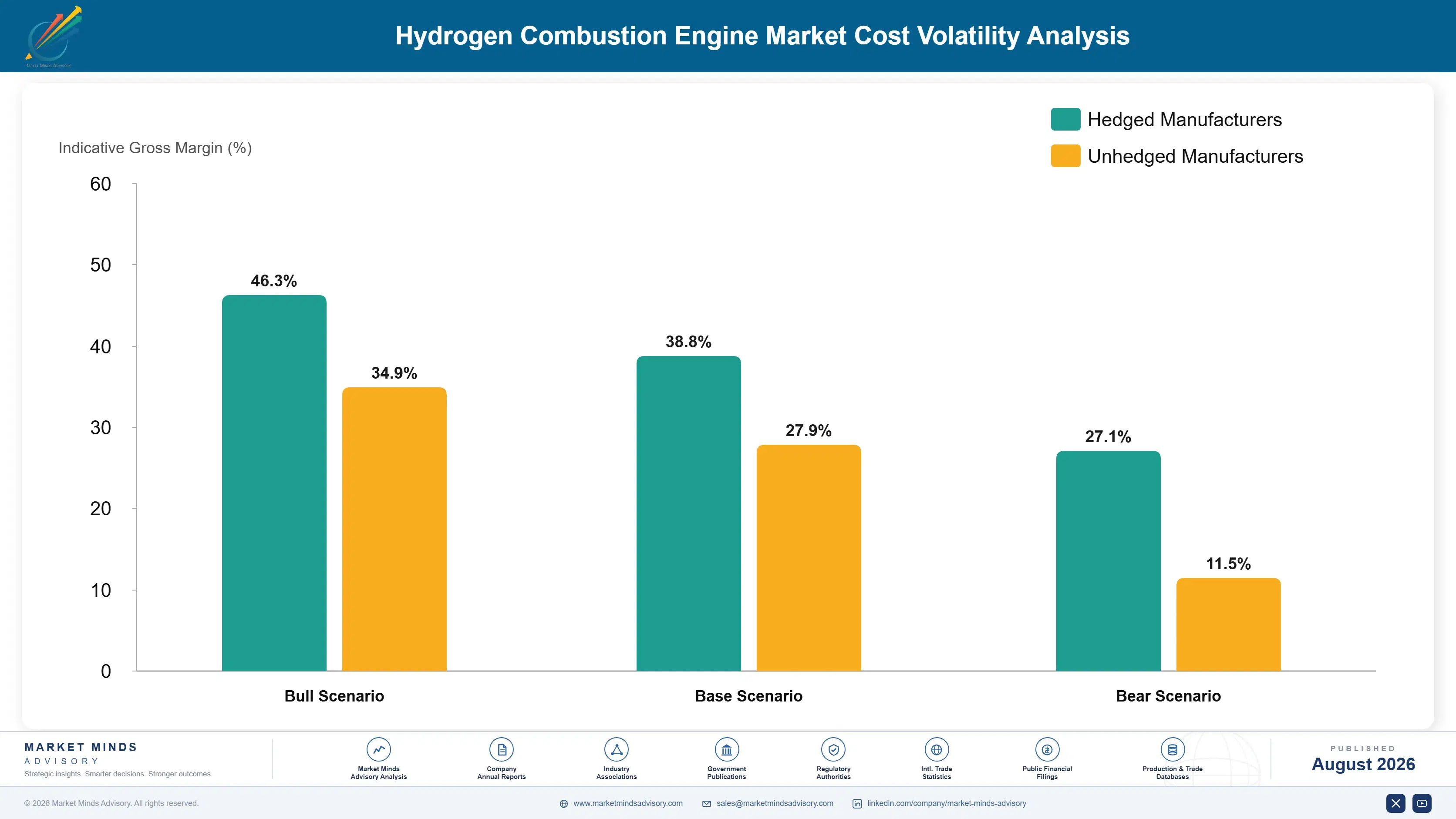
Fuel injection systems and NOx aftertreatment components together account for roughly 44 percent of hydrogen combustion engine cost of goods sold, with specialized injector manufacturing concentrated among a small number of suppliers who have adapted diesel injection technology for hydrogen's combustion characteristics. Injector sourcing is the sharper constraint, since qualifying a hydrogen-specific injector takes considerably longer than sourcing conventional diesel components.
Hydrogen fuel injector supply became a genuine bottleneck during 2023 and 2024 as pilot demand outpaced available manufacturing capacity, pushing lead times out substantially according to industry capacity tracking data collected across major suppliers. Bosch's 2024 annual report cited hydrogen component development costs as a factor affecting near-term margins in its powertrain segment despite growing order volume, and several suppliers announced dedicated capacity expansion investments specifically in response to the constraint.

The disadvantage falls hardest on smaller makers without in-house fuel system development or long-term supply agreements. Cummins and Bosch, with scale to invest in dedicated manufacturing, absorb demand surges more smoothly than smaller manufacturers dependent on third-party suppliers. That gap widens further for manufacturers without diversified sourcing, who face both capacity constraints and quality variability.
hydrogen-combustion-engine-market-cost-volatility-analysis-1787300969509

Expanding In-House Hydrogen Injector Manufacturing

Leading engine makers are investing directly in dedicated hydrogen fuel injector manufacturing capacity rather than relying entirely on third-party component suppliers, reducing exposure to capacity constraints during periods of surging pilot demand. Bosch and Cummins have both announced expansion investments since 2023, and several suppliers are qualifying secondary manufacturing partners to build supply chain redundancy.

Diversifying Fuel System Component Sourcing

Several engine makers have moved to qualify multiple hydrogen fuel injector and component suppliers rather than relying on a single manufacturer, reducing exposure to any one supplier's capacity constraints or quality issues. This diversification adds modest coordination complexity but meaningfully reduces the risk of a single manufacturing disruption affecting an entire engine platform's availability across major markets.

Building Long-Term Capacity Reservation Agreements

Leading engine makers are negotiating long-term capacity reservation agreements with component manufacturers, securing guaranteed production slots ahead of anticipated demand rather than competing for available capacity on the spot market during periods of industry-wide tightness. This approach requires accurate demand forecasting but provides meaningfully more supply certainty than spot market purchasing offers most smaller competitors relying on shared capacity.

Portfolio Architecture for Margin Defence

The portfolio splits into three tiers. Commodity converted diesel platforms and basic aftertreatment systems sit at the volume base with thin margins, competing on price and delivery reliability. Premium purpose-built engines and captive fleet infrastructure partnerships occupy the middle tier, commanding stronger margins through validated performance. Marine and off-highway platform licensing and service contracts sit at the top, where margins run richest and competitive intensity stays lowest
The tension between volume and premium runs through how engine makers allocate investment. Conventional conversion work requires steady throughput to cover fixed costs, pulling suppliers toward volume even as growth slows, while next-generation combustion chemistry and infrastructure partnerships demand sustained investment that only pays off once adoption scales. Makers that lean too far toward either extreme risk losing either the cash generation volume provides or the margin growth premium platforms deliver.

High-value margin pools concentrate in captive fleet infrastructure partnerships and marine platform licensing, where technical barriers keep competition thin and operators pay premium prices for validated performance. That concentration is likely to deepen as heavy-duty decarbonization regulation continues expanding beyond the European Union.

Volume / Commodity-Adjacent Tier

Commodity diesel-to-hydrogen engine conversions and basic aftertreatment systems sold primarily on price and delivery reliability to a broad base of conventional fleet operators worldwide, where switching suppliers costs little beyond requalification.
Gross Margin: 9%-15%

Premium / Certified Tier

Purpose-built hydrogen combustion engines and captive fleet infrastructure partnerships sold with technical support to fleet operators advancing decarbonization compliance timelines, priced to reflect the validation investment and engineering work involved.
Gross Margin: 22%-30%

Sustainability / Regulatory / Next-Generation Tier

Marine and off-highway platform licensing agreements and fleet performance service contracts built for operators requiring validated technology and integrated infrastructure support at full commercial operating scale across every duty cycle.
Gross Margin: 32%-42%
hydrogen-combustion-engine-market-portfolio-architecture-1787300970013

High-value Sub-segments and Strategic Watch-out

Marine Propulsion Platform Licensing

Shipping decarbonization mandates are forcing marine operators to specify validated hydrogen combustion platforms with limited existing supplier competition at commercial scale. Qualification barriers keep the field narrow, and volume is expanding faster than almost any other category tracked in this report worldwide today across every duty cycle.
Gross Margin: 32%-42%

Captive Fleet Infrastructure Partnerships

Recurring infrastructure partnership revenue attached to captive fleet transitions grows steadily as more construction and mining operators commit to hydrogen combustion. Growth is moderate compared with marine platforms but margins are among the richest in the portfolio once expertise is built, and renewal rates run high.
Gross Margin: 30%-38%

Commodity Diesel-to-Hydrogen Conversions

The largest revenue base by volume, sold into conventional fleet operators worldwide on price and delivery reliability. Growth tracks fleet capital spending closely and margins stay thin, but the segment funds purpose-built platform development across the portfolio, making it strategically indispensable despite its low relative margins.
Gross Margin: 9%-15%

Chinese Domestic Engine Exports

Chinese manufacturers led by Weichai are exporting increasingly credible hydrogen combustion engines at prices well below Western equivalents, initially into Southeast Asia and Africa. If technical gaps close further, this segment could pressure premium pricing industry-wide within the decade, particularly in commodity conversion categories where differentiation is already thin.
Gross Margin: 14%-22%

Recurring Service Revenue Inside Every Fleet

Hydrogen combustion engines generate revenue closer to an annuity than a one-time sale once infrastructure partnerships and service contracts are included, since every operating fleet consumes another cycle of maintenance and catalyst replacement regardless of near-term capital spending volatility. That repeat-purchase dynamic gives engine makers more predictable revenue than headline volatility alone would suggest, provided their platform stays specified into a fleet's equipment roster.
Adoption depth varies sharply by fleet type. Captive fleet operators sign multi-year infrastructure agreements that lock in preferred engine makers across their depot network, creating high switching costs once refueling infrastructure is built around a platform. On-highway trucking fleets behave differently, evaluating powertrain options more transactionally, which keeps competition sharper but limits how much recurring revenue any maker can count on from that segment today.

A generational shift in buyer profiles is underway as fleet engineers who trained on alternative powertrains replace an older generation familiar exclusively with diesel systems. That shift favors makers with strong hydrogen combustion technology over those competing purely on diesel reliability, and it is reshaping which suppliers get invited to participate in new fleet technology selection.
hydrogen-combustion-engine-market-end-use-penetration-index-1787300970501

Where MMA Sees the Opportunity

These are among the four positions where our research anticipates prominent divergence between winners and laggards over the coming forecast period. Each is grounded in the demand model, the regulatory perimeter, and the announced capacity pipeline.
01 / CAPTIVE FLEET PRIORITY

Prioritize captive fleet applications over on-highway trucking initially

Marine and off-highway applications are growing considerably faster than on-highway trucking because captive fleet operators can solve refueling infrastructure at a single depot rather than requiring public network buildout, removing the problem that constrains broader hydrogen adoption. Engine makers that concentrate commercial development on captive fleet applications first can generate real-world performance data and revenue faster than competitors waiting for on-highway infrastructure to mature. MMA recommends prioritizing marine and off-highway commercial programs over on-highway trucking development until public refueling infrastructure reaches sufficient density to support that larger but infrastructure-dependent market.
02 / INFRASTRUCTURE PARTNERSHIP EXPANSION

Build infrastructure partnership capability to capture premium pricing

Infrastructure partnership services command meaningful pricing premiums over standalone engine sales, and engine makers without this capability are increasingly excluded from captive fleet transitions where operators need a single accountable partner for both engine and refueling infrastructure. Suppliers like Deutz that have already built infrastructure partnership capability are capturing disproportionate share of new captive fleet commitments as a result. MMA recommends building or partnering into infrastructure development capability rather than continuing to compete purely on engine specifications and price alone.
03 / NOX AFTERTREATMENT BUNDLING

Bundle validated aftertreatment systems with every engine sale

Bundled aftertreatment sales command a meaningful premium over engines sold without integrated emissions control, since fleet operators new to hydrogen combustion value having a single accountable supplier rather than managing multiple vendor relationships during an unfamiliar technology transition. Engine makers without bundled aftertreatment capability risk losing deals to competitors like Cummins and Deutz that already offer integrated systems. MMA recommends developing bundled aftertreatment capability now, before competitors establish this as a standard customer expectation rather than a differentiator worth paying extra to secure.
04 / CHINESE EXPORT DEFENSE

Defend Western technology lead against rising Chinese engine exports

Chinese manufacturers led by Weichai are exporting increasingly credible hydrogen combustion engines into Southeast Asia and Africa at prices Western suppliers struggle to match, benefiting from domestic manufacturing scale and supportive national hydrogen policy. If that price and technology gap continues narrowing, Western engine makers risk losing share in price-sensitive emerging markets faster than premium captive fleet and marine growth can offset. MMA recommends accelerating technology differentiation and infrastructure partnership capability rather than competing on price alone against lower-cost Chinese alternatives.

Engagement Snapshot From the Field

A live engagement with an industry participant carrying material or product regulatory and market exposure ahead of a defining policy shift, showing how our research translates into a defensible multi-year portfolio strategy.
MARKET MINDS ADVISORY · CLIENT ENGAGEMENT SUMMARY
Hydrogen Combustion Engine Producer Strategic Portfolio Review and Transition Roadmap 2026·Investment Scenario on Hydrogen Combustion Engine Exposure Evaluation 2025-26
CLIENT PROFILE
The client is a regional construction and mining equipment fleet operator running approximately 180 pieces of heavy equipment across five job sites, reporting approximately 65 million dollars in annual fuel and equipment maintenance spend (client-reported, unverified by MMA). The company faced rising diesel fuel costs and tightening emissions regulations at several job sites and was evaluating whether to pilot hydrogen combustion equipment at its largest, most centralized site.
STRATEGIC CHALLENGE
Leadership needed to determine whether piloting hydrogen combustion equipment at a single centralized site would generate enough operational learning to justify the infrastructure investment required, or whether waiting for the technology and refueling infrastructure to mature further offered a lower-risk path forward given the client's constrained capital budget for equipment upgrades.
MMA APPROACH
MMA benchmarked total cost of ownership and infrastructure investment requirements across comparable construction fleet hydrogen combustion pilots already underway in Europe, modeling total cost and operational risk under pilot versus wait-and-see scenarios. The engagement combined primary interviews with two engine maker technical teams and secondary analysis of comparable pilot program outcomes to inform the client's decision.
KEY FINDINGS
  1. Dedicated depot refueling infrastructure at the client's largest site would cost approximately 8 million dollars, recoverable over an estimated six years at current diesel price differentials (client-reported, unverified by MMA).
  2. Hydrogen combustion equipment carried a 22 percent upfront price premium over comparable diesel equipment, though maintenance costs ran comparably given the familiar engine architecture (client-reported, unverified by MMA).
  3. Peer construction fleet operators that piloted hydrogen combustion equipment reported meaningful operator and technician acceptance given the familiar maintenance requirements compared with battery-electric alternatives.
  4. Regional hydrogen fuel supply agreements were available at a negotiated price point that meaningfully improved projected total cost of ownership compared with spot market hydrogen pricing (client-reported, unverified by MMA).
CLIENT PROFILE
The client is a regional construction and mining equipment fleet operator running approximately 180 pieces of heavy equipment across five job sites, reporting approximately 65 million dollars in annual fuel and equipment maintenance spend (client-reported, unverified by MMA). The company faced rising diesel fuel costs and tightening emissions regulations at several job sites and was evaluating whether to pilot hydrogen combustion equipment at its largest, most centralized site.
STRATEGIC CHALLENGE
Leadership needed to determine whether piloting hydrogen combustion equipment at a single centralized site would generate enough operational learning to justify the infrastructure investment required, or whether waiting for the technology and refueling infrastructure to mature further offered a lower-risk path forward given the client's constrained capital budget for equipment upgrades.
MMA APPROACH
MMA benchmarked total cost of ownership and infrastructure investment requirements across comparable construction fleet hydrogen combustion pilots already underway in Europe, modeling total cost and operational risk under pilot versus wait-and-see scenarios. The engagement combined primary interviews with two engine maker technical teams and secondary analysis of comparable pilot program outcomes to inform the client's decision.
KEY FINDINGS
  1. Dedicated depot refueling infrastructure at the client's largest site would cost approximately 8 million dollars, recoverable over an estimated six years at current diesel price differentials (client-reported, unverified by MMA).
  2. Hydrogen combustion equipment carried a 22 percent upfront price premium over comparable diesel equipment, though maintenance costs ran comparably given the familiar engine architecture (client-reported, unverified by MMA).
  3. Peer construction fleet operators that piloted hydrogen combustion equipment reported meaningful operator and technician acceptance given the familiar maintenance requirements compared with battery-electric alternatives.
  4. Regional hydrogen fuel supply agreements were available at a negotiated price point that meaningfully improved projected total cost of ownership compared with spot market hydrogen pricing (client-reported, unverified by MMA).
RECOMMENDED STRATEGY
Phase 1: Phase 1 (Months 1 to 6): Build dedicated hydrogen refueling infrastructure at the client's largest, most centralized job site ahead of equipment delivery. Phase 2: Phase 2 (Months 7 to 18): Deploy a pilot fleet of hydrogen combustion equipment at that site, benchmarking performance against comparable diesel equipment. Phase 3: Phase 3 (Months 19 to 36): Evaluate expansion to additional job sites based on pilot performance data and evolving regional hydrogen fuel supply economics.
OUTCOME
Within the first year of pilot deployment, the client reported operational performance comparable to diesel equipment with meaningfully lower emissions-related compliance costs at its most heavily regulated site (client-reported, unverified by MMA). The company has since committed to expanding hydrogen combustion equipment to two additional job sites based on the pilot's operational results.

Frequently Asked Questions

Foundational context covering the market sizes, CAGR, scope, country, region and competition that inform every finding below. This section is provided to cover basics and most often pre-purchase conversations, answered from the MMA Primary Research Dataset.

What is the current size of the Hydrogen Combustion Engine Market?

The global hydrogen combustion engine market was valued at approximately 1.8 billion dollars in 2025. Growth is driven primarily by heavy-duty decarbonization regulation and captive fleet infrastructure economics.

How large will the Hydrogen Combustion Engine Market be by 2036?

MMA forecasts the market reaching approximately 6.0 billion dollars by 2036, roughly 2.97 times its 2026 value. Marine propulsion and off-highway applications account for much of that growth.

What is the CAGR for the Hydrogen Combustion Engine Market 2026 to 2036?

The market is projected to grow at an 11.5 percent compound annual rate over the forecast period. Bull and bear scenarios range from 10.2 to 12.8 percent depending on regulatory enforcement pace.

Which segment is growing fastest?

Marine propulsion engines are the fastest-growing segment, expanding at roughly 1.35 times the overall market rate. Shipping decarbonization mandates and route-based refueling economics are the primary drivers.

Who are the major companies in the Hydrogen Combustion Engine Market?

Cummins, Deutz, Weichai, Volvo Group, and Bosch lead the market on a revenue basis. Together they hold well over half of global revenue in a still-concentrated field.

Which country is growing fastest?

Germany is the fastest-growing country, driven by its established diesel engine manufacturing heritage and European Union hydrogen corridor policy. Domestic engine makers are scaling commercial production quickly.

Report Segmentation Architecture

The full report scope spans multiple orthogonal segmentation dimensions, with cross-tabulated demand data provided for each dimension pair. Coverage extends further to regional breakdowns, trend trajectories, and the competitive detail needed to support segment-level decision-making.

By Application

  • Heavy-Duty On-Highway Truck Engines
  • Off-Highway and Construction Equipment Engines
  • Marine Propulsion Engines
  • Stationary Power Generation Engines
  • Rail Locomotive Engines
  • Agricultural Equipment Engines

By End-Use Industry

  • Construction and Mining
  • Marine and Shipping
  • Power Generation Utilities
  • Freight and Logistics
  • Agriculture

By Commercial Model

  • Direct Engine Sale
  • Retrofit Conversion Kit
  • Infrastructure Partnership Service
  • Fleet Performance Service Contract

By Region

  • North America
  • Western Europe
  • East Asia
  • South Asia and Pacific
  • Latin America
  • Middle East and Africa
  • Eastern Europe

Scope, Methodology, and Coverage

Every figure in this report is reproducible from documented input assumptions. The scope below maps the historical period, the forecast horizon, the segmentation dimensions, and the countries covered, alongside the underlying primary and qualitative methodology.
Historical Period
2020 to 2025
Forecast Period
2026 to 2036
Base Year
2025 (USD billions; MMA Primary Research Dataset, August 2026)
Market Definition
The hydrogen combustion engine market covers internal combustion engines modified or purpose-built to run on hydrogen fuel across heavy-duty on-highway trucks, off-highway and construction equipment, marine propulsion, stationary power generation, rail locomotives, and agricultural equipment. It excludes hydrogen fuel cell systems, battery-electric powertrains, and hydrogen production and refueling infrastructure.
Quantitative Units
USD billions (current prices); unit shipments and installed engine base where applicable
Segmentation Dimensions
By Application; By End-Use Industry; By Commercial Model; By Region
Regions Covered
North America, Western Europe, East Asia, South Asia and Pacific, Latin America, Middle East and Africa, Eastern Europe
Countries Covered
USA, China, Germany, France, UK, Japan, South Korea, India, Australia, Canada, Brazil, Mexico, Indonesia, Vietnam, Thailand, Malaysia, UAE, Saudi Arabia, South Africa, Nigeria, Turkey, Poland, Netherlands, Italy, Spain, Sweden, Switzerland, Argentina, Colombia, Singapore, and additional markets relevant to this sector
Key Companies Profiled
Cummins, Deutz, Weichai, Volvo Group, Bosch, MAN Truck & Bus, Wartsila, Yanmar, Toyota, Hyundai Motor Group, Doosan Infracore, Caterpillar, Liebherr, JCB, Kawasaki Heavy Industries, Rolls-Royce Power Systems, AVL List, Westport Fuel Systems, Bharat Forge, Eicher Motors
Quantitative Methodology
Primary survey, n=3,800 respondents, Q4 2025, six countries; demand-side model with trade association cross-validation
Qualitative Methodology
47 expert interviews, Q4 2025; applied to validate demand model assumptions, identify emerging dynamics, and assess competitive positioning
Report Format
PDF and XLSX data workbook (Word format preview document)
Publisher
Market Minds Advisory
Report Code
MMA-2026-AUT-101
Published
August 2026
Contact
sales@marketmindsadvisory.com | www.marketmindsadvisory.com

Purchase the full Hydrogen Combustion Engine Market Report (2026 to 2036).

The full report provides detailed sizing and ten-year forecasts for each of the six application categories tracked in this analysis, alongside country-level detail across thirty markets. It includes a complete competitive benchmarking of the top twenty engine makers on a revenue basis, with moat and risk analysis for the two market leaders. The report also contains a dedicated fuel system component cost and supply chain risk assessment, plus scenario modeling across bull, base, and bear cases through 2036. Buyers receive access to the underlying primary survey and expert interview datasets referenced throughout the analysis.
Ten-year forecasts across all six application categories
Competitive benchmarking of twenty profiled engine makers
Fuel injection and aftertreatment supply chain analysis
Bull, base, and bear scenario modeling through 2036
Country-level sizing across thirty tracked national markets
Access to underlying primary survey and interview data

Built For The People Who Decide

From boardroom strategy to bench-side execution, this report is read cover-to-cover by leaders shaping the next decade of their industry, turning demand scenarios, market dynamics and valuation benchmarks into decisions.
CXOs/ Presidents/ VPs/ Managers
M&A and Corporate Development
Strategy Teams and R&D Heads
Procurement and Product Directors
Regulatory and Compliance Leaders
Investor Relations and Equity Analysts