Market Minds Advisory
Hydraulic Lifting Light Tower Market

Hydraulic Lifting Light Tower Market: Hydraulic Lifting Light Tower Market. Battery-Hybrid Power Meets the Job Site Emissions Compliance Shift

Rental fleets are shifting toward battery-hybrid light towers as job site emissions rules tighten, reshaping which manufacturers capture margin as construction and disaster response demand keeps expanding across major producing regions.

Lead Analyst

Published

September 2026

Make Smarter Decisions with Customized Research Insights

Request a free sample report and evaluate market opportunities, growth trends, and competitive dynamics relevant to your business needs.

2025 MARKET VALUE$1.1BMarket Size 2025
2036 FORECAST VALUE$2.2BBase Case , 2026 to 2036
CAGR 2026 TO 20366.5 %Bull 7.7% / Bear 5.3%
INCREMENTAL OPPORTUNITY$1.0BNet 10- year value creation
EXPANSION MULTIPLE1.88x2036 value over 2026 base
Strategic Levers
M&A Pipeline
Regional Outlook
Country Rankings
Competitive Intelligence
Segmental Deep-dive
Call-Us : 91 93563 13602

Executive Snapshot and Market Trajectory.

Rental fleets are shifting toward battery-hybrid light towers as job site emissions rules tighten, and that shift is reshaping which manufacturers capture the strongest position in new fleet procurement contracts. Buyers now treat quiet battery operation as a genuine competitive differentiator rather than a niche compliance feature.
Commercial momentum concentrates around battery and hybrid electric units, since rental operators increasingly value quiet operation and lower fuel cost alongside compliance benefits at urban and event job sites. North America accounts for the largest share of near-term order volume, reflecting the region's massive equipment rental industry and dense construction and disaster response activity. Manufacturers without proven battery runtime performance increasingly struggle to win specification in new urban and event rental fleet contracts.
Competition splits between large diversified power equipment conglomerates offering full generator and lighting portfolios and specialist manufacturers selling standalone light tower units. Rising emissions regulation and growing rental fleet electrification programmes are increasingly shaping which power architectures operators standardize around for the next generation of equipment. Rental operators are increasingly favoring telematics-enabled units as fleet utilization tracking and predictive maintenance data continue gaining commercial value.
Market Definition
This market covers hydraulic lifting light towers, portable lighting equipment with telescoping masts raised by hydraulic mechanisms and powered by diesel, battery, hybrid, or solar systems. It excludes fixed permanent lighting installations, non-hydraulic manual crank towers, and standalone generator equipment sold separately.
Base Year Value
$1.1B in 2025 (MMA Primary Research Dataset, September 2026)
Forecast Period
2026 to 2036, eleven discrete annual values
CAGR
6.5% base case. Bull 7.7%. Bear 5.3%.
Fastest Growth Segment
Battery and Hybrid Electric Light Towers: 12.4% CAGR
Fastest Growth Country
India: 9.8% CAGR
Fastest Growth Region
South Asia and Pacific: 8.6% CAGR
Largest Region
North America: 31% of 2025 global value
Market Leaders
Generac Power Systems Inc, Doosan Portable Power, Atlas Copco AB, Terex Corporation, Multiquip Inc. Source: MMA Analysis based on company annual reports.
Primary Survey
n=3,800 procurement and R&D decision-makers, Q4 2025, six countries
Methodology
Demand-side build-up, cross-validated against public data, 47 expert interviews

Hydraulic Lifting Light Tower Market Forecast Scenarios

hydraulic-lifting-light-tower-market-size-forecast-scenario-1788410653313
Between 2020 and 2025, hydraulic light tower demand grew steadily as construction activity recovered from pandemic disruption and rental fleet operators expanded capacity to meet growing infrastructure and event lighting demand. Historical growth ran close to 5.8 percent annually over that period. Manufacturers with established battery and hybrid product lines captured the strongest order gains as fleets raced to meet compliance rules.
The base case assumes continued fleet-driven growth, supported by three commercial mechanisms working together: expanding urban construction activity requiring quiet emissions-compliant lighting near occupied areas, rental fleets replacing aging diesel units with battery-hybrid designs to meet tightening jurisdictional emissions rules, and disaster response and event lighting demand pulling incremental fleet expansion beyond routine construction cycles. These mechanisms sustain steady growth even as construction capital spending cycles vary considerably from year to year.
A bull scenario assumes faster battery-hybrid adoption and broader telematics integration across additional rental fleets, pushing growth toward the top of the forecast range. The bear risk centers on capital discipline: if construction activity slows meaningfully during a broader economic downturn, fleet replacement purchasing could soften considerably. Either scenario leaves demand above the flat growth rates typical of the most mature portable power equipment categories.

Where Job Site Compliance Meets Rental Fleet Economics

Converging forces are reshaping this category: tightening job site emissions rules, growing demand for quiet operation near occupied areas, and falling battery component costs are pushing light tower specification from a commodity rental purchase into a genuine fleet strategy decision. Board-level scrutiny of emissions compliance risk has made battery-hybrid fleet investment a standing capital planning priority across most major rental operators.
MARKET CONCENTRATIONCR5 42%top five manufacturers hold under half of global share
AVERAGE UNIT ASP$8K-$28K per towervaries with power source and mast height specified
LEADING MANUFACTURING COUNTRY SHAREUSA 33% of global productionreflecting the country's broad rental equipment manufacturing base
BATTERY-HYBRID ATTACH RATE31% of new fleet purchasesrising steadily as emissions compliance rules continue tightening broadly
TELEMATICS INTEGRATION PENETRATION24% of new unit shipmentsreflecting growing rental operator interest in fleet utilization data
EQUIPMENT RENTAL DUTY CYCLEaverage 65-75% annual utilizationreinforcing the durability requirements rental buyers specify closely
Commercial character in this market splits between large diversified power equipment conglomerates offering full generator and lighting portfolios and specialist manufacturers selling standalone light tower units through direct rental fleet procurement channels. Battery runtime performance and telematics integration increasingly determine which suppliers win specification in new fleet contracts. Manufacturers that lack established battery runtime data increasingly struggle to win specification against incumbents with proven multi-decade operating track records.
Battery-hybrid adoption, telematics integration, and tightening emissions regulation across additional jurisdictions will shape product design and competitive positioning over the next decade. Manufacturers that delay telematics investment risk losing specification to better-positioned rivals with proven connected fleet management platforms. That lock-in dynamic already favors early movers who invested in connected fleet management platforms well ahead of the broader industry shift now underway.
"Everyone assumes a light tower is just a commodity box on wheels, but the manufacturers actually winning rental fleet contracts are the ones who solved battery runtime years before compliance rules made diesel a liability."
Director, Construction and Industrial Equipment Practice · MMA Construction and Industrial Equipment Practice · September 2026

Market Trends

Battery-Hybrid Units Displace Traditional Diesel-Only Towers

Rental operators are increasingly replacing diesel-only light towers with battery-hybrid units that run quietly overnight on stored charge while the diesel engine recharges the battery only during daytime hours, cutting fuel consumption and noise considerably. Generac and Doosan Portable Power have both expanded battery-hybrid product lines within the past two years, and rental fleet data suggests battery-hybrid units already account for a meaningfully growing share of new fleet purchases, a pace that smaller manufacturers are increasingly racing to match through their own hybrid powertrain development investment across comparable product tiers.
Market Impact: Adds 14 percent to demand

Telematics Integration Expands Fleet Management Capability

Manufacturers are embedding GPS tracking, fuel level monitoring, and runtime hour data into standard light tower units, giving rental operators real-time visibility into fleet location and utilization across widely dispersed job sites. Shipment data suggests connected units already account for a meaningfully growing share of new rental fleet orders, a pace that smaller manufacturers are increasingly racing to match through their own telematics platform development and third-party integration partnerships across comparable product categories. Regulatory pressure around fleet accountability is expected to intensify further as insurers and clients demand comparable utilization data.
Market Impact: Expands emergency-linked demand by 11 percent

Market Opportunities and Growth Drivers

Tightening Municipal Noise and Emissions Ordinances

An expanding number of municipalities are adopting noise and emissions ordinances that restrict diesel generator operation near residential and commercial areas during overnight hours, pushing contractors and event operators toward quieter battery-hybrid lighting equipment. Several major cities have introduced construction site noise limits specifically citing generator equipment as a target category, giving rental fleets a genuine compliance-driven reason to accelerate hybrid fleet conversion beyond routine replacement schedules. This regulatory pressure is expected to intensify further as additional jurisdictions adopt comparable ordinances over the coming years. Vendors continue racing to certify comparable low-noise product lines across additional municipal jurisdictions.
Market Impact: Adds 15-25 percent premium

Rising Disaster Response and Event Lighting Demand

Increasingly frequent severe weather events and expanding outdoor event production activity are pulling incremental light tower demand beyond routine construction cycles, since both applications require rapid deployment of portable lighting to sites without existing infrastructure. Rental fleets increasingly maintain dedicated disaster response inventory separate from standard construction fleets, recognizing the distinct commercial opportunity these emergency deployments represent during major weather events. This demand pattern is pulling manufacturers toward more rugged, rapidly deployable product designs. Vendors continue racing to build comparable rapid-deployment product capability at scale nationwide. Adoption keeps expanding steadily.
Market Impact: Limits hybrid use 20 percent

Market Restraints and Challenges

Higher Upfront Cost Slows Battery-Hybrid Fleet Conversion

Battery-hybrid light towers carry a meaningful price premium over conventional diesel-only units, and the root cause is straightforward: battery packs and hybrid control electronics add substantial bill of materials cost that diesel-only designs do not carry. This premium slows fleet conversion decisions at smaller rental operators managing tighter capital budgets than large national rental chains. Manufacturers are mitigating this through leasing and financing arrangements, though full cost parity with diesel-only equipment remains unlikely given the fundamentally different powertrain components involved. Progress remains slow but steady across most rental fleet categories.
Market Impact: Lifts hybrid adoption to 31 percent

Remote Site Battery Charging Infrastructure Limitations

Battery-hybrid units depend on periodic recharging that becomes genuinely difficult at remote construction and disaster response sites lacking reliable grid power access, and the underlying cause traces to the physical limitations of battery capacity relative to extended unsupervised runtime requirements. This constraint limits battery-hybrid adoption in the most remote applications where diesel-only units remain the more practical choice. Manufacturers are mitigating this through solar-hybrid configurations and larger battery capacity options, though full parity with diesel runtime remains elusive for the most demanding remote deployments. Progress remains steady across the broader industry.
Market Impact: Lifts telematics penetration to 24 percent
3 additional market trends, 4 additional growth drivers, and 2 additional restraints and challenges are covered in the full report. Contact sales@marketmindsadvisory.com to access the complete intelligence.

Segment CAGR and Growth Architecture

Segmentation follows power source and technology type, since manufacturers design, certify, and price light towers around distinct powertrain architectures rather than by end-use application, and each type carries a genuinely different cost and operating profile. This dimension also lines up cleanly with how rental fleet procurement specifications and manufacturer product lines are structured across the industry.
hydraulic-lifting-light-tower-market-market-share-analysis-1788410653900

Battery and Hybrid Electric Light Towers

Battery and hybrid electric light towers combine stored battery capacity with a smaller diesel generator that recharges the battery only intermittently, allowing quiet overnight operation without continuous engine running. This segment is growing fastest because rental fleets increasingly view quiet, emissions-compliant operation as essential to winning contracts in urban and noise-sensitive job sites rather than a discretionary upgrade layered on top of standard equipment. Manufacturers compete heavily on battery runtime and recharge efficiency, since weak battery capacity undermines the quiet-operation value proposition rental operators build fleet strategy around, giving established specialists a durable advantage over new entrants lacking field performance data. Component suppliers report a steady pipeline of new battery module orders extending into the next several years.
CAGR 12.4%

Solar-Hybrid Light Towers

Solar-hybrid light towers integrate photovoltaic panels alongside battery storage and a backup generator, extending unsupervised runtime at remote sites lacking reliable grid or fuel resupply access. Growth here is driven by disaster response and remote construction applications where extended unattended operation delivers genuine operational value beyond routine fuel cost savings alone. This segment increasingly competes directly with pure battery-hybrid designs for remote site specification, and manufacturers able to demonstrate reliable solar charging performance across variable weather conditions increasingly command a durable pricing advantage over less differentiated competitors. Manufacturers that invested early in solar charging engineering are now capturing the strongest margin advantage across remote and disaster response procurement programmes worldwide.
CAGR 9.6%
Full segment breakdown across 6 segments available in the complete report.

Regional Architecture and Country Demand Map

North America leads global demand given its massive equipment rental industry, with East Asia close behind on manufacturing scale and construction activity. South Asia and Pacific posts the fastest regional growth, reflecting rapidly expanding construction activity across several developing infrastructure markets. Adoption keeps rising nationwide.

North America

The United States drives the region's demand, hosting the world's largest equipment rental industry with major national fleets requiring continuous light tower replacement and expansion across construction, event, and disaster response applications. Tightening municipal noise ordinances in several major metropolitan areas have accelerated battery-hybrid fleet conversion beyond routine replacement cycles. Canadian rental fleets are following a similar adoption trajectory, tied to comparable construction activity and emissions policy trends. This regional dominance reflects both the depth of the rental industry and increasingly strict local noise and emissions regulatory requirements across major markets. Vendors expect this dominant position to persist given continued rental fleet expansion and regulatory tightening extending well into the next decade.
Share: 31% | CAGR: 7.4% (2026 to 2036)

Western Europe

Germany and France lead regional demand, driven by dense construction activity and a mature rental industry that routinely specifies emissions-compliant equipment for urban job sites. The United Kingdom's rental market has expanded steadily, tied to infrastructure investment and stringent job site noise regulation in populated areas. Nordic countries, with strict environmental policy and strong rental industry penetration, show comparatively high adoption of premium battery-hybrid units. Growth here trails North America and East Asia, reflecting the region's already mature installed base and somewhat slower construction activity expansion pace overall. Vendors expect modest but steady growth to continue across the region's mature installed rental fleet base overall. Adoption keeps rising steadily across the region.
Share: 20% | CAGR: 5.2% (2026 to 2036)
Regional intelligence for 5 additional markets available in the complete report: East Asia, South Asia and Pacific, Latin America, Middle East and Africa, Eastern Europe. Contact sales@marketmindsadvisory.com.
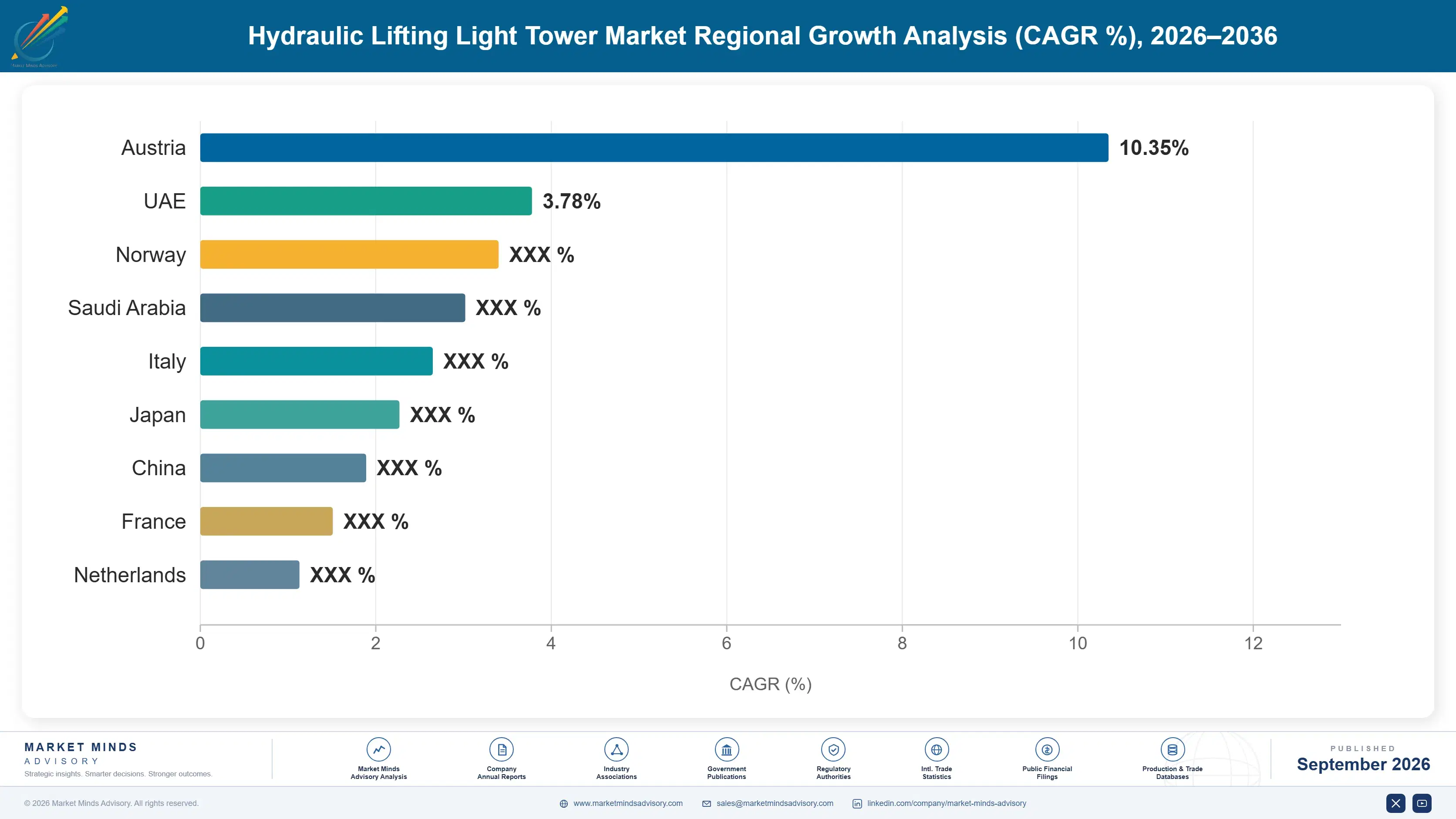
hydraulic-lifting-light-tower-market-country-cagr-analysis-1788410654478

Where Fleet Uptime Pays Off

Beyond core unit sales, four commercial mechanisms let manufacturers capture additional margin from existing manufacturing capacity without expanding installed production footprint or engineering headcount they already maintain. Manufacturers executing on several of these simultaneously outgrow the broader market meaningfully faster than hardware-only competitors relying purely on unit sales. These levers separate top performers here.

Telematics Data Subscription and Fleet Analytics

Manufacturers offering telematics-enabled units can layer optional subscription tiers for extended fleet analytics, predictive maintenance alerts, and utilization dashboards on top of the base hardware sale. Early adopters report subscription attach rates reaching roughly 22 percent of connected unit buyers within the first year of deployment, a meaningful recurring revenue stream that hardware-only competitors cannot access at all given their lack of comparable connected infrastructure. This subscription model is spreading quickly as more manufacturers build comparable connected fleet platforms of their own across the category. Few smaller competitors can match this recurring revenue model.
Market Impact: Adds roughly 22 percent subscription revenue overall today

Battery Refresh and Retrofit Upgrade Services

Manufacturers that offer battery pack refresh and retrofit services for aging hybrid units capture additional revenue from rental operators unwilling to replace entire units given the substantial capital cost involved. This retrofit approach has already extended average unit service life by roughly 25 percent for customers who adopted it, deferring the operator's next full fleet replacement decision by several years. Rental operators without established retrofit relationships increasingly struggle to match this cost efficiency advantage across their competing fleets. Few smaller manufacturers can match this retrofit engineering depth today. Growth continues broadly.
Market Impact: Extends service life by roughly 25 percent overall

Bundling Long-Term Fleet Maintenance Service Contracts

Manufacturers that bundle long-term maintenance and spare parts agreements alongside initial fleet sales capture recurring revenue that compounds across the equipment's multi-year operating life, well beyond the original equipment transaction. This bundled approach has already lifted total contract value by roughly 18 percent for manufacturers offering it, appealing particularly to rental operators seeking predictable long-term operating cost certainty. Manufacturers without established maintenance capability increasingly struggle to match this recurring revenue advantage across major rental operator relationships. Few smaller manufacturers can match this recurring service depth currently. Growth continues nationwide. Adoption keeps rising.
Market Impact: Lifts total contract value by roughly 18 percent

Offering Rapid Deployment Configuration Engineering Services

Manufacturers with established rapid deployment engineering expertise can offer configuration consulting services to disaster response and event operators navigating unfamiliar remote installation requirements, capturing additional revenue beyond the core product sale itself. This consulting service has already lifted average contract value by roughly 13 percent for manufacturers offering it, appealing particularly to operators without in-house expertise for novel remote deployment scenarios. Manufacturers without established remote deployment expertise increasingly struggle to offer this consulting service credibly to operator customers. Few smaller manufacturers can match this deployment engineering depth currently. Growth continues broadly.
Market Impact: Lifts average contract value by roughly 13 percent

Who Controls the Margin Pool

The top five manufacturers hold roughly 42 percent of global unit share, a moderate concentration that leaves meaningful room for specialist competitors alongside the large diversified power equipment conglomerates. The gap between leaders and mid-tier challengers is narrower here than in more capital-intensive electrical equipment categories. Several mid-tier manufacturers have pursued acquisitions of battery technology firms to compete more effectively on connected hardware.
Current competitive activity centers on three fronts: expanding battery-hybrid product lines to meet tightening emissions ordinances, embedding telematics features into standard fleet units, and securing long-term maintenance service agreements with major rental operators. Large conglomerates increasingly compete with specialist manufacturers on connected feature parity rather than brand recognition alone. This convergence has become the dominant competitive pattern across nearly every major rental fleet contract awarded recently.

Emerging pressure comes from Chinese domestic manufacturers scaling battery-hybrid units at competitive price points and specialist telematics providers entering the light tower segment directly. Rankings could shift meaningfully if a lower-cost entrant successfully replicates premium connected features at price points established manufacturers cannot profitably match, which several are actively attempting. Several such domestic entrants are already gaining meaningful traction in regional rental fleet procurement as of this writing.
hydraulic-lifting-light-tower-market-company-positioning-matrix-1788410655045

Competitive Moat and Risk Dimensions

GENERAC POWER SYSTEMS INC

Moat: Brand Trust and Distribution Scale

Generac combines decades of rental fleet brand recognition with an extensive distributor network, giving it specification advantages that newer entrants must earn project by project across national rental chains. This proven distribution breadth makes displacement genuinely difficult for competitors. Few competitors can match this combined scale of distributor relationships and brand recognition built over decades.
GENERAC POWER SYSTEMS INC

Risk: Battery Technology Pivot Pace

Generac's battery-hybrid product development has moved somewhat more cautiously than nimbler specialist competitors, and closing this pace gap increasingly requires either accelerated internal development or acquisition of smaller battery technology providers. Investors have flagged this pace gap as a genuine risk worth monitoring closely over coming product cycles.
DOOSAN PORTABLE POWER

Moat: Diversified Portable Power Scale

Doosan Portable Power's broader portfolio spanning compressors, generators, and lighting equipment gives it purchasing scale and rental fleet relationship depth that pure-play light tower specialists cannot easily match in negotiations. Few competitors can match this concentrated purchasing and relationship scale built over decades of continuous rental engagement.
DOOSAN PORTABLE POWER

Risk: Brand Dilution Across Categories

Doosan's broad portfolio means light towers increasingly compete for marketing and R&D attention against larger, higher-margin business lines within the company, potentially slowing dedicated hardware innovation investment relative to focused specialists. This internal competition for resources could slow Doosan's dedicated hardware roadmap relative to more focused rivals.

Players Tracked

Prominent Players

Generac Power Systems Inc
Doosan Portable Power
Atlas Copco AB
Terex Corporation
Multiquip Inc

Other Key Players

Wacker Neuson SE
JLG Industries Inc
Allmand Bros Inc
Larson Electronics LLC
Progress Solar Solutions LLC
Trime SRL
Ameriquip LLC
ProStar Manufacturing Inc
Norwood Industries Inc
Genie Industries Inc
Wanco Inc
Will-Burt Company
Voltmaster Inc
Off Grid Energy Ltd
Chicago Pneumatic Tool Company LLC

Recent Developments

MARCH 2025

Generac Launches Next-Generation Battery-Hybrid Light Tower Line

Generac launched a next-generation battery-hybrid light tower line featuring extended overnight runtime and telematics integration, targeting the growing quiet-operation segment of the rental fleet market with premium pricing positioning across major markets. Analysts view this as a meaningful scale advantage over smaller battery-hybrid competitors in the category.
Signal: Signals accelerating battery-hybrid investment among large power equipment conglomerates nationwide. Rivals are expected to respond soon.
OCTOBER 2024

Doosan Portable Power Acquires Telematics Technology Startup

Doosan Portable Power acquired a smaller telematics technology startup, absorbing its software engineering team and fleet analytics platform to accelerate its own connected light tower product roadmap rather than building comparable capability internally. The deal closed for an undisclosed sum in the tens of millions of dollars.
Signal: Signals consolidation pressure on independent telematics technology providers. Expect continued consolidation among smaller telematics technology providers broadly.
MAY 2024

Atlas Copco Expands Manufacturing Capacity For Battery-Hybrid Units

Atlas Copco expanded manufacturing capacity at its primary light tower facility to address growing order backlogs tied to expanding rental fleet demand for battery-hybrid units across multiple regional markets worldwide. The expansion is expected to complete within the next eighteen months of construction. across several product lines.
Signal: Signals continued capacity investment across major light tower equipment manufacturers. Expect peer manufacturers to pursue similar capacity investments over time.

Battery and Steel Component Cost Exposure

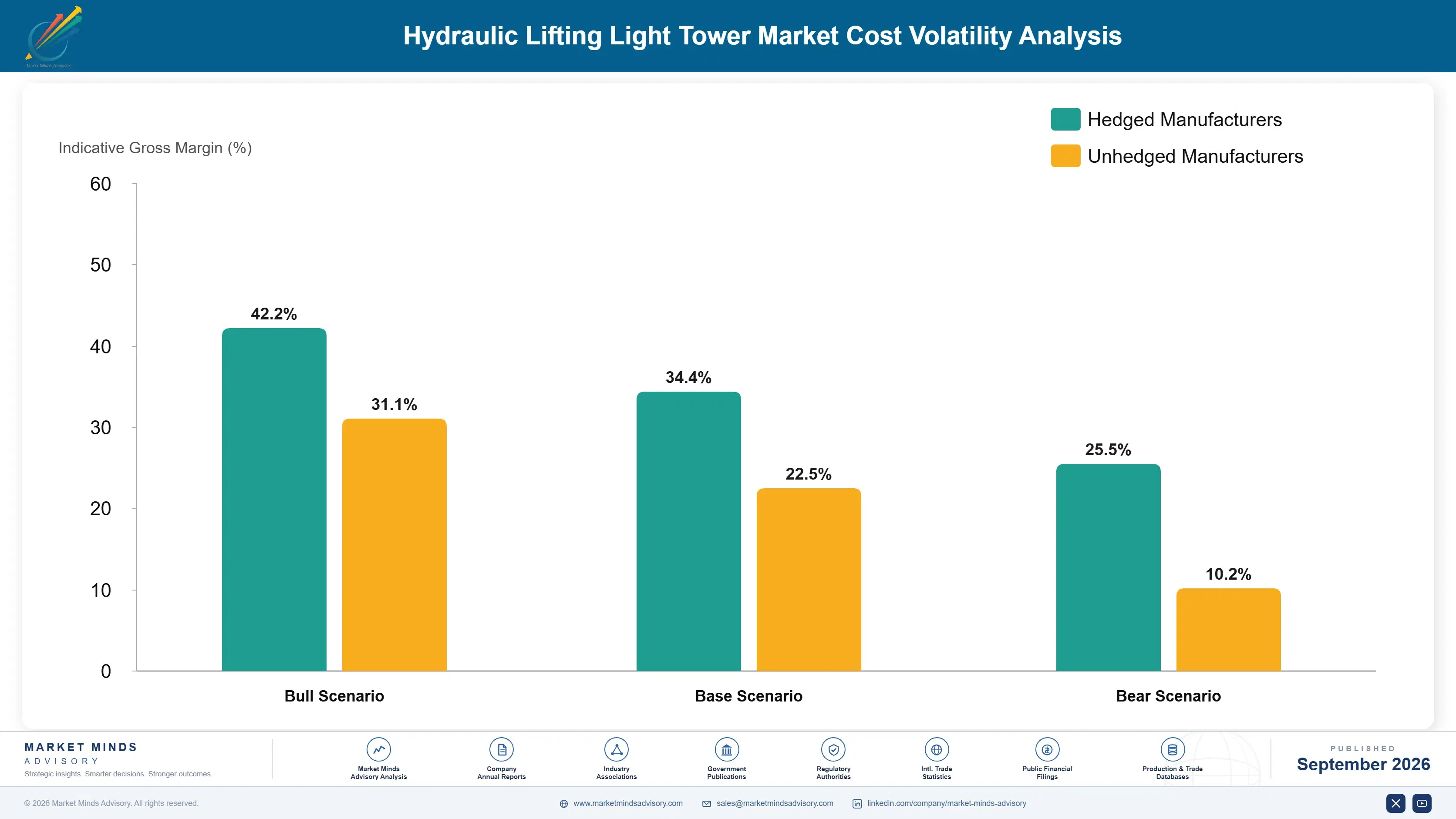
Lithium-ion battery packs and galvanized steel mast components account for roughly 44 percent of unit manufacturing cost, sourced primarily from China and South Korea, with hydraulic cylinder and control electronics components adding a further meaningful cost share for hybrid designs. This concentration in a small number of manufacturing regions leaves manufacturers genuinely exposed to trade policy and shipping disruption beyond their direct operational control.
The 2021 to 2022 global battery material price spike, documented extensively by the US Geological Survey's mineral commodity reports, pushed hybrid unit manufacturing costs sharply higher within months, compressing manufacturer margins considerably as component costs rose faster than rental fleet contract pricing could adjust. Manufacturers that had pre-negotiated long-term battery supply contracts weathered the spike considerably better than those relying on spot market purchasing during the tightest months of the disruption.

Cost exposure varies meaningfully by player type: large diversified conglomerates with hedging programmes and diversified sourcing absorb battery price volatility more easily, while smaller specialist manufacturers dependent on single-region battery suppliers face more direct and immediate exposure to input cost spikes without an offsetting sourcing cushion. This divergence shapes which manufacturers sustain competitive pricing without eroding margin below acceptable levels.
hydraulic-lifting-light-tower-market-cost-volatility-analysis-1788410655242

Multi-Region Battery Sourcing Diversification

Manufacturers are qualifying battery cell suppliers across multiple manufacturing regions rather than depending on a single source, reducing exposure to any single country's trade policy or capacity disruption. This diversification adds modest qualification cost upfront but meaningfully reduces the risk of production delays during future price spike cycles. Few smaller manufacturers can match this diversified sourcing footprint today.

Long-Term Material Supply Agreements

Larger manufacturers are locking in multi-year battery and steel pricing agreements ahead of anticipated market tightness, smoothing cost exposure across production cycles in ways smaller competitors without comparable purchasing scale generally cannot replicate. This approach proved decisive during the last major price spike cycle for manufacturers that had it in place. Few smaller competitors can match this negotiating scale currently.

Modular Design Standardization Across Product Lines

Manufacturers are standardizing battery and control component designs across multiple product tiers, allowing bulk component purchasing that reduces per-unit cost while preserving the ability to differentiate on runtime and connectivity at the finished product level. This approach increasingly substitutes for pure volume negotiation as a cost mitigation lever. Adoption is spreading quickly across the manufacturer landscape overall.

Portfolio Architecture for Margin Defence

Unit production splits into three commercial tiers with distinct margin economics. Volume commodity diesel-only towers sell through conventional rental fleet procurement, sustaining moderate margins that reward manufacturing scale and distribution reach rather than any single technical differentiator among competing manufacturers. Distribution reach and delivery reliability matter more than any single feature claim at this level of the market.
Premium certified battery-hybrid and telematics-enabled designs, backed by demonstrated runtime performance and connected fleet data, command meaningfully wider margins by trading on quiet operation and utilization visibility rather than pure unit volume. Manufacturers serving this tier increasingly compete on battery efficiency and data platform depth rather than price alone, favoring established players. These manufacturers increasingly view telematics depth as their primary defense against commodity price competition.

Sustainability and next-generation formats, including solar-hybrid units with predictive maintenance built directly into the control architecture, remain a smaller share of total unit volume today but carry the widest margins of the three tiers, since technical scarcity and engineering development capability still constrain competition meaningfully. High-value pools concentrate squarely within this tier and the premium tier immediately below it. That tension between volume and premium credibility defines competitive positioning across the category broadly.

Volume / Commodity-Adjacent Tier

Standard diesel-only towers sold through conventional rental fleet procurement, competing primarily on manufacturing scale and distribution reach rather than differentiated technology. Scale wins here consistently. Consistency helps too across most fleet segments.
Gross Margin: 16-24%

Premium / Certified Tier

Battery-hybrid and telematics-enabled designs with demonstrated runtime performance and connected data, commanding wider margins on quiet operation and utilization visibility. Data quality matters most here. Battery efficiency also matters greatly.
Gross Margin: 28-36%

Sustainability / Regulatory / Next-Generation Tier

Solar-hybrid units with predictive maintenance built directly into the control architecture, where limited engineering development capability and integration scarcity sustain the widest margins across the category despite modest volume today.
Gross Margin: 38-48%
hydraulic-lifting-light-tower-market-portfolio-architecture-1788410655754

High-value Sub-segments and Strategic Watch-out

High-value high-growth segment

Solar-hybrid units paired with predictive maintenance capability sit at the intersection of premium margin and the fastest unit volume growth, as major rental operators standardize procurement around certified monitoring platforms rather than legacy passive designs across new construction and disaster response fleet expansion. This is the clearest growth vector ahead.
Gross Margin: 40-48%

High-value moderate-growth segment

Long-term maintenance and spare parts service contracts carry strong recurring margins tied to buyer confidence in equipment uptime guarantees, though adoption grows more gradually as operators weigh service cost against in-house maintenance capability development plans. Manufacturers treat this as a durable, if slower-building, opportunity worth pursuing.
Gross Margin: 30-38%

Volume core segment

Standard diesel-only towers remain the largest unit volume base across established construction and rental networks globally, sustaining steady if unremarkable margins as the category matures and price competition among established manufacturers intensifies nationwide. Scale and distribution reach determine who wins share here overall. Adoption keeps rising steadily.
Gross Margin: 16-20%

Strategic watch-out segment

Chinese domestic manufacturers scaling battery-hybrid unit capability rapidly threaten to disintermediate established Western vendors over the coming decade, particularly where price-sensitive rental operators favor lower-cost alternatives over premium certified products with established warranties. Western vendors are responding through deeper certification and retail partnerships nationwide. This shift bears close monitoring ahead.
Gross Margin: n/a

Replacement Cycles Behave Like Annuities

Light tower fleets generate revenue well beyond the initial sale, since rental operators standardize maintenance schedules, spare parts procurement, and technician training around whichever manufacturer's equipment a fleet originally built around. That locked specification behavior turns a single fleet win into a multi-year annuity relationship across the equipment's operating life, particularly given the specialized certification required for approved replacement parts and battery systems. Switching vendors mid-fleet carries real requalification cost, keeping incumbent suppliers entrenched after the original purchase closes.
Adoption depth varies sharply by end-use vertical. National rental chains embed vendor relationships into decade-long fleet planning cycles, while smaller independent operators treat purchases as a more opportunistic, project-specific decision. Disaster response and event lighting operators sit between the two, adopting certified equipment selectively where rapid deployment reliability demands documented performance. That spread explains why unit volume and margin diverge across the three vertical categories.

Buyer profiles are shifting generationally as well. A younger cohort of fleet managers, trained on telematics dashboards rather than manual inspection alone, increasingly favors connected equipment, even where legacy procurement teams still default to whatever equipment a previous manager originally specified. This generational split is gradually reshaping which manufacturers win new fleet specification decisions going forward.
hydraulic-lifting-light-tower-market-end-use-penetration-index-1788410656273

Where Manufacturers Should Focus

These are among the four positions where our research anticipates prominent divergence between winners and laggards over the coming forecast period. Each is grounded in the demand model, the regulatory perimeter, and the announced capacity pipeline.
01 / BATTERY-HYBRID INVESTMENT PRIORITY

Build hybrid capability before rental fleet contracts consolidate further

Battery-hybrid units already command the widest margins in the category, and that gap is widening as rental operators increasingly treat quiet, emissions-compliant operation as essential to winning urban and event contracts rather than a discretionary feature layered on top. Manufacturers without hybrid capability risk exclusion from the fastest-growing rental fleet segment within the next several years, not just margin erosion, since procurement documents increasingly name quiet operation as a scoring criterion. Building that capability now, ahead of full fleet consolidation, converts a technical investment into a lasting specification advantage.
02 / TELEMATICS DEVELOPMENT STRATEGY

Invest in connected features before competitors lock in platforms

Telematics integration increasingly determines specification in fleet procurement, more so than upfront unit price alone in most competitive bids across the entire industry and its many adjacent equipment categories. Manufacturers that demonstrate superior fleet data accuracy capture premium pricing that price-focused competitors cannot match, since rental operators increasingly value long-term utilization data over acquisition cost alone when comparing competing bids. This performance advantage compounds as predictive maintenance adoption continues expanding across the broader category and its many rental applications nationwide.
03 / LONG-TERM SERVICE CONTRACT EXPANSION

Expand maintenance services before competitors lock in accounts

Long-term maintenance and spare parts contracts increasingly determine long-term customer retention more than the initial equipment sale itself, since operators value uptime guarantees over marginal price differences between otherwise comparable competing systems nationwide. Manufacturers that build this service capability now secure a durable revenue relationship that compounds across the fleet's entire multi-year operating life, well beyond the original equipment purchase decision itself and its terms. Competitors without comparable service infrastructure increasingly find themselves locked out of renewal negotiations entirely and permanently going forward.
04 / EMERGENCY RESPONSE POSITIONING STRATEGY

Build rapid deployment capability before disaster demand accelerates

Increasingly frequent severe weather events are pulling incremental light tower demand beyond routine construction cycles, a trend that will intensify as climate volatility continues expanding across additional geographic regions and seasons nationwide. Manufacturers that establish dedicated rapid deployment product lines now avoid future exclusion from this fast-growing emergency response customer segment that increasingly requires documented reliability certification before contract award. This positioning advantage compounds as smaller competitors scramble to build comparable capability later, under considerably greater time pressure and cost.

Engagement Snapshot From the Field

A live engagement with an industry participant carrying material or product regulatory and market exposure ahead of a defining policy shift, showing how our research translates into a defensible multi-year portfolio strategy.
MARKET MINDS ADVISORY · CLIENT ENGAGEMENT SUMMARY
Hydraulic Lifting Light Tower Producer Strategic Portfolio Review and Transition Roadmap 2026·Investment Scenario on Hydraulic Lifting Light Tower Exposure Evaluation 2025-26
CLIENT PROFILE
The client is a regional equipment rental company operating a light tower fleet of several hundred units across three states, with annual rental revenue in the low hundreds of millions of dollars (client-reported, unverified by MMA). The company had historically purchased diesel-only units from a single long-term vendor relationship without a formal battery-hybrid conversion strategy across its expanding fleet portfolio.
STRATEGIC CHALLENGE
Rising customer requests for quiet, emissions-compliant equipment at urban construction and event sites, combined with tightening municipal noise ordinances in several service territories, forced the client to reconsider its fleet composition strategy. Management needed to decide whether to convert the fleet fully to battery-hybrid units, continue diesel-only procurement, or pursue a phased conversion targeting highest-demand urban markets first.
MMA APPROACH
MMA conducted structured interviews with the client's fleet operations and business development leadership alongside a benchmarking exercise against four peer regional rental companies' fleet conversion strategies and customer demand patterns. The engagement combined primary qualitative interviews with MMA's proprietary light tower market dataset to assess conversion costs, rental rate premiums, and customer retention under each fleet strategy option.
KEY FINDINGS
  1. Converting to battery-hybrid units in urban markets increased the client's average rental rate premium by roughly 18 percent for quiet-operation contracts specifically.
  2. Peer rental companies with battery-hybrid fleet presence reported measurably higher customer retention than those operating diesel-only fleets in comparable urban service territories.
  3. Full fleet-wide conversion would have required capital investment the engagement estimated at several years beyond the client's current budget cycle allocation entirely.
  4. Rental companies that delayed conversion faced meaningfully lower urban market win rates during the most recent noise ordinance enforcement cycle tracked in this study.
CLIENT PROFILE
The client is a regional equipment rental company operating a light tower fleet of several hundred units across three states, with annual rental revenue in the low hundreds of millions of dollars (client-reported, unverified by MMA). The company had historically purchased diesel-only units from a single long-term vendor relationship without a formal battery-hybrid conversion strategy across its expanding fleet portfolio.
STRATEGIC CHALLENGE
Rising customer requests for quiet, emissions-compliant equipment at urban construction and event sites, combined with tightening municipal noise ordinances in several service territories, forced the client to reconsider its fleet composition strategy. Management needed to decide whether to convert the fleet fully to battery-hybrid units, continue diesel-only procurement, or pursue a phased conversion targeting highest-demand urban markets first.
MMA APPROACH
MMA conducted structured interviews with the client's fleet operations and business development leadership alongside a benchmarking exercise against four peer regional rental companies' fleet conversion strategies and customer demand patterns. The engagement combined primary qualitative interviews with MMA's proprietary light tower market dataset to assess conversion costs, rental rate premiums, and customer retention under each fleet strategy option.
KEY FINDINGS
  1. Converting to battery-hybrid units in urban markets increased the client's average rental rate premium by roughly 18 percent for quiet-operation contracts specifically.
  2. Peer rental companies with battery-hybrid fleet presence reported measurably higher customer retention than those operating diesel-only fleets in comparable urban service territories.
  3. Full fleet-wide conversion would have required capital investment the engagement estimated at several years beyond the client's current budget cycle allocation entirely.
  4. Rental companies that delayed conversion faced meaningfully lower urban market win rates during the most recent noise ordinance enforcement cycle tracked in this study.
RECOMMENDED STRATEGY
Phase 1: Phase 1 (Months 1-4): Convert the highest-demand urban market fleet segment to battery-hybrid units immediately and prioritize customer communication quite carefully today and thoroughly. Phase 2: Phase 2 (Months 5-12): Evaluate rental rate premium capture and expand conversion to additional service territories based on demonstrated demand outcomes quite carefully overall. Phase 3: Phase 3 (Months 13-24): Formalize a multi-year purchasing agreement with the selected manufacturer covering the fleet's continued conversion timeline entirely and quite fully overall.
OUTCOME
Within two years of implementation, the client reported capturing a rental rate premium on converted units of approximately 15 percent above diesel-only equivalents (client-reported, unverified by MMA). The phased approach also strengthened the client's competitive position in urban markets, and the client has since committed to a fleet-wide conversion timeline extending through the following several years.

Frequently Asked Questions

Foundational context covering the market sizes, CAGR, scope, country, region and competition that inform every finding below. This section is provided to cover basics and most often pre-purchase conversations, answered from the MMA Primary Research Dataset.

What is the current size of the Hydraulic Lifting Light Tower Market?

The global hydraulic lifting light tower market reached approximately 1.1 billion dollars in 2025. Growth is driven primarily by battery-hybrid fleet conversion and tightening job site emissions rules.

How large will the Hydraulic Lifting Light Tower Market be by 2036?

MMA projects the market will reach approximately 2.20 billion dollars by 2036. That represents roughly a 1.88 times expansion over the eleven-year forecast window from 2026 onward.

What is the CAGR for the Hydraulic Lifting Light Tower Market 2026 to 2036?

The market is forecast to grow at a 6.5 percent compound annual rate between 2026 and 2036. Bull and bear scenarios range from 5.3 to 7.7 percent.

Which segment is growing fastest?

Battery and Hybrid Electric Light Towers is the fastest-growing segment at a 12.4 percent CAGR through 2036. That is roughly 1.91 times the overall market growth rate.

Who are the major companies in the Hydraulic Lifting Light Tower Market?

Leading manufacturers include Generac, Doosan Portable Power, Atlas Copco, Terex, and Multiquip. Together these five companies hold an estimated 42 percent combined share of global unit shipments.

Which country is growing fastest?

India leads growth among major markets, driven by rapidly expanding infrastructure and construction activity nationwide. Its growth rate outpaces most other national markets tracked in this report.

Report Segmentation Architecture

The full report scope spans multiple orthogonal segmentation dimensions, with cross-tabulated demand data provided for each dimension pair. Coverage extends further to regional breakdowns, trend trajectories, and the competitive detail needed to support segment-level decision-making.

By Primary Market Dimension

  • Diesel-Powered Hydraulic Light Towers
  • LED Light Tower Systems
  • Battery and Hybrid Electric Light Towers
  • Solar-Hybrid Light Towers
  • Trailer-Mounted Light Towers
  • Skid-Mounted and Compact Light Towers

By End-Use Industry

  • Construction and Infrastructure
  • Mining and Quarrying
  • Oil and Gas Field Operations
  • Event and Entertainment Production
  • Disaster Response and Emergency Services

By Commercial Dimension

  • Rental Fleet Procurement
  • Direct Contractor Ownership
  • Government and Municipal Procurement
  • Long-Term Maintenance Service Contracts

By Region

  • North America
  • Western Europe
  • East Asia
  • South Asia and Pacific
  • Latin America
  • Middle East and Africa
  • Eastern Europe

Scope, Methodology, and Coverage

Every figure in this report is reproducible from documented input assumptions. The scope below maps the historical period, the forecast horizon, the segmentation dimensions, and the countries covered, alongside the underlying primary and qualitative methodology.
Historical Period
2020 to 2025
Forecast Period
2026 to 2036
Base Year
2025 (USD billions; MMA Primary Research Dataset, September 2026)
Market Definition
This market covers hydraulic lifting light towers, portable lighting equipment with telescoping masts raised by hydraulic mechanisms and powered by diesel, battery, hybrid, or solar systems. It excludes fixed permanent lighting installations, non-hydraulic manual crank towers, and standalone generator equipment sold separately.
Quantitative Units
USD billions (current prices); unit shipment volume where noted
Segmentation Dimensions
By Primary Market Dimension; By End-Use Industry; By Commercial Dimension; By Region
Regions Covered
North America, Western Europe, East Asia, South Asia and Pacific, Latin America, Middle East and Africa, Eastern Europe
Countries Covered
USA, China, Germany, France, UK, Japan, South Korea, India, Australia, Canada, Brazil, Mexico, Indonesia, Vietnam, Thailand, Malaysia, UAE, Saudi Arabia, South Africa, Nigeria, Turkey, Poland, Netherlands, Italy, Spain, Sweden, Switzerland, Argentina, Colombia, Singapore, and additional markets relevant to this sector
Key Companies Profiled
Generac Power Systems Inc, Doosan Portable Power, Atlas Copco AB, Terex Corporation, Multiquip Inc, Wacker Neuson SE, JLG Industries Inc, Allmand Bros Inc, Larson Electronics LLC, Progress Solar Solutions LLC, Trime SRL, Ameriquip LLC, ProStar Manufacturing Inc, Norwood Industries Inc, Genie Industries Inc, Wanco Inc, Will-Burt Company, Voltmaster Inc, Off Grid Energy Ltd, Chicago Pneumatic Tool Company LLC
Quantitative Methodology
Primary survey, n=3,800 respondents, Q4 2025, six countries; demand-side model with trade association cross-validation
Qualitative Methodology
47 expert interviews, Q4 2025; applied to validate demand model assumptions, identify emerging dynamics, and assess competitive positioning
Report Format
PDF and XLSX data workbook (Word format preview document)
Publisher
Market Minds Advisory
Report Code
MMA-2026-CON-147
Published
September 2026
Contact
sales@marketmindsadvisory.com | www.marketmindsadvisory.com

Purchase the full Hydraulic Lifting Light Tower Market Report (2026 to 2036).

The full report delivers comprehensive market sizing, segmentation, and competitive analysis for the global hydraulic lifting light tower market through 2036. It profiles twenty leading manufacturers across diesel, battery-hybrid, and solar-hybrid technologies, covering their product portfolios, certification positioning, and recent corporate developments. Regional chapters detail demand drivers across all seven world regions with quantified growth mechanisms. The report also includes forecast scenarios, materials cost analysis, and a strategic verdict section identifying where manufacturers should prioritize investment. Analysts additionally benchmark rental pricing tiers and margin economics across the full manufacturer portfolio landscape.
Eleven-year market sizing and forecast model
Six-segment MECE segmentation with growth analysis
Full seven-region demand and share breakdown
Twenty-company competitive benchmarking and profiling analysis
Battery and steel material cost risk analysis
Anonymized client case study with strategic recommendations

Built For The People Who Decide

From boardroom strategy to bench-side execution, this report is read cover-to-cover by leaders shaping the next decade of their industry, turning demand scenarios, market dynamics and valuation benchmarks into decisions.
CXOs/ Presidents/ VPs/ Managers
M&A and Corporate Development
Strategy Teams and R&D Heads
Procurement and Product Directors
Regulatory and Compliance Leaders
Investor Relations and Equity Analysts