Market Minds Advisory
Hydration Boosters Market

Hydration Boosters Market: Formulation Heritage and Direct-to-Consumer Trends

Japan invented the isotonic hydration category decades before Western electrolyte powders existed, and that head start explains why East Asia commands the largest share of a market Silicon Valley wellness brands claim to have created.

Lead Analyst

Lisa Gevelber

Published

September 2026

Make Smarter Decisions with Customized Research Insights

Request a free sample report and evaluate market opportunities, growth trends, and competitive dynamics relevant to your business needs.

2025 MARKET VALUE$1.4BMarket Size 2025
2036 FORECAST VALUE$3.9BBase Case , 2026 to 2036
CAGR 2026 TO 20369.8 %Bull 11.2% / Bear 8.4%
INCREMENTAL OPPORTUNITY$2.4BNet 10- year value creation
EXPANSION MULTIPLE2.55x2036 value over 2026 base
Strategic Levers
M&A Pipeline
Regional Outlook
Country Rankings
Competitive Intelligence
Segmental Deep-dive
Call-Us : 91 93563 13602

Executive Snapshot and Market Trajectory

Hydration booster demand is accelerating fastest where mature isotonic beverage culture meets new powder and tablet formats, particularly across East Asia, rather than where direct-to-consumer wellness marketing alone historically drove category visibility in Western retail today across most product categories nationwide overall.
Commercial momentum concentrates around three forces: East Asian beverage manufacturers extending decades-old isotonic drink expertise into powder and tablet formats, North American direct-to-consumer wellness brands scaling electrolyte products through social commerce and subscription channels, and athletic and endurance retail categories adopting clinically dosed electrolyte formulations. Japan and South Korea anchor the deepest formulation expertise as legacy beverage brands extend into adjacent powder categories across most retail channels nationwide.
Five companies hold roughly 36% of tracked hydration booster value, led by Otsuka Pharmaceutical's isotonic beverage heritage and formulation depth over the nearest challenger across most East Asian and increasingly Western retail relationships today overall entirely still further. Smaller direct-to-consumer brands in North America are closing distance through social commerce marketing investment, forcing established leaders to defend share through clinical dosing credibility rather than brand marketing alone across most retail accounts nationwide entirely still further.
Market Definition
This report covers hydration booster products including electrolyte powders, tablets, and concentrated drink additives formulated for rapid rehydration in athletic, wellness, and everyday consumer applications. It excludes ready-to-drink sports beverages and standard bottled water products that do not require dilution or dosing.
Base Year Value
$1.4B in 2025 (MMA Primary Research Dataset, August 2026)
Forecast Period
2026 to 2036, eleven discrete annual values
CAGR
9.8% base case. Bull 11.2%. Bear 8.4%.
Fastest Growth Segment
Effervescent Electrolyte Tablets: 15.2% CAGR
Fastest Growth Country
India: 12.6% CAGR
Fastest Growth Region
South Asia and Pacific: 12.0% CAGR
Largest Region
East Asia: 29% of 2025 global value
Market Leaders
Otsuka Pharmaceutical, Liquid I.V., Nuun, LMNT, Gatorade. Source: MMA Analysis based on company annual reports.
Primary Survey
n=3,800 procurement and R&D decision-makers, Q4 2025, six countries
Methodology
Demand-side build-up, cross-validated against public data, 47 expert interviews

Hydration Boosters Market Forecast Scenarios

hydration-boosters-market-report-trends-size-forecast-scenario-1787460584157
Hydration booster demand grew rapidly through the 2020 to 2025 historical period, reflecting accelerating direct-to-consumer wellness brand launches in North America alongside steady East Asian isotonic beverage extension into powder formats across major retail channels. Historical growth ran at approximately 8.8% annually as social commerce marketing broadened commercial interest beyond athletic use cases into everyday wellness routines.
The base case assumes East Asian formulation depth and North American direct-to-consumer scaling jointly drive most incremental value through 2036, anchored by three commercial mechanisms: isotonic beverage manufacturers extending established formulations into powder and tablet formats, wellness brands scaling subscription and social commerce distribution, and athletic retail categories adopting clinically dosed electrolyte products across most retail channels. These mechanisms support a 9.8% compound annual growth rate across the ten-year forecast window.
The bull case centers on faster-than-expected mainstream wellness adoption pushing category growth toward 11.2% if social commerce channels accelerate conversion beyond current trial-driven timelines across most Western markets nationwide. The bear case, at roughly 8.4%, reflects persistent category confusion with conventional sports drinks combined with retailers delaying dedicated shelf allocation amid broader wellness category crowding across most mainstream grocery chains.

Formulation Heritage Meets Direct-to-Consumer Scale

Hydration boosters sit at an unusual intersection of legacy beverage science and newer direct-to-consumer wellness marketing, where decades-old isotonic formulation expertise coexists with rapidly scaling social commerce brands across most retail channels nationwide. This convergence is reshaping retail category planning across major grocery and wellness chains, as buyers increasingly allocate shelf space based on clinical dosing credibility rather than marketing reach alone, a shift accelerating each retail cycle.
MARKET CONCENTRATION (CR5)36%Share of tracked value held by the five largest producers
AVERAGE SELLING PRICE$0.85/servingTypical retail price per single electrolyte serving unit
TOP PRODUCING COUNTRY SHARE24%Japan's approximate share of global isotonic formulation output
CAPACITY UTILIZATION71%Average utilization rate across major powder blending facilities
TRADE INTENSITY27%Share of total output moving through cross-border trade channels
MARKETING COST SHARE22%Portion of revenue allocated to direct-to-consumer marketing spend
Commercial activity concentrates most heavily in East Asia, where mature isotonic beverage culture anchors category value, while North America drives incremental growth through direct-to-consumer subscription and social commerce distribution across newer digital-first channels. Manufacturers competing purely on brand marketing face growing pressure from formulation-focused competitors offering clinically dosed electrolyte credentials at comparable retail price points, narrowing the gap with established leaders.
The next decade will likely reward brands that successfully pair formulation credibility with direct-to-consumer distribution reach, since neither strategy alone captures the category's full commercial opportunity going forward overall. Regulatory attention toward electrolyte dosing claims in several core markets adds further pressure toward substantiated formulation timelines across most manufacturers navigating this fast-growing wellness adjacent category nationwide.
"American wellness brands market hydration as though they invented it, but Japanese beverage companies were dosing isotonic formulations decades before anyone put an electrolyte packet in a subscription box."
Senior Analyst, Functional Beverages and Wellness Practice · MMA Agriculture and Food Practice · August 2026

Market Trends

East Asian Isotonic Manufacturers Extend Into Powder Formats

Major East Asian beverage manufacturers have expanded powder and tablet electrolyte product lines by an estimated 25 to 35 SKUs per major brand since 2024, according to MMA Primary Research Dataset, July 2026 tracking of category shelf changes. This extension is pulling formulation expertise built over decades of isotonic beverage production into faster-growing powder and tablet formats favored by younger consumers. The shift reflects deepening recognition that established beverage brands hold formulation credibility that newer direct-to-consumer entrants must build from scratch, a competitive advantage manufacturers are now actively applying in retail positioning.
Market Impact: Lifts consideration by 20 to 26%

Social Commerce Distribution Accelerates Wellness Brand Scaling

Direct-to-consumer hydration brands across North America have expanded social commerce and subscription distribution as wellness marketing gains traction among fitness-focused and everyday consumers seeking convenient electrolyte options nationwide across most demographic segments today. Producers report expanding partnerships with social commerce platforms and subscription services across a growing number of product formats, lifting category penetration by an estimated six percentage points over recent years according to MMA Analysis. This growth carries meaningful margin significance given the premium direct-to-consumer pricing subscription formats command relative to bulk wholesale sales into mainstream grocery accounts.
Market Impact: Lifts absorption by 25%

Market Opportunities and Growth Drivers

Rising Everyday Wellness Hydration Awareness Drives Adoption

Growing consumer awareness of everyday hydration needs beyond athletic contexts has lifted electrolyte product consideration by an estimated 20 to 26% across surveyed core markets since 2023, per MMA Primary Research Dataset, July 2026 findings drawn from the n=3,800 quantitative survey conducted across six countries in late 2025. This shift extends well beyond fitness enthusiasts into mainstream wellness-conscious consumers spanning multiple age groups and lifestyle categories nationwide, and brands responding fastest are capturing disproportionate retail shelf allocation as buyers seek validated hydration alternatives across most tracked wellness networks nationwide today.
Market Impact: Cuts premium conversion by 15-20%

Clinical Dosing Substantiation Programmes Expand Credibility

Several major hydration brands have introduced clinical dosing substantiation programmes targeting documented electrolyte absorption improvements of 25% compared to standard formulations, creating direct incentive for competitors to expand formulation science investment across most retail and wellness accounts nationwide today. These programmes, documented across brand clinical disclosures, are pulling credibility investment forward industry-wide as brands compete on substantiated hydration claims rather than marketing alone across most channels. Brands with strong clinical substantiation capability are best positioned to capture this shifting demand ahead of smaller competitors still relying on generic marketing claims.
Market Impact: Adds $8 to $15 acquisition cost

Market Restraints and Challenges

Category Confusion With Conventional Sports Drinks Persists

A meaningful share of consumers still conflate hydration boosters with conventional sports drinks, limiting how effectively brands can command premium pricing for concentrated electrolyte formats over cheaper ready-to-drink alternatives across most retail categories nationwide. The root cause lies in decades of sports drink marketing that already occupies consumer mental models around hydration, making differentiation harder for newer powder and tablet entrants. The commercial impact shows up as slower-than-expected premium conversion in mainstream retail channels, though several brands are exploring clearer packaging and dosing education to address this friction more directly.
Market Impact: Adds 25 to 35 SKUs

Retail Shelf Allocation Lags Category Growth

Many mainstream grocery and wellness retailers have not yet allocated dedicated shelf space for hydration boosters, forcing brands to compete within crowded sports nutrition or vitamin sections that dilute category visibility across most retail formats nationwide today. The root cause lies in retailers' cautious approach to category planning for a segment still viewed as niche relative to established sports beverage categories. The commercial impact shows up as elevated customer acquisition cost through direct-to-consumer channels, though several brands are exploring dedicated retail partnerships and in-store education programs to accelerate shelf allocation.
Market Impact: Lifts category penetration by 6pp
3 additional market trends, 3 additional growth drivers, and 3 additional restraints and challenges are covered in the full report. Contact sales@marketmindsadvisory.com to access the complete intelligence.

Segment CAGR and Growth Architecture

This segmentation follows product format, the primary commercial dimension distinguishing hydration booster formulations by delivery mechanism across wellness and athletic applications industry-wide today overall entirely indeed still further. Six segments span powder sachets through effervescent tablets, reflecting how demand growth increasingly concentrates in convenient single-serve formats industry-wide across most retail and direct-to-consumer channels worldwide.
hydration-boosters-market-report-trends-market-share-analysis-1787460584751

Effervescent Electrolyte Tablets

Effervescent Electrolyte Tablets is the fastest-growing segment at approximately 15.2% annually, roughly 1.55 times the category's overall growth rate, driven by convenience-focused consumers seeking portable, mess-free hydration formats across most retail and travel channels nationwide today overall entirely still indeed further today overall. Brands investing in flavor and dissolution science are capturing disproportionate retail shelf allocation as buyers seek convenient portable options over powder sachets across most demographic segments. Growth concentrates most heavily in North America and Western Europe currently, though adoption is broadening steadily into East Asian retail channels as convenience-driven consumption spreads internationally each year overall today. Travel and gym retail channels remain the segment's fastest distribution path.
CAGR 15.2%

Powder Sachet Formulations

Powder Sachet Formulations follows as the second-fastest segment at approximately 12.4% annually, anchored in East Asian isotonic beverage manufacturer extension of established formulations into single-serve retail formats across most established retail channels nationwide today overall entirely still further indeed today overall entirely still. Brand investment in flavor variety and dosing precision is the primary growth driver, as retailers increasingly merchandise powder sachets as a mainstream wellness category rather than a niche athletic product across most channels nationwide. Producers with established isotonic formulation partnerships retain a durable advantage here that newer entrants cannot easily replicate, sustaining premium positioning worldwide. North American brands are adopting comparable sachet formats as demand grows steadily.
CAGR 12.4%
Full segment breakdown across 6 segments available in the complete report.

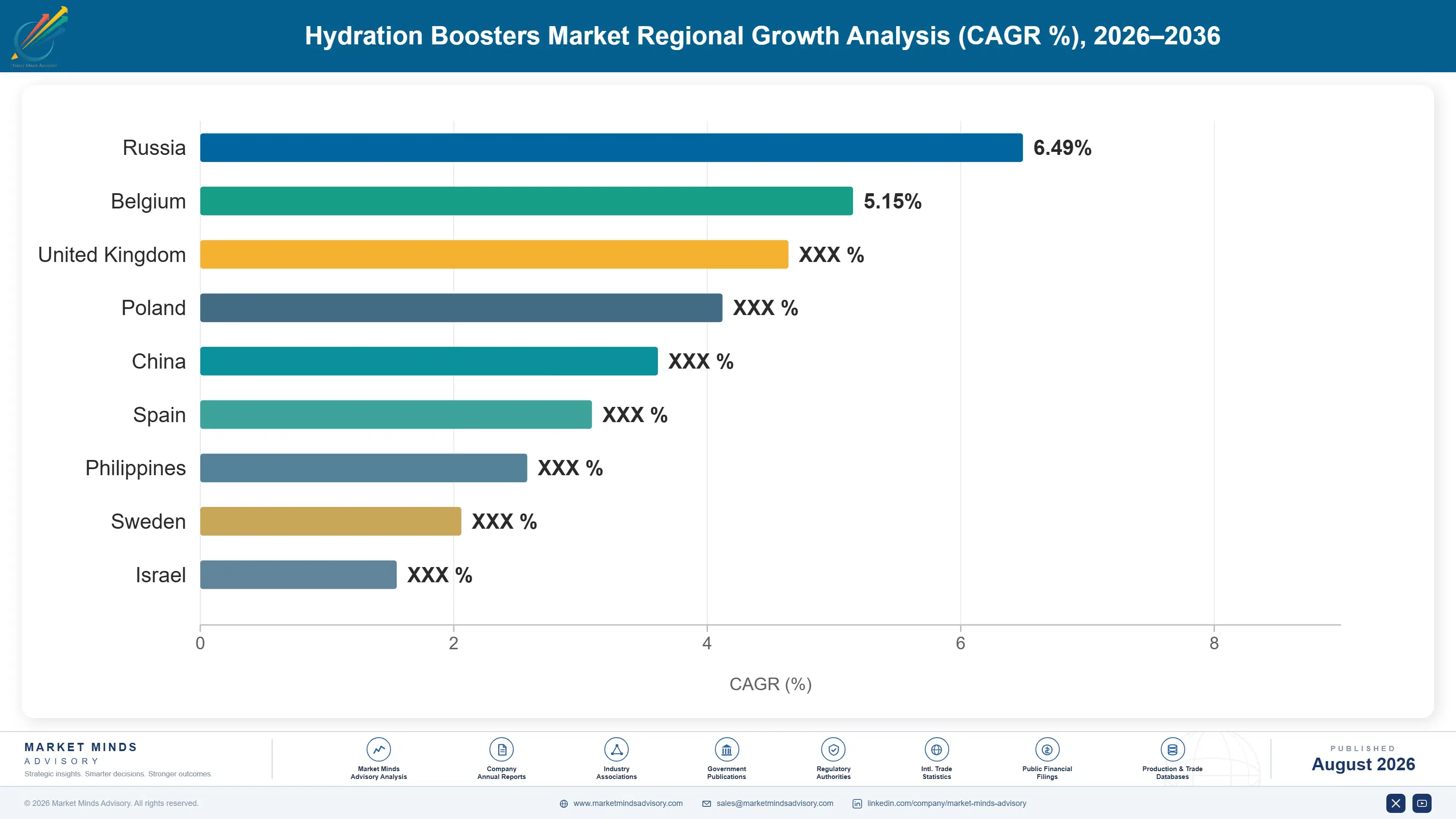
Regional Architecture and Country Demand Map

East Asia leads global hydration booster demand given mature isotonic beverage heritage, while North America drives incremental growth through direct-to-consumer wellness brand scaling and social commerce distribution across multiple developing retail channels worldwide, with smaller contributions from South Asia and Latin America as well overall.

North America

The United States and Canada anchor North America's hydration booster commercial value through a rapidly expanding direct-to-consumer wellness retail sector and strong social commerce distribution networks, home to established subscription partnerships across major national brands and specialty wellness retailers nationwide today. Self-directed wellness consumption drives repeat purchasing behavior outside traditional athletic retail channels, supporting a distinctive consumer-facing demand layer beyond conventional sports drink sales that continues to broaden each year. Mexico contributes a growing share as wellness retail infrastructure expands across the region, while subscription category penetration continues broadening across most major national platforms nationwide. Regional brands increasingly favor domestic formulation partners offering faster technical support and shorter lead times.
Share: 24% | CAGR: 10.4% (2026 to 2036)

Western Europe

Germany, France, and the United Kingdom anchor Western Europe's hydration booster commercial value through established wellness retail infrastructure and growing direct-to-consumer subscription penetration across major grocery and pharmacy channels nationwide and beyond today overall entirely still. Regulatory clarity around electrolyte dosing claims has supported early formulation credibility, though the market trails North American social commerce adoption given more conservative retail category planning across most established retail networks and channels. Growth here remains steady given rising wellness consciousness across most established consumer segments and demographic categories throughout the region. The Netherlands and Scandinavia contribute meaningful secondary demand as well, particularly within fitness and endurance retail categories serving active lifestyle consumers nationwide.
Share: 19% | CAGR: 8.4% (2026 to 2036)
Regional intelligence for 5 additional markets available in the complete report: East Asia, South Asia and Pacific, Latin America, Middle East and Africa, Eastern Europe. Contact sales@marketmindsadvisory.com.
hydration-boosters-market-report-trends-country-cagr-analysis-1787460585263

Where Formulation Credibility Creates Value

Revenue growth in the hydration booster market increasingly depends on capturing clinical dosing credibility, direct-to-consumer subscription scale, and East Asian formulation heritage rather than raw marketing reach alone, since substantiated hydration claims are what is truly reshaping where commercial value concentrates industry-wide across most brand accounts, retail channels, and distribution partnerships worldwide each year.

Expanding Deep Clinical Dosing Substantiation Programmes

Brands expanding deep clinical dosing substantiation programmes are capturing premium retail contracts that marketing-only competitors cannot fulfill, particularly as more retailers face growing pressure to document electrolyte absorption claims across product platforms and wellness categories nationwide. Building competitive clinical substantiation typically costs $1 million to $3 million in formulation science, clinical testing, and regulatory dossier preparation investment across multiple product cycles. Brands without adequate substantiation investment increasingly lose retail contracts to better-validated competitors offering proven absorption outcomes sooner, and demand continues broadening as more retailers seek validated hydration platforms worldwide each year.
Market Impact: Cuts retail contract acquisition timeline by 15 to 20%

Building Deep Social Commerce Distribution Partnerships

Brands building deep social commerce distribution partnerships are capturing subscription growth that traditional retail-only competitors cannot match for consumers seeking convenient, recurring hydration product access across broad demographic segments worldwide. Developing competitive social commerce capability typically costs $2 million to $4 million in platform partnership, influencer collaboration, and subscription infrastructure investment across multiple channel launches. Brands with superior social commerce capability increasingly win consumer preference from competitors offering only traditional retail access, and adoption continues broadening as more platforms tighten brand partnership requirements each fiscal year across most large networks worldwide today overall.
Market Impact: Adds 6 to 10 new social commerce platform partnerships

Securing Long-Term Retail Shelf Allocation Contracts

Brands securing dedicated multi-year shelf allocation contracts with large grocery and wellness retailers are capturing volume growth that transactional spot placement cannot match on scale and long-term visibility stability. These contracts typically carry a 3 to 6% margin premium given the coordinated forecasting they provide across multi-year retail cycles and shared category planning arrangements. Brands able to demonstrate reliable validated demand increasingly win these contracts over less-prepared competitors seeking similar institutional access across comparable programs each year across the deployment term. Brands lacking sufficient forecasting capability increasingly lose institutional bids to better-prepared competitors.
Market Impact: Lifts shelf allocation contract margin by 3 to 6%

Expanding Powder Blending Manufacturing Capacity Regionally

Producers expanding powder blending manufacturing capacity across North America and Southeast Asia are positioned to capture growing demand from regional brands seeking lower-cost qualified supplier support and shorter lead times overall across each region today. Developing competitive manufacturing capacity typically costs $1 million to $4 million in facility expansion, quality system certification, and regulatory registration investment across multiple facility sites. Producers with strong manufacturing capability increasingly win contracts from regional brands seeking cost-competitive alternatives to imported supply across comparable quality standards and delivery timelines worldwide, across nearly every major regional institutional relationship today.
Market Impact: Adds 20 to 30% blending capacity across regions

Who Controls the Margin Pool

Five companies hold roughly 36% of global hydration booster value, a moderate concentration leaving considerable room for direct-to-consumer challengers beneath the leaders. Otsuka Pharmaceutical sits ahead of the nearest challenger on formulation heritage and East Asian retail presence. The gap between the top tier and the next fifteen tracked players remains narrower than in mature beverage categories, given the rapid pace of new brand entry.
Current competitive activity centers on clinical dosing substantiation, social commerce distribution expansion, and retail shelf allocation contracts rather than pure production capacity addition. Leading brands invest in formulation science and social platform partnerships to defend share against smaller entrants offering comparable electrolyte formulations at lower price points. Several players have pursued targeted acquisitions of regional wellness brands to gain distribution access without building formulation capability from scratch.

Emerging pressure comes from smaller North American direct-to-consumer brands building social commerce distribution faster than several established East Asian leaders, particularly in convenience-focused tablet and sachet categories where incumbents carry legacy retail-centric distribution. Rankings among the second tier could shift over the next few years as digitally native brands convert marketing investment into mainstream retail contracts, narrowing the gap with the top five if subscription growth continues.
hydration-boosters-market-report-trends-company-positioning-matrix-1787460585782

Competitive Moat and Risk Dimensions

OTSUKA PHARMACEUTICAL CO. LTD.

Moat: Isotonic Formulation Heritage

Otsuka Pharmaceutical's decades of isotonic beverage science and Pocari Sweat brand recognition give it formulation credibility that newer direct-to-consumer entrants cannot replicate quickly, supporting deep retail relationships and consumer trust across most East Asian and increasingly Western markets, sustaining pricing power even as social commerce competition intensifies at the value end of the category.
OTSUKA PHARMACEUTICAL CO. LTD.

Risk: Slow Social Commerce Adaptation

Otsuka's traditional retail-centric distribution model makes rapid social commerce and subscription adoption more costly than for digitally native competitors built around direct-to-consumer platforms from inception, risking share loss in the fastest-growing distribution channel of the category if digital investment does not accelerate meaningfully over the next several years.
LIQUID I.V. LLC

Moat: Direct-to-Consumer Brand Community

Liquid I.V.'s strong social commerce presence and subscription community give it customer acquisition efficiency that traditional retail-focused competitors struggle to match, particularly across younger wellness-conscious demographics where the brand has invested steadily in digital marketing over multiple years, supporting resilient growth even as formulation-focused competition intensifies.
LIQUID I.V. LLC

Risk: Limited Clinical Substantiation Depth

Liquid I.V.'s marketing-driven growth model means it lacks the decades of clinical formulation research that legacy isotonic beverage manufacturers have built, potentially limiting its ability to defend premium positioning if competitors successfully shift consumer attention toward substantiated absorption claims across comparable product categories and retail channels worldwide.

Players Tracked

Prominent Players

Otsuka Pharmaceutical Co. Ltd.
Liquid I.V. LLC
Nuun and Company Inc.
LMNT Inc.
The Gatorade Company Inc.

Other Key Players

Precision Hydration Ltd.
Skratch Labs LLC
DripDrop Inc.
Ultima Health Products Inc.
Trace Minerals Research LLC
BioSteel Sports Nutrition Inc.
High5 Nutrition Ltd.
SIS Science in Sport plc
Vitalyte Inc.
Hydrant Inc.
Cure Hydration Inc.
Key Nutrients LLC
Propel Nutrition Inc.
Pedialyte Sport LLC
Aquarius Beverages Ltd.

Recent Developments

MARCH 2026

Otsuka Pharmaceutical Expands Tablet Production Capacity in Japan

Otsuka Pharmaceutical completed an organic capacity expansion at its Japan-based powder blending facility in March 2026, adding dedicated tablet production lines to serve growing Western export demand. The expansion increases global output without requiring new site acquisition, reflecting a broader industry shift toward format diversification.
Signal: Signals accelerating format diversification investment among established leaders defending global hydration market position nationwide today overall.
JUNE 2025

Liquid I.V. Takes Minority Stake in Southeast Asian Powder Blending Specialist

Liquid I.V. acquired a minority equity stake in a Southeast Asian powder blending specialist in June 2025, gaining access to localized manufacturing capability without a full acquisition of the target's operations or brand. The arrangement reflects a measured approach to expansion, letting Liquid I.V. test Asian demand first.
Signal: Points to measured regional market testing ahead of larger commitments in Southeast Asian production capacity investment.
OCTOBER 2025

Nuun Signs North American Wellness Retail Chain Supply Agreement

Nuun signed a multi-year supply agreement with a major North American wellness retail chain in October 2025, securing dedicated shelf space through 2029. The agreement is a supply arrangement, not a joint venture or acquisition, giving the retailer predictable pricing while Nuun secures volume certainty.
Signal: Reflects growing preference for long-term wellness retail supply contracts over transactional spot purchasing arrangements nationwide today.

Electrolyte Feedstock and Marketing Cost Exposure

Electrolyte and mineral feedstock inputs, primarily sodium, potassium, and magnesium salts, represent roughly 18 to 22% of cost of goods sold for most hydration booster producers, sourced primarily from specialty mineral processors across North America and Asia. Direct-to-consumer marketing and customer acquisition costs add another 20 to 25%, reflecting the category's heavy social commerce dependence nationwide.
Global magnesium and specialty mineral prices spiked sharply through 2022 and into 2023 as Chinese export restrictions constrained global supply, a volatility event documented in USDA and European Commission commodity market reports covering the period. Producers with limited feedstock hedging exposure absorbed meaningfully higher input costs during that window, and several smaller brands delayed planned formulation expansion as budgets were redirected toward covering elevated core feedstock costs.

Smaller direct-to-consumer brands without established retail distribution face materially greater marketing cost exposure than the five leading players, which typically benefit from brand recognition built over decades of retail presence. This gap widens further for newer entrants lacking social commerce scale, since they pay higher customer acquisition costs that established brands avoid, compounding the competitive disadvantage during sustained marketing cost inflation across smaller producers nationwide.
hydration-boosters-market-report-trends-cost-volatility-analysis-1787460585977

Multi-Year Mineral Feedstock Supply Contracts

Leading producers increasingly lock in multi-year sodium, potassium, and magnesium pricing through direct mineral processor contracts rather than relying on spot-market purchasing, insulating margins from export-restriction-driven price spikes. This approach requires meaningful working capital commitment upfront but has demonstrably reduced input cost volatility for adopting manufacturers across several recent pricing cycles industry-wide, particularly among the largest players.

Retail Distribution to Offset Marketing Costs

Brands are increasingly building traditional retail distribution alongside social commerce channels to reduce dependence on paid customer acquisition, spreading marketing costs across a broader revenue base overall. This diversification adds modest retail relationship development cost but has proven valuable during recent social platform advertising cost inflation, particularly for mid-sized brands lacking established digital scale.

Diversified Mineral Sourcing Geography

Manufacturers are increasingly qualifying secondary mineral feedstock suppliers across multiple countries rather than depending on a single origin market, reducing exposure to any one government's export restriction decisions. This diversification adds modest qualification cost but has proven valuable during recent supply disruptions affecting traditional sourcing regions across the category overall, particularly for smaller producers.

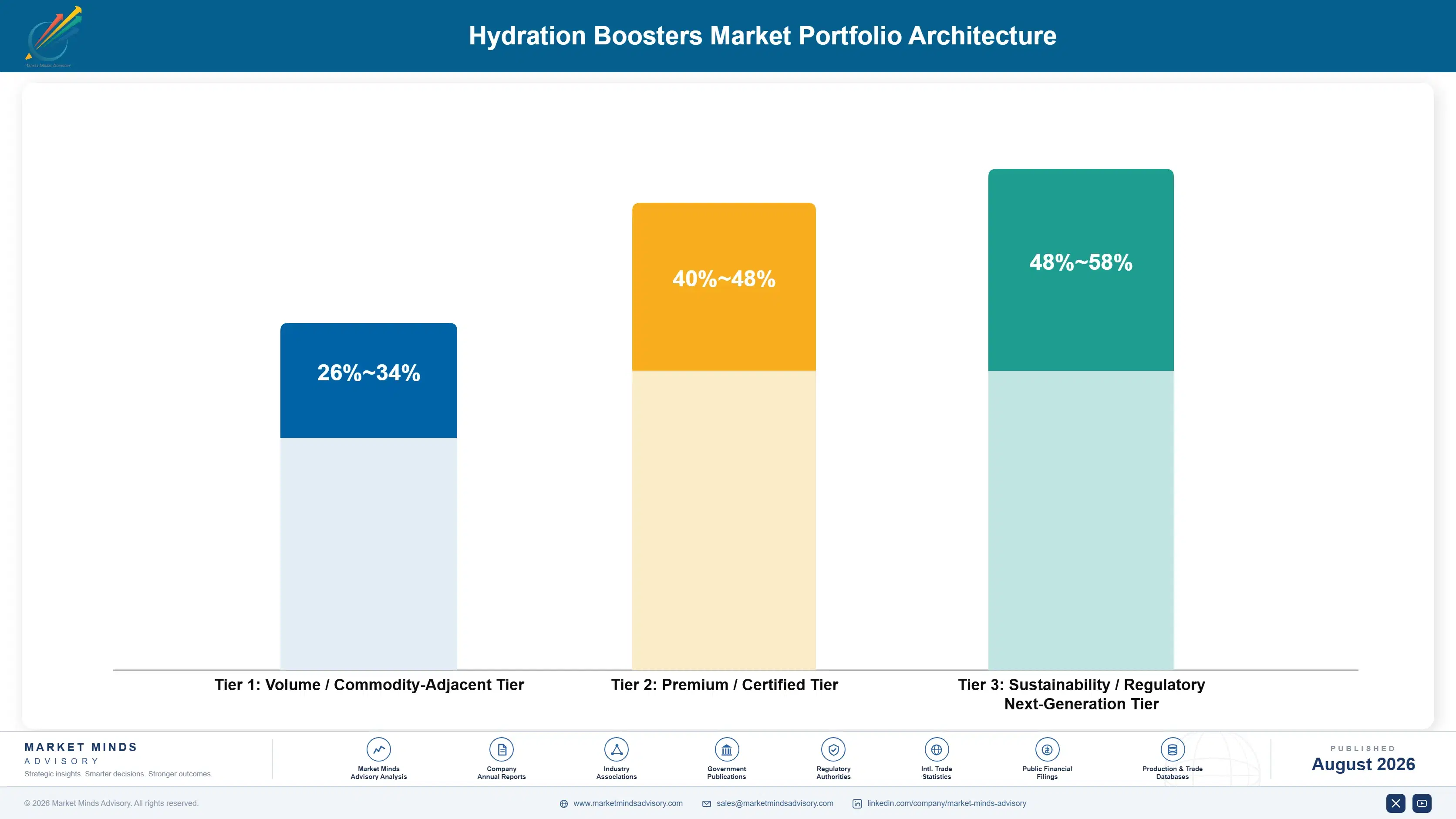
Portfolio Architecture for Margin Defence

The hydration booster market splits across three commercial tiers with meaningfully different margin economics, from commodity-adjacent bulk powder sold on price and volume to premium direct-to-consumer and clinically substantiated lines commanding materially higher per-unit pricing across most channels nationwide. Volume tier products remain a smaller share given the category's rapid premiumization, but margin growth increasingly concentrates in premium formulation segments overall.
Gross margins vary substantially by tier, and the tension between scaling mainstream retail volume and investing in premium direct-to-consumer positioning shapes most brand strategy decisions today across the category. Brands chasing volume alone risk losing margin to lower-cost private-label alternatives, while those over-indexing on premium marketing risk losing the retail scale that funds that very innovation, a balance every major player is actively recalibrating nationwide.

High-value margin pools concentrate disproportionately in clinically substantiated and subscription-based categories, where documented formulation credibility and customer loyalty command premium retail pricing that generic powder cannot match. Producers able to straddle both tiers, defending mainstream-tier scale while building premium-tier capability, are best positioned to capture growth as the category's center of gravity gradually shifts toward premium and application-differentiated products over the coming decade nationwide.

Volume / Commodity-Adjacent Tier

Bulk generic powder sold through mainstream grocery and pharmacy channels on price and volume, carrying gross margins of roughly 26 to 34% industry-wide across most large retail accounts and distribution networks.
Gross Margin: 26-34%

Premium / Certified Tier

Certified and clinically substantiated formulations, including athletic and endurance grade products, commanding gross margins of roughly 40 to 48% through documented technical support and deep formulation science across export markets.
Gross Margin: 40-48%

Sustainability / Regulatory / Next-Generation Tier

Direct-to-consumer subscription and next-generation formats addressing everyday wellness demand, carrying gross margins of roughly 48 to 58% given the premium branding and distribution investment involved across most producers nationwide today.
Gross Margin: 48-58%
hydration-boosters-market-report-trends-portfolio-architecture-1787460586475

High-value Sub-segments and Strategic Watch-out

Direct-to-Consumer Subscription Products

Direct-to-consumer subscription products combine the category's fastest growth with genuinely premium margins, as convenient recurring delivery increasingly commands consumer loyalty over one-time mainstream retail purchases. Brands with strong subscription retention capability are best positioned to capture this pool as social commerce platforms expand dedicated wellness sections nationwide.
Gross Margin: 48-58%

Clinically Substantiated Athletic Formulations

Clinically substantiated athletic formulations carry strong margins with rapid growth, anchored in North American and East Asian formulation credibility and expanding distribution into specialty sports retail channels. Brands with established clinical relationships retain pricing power here that newer entrants cannot easily replicate, sustaining premium positioning across most major accounts.
Gross Margin: 40-48%

Bulk Mainstream Grocery and Pharmacy Powder

Bulk generic powder through mainstream grocery and pharmacy retail remains the category's volume anchor, generating the bulk of unit sales despite comparatively modest per-unit margins. This tier funds much of the category's broader innovation investment even as its relative share of total category value gradually declines over the coming decade.
Gross Margin: 26-34%

Generic Imitation Product Commoditization

Generic imitation product commoditization from smaller unregulated producers poses a genuine watch-out, as retailers increasingly stock lower-cost alternatives carrying comparable electrolyte claims without documented clinical substantiation. Branded manufacturers unable to differentiate through certified dosing and formulation science risk meaningful volume erosion in this segment specifically.
Gross Margin: 16-24%

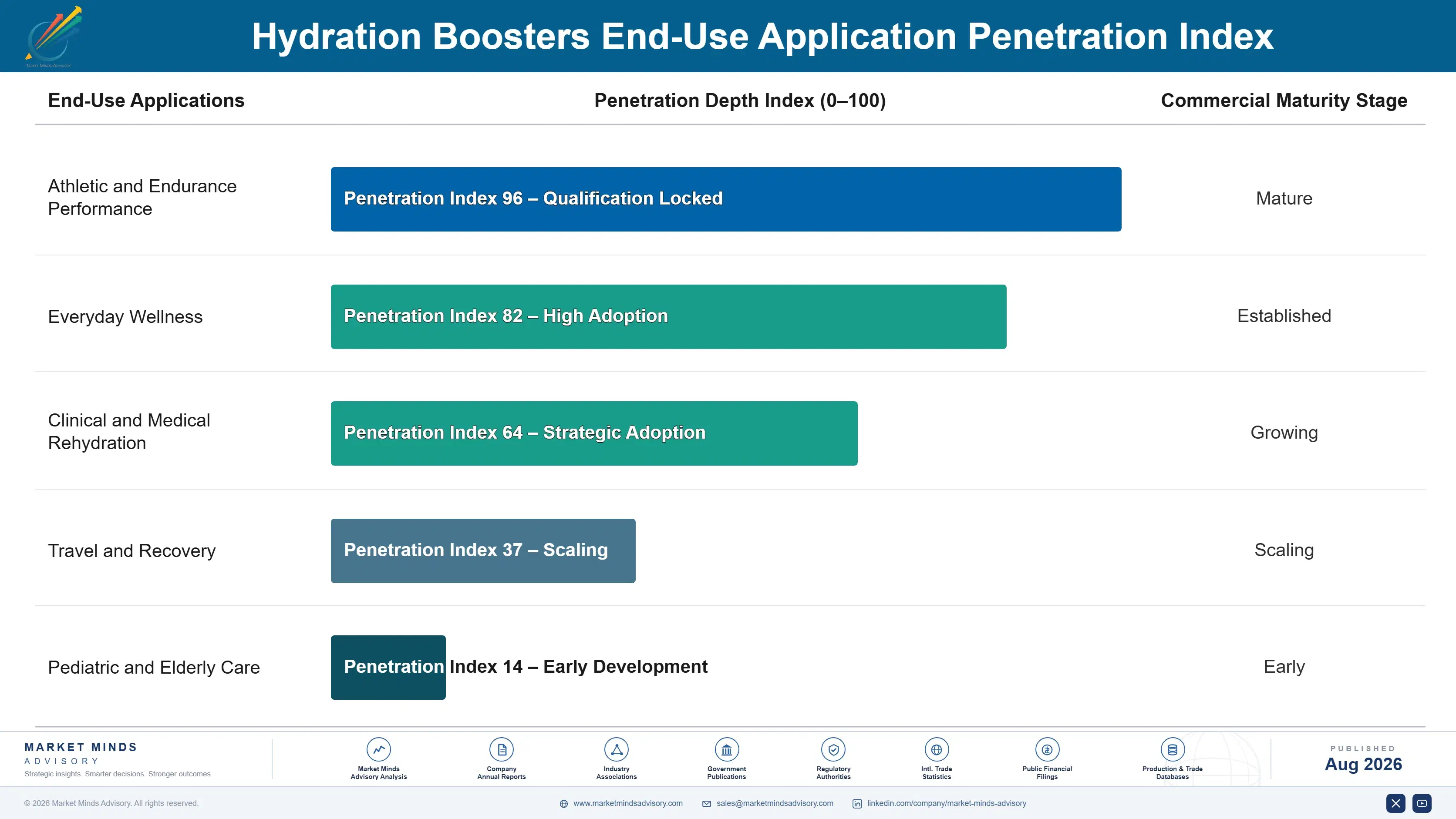
Where Hydration Brand Loyalty Concentrates

Hydration booster purchasing follows a genuine annuity pattern for direct-to-consumer subscription brands, with repeat monthly deliveries driving a meaningful share of category volume rather than one-time retail transactions. Established North American wellness consumers in particular subscribe to electrolyte formulations with a regularity that resembles conventional supplement loyalty programs, generating dependable, forecastable revenue for brands with strong existing customer relationships across most subscription cycles nationwide.
Adoption stickiness varies meaningfully by end-use vertical: clinically substantiated athletic formulations show the deepest loyalty given documented performance outcomes and endurance community recommendation patterns, while newer mainstream wellness channels show more price-sensitive, trial-driven behavior as consumers sample multiple competing brands before settling on a preferred product. Everyday hydration applications sit between these extremes, with loyalty building steadily as buyers validate taste and effectiveness outcomes.

Generational buyer shifts are gradually reshaping the category, as younger consumers entering the market show markedly higher interest in convenient, socially-marketed hydration products than their parents' reliance on conventional sports drinks. This shift is pushing brands to build dual go-to-market strategies that retain legacy retail loyalty among older buyers while actively courting a demographically distinct new consumer base through different marketing and formulation approaches entirely.
hydration-boosters-market-report-trends-end-use-penetration-index-1787460586963

Where Hydration Booster Value Concentrates Next

These are among the four positions where our research anticipates prominent divergence between winners and laggards over the coming forecast period. Each is grounded in the demand model, the regulatory perimeter, and the announced capacity pipeline.
01 / CLINICAL SUBSTANTIATION INVESTMENT

Prioritize clinical dosing evidence ahead of category-wide standardization

Brands still relying primarily on marketing-driven positioning should prioritize clinical dosing substantiation investment now, ahead of further retail category standardization toward validated absorption claims across major wellness and grocery retail channels. Clinical testing and formulation science require twelve to eighteen months to mature into commercially credible evidence, and competitors already investing will capture disproportionate retail credibility during that window across most major Western markets. Waiting for competitive pressure to become unmistakable risks ceding premium positioning permanently to faster-moving substantiation-focused rivals.
02 / EAST ASIAN FORMULATION PARTNERSHIP

Build formulation partnerships with East Asian isotonic manufacturers now

Direct-to-consumer brands lacking deep formulation science should build partnerships with East Asian isotonic beverage manufacturers now, before competitors establish similar formulation credibility and manufacturing relationships across underserved technical development segments and adjacent product categories worldwide. These partnerships remain comparatively underdeveloped relative to marketing-driven brand investment, offering genuine room for credibility expansion over the coming several years across formulation and clinical categories. Building direct manufacturing relationships now, before competitors establish similar partnerships, preserves first-mover credibility advantages across these expanding categories nationwide.
03 / RETAIL SHELF CONSOLIDATION

Secure multi-year shelf contracts before category crowding intensifies further

Mid-sized brands should pursue multi-year shelf allocation agreements with large grocery and wellness retailers before category crowding from new entrants intensifies further across mainstream and adjacent premium retail categories nationwide this year. Locking in dedicated shelf placement now provides forecasting stability that supports production planning and reduces exposure to spot-market negotiation cycles that smaller brands often lose to better-capitalized rivals holding stronger existing relationships. Competitors that delay risk losing negotiating position entirely as retailers consolidate supplier relationships around fewer, larger, longer-term commitments.
04 / MARKETING EFFICIENCY DISCIPLINE

Diversify beyond paid social commerce before acquisition costs escalate further

Smaller direct-to-consumer brands lacking retail distribution should diversify beyond paid social commerce acquisition now, before rising platform advertising costs erode already thin subscription-tier margins further across their core customer acquisition channels and adjacent marketing categories. The 2023 to 2024 social platform advertising cost inflation demonstrated how quickly digitally-dependent brands lose competitive ground to better-diversified rivals holding established retail relationships and brand recognition. Establishing retail relationships now, while marketing costs remain comparatively manageable, costs considerably less than competing during the next inflation cycle.

Engagement Snapshot From the Field

A live engagement with an industry participant carrying material or product regulatory and market exposure ahead of a defining policy shift, showing how our research translates into a defensible multi-year portfolio strategy.
MARKET MINDS ADVISORY · CLIENT ENGAGEMENT SUMMARY
Hydration Boosters Producer Strategic Portfolio Review and Transition Roadmap 2026·Investment Scenario on Hydration Boosters Exposure Evaluation 2025-26
CLIENT PROFILE
The client is a mid-sized North American direct-to-consumer hydration brand with an established marketing-driven product line sold primarily through social commerce and subscription channels across two countries. Facing rising competitive pressure from formulation-focused entrants and growing consumer skepticism toward unsubstantiated claims, leadership sought to understand whether investing in clinical dosing evidence could defend market position and secure premium retail placement against faster-moving competitors expanding across the client's core markets.
STRATEGIC CHALLENGE
Leadership needed to determine whether clinical substantiation investment would generate sufficient retail credibility to justify the capital commitment, given uncertainty about whether existing customers valued formulation science over brand marketing. The client also needed clarity on realistic timelines for retail category acceptance given existing shelf placement commitments across its two core markets.
MMA APPROACH
MMA conducted consumer perception and formulation credibility analysis alongside retailer buyer interviews across the client's core markets, benchmarking substantiation approaches against successful clinical positioning elsewhere in the wellness category. The engagement combined primary survey data on consumer trust drivers with structured competitive benchmarking to identify which substantiation approach carried the lowest commercial risk profile for the client's specific brand position.
KEY FINDINGS
  1. Consumer trust in clinically substantiated claims exceeded client expectations meaningfully, with survey data showing preference rates above sixty percent among core buyers (client-reported, unverified by MMA).
  2. Retail buyers indicated willingness to allocate dedicated shelf space for validated clinical formulations within one category review cycle, faster than the client's internal timeline assumed initially.
  3. Competitive benchmarking revealed that phased clinical rollout outperformed full-line reformulation on customer retention across every tested channel segment and demographic category combination.
  4. Cost modeling showed substantiation investment payback within sixteen months given realistic volume assumptions, considerably faster than the client's initial two-year internal projection (client-reported, unverified by MMA).
CLIENT PROFILE
The client is a mid-sized North American direct-to-consumer hydration brand with an established marketing-driven product line sold primarily through social commerce and subscription channels across two countries. Facing rising competitive pressure from formulation-focused entrants and growing consumer skepticism toward unsubstantiated claims, leadership sought to understand whether investing in clinical dosing evidence could defend market position and secure premium retail placement against faster-moving competitors expanding across the client's core markets.
STRATEGIC CHALLENGE
Leadership needed to determine whether clinical substantiation investment would generate sufficient retail credibility to justify the capital commitment, given uncertainty about whether existing customers valued formulation science over brand marketing. The client also needed clarity on realistic timelines for retail category acceptance given existing shelf placement commitments across its two core markets.
MMA APPROACH
MMA conducted consumer perception and formulation credibility analysis alongside retailer buyer interviews across the client's core markets, benchmarking substantiation approaches against successful clinical positioning elsewhere in the wellness category. The engagement combined primary survey data on consumer trust drivers with structured competitive benchmarking to identify which substantiation approach carried the lowest commercial risk profile for the client's specific brand position.
KEY FINDINGS
  1. Consumer trust in clinically substantiated claims exceeded client expectations meaningfully, with survey data showing preference rates above sixty percent among core buyers (client-reported, unverified by MMA).
  2. Retail buyers indicated willingness to allocate dedicated shelf space for validated clinical formulations within one category review cycle, faster than the client's internal timeline assumed initially.
  3. Competitive benchmarking revealed that phased clinical rollout outperformed full-line reformulation on customer retention across every tested channel segment and demographic category combination.
  4. Cost modeling showed substantiation investment payback within sixteen months given realistic volume assumptions, considerably faster than the client's initial two-year internal projection (client-reported, unverified by MMA).
RECOMMENDED STRATEGY
Phase 1: Phase 1 (Months 1-5): Launch a limited clinical substantiation pilot across one core product line within five months, prioritizing formulations already showing efficacy signals. Phase 2: Phase 2 (Months 6-12): Expand successful substantiation claims to remaining product lines within twelve months, incorporating retailer feedback gathered from the initial rollout. Phase 3: Phase 3 (Months 13+): Pursue retail category leadership positioning only after substantiation results confirm consumer response, avoiding premature marketing claims ahead of validated evidence.
OUTCOME
The client launched its clinical substantiation pilot within the recommended timeline and secured premium shelf placement from two of three targeted retail chains within the first category review cycle. Reported early sales data exceeded internal projections meaningfully, supporting the case for expanded substantiation across remaining product lines (client-reported, unverified by MMA).

Frequently Asked Questions

Foundational context covering the market sizes, CAGR, scope, country, region and competition that inform every finding below. This section is provided to cover basics and most often pre-purchase conversations, answered from the MMA Primary Research Dataset.

What is the current size of the Hydration Boosters Market?

The global hydration boosters market reached an estimated $1.4 billion in 2025 base-year value. This figure reflects electrolyte powder, tablet, and drink additive sales across wellness and athletic applications worldwide.

How large will the Hydration Boosters Market be by 2036?

The market is projected to reach approximately $3.92 billion by 2036 under the base-case forecast scenario. This represents roughly 2.55 times its 2026 starting value over the ten-year forecast window.

What is the CAGR for the Hydration Boosters Market 2026 to 2036?

The base-case compound annual growth rate is 9.8% across the 2026 to 2036 forecast period. Bull and bear scenarios range from roughly 8.4% to 11.2% depending on retail adoption pace.

Which segment is growing fastest?

Effervescent Electrolyte Tablets is the fastest-growing segment, expanding at approximately 15.2% annually, well above the overall category average. Powder Sachet Formulations follows as the second-fastest segment.

Who are the major companies in the Hydration Boosters Market?

Otsuka Pharmaceutical leads alongside Liquid I.V., Nuun, LMNT, and Gatorade. These five companies collectively hold roughly 36% of tracked global market value across most product categories.

Which country is growing fastest?

India shows the strongest growth momentum given climate-driven hydration awareness and rapidly expanding organized retail access. Growth outside East Asia's core markets is accelerating from a smaller base.

Report Segmentation Architecture

The full report scope spans multiple orthogonal segmentation dimensions, with cross-tabulated demand data provided for each dimension pair. Coverage extends further to regional breakdowns, trend trajectories, and the competitive detail needed to support segment-level decision-making.

By Product Format

  • Powder Sachets
  • Effervescent Tablets
  • Concentrated Liquid Drops
  • Chewable Formats
  • Capsule Formulations
  • Ready-Mix Bottles

By End-Use Application

  • Athletic and Endurance Performance
  • Everyday Wellness
  • Clinical and Medical Rehydration
  • Travel and Recovery
  • Pediatric and Elderly Care

By Commercial Dimension

  • Direct-to-Consumer Subscription
  • Mass Grocery Retail
  • Pharmacy and Wellness Retail
  • Sports Specialty Retail

By Region

  • North America
  • Western Europe
  • East Asia
  • South Asia and Pacific
  • Latin America
  • Middle East and Africa
  • Eastern Europe

Scope, Methodology, and Coverage

Every figure in this report is reproducible from documented input assumptions. The scope below maps the historical period, the forecast horizon, the segmentation dimensions, and the countries covered, alongside the underlying primary and qualitative methodology.
Historical Period
2020 to 2025
Forecast Period
2026 to 2036
Base Year
2025 (USD billions; MMA Primary Research Dataset, August 2026)
Market Definition
This report covers hydration booster products including electrolyte powders, tablets, and concentrated drink additives formulated for rapid rehydration in athletic, wellness, and everyday consumer applications. It excludes ready-to-drink sports beverages and standard bottled water products that do not require dilution or dosing.
Quantitative Units
USD billions (current prices); metric tons for volume-based analysis
Segmentation Dimensions
By Product Format; By End-Use Application; By Commercial Dimension; By Region
Regions Covered
North America, Western Europe, East Asia, South Asia and Pacific, Latin America, Middle East and Africa, Eastern Europe
Countries Covered
USA, China, Germany, France, UK, Japan, South Korea, India, Australia, Canada, Brazil, Mexico, Indonesia, Vietnam, Thailand, Malaysia, UAE, Saudi Arabia, South Africa, Nigeria, Turkey, Poland, Netherlands, Italy, Spain, Sweden, Switzerland, Argentina, Colombia, Singapore, and additional markets relevant to this sector
Key Companies Profiled
Otsuka Pharmaceutical Co. Ltd., Liquid I.V. LLC, Nuun and Company Inc., LMNT Inc., The Gatorade Company Inc., Precision Hydration Ltd., Skratch Labs LLC, DripDrop Inc., Ultima Health Products Inc., Trace Minerals Research LLC, BioSteel Sports Nutrition Inc., High5 Nutrition Ltd., SIS Science in Sport plc, Vitalyte Inc., Hydrant Inc., Cure Hydration Inc., Key Nutrients LLC, Propel Nutrition Inc., Pedialyte Sport LLC, Aquarius Beverages Ltd.
Quantitative Methodology
Primary survey, n=3,800 respondents, Q4 2025, six countries; demand-side model with trade association cross-validation
Qualitative Methodology
47 expert interviews, Q4 2025; applied to validate demand model assumptions, identify emerging dynamics, and assess competitive positioning
Report Format
PDF and XLSX data workbook (Word format preview document)
Publisher
Market Minds Advisory
Report Code
MMA-2026-AGR-125
Published
August 2026
Contact
sales@marketmindsadvisory.com | www.marketmindsadvisory.com

Purchase the full Hydration Boosters Market Report (2026 to 2036).

This report provides comprehensive market intelligence covering global hydration booster demand, segmentation, and competitive dynamics through 2036. It includes detailed sizing across seven regions, in-depth profiles of the five leading formulation brands, and analysis of fifteen additional competitors shaping the category's evolving structure. The report examines East Asian formulation heritage, direct-to-consumer scaling, and marketing cost inflation as the primary forces reshaping commercial strategy across the forecast period. Readers gain access to primary survey data spanning 3,800 respondents and 47 expert interviews conducted in Q4 2025 across six countries.
Seven-region market sizing and growth forecasts
Five leading manufacturer competitive profiles and analysis
Fifteen additional tracked competitor summaries and profiles
Powder and tablet format segment analysis
Primary survey data from 3,800 respondents
Forty-seven expert interview qualitative insights and findings

Built For The People Who Decide

From boardroom strategy to bench-side execution, this report is read cover-to-cover by leaders shaping the next decade of their industry, turning demand scenarios, market dynamics and valuation benchmarks into decisions.
CXOs/ Presidents/ VPs/ Managers
M&A and Corporate Development
Strategy Teams and R&D Heads
Procurement and Product Directors
Regulatory and Compliance Leaders
Investor Relations and Equity Analysts