Market Minds Advisory
Hybrid Generator Sets Market

Hybrid Generator Sets Market: Hybrid Generator Sets Market: The Fleet Buys, Not The Contractor

A conventional set on a building site runs at a quarter load all day, which wrecks the engine and wastes the fuel. The battery lets it switch off entirely for hours.

Lead Analyst

Published

September 2026

Make Smarter Decisions with Customized Research Insights

Request a free sample report and evaluate market opportunities, growth trends, and competitive dynamics relevant to your business needs.

2025 MARKET VALUE$3.1BMarket Size 2025
2036 FORECAST VALUE$10.8BBase Case , 2026 to 2036
CAGR 2026 TO 203612.0 %Bull 13.2% / Bear 10.8%
INCREMENTAL OPPORTUNITY$7.3BNet 10- year value creation
EXPANSION MULTIPLE3.11x2036 value over 2026 base
Strategic Levers
M&A Pipeline
Regional Outlook
Country Rankings
Competitive Intelligence
Segmental Deep-dive
Call-Us : 91 93563 13602

Executive Snapshot and Market Trajectory.

The saving comes from load factor rather than from engine efficiency. A conventional set carries around 26% load across a working day, where it burns fuel badly and wet-stacks, and a hybrid runs the engine hard to charge and then stops it completely for up to nine hours.
Retrofit hybrid conversion kits grow at 18.0%, half again the market rate of 12.0%, because a rental fleet holding hundreds of conventional sets can hybridise them without replacing any of the engines it already owns. Middle East and Africa holds 26% of demand, far outside any normal band, because African telecom towers running on diesel are the largest single application by units anywhere. Almost nobody outside that particular business ever writes about it.
Concentration is moderate at 44% of units shipped and the customer is a rental fleet rather than a contractor. Some 61% of units are bought by hire companies assessing utilisation, maintenance interval and residual value, which means a proposal built around a contractor's fuel bill is being made to somebody who does not pay it. Nearly every manufacturer in this category still leads with the fuel savings anyway.
Market Definition
The hybrid generator sets market covers packaged power units combining a combustion engine with integrated battery storage and control allowing engine-off operation, spanning battery-engine sets below one hundred kilovolt-amperes, battery-engine sets between one hundred and five hundred, solar-battery-engine trihybrid sets, containerised large hybrid systems above five hundred, retrofit hybrid conversion kits, and telecom tower hybrid systems. Scope is measured as units shipped into rental fleet and end-user service. Excluded are conventional generator sets without storage, standalone battery energy storage systems, uninterruptible power supplies, grid-connected microgrids, and stationary prime power plant above packaged ratings.
Base Year Value
$3.1B in 2025 (MMA Primary Research Dataset, September 2026)
Forecast Period
2026 to 2036, eleven discrete annual values
CAGR
12.0% base case. Bull 13.2%. Bear 10.8%.
Fastest Growth Segment
Retrofit Hybrid Conversion Kits: 18.0% CAGR
Fastest Growth Country
India: 14.2% CAGR
Fastest Growth Region
South Asia and Pacific: 14.2% CAGR
Largest Region
Middle East and Africa: 26% of 2025 global value
Market Leaders
Aggreko, Caterpillar, Atlas Copco, Himoinsa and Rolls-Royce. Source: MMA Analysis, July 2026.
Primary Survey
n=3,800 procurement and R&D decision-makers, Q4 2025, six countries
Methodology
Demand-side build-up, cross-validated against public data, 47 expert interviews

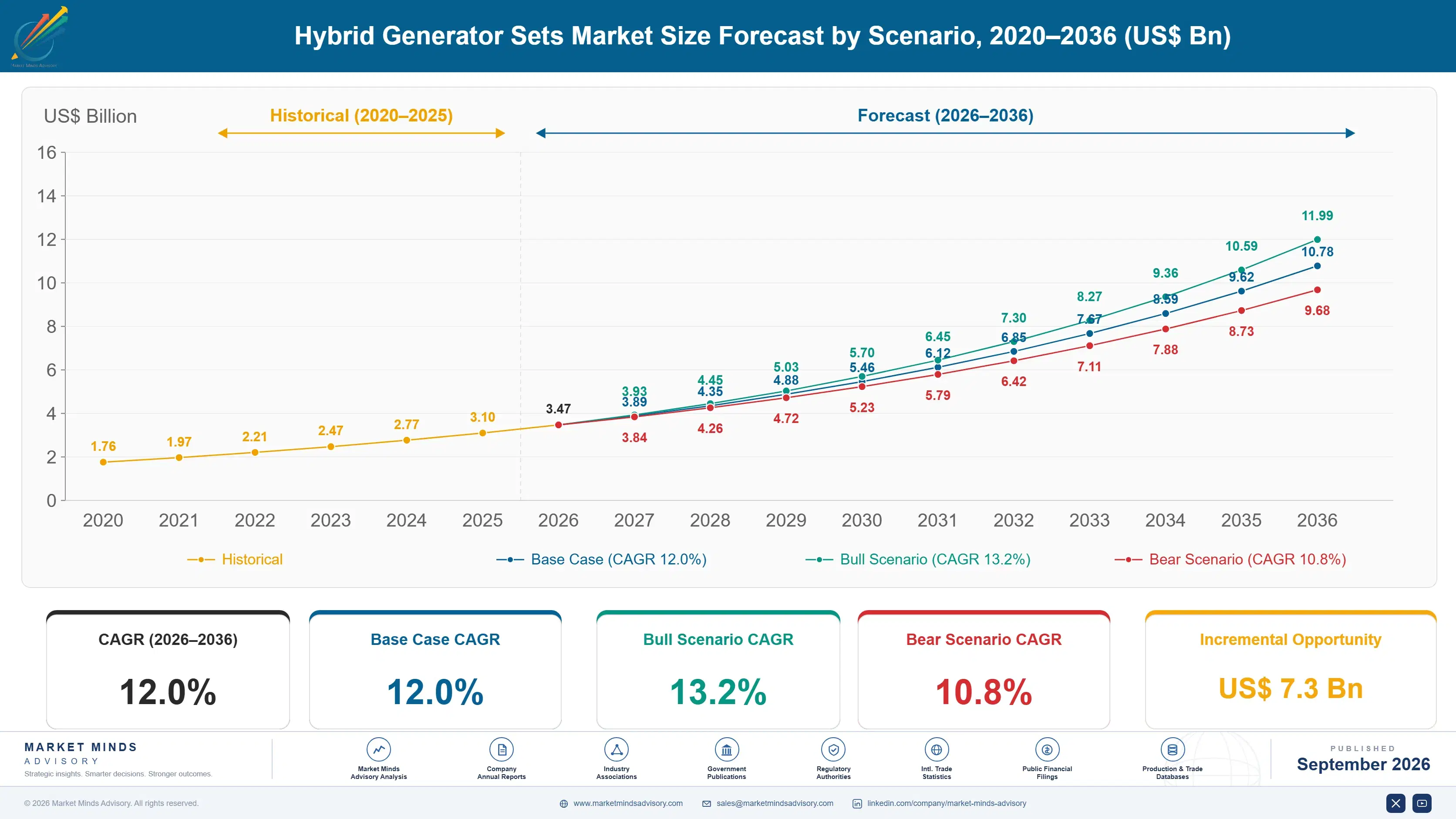
Hybrid Generator Sets Market Forecast Scenarios

hybrid-generator-sets-market-size-forecast-scenario-1788410792462
Between 2020 and 2025 the sector compounded at 10.6% and urban regulation rather than fuel price drove most of it. Low emission zones and construction site requirements across European cities made engine-off capability a condition of working rather than an efficiency choice. Telecom tower hybridisation continued separately on economics that had nothing to do with any city.
The 12.0% base case rests on three mechanisms. Urban emission and noise requirements keep extending to more cities and more site categories, which converts a preference into a permit condition. Rental fleets are replacing conventional sets on a normal cycle and specifying hybrids because customers increasingly ask for them. And African and South Asian telecom tower populations continue hybridising on straightforward diesel economics. None of the three depends on fuel prices being high.
The bull case at 13.2% turns on retrofit conversion becoming standard fleet practice rather than a selective upgrade, which would reach an installed base far larger than annual new unit shipments. The bear case at 10.8% is battery cost and lifetime: a pack requiring replacement every seven years against a fifteen year engine changes the fleet economics considerably, and residual values remain genuinely uncertain.

Twenty Six Percent Load All Day

The mechanism is load factor and almost nobody explains it properly. A generator on a construction site, an event or a telecom tower spends most of its hours at around 26% load, where a diesel engine is inefficient and accumulates maintenance problems it would never see at rated output. A hybrid runs the engine hard into a battery and stops it entirely, cutting consumption around 52%.
TOP FIVE CONCENTRATION44%Share of units shipped held by five largest manufacturers
TYPICAL SITE LOAD FACTOR26%Average loading a conventional set carries across a working day
FUEL REDUCTION ACHIEVED52%Consumption saved against a conventional set on identical duty
SILENT RUNNING PERIOD9 hoursTime the unit operates on battery with the engine stopped
RENTAL FLEET SHARE61%Portion of units bought by hire fleets not users
BATTERY REPLACEMENT INTERVAL7 yearsPeriod before the storage pack requires replacement in service
The customer is a rental fleet and the product is judged accordingly. Some 61% of units are purchased by hire companies whose questions are about utilisation rates, service intervals, residual value at disposal and whether their own technicians can maintain the battery system, not about a contractor's fuel bill which the hire company never sees. A manufacturer selling fuel savings is addressing somebody who is not in the room.
Regulation created demand that fuel economics alone would not have. Low emission zone requirements, construction engine standards in several European cities and night noise limits together make a nine hour engine-off period a condition of working rather than a saving. That makes the purchase necessary rather than optional in specific geographies, which is why European adoption ran ahead of markets with far more expensive diesel.
"Every brochure in this category leads with fuel savings and six in ten of these units are bought by a hire company that never buys a litre of diesel. Somebody should be selling them residual value and service intervals instead."
Director, Distributed Power Equipment Practice · MMA Energy Practice · September 2026

Market Trends

City rules made engine-off a permit condition

Low emission zone requirements, construction machinery emission standards in several European cities and night working noise limits have together converted engine-off capability from an efficiency option into a condition of being allowed to operate at all on certain sites. That is a fundamentally different purchase, because a contractor unable to work is not comparing fuel costs against anything. European adoption consequently ran well ahead of markets with considerably more expensive diesel, which is the clearest evidence available that regulation rather than economics drove this category into existence. Regulation built this category outright.
Market Impact: Serves 1 duty almost perfectly

Retrofit reaches a fleet nobody has to replace

A rental company holding hundreds of conventional sets can add battery storage and hybrid control without replacing any engine, which converts a capital replacement decision into an upgrade priced at a fraction of a new unit. Retrofit kits grow at 18.0% against a market rate of 12.0% for that reason alone. The installed conventional fleet is many times larger than annual new unit shipments, so the addressable population for conversion dwarfs the new equipment market entirely, and very few manufacturers have built a proper retrofit offer. Very few manufacturers have built a proper retrofit offer at all.
Market Impact: Follows a 7 year fleet cycle

Market Opportunities and Growth Drivers

Telecom towers burn diesel where no grid reaches

Off-grid and unreliable-grid telecommunications towers across Africa and South Asia run diesel generators continuously at low and predictable load, which is precisely the duty where a battery hybrid delivers most and where the payback arithmetic is simplest anybody will encounter. Tower companies operate these sites in their tens of thousands and manage them as a fuel logistics problem rather than as power equipment. Middle East and Africa takes 26% of category demand largely on this application, and it is almost entirely absent from how this market is usually described. Nobody outside it writes about this.
Market Impact: Replaces packs every 7 years

Fleet replacement cycles pull hybrids in by default

Rental companies replace generator sets on a normal fleet cycle and increasingly specify hybrids for that replacement, because customers ask for them, because urban sites require them and because a set that cannot work in a low emission zone has a smaller addressable hire market. That makes adoption a function of fleet renewal timing rather than of any purchasing decision about hybrid technology specifically. It also means demand is considerably more predictable than a new technology category would normally be. Demand is consequently far more predictable than any new technology category would normally be, which suits planning.
Market Impact: Adds 1 discipline to workshops

Market Restraints and Challenges

Battery life does not match engine life

A storage pack requires replacement after around seven years of service while the engine beneath it runs fifteen or more, which puts a substantial mid-life cost into a fleet asset that conventional sets simply do not carry. The root cause is that cycling a battery daily in a temperature-uncontrolled enclosure ages it faster than any datasheet cycle count suggests. Commercial impact is residual value uncertainty that hire companies price conservatively. Participants are responding with modular replaceable packs, thermal management, battery health monitoring and residual value guarantees written into the sale.
Market Impact: Requires 9 hours engine-off operation

Fleet technicians were trained on engines

A rental company's service organisation understands diesel engines thoroughly and has generally never worked on high voltage battery systems, which introduces training, tooling and safety requirements that the hire company must fund before the first unit earns anything. The root cause is that hybridisation adds an entirely different discipline to a maintenance operation built around one. Commercial impact is a barrier that has nothing to do with the product. Mitigation runs through supplier-delivered training, remote diagnostics, sealed battery modules requiring no field intervention and service contracts covering the storage system entirely.
Market Impact: Converts fleets at 18.0% growth
3 additional market trends, 4 additional growth drivers, and 2 additional restraints and challenges are covered in the full report. Contact sales@marketmindsadvisory.com to access the complete intelligence.

Segment CAGR and Growth Architecture

Segmentation follows configuration, the dimension on which capital cost, application and installation route all move together. Small and containerised sets carry the volume across construction, events and industrial hire. Retrofit kits and trihybrid systems carry the growth, because one reaches an existing fleet and the other suits sites where sunlight is more reliable than any fuel delivery.
hybrid-generator-sets-market-market-share-analysis-1788410792993

Retrofit Hybrid Conversion Kits

Retrofit hybrid conversion kits grow at 18.0%, half again the market rate of 12.0%, and they address a population many times larger than annual new equipment shipments. A rental company holding hundreds of conventional sets can add a battery module and hybrid controller without replacing any engine, which turns a capital replacement into an upgrade at a fraction of a new unit price and extends the working life of assets already earning. The engineering is straightforward and the commercial obstacle is that manufacturers selling new units have limited enthusiasm for a product that keeps old ones working. Independent converters have consequently taken positions the original equipment manufacturers left available to them.
CAGR 18.0%

Solar-Battery-Engine Trihybrid Sets

Solar-battery-engine trihybrid sets at 16.8% add photovoltaic generation to the battery and engine combination, which suits sites where the sun is more dependable than the fuel delivery and where the unit stays in one place long enough for the panels to be worth deploying. Telecom towers, mining camps, remote construction and humanitarian operations all fit that description. Panel deployment and recovery add setup time that a mobile hire unit cannot always justify, so adoption concentrates in semi-permanent applications rather than in general rental. Fuel logistics rather than energy cost drives the arithmetic in almost every case where these are specified. Semi-permanent applications rather than general rental are where these are specified almost every time.
CAGR 16.8%
Full segment breakdown across 6 segments available in the complete report.

Regional Architecture and Country Demand Map

Middle East and Africa takes 26%, far outside any normal band, on telecom tower hybridisation nobody writes about. Western Europe follows on urban emission rules rather than fuel cost. Two entirely unrelated applications and one regulation between them decide almost every position on this map.

Middle East and Africa

A 26% share far outside any normal band rests on an application that rarely appears in descriptions of this market. Telecommunications towers across sub-Saharan Africa operate off-grid or on unreliable supply, running diesel continuously at low and predictable load, which is the ideal hybrid duty and produces the simplest payback anybody in this sector will encounter. Tower companies manage tens of thousands of such sites as a fuel logistics problem. Gulf demand comes from construction and events at high ambient temperatures that stress battery systems considerably. Mining across the continent adds substantial containerised demand at larger ratings. Mining adds substantial containerised demand at the larger ratings. Payback here is the simplest anywhere.
Share: 26% | CAGR: 12.4% (2026 to 2036)

Western Europe

Regulation rather than fuel cost built this market and the evidence is that adoption ran ahead of regions with far more expensive diesel. Low emission zone requirements, construction machinery emission standards in cities including London and Amsterdam and night working noise limits together make engine-off capability a condition of operating on certain sites rather than an efficiency choice. Rental fleets across the region have specified hybrids on replacement cycles accordingly, and hire customers increasingly request them by name. Growth at 10.4% is the slowest of the seven regions on a base that adopted earliest and is now largely converted. The base adopted earliest and is largely converted now. Hire customers now request them by name.
Share: 22% | CAGR: 10.4% (2026 to 2036)
Regional intelligence for 5 additional markets available in the complete report: North America, East Asia, South Asia and Pacific, Latin America, Eastern Europe. Contact sales@marketmindsadvisory.com.
hybrid-generator-sets-market-country-cagr-analysis-1788410793498

Four Moves On Who Buys

None of these four is about the engine or the battery, because both are bought from suppliers everybody uses and the integration is well understood. Each works on the fact that a hire fleet buys these, that a regulation rather than a fuel price creates the demand, and that the existing fleet is enormous.

Sell residual value to the fleet manager

Some 61% of units go to hire companies whose economics turn on utilisation, service intervals and what the asset fetches at disposal, and none of whom ever buys a litre of the diesel the brochures are about. A proposal built around residual value guarantees, service interval data and battery health warranty addresses the questions actually being asked in that room. It costs a commercial commitment rather than any product change. Almost every manufacturer here still leads with fuel savings to somebody who does not pay for fuel. Fuel savings reach nobody here.
Market Impact: Addresses the 61% of buyers who actually decide

Build a proper retrofit conversion business

The installed conventional fleet is many times larger than annual new unit shipments, and adding a battery module and hybrid controller converts an existing set at a fraction of new unit cost while extending the working life of an asset already earning. Retrofit grows at 18.0% against a market rate of 12.0%. Manufacturers selling new equipment have understandably limited enthusiasm for keeping old equipment working, which is exactly why independent converters have taken the positions they left available. Independent converters have taken exactly the positions those manufacturers chose to leave open to them.
Market Impact: Grows at 18.0% against a 12.0% market rate

Follow the city rules, not the diesel price

Adoption ran ahead in Europe where diesel is expensive and regulation is strict, and lags in markets where diesel is cheap and rules are loose, which tells you plainly which of the two actually drives this category. Low emission zone extensions, construction machinery standards and night noise limits are published in advance and city by city. Tracking those and positioning fleets ahead of a 9 hour engine-off requirement is calendar work rather than market research. Very few manufacturers follow municipal rulemaking at all. Almost nobody follows municipal rulemaking. Rules are published well ahead.
Market Impact: Anticipates a 9 hour engine-off rule ahead of implementation

Take the service burden off the hire company

A rental company's technicians know diesel engines and have generally never worked on high voltage storage, which puts 1 additional discipline and its training, tooling and safety obligations onto the customer before a unit earns anything. Sealed modules requiring no field intervention, remote battery diagnostics and service contracts covering the storage system entirely remove that barrier, which has nothing to do with the product's performance. It costs a service organisation rather than engineering. Suppliers who solved it are winning fleets on operational simplicity. Suppliers solving it win on operational simplicity.
Market Impact: Removes 1 whole discipline from the customer workshop

Who Controls the Margin Pool

CR5 stands at 44% of units shipped into fleet and end-user service, which is the only comparable basis since hybrid sets sit inside far larger power equipment and rental reporting for most participants. Concentration is moderate because the engine and battery both come from third parties, integration is well understood, and regional assemblers compete effectively wherever freight and duty matter. Regional assemblers compete effectively wherever freight and duty matter.
Competition runs on rental fleet relationships, service capability and regulatory positioning. Fleet relationships decide the 61% of volume that hire companies purchase. Service capability decides whether a fleet can maintain the units without building a new discipline. Regulatory positioning decides who has product ready when a city implements a rule. Engine and battery specification differentiate remarkably little between integrators. Nobody differentiates on the engine or the cells.

Rankings will move on retrofit rather than on new equipment, because the installed conventional fleet dwarfs annual shipments and converting it does not require anybody to replace an engine. Original equipment manufacturers are conflicted about a product that extends the life of units they would rather replace. The pressure comes from independent converters occupying a position the incumbents chose not to take.
hybrid-generator-sets-market-company-positioning-matrix-1788410794030

Competitive Moat and Risk Dimensions

AGGREKO

Moat: Fleet scale and operating data

Operating one of the largest rental fleets in the world provides both a captive deployment route and operating data on hybrid performance across every application and climate, which informs specification in a way no manufacturer selling into third-party fleets matches. It is its own most demanding customer. Competitors learn from customer feedback while this business reads its own service records.
AGGREKO

Risk: Fleet capital constrains expansion

Growing hybrid capacity means buying units into an owned fleet rather than selling them to somebody else's, which consumes capital that a manufacturer selling equipment never commits. Utilisation risk sits with the company throughout. Competitors selling to independent fleets grow without carrying assets, which is a materially easier expansion path in a market growing at double digits.
ATLAS COPCO

Moat: Rental channel depth in Europe

Long-established relationships with European equipment rental companies, developed across compressors and generators over decades, position the group with exactly the buyers making 61% of purchases in the region where regulation drove adoption earliest. Those relationships turn on service, parts availability and residual value rather than on specification. A competitor with better technology still has to displace a fleet standard.
ATLAS COPCO

Risk: Limited telecom tower position

The largest single application by units is telecom tower hybridisation across Africa and South Asia, bought by tower companies through channels entirely unlike European equipment rental and on economics driven by fuel logistics rather than emission rules. Rental channel strength provides no route there at all. Building one means a different product, a different price point and a different organisation.

Players Tracked

Prominent Players

Aggreko
Caterpillar
Atlas Copco
Himoinsa
Rolls-Royce

Other Key Players

Cummins
Generac
Kohler
Wacker Neuson
JCB
Yanmar
Denyo
Doosan Bobcat
FG Wilson
Pramac
Green Power Systems
Kirloskar Oil Engines
Mahindra Powerol
Sudhir Power
Ampd Energy

Recent Developments

FEBRUARY 2025

Further cities extended construction machinery emission requirements

Additional European cities extended emission and noise requirements covering construction site machinery to more site categories and more working hours, making engine-off capability a condition of operating rather than an efficiency option. Rental fleets serving those cities accelerated hybrid specification on replacement cycles immediately afterwards.
Signal: A municipal rule creates demand in this market far more reliably than any diesel price ever has.
JUNE 2025

Tower companies expanded hybridisation across African site portfolios

African tower operators extended hybrid conversion programmes across substantial portions of their off-grid site portfolios, driven by fuel cost, delivery logistics and theft rather than by any emissions requirement. The application is the largest single use of hybrid sets by unit count anywhere in the world.
Signal: The biggest single application in this whole market is one that almost nobody outside it discusses.
OCTOBER 2025

Independent converters took retrofit share from equipment makers

Independent conversion specialists won retrofit programmes across several European rental fleets, adding battery storage and hybrid control to existing conventional sets. Original equipment manufacturers had shown very limited appetite for a product extending the working life of units they would much prefer to replace outright.
Signal: A conflict of interest has quietly opened a segment growing faster than the equipment business itself.

Cells, Engines And Enclosures

Battery cells and pack assembly account for roughly 34% of unit cost, the engine and alternator around 27%, and enclosure with sound attenuation a further 14%. Power electronics and control systems make up most of the remainder. The battery is the single largest line and the one that has moved most, which is unusual for a product category that spent decades being priced from an engine catalogue.
Battery cell pricing fell substantially through recent years on electric vehicle manufacturing scale entirely unconnected to power equipment, which Energy Information Administration reporting tracked alongside wider energy costs. Manufacturers pricing units against earlier cell costs found margins improving without doing anything. Those who had passed the expected reductions through in advance did not, which is an uncomfortable outcome from a reasonable commercial decision taken early.

The disadvantage falls on pack integration rather than on cell purchasing. A manufacturer buying cells and building its own pack with proper thermal management achieves a service life the seven year replacement figure understates, while one buying a complete pack accepts whatever life that supplier designed for. Where residual value decides the fleet purchase, that difference reaches the commercial position rather than only the cost line.
hybrid-generator-sets-market-cost-volatility-analysis-1788410794225

Design thermal management into the pack properly

Cells are 34% of unit cost and pack life determines residual value, which is what a hire fleet actually buys on. Cycling daily in an uncontrolled enclosure ages a pack faster than any datasheet suggests, and thermal management extends life past seven years. It costs engineering and enclosure volume, and reaches the commercial position rather than the cost.

Contract cells against a falling price curve

Cell prices have moved substantially and mostly downward on electric vehicle manufacturing scale that has nothing to do with power equipment demand. Index-linked supply agreements capture that movement rather than locking a price that the market then passes. Manufacturers who fixed cell prices early kept costs above where the market went, which is a reasonable decision that aged badly.

Build modular packs replaceable in the field

A pack requiring replacement after seven years against a fifteen year engine creates a mid-life cost that hire fleets price conservatively into residual value. Modular packs replaced in sections rather than complete reduce that cost and make later life predictable. It is a design decision taken once that improves every disposal valuation afterwards. Every disposal valuation improves afterwards.

Portfolio Architecture for Margin Defence

Margin here follows the buyer rather than the configuration, which no product range reflects. A unit sold into a rental fleet competes against comparable equipment on residual value and service cost, and earns what a fleet purchasing department allows. The same technology sold to a tower company as a fuel logistics solution, or into a city where regulation makes it mandatory, prices against an entirely different alternative.
Volume and premium pull against each other through the fleet relationship rather than the factory. Standard hire units carry the volume that keeps a manufacturer on a rental company's approved list and inside its replacement planning, and that position is what makes the specialised and retrofit business reachable. Losing the fleet standard removes access to 61% of the market regardless of what else the range contains.

High-value pools sit in retrofit conversion, in telecom tower systems and in battery service contracts nobody offers properly. The third is the most available: hire fleets face training, tooling and safety obligations they never asked for, and a supplier taking the entire storage system under a service contract removes a barrier that has nothing to do with product performance at all.

Volume / Commodity-Adjacent

Standard battery-engine hire sets sold into rental fleets on residual value and service cost against comparable integrated equipment. Configurations are broadly similar between manufacturers. The 8 point spread reflects whether the pack is built internally or purchased complete.
Gross Margin: 14 to 22%

Premium / Certified

Units meeting specific city emission and noise requirements, and containerised systems at larger ratings for mining and industrial duty. Compliance and rating rather than price support the margin. The 8 point spread reflects how many municipal specifications the unit already satisfies.
Gross Margin: 28 to 36%

Sustainability / Regulatory / Next-Generation

Retrofit conversion kits, telecom tower systems and battery service contracts covering the storage system entirely. Margins are high because each addresses a barrier rather than competing on specification. The 18 point spread separates conversion hardware from recurring service and monitoring revenue.
Gross Margin: 36 to 54%
hybrid-generator-sets-market-portfolio-architecture-1788410794723

High-value Sub-segments and Strategic Watch-out

Retrofit Hybrid Conversion Kits

High value and high growth at 18.0%. It reaches an installed fleet many times larger than annual shipments, at a fraction of new unit cost, extending assets already earning. The 8 point spread reflects whether conversion is supplied as a kit or as an installed service.
Gross Margin: 40 to 48%

Solar-Battery-Engine Trihybrid Sets

High value with strong growth at 16.8%. Fuel logistics rather than energy cost drives adoption, in semi-permanent sites where panels stay deployed long enough to pay. The 8 point spread reflects whether panel mounting and deployment are engineered or left to the customer. Deployment time constrains it.
Gross Margin: 32 to 40%

Battery-Engine Sets Below One Hundred kVA

The volume core. It earns modestly and it holds the fleet standard position that makes every specialised product in the range reachable at all. The 8 point spread reflects production volume and whether the battery pack is assembled internally by the manufacturer. Volume decides the economics.
Gross Margin: 12 to 20%

Containerised Large Hybrid Systems

The strategic watch-out. At these ratings a grid-connected microgrid or a battery system alone increasingly answers the same duty without any engine involved. The 22 point spread separates genuinely remote applications from those where a connection is available. A battery alone increasingly answers this duty without any engine present.
Gross Margin: 18 to 40%

Seven Years On A Fleet

The annuity here follows a fleet replacement cycle rather than any customer relationship, which makes demand predictable and impersonal. A rental company replaces sets on a roughly seven year cycle and specifies whatever meets its customers' requirements, so a manufacturer on the approved list captures that replacement without competing per unit. Falling off the list removes a cycle of volume at a single procurement decision.
Stickiness varies enormously by service arrangement rather than by product. A fleet whose technicians have been trained and tooled by one supplier, and whose battery systems are covered by that supplier's service contract, does not change manufacturer casually because the switching cost lands on its own workshop. A fleet buying units and servicing them independently switches on price and residual value at every cycle without hesitation.

Buyer profiles have shifted from site managers toward fleet purchasing and asset finance, and the sales approach has not caught up. A site manager cared about output, noise and reliability on the job. A fleet buyer asks about residual value at disposal, service interval cost and whether the battery is warranted for the holding period. Nothing in a fuel savings brochure answers any of those three.
hybrid-generator-sets-market-end-use-penetration-index-1788410795210

Who Is Actually Buying

These are among the four positions where our research anticipates prominent divergence between winners and laggards over the coming forecast period. Each is grounded in the demand model, the regulatory perimeter, and the announced capacity pipeline.
01 / FLEET ECONOMICS SELLING

Talk about disposal value, not diesel

Some 61% of units in this market are purchased by hire companies whose economics turn entirely on utilisation rates, service interval costs and what an asset fetches at disposal, and not one of whom ever buys a litre of the diesel that every product brochure is written about. A proposal built around residual value guarantees, service interval data and battery health warranty answers the questions actually asked in that room. It costs a commercial commitment rather than any product change at all.
02 / RETROFIT BUSINESS BUILDING

Convert the fleet somebody already owns

The installed conventional generator fleet is many times larger than annual new unit shipments, and adding a battery module with hybrid control converts an existing set at a fraction of a new unit price while extending the working life of an asset that is already earning revenue. Retrofit kits grow at 18.0% against a market rate of 12.0%. Manufacturers selling new equipment have understandably limited enthusiasm for keeping old equipment working, which is precisely why independent converters have taken the positions they left open.
03 / MUNICIPAL RULE TRACKING

Read the city rules before the fuel price

Adoption ran ahead in Europe where diesel is expensive and regulation is strict, and lags across markets where diesel is cheap and the rules are loose, which demonstrates plainly which of those two things actually creates demand in this category. Low emission zone extensions, construction machinery emission standards and night working noise limits are all published in advance and implemented city by city. Tracking that and positioning fleets ahead of implementation is calendar work rather than market research, and very few manufacturers do any of it.
04 / STORAGE SERVICE OWNERSHIP

Take the battery off the customer's workshop

A rental company's service technicians understand diesel engines thoroughly and have generally never worked on high voltage storage systems, which imposes training, tooling and safety obligations that the hire company must fund before a single unit earns anything for it. Sealed modules requiring no field intervention, remote battery diagnostics and service contracts covering the storage system entirely remove a barrier that has nothing whatever to do with the product's performance. Suppliers who solved that are winning fleets on operational simplicity alone.

Engagement Snapshot From the Field

A live engagement with an industry participant carrying material or product regulatory and market exposure ahead of a defining policy shift, showing how our research translates into a defensible multi-year portfolio strategy.
MARKET MINDS ADVISORY · CLIENT ENGAGEMENT SUMMARY
Hybrid Generator Sets Producer Strategic Portfolio Review and Transition Roadmap 2026·Investment Scenario on Hybrid Generator Sets Exposure Evaluation 2025-26
CLIENT PROFILE
A European generator manufacturer with a competitive hybrid range selling into equipment rental fleets across nine countries, with annual hybrid revenue in the tens of millions of euros and specification win rates well below its conventional product share (client-reported, unverified by MMA). Technical reviews rated the range highly throughout. Its conventional product share was considerably higher.
STRATEGIC CHALLENGE
The company held strong fleet positions on conventional sets and kept losing hybrid specifications to competitors with comparable products, which no amount of technical comparison explained. Management needed to understand what a fleet buyer was evaluating on hybrids that it was not evaluating on the conventional equipment the company won routinely.
MMA APPROACH
MMA reconstructed every hybrid specification decision at the client's fleet customers across three years, comparing what was asked and what was offered against the winning proposals. Forty-seven expert interviews with fleet purchasing managers, workshop managers, hire desk staff and competing manufacturers established what actually determined hybrid selection inside a rental company.
KEY FINDINGS
  1. Fleet buyers raised battery residual value and end-of-holding-period condition in 9 of every 10 evaluations, and the client offered no guarantee of any kind.
  2. Workshop managers held an effective veto and rejected units their technicians could not service, which the client had never addressed with training or tooling.
  3. Winning competitors offered service contracts covering the storage system entirely, removing a cost and a liability the client left with the customer.
  4. The client had no retrofit offer at all, while 3 of its fleet customers had converted conventional units through independent specialists during the period.
CLIENT PROFILE
A European generator manufacturer with a competitive hybrid range selling into equipment rental fleets across nine countries, with annual hybrid revenue in the tens of millions of euros and specification win rates well below its conventional product share (client-reported, unverified by MMA). Technical reviews rated the range highly throughout. Its conventional product share was considerably higher.
STRATEGIC CHALLENGE
The company held strong fleet positions on conventional sets and kept losing hybrid specifications to competitors with comparable products, which no amount of technical comparison explained. Management needed to understand what a fleet buyer was evaluating on hybrids that it was not evaluating on the conventional equipment the company won routinely.
MMA APPROACH
MMA reconstructed every hybrid specification decision at the client's fleet customers across three years, comparing what was asked and what was offered against the winning proposals. Forty-seven expert interviews with fleet purchasing managers, workshop managers, hire desk staff and competing manufacturers established what actually determined hybrid selection inside a rental company.
KEY FINDINGS
  1. Fleet buyers raised battery residual value and end-of-holding-period condition in 9 of every 10 evaluations, and the client offered no guarantee of any kind.
  2. Workshop managers held an effective veto and rejected units their technicians could not service, which the client had never addressed with training or tooling.
  3. Winning competitors offered service contracts covering the storage system entirely, removing a cost and a liability the client left with the customer.
  4. The client had no retrofit offer at all, while 3 of its fleet customers had converted conventional units through independent specialists during the period.
RECOMMENDED STRATEGY
Phase 1: Phase one: offer battery residual value guarantees and end-of-period condition warranties, since fleet buyers raise them in nearly every evaluation. Phase 2: Phase two: fund technician training and tooling at fleet customers, since workshop managers hold an effective veto over anything they cannot service. Phase 3: Phase three: build a retrofit conversion offer, since customers are already converting through independents and the installed fleet is very large.
OUTCOME
Within five quarters hybrid specification win rates had risen close to the client's conventional share and two fleets had contracted storage service (client-reported, unverified by MMA). The retrofit offer launched late in the period. Technical specifications were unchanged throughout. Two further fleets are in discussion on the same terms.

Frequently Asked Questions

Foundational context covering the market sizes, CAGR, scope, country, region and competition that inform every finding below. This section is provided to cover basics and most often pre-purchase conversations, answered from the MMA Primary Research Dataset.

What is the current size of the Hybrid Generator Sets Market?

The global hybrid generator sets market was valued at USD 3.1 billion in 2025, covering packaged units combining engines with integrated battery storage. The 2026 figure reaches USD 3.47 billion.

How large will the Hybrid Generator Sets Market be by 2036?

MMA forecasts USD 10.78 billion by 2036, an increase of USD 7.31 billion over the 2026 base. That represents an expansion multiple of 3.11 times across the forecast period.

What is the CAGR for the Hybrid Generator Sets Market 2026 to 2036?

The base case compound annual growth rate is 12.0%, with a bull case at 13.2% and a bear case at 10.8%. Historical growth between 2020 and 2025 ran at 10.6%.

Which segment is growing fastest?

Retrofit hybrid conversion kits grow at 18.0%, half again the market rate of 12.0%, because they reach an installed fleet far larger than annual shipments. Trihybrid sets follow at 16.8%.

Who are the major companies in the Hybrid Generator Sets Market?

Aggreko, Caterpillar, Atlas Copco, Himoinsa and Rolls-Royce lead on units shipped into fleet and end-user service, with combined CR5 of 44%. Regional assemblers compete effectively on freight-sensitive work.

Which country is growing fastest?

India grows fastest at 14.2%, on telecom tower hybridisation across very large site populations on unreliable grid supply. South Asia and Pacific leads regionally at 18% of demand.

Report Segmentation Architecture

The full report scope spans multiple orthogonal segmentation dimensions, with cross-tabulated demand data provided for each dimension pair. Coverage extends further to regional breakdowns, trend trajectories, and the competitive detail needed to support segment-level decision-making.

By Configuration

  • Battery-Engine Sets Below One Hundred kVA
  • Battery-Engine Sets One Hundred to Five Hundred kVA
  • Solar-Battery-Engine Trihybrid Sets
  • Containerised Large Hybrid Systems
  • Retrofit Hybrid Conversion Kits
  • Telecom Tower Hybrid Systems

By End-Use Industry

  • Construction Site Power
  • Events and Entertainment
  • Telecommunications Infrastructure
  • Mining and Remote Industrial
  • Film and Broadcast Production
  • Emergency and Disaster Response

By Commercial Dimension

  • Rental Fleet Purchase
  • Direct End User Sale
  • Tower Company Framework Supply
  • Retrofit Conversion Programmes
  • Battery Service Contracts
  • Distributor and Dealer Networks

By Region

  • North America
  • Western Europe
  • East Asia
  • South Asia and Pacific
  • Latin America
  • Middle East and Africa
  • Eastern Europe

Scope, Methodology, and Coverage

Every figure in this report is reproducible from documented input assumptions. The scope below maps the historical period, the forecast horizon, the segmentation dimensions, and the countries covered, alongside the underlying primary and qualitative methodology.
Historical Period
2020 to 2025
Forecast Period
2026 to 2036
Base Year
2025 (USD billions; MMA Primary Research Dataset, September 2026)
Market Definition
The hybrid generator sets market covers packaged power units combining a combustion engine with integrated battery storage and control allowing engine-off operation, spanning battery-engine sets below one hundred kilovolt-amperes, battery-engine sets between one hundred and five hundred, solar-battery-engine trihybrid sets, containerised large hybrid systems above five hundred, retrofit hybrid conversion kits, and telecom tower hybrid systems. Scope is measured as units shipped into rental fleet and end-user service. Excluded are conventional generator sets without storage, standalone battery energy storage systems, uninterruptible power supplies, grid-connected microgrids, and stationary prime power plant above packaged ratings.
Quantitative Units
USD billion, 2025 base year, 2026 to 2036 forecast period
Segmentation Dimensions
Configuration, end-use application, commercial channel, region
Regions Covered
North America, Western Europe, East Asia, South Asia and Pacific, Latin America, Middle East and Africa, Eastern Europe
Countries Covered
United States, Canada, United Kingdom, Netherlands, Germany, France, Spain, Poland, China, Japan, Indonesia, India, Australia, Brazil, Chile, Saudi Arabia, Nigeria, Kenya
Key Companies Profiled
20 companies across power equipment groups, rental operators and regional assemblers
Quantitative Methodology
Primary survey, n=3,800 respondents, Q4 2025, six countries; demand-side model with trade association cross-validation
Qualitative Methodology
47 expert interviews, Q4 2025; applied to validate demand model assumptions, identify emerging dynamics, and assess competitive positioning
Report Format
PDF and XLSX data workbook (Word format preview document)
Publisher
Market Minds Advisory
Report Code
MMA-2026-ENE-481
Published
September 2026
Contact
sales@marketmindsadvisory.com | www.marketmindsadvisory.com

Purchase the full Hybrid Generator Sets Market Report (2026 to 2036).

The full MMA report on the hybrid generator sets market runs to detailed configuration and regional models across the 2026 to 2036 forecast period, with unit cost benchmarks separated by battery content and pack integration route. It profiles 20 companies on a consistent units shipped basis, covering power equipment groups, rental operators and regional assemblers. Rental fleet purchasing behaviour and telecom tower demand are modelled separately, since the two buy on entirely different logic. Regional chapters cover the seven MMA regions with country-level detail on the eighteen markets surveyed. Primary research draws on a quantitative survey of 3,800 respondents across six countries and 47 expert interviews conducted in Q4 2025.
Unit cost benchmarks by battery content and pack integration
Rental fleet and telecom tower demand modelled entirely separately
City emission and noise requirements tracked across surveyed urban markets
Twenty company profiles on consistent units shipped basis
Retrofit conversion opportunity sized against the installed conventional fleet
Seven regional chapters with eighteen country detail tables

Built For The People Who Decide

From boardroom strategy to bench-side execution, this report is read cover-to-cover by leaders shaping the next decade of their industry, turning demand scenarios, market dynamics and valuation benchmarks into decisions.
CXOs/ Presidents/ VPs/ Managers
M&A and Corporate Development
Strategy Teams and R&D Heads
Procurement and Product Directors
Regulatory and Compliance Leaders
Investor Relations and Equity Analysts