Market Minds Advisory
Humanized Mouse Model Market

Humanized Mouse Model Market: Immuno-Oncology Research Redraws Preclinical Standards

Expanding checkpoint inhibitor and cell therapy pipelines are pushing pharmaceutical sponsors toward humanized immune system models that predict human response more reliably than conventional xenografts, while patient-derived xenograft adoption accelerates demand for personalized oncology modelling.

Lead Analyst

Alice Ballenger

Published

September 2026

Make Smarter Decisions with Customized Research Insights

Request a free sample report and evaluate market opportunities, growth trends, and competitive dynamics relevant to your business needs.

2025 MARKET VALUE$0.3BMarket Size 2025
2036 FORECAST VALUE$0.8BBase Case , 2026 to 2036
CAGR 2026 TO 20369.8 %Bull 11.0% / Bear 8.6%
INCREMENTAL OPPORTUNITY$0.5BNet 10- year value creation
EXPANSION MULTIPLE2.55x2036 value over 2026 base
Strategic Levers
M&A Pipeline
Regional Outlook
Country Rankings
Competitive Intelligence
Segmental Deep-dive
Call-Us : 91 93563 13602

Executive Snapshot and Market Trajectory

Immuno-oncology pipeline expansion is compressing the model procurement cycle faster than pharmaceutical sponsors originally budgeted for, forcing research budgets toward humanized immune system models ahead of routine conventional xenograft replacement across nearly every major preclinical programme currently active this year across most therapeutic areas and their associated funding cycles.
Humanized immune system mice are pulling ahead of every other category as checkpoint inhibitor and cell therapy programmes seek predictive accuracy that conventional immunodeficient models cannot provide. North America concentrates the largest share of commercial volume given Jackson Laboratory's dominant global model supply position and concentrated NIH and biopharma research funding, while China is growing fastest as domestic contract research organisations expand humanized model production capacity nationwide across most major research provinces.
Competition splits between established research institutions with deep genetic engineering heritage and contract research organisations defending narrow but valuable model licensing and breeding relationships built over decades of validation publications and peer-reviewed studies. Tightening reproducibility standards, combined with rising demand for patient-derived xenograft integration, are raising the engineering bar that smaller regional suppliers increasingly struggle to clear without significant new capital investment and specialised breeding infrastructure.
Market Definition
The humanized mouse model market covers humanized immune system, genetically humanized, humanized liver, patient-derived xenograft humanized, and humanized microbiome mouse models sold for preclinical drug discovery, immuno-oncology, and infectious disease research applications. It excludes standard immunodeficient mice without human tissue engraftment, non-mouse animal models, and in vitro organoid systems sold as standalone research tools.
Base Year Value
$0.3B in 2025 (MMA Primary Research Dataset, August 2026)
Forecast Period
2026 to 2036, eleven discrete annual values
CAGR
9.8% base case. Bull 11.0%. Bear 8.6%.
Fastest Growth Segment
Humanized Immune System Mice: 13.6% CAGR
Fastest Growth Country
China: 14.2% CAGR
Fastest Growth Region
South Asia and Pacific: 11.8% CAGR
Largest Region
North America: 32% of 2025 global value
Market Leaders
The Jackson Laboratory, Taconic Biosciences, Inc., Charles River Laboratories International, Inc., Envigo, Crown Bioscience, Inc. Source: MMA Analysis based on company annual reports and investor filings.
Primary Survey
n=3,800 procurement and R&D decision-makers, Q4 2025, six countries
Methodology
Demand-side build-up, cross-validated against public data, 47 expert interviews

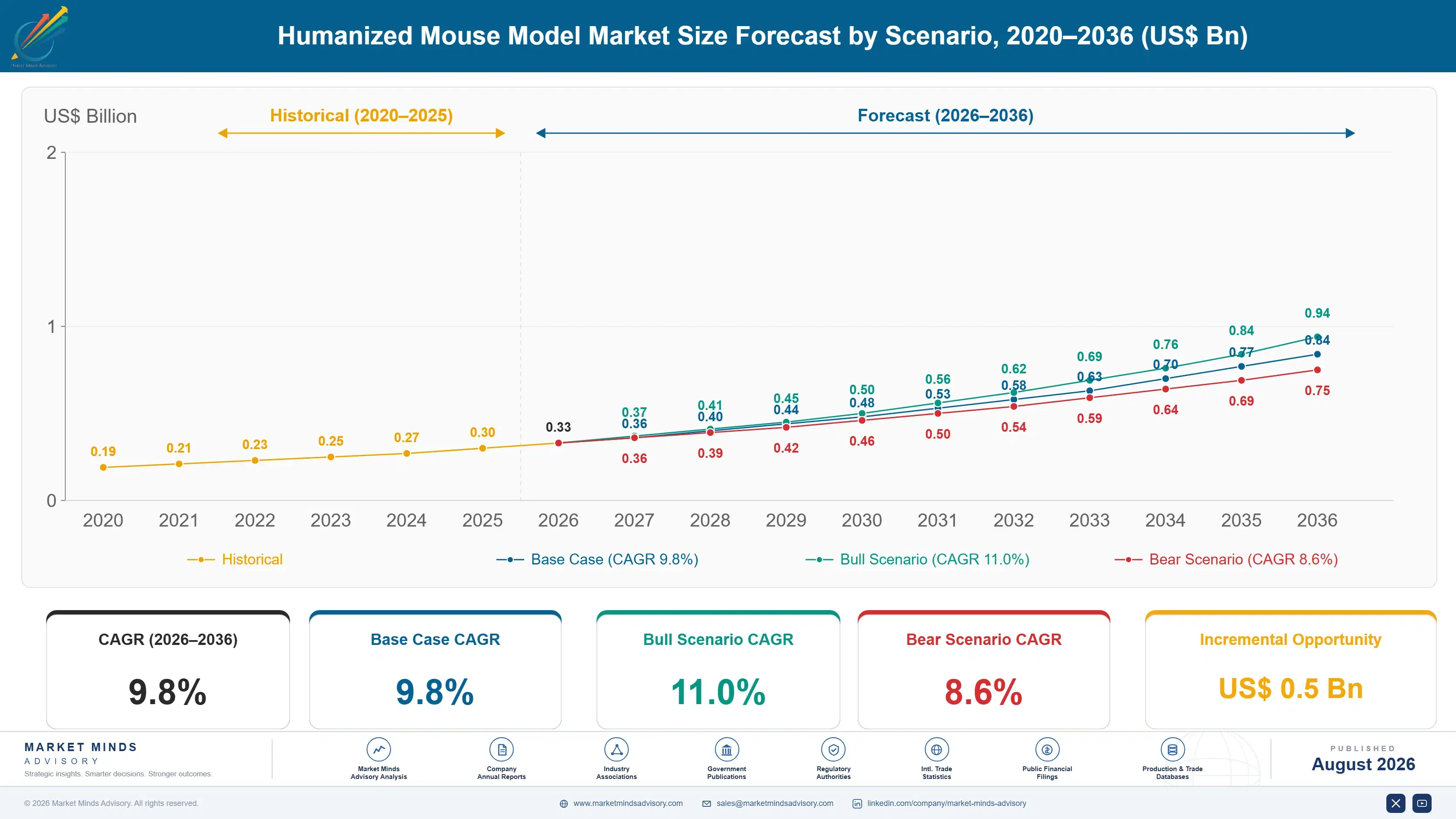
Humanized Mouse Model Market Forecast Scenarios

humanized-mouse-model-market-size-forecast-scenario-1787297714811
Growth from 2020 to 2025 compounded near 8.0%, held back early by pandemic-era laboratory access restrictions that delayed preclinical research programme procurement across most major markets for well over a year, then accelerated steadily as deferred research budgets resumed entering the back half of the five-year historical period tracked closely in this analysis and its underlying funding data.
Three mechanisms carry the base case to 9.8%. First, expanding checkpoint inhibitor and cell therapy pipeline breadth, which delivers predictive accuracy that conventional immunodeficient models cannot reliably provide across comparable validation depth. Second, growing patient-derived xenograft integration, which pushes sponsors toward personalized oncology modelling beyond standard cell-line derived approaches. Third, expanding Chinese contract research capacity, which drives substantial new model production investment well beyond traditional Western supply markets and their established breeding bases.
The bull case at 11.0% assumes immuno-oncology pipeline expansion accelerates faster than current clinical timelines suggest and Chinese contract research capacity outpaces current national targets by a meaningful margin. The bear case at 8.6% assumes pharmaceutical research and development budgets soften under broader economic pressure and sponsors defer non-critical model procurement across several major markets simultaneously and without much warning.

Predictive Accuracy Becomes the Preclinical Standard

Three forces converge on this market simultaneously. Checkpoint inhibitor and cell therapy pipeline breadth keeps expanding as sponsors seek predictive accuracy that conventional immunodeficient models cannot reliably provide across comparable preclinical validation depth. Patient-derived xenograft integration keeps growing, pushing sponsors toward personalized oncology modelling beyond standard cell-line derived approaches that fail to capture patient tumour heterogeneity. Chinese contract rese
MARKET CONCENTRATIONCR5 54%Reflects consolidation among established research institutions and contract research organisations
AVERAGE MODEL PRICEUSD 850-18,000Varies substantially by engraftment complexity and validation documentation depth
TOP PRODUCING COUNTRY SHAREUSA 31%Reflects concentrated genetic engineering research and breeding facility capacity base
RESEARCH ADOPTION RATE56%Share of major immuno-oncology programmes using humanized model platforms
TRADE INTENSITY33%Share of finished model shipments crossing borders before reaching laboratory
VALIDATED STRAIN COUNT180+Distinct humanized mouse strains currently validated and commercially available today
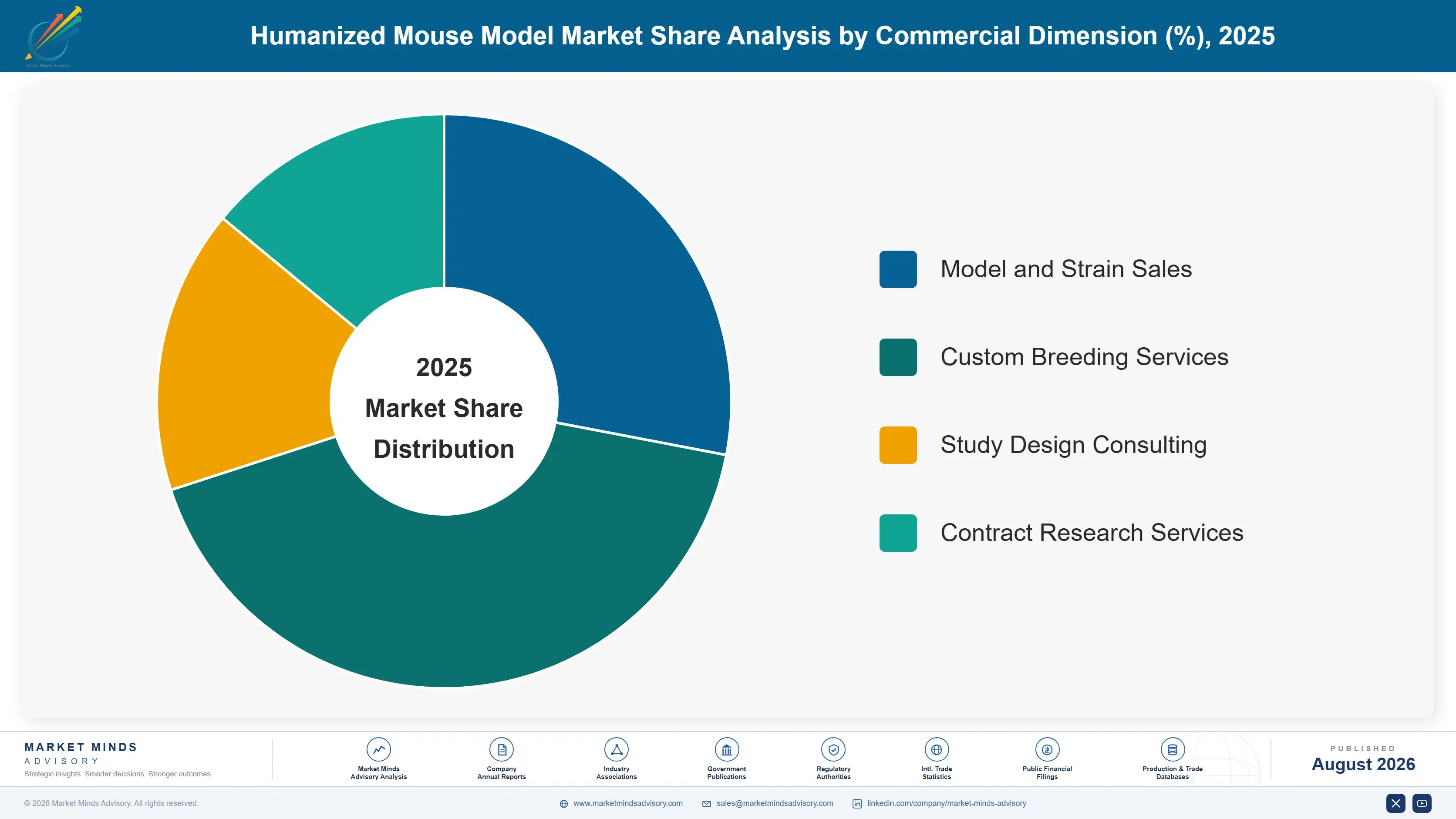
Commercially, the market splits between established research institutions with deep genetic engineering heritage selling through licensing and direct distribution networks, and contract research organisations defending narrow but valuable model licensing and breeding relationships built over decades of validation publications and peer-reviewed studies. Institutions capture more value through strain licensing and custom breeding services, while contract research organisations compete primarily on turnaround speed and integrated study design support.
Looking ahead, expanding checkpoint inhibitor pipelines, growing patient-derived xenograft adoption, and rising Chinese production capacity will shape which suppliers capture the fastest-growing demand pools over the coming decade, rewarding those who invested early in both genetic engineering depth and regional breeding capacity rather than those relying solely on legacy conventional xenograft catalog sales.
"A conventional xenograft used to be good enough for most oncology screening. Now sponsors want an immune system that actually behaves like a human one, and that's rewritten who wins the research contract."
Director, Preclinical Research Models Practice · MMA Healthcare - Preclinical Re

Market Trends

Humanized Immune System Models Expand Immuno-Oncology Adoption

Pharmaceutical sponsors keep expanding humanized immune system model adoption across most major checkpoint inhibitor and cell therapy programmes, pushing procurement toward models that deliver predictive accuracy conventional immunodeficient mice cannot reliably provide across comparable preclinical validation depth. Sponsors previously running standard xenograft protocols for early-stage compound evaluation increasingly rewrite research plans to require humanized immune validation before candidates advance, since late-stage clinical failure tied to poor preclinical prediction carries substantial cost. Suppliers with validated humanized platforms already proven across comparable pharmaceutical programmes are capturing contracts that competitors still lacking published validation data cannot bid on.
Market Impact: Chinese model production grew 26%
Patient-Derived Xenograft Integration Expands Personalized Modelling

Patient-derived xenograft integration keeps expanding across most major oncology research programmes as sponsors seek personalized modelling that standard cell-line derived xenografts cannot reliably provide at comparable tumour heterogeneity capture. This shift is reshaping which suppliers can compete profitably for large pharmaceutical contracts, since achieving validated humanized patient-derived platforms requires sustained engineering investment that smaller specialist suppliers increasingly cannot match on comparable research budgets or breeding infrastructure. Suppliers with validated humanized patient-derived platforms are capturing oncology design wins that competitors still relying on standard cell-line models increasingly cannot match on documented translational accuracy.
Market Impact: Cell therapy model demand grew 21%

Market Opportunities and Growth Drivers

Chinese Contract Research Capacity Expands Rapidly

China's domestic contract research sector continues expanding humanized mouse model production capacity as developers pursue rapid turnaround that established Western breeding facilities increasingly struggle to match given persistent global demand for validated strains simultaneously and aggressively across most major research provinces. Each newly expanded breeding facility requires substantial validated genetic engineering procurement meeting international quality standards rather than informal institutional-level sourcing. Chinese contract research organisations increasingly treat validated humanized strain development as a critical input in pharmaceutical partnership qualification rather than a downstream research decision, pushing suppliers further into the specification conversation earlier in programme development than before.
Market Impact: Breeding facility costs rose over 23%

Cell Therapy Pipeline Growth Reshapes Model Demand

Cell therapy pipeline growth keeps climbing across most major pharmaceutical programmes, forcing sponsors to adopt humanized immune system models that conventional xenografts cannot reliably support across comparable engraftment consistency requirements. Sponsors increasingly favor suppliers with documented humanized validation credentials in preclinical study design and regulatory submission decisions, pushing developers to treat validated models as a commercial necessity rather than a research nicety. Suppliers with proven humanized platforms are winning pharmaceutical sponsor contracts that competitors relying on conventional models increasingly cannot match on documented predictive accuracy and reproducibility across comparable multi-year cell therapy programmes.
Market Impact: Adds 4 to 8 weeks

Market Restraints and Challenges

Breeding and Husbandry Cost Inflation Squeezes Margin

Specialized breeding facility and husbandry cost pricing has risen considerably faster than general laboratory animal inflation across recent years, squeezing margin on fixed-price institutional supply contracts signed before the cost increases materialised across the contract term. The root cause is direct exposure to specialized breeding infrastructure and husbandry labour that suppliers cannot meaningfully influence through purchasing scale alone. The commercial impact falls hardest on smaller specialist suppliers lacking scale to negotiate favorable long-term facility costs. Several suppliers now build cost escalation clauses into supply agreements and are expanding automated husbandry systems where performance requirements allow it.
Market Impact: Humanized model orders rose 29%

Engraftment Variability Delays Preclinical Study Timelines

A persistent variability in human tissue engraftment success rates across humanized model batches is delaying study timelines even when model procurement and shipping logistics proceed on schedule without complication elsewhere. The root cause traces to inherent biological variability in donor tissue sources outpacing standardised engraftment protocols across most supplier organisations globally. The commercial impact includes extended study timelines and rising replacement animal costs that erode the total research economics sponsors originally budgeted for. Several suppliers now offer engraftment verification testing and guaranteed replacement programmes that reduce variability risk across research programmes.
Market Impact: Patient-derived model demand grew over 25%
3 additional market trends, 4 additional growth drivers, and 2 additional restraints and challenges are covered in the full report. Contact sales@marketmindsadvisory.com to access the complete intelligence.

Segment CAGR and Growth Architecture

Segmentation follows model engraftment type rather than research application, since a single humanized platform commonly serves drug discovery, immuno-oncology, and infectious disease research simultaneously across very different sponsor organisations and study designs worldwide. This reflects how suppliers actually organise genetic engineering, breeding validation, and commercial catalog structure internally across their own operating divisions and regional breeding facilities.
humanized-mouse-model-market-market-share-analysis-1787297715395

Humanized Immune System Mice

Humanized immune system mice carry engrafted human haematopoietic stem cells or peripheral blood mononuclear cells to reconstitute a functional human immune system, most valued where checkpoint inhibitor and cell therapy programmes pursue predictive accuracy that conventional immunodeficient models cannot reliably provide. Growth outpaces every other category as sponsors increasingly specify humanized immune validation at the study design stage for new immunotherapy programmes rather than treating it as a later research consideration. Suppliers with validated humanized platforms already proven across comparable pharmaceutical programmes are capturing contracts that competitors still lacking published validation data cannot bid on at all. The United States and China drive the bulk of current volume given their concentration of active immuno-oncology research investment.
CAGR 13.6%

Patient-Derived Xenograft Humanized Mice

Patient-derived xenograft humanized mice combine engrafted patient tumour tissue with a reconstituted human immune system, most valued where oncology researchers pursue personalized modelling that standard cell-line derived xenografts cannot reliably provide across comparable tumour heterogeneity capture. Growth is second-fastest across the segmentation, driven by expanding precision oncology research and rising demand for immunotherapy response prediction beyond traditional cell-line screening. Suppliers with validated humanized patient-derived platforms are capturing oncology design wins that competitors still relying on standard xenografts increasingly cannot match on documented translational accuracy. Pricing reflects that complexity, commanding meaningfully higher per-unit value than standard conventional alternatives. The United States leads current adoption, with China expanding domestic patient-derived breeding capacity to serve its growing oncology pipeline.
CAGR 11.8%
Full segment breakdown across 5 segments available in the complete report.

Regional Architecture and Country Demand Map

North America holds the largest share given Jackson Laboratory's dominant global model supply position and concentrated NIH and biopharma research funding across most well-established academic institutions. China is growing fastest as domestic contract research organisations expand humanized model production capacity nationwide across most major research provinces and their satellite cities.

North America

The United States drives the overwhelming majority of regional demand through sustained pharmaceutical and academic research spending, with Jackson Laboratory's Bar Harbor headquarters anchoring global strain development and validation across most well-funded immuno-oncology programmes and their publication pipelines. Domestic supplier headquarters concentration, spanning Jackson Laboratory, Taconic Biosciences, and Charles River among others, supports deep breeding and distribution reach that imported competitors struggle to match on turnaround speed. Canada contributes a meaningful base through its own academic immunology research sector, particularly institutions tied to established preclinical collaborations. Strain validation depth remains the binding factor shaping supplier selection across much of the region, more so than raw model pricing across most institutional and pharmaceutical procurement decisions.
Share: 32% | CAGR: 9.2% (2026 to 2036)

Western Europe

Germany anchors regional demand through its dense biotech research base and concentration of academic immunology centres pursuing humanized model adoption ahead of most regional peers and their comparable breeding networks. France contributes significant volume through GenOway and comparable manufacturers serving pharmaceutical and academic customers internationally from European breeding bases spanning decades of accumulated genetic engineering knowledge. The United Kingdom adds further volume through established distributor networks serving academic and pharmaceutical research centres directly. The region's strong academic research funding framework sustains steady replacement demand independent of export market cycles entirely. Growth trails the global average because much of the region's own research base already carries modern validated strains installed during previous funding cycles.
Share: 24% | CAGR: 8.3% (2026 to 2036)
Regional intelligence for 5 additional markets available in the complete report: East Asia, South Asia and Pacific, Latin America, Middle East and Africa, Eastern Europe. Contact sales@marketmindsadvisory.com.
humanized-mouse-model-market-country-cagr-analysis-1787297715914

Where Suppliers Can Capture More Value

Suppliers sit between tightening reproducibility specification and rising demand for patient-derived and immune system humanized platforms, a position that offers several distinct paths to capture more value than a standard model sale provides, particularly as study design consulting and breeding partnerships gain commercial importance among pharmaceutical buyers. The four levers below reflect where margin is genuinely shifting across the industry.

Bundle Study Design Consulting With Model Sales

Pharmaceutical sponsors navigating increasingly demanding reproducibility requirements increasingly prefer suppliers who bundle study design consulting with model sales, since that pairing reduces the sponsor's own publication risk considerably compared with sourcing models and protocol guidance separately from different vendors during time-sensitive research windows. Jackson Laboratory and Taconic have both expanded dedicated study design consulting practices covering programmes worth well over USD 175 million combined across recent years of active engagement in the sector. That structure builds stickier customer relationships since switching suppliers mid-programme would force researchers to restart validation entirely from scratch.
Market Impact: Study design consulting now exceeds USD 175 million

Expand Custom Breeding Partnerships Around Installed Base

Research programmes require ongoing custom strain development and breeding support across their multi-year study timelines, and suppliers who maintain the original licensing relationship into ongoing breeding partnerships capture recurring revenue considerably more predictable than one-time model sales alone ever provide, often worth USD 2 million or more annually across a comparable sponsor relationship. That relationship also generates early visibility into a sponsor's future expansion and study design plans before competitors even learn a tender is coming their way at all. Building this breeding depth should rank above chasing every available new model sale opportunity across the wider research market.
Market Impact: Breeding partnerships renew across 3 to 5 year cycles

Expand Patient-Derived Xenograft Production Capacity Widely

Patient-derived humanized demand represents a considerably larger addressable market than standard cell-line xenograft demand alone could ever support, since over 44% of oncology research programmes surveyed now specify patient-derived validation as a mandatory requirement rather than an optional upgrade across most major producing markets tracked in this report. Suppliers expanding dedicated patient-derived capacity capture pharmaceutical contracts that generalist competitors increasingly cannot match, generating meaningful revenue through phased capacity conversion that unfolds across multiple budget cycles rather than a single capital purchase decision made all at once across the sponsor's broader research plan.
Market Impact: Patient-derived validation requirements now exceed 44 percent industry-wide

Expand Chinese Contract Research Support Now

Chinese humanized model demand is scaling quickly, growing near 14% annually, as domestic contract research organisations expand production capacity requiring validated genetic engineering meeting international quality standards across most major research provinces and their satellite institutions. Suppliers establishing local breeding and technical support presence early are winning multi-year pharmaceutical contracts before competitors relying solely on imported models can match local pricing and delivery turnaround speed across comparable research scale. That early-mover position compounds considerably as China's biotech sector keeps climbing through the remainder of the decade ahead of most other regional markets.
Market Impact: Chinese demand grows near 14% each year now

Who Controls the Margin Pool

Concentration sits at a notable 54% for the top five, reflecting a market shaped by established research institutions with deep genetic engineering heritage and numerous contract research organisations defending narrow but valuable model licensing and breeding relationships. The gap between leaders and challengers comes down to strain validation depth rather than raw breeding scale alone. All participants here are assessed on one basis, annual model and licensing revenue from humanized mouse sal
Competition runs along three lines. First, strain validation depth, since suppliers with documented reproducibility data win pharmaceutical tenders competitors still completing validation cannot bid on. Second, breeding capacity scalability, as sponsors increasingly demand consistent engraftment supply bundled into standard research agreements. Third, distribution reach, particularly for suppliers pursuing fast-growing Chinese contract research markets directly.

Pressure is building from two directions. Chinese suppliers are narrowing the genetic engineering gap considerably faster than expected, squeezing volume established Western institutions previously captured on validation reputation alone. Meanwhile larger contract research organisations keep acquiring specialty humanized model developers to fill capability gaps rather than build organically, consolidating the field further. Rankings should favor suppliers combining strain validation depth with genuine regional breeding reach.
humanized-mouse-model-market-company-positioning-matrix-1787297716464

Competitive Moat and Risk Dimensions

THE JACKSON LABORATORY

Moat: Deep strain validation heritage

Jackson Laboratory's decades-long presence in genetic engineering research gives it deep credibility with pharmaceutical sponsors navigating reproducibility requirements, supporting premium pricing that narrower regional competitors cannot command. Its scale supports engineering investment in next-generation humanized strains that smaller specialist suppliers typically cannot match on comparable research budgets.
THE JACKSON LABORATORY

Risk: Non-profit governance structure constraint

Jackson Laboratory's non-profit governance structure can slow commercial decision-making relative to pure-play for-profit competitors, leaving it potentially less agile in responding to fast-moving pharmaceutical partnership opportunities and competitive pricing pressure across commercial contract negotiations. Faster-moving contract research organisations increasingly win time-sensitive tenders that Jackson's slower internal approval processes struggle to match on turnaround alone.
CHARLES RIVER LABORATORIES INTERNATIONAL, INC.

Moat: Broad integrated research breadth

Charles River's product portfolio spans preclinical safety testing, model breeding, and contract research applications simultaneously, letting it cross-sell across buyer categories that narrower competitors cannot reach with a single relationship. Its global distribution network supports rapid fulfillment that smaller specialist suppliers typically cannot match on delivery speed.
CHARLES RIVER LABORATORIES INTERNATIONAL, INC.

Risk: Broader portfolio strategic focus

Charles River's humanized model revenue remains a smaller share of a much larger contract research portfolio, leaving strategic focus more exposed to internal capital allocation shifts than pure-play competitors dedicated entirely to humanized model development and their specific customer relationships. Specialist rivals with narrower focus can move faster on humanized platform investment decisions.

Players Tracked

Prominent Players

The Jackson Laboratory
Taconic Biosciences, Inc.
Charles River Laboratories International, Inc.
Envigo
Crown Bioscience, Inc.

Other Key Players

GemPharmatech Co., Ltd.
Cyagen Biosciences Inc.
Biocytogen Pharmaceuticals Co., Ltd.
GenOway
Trans Genic Inc.
Ozgene Pty Ltd.
Model Animal Research Center
Shanghai Model Organisms Center, Inc.
Applied StemCell, Inc.
Ingenious Targeting Laboratory, Inc.
Champions Oncology, Inc.
Hera BioLabs, Inc.
Vital River Laboratories Co., Ltd.
SAGE Labs
inVivos Pte Ltd.

Recent Developments

MARCH 2025

Jackson Laboratory launches expanded humanized platform for solid tumour research

Jackson Laboratory launched an expanded humanized immune system platform specifically engineered for solid tumour immuno-oncology programmes requiring documented reproducibility beyond what its prior generation strain could reliably provide. This was a product launch rather than an acquisition, extending its genetic engineering into a broader customer base worldwide.
Signal: Suppliers are increasingly launching dedicated solid tumour platforms rather than adapting standard humanized strains after the original release.
OCTOBER 2024

Charles River acquires specialty patient-derived xenograft technology developer

Charles River acquired a specialty patient-derived xenograft technology developer to strengthen its oncology modelling portfolio rather than continue developing comparable technology internally for select applications across its broader catalog and customer base. This was a confirmed acquisition, extending Charles River's engineering capability directly and permanently across its research models division.
Signal: Larger suppliers are acquiring specialty patient-derived xenograft developers to internalise personalized modelling capability rather than license it.
MAY 2025

Crown Bioscience signs multi-year supply agreement across Chinese pharmaceutical programme

Crown Bioscience signed a multi-year model supply agreement covering validated humanized strain deliveries across several Chinese pharmaceutical partnership expansion projects currently under active development across multiple provinces. This was a confirmed supply agreement rather than an acquisition, extending Crown Bioscience's East Asian presence directly and substantially over time.
Signal: Model supply agreements are increasingly tied to national biotech partnership cycles rather than standalone one-off tenders.

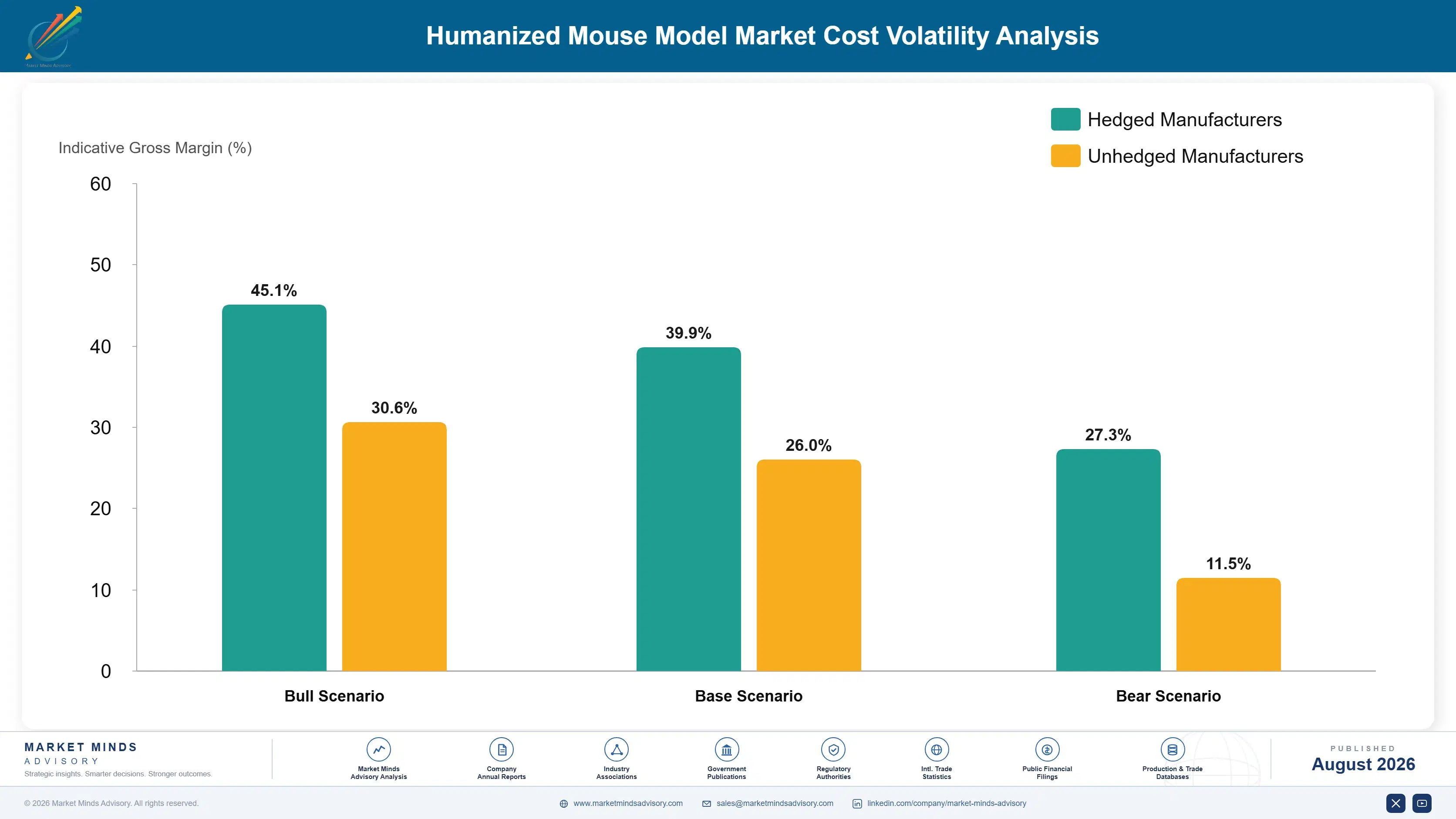
Breeding Facility and Husbandry Cost Exposure

Specialized breeding facility maintenance, husbandry labour, and donor tissue sourcing together make up roughly 58% of model production cost, with breeding facility costs sourced through specialized biocontainment infrastructure suppliers cannot meaningfully influence on their own, and donor tissue sourced through a smaller number of qualified specialty suppliers subject to their own certification requirements and periodic audits.
Breeding facility and husbandry costs rose considerably through 2024, with published life sciences industry data and company annual reports showing sustained upward pricing pressure tied to constrained specialized labour availability and rising global research demand competing directly with suppliers for available breeding capacity across every major producing region. Several suppliers absorbed a meaningful share of the cost increase rather than risk losing fixed-price institutional supply agreements already signed before the volatility began that year, eroding margin more than budgeted.

Larger established institutions with greater breeding scale negotiate more favorable facility and labour economics than smaller specialist suppliers, who typically lack comparable volume leverage with upstream infrastructure providers across most specialty markets. That gap widens further for suppliers dependent on a small number of donor tissue sources, since switching sources requires renewed qualification testing taking several months to complete across each affected product line.
humanized-mouse-model-market-cost-volatility-analysis-1787297716664

Qualify Multiple Donor Tissue Suppliers

Suppliers qualifying two or more sources for critical donor tissue components reduce single-source dependency risk considerably, though the qualification process itself requires meaningful upfront testing investment and lead time before a second source becomes usable in volume production supporting validated engraftment performance requirements across every strain family and customer contract currently under active development.

Negotiate Multi-Year Facility-Indexed Supply Contracts

Suppliers negotiating multi-year breeding facility supply contracts with indexed pricing formulas protect margin predictability better than those repricing purchases annually, a structure that requires accepting somewhat higher baseline pricing in exchange for materially reduced volatility exposure across the full contract term negotiated with each upstream partner directly and renewed periodically as demand shifts over time.

Build Cost Escalation Clauses Into Customer Agreements

Suppliers building input cost escalation clauses directly into multi-year institutional supply agreements pass volatility through to buyers rather than absorbing it against thin project margin, a structure that protects profitability during price spikes though it requires negotiating leverage smaller suppliers often lack against larger pharmaceutical and academic buyers with considerably more purchasing scale and longer-term budget certainty.

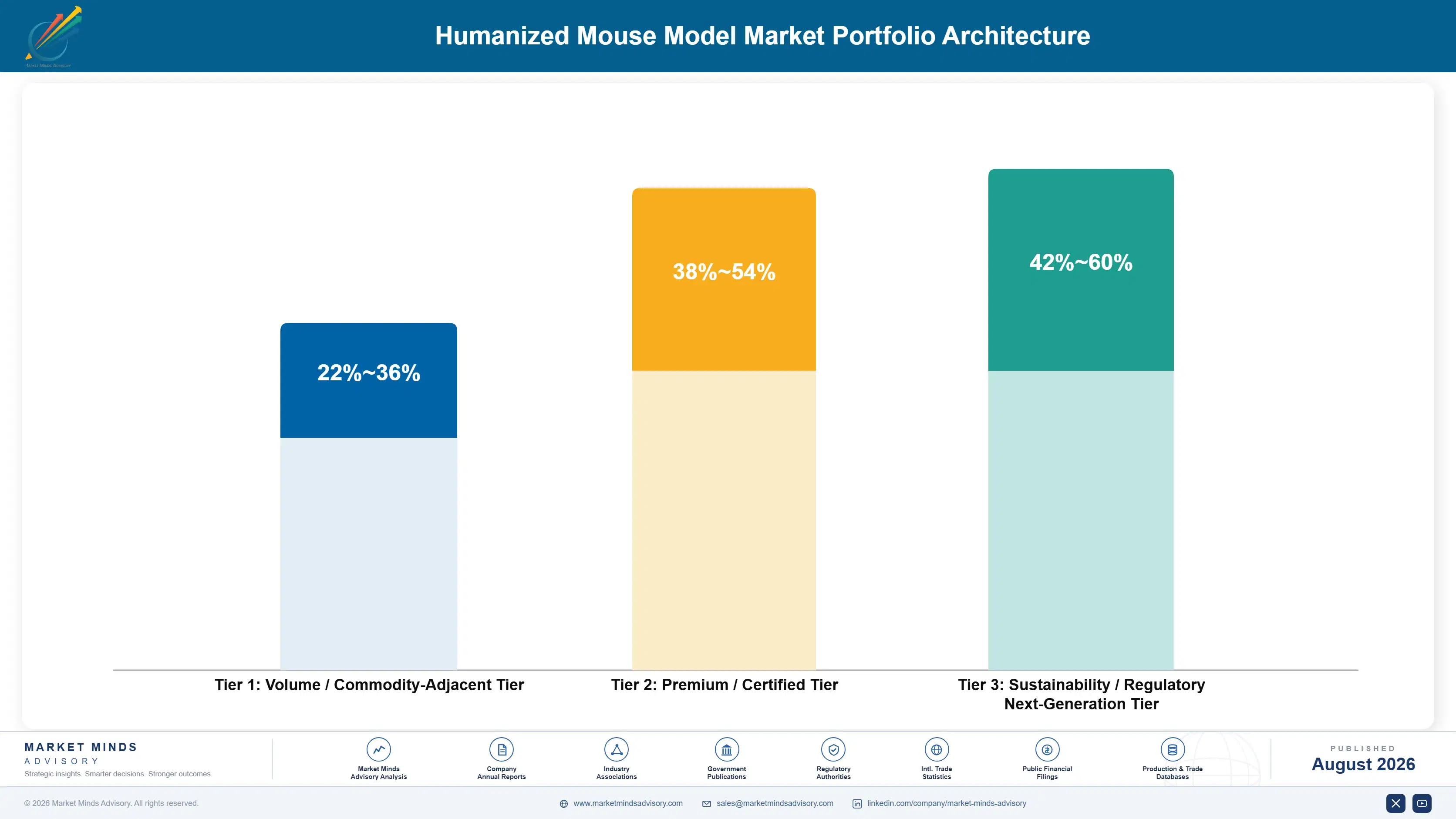
Portfolio Architecture for Margin Defence

The portfolio splits into three tiers with sharply different economics. Standard conventional xenograft models form the volume tier, competing largely on price and delivery lead time with margin set by breeding cost and production scale. Humanized immune system and patient-derived platforms earn considerably more because genetic engineering complexity and validation requirements both resist the commoditisation pressure hitting standard models. Study-design-consulting-integrated premium platforms
The tension runs between winning standard conventional volume on price and delivery speed, and building humanized or patient-derived capability that protects margin over the long run. A supplier chasing every standard academic tender available eventually gets squeezed as regional breeders undercut aggressively on price, yet building humanized capability requires engineering investment thin-margin standard sales rarely fund adequately on their own.

High-value pools concentrate where genetic engineering complexity, validation publication depth, or consulting depth limit competition: humanized platforms serving immuno-oncology researchers, patient-derived systems serving precision oncology customers, and breeding-partnership-backed relationships spanning multiple years of research collaboration. Standard conventional xenograft models sit at the other end, competing almost entirely on price and delivery lead time.

Volume / Commodity-Adjacent Tier

Standard conventional xenograft and immunodeficient models for mainstream academic and industrial applications, competing largely on price and delivery speed with thin, scale-dependent margin across most tenders and institutional bids reviewed each cycle.
Gross Margin: 22-36%

Premium / Certified Tier

Humanized immune system and patient-derived platforms with validated engineering and reproducibility documentation serving pharmaceutical and oncology customers, priced for complexity and documented accuracy built over years of testing and publication.
Gross Margin: 38-54%

Sustainability / Regulatory / Next-Generation Tier

Study-design-consulting-integrated platforms with connected validation documentation, priced on engineering and compliance value that extends well beyond raw model economics and standard pricing alone across most customer segments and sponsor relationships.
Gross Margin: 42-60%
humanized-mouse-model-market-portfolio-architecture-1787297717167

High-value Sub-segments and Strategic Watch-out

Humanized Immune System Mice

High value and high growth at 13.6%, the fastest category, as checkpoint inhibitor and cell therapy programmes seek predictive accuracy that conventional immunodeficient models cannot provide across nearly every major producing region tracked closely throughout this entire report today and beyond into the next forecast decade.
Gross Margin: 38-54%

Patient-Derived Xenograft Humanized Mice

High value with strong growth at 11.8%, driven by expanding precision oncology research and rising demand for immunotherapy response prediction beyond traditional cell-line screening across most regulated categories tracked carefully in this full report and its underlying survey data today and across the coming decade.
Gross Margin: 38-54%

Genetically Humanized Mice

The volume core by installed strain count, growing near 8.2% as standard gene knock-in applications remain the largest category even as growth concentrates in immune system and patient-derived formats elsewhere across the broader portfolio, margin mix, and supplier catalog structure tracked throughout this entire report today.
Gross Margin: 22-36%

Humanized Liver Mice

The strategic watch-out, growing slowest at roughly 6.4% and facing steady commoditisation as standard hepatic metabolism applications become a bundled feature rather than a genuinely differentiated purchase decision across most regional tenders reviewed throughout this analysis and its underlying data today and the coming decade.
Gross Margin: 18-30%

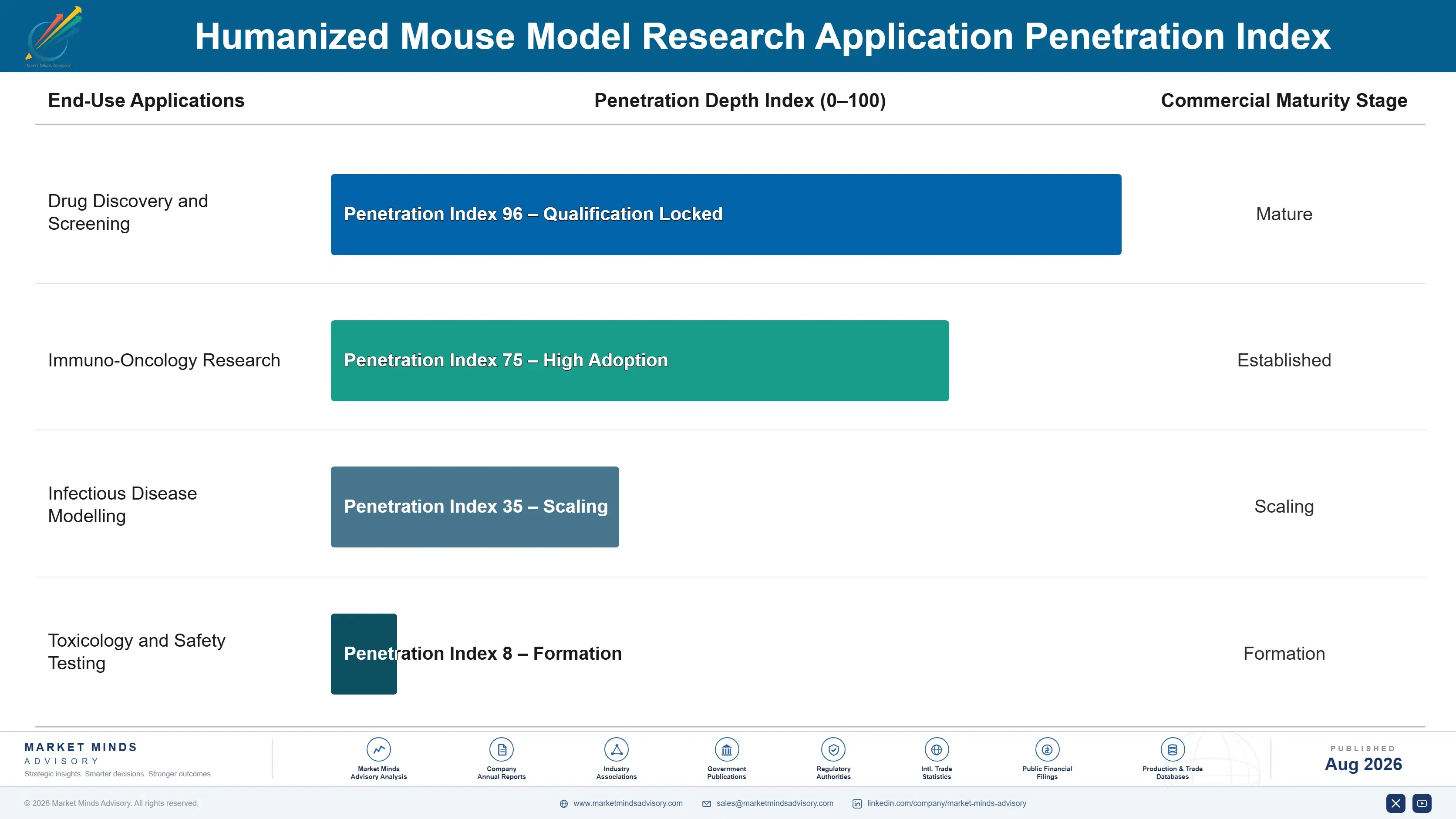
Recurring Revenue Through Study Design Cycles

Model revenue increasingly behaves like an annuity layered on top of the original licensing sale rather than a one-time transaction. Every strain update, breeding renewal, and study design consultation extends the supplier relationship well beyond delivery day, and suppliers with validated study design support capture repeat business with lower friction than switching to an unproven alternative provider would require of a demanding pharmaceutical or academic buyer.
Adoption depth varies considerably by end-use vertical. Pharmaceutical sponsors have the deepest, most established humanized adoption given regulatory requirements that make unvalidated screening data extremely costly in development terms, while academic researchers are earlier in adopting comparable reproducibility-documented models and still weighing grant cost against demonstrated publication advantage. Contract research organisations sit furthest behind, adopting premium patient-derived platforms more slowly as cost sensitivity remains considerably higher there than in regulated pharmaceutical categories.

A generational shift is underway in procurement teams across most major markets. Younger research leadership increasingly treats humanized validation and reproducibility documentation as baseline procurement requirements rather than differentiators, a shift that is compressing the commercial advantage early-adopting suppliers once held over peers still running largely undocumented breeding histories.
humanized-mouse-model-market-end-use-penetration-index-1787297717663

Where Suppliers Should Focus Next

These are among the four positions where our research anticipates prominent divergence between winners and laggards over the coming forecast period. Each is grounded in the demand model, the regulatory perimeter, and the announced capacity pipeline.
01 / STUDY DESIGN CONSULTING BUNDLING

Consulting increasingly separates leaders from challengers

Pharmaceutical sponsors navigating increasingly demanding reproducibility requirements increasingly prefer suppliers who bundle study design consulting with model sales, since that pairing reduces the sponsor's own publication risk considerably compared with sourcing models and protocol guidance separately from different vendors during time-sensitive research windows. That structure builds stickier customer relationships since switching suppliers mid-programme would force researchers to restart validation entirely from scratch. Suppliers without comparable consulting practices remain exposed as customers increasingly expect integrated study design expertise rather than models alone.
02 / CUSTOM BREEDING EXPANSION

Recurring breeding partnerships beat one-time model sales

Research programmes require ongoing custom strain development and breeding support across their multi-year study timelines, and suppliers who maintain the original licensing relationship into ongoing breeding partnerships capture recurring revenue considerably more predictable than one-time model sales alone ever provide. That relationship also generates early visibility into a sponsor's future expansion plans before competitors even learn a tender is coming their way. Building this breeding depth should rank above chasing every available new model sale opportunity across the wider research market and its many funding cycles.
03 / PATIENT-DERIVED CAPACITY EXPANSION

Personalized modelling demand warrants early capacity investment

Patient-derived humanized demand represents a considerably larger addressable market than standard cell-line xenograft demand alone could ever support, since over 44% of oncology research programmes surveyed now specify patient-derived validation as a mandatory requirement across most major producing markets. Suppliers expanding dedicated patient-derived capacity capture pharmaceutical contracts that generalist competitors increasingly cannot match, generating meaningful revenue through phased capacity conversion unfolding across multiple budget cycles. Building this capacity should rank above chasing standard cell-line tenders exclusively across every major research programme.
04 / CHINESE MARKET EXPANSION

Early presence in contract research expansion compounds over time

Chinese humanized model demand is scaling quickly as domestic contract research organisations expand production capacity requiring validated genetic engineering meeting international quality standards across most major research provinces and their satellite institutions. Suppliers establishing local breeding and technical support presence early are winning multi-year pharmaceutical contracts before competitors relying solely on imported models can match local pricing and delivery turnaround. That early position compounds considerably as China's biotech sector keeps climbing through the remainder of the decade, rewarding early movers meaningfully over slower-moving competitors.

Engagement Snapshot From the Field

A live engagement with an industry participant carrying material or product regulatory and market exposure ahead of a defining policy shift, showing how our research translates into a defensible multi-year portfolio strategy.
MARKET MINDS ADVISORY · CLIENT ENGAGEMENT SUMMARY
Humanized Mouse Model Producer Strategic Portfolio Review and Transition Roadmap 2026·Investment Scenario on Humanized Mouse Model Exposure Evaluation 2025-26
CLIENT PROFILE
A mid-size pharmaceutical sponsor advancing an early-stage checkpoint inhibitor programme across two lead oncology indications engaged MMA while evaluating a preclinical model strategy ahead of an anticipated investigational new drug filing within its expanding pipeline. The client reported reliance on conventional xenograft models for its current preclinical screening, with no existing humanized immune system capability across its current research infrastructure (client-reported, unverified by MMA).
STRATEGIC CHALLENGE
Leadership needed to decide whether converting to humanized immune system models would strengthen regulatory submission credibility faster than continuing sole reliance on conventional xenografts, while also weighing which suppliers offered breeding support flexible enough to sequence conversion across two indications without disrupting ongoing preclinical commitments already under signed contract with academic collaborators.
MMA APPROACH
MMA benchmarked four qualified model suppliers on humanized strain validation, breeding capacity flexibility, and total lifecycle cost against the client's two-indication research plan in considerable detail. We modelled a phased conversion sequence prioritising the highest-priority indication first across the pipeline. We then assessed each supplier's technical support capacity given the client's aggressive filing timeline.
KEY FINDINGS
  1. Converting the highest-priority indication to humanized models first would capture roughly 52% of projected regulatory credibility improvement within the programme's first year alone.
  2. Two of four candidate suppliers could not guarantee breeding capacity meeting the client's aggressive filing timeline across both indications reliably or within budget.
  3. Humanized model conversion would reduce projected late-stage clinical attrition risk by an estimated 28% once fully operational across the converted programme segment.
  4. The leading supplier's bundled validation documentation would reduce the client's own regulatory filing burden by several weeks per submission cycle, freeing internal staff time.
CLIENT PROFILE
A mid-size pharmaceutical sponsor advancing an early-stage checkpoint inhibitor programme across two lead oncology indications engaged MMA while evaluating a preclinical model strategy ahead of an anticipated investigational new drug filing within its expanding pipeline. The client reported reliance on conventional xenograft models for its current preclinical screening, with no existing humanized immune system capability across its current research infrastructure (client-reported, unverified by MMA).
STRATEGIC CHALLENGE
Leadership needed to decide whether converting to humanized immune system models would strengthen regulatory submission credibility faster than continuing sole reliance on conventional xenografts, while also weighing which suppliers offered breeding support flexible enough to sequence conversion across two indications without disrupting ongoing preclinical commitments already under signed contract with academic collaborators.
MMA APPROACH
MMA benchmarked four qualified model suppliers on humanized strain validation, breeding capacity flexibility, and total lifecycle cost against the client's two-indication research plan in considerable detail. We modelled a phased conversion sequence prioritising the highest-priority indication first across the pipeline. We then assessed each supplier's technical support capacity given the client's aggressive filing timeline.
KEY FINDINGS
  1. Converting the highest-priority indication to humanized models first would capture roughly 52% of projected regulatory credibility improvement within the programme's first year alone.
  2. Two of four candidate suppliers could not guarantee breeding capacity meeting the client's aggressive filing timeline across both indications reliably or within budget.
  3. Humanized model conversion would reduce projected late-stage clinical attrition risk by an estimated 28% once fully operational across the converted programme segment.
  4. The leading supplier's bundled validation documentation would reduce the client's own regulatory filing burden by several weeks per submission cycle, freeing internal staff time.
RECOMMENDED STRATEGY
Phase 1: Phase 1 (0 to 8 months): Finalise supplier selection and convert the highest-priority indication identified across both active programmes first. Phase 2: Phase 2 (8 to 16 months): Complete second-indication conversion, sequenced carefully around ongoing preclinical commitments across both indications and their timelines. Phase 3: Phase 3 (16 to 26 months): Complete full model conversion and renegotiate breeding partnership terms under the new supply structure.
OUTCOME
The sponsor completed priority indication conversion within the targeted ten-month window and reported regulatory credibility improvement tracking close to the modelled estimate across the converted programme segment. Projected clinical attrition risk also declined measurably under the humanized programme, though full twenty-six-month transition figures were not yet available at the time of reporting (client-reported, unverified by MMA).

Frequently Asked Questions

Foundational context covering the market sizes, CAGR, scope, country, region and competition that inform every finding below. This section is provided to cover basics and most often pre-purchase conversations, answered from the MMA Primary Research Dataset.

What is the current size of the Humanized Mouse Model Market?

The global humanized mouse model market is valued at USD 0.3 billion in 2025, covering humanized immune system, genetically humanized, liver, and patient-derived xenograft models across preclinical research applications.

How large will the Humanized Mouse Model Market be by 2036?

The market is projected to reach USD 0.84 billion by 2036, roughly 2.55 times its 2026 value of USD 0.33 billion, driven by checkpoint inhibitor pipelines and patient-derived xenograft adoption.

What is the CAGR for the Humanized Mouse Model Market 2026 to 2036?

The base case CAGR is 9.8%, with a bull case of 11.0% if immuno-oncology pipeline expansion accelerates faster than expected, and a bear case of 8.6% under softer pharmaceutical research spending.

Which segment is growing fastest?

Humanized Immune System Mice lead at a 13.6% CAGR, roughly 1.39 times the overall market rate, as checkpoint inhibitor and cell therapy programmes seek predictive accuracy beyond conventional models.

Who are the major companies in the Humanized Mouse Model Market?

Jackson Laboratory, Taconic Biosciences, Charles River, Envigo, and Crown Bioscience lead the market, together holding roughly 54% of model and licensing revenue generated worldwide each year.

Which country is growing fastest?

China leads at a 14.2% CAGR as domestic contract research organisations expand humanized model production capacity nationwide across most major research provinces and their satellite cities.

Report Segmentation Architecture

The full report scope spans multiple orthogonal segmentation dimensions, with cross-tabulated demand data provided for each dimension pair. Coverage extends further to regional breakdowns, trend trajectories, and the competitive detail needed to support segment-level decision-making.

By Model Engraftment Type

  • Humanized Immune System Mice
  • Genetically Humanized Mice
  • Humanized Liver Mice
  • Patient-Derived Xenograft Humanized Mice
  • Humanized Microbiome Mice

By Research Application

  • Drug Discovery and Screening
  • Immuno-Oncology Research
  • Infectious Disease Modelling
  • Toxicology and Safety Testing

By Commercial Dimension

  • Model and Strain Sales
  • Custom Breeding Services
  • Study Design Consulting
  • Contract Research Services

By Region

  • North America
  • Western Europe
  • East Asia
  • South Asia and Pacific
  • Latin America
  • Middle East and Africa
  • Eastern Europe

Scope, Methodology, and Coverage

Every figure in this report is reproducible from documented input assumptions. The scope below maps the historical period, the forecast horizon, the segmentation dimensions, and the countries covered, alongside the underlying primary and qualitative methodology.
Historical Period
2020 to 2025
Forecast Period
2026 to 2036
Base Year
2025 (USD billions; MMA Primary Research Dataset, August 2026)
Market Definition
The humanized mouse model market covers humanized immune system, genetically humanized, humanized liver, patient-derived xenograft humanized, and humanized microbiome mouse models sold for preclinical drug discovery, immuno-oncology, and infectious disease research applications. It excludes standard immunodeficient mice without human tissue engraftment, non-mouse animal models, and in vitro organoid systems sold as standalone research tools.
Quantitative Units
USD billions (current prices); annual model unit volume where applicable
Segmentation Dimensions
By Model Engraftment Type; By Research Application; By Commercial Dimension; By Region
Regions Covered
North America, Western Europe, East Asia, South Asia and Pacific, Latin America, Middle East and Africa, Eastern Europe
Countries Covered
USA, China, Germany, France, UK, Japan, South Korea, India, Australia, Canada, Brazil, Mexico, Switzerland, Netherlands, UAE, Saudi Arabia, South Africa, Nigeria, Turkey, Poland, Italy, Spain, Sweden, Israel, Singapore, and additional markets relevant to this sector
Key Companies Profiled
The Jackson Laboratory, Taconic Biosciences, Inc., Charles River Laboratories International, Inc., Envigo, Crown Bioscience, Inc., GemPharmatech Co., Ltd., Cyagen Biosciences Inc., Biocytogen Pharmaceuticals Co., Ltd., GenOway, Trans Genic Inc., Ozgene Pty Ltd., Model Animal Research Center, Shanghai Model Organisms Center, Inc., Applied StemCell, Inc., Ingenious Targeting Laboratory, Inc., Champions Oncology, Inc., Hera BioLabs, Inc., Vital River Laboratories Co., Ltd., SAGE Labs, inVivos Pte Ltd.
Quantitative Methodology
Primary survey, n=3,800 respondents, Q4 2025, six countries; demand-side model with trade association cross-validation
Qualitative Methodology
47 expert interviews, Q4 2025; applied to validate demand model assumptions, identify emerging dynamics, and assess competitive positioning
Report Format
PDF and XLSX data workbook (Word format preview document)
Publisher
Market Minds Advisory
Report Code
MMA-2026-HLT-142
Published
August 2026
Contact
sales@marketmindsadvisory.com | www.marketmindsadvisory.com

Purchase the full Humanized Mouse Model Market Report (2026 to 2036).

The full report delivers granular sizing and forecasts across all five model engraftment segments and seven global regions through 2036. It profiles twenty companies across established research institutions and contract research organisations, benchmarking strain validation depth, breeding capacity scalability, and distribution reach in considerable detail. Analysts detail breeding cost exposure, portfolio margin tiers, and demand architecture by end-use vertical across major global markets and their evolving research funding environments. Buyers receive both the standalone report and full access to underlying data tables supporting every figure and forecast presented throughout.
Five-segment model engraftment sizing and full forecasts
Seven-region global market share breakdown detail
Twenty-company detailed competitive profile benchmarking analysis
Breeding cost exposure and supplier mitigation analysis
Portfolio margin tier benchmarking economics framework
Anonymised client engagement outcome case study

Built For The People Who Decide

From boardroom strategy to bench-side execution, this report is read cover-to-cover by leaders shaping the next decade of their industry, turning demand scenarios, market dynamics and valuation benchmarks into decisions.
CXOs/ Presidents/ VPs/ Managers
M&A and Corporate Development
Strategy Teams and R&D Heads
Procurement and Product Directors
Regulatory and Compliance Leaders
Investor Relations and Equity Analysts