Market Minds Advisory
Human Osteoblasts Market

Human Osteoblasts Market: Donor Variability, Tissue Supply Chains, and Animal Model Replacement

Every lot of primary osteoblasts comes from a different human being, and mineralisation capacity varies by nearly forty per cent between donors, which quietly undermines the reproducibility of an entire research field.

Lead Analyst

Alice Ballenger

Published

September 2026

Make Smarter Decisions with Customized Research Insights

Request a free sample report and evaluate market opportunities, growth trends, and competitive dynamics relevant to your business needs.

2025 MARKET VALUE$0.6BMarket Size 2025
2036 FORECAST VALUE$2.0BBase Case , 2026 to 2036
CAGR 2026 TO 203611.6 %Bull 12.9% / Bear 10.4%
INCREMENTAL OPPORTUNITY$1.3BNet 10- year value creation
EXPANSION MULTIPLE3.00x2036 value over 2026 base
Strategic Levers
M&A Pipeline
Regional Outlook
Country Rankings
Competitive Intelligence
Segmental Deep-dive
Call-Us : 91 93563 13602

Executive Snapshot and Market Trajectory

The supply chain for this product starts in an operating theatre. Primary human osteoblasts come from trabecular bone removed during hip replacement, which means every lot is a different person and the relationship that matters most is with a tissue bank rather than a factory. No factory schedule governs it.
Three-dimensional bone model systems compound at 17.4%, a full 1.50x the market rate, as regulators move deliberately away from requiring animal data and researchers need human tissue models that behave like bone rather than like a flat plastic dish. North America holds 32% of value because academic and biotechnology research funding there still exceeds every other region, though that position looked considerably more secure two years ago. Federal funding disruption tested it during 2025.
Concentration sits at 58%, with Lonza and PromoCell leading a supplier base that competes on donor documentation and lot consistency rather than on any product feature. Mineralisation capacity varies by roughly 38% between donors, which makes lot-to-lot reproducibility the defining commercial problem and the reason researchers hoard vials from lots that worked. Suppliers compete on documentation and lot continuity, because nothing about the cells differentiates one catalogue from another.
Market Definition
This market covers human osteoblast cell products and directly derived systems supplied for research, drug discovery and tissue engineering, spanning cryopreserved primary human osteoblasts, immortalised osteoblast cell lines, induced pluripotent stem cell derived osteoblasts, osteoblast growth media and differentiation supplements, three-dimensional bone model systems, and donor-matched or disease-state osteoblast panels. Measurement is at supplier revenue. Bone graft materials for clinical implantation, cell therapy products, orthopaedic devices, and animal-derived osteoblast products are excluded.
Base Year Value
$0.6B in 2025 (MMA Primary Research Dataset, August 2026)
Forecast Period
2026 to 2036, eleven discrete annual values
CAGR
11.6% base case. Bull 12.9%. Bear 10.4%.
Fastest Growth Segment
Three-Dimensional Bone Model Systems: 17.4% CAGR
Fastest Growth Country
China: 18.4% CAGR
Fastest Growth Region
South Asia and Pacific: 13.8% CAGR
Largest Region
North America: 32% of 2025 global value
Market Leaders
Lonza, PromoCell, Thermo Fisher Scientific, Merck KGaA, and Cell Applications. Source: MMA Primary Research Dataset, July 2026.
Primary Survey
n=3,800 procurement and R&D decision-makers, Q4 2025, six countries
Methodology
Demand-side build-up, cross-validated against public data, 47 expert interviews

Human Osteoblasts Market Forecast Scenarios

human-osteoblasts-market-size-forecast-scenario-1787303509811
Growth ran at roughly 10.3% between 2020 and 2025, held down early and lifted late. Laboratory closures through 2020 stopped cell culture work almost completely and tissue collection with it, since elective orthopaedic surgery was suspended across most health systems. Recovery from 2022 was rapid, and demand then accelerated as regulatory attitudes toward animal testing shifted and osteoporosis drug programmes returned to active development after a quiet decade.
Base case growth of 11.6% rests on three mechanisms. Regulatory acceptance of human cell-based models in place of animal data is widening, and bone remodelling is difficult to study in rodents whose skeletal biology differs materially from ours. Stem cell derived osteoblasts are maturing toward a product that removes donor variability entirely. And bone metastasis research has expanded sharply as oncology pipelines began addressing skeletal disease directly rather than incidentally.
The bull case at 12.9% assumes three-dimensional bone models gain formal regulatory qualification for specific applications, which would move them from exploratory research into required submission packages. The bear case at 10.4% is a funding case: roughly 61% of purchasing is academic, and sustained reduction in national research budgets translates almost immediately into fewer vials ordered, with no commercial substitute available.

Human Osteoblasts: Donor Supply and Model Credibility

This is a biology supply business rather than a manufacturing one. Primary human osteoblasts are isolated from trabecular bone removed during hip and knee replacement surgery, so availability depends on consented surgical tissue reaching a processing laboratory quickly enough for the cells to survive. Suppliers compete on hospital and tissue bank relationships, on donor documentation, and on characterisation consistency.
TOP FIVE CONCENTRATION58%Established cell suppliers hold most documented donor material worldwide
DONOR LOT VARIABILITY38%Typical spread in mineralisation capacity between individual donor lots
AVERAGE VIAL PRICEUSD 640Blended price per cryopreserved vial of characterised primary cells
PASSAGE NUMBER LIMIT6 passagesPractical culture limit before cells lose their bone forming phenotype
ACADEMIC PURCHASER SHARE61%Revenue from university and public research institutions rather than industry
REPEAT ORDER RATE44%Customers returning for additional material from the same donor lot
Donor variability is the problem nobody has solved. Mineralisation capacity differs by roughly 38% between lots, and cells from a seventy-year-old woman with osteoporosis behave nothing like those from a forty-year-old trauma patient. Researchers who find a lot that works order more of it, which is why the repeat order rate sits near 44%, and why a supplier running out of a popular lot loses the customer rather than substituting another.
The cells also do not last. Primary osteoblasts dedifferentiate in culture and lose their bone-forming phenotype after roughly six passages, which limits how many experiments a vial supports and makes this a genuine consumable. Immortalised lines avoid that constraint and behave less like real bone. Stem cell derived osteoblasts promise unlimited defined supply and remain phenotypically immature.
"Half the published bone biology literature rests on cells from donors nobody characterised properly, and the field is only now admitting how much of the variation between papers is donor variation. That admission is what will actually build this market, not any new product."
Principal Analyst, Cell Biology Research Tools Practice · MMA Healthcare Practic

Market Trends

Regulatory movement away from animal data lifts human bone models

Regulators have begun formally accepting human cell-based evidence in place of animal studies for defined applications, and bone is an unusually strong candidate because rodent skeletal biology differs materially from human remodelling. Three-dimensional systems co-culturing osteoblasts with osteoclasts reproduce the resorption and formation cycle that flat culture cannot, and organ-on-chip platforms add mechanical loading. Adoption is running ahead of formal qualification, with pharmaceutical groups building these models internally before any regulator requires them, because the alternative animal data is increasingly questioned. Pricing sits far above a vial of cells, because the product includes scaffold and protocol.
Market Impact: Affects over 70% of advanced cases

Stem cell derived osteoblasts attack donor variability directly

Induced pluripotent stem cell derived osteoblasts offer what primary material cannot: unlimited supply from one defined genetic background, isogenic controls for disease variants, and lots that behave identically across years of experiments. That would remove the roughly 38% mineralisation spread between donors which currently undermines reproducibility across the whole field. Phenotypic maturity remains the obstacle, since differentiated cells resemble immature osteoblasts more than mature bone-forming cells. Differentiation protocols keep improving and several suppliers now offer commercial products. Most laboratories still validate stem cell derived material against primary cells before trusting it, which slows substitution considerably.
Market Impact: Screening across 1,000 conditions

Market Opportunities and Growth Drivers

Bone metastasis research expands with oncology pipeline breadth

Prostate, breast and lung cancers metastasise to bone in a large share of advanced cases, and the interaction between tumour cells and the osteoblast lineage determines whether lesions form as bone-building or bone-destroying disease. Oncology programmes addressing skeletal metastasis directly need co-culture systems combining human osteoblasts with tumour cells, and that requirement has grown considerably as bone-targeted therapies moved through development. This demand sits with well-funded industry purchasers rather than with academic budgets, which makes it commercially attractive. Industrial purchasers buy larger quantities with longer visibility than any academic laboratory ever does.
Market Impact: Lots exhaust after 6 passages

Osteoporosis anabolic drug programmes return to active development

Sclerostin inhibition demonstrated that stimulating bone formation rather than merely suppressing resorption works clinically, and that result reopened a therapeutic area that had been commercially quiet for a decade. Programmes targeting the Wnt pathway and osteoblast differentiation directly require human osteoblast models, because the pathway biology differs enough between species that rodent work translates poorly. Screening cascades built for these programmes consume primary cells and specialised differentiation media across thousands of experimental conditions. Species differences in Wnt pathway biology mean rodent work translates poorly, which forces these programmes onto human cells from the outset.
Market Impact: Roughly 61% academic funded

Market Restraints and Challenges

Surgical tissue supply constrains what suppliers can actually offer

Primary osteoblasts come from trabecular bone removed during joint replacement, so supply depends on consented surgical waste reaching processing quickly enough for viable isolation. The root cause is that this is donated human tissue governed by consent frameworks, ethics approval and time-critical logistics rather than by any production schedule. Commercial impact is that suppliers cannot manufacture to demand and popular donor lots simply run out. Responses include broader hospital network agreements, expanded cryopreserved banking, and stem cell derived alternatives that sidestep collection entirely. None of that removes the underlying dependence on elective surgical scheduling.
Market Impact: Bone models growing at 17.4%

Academic funding dependence makes demand budget-driven rather than scientific

Roughly 61% of purchasing comes from universities and public research institutes whose spending follows national research appropriations rather than any scientific priority. The root cause is that bone biology is predominantly an academic field with a comparatively small industrial base beside it. Commercial impact was demonstrated in 2025, when disruption to United States research funding translated into cancelled orders within a single quarter. Suppliers respond by building industrial customer bases in oncology and drug discovery where budgets behave quite differently. Building an industrial customer base takes years, and almost nobody started early enough.
Market Impact: Removes roughly 38% donor spread
3 additional market trends, 4 additional growth drivers, and 2 additional restraints and challenges are covered in the full report. Contact sales@marketmindsadvisory.com to access the complete intelligence.

Segment CAGR and Growth Architecture

Segmentation follows product category, because category determines the source material, the supply constraint, the characterisation burden and the price a laboratory will accept. Six categories cover human osteoblast supply without overlap. Research application, whether osteoporosis, oncology, tissue engineering or basic bone biology, cuts across every category and is treated as an application attribute here. Category sets the commercial rules.
human-osteoblasts-market-market-share-analysis-1787303510361

Three-Dimensional Bone Model Systems

Growing at 17.4%, a full 1.50x the market rate, these systems culture osteoblasts within scaffolds, spheroids or microfluidic devices, frequently alongside osteoclasts so that the resorption and formation cycle actually occurs. Flat plastic culture cannot reproduce that, and rodent skeletal biology differs enough from human remodelling that animal data translates poorly. Regulatory movement away from mandatory animal studies has accelerated adoption ahead of any formal qualification requirement. Pricing sits far above a vial of cells because the product includes scaffold, protocol and often the readout, which makes this the most commercially attractive category here. The capability required is protocol development and validation rather than tissue access, which is a different organisation entirely.
CAGR 17.4%

iPSC-Derived Osteoblast Products

Induced pluripotent stem cell derived osteoblasts grow at 14.8% by promising what donor material fundamentally cannot: unlimited supply from a single defined genetic background, with isogenic controls allowing a disease variant to be compared against an otherwise identical cell. That removes the roughly 38% mineralisation spread between donors which currently confounds comparison across published studies. The obstacle is phenotypic maturity, since differentiated cells more closely resemble immature osteoblasts than fully mature bone-forming cells. Protocols improve steadily and several suppliers now sell commercial products, though most laboratories still validate against primary material. Suppliers holding both primary and derived products can offer the direct comparison researchers need before committing to either one.
CAGR 14.8%
Full segment breakdown across 6 segments available in the complete report.

Regional Architecture and Country Demand Map

Regional value follows research funding intensity rather than population or disease burden, because almost every purchaser here is a laboratory rather than a patient or a health system. Public appropriations decisions therefore move this market more directly than any scientific development does. Grant cycles set the demand rhythm.

North America

North America holds the largest share at 32%, and the reason is funding concentration rather than anything about bone biology specifically. United States academic research appropriations and biotechnology research spending together still exceed any other region, and orthopaedic and oncology research groups there purchase characterised primary cells at prices that laboratories elsewhere frequently cannot justify. Tissue supply is also strong, supported by well-developed consent frameworks and organ procurement organisations. Growth at 10.6% is the slowest of the seven regions, because 2025 disruption to federal research funding translated into cancelled orders within a quarter and confidence has not fully returned. Industrial purchasers here are the most demanding on documentation of any region tracked.
Share: 32% | CAGR: 10.6% (2026 to 2036)

East Asia

Twenty-six per cent of value, growing at 13.0%, and China compounds at 18.4%, the fastest of any country tracked here. Chinese life science research funding has expanded continuously while Western budgets tightened, and Chinese groups now publish a substantial share of the world's bone biology literature. Domestic suppliers including Creative Bioarray serve that demand at prices international competitors cannot match, though characterisation documentation is generally thinner. Japanese demand is smaller, older and highly sophisticated, with strong induced pluripotent stem cell capability following from domestic research leadership in that field. South Korean orthopaedic research purchasing has expanded steadily. Documentation depth rather than cell quality is what still separates regional suppliers from international ones.
Share: 26% | CAGR: 13.0% (2026 to 2036)
Regional intelligence for 5 additional markets available in the complete report: Western Europe, South Asia and Pacific, Latin America, Middle East and Africa, Eastern Europe. Contact sales@marketmindsadvisory.com.
human-osteoblasts-market-country-cagr-analysis-1787303510895

Where Cell Supply Value Actually Accrues

Nobody in this market competes on the cells themselves, because everybody isolates them the same way from the same kind of surgical tissue. Value accrues to whoever documents donors most thoroughly, whoever can guarantee a lot will still exist next year, and whoever sells a model rather than a vial. The cells themselves settle nothing.

Bank popular donor lots deeply rather than broadly

Researchers who find a lot that mineralises well order it repeatedly, which is why the repeat order rate sits near 44%, and a supplier that exhausts a popular lot loses the customer rather than selling a substitute. Expanding a proven lot through controlled early passage and banking it deeply costs working capital and protects multi-year experimental programmes. Suppliers offering lot reservation against standing orders retain roughly 35% more repeat customers than those selling from whatever happens to be in stock. Working capital is essentially the whole cost of doing it properly.
Market Impact: Retains around 35% more repeat orde

Sell donor documentation as the actual product

Mineralisation capacity varies by roughly 38% between donors, and a laboratory comparing results across studies needs to know age, sex, skeletal site, disease status and medication history. Most suppliers provide a fraction of that. Comprehensive donor characterisation costs little beyond disciplined record-keeping at collection and supports pricing roughly 45% above minimally documented equivalents, particularly with industrial purchasers who must defend data to regulators. It also makes a supplier considerably harder to substitute mid-programme. Record-keeping discipline at collection is the entire requirement, and most suppliers still do not apply it consistently across every donor they process.
Market Impact: Supports roughly 45% pricing premiu

Move from vials toward complete model systems

A vial of cells sells once and competes on price against every other supplier isolating from the same tissue. A three-dimensional co-culture system including scaffold, differentiation protocol, osteoclast partner cells and validated readout sells at many multiples of that and cannot easily be assembled from components. Model systems are growing at 17.4% while primary vials grow at less than 10%. The capability required is protocol development and validation rather than tissue access, which is a different organisation entirely. Most suppliers here have never built any protocol development capability at all.
Market Impact: Model systems are growing at 17.4%

Build industrial demand alongside the academic base

Roughly 61% of purchasing is academic and moves with national research appropriations, as United States suppliers discovered within a quarter during the 2025 funding disruption. Oncology bone metastasis programmes, osteoporosis drug discovery and orthopaedic device biocompatibility testing all sit with industrial purchasers whose budgets behave quite differently and who buy larger quantities with longer visibility. Reaching them requires documentation, quality systems and supply guarantees that academic selling never demanded, and most specialist suppliers have not built any of it. That gap is why academic order volatility still determines quarterly performance across the supplier base.
Market Impact: Reduces exposure to that 61% academ

Who Controls the Margin Pool

Concentration sits at 58% across the top five, measured on annual revenue from human osteoblast cell products, derived models and associated culture media, the single basis applied throughout. Lonza and PromoCell lead through the depth of their tissue sourcing networks and donor documentation practices. Thermo Fisher Scientific and Merck KGaA reach the same laboratories through catalogue breadth instead, which is a quite different position.
Competition runs on three dimensions, none of which involves the cells behaving differently. Donor documentation decides whether an industrial purchaser can use the material at all, and most suppliers provide too little of it. Lot availability decides retention, since a researcher whose lot runs out must revalidate everything. Catalogue convenience decides much academic purchasing, since cells get added to an existing requisition without deliberation.

Pressure builds from two directions. Chinese suppliers including Creative Bioarray serve a rapidly expanding domestic research base at prices international competitors cannot match, with documentation that is improving. Separately, stem cell derived products threaten to remove the tissue sourcing advantage entirely, since an unlimited defined-genotype line needs no hospital relationship at all. Rankings shift most where a supplier converts a vial business into a model systems business first.
human-osteoblasts-market-company-positioning-matrix-1787303511429

Competitive Moat and Risk Dimensions

LONZA

Moat: Tissue sourcing network depth

Lonza has built hospital, surgeon and tissue bank relationships across multiple countries over decades, together with the consent frameworks, ethics approvals and time-critical logistics that make viable isolation possible. That network is genuinely difficult to replicate quickly, because it depends on institutional trust and regulatory permissions rather than on any capital investment a competitor could simply match.
LONZA

Risk: Stem cell derived displacement

Induced pluripotent stem cell derived osteoblasts require no surgical tissue at all, which would neutralise the sourcing advantage entirely if phenotypic maturity improves enough to satisfy researchers. Chinese suppliers compete hard on price in the fastest-growing regional market. Primary cell vials also carry lower margins than the model systems where category growth is concentrating.
PROMOCELL

Moat: Donor documentation and characterisation

PromoCell built its position on thorough donor characterisation and consistent quality documentation, which matters enormously to industrial purchasers who must defend experimental data to regulators or partners. That discipline is unglamorous, hard to retrofit, and it makes the company difficult to substitute part-way through a multi-year research programme without invalidating comparisons already made.
PROMOCELL

Risk: Narrow catalogue reach

Specialist primary cell suppliers reach laboratories that are already looking for them, while broad catalogue competitors capture purchases made almost incidentally alongside media and plastics. Scale in three-dimensional model systems requires protocol development capability rather than tissue access. European funding stability is an advantage that limits growth as much as it protects it.

Players Tracked

Prominent Players

Lonza
PromoCell
Thermo Fisher Scientific
Merck KGaA
Cell Applications

Other Key Players

ATCC
ScienCell Research Laboratories
Creative Bioarray
Cell Biologics
Zen-Bio
Axol Bioscience
FUJIFILM Cellular Dynamics
Corning
Charles River Laboratories
Takara Bio
STEMCELL Technologies
Bio-Techne
CellSystems
Innoprot
Lifeline Cell Technology

Recent Developments

APRIL 2025

United States research funding disruption cuts academic cell reagent orders

Disruption to United States federal research appropriations translated into cancelled and deferred cell reagent orders across academic laboratories within a single quarter, exposing how directly primary cell supplier revenue tracks public research budgets rather than any underlying scientific demand. Suppliers reported the effect across the whole sector.
Signal: Academic funding decisions move this marke
OCTOBER 2025

Regulators widen acceptance of human cell models over animal studies

Regulatory guidance widened acceptance of human cell-based evidence in place of animal studies for defined applications, an incremental extension rather than a wholesale replacement, and bone remodelling was identified as an area where rodent models translate particularly poorly to human biology. Qualification requirements were not yet specified.
Signal: Bone is an unusually strong candidate for
FEBRUARY 2026

Suppliers expand three-dimensional osteoblast and osteoclast co-culture ranges

Several primary cell suppliers extended three-dimensional bone model ranges combining osteoblasts with osteoclasts in scaffold and microfluidic formats, organic product development rather than acquisition, targeting pharmaceutical customers building remodelling assays ahead of any formal regulatory requirement. Pricing sits at many multiples of a single cryopreserved vial of primary cells.
Signal: Suppliers are now shifting from selling vi

Tissue Access, Media and Cold Chain Exposure

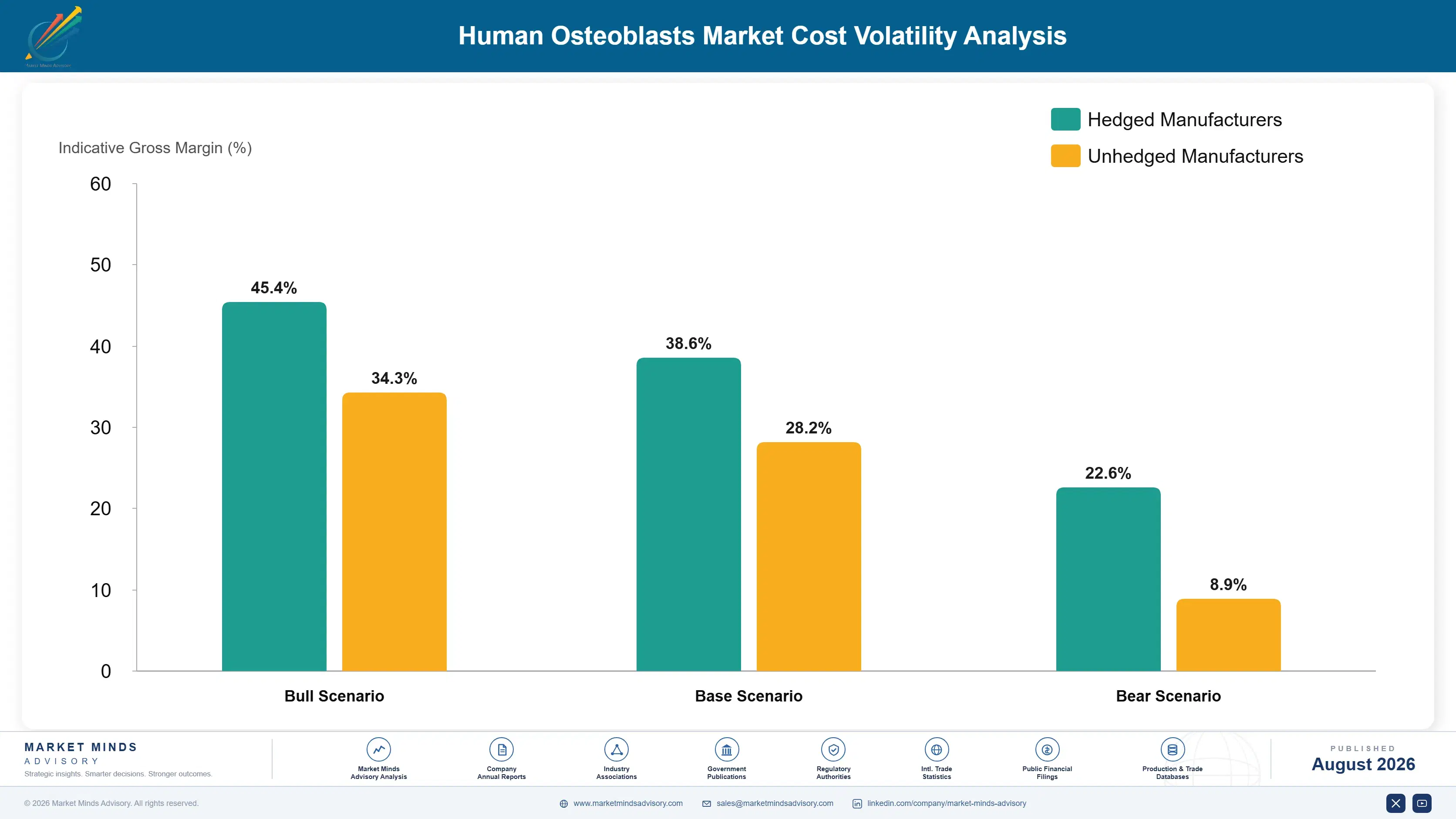
Cost structures here look nothing like a manufacturing business. Tissue procurement, consent administration and ethics compliance account for roughly 26% of cost of goods, and specialist laboratory labour for isolation, expansion and characterisation contributes a further 34%. Culture media, serum and growth factors add around 18%, with cryopreservation and validated cold chain shipping carrying most of the remainder across every unit sold.
Foetal bovine serum pricing through 2021 and 2023 illustrated the exposure clearly. Herd size reduction and export restriction pushed serum costs sharply higher across the cell culture industry, and Thermo Fisher Scientific and Merck both referenced raw material and media cost pressure in their reporting across those years. Suppliers running catalogue pricing published annually could not reprice mid-year, and margin absorbed most of the increase.

The disadvantage falls hardest on specialists without catalogue scale. A supplier selling only primary cells amortises tissue procurement and quality overhead across a narrow revenue base, while a broad catalogue competitor spreads identical compliance cost across thousands of products. Geography compounds it: cryogenic shipping into Latin America, Africa and parts of Asia can cost more than the vial itself, pricing specialists out of markets catalogue competitors already serve.
human-osteoblasts-market-cost-volatility-analysis-1787303511626

Broaden hospital and tissue bank agreements across several countries

Single-country tissue sourcing leaves a supplier exposed to one consent framework, one set of ethics committees and one pattern of elective surgery scheduling. Agreements across several jurisdictions smooth collection and widen the donor demographic range that industrial purchasers increasingly ask for. Building each relationship takes years, which is precisely why it protects the position.

Qualify serum-free and chemically defined media formulations

Foetal bovine serum pricing has risen repeatedly and supply depends on herd conditions nobody in this industry controls. Chemically defined alternatives cost more per litre today and remove both the price exposure and the lot-to-lot variability that serum itself introduces into experiments. Qualification takes time and improves the product as well as the cost position.

Consolidate cold chain shipping through regional distribution partners

Cryogenic shipping into distant markets frequently costs more than the material inside the container, which prices specialist suppliers out of exactly the regions growing fastest. Regional distributors holding local cryogenic inventory convert an unaffordable individual shipment into an ordinary domestic delivery, at the cost of a margin share worth paying. The margin share is worth paying.

Portfolio Architecture for Margin Defence

Margin architecture divides on how easily a competitor can supply the same thing. Immortalised cell lines are distributed by many suppliers from common repositories and earn very little. Primary vials earn more, protected by tissue access and documentation quality rather than by anything about the cells. Model systems and disease-state panels earn most, combining cells with protocol, scaffold and validation work.
The volume versus premium tension runs between academic and industrial purchasing. Academic laboratories buy single vials on grant budgets, negotiate little and disappear when appropriations tighten. Industrial purchasers buy larger quantities with multi-year visibility, demand documentation and quality systems that cost real money to maintain, and pay accordingly. Most specialist suppliers are built entirely for the first and have never seriously attempted the second.

High-value pools sit where substitution would invalidate existing work. A laboratory three years into a programme using a documented donor lot cannot switch supplier without repeating comparisons. An industrial group whose regulatory submission cites a characterised model system is similarly committed. Generic primary vials sold from whatever lot happens to be available sit at the opposite extreme, competing on catalogue price and shipping cost alone.

Volume / Commodity-Adjacent Tier

Immortalised osteoblast cell lines and basic growth media distributed by many suppliers from shared repositories and common formulations, competing on catalogue price, shipping cost and how quickly an order actually arrives.
Gross Margin: 34-48%

Premium / Certified Tier

Cryopreserved primary human osteoblasts with documented donor characteristics and reserved lot availability, protected by tissue sourcing networks and by record-keeping discipline that competitors find difficult to retrofit afterwards. Switching mid-programme invalidates comparisons already published.
Gross Margin: 55-68%

Sustainability / Regulatory / Next-Generation Tier

Three-dimensional bone model systems, disease-state donor panels and stem cell derived osteoblast products, combining cells with scaffold, protocol and validation. Best margins in the category and the least substitutable positions available.
Gross Margin: 68-82%
human-osteoblasts-market-portfolio-architecture-1787303512125

Consumable Demand Across Research Programmes

Primary osteoblasts are a genuine consumable rather than a durable reagent. Cells dedifferentiate and lose bone-forming phenotype after roughly six passages, so a vial supports a bounded number of experiments and a research programme running for years consumes material continuously. That produces recurring demand tied to project duration rather than to any purchasing cycle, which makes forecasting unusually dependent on knowing what grants have been awarded.
Stickiness depends entirely on the lot. A researcher whose experiments work on a particular donor lot will keep ordering it, because switching means revalidating everything already published or submitted, and the repeat order rate near 44% reflects exactly that. Suppliers reserving lots against standing orders convert a transactional relationship into a multi-year one. A supplier exhausting a lot loses the customer outright.

Buyer profiles are shifting slowly but decisively. Academic principal investigators, who still account for roughly 61% of purchasing, order small quantities against grant lines and choose largely on catalogue convenience. Industrial purchasers in oncology, osteoporosis drug discovery and device biocompatibility buy larger volumes, require documentation and quality systems, and behave like procurement functions rather than like scientists. Very few specialist suppliers are organised for that second customer.
human-osteoblasts-market-end-use-penetration-index-1787303512623

Where Osteoblast Supply Strategy Lands

These are among the four positions where our research anticipates prominent divergence between winners and laggards over the coming forecast period. Each is grounded in the demand model, the regulatory perimeter, and the announced capacity pipeline.
01 / DONOR DOCUMENTATION DISCIPLINE

The paperwork is the product, not the cells

Mineralisation capacity varies by roughly 38% between donor lots, so a laboratory comparing results across studies needs age, sex, skeletal site, disease status and medication history recorded properly at the point of collection. Most suppliers provide only a fraction of that and compete instead on catalogue price and delivery speed. Comprehensive characterisation costs little beyond disciplined record-keeping at collection, and it supports pricing around 45% above minimally documented equivalents, particularly with industrial purchasers who must defend their data to regulators.
02 / LOT BANKING INVESTMENT

Running out of a good lot loses the customer permanently

Researchers who find a donor lot that mineralises well order it repeatedly, and the repeat order rate near 44% reflects how unwilling anybody is to revalidate a multi-year programme against different cells. A supplier exhausting a popular lot does not sell a substitute; it loses the account outright to whoever can guarantee continuity. Expanding proven lots through controlled early passage and banking them deeply ties up working capital, and it retains roughly 35% more repeat customers than selling from available stock.
03 / MODEL SYSTEMS TRANSITION

Selling vials competes on price and selling systems does not

A cryopreserved vial competes against every supplier isolating from the same kind of surgical tissue, while a three-dimensional co-culture system including scaffold, differentiation protocol, partner cells and a validated readout sells at many multiples of that and cannot be assembled from separately purchased components. Model systems are growing at 17.4% against under 10% for primary vials. The capability required is protocol development and validation rather than tissue access, which is a different organisation entirely and one most suppliers have never built.
04 / INDUSTRIAL BASE BUILDING

Academic budgets vanish faster than anybody plans for

Roughly 61% of all purchasing here follows national research appropriations rather than any scientific priority, and disruption to United States federal research funding during 2025 translated into cancelled orders within a single quarter right across the whole supplier base. Oncology bone metastasis work, osteoporosis drug discovery and orthopaedic device biocompatibility testing all sit with industrial buyers whose budgets behave completely differently. Reaching those buyers demands documentation, formal quality systems and supply guarantees that academic catalogue selling has never once required of anybody.

Engagement Snapshot From the Field

A live engagement with an industry participant carrying material or product regulatory and market exposure ahead of a defining policy shift, showing how our research translates into a defensible multi-year portfolio strategy.
MARKET MINDS ADVISORY · CLIENT ENGAGEMENT SUMMARY
Human Osteoblasts Producer Strategic Portfolio Review and Transition Roadmap 2026·Investment Scenario on Human Osteoblasts Exposure Evaluation 2025-26
CLIENT PROFILE
A European specialist primary cell supplier providing human osteoblasts, chondrocytes and related musculoskeletal cell types to academic and biotechnology laboratories across Europe and North America. Annual revenue was approximately USD 34 million (client-reported, unverified by MMA), with roughly 74% from cryopreserved primary vials sold through catalogue and distributor channels. The company offered no three-dimensional model systems and held no formal quality management certification.
STRATEGIC CHALLENGE
United States academic order volumes had fallen sharply within a single quarter following federal research funding disruption, and Chinese suppliers were taking price-sensitive business across Asia. The board wanted to know whether to defend catalogue share through pricing and distributor expansion, or to invest in three-dimensional model system development and the quality systems that industrial purchasers require, which the company could not fund simultaneously.
MMA APPROACH
MMA conducted 47 expert interviews across academic principal investigators, pharmaceutical discovery scientists, orthopaedic device testing managers, tissue bank directors and laboratory procurement leads in six countries. A quantitative survey of 3,800 respondents established purchasing authority, supplier selection criteria and documentation requirements across academic and industrial buyer types. We then modelled revenue and margin under both options against observed funding trajectories and model system adoption rates.
KEY FINDINGS
  1. Industrial purchasers in five of six markets required donor documentation and quality certification that the client did not provide, and several had excluded it from evaluation for exactly that reason.
  2. Academic buyers selected primarily on catalogue convenience and delivery speed, showing little brand attachment and switching readily to whichever supplier appeared in an existing purchasing agreement.
  3. Researchers using a documented donor lot for more than a year reported they would not switch supplier under any realistic price difference, because revalidation would invalidate published comparisons.
  4. Three-dimensional bone model adoption among pharmaceutical customers was running ahead of any regulatory requirement, and none of those customers regarded price as a primary selection factor.
CLIENT PROFILE
A European specialist primary cell supplier providing human osteoblasts, chondrocytes and related musculoskeletal cell types to academic and biotechnology laboratories across Europe and North America. Annual revenue was approximately USD 34 million (client-reported, unverified by MMA), with roughly 74% from cryopreserved primary vials sold through catalogue and distributor channels. The company offered no three-dimensional model systems and held no formal quality management certification.
STRATEGIC CHALLENGE
United States academic order volumes had fallen sharply within a single quarter following federal research funding disruption, and Chinese suppliers were taking price-sensitive business across Asia. The board wanted to know whether to defend catalogue share through pricing and distributor expansion, or to invest in three-dimensional model system development and the quality systems that industrial purchasers require, which the company could not fund simultaneously.
MMA APPROACH
MMA conducted 47 expert interviews across academic principal investigators, pharmaceutical discovery scientists, orthopaedic device testing managers, tissue bank directors and laboratory procurement leads in six countries. A quantitative survey of 3,800 respondents established purchasing authority, supplier selection criteria and documentation requirements across academic and industrial buyer types. We then modelled revenue and margin under both options against observed funding trajectories and model system adoption rates.
KEY FINDINGS
  1. Industrial purchasers in five of six markets required donor documentation and quality certification that the client did not provide, and several had excluded it from evaluation for exactly that reason.
  2. Academic buyers selected primarily on catalogue convenience and delivery speed, showing little brand attachment and switching readily to whichever supplier appeared in an existing purchasing agreement.
  3. Researchers using a documented donor lot for more than a year reported they would not switch supplier under any realistic price difference, because revalidation would invalidate published comparisons.
  4. Three-dimensional bone model adoption among pharmaceutical customers was running ahead of any regulatory requirement, and none of those customers regarded price as a primary selection factor.
RECOMMENDED STRATEGY
Phase 1: Phase one: obtain quality management certification and formalise donor characterisation records, since both were disqualifying gaps rather than competitive disadvantages with industrial purchasers. Phase 2: Phase two: develop osteoblast and osteoclast co-culture model systems with validated remodelling readouts, targeting pharmaceutical customers rather than the academic catalogue base. Phase 3: Phase three: introduce lot reservation against standing orders for existing academic customers, protecting the multi-year programmes that generate repeat purchasing.
OUTCOME
The client achieved certification within eleven months and launched two co-culture model products (client-reported, unverified by MMA). Industrial revenue rose from a negligible base to roughly a fifth of the total within eighteen months, blended gross margin improved about eight percentage points, and academic order volatility no longer determined quarterly performance.

Frequently Asked Questions

Foundational context covering the market sizes, CAGR, scope, country, region and competition that inform every finding below. This section is provided to cover basics and most often pre-purchase conversations, answered from the MMA Primary Research Dataset.

What is the current size of the Human Osteoblasts Market?

The global human osteoblast market was valued at USD 0.6 billion in 2025, covering primary cells, immortalised lines, stem cell derived products, culture media, three-dimensional models and disease-state donor panels. Clinical bone graft materials fall outside this definition.

How large will the Human Osteoblasts Market be by 2036?

MMA forecasts the market at USD 2.01 billion by 2036, expanding 3.00 times from the 2026 base of USD 0.67 billion. That represents roughly USD 1.34 billion of incremental value across the forecast decade.

What is the CAGR for the Human Osteoblasts Market 2026 to 2036?

The base case compound annual growth rate is 11.6%, with a bull case of 12.9% and a bear case of 10.4%. The bear case reflects sustained reduction in the academic research budgets supplying most demand.

Which segment is growing fastest?

Three-dimensional bone model systems grow at 17.4%, a full 1.50x the overall market rate. Regulatory movement away from mandatory animal studies has accelerated adoption ahead of any formal qualification requirement.

Who are the major companies in the Human Osteoblasts Market?

Lonza, PromoCell, Thermo Fisher Scientific, Merck KGaA and Cell Applications together hold 58% of revenue. Suppliers compete on tissue sourcing networks and donor documentation rather than on any difference in the cells themselves.

Which country is growing fastest?

China grows fastest at 18.4%, as domestic life science research funding expands while Western budgets tighten. North America remains the largest region at 32% of value on research funding concentration.

Report Segmentation Architecture

The full report scope spans multiple orthogonal segmentation dimensions, with cross-tabulated demand data provided for each dimension pair. Coverage extends further to regional breakdowns, trend trajectories, and the competitive detail needed to support segment-level decision-making.

By Product Category

  • Cryopreserved Primary Human Osteoblasts
  • Immortalised Osteoblast Cell Lines
  • iPSC-Derived Osteoblast Products
  • Osteoblast Growth Media and Supplements
  • Three-Dimensional Bone Model Systems
  • Donor-Matched and Disease-State Panels

By End-Use Industry

  • Academic and University Research
  • Pharmaceutical Drug Discovery
  • Orthopaedic Device Development
  • Contract Research Organisations
  • Tissue Engineering and Regenerative Medicine
  • Government and Institutional Research

By Commercial Dimension

  • Catalogue and Online Ordering
  • Distributor and Reseller Networks
  • Lot Reservation and Standing Orders
  • Custom Isolation and Donor Matching Services
  • Institutional Framework Purchasing Agreements
  • Collaborative Research Supply Arrangements

By Region

  • North America
  • East Asia
  • Western Europe
  • South Asia and Pacific
  • Latin America
  • Middle East and Africa
  • Eastern Europe

Scope, Methodology, and Coverage

Every figure in this report is reproducible from documented input assumptions. The scope below maps the historical period, the forecast horizon, the segmentation dimensions, and the countries covered, alongside the underlying primary and qualitative methodology.
Historical Period
2020 to 2025
Forecast Period
2026 to 2036
Base Year
2025 (USD billions; MMA Primary Research Dataset, August 2026)
Market Definition
This market comprises human osteoblast cell products and directly derived model systems supplied for research, drug discovery, device testing and tissue engineering applications, measured at supplier revenue across catalogue, distributor, framework and custom service channels. Coverage spans cryopreserved primary human osteoblasts isolated from consented surgical tissue, immortalised osteoblast cell lines, induced pluripotent stem cell derived osteoblast products, osteoblast growth media, differentiation supplements and mineralisation reagents, three-dimensional bone model systems including scaffold, spheroid, organoid and microfluidic co-culture formats, and donor-matched or disease-state osteoblast panels supplied for comparative study. Bone graft substitutes and biomaterials intended for clinical implantation, cell therapy and regenerative medicine products administered to patients, orthopaedic implants and instrumentation, animal-derived osteoblast products, mesenchymal stem cells sold without osteogenic differentiation, and bone histology or imaging services fall outside scope.
Quantitative Units
USD billions (current prices); vial and unit shipments by product category; average price per cryopreserved vial; documented donor lot counts; academic and industrial purchaser split
Segmentation Dimensions
By Product Category; By End-Use Industry; By Commercial Dimension; By Region
Regions Covered
North America, East Asia, Western Europe, South Asia and Pacific, Latin America, Middle East and Africa, Eastern Europe
Countries Covered
United States, Canada, Germany, United Kingdom, France, Switzerland, Netherlands, Sweden, Denmark, Belgium, China, Japan, South Korea, Taiwan, India, Australia, Singapore, Brazil, Mexico, Argentina, Chile, Israel, Saudi Arabia, United Arab Emirates, South Africa, Poland, Czechia, Hungary, and additional markets relevant to life science research reagent analysis
Key Companies Profiled
Lonza, PromoCell, Thermo Fisher Scientific, Merck KGaA, Cell Applications, ATCC, ScienCell Research Laboratories, Creative Bioarray, Cell Biologics, Zen-Bio, Axol Bioscience, FUJIFILM Cellular Dynamics, Corning, Charles River Laboratories, Takara Bio, STEMCELL Technologies, Bio-Techne, CellSystems, Innoprot, Lifeline Cell Technology
Quantitative Methodology
Primary survey, n=3,800 respondents, Q4 2025, six countries; demand-side model with trade association cross-validation
Qualitative Methodology
47 expert interviews, Q4 2025; applied to validate demand model assumptions, identify emerging dynamics, and assess competitive positioning
Report Format
PDF and XLSX data workbook (Word format preview document)
Publisher
Market Minds Advisory
Report Code
MMA-2026-HLT-171
Published
August 2026
Contact
sales@marketmindsadvisory.com | www.marketmindsadvisory.com

Purchase the full Human Osteoblasts Market Report (2026 to 2036).

The full MMA report treats donor variability as the commercial problem it actually is, quantifying how lot-to-lot differences shape purchasing behaviour, retention and pricing across the category. It sizes six product categories and seven regions to 2036, modelling vial shipments, model system adoption, academic and industrial purchaser split and research funding trajectories separately. Competitive assessment covers twenty suppliers on one consistent revenue basis, with attention to tissue sourcing networks and documentation practice. Cost exposure is traced through tissue procurement, specialist labour, serum pricing and cryogenic shipping. Four commercial levers and a strategic verdict close the report, grounded in 47 expert interviews and a 3,800-respondent survey.
Six product categories sized separately to 2036
Donor variability quantified against purchasing and retention behaviour
Research funding exposure mapped by region and purchaser
Twenty suppliers assessed on one consistent basis
Animal model replacement trajectory modelled against regulatory movement
Anonymised client engagement with tested strategic recommendations

Built For The People Who Decide

From boardroom strategy to bench-side execution, this report is read cover-to-cover by leaders shaping the next decade of their industry, turning demand scenarios, market dynamics and valuation benchmarks into decisions.
CXOs/ Presidents/ VPs/ Managers
M&A and Corporate Development
Strategy Teams and R&D Heads
Procurement and Product Directors
Regulatory and Compliance Leaders
Investor Relations and Equity Analysts