Market Minds Advisory
Human Combinatorial Antibody Libraries (HuCAL) Market

Human Combinatorial Antibody Libraries (HuCAL) Market: Developability Economics, Computational Design, and Royalty Dependence

The foundational display patents expired years ago, so nobody sells access to the technology any more; they sell the probability that what comes out of the library survives development, and most of it does not.

Lead Analyst

Alice Ballenger

Published

September 2026

Make Smarter Decisions with Customized Research Insights

Request a free sample report and evaluate market opportunities, growth trends, and competitive dynamics relevant to your business needs.

2025 MARKET VALUE$2.4BMarket Size 2025
2036 FORECAST VALUE$7.7BBase Case , 2026 to 2036
CAGR 2026 TO 203611.2 %Bull 12.5% / Bear 10.0%
INCREMENTAL OPPORTUNITY$5.0BNet 10- year value creation
EXPANSION MULTIPLE2.89x2036 value over 2026 base
Strategic Levers
M&A Pipeline
Regional Outlook
Country Rankings
Competitive Intelligence
Segmental Deep-dive
Call-Us : 91 93563 13602

Executive Snapshot and Market Trajectory

Roughly 42% of antibody hits selected from a library fail later on aggregation, expression yield or immunogenicity. That failure rate, not binding affinity, is what this market actually competes on, and it is the reason library quality still commands a price years after the underlying patents lapsed.
Computationally designed synthetic libraries compound at 16.8%, a full 1.50x the market rate, by pre-filtering variants in silico so that raw diversity stops being the point. East Asia holds the largest share at 30%: Chinese biotechs now originate more antibody discovery programmes than any other country and Chinese contract organisations run screening campaigns for Western sponsors, so the technology spend lands there regardless of where the asset is eventually licensed.
Concentration is low at 38%, spread across reagent suppliers, discovery service organisations and platform licensors who compete only occasionally. Bio-Rad Laboratories holds the original HuCAL platform and Twist Bioscience has built synthetic library scale around DNA writing. The economics are unusual: much of the value sits in milestones and royalties on programmes a library company neither controls nor can accelerate. Those payments arrive a decade later, and most of them never arrive at all.
Market Definition
This market covers synthetic and semi-synthetic antibody library technologies used to discover fully human antibodies without animal immunisation, spanning phage, yeast, mammalian, ribosome and messenger RNA display libraries, single B-cell derived recombinant libraries, and computationally designed synthetic libraries. Measurement covers library product sales, screening and discovery service revenue, and platform licensing including upfront and milestone payments. Transgenic animal immunisation platforms, hybridoma production, downstream antibody manufacturing, and the therapeutic antibodies themselves once commercialised are excluded.
Base Year Value
$2.4B in 2025 (MMA Primary Research Dataset, August 2026)
Forecast Period
2026 to 2036, eleven discrete annual values
CAGR
11.2% base case. Bull 12.5%. Bear 10.0%.
Fastest Growth Segment
Computationally Designed Synthetic Libraries: 16.8% CAGR
Fastest Growth Country
China: 17.4% CAGR
Fastest Growth Region
South Asia and Pacific: 13.4% CAGR
Largest Region
East Asia: 30% of 2025 global value
Market Leaders
Bio-Rad Laboratories, Twist Bioscience, Charles River Laboratories, WuXi Biologics, and Danaher. Source: MMA Primary Research Dataset, July 2026.
Primary Survey
n=3,800 procurement and R&D decision-makers, Q4 2025, six countries
Methodology
Demand-side build-up, cross-validated against public data, 47 expert interviews

Human Combinatorial Antibody Libraries (HuCAL) Market Forecast Scenarios

human-combinatorial-antibody-libraries-hucal-marke-size-forecast-scenario-1787303503883
Growth ran at roughly 9.9% between 2020 and 2025, and two very different forces produced it. Pandemic antibody programmes pulled enormous screening demand forward through 2020 and 2021, then fell away sharply once vaccination reduced therapeutic antibody use. Underneath that spike, Chinese antibody discovery expanded continuously and became the largest source of new programme starts, holding growth through a difficult Western funding environment.
Base case growth of 11.2% rests on three mechanisms. Antibody formats keep multiplying, and bispecifics, antibody-drug conjugates and multispecific constructs each require more discovery campaigns per approved product than a plain monoclonal ever did. Computational design compresses cycle time and improves developability, which raises what sponsors will pay per campaign. And outsourcing keeps rising, with roughly 61% of discovery campaigns now run by a contract organisation rather than inside the sponsor.
The bull case at 12.5% assumes computationally designed libraries demonstrably cut downstream developability failure, which would justify pricing well above current service rates. The bear case at 10.0% is a funding one: Western biotech capital has been tight since 2022, and discovery spending is the first line cut when a company extends its runway rather than starting new programmes.

Antibody Libraries: Developability Risk and Royalty Structures

The foundational phage display patents expired years ago, which should have commoditised this market and did not. What survived the patent cliff was know-how: how a library is designed, which frameworks it uses, how selection pressure is applied, and how much of the output survives contact with a development team. Access to display technology is free now. Getting a usable antibody out of it is not.
TOP FIVE CONCENTRATION38%Reagent suppliers, service organisations and licensors rarely compete directly
LIBRARY DIVERSITY SCALE10^11 variantsTypical unique binder diversity held in a synthetic display library
DEVELOPABILITY FAILURE RATE42%Selected binders failing later on aggregation, expression or immunogenicity
DISCOVERY CYCLE TIME14 weeksTypical duration from target delivery to characterised lead panel
LICENSED PROGRAMME ROYALTY3.5%Median royalty rate carried on antibodies discovered under platform licence
OUTSOURCED DISCOVERY SHARE61%Campaigns run by contract organisations rather than sponsor laboratories
Developability is the commercial variable that matters. Roughly 42% of binders selected on affinity alone fail later on aggregation, low expression yield, poor thermal stability or immunogenicity risk, and each failure costs a sponsor months. Libraries built on well-behaved human frameworks with sequence liabilities designed out produce lower failure rates, and sponsors pay for that difference even though it is invisible at the point of selection.
Revenue arrives in three quite different forms. Reagent and library product sales are immediate and modest. Discovery service campaigns are project revenue with predictable margins. Platform licences carry upfront fees, development milestones and royalties near 3.5%, which are enormously valuable and arrive up to a decade after the work, on programmes the library company neither controls nor can influence.
"Everyone in this market talks about diversity, as though 10 to the eleventh binders were an achievement rather than a filtering problem. The companies making money are the ones whose libraries produce antibodies that a process development group does not send straight back."
Principal Analyst, Biologics Discovery and Research Tools Practice · MMA Healthc

Market Trends

Computational design replaces brute-force diversity in library construction

Machine learning models trained on antibody structure and sequence liability data now design library diversity deliberately rather than sampling it randomly, and companies including Absci and Generate Biomedicines have built discovery platforms around that principle. The practical effect is that a smaller, better-designed library outperforms a larger naive one, because variants carrying known aggregation or immunogenicity liabilities are never synthesised. Sponsors care about the downstream consequence rather than the method, and campaigns using designed libraries report meaningfully lower developability attrition at the lead optimisation stage. Contract data rights govern who accumulates the evidence that makes the next library better still.
Market Impact: Requires 3 times more campaigns
Chinese discovery origination reshapes where library spending lands

Chinese biotechs now start more antibody discovery programmes than those of any other single country, and Chinese contract research organisations run screening campaigns for Western sponsors at prices and timelines that domestic providers struggle to match. Out-licensing of Chinese-discovered antibodies to large Western pharmaceutical companies has become routine since 2023. The commercial consequence for library suppliers is that technology spending increasingly lands in East Asia even when the resulting asset is developed and commercialised in the United States or Europe. Western service providers have no cost answer to that, and several have stopped bidding for routine screening work altogether.
Market Impact: About 35% cite target intractabilit

Market Opportunities and Growth Drivers

Complex antibody formats multiply discovery campaigns per approved product

A bispecific antibody requires binder discovery against two targets and then extensive pairing and format optimisation, and a trispecific or antibody-drug conjugate adds further constraints on affinity balance and internalisation behaviour. Each approved product therefore consumes several times the discovery work a plain monoclonal did a decade ago. Since bispecific and multispecific constructs now account for a substantial and rising share of clinical-stage antibody pipelines, campaign volume grows considerably faster than the number of programmes reaching approval ever suggests. Discovery capacity therefore grows against a pipeline count that badly understates the underlying workload.
Market Impact: Royalties arrive after 10 years

Synthetic libraries reach targets that immunisation cannot address

Highly conserved targets produce weak immune responses in animals, toxic antigens cannot be administered, and membrane proteins in native conformation are difficult to present at all. Synthetic combinatorial libraries sidestep every one of those problems because selection happens in vitro against whatever the sponsor can produce. That is a genuine capability rather than a cost argument, and it is the reason display technology retained its position after transgenic animal platforms arrived. Roughly 35% of campaigns cite target intractability as the reason for choosing a library route. That capability argument survives price competition considerably better than any cost argument does.
Market Impact: Exactly 0 licences now legally requ

Market Restraints and Challenges

Royalty revenue arrives a decade after the work

A platform licence signed today produces meaningful royalty income only if the antibody reaches market, which typically takes eight to twelve years and succeeds in a small minority of cases. The root cause is that library companies sit at the very start of a development chain they neither control nor can accelerate. Commercial impact is a revenue profile that resists forecasting and complicates valuation considerably. Suppliers respond by weighting upfront and milestone payments more heavily, and by building service revenue that converts work into cash immediately. Portfolio breadth is the only thing that makes the arithmetic work at all.
Market Impact: Cuts attrition by roughly 30%

Expired foundational patents removed the technology access barrier

The core phage display patents that once required a licence for any commercial antibody selection have expired, so nobody needs permission to run a display campaign. The root cause is simply the passage of time on a technology developed in the nineteen eighties and nineties. Commercial impact has been a shift from licence enforcement toward competing on library quality, screening know-how and downstream developability, which is a harder and less defensible position. Suppliers now protect value through proprietary framework designs, trade secret selection protocols and data assets rather than patents. Trade secrets are harder to defend than patents were.
Market Impact: China at 17.4% annual growth
4 additional market trends, 2 additional growth drivers, and 3 additional restraints and challenges are covered in the full report. Contact sales@marketmindsadvisory.com to access the complete intelligence.

Segment CAGR and Growth Architecture

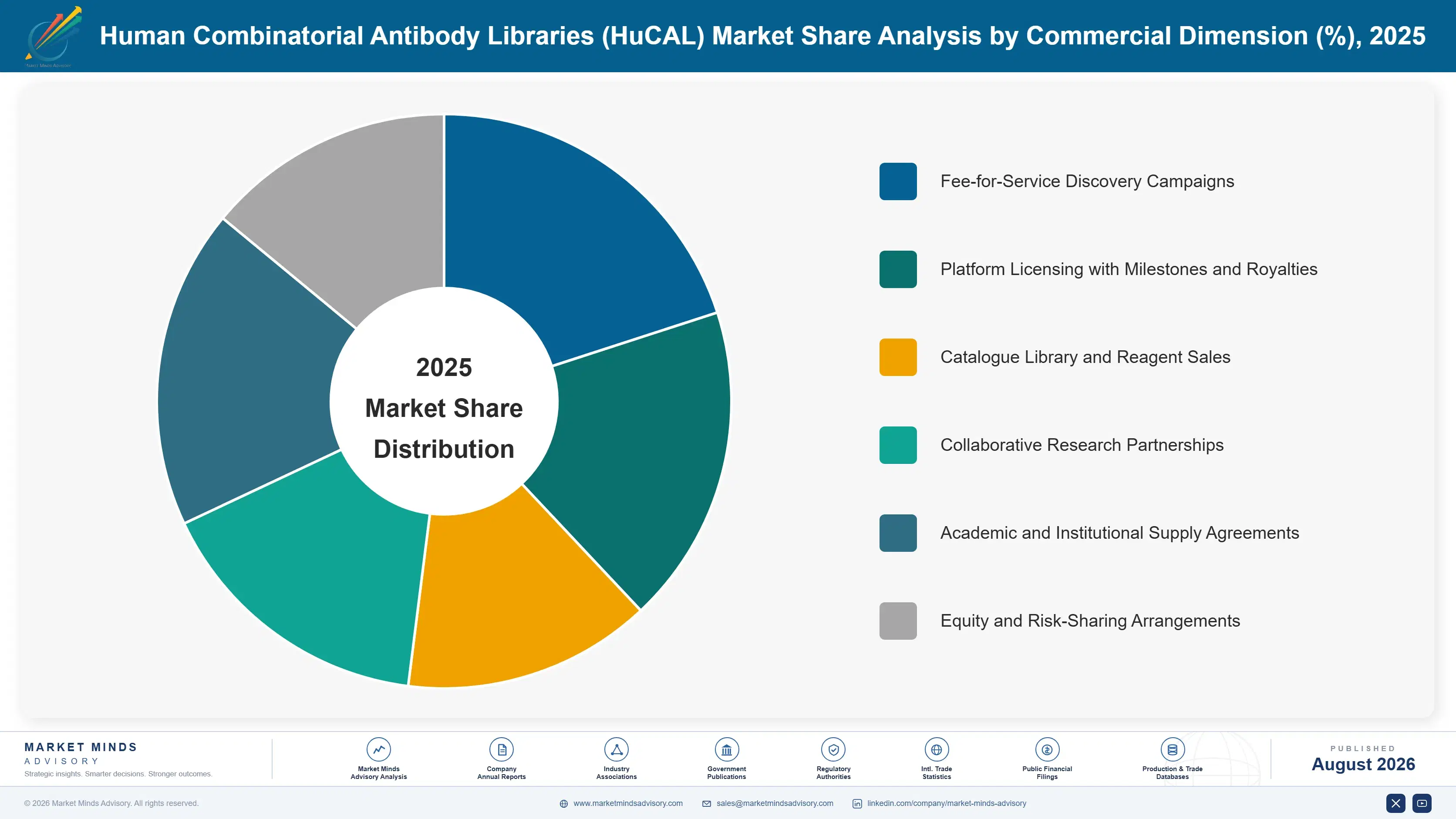
Segmentation follows the library construction and display technology, because that determines the diversity achievable, the selection conditions available, the format in which binders are presented and the downstream developability profile of what emerges. Six technologies cover the field without overlap. Therapeutic, diagnostic and research application cuts across every technology and is treated as an application attribute here.
human-combinatorial-antibody-libraries-hucal-marke-market-share-analysis-1787303504423

Computationally Designed Synthetic Libraries

Growing at 16.8%, a full 1.50x the market rate, these libraries use machine learning models trained on structure and sequence liability data to design diversity deliberately rather than sample it at random. Variants carrying known aggregation, glycosylation or immunogenicity liabilities are simply never synthesised, so a smaller library outperforms a much larger naive one. Absci, Generate Biomedicines and several platform biotechs have built entire discovery businesses on that principle. The commercial argument is downstream attrition rather than hit rate, which makes it harder to demonstrate at contract signature and considerably more valuable once a sponsor has seen it work twice. Contract terms governing campaign data rights decide which supplier accumulates the asset that keeps the advantage compounding.
CAGR 16.8%

Mammalian Cell Display Libraries

Mammalian display grows at 13.8% by presenting antibodies as full immunoglobulin molecules on human cells, complete with native glycosylation and folding, rather than as fragments on a bacteriophage surface. That removes the reformatting step where phage-derived binders frequently lose affinity or gain aggregation problems, which is exactly where a meaningful part of the 42% developability failure rate originates. Library sizes are smaller because mammalian transfection limits achievable diversity, so the technology usually follows an initial phage or yeast selection rather than replacing it. Cost per campaign runs above other display formats and sponsors increasingly accept that trade. It usually follows an initial phage or yeast selection rather than replacing one.
CAGR 13.8%
Full segment breakdown across 6 segments available in the complete report.

Regional Architecture and Country Demand Map

Regional value follows where discovery campaigns are physically run rather than where the resulting antibodies are eventually developed or sold, and those have separated sharply since outsourcing to Asian contract organisations became standard practice for Western sponsors. Origination and development have separated as decisively as screening and licensing have.

East Asia

East Asia takes the largest share at 30%, and the mechanism is specific rather than general. Chinese biotechs now start more antibody discovery programmes than those of any other single country, and out-licensing of Chinese-discovered assets to large Western pharmaceutical companies has become routine since 2023. Alongside that, WuXi Biologics, GenScript and Sino Biological run screening campaigns for Western sponsors at prices and timelines domestic providers cannot match, so library spending lands here even when the asset is developed elsewhere. Japanese antibody discovery is smaller but technically deep, with strong academic display technology traditions. Growth at 12.6% reflects both origination and outsourced service capture. Origination and outsourced capture reinforce each other here in a way no other region matches.
Share: 30% | CAGR: 12.6% (2026 to 2036)

North America

Twenty-nine per cent of value, concentrated in Boston, San Francisco and San Diego biotech clusters where most Western antibody programmes originate and where the platform licensors with royalty-bearing agreements are headquartered. Spending per campaign is the highest anywhere, since sponsors here run more parallel campaigns and buy more extensive characterisation work. Venture funding conditions since 2022 have restrained new programme starts noticeably, and discovery is typically the first budget line cut when a company chooses runway extension over pipeline expansion. Growth at 10.2% therefore trails East Asia despite a larger installed base of platform technology and expertise. The royalty-bearing platform agreements signed here nonetheless remain the most valuable positions anywhere in this market.
Share: 29% | CAGR: 10.2% (2026 to 2036)
Regional intelligence for 5 additional markets available in the complete report: Western Europe, South Asia and Pacific, Latin America, Middle East and Africa, Eastern Europe. Contact sales@marketmindsadvisory.com.
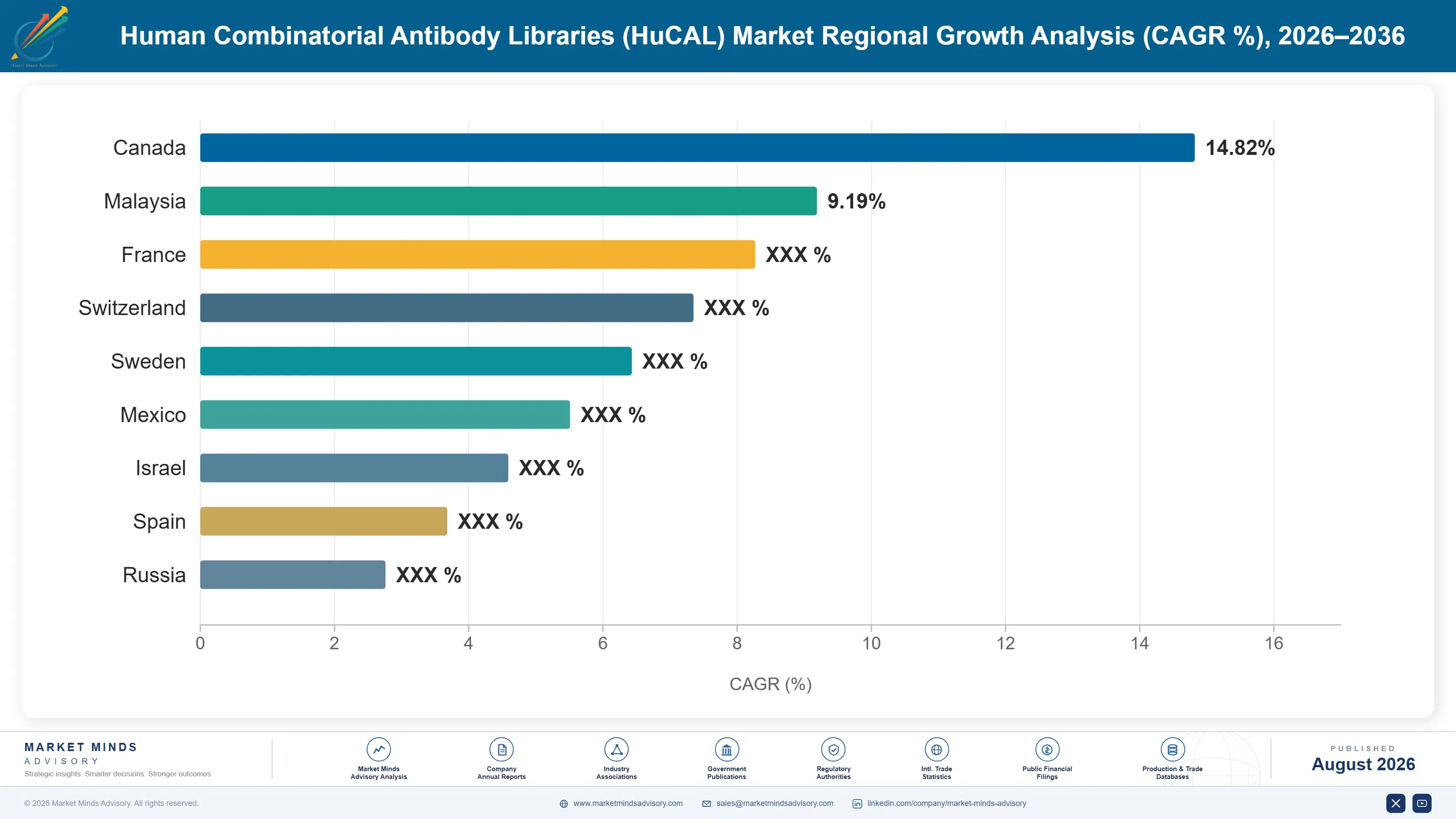
human-combinatorial-antibody-libraries-hucal-marke-country-cagr-analysis-1787303504953

Where Antibody Library Value Concentrates

The technology itself is free to use and the diversity numbers everybody quotes decide almost nothing. Value accrues to whoever produces binders that survive development, to whoever captures a licence before a programme becomes valuable, and to whoever holds the data that makes the next library better than the last. Diversity figures decide almost nothing.

Price on downstream attrition rather than on campaign delivery

Roughly 42% of selected binders fail later on aggregation, expression or immunogenicity, and each failure costs a sponsor several months of programme time. A library that reduces that failure rate by even a third is worth far more than the price difference between two screening campaigns, but only to a sponsor who has measured it. Suppliers who publish developability outcome data and track it across delivered campaigns can defend pricing roughly 40% above commodity screening rates. Those who sell on diversity and turnaround time cannot. Very few suppliers currently track their delivered campaigns that far downstream.
Market Impact: Defends about 40% pricing premium o

Take equity or milestones before a programme becomes valuable

Platform licences signed at discovery stage carry royalties near 3.5% and cost the sponsor little, because the antibody is worth nothing yet. The same terms are unobtainable once a programme enters clinical development. Library companies with the balance sheet to accept deferred value over immediate service fees build royalty portfolios that eventually dwarf their operating revenue. The discipline is portfolio construction rather than deal-making: any single programme almost certainly fails, so the position only works across dozens of agreements signed patiently over years. Deal-making skill matters far less here than patience does.
Market Impact: Carries a roughly 3.5% median royal

Build proprietary developability datasets from delivered campaigns

Every screening campaign generates data linking sequence features to expression yield, aggregation behaviour and stability, and most suppliers discard it once the customer is delivered. Companies that retain and structure that data train models improving library design continuously, which compounds into a genuine advantage no competitor can replicate by buying equipment. Computationally designed libraries already cut attrition by roughly 30%, and the datasets behind them get better with volume. Contract language governing data rights matters enormously here and is routinely negotiated far too casually at signature. Most suppliers surrender those rights by default at signature.
Market Impact: Cuts downstream developability attr

Position against targets that immunisation platforms genuinely cannot reach

Highly conserved antigens, toxic targets and membrane proteins requiring native conformation defeat animal immunisation entirely, and about 35% of library campaigns cite exactly that as the reason for the route chosen. That is a capability argument rather than a cost one, and it survives price competition from transgenic animal platforms and single B-cell screening alike. Commercial focus on those target classes produces higher win rates and better pricing than competing for straightforward soluble targets where several technologies work equally well. Straightforward soluble targets invite exactly the price contest a Western provider loses.
Market Impact: About 35% of campaigns cite genuine

Who Controls the Margin Pool

Concentration is low at 38% across the top five, measured on annual revenue from antibody library technology, screening services and associated platform licensing, the single basis applied throughout. Bio-Rad Laboratories holds the original HuCAL platform for research antibodies and Twist Bioscience has built synthetic library capability on DNA writing scale. Charles River, WuXi Biologics and Danaher follow through services and reagent supply, so the leading five rarely compete for one contract.
Competition runs on three separate dimensions. Library quality, meaning the developability profile of what emerges, is the most valuable and the hardest to demonstrate before a sponsor has run two campaigns. Service execution covers cycle time, characterisation depth and price, and this is where Chinese and Indian contract organisations compete hardest. Platform licensing is a business development contest over royalty terms rather than any technical characteristic.

Pressure arrives from two directions. Computational discovery companies including Absci, Generate Biomedicines and AbCellera approach the problem as a modelling exercise and treat wet-lab screening as validation rather than as the product. Separately, Chinese contract organisations compete on price and timeline that Western service providers cannot match. Rankings shift most where an established supplier turns accumulated campaign data into genuine computational capability.
human-combinatorial-antibody-libraries-hucal-marke-company-positioning-matrix-1787303505498

Competitive Moat and Risk Dimensions

BIO-RAD LABORATORIES

Moat: Original HuCAL platform ownership

Bio-Rad holds the HuCAL synthetic library for research antibody applications, a validated framework design with a long publication record and thousands of characterised binders behind it. That heritage carries genuine credibility with sponsors evaluating library quality, and the accumulated sequence and performance record is not something a competitor can assemble quickly from a standing start.
BIO-RAD LABORATORIES

Risk: Research reagent orientation

The position is strongest in research antibody supply rather than in therapeutic discovery, where the milestone and royalty value actually accumulates over time. Computational platform companies are competing on developability outcomes that a fixed framework library cannot easily improve. Growth depends on academic and pharmaceutical research budgets that have been under sustained pressure.
TWIST BIOSCIENCE

Moat: Synthetic DNA writing scale

Twist manufactures the synthetic DNA that library construction depends on, at a cost and precision position built for a much larger genomics business. That lets it construct designed libraries rapidly and iterate library composition in ways competitors buying oligonucleotides externally cannot match on either economics or turnaround.
TWIST BIOSCIENCE

Risk: Discovery services profitability

Antibody discovery sits alongside a capital-intensive synthetic DNA business, and the segment competes for investment against genomics applications with clearer near-term economics. Chinese contract organisations undercut service pricing substantially. Building the therapeutic licensing relationships that generate royalty value requires business development depth that a manufacturing-led organisation has to acquire deliberately.

Players Tracked

Prominent Players

Bio-Rad Laboratories
Twist Bioscience
Charles River Laboratories
WuXi Biologics
Danaher

Other Key Players

Creative Biolabs
GenScript Biotech
Sino Biological
Adimab
Specifica
Abzena
Evotec
Lonza Group
Sartorius
Absci
Generate Biomedicines
AbCellera Biologics
Alloy Therapeutics
OmniAb
Fusion Antibodies

Recent Developments

MARCH 2025

Absci expands computational antibody design collaboration with pharmaceutical partner

Absci widened a computational antibody design collaboration with a large pharmaceutical partner, extending the agreement to additional targets after initial campaigns produced binders with lower downstream developability attrition than the sponsor's internal display screening had achieved previously. No equity or acquisition formed part of the arrangement.
Signal: Sponsors are beginning to contract on deve
AUGUST 2025

WuXi Biologics reports rising Western sponsor antibody discovery volumes

WuXi Biologics disclosed continued growth in antibody discovery campaigns run for North American and European sponsors, reflecting an outsourcing pattern in which library screening work is performed in China while the resulting assets are developed and commercialised in Western markets. Campaign pricing remained well below Western rates.
Signal: Discovery technology spending increasingly
JANUARY 2026

Twist Bioscience broadens designed antibody library portfolio for difficult targets

Twist Bioscience extended its synthetic antibody library range with designed collections aimed at membrane proteins and highly conserved antigens, an organic product expansion rather than an acquisition, addressing target classes where animal immunisation platforms consistently fail to generate usable responses. No acquisition or partner facility was involved.
Signal: Target intractability remains the single m

Synthetic DNA and Screening Cost Exposure

Cost structures here are dominated by synthetic biology inputs and skilled labour rather than by materials. Synthetic DNA for library construction accounts for roughly 26% of campaign cost of goods, sourced from a narrow set of oligonucleotide manufacturers with meaningful scale. Specialist scientific labour contributes a further 38%, the largest single line and the one that has moved most, since antibody engineers command salaries rising faster than service pricing.
Reagent and consumable supply through 2021 and 2022 illustrated the exposure. Cell culture media, filtration consumables and specialist enzymes all faced allocation delays as biopharmaceutical manufacturing demand surged, and Sartorius and Lonza both documented supply and capacity constraint in their annual reporting for those years. Discovery organisations running fixed-price campaigns absorbed the increases, because contracts were signed before the shortage and renegotiation is not realistic mid-campaign.

The disadvantage falls hardest on Western service providers with high labour cost and no synthetic DNA capability of their own. A company buying oligonucleotides externally pays a margin its integrated competitors do not, and pays scientists two to three times Chinese or Indian rates for equivalent work. Geography compounds it: contract pricing is now benchmarked against Asian providers regardless of where work is performed.
human-combinatorial-antibody-libraries-hucal-marke-cost-volatility-analysis-1787303505694

Integrate or contract synthetic DNA supply at library construction scale

Oligonucleotide cost is the largest material line in library construction and it is supplied by a small number of manufacturers with real pricing power. Companies holding internal DNA writing capability or long-term supply agreements construct and iterate designed libraries at costs that competitors buying spot volumes simply cannot approach on either price or turnaround.

Shift routine screening steps toward lower-cost regional capacity

Selection rounds and primary screening are labour-intensive and technically routine, while library design and lead characterisation are not. Splitting campaigns so routine steps run in lower-cost geographies preserves the high-value work in-house and protects pricing against Asian competitors who quote the whole campaign at a single rate. Quoting a single blended rate concedes the whole contest.

Write campaign contracts with reagent cost pass-through provisions

Fixed-price campaign contracts transferred the entire consumable and enzyme cost increase onto discovery organisations during the last supply cycle. Newer agreements increasingly carry narrow pass-through covering named reagent categories only. Sponsors accept that more readily than a general escalator, because the underlying supply constraints were publicly documented and clearly outside any provider's control. Sponsors verify the constraint themselves.

Portfolio Architecture for Margin Defence

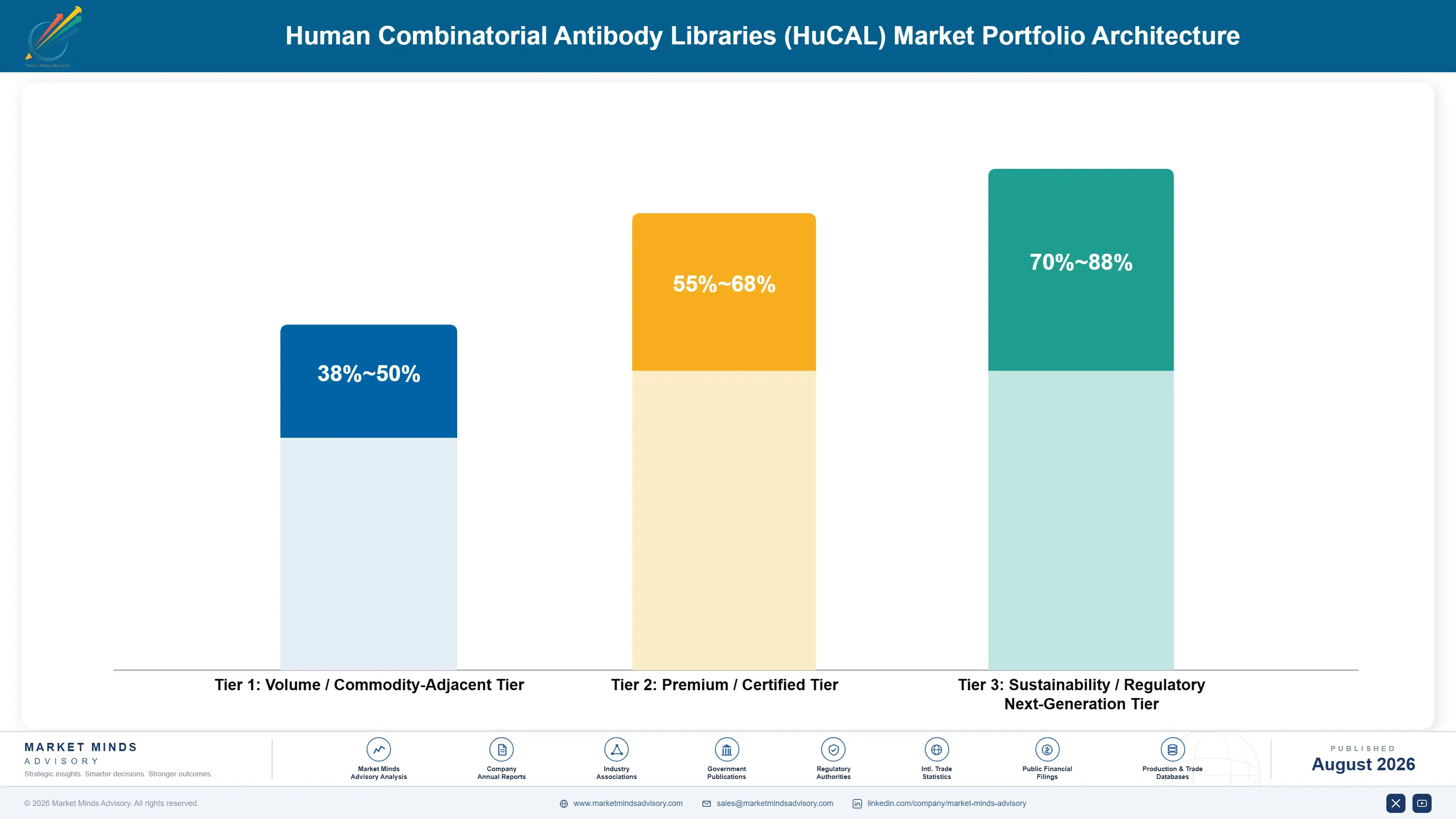
Margin architecture divides by how far revenue sits from the eventual therapeutic. Reagent and catalogue library sales earn ordinary research tools margins on products competitors can approximate. Discovery service campaigns earn project margins constrained by labour cost and by Asian price benchmarking. Platform licensing earns most by a wide distance, since a royalty costs almost nothing to service.
The volume versus premium tension is a cash timing problem more than a pricing one. Service revenue converts work into cash within a quarter and funds the business. Licensing revenue may not arrive for a decade and most of it never arrives at all, since the great majority of discovery programmes fail somewhere before approval. Companies without balance sheet depth take service fees and forfeit the far larger royalty position.

High-value pools concentrate where a sponsor cannot easily go elsewhere. Difficult target classes, conserved antigens and membrane proteins requiring native presentation all support premium pricing because animal immunisation genuinely fails there. Demonstrated developability advantage supports it too, once a sponsor has measured the difference across two campaigns. Straightforward soluble targets, where several technologies work comparably well, sit at the other extreme and price accordingly.

Volume / Commodity-Adjacent Tier

Catalogue recombinant antibodies, standard library kits and routine primary screening services, where several technologies work comparably and Chinese and Indian providers set the price benchmark for the whole category. Execution speed and cost position are the only differentiators available.
Gross Margin: 38-50%

Premium / Certified Tier

Full discovery campaigns against difficult targets, mammalian display work and extensive lead characterisation, protected by scientific know-how, framework quality and demonstrated developability performance across delivered programmes. Sponsors who have measured the difference across two campaigns rarely move afterwards.
Gross Margin: 55-68%

Sustainability / Regulatory / Next-Generation Tier

Computationally designed libraries and platform licensing carrying milestones and royalties, protected by proprietary datasets, framework designs and agreements signed before a programme carried any value. Best returns available anywhere in the market.
Gross Margin: 70-88%
human-combinatorial-antibody-libraries-hucal-marke-portfolio-architecture-1787303506199

Deferred Value Across Discovery Programmes

The annuity in this market is a royalty stream that may never arrive. A platform licence signed at discovery stage carries a median royalty near 3.5% on a product that will take eight to twelve years to reach market and probably will not get there. Across dozens of agreements the arithmetic works; across any single one it does not.
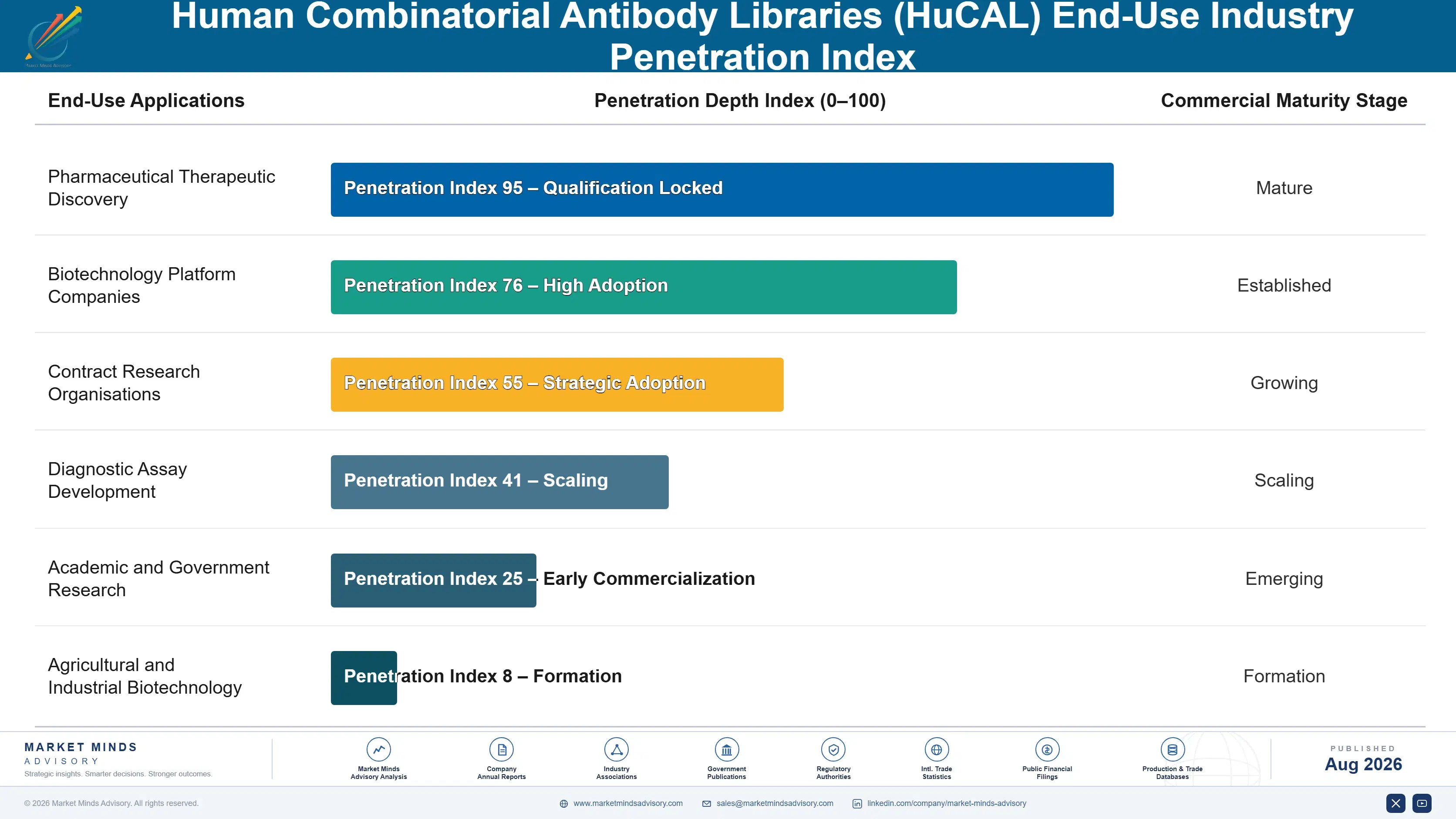
Stickiness varies by what a sponsor has actually verified. A pharmaceutical company that has run two campaigns and measured lower developability attrition will return, because the alternative means repeating that comparison at the cost of programme time. Sponsors who bought on price and turnaround switch providers freely at every campaign. Platform licences are the stickiest of all, since a signed royalty agreement travels with the antibody through every subsequent partnering transaction.

Buyer profiles have shifted considerably. A decade ago discovery directors inside pharmaceutical companies selected library partners on scientific merit and ran campaigns internally. Today roughly 61% of campaigns are outsourced, procurement functions negotiate the contracts, and a growing share of the origination sits with Chinese biotechs whose assets are later licensed westward. Suppliers selling on scientific reputation alone are often talking to the wrong person.
human-combinatorial-antibody-libraries-hucal-marke-end-use-penetration-index-1787303506691

Where Library Strategy Must Land

These are among the four positions where our research anticipates prominent divergence between winners and laggards over the coming forecast period. Each is grounded in the demand model, the regulatory perimeter, and the announced capacity pipeline.
01 / DEVELOPABILITY EVIDENCE PRIORITY

Sell attrition reduction, because diversity numbers persuade nobody

Roughly 42% of binders selected on affinity fail later on aggregation, expression yield or immunogenicity, and each of those failures costs a sponsor several months of programme time that nobody ever budgets for. Suppliers who publish developability outcomes and then track them across every delivered campaign can defend pricing around 40% above commodity screening rates. Those still quoting library diversity at ten to the eleventh variants are describing a filtering problem as though it were an achievement somebody should pay for.
02 / ROYALTY PORTFOLIO CONSTRUCTION

Take the licence before the programme is worth anything

Platform licences signed at discovery stage carry royalties near 3.5% and cost a sponsor almost nothing, because the antibody has no demonstrated value yet and the terms become unobtainable once clinical development begins. Any individual programme almost certainly fails somewhere before approval, so the position only works across dozens of agreements accumulated patiently over many years. Companies without sufficient balance sheet depth take the immediate service fee instead and forfeit a deferred position that would have been worth considerably more.
03 / CAMPAIGN DATA OWNERSHIP

Contract data rights decide who builds the compounding asset

Every delivered campaign generates sequence and performance data capable of training better library design, and computationally designed libraries already cut downstream attrition by roughly 30% using precisely that kind of accumulated campaign evidence. Most suppliers discard that data once the customer has been delivered, and the contract language governing those rights is routinely negotiated far too casually at signature. Whoever retains and properly structures that data builds a compounding advantage that competitors cannot purchase with equipment or replicate by hiring.
04 / TARGET CLASS POSITIONING

Compete where animal immunisation platforms genuinely cannot work

Highly conserved antigens, toxic targets and membrane proteins requiring native conformation defeat animal immunisation entirely, and about 35% of library campaigns cite that intractability as the reason the route was chosen at all. That is a genuine capability argument rather than a cost one, and it survives price competition from transgenic platforms and Asian service providers alike. Chasing straightforward soluble targets, where several competing technologies perform comparably well, invites exactly the price contest that a Western provider will reliably lose.

Engagement Snapshot From the Field

A live engagement with an industry participant carrying material or product regulatory and market exposure ahead of a defining policy shift, showing how our research translates into a defensible multi-year portfolio strategy.
MARKET MINDS ADVISORY · CLIENT ENGAGEMENT SUMMARY
Human Combinatorial Antibody Libraries (HuCAL) Producer Strategic Portfolio Review and Transition Roadmap 2026·Investment Scenario on Human Combinatorial Antibody Libraries (HuCAL) Exposure Evaluation 2025-26
CLIENT PROFILE
A Western European antibody discovery services organisation running phage and yeast display campaigns for pharmaceutical and biotech sponsors, with annual revenue of approximately USD 74 million (client-reported, unverified by MMA). Roughly 85% came from fee-for-service discovery campaigns priced per project, with a small catalogue antibody business alongside. The company held no platform licensing agreements carrying milestones or royalties on any sponsor programme.
STRATEGIC CHALLENGE
Chinese and Indian contract organisations had won three significant accounts on price and timeline within eighteen months, and campaign pricing across the client's remaining book had fallen for two consecutive years. The board wanted to know whether to compete on cost through offshore capacity, or to reposition around difficult targets and developability performance where price benchmarking might apply less directly.
MMA APPROACH
MMA conducted 47 expert interviews across pharmaceutical discovery directors, biotech chief scientific officers, procurement leads, process development scientists and contract organisation operators in six countries. A quantitative survey of 3,800 respondents established provider selection criteria, switching behaviour and willingness to pay by target class. We then modelled revenue and margin under both options against observed pricing trends and outsourcing patterns in each sponsor segment.
KEY FINDINGS
  1. Process development scientists identified aggregation and expression yield failures as their largest source of lost programme time, and none had ever seen a discovery provider present outcome data on those measures.
  2. Sponsors who had measured developability differences across two or more campaigns showed almost no price sensitivity, while those selecting on turnaround switched providers at nearly every project.
  3. Campaigns against conserved antigens and membrane proteins carried pricing roughly forty per cent above soluble target work, and Asian providers were rarely shortlisted for those target classes.
  4. None of the client's existing campaign contracts granted it any rights to retain sequence and performance data, which had been surrendered to sponsors by default at signature.
CLIENT PROFILE
A Western European antibody discovery services organisation running phage and yeast display campaigns for pharmaceutical and biotech sponsors, with annual revenue of approximately USD 74 million (client-reported, unverified by MMA). Roughly 85% came from fee-for-service discovery campaigns priced per project, with a small catalogue antibody business alongside. The company held no platform licensing agreements carrying milestones or royalties on any sponsor programme.
STRATEGIC CHALLENGE
Chinese and Indian contract organisations had won three significant accounts on price and timeline within eighteen months, and campaign pricing across the client's remaining book had fallen for two consecutive years. The board wanted to know whether to compete on cost through offshore capacity, or to reposition around difficult targets and developability performance where price benchmarking might apply less directly.
MMA APPROACH
MMA conducted 47 expert interviews across pharmaceutical discovery directors, biotech chief scientific officers, procurement leads, process development scientists and contract organisation operators in six countries. A quantitative survey of 3,800 respondents established provider selection criteria, switching behaviour and willingness to pay by target class. We then modelled revenue and margin under both options against observed pricing trends and outsourcing patterns in each sponsor segment.
KEY FINDINGS
  1. Process development scientists identified aggregation and expression yield failures as their largest source of lost programme time, and none had ever seen a discovery provider present outcome data on those measures.
  2. Sponsors who had measured developability differences across two or more campaigns showed almost no price sensitivity, while those selecting on turnaround switched providers at nearly every project.
  3. Campaigns against conserved antigens and membrane proteins carried pricing roughly forty per cent above soluble target work, and Asian providers were rarely shortlisted for those target classes.
  4. None of the client's existing campaign contracts granted it any rights to retain sequence and performance data, which had been surrendered to sponsors by default at signature.
RECOMMENDED STRATEGY
Phase 1: Phase one: rewrite standard campaign contract terms to retain sequence and performance data rights, and begin systematically structuring the historical record already held. Phase 2: Phase two: reposition commercially around difficult target classes and publish developability outcome data across delivered campaigns rather than competing on turnaround. Phase 3: Phase three: offer selected biotech sponsors reduced campaign fees in exchange for milestone and royalty participation, building a portfolio position over several years.
OUTCOME
The client rewrote its contract terms within two quarters and began publishing developability outcomes, and average campaign pricing recovered roughly twelve per cent over the following year (client-reported, unverified by MMA). It had signed four milestone-bearing agreements with early-stage biotech sponsors by the end of the engagement year, establishing a royalty position where none had existed.

Frequently Asked Questions

Foundational context covering the market sizes, CAGR, scope, country, region and competition that inform every finding below. This section is provided to cover basics and most often pre-purchase conversations, answered from the MMA Primary Research Dataset.

What is the current size of the Human Combinatorial Antibody Libraries (HuCAL) Market?

The global human combinatorial antibody library market was valued at USD 2.4 billion in 2025, covering display library products, discovery screening services and platform licensing. Downstream antibody manufacturing and commercialised therapeutics fall outside this definition.

How large will the Human Combinatorial Antibody Libraries (HuCAL) Market be by 2036?

MMA forecasts the market at USD 7.72 billion by 2036, expanding 2.89 times from the 2026 base of USD 2.67 billion. That represents roughly USD 5.05 billion of incremental value across the forecast decade.

What is the CAGR for the Human Combinatorial Antibody Libraries (HuCAL) Market 2026 to 2036?

The base case compound annual growth rate is 11.2%, with a bull case of 12.5% and a bear case of 10.0%. The bear case reflects continued pressure on Western biotech discovery funding.

Which segment is growing fastest?

Computationally designed synthetic libraries grow at 16.8%, a full 1.50x the overall market rate. They cut downstream developability attrition by roughly 30% by never synthesising variants carrying known sequence liabilities.

Who are the major companies in the Human Combinatorial Antibody Libraries (HuCAL) Market?

Bio-Rad Laboratories, Twist Bioscience, Charles River Laboratories, WuXi Biologics and Danaher together hold 38% of revenue, and they rarely compete for the same contract because reagent supply, discovery services and platform licensing are largely separate businesses.

Which country is growing fastest?

China grows fastest at 17.4%, originating more antibody discovery programmes than any other single country while also running screening campaigns for Western sponsors. East Asia is the largest region at 30% of value.

Report Segmentation Architecture

The full report scope spans multiple orthogonal segmentation dimensions, with cross-tabulated demand data provided for each dimension pair. Coverage extends further to regional breakdowns, trend trajectories, and the competitive detail needed to support segment-level decision-making.

By Library and Display Technology

  • Phage Display Synthetic Libraries
  • Yeast Display Libraries
  • Mammalian Cell Display Libraries
  • Ribosome and Messenger RNA Display Libraries
  • Single B-Cell Derived Recombinant Libraries
  • Computationally Designed Synthetic Libraries

By End-Use Industry

  • Pharmaceutical Therapeutic Discovery
  • Biotechnology Platform Companies
  • Contract Research Organisations
  • Diagnostic Assay Development
  • Academic and Government Research
  • Agricultural and Industrial Biotechnology

By Commercial Dimension

  • Fee-for-Service Discovery Campaigns
  • Platform Licensing with Milestones and Royalties
  • Catalogue Library and Reagent Sales
  • Collaborative Research Partnerships
  • Academic and Institutional Supply Agreements
  • Equity and Risk-Sharing Arrangements

By Region

  • East Asia
  • North America
  • Western Europe
  • South Asia and Pacific
  • Latin America
  • Middle East and Africa
  • Eastern Europe

Scope, Methodology, and Coverage

Every figure in this report is reproducible from documented input assumptions. The scope below maps the historical period, the forecast horizon, the segmentation dimensions, and the countries covered, alongside the underlying primary and qualitative methodology.
Historical Period
2020 to 2025
Forecast Period
2026 to 2036
Base Year
2025 (USD billions; MMA Primary Research Dataset, August 2026)
Market Definition
This market comprises synthetic and semi-synthetic antibody library technologies used to discover fully human antibodies without animal immunisation, measured at supplier revenue across library product sales, discovery screening services and platform licensing including upfront, milestone and royalty payments. Coverage spans phage display synthetic libraries including the human combinatorial antibody library format, yeast display libraries, mammalian cell display libraries presenting full immunoglobulin molecules, ribosome and messenger RNA display systems, single B-cell derived recombinant libraries, and computationally designed synthetic libraries constructed from machine learning guided sequence selection. Transgenic animal immunisation platforms, hybridoma generation and screening, downstream antibody process development and manufacturing, commercialised therapeutic antibody sales, protein and peptide libraries not directed at antibody discovery, and nucleic acid aptamer platforms fall outside scope.
Quantitative Units
USD billions (current prices); discovery campaigns run by technology type; library diversity in unique variants; average campaign price; licensed programme counts and royalty rates
Segmentation Dimensions
By Library and Display Technology; By End-Use Industry; By Commercial Dimension; By Region
Regions Covered
East Asia, North America, Western Europe, South Asia and Pacific, Latin America, Middle East and Africa, Eastern Europe
Countries Covered
China, Japan, South Korea, Taiwan, United States, Canada, Germany, United Kingdom, Switzerland, France, Netherlands, Denmark, Sweden, India, Australia, Singapore, Brazil, Argentina, Mexico, Israel, Saudi Arabia, United Arab Emirates, South Africa, Poland, Czechia, Hungary, and additional markets relevant to antibody discovery capability analysis
Key Companies Profiled
Bio-Rad Laboratories, Twist Bioscience, Charles River Laboratories, WuXi Biologics, Danaher, Creative Biolabs, GenScript Biotech, Sino Biological, Adimab, Specifica, Abzena, Evotec, Lonza Group, Sartorius, Absci, Generate Biomedicines, AbCellera Biologics, Alloy Therapeutics, OmniAb, Fusion Antibodies
Quantitative Methodology
Primary survey, n=3,800 respondents, Q4 2025, six countries; demand-side model with trade association cross-validation
Qualitative Methodology
47 expert interviews, Q4 2025; applied to validate demand model assumptions, identify emerging dynamics, and assess competitive positioning
Report Format
PDF and XLSX data workbook (Word format preview document)
Publisher
Market Minds Advisory
Report Code
MMA-2026-HLT-115
Published
August 2026
Contact
sales@marketmindsadvisory.com | www.marketmindsadvisory.com

Purchase the full Human Combinatorial Antibody Libraries (HuCAL) Market Report (2026 to 2036).

The full MMA report examines a market where the foundational technology is free and the value sits entirely in what survives development, quantifying developability attrition by library type and tracing where campaign spending actually lands. It sizes six library technologies and seven regions to 2036, modelling campaign volumes, service pricing and licensing economics separately so deferred royalty value can be distinguished from operating revenue. Competitive assessment covers twenty suppliers on one consistent revenue basis. Cost exposure is traced through synthetic DNA supply, specialist labour and reagent availability. Four commercial levers and a strategic verdict close the report, grounded in 47 expert interviews and a 3,800-respondent survey.
Six library technologies sized separately to 2036
Developability attrition quantified across display formats
Royalty and milestone economics modelled against service revenue
Twenty suppliers assessed on one consistent basis
Chinese origination and outsourcing patterns mapped by sponsor
Anonymised client engagement with tested strategic recommendations

Built For The People Who Decide

From boardroom strategy to bench-side execution, this report is read cover-to-cover by leaders shaping the next decade of their industry, turning demand scenarios, market dynamics and valuation benchmarks into decisions.
CXOs/ Presidents/ VPs/ Managers
M&A and Corporate Development
Strategy Teams and R&D Heads
Procurement and Product Directors
Regulatory and Compliance Leaders
Investor Relations and Equity Analysts