Market Minds Advisory
Hot Chamber Die Casting Machine Market

Hot Chamber Die Casting Machine Market: Fast Cycles, Low Melting Points, Narrow Alloys

The gooseneck sits in the melt, which makes cycles fast and limits the machine to zinc and magnesium forever. Every commercial question in this market follows from that one design constraint.

Lead Analyst

David Horsley

Published

September 2026

Make Smarter Decisions with Customized Research Insights

Request a free sample report and evaluate market opportunities, growth trends, and competitive dynamics relevant to your business needs.

2025 MARKET VALUE$1.6BMarket Size 2025
2036 FORECAST VALUE$2.5BBase Case , 2026 to 2036
CAGR 2026 TO 20364.2 %Bull 5.4% / Bear 3.0%
INCREMENTAL OPPORTUNITY$0.8BNet 10- year value creation
EXPANSION MULTIPLE1.51x2036 value over 2026 base
Strategic Levers
M&A Pipeline
Regional Outlook
Country Rankings
Competitive Intelligence
Segmental Deep-dive
Call-Us : 91 93563 13602

Executive Snapshot and Market Trajectory

The injection system sits inside the molten metal, which is why hot chamber machines cycle in seconds and why they will never cast aluminium. That trade is permanent and it shapes everything else here. The market is worth USD 1.6 billion in 2025 and grows at a mature 4.2%.
Magnesium machines grow fastest at 7.6%, roughly 1.81 times the market rate, as vehicle weight targets push interior components away from steel and plastic and into cast magnesium instead. East Asia takes 41% of value, well beyond the band this framework applies, because Chinese zinc and magnesium casting capacity supplies consumer hardware, electronics, and automotive components for most of the world. North America follows at 22%.
Concentration sits at 48% across the top five, with Bühler, Frech, and the Chinese builders holding most of the field between the three of them. Competition turns on cycle time, die life, and whether a given machine holds its tolerance across a long production run. Price competition from the Chinese builders has been severe over the past decade, and it has now hollowed out the entire middle tier of the market.
Market Definition
The hot chamber die casting machine market covers machines in which the injection mechanism is submerged in the molten metal bath, casting low melting point alloys, principally zinc and magnesium, together with the automation, thermal control, and die handling systems supplied with them. Cold chamber machines for aluminium and copper alloys, gravity and low pressure casting equipment, dies and tooling, and the castings themselves are excluded.
Base Year Value
$1.6B in 2025 (MMA Primary Research Dataset, August 2026)
Forecast Period
2026 to 2036, eleven discrete annual values
CAGR
4.2% base case. Bull 5.4%. Bear 3.0%.
Fastest Growth Segment
Magnesium Alloy Machines: 7.6% CAGR
Fastest Growth Country
India: 6.8% CAGR
Fastest Growth Region
South Asia and Pacific: 6.2% CAGR
Largest Region
East Asia: 41% of 2025 global value
Market Leaders
Bühler Group, Frech, Yizumi, LK Technology, Shibaura Machine. Source: MMA Primary Research Dataset, July 2026.
Primary Survey
n=3,800 procurement and R&D decision-makers, Q4 2025, six countries
Methodology
Demand-side build-up, cross-validated against public data, 47 expert interviews

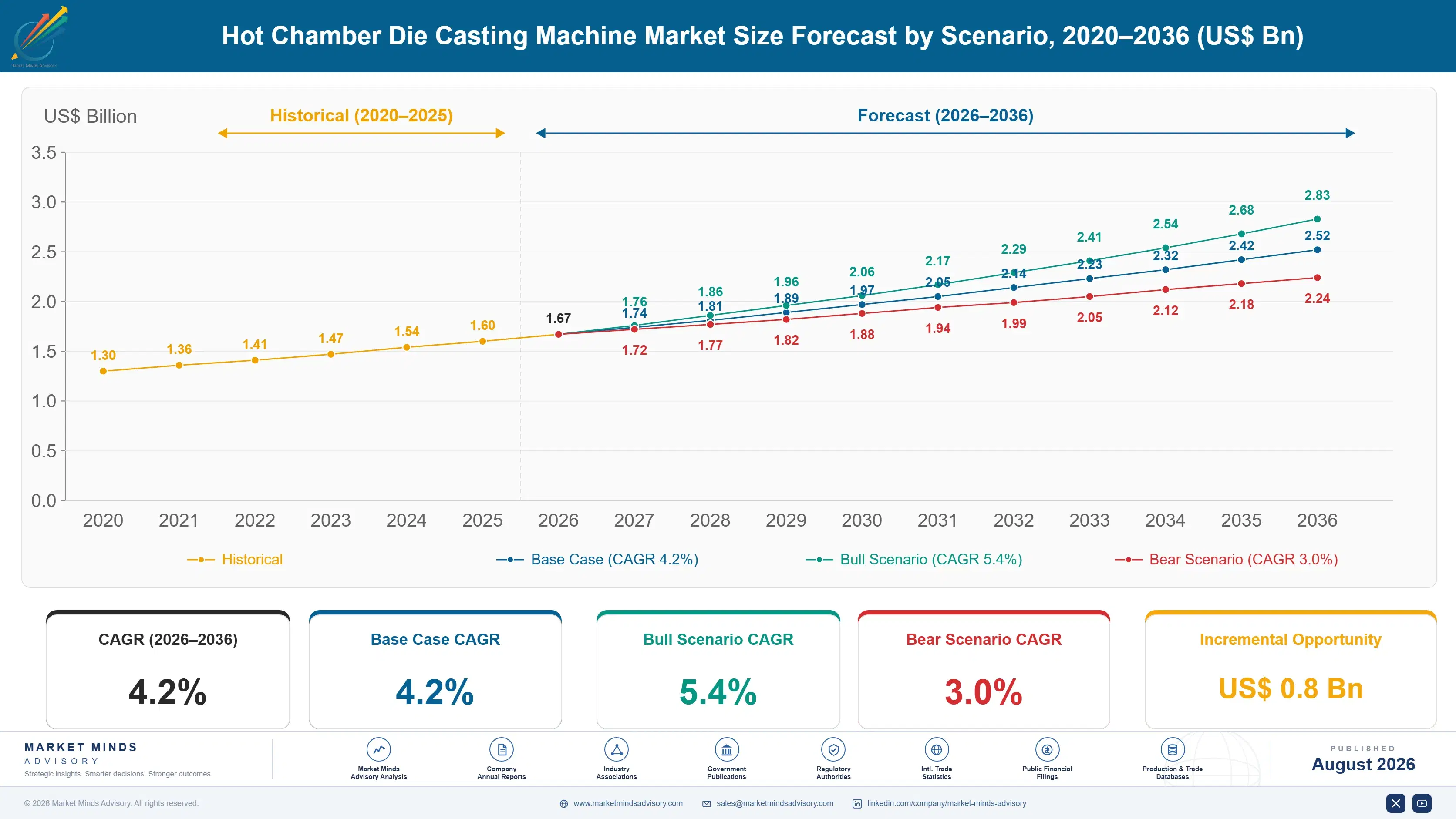
Hot Chamber Die Casting Machine Market Forecast Scenarios

hot-chamber-die-casting-machine-market-size-forecast-scenario-1787333963156
The 2020 to 2025 period was flat with a shock in the middle. Automotive and consumer hardware demand collapsed in 2020, recovered through 2021 and 2022, then ran into European energy costs that made zinc casting uneconomic at several plants. Chinese builders gained share throughout on price. A 3.4% historical CAGR describes a market where unit volumes barely moved and value shifted between suppliers rather than growing.
Three mechanisms carry the 4.2% base case. Magnesium adoption in vehicle interiors is the largest, since weight targets are pushing components that were steel or plastic into cast magnesium at volumes that need dedicated machines. Replacement of machines installed during the 1990s expansion is the second, because those assets are now well past economic life. And automation retrofits are the third, converting standalone machines into cells that run with far less labour attached.
The 5.4% bull case depends on magnesium supply diversifying outside China, which would remove the single largest constraint on adoption in Western vehicle programmes. The 3.0% bear case is zinc substitution, since plastic and aluminium continue to displace zinc castings in consumer hardware and any acceleration there removes the volume base that keeps machine builders viable.

The Gooseneck Sits In The Melt

Everything about a hot chamber machine follows from one design decision. The injection cylinder and gooseneck sit submerged in the molten metal, so metal is always ready and cycle times drop to a few seconds. It also means the mechanism lives permanently in hot liquid metal, which rules out any alloy that would attack the steel. Aluminium does exactly that, which is why aluminium goes to cold chamber machines and always will.
TOP FIVE CONCENTRATION48%Chinese entrants have compressed the middle of the field
TYPICAL CYCLE TIME4 secondsShot to shot on small zinc components under normal operation
AVERAGE MACHINE PRICEUSD 185,000Configured hot chamber system before automation and tooling
MACHINE SERVICE LIFE20 to 30 yearsOperating years before replacement becomes a commercially unavoidable decision
ENERGY COST SHARE18%Melting and holding power as a portion of conversion cost
LEADING PRODUCER SHARE46%Manufacturing concentrates where casting volume itself is greatest
That leaves zinc and magnesium, and the two are heading in different directions. Zinc is the volume base: hardware, locks, connectors, decorative trim, all cast at extraordinary speed and increasingly under pressure from plastic and aluminium alternatives. Magnesium is the growth story, pushed by vehicle weight targets into interior brackets, housings, and support structures that were previously something else.
Commercially the market has bifurcated. Chinese builders sell capable machines at prices European makers cannot approach, and they have taken the mid-range almost entirely. What remains defensible at the top is precision, die life, and process stability across long runs, which is where Bühler and Frech still win. The middle is where the casualties are.
"Buyers compare machines on price per tonne of clamp force, which tells you almost nothing. The number that decides profitability is how many good parts come off before the die needs work, and almost nobody asks that question during procurement."
Principal, Metal Forming Equipment Practice · MMA Construction and Industrial Eq

Market Trends

Magnesium Moves Into Vehicle Interior Structures

Vehicle weight targets have pushed carmakers toward magnesium for instrument panel beams, seat frames, steering wheel armatures, and display housings, all components previously made from steel stampings or injection moulded plastic. Magnesium castings weigh around a third less than equivalent aluminium and considerably less than steel, and hot chamber casting suits the alloy because its melting point sits low enough for the submerged gooseneck to survive. The machines needed are larger than typical zinc equipment and command higher prices. This is the only genuinely fast-growing application in an otherwise mature market.
Market Impact: Half the base exceeds 25 years
Chinese Builders Have Taken The Middle Market

Yizumi, LK Technology, and several smaller Chinese manufacturers now supply machines with cycle performance close to European equipment at prices between forty and sixty percent lower. They have taken most of the mid-range business across Asia, and increasingly in Europe and North America where buyers have accepted the trade against a shorter expected life. European builders have responded by moving upmarket into precision and automation rather than competing on price, which works for the top of the range and leaves the volume tier to the entrants permanently. The middle tier is not coming back.
Market Impact: Cells cut labour content 60%

Market Opportunities and Growth Drivers

Ageing Installed Base Forces Replacement Decisions

A large share of the installed hot chamber base was put in during the 1990s and early 2000s expansion, and those machines are now twenty-five to thirty years old with maintenance costs rising and tolerance drifting. Casting shops running them face a straightforward choice between continuing to repair and replacing with equipment that cycles faster and uses less energy. Energy costs in Europe have sharpened that calculation considerably since 2022. Replacement demand is now a larger revenue stream than capacity expansion in most developed markets, and it is reasonably predictable.
Market Impact: China holds 85% of magnesium supply

Automation Cells Reduce Labour Content Per Casting

Hot chamber casting has historically needed an operator per machine for part extraction, trimming, and inspection, and labour cost in developed markets has made that untenable. Integrated cells with extraction robots, automated trim presses, and vision inspection cut labour content substantially and improve consistency at the same time. Machine builders selling the cell rather than the machine capture two to three times the contract value, and buyers accept it because the payback runs under three years at current wage levels. Automation content is now the fastest-growing part of most order books.
Market Impact: Thin-wall cuts zinc weight 30%

Market Restraints and Challenges

Magnesium Supply Concentration Deters Western Adoption

China produces the overwhelming majority of primary magnesium, and a 2021 energy curtailment in Shaanxi province cut output sharply enough to halt casting operations in Europe within weeks. The root cause is that magnesium smelting is energy-intensive and Western capacity closed decades ago on cost grounds. Commercially this makes carmakers hesitant to design magnesium into platforms they must supply for a decade, which caps machine demand regardless of the engineering case. Participants are mitigating by supporting new smelting projects in North America and Australia and by qualifying secondary and recycled magnesium streams.
Market Impact: Magnesium cuts component weight 33%

Zinc Castings Keep Losing Ground To Alternatives

Engineered plastics and aluminium continue to replace zinc in hardware, automotive trim, and consumer products, driven by weight, cost, and the perception that zinc is an older material. The root cause is that zinc's density works against it in any weight-sensitive application, and the surface finish advantage it once held has narrowed as plating and moulding improved. Commercially this erodes the volume base that supports machine builders. Mitigation is running toward thin-wall zinc casting that cuts component weight substantially, and toward applications where zinc's dimensional stability and shielding properties still cannot be matched.
Market Impact: Chinese pricing runs 40% below Euro
3 additional market trends, 2 additional growth drivers, and 4 additional restraints and challenges are covered in the full report. Contact sales@marketmindsadvisory.com to access the complete intelligence.

Segment CAGR and Growth Architecture

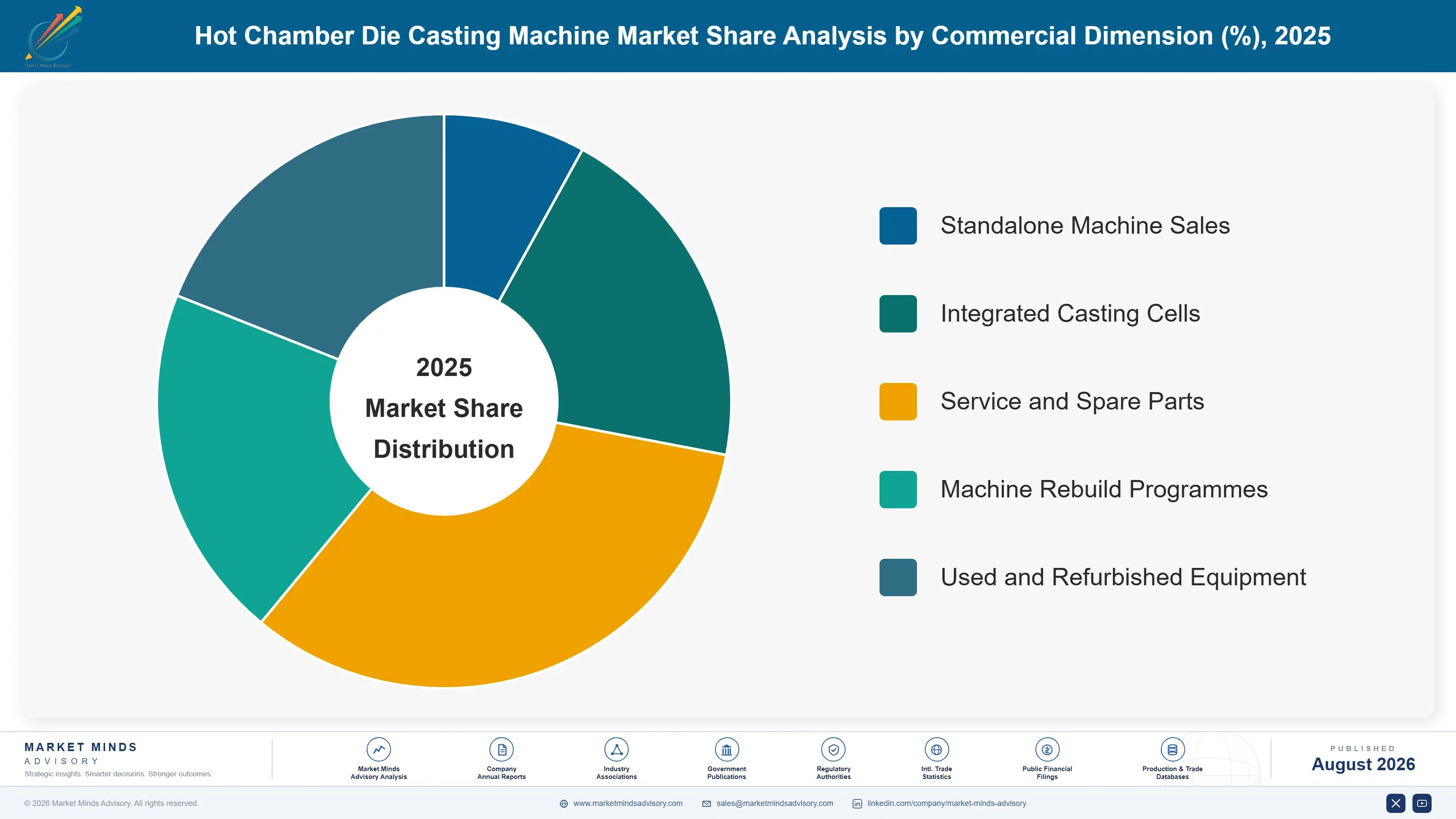
Segmentation follows the cast alloy system, because a hot chamber machine is built entirely around the specific metal that it will hold. Gooseneck material, holding furnace design, injection pressure, and die thermal management all change with the alloy, and a machine specified for one alloy system rarely converts economically to another one later on.
hot-chamber-die-casting-machine-market-market-share-analysis-1787333963693

Magnesium Alloy Machines

Magnesium machines grow fastest at 7.6%, roughly 1.81 times the market rate, and they are the only genuinely expanding part of this market. Vehicle weight targets have moved instrument panel beams, seat frames, steering wheel armatures, and display housings from steel and plastic into cast magnesium, which weighs about a third less than the aluminium alternative. The alloy's low melting point suits the submerged gooseneck, so hot chamber casting works where it cannot for aluminium. Machines run larger and carry higher prices than zinc equipment, with tighter atmosphere control because molten magnesium ignites. Supply concentration in China remains the practical brake on adoption. Order books here look nothing like the rest of this market.
CAGR 7.6%

High-Strength Zinc Alloy Machines

High-strength zinc alloy machines grow at 4.8%, casting the ZA and copper-modified grades that deliver considerably better mechanical properties than standard Zamak. These alloys let designers replace small aluminium castings and machined bronze bearings with a net-shape zinc part, which is where most of the growth comes from. Higher aluminium content raises the melting point toward the limit a submerged gooseneck tolerates, so machines need upgraded gooseneck materials and closer thermal control than standard zinc work requires. Buyers here are technically sophisticated and tend to specify on die life and dimensional stability rather than on machine price alone. Machine builders with real metallurgical support win most of this work. Price alone rarely decides these orders.
CAGR 4.8%
Full segment breakdown across 7 segments available in the complete report.

Regional Architecture and Country Demand Map

Regional shares here follow where zinc and magnesium castings are actually produced, which is not at all the same thing as where the finished products end up being sold. Casting is labour and energy sensitive, and it has migrated accordingly over the last three decades.

East Asia

East Asia takes 41% of value against a 30% ceiling in this framework, and the migration of casting itself explains the breach. Chinese foundries supply zinc hardware, connectors, and decorative components to the world, and China produces the overwhelming majority of primary magnesium, which puts magnesium casting capacity close to the metal. Yizumi, LK Technology, and a long tail of smaller builders manufacture domestically at prices European makers cannot approach, so the region buys most of its machines from within. Japanese and Korean demand is smaller, technically demanding, and weighted toward precision electronics components. Growth at 4.8% exceeds the global rate on continued casting capacity additions. Export volumes of finished castings sustain machine demand well beyond domestic consumption.
Share: 41% | CAGR: 4.8% (2026 to 2036)

Western Europe

Western Europe holds 18% of value, at the floor of the band this framework applies, and energy cost is steadily eroding the position. Zinc casting is power-intensive and several German and Italian foundries cut output or closed after 2022, taking machine demand with them. What remains is high-precision work for automotive, locking hardware, and industrial components where tolerance and finish justify the cost of casting locally. Bühler and Frech both manufacture here and export the majority of what they build, which does not show in regional consumption. Growth at 2.6% trails the global rate on that continuing capacity attrition. Automation content per machine is the highest anywhere, which partly offsets falling unit volume.
Share: 18% | CAGR: 2.6% (2026 to 2036)
Regional intelligence for 5 additional markets available in the complete report: North America, South Asia and Pacific, Latin America, Middle East and Africa, Eastern Europe. Contact sales@marketmindsadvisory.com.
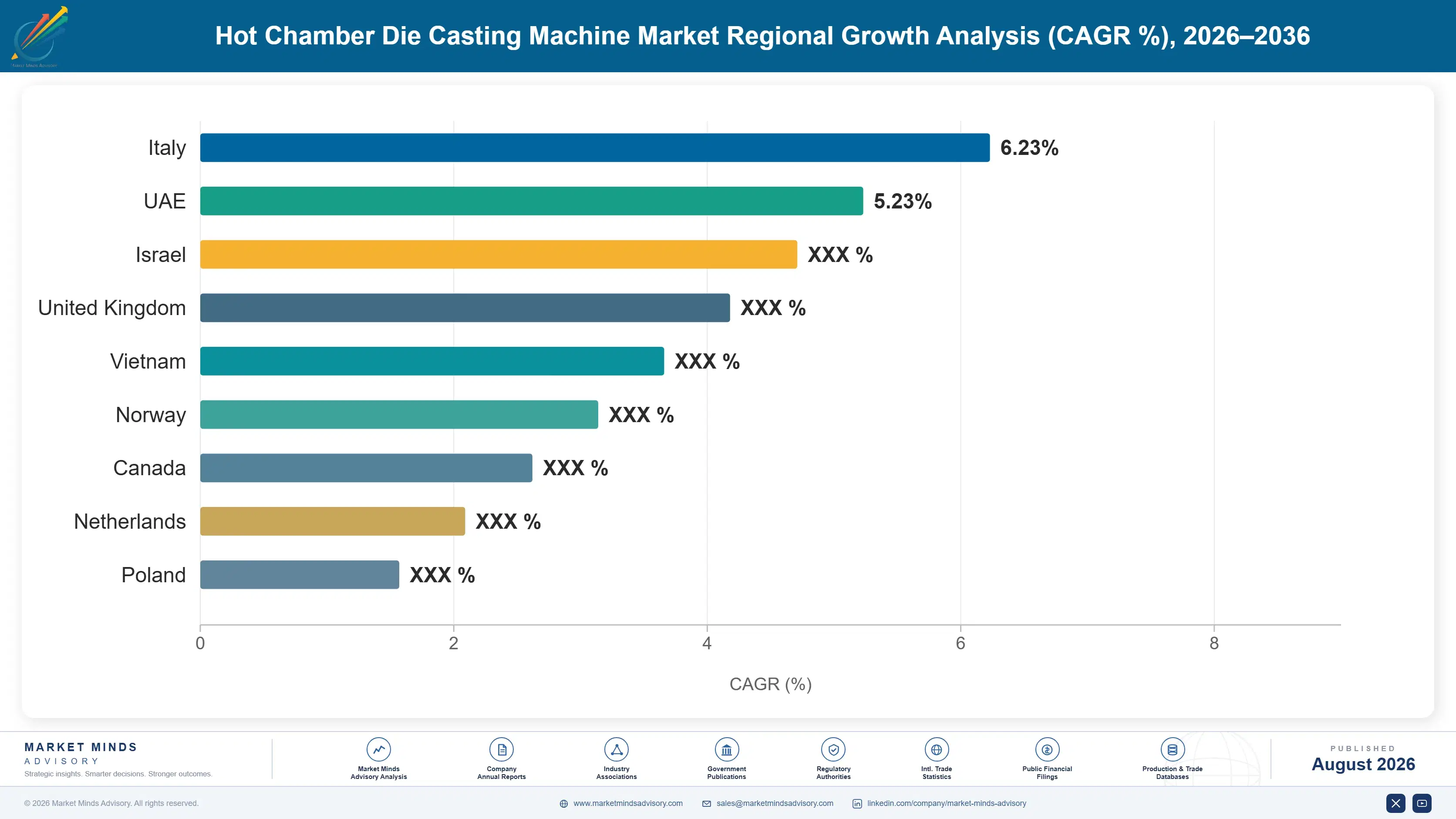
hot-chamber-die-casting-machine-market-country-cagr-analysis-1787333964215

Where Machine Builders Still Make Money

Selling machines against Chinese pricing is a losing argument, and most European builders have by now worked that out for themselves. What still earns money is the automation wrapped around the machine, the parts and rebuild revenue running across a thirty-year operating life, and getting paid for die life rather than for clamp force.

Sell The Casting Cell Rather Than The Machine

A standalone hot chamber machine competes directly on price against Chinese equipment and loses that comparison. The same machine inside an integrated cell with extraction robot, trim press, and vision inspection carries two to three times the contract value, typically USD 400,000 to USD 600,000 against 185,000 for the press alone, and is judged on labour saved rather than purchase price. Payback runs under three years at developed-market wage levels. It also creates service and integration revenue the machine alone never generates. Very few standalone machine sales are worth chasing at current price levels.
Market Impact: Cells raise contract value 200 perc

Monetise A Thirty-Year Installed Base Properly

These machines run twenty to thirty years, consuming goosenecks, nozzles, plungers, and hydraulic components continuously, and most builders capture only a fraction of that spend because third-party parts are cheaper and easily available. Structured service agreements bundling parts, preventive maintenance, and thermal system calibration recover 3% to 6% of machine value annually at margins well above equipment. Rebuild programmes on twenty-five-year-old machines are the larger opportunity, since a full rebuild costs roughly half a new machine and the customer keeps a known asset running. Most builders have never staffed for this properly.
Market Impact: Service recovers 3 to 6 percent of

Price Against Die Life, Not Clamp Force

Buyers compare machines on price per tonne of clamp force, which measures almost nothing that actually affects profitability. What determines casting economics is how many good parts run before the die needs work, and thermal control and shot consistency drive that directly. A machine that extends die life by 20% saves more across five years than the entire price difference against a cheaper competitor. Builders who bring measured die life data into the sale change the comparison completely, and very few of them currently bother to do it. The data exists in every service department.
Market Impact: Die life improvements reach 20 perc

Who Controls the Margin Pool

Concentration sits at 48% across the top five measured on hot chamber machine revenue, and the field has split rather than consolidated. Bühler and Frech hold the precision and automation end, with Frech in particular carrying the deepest hot chamber specialisation of any builder. Yizumi and LK Technology have taken the volume tier across Asia and increasingly elsewhere. Shibaura Machine sits between them on Japanese precision work. The gap is now positioning rather than scale.
Competition currently turns on three things. Purchase price, which the Chinese builders win outright and which decides most mid-range orders. Automation integration capability, where European builders hold a real advantage and where the money increasingly is. And service coverage near the customer, which matters enormously to a foundry whose machine stopping means the die cooling and the shift lost.

Pressure runs in both directions now. Chinese builders are moving upmarket into automation and precision, closing a gap European makers assumed would hold longer. European builders are pushing into service and rebuild revenue that Chinese suppliers cannot easily support at distance. Rankings will shift wherever local service presence gets established, which is the constraint currently holding the Chinese advance outside Asia.
hot-chamber-die-casting-machine-market-company-positioning-matrix-1787333964736

Competitive Moat and Risk Dimensions

BÜHLER GROUP

Moat: Automation and process integration depth

Bühler sells casting cells rather than machines, combining the press with extraction, trimming, inspection, and process monitoring under one engineering responsibility. That capability is genuinely hard to assemble and it moves the purchase decision away from price per tonne of clamp force, which is the only comparison Chinese competitors currently win outright.
BÜHLER GROUP

Risk: Hot chamber is peripheral

Hot chamber represents a small part of a much larger business weighted toward aluminium cold chamber and food processing equipment, which affects how development budget gets allocated internally. A competitor concentrating entirely on hot chamber can out-invest Bühler in that specific technology without matching its overall scale, and Frech has done exactly that for years.
FRECH

Moat: Deepest hot chamber specialisation

Frech has concentrated on hot chamber technology longer and more completely than any competitor, which shows in gooseneck design, thermal management, and magnesium capability. Foundries running demanding zinc and magnesium work treat the name as the default specification, and that reputation is worth a price premium that no specification comparison on paper would justify.
FRECH

Risk: German cost base and scale

Manufacturing in Germany against Chinese competitors pricing forty to sixty percent below is a permanent cost disadvantage on any order where precision is not the binding requirement. Frech's specialisation also means it cannot spread fixed cost across adjacent equipment lines the way broader competitors can, which makes volume decline more painful when it comes.

Players Tracked

Prominent Players

Bühler Group
Frech
Yizumi
LK Technology
Shibaura Machine

Other Key Players

Colosio
Norican Group
Idra Group
Techmire
Ube Machinery
Toyo Machinery and Metal
Haitian Die Casting
Zitai Precision Machinery
Ningbo Hairong Machinery
Electronica Hitech Engineering
Sanjay Machine Tools
Maicopresse
Tecnopres
Hishinuma Machinery
Birch Machines

Recent Developments

MARCH 2025

European builder launched magnesium cell for automotive interiors

A European machine builder introduced an integrated magnesium casting cell aimed at vehicle interior components, combining atmosphere control, automated extraction, and inline dimensional inspection in a single package. The system targets carmakers moving instrument panel and seat structures away from steel stampings into cast magnesium.
Signal: Magnesium is being sold as a complete prod
SEPTEMBER 2024

Chinese builder opened European service and parts operation

A Chinese die casting machine manufacturer established a European service and spare parts operation, addressing the support gap that had been the main obstacle to selling into European foundries. Machine pricing had never been the problem for these builders; response time on a stopped press was.
Signal: Service presence is the last real barrier
JANUARY 2025

Japanese producer extended precision range for electronics components

A Japanese machine builder extended its small-tonnage hot chamber range with tighter shot control, aimed at electronics connector and shielding components. Dimensional repeatability across very long production runs matters considerably more than raw cycle time does in that application, which suits established Japanese engineering strengths.
Signal: Precision at small tonnage is where Japane

Steel, Hydraulics, And Machining

Fabricated and machined steel for platens, tie bars, and frames carries roughly 32% to 40% of cost of goods, bought from European, Japanese, and Chinese mills depending on where the machine is built. Hydraulic pumps, valves, and accumulators add 20% to 26% from a concentrated supplier base. Control systems, servo drives, and heating elements make up most of the balance, with specialist gooseneck alloys a small but critical item.
European steel and energy costs rose sharply through 2022 and 2023 after the gas shock, and machine builders quoting fixed prices on twelve-month delivery schedules absorbed most of the increase themselves. European Commission energy statistics record industrial electricity costs roughly doubling at the peak. The effect compounded a competitive problem rather than creating one, because Chinese builders faced no equivalent increase during exactly that period.

Exposure divides by where a builder manufactures and what it sells. Chinese builders operating on domestic steel and energy have a cost base European makers cannot reach, and no amount of purchasing discipline closes it. European builders selling automation-heavy cells carry proportionally less steel per unit of revenue. Those still selling standalone machines against imported equipment sit worst, exposed on cost and undifferentiated on product.
hot-chamber-die-casting-machine-market-cost-volatility-analysis-1787333964930

Shift revenue mix toward automation and controls

Robots, vision systems, controls, and integration engineering carry very little steel per unit of revenue and better margins than the press itself. Raising that share reduces metal exposure without changing anything about how machines are built. It also moves the sale away from the price comparison that Chinese builders win, which is worth considerably more than the input cost saving.

Standardise frames and platens across the range

Common frame, platen, and tie bar designs shared across several machine sizes raise steel purchase volumes for any given grade and support forward contracts that per-model buying cannot. Fabrication setup cost and inventory both fall. The obstacle is sales pressure for custom configurations, which erodes the purchasing advantage one exception at a time until nothing is left of it.

Source components regionally to match build location

Builders with assembly in more than one region can match component sourcing to where the machine is built rather than shipping European hydraulics to Asian plants out of habit. This cuts both landed cost and currency exposure. Qualification effort is the barrier, since hydraulic and control components need validation before a builder will accept them into a proven design.

Portfolio Architecture for Margin Defence

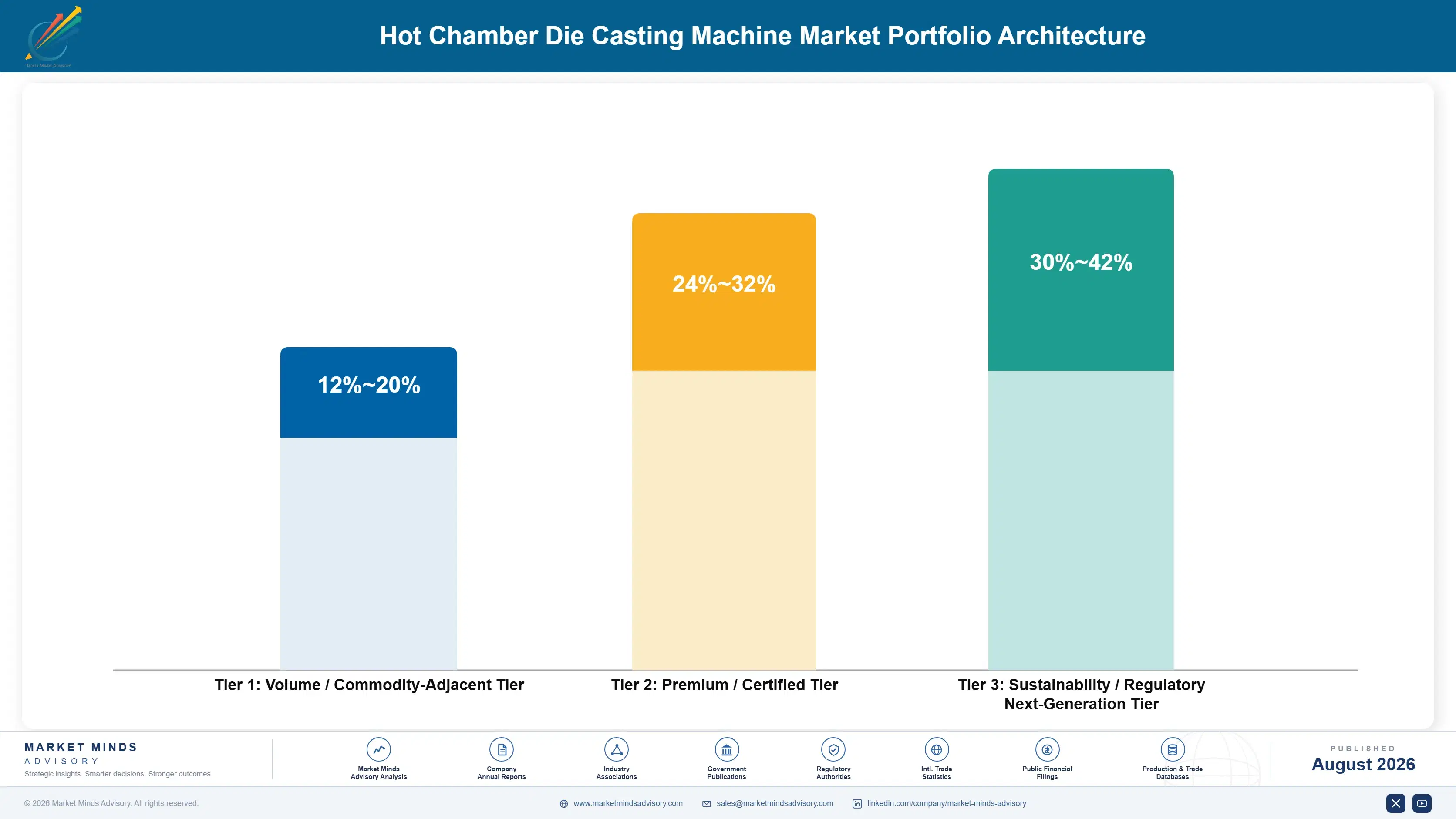
Margin here tracks how far a builder has moved away from simply selling a press. Standalone machines are close to commodity, judged on clamp force and price, and the Chinese builders set the level everybody else works against. Integrated cells with automation and process control are judged on labour saved and parts consistency, which is a different conversation and a considerably more profitable one.
The volume tension is uncomfortable for European builders. Standalone machine volume funds factory utilisation and keeps the service base growing, and giving it up to concentrate on cells means running plants below capacity. Holding the volume means competing on price against a cost base that cannot be matched. Most have chosen to retreat upmarket, and the ones that hesitated have generally lost both.

High-value pools sit in three places. Magnesium cells for automotive interior structures, automation and integration content on any machine, and rebuild programmes on the large installed base now passing twenty-five years. All three are defended by engineering capability and local presence rather than by manufacturing cost, which is the only ground where European builders still hold a real advantage.

Volume / Commodity-Adjacent Tier

Standalone zinc machines in standard tonnage ranges, sold on clamp force and price. The range reflects how differently Chinese and European cost bases carry the same product into what is effectively one global comparison.
Gross Margin: 12-20%

Premium / Certified Tier

Precision machines for high-strength zinc alloys and demanding tolerance work, plus integrated automation cells. Engineering capability and process support rather than hardware cost sustain the margin here against cheaper alternatives.
Gross Margin: 24-32%

Sustainability / Regulatory / Next-Generation Tier

Magnesium cells with atmosphere control, energy-efficient melting and holding systems, and installed base rebuild programmes. The wide range reflects genuinely different economics between new magnesium systems and rebuild work on existing assets.
Gross Margin: 30-42%
hot-chamber-die-casting-machine-market-portfolio-architecture-1787333965424

High-value Sub-segments and Strategic Watch-out

Magnesium Casting Cells

Growing at 7.6% with the best margins available, because atmosphere control and process expertise are genuinely hard and carmakers pay for a system that works. Chinese magnesium supply concentration remains the practical brake on how fast this can expand. Carmaker interest is running ahead of committed programmes.
Gross Margin: 32-44%

Automation and Integration Content

Growing faster than machines themselves as labour cost pushes foundries toward cells rather than standalone presses. It carries almost no steel per unit of revenue and moves the sale away from the price comparison European builders consistently lose. It is also the hardest content for a distant supplier to deliver.
Gross Margin: 28-38%

Standard Zinc Machines

The volume base of the market and the part Chinese builders have taken most completely, judged on clamp force and purchase price alone. It still funds factory utilisation and grows the installed base that service revenue eventually depends on. Defending it on price alone has not worked for anybody.
Gross Margin: 12-20%

Installed Base Rebuild Programmes

A large population of machines is now passing twenty-five years, and a rebuild costs roughly half a new machine while keeping a known asset. The watch-out is that rebuilds cannibalise new machine sales the builder might otherwise have won. Managing that tension is a commercial judgement, not a technical one.
Gross Margin: 26-36%

What The Machine Earns Afterwards

A hot chamber machine earns more after installation than most builders collect. It runs twenty to thirty years, consuming goosenecks, nozzles, plungers, seals, and hydraulic components throughout, and third-party suppliers take a large share of that spend because their parts are cheaper and immediately available. Builders who structure service agreements around parts, calibration, and preventive maintenance recover 3% to 6% of machine value annually at margins the machine sale never reaches.
Stickiness varies by foundry type more than by geography. Automotive component casters standardise on one builder across a plant because operator training, spare parts inventory, and process recipes all carry over, and they replace like for like almost automatically. Hardware and consumer product casters are far more price-driven and switch readily. Contract casters bidding on part price are the least loyal of all, buying whatever machine clears the payback calculation.

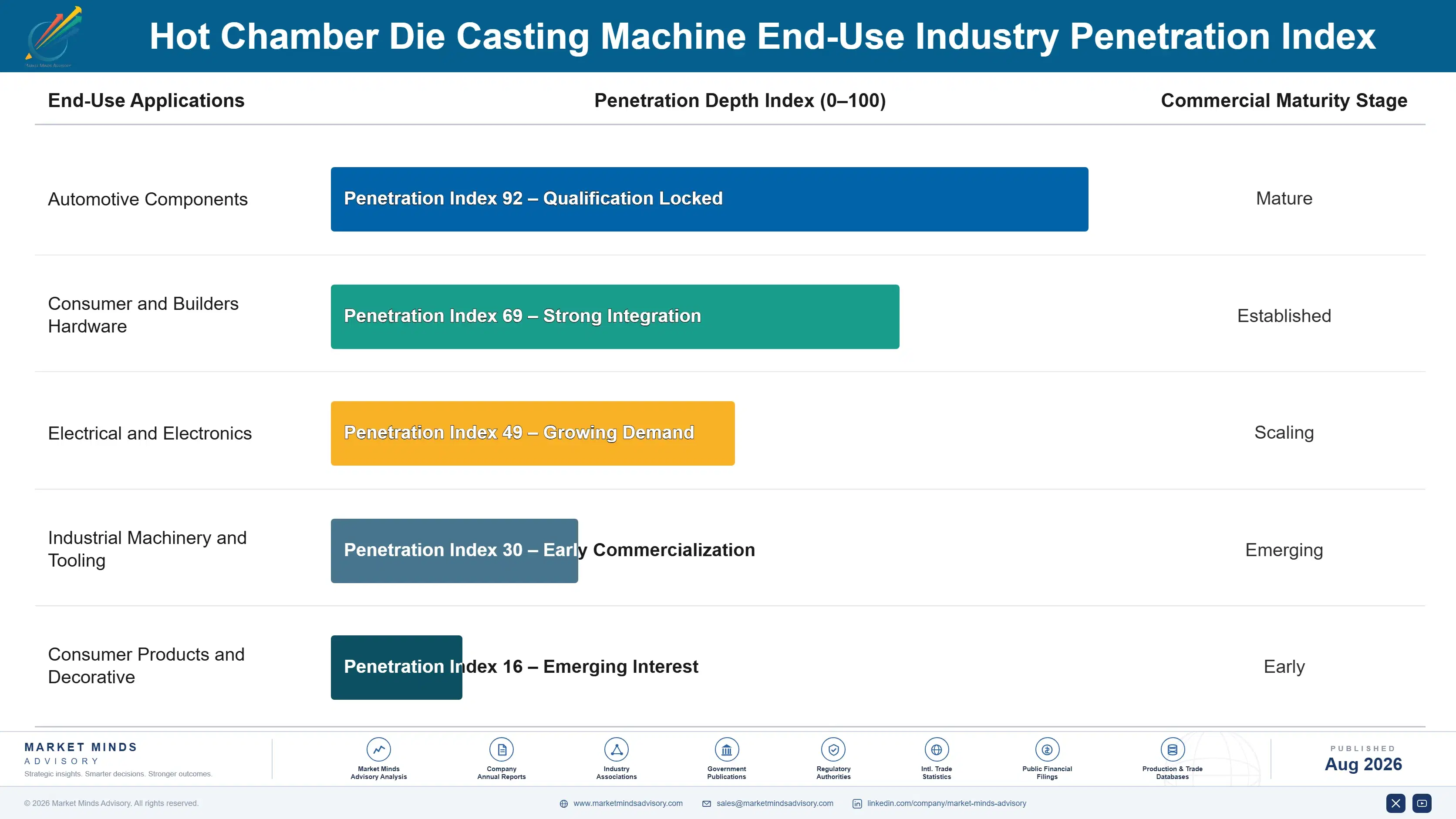
Buyer profiles have shifted toward operations and away from engineering. The decision increasingly sits with a plant manager measured on labour cost per part rather than with a process engineer comparing shot control. That change favours builders selling automation and quantified productivity, and it disadvantages those still presenting technical specifications to people who no longer make the call.
hot-chamber-die-casting-machine-market-end-use-penetration-index-1787333965913

Where To Compete Here

These are among the four positions where our research anticipates prominent divergence between winners and laggards over the coming forecast period. Each is grounded in the demand model, the regulatory perimeter, and the announced capacity pipeline.
01 / AUTOMATION CONTENT GROWTH

Sell the cell, never the bare machine

A standalone press competes on clamp force and price, which is a comparison the Chinese builders win outright and which European ones cannot expect to survive for very long. The same machine inside an integrated cell carries two to three times the contract value and is judged on labour saved instead of on purchase price. Payback under three years makes the case easy for the buyer, and it moves the whole conversation onto ground where engineering capability actually counts for something.
02 / INSTALLED BASE RECAPTURE

Take back the parts and rebuild revenue

These machines run twenty to thirty years and consume goosenecks, plungers, and hydraulic components throughout that life, yet third-party suppliers capture much of the spend because they are cheaper and rather quicker to deliver on. Structured service agreements recover 3% to 6% of machine value annually at margins comfortably above the original equipment sale itself. Rebuilds on the twenty-five-year population are the larger prize of the two, since a rebuild costs about half a new machine and keeps a known asset running.
03 / MAGNESIUM POSITION BUILDING

Build the magnesium capability before demand arrives

Magnesium is the only genuinely fast-growing part of this market, and it demands atmosphere control and process expertise that take years of sustained engineering investment to develop properly. Supply concentration in China currently caps adoption, but smelting projects outside China are advancing steadily and that constraint will eventually ease for everybody in the industry. Builders who wait for a clear demand signal before investing anything will arrive long after the carmakers have already qualified somebody else's equipment into the platform.
04 / DIE LIFE SELLING

Change the comparison from price to output

Buyers compare machines on price per tonne of clamp force, a number that says almost nothing at all about whether the foundry will actually end up making money. Die life and shot consistency are what determine casting economics, and a 20% die life improvement outweighs the entire price gap against a cheaper machine within about five years. Builders who bring properly measured data into that argument change the basis of competition entirely, and remarkably few of them currently take the trouble.

Engagement Snapshot From the Field

A live engagement with an industry participant carrying material or product regulatory and market exposure ahead of a defining policy shift, showing how our research translates into a defensible multi-year portfolio strategy.
MARKET MINDS ADVISORY · CLIENT ENGAGEMENT SUMMARY
Hot Chamber Die Casting Machine Producer Strategic Portfolio Review and Transition Roadmap 2026·Investment Scenario on Hot Chamber Die Casting Machine Exposure Evaluation 2025-26
CLIENT PROFILE
A tier one automotive component caster operating zinc and magnesium die casting across three European plants, with roughly USD 280 million in annual revenue (client-reported, unverified by MMA). Around sixty hot chamber machines were in service, a substantial share of them more than twenty-five years old and increasingly expensive to keep running within acceptable tolerance.
STRATEGIC CHALLENGE
European energy costs had made the zinc business marginal at two of the three plants, while a customer had asked the client to quote magnesium interior structures requiring capability it did not have. Capital was sufficient for one of those problems, not both, and the board was split on which mattered more.
MMA APPROACH
MMA modelled conversion cost per part at each plant under current and projected energy pricing, and separately assessed what magnesium capability would cost to build against the realistic volume the customer enquiry represented. Rebuild economics on the ageing machines were compared against replacement, and Chinese machine options were evaluated on total cost including service exposure.
KEY FINDINGS
  1. Rebuilding twenty-two of the oldest machines cost roughly 45% of replacement (client-reported, unverified by MMA) and recovered most of the tolerance and energy performance of new equipment.
  2. The magnesium enquiry represented volume that would not cover dedicated capability at one plant, but comfortably would if the client consolidated the work with two other pending enquiries.
  3. Chinese machines quoted 44% below European equivalents but carried service response times that the client's uptime commitments to its own customers could not tolerate.
  4. Consolidating zinc production from three plants into two removed enough fixed cost to make the remaining operations viable at projected energy prices.
CLIENT PROFILE
A tier one automotive component caster operating zinc and magnesium die casting across three European plants, with roughly USD 280 million in annual revenue (client-reported, unverified by MMA). Around sixty hot chamber machines were in service, a substantial share of them more than twenty-five years old and increasingly expensive to keep running within acceptable tolerance.
STRATEGIC CHALLENGE
European energy costs had made the zinc business marginal at two of the three plants, while a customer had asked the client to quote magnesium interior structures requiring capability it did not have. Capital was sufficient for one of those problems, not both, and the board was split on which mattered more.
MMA APPROACH
MMA modelled conversion cost per part at each plant under current and projected energy pricing, and separately assessed what magnesium capability would cost to build against the realistic volume the customer enquiry represented. Rebuild economics on the ageing machines were compared against replacement, and Chinese machine options were evaluated on total cost including service exposure.
KEY FINDINGS
  1. Rebuilding twenty-two of the oldest machines cost roughly 45% of replacement (client-reported, unverified by MMA) and recovered most of the tolerance and energy performance of new equipment.
  2. The magnesium enquiry represented volume that would not cover dedicated capability at one plant, but comfortably would if the client consolidated the work with two other pending enquiries.
  3. Chinese machines quoted 44% below European equivalents but carried service response times that the client's uptime commitments to its own customers could not tolerate.
  4. Consolidating zinc production from three plants into two removed enough fixed cost to make the remaining operations viable at projected energy prices.
RECOMMENDED STRATEGY
Phase 1: Phase one: rebuild the twenty-two oldest machines rather than replacing them outright, releasing that capital toward the magnesium capability instead. Phase 2: Phase two: consolidate zinc casting into the two plants with the better energy contracts and close the third site progressively. Phase 3: Phase three: build magnesium capability at a single plant sized for the consolidated enquiry volume rather than the one customer.
OUTCOME
The client rebuilt twenty-two machines and began consolidating zinc production across two plants, reporting fixed cost reduction of approximately USD 14 million annually (client-reported, unverified by MMA). Magnesium capability was installed at one site sized for consolidated volume, and the client won two of the three enquiries it had been pursuing.

Frequently Asked Questions

Foundational context covering the market sizes, CAGR, scope, country, region and competition that inform every finding below. This section is provided to cover basics and most often pre-purchase conversations, answered from the MMA Primary Research Dataset.

What is the current size of the Hot Chamber Die Casting Machine Market?

The market reached USD 1.6 billion in 2025 and is forecast at USD 1.67 billion for 2026. Growth is mature, driven more by replacement and automation than by new casting capacity.

How large will the Hot Chamber Die Casting Machine Market be by 2036?

MMA forecasts USD 2.52 billion by 2036, an increase of USD 0.85 billion over 2026. That represents an expansion multiple of 1.51 times across the forecast period.

What is the CAGR for the Hot Chamber Die Casting Machine Market 2026 to 2036?

The base case CAGR is 4.2%, with a bull case at 5.4% and a bear case at 3.0%. The bull case depends on magnesium supply diversifying outside China.

Which segment is growing fastest?

Magnesium alloy machines grow fastest at 7.6%, roughly 1.81 times the market rate. Vehicle weight targets are moving interior structures from steel and plastic into cast magnesium.

Who are the major companies in the Hot Chamber Die Casting Machine Market?

Bühler Group, Frech, Yizumi, LK Technology, and Shibaura Machine lead the market. The top five hold roughly 48% of hot chamber machine revenue, with the field split between precision and price positions.

Which country is growing fastest?

India grows fastest at 6.8%, driven by zinc casting expansion for automotive components, hardware, and electrical accessories under production linked incentive schemes. Most of that is new capacity rather than replacement.

Report Segmentation Architecture

The full report scope spans multiple orthogonal segmentation dimensions, with cross-tabulated demand data provided for each dimension pair. Coverage extends further to regional breakdowns, trend trajectories, and the competitive detail needed to support segment-level decision-making.

By Cast Alloy System

  • Magnesium Alloy Machines
  • High-Strength Zinc Alloy Machines
  • Standard Zamak Zinc Machines
  • Lead and Tin Alloy Machines
  • Specialty Low-Melt Alloy Machines

By End-Use Industry

  • Automotive Components
  • Consumer and Builders Hardware
  • Electrical and Electronics
  • Industrial Machinery and Tooling
  • Consumer Products and Decorative

By Commercial Dimension

  • Standalone Machine Sales
  • Integrated Casting Cells
  • Service and Spare Parts
  • Machine Rebuild Programmes
  • Used and Refurbished Equipment

By Region

  • East Asia
  • Western Europe
  • North America
  • South Asia and Pacific
  • Latin America
  • Middle East and Africa
  • Eastern Europe

Scope, Methodology, and Coverage

Every figure in this report is reproducible from documented input assumptions. The scope below maps the historical period, the forecast horizon, the segmentation dimensions, and the countries covered, alongside the underlying primary and qualitative methodology.
Historical Period
2020 to 2025
Forecast Period
2026 to 2036
Base Year
2025 (USD billions; MMA Primary Research Dataset, August 2026)
Market Definition
The hot chamber die casting machine market comprises pressure die casting machines in which the injection mechanism is submerged in the molten metal bath, valued at builder selling prices to foundries, component casters, and contract manufacturers. It spans machines for magnesium alloys, high-strength zinc alloys, standard Zamak zinc, lead and tin alloys, and specialty low-melt systems, together with the extraction robots, trim presses, vision inspection, thermal control, and process monitoring supplied as integrated casting cells, and the service, spare parts, and rebuild programmes attached to the installed base. Cold chamber machines for aluminium, copper, and brass alloys, gravity and low pressure casting equipment, injection moulding machines, dies and tooling, melting furnaces sold independently, and the castings themselves are excluded.
Quantitative Units
USD billions (current prices); volume in machines shipped
Segmentation Dimensions
By Cast Alloy System; By End-Use Industry; By Commercial Dimension; By Region
Regions Covered
East Asia, Western Europe, North America, South Asia and Pacific, Latin America, Middle East and Africa, Eastern Europe
Countries Covered
China, Japan, South Korea, Taiwan, India, Thailand, Vietnam, Malaysia, Indonesia, Australia, Germany, Italy, Switzerland, Spain, France, UK, Netherlands, Austria, Sweden, Poland, Czechia, Slovakia, Hungary, Romania, USA, Canada, Mexico, Brazil, Argentina, Colombia, Chile, Turkey, Saudi Arabia, United Arab Emirates, South Africa, Egypt, and additional markets relevant to this sector
Key Companies Profiled
Bühler Group, Frech, Yizumi, LK Technology, Shibaura Machine, Colosio, Norican Group, Idra Group, Techmire, Ube Machinery, Toyo Machinery and Metal, Haitian Die Casting, Zitai Precision Machinery, Ningbo Hairong Machinery, Electronica Hitech Engineering, Sanjay Machine Tools, Maicopresse, Tecnopres, Hishinuma Machinery, Birch Machines
Quantitative Methodology
Primary survey, n=3,800 respondents, Q4 2025, six countries; demand-side model with trade association cross-validation
Qualitative Methodology
47 expert interviews, Q4 2025; applied to validate demand model assumptions, identify emerging dynamics, and assess competitive positioning
Report Format
PDF and XLSX data workbook (Word format preview document)
Publisher
Market Minds Advisory
Report Code
MMA-2026-CON-582
Published
August 2026
Contact
sales@marketmindsadvisory.com | www.marketmindsadvisory.com

Purchase the full Hot Chamber Die Casting Machine Market Report (2026 to 2036).

The full report examines hot chamber die casting machine demand across seven regions and five cast alloy systems, with particular attention to how Chinese price competition has split the market and where European builders still hold defensible ground. It quantifies the magnesium opportunity in vehicle interior structures and the supply constraint currently capping it. Competitive analysis covers twenty participants assessed on hot chamber machine revenue, including how automation content is reshaping where margin sits. Regional chapters trace casting capacity migration and the replacement demand now emerging from an ageing installed base.
Seven-region casting capacity and machine demand analysis
Five alloy system segmentation with growth rates
Twenty participant competitive assessment and positioning
Magnesium adoption modelling against primary supply constraints
Automation content and cell economics benchmarking
Installed base age profile and rebuild opportunity sizing

Built For The People Who Decide

From boardroom strategy to bench-side execution, this report is read cover-to-cover by leaders shaping the next decade of their industry, turning demand scenarios, market dynamics and valuation benchmarks into decisions.
CXOs/ Presidents/ VPs/ Managers
M&A and Corporate Development
Strategy Teams and R&D Heads
Procurement and Product Directors
Regulatory and Compliance Leaders
Investor Relations and Equity Analysts