Market Minds Advisory
Hormone Replacement Therapy Market

Hormone Replacement Therapy Market: Menopause Renaissance and Telehealth Testosterone Dynamics

Menopause treatment is shedding decades of post-2002 stigma while telehealth clinics normalize testosterone prescribing for men, together pulling hormone therapy out of a mature, flat category and into one of pharma's more surprising growth stories.

Lead Analyst

Alice Ballenger

Published

September 2026

Make Smarter Decisions with Customized Research Insights

Request a free sample report and evaluate market opportunities, growth trends, and competitive dynamics relevant to your business needs.

2025 MARKET VALUE$14.5BMarket Size 2025
2036 FORECAST VALUE$35.2BBase Case , 2026 to 2036
CAGR 2026 TO 20368.4 %Bull 9.6% / Bear 7.1%
INCREMENTAL OPPORTUNITY$19.5BNet 10- year value creation
EXPANSION MULTIPLE2.24x2036 value over 2026 base
Strategic Levers
M&A Pipeline
Regional Outlook
Country Rankings
Competitive Intelligence
Segmental Deep-dive
Call-Us : 91 93563 13602

Executive Snapshot and Market Trajectory

Hormone replacement therapy is emerging from two decades of post-2002 prescribing caution as menopause treatment sheds its stigma and testosterone replacement grows rapidly through telehealth clinics reaching men who never previously visited an endocrinologist worldwide each year. Buyers face genuinely new access pathways that barely existed five years ago.
Testosterone replacement therapy is the fastest-growing segment as direct-to-consumer telehealth platforms normalize prescribing for hypogonadism symptoms that men previously left untreated, while bioidentical and compounded formulations gain share among menopausal patients seeking perceived-natural alternatives. North America anchors the deepest commercial concentration, reflecting telehealth platform density, high baseline prescribing culture, and reimbursement infrastructure that other regions have not yet matched at comparable scale. particularly among younger, digitally engaged patients.
Pfizer and Organon set the therapeutic benchmark through broad estrogen and combined hormone product portfolios, while telehealth-native entrants including Hims and Hers and Roman capture testosterone prescribing volume that traditional pharmaceutical distribution channels reach less efficiently. Expanding menopause awareness and destigmatized testosterone prescribing are both reshaping which companies capture patient volume, particularly across smaller regional competitors with fewer resources and slower prescribing networks. Larger incumbents are accelerating their own digital investment to close this gap.
Market Definition
The hormone replacement therapy market covers pharmaceutical products used to treat menopausal symptoms through estrogen and combined hormone therapy and to treat male hypogonadism through testosterone replacement therapy. It spans oral, transdermal, injectable, and implant delivery formats across both bioidentical and synthetic hormone products. Fertility treatments, oral contraceptives, and gender-affirming hormone therapy are excluded from this scope.
Base Year Value
$14.5B in 2025 (MMA Primary Research Dataset, August 2026)
Forecast Period
2026 to 2036, eleven discrete annual values
CAGR
8.4% base case. Bull 9.6%. Bear 7.1%.
Fastest Growth Segment
Testosterone Replacement Therapy (Injectable and Topical): 15.4% CAGR
Fastest Growth Country
South Korea: 10.6% CAGR
Fastest Growth Region
South Asia and Pacific: 10.4% CAGR
Largest Region
North America: 30% of 2025 global value
Market Leaders
Pfizer, Bayer, Organon, AbbVie, Besins Healthcare. Source: MMA Analysis based on company annual reports.
Primary Survey
n=3,800 procurement and R&D decision-makers, Q4 2025, six countries
Methodology
Demand-side build-up, cross-validated against public data, 47 expert interviews

Hormone Replacement Therapy Market Forecast Scenarios

hormone-replacement-therapy-market-size-forecast-scenario-1787303651854
Hormone replacement therapy demand grew slowly across 2020 to 2025 as lingering post-2002 prescribing caution persisted among older physicians, then began accelerating as menopause awareness campaigns and telehealth testosterone platforms both gained traction. The market grew at an estimated 7.2% historical CAGR across the period, reflecting a gradual inflection from a flat, mature category toward renewed growth.
The base case assumes menopause treatment destigmatization continues expanding prescribing among both patients and physicians through 2030, telehealth testosterone platforms keep growing their reach into previously underserved patient populations, and bioidentical formulation adoption broadens beyond compounding pharmacies into mainstream branded products. Together these three commercial mechanisms support an 8.4% forecast CAGR, with oral estrogen therapy remaining the volume anchor even as testosterone and bioidentical formulations capture a growing share of total value each year across every major market worldwide.
The bull case centers on faster-than-expected physician prescribing normalization following continued favorable long-term safety data publication well ahead of current timelines. The bear case centers on renewed regulatory scrutiny of telehealth testosterone prescribing practices, which would slow platform-driven volume growth and push the category back toward its historically flat baseline trajectory across several major markets for years.

Destigmatization and Distribution Channel Disruption

Hormone replacement therapy sits at the intersection of women's health and men's endocrine treatment, since menopausal estrogen therapy and testosterone replacement serve entirely different patient populations despite sharing manufacturing and regulatory infrastructure. That split has kept the vendor base divided between legacy pharmaceutical companies competing on established product portfolios and newer telehealth-native entrants competing on prescribing access.
TOP 5 CONCENTRATION38%share held by leading five hormone therapy companies overall
AVERAGE ANNUAL COST$650 per patienttypical annual cost across standard hormone therapy regimens
LEADING COUNTRY SHAREUnited States, 24%share of global hormone therapy patient volume overall
TELEHEALTH PRESCRIBING SHARE31% of new TRT startsshare of new testosterone prescriptions originating through telehealth
GENERIC PENETRATION62% of oral estrogen volumeshare of oral estrogen volume served by generic products
TREATMENT CONTINUATION RATE58% at twelve monthstypical share of patients still on therapy after one year
Commercially, the market splits between a mature generic oral and transdermal base sold through traditional pharmacy and physician channels, and a smaller but faster-growing telehealth and bioidentical tier sold on convenience and perceived formulation advantages rather than price alone. Compounded formulations and long-acting implants round out demand with patient-specific purchasing tied to individual symptom management preferences.
Over the next decade, distribution channel access and prescribing normalization will matter more than raw product formulation alone, since patients increasingly select treatment pathways based on how easily they can access diagnosis and prescribing rather than which specific hormone product a physician recommends. Companies that can expand telehealth and destigmatized prescribing access fastest stand to capture a widening share of a market that access barriers are reshaping as much as clinical need is.
"This category spent twenty years being under-prescribed out of fear. Now it's being over-marketed by companies racing to fix that overcorrection."
Director, Women's Health and Endocrine Therapeutics Practice · MMA Healthcare /

Market Trends

Telehealth Platforms Normalize Testosterone Prescribing Nationwide

Direct-to-consumer telehealth platforms are reaching men experiencing hypogonadism symptoms who previously never sought treatment through traditional primary care channels, following simplified virtual consultation and at-home lab testing models that remove the friction of an in-person urology or endocrinology visit. Hims and Hers and Roman have both expanded testosterone-focused telehealth offerings meaningfully since 2023, targeting men who found traditional prescribing pathways inconvenient or stigmatizing to navigate. Traditional physician practices are responding more slowly, constrained by established referral patterns and reimbursement structures, but telehealth-originated volume is broadening steadily each year across most major metropolitan and suburban markets nationwide and increasingly beyond.
Market Impact: Adds 40 million eligible patients g

Menopause Awareness Campaigns Reduce Physician Prescribing Hesitancy

Sustained public menopause awareness campaigns, amplified through social media and celebrity advocacy, are reducing the lingering physician prescribing hesitancy that followed the 2002 Women's Health Initiative study results, letting more menopausal patients access hormone therapy for symptom management. Medical societies including the Menopause Society have updated clinical guidance since 2022 to more clearly frame hormone therapy risk-benefit tradeoffs for eligible patients, giving physicians clearer prescribing confidence. This awareness shift is shortening the interval between symptom onset and treatment initiation, letting more patients access therapy earlier in their menopausal transition. This shift is expected to broaden as more societies update guidance.
Market Impact: Covers 8 million additional patient

Market Opportunities and Growth Drivers

Aging Population Expands The Eligible Patient Base

Global population aging continues expanding both the menopausal and andropausal eligible patient base each year, with the number of women entering menopause and men experiencing age-related testosterone decline both projected to grow substantially through 2036 as life expectancy rises across developed and developing markets alike. This demographic tailwind sustains long-term demand for hormone therapy regardless of near-term prescribing normalization pace in any single market, providing a durable baseline growth floor beneath the faster-growing telehealth and awareness-driven demand layered on top of it. Companies that anticipate this durable demographic growth are positioning capacity investment accordingly.
Market Impact: Threatens 31% of new TRT volume

Employer and Insurer Wellness Programs Expand Coverage Access

A growing number of employer health plans and insurers are expanding coverage for both menopause management and testosterone replacement therapy as part of broader workplace wellness and healthy aging initiatives, reducing the out-of-pocket cost barrier that previously discouraged many eligible patients from seeking treatment. Several major employers have added dedicated menopause support benefits since 2023, reflecting growing recognition of menopause symptom impact on workplace productivity and retention. Similar coverage expansion is gradually extending to testosterone replacement therapy as telehealth platforms negotiate insurance partnerships. Companies with strong employer relationships increasingly capture this reimbursement-ready patient volume first.
Market Impact: Excludes 35% of eligible candidates

Market Restraints and Challenges

Regulatory Scrutiny Of Telehealth Prescribing Practices Intensifies

Regulators in several markets are increasingly scrutinizing telehealth testosterone prescribing practices, questioning whether virtual consultation and at-home lab testing models provide adequate clinical oversight compared with traditional in-person diagnosis, creating uncertainty for platforms built around this simplified access model. This scrutiny is most acute in markets where telehealth prescribing volume has grown fastest, since regulators worry that convenience-driven prescribing may extend therapy to patients without genuine clinical need for treatment. Telehealth platforms are responding by strengthening clinical protocols and lab verification requirements to preserve regulatory goodwill, though meaningful policy clarity will likely take several more years across most affected markets.
Market Impact: Adds $650 per treated patient annua

Lingering Safety Perception Concerns Persist Among Patients

Despite two decades of subsequent research refining the original 2002 Women's Health Initiative findings, many patients and some physicians still associate hormone therapy broadly with elevated cancer and cardiovascular risk, a perception that persists even though current clinical guidance recommends therapy for many eligible patients at appropriate ages and doses. That lingering perception means some eligible patients decline treatment outright or discontinue therapy prematurely despite symptom burden, particularly among patients who recall media coverage from the original study release. Pharmaceutical companies are investing in patient education campaigns to close this gap, though changing deeply held beliefs takes time.
Market Impact: Cuts diagnosis delay by 14 months
3 additional market trends, 2 additional growth drivers, and 4 additional restraints and challenges are covered in the full report. Contact sales@marketmindsadvisory.com to access the complete intelligence.

Segment CAGR and Growth Architecture

Hormone replacement therapy products segment by delivery format and patient population, the classification physicians and payers use to set prescribing pathway, dosing structure, and reimbursement terms, since oral, transdermal, and injectable buyers each negotiate under distinct commercial terms. Vendors price each category differently depending on delivery complexity and formulation differentiation involved. Patients weigh both factors when choosing treatment.
hormone-replacement-therapy-market-market-share-analysis-1787303652388

Testosterone Replacement Therapy (Injectable and Topical)

Testosterone replacement therapy is the fastest-growing segment as telehealth platforms expand access to men experiencing hypogonadism symptoms who previously found traditional prescribing pathways inconvenient or stigmatizing. Hims and Hers and Roman have both expanded testosterone-focused telehealth offerings since 2023, targeting men who want simplified virtual diagnosis and home delivery rather than traditional in-person urology visits. Platforms that build strong telehealth prescribing infrastructure early are capturing patient volume from traditional pharmaceutical distribution channels that reach this population less efficiently, an advantage that compounds as more men become aware of accessible testosterone treatment options. If telehealth-driven testosterone adoption continues at the current pace, this segment could approach a meaningful share of total category value within the next decade.
CAGR 15.4%

Bioidentical and Compounded Hormone Formulations

Bioidentical and compounded hormone formulations form the second-fastest segment as menopausal patients increasingly seek formulations perceived as more natural than traditional synthetic hormone products, even where clinical evidence for meaningful outcome differences remains limited. Specialty compounding pharmacies and newer branded bioidentical products have both expanded availability since 2023, targeting patients whose physicians are willing to prescribe outside traditional generic estrogen pathways. Companies that build strong bioidentical product credibility early are capturing patient loyalty from compounding pharmacies that lack manufacturing scale and consistency, an advantage that compounds as branded options gain broader physician acceptance. This segment increasingly serves patients dissatisfied with standard generic hormone therapy options. Payers are watching this shift closely given its implications for long-term prescribing economics.
CAGR 11.8%
Full segment breakdown across 6 segments available in the complete report.

Regional Architecture and Country Demand Map

Hormone replacement therapy commercial activity concentrates where telehealth infrastructure and prescribing normalization are most advanced, even though the eligible patient population itself is distributed globally in rough proportion to population aging rather than concentrated in any particular region worldwide each year. particularly across major metropolitan healthcare markets.

North America

The United States accounts for the overwhelming majority of North America's hormone replacement therapy commercial value, reflecting dense telehealth platform infrastructure, high baseline physician prescribing culture, and comparatively strong insurance coverage for both menopause management and testosterone replacement therapy. Canada contributes a smaller but growing share as telehealth platforms gradually expand cross-border service offerings and provincial health systems reassess hormone therapy coverage policy. Telehealth-originated testosterone prescribing volume has grown fastest in the United States given its concentration of direct-to-consumer platforms and comparatively permissive telehealth prescribing regulation. Menopause treatment prescribing is normalizing steadily across major metropolitan markets as physician confidence continues to build. Employer wellness program adoption is expanding fastest here, further reinforcing the region's leading position.
Share: 30% | CAGR: 9.4% (2026 to 2036)

Western Europe

Germany, France, and the United Kingdom together anchor Western Europe's hormone replacement therapy demand, reflecting well-established national health system prescribing infrastructure though telehealth testosterone platforms have expanded more cautiously given stricter regional telehealth prescribing regulation. Menopause treatment prescribing has recovered steadily from post-2002 caution, supported by national health service guidance updates and growing public awareness campaigns across several member markets. Smaller Western European markets rely more heavily on traditional physician prescribing channels rather than telehealth platforms, reflecting both regulatory structure and consumer preference differences relative to North America. Generic hormone therapy remains the dominant revenue source across most of the region currently. Regulatory caution around telehealth prescribing is expected to persist for several more years across most member states.
Share: 23% | CAGR: 7.1% (2026 to 2036)
Regional intelligence for 5 additional markets available in the complete report: East Asia, South Asia and Pacific, Latin America, Middle East and Africa, Eastern Europe. Contact sales@marketmindsadvisory.com.
hormone-replacement-therapy-market-country-cagr-analysis-1787303652909

Where Prescribing Growth Concentrates Next

Revenue growth in hormone replacement therapy increasingly depends on capturing telehealth prescribing volume, menopause awareness-driven demand, and bioidentical formulation adoption rather than raw generic volume alone, since access and awareness, not clinical need, currently limit category growth. The levers below outline where that value is concentrating fastest across the prescribing pathway today. Companies that move first capture disproportionate share.

Expanding Telehealth Testosterone Prescribing Infrastructure Further

Companies expanding telehealth prescribing infrastructure for testosterone replacement therapy are capturing patient volume that traditional pharmaceutical distribution channels reach less efficiently, particularly among men who previously found in-person prescribing pathways inconvenient. Building competitive telehealth infrastructure typically costs $15 million to $35 million in platform development, physician network, and lab partnership investment. Companies without adequate telehealth infrastructure increasingly lose patient volume to platform-native competitors offering simplified virtual access. Companies without such investment risk losing this fast-growing patient segment to better-positioned competitors permanently. That advantage compounds further as more patients discover accessible testosterone treatment options.
Market Impact: Costs $15 to $35 million to fully b

Building Menopause Awareness And Physician Education Programs

Companies investing in menopause awareness and physician education programs are capturing prescribing volume that destigmatization opens industry-wide, since many eligible patients still do not seek treatment due to lingering perception concerns from decades-old safety data. Building competitive awareness infrastructure typically costs $8 million to $20 million in patient education, physician outreach, and public campaign investment. Companies with stronger awareness programs increasingly win prescribing share from competitors that rely solely on traditional physician detailing. Companies without such investment risk missing the destigmatization-driven demand wave already underway. That advantage compounds further as destigmatization continues expanding the addressable eligible population.
Market Impact: Costs $8 to $20 million to fully bu

Securing Employer And Insurer Coverage Partnerships

Companies securing coverage partnerships with employers and insurers expanding menopause and testosterone therapy benefits are capturing patient volume in reimbursement-ready populations that remain largely untapped commercially. These partnerships typically carry a 10 to 18% margin premium over standard retail pharmacy channels given the volume commitment and care coordination support employers value. Companies able to demonstrate strong patient outcomes data increasingly win employer benefit contracts over less-prepared competitors. Companies without such partnerships compete purely on retail pharmacy volume when employer channels remain closed. That advantage compounds further as more employers formalize dedicated menopause and wellness benefits.
Market Impact: Commands a 10 to 18% margin premium

Investing In Branded Bioidentical Formulation Development

Companies developing branded bioidentical formulations with rigorous clinical evidence are positioned to capture patient volume currently served by inconsistent compounding pharmacy products lacking comparable manufacturing quality assurance. Developing a competitive branded bioidentical portfolio typically costs $40 million to $90 million in formulation development, clinical trial, and regulatory submission investment. Companies with credible branded bioidentical options increasingly win patient loyalty from compounding pharmacies lacking manufacturing consistency. Companies without such investment risk losing this growing patient segment to compounding pharmacies indefinitely. That advantage compounds further as more physicians gain confidence prescribing branded bioidentical options.
Market Impact: Costs $40 to $90 million to fully d

Who Controls the Margin Pool

The top five vendors hold an estimated 38% of global hormone replacement therapy revenue, a fragmented plurality reflecting the broad range of generic and branded products spanning both menopausal and testosterone therapy categories. Organon and Besins Healthcare lead on women's health and testosterone portfolio depth respectively, while a fragmented tail of generic manufacturers and telehealth entrants competes on price and access.
Current competitive activity centers on three fronts. Telehealth infrastructure investment is opening a new front for companies willing to build direct-to-consumer prescribing capability ahead of broader traditional channel adoption. Menopause awareness programming is becoming increasingly important as companies compete for prescribing share amid ongoing destigmatization. And several bioidentical formulation developers are pursuing branded product launches to differentiate beyond commoditized generic hormone products.

Emerging pressure comes from telehealth-native companies moving into broader hormone therapy categories as they partner with pharmacy and lab networks, though matching Organon or Besins Healthcare's established prescriber relationships remains years away for most. If these challengers close that relationship gap, expect share to shift within specific patient acquisition channels first, before any material pressure reaches the largest incumbents given how embedded existing physician relationships are across the industry.
hormone-replacement-therapy-market-company-positioning-matrix-1787303653436

Competitive Moat and Risk Dimensions

ORGANON & CO.

Moat: Broad Women's Health Portfolio Depth

Organon operates one of the industry's broadest dedicated women's health product portfolios, built through its 2021 spinoff from Merck with an established base of menopause therapy, contraception, and fertility products. That portfolio breadth gives Organon deep physician relationships across women's health specialties that narrower competitors cannot easily replicate.
ORGANON & CO.

Risk: Post-Spinoff Debt Load Pressure

Organon carries substantial debt inherited from its spinoff structure, limiting the capital available for aggressive investment in newer growth areas like bioidentical formulation development or telehealth infrastructure relative to less leveraged competitors. If category growth accelerates faster than Organon's investment capacity allows, it risks ceding emerging segment share to better-capitalized rivals.
BESINS HEALTHCARE

Moat: Global AndroGel License Control

Besins Healthcare controls licensing for AndroGel and related testosterone gel formulations across major international markets, giving it deep physician and distributor relationships built over years as the branded testosterone replacement therapy standard. That established relationship network provides a durable foundation as telehealth platforms increasingly compete for the same prescribing volume.
BESINS HEALTHCARE

Risk: Generic Testosterone Gel Erosion

Generic testosterone gel competition has eroded AndroGel's branded pricing power meaningfully in several major markets, compressing margins that historically funded Besins Healthcare's marketing and physician education investment. As telehealth platforms increasingly favor lower-cost generic and injectable alternatives, Besins Healthcare faces mounting pressure on its core franchise.

Players Tracked

Prominent Players

Pfizer Inc.
Bayer AG
Organon & Co.
AbbVie Inc.
Besins Healthcare

Other Key Players

Teva Pharmaceutical Industries Ltd.
Viatris Inc.
Endo International plc
Amneal Pharmaceuticals Inc.
Perrigo Company plc
Theramex
Mithra Pharmaceuticals SA
Fuji Pharma Co., Ltd.
Mayne Pharma Group Limited
Hims and Hers Health Inc.
Roman Health Ventures Inc.
Marius Pharmaceuticals LLC
Lupin Limited
Sun Pharmaceutical Industries Ltd.
Sandoz Group AG

Recent Developments

MAY 2025

Hims and Hers Expands Testosterone Telehealth Offering

Hims and Hers expanded its testosterone replacement therapy telehealth offering to additional states, adding at-home lab testing and expanded physician network capacity to meet growing patient demand. The expansion followed sustained subscriber growth that had pushed existing platform capacity toward its operating limits. Additional state-level expansions are expected soon.
Signal: Confirms telehealth remains the primary gr
OCTOBER 2024

Organon Launches Updated Menopause Awareness Campaign

Organon launched an expanded menopause awareness and physician education campaign spanning multiple major markets, building on growing public destigmatization momentum to drive prescribing normalization among both patients and physicians. The campaign followed encouraging results from earlier pilot markets. Similar campaigns are expected across other major manufacturers industry-wide.
Signal: Shows established manufacturers investing
JANUARY 2025

Theramex Announces Branded Bioidentical Product Launch

Theramex announced the launch of a new branded bioidentical hormone therapy product in several European markets, targeting patients previously served primarily by inconsistent compounding pharmacy formulations. The launch followed several years of clinical development and regulatory submission work. Similar branded launches are expected across other manufacturers over the coming years.
Signal: Signals branded bioidentical products are

Active Ingredient and Compliance Cost Pressure

Active pharmaceutical ingredient sourcing and manufacturing compliance together account for roughly 30% of effective cost of goods for hormone therapy manufacturers, given the specialized synthesis and quality control requirements involved in hormone product manufacturing. Packaging and delivery device costs add a further meaningful share, particularly for transdermal patch and injectable formulations requiring specialized components. Distribution and cold-chain logistics costs round out the rem
Hormone active ingredient costs rose meaningfully following 2022 global supply chain disruption, with several manufacturers reporting input cost increases exceeding 15% in their annual reports before pricing stabilized through 2023 and into 2024. Industry supply chain reviews have flagged active ingredient sourcing as this market's single most concentrated input, more than packaging or delivery device costs combined. Several manufacturers have flagged sourcing concentration as an ongoing operational risk.

Smaller telehealth-native companies without established manufacturing relationships absorbed the 2022 cost increases hardest, losing pricing competitiveness to larger integrated manufacturers including Pfizer and Bayer that had negotiated priority supplier allocation years in advance. Companies with secured active ingredient supply weathered the cost increases far better than those dependent on spot market purchasing, a cost advantage that persists most sharply across smaller telehealth-native entrants today.
hormone-replacement-therapy-market-cost-volatility-analysis-1787303653631

Long-Term Supplier Agreements Secure Active Ingredient Pricing

Manufacturers increasingly negotiate multi-year active ingredient supply agreements with priority allocation clauses, reducing exposure to spot market price volatility during periods of global supply chain disruption. This approach has helped several manufacturers maintain more stable pricing even during periods of broader input cost inflation across the industry. This approach is becoming increasingly standard practice across the broader industry today.

Contract Manufacturing Partnerships Expand Available Capacity

Smaller telehealth-native companies increasingly partner with established contract manufacturers to access hormone product manufacturing capacity without building proprietary infrastructure, spreading fixed capital cost across shared facilities. This approach lets smaller developers reach market timelines competitive with larger integrated manufacturers. This model has become increasingly common as smaller companies scale operations without heavy capital investment.

Vertical Integration Into Ingredient Sourcing Reduces Exposure

Several larger manufacturers are investing in direct active ingredient sourcing relationships to reduce dependence on third-party suppliers, gaining pricing control and supply security that non-integrated competitors cannot match during periods of tightening capacity. This integration also reduces exposure to spot market volatility. This has helped several companies weather recent input cost volatility more effectively than smaller rivals.

Portfolio Architecture for Margin Defence

Hormone replacement therapy portfolios span three margin tiers, from commodity-adjacent generic oral and transdermal products sold largely on price, through certified branded testosterone and menopause products carrying moderate premiums, toward an emerging next-generation tier built around bioidentical formulations and telehealth-delivered care still gaining share. Gross margin widens meaningfully at each tier as formulation differentiation and access convenience increase across the industry to
The volume versus premium tension centers on distribution channel investment allocation. Companies must choose between dedicating capital to high-margin telehealth and bioidentical programs with growing but still-smaller volume, or serving reliable generic demand that fills out most prescription volume across a typical year. Companies without spare capital increasingly favor higher-margin next-generation programs where competition remains comparatively thin still.

High-value margin pools concentrate in telehealth-delivered testosterone therapy and branded bioidentical formulations, where distribution innovation and formulation investment keep competition thin and patients pay a premium for convenience and perceived quality. Generic hormone therapy remains the volume anchor but carries the thinnest margins across the entire portfolio, leaving smaller manufacturers with fewer diversification options than larger integrated competitors today.

Volume / Commodity-Adjacent Tier

Generic oral and transdermal hormone products sold largely on price and pharmacy availability without distribution-driven premiums, across most standard prescribing channels worldwide each year. Price competition and pharmacy availability remain the primary purchasing drivers in this tier.
Gross Margin: 18-28%

Premium / Certified Tier

Branded testosterone and menopause products sold under established physician relationships carrying moderate pricing power built through years of proven clinical performance across major markets worldwide. Physicians increasingly compare clinical performance data before recommending a specific branded product.
Gross Margin: 32-42%

Sustainability / Regulatory / Next-Generation Tier

Telehealth-delivered testosterone therapy and branded bioidentical formulations in active patient adoption, commanding premium pricing against limited proven alternatives as access and formulation quality expand across major markets. Companies with the strongest access and formulation credibility capture most of this premium value.
Gross Margin: 45-58%
hormone-replacement-therapy-market-portfolio-architecture-1787303654128

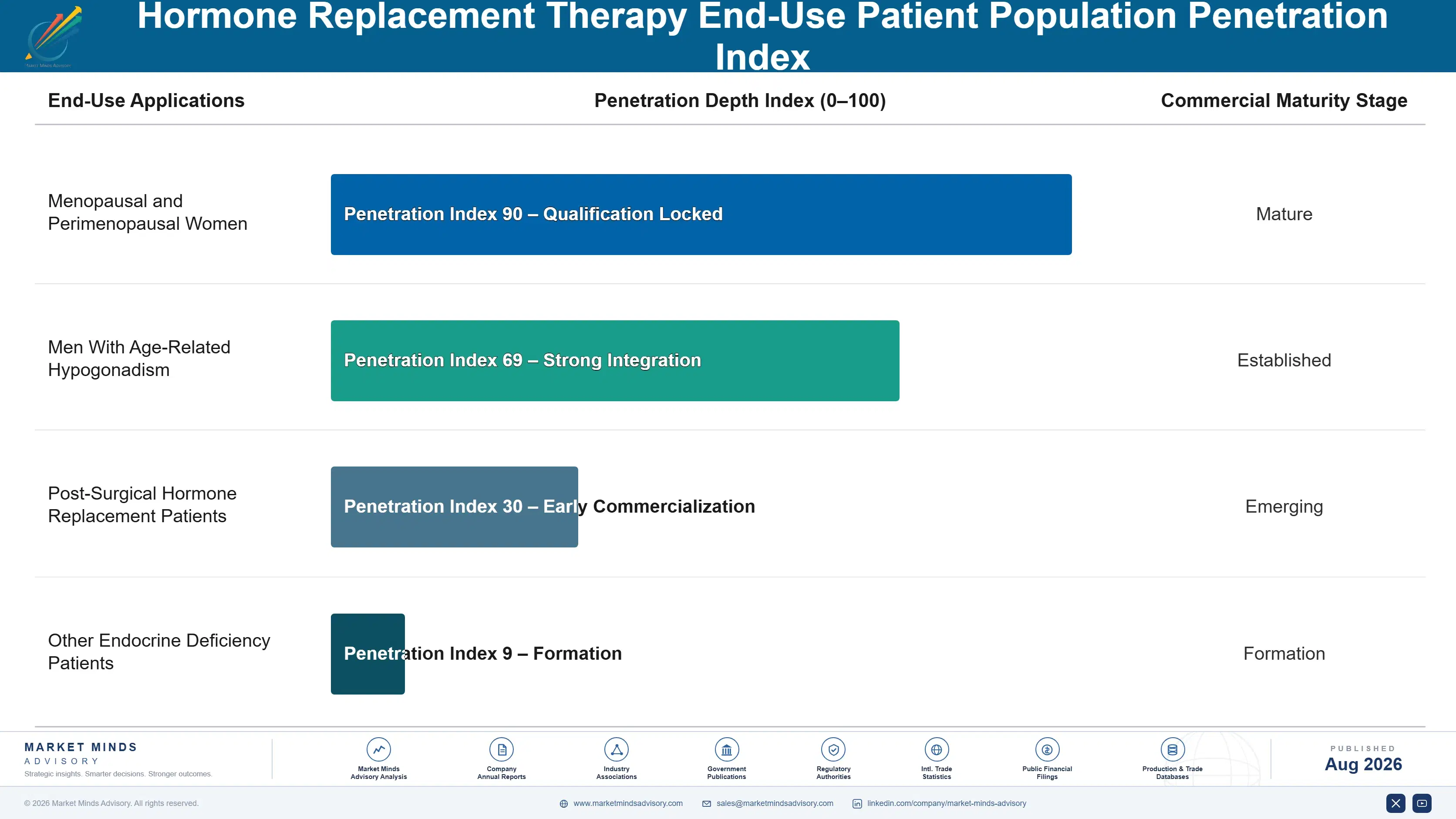
Chronic Symptom Management Purchasing

Hormone replacement therapy purchasing functions closer to an annuity than a single transaction, since most patients who begin treatment continue for years to manage ongoing menopausal or hypogonadism symptoms, tracking prescription refill cycles rather than any defined treatment endpoint for most of their eligible treatment years. Telehealth subscription relationships behave similarly, since platforms increasingly structure testosterone therapy around recurring subscription billing rather than
Adoption depth varies sharply by end-use vertical. Digitally engaged younger patients and telehealth-native populations show the deepest engagement with newer testosterone and bioidentical products, given comfort with virtual care models and willingness to pay convenience premiums, while older patients adopt more slowly through traditional physician relationships built over many years. That divide shapes where companies concentrate commercial investment.

A generational shift is underway as younger physicians, trained during the era of destigmatized menopause discussion and telehealth-normalized prescribing, evaluate treatment protocols on updated clinical evidence rather than decades-old caution inherited from older colleagues. That openness gives access-forward companies a rare opening to win prescribing share in a category where legacy caution has otherwise been difficult to dislodge, across several major markets today.
hormone-replacement-therapy-market-end-use-penetration-index-1787303654633

Where MMA Sees The Opportunity

These are among the four positions where our research anticipates prominent divergence between winners and laggards over the coming forecast period. Each is grounded in the demand model, the regulatory perimeter, and the announced capacity pipeline.
01 / TELEHEALTH INFRASTRUCTURE INVESTMENT

Build Telehealth Prescribing Capacity Before Regulation Tightens

Telehealth testosterone prescribing is growing rapidly, and companies without dedicated infrastructure investment are losing patient volume to platform-native competitors as this access-driven demand accelerates. Infrastructure investment requires meaningful upfront capital but opens durable patient relationships that traditional distribution channels cannot match at comparable convenience. Companies waiting until regulatory clarity fully emerges will find themselves racing to catch up against incumbents who invested years earlier, a gap that widens each quarter infrastructure investment lags behind competitor platforms already underway across the industry.
02 / MENOPAUSE AWARENESS INVESTMENT

Fund Destigmatization Programs Before Awareness Fully Peaks

Physicians have not universally overcome post-2002 prescribing caution, leaving a genuine opportunity for companies willing to fund awareness and education programs ahead of confirmed full destigmatization. Waiting for awareness to fully peak organically risks missing the prescribing normalization window entirely once physician confidence broadly resets across the industry. The investment required is meaningful but positions early movers to capture a category growing faster than generic hormone therapy today, a window that will not stay open indefinitely once awareness fully normalizes.
03 / BIOIDENTICAL FORMULATION DEVELOPMENT

Launch Branded Bioidentical Products Before Compounders Consolidate

Patient demand for bioidentical formulations has repeatedly outpaced branded product availability, and companies without dedicated bioidentical development risk ceding this growing segment entirely to compounding pharmacies that lack comparable manufacturing consistency. Branded bioidentical products represent a meaningful differentiation opportunity even as generic hormone therapy remains the current volume anchor. Companies pursuing bioidentical development now, while competitive density remains low, protect prescribing share against the next wave of branded competitors entering this category as evidence generation matures across the broader category.
04 / REGIONAL ACCESS INVESTMENT

Prioritize South Asia and East Asia Access Investment

South Asia and Pacific and East Asia carry large and growing eligible patient populations relative to their current commercial hormone therapy value, as endocrinology specialty access and awareness accelerate across India, China, and neighboring markets. Companies concentrating investment solely around legacy North American telehealth relationships risk ceding share in the regions where patient volume growth will be steepest through 2036. Early investment in regional prescribing infrastructure offers a meaningful head start over competitors still anchored entirely to legacy Western customer bases.

Engagement Snapshot From the Field

A live engagement with an industry participant carrying material or product regulatory and market exposure ahead of a defining policy shift, showing how our research translates into a defensible multi-year portfolio strategy.
MARKET MINDS ADVISORY · CLIENT ENGAGEMENT SUMMARY
Hormone Replacement Therapy Producer Strategic Portfolio Review and Transition Roadmap 2026·Investment Scenario on Hormone Replacement Therapy Exposure Evaluation 2025-26
CLIENT PROFILE
The client is a regional women's health clinic network operating multiple locations across a major United States metropolitan area, offering both primary care and specialty menopause management services. The network reported annual clinical revenue of approximately $95 million (client-reported, unverified by MMA) and was evaluating whether to launch a dedicated menopause specialty service line or continue integrating menopause care within general gynecology practice instead.
STRATEGIC CHALLENGE
Leadership needed to decide whether building a dedicated menopause specialty service line, which required additional clinical staffing and marketing investment, would generate sufficient incremental patient volume to justify the cost relative to continuing the existing integrated care model. Competing clinic networks were beginning to launch similar dedicated service lines regionally.
MMA APPROACH
MMA benchmarked the client's projected patient demand against comparable clinic networks that had already launched dedicated menopause service lines, modeling incremental patient acquisition and revenue against staffing and marketing investment requirements. The analysis incorporated primary survey data from clinic administrators at eleven comparable regional networks. Findings were cross-checked against regional patient acquisition benchmarks published in recent healthcare industry surveys.
KEY FINDINGS
  1. Incremental patient volume from a dedicated menopause service line exceeded management's initial projections once regional awareness campaign timing and competitive launch activity were incorporated into the demand model.
  2. Peer clinic networks that launched dedicated service lines reported measurably stronger patient retention than networks offering menopause care only within general gynecology visits.
  3. Marketing investment payback occurred faster than initially budgeted once patient referral and word-of-mouth growth within the target demographic were properly accounted for in the model.
  4. Continuing the integrated care model carried a quantifiable competitive risk as patients increasingly searched specifically for dedicated menopause specialists rather than general gynecology practices.
CLIENT PROFILE
The client is a regional women's health clinic network operating multiple locations across a major United States metropolitan area, offering both primary care and specialty menopause management services. The network reported annual clinical revenue of approximately $95 million (client-reported, unverified by MMA) and was evaluating whether to launch a dedicated menopause specialty service line or continue integrating menopause care within general gynecology practice instead.
STRATEGIC CHALLENGE
Leadership needed to decide whether building a dedicated menopause specialty service line, which required additional clinical staffing and marketing investment, would generate sufficient incremental patient volume to justify the cost relative to continuing the existing integrated care model. Competing clinic networks were beginning to launch similar dedicated service lines regionally.
MMA APPROACH
MMA benchmarked the client's projected patient demand against comparable clinic networks that had already launched dedicated menopause service lines, modeling incremental patient acquisition and revenue against staffing and marketing investment requirements. The analysis incorporated primary survey data from clinic administrators at eleven comparable regional networks. Findings were cross-checked against regional patient acquisition benchmarks published in recent healthcare industry surveys.
KEY FINDINGS
  1. Incremental patient volume from a dedicated menopause service line exceeded management's initial projections once regional awareness campaign timing and competitive launch activity were incorporated into the demand model.
  2. Peer clinic networks that launched dedicated service lines reported measurably stronger patient retention than networks offering menopause care only within general gynecology visits.
  3. Marketing investment payback occurred faster than initially budgeted once patient referral and word-of-mouth growth within the target demographic were properly accounted for in the model.
  4. Continuing the integrated care model carried a quantifiable competitive risk as patients increasingly searched specifically for dedicated menopause specialists rather than general gynecology practices.
RECOMMENDED STRATEGY
Phase 1: Phase 1 (Months 1 to 6): Recruit dedicated menopause specialty clinical staff and begin targeted regional awareness campaign development ahead of formal launch. Phase 2: Phase 2 (Months 7 to 14): Launch the dedicated menopause service line while tracking patient acquisition and retention against the modeled demand benchmark closely. Phase 3: Phase 3 (Months 15 to 24): Expand service line marketing and referral partnerships to capture broader regional patient volume once initial performance is confirmed.
OUTCOME
Within eighteen months of launch, the client reported dedicated menopause service line patient volume growth of approximately 34% (client-reported, unverified by MMA), exceeding initial projections meaningfully. Patient retention at twelve months improved measurably (client-reported, unverified by MMA), and the network now serves as a regional referral destination for menopause care.

Frequently Asked Questions

Foundational context covering the market sizes, CAGR, scope, country, region and competition that inform every finding below. This section is provided to cover basics and most often pre-purchase conversations, answered from the MMA Primary Research Dataset.

What is the current size of the Hormone Replacement Therapy Market?

The global hormone replacement therapy market was valued at approximately $14.5 billion in 2025. Growth is driven by menopause treatment destigmatization and rapid telehealth testosterone prescribing expansion.

How large will the Hormone Replacement Therapy Market be by 2036?

The market is forecast to reach approximately $35.2 billion by 2036, roughly 2.24 times its 2026 value as telehealth and bioidentical formulations broaden globally. Growth reflects both testosterone and bioidentical formulation adoption broadening steadily.

What is the CAGR for the Hormone Replacement Therapy Market 2026 to 2036?

The market is forecast to grow at an 8.4% CAGR between 2026 and 2036. Bull and bear scenarios range from roughly 7.1% to 9.6% depending on regulatory and awareness trends.

Which segment is growing fastest?

Testosterone replacement therapy is the fastest-growing segment at approximately 15.4% CAGR, roughly 1.83 times the overall market growth rate. Bioidentical formulations follow as the second-fastest segment.

Who are the major companies in the Hormone Replacement Therapy Market?

Leading companies include Pfizer, Bayer, Organon, AbbVie, and Besins Healthcare, together holding an estimated 38% of global commercial revenue. Generic manufacturers make up much of the remaining fragmented share.

Which country is growing fastest?

South Korea is the fastest-growing country at approximately 10.6% CAGR, driven by rising menopause awareness and wellness-oriented hormone therapy adoption. The United States still commands the largest overall share of commercial value.

Report Segmentation Architecture

The full report scope spans multiple orthogonal segmentation dimensions, with cross-tabulated demand data provided for each dimension pair. Coverage extends further to regional breakdowns, trend trajectories, and the competitive detail needed to support segment-level decision-making.

By Delivery Format and Product Type

  • Oral Estrogen and Combined Hormone Therapy
  • Transdermal Patches and Gels
  • Testosterone Replacement Therapy (Injectable and Topical)
  • Bioidentical and Compounded Hormone Formulations
  • Vaginal and Local Estrogen Therapy
  • Long-Acting Implants and Pellets

By End-Use Patient Population

  • Menopausal and Perimenopausal Women
  • Men With Age-Related Hypogonadism
  • Post-Surgical Hormone Replacement Patients
  • Other Endocrine Deficiency Patients

By Commercial Dimension

  • Traditional Physician-Prescribed Channels
  • Telehealth and Direct-to-Consumer Channels
  • Employer and Insurer Benefit Programs
  • Compounding Pharmacy and Specialty Channels

By Region

  • North America
  • Western Europe
  • East Asia
  • South Asia and Pacific
  • Latin America
  • Middle East and Africa
  • Eastern Europe

Scope, Methodology, and Coverage

Every figure in this report is reproducible from documented input assumptions. The scope below maps the historical period, the forecast horizon, the segmentation dimensions, and the countries covered, alongside the underlying primary and qualitative methodology.
Historical Period
2020 to 2025
Forecast Period
2026 to 2036
Base Year
2025 (USD billions; MMA Primary Research Dataset, August 2026)
Market Definition
The hormone replacement therapy market covers pharmaceutical products used to treat menopausal symptoms through estrogen and combined hormone therapy and to treat male hypogonadism through testosterone replacement therapy. It spans oral, transdermal, injectable, and implant delivery formats across both bioidentical and synthetic hormone products. Fertility treatments, oral contraceptives, and gender-affirming hormone therapy are excluded from this scope.
Quantitative Units
USD billions (current prices); patient volume in millions where applicable
Segmentation Dimensions
By Delivery Format and Product Type; By End-Use Patient Population; By Commercial Dimension; By Region
Regions Covered
North America, Western Europe, East Asia, South Asia and Pacific, Latin America, Middle East and Africa, Eastern Europe
Countries Covered
USA, China, Germany, France, UK, Japan, South Korea, India, Australia, Canada, Brazil, Mexico, Indonesia, Vietnam, Thailand, Malaysia, UAE, Saudi Arabia, South Africa, Nigeria, Turkey, Poland, Netherlands, Italy, Spain, Sweden, Switzerland, Argentina, Colombia, Singapore, and additional markets relevant to this sector
Key Companies Profiled
Pfizer Inc., Bayer AG, Organon & Co., AbbVie Inc., Besins Healthcare, Teva Pharmaceutical Industries Ltd., Viatris Inc., Endo International plc, Amneal Pharmaceuticals Inc., Perrigo Company plc, Theramex, Mithra Pharmaceuticals SA, Fuji Pharma Co., Ltd., Mayne Pharma Group Limited, Hims and Hers Health Inc., Roman Health Ventures Inc., Marius Pharmaceuticals LLC, Lupin Limited, Sun Pharmaceutical Industries Ltd., Sandoz Group AG
Quantitative Methodology
Primary survey, n=3,800 respondents, Q4 2025, six countries; demand-side model with trade association cross-validation
Qualitative Methodology
47 expert interviews, Q4 2025; applied to validate demand model assumptions, identify emerging dynamics, and assess competitive positioning
Report Format
PDF and XLSX data workbook (Word format preview document)
Publisher
Market Minds Advisory
Report Code
MMA-2026-HLT-156
Published
August 2026
Contact
sales@marketmindsadvisory.com | www.marketmindsadvisory.com

Purchase the full Hormone Replacement Therapy Market Report (2026 to 2036).

This report provides a comprehensive analysis of the global hormone replacement therapy market, covering menopausal and testosterone therapy segments across all seven MMA-tracked global regions. It includes detailed market sizing and forecasts through 2036, competitive benchmarking of the top twenty vendors across traditional and telehealth-native companies, and segment-level analysis of delivery format adoption. The report draws on MMA's primary survey of 3,800 respondents and 47 expert interviews conducted in the fourth quarter of 2025, supplemented by company disclosures and government health agency data. Buyers receive full access to regional data tables, competitive profiles, and strategic recommendations tailored to pharmaceutical manufacturers, telehealth platforms, and healthcare investors worldwide.
Full seven-region market sizing and forecast data
Competitive benchmarking of twenty profiled industry vendors
Segment-level analysis of delivery format adoption trends
Primary survey data from 3,800 global respondents
Expert interview insights from 47 endocrine health specialists
Strategic recommendations for manufacturers and telehealth platforms

Built For The People Who Decide

From boardroom strategy to bench-side execution, this report is read cover-to-cover by leaders shaping the next decade of their industry, turning demand scenarios, market dynamics and valuation benchmarks into decisions.
CXOs/ Presidents/ VPs/ Managers
M&A and Corporate Development
Strategy Teams and R&D Heads
Procurement and Product Directors
Regulatory and Compliance Leaders
Investor Relations and Equity Analysts