

Market Minds Advisory
Hopped Malt Extract Market

Hopped Malt Extract Market: Alcohol-Free Brewing Recovery, Kit Convenience And A Niche That Sits Between Two Industries

Dealcoholisation strips hop aroma along with the ethanol, and adding it back as a single hopped extract has proved considerably more practical than reformulating the base beer, which is why this small category grows.

Lead Analyst

Lisa Gevelber

Published

September 2026

Make Smarter Decisions with Customized Research Insights

Request a free sample report and evaluate market opportunities, growth trends, and competitive dynamics relevant to your business needs.

2025 MARKET VALUE$0.5BMarket Size 2025
2036 FORECAST VALUE$1.0BBase Case , 2026 to 2036
CAGR 2026 TO 20366.4 %Bull 7.6% / Bear 5.2%
INCREMENTAL OPPORTUNITY$0.5BNet 10- year value creation
EXPANSION MULTIPLE1.86x2036 value over 2026 base
Strategic Levers
M&A Pipeline
Regional Outlook
Country Rankings
Competitive Intelligence
Segmental Deep-dive
Call-Us : 91 93563 13602

Executive Snapshot and Market Trajectory

Removing alcohol from beer removes hop aroma with it, and the result tastes thin and faintly of wort. Adding character back as a single hopped extract has proved more practical than reformulating the base beer, which is why this small ingredient category is growing at all.
Alcohol-free brewing applications carry the growth on exactly that mechanism, since brewers producing at scale need a practical fix rather than a formulation project. Home brewing and kit supply grows nearly as fast on convenience that genuinely holds, because mashing is the difficult part. Western Europe holds the largest share on brewing tradition, alcohol-free adoption and extract production capability all sitting in the same place. Nobody with real scale has ever contested this category properly.
Concentration reads at 68% for the top five because this is a small category served by specialist maltsters and hop processors rather than by large ingredient companies. It sits awkwardly between the malting and hop industries, which is why nobody with real scale has treated it as a priority and why the specialists have kept their positions. Large brewers developing in-house aroma recovery would remove the very application driving that growth.
Market Definition
This market covers hopped malt extract in liquid and dried forms, spanning extract for alcohol-free and low-alcohol brewing, home brewing and kit manufacturing supply, commercial brewing adjunct use, food and confectionery flavouring applications, and distilling and beverage applications. Unhopped malt extract, hop products including pellets and extracts sold separately, brewing malt sold as grain, and finished beer or beverages are excluded from the sizing.
Base Year Value
$0.5B in 2025 (MMA Primary Research Dataset, August 2026)
Forecast Period
2026 to 2036, eleven discrete annual values
CAGR
6.4% base case. Bull 7.6%. Bear 5.2%.
Fastest Growth Segment
Alcohol-Free Brewing Applications: 9.6% CAGR
Fastest Growth Country
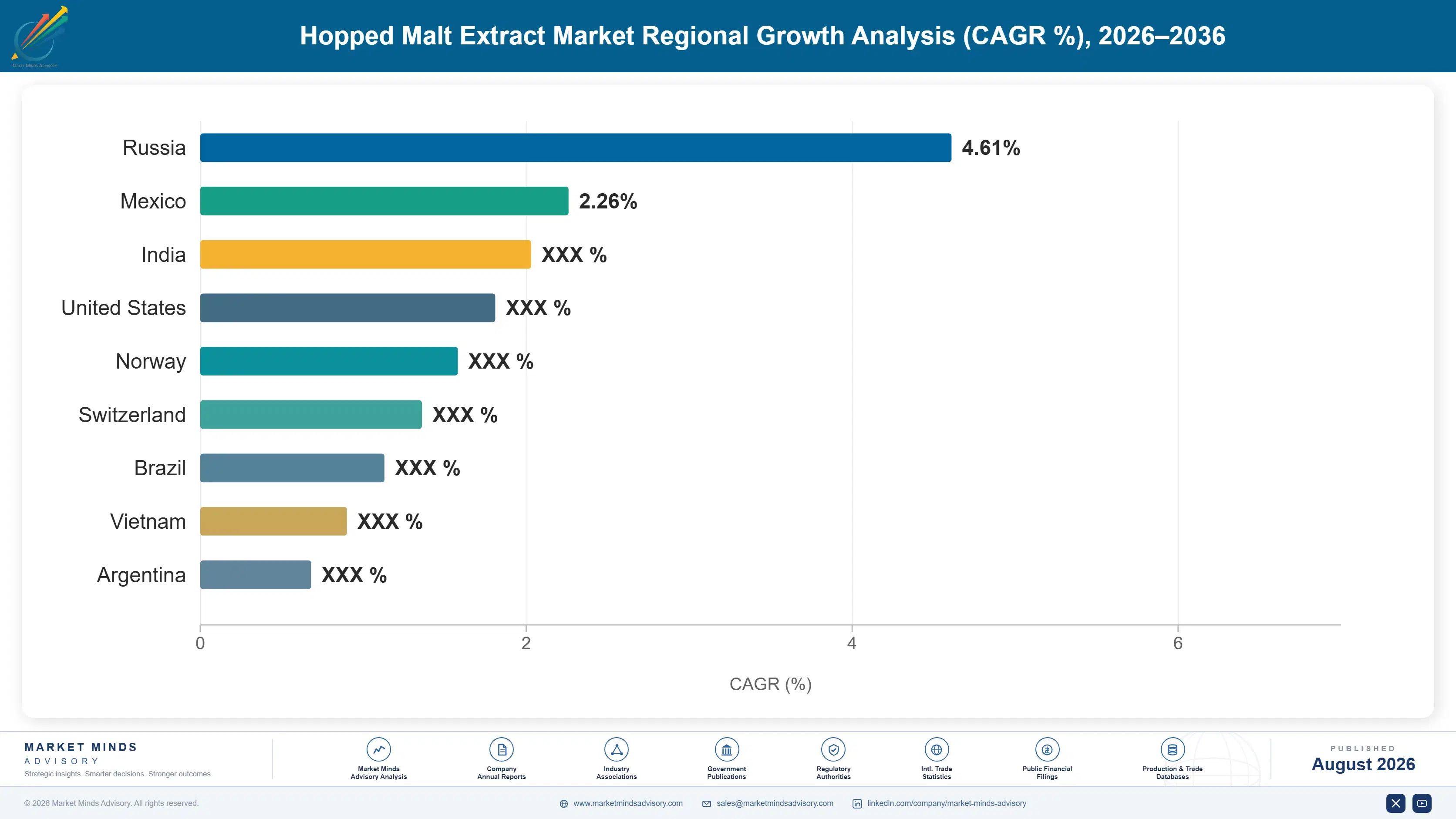
India: 8.7% CAGR
Fastest Growth Region
South Asia and Pacific: 8.5% CAGR
Largest Region
Western Europe: 31% of 2025 global value
Market Leaders
Muntons, Simpsons Malt, Briess Malt and Ingredients, Ireks and Malteurop lead on hopped malt extract revenue. Source: MMA Primary Research Dataset, July 2026.
Primary Survey
n=3,800 procurement and R&D decision-makers, Q4 2025, six countries
Methodology
Demand-side build-up, cross-validated against public data, 47 expert interviews

Hopped Malt Extract Market Forecast Scenarios

hopped-malt-extract-market-trends-growth-size-forecast-scenario-1787460137835
Growth ran at 5.3% annually between 2020 and 2025, and home brewing distorted the middle of it considerably. Lockdown home brewing produced a surge in kit demand that partly retreated afterwards, while commercial brewing adjunct use held steady. Underneath both, alcohol-free brewing began pulling extract demand upward as brewers worked out what dealcoholisation actually costs them in aroma.
The base case at 6.4% rests on three mechanisms. Alcohol-free brewing keeps expanding across every major beer market and the aroma restoration problem does not solve itself. Home brewing and kit demand grows steadily now that the lockdown distortion has washed through. And Indian and Southeast Asian craft brewing develops, where small producers without full brewhouses find extract a practical route into production at modest scale. None of the three depends on home brewing surging again.
The bull case at 7.6% turns on alcohol-free reaching double-digit share of beer volume in major markets, which would pull extract demand up sharply. The bear case at 5.2% reflects large brewers solving aroma restoration through in-house hop dosing instead, which several are attempting and which would remove the application driving most of the growth.

A Small Category With One Growing Application

Hopped malt extract is a small ingredient category that sits awkwardly between the malting and hop industries, which is why large ingredient companies have never treated it as a priority and specialist producers have kept their positions comfortably. Concentration near 68% among the top five reflects that rather than any deliberate consolidation. Large ingredient companies have never treated it as worth contesting properly.
TOP FIVE CONCENTRATION68%High, since specialist maltsters and hop processors serve this category
ALCOHOL-FREE APPLICATION SHARE34%Portion of volume entering alcohol-free and low-alcohol brewing
HOME BREWING VALUE SHARE29%Portion of value from home brewing and kit manufacturing
MALT COST SHARE46% of COGSMalt contribution to hopped extract manufactured cost overall
KIT PRICING MULTIPLE5.8 timesRetail kit pricing against bulk commercial extract per kilogram
EVAPORATION ENERGY SHARE22% of COGSEvaporation and concentration energy share of manufactured cost
One application is doing the growing. Dealcoholisation removes hop aroma along with ethanol and leaves a beer tasting thin and faintly of wort, which brewers producing alcohol-free at scale have to solve somehow. Adding hopped extract back after processing restores body and hop character in a single addition, and roughly 34% of category volume now goes there.
Home brewing is the other commercially interesting half and it behaves entirely differently. A household pays retail pricing at roughly 5.8 times what a brewery pays per kilogram, for a product whose whole proposition is that it replaces mashing and boiling. That convenience argument holds up better than most, since mashing genuinely is the difficult part of brewing at home. Kit demand normalised after the lockdown surge and now grows steadily.
"This is a small category that nobody large has bothered to contest, kept alive by home brewers for decades and now growing because alcohol-free beer has an aroma problem that turns out to be easier to solve with an ingredient than with a process."
Director, Brewing Ingredients and Specialty Malt Practice · MMA Brewing Ingredients Practice · August 2026

Market Trends

Alcohol-Free Aroma Restoration Becomes The Growth Application

Dealcoholisation strips hop aroma along with the ethanol and leaves beer tasting thin and faintly of wort, which every brewer producing alcohol-free at scale has to address somehow. Adding hopped malt extract back after processing restores body and hop character in a single addition rather than requiring separate malt and hop steps. Roughly 34% of category volume now goes to that application, and brewers have found it considerably more practical than reformulating the base beer entirely. The aroma problem is physical rather than a formulation error, so improved dealcoholisation does not solve it.
Market Impact: Alcohol-free grows at 5.4% annually
Home Brewing Pricing Subsidises A Small Commercial Category

A household buying a kit pays roughly 5.8 times per kilogram what a brewery pays for bulk extract, for a product whose proposition is replacing the mashing and boiling stage entirely. That convenience argument holds up better than most because mashing genuinely is the difficult part of brewing at home. Home brewing carries roughly 29% of category value on a small share of tonnage, which is what makes a category this size commercially viable at all. Retailer pressure on that pricing matters more to returns than any commercial volume does.
Market Impact: India grows at 8.7% annually

Market Opportunities and Growth Drivers

Alcohol-Free Beer Expansion Continues Across Every Major Market

Alcohol-free lager and beer volume is growing across North America, Europe and increasingly Asia as quality improvements finally produced products people order twice rather than tolerate. Every litre of that requires aroma restoration somewhere in the process, and hopped extract is the most practical route for brewers producing at scale. The aroma problem is physical rather than a formulation error, so it does not solve itself as dealcoholisation technology improves further. Quality improvements finally produced alcohol-free products people order twice rather than merely tolerate. Every litre needs aroma restored somewhere.
Market Impact: Application drives 34% of volume

Asian Craft Brewing Develops Without Full Brewhouse Capital

Small brewers across India and Southeast Asia are entering production without the capital for a full mashing and lautering installation, and extract-based brewing offers a practical route in at modest scale. Indian demand grows near 8.7% annually as craft brewing develops in urban markets. The route carries a quality ceiling that serious producers eventually outgrow, which makes it a stepping stone rather than a permanent position for most of them. Regulation varies considerably by country across the region and shapes how quickly craft brewing develops anywhere. Capital rather than capability is the barrier.
Market Impact: Evaporation is 22% of cost

Market Restraints and Challenges

Large Brewers May Solve Aroma Restoration In House

Several large brewers are working on hop dosing and aroma recovery systems that would restore character after dealcoholisation without buying a hopped extract, which would remove the application driving most of this category's growth. The root cause is that a brewer with scale and technical capability would rather solve a problem than buy a solution. Commercially this makes the growth application less secure than volume alone suggests. Participants are responding with technical partnership, formulation support and application development for smaller brewers. Application development for smaller brewers is the other defensive response available.
Market Impact: Application takes 34% of volume

Evaporation Energy Costs Cannot Be Passed Through Easily

Concentrating malt extract requires removing a great deal of water, which makes evaporation roughly 22% of manufactured cost and this an energy-intensive business for its size. The root cause is physics rather than inefficiency. Commercially this exposed producers badly through the 2022 energy period, since brewing customers buy on annual terms and home brewing retail pricing has limited headroom. Participants are responding with evaporation efficiency investment, mechanical vapour recompression and dried extract formats where transport savings offset processing cost. Dried extract formats trade plant energy for transport savings where distance justifies it.
Market Impact: Home brewing holds 29% of value
4 additional market trends, 2 additional growth drivers, and 3 additional restraints and challenges are covered in the full report. Contact sales@marketmindsadvisory.com to access the complete intelligence.

Segment CAGR and Growth Architecture

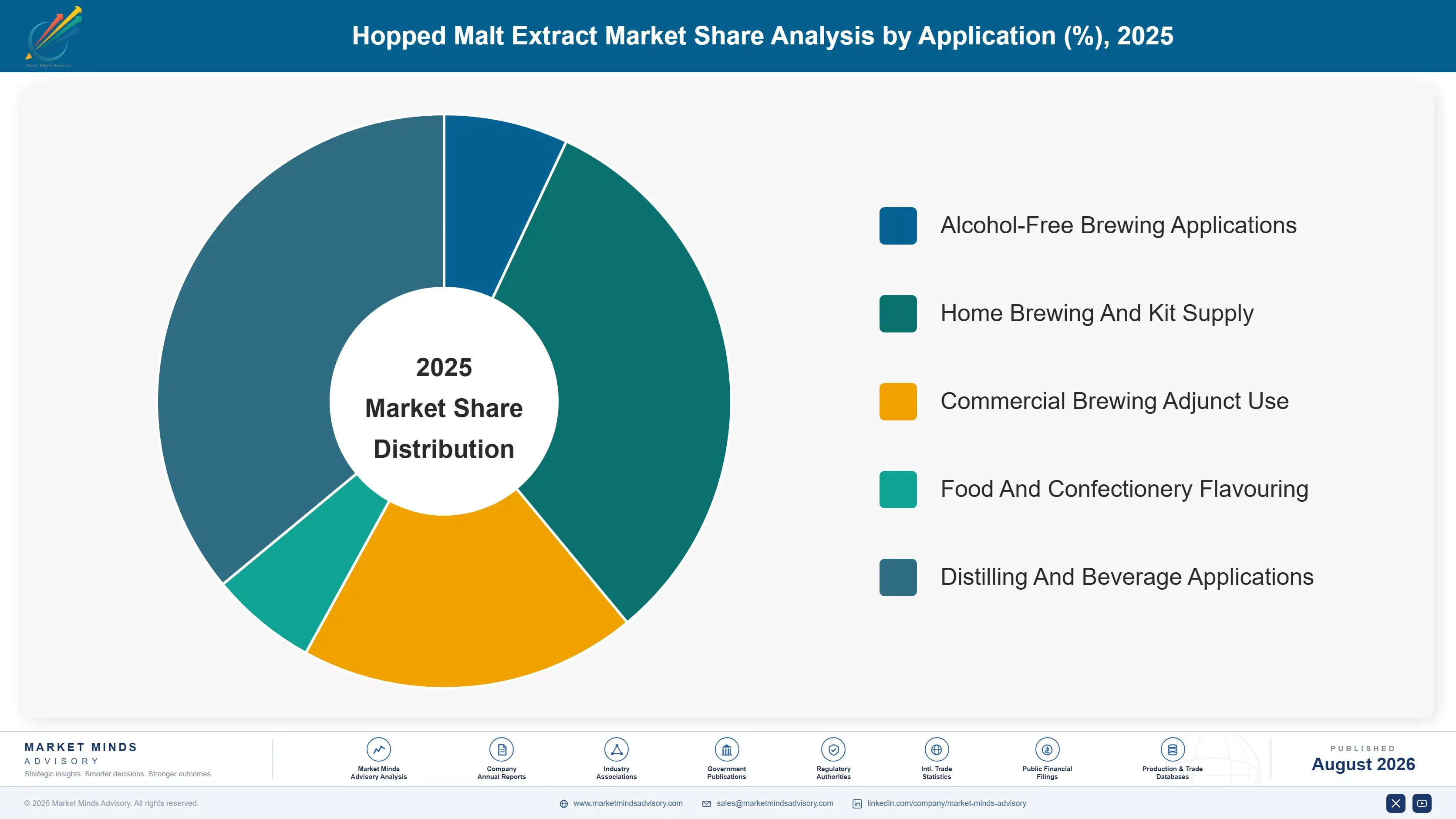
Five application categories divide this market on who buys the extract and what they use it for rather than on malt variety or hop selection. That reflects commercial reality, since a household buying a kit and a brewery buying by the tonne are entirely different customers paying very different prices for materially similar material.
hopped-malt-extract-market-trends-growth-market-share-analysis-1787460138406

Alcohol-Free Brewing Applications

Growing at 9.6% and the fastest part of this market. Non-alcoholic and low-alcohol brewing has a particular problem: dealcoholisation strips aroma along with the ethanol, and what remains tastes thin and vaguely of wort. Hopped malt extract added back after processing restores body and hop character in a single ingredient rather than requiring separate malt and hop additions to a product that has already been through the process. That single application is why this segment grows faster than the rest of the category combined. Brewers producing alcohol-free at scale have found it considerably more practical than reformulating the base beer. Alcohol-free volume keeps growing across every major beer market. Practicality decides it.
CAGR 9.6%

Home Brewing And Kit Supply

Growing at 8.0% on hopped malt extract supplied into home brewing and craft kit manufacturing, where the buyer is a household or a small producer without a brewhouse and the extract replaces the entire mashing and boiling stage. That convenience is the whole proposition and it holds up commercially in a way most convenience arguments do not, because mashing genuinely is the difficult part of brewing. Kit manufacturers buy on hop character consistency and shelf stability rather than on price alone. The segment is small in tonnage and disproportionately profitable, since a household pays retail pricing for what a brewery would buy by the tonne. Shelf stability matters more here than to a brewery.
CAGR 8.0%
Full segment breakdown across 5 segments available in the complete report.

Regional Architecture and Country Demand Map

Western Europe holds 31% of global value because brewing tradition, alcohol-free adoption and extract production capability all sit in the same place. North America follows at 26% on home brewing depth, while South Asia and Pacific grows fastest on craft brewing development. Alcohol-free adoption drives everything.

Western Europe

Note: Western Europe sits above the standard share band because brewing tradition, the world's most advanced alcohol-free adoption and the specialist extract production capability all happen to sit in the same place, which no realistic allocation avoids. British and German maltsters built this category and still lead it. Alcohol-free beer shares in Spain and Germany are years ahead of other regions, which pulls the growth application harder here than anywhere. Home brewing is well established though smaller than in North America. Energy costs through 2022 hit evaporation-intensive extract production hard and margins have not fully recovered since. British and German maltsters built this category and still lead it comfortably. Spanish alcohol-free shares are years ahead of most regions.
Share: 31% | CAGR: 5.1% (2026 to 2036)

North America

Home brewing depth is what distinguishes this region, with a hobbyist base built over decades and kit manufacturing that supplies both domestic and export demand. That business carries pricing no commercial brewing customer would ever accept, which subsidises a category this size considerably. Craft brewing is mature and consolidating, with extract-based production largely confined to the smallest producers and contract operations. Alcohol-free adoption is growing quickly from a low base and pulling extract demand with it. Domestic malting and extract capability is substantial, with Briess among the established specialist producers serving the region. Kit manufacturing supplies both domestic and export demand from an established base. Craft brewing is consolidating after years of expansion.
Share: 26% | CAGR: 6.8% (2026 to 2036)
Regional intelligence for 5 additional markets available in the complete report: East Asia, South Asia and Pacific, Latin America, Middle East and Africa, Eastern Europe. Contact sales@marketmindsadvisory.com.
hopped-malt-extract-market-trends-growth-country-cagr-analysis-1787460138927

Where Malt Extract Value Actually Sits

Four positions separate producers earning real returns from those selling concentrated wort by the tonne: building alcohol-free application capability, holding home brewing and kit pricing, investing in evaporation efficiency, and partnering with brewers technically before they solve the aroma problem themselves internally. Only the second is genuinely hard for anybody to replicate quickly. The rest are choices.

Build Alcohol-Free Application Capability With Brewers

Dealcoholisation strips hop aroma along with the ethanol and leaves beer tasting thin, which every brewer producing alcohol-free at scale has to solve somehow. Roughly 34% of category volume now goes to that application and it is the only part genuinely growing. Producers offering formulation support and application development alongside the extract hold positions worth 30% to 40% more than those simply supplying material against a specification somebody else wrote. Brewers producing at scale need a practical fix rather than a project. It is the only part genuinely growing. Formulation support is what holds it.
Market Impact: Serves the 34% share of total category volume

Hold Home Brewing And Kit Channel Pricing

A household pays roughly 5.8 times per kilogram what a brewery pays for materially similar extract, because the proposition is replacing mashing rather than buying an ingredient. That business carries 29% of category value on a small share of tonnage and is what makes a category this size commercially viable at all. Defending kit channel pricing against retailer pressure matters more to returns than winning any additional commercial brewing volume would. Convenience arguments rarely hold this well anywhere else. Mashing genuinely is the difficult part of brewing. Retailers know the pricing looks generous.
Market Impact: Realises 5.8 times the bulk commercial pricing level

Invest In Evaporation Efficiency Against Fixed Pricing

Concentrating extract means removing a great deal of water, which makes evaporation roughly 22% of manufactured cost in a business whose customers buy on annual terms with no recovery mechanism. Mechanical vapour recompression and heat recovery cut consumption by 18% to 26% against energy pricing that has stayed elevated. Producers who invested before 2022 came through that period considerably better than those still deferring the capital decision afterwards. Customers buy on annual terms with nothing built in. Water removal is the whole cost. Payback runs several years at current pricing.
Market Impact: Cuts evaporation energy by as much as 26%

Partner Technically Before Brewers Solve It Themselves

Several large brewers are developing in-house hop dosing and aroma recovery that would remove the application driving most of this category's growth, because a brewer with scale would rather solve a problem than keep buying a solution. Producers embedding themselves in brewer development work become part of the answer rather than the thing being replaced. That relationship is considerably harder to displace than a supply contract for an ingredient. Roughly 34% of category volume depends on that application continuing. Producers embedded in development work retain 30% to 40% more of it than suppliers do.
Market Impact: Protects the 34% share that drives category growth

Who Controls the Margin Pool

Concentration reads at 68% for the top five measured on hopped malt extract revenue, the basis used throughout this section, and it reflects how small this category is rather than any deliberate consolidation. Muntons and Simpsons hold British positions built over decades. Briess serves North America, Ireks and Malteurop bring continental European malting scale, and none of them treats extract as a primary business.
Competition runs on three fronts. Alcohol-free application capability is the first and it is where the only genuine growth sits. Home brewing channel position is the second, since that pricing subsidises the whole category. Evaporation efficiency is the third, and it decides margin in a business where energy cannot be passed through to annual contracts. None of the three is a scale argument.

Pressure arrives from two directions. Large brewers developing in-house aroma recovery would remove the application driving growth, which is the most serious risk anybody in this category faces. Separately, home brewing demand normalised after the lockdown surge. Rankings will shift toward producers embedded in brewer development work rather than those supplying material against written specifications. Specification supply alone protects nothing here.
hopped-malt-extract-market-trends-growth-company-positioning-matrix-1787460139444

Competitive Moat and Risk Dimensions

MUNTONS

Moat: Home brewing brand and depth

Decades of home brewing kit presence and consumer recognition give the business channel pricing that no commercial brewing customer would accept, and that pricing is what makes a category this size viable. Malting integration also secures the largest input cost line rather than leaving it exposed to a market the business does not participate in.
MUNTONS

Risk: Home brewing demand normalisation

Home brewing demand surged during lockdowns and partly retreated afterwards, and the hobbyist base is not growing quickly in the markets where it is established. Energy costs also weigh heavily on evaporation-intensive extract production, with British and European pricing staying above the previous decade's baseline throughout.
BRIESS MALT AND INGREDIENTS

Moat: North American malting integration

Malting integration across a substantial North American base secures the input representing nearly half of extract manufactured cost, and specialty malt capability supports extract characters that a general maltster cannot readily produce. Craft brewing relationships built through malt supply also open extract conversations that a pure extract producer would have to start from nothing.
BRIESS MALT AND INGREDIENTS

Risk: Craft brewing consolidation exposure

North American craft brewing is consolidating after years of expansion, and extract-based production was always concentrated among the smallest producers most exposed to that shakeout. Alcohol-free application development also trails European practice, where the growth is happening fastest and where competitors have built application capability earlier.

Players Tracked

Prominent Players

Muntons
Simpsons Malt
Briess Malt and Ingredients
Ireks
Malteurop

Other Key Players

Boortmalt
Viking Malt
Crisp Malting Group
Bairds Malt
Weyermann Specialty Malts
Rahr Corporation
Great Western Malting
Castle Malting
Thomas Fawcett and Sons
Bestmalz
Mangrove Jack's
Coopers Brewery
Black Rock Malt Extracts
Cargill Malt
Soufflet Malt

Recent Developments

JANUARY 2025

Application partnership formed with brewer developing alcohol-free range

An extract producer entered a formulation partnership with a brewer developing an alcohol-free range, working on aroma restoration alongside the brewery's own technical team rather than supplying material against a specification written without them. The arrangement covers formulation and sensory work across the whole range.
Signal: Embedded technical partnership is considerably harder to displace than any ordinary supply contract for an ingredient
MAY 2025

Mechanical vapour recompression commissioned at extract evaporation plant

A malt extract producer commissioned mechanical vapour recompression at its evaporation facility, cutting energy consumption in a process where water removal drives cost and where annual customer contracts provide no mechanism for recovering movements. Payback was recalculated against energy pricing that had risen substantially since the last assessment.
Signal: Evaporation efficiency is the only energy lever available when contracts cannot absorb any movement at all
SEPTEMBER 2025

Brewer trials in-house hop dosing for alcohol-free aroma recovery

A large brewer began trialling in-house hop dosing systems to restore aroma after dealcoholisation, testing whether the problem can be solved within the brewery rather than by purchasing hopped extract from an outside supplier. No extract producer had approached the brewery with a technical partnership before the trials began.
Signal: Large brewers with scale would generally rather solve a problem internally than keep buying a solution

What Drives Extract Production Cost

Malt accounts for roughly 46% of manufactured cost, which makes malting integration the single most valuable position a producer can hold in this business. Evaporation and concentration energy contributes around 22%, since removing water from wort is inherently demanding. Hops add about 9% and vary with variety and quantity. Packaging reaches roughly 12%, and labour and fixed operating cost close to 11% across a typical facility.
European and British energy pricing rose sharply through 2022 and has stayed above the previous decade's baseline according to International Energy Agency data, which hit evaporation-intensive extract production disproportionately. Malting barley prices moved separately on European and North American harvest conditions tracked in United States Department of Agriculture grain data across the same seasons. Extract producers absorbed a considerable share of both movements without recovery.

The disadvantage mechanism is energy exposure against customers who buy on annual terms, and it falls hardest on producers without malting integration. Brewing customers negotiate annually and home brewing retail pricing has limited headroom, so a mid-year energy movement lands on margin with nowhere to go. Exposure varies by integration, since integrated maltsters control the larger cost line while merchant extract producers control neither.
hopped-malt-extract-market-trends-growth-cost-volatility-analysis-1787460139640

Integrate malting to control the dominant cost line

Malt is nearly half of manufactured cost and a merchant extract producer buying it competitively controls neither of the two largest inputs in the business. Malting integration secures that line and provides specialty malt capability a general supplier cannot readily match. The capital and operational complexity are both substantial, which is why few extract producers operate without being maltsters first.

Invest in vapour recompression and heat recovery

Evaporation is over a fifth of manufactured cost and annual customer contracts provide no route to recover a mid-year energy movement at all. Vapour recompression and heat recovery cut consumption materially against pricing elevated since 2022. Payback runs several years, and producers who committed the capital before energy costs rose came through that period visibly better positioned.

Offer dried extract where transport savings offset processing

Removing further water to produce dried extract costs more energy at the plant while cutting transport weight substantially, which changes the economics for customers at distance and for kit manufacturers packing retail units. The trade only works above certain distances and volumes. Dried formats also carry longer shelf life, which matters more to home brewing distribution than to a brewery.

Portfolio Architecture for Margin Defence

Portfolio economics here divide on channel rather than on product, since the extract itself differs little between applications. Bulk commercial brewing adjunct supply competes on price per tonne against a customer who could mash conventionally instead, which caps what the material is worth however good it happens to be. Nothing about that position rewards capability at all.
The middle tier is alcohol-free brewing application supply. Dealcoholisation creates a problem the brewer must solve, extract is the practical answer at scale, and roughly 34% of volume goes there. Margins reach the low thirties, and producers offering formulation support alongside the material hold considerably better positions than those supplying against a written specification. Formulation involvement is what holds it.

Above both sits home brewing and kit channel supply. A household pays roughly 5.8 times per kilogram what a brewery pays, because the proposition is replacing mashing rather than buying an ingredient, and margins reach the high forties. That pricing is what makes a category this small commercially viable, and defending it against retailer pressure matters more than any commercial volume. Retailer pressure is the genuine threat here.

Volume / Commodity-Adjacent

Bulk commercial brewing adjunct supply priced per tonne. The range reflects malt and energy cost rather than commercial skill, and the customer could mash conventionally instead if pricing moved. Capability earns nothing.
Gross Margin: 14 to 22%

Premium / Certified

Alcohol-free brewing application supply with formulation support. The range reflects how embedded the technical relationship is and whether the producer helps develop the product or supplies against a specification. Involvement decides duration.
Gross Margin: 28 to 37%

Sustainability / Regulatory / Next-Generation

Home brewing and kit channel supply at retail-derived pricing. The wide range reflects brand position and how far retailer pressure has eroded the pricing that convenience originally supported. Brand position matters most.
Gross Margin: 42 to 53%
hopped-malt-extract-market-trends-growth-portfolio-architecture-1787460140142

High-value Sub-segments and Strategic Watch-out

Home Brewing And Kit Channel

High value on steady growth and the pricing that makes this small category viable at all. The wide range reflects brand position and how far retailer pressure has eroded the premium that convenience originally supported for producers. It funds the whole category. Convenience supports it.
Gross Margin: 42 to 53%

Alcohol-Free Application Supply

High value and high growth together, serving a problem dealcoholisation creates that brewers must solve somehow. The range reflects how embedded technical support is, since formulation partnership holds considerably better than specification supply. Brewers must solve the problem somehow. Partnership beats specification supply. Growth sits here.
Gross Margin: 33 to 43%

Small Craft Brewer Supply

A steady position serving producers without full mashing installations, particularly in developing craft markets. The range reflects whether the relationship extends beyond material into recipe support, which smaller brewers value considerably. Recipe support is what these buyers want. Quality ceilings apply. Producers eventually outgrow it.
Gross Margin: 27 to 36%

Bulk Commercial Adjunct Volume

The strategic watch-out. Volumes exist but the customer could mash conventionally, pricing is capped by that alternative, and nothing about the position rewards technical capability. The range reflects malt and energy cost alone. Conventional mashing caps the price. Nothing protects it. Energy cost decides margin.
Gross Margin: 14 to 22%

How Extract Demand Actually Repeats

Repeat behaviour divides sharply between the two halves of this market and they share almost nothing. A brewery that has built an alcohol-free product around a particular extract repeats that volume for as long as the product is made, because changing it means sensory work nobody wants to redo. A home brewer buys a kit, uses it, and decides again from scratch next time.
Stickiness varies by how the position was won. Alcohol-free applications developed jointly with a brewer hold best, since the extract is part of a formulation the brewer helped create. Kit brand loyalty holds moderately and is genuinely brand-driven, which is unusual for an ingredient. Small craft brewer relationships hold on recipe support. Bulk adjunct supply holds worst, moving on price per tonne at every review.

The buyer profile has shifted noticeably. This category was kept alive for decades by home brewers buying kits from a handful of familiar names, and that business still funds a great deal of it. Growth now comes from brewery technical teams solving a dealcoholisation problem, which is a considerably more demanding customer buying on formulation performance rather than on convenience.
hopped-malt-extract-market-trends-growth-end-use-penetration-index-1787460140629

Where To Compete And Why

These are among the four positions where our research anticipates prominent divergence between winners and laggards over the coming forecast period. Each is grounded in the demand model, the regulatory perimeter, and the announced capacity pipeline.
01 / ALCOHOL-FREE APPLICATION BUILDING

Dealcoholisation removes aroma with ethanol

Removing alcohol strips hop aroma along with it and leaves beer tasting thin and faintly of wort, which every brewer producing alcohol-free at scale has to solve one way or another. Roughly 34% of category volume now goes to that application and it is the only genuinely growing part of this business. Producers offering formulation support alongside the extract hold positions worth 30% to 40% more than those simply supplying material against a written specification that somebody else has already prepared for them.
02 / KIT CHANNEL PRICING DEFENCE

Households pay what breweries never would

A household pays roughly 5.8 times per kilogram what a brewery pays for materially similar extract, because the proposition being sold is replacing the mashing stage rather than buying an ingredient at all. That business carries 29% of category value on a small share of tonnage, and it is what makes a category this size commercially viable in the first place. Defending that channel pricing matters more to returns than winning any amount of additional commercial brewing volume ever would.
03 / EVAPORATION EFFICIENCY INVESTMENT

Water removal is the cost

Concentrating extract means removing a great deal of water, which makes evaporation roughly 22% of manufactured cost in a business whose customers all buy on annual terms with no recovery mechanism of any kind built into them. Mechanical vapour recompression and heat recovery cut consumption by 18% to 26% against energy pricing that has stayed elevated since 2022. Producers who invested before then came through that whole period considerably better than those who are still deferring the capital decision now.
04 / BREWER PARTNERSHIP TIMING

They would rather solve it

Several large brewers are developing in-house hop dosing and aroma recovery that would remove the application driving most of this category's growth, because a brewer with scale and technical capability would rather solve a problem than keep buying a solution indefinitely. Producers embedding themselves in brewer development work become part of the answer instead of the thing being replaced, Roughly 34% of category volume depends on that application continuing. That relationship is considerably harder to displace than any supply contract.

Engagement Snapshot From the Field

A live engagement with an industry participant carrying material or product regulatory and market exposure ahead of a defining policy shift, showing how our research translates into a defensible multi-year portfolio strategy.
MARKET MINDS ADVISORY · CLIENT ENGAGEMENT SUMMARY
Hopped Malt Extract Producer Strategic Portfolio Review and Transition Roadmap 2026·Investment Scenario on Hopped Malt Extract Exposure Evaluation 2025-26
CLIENT PROFILE
A European specialist malt extract producer with annual revenue near $64 million (client-reported, unverified by MMA), supplying hopped and unhopped extract to home brewing kit manufacturers and commercial brewers across seven countries. Roughly 61% of volume was bulk commercial adjunct supply, with limited alcohol-free application work and no technical partnership arrangements anywhere in the business.
STRATEGIC CHALLENGE
Energy costs had compressed margins on evaporation-intensive production while bulk adjunct customers negotiated hard on annual terms, and two brewers had begun exploring in-house aroma recovery for their alcohol-free ranges. Management needed to decide between defending bulk volume, building alcohol-free application capability, or investing further in the home brewing kit channel.
MMA APPROACH
MMA modelled contribution by channel and application across four years of the client's own data, benchmarked energy consumption against comparable evaporation operations, and assessed alcohol-free application development requirements with brewer technical teams. Twenty expert interviews with brewers, kit manufacturers and equipment suppliers tested each of the routes genuinely available to the business.
KEY FINDINGS
  1. Bulk commercial adjunct supply delivered barely positive contribution after energy costs rose, and the customer alternative of conventional mashing capped what the material could ever be worth.
  2. Kit channel volume generated roughly 4.9 times the contribution per tonne of bulk supply, and the client had been treating both channels with equivalent commercial attention throughout.
  3. Brewers exploring in-house aroma recovery said they would have preferred a technical partner, and none had been approached by any extract producer offering development support.
  4. Evaporation energy consumption ran roughly 21% above comparable operations that had installed vapour recompression, and the client's last assessment used pre-2022 energy pricing.
CLIENT PROFILE
A European specialist malt extract producer with annual revenue near $64 million (client-reported, unverified by MMA), supplying hopped and unhopped extract to home brewing kit manufacturers and commercial brewers across seven countries. Roughly 61% of volume was bulk commercial adjunct supply, with limited alcohol-free application work and no technical partnership arrangements anywhere in the business.
STRATEGIC CHALLENGE
Energy costs had compressed margins on evaporation-intensive production while bulk adjunct customers negotiated hard on annual terms, and two brewers had begun exploring in-house aroma recovery for their alcohol-free ranges. Management needed to decide between defending bulk volume, building alcohol-free application capability, or investing further in the home brewing kit channel.
MMA APPROACH
MMA modelled contribution by channel and application across four years of the client's own data, benchmarked energy consumption against comparable evaporation operations, and assessed alcohol-free application development requirements with brewer technical teams. Twenty expert interviews with brewers, kit manufacturers and equipment suppliers tested each of the routes genuinely available to the business.
KEY FINDINGS
  1. Bulk commercial adjunct supply delivered barely positive contribution after energy costs rose, and the customer alternative of conventional mashing capped what the material could ever be worth.
  2. Kit channel volume generated roughly 4.9 times the contribution per tonne of bulk supply, and the client had been treating both channels with equivalent commercial attention throughout.
  3. Brewers exploring in-house aroma recovery said they would have preferred a technical partner, and none had been approached by any extract producer offering development support.
  4. Evaporation energy consumption ran roughly 21% above comparable operations that had installed vapour recompression, and the client's last assessment used pre-2022 energy pricing.
RECOMMENDED STRATEGY
Phase 1: Phase one: approach the two brewers exploring in-house recovery with a technical partnership offer, since neither has been approached and both said they would prefer one. Phase 2: Phase two: commit vapour recompression capital on revised energy pricing, which changes the payback materially against the pre-2022 assessment the client relied on. Phase 3: Phase three: reduce bulk adjunct exposure where contribution is negligible, redirecting capacity toward kit and application volume that actually pays.
OUTCOME
The client signed technical partnerships with both brewers within nine months and retained the alcohol-free volume that had been at risk (client-reported, unverified by MMA). Vapour recompression was commissioned within fourteen months, energy consumption fell by roughly 19%, and blended gross margin improved by about seven points as bulk exposure was reduced.

Frequently Asked Questions

Foundational context covering the market sizes, CAGR, scope, country, region and competition that inform every finding below. This section is provided to cover basics and most often pre-purchase conversations, answered from the MMA Primary Research Dataset.

What is the current size of the Hopped Malt Extract Market?

The global hopped malt extract market was valued at $0.50 billion in 2025, reaching an estimated $0.53 billion in 2026. That covers hopped malt extract in liquid and dried forms across brewing and food applications.

How large will the Hopped Malt Extract Market be by 2036?

MMA forecasts the market reaching $0.99 billion by 2036, an increase of $0.46 billion over the 2026 base. That represents an expansion multiple of 1.86 times across the forecast period.

What is the CAGR for the Hopped Malt Extract Market 2026 to 2036?

The base case compound annual growth rate is 6.4%, with a bull case of 7.6% and a bear case of 5.2%. Historical growth between 2020 and 2025 ran at 5.3% annually.

Which segment is growing fastest?

Alcohol-free brewing applications grow at 9.6%, a full 1.50 times the market rate, restoring aroma that dealcoholisation removes. Home brewing and kit supply follows at 8.0% annually.

Who are the major companies in the Hopped Malt Extract Market?

Muntons, Simpsons Malt, Briess Malt and Ingredients, Ireks and Malteurop lead on hopped malt extract revenue. Together they account for roughly 68% of a genuinely small category.

Which country is growing fastest?

India grows fastest at 8.7% annually as craft brewing develops among producers entering without full mashing installations. Vietnam and Thailand follow on similar craft development.

Report Segmentation Architecture

The full report scope spans multiple orthogonal segmentation dimensions, with cross-tabulated demand data provided for each dimension pair. Coverage extends further to regional breakdowns, trend trajectories, and the competitive detail needed to support segment-level decision-making.

By Application

  • Alcohol-Free Brewing Applications
  • Home Brewing And Kit Supply
  • Commercial Brewing Adjunct Use
  • Food And Confectionery Flavouring
  • Distilling And Beverage Applications

By End-Use Industry

  • Large Scale Commercial Brewing
  • Craft And Microbrewing
  • Home Brewing And Hobbyist
  • Contract And Private Label Brewing
  • Bakery And Confectionery Manufacturing
  • Distilling And Spirits Production

By Commercial Dimension

  • Direct Supply To Brewers
  • Kit Manufacturer Supply
  • Home Brewing Retail Distribution
  • Ingredient Distributor Channel
  • Technical Partnership And Development Arrangements

By Region

  • North America
  • Western Europe
  • East Asia
  • South Asia and Pacific
  • Latin America
  • Middle East and Africa
  • Eastern Europe

Scope, Methodology, and Coverage

Every figure in this report is reproducible from documented input assumptions. The scope below maps the historical period, the forecast horizon, the segmentation dimensions, and the countries covered, alongside the underlying primary and qualitative methodology.
Historical Period
2020 to 2025
Forecast Period
2026 to 2036
Base Year
2025 (USD billions; MMA Primary Research Dataset, August 2026)
Market Definition
This report covers hopped malt extract in liquid and dried forms, spanning extract supplied for alcohol-free and low-alcohol brewing, home brewing and kit manufacturing, commercial brewing adjunct use, food and confectionery flavouring, and distilling and beverage applications, across direct brewer supply, kit manufacturing, retail distribution, ingredient distribution and technical partnership channels. Unhopped malt extract, hop products including pellets and hop extracts sold separately, brewing malt sold as grain, brewing yeast, and finished beer or beverages are excluded from the sizing.
Quantitative Units
USD billions at producer realised value; volume in thousand tonnes; realised pricing in USD per kilogram.
Segmentation Dimensions
By application; by end-use industry; by commercial dimension; by region.
Regions Covered
North America, Western Europe, East Asia, South Asia and Pacific, Latin America, Middle East and Africa, Eastern Europe
Countries Covered
United Kingdom, Germany, Belgium, Netherlands, France, Spain, Poland, Czech Republic, United States, Canada, Mexico, Brazil, Argentina, China, Japan, South Korea, India, Australia, Turkey, South Africa.
Key Companies Profiled
Muntons, Simpsons Malt, Briess Malt and Ingredients, Ireks, Malteurop, Boortmalt, Viking Malt, Crisp Malting Group, Bairds Malt, Weyermann Specialty Malts, Rahr Corporation, Castle Malting, Coopers Brewery, Cargill Malt and others.
Quantitative Methodology
Primary survey, n=3,800 respondents, Q4 2025, six countries; demand-side model with trade association cross-validation
Qualitative Methodology
47 expert interviews, Q4 2025; applied to validate demand model assumptions, identify emerging dynamics, and assess competitive positioning
Report Format
PDF and XLSX data workbook (Word format preview document)
Publisher
Market Minds Advisory
Report Code
MMA-2026-AGR-271
Published
August 2026
Contact
sales@marketmindsadvisory.com | www.marketmindsadvisory.com

Purchase the full Hopped Malt Extract Market Report (2026 to 2036).

The full report sizes the hopped malt extract market across five applications, six end-use industries and seven regions, with tonnage and per kilogram pricing detail behind every value estimate. It profiles twenty companies on malting integration, alcohol-free application capability and kit channel position. Regional chapters cover brewing tradition, alcohol-free adoption and home brewing depth by market. Cost analysis quantifies malt, evaporation energy and hop exposure by integration position. Application analysis assesses how far brewers are progressing toward toward solving the aroma restoration problem internally instead.
Tonnage and per kilogram pricing by application
Alcohol-free brewing volumes and aroma restoration approaches compared
Kit channel pricing against bulk commercial supply measured
Evaporation energy cost and efficiency benchmarking by facility
Competitive position assessments across twenty companies
Malting integration position mapped across extract producers globally

Built For The People Who Decide

From boardroom strategy to bench-side execution, this report is read cover-to-cover by leaders shaping the next decade of their industry, turning demand scenarios, market dynamics and valuation benchmarks into decisions.
CXOs/ Presidents/ VPs/ Managers
M&A and Corporate Development
Strategy Teams and R&D Heads
Procurement and Product Directors
Regulatory and Compliance Leaders
Investor Relations and Equity Analysts