Market Minds Advisory
Homomorphic Encryption Market

Homomorphic Encryption Market: Homomorphic Encryption Market: Silicon Acceleration, Regulated Demand and the Overhead Problem, 2026 to 2036

The cryptography has worked for fifteen years and the arithmetic still runs thousands of times slower than plaintext, which makes this a semiconductor problem dressed up as a software one.

Lead Analyst

Published

September 2026

Make Smarter Decisions with Customized Research Insights

Request a free sample report and evaluate market opportunities, growth trends, and competitive dynamics relevant to your business needs.

2025 MARKET VALUE$0.3BMarket Size 2025
2036 FORECAST VALUE$1.7BBase Case , 2026 to 2036
CAGR 2026 TO 203617.2 %Bull 18.6% / Bear 15.8%
INCREMENTAL OPPORTUNITY$1.4BNet 10- year value creation
EXPANSION MULTIPLE4.89x2036 value over 2026 base
Strategic Levers
M&A Pipeline
Regional Outlook
Country Rankings
Competitive Intelligence
Segmental Deep-dive
Call-Us : 91 93563 13602

Executive Snapshot and Market Trajectory.

Nothing is wrong with the cryptography and everything is wrong with the speed. Computing on encrypted data runs roughly 9,000 times slower than the same operation in plaintext, which is why a technology proven in 2009 still sits mostly in pilots. Fifteen years of pilots followed from that one number.
What is changing is silicon rather than mathematics. Dedicated acceleration programmes are targeting around 1,000 times improvement, which would put specific workloads inside commercial reach for the first time. Approximate arithmetic schemes grow at 25.8%, half again the market rate of 17.2%, because they suit the statistical and machine learning workloads that regulated buyers actually want to run on data they are not permitted to see. Regulated buyers want exactly those workloads.
Five vendors hold 46% of measured commercial licence revenue, and 71% of that revenue comes from finance, healthcare and government. Only 14% of engagements have reached production rather than pilot, which is the honest state of this market. Regulation rather than efficiency is what pays for the work being done, and buyers who cannot legally move data are the ones writing cheques. Nobody buys this for performance reasons.
Market Definition
The homomorphic encryption market covers software libraries, compilers, managed services and dedicated acceleration hardware that permit computation on encrypted data without decryption, spanning partially homomorphic, somewhat homomorphic, levelled fully homomorphic, approximate arithmetic, boolean circuit and threshold or multi-key scheme families. Sizing is measured at vendor licence, subscription and services revenue. Conventional encryption at rest and in transit, confidential computing based on hardware enclaves, secure multiparty computation without homomorphic primitives, and differential privacy tooling are excluded.
Base Year Value
$0.3B in 2025 (MMA Primary Research Dataset, September 2026)
Forecast Period
2026 to 2036, eleven discrete annual values
CAGR
17.2% base case. Bull 18.6%. Bear 15.8%.
Fastest Growth Segment
Approximate Arithmetic Schemes: 25.8% CAGR
Fastest Growth Country
Israel: 27.4% CAGR
Fastest Growth Region
South Asia and Pacific: 19.2% CAGR
Largest Region
North America: 40% of 2025 global value
Market Leaders
Zama, Duality Technologies, IBM, Microsoft, Enveil. Source: MMA Analysis based on company disclosures and measured commercial licence and services revenue.
Primary Survey
n=3,800 procurement and R&D decision-makers, Q4 2025, six countries
Methodology
Demand-side build-up, cross-validated against public data, 47 expert interviews

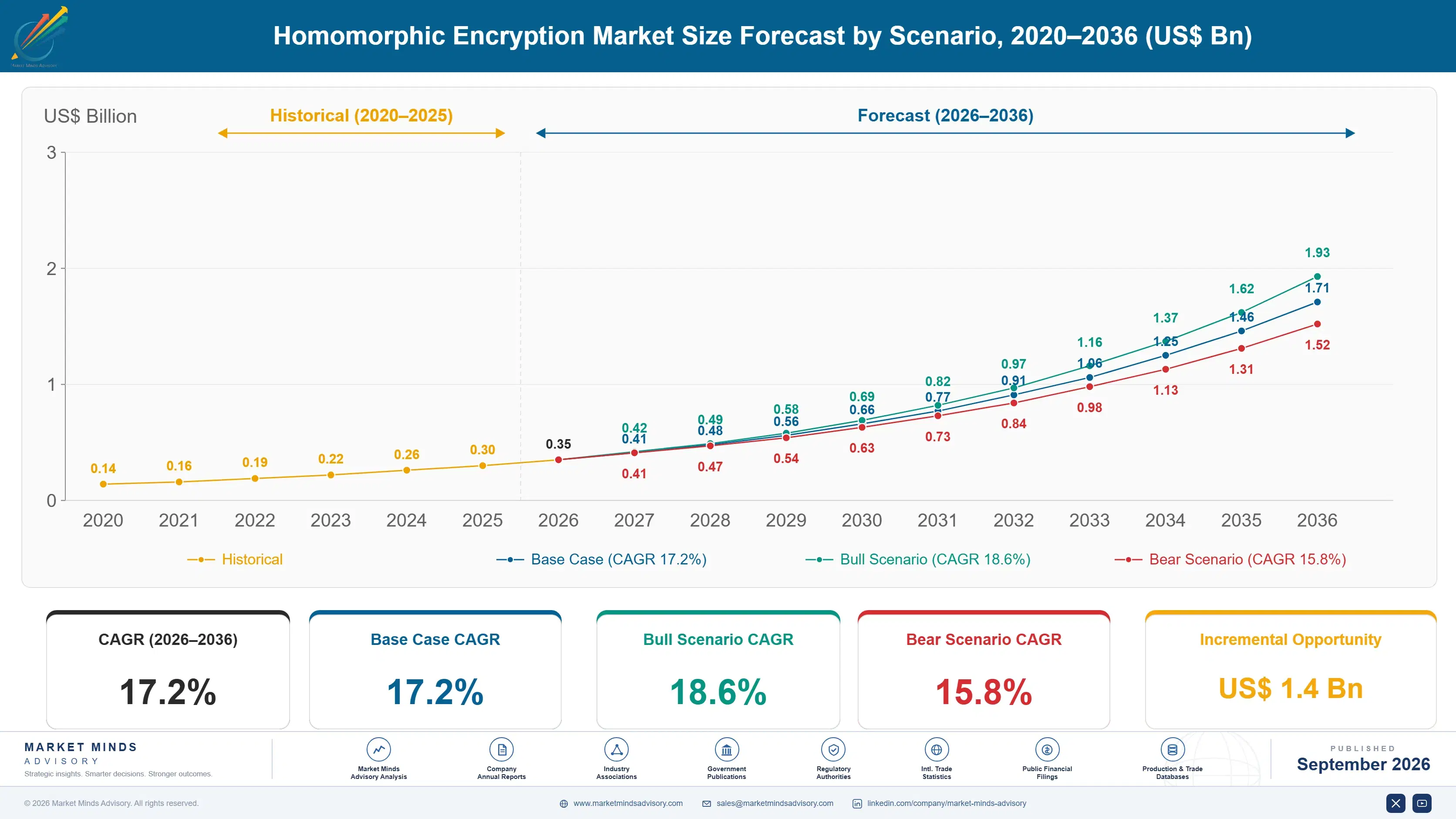
Homomorphic Encryption Market Forecast Scenarios

homomorphic-encryption-market-size-forecast-scenario-1788414350795
Between 2020 and 2025 the market compounded at 15.8% from a base small enough that a single enterprise contract moved the annual figure. Almost all realised revenue came from partially homomorphic schemes inside private set intersection and secure aggregation, deployed in advertising measurement, federated learning and financial fraud consortia. Fully homomorphic work carried the headlines while the narrower techniques quietly carried the revenue.
The 17.2% base case rests on three commercial mechanisms. Cross-border data transfer rulings and sector privacy rules have made processing data you cannot read a compliance answer rather than a curiosity, which moves the buyer from research budgets to compliance budgets. Acceleration silicon is arriving from several programmes at once and will make defined workloads viable. And library maturity now lets an ordinary engineering team build something without employing a cryptographer.
The bull case is acceleration hardware delivering near its target and a settled standard arriving together, which would move enterprise buyers off the sidelines faster than any current forecast assumes. The bear case is hardware enclaves and confidential computing proving good enough for most regulated workloads at a fraction of the overhead, confining this technology to cases where trusted hardware is unacceptable.

A Solved Problem Nobody Can Afford To Run

Homomorphic encryption lets a party compute on data it cannot read, which sounds like a solution to every privacy problem in computing and has been possible since 2009. The obstacle has never been correctness. It is that the arithmetic runs around 9,000 times slower than plaintext on general purpose hardware, and ciphertext expands data roughly 40 times, so a one second query takes most of a day.
TOP FIVE CONCENTRATION46%Share of measured commercial licence revenue held by leaders
COMPUTATION OVERHEAD9,000xSlowdown against equivalent plaintext computation on general purpose hardware
ACCELERATOR TARGET SPEEDUP1,000xImprovement dedicated silicon programmes are designed to deliver
PRODUCTION DEPLOYMENT SHARE14%Portion of engagements that have reached production rather than pilot
CIPHERTEXT EXPANSION40xGrowth in data size once encrypted under these schemes
REGULATED SECTOR REVENUE71%Portion of revenue from finance, healthcare and government buyers
That overhead is a hardware problem, and hardware is finally being built for it. Several dedicated acceleration programmes, some publicly funded and some venture backed, target roughly 1,000 times improvement through purpose-built number-theoretic transform engines and enormous on-chip memory bandwidth. Reaching that would not make the technology general purpose, but it would place defined workloads such as encrypted database queries and private inference inside commercial reach.
Meanwhile the revenue is coming from somewhere less glamorous. Partially homomorphic schemes support private set intersection and secure aggregation in advertising measurement, federated learning and bank fraud consortia, and those deployments are real. Only 14% of engagements have reached production, and 71% of revenue comes from finance, healthcare and government, where a regulator rather than a chief technology officer created the requirement.
"The field has been five years away for fifteen years, and the reason is not that anyone is wrong. Everybody knows exactly what needs to happen. It needs a chip, and until the chips ship this market will keep selling compliance answers to buyers who have no legal alternative."
Director, Applied Cryptography and Privacy Technology Practice · MMA Technology and Cybersecurity Practice · September 2026

Market Trends

Dedicated Silicon Moves From Research To Tape-Out

The performance gap is dominated by polynomial multiplication and by moving very large ciphertexts between memory and compute, neither of which general purpose processors handle well. Purpose-built engines with wide number-theoretic transform units and large on-chip memory are being taped out by several teams, some publicly funded and some venture backed, targeting roughly 1,000 times improvement. Reaching even a fraction of that changes which workloads are viable, and the first commercial silicon is expected to reach customers during the forecast period. This market's trajectory now depends on semiconductor execution rather than on any cryptographic advance.
Market Impact: Drives 71% of revenue
Approximate Arithmetic Fits The Machine Learning Workload

Schemes supporting approximate arithmetic on real numbers rather than exact integer operations suit statistics and machine learning, where a small controlled error is acceptable and exactness is not required. That matches what regulated buyers actually want: model inference and analytics on data they cannot legally read. The scheme family originated in academic work in Korea and has become the practical default for these workloads. Growth at 25.8% is half again the market rate of 17.2%, and almost every commercial privacy-preserving machine learning deployment now rests on it rather than on exact schemes.
Market Impact: Joins 8 institutions securely

Market Opportunities and Growth Drivers

Cross-Border Transfer Rules Create A Compliance Answer

Rulings restricting transfer of personal data outside protective jurisdictions left multinational organisations unable to move data they nonetheless need to analyse centrally. Processing under encryption answers that directly, because the data never exists in readable form outside its jurisdiction. That converts homomorphic encryption from a research interest into a compliance instrument with a budget behind it. Around 71% of revenue now comes from finance, healthcare and government, where the requirement originates with a regulator rather than with any technology strategy. Compliance budgets behave quite differently from research budgets, in both scale and durability.
Market Impact: Runs 9,000 times slower

Fraud Consortia Need Computation Across Rival Institutions

Banks want to detect fraud patterns that appear across institutions rather than within one, and competition law and privacy rules both prevent them pooling customer data. Private set intersection and secure aggregation let several institutions compute a joint result without any of them seeing another's records. Several consortia are now operating rather than piloting, which makes this the clearest production use case in the market. The technique used is partially homomorphic rather than fully homomorphic, which is why realised revenue and research attention point in different directions. The distinction matters commercially.
Market Impact: Leaves 86% in pilot stage

Market Restraints and Challenges

Overhead Keeps Most Workloads Commercially Impossible

Running roughly 9,000 times slower than plaintext with data expanding around 40 times means most computations are not merely expensive but infeasible, and no amount of engineering discipline changes arithmetic of that magnitude. The root cause is that security rests on noise that grows with every operation, requiring large parameters and periodic bootstrapping that dominates runtime. Commercial impact is a market confined to small, high-value computations. Mitigation runs through dedicated acceleration silicon, scheme switching that uses the cheapest family for each operation, and hybrid designs that encrypt only the sensitive fraction of a workload.
Market Impact: Targets 1,000 times improvement

Absence Of A Settled Standard Keeps Enterprises Waiting

Enterprise security teams will not build on cryptography without a recognised standard specifying parameter sets, security levels and implementation requirements, and homomorphic encryption has been standardised only partially. The root cause is that the schemes are still evolving and parameter security estimates move as lattice attacks improve. Commercial impact is buyers running pilots indefinitely rather than committing to production. Participants are mitigating through consortium standards work, published parameter tables with security estimates and third-party audit of implementations, though none of that substitutes for formal standardisation. Buyers are waiting rather than refusing.
Market Impact: Grows at 25.8% annually
4 additional market trends, 3 additional growth drivers, and 2 additional restraints and challenges are covered in the full report. Contact sales@marketmindsadvisory.com to access the complete intelligence.

Segment CAGR and Growth Architecture

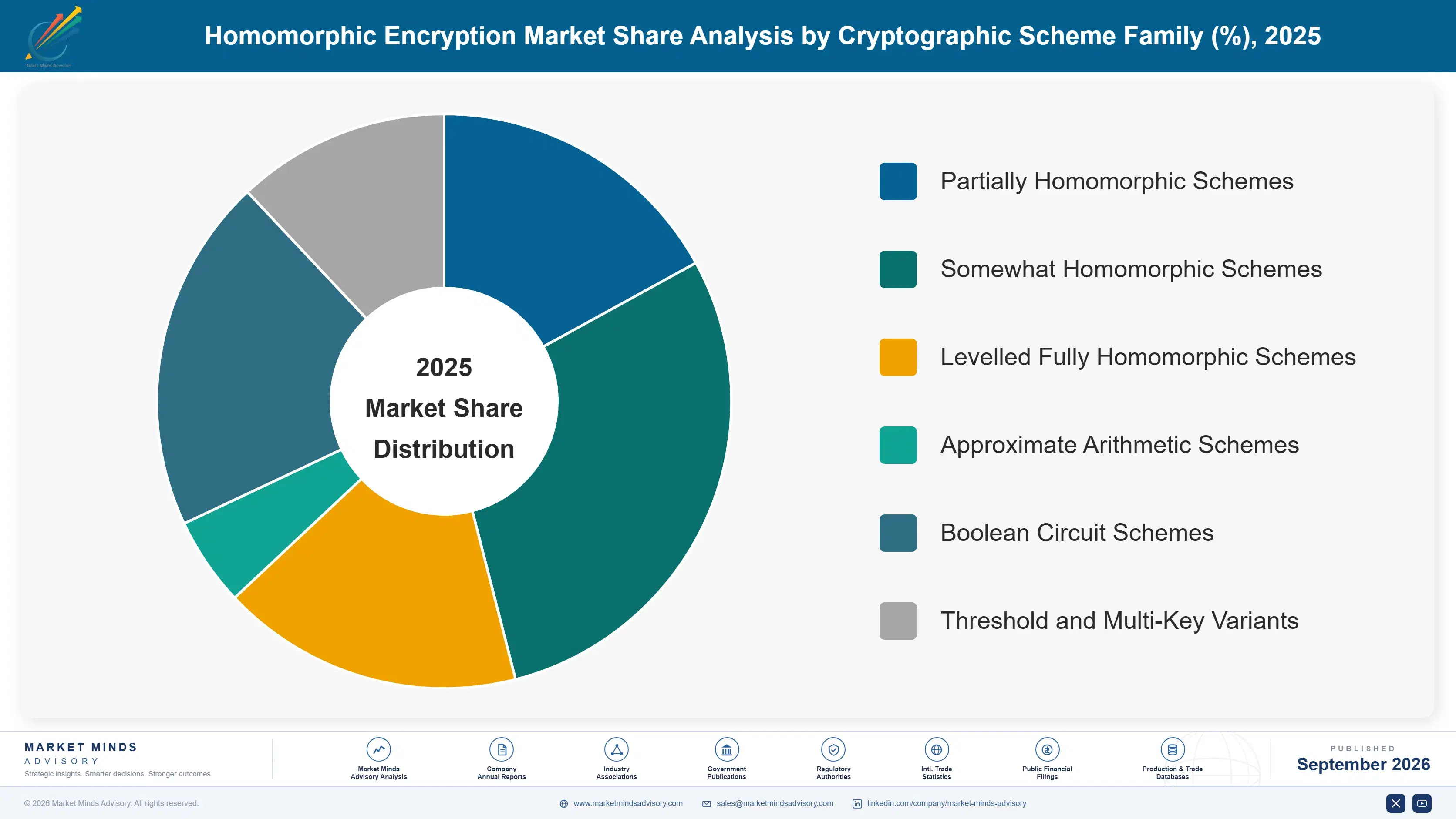
Segmentation follows the cryptographic scheme family, which determines what operations are possible, how fast they run and which workloads are realistic. Partially, somewhat, levelled fully, approximate arithmetic, boolean circuit and threshold constructions each suit different problems, and buyers increasingly combine several within one application rather than choosing between them. Combination is now normal practice.
homomorphic-encryption-market-market-share-analysis-1788414351321

Approximate Arithmetic Schemes

These schemes compute on real numbers with a small controlled error rather than performing exact integer arithmetic, which suits statistics, model inference and analytics where exactness was never required. That is precisely the workload regulated buyers want to run on data they cannot legally read, and it is why almost every commercial privacy-preserving machine learning deployment now rests on this family. The scheme originated in academic work at a Korean university and became the practical default within a few years. Growth at 25.8% is half again the market rate of 17.2%. Managing the accumulated approximation error across deep computations remains genuinely difficult engineering. Choosing parameters that hold accuracy across a deep circuit is where projects fail.
CAGR 25.8%

Boolean Circuit Schemes

Boolean circuit schemes evaluate arbitrary logic gate by gate with fast bootstrapping after each operation, which makes them the natural choice for comparisons, decision trees, control flow and anything that is not straightforward arithmetic. Throughput on bulk numeric work is poor, so they are usually combined with arithmetic schemes rather than used alone. Growth at 23.6% reflects both that combination becoming standard practice and the compiler tooling around this family maturing faster than elsewhere. Developer accessibility here is the best in the market, which matters far more than raw performance for buyers evaluating whether a project is feasible at all. Mixing families within one application is now normal rather than exceptional practice.
CAGR 23.6%
Full segment breakdown across 6 segments available in the complete report.

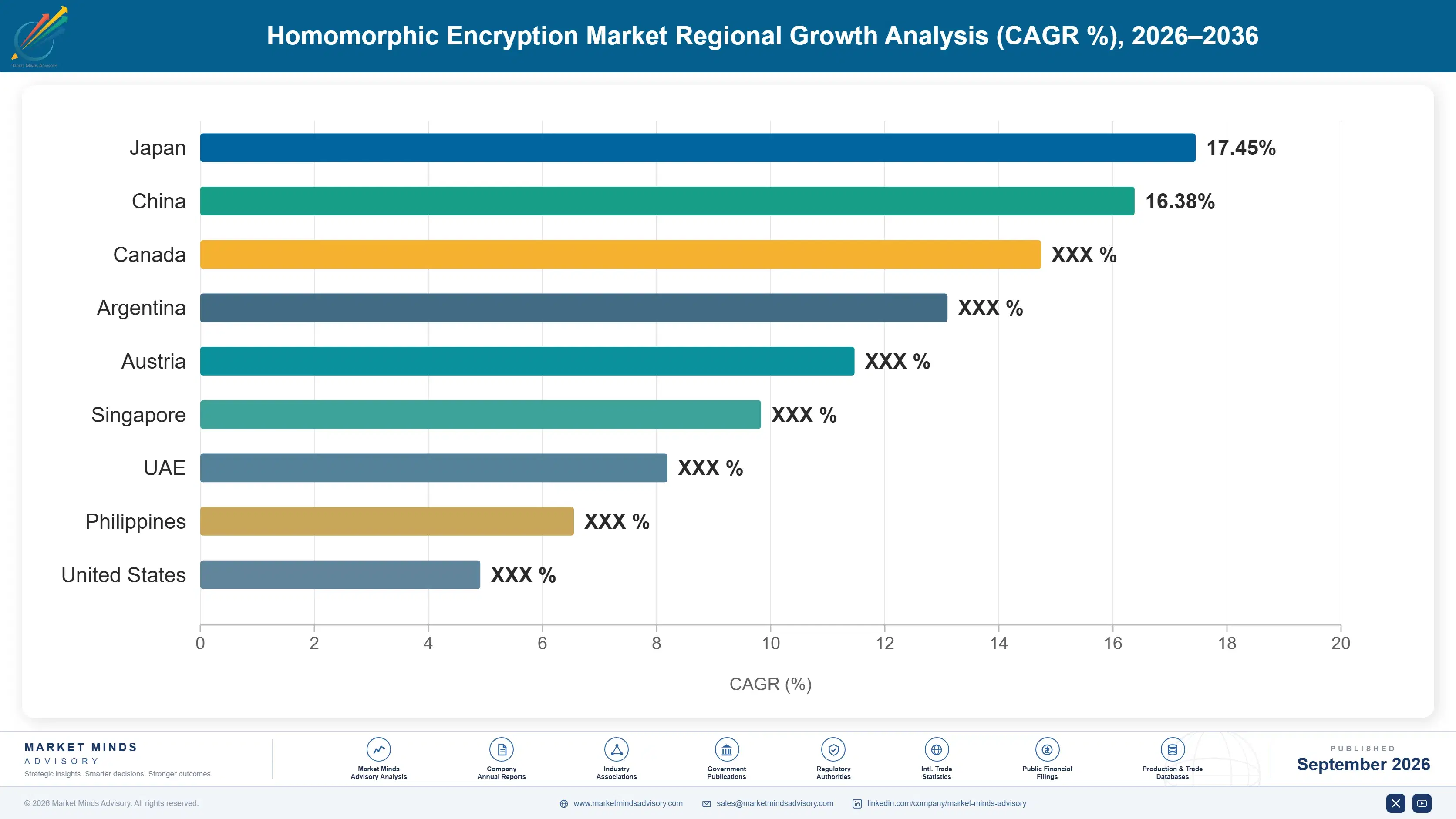
Regional Architecture and Country Demand Map

Activity follows research concentration, venture funding and regulated buyer density rather than economic size or software market share. North America leads on all three at once, and the gap over every other region is currently very wide indeed. Software market share is a poor guide.

North America

Publicly funded acceleration programmes, the densest concentration of venture-backed cryptography ventures anywhere and a deep base of regulated financial and healthcare buyers together explain why North America sits at 40%, far above the 32% ceiling of the standard band. Defence research funding carried this field through the years when no commercial buyer would touch it. Large technology companies maintain open source libraries that much of the world builds on. Financial fraud consortia here reached production earlier than anywhere else, which gives American vendors reference deployments competitors cannot match. The concentration is genuine rather than an artefact of measurement, since the buyers, the funding and the ventures all sit within a few hours of each other.
Share: 40% | CAGR: 16.6% (2026 to 2036)

Western Europe

Data protection rules and cross-border transfer restrictions originated here and remain stricter than anywhere, which makes processing under encryption a compliance instrument rather than an experiment. French and Belgian research groups produced several of the schemes and libraries the field depends on, and at least one European venture has become a leading commercial provider. Health research collaborations across national boundaries are a distinctive local use case, since the data genuinely cannot be pooled. Growth of 15.6% is the slowest of any region, from the second largest base. Vendors here compete on regulatory credibility rather than on performance, which suits a market where the requirement originates in law rather than in any technology roadmap.
Share: 24% | CAGR: 15.6% (2026 to 2036)
Regional intelligence for 5 additional markets available in the complete report: East Asia, South Asia and Pacific, Middle East and Africa, Latin America, Eastern Europe. Contact sales@marketmindsadvisory.com.
homomorphic-encryption-market-country-cagr-analysis-1788414351849

Where This Technology Earns Today

Four positions carry margin in a market where only 14% of engagements reach production. Each depends on choosing which problem to solve rather than on cryptographic sophistication, and the vendors doing well are generally those that narrowed their ambition earlier than their competitors did. Narrowing early is what separates them from the rest. Nothing here is cryptographic.

Sell Compliance Outcomes Not Cryptographic Capability

Around 71% of revenue comes from finance, healthcare and government, where a regulator rather than a technologist created the requirement, and those buyers are purchasing a defensible answer to a legal problem. Vendors presenting scheme selection and parameter security to a compliance officer lose to vendors presenting an auditable process. The technical audience does not hold the budget in these organisations. This is a positioning decision that costs nothing and that a surprising number of vendors have still not made properly. It costs nothing to change and many vendors still have not.
Market Impact: Reaches the 71% of revenue from regulated buyers

Target Small High-Value Computations Very Deliberately

At roughly 9,000 times overhead, the only viable workloads are those where the computation is small and the value of privacy is large: a fraud match, a regulatory check, an inference against a sensitive model. Vendors pursuing general purpose analytics burn engineering effort on problems the arithmetic will not permit for years. Narrowing scope early is what separates the vendors with production references from those with a pilot list. The discipline is refusing work that will fail on performance rather than accepting it and hoping. Hoping the hardware arrives first is not a strategy.
Market Impact: Fits inside the 9,000 times overhead constraint properly

Invest In Compiler Experience Over Scheme Depth

Compilers that accept ordinary code and handle parameter selection automatically remove the cryptographer from the project, which widens the addressable buyer from organisations employing one to any competent engineering team. That shift matters more commercially than any performance improvement available in software. Boolean circuit tooling has matured fastest and its segment grows at 23.6% partly for that reason. Vendors competing on cryptographic sophistication are optimising for an evaluator who is no longer making the decision. Boolean circuit tooling has matured fastest and that segment now grows at 23.6% partly because of it.
Market Impact: Opens the 23.6% growth segment to ordinary teams

Position For Acceleration Silicon Before It Ships

Dedicated hardware targeting roughly 1,000 times improvement changes which workloads are viable, and the software vendor whose libraries and compilers already target that silicon captures the workloads it makes viable first. Co-design work has to happen before tape-out, not afterwards. Vendors treating hardware as somebody else's problem will find their software stack unsupported on the platforms that matter. The window for that co-design work is closing as designs freeze. Backing the wrong platform is a risk, and backing none at all is a larger one. Stacks targeting no accelerator will be absent when the workloads finally become viable.
Market Impact: Prepares for the 1,000 times hardware speedup ahead

Who Controls the Margin Pool

Measured on commercial licence and services revenue, the basis used throughout this section, the top five hold 46%. Concentration is high for a young software market because the required expertise is genuinely scarce and because open source libraries maintained by large technology companies set the baseline everyone else builds against. The gap between leaders and the rest is production reference deployments rather than cryptographic capability.
Competition runs on developer experience, production references and increasingly on hardware co-design rather than on scheme performance figures that buyers cannot evaluate. Specialist ventures compete on focus and speed. Large technology companies contribute libraries that commoditise the foundations while monetising adjacent cloud services. Silicon ventures occupy a different position entirely, selling into a future rather than a present market.

Pressure builds from two directions. Confidential computing based on hardware enclaves solves many of the same problems at a fraction of the overhead, and for buyers willing to trust a processor vendor it is the obvious answer. And the arrival of acceleration silicon will redistribute positions toward whoever co-designed against it. Rankings shift where vendors narrowed scope to viable workloads and built compiler experience rather than pursuing cryptographic generality.
homomorphic-encryption-market-company-positioning-matrix-1788414352371

Competitive Moat and Risk Dimensions

ZAMA

Moat: Developer experience and tooling

Compiler and library work that lets ordinary engineers build homomorphic applications without a cryptographer has attracted a developer base far wider than the specialist audience competitors reach. Open tooling builds adoption that converts into commercial licensing later. Depth in boolean circuit schemes positions the company well for the mixed-scheme applications that most real deployments actually require.
ZAMA

Risk: Revenue behind adoption curve

Wide developer adoption has not yet converted into commercial revenue at the same rate, which is the familiar risk of building a community before a business. Open tooling also lowers the barrier for competitors building on the same foundations. Dependence on the overhead problem being solved by hardware developed elsewhere leaves market timing outside the company's own control.
DUALITY TECHNOLOGIES

Moat: Regulated sector production references

Production deployments with financial institutions and healthcare organisations give reference evidence that matters enormously in a market where only 14% of engagements reach production at all. Research provenance from recognised cryptographers supports credibility with buyers who cannot assess the technology themselves. Participation in acceleration programmes provides early sight of the hardware that determines future viability.
DUALITY TECHNOLOGIES

Risk: Services concentration in delivery

A substantial share of revenue arrives as services rather than repeatable licensing, which scales with headcount rather than with software and constrains margin. Regulated buyers demand customisation that resists productisation. Competition from confidential computing is strongest in exactly the financial and healthcare accounts where the company is most established.

Players Tracked

Prominent Players

Zama
Duality Technologies
IBM
Microsoft
Enveil

Other Key Players

Inpher
Cosmian
Optalysys
Cornami
Fabric Cryptography
Niobium Microsystems
CryptoLab
Desilo
Intel
Samsung Electronics
Thales
Google
Fortanix
Oasis Labs
Chain Reaction

Recent Developments

MARCH 2025

Acceleration venture raises financing round for homomorphic silicon

A hardware venture developing dedicated homomorphic encryption acceleration completed a substantial equity financing round, an investment rather than any acquisition or joint venture. Proceeds were directed toward tape-out and toward software co-design with library providers rather than to general operations. Software partners were named alongside the round.
Signal: Investors are now funding the semiconductor answer rather than any further work on the cryptography itself.
NOVEMBER 2024

Standards work advances on homomorphic encryption parameter sets

A recognised standards effort advanced published parameter tables and security level definitions for homomorphic schemes, addressing the gap that has kept enterprise security teams from committing to production. The work covered several scheme families and the lattice attack estimates underpinning parameter choice. Enterprise buyers had asked for it.
Signal: Enterprise buyers will not leave pilot stage until a recognised standard tells them which parameters are safe.
JULY 2025

Financial consortium deploys cross-institution encrypted fraud matching

A group of financial institutions moved a private set intersection deployment into production for cross-institution fraud pattern detection, a deployment decision rather than any corporate transaction. Competition law and privacy obligations had previously prevented the institutions from pooling any customer data at all. Production followed a long pilot.
Signal: The clearest production case in this market uses partial schemes rather than the fully homomorphic ones discussed.

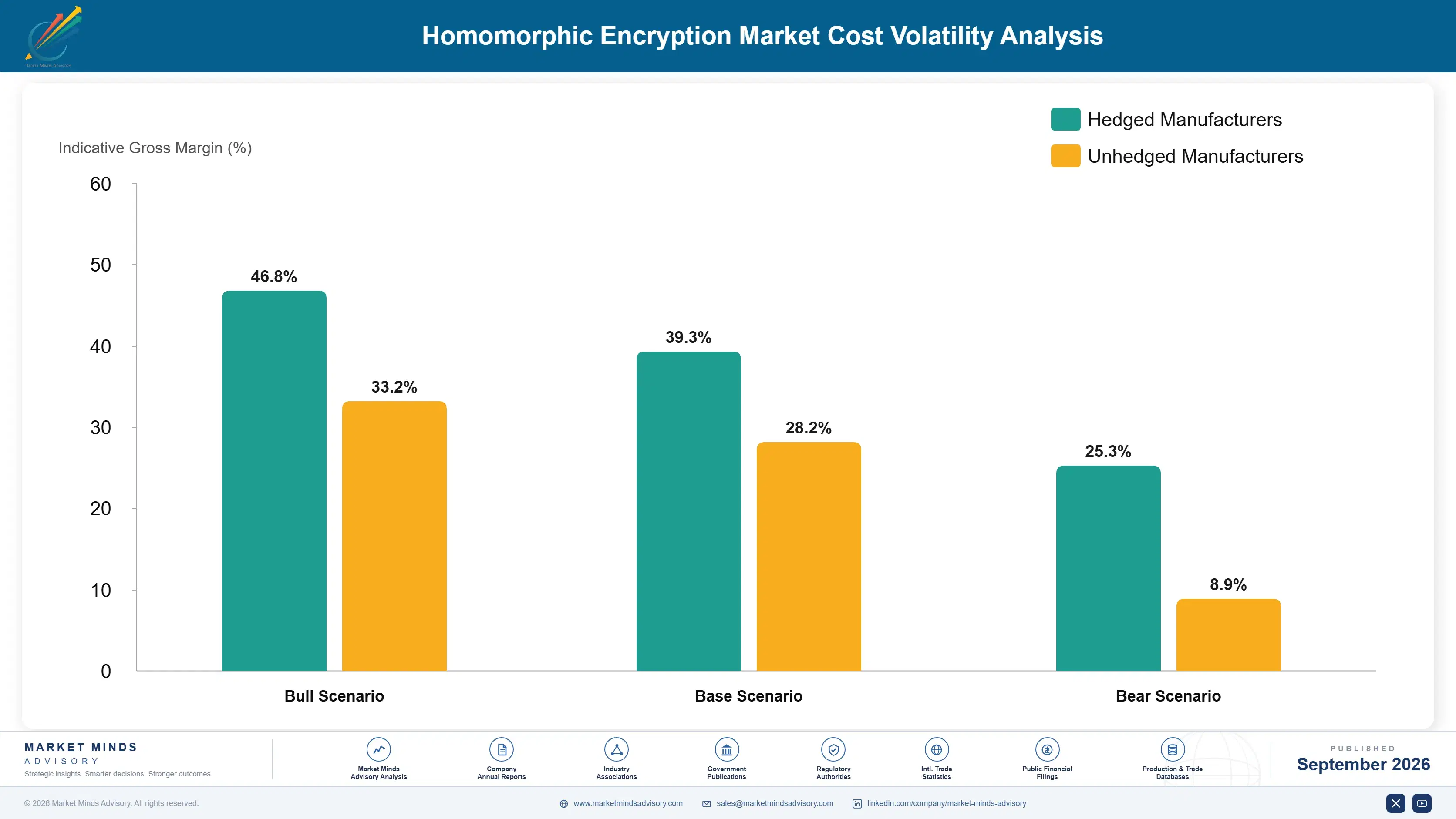
Cryptographers, Compute And Silicon

Research and engineering labour accounts for roughly 62% of vendor cost, benchmarking and development compute around 14%, hardware development for those pursuing silicon between 10 and 20%, and audit, patent and commercial overhead the balance. The labour is not general software labour: applied cryptographers with lattice expertise number in the low thousands worldwide, and US Bureau of Labor Statistics data does not separate them as a category.
Compensation for applied cryptographers rose sharply as artificial intelligence and post-quantum work competed for the same mathematical talent, and several vendors disclosed increased research expense across the period without corresponding revenue. Development compute costs rose alongside, since benchmarking homomorphic workloads consumes accelerator time at rates that plaintext development never approached. Both pressures arrived while the market remained small. Both arrived while realised revenue stayed small enough that a single contract moved it.

The disadvantage mechanism is funding structure rather than efficiency. A vendor backed by research grants can carry a long development period; one funded by venture capital against milestones cannot, and must narrow scope. Silicon ventures carry the heaviest burden of all, since tape-out costs arrive years before any customer does. That difference explains most of the strategic divergence here.
homomorphic-encryption-market-cost-volatility-analysis-1788414352566

Open source foundations to share development cost

Contributing to and building on shared open libraries spreads the cost of core scheme implementation across the whole field rather than duplicating it inside every vendor. It also commoditises the foundation a vendor might otherwise have differentiated on, which is a genuine trade rather than a free saving, and several vendors have judged it wrongly.

Academic collaboration in place of internal research

Sponsoring university groups gives access to the scarce mathematical talent without carrying it as permanent headcount, and much of the field's foundational work originated in exactly those groups. The cost is slower direction and publication timelines that suit academic careers rather than commercial roadmaps, which vendors consistently underestimate. Several vendors have learned this expensively.

Hardware co-design partnerships rather than own silicon

Partnering with an acceleration venture rather than developing silicon internally gives a software vendor early platform access without carrying tape-out cost. It requires committing to a design before anyone knows which will succeed, and backing the wrong platform leaves a software stack unsupported on the hardware customers eventually buy. The bet has to be placed early.

Portfolio Architecture for Margin Defence

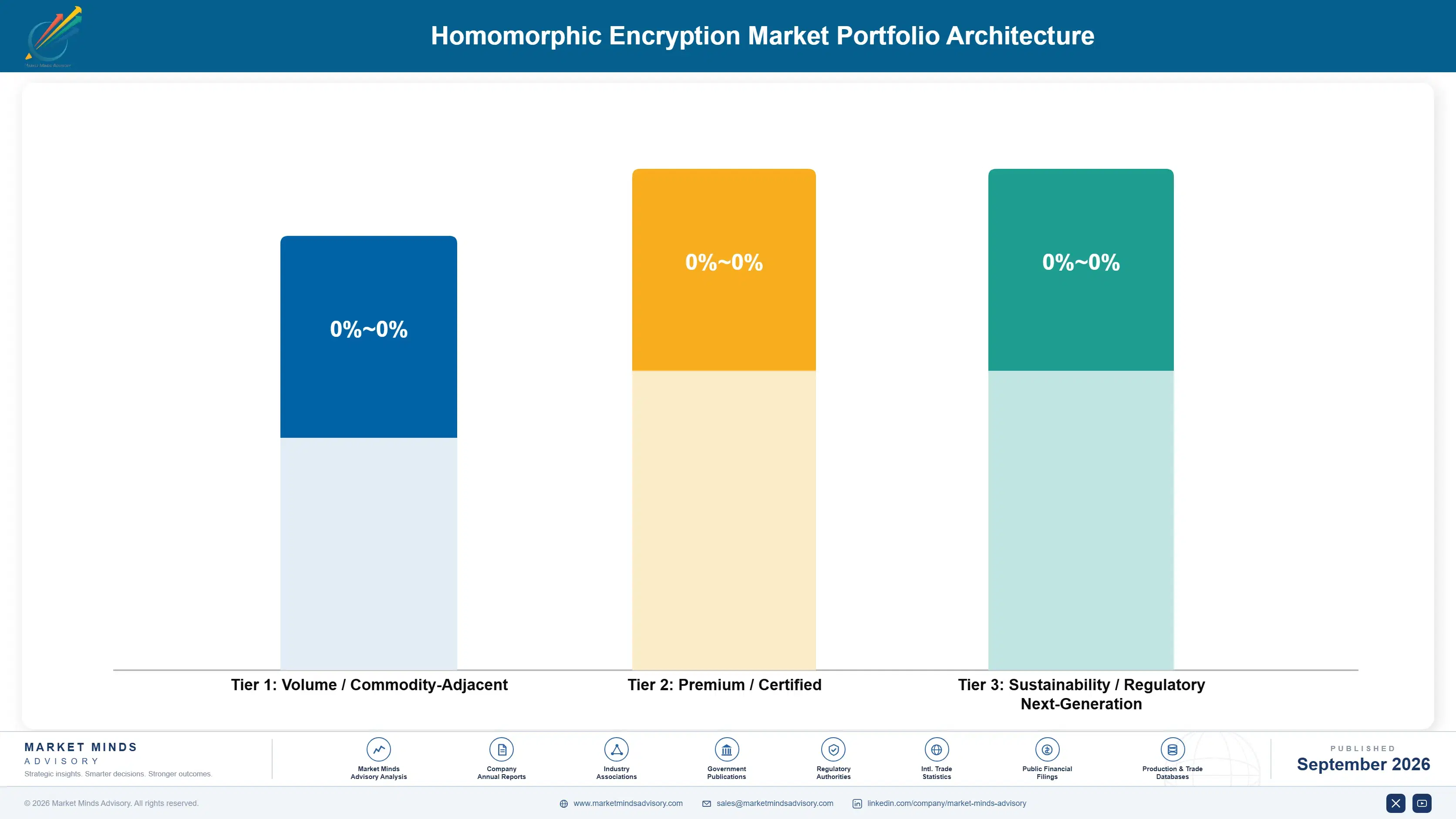
Margin separates by whether the work is repeatable. Bespoke engagements with regulated buyers who require customisation, integration and hand-holding scale with headcount rather than software, and margin reflects that constraint directly. Licensed libraries and compiler tooling scale properly, but adoption there has run well ahead of revenue because much of the developer base is experimenting rather than deploying anything into production.
The volume against premium tension is unusual because volume barely exists. Only 14% of engagements reach production, so the pilot work that consumes most delivery capacity generates little repeat revenue and mostly buys reference credibility. Vendors funding a large services organisation from pilot fees are running a consultancy that believes it is a software business. Choosing which pilots to accept is the single most consequential commercial decision most of these vendors make.

High-value pools sit where the workload genuinely fits the arithmetic: cross-institution matching, regulatory verification and private inference against sensitive models. Each is small in computation and large in the value of privacy, which is exactly the shape this technology can serve today. The pools are narrow and carry almost all of the market's production revenue.

Volume / Commodity-Adjacent

Pilot engagements, proof of concept work and integration services for buyers evaluating the technology. Delivery scales with headcount rather than software, and much of it never converts into anything repeatable at all.
Gross Margin: 34 to 44%

Premium / Certified

Licensed libraries, compilers and managed services for buyers who have reached production. The 12 point range reflects how much customisation each deployment demands and whether the vendor productised it properly beforehand.
Gross Margin: 52 to 64%

Sustainability / Regulatory / Next-Generation

Compliance-positioned platforms sold to regulated buyers, and software co-designed for acceleration silicon. The 16 point range reflects how completely a defensible regulatory position changes pricing against a technical sale. Very few vendors hold it.
Gross Margin: 60 to 76%
homomorphic-encryption-market-portfolio-architecture-1788414353067

High-value Sub-segments and Strategic Watch-out

Regulated Compliance Platforms

Highest value position available, sold to buyers where a regulator rather than a technologist created the requirement and where no legal alternative exists. Compliance budgets behave quite differently from technology budgets in both size and durability. No legal alternative exists for these buyers. Nothing else compares.
Gross Margin: 62 to 76%

Cross-Institution Matching Services

The clearest production use case in the market, letting rival institutions compute joint results without pooling data that competition law forbids them to share. Uses partial schemes rather than fully homomorphic ones, which surprises most observers. Competition law rather than technology created this requirement. It surprises most observers.
Gross Margin: 54 to 66%

Developer Tooling And Libraries

Widening the addressable buyer from organisations employing a cryptographer to any competent engineering team, which matters more commercially than any software performance gain. Adoption currently runs well ahead of realised revenue. Conversion from adoption to revenue is the open commercial question here. Conversion remains the question.
Gross Margin: 48 to 60%

Exploratory Pilot Engagements

Consumes most delivery capacity across the industry while converting to production in only a small minority of cases. Necessary for reference credibility rather than attractive on returns, and choosing which to accept is the decision that matters. Most never convert into anything repeatable. Selection is everything.
Gross Margin: 34 to 44%

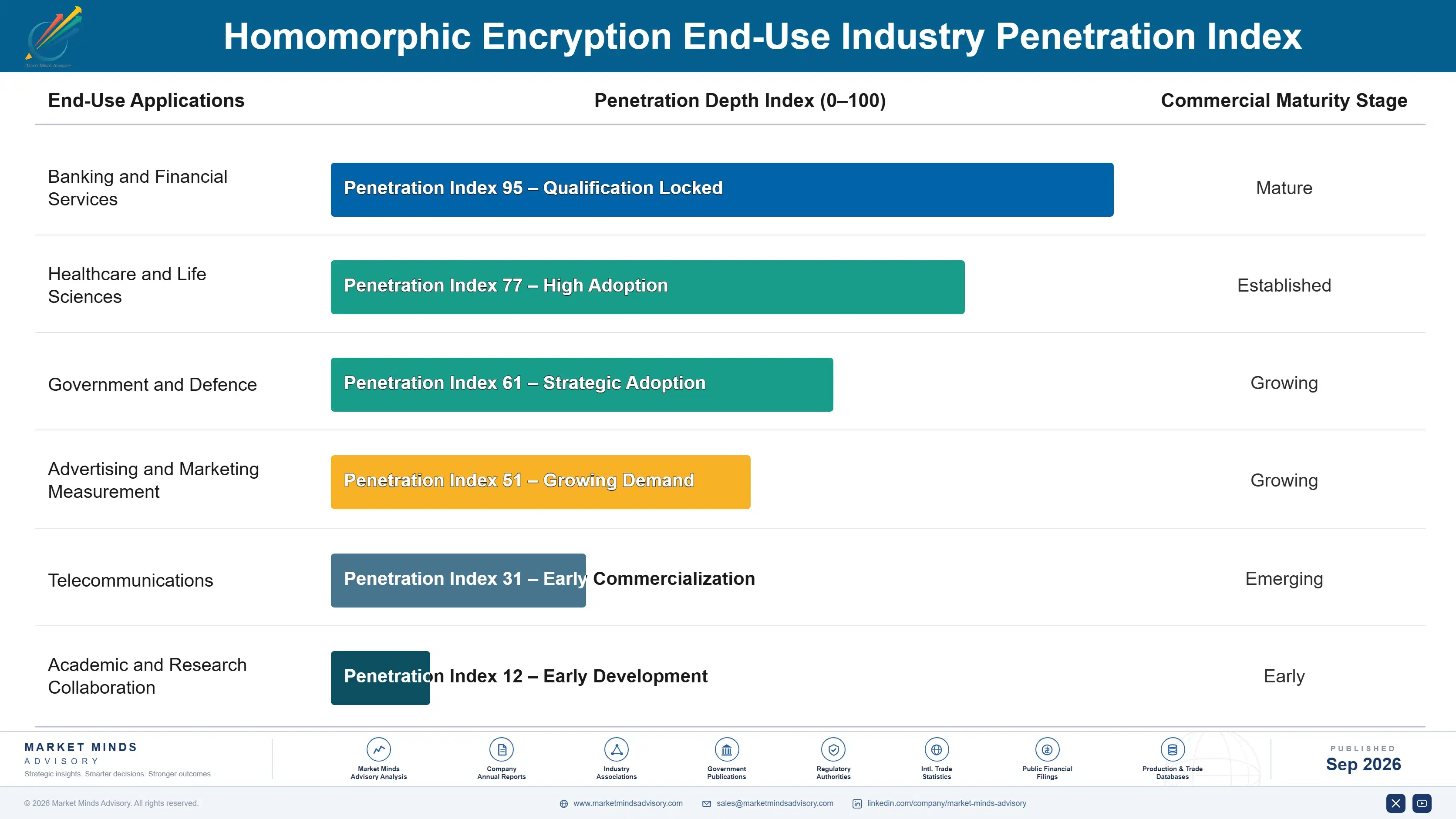
Who Actually Buys This Technology

Annuity economics arrive only after production, and only 14% of engagements get there. A deployment that does reach production is genuinely durable, because replacing the cryptographic layer of a regulated workflow means repeating an audit nobody wants to repeat, so switching is rare and renewal reliable. Everything before that point is project revenue dressed as pipeline, which is the distinction most vendor forecasts in this market fail to draw.
Adoption depth varies sharply by buyer type. Financial institutions specify deeply, involve their own cryptographers and demand third-party audit of implementations, and they switch reluctantly once deployed. Healthcare and research collaborations buy narrower capability and rely heavily on vendor guidance. Technology companies evaluating the field frequently build internally afterwards, which makes them expensive prospects that consume delivery capacity without ever becoming customers.

The buyer profile has moved decisively. This was once bought by research groups and innovation teams exploring what might become possible, with budgets to match. It now sits with compliance and risk functions answering a legal obligation about data they may not move or read, and those functions ask about auditability rather than performance. Vendors pitching cryptographic elegance address an audience that stopped holding the budget.
homomorphic-encryption-market-end-use-penetration-index-1788414353553

Where Vendors Should Compete

These are among the four positions where our research anticipates prominent divergence between winners and laggards over the coming forecast period. Each is grounded in the demand model, the regulatory perimeter, and the announced capacity pipeline.
01 / COMPLIANCE POSITIONING CHOICE

Sell to the regulator's requirement, not the engineer

Around 71% of revenue comes from finance, healthcare and government, where a regulator rather than any technologist created the requirement and the buyer is purchasing a defensible answer to a legal obligation they cannot avoid. Vendors presenting scheme selection and parameter security to a compliance officer lose consistently to vendors presenting a simple auditable process instead. The technical audience does not hold the budget in these organisations, and a surprising number of vendors have still not properly adjusted to that.
02 / WORKLOAD SCOPE DISCIPLINE

Refuse the computations the arithmetic cannot carry

At roughly 9,000 times overhead with data expanding around 40 times, only small computations with very high privacy value are viable at all, and general purpose analytics will not be feasible for years whatever any vendor currently promises about them. Vendors pursuing broad general workloads consume engineering effort on problems the underlying arithmetic simply forbids. Narrowing scope early is precisely what separates the vendors holding production references from those maintaining an impressive pilot list and very little revenue behind it.
03 / COMPILER INVESTMENT PRIORITY

Remove the cryptographer before improving the scheme

Compilers that accept ordinary code and select parameters automatically widen the addressable buyer from the organisations that employ a cryptographer to any competent engineering team, which is a larger commercial change than any software performance gain currently available anywhere. Boolean circuit tooling in particular has matured fastest and that segment grows at 23.6% partly because of exactly that maturity. Vendors still competing on cryptographic sophistication are optimising for an evaluator who no longer makes the purchasing decision in these organisations.
04 / SILICON CO-DESIGN TIMING

Target the accelerators before their designs freeze

Dedicated acceleration hardware aiming at roughly 1,000 times improvement will decide which workloads eventually become commercially viable, and the software vendor whose libraries already target that silicon captures those workloads first on the day it ships. Co-design work has to happen before tape-out rather than at any point afterwards, and that window is closing quickly as designs freeze. Vendors treating hardware as somebody else's problem will find their stack unsupported on precisely the platforms customers eventually go on to buy.

Engagement Snapshot From the Field

A live engagement with an industry participant carrying material or product regulatory and market exposure ahead of a defining policy shift, showing how our research translates into a defensible multi-year portfolio strategy.
MARKET MINDS ADVISORY · CLIENT ENGAGEMENT SUMMARY
Homomorphic Encryption Producer Strategic Portfolio Review and Transition Roadmap 2026·Investment Scenario on Homomorphic Encryption Exposure Evaluation 2025-26
CLIENT PROFILE
A European financial services group operating across nine national markets with annual revenue reported at approximately USD 6.2 billion (client-reported, unverified by MMA). Cross-border data transfer restrictions prevented the group from analysing customer data centrally, and three separate homomorphic encryption pilots had been running across different business units without any coordination between them at any point.
STRATEGIC CHALLENGE
None of the three pilots had reached production after two years, and each business unit blamed performance while the vendors blamed scope. Management could not establish whether the technology was genuinely unready, whether the workloads chosen were unsuitable, or whether the group was simply buying from the wrong providers entirely.
MMA APPROACH
MMA assessed each pilot workload against realistic performance envelopes for the scheme families involved, benchmarked vendor production references across comparable regulated deployments, and examined whether confidential computing would satisfy the same compliance requirement at lower overhead. Legal counsel positions on each option were compared directly. Vendor claims were tested against benchmarks.
KEY FINDINGS
  1. Two of the three pilot workloads were computationally infeasible under any current scheme, and no vendor had told the group this because each hoped acceleration hardware would arrive first.
  2. The third workload, cross-border fraud pattern matching, was viable using partial schemes rather than the fully homomorphic approach the vendor had proposed and priced.
  3. Confidential computing satisfied the compliance requirement for four adjacent workloads at a small fraction of the overhead, and legal counsel accepted it where the processor vendor was trusted.
  4. Vendor selection had been made by technology teams on cryptographic capability, while the actual budget and the actual requirement both sat with the group compliance function.
CLIENT PROFILE
A European financial services group operating across nine national markets with annual revenue reported at approximately USD 6.2 billion (client-reported, unverified by MMA). Cross-border data transfer restrictions prevented the group from analysing customer data centrally, and three separate homomorphic encryption pilots had been running across different business units without any coordination between them at any point.
STRATEGIC CHALLENGE
None of the three pilots had reached production after two years, and each business unit blamed performance while the vendors blamed scope. Management could not establish whether the technology was genuinely unready, whether the workloads chosen were unsuitable, or whether the group was simply buying from the wrong providers entirely.
MMA APPROACH
MMA assessed each pilot workload against realistic performance envelopes for the scheme families involved, benchmarked vendor production references across comparable regulated deployments, and examined whether confidential computing would satisfy the same compliance requirement at lower overhead. Legal counsel positions on each option were compared directly. Vendor claims were tested against benchmarks.
KEY FINDINGS
  1. Two of the three pilot workloads were computationally infeasible under any current scheme, and no vendor had told the group this because each hoped acceleration hardware would arrive first.
  2. The third workload, cross-border fraud pattern matching, was viable using partial schemes rather than the fully homomorphic approach the vendor had proposed and priced.
  3. Confidential computing satisfied the compliance requirement for four adjacent workloads at a small fraction of the overhead, and legal counsel accepted it where the processor vendor was trusted.
  4. Vendor selection had been made by technology teams on cryptographic capability, while the actual budget and the actual requirement both sat with the group compliance function.
RECOMMENDED STRATEGY
Phase 1: Phase one: terminate the two infeasible pilots immediately and redirect that budget toward the fraud matching workload that genuinely works. Phase 2: Phase two: adopt confidential computing for adjacent workloads where legal counsel accepts trusted hardware, reserving encryption for cases where it does not. Phase 3: Phase three: move both vendor selection and budget ownership to the compliance function that actually holds the underlying regulatory requirement.
OUTCOME
Within nine months the group had moved cross-border fraud matching into production across four markets, closed two pilots, and reported privacy technology spend down 22% while delivering more capability than before (client-reported, unverified by MMA). Confidential computing now handles the adjacent workloads under compliance oversight.

Frequently Asked Questions

Foundational context covering the market sizes, CAGR, scope, country, region and competition that inform every finding below. This section is provided to cover basics and most often pre-purchase conversations, answered from the MMA Primary Research Dataset.

What is the current size of the Homomorphic Encryption Market?

The market was valued at USD 0.3 billion in 2025 and reaches USD 0.35 billion in 2026. Most realised revenue comes from partial schemes rather than fully homomorphic deployments.

How large will the Homomorphic Encryption Market be by 2036?

MMA forecasts USD 1.71 billion by 2036, an increase of USD 1.36 billion over the 2026 base. That represents an expansion multiple of 4.89 times.

What is the CAGR for the Homomorphic Encryption Market 2026 to 2036?

The base case CAGR is 17.2%, with a bull case of 18.6% and a bear case of 15.8%. The historical rate between 2020 and 2025 was 15.8%.

Which segment is growing fastest?

Approximate arithmetic schemes grow at 25.8%, half again the market rate of 17.2%. They suit the statistical and machine learning workloads regulated buyers actually want to run.

Who are the major companies in the Homomorphic Encryption Market?

Zama, Duality Technologies, IBM, Microsoft and Enveil lead on measured commercial licence and services revenue. Together they account for roughly 46% of the market today.

Which country is growing fastest?

Israel grows fastest at 27.4%, combining dense applied cryptography research with venture funding that commercialises the work within a few years rather than a decade.

Report Segmentation Architecture

The full report scope spans multiple orthogonal segmentation dimensions, with cross-tabulated demand data provided for each dimension pair. Coverage extends further to regional breakdowns, trend trajectories, and the competitive detail needed to support segment-level decision-making.

By Cryptographic Scheme Family

  • Partially Homomorphic Schemes
  • Somewhat Homomorphic Schemes
  • Levelled Fully Homomorphic Schemes
  • Approximate Arithmetic Schemes
  • Boolean Circuit Schemes
  • Threshold and Multi-Key Variants

By End-Use Industry

  • Banking and Financial Services
  • Healthcare and Life Sciences
  • Government and Defence
  • Advertising and Marketing Measurement
  • Telecommunications
  • Academic and Research Collaboration

By Deployment Model and Delivery Route

  • Licensed Software Libraries
  • Compiler and Developer Tooling
  • Managed Privacy Services
  • Dedicated Acceleration Hardware
  • Systems Integrator Delivery
  • Direct Enterprise Engagement

By Region

  • North America
  • Western Europe
  • East Asia
  • South Asia and Pacific
  • Middle East and Africa
  • Latin America
  • Eastern Europe

Scope, Methodology, and Coverage

Every figure in this report is reproducible from documented input assumptions. The scope below maps the historical period, the forecast horizon, the segmentation dimensions, and the countries covered, alongside the underlying primary and qualitative methodology.
Historical Period
2020 to 2025
Forecast Period
2026 to 2036
Base Year
2025 (USD billions; MMA Primary Research Dataset, September 2026)
Market Definition
The homomorphic encryption market covers software libraries, compilers, managed services and dedicated acceleration hardware that permit computation on encrypted data without decryption, spanning partially homomorphic, somewhat homomorphic, levelled fully homomorphic, approximate arithmetic, boolean circuit and threshold or multi-key scheme families. Sizing is measured at vendor licence, subscription and services revenue. Conventional encryption at rest and in transit, confidential computing based on hardware enclaves, secure multiparty computation without homomorphic primitives, and differential privacy tooling are excluded.
Quantitative Units
USD millions at vendor licence, subscription and services revenue, with supporting production deployment counts and engagement volumes by region
Segmentation Dimensions
Cryptographic scheme family, end-use industry, deployment model and delivery route, region
Regions Covered
North America, Western Europe, East Asia, South Asia and Pacific, Middle East and Africa, Latin America, Eastern Europe
Countries Covered
United States, Canada, France, Belgium, Netherlands, Germany, United Kingdom, Switzerland, Israel, Saudi Arabia, South Korea, Japan, China, India, Singapore, Australia, Brazil, Poland
Key Companies Profiled
Zama, Duality Technologies, IBM, Microsoft, Enveil, Inpher, Cosmian, Optalysys, Cornami, Fabric Cryptography, Niobium Microsystems, CryptoLab, Desilo, Intel, Samsung Electronics, Thales, Google, Fortanix, Oasis Labs, Chain Reaction
Quantitative Methodology
Primary survey, n=3,800 respondents, Q4 2025, six countries; demand-side model with trade association cross-validation
Qualitative Methodology
47 expert interviews, Q4 2025; applied to validate demand model assumptions, identify emerging dynamics, and assess competitive positioning
Report Format
PDF and XLSX data workbook (Word format preview document)
Publisher
Market Minds Advisory
Report Code
MMA-2026-TEC-611
Published
September 2026
Contact
sales@marketmindsadvisory.com | www.marketmindsadvisory.com

Purchase the full Homomorphic Encryption Market Report (2026 to 2036).

The full report separates realised revenue from research attention throughout, which is the distinction that explains why partial schemes carry the money while fully homomorphic work carries the headlines. It sizes six scheme families with individual growth rates, seven regions built from research concentration and regulated buyer density, and the acceleration silicon programmes that will decide which workloads become viable. Competitive analysis covers twenty vendors on a consistent licence and services revenue basis, with production references and compiler experience treated as the decisive variables. Input cost modelling breaks out cryptographic labour, compute and silicon development exposure by funding structure.
Six scheme families with individual growth rates
Realised revenue separated from research attention
Acceleration silicon programmes mapped against workload viability
Production against pilot conversion rates by sector
Twenty vendors on consistent licence revenue basis
Cryptographic labour and compute cost exposure

Built For The People Who Decide

From boardroom strategy to bench-side execution, this report is read cover-to-cover by leaders shaping the next decade of their industry, turning demand scenarios, market dynamics and valuation benchmarks into decisions.
CXOs/ Presidents/ VPs/ Managers
M&A and Corporate Development
Strategy Teams and R&D Heads
Procurement and Product Directors
Regulatory and Compliance Leaders
Investor Relations and Equity Analysts