Market Minds Advisory
Homeland Security Market

Homeland Security Market: Homeland Security Market. AI-Enabled Surveillance and Cyber Defense Reshape a Budget-Driven Global Category

Nation-state cyberattacks on critical infrastructure and AI-enabled surveillance are pulling homeland security budgets away from physical screening equipment toward software-defined defense, forcing legacy contractors to rebuild their competitive positioning. this year specifically.

Lead Analyst

Published

September 2026

Make Smarter Decisions with Customized Research Insights

Request a free sample report and evaluate market opportunities, growth trends, and competitive dynamics relevant to your business needs.

2025 MARKET VALUE$580.0BMarket Size 2025
2036 FORECAST VALUE$1196MBase Case , 2026 to 2036
CAGR 2026 TO 20366.8 %Bull 8.0% / Bear 5.5%
INCREMENTAL OPPORTUNITY$576.5BNet 10- year value creation
EXPANSION MULTIPLE1.93x2036 value over 2026 base
Strategic Levers
M&A Pipeline
Regional Outlook
Country Rankings
Competitive Intelligence
Segmental Deep-dive
Call-Us : 91 93563 13602

Executive Snapshot and Market Trajectory.

Nation-state cyberattacks targeting critical infrastructure and government networks are pulling homeland security budgets decisively toward cybersecurity capability, and that reallocation is now the dominant force reshaping procurement priorities across national security agencies worldwide this year. particularly across agencies managing both border and infrastructure risk simultaneously.
Demand is concentrated among national government agencies modernising border security and critical infrastructure protection, while government cybersecurity spending is growing fastest as agencies confront sophisticated state-sponsored threats that legacy physical security investment cannot address. North America holds the deepest current spending base, reflecting the scale of United States federal homeland security budgets specifically. Colocation of cybersecurity and physical security teams inside single agency structures is also becoming more common among the largest governments.
Competitive structure remains moderately fragmented across large diversified defense and technology contractors and specialised security technology firms competing for the same government procurement budgets. Government agencies increasingly favour vendors demonstrating integrated software and hardware capability over point-solution providers, reshaping competitive dynamics faster than several traditional physical security equipment makers anticipated eighteen months ago specifically. Several traditional hardware contractors are acquiring cybersecurity specialists rather than building capability internally.
Market Definition
This market covers products, systems, and services deployed by government agencies and critical infrastructure operators for border security, critical infrastructure protection, government cybersecurity, screening and detection, emergency management, and biometric identification purposes. It excludes military combat systems and weapons platforms not specifically oriented toward homeland security missions, and general commercial cybersecurity products not sold primarily to government or critical infrastructure customers.
Base Year Value
$580.0B in 2025 (MMA Primary Research Dataset, September 2026)
Forecast Period
2026 to 2036, eleven discrete annual values
CAGR
6.8% base case. Bull 8.0%. Bear 5.5%.
Fastest Growth Segment
Cybersecurity for Government and Public Sector: 11.5% CAGR
Fastest Growth Country
India: 9.8% CAGR
Fastest Growth Region
South Asia and Pacific: 8.8% CAGR
Largest Region
North America: 32% of 2025 global value
Market Leaders
Lockheed Martin Corporation, RTX Corporation, Leidos Holdings Inc., Honeywell International Inc., Thales Group. Source: MMA Analysis based on company annual reports and investor filings.
Primary Survey
n=3,800 procurement and R&D decision-makers, Q4 2025, six countries
Methodology
Demand-side build-up, cross-validated against public data, 47 expert interviews

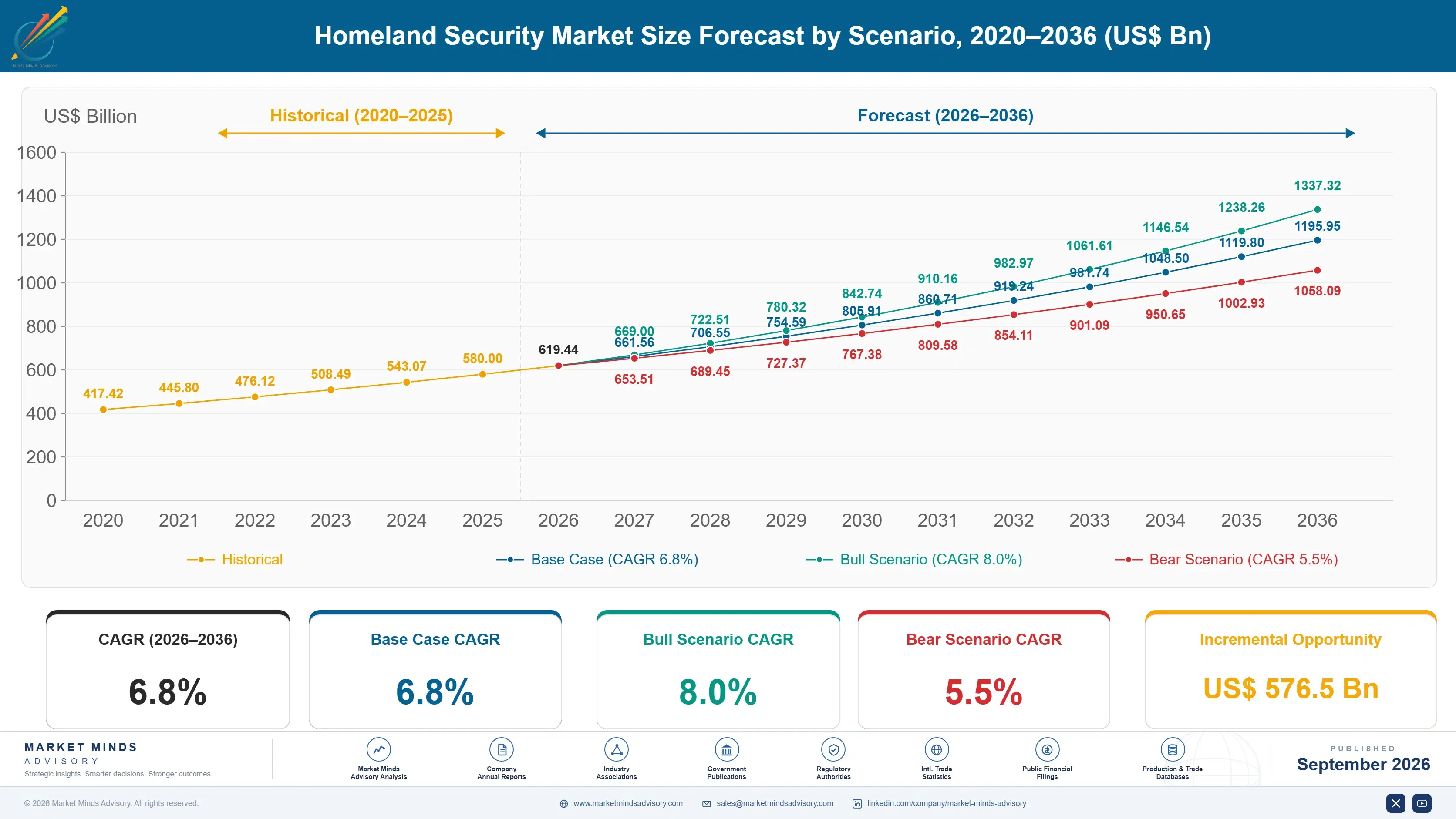
Homeland Security Market Forecast Scenarios

homeland-security-market-size-forecast-scenario-1788421443833
Between 2020 and 2025 the category grew steadily as governments increased border security and critical infrastructure protection investment, with cybersecurity spending accelerating meaningfully from 2022 onward following a wave of high-profile nation-state attacks on government and infrastructure targets. Pandemic-era supply chain disruption briefly slowed screening equipment deliveries during this period as well. Historical annual growth averaged roughly 6.1 percent across this period, MMA estimates.
The base case assumes continued solid growth driven by three mechanisms: sustained government cybersecurity investment responding to escalating nation-state threat activity, continued border security modernisation programmes across multiple major governments simultaneously, and rising adoption of AI-enabled surveillance and biometric identification technology across both border and critical infrastructure applications. These three mechanisms compound fastest in governments facing simultaneous border and cyber threat pressure. reinforcing cyber investment even where broader budgets stay flat.
A bull scenario turns on a major cyberattack against critical infrastructure in a developed economy forcing accelerated government-wide cybersecurity investment industry-wide. The bear risk is government budget consolidation or fiscal austerity measures delaying planned homeland security modernisation programmes across several major markets, compressing procurement volume across the category's largest legacy applications specifically. replacing steady multi-year programme visibility with genuine funding uncertainty for affected contractors.

Software-Defined Defense Reshapes a Budget-Driven Category

Two forces are converging on this category at once: nation-state cyberattacks against critical infrastructure and government networks escalating in frequency and sophistication, and AI-enabled analysis maturing enough to make surveillance and screening systems meaningfully more capable than legacy hardware-only equipment. Together these are pulling government procurement budgets toward software-defined capability that traditional physical security equipment manufacturers must now match or partner to provide. This dual pressure is reshaping vendor selection criteria across nearly every mission area simultaneously.
MARKET CONCENTRATIONCR5 34%Reflects a genuinely fragmented, multi-vendor procurement landscape overall
AVERAGE CONTRACT VALUEUSD 42 million per programmeBlended across border, infrastructure, and cyber contract types
TOP PRODUCING COUNTRY SHAREUnited States 29%Anchored firmly by concentrated federal homeland security budgets
CYBERSECURITY BUDGET SHARE22% of total category spendingPortion of homeland security budgets allocated to cyber defense
AI SURVEILLANCE ADOPTION RATE37% of new screening deploymentsShare of new deployments incorporating AI-enabled threat analysis
AVERAGE PROGRAMME DURATION7 years per contract cycleTypical duration of a major homeland security procurement contract
Commercially, the market behaves like a genuinely multi-vendor government procurement category rather than a concentrated technology market, with large diversified defense contractors, specialised security technology firms, and increasingly software-native cybersecurity vendors all competing for overlapping budget lines. Government agencies increasingly favour vendors demonstrating integrated software and hardware capability over point-solution providers addressing only a narrow piece of a broader security architecture.
Over the next decade, expect cybersecurity and AI-enabled analysis capability to become standard expectations across nearly every homeland security procurement category rather than standalone specialty purchases. Vendors that build genuine software engineering depth alongside traditional hardware and systems integration capability will capture a growing share of category budget even as legacy hardware-only equipment continues facing commoditisation pressure.
"Homeland security used to mean concrete barriers and X-ray machines. Increasingly it means code, and the contractors who haven't figured that out yet are going to lose the next decade of budget cycles."
Director, National Security and Critical Infrastructure Technology Practice · MMA Technology Practice · September 2026

Market Trends

Nation-State Cyberattacks Redirect Budgets Toward Cyber Defense

Government agencies and critical infrastructure operators are redirecting homeland security budgets toward cybersecurity capability at an accelerating pace, responding to a documented rise in sophisticated nation-state cyberattacks targeting government networks, energy grids, and water systems across multiple developed economies. MMA's Q4 2025 primary research found cybersecurity representing twenty two percent of total homeland security budget allocation among surveyed government agencies, up from roughly fourteen percent three years earlier, as agencies reprioritised spending following several high-profile incidents. This shift is reshaping vendor selection criteria across nearly every homeland security procurement category, since agencies now evaluate hardware programmes for embedded cybersecurity vulnerability.
Market Impact: Drives 66% of new budget approvals
AI-Enabled Surveillance Systems Reach Mainstream Government Deployment

Government agencies deploying border security and critical infrastructure surveillance systems are increasingly specifying AI-enabled analysis capability, automated threat flagging and pattern recognition across camera and sensor networks, rather than relying on human operators reviewing raw video feeds continuously. MMA's expert interview programme found AI-enabled surveillance representing a meaningfully growing share of new government screening and monitoring deployments during 2025, with agencies citing reduced operator staffing requirements and improved detection consistency as primary adoption drivers. This shift is reshaping vendor competitiveness toward firms with genuine AI and data science capability rather than camera and sensor hardware manufacturing alone.
Market Impact: Sustains demand across 10+ programmes

Market Opportunities and Growth Drivers

Escalating Nation-State Threat Activity Sustains Cyber Investment

Escalating nation-state cyberattack activity targeting government networks and critical infrastructure across multiple developed and emerging economies continues justifying sustained, multi-year cybersecurity budget commitments that political leadership finds difficult to reduce even during broader fiscal austerity periods. Surveyed government security officials linked sixty six percent of new cybersecurity budget approvals directly to a specific documented threat incident or credible intelligence warning, according to MMA's Q4 2025 primary research programme covering government security buyers across six countries. This threat-driven budget justification gives cybersecurity spending a degree of political durability that other discretionary government technology spending categories often lack during budget negotiation cycles.
Market Impact: Extends procurement cycles by 8 months

Border Security Modernisation Programmes Continue Across Major Governments

Multiple major governments are continuing multi-year border security modernisation programmes incorporating AI-enabled surveillance, biometric identification, and integrated sensor networks to replace aging physical infrastructure and manual screening processes at land, air, and maritime border crossings. Announced border security modernisation capital expenditure across major governments tracked in MMA's primary research programme continued climbing through 2025, sustaining equipment and systems integration demand broadly across the category. This modernisation cycle is expected to continue for several more years as border security technology upgrades remain incomplete across most major national border infrastructure globally.. broadly.
Market Impact: Delays programme funding by 6 months

Market Restraints and Challenges

Government Procurement Cycles Slow Vendor Adaptation Speed

Lengthy government procurement cycles, often spanning multiple years from initial requirement definition through contract award, are slowing how quickly vendors can bring newer AI-enabled and cybersecurity capability to government customers. The root cause is that government procurement requires extensive competitive bidding, security clearance verification, and compliance documentation that commercial technology sales cycles do not typically require, extending timelines well beyond commercial norms. The commercial impact shows up as vendors bringing technology to government customers years after equivalent commercial capability exists elsewhere. Several vendors are pursuing faster procurement vehicles and pre-competed contract frameworks that allow quicker adoption once qualified.
Market Impact: Lifts cyber budget share 8 points

Fiscal Budget Pressure Threatens Sustained Programme Funding

Government fiscal pressure and competing budget priorities across multiple spending categories are creating genuine risk that planned multi-year homeland security modernisation programmes face funding delays or scope reductions during annual budget approval cycles. The root cause is that homeland security spending, despite its political salience, still competes against healthcare, education, and other politically sensitive categories for the same finite government resources each fiscal year. The commercial impact falls hardest on vendors dependent on multi-year continuity, since a funding interruption can delay revenue recognition considerably. Several vendors are diversifying across multiple government customers and programme types to reduce single-programme funding dependency.
Market Impact: Adds 11.5% segment CAGR versus category
3 additional market trends, 4 additional growth drivers, and 3 additional restraints and challenges are covered in the full report. Contact sales@marketmindsadvisory.com to access the complete intelligence.

Segment CAGR and Growth Architecture

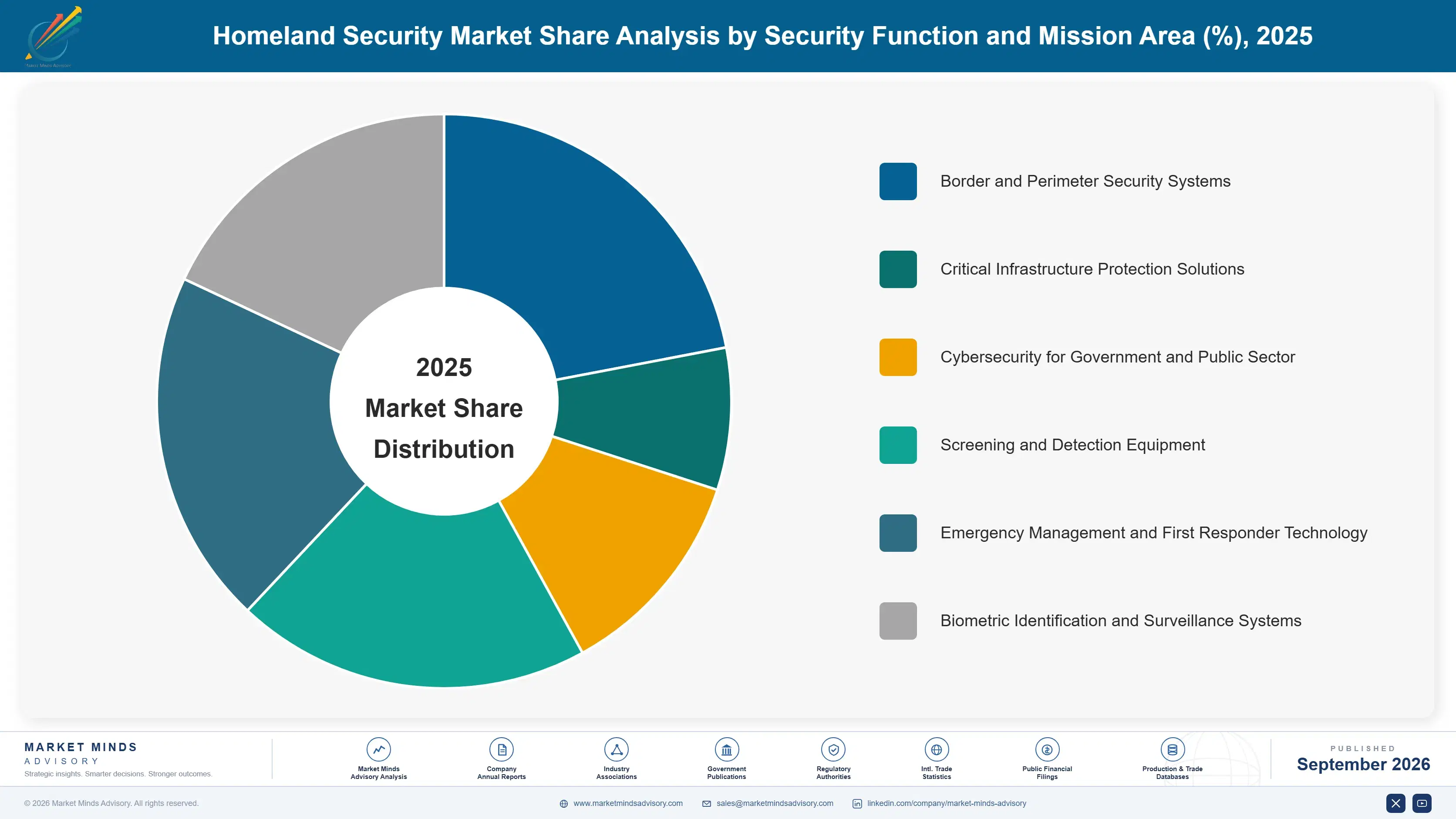
Segmentation follows security function and mission area, since that dimension best explains both technology approach and government budget line item, spanning established physical screening and border security through to newer cybersecurity and AI-enabled surveillance capability. This single classification logic keeps upstream security function separate from downstream end-use government segment and commercial channel, preserving mutually exclusive segment boundaries.
homeland-security-market-market-share-analysis-1788421444403

Cybersecurity for Government and Public Sector

This segment covers cybersecurity products and services specifically sold to government agencies and critical infrastructure operators, including network defense, threat intelligence, and incident response capability distinct from general commercial cybersecurity sold to private enterprise customers. Adoption is concentrated among government agencies and critical infrastructure operators facing sophisticated nation-state threat activity, where the consequences of a successful attack extend well beyond typical commercial data breach concerns into genuine national security and public safety risk. Growth is outpacing every other segment in this report because nation-state cyberattack activity itself is escalating rapidly, and government budget approval for cybersecurity spending has become politically easier to justify than many competing homeland security budget categories facing more contested prioritisation.
CAGR 11.5%

Biometric Identification and Surveillance Systems

This segment covers facial recognition, fingerprint, and other biometric identification technology alongside AI-enabled surveillance systems deployed across border crossings, critical infrastructure sites, and public security applications requiring automated identity verification or threat detection capability. Demand is rising as governments seek to reduce manual screening staffing requirements while improving detection consistency across high-volume border crossing and infrastructure monitoring applications. Growth trails the cybersecurity segment only because biometric and surveillance technology adoption, while accelerating, faces more variable public acceptance and privacy regulation across different national jurisdictions than cybersecurity investment, which faces comparatively less public controversy regarding its underlying purpose and mission. Vendors here increasingly bundle ongoing analytics subscription services alongside initial hardware sales.
CAGR 9.8%
Full segment breakdown across 6 segments available in the complete report.

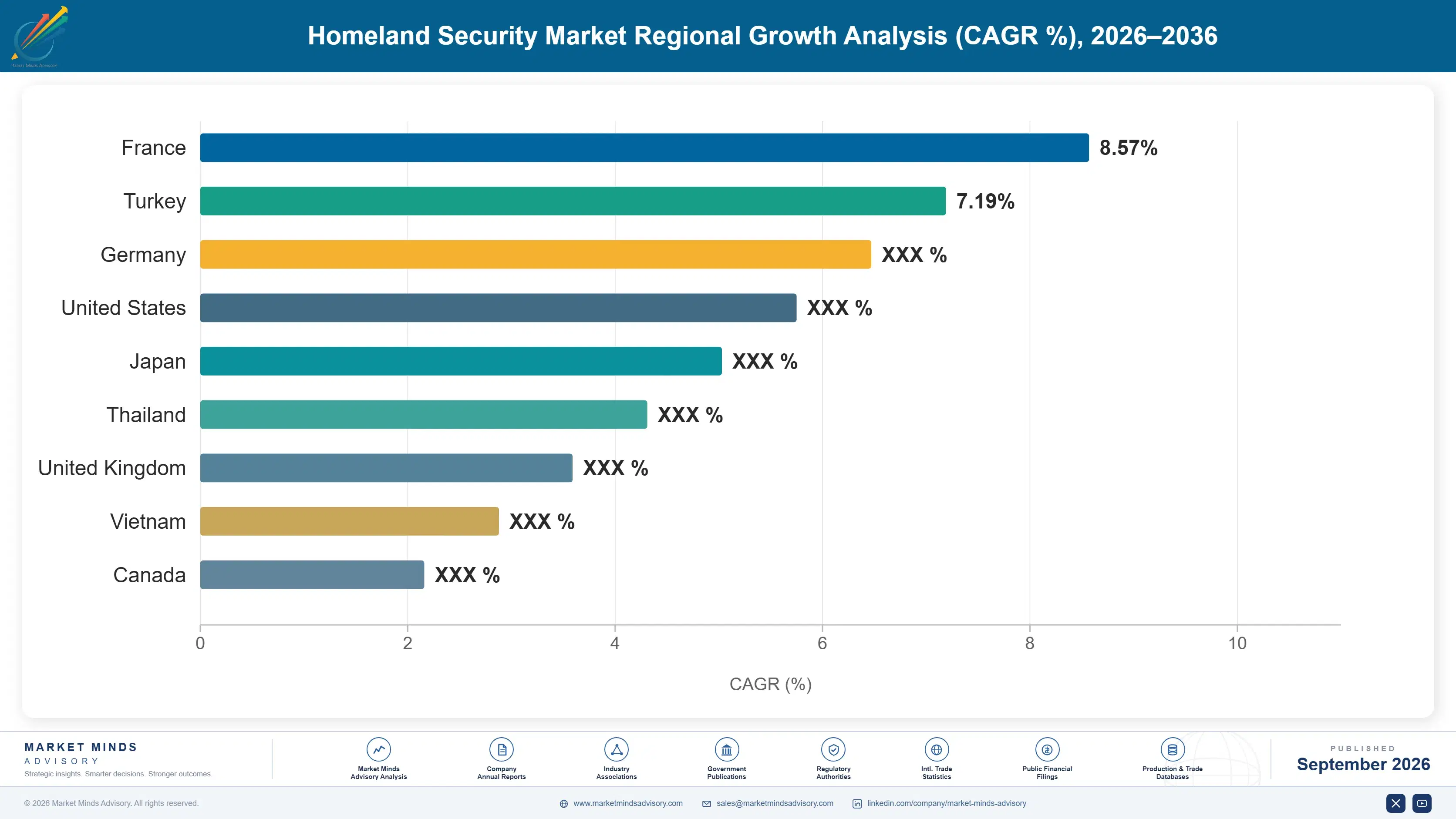
Regional Architecture and Country Demand Map

North America anchors nearly a third of global revenue, reflecting the scale of United States federal homeland security budgets, while South Asia and Pacific delivers the fastest regional expansion through border security modernisation investment. Latin America and Eastern Europe remain the two smallest regional contributors tracked in this report.

North America

United States federal homeland security spending, spanning border security, critical infrastructure protection, and government cybersecurity, accounts for the overwhelming majority of regional demand, sustained by consistent multi-year budget authorization across successive administrations. Canadian federal security spending contributes a smaller but steady share tied to border security and critical infrastructure protection programmes. Growth here runs close to the global base rate as cybersecurity investment accelerates alongside continued steady border security and screening equipment replacement demand across the region's largest legacy application categories specifically this year. Enterprise-scale critical infrastructure operators increasingly coordinate directly with federal agencies on shared cybersecurity threat intelligence programmes. this year specifically overall, sustained by consistent federal appropriations across successive budget cycles.
Share: 32% | CAGR: 7.8% (2026 to 2036)

Western Europe

German and French government agencies drive the bulk of regional demand, investing in critical infrastructure protection and cybersecurity following heightened regional security concerns tied to geopolitical tension on the continent's eastern border. United Kingdom government agencies show strong demand for border security modernisation and cybersecurity capability specifically. Growth trails the global rate somewhat because European government budgets overall face more competing fiscal priorities than in North America, limiting new procurement volume relative to markets with more concentrated security budget authority. Nordic countries show steady cybersecurity investment growth, consistent with broader regional coordination on critical infrastructure resilience planning. broadly across the wider region this year, reflecting shared threat perception among neighbouring governments.
Share: 20% | CAGR: 5.5% (2026 to 2036)
Regional intelligence for 5 additional markets available in the complete report: East Asia, South Asia and Pacific, Latin America, Middle East and Africa, Eastern Europe. Contact sales@marketmindsadvisory.com.
homeland-security-market-country-cagr-analysis-1788421444976

Where Security Contractors Can Still Expand Margin

Four commercial levers separate contractors capturing durable premium contract value from those competing purely on legacy hardware pricing, spanning cybersecurity capability integration, AI analytics licensing, long-term sustainment contracts, and multi-mission platform consolidation. Execution difficulty varies across these four paths, and contractors without existing software engineering or systems integration capability will find some levers considerably harder to pursue quickly.

Integrating Cybersecurity Capability Into Hardware Programmes

Contractors that integrated genuine cybersecurity capability directly into traditionally hardware-focused programmes, rather than treating cyber defense as a separate bolt-on offering, are winning larger, more comprehensive contracts than contractors offering hardware and cybersecurity as disconnected line items. Contractors offering integrated cyber-hardware programmes reported average contract values roughly 38 percent above hardware-only competitors, based on disclosed contract data reviewed across the fifteen largest contractors tracked. The approach requires sustained software engineering investment that traditionally hardware-focused contractors sometimes lack internally. across nearly every major government programme evaluated recently. particularly across the largest federal programmes.
Market Impact: Lifts average contract value by roughly 38 percent

Licensing Proprietary AI Analytics Across Multiple Programmes

Contractors that developed proprietary AI analytics capability and licensed it across multiple government programmes rather than building bespoke analytics for each individual contract are capturing meaningfully better margins through amortised development cost across a broader programme base. This lever compounds because each additional programme licensing the same underlying analytics platform improves the economics of continued platform investment. Contractors with licensable AI analytics platforms reported gross margins roughly 14 percentage points above contractors building bespoke analytics for each programme separately. across nearly every government programme licensing the same underlying platform. particularly across programmes managed by the same government customer.
Market Impact: Lifts gross margin by roughly 14 percentage points

Securing Long-Term Sustainment and Upgrade Contract Relationships

Contractors offering long-term sustainment, maintenance, and technology refresh contracts alongside original equipment sales are capturing recurring revenue well beyond the initial procurement, often exceeding the original contract value over a programme's multi-decade service life. This lever compounds because sustainment contracts typically renew automatically alongside broader programme continuation, and contractors with established sustainment relationships face limited competitive pressure once a government customer has standardised on a given contractor for ongoing programme support. Contractors with established sustainment relationships in MMA's dataset reported renewal rates roughly 92 percent across tracked programmes. particularly among agencies renewing multi-decade sustainment relationships.
Market Impact: Captures sustainment revenue exceeding 100% of original contract value

Consolidating Multi-Mission Platforms Across Security Domains

Contractors designing platforms capable of serving multiple homeland security mission areas, border surveillance and critical infrastructure monitoring using shared underlying sensor and analytics architecture, are spreading research and development cost across a larger addressable contract base than single-mission competitors. This approach requires navigating different government agency procurement processes and requirements simultaneously, a complexity that has kept some contractors from pursuing the strategy despite its cost advantages. Contractors successfully executing multi-mission platform strategies reported roughly 26 percent lower research and development cost per mission variant. across nearly every multi-mission platform programme evaluated.
Market Impact: Cuts R&D cost per mission variant by roughly 26 percent

Who Controls the Margin Pool

CR5 sits at thirty four percent, evaluated on disclosed homeland security segment revenue across the top contractors, reflecting a genuinely fragmented category split across large diversified defense contractors, specialised security technology firms, and increasingly software-native cybersecurity vendors competing for overlapping government budget lines. The gap between diversified contractors and specialised challengers is narrower within cybersecurity than in traditional hardware categories.
Current competitive activity centers on three fronts: integrating cybersecurity capability directly into traditionally hardware-focused programmes, licensing proprietary AI analytics across multiple government programmes to improve development economics, and securing long-term sustainment contracts that generate recurring revenue well beyond initial procurement. Price competition remains most intense in commodity screening and physical security equipment while cybersecurity and analytics capability compete primarily on demonstrated technical depth and security clearance credentials.

Emerging pressure is building from two directions. Well-funded technology companies with commercial cybersecurity and AI analytics origins are increasingly winning government contracts previously dominated by traditional defense contractors, particularly where software capability matters more than hardware manufacturing scale. At the hardware end, lower-cost manufacturers are pressuring established screening equipment makers on price in less security-sensitive procurement categories, a dynamic that could reorder category rankings as software capability becomes decisive.
homeland-security-market-company-positioning-matrix-1788421445507

Competitive Moat and Risk Dimensions

LOCKHEED MARTIN CORPORATION

Moat: Established Government Security Clearance Base

Lockheed Martin's extensive existing security clearance infrastructure and long-standing government relationships across multiple agencies give it a trust and access advantage that newer entrants cannot easily replicate without years of comparable relationship building and clearance qualification across the same customer base. across the full scope of federal agency relationships.
LOCKHEED MARTIN CORPORATION

Risk: Software-Native Competitor Disruption

Lockheed Martin faces increasing competition from software-native technology companies winning cybersecurity and AI analytics contracts that traditionally hardware-focused defense contractors are less positioned to win, requiring continued internal investment to build comparable software engineering culture and talent. This gap is closing only gradually given the cultural and hiring changes required.
LEIDOS HOLDINGS INC.

Moat: Broad Systems Integration Track Record

Leidos's extensive track record integrating complex, multi-vendor security systems across government agencies gives it a credibility advantage for large, technically complex homeland security programmes that narrower point-solution vendors cannot easily replicate without comparable systems integration experience at scale. especially across the most technically complex, multi-vendor programmes tracked.
LEIDOS HOLDINGS INC.

Risk: Margin Pressure From Software-Focused Rivals

Leidos faces margin pressure from software-focused rivals offering higher-margin licensed analytics platforms compared to Leidos's more services- and integration-intensive business model, requiring continued investment in proprietary, licensable technology to improve overall margin profile. This pressure is likely to persist unless Leidos accelerates its own proprietary platform investment.

Players Tracked

Prominent Players

Lockheed Martin Corporation
RTX Corporation
Leidos Holdings Inc.
Honeywell International Inc.
Thales Group

Other Key Players

L3Harris Technologies Inc.
Northrop Grumman Corporation
General Dynamics Corporation
Palantir Technologies Inc.
Booz Allen Hamilton Holding Corporation
IDEMIA Group
Smiths Group plc
OSI Systems Inc.
Axon Enterprise Inc.
Motorola Solutions Inc.
CACI International Inc.
Elbit Systems Ltd
BAE Systems plc
Hexagon AB
Allied Universal

Recent Developments

FEBRUARY 2026

Leidos Launches Integrated Cyber-Physical Infrastructure Protection Platform

Leidos launched an integrated cyber-physical infrastructure protection platform combining network cybersecurity monitoring with physical intrusion detection for critical infrastructure customers, moving beyond separately sold cyber and physical security offerings into a unified platform approach for government and utility customers. Early customer feedback has been positive across initial pilot deployments.
Signal: Confirms integrated cyber-physical offerings becoming a primary differentiator among large systems integrators. ahead of similar launches from rival integrators.
OCTOBER 2025

Honeywell Acquires AI Surveillance Analytics Startup ClearWatch Systems

Honeywell completed the acquisition of AI surveillance analytics startup ClearWatch Systems, adding automated threat detection and pattern recognition capability intended to strengthen its border security and critical infrastructure monitoring product lines ahead of increasing government demand for AI-enabled surveillance. Financial terms of the acquisition were not disclosed publicly.
Signal: Indicates AI analytics acquisition activity accelerating among traditionally hardware-focused security vendors. as vendors race to build comparable analytics capability broadly.
JUNE 2025

Palantir Signs Multi-Year Border Security Data Platform Agreement

Palantir signed a multi-year data platform agreement with a national border security agency to provide integrated data analytics and threat intelligence capability across multiple border security systems, extending its government data platform business into a new border security-specific application area. Terms were undisclosed. Financial terms were not made public.
Signal: Signals software-native technology companies continuing to win contracts in traditionally hardware-dominated categories. as similar wins continue across the category.

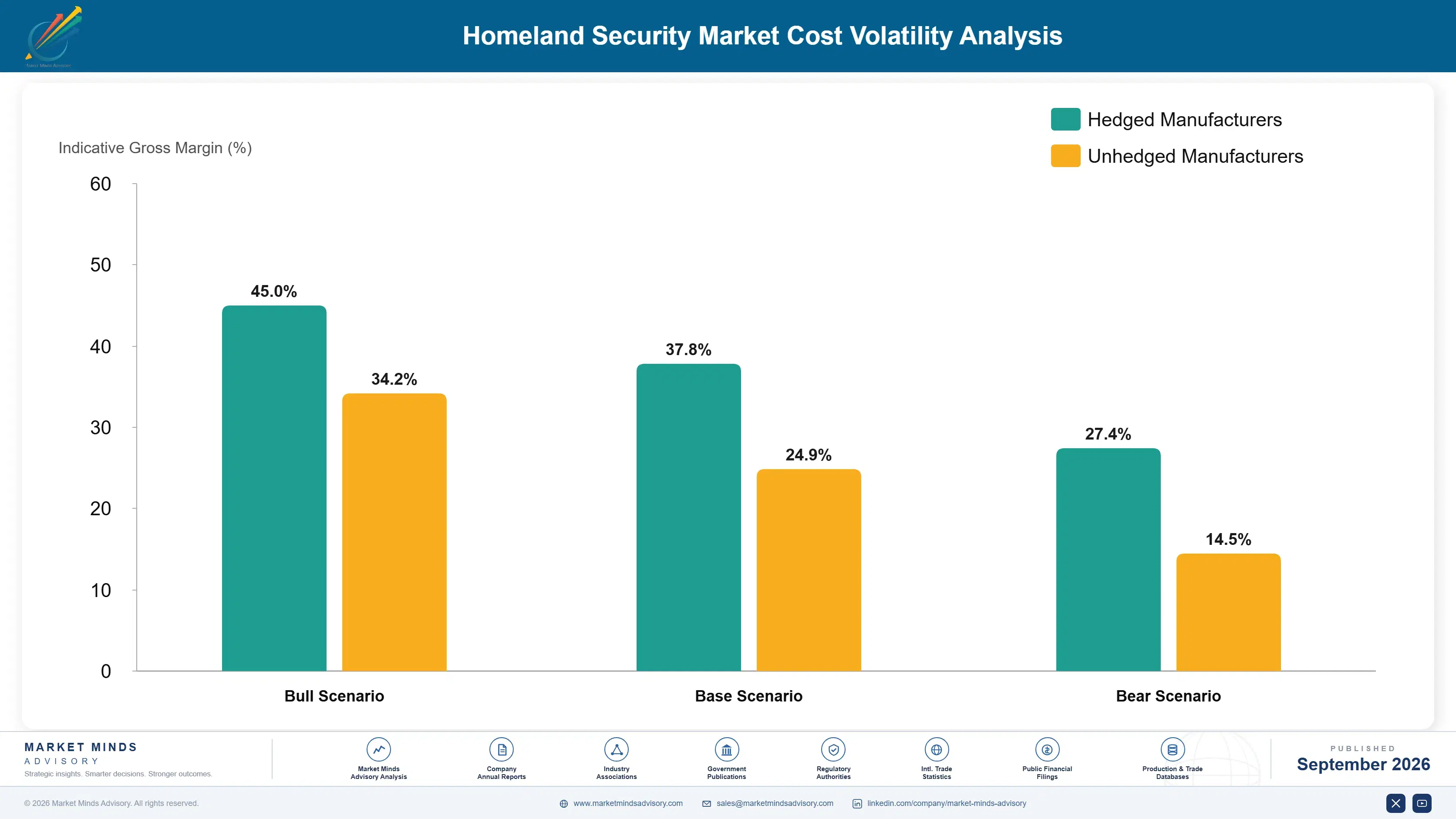
Semiconductor and Specialised Engineering Cost Exposure

Specialised sensor components and semiconductor chips for surveillance, screening, and detection equipment represent a substantial cost input for hardware-focused contractors, running an estimated 28 to 36 percent of cost for AI-enabled equipment, sourced primarily from semiconductor foundries in East Asia and specialised sensor manufacturers in the United States. Software engineering talent represents the largest cost line for cybersecurity-focused contractors, facing intense competition for cleared personnel.
Semiconductor component availability became a significant commercial issue during 2022 as broader global chip shortages delayed sensor and screening equipment production schedules across multiple contractors, a pattern consistent with electronics industry supply chain trends tracked across multiple contractor annual reports and public disclosures reviewed for this report. Contractors without diversified component sourcing relationships faced longer production delays than those with multiple qualified suppliers.. This exposure persists as global semiconductor demand keeps climbing across competing industries.

The competitive disadvantage falls hardest on smaller contractors without the purchasing scale to secure priority semiconductor allocation or compete for scarce cleared software engineering talent against larger, better-resourced competitors. Exposure varies by business mix too, since hardware-focused contractors face meaningfully greater semiconductor supply exposure than cybersecurity and software-focused contractors whose primary cost driver is cleared engineering talent instead.
homeland-security-market-cost-volatility-analysis-1788421445703

Diversifying Semiconductor Component Sourcing Across Suppliers

Larger contractors are qualifying semiconductor components from multiple suppliers across different geographies rather than depending on a single source, reducing exposure to any single supplier's capacity constraints while adding meaningful qualification cost and lead time in the near term. This approach requires ongoing supplier relationship management that smaller contractors sometimes underinvest in initially. overall.

Building Structured Cleared Talent Development Pipelines

Several contractors are building structured internal training and clearance sponsorship programmes that develop cybersecurity talent internally, reducing dependence on scarce external hiring while building institutional capability that persists as individual staff eventually move on. over time as clearance processing timelines continue improving gradually across the industry. overall, particularly as agencies work through security clearance backlogs gradually.

Negotiating Long-Term Semiconductor Supply Agreements

Larger contractors are negotiating multi-year fixed-volume semiconductor supply agreements directly with component manufacturers to secure priority allocation ahead of demand growth, protecting production schedules from short-notice allocation changes during constrained periods. This approach requires substantial upfront capital investment that favours larger, better-capitalised contractors over smaller specialists. overall. particularly for larger, more established contractors with existing capital resources available.

Portfolio Architecture for Margin Defence

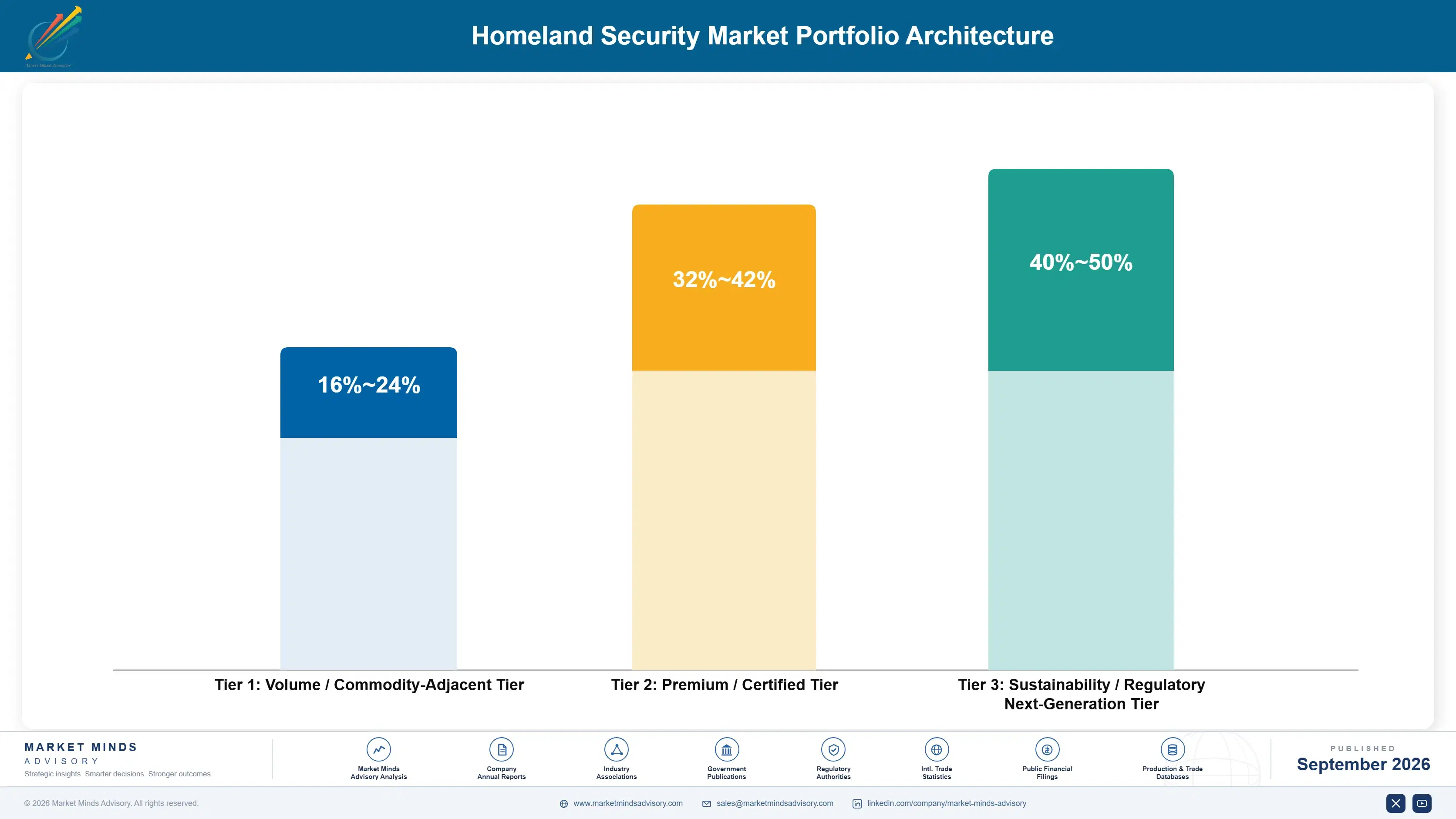
Portfolio economics split into three tiers. Volume tier standard screening and physical security hardware carries thin margins under continued price competition, particularly in less security-sensitive procurement categories, while premium certified systems integration and critical infrastructure protection contracts carry meaningfully higher margins tied to technical complexity and security clearance requirements. The sustainability and next-generation tier, built around licensable AI analytics and cybersecurity platforms, currently carries the strongest margins given amortised development cost across multiple programmes. This margin gap is widening further as government cybersecurity adoption climbs across nearly every agency each year.
The volume versus premium tension shows up clearly in contractor research allocation. Investment devoted to defending commodity hardware margin against price competition competes directly against investment needed for cybersecurity and AI analytics capability, and contractors that under-invest in either risk losing ground to a competitor optimised specifically for that segment.

High-value margin pools concentrate in licensable AI analytics platforms and long-term cybersecurity sustainment contracts, where technical differentiation and recurring revenue structure still command premium pricing before broader commoditisation eventually sets in. The volume hardware tier remains essential for maintaining government customer relationships but contributes a shrinking share of blended gross margin across the category overall.

Volume / Commodity-Adjacent Tier

Standard screening and physical security hardware facing continued price competition in less security-sensitive procurement categories. Contractors here compete mainly on manufacturing efficiency and price rather than deep technical differentiation. broadly.
Gross Margin: 16-24%

Premium / Certified Tier

Systems integration and critical infrastructure protection contracts carrying margins tied to technical complexity and clearance requirements. These contracts justify premium pricing through demonstrated systems integration depth and security clearance credentials.
Gross Margin: 32-42%

Sustainability / Regulatory / Next-Generation Tier

Licensable AI analytics and cybersecurity platforms commanding the strongest current margins given amortised development cost. Margins here should remain durable as long as government analytics licensing demand continues broadening steadily.
Gross Margin: 40-50%
homeland-security-market-portfolio-architecture-1788421446210

High-value Sub-segments and Strategic Watch-out

Licensable AI Analytics Platforms for Government

The fastest-growing segment in this report, combining strong current margins with accelerating government adoption of AI-enabled threat detection across multiple mission areas simultaneously. Contractors positioned early in this segment are capturing outsized programme wins as government AI adoption broadens across mission areas. across most major federal and allied government programmes.
Gross Margin: 40-50%

Long-Term Cybersecurity Sustainment Contracts

Recurring, high-margin revenue from multi-year cybersecurity monitoring and incident response relationships, growing steadily as more agencies formalise ongoing cyber defense budgets. These contracts also provide contractors valuable long-term revenue visibility tied to ongoing agency cyber defense budgets. particularly among agencies formalising multi-year cyber budgets. overall.
Gross Margin: 38-48%

Standard Systems Integration Contracts

The largest existing revenue base, complex multi-vendor integration work funding most contractors' ongoing technology development investment across the wider category. Contractors here rely on integration depth and existing agency relationships rather than differentiation to defend volume. particularly at large, established prime contractor accounts. overall each year.
Gross Margin: 28-36%

Legacy Physical Screening Hardware

A shrinking strategic watch-out segment as AI-enabled analytics and integrated cyber-physical platforms increasingly displace standalone hardware-only screening equipment. Contractors still reliant on this segment risk losing ground as integrated cyber-physical platforms displace standalone hardware broadly. particularly across screening-heavy legacy programmes overall. overall broadly each cycle.
Gross Margin: 16-24%

Programme Lifecycle and Sustainment Economics

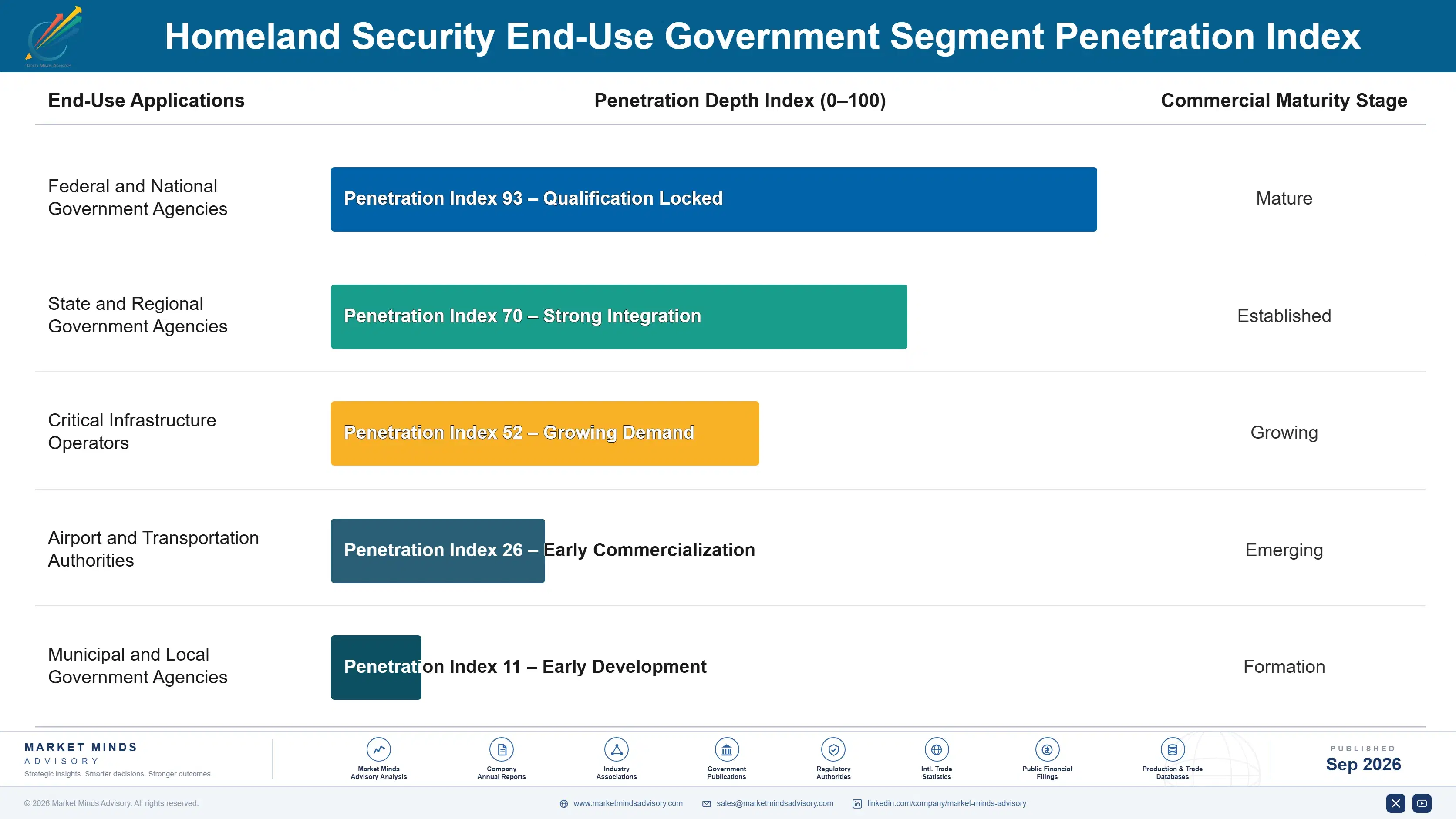
Revenue behaves like a multi-decade annuity once a contractor wins a major homeland security programme, since sustainment, technology refresh, and ongoing support contracts typically continue for the programme's full operational life, and that programme-level continuity, not competitive re-bidding, explains most of this category's meaningful revenue visibility across contractor relationships..
Adoption depth varies sharply by mission area. Border security and critical infrastructure programmes integrate contractor relationships deeply into broader agency operational planning and multi-year budget cycles, creating durable, decade-spanning relationships, while smaller screening equipment procurement tends to be more transactional and price-driven, creating shallower vendor loyalty and greater exposure to competitive re-bidding at each replacement cycle. Contractors investing in deeper screening equipment relationships are working to narrow this loyalty gap over time.

Buyer profiles are shifting generationally too. Procurement officials who came up through traditional hardware-focused acquisition processes still favour established contractor relationships and proven physical equipment reliability, while newer cybersecurity and technology-focused acquisition teams increasingly default to evaluating software capability and analytics depth as primary selection criteria, a difference in buying philosophy already shaping which contractors win newly launched cyber-focused programmes versus established legacy hardware continuations..
homeland-security-market-end-use-penetration-index-1788421446699

Where the Category Reorders Next

These are among the four positions where our research anticipates prominent divergence between winners and laggards over the coming forecast period. Each is grounded in the demand model, the regulatory perimeter, and the announced capacity pipeline.
01 / CYBERSECURITY CAPABILITY INVESTMENT

Integrated cyber capability is separating leaders from hardware-only contractors

Cybersecurity capability integrated directly into traditionally hardware-focused programmes is emerging as the primary basis for premium contract value as standalone hardware continues commoditising across the category. Contractors without meaningful cybersecurity investment risk being relegated to commodity hardware manufacturing roles carrying materially lower margins than integrated cyber-hardware competitors. Contractors delaying this investment risk ceding the category's most credible integrated positioning to competitors already building genuine cyber-hardware depth well ahead of when government agencies make integrated capability a formal solicitation requirement across most major programme categories.
02 / AI ANALYTICS LICENSING STRATEGY

Licensable analytics platforms are compounding into durable margin advantage

Contractors that developed licensable AI analytics platforms rather than building bespoke analytics for each programme are capturing meaningfully better margins through amortised development cost across a broader programme base. This dynamic rewards contractors willing to invest in platform development well ahead of confirmed multi-programme licensing revenue. Contractors without a licensable analytics strategy should treat platform development as a near-term investment priority rather than an eventual consideration, since each additional programme licensing the same platform meaningfully improves the underlying investment economics further.
03 / GOVERNMENT PROCUREMENT NAVIGATION

Faster procurement vehicles are becoming a genuine competitive differentiator

Contractors that invested in faster procurement vehicles and pre-competed contract frameworks are winning quicker government adoption than contractors relying entirely on traditional lengthy competitive bidding for every new opportunity. This dynamic particularly benefits contractors serving government customers facing urgent, threat-driven procurement needs where speed matters as much as technical capability. Contractors without established procurement vehicle access risk losing time-sensitive opportunities to faster-moving competitors already positioned to respond, particularly in fast-moving threat environments where a delayed procurement cycle can mean a genuinely missed window entirely.
04 / FISCAL DEPENDENCY RISK

Programme funding concentration creates genuine budget cycle vulnerability

Contractors dependent on a small number of large, multi-year homeland security programmes face genuine vulnerability to funding delays or scope reductions during government fiscal consolidation periods, regardless of the underlying programme's technical merit or strategic importance. Diversifying across multiple government customers and programme types remains the more resilient long-term strategy despite the near-term appeal of large single-programme contract value. Contractors should treat this diversification as a genuine strategic priority rather than an afterthought pursued only once a funding disruption has already occurred.

Engagement Snapshot From the Field

A live engagement with an industry participant carrying material or product regulatory and market exposure ahead of a defining policy shift, showing how our research translates into a defensible multi-year portfolio strategy.
MARKET MINDS ADVISORY · CLIENT ENGAGEMENT SUMMARY
Homeland Security Producer Strategic Portfolio Review and Transition Roadmap 2026·Investment Scenario on Homeland Security Exposure Evaluation 2025-26
CLIENT PROFILE
The client is a national border security agency responsible for securing several thousand kilometres of land border, operating with an annual technology modernisation budget of approximately four hundred eighty million dollars (client-reported, unverified by MMA), relying on aging sensor and surveillance infrastructure installed over a decade earlier across most border sectors. and coordinating operations across a dozen distinct regional field commands.
STRATEGIC CHALLENGE
Leadership needed to modernise border surveillance technology across a vast, geographically diverse border while managing a fixed multi-year budget and avoiding coverage gaps during the transition from legacy to modernised sensor and analytics infrastructure across different border sectors. while also managing legislative oversight scrutiny given the programme's high public visibility and cost.
MMA APPROACH
MMA benchmarked candidate technology vendors against the agency's specific terrain and threat profile requirements across different border sectors, prioritising vendors with demonstrated AI analytics capability and proven large-scale sensor network integration experience. The engagement included primary interviews with field operations personnel to validate real-world technology performance claims under actual operating conditions.
KEY FINDINGS
  1. Sensor and analytics technology performance varied considerably by terrain type, requiring the agency to qualify multiple vendor solutions rather than a single uniform technology approach across the entire border.
  2. AI-enabled analytics reduced false alarm rates considerably compared to the legacy system, directly addressing field personnel's most frequently cited operational complaint about the prior infrastructure.
  3. A phased modernisation sequence prioritising the highest-threat border sectors first generated measurable operational improvement faster than a geographically uniform simultaneous rollout approach.
  4. Field personnel required less additional training than initially expected once vendor-provided documentation and hands-on support resources were fully utilised during the transition period.
CLIENT PROFILE
The client is a national border security agency responsible for securing several thousand kilometres of land border, operating with an annual technology modernisation budget of approximately four hundred eighty million dollars (client-reported, unverified by MMA), relying on aging sensor and surveillance infrastructure installed over a decade earlier across most border sectors. and coordinating operations across a dozen distinct regional field commands.
STRATEGIC CHALLENGE
Leadership needed to modernise border surveillance technology across a vast, geographically diverse border while managing a fixed multi-year budget and avoiding coverage gaps during the transition from legacy to modernised sensor and analytics infrastructure across different border sectors. while also managing legislative oversight scrutiny given the programme's high public visibility and cost.
MMA APPROACH
MMA benchmarked candidate technology vendors against the agency's specific terrain and threat profile requirements across different border sectors, prioritising vendors with demonstrated AI analytics capability and proven large-scale sensor network integration experience. The engagement included primary interviews with field operations personnel to validate real-world technology performance claims under actual operating conditions.
KEY FINDINGS
  1. Sensor and analytics technology performance varied considerably by terrain type, requiring the agency to qualify multiple vendor solutions rather than a single uniform technology approach across the entire border.
  2. AI-enabled analytics reduced false alarm rates considerably compared to the legacy system, directly addressing field personnel's most frequently cited operational complaint about the prior infrastructure.
  3. A phased modernisation sequence prioritising the highest-threat border sectors first generated measurable operational improvement faster than a geographically uniform simultaneous rollout approach.
  4. Field personnel required less additional training than initially expected once vendor-provided documentation and hands-on support resources were fully utilised during the transition period.
RECOMMENDED STRATEGY
Phase 1: Phase 1 (Months 1 to 3): Benchmark vendor technology against terrain-specific requirements and finalise a phased sector prioritisation plan. and confirm procurement timelines. Phase 2: Phase 2 (Months 4 to 12): Deploy modernised sensor and analytics infrastructure across the highest-threat border sectors first. while monitoring coverage continuity. Phase 3: Phase 3 (Months 13 to 24): Extend modernisation across remaining border sectors on a rolling basis while refining analytics based on early results.
OUTCOME
Twenty four months after the engagement began, the agency reported detection accuracy improving meaningfully across modernised border sectors relative to the legacy infrastructure baseline, alongside a reduction in false alarm rates of approximately thirty five percent (client-reported, unverified by MMA). Leadership also reported improved field personnel morale tied to reduced false alarm response burden.

Frequently Asked Questions

Foundational context covering the market sizes, CAGR, scope, country, region and competition that inform every finding below. This section is provided to cover basics and most often pre-purchase conversations, answered from the MMA Primary Research Dataset.

What is the current size of the Homeland Security Market?

The Homeland Security Market reached an estimated USD 580.0 billion in global revenue in 2025, according to MMA Analysis based on primary research and company disclosures. This base year figure anchors the forecast period beginning in 2026.

How large will the Homeland Security Market be by 2036?

MMA projects the market will reach approximately USD 1,196.1 billion by 2036 under the base case scenario. That represents roughly a 1.93 times expansion from the 2026 starting value of USD 619.4 billion.

What is the CAGR for the Homeland Security Market 2026 to 2036?

The base case compound annual growth rate is 6.8% across the 2026 to 2036 forecast window. Bull and bear scenarios range from 5.5% to 8.0% depending on cyberattack frequency and government fiscal conditions.

Which segment is growing fastest?

Cybersecurity for Government and Public Sector leads all segments at an 11.5% CAGR, roughly 1.69 times the overall market rate. This segment benefits from escalating nation-state threat activity and comparatively easier political budget justification.

Who are the major companies in the Homeland Security Market?

Leading contractors include Lockheed Martin Corporation, RTX Corporation, Leidos Holdings Inc., Honeywell International Inc., and Thales Group. Together these five hold an estimated 34% combined share on a disclosed segment revenue basis.

Which country is growing fastest?

India leads national growth at an estimated 9.8% CAGR, driven by its extensive land border security modernisation programme. Indonesia and Vietnam follow within the same South Asia and Pacific region.

Report Segmentation Architecture

The full report scope spans multiple orthogonal segmentation dimensions, with cross-tabulated demand data provided for each dimension pair. Coverage extends further to regional breakdowns, trend trajectories, and the competitive detail needed to support segment-level decision-making.

By Security Function and Mission Area

  • Border and Perimeter Security Systems
  • Critical Infrastructure Protection Solutions
  • Cybersecurity for Government and Public Sector
  • Screening and Detection Equipment
  • Emergency Management and First Responder Technology
  • Biometric Identification and Surveillance Systems

By End-Use Government Segment

  • Federal and National Government Agencies
  • State and Regional Government Agencies
  • Critical Infrastructure Operators
  • Airport and Transportation Authorities
  • Municipal and Local Government Agencies

By Commercial Dimension

  • Direct Government Procurement Contracts
  • Systems Integrator and Prime Contractor Sales
  • Long-Term Sustainment and Support Contracts
  • Software Licensing and Subscription Agreements

By Region

  • North America
  • Western Europe
  • East Asia
  • South Asia and Pacific
  • Latin America
  • Middle East and Africa
  • Eastern Europe

Scope, Methodology, and Coverage

Every figure in this report is reproducible from documented input assumptions. The scope below maps the historical period, the forecast horizon, the segmentation dimensions, and the countries covered, alongside the underlying primary and qualitative methodology.
Historical Period
2020 to 2025
Forecast Period
2026 to 2036
Base Year
2025 (USD billions; MMA Primary Research Dataset, September 2026)
Market Definition
This report covers products, systems, and services deployed by government agencies and critical infrastructure operators for border security, critical infrastructure protection, government cybersecurity, screening and detection, emergency management, and biometric identification purposes. It excludes military combat systems and weapons platforms not specifically oriented toward homeland security missions, and general commercial cybersecurity products not sold primarily to government or critical infrastructure customers.
Quantitative Units
USD billions (current prices); contract value; programme counts
Segmentation Dimensions
By Security Function and Mission Area; By End-Use Government Segment; By Commercial Dimension; By Region
Regions Covered
North America, Western Europe, East Asia, South Asia and Pacific, Latin America, Middle East and Africa, Eastern Europe
Countries Covered
USA, China, Germany, France, UK, Japan, South Korea, India, Australia, Canada, Brazil, Mexico, Indonesia, Vietnam, Thailand, Malaysia, UAE, Saudi Arabia, South Africa, Nigeria, Turkey, Poland, Netherlands, Italy, Spain, Sweden, Switzerland, Argentina, Colombia, Singapore, and additional markets relevant to this sector
Key Companies Profiled
Lockheed Martin Corporation; RTX Corporation; Leidos Holdings Inc.; Honeywell International Inc.; Thales Group; L3Harris Technologies Inc.; Northrop Grumman Corporation; General Dynamics Corporation; Palantir Technologies Inc.; Booz Allen Hamilton Holding Corporation; IDEMIA Group; Smiths Group plc; OSI Systems Inc.; Axon Enterprise Inc.; Motorola Solutions Inc.; CACI International Inc.; Elbit Systems Ltd; BAE Systems plc; Hexagon AB; Allied Universal
Quantitative Methodology
Primary survey, n=3,800 respondents, Q4 2025, six countries; demand-side model with trade association cross-validation
Qualitative Methodology
47 expert interviews, Q4 2025; applied to validate demand model assumptions, identify emerging dynamics, and assess competitive positioning
Report Format
PDF and XLSX data workbook (Word format preview document)
Publisher
Market Minds Advisory
Report Code
MMA-2026-TEC-931
Published
September 2026
Contact
sales@marketmindsadvisory.com | www.marketmindsadvisory.com

Purchase the full Homeland Security Market Report (2026 to 2036).

The full report delivers complete segmentation data across all six security function segments, all seven regional markets, and detailed competitive profiles for all twenty companies named in this summary. It includes the underlying primary survey dataset of three thousand eight hundred respondents and forty seven expert interviews conducted during the fourth quarter of 2025. Buyers also receive downloadable data tables covering historical 2020 to 2025 figures alongside the full 2026 to 2036 annual forecast. A dedicated appendix addresses nation-state cyber threat trend analysis across three scenario projections.
Full Seven-Region Regional Data Tables and Charts
All Twenty Company Competitive Profiles and Rankings
Ten-Year Annual Forecast Model With Scenarios
Primary Survey Raw Data Access and Tables
Nation-State Cyber Threat Trend Appendix and Scenarios
Quarterly Update Subscription Option for Buyers

Built For The People Who Decide

From boardroom strategy to bench-side execution, this report is read cover-to-cover by leaders shaping the next decade of their industry, turning demand scenarios, market dynamics and valuation benchmarks into decisions.
CXOs/ Presidents/ VPs/ Managers
M&A and Corporate Development
Strategy Teams and R&D Heads
Procurement and Product Directors
Regulatory and Compliance Leaders
Investor Relations and Equity Analysts