Market Minds Advisory
Home Security Sensors Market

Home Security Sensors Market: Home Security Sensors Market. Smart Home Integration Converts Standalone Alarms Into Connected Platforms

Rising smart home platform adoption is pulling standalone door, window, and motion sensors into connected home networks that homeowners monitor remotely, reshaping purchase decisions once driven almost entirely by professional installers.

Lead Analyst

Published

September 2026

Make Smarter Decisions with Customized Research Insights

Request a free sample report and evaluate market opportunities, growth trends, and competitive dynamics relevant to your business needs.

2025 MARKET VALUE$5.6BMarket Size 2025
2036 FORECAST VALUE$14.8BBase Case , 2026 to 2036
CAGR 2026 TO 20369.2 %Bull 10.4% / Bear 8.0%
INCREMENTAL OPPORTUNITY$8.6BNet 10- year value creation
EXPANSION MULTIPLE2.41x2036 value over 2026 base
Strategic Levers
M&A Pipeline
Regional Outlook
Country Rankings
Competitive Intelligence
Segmental Deep-dive
Call-Us : 91 93563 13602

Executive Snapshot and Market Trajectory.

Smart home platform integration is converting standalone door, window, and motion sensors into connected devices that homeowners monitor and control remotely, replacing the professionally installed hardwired systems that dominated the category for decades across most residential markets, rental housing segments, multi-family apartment communities, and short-term vacation property portfolios.
Motion and entry sensors still anchor the bulk of current unit volume, but smart lock and access sensors are pulling installed base growth faster as renters and homeowners alike adopt keyless entry systems that integrate directly with existing smart home platforms, reshaping retail distribution channels well beyond traditional professional installation relationships and monitoring contracts across most residential markets nationwide and across rental property portfolios, property management companies, and short-term vacation rental operators.
Competitive intensity concentrates around platform interoperability and subscription monitoring attachment rather than raw sensor sensitivity specifications, as vendors race to certify compatibility across the widest possible set of smart home platforms ahead of consumers committing to a single brand for their entire connected home purchase across multiple device categories, years of ongoing subscription commitments, and future equipment upgrades or replacements made across the entire household.
Market Definition
The home security sensors market covers motion, entry, glass break, smoke, carbon monoxide, water leak, and smart lock sensors sold for residential security and monitoring applications. It excludes standalone security cameras, professional monitoring service subscriptions sold separately from hardware, and commercial or industrial-grade security sensor systems.
Base Year Value
$5.6B in 2025 (MMA Primary Research Dataset, September 2026)
Forecast Period
2026 to 2036, eleven discrete annual values
CAGR
9.2% base case. Bull 10.4%. Bear 8.0%.
Fastest Growth Segment
Smart Lock and Access Sensors: 13.5% CAGR
Fastest Growth Country
Mexico: 10.5% CAGR
Fastest Growth Region
South Asia and Pacific: 11.2% CAGR
Largest Region
North America: 32% of 2025 global value
Market Leaders
Ring, ADT, Honeywell, Johnson Controls, and SimpliSafe lead the competitive landscape. Source: MMA Primary Research Dataset, July 2026.
Primary Survey
n=3,800 procurement and R&D decision-makers, Q4 2025, six countries
Methodology
Demand-side build-up, cross-validated against public data, 47 expert interviews

Home Security Sensors Market Forecast Scenarios

home-security-sensors-market-size-forecast-scenario-1790004993103
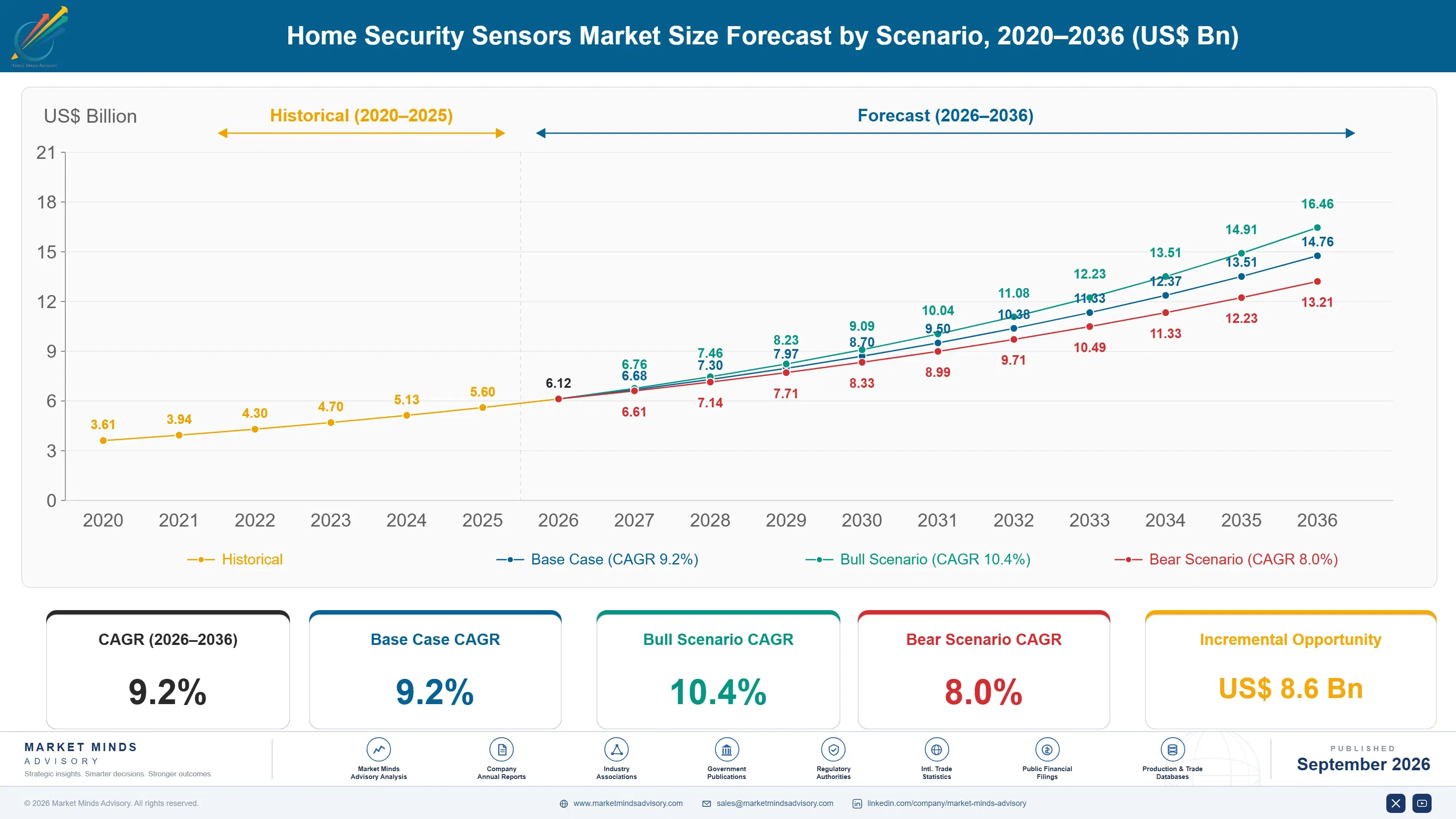
Between 2020 and 2025 home security sensor demand progressed steadily as DIY installation kits gradually displaced professionally installed systems, with smart lock and access sensor adoption entering the mainstream only toward the end of the period, producing a historical CAGR of 8.4 percent that understates the pace now underway as smart home platform integration deepens across most residential segments.
The base case assumes three commercial mechanisms compound together: falling wireless sensor and connectivity hardware costs make comprehensive home sensor coverage economically viable across mid-market households, insurance premium discount programs increasingly reward homes with monitored water leak and smoke sensor coverage, and smart home platform vendors increasingly bundle sensor compatibility certification into their broader device lineups rather than leaving interoperability to third-party sensor makers alone across every new product launch.
A bull scenario builds on accelerated insurance industry adoption of sensor-based premium discount programs that pull forward household sensor purchases years ahead of current timelines across major residential insurance markets. The bear case centers on smart home platform consolidation around a small number of dominant platforms, eroding independent sensor vendor differentiation and compressing pricing power industry-wide.

Platform Compatibility Now Drives Sensor Purchase Decisions

Homeowners increasingly evaluate sensor brands on smart home platform compatibility and app integration quality before comparing detection range or battery life specifications directly, a shift that rewards vendors able to demonstrate certified interoperability across the widest range of existing household devices simultaneously rather than a single flagship hub configuration alone, since most households already own multiple competing smart devices from several different manufacturers today.
MARKET CONCENTRATIONCR5 42%Top five vendors hold meaningfully fragmented but consolidating share
AVERAGE SENSOR PRICE$34 per unitTypical retail price for a standard wireless entry sensor
TOP ADOPTING COUNTRY SHAREUnited States 27%Largest single-country base of installed home security sensors
SMART PLATFORM COMPATIBILITY5 major platformsTypical number of smart home platforms a leading sensor supports
SUBSCRIPTION ATTACHMENT RATE58%Share of sensor purchasers also subscribing to monitoring services
BATTERY REPLACEMENT CYCLE18 monthsTypical interval before households replace standard sensor batteries
Renters and multi-family property managers favor sensor kits bundled with self-monitoring subscription apps, since professional installation and long-term monitoring contracts alone rarely fit the shorter tenancy timelines and budget constraints that rental households typically face when furnishing a new residence or apartment unit ahead of a scheduled move-in date each annual lease renewal and property turnover cycle.
Sensor development remains concentrated among a small number of vendors with deep smart home platform partnerships, though rising demand from insurance-linked monitoring programs is pushing some smaller vendors toward specialized water leak and environmental sensor niches that larger incumbents deprioritize given limited near-term deal volume and uncertain long-term account commitments across smaller regional insurance carriers, their underwriting partners, and various reinsurance backers across the country.
"A sensor that can't talk to the customer's existing smart speaker or hub is dead on arrival at the shelf. Detection range and battery life barely matter next to that one compatibility question."
Senior Analyst, Connected Home and Consumer Security Practice · MMA Technology Practice · September 2026

Market Trends

Insurance Discount Programs Accelerate Sensor Adoption

Homeowner insurance carriers increasingly offer premium discounts to policyholders who install monitored water leak and smoke sensors, treating verified sensor coverage as a measurable risk reduction factor worth pricing into underwriting decisions rather than a generic safety recommendation buried in policy paperwork. Sensor vendors are responding by building direct data-sharing partnerships with insurance carriers, letting homeowners automatically qualify for discounts without manually submitting proof of installation through separate paperwork processes. This trend is pulling water leak and environmental sensor purchases forward among homeowners who previously viewed these categories as optional upgrades rather than essential household equipment this year.
Market Impact: Cuts per-sensor cost by 27 percent

DIY Installation Displaces Professional Monitoring Contracts

Wireless sensor kits with simplified peel-and-stick mounting and smartphone app pairing are increasingly displacing the professionally installed hardwired systems that dominated home security for decades, letting consumers set up comprehensive sensor coverage within an hour without scheduling a technician visit or signing a multi-year monitoring contract with a third party. Retailers report meaningfully higher sensor kit sell-through when DIY installation options sit alongside professionally monitored alternatives on store shelves, since price-sensitive consumers increasingly favor the lower upfront cost and installation flexibility that self-installed systems provide across rental and owned properties alike.
Market Impact: Adds 19 percent renter household demand

Market Opportunities and Growth Drivers

Falling Sensor Costs Widen Multi-Room Coverage

Wireless sensor component prices have declined steadily as broader consumer IoT device manufacturing scale improved across the shared radio and battery supply chain that home security sensor makers also draw from for their own hardware, enclosure, and mounting hardware production lines. Households who previously purchased a single entry sensor for a front door now equip every window and interior doorway with coverage, since the marginal cost per additional sensor has narrowed considerably against the comprehensive coverage and peace of mind that full-home sensor deployment delivers across every household room and access point.
Market Impact: Slows purchase decisions by 18 percent

Rental Market Growth Expands Self-Monitored Demand

The growing share of households renting rather than owning their homes is expanding demand for self-monitored, non-permanent sensor systems that tenants can install without landlord approval and remove entirely when they move to a new residence at lease end without leaving any wall or door damage behind that would affect their full security deposit return amount. Property management companies increasingly specify sensor-ready units as a marketing differentiator to attract security-conscious renters, particularly in markets where package theft and unit break-ins have become meaningful tenant concerns influencing leasing decisions each year.
Market Impact: Cuts subscription attachment by 14 percent

Market Restraints and Challenges

Platform Fragmentation Complicates Household Purchase Decisions Today

Consumers face a confusing landscape of competing smart home standards and hub requirements, forcing many to research compatibility carefully before purchasing sensors rather than simply grabbing the first option off a store shelf. The root cause is that major technology companies have historically prioritized building proprietary device relationships over open interoperability, since locking customers into a single vendor's device lineup generates more downstream hardware and subscription revenue than an open standard would. Industry-wide compatibility standards have improved this somewhat in recent years, though legacy fragmentation continues limiting how freely consumers can mix sensor brands within a household.
Market Impact: Covers 24 percent of new installations

Subscription Fatigue Limits Monitoring Attachment Rates

Consumers already juggling numerous recurring subscription services increasingly resist adding another monthly monitoring fee on top of a one-time sensor hardware purchase, particularly when self-monitoring through a free smartphone app delivers most of the perceived security benefit without ongoing cost. The underlying constraint is genuine budget fatigue rather than product dissatisfaction, since household subscription spending across streaming, software, and connected device services has grown substantially faster than household income in recent years. Some vendors now offer tiered monitoring options that let customers pay only for premium features like professional dispatch during active alarm events.
Market Impact: Lifts DIY adoption by 31 percent
3 additional market trends, 4 additional growth drivers, and 2 additional restraints and challenges are covered in the full report. Contact sales@marketmindsadvisory.com to access the complete intelligence.

Segment CAGR and Growth Architecture

Six product segments define home security sensor demand, spanning motion sensors, door and window sensors, glass break sensors, smoke and carbon monoxide sensors, water leak sensors, and smart lock and access sensors across owned and rental households alike. Smart lock and access sensors now grow fastest as keyless entry integration deepens across smart home platforms.
home-security-sensors-market-market-share-analysis-1790004993644

Smart Lock and Access Sensors

Homeowners and renters are converting traditional deadbolt locks into keyless smart lock systems that integrate directly with existing smart home platforms, letting residents grant temporary digital access to guests, service providers, and short-term rental customers without cutting physical keys or coordinating in-person handoffs and lockbox arrangements across busy weekly schedules. Rental property managers anchor much of the near-term demand, given the operational efficiency of remotely managing access codes across turnover cycles without dispatching maintenance staff to rekey locks between tenants. Homeowners increasingly specify smart locks alongside broader smart home purchases rather than treating access control as a standalone security decision separate from other connected devices in the household or apartment.
CAGR 13.5%

Water Leak Sensors

Homeowners and insurance carriers are jointly driving water leak sensor adoption as water damage claims continue rising in both frequency and average payout size, making early leak detection a genuine financial priority rather than a secondary convenience feature bundled into broader security packages sold at retail stores and online marketplaces nationwide today. Insurance premium discount programs anchor much of the current demand, since carriers increasingly treat verified sensor coverage as a measurable underwriting factor worth pricing into policy terms directly. Vacation and rental property owners increasingly contribute meaningful purchase volume, given the elevated risk of undetected water damage accumulating in unoccupied properties between visits or tenant occupancy periods each season.
CAGR 12.0%
Full segment breakdown across 6 segments available in the complete report.

Regional Architecture and Country Demand Map

North America leads global home security sensor demand, anchored by the region's deep DIY retail distribution base and the world's most mature professional monitoring subscription industry nationwide, well ahead of a fast-growing East Asian smart home device manufacturing and rapidly expanding consumer adoption base today.

North America

DIY retail distribution depth anchors regional demand more deeply than anywhere else, with major home improvement and electronics retailers here having stocked wireless sensor kits alongside professional systems for well over a decade of consumer familiarity. Professional monitoring subscription penetration also drives substantial regional demand, given the deeply established security company relationships that many households maintain even as DIY alternatives expand market share. Rental market growth across major metro areas contributes a steady secondary demand base, particularly as property managers increasingly specify sensor-ready units to attract security-conscious tenants competing for limited rental housing inventory. Canada follows similar DIY and monitoring adoption patterns as its southern neighbor, though at a comparatively smaller absolute market scale overall.
Share: 32% | CAGR: 9.7% (2026 to 2036)

East Asia

Smart home device manufacturing concentration gives this region substantial adoption depth, with China anchoring the bulk of regional demand across its rapidly expanding urban apartment and smart building construction base pursuing government-backed smart city modernization programs. Japan contributes meaningful demand tied to its aging population's growing interest in remote monitoring and emergency detection sensors for elderly residents living independently. South Korea's dense urban housing market and strong smart home platform penetration increasingly drive sensor attachment as standard equipment across new residential construction and major building renovation projects nationwide. Taiwan and Singapore also contribute meaningful regional demand tied to their dense urban housing and advanced smart home retail infrastructure. These trends reinforce the region's overall sensor adoption depth.
Share: 22% | CAGR: 10.2% (2026 to 2036)
Regional intelligence for 5 additional markets available in the complete report: Western Europe, South Asia and Pacific, Latin America, Middle East and Africa, Eastern Europe. Contact sales@marketmindsadvisory.com.
home-security-sensors-market-country-cagr-analysis-1790004994172

Converting Sensor Sales Into Household Subscriptions

Vendors capture the largest share of long-term value by bundling core sensors with monitoring subscriptions, insurance partnership programs, and expansion kit offers that convert one-time hardware sales into multi-year household relationships spanning renewal cycles, additional device purchases, and eventual full-home coverage across every connected room, access point, outdoor space, and shared common living area.

Bundle Self-Monitoring Subscriptions With Sensor Kits

Vendors increasingly attach self-monitoring subscription apps to core sensor kit sales, converting a one-time hardware purchase into a recurring revenue relationship that persists across the full multi-year service life of each sensor installed in a household and across every device added later during subsequent expansion purchases. Customers gain cloud storage, smart alerts, and remote access features, while vendors capture margin that hardware price competition alone increasingly compresses across standard sensor product tiers. Roughly 35 percent of sensor kit purchasers now attach a paid monitoring subscription within the first year of ownership.
Market Impact: Adds roughly 22 percent recurring subscription revenue overall

Partner With Insurance Carriers on Premium Discounts

Vendors bundling verified sensor data feeds with insurance carrier premium discount programs capture ongoing partnership revenue, worth roughly 15 percent of contract value, while helping households qualify for savings that offset the original hardware purchase cost over time, creating a compelling value proposition beyond security alone and its associated peace of mind. This approach appeals particularly to price-sensitive households who might otherwise delay a sensor purchase, since the insurance savings meaningfully shortens the effective payback period on the initial investment. Vendors report significantly higher purchase conversion rates among households presented with a discount partnership.
Market Impact: Lifts purchase conversion rates by 26 percent overall

Sell Property Manager Bulk Deployment Programs

Vendors with dedicated property management sales teams increasingly offer bulk deployment programs to multi-family landlords seeking to equip entire apartment complexes with sensor-ready units, capturing meaningfully higher per-property margins, often 30 percent above standard consumer rates, than individual retail sales alone since bulk contracts include ongoing maintenance and tenant onboarding support across the full property portfolio and its future planned expansions, renovations, and upgrade cycles. This channel also builds a valuable pipeline of individual tenant subscription upgrades, since tenants exposed to base sensor hardware frequently purchase premium monitoring add-ons directly.
Market Impact: Generates roughly 20 percent incremental channel margin overall

Monetize Aggregated Household Risk Analytics Data

Vendors with large installed sensor bases increasingly package anonymized household risk and incident data into secondary analytics products sold to insurance carriers and property developers seeking neighborhood-level risk benchmarking data across comparable housing types and regions. This data layer requires minimal incremental cost to produce once the underlying monitoring infrastructure already exists, making it disproportionately profitable relative to standard hardware margins that rarely exceed 24 percent across the category. Early movers in this space are building data moats that later entrants will find increasingly difficult to replicate at comparable scale.
Market Impact: Generates roughly 12 percent incremental margin each year

Who Controls the Margin Pool

The home security sensors market carries a CR5 of 42 percent, leaving meaningful room for smart home platform companies and specialized sensor makers to compete alongside the largest traditional security incumbents across most application segments simultaneously. Ring and ADT's brand recognition and installed base scale separate them clearly from the next tier of challengers, most of whom compete on specialized sensor categories rather than broad-based platform competition.
Current competitive activity centers on smart home platform compatibility certification and subscription monitoring attachment races, as vendors work to certify sensors across the widest possible set of existing household hubs ahead of consumers committing to a single brand for their connected home purchase. Several vendors have also begun bundling insurance partnership discounts and property management bulk programs to lock in customers beyond the initial sensor sale.

Rankings are most likely to shift as smart home platform consolidation continues, favoring vendors with proven interoperability across dominant hub platforms over those tied to a single proprietary platform. Smaller specialists focused narrowly on single sensor categories like water leak detection face rising pressure from platform vendors extending coverage across adjacent sensor types, threatening the niche positioning several mid-tier vendors have relied on for years.
home-security-sensors-market-company-positioning-matrix-1790004994702

Competitive Moat and Risk Dimensions

RING

Moat: Smart home platform integration depth

Ring's deep integration into Amazon's broader smart home and voice assistant platform gives it a distribution advantage competitors struggle to match, letting the company bundle sensor sales into a household's existing device relationships that customers already plan around Amazon hardware and voice control preferences across their entire connected household.
RING

Risk: Platform dependency and data concerns

Ring's deep dependency on its parent platform makes it more exposed to shifts in Amazon's broader business priorities than independent competitors, and its data privacy practices have drawn regulatory and consumer scrutiny that occasionally complicates purchase decisions for privacy-conscious households evaluating alternative sensor brands and monitoring providers.
ADT

Moat: Professional monitoring relationship depth

ADT's decades-long installed base of professionally monitored households gives it design-in relationships across a wide range of insurance partnerships and home builder programs that newer DIY-focused competitors offering standalone hardware have struggled to match in this specific professional monitoring niche and its associated referral networks.
ADT

Risk: Exposure to DIY market erosion

ADT's professional monitoring-centered business model leaves it more exposed to DIY sensor adoption trends than vendors selling primarily self-monitored hardware, compressing subscription revenue growth during periods when price-sensitive consumers increasingly favor lower-cost self-installed alternatives over traditional contract-based monitoring services and their extended long-term commitment terms.

Players Tracked

Prominent Players

Ring LLC
ADT Inc
Honeywell International Inc
Johnson Controls International plc
SimpliSafe Inc

Other Key Players

Vivint Smart Home Inc
Resideo Technologies Inc
Google LLC
Wyze Labs Inc
Abode Systems Inc
Ecolink Intelligent Technology Inc
Alarm.com Holdings Inc
Anker Innovations Limited
Arlo Technologies Inc
D-Link Corporation
Swann Communications Pty Ltd
Robert Bosch GmbH
Napco Security Technologies Inc
Zicom Electronic Security Systems Ltd
Guardian Protection Services Inc

Recent Developments

APRIL 2025

Ring launches AI-powered motion sensor with pet detection

Ring announced a new AI-powered motion sensor featuring pet detection to reduce false alarm triggers, targeting households seeking more accurate activity monitoring without disabling motion detection entirely when pets are present at home during working hours, overnight monitoring periods, or extended vacation and travel absences.
Signal: Signals sensor vendors steadily racing to reduce false alarm rates through advanced AI-driven pet detection technology
JULY 2025

ADT signs smart home platform partnership agreement

ADT entered into a partnership agreement with a major smart home platform provider to expand cross-platform sensor compatibility for its professionally monitored customer base, extending its existing monitoring relationship into a broader connected device platform integration covering multiple hub platforms, popular voice assistants, and mobile applications.
Signal: Signals traditional monitoring incumbents steadily expanding further into broader smart home platform compatibility and integration partnerships
NOVEMBER 2025

Johnson Controls acquires home sensor startup

Johnson Controls acquired a sensor startup specializing in water leak and environmental detection technology, strengthening its residential security portfolio for insurance-linked monitoring programs seeking expanded environmental sensor coverage across existing customer accounts and new partnership channels serving multi-family property managers and their tenant bases nationwide.
Signal: Signals environmental sensor capability steadily becoming a key competitive differentiator across the entire global sensor industry

Wireless Radio Chips and Battery Cell Exposure

Wireless radio and connectivity chipsets, alongside lithium battery cells, together represent roughly 44 percent of home security sensor cost of goods sold, sourced predominantly from a concentrated group of manufacturers based across Taiwan, China, and South Korea, with secondary battery cell fabrication capacity spread steadily across Japan and parts of broader Southeast Asia as well.
Wireless chipset prices spiked meaningfully during 2025 as demand for specialized low-power connectivity components surged across consumer IoT, wearable, and smart home device sectors simultaneously, a trend company annual reports linked to broader semiconductor capacity constraints affecting multiple industries at once worldwide and across several regions, forcing several sensor vendors to absorb higher component costs for two consecutive fiscal quarters rather than pass the full increase through to retail customers mid-contract.

Smaller vendors without long-term chipset supplier agreements face the sharpest cost pressure during these episodes, since they lack the purchasing volume to secure priority component allocation during shortages. Larger vendors with multi-year supply contracts and diversified sourcing relationships weather these episodes with comparatively minor disruption to production schedules and existing retail delivery commitments across their broader distribution network and retail partner base.
home-security-sensors-market-cost-volatility-analysis-1790004994897

Diversify wireless chipset sourcing relationships

Several vendors are qualifying alternative wireless chipset suppliers outside the traditional Taiwanese and Korean supply base, reducing exposure to future capacity disruptions tied to a concentrated set of specialized global producers and shortening emergency procurement timelines across the broader consumer electronics supply chain and its component distributors, secondary fabrication partners, and contract electronics manufacturers.

Invest in domestic battery cell assembly

Larger vendors increasingly invest in domestic battery cell assembly infrastructure, trading upfront capital investment for long-term supply certainty that protects production schedules during periods of broader global component shortages affecting the wider consumer electronics sector and its major regional suppliers, assembly partners, secondary fabrication sites, contract manufacturers, and their broader distribution centers worldwide overall.

Negotiate multi-year chipset supply agreements

Vendors are increasingly locking in multi-year fixed-price chipset agreements with key suppliers, trading some near-term flexibility for predictable input cost planning across multi-year retail delivery commitments and internal margin forecasts spanning several fiscal years across the entire organization, its regional business units, its long-term global supplier network, and various retail distribution partners nationwide and abroad.

Portfolio Architecture for Margin Defence

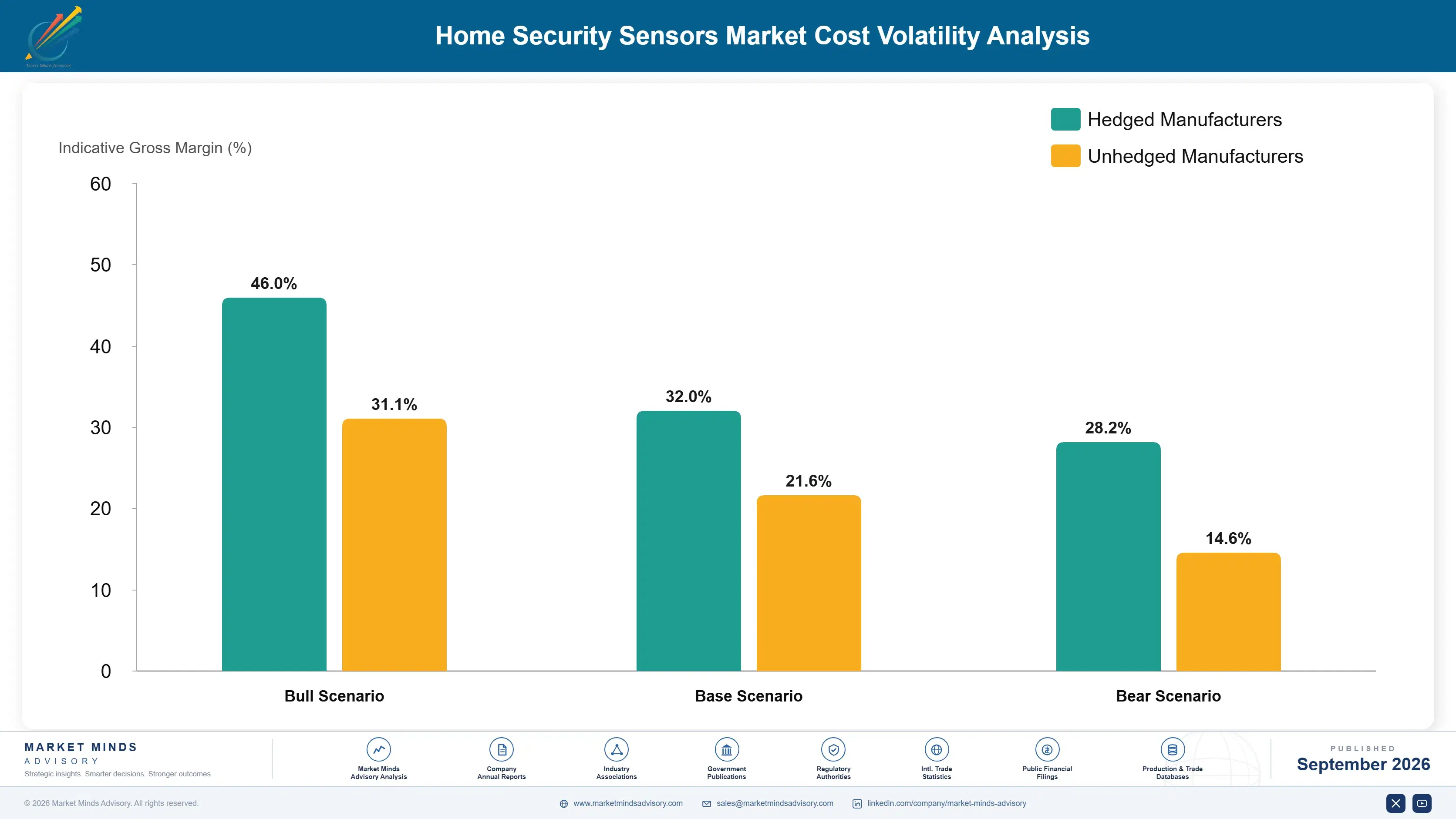
Three tiers structure the home security sensors market, separating volume-oriented basic entry sensors from premium smart lock and multi-platform certified sensor systems carrying subscription monitoring value. Gross margin ranges span roughly twenty points between the volume tier and the certified premium tier, reflecting how much value smart home buyers place on platform compatibility and subscription monitoring integration across most application categories and household types.
Volume-tier sensors still dominate unit counts across basic door and window entry deployments, but premium smart lock and multi-platform certified systems capture a disproportionate share of vendor profit pools because smart home buyers pay materially more for guaranteed interoperability and recurring monitoring subscription attachment. This tension shapes vendor product roadmaps directly, pushing established players toward higher-margin certified platforms and away from basic entry sensors alone as competition intensifies.

High-value margin pools concentrate specifically around subscription monitoring bundled with insurance partnership programs, since smart home buyers increasingly value the recurring monitoring service and premium discount access these arrangements generate over simple hardware sales alone, a pattern accelerating as full-home sensor coverage grows across multiple device categories, rooms, and connected household platforms nationwide.

Volume / Commodity-Adjacent Tier

Standard entry and motion sensors for basic home security coverage, sold largely on price and delivery speed against established regional competitors across mature national retail markets and secondary online channels.
Gross Margin: 25 to 32%

Premium / Certified Tier

Smart lock and multi-platform certified sensor systems commanding materially higher prices from buyers requiring guaranteed interoperability across major smart home platforms and recurring subscription monitoring integration and insurance partnership programs.
Gross Margin: 38 to 46%

Sustainability / Regulatory / Next-Generation Tier

Energy-efficient sensor platforms with extended battery life aligned to emerging device longevity expectations and long-term household total cost of ownership targets across large consumer segments, rental markets, and property management portfolios.
Gross Margin: 42 to 51%
home-security-sensors-market-portfolio-architecture-1790004995401

High-value Sub-segments and Strategic Watch-out

Smart Lock and Access Sensor Systems

Combines the fastest unit growth with the richest margin profile as households pair certified access hardware with subscription monitoring apps, creating durable recurring revenue streams beyond the initial hardware sale itself across expanding full-home coverage programs and successive smart home platform generations worldwide over the coming years.
Gross Margin: 44 to 52%

Water Leak and Environmental Sensors

Commands strong margins from insurance-linked monitoring programs seeking certified reliability across regulated premium discount qualification standards, though growth trails the fastest smart lock segment by a moderate but consistent margin across most household budgets nationwide and across several export-oriented retail and product distribution channels worldwide.
Gross Margin: 36 to 44%

Standard Entry and Motion Sensors

Remains the volume core of the market, anchoring unit shipments across routine basic security deployments even as margin pressure intensifies from regional low-cost competitors expanding aggressively into adjacent retail channels and secondary markets across multiple continents and several fast-growing emerging retail economies worldwide each year.
Gross Margin: 24 to 31%

Legacy Hardwired System Replacement Programs

Warrants close monitoring as aging hardwired security installations approach replacement age, creating a swing factor that could either sustain volume-tier demand or accelerate migration toward wireless certified platforms entirely across the customer base over the coming several forecast years and its multi-year budget planning cycles ahead.
Gross Margin: 20 to 27%

Household Coverage as Recurring Infrastructure

Home security sensors increasingly function as long-lived household infrastructure rather than one-time hardware sales, generating recurring subscription, cloud storage, and eventual device replacement revenue across a typical five to seven year sensor service life. Households rarely swap sensor brands mid-installation given the cost of replacing an entire connected system and reconfiguring smart home platform pairings, giving incumbent vendors durable annuity-like revenue once a brand is established within a household.
Adoption stickiness varies meaningfully by end-use segment. Homeowners exhibit the deepest lock-in given multi-year residency and full-home sensor investment across every room and access point, while renters switch more readily since their sensor systems are typically portable and carry lower integration complexity between residences. Property management companies sit between these two, valuing reliable vendor relationships but retaining flexibility as bulk contracts create natural vendor re-evaluation points at renewal.

Buyer profiles are shifting generationally as younger households increasingly favor self-monitored subscription apps offering flexible monthly commitments over legacy multi-year professional monitoring contracts requiring long-term agreements. Younger homeowners and renters entering the housing market expect the same flexible commercial terms common across other subscription software categories, gradually reshaping vendor selection criteria toward platforms bundling monitoring support alongside core sensor hardware.
home-security-sensors-market-end-use-penetration-index-1790004995898

Where Home Sensor Value Concentrates Next

These are among the four positions where our research anticipates prominent divergence between winners and laggards over the coming forecast period. Each is grounded in the demand model, the regulatory perimeter, and the announced capacity pipeline.
01 / PLATFORM COMPATIBILITY PRIORITY

Prioritize smart home interoperability over sensor specifications

Vendors still competing primarily on base sensor detection range and battery life specifications face compressing margins as regional low-cost competitors intensify price competition across standard entry sensor deployments and basic retail channels. Reallocating engineering investment toward smart home platform certification captures the disproportionate profit pool tied to household connected home purchase decisions now determining vendor selection across the most valuable customer segments. Firms that delay this shift risk ceding the highest-margin full-home coverage contracts to faster-moving rivals within the next several years.
02 / COMPONENT SUPPLY RESILIENCE

Diversify wireless chipset and battery cell sourcing

Wireless chipset exposure remains concentrated among a small group of Taiwanese and Korean suppliers, leaving vendors without diversified sourcing relationships vulnerable during future capacity shortages tied to competing consumer IoT and wearable demand across multiple sectors simultaneously and unpredictably. Securing multi-year fixed-price component contracts protects production schedules against the kind of cost compression seen during the 2025 pricing spike, when several vendors absorbed higher costs for two consecutive fiscal quarters rather than pass them through. This single step meaningfully reduces earnings volatility tied to component pricing swings ahead.
03 / GEOGRAPHIC MARKET PRIORITIZATION

Prioritize North America and Mexico expansion investment

North America anchors regional volume through the world's deepest DIY retail distribution base and most mature monitoring subscription industry, while Mexico's faster growth trajectory reflects an earlier stage of urban security investment across its expanding middle-class housing market and retail channels. Vendors that establish local distribution partnerships or service centers in these regions gain meaningful cost and delivery advantages over competitors operating from more distant headquarters locations. This positioning matters increasingly as customers favor suppliers who can meet compressed delivery timelines reliably.
04 / RECURRING REVENUE MONETIZATION

Build recurring revenue through insurance partnership programs

Bundling verified sensor data feeds with subscription-based insurance premium discount programs creates a recurring revenue stream that hardware sales alone cannot replicate across a vendor's installed household base and multi-year monitoring relationships spanning several years of ongoing service delivery. Vendors making this transition report materially stronger blended margins than peers still selling standard sensors as one-time hardware transactions, and several have begun restructuring sales compensation around subscription attachment rates. Building this capability now positions vendors ahead of the broader industry shift toward subscription-based household monitoring.

Engagement Snapshot From the Field

A live engagement with an industry participant carrying material or product regulatory and market exposure ahead of a defining policy shift, showing how our research translates into a defensible multi-year portfolio strategy.
MARKET MINDS ADVISORY · CLIENT ENGAGEMENT SUMMARY
Home Security Sensors Producer Strategic Portfolio Review and Transition Roadmap 2026·Investment Scenario on Home Security Sensors Exposure Evaluation 2025-26
CLIENT PROFILE
A regional property management firm operating roughly 40 multi-family apartment communities across a mid-sized North American metro area approached MMA to evaluate deploying sensor-ready units as a standard tenant amenity. The firm managed approximately 6,200 individual rental units, with rising tenant demand for smart home features increasingly influencing leasing decisions and unit renewal rates across its competitive portfolio.
STRATEGIC CHALLENGE
The firm faced a choice between offering sensor kits as an optional paid upgrade available to interested tenants or bundling sensor-ready units as a standard included amenity across the entire portfolio at lease signing. Internal teams disagreed on which approach better balanced near-term capital investment against the leasing conversion and renewal rate improvements sensor availability increasingly delivered.
MMA APPROACH
MMA conducted primary interviews with leasing and property operations executives and reviewed sensor vendor bulk deployment programs against the firm's existing unit turnover schedule and capital budget. The team modeled leasing conversion improvement and capital cost under three deployment scenarios, benchmarking projected costs against comparable property management modernization programs across similar regional portfolios.
KEY FINDINGS
  1. Roughly thirty-eight percent of prospective tenants cited smart home sensor availability as a meaningful factor in their overall leasing decision process this year.
  2. Standard bundled sensor deployment delivered the strongest leasing conversion improvement relative to the capital committed across comparable regional portfolios (client-reported, unverified by MMA).
  3. Phased rollout tied to natural unit turnover reduced peak capital outlay by roughly twenty-three percent compared to immediate portfolio-wide deployment (client-reported, unverified by MMA).
  4. Tenant renewal rates improved measurably once sensor-equipped units represented a clear majority of the firm's entire total rental housing portfolio inventory nationwide.
CLIENT PROFILE
A regional property management firm operating roughly 40 multi-family apartment communities across a mid-sized North American metro area approached MMA to evaluate deploying sensor-ready units as a standard tenant amenity. The firm managed approximately 6,200 individual rental units, with rising tenant demand for smart home features increasingly influencing leasing decisions and unit renewal rates across its competitive portfolio.
STRATEGIC CHALLENGE
The firm faced a choice between offering sensor kits as an optional paid upgrade available to interested tenants or bundling sensor-ready units as a standard included amenity across the entire portfolio at lease signing. Internal teams disagreed on which approach better balanced near-term capital investment against the leasing conversion and renewal rate improvements sensor availability increasingly delivered.
MMA APPROACH
MMA conducted primary interviews with leasing and property operations executives and reviewed sensor vendor bulk deployment programs against the firm's existing unit turnover schedule and capital budget. The team modeled leasing conversion improvement and capital cost under three deployment scenarios, benchmarking projected costs against comparable property management modernization programs across similar regional portfolios.
KEY FINDINGS
  1. Roughly thirty-eight percent of prospective tenants cited smart home sensor availability as a meaningful factor in their overall leasing decision process this year.
  2. Standard bundled sensor deployment delivered the strongest leasing conversion improvement relative to the capital committed across comparable regional portfolios (client-reported, unverified by MMA).
  3. Phased rollout tied to natural unit turnover reduced peak capital outlay by roughly twenty-three percent compared to immediate portfolio-wide deployment (client-reported, unverified by MMA).
  4. Tenant renewal rates improved measurably once sensor-equipped units represented a clear majority of the firm's entire total rental housing portfolio inventory nationwide.
RECOMMENDED STRATEGY
Phase 1: Phase one deployed sensor-ready units across newly vacant apartments as part of routine unit turnover and renovation cycles across the portfolio. Phase 2: Phase two extended deployment to occupied units at lease renewal as tenants gradually opted into the new sensor amenity offering. Phase 3: Phase three established a formal capital budgeting process tying all future property acquisitions to standard sensor deployment specifications and budgets.
OUTCOME
The firm adopted the phased sensor deployment approach, reporting a twenty-three percent reduction in peak capital outlay against its original portfolio-wide rollout budget (client-reported, unverified by MMA). Leasing conversion rates on sensor-equipped units improved measurably within the first full year of the phased deployment program.

Frequently Asked Questions

Foundational context covering the market sizes, CAGR, scope, country, region and competition that inform every finding below. This section is provided to cover basics and most often pre-purchase conversations, answered from the MMA Primary Research Dataset.

What is the current size of the Home Security Sensors Market?

The home security sensors market reached an estimated 5.6 billion dollars globally in 2025. Growth reflects accelerating smart home platform integration and DIY installation adoption across most residential markets worldwide.

How large will the Home Security Sensors Market be by 2036?

MMA projects the market will reach roughly 14.8 billion dollars by 2036 under the base case scenario. That reflects nearly a two and a half times increase over 2026 revenue by 2036.

What is the CAGR for the Home Security Sensors Market 2026 to 2036?

The base case compound annual growth rate is 9.2 percent across the forecast period. Bull and bear scenarios range from 8.0 percent to 10.4 percent depending on smart home platform adoption pace.

Which segment is growing fastest?

Smart Lock and Access Sensors leads growth at a 13.5 percent CAGR, roughly 1.47 times the overall market rate. Keyless entry integration with smart home platforms drives this accelerating pace.

Who are the major companies in the Home Security Sensors Market?

Ring, ADT, Honeywell, Johnson Controls, and SimpliSafe lead the competitive landscape. Combined, the top five players hold an estimated 42 percent share on a revenue basis.

Which country is growing fastest?

Mexico leads country-level growth at a 10.5 percent CAGR, outpacing the global average as urban security concerns and middle-class housing investment accelerate. Rising retail distribution infrastructure contributes meaningfully to this pace.

Report Segmentation Architecture

The full report scope spans multiple orthogonal segmentation dimensions, with cross-tabulated demand data provided for each dimension pair. Coverage extends further to regional breakdowns, trend trajectories, and the competitive detail needed to support segment-level decision-making.

By Primary Market Dimension

  • Motion Sensors
  • Door and Window Sensors
  • Glass Break Sensors
  • Smoke and Carbon Monoxide Sensors
  • Water Leak Sensors
  • Smart Lock and Access Sensors

By End-Use Industry

  • Single-Family Homeowners
  • Multi-Family Rental Properties
  • Vacation and Short-Term Rentals
  • Property Management Companies
  • New Residential Construction
  • Insurance-Linked Monitoring Programs

By Commercial Dimension

  • Direct-to-Consumer Retail
  • DIY Home Improvement Channel
  • Professional Installation and Monitoring
  • Property Manager Bulk Programs
  • Online and E-Commerce Channel
  • Insurance Carrier Partnership Programs

By Region

  • North America
  • Western Europe
  • East Asia
  • South Asia and Pacific
  • Latin America
  • Middle East and Africa
  • Eastern Europe

Scope, Methodology, and Coverage

Every figure in this report is reproducible from documented input assumptions. The scope below maps the historical period, the forecast horizon, the segmentation dimensions, and the countries covered, alongside the underlying primary and qualitative methodology.
Historical Period
2020 to 2025
Forecast Period
2026 to 2036
Base Year
2025 (USD billions; MMA Primary Research Dataset, September 2026)
Market Definition
The home security sensors market covers motion, entry, glass break, smoke, carbon monoxide, water leak, and smart lock sensors sold for residential security and monitoring applications. It excludes standalone security cameras, professional monitoring service subscriptions sold separately from hardware, and commercial or industrial-grade security sensor systems.
Quantitative Units
USD Billion
Segmentation Dimensions
Product Type, End-Use Segment, Commercial Channel, Region
Regions Covered
North America, Western Europe, East Asia, South Asia and Pacific, Latin America, Middle East and Africa, Eastern Europe
Countries Covered
United States, Canada, Germany, United Kingdom, France, China, Japan, South Korea, India, Australia, Brazil, Mexico, Saudi Arabia, United Arab Emirates, Poland
Key Companies Profiled
Ring LLC, ADT Inc, Honeywell International Inc, Johnson Controls International plc, SimpliSafe Inc, Vivint Smart Home Inc, Resideo Technologies Inc, Google LLC, Wyze Labs Inc, Abode Systems Inc, Ecolink Intelligent Technology Inc, Alarm.com Holdings Inc, Anker Innovations Limited, Arlo Technologies Inc, D-Link Corporation, Swann Communications Pty Ltd, Robert Bosch GmbH, Napco Security Technologies Inc, Zicom Electronic Security Systems Ltd, Guardian Protection Services Inc
Quantitative Methodology
Primary survey, n=3,800 respondents, Q4 2025, six countries; demand-side model with trade association cross-validation
Qualitative Methodology
47 expert interviews, Q4 2025; applied to validate demand model assumptions, identify emerging dynamics, and assess competitive positioning
Report Format
PDF and XLSX data workbook (Word format preview document)
Publisher
Market Minds Advisory
Report Code
MMA-2026-TEC-569
Published
September 2026
Contact
sales@marketmindsadvisory.com | www.marketmindsadvisory.com

Purchase the full Home Security Sensors Market Report (2026 to 2036).

This report delivers a comprehensive analysis of the global home security sensors market across the 2026 to 2036 forecast period. It covers market sizing, segmentation by product type and end-use segment, and regional demand dynamics across all seven major world regions. The report profiles twenty leading vendors, benchmarks competitive positioning, and quantifies input cost exposure tied to wireless chipset and battery cell supply chains. Analysts detail revenue diversification strategies, portfolio margin economics, and the demand mechanisms shaping household procurement decisions through the coming decade. A dedicated client case study illustrates how these findings translate into practical property portfolio decisions.
Seven-region demand and CAGR breakdown analysis
Twenty-company competitive benchmarking and positioning profile
Revenue lever and monetization pathway analysis
Input cost exposure and mitigation strategies
Segment-level growth and margin forecasting detail
Client engagement case study with outcomes

Built For The People Who Decide

From boardroom strategy to bench-side execution, this report is read cover-to-cover by leaders shaping the next decade of their industry, turning demand scenarios, market dynamics and valuation benchmarks into decisions.
CXOs/ Presidents/ VPs/ Managers
M&A and Corporate Development
Strategy Teams and R&D Heads
Procurement and Product Directors
Regulatory and Compliance Leaders
Investor Relations and Equity Analysts