Market Minds Advisory
Home Security Drone Market

Home Security Drone Market: Home Security Drone Market. Trends and Forecast 2026 to 2036

Rising residential break-in rates, insurer premium incentives, and dock-based autonomous patrol technology are pulling home security drones out of hobbyist novelty into a mainstream perimeter monitoring category, rewarding makers who prove reliable weather-tolerant flight.

Lead Analyst

Published

September 2026

Make Smarter Decisions with Customized Research Insights

Request a free sample report and evaluate market opportunities, growth trends, and competitive dynamics relevant to your business needs.

2025 MARKET VALUE$1.1BMarket Size 2025
2036 FORECAST VALUE$5.4BBase Case , 2026 to 2036
CAGR 2026 TO 203615.5 %Bull 16.8% / Bear 14.2%
INCREMENTAL OPPORTUNITY$4.1BNet 10- year value creation
EXPANSION MULTIPLE4.23x2036 value over 2026 base
Strategic Levers
M&A Pipeline
Regional Outlook
Country Rankings
Competitive Intelligence
Segmental Deep-dive
Call-Us : 91 93563 13602

Executive Snapshot and Market Trajectory.

Home security drones have moved from a niche hobbyist gadget into a credible perimeter monitoring layer for residential and light commercial properties, as dock-based autonomous launch systems finally solved the battery life and constant pilot-attention problems that stalled this entire category for years across the broader consumer electronics market.
Insurer premium discount programmes, rising suburban break-in rates, and integration with existing smart home camera platforms are converging on autonomous dock-based drones that patrol a property perimeter without a human operator present at any time, while American manufacturers concentrate scarce engineering talent and specialized manufacturing capacity within a handful of security robotics firms serving both residential and light commercial customers directly across the entire country and its rapidly growing suburban markets.
Competitive intensity centers on a small group of security robotics specialists competing on flight reliability and false-alarm reduction rather than price, even as drone airspace regulation and rising privacy concerns from neighbors threaten to slow adoption in the very suburban and multi-family markets this category depends on for volume growth over the coming decade of continued industry expansion, consolidation, and rapid technology maturation nationwide today.
Market Definition
The home security drone market covers autonomous and dock-based drones purpose-built for residential and light commercial perimeter monitoring, intrusion detection, and patrol. It excludes general-purpose consumer camera drones sold for photography, agricultural and industrial inspection drones, and standalone fixed camera security systems without flight capability.
Base Year Value
$1.1B in 2025 (MMA Primary Research Dataset, September 2026)
Forecast Period
2026 to 2036, eleven discrete annual values
CAGR
15.5% base case. Bull 16.8%. Bear 14.2%.
Fastest Growth Segment
Autonomous Dock-Based Patrol Drones for Residential Perimeters: 22.0% CAGR
Fastest Growth Country
United States: 17.5% CAGR
Fastest Growth Region
South Asia and Pacific: 17.5% CAGR
Largest Region
North America: 46% of 2025 global value
Market Leaders
Leading suppliers: Sunflower Labs, Aptonomy, Brinc Drones, Asylon, Easy Aerial. Source: MMA Primary Research Dataset, July 2026.
Primary Survey
n=3,800 procurement and R&D decision-makers, Q4 2025, six countries
Methodology
Demand-side build-up, cross-validated against public data, 47 expert interviews

Home Security Drone Market Forecast Scenarios

home-security-drone-market-size-forecast-scenario-1790000570378
Between 2020 and 2025, home security drone demand grew from a small base as early dock-based launch systems proved autonomous flight could operate reliably without a licensed pilot present, lifting volume well ahead of broader consumer drone market growth as insurers and security integrators took notice of the category's early results and began forming meaningful partnerships.
The base case assumes continued residential and light commercial adoption and rests on three commercial mechanisms: expanding insurer premium discount programmes that directly subsidize drone installation cost for policyholders nationwide, rising suburban property crime rates pushing homeowners toward active deterrence rather than passive recording alone, and smart home platform integration that lets drones respond automatically to camera and sensor alerts detected onsite, each reinforcing adoption momentum through the back half of the forecast window.
A bull case built on faster-than-expected insurer partnership expansion and broader FAA rule simplification for autonomous flight could push volumes meaningfully above trend, while a bear scenario tied to restrictive local drone ordinances and persistent neighbor privacy complaints would compress order growth and slow new market entry across suburban jurisdictions nationwide over the coming several years.

Home Security Drones: Autonomy Economics and Adoption Barriers

Home security drone economics hinge on solving the autonomy problem completely: any system that still requires a licensed pilot or constant human supervision cannot scale into the mass residential market regardless of flight performance or camera quality, since the entire commercial pitch depends on eliminating labor cost from every patrol cycle and every alert response the property generates throughout the entire year.
MARKET CONCENTRATIONCR5 48%top five makers hold roughly half of unit sales
AVERAGE SELLING PRICE$3,800 per systempricing bundles the drone, dock, and software subscription together
TOP PRODUCING COUNTRY SHAREUnited States 46%leads volume ahead of Israel and United Kingdom
CAPACITY UTILISATION68%assembly lines run below ceiling amid demand uncertainty
TRADE INTENSITY31% exportedmost units ship to domestic residential and commercial buyers
FEEDSTOCK COST SHARE38%batteries and camera sensor modules dominate input cost
Pricing bundles hardware, dock infrastructure, and a recurring software subscription into a single package, so operators who can drive down dock manufacturing cost while maintaining reliable weather-tolerant flight command a durable advantage over point-solution hardware sellers who lack a comparable recurring subscription revenue stream to fund ongoing software development and fleet-wide reliability improvements across their entire installed customer base nationwide today.
Battery and camera sensor costs move with broader consumer electronics component cycles rather than security industry demand specifically, which means margin timing in this business often depends more on global electronics component availability and pricing than on local property crime trends or insurer partnership announcements that drive most of the headline demand narrative in trade press coverage each quarter and investor presentation.
"The dock is the real product here, not the drone. Anyone can put a camera on a quadcopter. Getting it to launch, patrol, and land itself reliably for three years without a service call is the actual engineering problem."
Director, Security Robotics Practice · MMA Technology Practice · September 2026

Market Trends

Insurer Premium Discount Programmes Directly Subsidize Drone Purchases

Major homeowner insurers have expanded premium discount programmes covering roughly 12 percent of policy cost for customers who install approved autonomous security drone systems, effectively subsidizing a meaningful share of hardware purchase price through reduced annual premiums. This subsidy structure mirrors how insurers previously drove adoption of monitored alarm systems and smoke detectors decades earlier, using financial incentives rather than direct marketing to accelerate category adoption. Drone makers who secure insurer certification gain a distribution advantage that unqualified competitors cannot match regardless of product quality, since the insurer relationship has become a gating factor for market access.
Market Impact: Suburban burglary rates rose 9 percent
Multi-Family Property Managers Adopt Fleet-Based Drone Patrol

Multi-family residential property managers have begun deploying fleet-based drone patrol systems covering multiple buildings from shared dock infrastructure, with early adopters reporting deployment across more than 300 properties nationally by the end of 2025 alone this year. This commercial channel differs meaningfully from single-family residential sales, since property managers evaluate systems on cost per unit covered and liability reduction rather than personal security preference alone. Vendors who can demonstrate fleet management software capable of coordinating multiple drones across a shared property are winning larger, stickier contracts than single-home sales typically generate.
Market Impact: Over 40 million smart devices installed

Market Opportunities and Growth Drivers

Suburban Property Crime Rates Push Homeowners Toward Active Deterrence

Residential burglary rates in major suburban metropolitan areas rose roughly 9 percent between 2023 and 2025 according to municipal police reporting, pushing homeowners who previously relied on passive camera recording toward active deterrence systems that can respond to intrusion in real time. Traditional fixed cameras document a crime after it happens, while patrol drones can intercept an intruder while still on the property, a distinction insurers and homeowner associations increasingly emphasize. This shift from passive documentation to active response is reshaping how the entire residential security category positions itself against legacy alarm and camera competitors.
Market Impact: Over 60 municipalities restrict drone flight

Smart Home Platform Integration Expands Addressable Customer Base

Security drone makers integrating with existing smart home platforms can now trigger autonomous patrol flights automatically from more than 40 million installed smart camera and sensor devices already in American homes, dramatically lowering the customer acquisition cost compared with selling a standalone system. This integration approach converts an existing smart home customer base into a warm sales funnel rather than requiring drone makers to build demand from scratch through direct marketing. Platform partnerships with major smart home brands have become a primary competitive battleground, since exclusive integration agreements can lock out rival drone makers from an entire customer segment.
Market Impact: Flight duration stays under 25 minutes

Market Restraints and Challenges

Local Drone Ordinances Restrict Flight Over Neighboring Property

More than 60 municipalities across the United States have passed local ordinances restricting drone flight over neighboring property without explicit consent, directly limiting the effective coverage area a single dock-based system can patrol on smaller suburban lots. The root cause is a genuine legal gap: airspace rights above private property remain contested territory between federal aviation authority and local nuisance and privacy law that varies significantly by jurisdiction. Manufacturers are exploring tethered flight modes and geofencing software that automatically restricts patrol boundaries to a single property line, though this reduces the system's effective coverage and value proposition for smaller lots.
Market Impact: Discounts cover 12 percent of premiums

Battery Reliability Limits Weather Tolerance and Flight Duration

Current battery technology limits most home security drones to flight durations under 25 minutes per charge cycle and degrades noticeably in temperatures below freezing, constraining year-round reliability in colder climates that represent a meaningful share of the addressable suburban market. The root cause is fundamental lithium battery chemistry that has not kept pace with the power demands of continuous autonomous flight and onboard camera processing. Manufacturers are testing solid-state battery alternatives and hybrid charging dock designs that top off between flights, though neither approach has yet reached cost parity with existing lithium battery systems at scale.
Market Impact: Fleet drones now cover 300 properties
3 additional market trends, 4 additional growth drivers, and 3 additional restraints and challenges are covered in the full report. Contact sales@marketmindsadvisory.com to access the complete intelligence.

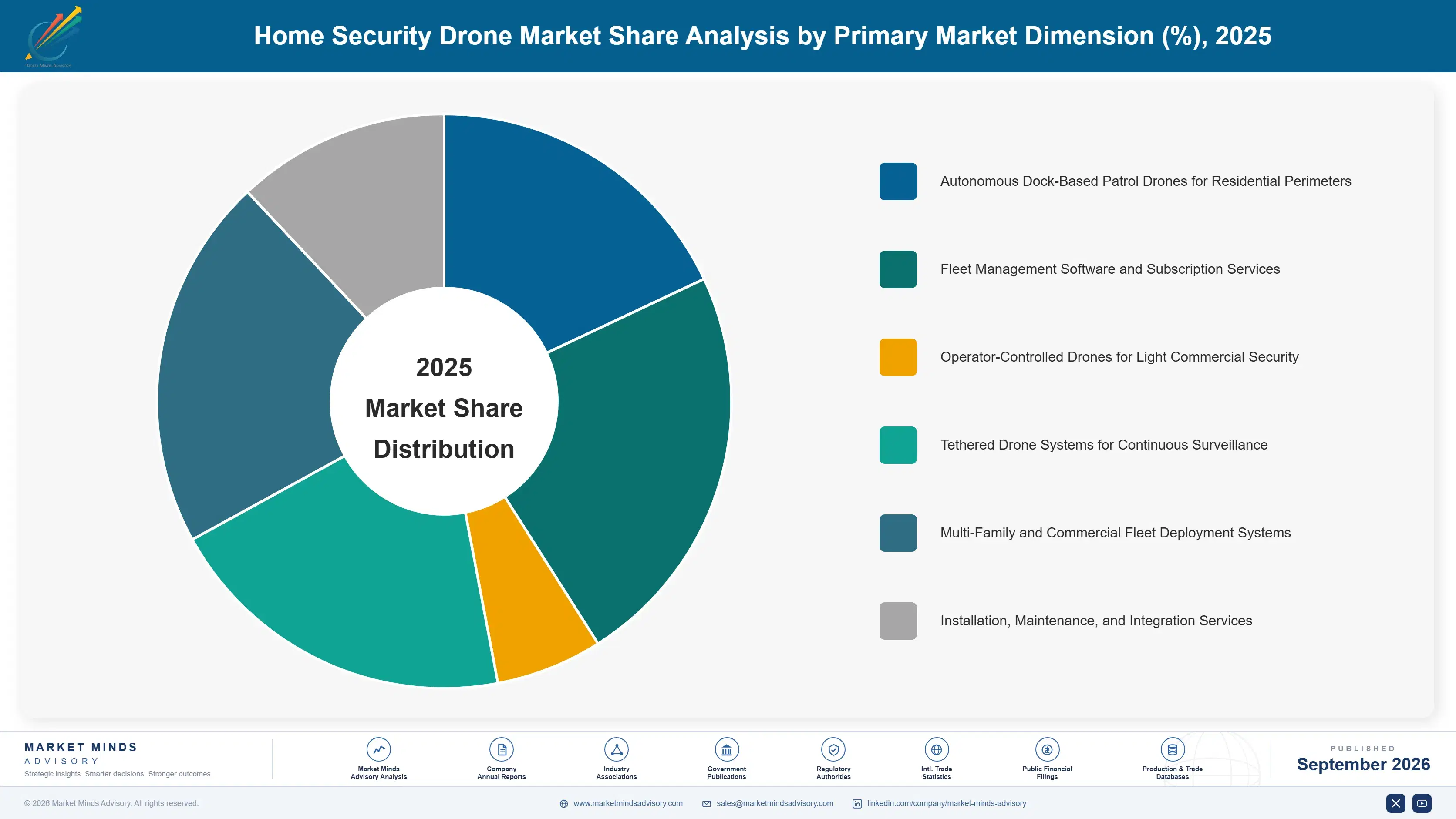
Segment CAGR and Growth Architecture

Home security drones are segmented here in this analysis by deployment architecture rather than by customer type, since dock-based autonomous systems, handheld operator-controlled units, tethered systems, and fleet management software carry distinct cost structures and technical requirements despite serving overlapping residential and commercial customers across every geography, price tier, and property type nationwide today.
home-security-drone-market-market-share-analysis-1790000570958

Autonomous Dock-Based Patrol Drones for Residential Perimeters

Autonomous dock-based patrol drones for residential perimeters are the fastest-growing segment, expanding at 22.0 percent annually as the category's core technical barrier, unreliable unsupervised flight, has been substantially solved by leading manufacturers over the past three years of sustained engineering investment and product iteration nationwide today. Homeowners increasingly choose dock-based systems over operator-controlled alternatives specifically because they require zero ongoing attention once installed, matching consumer expectations set by other smart home devices that operate autonomously without supervision or intervention of any kind. Insurer certification programmes overwhelmingly favor dock-based systems over operator-controlled units, since automated patrol schedules are easier to verify and audit for premium discount eligibility than manually triggered flights.
CAGR 22.0%

Fleet Management Software and Subscription Services

Fleet management software and subscription services are the second-fastest segment, growing at 20.0 percent as the installed base of dock-based drones large enough to generate meaningful recurring software revenue has finally reached commercial scale across major metropolitan markets nationwide today and increasingly well beyond them. This segment captures the recurring revenue component of an industry that was previously dominated entirely by one-time hardware sales, fundamentally changing unit economics for manufacturers who can convert customers into long-term subscribers rather than one-time buyers. Property managers overseeing multi-family fleets are the primary driver of this segment's growth, since coordinating dozens of drones across scattered buildings requires centralized software that individual homeowners never needed.
CAGR 20.0%
Full segment breakdown across 6 segments available in the complete report.

Regional Architecture and Country Demand Map

Home security drone demand concentrates wherever suburban homeownership rates, insurer partnership programmes, and specialized manufacturing capability all converge together at genuine national scale today, pulling a disproportionate share of total global installed volume into North America well ahead of every single other region worldwide by far.

North America

North America's share sits well above the standard regional band because nearly every major home security drone manufacturer is headquartered in the United States, and the country's combination of high single-family homeownership rates and an established insurer partnership network gives domestic manufacturers a natural home market advantage. Suburban sprawl across Sun Belt states, where detached homes with meaningful perimeter distance dominate housing stock, creates ideal conditions for dock-based patrol systems that struggle in denser urban housing. Canadian adoption follows similar patterns though at smaller scale, benefiting from cross-border distribution by the same manufacturers serving the United States. This is not a demand artifact but a direct reflection of where the category's founding companies and core customer base both reside.
Share: 46% | CAGR: 16.5% (2026 to 2036)

Western Europe

Western Europe's demand centers on the United Kingdom and Germany, where rising rural and suburban property crime concerns have driven adoption despite considerably more restrictive drone airspace regulation than the United States imposes on residential operators nationwide. German privacy law creates meaningful compliance friction for drone-based surveillance near neighboring properties, slowing adoption relative to the underlying demand suburban homeowners express in customer surveys. French and Nordic insurers have begun piloting premium discount programmes modeled directly on American precedents, though regulatory approval processes move considerably slower than in the United States. Denser housing patterns across much of the region limit the addressable market compared with American suburban sprawl and its detached homes.
Share: 22% | CAGR: 14.0% (2026 to 2036)
Regional intelligence for 5 additional markets available in the complete report: East Asia, South Asia and Pacific, Latin America, Middle East and Africa, Eastern Europe. Contact sales@marketmindsadvisory.com.
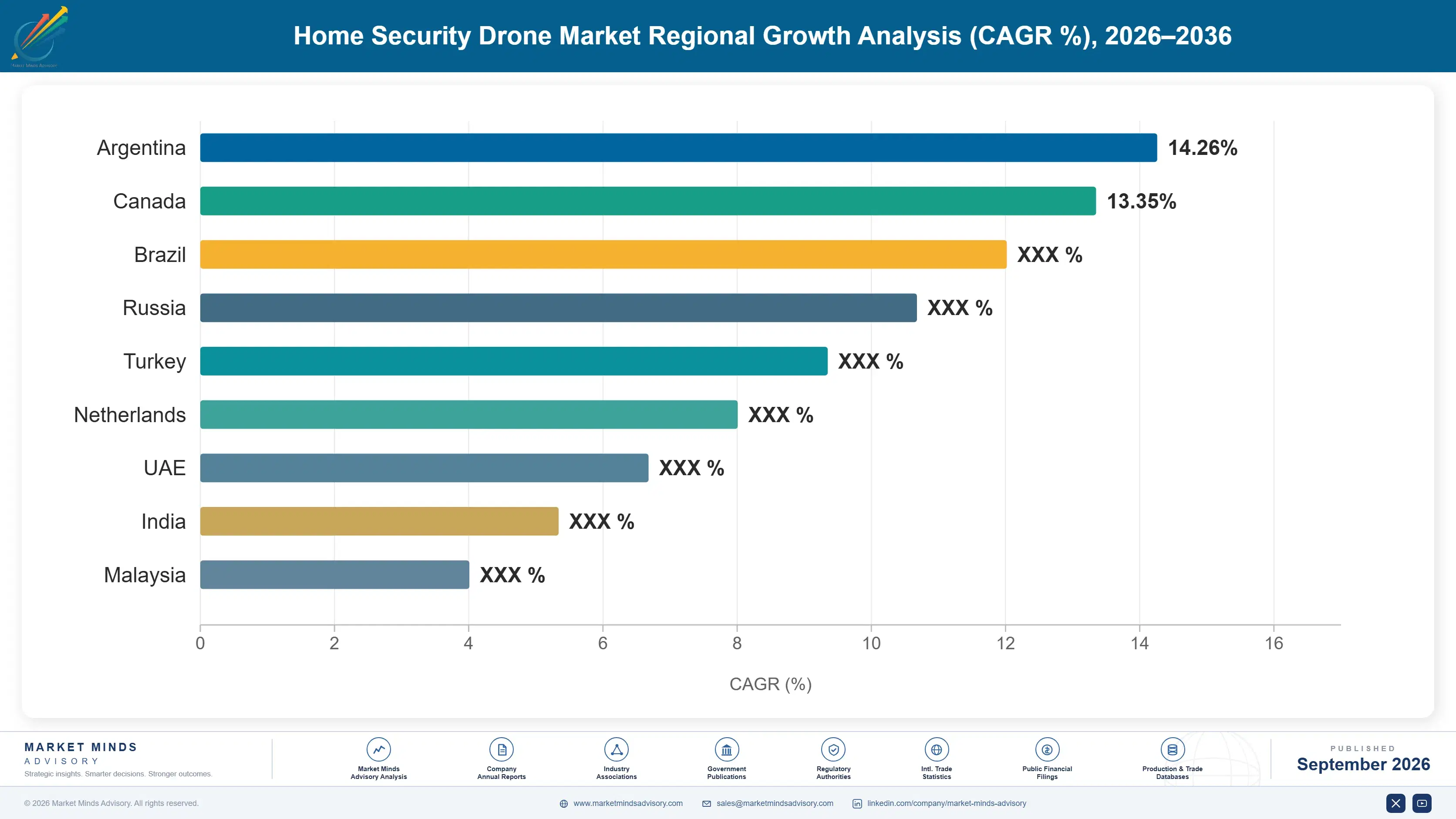
home-security-drone-market-country-cagr-analysis-1790000571489

Autonomous Flight Precision and Recurring Monitoring Revenue

Home security drone makers can expand revenue well beyond one-time hardware sales by moving into recurring monitoring subscriptions, insurer certification and referral partnerships, fleet management software licensing for multi-family property managers, and bundled professional installation and ongoing maintenance services that hardware-only competitors cannot easily replicate or match on price alone in this fast-moving category.

Recurring Monitoring and Alert Response Subscriptions

Manufacturers who bundle a monthly monitoring subscription alongside hardware sales capture recurring revenue per household rather than a single upfront payment, converting what was historically a one-time consumer electronics purchase into an annuity-like customer relationship. This subscription layer typically carries margins above 55 percent, far exceeding hardware margins, because it draws on cloud infrastructure and alert response capability that scales efficiently across a large installed base. Customers who adopt monitoring subscriptions also churn at meaningfully lower rates than hardware-only buyers, since canceling means losing active perimeter protection rather than just a software feature.
Market Impact: Monitoring subscriptions carry margins well above 55 percent

Insurer Certification and Referral Partnership Programmes

Manufacturers who secure formal insurer certification for their systems gain access to referral programmes that route qualified customers directly through insurance agent networks rather than relying solely on direct-to-consumer marketing spend and paid search. Insurers typically pay certified manufacturers a referral fee near 8 percent of the hardware sale price per completed installation, adding a secondary revenue stream on top of the sale itself. This channel also dramatically lowers customer acquisition cost compared with paid digital advertising, since insurance agents already have an established trust relationship with the homeowner they are referring.
Market Impact: Referral fees run near 8 percent of sales

Licensing Proprietary Autonomous Navigation Software Technology

A small number of manufacturers have developed proprietary autonomous navigation and obstacle avoidance software that outperforms off-the-shelf drone flight controllers used by smaller rivals in the same category, and some now license this software to smaller regional competitors for an upfront fee plus a running royalty near 6 percent of licensee hardware revenue each year. This converts research investment into a second income stream without requiring additional capital expenditure on manufacturing capacity. Licensing also extends the technology's reach into markets where the original developer lacks direct sales and distribution presence.
Market Impact: Royalty fees run near 6 percent of revenue

Fleet Management Software Licensing for Property Managers

Beyond individual hardware sales, manufacturers can license fleet management software separately to multi-family property managers coordinating dozens of drones across scattered buildings, charging per managed unit rather than folding this capability into base hardware pricing. Property managers requiring centralized dashboards and automated patrol scheduling pay a premium of roughly 25 percent over standard per-unit hardware fees for this software layer, and the underlying platform often becomes reusable across multiple property portfolios at no incremental development cost. This add-on has become a meaningful profit center for manufacturers serving the commercial multi-family segment.
Market Impact: Adds a 25 percent premium over standard fees

Who Controls the Margin Pool

Home security drone supply sits in the hands of a moderately concentrated group of security robotics specialists, with a CR5 near 48 percent that reflects how recently this category matured from experimental hardware into commercially reliable systems available at scale. The gap between the leading makers and smaller challengers is meaningful but not yet insurmountable, since insurer certification and distribution partnerships remain open to new entrants who can prove reliability.
Current competitive activity centers on insurer certification races and fleet software development rather than pure hardware differentiation, since most leading systems have converged on broadly similar flight and camera specifications across the category. Firms are differentiating through proprietary autonomous navigation software and through exclusive smart home platform integration agreements that lock competitors out of specific distribution channels.

Emerging pressure comes from multi-family property management customers who reward fleet software sophistication and per-unit economics over residential-style marketing, opening space for commercial-first entrants outside the direct-to-consumer channel. Rankings could shift meaningfully if a mid-tier manufacturer secures a major national insurer partnership or if a well-funded new entrant scales manufacturing faster than incumbents can respond with comparable reliability and coverage.
home-security-drone-market-company-positioning-matrix-1790000572017

Competitive Moat and Risk Dimensions

SUNFLOWER LABS

Moat: Insurer Certification and Distribution Network

Sunflower Labs holds certification with more of the largest national homeowner insurers than any rival, giving it a distribution channel through insurance agents that newer entrants cannot access without repeating years of certification and testing. This channel advantage compounds as more insurers adopt drone discount programmes, since Sunflower's early certifications position it as the reference system regulators point to.
SUNFLOWER LABS

Risk: Narrow Residential Customer Concentration

A large share of Sunflower Labs' revenue traces back to single-family residential customers acquired through insurer channels, leaving it comparatively underexposed to the faster-growing multi-family commercial fleet segment that rivals with stronger property management relationships are capturing more aggressively. Expanding into commercial fleet sales would require a different go-to-market motion than its insurer-led residential strategy.
APTONOMY

Moat: Fleet Management Software Sophistication

Aptonomy's fleet management software, built initially for commercial and industrial security customers, gives it a meaningful head start in the multi-family property management segment now driving the category's fastest growth. This software depth lets it win contracts on centralized dashboard capability that residential-focused competitors have not yet built, since coordinating dozens of drones requires different software entirely.
APTONOMY

Risk: Weaker Consumer Brand Recognition

Aptonomy's commercial and industrial security heritage has left it with weaker brand recognition among individual homeowners than consumer-first competitors who invested early in direct-to-consumer marketing and insurer partnerships. Building comparable residential brand awareness would require marketing investment that diverts resources from its stronger commercial fleet positioning.

Players Tracked

Prominent Players

Sunflower Labs
Aptonomy
Brinc Drones
Asylon
Easy Aerial

Other Key Players

Scout Security
Percepto
American Robotics
Skydio
Ring (Amazon)
ADT Commercial
Verkada
Nightingale Security
Iron Drone
Fortem Technologies
Airobotics
Corvus Robotics
DroneShield
Zenith Aerospace
Watchtower Robotics

Recent Developments

MARCH 2026

Sunflower Labs Signs Third National Insurer Certification

Sunflower Labs completed certification with a third major national homeowner insurer, expanding its premium discount referral network to cover roughly 60 percent of the American homeowner insurance market by policy count. The certification followed an 18-month reliability testing process conducted jointly with the insurer's underwriting team.
Signal: Signals continued consolidation of insurer distribution access among a very small group of newly certified manufacturers.
SEPTEMBER 2025

Aptonomy Signs Multi-Family Property Management Agreement

Aptonomy entered a multi-year agreement with a national multi-family property management firm to deploy fleet-based drone patrol across more than 200 properties nationally. The agreement is a commercial supply and software licensing contract rather than an acquisition or joint venture, marking Aptonomy's largest single commercial deployment to date.
Signal: Confirms Aptonomy's commercial fleet strategy is winning large multi-property contracts well ahead of residential sales growth.
DECEMBER 2025

Brinc Drones Acquires Autonomous Navigation Software Startup

Brinc Drones completed the acquisition of a smaller autonomous navigation software startup focused on obstacle avoidance for low-altitude residential flight, adding proprietary computer vision technology to its product portfolio. The acquired firm's roughly 25 employees and existing patents transferred fully, giving Brinc immediate access to improved flight reliability.
Signal: Confirms acquisition, rather than organic internal development, remains Brinc's clearly preferred route into navigation software gains.

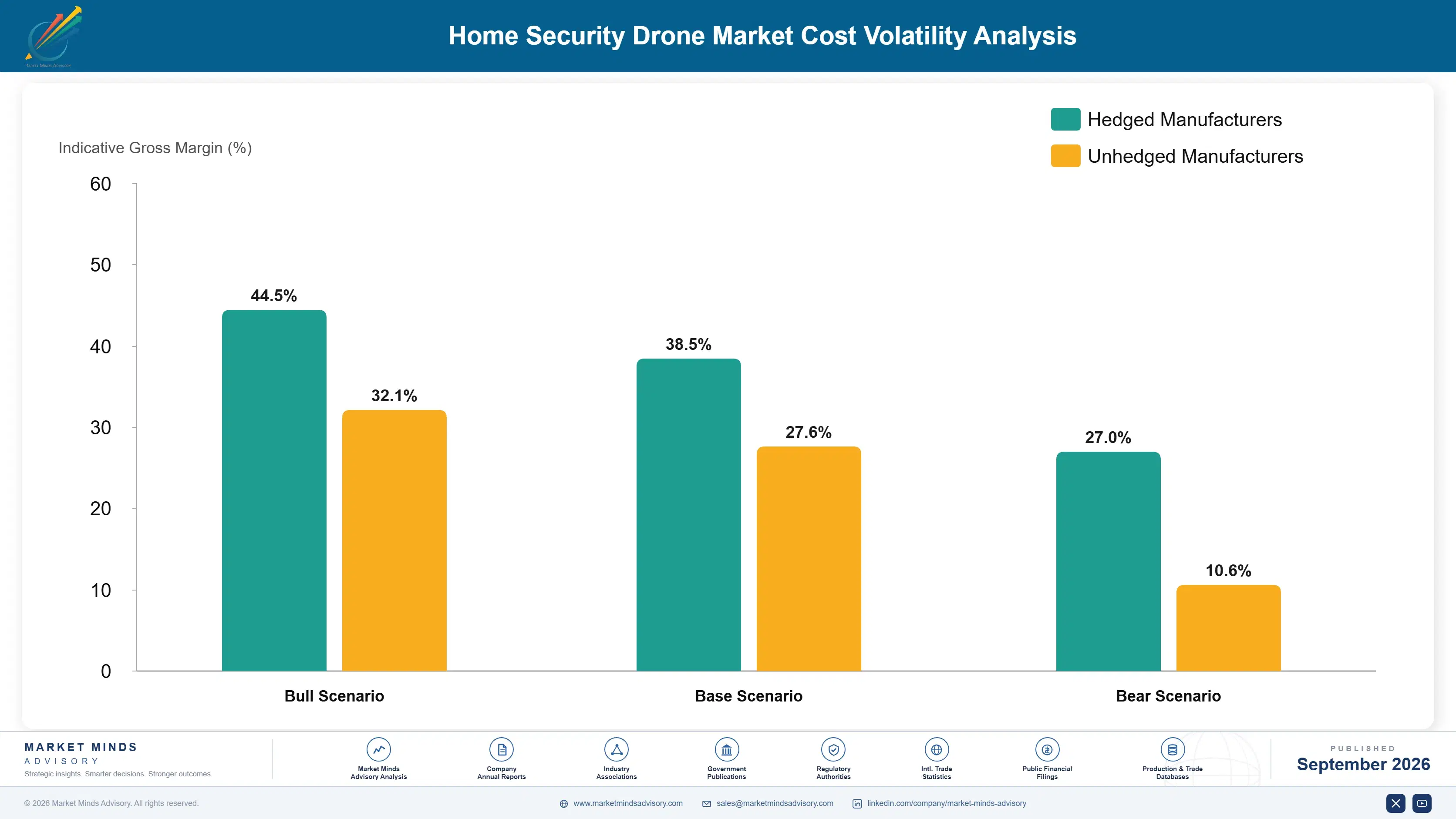
Battery and Sensor Price Exposure in Assembly

Lithium battery packs and camera sensor modules together account for roughly 38 percent of home security drone cost of goods sold, with battery cells sourced primarily from Asian cell manufacturers while camera sensor supply concentrates among a handful of specialty imaging semiconductor producers holding genuinely limited spare capacity for sudden demand surges across the broader global consumer electronics industry.
Lithium carbonate prices climbed more than 40 percent between mid-2024 and late 2025 according to International Energy Agency battery material tracking data, forcing several smaller manufacturers to delay product launches while renegotiating battery supply contracts. The volatility coincided with broader electric vehicle battery demand competing for the same lithium supply chain, and drone makers without long-term battery supply agreements absorbed the bulk of the cost swing directly into compressed margins.

Larger manufacturers who secured multi-year battery supply agreements are insulated from these price swings in ways that smaller competitors buying on shorter-term contracts simply are not. This gap widens further for manufacturers competing on price in the operator-controlled commercial segment, where thinner margins leave less room to absorb sudden component cost increases without raising customer prices.
home-security-drone-market-cost-volatility-analysis-1790000572215

Securing Multi-Year Lithium Battery Supply Contracts

Larger manufacturers are locking in multi-year battery supply agreements with cell producers rather than purchasing on shorter-term contracts, insulating themselves from lithium price volatility that hits smaller competitors hardest during extended periods of tight global supply. This approach requires substantial upfront negotiation but pays back through predictable input cost over the equipment's operational life.

Qualifying Alternative Camera Sensor Suppliers

Several manufacturers are qualifying alternative camera sensor suppliers beyond their traditional sources to reduce dependence on any single imaging semiconductor producer, even though these newer suppliers currently carry slightly higher qualification costs during initial production ramp phases each year. This diversification smooths supply continuity risk during future component shortages or price spikes affecting the industry.

Portfolio Architecture for Margin Defence

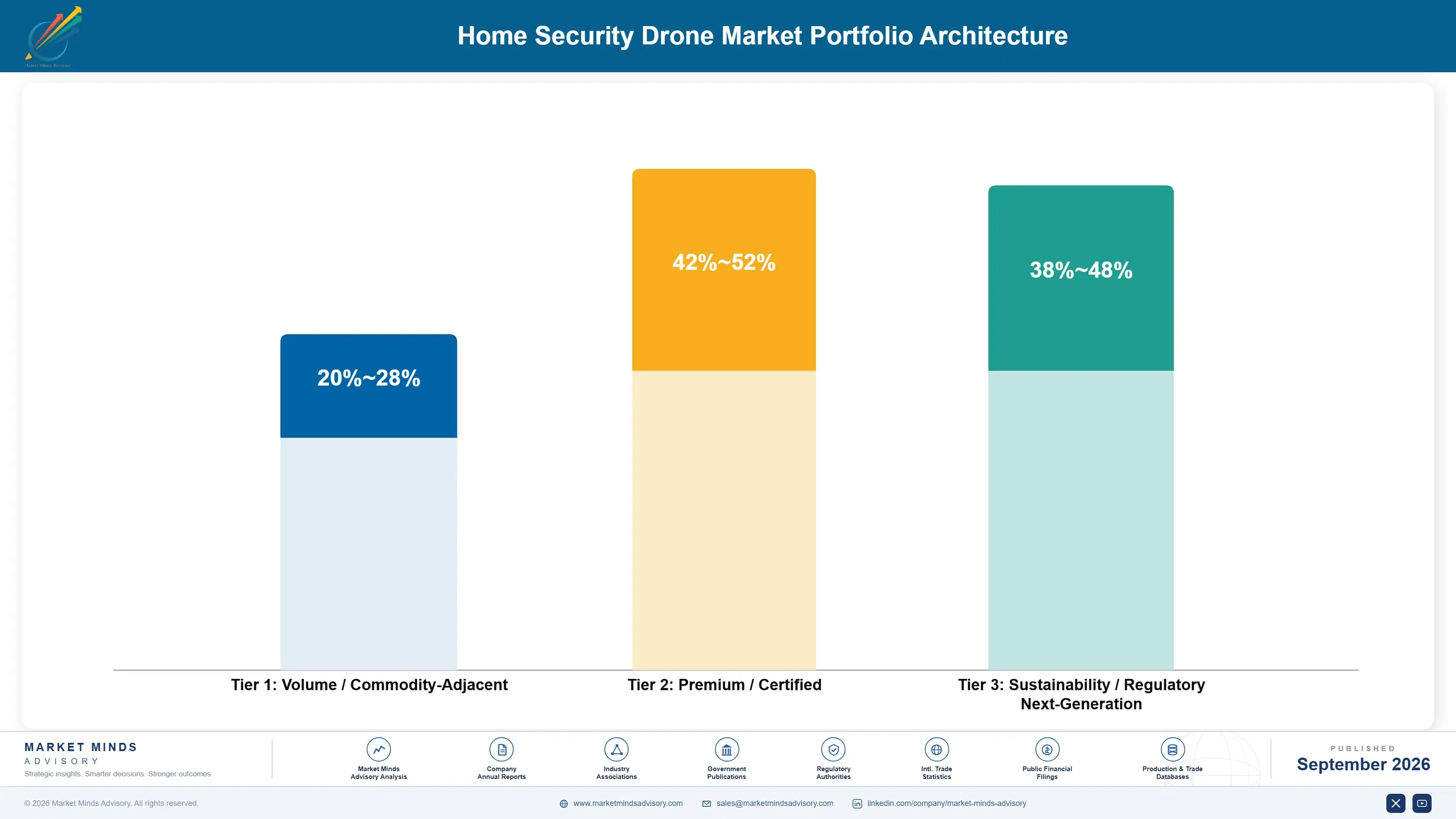
Home security drone margin economics separate cleanly along subscription attachment rather than hardware specification alone, with the widest gross margins concentrated in insurer-certified systems bundled with monitoring subscriptions regardless of whether the customer is a single-family homeowner or a multi-family property manager purchasing at scale. Hardware-only sales run on considerably thinner margins sustained by unit volume rather than recurring revenue.
The tension between volume and premium tiers plays out most clearly in go-to-market strategy: every dollar spent pursuing insurer certification and subscription attachment pulls sales resources away from faster, lower-margin operator-controlled commercial sales that still generate steady, if unglamorous, revenue each quarter and fiscal year. Most established manufacturers pursue both channels simultaneously rather than fully committing capital to one over the other.

High-value margin pools concentrate overwhelmingly in insurer-certified residential systems with attached monitoring subscriptions, where certification barriers and subscription stickiness keep new entrants out far more effectively than pricing power alone ever could achieve on its own. Multi-family fleet and regulatory-driven segments remain smaller today but are positioned to absorb a growing share of new capital investment as property managers standardize on drone patrol.

Volume / Commodity-Adjacent

Operator-controlled and hardware-only drone sales without attached monitoring subscriptions, running on lower volume than mature security categories but thin unit margins sustained by hardware markup alone rather than recurring revenue.
Gross Margin: 20-28%

Premium / Certified

Insurer-certified dock-based systems bundled with monitoring subscriptions, where certification barriers, subscription attach rates, and reliability track record command a durable price premium over hardware-only competitors across the entire residential market.
Gross Margin: 42-52%

Sustainability / Regulatory / Next-Generation

Fleet management software and multi-family commercial deployment platforms tied to property manager standardization decisions, still small in volume today but drawing rising capital allocation from established manufacturers positioning early ahead of demand.
Gross Margin: 38-48%
home-security-drone-market-portfolio-architecture-1790000572725

High-value Sub-segments and Strategic Watch-out

Autonomous Dock-Based Drones with Insurer Certification

The fastest-growing, highest-margin segment, driven by insurer premium discount programmes and rising suburban demand for active deterrence over passive recording alone nationwide. Certification barriers protect incumbent margins, and the segment is expected to absorb the largest share of new capital investment through the forecast window.
Gross Margin: 42-50%

Fleet Management Software for Property Managers

High-value and growing steadily as multi-family property managers standardize on centralized drone coordination platforms across their entire portfolio of managed buildings nationwide today, with software margins running well above comparable hardware sales and increasingly durable recurring revenue attached to every managed unit under long-term contract.
Gross Margin: 50-60%

Operator-Controlled Commercial Security Drones

The volume core of the market, sustained by ongoing light commercial security demand and steady replacement purchasing across major metropolitan markets globally and nationwide today still consistently, though margins stay moderate because operator-controlled systems face steady competition from a wider pool of general-purpose drone suppliers.
Gross Margin: 22-30%

Legacy Tethered Surveillance Drone Systems

A strategic watch-out segment where accelerating adoption of untethered dock-based autonomous systems could leave committed tethered system manufacturing capacity substantially underutilized well before existing long-term commercial service contracts naturally expire across the entire broader legacy supplier base entirely over the coming several years ahead nationwide.
Gross Margin: 16-22%

Recurring Subscription Revenue Beneath Hardware Sales

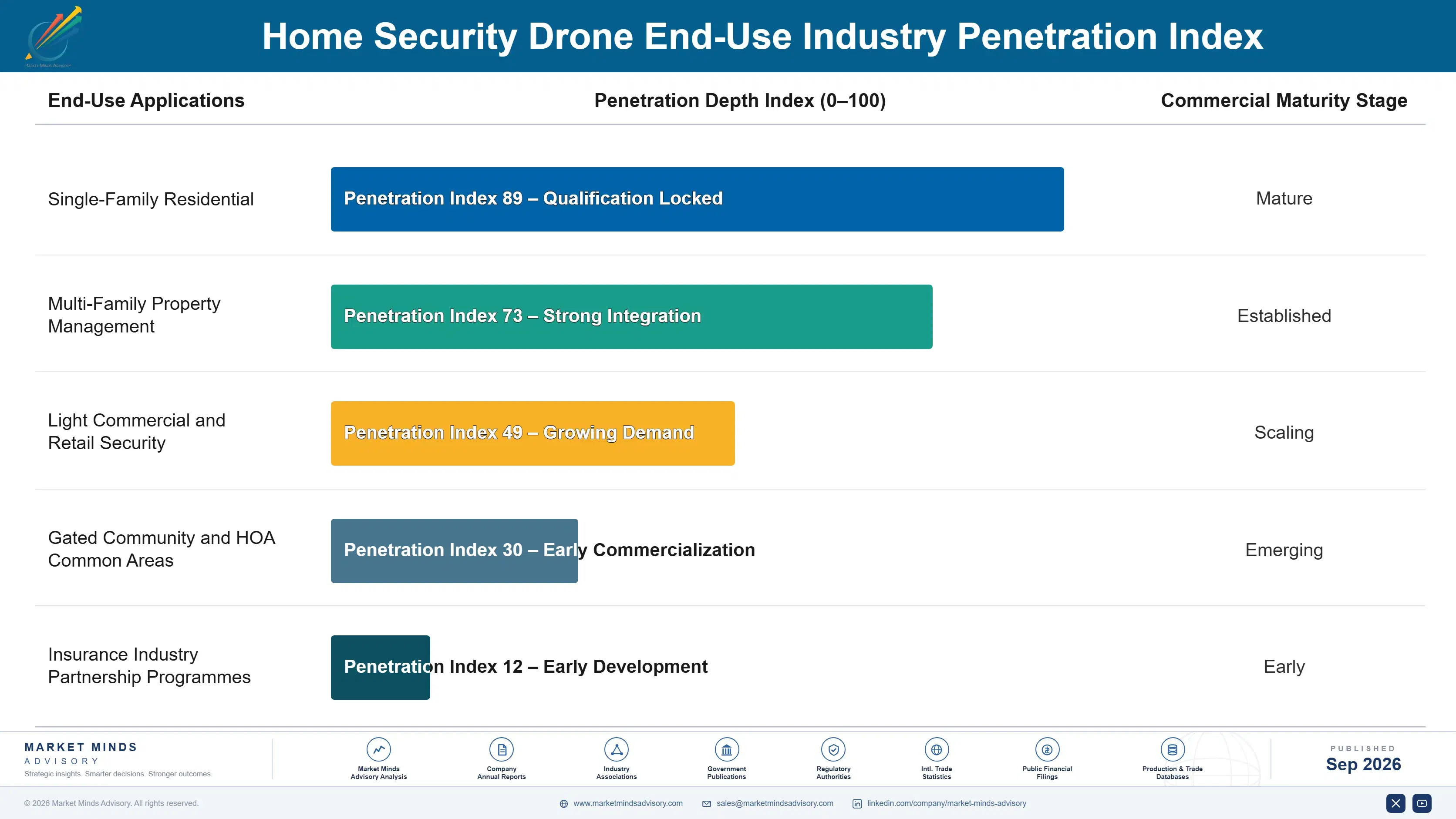
Home security drone revenue behaves less like a one-time consumer electronics sale and more like an annuity once a monitoring subscription is attached, since insurer certification requirements and switching friction lock in recurring monthly payments that persist well beyond the original hardware purchase across the entire multi-year customer relationship.
Stickiness varies sharply by end-use vertical: insurer-certified residential systems carry the deepest lock-in because switching providers means losing accumulated insurer discount eligibility built up over years of continuous coverage, while operator-controlled commercial systems are far more contestable since property managers routinely evaluate multiple vendors each contract renewal cycle. Multi-family fleet relationships sit closer to residential stickiness, anchored by integrated software and hardware deployment across an entire property portfolio.

Buyer profiles are shifting generationally as procurement decisions move from individual homeowners acting alone toward insurance agents and property management companies who weigh liability reduction and fleet economics far more heavily than personal security preference alone. This generational change favors incumbents with documented insurer certification and fleet software capability over new entrants offering only lower hardware cost, reshaping how future purchasing decisions get made across the entire industry.
home-security-drone-market-end-use-penetration-index-1790000573224

Where Insurer Certification Decides Market Access

These are among the four positions where our research anticipates prominent divergence between winners and laggards over the coming forecast period. Each is grounded in the demand model, the regulatory perimeter, and the announced capacity pipeline.
01 / INSURER CERTIFICATION PRIORITY

Pursue Insurer Certification Before Distribution Channels Consolidate

Manufacturers without insurer certification should pursue it deliberately and soon, since insurer referral channels are becoming the primary distribution mechanism for this category and remaining slots are filling quickly across the largest national carriers. Waiting even one certification cycle risks permanent exclusion from the channel that increasingly decides which brands homeowners actually consider purchasing in the first place. Early movers who invested ahead of the insurer partnership wave are already locking in referral volume that latecomers cannot easily displace at this stage.
02 / SUBSCRIPTION ATTACHMENT STRATEGY

Build Subscription Attachment Into Every Hardware Sale

Hardware-only manufacturers should build monitoring subscription attachment into every single sale deliberately and consistently, since recurring revenue generates far more lifetime value than a single upfront hardware payment ever could produce alone. Developing credible cloud monitoring infrastructure takes real investment and demands sustained commitment most smaller competitors will simply not make voluntarily given the uncertain near-term payback timeline involved. Firms that clear this bar first should expect to hold meaningful customer lifetime value advantages over hardware-only rivals for years afterward.
03 / MULTI-FAMILY FLEET EXPANSION

Build Fleet Software Capability to Capture Property Managers

Manufacturers still focused exclusively on single-home residential sales should invest in fleet management software immediately and quite decisively today, since multi-family property management represents the fastest-growing commercial channel and requires fundamentally different software than any residential deployment ever needed or supported. This is no longer a discretionary product decision given how quickly property managers are standardizing procurement around vendors with proven fleet coordination capability. Competitors with fleet software already built will simply out-compete rivals lacking this capability during contract negotiations.
04 / REGULATORY RISK MITIGATION

Build Geofencing Compliance Ahead of Local Ordinance Expansion

Firms weighing regulatory exposure should evaluate proactive geofencing and compliance software investment carefully and methodically over an extended planning horizon, particularly where local drone ordinances could restrict flight over neighboring property in additional jurisdictions nationwide over time and expand further into new markets. This compliance investment carries real engineering cost and should not be treated as a near-term sales feature alone. It functions best as a defensive positioning strategy against regulatory risk rather than a present-day competitive differentiator for most manufacturers.

Engagement Snapshot From the Field

A live engagement with an industry participant carrying material or product regulatory and market exposure ahead of a defining policy shift, showing how our research translates into a defensible multi-year portfolio strategy.
MARKET MINDS ADVISORY · CLIENT ENGAGEMENT SUMMARY
Home Security Drone Producer Strategic Portfolio Review and Transition Roadmap 2026·Investment Scenario on Home Security Drone Exposure Evaluation 2025-26
CLIENT PROFILE
The client is a regional multi-family property management firm overseeing more than 40 residential communities across three states, preparing to deploy autonomous drone patrol as a differentiator in a competitive leasing market. The company had previously relied entirely on fixed camera systems and human security patrols and had no prior sourcing relationship with drone security manufacturers. Its operations team understood physical security requirements but lacked experience evaluating autonomous flight technology.
STRATEGIC CHALLENGE
The client needed to identify and qualify a drone security vendor capable of coordinating fleet deployment across 40 geographically dispersed properties within a ten-month rollout window tied to a competitive leasing season deadline. Existing supplier relationships in fixed camera systems offered no relevant fleet coordination pathway, and the client's operations team had never evaluated autonomous drone reliability or insurer liability implications before this specific programme.
MMA APPROACH
MMA conducted a structured supplier assessment across eight qualified drone security vendors, screening for multi-property fleet management software capability, liability insurance coverage, and documented reliability track record across comparable multi-family deployments. The assessment combined primary interviews with vendor engineering leadership and a review of each candidate's field performance data from existing multi-family customers over the prior two years.
KEY FINDINGS
  1. Only two of eight assessed vendors held fleet management software mature enough to coordinate patrol scheduling reliably across all 40 dispersed properties.
  2. The client's initial preferred vendor lacked adequate liability insurance coverage for multi-property deployment, a gap that would have delayed the rollout by months.
  3. Recurring subscription revenue, once modeled across the full portfolio, represented a cost roughly 30 percent lower than maintaining equivalent human patrol coverage.
  4. Two of the eight candidate vendors offered bundled installation services across multiple properties, which reduced the client's internal coordination burden quite considerably.
CLIENT PROFILE
The client is a regional multi-family property management firm overseeing more than 40 residential communities across three states, preparing to deploy autonomous drone patrol as a differentiator in a competitive leasing market. The company had previously relied entirely on fixed camera systems and human security patrols and had no prior sourcing relationship with drone security manufacturers. Its operations team understood physical security requirements but lacked experience evaluating autonomous flight technology.
STRATEGIC CHALLENGE
The client needed to identify and qualify a drone security vendor capable of coordinating fleet deployment across 40 geographically dispersed properties within a ten-month rollout window tied to a competitive leasing season deadline. Existing supplier relationships in fixed camera systems offered no relevant fleet coordination pathway, and the client's operations team had never evaluated autonomous drone reliability or insurer liability implications before this specific programme.
MMA APPROACH
MMA conducted a structured supplier assessment across eight qualified drone security vendors, screening for multi-property fleet management software capability, liability insurance coverage, and documented reliability track record across comparable multi-family deployments. The assessment combined primary interviews with vendor engineering leadership and a review of each candidate's field performance data from existing multi-family customers over the prior two years.
KEY FINDINGS
  1. Only two of eight assessed vendors held fleet management software mature enough to coordinate patrol scheduling reliably across all 40 dispersed properties.
  2. The client's initial preferred vendor lacked adequate liability insurance coverage for multi-property deployment, a gap that would have delayed the rollout by months.
  3. Recurring subscription revenue, once modeled across the full portfolio, represented a cost roughly 30 percent lower than maintaining equivalent human patrol coverage.
  4. Two of the eight candidate vendors offered bundled installation services across multiple properties, which reduced the client's internal coordination burden quite considerably.
RECOMMENDED STRATEGY
Phase 1: Phase 1 (Vendor Screening): Narrow the eight candidate vendors down to two finalists based on fleet software and insurance coverage. Phase 2: Phase 2 (Pilot Deployment): Commission a pilot rollout across five representative properties before committing to the entire full portfolio-wide deployment. Phase 3: Phase 3 (Contract Structuring): Negotiate a portfolio-wide subscription agreement with pricing tiers tied to property count and rollout timing milestones.
OUTCOME
The client selected a vendor with proven fleet software and completed the pilot deployment one month ahead of the leasing season deadline, differentiating its properties in marketing materials. Reported leasing conversion improvement at pilot properties exceeded internal targets according to client assessment, though exact figures remain (client-reported, unverified by MMA).

Frequently Asked Questions

Foundational context covering the market sizes, CAGR, scope, country, region and competition that inform every finding below. This section is provided to cover basics and most often pre-purchase conversations, answered from the MMA Primary Research Dataset.

What is the current size of the Home Security Drone Market?

The global home security drone market reached an estimated $1.1 billion in 2025, driven by insurer partnerships and dock-based autonomous flight adoption. This base-year figure reflects MMA Primary Research Dataset estimates as of July 2026.

How large will the Home Security Drone Market be by 2036?

The home security drone market is forecast to reach $5.37 billion by 2036, up from $1.27 billion in 2026. Growth is led by insurer discount programmes, suburban crime deterrence, and multi-family fleet demand.

What is the CAGR for the Home Security Drone Market 2026 to 2036?

The home security drone market is projected to grow at a 15.5 percent compound annual growth rate between 2026 and 2036. This reflects sustained residential and light commercial adoption across the forecast period.

Which segment is growing fastest?

Autonomous dock-based patrol drones for residential perimeters are the fastest-growing segment, expanding at 22.0 percent annually. That is roughly 1.42 times the overall market's 15.5 percent growth rate.

Who are the major companies in the Home Security Drone Market?

Major companies include Sunflower Labs, Aptonomy, Brinc Drones, Asylon, and Easy Aerial. These five firms hold a combined CR5 near 48 percent of global unit sales.

Which country is growing fastest?

The United States is growing fastest among individual countries, expanding at roughly 17.5 percent annually. Its insurer partnership network and suburban homeownership base are pulling demand upward each year.

Report Segmentation Architecture

The full report scope spans multiple orthogonal segmentation dimensions, with cross-tabulated demand data provided for each dimension pair. Coverage extends further to regional breakdowns, trend trajectories, and the competitive detail needed to support segment-level decision-making.

By Primary Market Dimension

  • Autonomous Dock-Based Patrol Drones for Residential Perimeters
  • Fleet Management Software and Subscription Services
  • Operator-Controlled Drones for Light Commercial Security
  • Tethered Drone Systems for Continuous Surveillance
  • Multi-Family and Commercial Fleet Deployment Systems
  • Installation, Maintenance, and Integration Services

By End-Use Industry

  • Single-Family Residential
  • Multi-Family Property Management
  • Light Commercial and Retail Security
  • Gated Community and HOA Common Areas
  • Insurance Industry Partnership Programmes

By Commercial Dimension

  • Direct-to-Consumer Retail Sales
  • Insurer Referral and Certification Channel
  • Property Management Contract Sales
  • Security Integrator Reseller Channel

By Region

  • North America
  • Western Europe
  • East Asia
  • South Asia and Pacific
  • Latin America
  • Middle East and Africa
  • Eastern Europe

Scope, Methodology, and Coverage

Every figure in this report is reproducible from documented input assumptions. The scope below maps the historical period, the forecast horizon, the segmentation dimensions, and the countries covered, alongside the underlying primary and qualitative methodology.
Historical Period
2020 to 2025
Forecast Period
2026 to 2036
Base Year
2025 (USD billions; MMA Primary Research Dataset, September 2026)
Market Definition
The home security drone market covers autonomous and dock-based drones purpose-built for residential and light commercial perimeter monitoring, intrusion detection, and patrol. It excludes general-purpose consumer camera drones sold for photography, agricultural and industrial inspection drones, and standalone fixed camera security systems without flight capability.
Quantitative Units
USD billions (current prices); unit shipment volume where applicable
Segmentation Dimensions
By Primary Market Dimension; By End-Use Industry; By Commercial Dimension; By Region
Regions Covered
North America, Western Europe, East Asia, South Asia and Pacific, Latin America, Middle East and Africa, Eastern Europe
Countries Covered
USA, China, Germany, France, UK, Japan, South Korea, India, Australia, Canada, Brazil, Mexico, Indonesia, Vietnam, Thailand, Malaysia, UAE, Saudi Arabia, South Africa, Nigeria, Turkey, Poland, Netherlands, Italy, Spain, Sweden, Switzerland, Argentina, Colombia, Singapore, and additional markets relevant to this sector
Key Companies Profiled
Sunflower Labs, Aptonomy, Brinc Drones, Asylon, Easy Aerial, Scout Security, Percepto, American Robotics, Skydio, Ring (Amazon), ADT Commercial, Verkada, Nightingale Security, Iron Drone, Fortem Technologies, Airobotics, Corvus Robotics, DroneShield, Zenith Aerospace, Watchtower Robotics
Quantitative Methodology
Primary survey, n=3,800 respondents, Q4 2025, six countries; demand-side model with trade association cross-validation
Qualitative Methodology
47 expert interviews, Q4 2025; applied to validate demand model assumptions, identify emerging dynamics, and assess competitive positioning
Report Format
PDF and XLSX data workbook (Word format preview document)
Publisher
Market Minds Advisory
Report Code
MMA-2026-TEC-964
Published
September 2026
Contact
sales@marketmindsadvisory.com | www.marketmindsadvisory.com

Purchase the full Home Security Drone Market Report (2026 to 2036).

The full report expands on every dimension summarized here, delivering complete segment-by-segment financial modeling, all seven regional profiles with country-level detail, and an extended competitive landscape covering all twenty profiled companies. It includes the complete methodology behind MMA's primary survey of 3,800 respondents and 47 expert interviews conducted across six countries in the fourth quarter of 2025. Buyers also receive downloadable data tables supporting every chart and figure referenced throughout the analysis. A dedicated appendix walks through the underlying assumptions behind every forecast scenario, and purchasers gain access to a live analyst briefing session to discuss findings directly.
Complete six-segment financial model, 2020 to 2036
All seven regional profiles with country detail
Twenty-company competitive benchmarking and profiling dataset
Primary survey and expert interview data tables
Live analyst briefing session included with purchase
Editable data appendix in spreadsheet format

Built For The People Who Decide

From boardroom strategy to bench-side execution, this report is read cover-to-cover by leaders shaping the next decade of their industry, turning demand scenarios, market dynamics and valuation benchmarks into decisions.
CXOs/ Presidents/ VPs/ Managers
M&A and Corporate Development
Strategy Teams and R&D Heads
Procurement and Product Directors
Regulatory and Compliance Leaders
Investor Relations and Equity Analysts