Market Minds Advisory
Home Rehabilitation Services Market

Home Rehabilitation Services Market: Hospital-to-Home Discharge Is Redrawing Post-Acute Care

Hospitals are discharging patients home earlier and pushing recovery therapy into the living room rather than an inpatient facility, forcing rehabilitation providers to defend clinic-based volume against telerehabilitation platforms built for remote, coordinated recovery.

Lead Analyst

Alice Ballenger

Published

September 2026

Make Smarter Decisions with Customized Research Insights

Request a free sample report and evaluate market opportunities, growth trends, and competitive dynamics relevant to your business needs.

2025 MARKET VALUE$24.0BMarket Size 2025
2036 FORECAST VALUE$58.9BBase Case , 2026 to 2036
CAGR 2026 TO 20368.5 %Bull 9.8% / Bear 7.2%
INCREMENTAL OPPORTUNITY$32.8BNet 10- year value creation
EXPANSION MULTIPLE2.26x2036 value over 2026 base
Strategic Levers
M&A Pipeline
Regional Outlook
Country Rankings
Competitive Intelligence
Segmental Deep-dive
Call-Us : 91 93563 13602

Executive Snapshot and Market Trajectory

Rehabilitation care has moved decisively out of the clinic and into the home, as hospitals discharge patients earlier than a decade ago and payers reimburse home-based recovery at a fraction of inpatient facility cost. Payers increasingly treat that shift as a genuine cost containment strategy rather than a convenience.
Telerehabilitation and remote monitoring services are pulling ahead of every other service category, growing considerably faster than in-person visits as providers extend therapist reach across larger patient caseloads. Amedisys and Encompass Health still anchor much of the referral relationships on decades of hospital discharge planning trust, but CenterWell Home Health is expanding aggressively behind Humana's payer integration, and North America consumes the largest share of that spending.
Competitive character splits between large multi-state providers defending hospital referral relationships and local agencies competing on personalised care continuity. Regulatory pathways for telerehabilitation reimbursement remain more predictable than staffing supply, which still varies considerably by region in how many licensed therapists are available to serve growing caseloads. That variability slows caseload expansion in regions without dedicated therapist training programmes. Providers are increasingly funding scholarship and training partnerships to close that gap.
Market Definition
The home rehabilitation services market covers physical therapy, occupational therapy, speech-language pathology, and skilled nursing rehabilitation support delivered in a patient's home following hospitalisation, surgery, or the onset of a functional impairment, including telerehabilitation and remote monitoring services and post-acute rehabilitation coordination. It excludes inpatient rehabilitation facility services, outpatient clinic-based therapy visits, and durable medical equipment sales.
Base Year Value
$24.0B in 2025 (MMA Primary Research Dataset, August 2026)
Forecast Period
2026 to 2036, eleven discrete annual values
CAGR
8.5% base case. Bull 9.8%. Bear 7.2%.
Fastest Growth Segment
Telerehabilitation and Remote Monitoring Services: 14.0% CAGR
Fastest Growth Country
India: 12.5% CAGR
Fastest Growth Region
South Asia and Pacific: 10.5% CAGR
Largest Region
North America: 30% of 2025 global value
Market Leaders
Amedisys Inc., Encompass Health Corporation, LHC Group Inc., BAYADA Home Health Care, CenterWell Home Health. Source: MMA Analysis based on company annual reports.
Primary Survey
n=3,800 procurement and R&D decision-makers, Q4 2025, six countries
Methodology
Demand-side build-up, cross-validated against public data, 47 expert interviews

Home Rehabilitation Services Market Forecast Scenarios

home-rehabilitation-services-market-size-forecast-scenario-1787303710715
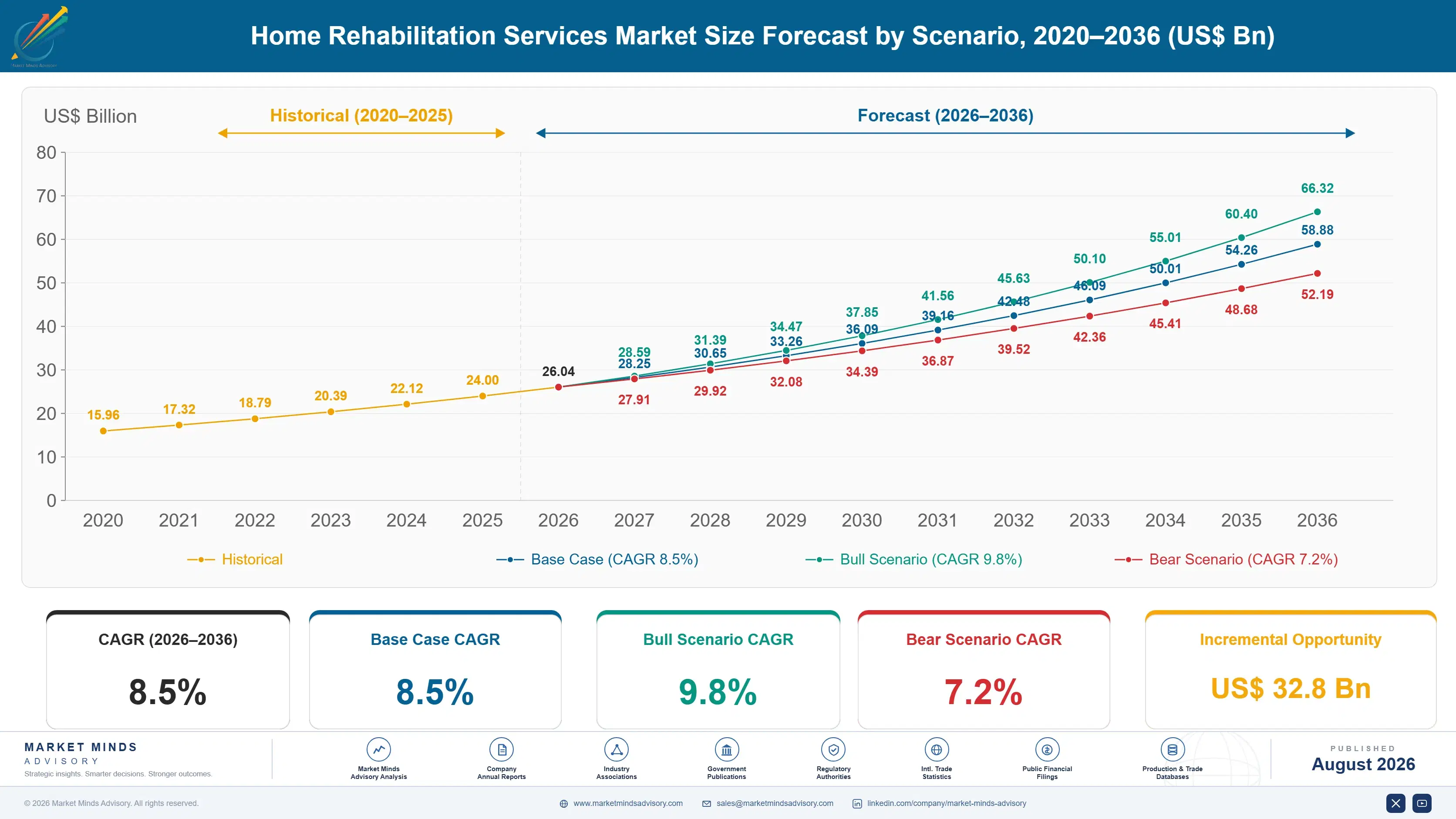
Between 2020 and 2025 the market grew at a 7.5% historical CAGR, accelerating sharply after hospitals adopted earlier discharge protocols to free inpatient capacity during elevated occupancy periods. Early telerehabilitation adoption concentrated among providers serving rural patients without convenient clinic access. Reporting that period remained limited given fragmented state-level licensure disclosure practices. Digital adoption stayed limited to a small number of large providers.
The base case carries the market to an 8.5% CAGR through 2036 on three mechanisms. First, hospitals continue discharging patients earlier as payers push post-acute recovery into lower-cost home settings. Second, telerehabilitation platforms extend therapist caseload capacity beyond what in-person visits alone could serve. Third, an ageing population in most developed markets keeps expanding the pool of patients needing post-surgical and functional recovery support. Improved coordination technology also strengthens the business case across most healthcare markets.
The bull case reaches 9.8% if payers expand home rehabilitation reimbursement parity with facility-based care faster than currently modelled, pulling forward provider expansion across a compressed timeline. The bear case falls to 7.2% if licensed therapist shortages worsen broadly, capping caseload growth regardless of underlying patient demand. That volatility already shows up in extended hiring timelines across several regional providers.

Why Hospital Discharge Timing Is Redrawing Rehabilitation Demand

Three forces converge on home rehabilitation demand at once. Hospitals continue discharging patients earlier as payers push post-acute recovery into lower-cost home settings rather than inpatient facilities. Telerehabilitation platforms extend therapist caseload capacity beyond what in-person visits alone could serve. And an ageing population in most developed markets keeps expanding the pool of patients needing post-surgical and functional recovery support.
MARKET CONCENTRATIONCR5: 28%Fragmented market with many regional providers competing broadly
AVERAGE SELLING PRICEUSD 85 to 220 per visitPricing varies considerably by discipline and regional geography
TOP PRODUCING COUNTRY SHAREUSA: 26% of visits deliveredMedicare home health benefit anchors domestic visit volume
CAPACITY UTILISATION72 to 84%Licensed therapist caseloads run near practical scheduling capacity
INPUT COST SHARE58 to 68% of revenueLicensed clinical staff compensation dominates operating cost structure
REPLACEMENT CYCLE LENGTHContinuousRecovery episodes require ongoing rather than periodic scheduling
Commercially, the market behaves like a coordinated clinical service rather than a generic staffing business. Providers compete on referral relationship depth, licensed staff retention, and care coordination quality rather than by price alone, because a missed visit or poor recovery outcome carries a genuine readmission cost far larger than the visit itself. That coordination discipline protects margin for providers with genuine hospital discharge planning relationships and keeps unlicensed staffing agencies out of clinical contracts.
Over the next decade, caseload extension technology becomes the real differentiator. Providers that combine in-person visits with telerehabilitation monitoring are capturing the referral volume increasingly dominating new hospital discharge planning relationships, while in-person-only providers lose ground even where clinical quality is comparable. That gap is already reshaping which providers win the largest hospital system referral contracts outright.
"A hospital doesn't discharge a patient to a rehab provider anymore, it discharges to a readmission risk score, and the providers winning referrals are the ones who can prove they'll keep that score down."
Director, Post-Acute Care and Home Health Services Practice · MMA Healthcare Ser

Market Trends

Telerehabilitation Extends Limited Therapist Caseload Capacity

Rehabilitation providers increasingly supplement in-person home visits with telerehabilitation sessions delivered by video, letting licensed therapists monitor exercise adherence and adjust recovery plans between physical visits rather than waiting for the next scheduled appointment. That hybrid model is stretching limited licensed therapist supply across considerably larger patient caseloads than in-person-only staffing models could ever support. Amedisys and LHC Group have both expanded telerehabilitation platforms specifically to capture rural patients and caseload capacity that in-person-only visit models could not reach economically. That extension is reshaping how providers plan hiring against projected referral demand.
Market Impact: Shortens average inpatient stays by

Payers Push Post-Acute Recovery Into Lower-Cost Home Settings

Medicare and private payers increasingly steer post-surgical and post-hospitalisation recovery toward home-based rehabilitation rather than inpatient rehabilitation facility stays, since home-based care costs considerably less per recovery episode while delivering comparable outcomes for most eligible patients. That steering has converted home rehabilitation from a secondary discharge option into the default recovery pathway for a growing share of eligible conditions. Hospital discharge planners increasingly default to home rehabilitation referrals unless a patient's condition specifically requires facility-level clinical support. Hospital discharge planners now increasingly treat home rehabilitation as the standard default pathway.
Market Impact: Adds 20-25% new eligible patients a

Market Opportunities and Growth Drivers

Earlier Hospital Discharge Protocols Push Recovery Into the Home

Hospitals facing persistent inpatient capacity pressure increasingly discharge patients earlier in their recovery than protocols specified a decade ago, shifting a meaningful share of clinical recovery work from inpatient nursing staff to home rehabilitation providers. That protocol shift has moved home rehabilitation from a post-discharge convenience into a clinically necessary continuation of active recovery care that hospitals depend on to safely manage bed capacity. Hospital discharge planning teams increasingly build home rehabilitation referral relationships into standard care pathways rather than treating them as an afterthought. That dependency is reshaping how hospitals evaluate discharge partner reliability across networks.
Market Impact: Leaves 15-20% of eligible referrals

Ageing Population Expands the Post-Surgical Recovery Patient Pool

Ageing populations across most developed markets are expanding the pool of patients requiring post-surgical and functional recovery support at a pace outstripping general population growth, particularly following joint replacement and cardiac procedures that concentrate heavily among older patients. That demographic pressure has made home rehabilitation demand considerably less cyclical than most healthcare services categories, since recovery need persists regardless of broader economic conditions. Providers increasingly build capacity planning around demographic projections rather than short-term referral volume alone. That demographic durability is reshaping how investors evaluate provider growth trajectories over the long term.
Market Impact: Cuts rural visit frequency by 30-40

Market Restraints and Challenges

Licensed Therapist Shortages Cap Caseload Growth

Persistent shortages of licensed physical, occupational, and speech therapists across most regions are capping how quickly providers can expand caseloads regardless of underlying referral demand, the root cause being that therapist training programmes have not scaled fast enough to match rising demand from an ageing population and earlier hospital discharge protocols. That staffing constraint leaves many providers turning away eligible referrals during peak demand periods, even where reimbursement and patient need both support additional visits. Providers are responding by expanding telerehabilitation capacity to stretch limited therapist supply considerably further still.
Market Impact: Expands therapist caseload capacity

Reimbursement Variability Limits Rural Provider Expansion

Home rehabilitation reimbursement rates vary considerably by payer and region, a variability that smaller rural providers absorb poorly against the higher per-visit travel cost that geographically dispersed rural caseloads require, the root cause being that reimbursement structures were largely designed around denser urban and suburban visit patterns. That reimbursement gap keeps comprehensive home rehabilitation coverage concentrated in urban and suburban markets, leaving rural patients dependent on less frequent visits or telerehabilitation alone. Providers are responding by advocating for rural-specific reimbursement adjustments with regional payers. Several providers now treat rural coverage as a core strategic differentiator against competitors.
Market Impact: Cuts recovery episode cost by 40-55
3 additional market trends, 4 additional growth drivers, and 3 additional restraints and challenges are covered in the full report. Contact sales@marketmindsadvisory.com to access the complete intelligence.

Segment CAGR and Growth Architecture

Segmentation follows service type, the single clinical logic that determines discipline, delivery mode, and recovery pathway. Physical therapy, occupational therapy, speech-language pathology, telerehabilitation, skilled nursing support, and post-acute coordination services each carry genuinely distinct clinical roles evaluated consistently throughout this report. Skilled nursing rehabilitation support sits within the same evaluated hierarchy, assessed consistently throughout.
home-rehabilitation-services-market-market-share-analysis-1787303711259

Telerehabilitation and Remote Monitoring Services

Telerehabilitation and remote monitoring services grow fastest at 14.0%, about 1.65 times the market's 8.5% overall rate, as providers increasingly stretch limited licensed therapist supply across considerably larger patient caseloads than in-person-only staffing models could ever support. Amedisys and LHC Group still command the largest share of telerehabilitation platform deployments on established hospital referral relationships, but smaller digital-native providers are winning contracts specifically focused on rural and underserved patient populations. Payer reimbursement expansion is letting more providers justify telerehabilitation investment without waiting for full reimbursement parity with in-person visits. Adoption concentrates first among providers serving geographically dispersed rural caseloads where travel cost is highest. Payers increasingly reference documented outcome data when approving new telerehabilitation coverage expansions.
CAGR 14.0%

Post-Surgical and Post-Acute Rehabilitation Coordination Services

Post-surgical and post-acute rehabilitation coordination services grow second-fastest at 11.5%, driven by hospitals increasingly outsourcing discharge planning coordination to specialised providers rather than managing it entirely with internal case management staff. Rather than simply delivering individual therapy visits, coordination services manage a patient's full recovery pathway across multiple disciplines, reducing the readmission risk that fragmented, uncoordinated care otherwise carries. Encompass Health and CenterWell Home Health have both expanded coordination service lines specifically to serve hospitals seeking to reduce readmission penalties under value-based payment models. Adoption is fastest among hospital systems facing the greatest readmission penalty exposure. Hospital case management teams increasingly reference documented outcome data when selecting coordination partners today.
CAGR 11.5%
Full segment breakdown across 6 segments available in the complete report.

Regional Architecture and Country Demand Map

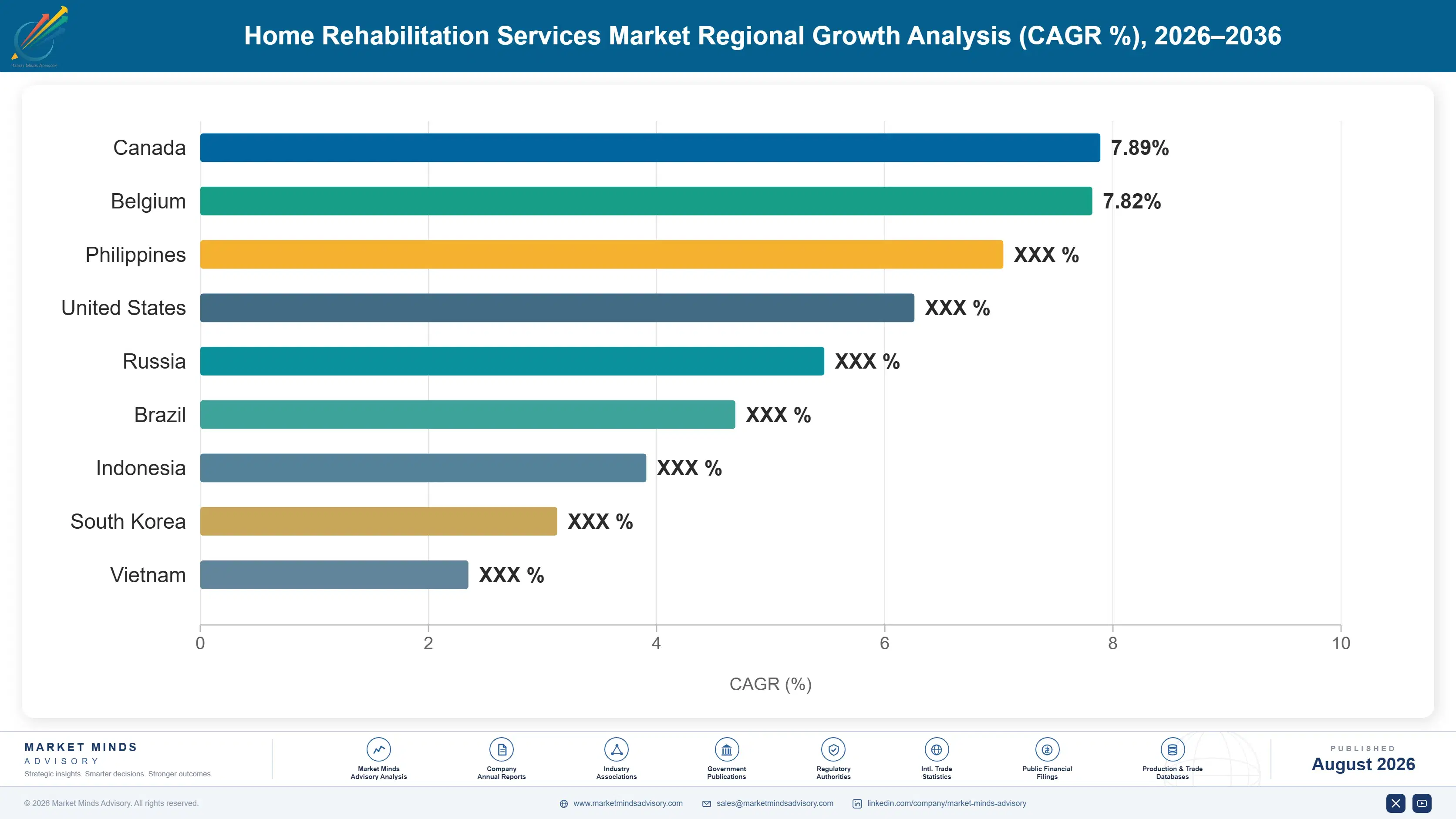
Global demand concentrates where hospital discharge volume and payer reimbursement infrastructure run deepest. North America leads on Medicare home health benefit coverage, East Asia follows on ageing population and expanding healthcare access, and South Asia and Pacific is closing the gap fastest of any region.

North America

The United States drives regional demand through Medicare's home health benefit, which reimburses home rehabilitation at a considerably lower cost than inpatient facility care and has steadily expanded eligible conditions over the past decade. Amedisys and Encompass Health both hold deep incumbency in hospital discharge planning relationships across major metropolitan markets, competing against CenterWell Home Health's growing Humana-integrated referral pipeline. Canada contributes a smaller layer through provincial health system home care programmes following comparable discharge timing trends. Growth of 9.0% reflects continued earlier discharge protocols and expanding telerehabilitation adoption across the region's largest metropolitan referral networks. Reimbursement structures increasingly reward providers with demonstrated readmission reduction performance. Providers increasingly cite that documented data during renewal negotiations.
Share: 30% | CAGR: 9.0% (2026 to 2036)

Western Europe

Germany, France, and the United Kingdom anchor demand through established national health service home care programmes that continue expanding eligible conditions under broader healthcare cost containment strategies. BAYADA Home Health Care holds genuine incumbency across German and broader European home care accounts, competing against national health service in-house provision in several markets. Reimbursement structures vary considerably by country, with Germany moving faster than centrally budgeted systems working through longer policy cycles. Growth of 7.0% trails the global rate as slower national health service policy caps the pace of home rehabilitation expansion relative to North America and Asia. Reimbursement structures increasingly reward providers with demonstrated care coordination outcomes. That documentation increasingly influences renewal negotiations across national contracts.
Share: 22% | CAGR: 7.0% (2026 to 2036)
Regional intelligence for 5 additional markets available in the complete report: East Asia, South Asia and Pacific, Latin America, Middle East and Africa, Eastern Europe. Contact sales@marketmindsadvisory.com.
home-rehabilitation-services-market-country-cagr-analysis-1787303711782

Where Home Rehabilitation Providers Can Defend Margin

Hospital referral relationships increasingly favour providers who can guarantee both discharge coordination and readmission reduction. The four levers below capture revenue before a referral relationship locks its provider list rather than after, rewarding providers who prove outcomes credibly across their full caseload. That reliability increasingly wins the largest value-based hospital system contracts. That reliability wins outright.

Bundle Coordination Services Into Hospital Discharge Contracts

Rehabilitation specification increasingly happens during hospital discharge protocol design rather than during later individual referrals, when care pathways and readmission risk scoring are already built into hospital case management systems. Providers that place coordination specialists inside hospital discharge planning teams from the outset capture the full patient pathway rather than competing for a smaller individual referral later. Amedisys reports that hospitals bundling coordination into discharge protocol design refer patient volumes roughly 28% higher than hospitals using standard referral processes. Early involvement also cuts the readmission risk that fragmented care otherwise carries.
Market Impact: Lifts referral volume roughly 28% v

Sell Telerehabilitation Platform Subscriptions to Smaller Agencies

Smaller regional home care agencies cannot justify building proprietary telerehabilitation infrastructure, yet they represent a large, historically underserved segment that larger providers previously found uneconomical to serve directly through platform licensing. Providers offering telerehabilitation platform subscriptions to smaller agencies are capturing recurring revenue worth 8 to 14% of comparable direct-service revenue annually, extending relationships well past a single referral. LHC Group has expanded its platform licensing offering specifically to capture this recurring layer across smaller regional agencies. Regional agencies increasingly cite that recurring revenue today when evaluating platform vendor partnerships.
Market Impact: Adds a durable 8-14% annual recurri

Build Rural Coverage Networks Through Telerehabilitation Hybrid Models

Reaching geographically dispersed rural patients requires travel cost that conventional in-person-only staffing models absorb poorly, leaving a large underserved rural population that hybrid telerehabilitation providers can capture more economically. Providers building hybrid in-person and telerehabilitation coverage models reach rural patients at meaningfully lower cost than in-person-only competitors, cutting effective visit delivery cost by roughly 35% in dispersed geographies. BAYADA Home Health Care has scaled exactly this hybrid rural approach across several states since 2024. That hybrid approach also builds referral loyalty ahead of larger hospital system contract negotiations across the industry today.
Market Impact: Cuts rural delivery cost by roughly

Target Value-Based Readmission Reduction Framework Agreements

Large hospital systems facing readmission penalties under value-based payment models increasingly want one accountable rehabilitation partner rather than referring to multiple disconnected providers across their discharge population, which shifts real purchasing power to a small number of system-level partnership decisions. Securing a framework agreement covering a hospital system's full discharge population delivers referral volume that no number of individual physician referrals can match. Encompass Health has pursued exactly this framework approach with several hospital systems since 2023. That framework relationship now spans a meaningful share of Encompass Health's system-wide portfolio.
Market Impact: Locks in referrals across a full sy

Who Controls the Margin Pool

Concentration sits at CR5 28%, low for a category still dominated by fragmented regional and local providers alongside a handful of multi-state operators. Amedisys and Encompass Health lead on hospital referral relationship depth, while the gap to challengers like LHC Group is more about geographic coverage than clinical capability. All participants are assessed on one consistent basis, home rehabilitation service revenue.
Current competitive activity runs across three dimensions. Service development concentrates on telerehabilitation platforms to extend therapist caseload capacity. Care coordination investment focuses on readmission risk reduction rather than visit volume alone. And contract structure centres on value-based hospital system framework agreements rather than individual physician referrals, a shift that rewards providers with genuine multi-state coordination capability. Makers investing in both technology and coordination depth are increasingly winning the largest referral relationships.

Emerging pressure comes from payer-owned home health platforms integrating rehabilitation directly into insurance products, winning referral volume that independent providers once assumed was theirs by default. Rankings will shift toward providers who combine telerehabilitation capability with proven readmission reduction data, since that combination is what large hospital systems are now specifying by default. Providers without a credible telerehabilitation roadmap face the sharpest erosion over the coming decade.
home-rehabilitation-services-market-company-positioning-matrix-1787303712311

Competitive Moat and Risk Dimensions

AMEDISYS INC.

Moat: Deep hospital referral relationships

Amedisys holds decades of accumulated hospital discharge planning relationships across major metropolitan markets, giving it a genuine credibility advantage winning large system referral agreements that newer entrants without comparable relationship history cannot easily replicate quickly. That relationship depth is difficult for newer entrants to replicate quickly at scale.
AMEDISYS INC.

Risk: Exposed to therapist supply constraints

Amedisys's caseload growth depends heavily on licensed therapist availability, leaving it more exposed than technology-native competitors to regional staffing shortages that can cap referral acceptance regardless of underlying hospital discharge demand across its service areas. That exposure grows every peak referral period across its highest-demand service areas.
ENCOMPASS HEALTH CORPORATION

Moat: Deep readmission reduction data

Encompass Health draws on decades of accumulated outcome data demonstrating readmission reduction, giving it a genuine advantage winning value-based hospital system contracts that providers without comparable documented outcomes cannot easily replicate quickly at comparable scale. That data advantage compounds with every new value-based contract Encompass Health secures.
ENCOMPASS HEALTH CORPORATION

Risk: Facility-based legacy dilutes home focus

Encompass Health's home rehabilitation business competes internally for investment against its larger inpatient rehabilitation facility operations, leaving room for home-focused specialists like Amedisys to out-invest it on home-specific technology and coordination capability. That focus gap has already cost Encompass Health share in several home-specific procurement decisions.

Players Tracked

Prominent Players

Amedisys Inc.
Encompass Health Corporation
LHC Group Inc.
BAYADA Home Health Care
CenterWell Home Health

Other Key Players

Aveanna Healthcare Holdings Inc.
Addus HomeCare Corporation
Interim HealthCare Inc.
National HealthCare Corporation
Brookdale Senior Living Inc.
Select Medical Holdings Corporation
Genesis Rehab Services
U.S. Physical Therapy Inc.
ATI Physical Therapy Inc.
Concentra Health Services Inc.
Enhabit Inc.
Chartwell Retirement Residences
Right at Home LLC
Home Instead Inc.
Visiting Nurse Service of New York

Recent Developments

MARCH 2025

Amedisys launches expanded telerehabilitation platform for rural patients

Amedisys introduced an expanded telerehabilitation platform specifically designed for rural patients with limited access to in-person visits. This was an organic service launch rather than an acquisition, extending Amedisys's addressable rural caseload capacity. The updated platform ships to rural service areas across major states this quarter.
Signal: Rural caseload extension is becoming a gen
SEPTEMBER 2025

LHC Group acquires regional telerehabilitation technology company

LHC Group completed the acquisition of a regional telerehabilitation technology company with proprietary remote monitoring software. The deal brought advanced platform capability in-house, expanding LHC Group's technology offering considerably beyond its prior licensed-platform arrangement. The acquired team now operates as LHC Group's dedicated technology division going forward.
Signal: Telerehabilitation technology is becoming
JULY 2025

Encompass Health signs value-based framework agreement with hospital system

Encompass Health entered a multi-year value-based framework agreement covering rehabilitation referrals across a regional hospital system's full discharge population. The agreement was a commercial services contract, not a joint venture or equity transaction, covering referrals across the system's full network. Similar agreements are now under discussion with other hospital systems.
Signal: Multi-year value-based framework agreement

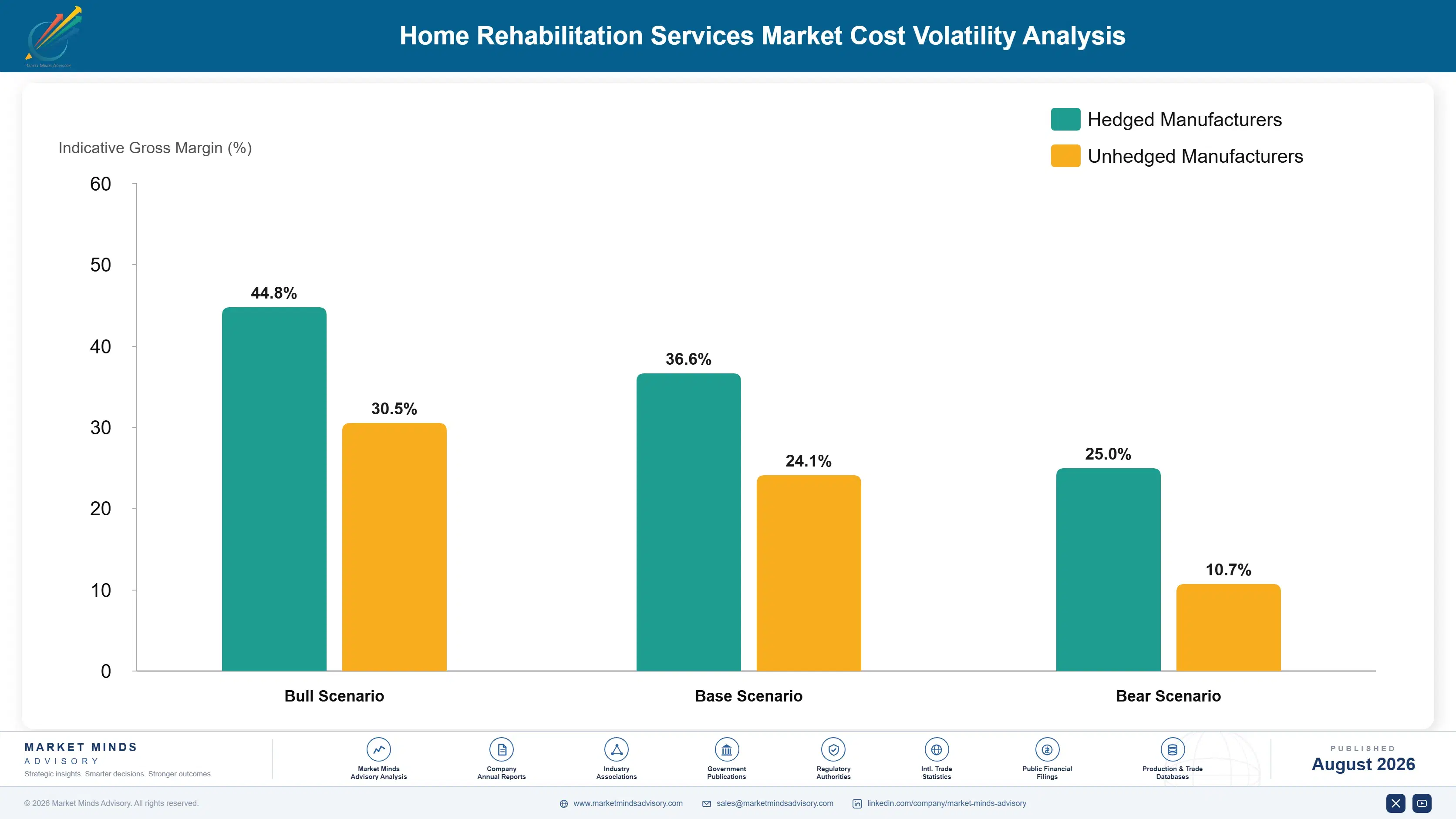
Licensed Clinical Staff Compensation Exposure

Licensed clinical staff compensation, including physical, occupational, and speech therapist wages and benefits, runs 58 to 68% of revenue, reflecting a persistent nationwide shortage of licensed rehabilitation professionals relative to growing patient demand. Travel and vehicle costs for in-person home visits add a further 8 to 12%, with administrative and care coordination overhead accounting for most of the remainder.
The nationwide healthcare staffing shortage running through 2021 and 2022 hit home rehabilitation providers directly, since licensed therapists faced competing offers from hospitals and outpatient clinics offering signing bonuses that home health providers struggled to match. Amedisys's 2022 Annual Report disclosed elevated staffing costs and extended time-to-fill for open therapist positions, attributing part of the pressure to broader healthcare labour market tightness that persisted through much of the year.

Exposure varies sharply by player type. Larger multi-state providers like Amedisys offer more competitive compensation and career advancement pathways, insulating them from the worst staffing pressure, while smaller regional agencies depend on local labour markets and absorb wage inflation directly into thinner margins. Geography matters too, since providers in areas with therapist training programmes face different exposure than those in underserved regions.
home-rehabilitation-services-market-cost-volatility-analysis-1787303712510

Build Direct Partnerships With Therapist Training Programmes

Partnering directly with physical, occupational, and speech therapy training programmes to recruit graduates before they enter the broader job market keeps a provider from competing purely on compensation against hospitals and clinics. Several large providers adopted training partnerships after the 2021 shortage exposed how tight regional labour markets genuinely were. That approach continued even as labour markets stabilised somewhat.

Expand Telerehabilitation To Reduce Per-Patient Staff Time

Supplementing in-person visits with telerehabilitation sessions lets a single therapist manage a larger caseload without proportionally increasing headcount, insulating providers from the worst effects of staffing shortages during periods of peak referral demand. Providers coordinating hybrid caseload models have meaningfully reduced per-patient staffing cost exposure across their networks. That coordination has meaningfully reduced cost exposure during peak demand periods.

Offer Flexible Scheduling To Improve Staff Retention

Offering therapists flexible scheduling and reduced administrative burden meaningfully improves retention compared with rigid, high-caseload staffing models that drive burnout and turnover. Providers investing in retention-focused scheduling have reduced staff turnover considerably, cutting the recurring cost of recruiting and onboarding replacement clinical staff. That retention improvement compounds meaningfully across multi-year provider growth. That retention advantage compounds across multi-year growth.

Portfolio Architecture for Margin Defence

The portfolio splits into three tiers with real margin separation, and the gap between tiers has widened as care coordination becomes a genuine differentiator rather than an add-on feature. Volume-tier standard in-person visits compete on price against undifferentiated staffing agencies and earn modestly. Premium coordination and value-based framework services earn considerably more because they solve a genuine readmission reduction problem that hospitals cannot engineer around cheaply.
The tension is between standard visit volume and per-contract coordination margin. Providers selling standard visits in bulk push hard on per-visit reimbursement, while hospital systems standardising on value-based framework agreements pay for readmission reduction and care coordination depth rather than negotiating down to the last dollar on every visit. Providers serving both buyer types run genuinely different sales motions under one brand.

High-value pools concentrate in coordination services sold with telerehabilitation platforms and value-based framework agreements, where switching cost is highest and price sensitivity lowest. Legacy standard visit business remains large in volume but persistently thin in margin, as payers treat it as a commodity purchase rather than a differentiated one. Providers investing in both coordination capability and framework relationships are best positioned to capture that concentration going forward.

Volume / Commodity-Adjacent Tier

Standard in-person therapy visits sold into routine referral relationships, priced against undifferentiated staffing agencies. Margin stays thin because payers negotiate primarily on per-visit reimbursement rate. Payers rarely differentiate between providers on anything beyond reimbursement rate and availability.
Gross Margin: 8-16%

Premium / Certified Tier

Coordination and value-based framework services sold into hospital systems standardising discharge relationships. Buyers pay for readmission reduction and care coordination depth rather than for visits alone. Documentation quality and coordination depth matter as much as the clinical specification itself.
Gross Margin: 18-28%

Sustainability / Regulatory / Next-Generation Tier

Telerehabilitation platform services bundled with coordination subscriptions sold to hospital systems and regional agencies. Margin reflects both technology differentiation and recurring revenue. Few providers currently combine both elements convincingly at meaningful commercial scale.
Gross Margin: 22-34%
home-rehabilitation-services-market-portfolio-architecture-1787303713010

Recurring Referral Demand Behind Every Discharge

Demand behaves like an annuity once a hospital system standardises on a referral relationship, because recovery episodes require ongoing scheduling throughout a patient's treatment course and readmission reduction requires continuing coordination beyond any single visit. That episode continuity, plus the underlying caseload expansion demand it eventually triggers, gives providers a predictable revenue tail well beyond any individual referral. Providers who secure early framework position capture
Adoption depth varies sharply by end-use vertical. Large hospital systems facing readmission penalties adopt coordinated rehabilitation fastest and deepest, since documented outcome improvement directly protects value-based payment revenue. Ambulatory surgical centres follow closely on post-procedure recovery referral volume. Smaller community hospitals adopt more slowly, often waiting for a readmission penalty exposure or capacity pressure to force the coordination decision.

Buyer profiles are shifting generationally. Referral decisions once sat with individual physicians evaluating single provider relationships; they now increasingly involve hospital system care coordination teams who specify referral standards before a single patient is discharged. That shift moves the real purchasing decision earlier into the discharge planning cycle. Providers who engage discharge planning teams early increasingly win preferred status ahead of individual physician decisions.
home-rehabilitation-services-market-end-use-penetration-index-1787303713510

Where Home Rehabilitation Value Concentrates

These are among the four positions where our research anticipates prominent divergence between winners and laggards over the coming forecast period. Each is grounded in the demand model, the regulatory perimeter, and the announced capacity pipeline.
01 / TELEREHABILITATION GROWTH STRATEGY

Caseload Extension Now Decides Long-Run Category Position

Telerehabilitation and remote monitoring services are growing at 14.0%, about 1.65 times the market's 8.5% overall rate, and that gap is widening as providers increasingly stretch limited therapist supply across larger caseloads than in-person-only models ever supported. Providers still anchored on in-person visits alone risk losing the fastest-growing, highest-margin value-based framework contracts to rivals offering proven telerehabilitation capability already deployed at scale. The window to build credible telerehabilitation capability is closing within this forecast period, and providers who act now win the largest contracts before rivals catch up.
02 / COORDINATION SERVICES STRATEGY

Readmission Reduction Data Is Becoming Table Stakes

Large hospital systems increasingly refuse to refer patients without documented readmission reduction outcomes, since an unmanaged recovery episode represents a genuine value-based payment penalty risk during constrained hospital budget cycles. Providers who build this coordination capability capture recurring referral volume and preferred-partner status that visit-only competitors cannot easily replicate at comparable scale. Those without credible coordination data will find themselves excluded from the largest hospital system framework agreements, losing referrals to better-equipped rivals with documented coordination data already in hand.
03 / VALUE-BASED FRAMEWORK CHANNEL

System-Wide Frameworks Will Outgrow Individual Referrals

Hospital systems are increasingly folding rehabilitation referrals into coordinated value-based standards rather than leaving them to individual physician discretion, concentrating real referral power in a small number of framework decisions that smaller providers cannot easily access at scale. Providers who secure framework status with major hospital systems capture referral volume across an entire discharge population that no number of individual physician referrals can replicate. Those still relying purely on individual referrals risk being locked out of this fastest-growing channel entirely.
04 / PAYER INTEGRATION PRESSURE

Payer-Owned Platforms Will Keep Pressuring Independent Providers

Payer-owned home health platforms have scaled fast enough to capture referral volume that independent providers once assumed was theirs by default, and that integration pressure is starting to spread into standard visit-based referrals as well. Providers competing purely on price against payer-owned platforms will struggle to hold margin over any meaningful time horizon. The more durable response is competing on documented outcome quality and coordination depth, categories where payer-owned platforms still visibly lag behind clinical incumbents, with consolidation among smaller providers likely as pressure intensifies.

Engagement Snapshot From the Field

A live engagement with an industry participant carrying material or product regulatory and market exposure ahead of a defining policy shift, showing how our research translates into a defensible multi-year portfolio strategy.
MARKET MINDS ADVISORY · CLIENT ENGAGEMENT SUMMARY
Home Rehabilitation Services Producer Strategic Portfolio Review and Transition Roadmap 2026·Investment Scenario on Home Rehabilitation Services Exposure Evaluation 2025-26
CLIENT PROFILE
A regional hospital system operating four hospitals approached MMA after readmission penalties under value-based payment models began meaningfully affecting annual reimbursement. The client reported that fragmented, uncoordinated rehabilitation referrals across multiple unaffiliated providers contributed to inconsistent recovery outcomes that leadership considered addressable through better coordination (client-reported, unverified by MMA). Leadership viewed this as both a financial and quality-of-care concern.
STRATEGIC CHALLENGE
The system had referred patients to whichever local provider had capacity for over a decade without a coordinated discharge partnership strategy, leading to inconsistent recovery outcomes and rising readmission penalty exposure. Leadership needed to evaluate whether a coordinated framework partnership could reduce readmissions within a constrained annual operating budget. The recent penalty escalation forced a formal strategic review of referral practices.
MMA APPROACH
MMA benchmarked the system's readmission rates against comparable hospital systems already operating coordinated rehabilitation framework partnerships, quantifying the outcome improvement a structured partnership would deliver. We evaluated candidate provider partners against documented outcome data, and modelled a phased transition schedule against the system's existing discharge planning workflow. We also assessed each candidate's technology platform for telerehabilitation compatibility.
KEY FINDINGS
  1. Comparable hospital systems operating coordinated framework partnerships showed considerably lower readmission rates than the system's fragmented referral approach, based on benchmarking performed during the review.
  2. A phased transition to a single coordinated provider partnership addressed most of the readmission risk without requiring an abrupt, disruptive change to established referral relationships.
  3. Two of three candidate providers evaluated could deliver system-wide coordination within the system's compressed transition timeline; the third required a considerably longer onboarding period.
  4. Piloting the coordinated partnership at one hospital before system-wide rollout considerably improved staff and physician buy-in during the transition (client-reported, unverified by MMA).
CLIENT PROFILE
A regional hospital system operating four hospitals approached MMA after readmission penalties under value-based payment models began meaningfully affecting annual reimbursement. The client reported that fragmented, uncoordinated rehabilitation referrals across multiple unaffiliated providers contributed to inconsistent recovery outcomes that leadership considered addressable through better coordination (client-reported, unverified by MMA). Leadership viewed this as both a financial and quality-of-care concern.
STRATEGIC CHALLENGE
The system had referred patients to whichever local provider had capacity for over a decade without a coordinated discharge partnership strategy, leading to inconsistent recovery outcomes and rising readmission penalty exposure. Leadership needed to evaluate whether a coordinated framework partnership could reduce readmissions within a constrained annual operating budget. The recent penalty escalation forced a formal strategic review of referral practices.
MMA APPROACH
MMA benchmarked the system's readmission rates against comparable hospital systems already operating coordinated rehabilitation framework partnerships, quantifying the outcome improvement a structured partnership would deliver. We evaluated candidate provider partners against documented outcome data, and modelled a phased transition schedule against the system's existing discharge planning workflow. We also assessed each candidate's technology platform for telerehabilitation compatibility.
KEY FINDINGS
  1. Comparable hospital systems operating coordinated framework partnerships showed considerably lower readmission rates than the system's fragmented referral approach, based on benchmarking performed during the review.
  2. A phased transition to a single coordinated provider partnership addressed most of the readmission risk without requiring an abrupt, disruptive change to established referral relationships.
  3. Two of three candidate providers evaluated could deliver system-wide coordination within the system's compressed transition timeline; the third required a considerably longer onboarding period.
  4. Piloting the coordinated partnership at one hospital before system-wide rollout considerably improved staff and physician buy-in during the transition (client-reported, unverified by MMA).
RECOMMENDED STRATEGY
Phase 1: Phase 1 (0 to 6 months): Pilot the coordinated rehabilitation partnership at the system's highest-readmission hospital first, validating outcomes before wider rollout. Phase 2: Phase 2 (6 to 18 months): Extend the partnership across the system's remaining hospitals ahead of the next value-based payment review cycle, tracking outcomes closely. Phase 3: Phase 3 (18 to 36 months): Fold the coordinated partnership into the system's permanent discharge planning standard, reviewing outcomes each payment cycle.
OUTCOME
The system piloted the coordinated partnership at its highest-readmission hospital and reported a measurable reduction in readmission rates during subsequent quarters. The phased rollout approach has since extended to two additional hospitals within the system facing comparable readmission penalty exposure (client-reported, unverified by MMA). Physicians reported greater confidence in the coordinated recovery process overall.

Frequently Asked Questions

Foundational context covering the market sizes, CAGR, scope, country, region and competition that inform every finding below. This section is provided to cover basics and most often pre-purchase conversations, answered from the MMA Primary Research Dataset.

What is the current size of the Home Rehabilitation Services Market?

The market was valued at USD 24.0 billion in 2025, with demand concentrated in physical therapy, telerehabilitation, and coordination services across major global healthcare markets.

How large will the Home Rehabilitation Services Market be by 2036?

The market is projected to reach USD 58.88 billion by 2036, an expansion multiple of 2.26 times its 2026 value. Telerehabilitation adoption drives much of that growth.

What is the CAGR for the Home Rehabilitation Services Market 2026 to 2036?

The base case CAGR is 8.5%, with a bull case of 9.8% and a bear case of 7.2%. The range reflects uncertainty around licensed therapist supply constraints.

Which segment is growing fastest?

Telerehabilitation and remote monitoring services grow fastest at 14.0%, about 1.65 times the overall market rate, as providers increasingly stretch limited therapist supply much further.

Who are the major companies in the Home Rehabilitation Services Market?

Amedisys, Encompass Health, LHC Group, BAYADA Home Health Care, and CenterWell Home Health lead the fragmented market at CR5 28%, reflecting genuine referral relationship depth.

Which country is growing fastest?

India grows fastest at 12.5%, driven by expanding urban healthcare access and rising post-surgical rehabilitation awareness. The United States remains the largest market by visit volume.

Report Segmentation Architecture

The full report scope spans multiple orthogonal segmentation dimensions, with cross-tabulated demand data provided for each dimension pair. Coverage extends further to regional breakdowns, trend trajectories, and the competitive detail needed to support segment-level decision-making.

By Service Type

  • Physical Therapy Home Services
  • Occupational Therapy Home Services
  • Speech-Language Pathology Home Services
  • Telerehabilitation and Remote Monitoring Services
  • Skilled Nursing Rehabilitation Support Services
  • Post-Surgical and Post-Acute Rehabilitation Coordination Services

By End-Use Industry

  • Hospital Discharge and Post-Acute Care
  • Ambulatory Surgical Centres
  • Skilled Nursing and Long-Term Care Facilities
  • Payer-Integrated Home Health Programmes
  • Independent Referral and Self-Pay Patients

By Commercial Dimension

  • Value-Based Hospital System Framework Agreements
  • Individual Physician Referral Relationships
  • Telerehabilitation Platform Subscriptions
  • Medicare and Private Payer Reimbursement Channels

By Region

  • North America
  • Western Europe
  • East Asia
  • South Asia and Pacific
  • Latin America
  • Middle East and Africa
  • Eastern Europe

Scope, Methodology, and Coverage

Every figure in this report is reproducible from documented input assumptions. The scope below maps the historical period, the forecast horizon, the segmentation dimensions, and the countries covered, alongside the underlying primary and qualitative methodology.
Historical Period
2020 to 2025
Forecast Period
2026 to 2036
Base Year
2025 (USD billions; MMA Primary Research Dataset, August 2026)
Market Definition
The home rehabilitation services market comprises physical therapy, occupational therapy, speech-language pathology, and skilled nursing rehabilitation support delivered in a patient's home following hospitalisation, surgery, or the onset of a functional impairment, spanning telerehabilitation and remote monitoring services and post-acute rehabilitation coordination. Inpatient rehabilitation facility services, outpatient clinic-based therapy visits, and durable medical equipment sales are excluded.
Quantitative Units
USD billions (current prices); therapy visits and coordinated recovery episodes delivered where applicable
Segmentation Dimensions
By Service Type; By End-Use Industry; By Commercial Dimension; By Region
Regions Covered
North America, Western Europe, East Asia, South Asia and Pacific, Latin America, Middle East and Africa, Eastern Europe
Countries Covered
USA, China, Germany, France, UK, Japan, South Korea, India, Australia, Canada, Brazil, Mexico, Indonesia, Vietnam, Thailand, Malaysia, UAE, Saudi Arabia, South Africa, Nigeria, Turkey, Poland, Netherlands, Italy, Spain, Sweden, Switzerland, Argentina, Colombia, Singapore, and additional markets relevant to this sector
Key Companies Profiled
Amedisys Inc., Encompass Health Corporation, LHC Group Inc., BAYADA Home Health Care, CenterWell Home Health, Aveanna Healthcare Holdings Inc., Addus HomeCare Corporation, Interim HealthCare Inc., National HealthCare Corporation, Brookdale Senior Living Inc., Select Medical Holdings Corporation, Genesis Rehab Services, U.S. Physical Therapy Inc., ATI Physical Therapy Inc., Concentra Health Services Inc., Enhabit Inc., Chartwell Retirement Residences, Right at Home LLC, Home Instead Inc., Visiting Nurse Service of New York
Quantitative Methodology
Primary survey, n=3,800 respondents, Q4 2025, six countries; demand-side model with trade association cross-validation
Qualitative Methodology
47 expert interviews, Q4 2025; applied to validate demand model assumptions, identify emerging dynamics, and assess competitive positioning
Report Format
PDF and XLSX data workbook (Word format preview document)
Publisher
Market Minds Advisory
Report Code
MMA-2026-HLT-107
Published
August 2026
Contact
sales@marketmindsadvisory.com | www.marketmindsadvisory.com

Purchase the full Home Rehabilitation Services Market Report (2026 to 2036).

The full MMA Home Rehabilitation Services report sizes the market across six service types, five end-use verticals, four commercial dimensions, and seven regions through 2036. It profiles twenty participants on a consistent service revenue basis, scoring each on referral relationship depth, telerehabilitation capability, and coordination outcome data. Scenario models quantify how hospital discharge timing, licensed therapist supply, and value-based payment policy move both demand and realised pricing. The report also includes delivered-cost modelling by service type and a hospital system framework benchmarking tool built for provider strategy and payer partnership teams.
Service type cost and outcome benchmarking
Discharge volume and referral tracker by region
Value-based framework agreement structure and pricing tracker
Licensed therapist supply and staffing policy tracker
Clinical staff compensation cost risk screen
Telerehabilitation subscription revenue and retention model

Built For The People Who Decide

From boardroom strategy to bench-side execution, this report is read cover-to-cover by leaders shaping the next decade of their industry, turning demand scenarios, market dynamics and valuation benchmarks into decisions.
CXOs/ Presidents/ VPs/ Managers
M&A and Corporate Development
Strategy Teams and R&D Heads
Procurement and Product Directors
Regulatory and Compliance Leaders
Investor Relations and Equity Analysts