Market Minds Advisory
Home Healthcare Market

Home Healthcare Market: Hospital-at-Home Expansion and Remote Monitoring Adoption

Payer cost pressure is pushing acute care out of hospitals and into patients' living rooms, as hospital-at-home programmes and remote monitoring platforms let providers manage conditions that required inpatient admission only a few years earlier.

Lead Analyst

Alice Ballenger

Published

September 2026

Make Smarter Decisions with Customized Research Insights

Request a free sample report and evaluate market opportunities, growth trends, and competitive dynamics relevant to your business needs.

2025 MARKET VALUE$445.0BMarket Size 2025
2036 FORECAST VALUE$1081MBase Case , 2026 to 2036
CAGR 2026 TO 20368.4 %Bull 9.6% / Bear 7.2%
INCREMENTAL OPPORTUNITY$598.2BNet 10- year value creation
EXPANSION MULTIPLE2.24x2036 value over 2026 base
Strategic Levers
M&A Pipeline
Regional Outlook
Country Rankings
Competitive Intelligence
Segmental Deep-dive
Call-Us : 91 93563 13602

Executive Snapshot and Market Trajectory

Health systems are discharging patients earlier and treating acute conditions at home under structured hospital-at-home programmes, reflecting a genuine payer-driven shift rather than a temporary pandemic-era accommodation that would fade once emergency waivers expired. Momentum in this shift shows no sign of slowing across most major health systems tracked.
Remote patient monitoring and hospital-at-home acute care are growing far faster than traditional home health aide and skilled nursing services, concentrated heavily in North American markets where Medicare waiver programmes and value-based payment models reward providers for keeping patients out of costlier inpatient settings, while India's rapidly expanding home healthcare sector reflects genuine hospital capacity constraints pushing care into the home by necessity. Payers everywhere are watching this shift closely as coverage decisions follow outcomes.
The five largest providers hold under a quarter of category revenue, leaving this a genuinely fragmented industry dominated by regional and local agencies competing on caregiver availability and clinical quality rather than national brand recognition. Payer reimbursement policy is becoming the single most consequential factor determining which providers can scale profitably. Smaller agencies face growing pressure to differentiate through outcomes rather than price alone.
Market Definition
The home healthcare market covers skilled nursing, home health aide and personal care, rehabilitation therapy, hospice and palliative care, remote patient monitoring, and hospital-at-home acute care services delivered to patients in a residential setting. It excludes assisted living and nursing home facility care, hospital inpatient services themselves, and durable medical equipment sales not bundled with an ongoing home care service relationship.
Base Year Value
$445.0B in 2025 (MMA Primary Research Dataset, August 2026)
Forecast Period
2026 to 2036, eleven discrete annual values
CAGR
8.4% base case. Bull 9.6%. Bear 7.2%.
Fastest Growth Segment
Hospital-at-Home Acute Care Programmes: 16.8% CAGR
Fastest Growth Country
India: 12.6% CAGR
Fastest Growth Region
South Asia and Pacific: 10.4% CAGR
Largest Region
North America: 32% of 2025 global value
Market Leaders
Amedisys, LHC Group, Encompass Health, BAYADA Home Health Care, and Addus HomeCare. Source: MMA Analysis based on company annual reports and disclosed segment revenue.
Primary Survey
n=3,800 procurement and R&D decision-makers, Q4 2025, six countries
Methodology
Demand-side build-up, cross-validated against public data, 47 expert interviews

Home Healthcare Market Forecast Scenarios

home-healthcare-market-size-forecast-scenario-1787303610006
Between 2020 and 2025 the market grew at roughly 7.4% a year, a pace lifted early by pandemic-era hospital capacity constraints that pushed care into the home before settling into steadier growth as hospital-at-home waiver programmes and remote monitoring adoption proved durable rather than temporary emergency accommodations. across most major healthcare systems tracked closely by industry observers.
The base case assumes 8.4% annual growth through 2036, driven by three commercial mechanisms operating together: hospital-at-home programme expansion under extended payer waivers reducing costlier inpatient admissions, remote patient monitoring adoption growing as connected devices become more affordable and reliable, and an ageing population across most developed healthcare systems expanding the addressable patient base for home-based chronic disease management. Caregiver workforce investment expansion adds a fourth complementary growth channel worth tracking closely.
A bull case near 9.7% follows if hospital-at-home waiver programmes secure permanent payer authorisation rather than periodic renewal, giving providers the reimbursement certainty needed to invest confidently in capacity. A bear case near 7.1% follows instead if waiver programmes lapse or payer reimbursement rates fail to keep pace with rising home care labour costs across major markets.

Payer-Driven Shift From Inpatient to Home Settings

Three forces converge on home healthcare delivery this decade: payer cost pressure pushing acute care out of hospital settings and into structured hospital-at-home programmes, remote patient monitoring technology maturing to a point where it can reliably support this care setting shift, and an ageing population across most developed markets expanding the addressable patient base for both chronic disease management and end-of-life care. Companies that read this shift early are already ahead of sl
MARKET CONCENTRATIONCR5 22%share held by top five providers by disclosed revenue
AVERAGE EPISODE COST$2,800-$38,000range spans standard home health episode to hospital-at-home stay
TOP SPENDING COUNTRYUSA, 29% shareof global home healthcare spending measured by service value
CAREGIVER VACANCY RATE18-24%share of home health aide positions unfilled at surveyed agencies
REMOTE MONITORING PENETRATION27%share of eligible chronic patients enrolled in monitoring programmes
AVERAGE LENGTH OF CARE45-90 daystypical duration of a standard home health service episode
Commercial character has shifted from fee-for-service episodic care toward value-based payment arrangements that reward providers for keeping patients out of hospitals and emergency departments entirely. Larger providers increasingly invest in remote monitoring infrastructure and care coordination technology that smaller regional agencies cannot easily replicate, giving scaled operators a genuine advantage in value-based contract negotiations with major payers.
Over the next decade, hospital-at-home reimbursement permanence, remote monitoring technology adoption, and persistent caregiver workforce shortages will keep separating providers with genuine technology and scale advantages from smaller agencies still operating on traditional fee-for-service models where margin pressure runs considerably tighter. Providers investing in evidence generation now are shaping how the whole field evolves going forward.
"A decade ago home health meant a nurse visiting twice a week to check vitals. Now hospitals are discharging genuinely acute patients into monitored home settings, and that shift has turned home healthcare into a real extension of the hospital rather than an alternative to it."
Director, Healthcare Services Practice · MMA Healthcare Services Practice

Market Trends

Hospital-at-Home Programmes Expand Under Extended Payer Waivers

The Centers for Medicare and Medicaid Services extended its Acute Hospital Care at Home waiver programme, letting participating hospitals treat genuinely acute conditions including pneumonia and heart failure in patients' homes with hospital-level monitoring and daily physician oversight rather than requiring inpatient admission. Health systems participating in the programme report meaningfully lower costs per episode alongside comparable or better clinical outcomes and higher patient satisfaction scores than equivalent inpatient care. Over two hundred hospitals have joined the programme since its introduction nationally. Health system executives report significant additional interest pending clearer signals about long-term reimbursement permanence beyond renewal cycles.
Market Impact: Drives 5.6 percent yearly care-sett

Remote Patient Monitoring Technology Reaches Mainstream Reliability

Connected blood pressure cuffs, pulse oximeters, and weight scales have become reliable and affordable enough for mainstream home health deployment, letting agencies monitor chronic disease patients continuously rather than relying entirely on periodic in-person visits that could miss early warning signs of deterioration. Providers report remote monitoring programmes reducing hospital readmission rates meaningfully among enrolled chronic heart failure and COPD patients compared to standard visit-based care models used previously. Major providers have expanded enrolment considerably over the past two years. Industry data shows monitoring-enabled patients generating measurably better outcomes than comparable patients receiving standard care alone.
Market Impact: Adds 4.2 percent demographic-driven

Market Opportunities and Growth Drivers

Payer Cost Pressure Favours Home Over Inpatient Settings

Major US payers including Medicare and large private insurers increasingly favour home-based care over inpatient hospital admission wherever clinically appropriate, since home care delivers meaningfully lower total cost per episode for conditions that do not require the full resource intensity of a hospital bed and round-the-clock nursing staff. This payer-driven preference is expanding demand for structured hospital-at-home and enhanced remote monitoring programmes considerably faster than traditional home health aide demand is growing across most developed healthcare systems tracked. Health systems report payer contract terms increasingly rewarding successful home-based management of conditions that previously defaulted to inpatient admission automatically.
Market Impact: Limits 16 pct capacity growth

Ageing Population Expands Chronic Disease Management Demand

United Nations population data shows the share of adults over sixty-five climbing steadily across most developed healthcare markets, directly expanding the patient population requiring ongoing chronic disease management, rehabilitation therapy, and eventually hospice and palliative care services that home healthcare providers increasingly deliver across most major national healthcare systems tracked. This demographic trend is considerably more predictable than most demand drivers affecting the broader healthcare sector, giving providers reasonable confidence in long-term capacity planning even amid near-term reimbursement policy uncertainty affecting specific programme types. Providers report steady demand growth tied directly to this demographic shift across most major markets.
Market Impact: Delays 11 percent of capacity inves

Market Restraints and Challenges

Persistent Caregiver Workforce Shortages Limit Capacity Growth

Home health aide and skilled nursing positions carry vacancy rates considerably higher than most other healthcare occupations, genuinely constraining how quickly agencies can expand service capacity even where patient demand and payer willingness to fund care both exist and continue growing. The root cause is that home care work offers lower wages and fewer benefits than comparable hospital-based nursing positions, making recruitment and retention genuinely difficult in a labour market where healthcare workers have considerable choice. Providers are mitigating this by raising wages and expanding benefits packages. though margin pressure limits investment without payer rate increases.
Market Impact: Adds 16.8 percent segment growth ye

Reimbursement Policy Uncertainty Slows Provider Investment

Hospital-at-home waiver programmes and other newer payment models depend on periodic regulatory renewal rather than permanent statutory authorisation, creating genuine investment uncertainty for providers considering major capacity expansion or technology infrastructure spending tied to these programmes specifically. The root cause is that permanent authorisation requires legislative action that has not yet occurred, leaving providers to plan around renewal cycles that could theoretically lapse and disrupt already-built care delivery infrastructure. Providers are mitigating this by diversifying revenue across service lines. reducing single-programme dependency risk considerably across the industry. Diversified providers report considerably steadier revenue through periods of policy uncertainty.
Market Impact: Lifts monitoring-enabled patient sh
3 additional market trends, 4 additional growth drivers, and 2 additional restraints and challenges are covered in the full report. Contact sales@marketmindsadvisory.com to access the complete intelligence.

Segment CAGR and Growth Architecture

Segmentation follows service type, the dimension that determines clinical intensity, reimbursement pathway, and which patient population a given service line typically serves, since service type drives both payer relationship and staffing model more than any other operational factor providers consider. across most current service lines and reimbursement pathways available. today. for physicians and payers alike.
home-healthcare-market-market-share-analysis-1787303610543

Hospital-at-Home Acute Care Programmes

Hospital-at-home programmes are pulling dramatically ahead as extended Medicare waiver authorisation lets participating health systems treat genuinely acute conditions in patients' homes with hospital-level monitoring rather than requiring inpatient admission, a shift that delivers meaningfully lower cost per episode alongside comparable clinical outcomes. Health systems report significant additional capacity interest pending clearer long-term reimbursement signals beyond periodic waiver renewal cycles. Growth concentrates in large integrated health systems first, where clinical infrastructure and remote monitoring technology already exist from broader digital health investment. Providers including Amedisys have expanded programme capacity to meet this demand. Order data confirms this segment's growth consistently outpaces every other home healthcare category tracked, reinforcing its clear lead across the industry.
CAGR 16.8%

Remote Patient Monitoring and Telehealth-Enabled Care

Remote patient monitoring and telehealth-enabled care form the second-fastest category, favoured as connected devices become reliable and affordable enough for mainstream chronic disease management deployment across a considerably broader patient population than earlier-generation monitoring technology could support cost-effectively. Providers report monitoring-enabled programmes reducing hospital readmission rates meaningfully among enrolled chronic disease patients compared to standard visit-based care models used historically. Growth concentrates in chronic heart failure, COPD, and diabetes management first, where continuous monitoring delivers the clearest measurable outcome improvement and cost avoidance for payers evaluating programme investment. Providers are scaling monitoring infrastructure specifically to bring this technology within reach of a broader patient population previously underserved by episodic visit-based care alone.
CAGR 13.5%
Full segment breakdown across 6 segments available in the complete report.

Regional Architecture and Country Demand Map

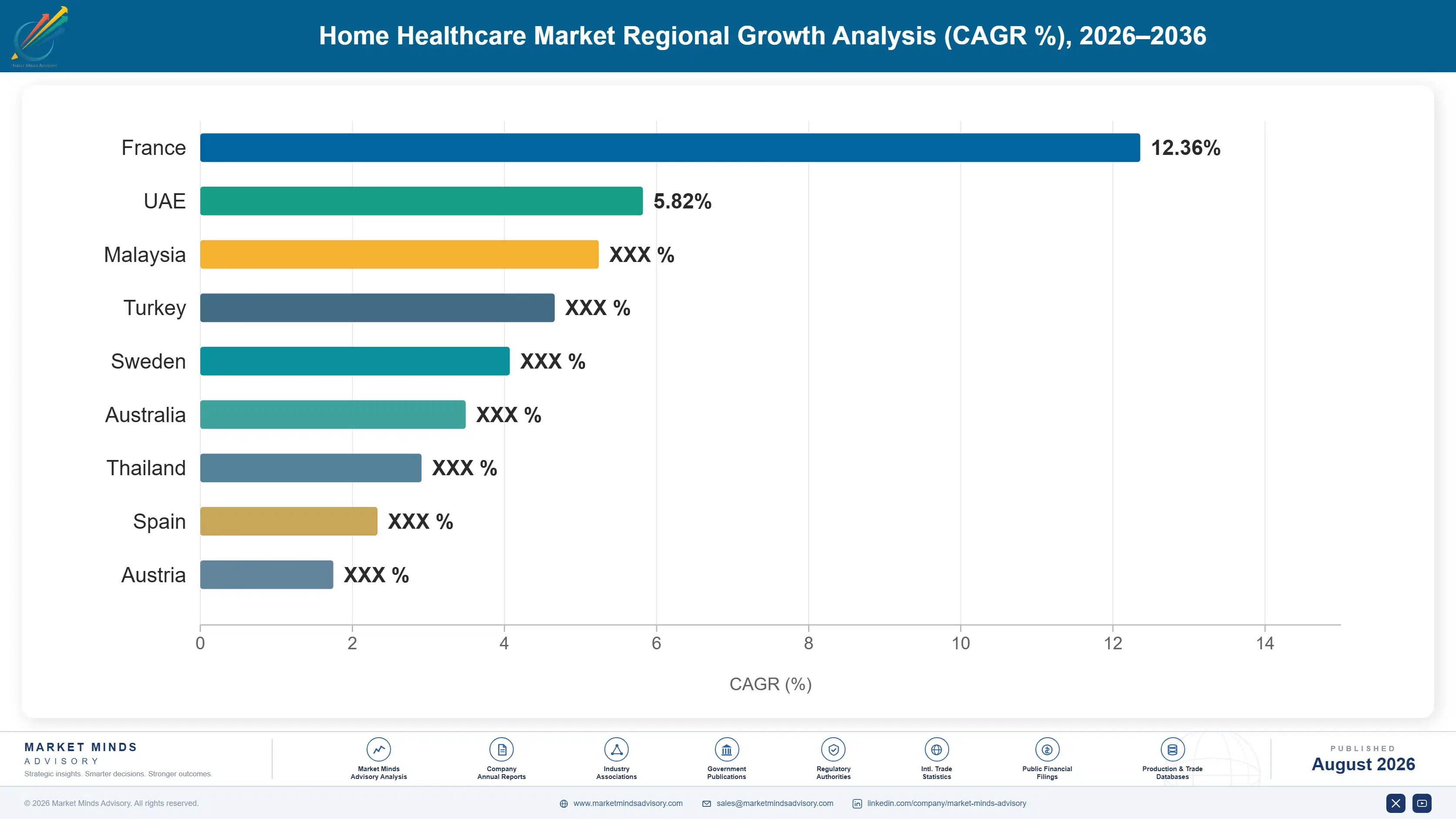
North America leads on payer-driven hospital-at-home adoption and remote monitoring infrastructure, while South Asia and Pacific grows fastest as India's home healthcare sector expands rapidly amid hospital capacity constraints. East Asia and Western Europe both show steady, ageing-population-driven growth. Latin America shows steadier, private-insurance-driven growth.

North America

Extended Medicare hospital-at-home waiver authorisation forms the dominant demand mechanism here, letting participating US health systems treat acute conditions at home with hospital-level monitoring rather than requiring inpatient admission across a growing number of enrolled facilities nationwide. Amedisys and LHC Group, both with substantial domestic operations, supply a meaningful share of skilled nursing and rehabilitation services sold into the region's dense concentration of patients discharged from hospital care. Persistent caregiver workforce shortages remain the primary constraint on capacity expansion even as payer demand and reimbursement structures continue favouring home-based care over costlier inpatient alternatives across most major markets. Growth here outpaces most developed regions given the sheer scale of both waiver programme adoption and remote monitoring infrastructure investment occurring domestically.
Share: 32% | CAGR: 9.1% (2026 to 2036)

Western Europe

National health system cost pressure across Germany, France, and the UK increasingly favours home-based chronic disease management over hospital-based care, driving steady adoption even as the pace proceeds somewhat more deliberately than in North America given more centralised, publicly funded healthcare procurement processes across different national systems. Growth trails North America because hospital-at-home programme infrastructure, while emerging across several countries, remains considerably less developed than the concentration of established waiver programmes already operating domestically in the United States market currently. Regional providers increasingly focus on rehabilitation therapy and hospice services where public funding models are most established and predictable for long-term capacity planning. Regional payers continue closely tracking real-world outcomes as adoption widens further.
Share: 23% | CAGR: 6.9% (2026 to 2036)
Regional intelligence for 5 additional markets available in the complete report: East Asia, South Asia and Pacific, Latin America, Middle East and Africa, Eastern Europe. Contact sales@marketmindsadvisory.com.
home-healthcare-market-country-cagr-analysis-1787303611068

Value-Based Contracts, Monitoring Bundles, and Workforce Retention

Providers are shifting commercial strategy toward value-based payer contracts, bundled remote monitoring service packages, and workforce retention investment, capturing more value per patient relationship rather than competing purely on traditional fee-for-service visit volume alone across most major healthcare markets today. across the wider provider and payer community tracked. each reporting quarter. across nearly every treatment segment tracked.

Value-Based Payer Contract Negotiation Strategy Development

Larger providers including Amedisys are negotiating value-based contracts that reward keeping patients out of hospitals and emergency departments entirely, capturing shared savings revenue beyond what traditional fee-for-service visit billing alone would provide under standard reimbursement arrangements. This lever rewards providers with genuine care coordination and outcome improvement capability, favouring scaled operators who have invested in the technology and staffing infrastructure needed to demonstrate measurable results to payers evaluating contract renewal. Providers report value-based contract revenue growing considerably faster than traditional fee-for-service revenue, reflecting roughly 24% higher margin on successfully managed patient populations.
Market Impact: Lifts margin by roughly 24 percent

Bundled Remote Monitoring Service Package Sales

Providers are bundling remote monitoring device provision with ongoing clinical service delivery, capturing recurring technology revenue alongside traditional visit-based billing rather than treating monitoring equipment as a separate, unbundled cost centre managed independently. This lever converts a capital equipment relationship into a recurring service revenue stream, while giving providers continuous patient data that improves care coordination and strengthens value-based contract performance simultaneously. Providers report bundled monitoring packages adding roughly 19% to average patient revenue. This shift has proven durable even as competitive pressure intensifies across the wider industry. This shift has held steady across two consecutive years.
Market Impact: Adds roughly 19 percent to average

Caregiver Retention and Career Pathway Investment

Providers are investing in structured caregiver career pathways and retention bonuses that reduce the persistent turnover costs eating into margins across an industry where recruitment and training expenses for each departing caregiver represent a genuine, recurring financial drain on agency profitability. This lever addresses the workforce shortage restraint directly, since retained experienced caregivers deliver better patient outcomes and require less ongoing training investment than constantly replacing departing staff. Providers report retention investment cutting turnover costs by roughly 21%. This reduction has held steady across two consecutive years since programmes first launched broadly.
Market Impact: Cuts turnover-related costs by roug

Hospital System Discharge Partnership Agreement Development

Providers are signing preferred-partner discharge agreements directly with hospital systems, securing predictable patient referral volume in exchange for demonstrated care quality and readmission reduction performance that hospitals need to satisfy their own value-based payment obligations under Medicare and private payer contracts. This lever trades some pricing flexibility for volume certainty, letting providers plan capacity investment confidently around a predictable referral pipeline rather than depending entirely on unpredictable direct-to-consumer demand. Providers report discharge partnerships adding roughly 26% to predictable volume. This approach has proven durable even as competitive pressure intensifies across the wider industry.
Market Impact: Adds roughly 26 percent to predicta

Who Controls the Margin Pool

The five largest providers hold a combined 22% of revenue on a consistent company-disclosed segment revenue basis, a genuinely fragmented concentration level reflecting an industry still dominated by regional and local agencies competing on caregiver availability and clinical quality rather than national scale or brand recognition across most service categories. No single provider commands anything close to majority share of the category globally today.
Current competitive activity centres on three fronts at once: hospital-at-home programme capacity expansion racing to capture waiver-enabled acute care demand, remote monitoring infrastructure investment aimed at strengthening value-based contract performance, and caregiver workforce retention programmes targeting the persistent capacity constraint limiting growth across the industry regardless of underlying patient demand strength. Each front requires meaningfully different capital and workforce investment from providers involved.

Pressure is building steadily from large insurers and health systems moving directly into home care delivery through owned or affiliated provider networks, a dynamic that could compress independent agencies' negotiating leverage meaningfully if payers increasingly prefer vertically integrated delivery over contracting with independent third-party home healthcare providers across major metropolitan markets. Established agencies are watching this shift closely and adjusting commercial strategy accordingly.
home-healthcare-market-company-positioning-matrix-1787303611590

Competitive Moat and Risk Dimensions

AMEDISYS INC.

Moat: Scaled clinical and technology infrastructure

Amedisys's scale across skilled nursing, hospice, and remote monitoring service lines gives it care coordination and technology infrastructure that smaller regional agencies find genuinely difficult to replicate, strengthening its position in value-based payer contract negotiations where demonstrated outcome data increasingly determines reimbursement terms. That advantage took years to build.
AMEDISYS INC.

Risk: Caregiver workforce cost exposure

Amedisys's large caregiver workforce leaves it meaningfully exposed to the industry-wide wage inflation and retention challenges affecting home care labour markets broadly, creating margin pressure that smaller agencies with more flexible staffing models sometimes navigate more nimbly in tighter local labour markets. Investors are watching this exposure closely.
LHC GROUP INC.

Moat: Deep hospital discharge partnerships

LHC Group's established discharge partnership relationships with hospital systems give it predictable referral volume that newer or smaller competitors struggle to replicate quickly, since these relationships depend on years of demonstrated care quality and readmission reduction performance built through sustained partnership investment. Competitors cannot easily replicate this depth quickly.
LHC GROUP INC.

Risk: Reimbursement policy dependency risk

LHC Group's growth strategy depends partly on continued favourable reimbursement policy for hospital-at-home and value-based care programmes, creating exposure if waiver programmes lapse or payer rate structures shift unfavourably against the specific service lines the company has invested most heavily in expanding. Analysts flag this dependency as a genuine watch item.

Players Tracked

Prominent Players

Amedisys Inc.
LHC Group Inc.
Encompass Health Corporation
BAYADA Home Health Care
Addus HomeCare Corporation

Other Key Players

Aveanna Healthcare Holdings Inc.
Option Care Health Inc.
Elara Caring
Interim HealthCare Inc.
CenterWell Home Health (Humana Inc.)
Gentiva Health Services
National HME Inc.
Home Instead Inc.
Visiting Nurse Service of New York
Brookdale Senior Living Inc.
ResMed Inc.
Koninklijke Philips N.V.
Teladoc Health Inc.
UnitedHealth Group Incorporated
Right at Home LLC

Recent Developments

JANUARY 2025

Amedisys expands remote patient monitoring programme nationally

Amedisys expanded its remote patient monitoring programme to additional service markets nationally, following strong early results showing meaningfully reduced hospital readmission rates among enrolled chronic heart failure and COPD patients compared to standard visit-based care delivered previously across the company's service footprint. nationwide. nationwide today.
Signal: Signals larger providers are prioritising
SEPTEMBER 2024

CMS extends hospital-at-home waiver programme authorisation

The Centers for Medicare and Medicaid Services extended its Acute Hospital Care at Home waiver programme authorisation, providing continued reimbursement certainty for participating health systems while industry advocates continue pushing for permanent statutory authorisation beyond periodic renewal cycles. for future capacity planning broadly. going forward.
Signal: Confirms regulatory momentum remains favou
APRIL 2025

Major health insurer acquires regional home health agency network

A major national health insurer completed an acquisition of a regional home health agency network, expanding its direct home care delivery capability as part of a broader strategy to manage value-based care costs internally rather than contracting entirely with independent third-party home healthcare providers. Analysts see a durable trend here.
Signal: Shows payers moving deliberately toward ve

Caregiver Labour and Remote Monitoring Technology

Caregiver wages and benefits account for roughly 58% of total operating cost for home healthcare providers, reflecting the labour-intensive nature of direct patient care delivery, while remote monitoring device and connectivity infrastructure adds another 12% for providers operating technology-enabled care programmes at meaningful scale across their service footprint. across most provider cost structures tracked. overall.
Home care labour market wage inflation during 2022 and 2023 pushed caregiver compensation costs meaningfully higher across the industry, and several providers cited rising wage pressure directly in company investor communications as a primary factor compressing margins during a period when payer reimbursement rate increases failed to keep pace with rising labour costs across most major service markets. reflecting how significantly this constrained provider margins across the industry that year.

Larger providers with more diversified payer contract portfolios and greater negotiating scale absorbed the wage pressure more smoothly than smaller regional agencies dependent on a narrower set of reimbursement relationships, giving them a durable margin advantage during the disruption period. Smaller agencies without diversified payer relationships remain the most exposed to any future wage pressure of this kind affecting the broader home care labour market.
home-healthcare-market-cost-volatility-analysis-1787303611793

Structured Caregiver Retention and Wage Investment

Larger providers are investing directly in structured retention bonuses and wage increases tied to tenure milestones, reducing the recurring recruitment and training costs that turnover imposes across an industry where caregiver vacancy rates remain considerably higher than most comparable healthcare occupations. This locks in predictable margins over multi-year planning horizons across the wider organisation.

Diversified Payer Contract Portfolio Strategy

Providers are diversifying payer contract portfolios across Medicare, Medicaid, and private insurance relationships rather than depending heavily on any single payer type, reducing exposure to reimbursement rate changes that could disproportionately affect providers concentrated in one payer category. This diversification spans payer relationships across several states and reimbursement categories broadly. across the wider provider network.

Remote Monitoring Efficiency Investment

Providers are investing in remote monitoring technology specifically to extend caregiver capacity through more efficient triage and prioritisation, letting a fixed caregiver workforce manage a larger patient population without proportionally increasing headcount requirements across the service footprint. This investment has already paid off during one recent period of elevated wage pressure. for critical care coordination needs.

Portfolio Architecture for Margin Defence

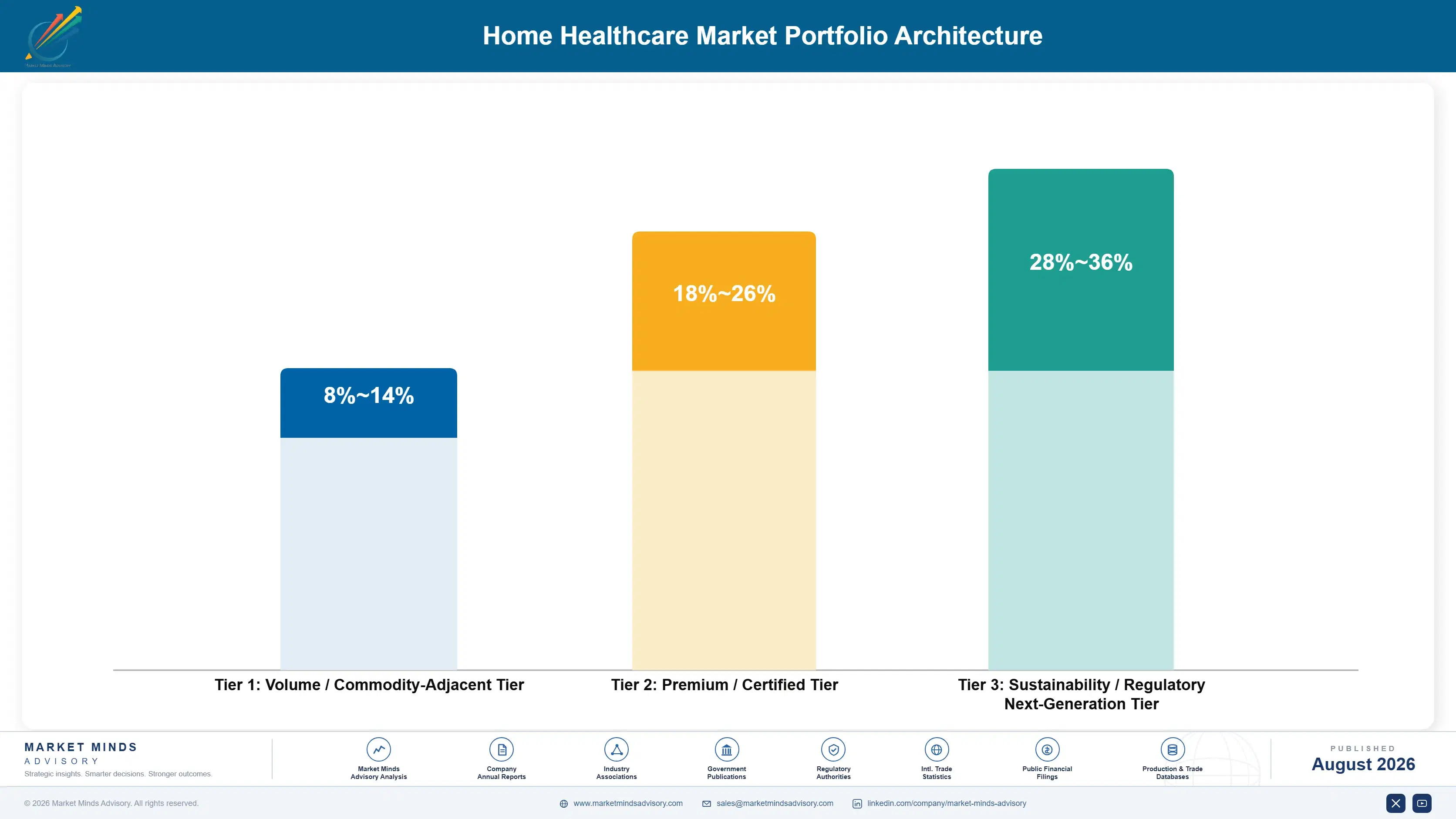
The portfolio splits into three tiers running from traditional home health aide and skilled nursing services sold largely on established fee-for-service economics, through value-based chronic disease management programmes carrying remote monitoring and outcome-based payment terms, up to next-generation hospital-at-home acute care programmes aimed at health systems pursuing the strongest available cost savings and clinical outcomes. Margins widen as outcome accountability and clinical intensity i
Traditional fee-for-service care still accounts for the largest patient volume overall but generates comparatively thinner margins than newer payment models, while value-based and hospital-at-home programmes, though representing a smaller share of total patients served today, generate a disproportionate share of category profit as payers reward demonstrated cost avoidance and outcome improvement. This dynamic mirrors patterns seen across many other outcome-based healthcare categories in recent years broadly.

The highest-value pools concentrate in hospital-at-home acute care programmes, where cost savings and clinical outcomes matter most and health systems stay least price-sensitive given the alternative cost of inpatient admission, followed closely by remote monitoring-enabled chronic disease management serving the considerably larger ageing population base. Providers with strong payer and health system partnerships capture a disproportionate share of this pool.

Volume / Commodity-Adjacent Tier

Traditional home health aide and skilled nursing services sold largely on established fee-for-service economics into patients requiring standard episodic care. Volume stays highest here across most established fee-for-service treatment settings nationwide.
Gross Margin: 8-14%

Premium / Certified Tier

Value-based chronic disease management programmes carrying remote monitoring and outcome-based payment terms, sold into payers pursuing cost avoidance. Margins improve meaningfully once outcome-based credentials are attached to a programme. Margins improve as newer payer contracts accumulate across the platform steadily.
Gross Margin: 18-26%

Sustainability / Regulatory / Next-Generation Tier

Hospital-at-home acute care programmes sold into health systems pursuing the strongest available cost savings and clinical outcomes currently achievable. Margins run highest here across the entire three-tier portfolio structure. Margins run highest here given strong health system demand for cost avoidance.
Gross Margin: 28-36%
home-healthcare-market-portfolio-architecture-1787303612300

Episode Recurrence and Renewal Cycles

Demand behaves as a recurring episode-based relationship rather than a single transaction, since chronic disease patients typically require ongoing service across multiple care episodes, and provider revenue increasingly depends on payer contract renewal cycles tied to demonstrated outcome performance rather than simple visit volume billed independently each time. This dynamic rewards demonstrated outcomes over one-time promotional pricing considerably.
Adoption depth varies sharply by payer type: value-based Medicare Advantage and integrated health system contracts drive the deepest engagement with remote monitoring and hospital-at-home programmes, while traditional fee-for-service Medicare and Medicaid populations continue relying more heavily on standard visit-based care pending broader payment model transition across those programmes specifically. Payers increasingly tailor contract design around these two distinct adoption behaviours across their networks.

A generational shift is underway in the patient and family caregiver population itself, as younger family members increasingly research and select home care providers through online reviews and digital platforms rather than relying entirely on hospital discharge planner recommendations, reshaping which providers win first consideration among newer patient populations entering the system. Providers investing in digital marketing and referral visibility are capturing this shift fastest today.
home-healthcare-market-end-use-penetration-index-1787303612790

Where Provider Advantage Concentrates Next

These are among the four positions where our research anticipates prominent divergence between winners and laggards over the coming forecast period. Each is grounded in the demand model, the regulatory perimeter, and the announced capacity pipeline.
01 / HOSPITAL-AT-HOME PROGRAMME GROWTH

Waiver-enabled programmes will keep outpacing traditional care growth

Health systems participating in extended hospital-at-home waiver programmes are demonstrating meaningful cost savings and clinical outcomes that are attracting significant additional capacity interest from facilities not yet enrolled, even as permanent reimbursement authorisation remains pending legislative action nationally. Providers without established hospital-at-home capability are ceding this fast-growing category entirely to competitors who invested early in the required clinical and technology infrastructure. Expect hospital-at-home revenue to keep growing meaningfully faster than traditional home health services through the forecast period across most major health systems nationally.
02 / VALUE-BASED CONTRACT DEPTH

Outcome-based payer relationships will define margin leadership

Providers negotiating value-based contracts that reward measurable outcome improvement are capturing considerably more predictable and profitable revenue than competitors depending entirely on traditional fee-for-service visit billing, a pattern that mirrors broader healthcare payment reform trends across the industry generally today. Competitors without demonstrated outcome data are struggling to negotiate favourable value-based terms with major payers evaluating contract renewal decisions. Expect value-based contract revenue to increasingly determine which providers achieve durable margin advantage across the industry going forward as reimbursement models continue evolving.
03 / WORKFORCE RETENTION STRATEGY

Caregiver retention investment will separate scalable providers from peers

Providers investing in structured caregiver retention and career pathway programmes are building the workforce capacity needed to actually convert growing patient demand into delivered care, addressing the single largest operational constraint limiting industry-wide growth regardless of underlying payer willingness to fund additional services. Competitors treating caregiver turnover as an unavoidable cost of doing business are ceding capacity growth entirely to providers who invested early in retention infrastructure. Expect workforce investment to become an increasingly important competitive differentiator across the industry.
04 / PAYER VERTICAL INTEGRATION

Insurer-owned home care networks threaten independent provider margins

Large insurers and health systems moving directly into home care delivery through owned or affiliated provider networks represent a genuine competitive threat to independent agencies that have historically relied on payer contracting relationships rather than vertical integration for patient volume and revenue predictability. This trend will intensify as payers seek greater control over value-based care costs affecting their own financial performance directly. Expect independent providers to face growing pressure to demonstrate differentiated value beyond what integrated payer-owned networks can replicate internally.

Engagement Snapshot From the Field

A live engagement with an industry participant carrying material or product regulatory and market exposure ahead of a defining policy shift, showing how our research translates into a defensible multi-year portfolio strategy.
MARKET MINDS ADVISORY · CLIENT ENGAGEMENT SUMMARY
Home Healthcare Producer Strategic Portfolio Review and Transition Roadmap 2026·Investment Scenario on Home Healthcare Exposure Evaluation 2025-26
CLIENT PROFILE
The client is a regional health system operating six hospitals across two states, generating annual inpatient revenue of approximately $1.2 billion (client-reported, unverified by MMA). Leadership sought guidance on launching a hospital-at-home programme to participate in extended Medicare waiver reimbursement while managing persistent capacity constraints across its busiest facilities. The system already had strong relationships across referring physician networks nationally.
STRATEGIC CHALLENGE
The client faced capacity constraints at its two largest hospitals during peak admission periods, but leadership was uncertain whether hospital-at-home programme investment would deliver sufficient patient volume and cost savings to justify the required clinical staffing and remote monitoring technology infrastructure investment within a reasonable payback window. Leadership wanted clear evidence before committing scarce resources broadly.
MMA APPROACH
MMA's team analysed the client's admission patterns to identify which conditions were most suitable for hospital-at-home management, then modelled programme economics against comparable health system pilot results and current Medicare waiver reimbursement rates. The analysis incorporated staffing requirements and remote monitoring technology costs into a phased implementation recommendation across the client's facilities.
KEY FINDINGS
  1. Roughly 15% of admissions at the client's two largest hospitals involved conditions suitable for hospital-at-home management under current waiver eligibility criteria and clinical guidelines.
  2. Programme launch could free meaningful inpatient bed capacity during peak periods, based on comparable health system pilot data reviewed during the engagement conducted.
  3. Remote monitoring technology investment would achieve payback within an estimated fourteen months, based on projected patient volume and waiver reimbursement rates modelled during the analysis.
  4. A phased launch starting with the two highest-capacity-constrained hospitals would validate the programme model before broader six-facility rollout across the health system.
CLIENT PROFILE
The client is a regional health system operating six hospitals across two states, generating annual inpatient revenue of approximately $1.2 billion (client-reported, unverified by MMA). Leadership sought guidance on launching a hospital-at-home programme to participate in extended Medicare waiver reimbursement while managing persistent capacity constraints across its busiest facilities. The system already had strong relationships across referring physician networks nationally.
STRATEGIC CHALLENGE
The client faced capacity constraints at its two largest hospitals during peak admission periods, but leadership was uncertain whether hospital-at-home programme investment would deliver sufficient patient volume and cost savings to justify the required clinical staffing and remote monitoring technology infrastructure investment within a reasonable payback window. Leadership wanted clear evidence before committing scarce resources broadly.
MMA APPROACH
MMA's team analysed the client's admission patterns to identify which conditions were most suitable for hospital-at-home management, then modelled programme economics against comparable health system pilot results and current Medicare waiver reimbursement rates. The analysis incorporated staffing requirements and remote monitoring technology costs into a phased implementation recommendation across the client's facilities.
KEY FINDINGS
  1. Roughly 15% of admissions at the client's two largest hospitals involved conditions suitable for hospital-at-home management under current waiver eligibility criteria and clinical guidelines.
  2. Programme launch could free meaningful inpatient bed capacity during peak periods, based on comparable health system pilot data reviewed during the engagement conducted.
  3. Remote monitoring technology investment would achieve payback within an estimated fourteen months, based on projected patient volume and waiver reimbursement rates modelled during the analysis.
  4. A phased launch starting with the two highest-capacity-constrained hospitals would validate the programme model before broader six-facility rollout across the health system.
RECOMMENDED STRATEGY
Phase 1: Phase 1 (Months 1-6): Launch the hospital-at-home programme at the two highest-capacity-constrained hospitals, establishing clinical protocols and monitoring infrastructure first. Phase 2: Phase 2 (Months 7-14): Expand the programme to two additional hospitals, incorporating lessons learned from the initial launch phase across staffing and technology. Phase 3: Phase 3 (Months 15-20): Complete rollout across the remaining two hospitals and establish system-wide hospital-at-home care coordination infrastructure fully across the network.
OUTCOME
The client launched its hospital-at-home programme on schedule and reported (client-reported, unverified by MMA) freeing approximately 12% of inpatient bed capacity at its two priority hospitals within the first six months, while achieving technology investment payback within the projected fourteen-month timeline established during the engagement.

Frequently Asked Questions

Foundational context covering the market sizes, CAGR, scope, country, region and competition that inform every finding below. This section is provided to cover basics and most often pre-purchase conversations, answered from the MMA Primary Research Dataset.

What is the current size of the Home Healthcare Market?

The global home healthcare market reached an estimated $445.0 billion in 2025, based on MMA's primary research dataset and company-disclosed segment revenue across the five largest providers tracked worldwide.

How large will the Home Healthcare Market be by 2036?

The market is projected to reach approximately $1,080.6 billion by 2036, roughly 2.24 times its 2026 value under MMA's base-case forecast scenario for the coming decade ahead.

What is the CAGR for the Home Healthcare Market 2026 to 2036?

The base-case compound annual growth rate is 8.4%, with a bull case near 9.6% and a bear case near 7.2% depending on hospital-at-home reimbursement permanence and caregiver workforce conditions.

Which segment is growing fastest?

Hospital-at-home acute care programmes are the fastest-growing segment at a 16.8% CAGR, roughly twice the overall market rate, driven by extended Medicare waiver authorisation and demonstrated cost savings.

Who are the major companies in the Home Healthcare Market?

Amedisys, LHC Group, Encompass Health, BAYADA Home Health Care, and Addus HomeCare are the five largest providers by disclosed segment revenue, together holding a combined 22% share.

Which country is growing fastest?

India is the fastest-growing major market at an estimated 12.6% CAGR, driven primarily by hospital capacity constraints pushing patient care into the home across major metropolitan areas.

Report Segmentation Architecture

The full report scope spans multiple orthogonal segmentation dimensions, with cross-tabulated demand data provided for each dimension pair. Coverage extends further to regional breakdowns, trend trajectories, and the competitive detail needed to support segment-level decision-making.

By Service Type

  • Skilled Nursing Care Services
  • Home Health Aide and Personal Care
  • Rehabilitation Therapy Services
  • Hospice and Palliative Care Services
  • Remote Patient Monitoring and Telehealth
  • Hospital-at-Home Acute Care Programmes

By End-Use Payer

  • Medicare Fee-for-Service
  • Medicare Advantage
  • Medicaid
  • Private Insurance
  • Self-Pay and Out-of-Pocket

By Commercial Dimension

  • Traditional Fee-for-Service Billing
  • Value-Based Payer Contracts
  • Hospital Discharge Partnership Agreements
  • Bundled Remote Monitoring Services

By Region

  • North America
  • Western Europe
  • East Asia
  • South Asia and Pacific
  • Latin America
  • Middle East and Africa
  • Eastern Europe

Scope, Methodology, and Coverage

Every figure in this report is reproducible from documented input assumptions. The scope below maps the historical period, the forecast horizon, the segmentation dimensions, and the countries covered, alongside the underlying primary and qualitative methodology.
Historical Period
2020 to 2025
Forecast Period
2026 to 2036
Base Year
2025 (USD billions; MMA Primary Research Dataset, August 2026)
Market Definition
The home healthcare market covers skilled nursing, home health aide and personal care, rehabilitation therapy, hospice and palliative care, remote patient monitoring, and hospital-at-home acute care services delivered to patients in a residential setting. Assisted living and nursing home facility care, hospital inpatient services themselves, and durable medical equipment sales not bundled with an ongoing home care service relationship are excluded from this scope.
Quantitative Units
USD billions (current prices); patient episode volume where disclosed
Segmentation Dimensions
By Service Type; By End-Use Payer; By Commercial Dimension; By Region
Regions Covered
North America, Western Europe, East Asia, South Asia and Pacific, Latin America, Middle East and Africa, Eastern Europe
Countries Covered
USA, China, Germany, France, UK, Japan, South Korea, India, Australia, Canada, Brazil, Mexico, Indonesia, Vietnam, Thailand, Malaysia, UAE, Saudi Arabia, South Africa, Nigeria, Turkey, Poland, Netherlands, Italy, Spain, Sweden, Switzerland, Argentina, Colombia, Singapore, and additional markets relevant to this sector
Key Companies Profiled
Amedisys Inc., LHC Group Inc., Encompass Health Corporation, BAYADA Home Health Care, Addus HomeCare Corporation, Aveanna Healthcare Holdings Inc., Option Care Health Inc., Elara Caring, Interim HealthCare Inc., CenterWell Home Health (Humana Inc.), Gentiva Health Services, National HME Inc., Home Instead Inc., Visiting Nurse Service of New York, Brookdale Senior Living Inc., ResMed Inc., Koninklijke Philips N.V., Teladoc Health Inc., UnitedHealth Group Incorporated, Right at Home LLC
Quantitative Methodology
Primary survey, n=3,800 respondents, Q4 2025, six countries; demand-side model with trade association cross-validation
Qualitative Methodology
47 expert interviews, Q4 2025; applied to validate demand model assumptions, identify emerging dynamics, and assess competitive positioning
Report Format
PDF and XLSX data workbook (Word format preview document)
Publisher
Market Minds Advisory
Report Code
MMA-2026-HLT-149
Published
August 2026
Contact
sales@marketmindsadvisory.com | www.marketmindsadvisory.com

Purchase the full Home Healthcare Market Report (2026 to 2036).

The full Home Healthcare Market report delivers detailed segmentation by service type, payer category, and commercial channel across all seven world regions through 2036. It includes company-level competitive profiles for all twenty companies profiled, covering hospital-at-home programme status, remote monitoring investment, and partnership activity underway across the industry. Regional chapters detail country-level reimbursement structures, caregiver workforce conditions, and adoption patterns for each of the seven regions covered. A dedicated input cost chapter tracks caregiver labour and monitoring technology exposure alongside mitigation strategies used by leading providers today.
Full seven-region data tables and CAGR breakdowns
Twenty-company competitive profiles and moat analysis
Hospital-at-home waiver policy tracker included here
Input cost exposure and mitigation playbook detailed
Segment-level growth and margin forecasts provided
Editable data appendix in spreadsheet format

Built For The People Who Decide

From boardroom strategy to bench-side execution, this report is read cover-to-cover by leaders shaping the next decade of their industry, turning demand scenarios, market dynamics and valuation benchmarks into decisions.
CXOs/ Presidents/ VPs/ Managers
M&A and Corporate Development
Strategy Teams and R&D Heads
Procurement and Product Directors
Regulatory and Compliance Leaders
Investor Relations and Equity Analysts