Market Minds Advisory
Home Blood Testing Devices Market

Home Blood Testing Devices Market: Strip Annuity Erosion, Self-Collection Growth, and Reimbursement Dependence

The largest category in home blood testing is being taken apart by sensors that never draw blood at all, leaving strip manufacturers defending an annuity that funded the whole industry for twenty-five years.

Lead Analyst

Alice Ballenger

Published

September 2026

Make Smarter Decisions with Customized Research Insights

Request a free sample report and evaluate market opportunities, growth trends, and competitive dynamics relevant to your business needs.

2025 MARKET VALUE$12.4BMarket Size 2025
2036 FORECAST VALUE$22.6BBase Case , 2026 to 2036
CAGR 2026 TO 20365.6 %Bull 6.8% / Bear 4.4%
INCREMENTAL OPPORTUNITY$9.5BNet 10- year value creation
EXPANSION MULTIPLE1.72x2036 value over 2026 base
Strategic Levers
M&A Pipeline
Regional Outlook
Country Rankings
Competitive Intelligence
Segmental Deep-dive
Call-Us : 91 93563 13602

Executive Snapshot and Market Trajectory

Blood glucose strips built this industry and are now its weakest position. Continuous sensors measure interstitial fluid rather than blood, sit outside this market's definition entirely, and are steadily removing the testing volume that funded everything else. Nobody inside the category can answer that with a better strip.
At-home blood collection and microsampling devices compound at 8.4%, a full 1.50x the market rate, by turning laboratory panels into something a patient posts back in an envelope. East Asia holds the largest share at 28%, carried by the world's two largest diabetes populations and by domestic manufacturers who reset strip pricing globally. Volume sits there; margin does not. Domestic manufacturers there set the global cost floor and have no intention of raising it.
Concentration is moderate at 47%, with Roche Diagnostics and LifeScan leading a group of established diabetes device businesses that all face the same displacement problem simultaneously. Chinese volume-based procurement cut strip prices sharply and permanently. The commercially interesting growth is now in self-collection, where the constraint is laboratory validation and reimbursement rather than anything about the device itself. Acquisition rather than development is how that gap is being closed.
Market Definition
This market covers devices and consumables used outside clinical settings to obtain and analyse blood samples, spanning blood glucose meters and test strips, home coagulation monitoring systems, at-home blood collection and microsampling devices, home lipid and metabolic panel devices, home haemoglobin testing, and home infectious disease immunoassay blood tests. Continuous glucose monitors measuring interstitial fluid rather than blood, laboratory analysers used in clinical settings, point-of-care devices operated by professionals, and non-blood home diagnostics are excluded.
Base Year Value
$12.4B in 2025 (MMA Primary Research Dataset, August 2026)
Forecast Period
2026 to 2036, eleven discrete annual values
CAGR
5.6% base case. Bull 6.8%. Bear 4.4%.
Fastest Growth Segment
At-Home Blood Collection and Microsampling Devices: 8.4% CAGR
Fastest Growth Country
India: 9.4% CAGR
Fastest Growth Region
South Asia and Pacific: 7.9% CAGR
Largest Region
East Asia: 28% of 2025 global value
Market Leaders
Roche Diagnostics, LifeScan, Ascensia Diabetes Care, Sinocare, and ARKRAY. Source: MMA Primary Research Dataset, July 2026.
Primary Survey
n=3,800 procurement and R&D decision-makers, Q4 2025, six countries
Methodology
Demand-side build-up, cross-validated against public data, 47 expert interviews

Home Blood Testing Devices Market Forecast Scenarios

home-blood-testing-devices-market-size-forecast-scenario-1787303469819
Growth ran at roughly 4.3% between 2020 and 2025, and two forces pulled against each other throughout. Pandemic conditions normalised home testing across every population, and self-collection volumes rose from almost nothing to a real category. Meanwhile continuous sensors took an accelerating share of type 1 diabetes testing, and Chinese volume-based procurement cut strip prices by more than half in the world's largest patient population.
Base case growth of 5.6% depends on three mechanisms. Diabetes prevalence keeps rising across South Asia, East Asia and Latin America faster than sensor adoption can reach those populations, so strip volume grows even as developed market volume falls. Self-collection microsampling converts an expanding set of laboratory panels into mail-in tests. And home immunoassay testing keeps broadening beyond infectious disease into hormone, allergy and biomarker panels sold direct to consumers.
The bull case at 6.8% assumes self-collection gains routine laboratory and payer acceptance across major markets, which would move a large volume of ordinary blood work out of phlebotomy entirely. The bear case at 4.4% reflects faster sensor substitution: continuous monitoring reaching type 2 patients on oral therapy at scale would remove the volume base that still supports strip manufacturing economics.

Home Blood Testing: Annuity Erosion and Collection Innovation

The economics of this market were settled twenty-five years ago and are now unravelling. Meters were given away, sometimes literally, and strips at 88% of revenue paid for everything afterwards. It was one of the cleanest consumable annuities in medical devices, and it depended entirely on patients continuing to prick their fingers several times a day. That assumption held for a very long time.
TOP FIVE CONCENTRATION47%Established diabetes device businesses hold most consumable revenue
CONSUMABLE REVENUE SHARE88%Strips, lancets and cartridges rather than meters and readers
AVERAGE STRIP PRICEUSD 0.28Blended global price per single blood glucose test strip
DAILY TESTING FREQUENCY2.4 testsAverage daily blood glucose checks across all insulin-treated patients
SENSOR CONVERSION RATE34%Insulin-treated patients who have moved to continuous monitoring instead
REIMBURSED VOLUME SHARE62%Consumable volume purchased through insurance rather than out of pocket
Continuous sensors broke that assumption from outside the market's boundary. They measure interstitial fluid, not blood, so they sit outside this definition, and roughly 34% of insulin-treated patients have already moved across. The remaining strip volume concentrates among type 2 patients on oral therapy, in markets where sensors are unaffordable, and among people whom guidelines increasingly suggest need not test daily at all. None of those three is a growth base.
Growth has moved to the collection end instead. Microsampling devices from Tasso, YourBio Health and Babson Diagnostics let a patient draw a validated capillary sample at home and post it to a laboratory, converting ordinary blood work into something that never requires a phlebotomist. The constraint there has never been the device. It is laboratory validation and payer acceptance. Each analyte needs separate validation.
"Strip manufacturers spent two decades optimising a product that patients only use because nothing better existed. Something better exists now, it does not touch blood, and it is not something a strip business can build its way out of."
Director, Diagnostics and Point-of-Care Devices Practice · MMA Medical Devices P

Market Trends

Continuous sensors displace strip testing from outside category boundaries

Interstitial glucose sensors have taken roughly 34% of insulin-treated patients away from fingerstick testing, and adoption keeps widening as pricing falls and reimbursement broadens. Because these devices measure interstitial fluid rather than blood, they sit outside this market's definition while removing its largest volume base. Strip manufacturers cannot answer with product improvement, since the competitive advantage is the absence of a blood sample entirely. The remaining defensible volume sits with type 2 patients on oral therapy and in markets where sensors remain unaffordable. Guidelines increasingly question whether that group benefits from routine daily testing at all.
Market Impact: Over 200 million patients affected
Microsampling turns laboratory panels into mail-in consumer testing

Devices from Tasso, YourBio Health and Babson Diagnostics collect validated capillary blood at home with minimal pain and no phlebotomist, then travel to a central laboratory by post. Direct-to-consumer testing companies and decentralised clinical trials have both adopted them quickly. The technology works; the constraint is that each analyte requires separate validation against venous reference ranges before a laboratory will report a result. Companies solving that validation problem across broad panels rather than single tests are the ones building defensible positions here. Reference laboratory directors treat validation breadth as their only real selection criterion.
Market Impact: Site visits cut by 40%

Market Opportunities and Growth Drivers

Diabetes prevalence rises fastest where sensors remain unaffordable

India and China together carry well over 200 million people with diabetes, and prevalence continues climbing across South Asia, Southeast Asia and Latin America. Continuous sensors cost far more than strips in those markets and reimbursement rarely covers them, so fingerstick testing remains the practical option for most patients. Strip volume therefore grows in exactly the geographies where developed market volume is falling. Domestic manufacturers capture most of that growth, since price competition at these levels favours local production heavily. Strip demand in these markets will keep growing through most of this forecast period.
Market Impact: Strip prices down over 50%

Decentralised clinical trials require validated home sample collection

Pharmaceutical sponsors have restructured trial design around remote participation since 2020, and blood sampling was the hardest element to move out of the clinic. Microsampling devices with validated analyte performance solve it, and sponsors pay well for that because site visits are the largest cost line in most trial budgets. This channel is smaller than consumer testing in volume but considerably better in margin, and it also generates the validation data that supports later clinical and consumer adoption of the same devices. Sponsors also fund the studies that widen the reportable menu.
Market Impact: Fewer than 60 analytes validated

Market Restraints and Challenges

Volume-based procurement permanently reset strip pricing in China

Chinese centralised procurement rounds cut blood glucose strip prices by more than half across the world's largest patient population, and those prices have not recovered. The root cause is a purchasing mechanism designed to convert clinical consumables into commodity tenders, and it works exactly as intended. Commercial impact reaches beyond China, because global buyers now reference Chinese pricing in their own negotiations. Manufacturers have responded by shifting production toward lower-cost sites, consolidating strip platforms, and moving commercial attention toward segments procurement has not yet reached. None of that restores the pricing that has already gone.
Market Impact: Roughly 34% of patients converted

Laboratory validation limits which tests self-collection can actually replace

A capillary sample collected at home does not behave identically to venous blood for every analyte, and laboratories will not report results without analyte-specific validation against established reference ranges. The root cause is analytical rather than regulatory: haemolysis, sample volume and collection technique all vary more outside a clinic. Commercial impact is that self-collection addresses a narrower panel than its marketing suggests. Device companies are funding multi-analyte validation studies and partnering directly with reference laboratories to widen the reportable menu systematically. Progress is steady, expensive and considerably slower than the marketing around self-collection implies to buyers.
Market Impact: Validated panels expanded 3 times
3 additional market trends, 2 additional growth drivers, and 4 additional restraints and challenges are covered in the full report. Contact sales@marketmindsadvisory.com to access the complete intelligence.

Segment CAGR and Growth Architecture

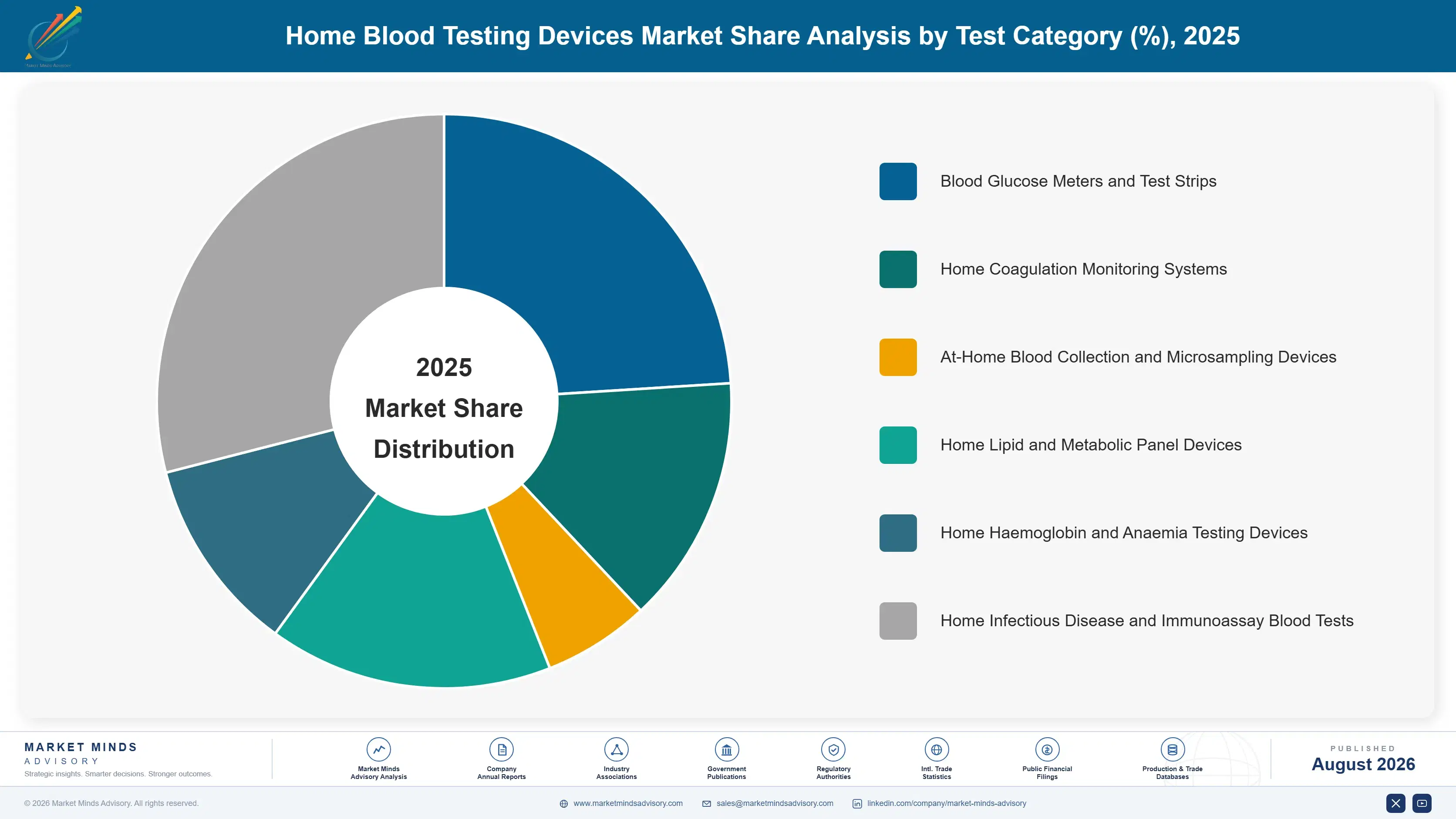
Segmentation follows the analyte or test category, because analyte determines the regulatory pathway, the reimbursement mechanism, the consumable design and the clinical use pattern. Six categories cover home blood testing without overlap. Collection format varies within categories and is treated here as a design attribute rather than as a segment. Analyte sets the commercial rules.
home-blood-testing-devices-market-market-share-analysis-1787303470359

At-Home Blood Collection and Microsampling Devices

Growing at 8.4%, a full 1.50x the market rate, this category covers devices that collect a validated blood sample at home for analysis at a central laboratory rather than on the spot. Tasso, YourBio Health and Babson Diagnostics have made collection close to painless and reliable enough that laboratories will accept the sample. Three buyer groups drive it: direct-to-consumer testing companies, pharmaceutical sponsors running decentralised trials, and health systems trying to reduce phlebotomy cost. Growth is limited by analyte validation rather than by device capability, and companies validating broad panels rather than single tests hold the defensible positions. Established diabetes businesses have started acquiring in this space rather than attempting to build the capability internally.
CAGR 8.4%

Home Infectious Disease and Immunoassay Blood Tests

Home immunoassay blood tests grow at 7.5%, having moved well beyond the HIV and hepatitis self-tests that established the category. Hormone panels, allergy screens, inflammatory markers and vitamin status tests now sell direct to consumers in most developed markets, generally without any clinician involvement. Regulatory treatment varies enormously between countries, from full self-test approval to outright prohibition, which fragments the market considerably. Margins are attractive because consumers pay directly and price sensitivity is low relative to laboratory equivalents. Clinical value is genuinely contested for several of these panels, and that debate represents the segment's main forward risk. Distribution runs through online retail and pharmacy rather than through any clinical or reimbursement channel.
CAGR 7.5%
Full segment breakdown across 6 segments available in the complete report.

Regional Architecture and Country Demand Map

Regional value follows diabetes prevalence, reimbursement structure and sensor affordability together, and those three pull in different directions. East Asia carries the largest patient populations at the lowest consumable prices. North America carries fewer patients at prices several times higher. Reimbursement decides which of those matters most.

East Asia

East Asia holds the largest share at 28%, carried by China's diabetes population of roughly 140 million and by domestic manufacturers who supply most of it. Sinocare and Yuwell Medical built cost positions that international manufacturers cannot match, and centralised volume-based procurement then cut strip prices by more than half. That combination produces enormous volume at thin margin, which is why value share understates unit share considerably here. Japanese testing behaviour is conservative and reimbursement is generous, supporting higher per-patient value. South Korean and Taiwanese manufacturers including i-SENS export widely. Growth at 6.6% is volume-led rather than price-led. Chinese producers now set the reference price that buyers everywhere else quote back to their own suppliers.
Share: 28% | CAGR: 6.6% (2026 to 2036)

North America

Twenty-seven per cent of value on a comparatively small patient base, entirely because United States strip pricing runs several times the global average and insurance covers most of it. That same pricing made continuous sensors an easy substitution once payers moved, and roughly a third of insulin-treated patients have already converted. Growth at 4.4% is the slowest of the seven regions alongside Eastern Europe, and sensor displacement is the reason. Self-collection has expanded fastest here, supported by direct-to-consumer testing companies and by decentralised trial sponsors. Canadian pricing sits materially lower under provincial formulary control and public tendering. Direct-to-consumer immunoassay testing also faces the lightest regulation of any region tracked in this report.
Share: 27% | CAGR: 4.4% (2026 to 2036)
Regional intelligence for 5 additional markets available in the complete report: Western Europe, South Asia and Pacific, Latin America, Middle East and Africa, Eastern Europe. Contact sales@marketmindsadvisory.com.
home-blood-testing-devices-market-country-cagr-analysis-1787303470882

Where Home Testing Value Now Sits

The consumable annuity that funded this industry is eroding at its most profitable end and growing at its least profitable one, which means nothing is defended by holding position. Value now accrues to validation breadth, to laboratory and payer relationships, and to cost positions that survive centralised procurement. Holding position defends nothing at all here.

Validate broad analyte panels rather than individual tests

Self-collection devices are limited by which analytes a laboratory will report from a capillary sample, and fewer than 60 are currently validated across the major reference laboratories. Validating a broad panel costs several times what a single analyte does and it opens disproportionately more revenue, because buyers want one collection device covering a whole test menu rather than several. Companies that funded multi-analyte validation early now supply the direct-to-consumer testing companies almost exclusively. Those that validated one test at a time are still selling one test at a time. The gap between those two groups keeps widening.
Market Impact: Opens roughly 60 additional reporta

Sell into decentralised trials before selling to consumers

Pharmaceutical sponsors pay considerably more per collection than consumer testing companies do, because a removed site visit saves several hundred dollars of trial cost. Margins in that channel run roughly 3 times consumer levels. More usefully, sponsor-funded studies generate exactly the analyte validation data that consumer and clinical adoption later requires, so the channel funds its own successor. Companies treating clinical trials as a niche rather than as the validation engine consistently arrive at the consumer market with a narrower reportable menu than competitors who did it the other way round.
Market Impact: Delivers roughly 3 times the consum

Concentrate strip manufacturing where procurement pricing survives

Centralised tendering has cut strip prices by more than half in China and is spreading through Latin American and Eastern European procurement. No commercial argument reverses that. What works is manufacturing consolidation: running fewer strip platforms at higher volume across fewer sites cuts unit cost by around 25% and keeps tender participation viable. Manufacturers who kept legacy platforms alive for small installed bases are the ones now exiting markets. The decision is unglamorous, it destroys some customer goodwill, and it is the only defence available. Manufacturers who kept legacy platforms alive for small installed bases are exiting markets now.
Market Impact: Cuts strip unit cost by about 25% o

Move commercial attention toward markets sensors cannot reach

Continuous sensors have taken roughly 34% of insulin-treated patients in reimbursed markets and almost none in markets where patients pay directly. Strip demand in India, Indonesia, Nigeria and much of Latin America is growing rather than shrinking, and will keep growing for most of this forecast. Redirecting commercial resource toward those geographies is the clearest available response to displacement. It requires accepting far lower revenue per patient and building distribution through pharmacy retail rather than through reimbursement negotiation. Revenue per patient falls sharply while total volume rises, which is an uncomfortable trade for organisations measured on average selling price.
Market Impact: Reaches over 200 million underserve

Who Controls the Margin Pool

Concentration sits at 47% across the top five, measured on annual revenue from home blood testing devices and their consumables, the single basis applied throughout this assessment. Roche Diagnostics and LifeScan lead, followed by Ascensia Diabetes Care, Sinocare and ARKRAY. What unites them is exposure: all five built their positions on blood glucose strips and face the same displacement simultaneously.
Competition runs on cost and distribution rather than on performance. Strip accuracy converged years ago and regulatory standards enforce a narrow band, so there is little left to differentiate. Chinese manufacturers compete on a cost base international producers cannot match, and procurement rewards exactly that. In self-collection the contest is entirely different, turning on how many analytes a device has validated and which reference laboratories will accept its samples.

Pressure arrives from two directions that barely overlap. Continuous sensor manufacturers remove insulin-treated testing volume without competing in this market at all. Meanwhile microsampling specialists, most of them venture-funded and none of them profitable, are building the validation and laboratory relationships that decide the growth segment. Rankings shift most where an established diabetes business acquires collection capability rather than attempting to develop it internally.
home-blood-testing-devices-market-company-positioning-matrix-1787303471418

Competitive Moat and Risk Dimensions

ROCHE DIAGNOSTICS

Moat: Integrated diagnostics channel breadth

Roche reaches home testing through the same clinical, pharmacy and payer relationships that support its laboratory diagnostics business, which no pure home testing competitor can replicate. That breadth supports tender participation across many countries simultaneously and gives the company credibility with reference laboratories that matters increasingly as self-collection grows in importance.
ROCHE DIAGNOSTICS

Risk: Strip volume displacement exposure

The home testing position rests heavily on blood glucose strips in reimbursed markets, which is precisely where continuous sensors are taking volume fastest. Chinese procurement has removed pricing on the remaining base. Roche has no meaningful continuous sensor position of its own, so the displaced volume moves to competitors rather than within the group.
LIFESCAN

Moat: Installed meter base scale

OneTouch meters sit in more households than any competing platform, and each one commits its user to compatible strips for as long as the meter remains in use. Pharmacy shelf position and payer formulary placement reinforce that base continuously. Replacing a meter requires patient effort and often a new prescription, so the installed base decays slowly rather than switching.
LIFESCAN

Risk: Single category concentration

The business is concentrated almost entirely in blood glucose testing, with no diagnostic breadth to absorb displacement and limited presence in self-collection or immunoassay categories. Sensor conversion removes patients permanently rather than temporarily. Tender-driven price erosion in emerging markets compounds it, leaving few directions in which the company can grow.

Players Tracked

Prominent Players

Roche Diagnostics
LifeScan
Ascensia Diabetes Care
Sinocare
ARKRAY

Other Key Players

Abbott Laboratories
i-SENS
Yuwell Medical
Nipro Corporation
Terumo Corporation
Trividia Health
Bionime Corporation
EKF Diagnostics
Siemens Healthineers
QuidelOrtho
OraSure Technologies
Tasso
YourBio Health
Babson Diagnostics
CoaguSense

Recent Developments

MARCH 2025

Tasso expands validated analyte menu through reference laboratory partnership

Tasso extended the range of analytes reportable from its home capillary collection device through a partnership with a major reference laboratory network, adding metabolic and hormone panels to a menu previously limited largely to immunology and infectious disease testing. No new device hardware was involved in the expansion.
Signal: Validation breadth rather than device perf
AUGUST 2025

Chinese procurement round cuts blood glucose strip tender prices again

A further centralised volume-based procurement round in China reduced contracted blood glucose strip prices below already compressed levels, extending a mechanism that has cut pricing by more than half since 2021 and that international manufacturers have largely stopped contesting. International manufacturers largely declined to bid this round.
Signal: Global buyers now reference Chinese tender
JANUARY 2026

Ascensia acquires home sample collection technology developer

Ascensia Diabetes Care completed the acquisition of a home blood sample collection technology developer, a genuine acquisition rather than a licensing arrangement, adding microsampling capability to a portfolio previously concentrated entirely in blood glucose meters and test strips. Terms of the transaction were not disclosed publicly.
Signal: Established diabetes businesses are now bu

Enzyme, Electrode and Assembly Cost Exposure

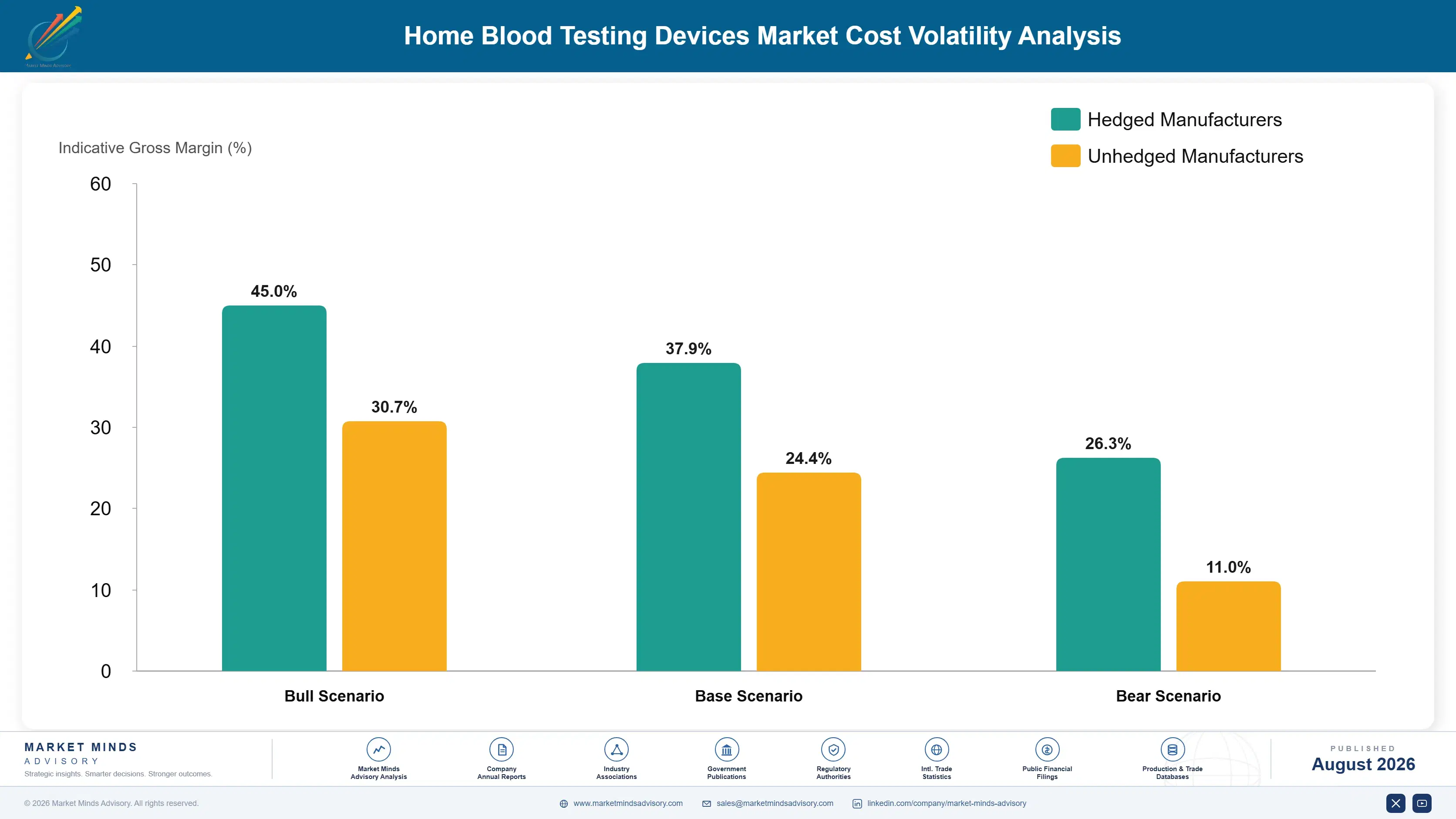
Test strip cost structures are dominated by materials that cost very little individually and by assembly precision that costs a great deal. Enzyme reagent, principally glucose oxidase and dehydrogenase preparations, accounts for roughly 22% of strip cost of goods, sourced from a narrow set of specialist biotechnology suppliers. Precious metal electrode deposition contributes a further 18%, and high-speed automated assembly with tight tolerance requirements carries most of the remainder.
The 2021 and 2022 semiconductor and precious metal squeeze illustrated the exposure well. Palladium and gold pricing moved sharply while meter electronics faced allocation delays, and Roche and Ascensia both disclosed input cost pressure and component availability constraints in their reporting for those years. Manufacturers could not reprice, because tender contracts were fixed and Chinese procurement had already established the ceiling. Margin absorbed the difference across most of the industry.

The disadvantage falls hardest on manufacturers with subscale strip platforms. High-speed assembly lines only reach competitive unit cost at very high volume, so a producer running several legacy platforms for small installed bases carries costs a consolidated competitor does not. Geography compounds it: Chinese and Southeast Asian assembly sites operate at labour and energy costs Western plants cannot approach.
home-blood-testing-devices-market-cost-volatility-analysis-1787303471637

Consolidate strip platforms onto fewer high-volume assembly lines

Legacy platforms maintained for small installed bases carry fixed cost that consolidated competitors simply do not. Migrating those users onto a single current platform costs customer goodwill and some attrition, and it cuts unit cost enough to keep tender participation viable. Manufacturers who avoided that decision are the ones now withdrawing from procurement markets altogether.

Qualify secondary enzyme reagent suppliers across the strip portfolio

Glucose oxidase and dehydrogenase preparations come from a narrow specialist supplier base, and regulatory change control makes substitution slow. Qualifying a second source across the whole portfolio at once spreads that cost thinly enough to justify carrying it permanently, which removes an availability risk that has interrupted production runs at several manufacturers. Production interruptions have already hit several manufacturers.

Index long-term tender contracts to published precious metal benchmarks

Multi-year tender pricing written at fixed rates transferred the full precious metal increase onto manufacturers during the last cycle. Newer contracts increasingly include narrow indexation covering electrode metal content only. Public procurement bodies accept it more readily than a general escalator, since the underlying benchmark is externally published and clearly outside any supplier's control.

Portfolio Architecture for Margin Defence

Margin architecture divides by how contestable the product is under centralised purchasing. Blood glucose strips sold into tendered markets earn commodity returns, and Chinese procurement has set that floor permanently. Home coagulation and haemoglobin systems earn more because volumes are smaller and tenders less aggressive. Self-collection devices and direct-to-consumer immunoassay tests earn the most, protected respectively by validation breadth and by consumers paying directly without any pa
The volume versus premium tension here runs along a geographic line. Growing strip volume sits in markets that pay least per unit, while the highest realised prices sit in markets losing volume to continuous sensors fastest. That is an uncomfortable combination, and it explains why several manufacturers have chosen to defend revenue in declining markets rather than pursue volume in growing ones. Both choices are defensible.

High-value pools sit where a payer is not involved. Direct-to-consumer hormone, allergy and biomarker panels are bought outright by consumers who show low price sensitivity relative to laboratory alternatives. Decentralised trial sampling is funded by pharmaceutical sponsors comparing device cost against site visits worth several hundred dollars each. Reimbursed strip supply sits at the opposite extreme entirely.

Volume / Commodity-Adjacent Tier

Blood glucose meters and test strips supplied into tendered and reimbursed markets, where centralised procurement sets pricing and accuracy standards have converged. Chinese manufacturers define the cost floor, and international producers increasingly decline to contest it.
Gross Margin: 22-34%

Premium / Certified Tier

Home coagulation monitoring, haemoglobin testing and specialist metabolic panel devices, where smaller volumes, clinical training requirements and less aggressive tendering support better pricing. Patient self-management programmes create genuine switching costs.
Gross Margin: 42-56%

Sustainability / Regulatory / Next-Generation Tier

Self-collection microsampling devices and direct-to-consumer immunoassay blood tests, protected by analyte validation breadth, laboratory relationships and consumers who pay directly. Best margins in the market and the segments with genuine competitive differentiation remaining.
Gross Margin: 58-72%
home-blood-testing-devices-market-portfolio-architecture-1787303472141

Consumable Annuity Under Genuine Threat

This industry ran the cleanest consumable annuity in medical devices for twenty-five years. Meters were placed at or below cost, sometimes given away entirely, and strips at 88% of revenue repaid that many times over as patients tested two or three times daily for decades. The model required only that fingerstick testing remain the sole practical option, and it did until quite recently.
Stickiness varies sharply by patient type. Insulin-treated patients tested most often and were therefore the most valuable, and they are precisely the group continuous sensors have taken. Type 2 patients on oral therapy test far less frequently and face guidelines that increasingly question whether routine testing helps them at all. Home coagulation patients are the stickiest group remaining, because self-management training creates a genuine commitment to one system.

Buyer profiles have shifted decisively away from the patient. A decade ago pharmacy shelf presence and brand recognition drove meter selection, and the patient chose. Today procurement bodies, insurers and formulary committees decide which strips are supplied, and in the growth segments the buyer is a reference laboratory or a pharmaceutical sponsor. Consumer choice now matters mainly in direct-to-consumer immunoassay testing, where no payer is involved.
home-blood-testing-devices-market-end-use-penetration-index-1787303472634

Where Home Testing Strategy Lands

These are among the four positions where our research anticipates prominent divergence between winners and laggards over the coming forecast period. Each is grounded in the demand model, the regulatory perimeter, and the announced capacity pipeline.
01 / DISPLACEMENT ACCEPTANCE DISCIPLINE

No better strip answers a device that draws no blood

Continuous sensors have taken roughly 34% of insulin-treated patients and keep advancing, and their advantage is the absence of a blood sample rather than any measurement improvement a strip could match. Manufacturers still investing in strip accuracy or lancing comfort improvements are addressing a competitive dimension that stopped mattering to patients several years ago. The only realistic responses left are geographic redirection toward markets that sensors cannot yet reach, and acquisition of capability in the categories that are actually growing.
02 / VALIDATION BREADTH INVESTMENT

Self-collection is limited by analytes, not by devices

Fewer than 60 analytes are currently validated for capillary home collection across the major reference laboratories, and that number rather than any device characteristic determines what self-collection can replace. Validating a broad panel costs several times what one analyte does and opens disproportionately more revenue, because buyers want a single device covering a whole test menu. Companies that funded multi-analyte validation early now supply the direct-to-consumer testing sector almost exclusively, while single-test validators still sell one test at a time.
03 / TRIAL CHANNEL SEQUENCING

Sell to pharmaceutical sponsors before selling to consumers

Decentralised clinical trial sponsors pay roughly three times consumer margins for home blood collection, because every site visit removed saves several hundred dollars of trial cost that appears directly in their own budgets. More usefully still, sponsor-funded studies generate exactly the analyte validation data that both consumer and clinical adoption later require anyway. Companies that treated clinical trials as a side channel rather than as the validation engine consistently arrive at consumer markets carrying a measurably narrower reportable test menu.
04 / MANUFACTURING CONSOLIDATION TIMING

Fewer platforms at higher volume is the only defence

Centralised procurement has cut strip pricing by more than half in China and the same purchasing mechanism is now spreading through Latin American and Eastern European tendering without any prospect of reversal. Running fewer strip platforms at higher volume across fewer assembly sites cuts unit cost by around 25% and keeps tender participation commercially viable. Manufacturers who kept legacy platforms alive for small installed bases out of customer loyalty are precisely the ones now withdrawing from those procurement markets entirely.

Engagement Snapshot From the Field

A live engagement with an industry participant carrying material or product regulatory and market exposure ahead of a defining policy shift, showing how our research translates into a defensible multi-year portfolio strategy.
MARKET MINDS ADVISORY · CLIENT ENGAGEMENT SUMMARY
Home Blood Testing Devices Producer Strategic Portfolio Review and Transition Roadmap 2026·Investment Scenario on Home Blood Testing Devices Exposure Evaluation 2025-26
CLIENT PROFILE
A diabetes device manufacturer with blood glucose meter and strip ranges sold across Western European, Latin American and Southeast Asian markets, generating annual revenue of approximately USD 480 million (client-reported, unverified by MMA). Roughly 90% came from strip consumables, split between reimbursed European tenders and out-of-pocket emerging market retail. The company held no continuous sensor product and no self-collection capability.
STRATEGIC CHALLENGE
European strip volumes had declined for four consecutive years as sensor reimbursement widened, while emerging market volume grew at prices a fraction of European levels. The board wanted to know whether to invest in developing a continuous sensor of its own, to acquire self-collection capability, or to concentrate entirely on emerging market strip supply where volume was still expanding reliably.
MMA APPROACH
MMA conducted 47 expert interviews across diabetologists, procurement officials, reference laboratory directors, pharmaceutical trial operations leads and pharmacy chain buyers in six countries. A quantitative survey of 3,800 respondents established testing behaviour, device selection and out-of-pocket willingness across patient types. We then modelled revenue and contribution under all three options against observed sensor conversion rates and tender pricing trajectories in each market.
KEY FINDINGS
  1. Sensor conversion among insulin-treated patients in the client's European markets was running ahead of internal planning assumptions, and diabetologists interviewed expected the trend to continue without any reversal.
  2. Developing a competitive continuous sensor would take an estimated five to seven years and substantial capital, by which point the accessible patient base in reimbursed markets would already have largely converted.
  3. Reference laboratory directors reported analyte validation breadth as their sole criterion for accepting a self-collection device, and none regarded device comfort or brand as relevant considerations at all.
  4. Emerging market strip volume was growing reliably but at gross margins roughly a third of European levels, insufficient on its own to replace the declining reimbursed revenue base.
CLIENT PROFILE
A diabetes device manufacturer with blood glucose meter and strip ranges sold across Western European, Latin American and Southeast Asian markets, generating annual revenue of approximately USD 480 million (client-reported, unverified by MMA). Roughly 90% came from strip consumables, split between reimbursed European tenders and out-of-pocket emerging market retail. The company held no continuous sensor product and no self-collection capability.
STRATEGIC CHALLENGE
European strip volumes had declined for four consecutive years as sensor reimbursement widened, while emerging market volume grew at prices a fraction of European levels. The board wanted to know whether to invest in developing a continuous sensor of its own, to acquire self-collection capability, or to concentrate entirely on emerging market strip supply where volume was still expanding reliably.
MMA APPROACH
MMA conducted 47 expert interviews across diabetologists, procurement officials, reference laboratory directors, pharmaceutical trial operations leads and pharmacy chain buyers in six countries. A quantitative survey of 3,800 respondents established testing behaviour, device selection and out-of-pocket willingness across patient types. We then modelled revenue and contribution under all three options against observed sensor conversion rates and tender pricing trajectories in each market.
KEY FINDINGS
  1. Sensor conversion among insulin-treated patients in the client's European markets was running ahead of internal planning assumptions, and diabetologists interviewed expected the trend to continue without any reversal.
  2. Developing a competitive continuous sensor would take an estimated five to seven years and substantial capital, by which point the accessible patient base in reimbursed markets would already have largely converted.
  3. Reference laboratory directors reported analyte validation breadth as their sole criterion for accepting a self-collection device, and none regarded device comfort or brand as relevant considerations at all.
  4. Emerging market strip volume was growing reliably but at gross margins roughly a third of European levels, insufficient on its own to replace the declining reimbursed revenue base.
RECOMMENDED STRATEGY
Phase 1: Phase one: abandon internal continuous sensor development entirely, since the realistic launch window falls well after the accessible patient base has already converted. Phase 2: Phase two: acquire a self-collection microsampling developer that already holds reference laboratory relationships, then fund broad multi-analyte validation immediately afterwards. Phase 3: Phase three: consolidate strip manufacturing onto a single platform and redirect that commercial capacity toward emerging market pharmacy retail distribution.
OUTCOME
The client cancelled its sensor programme and acquired a microsampling developer for approximately USD 210 million (client-reported, unverified by MMA), funding a multi-analyte validation programme alongside. Eighteen months on, strip platform consolidation had cut unit cost by roughly a fifth and the collection business had signed two decentralised trial sponsors.

Frequently Asked Questions

Foundational context covering the market sizes, CAGR, scope, country, region and competition that inform every finding below. This section is provided to cover basics and most often pre-purchase conversations, answered from the MMA Primary Research Dataset.

What is the current size of the Home Blood Testing Devices Market?

The global home blood testing devices market was valued at USD 12.4 billion in 2025, covering glucose meters and strips, coagulation monitoring, self-collection devices, metabolic panels and home immunoassay tests. Continuous interstitial glucose sensors fall outside this definition.

How large will the Home Blood Testing Devices Market be by 2036?

MMA forecasts the market at USD 22.58 billion by 2036, expanding 1.72 times from the 2026 base of USD 13.09 billion. That represents roughly USD 9.49 billion of incremental value across the forecast decade.

What is the CAGR for the Home Blood Testing Devices Market 2026 to 2036?

The base case compound annual growth rate is 5.6%, with a bull case of 6.8% and a bear case of 4.4%. The bear case reflects faster continuous sensor substitution reaching type 2 patients on oral therapy.

Which segment is growing fastest?

At-home blood collection and microsampling devices grow at 8.4%, a full 1.50x the overall market rate. Growth is limited by analyte validation against venous reference ranges rather than by device capability.

Who are the major companies in the Home Blood Testing Devices Market?

Roche Diagnostics, LifeScan, Ascensia Diabetes Care, Sinocare and ARKRAY together hold 47% of revenue. All five built their positions on blood glucose strips and face continuous sensor displacement simultaneously.

Which country is growing fastest?

India grows fastest at 9.4%, where rising diabetes prevalence meets continuous sensors that remain unaffordable for most patients. South Asia and Pacific is the fastest region overall at 7.9%.

Report Segmentation Architecture

The full report scope spans multiple orthogonal segmentation dimensions, with cross-tabulated demand data provided for each dimension pair. Coverage extends further to regional breakdowns, trend trajectories, and the competitive detail needed to support segment-level decision-making.

By Test Category

  • Blood Glucose Meters and Test Strips
  • Home Coagulation Monitoring Systems
  • At-Home Blood Collection and Microsampling Devices
  • Home Lipid and Metabolic Panel Devices
  • Home Haemoglobin and Anaemia Testing Devices
  • Home Infectious Disease and Immunoassay Blood Tests

By End-Use Industry

  • Individual Patient Self-Management
  • Direct-to-Consumer Testing Companies
  • Decentralised Clinical Trial Programmes
  • Home Health and Community Nursing Services
  • Long-Term Care and Residential Facilities
  • Public Health Screening Programmes

By Commercial Dimension

  • Reimbursed Prescription Supply
  • National and Centralised Tender Procurement
  • Retail Pharmacy Distribution
  • Online and Direct-to-Consumer Sales
  • Reference Laboratory Supply Agreements
  • Pharmaceutical Sponsor Contracts

By Region

  • East Asia
  • North America
  • Western Europe
  • South Asia and Pacific
  • Latin America
  • Middle East and Africa
  • Eastern Europe

Scope, Methodology, and Coverage

Every figure in this report is reproducible from documented input assumptions. The scope below maps the historical period, the forecast horizon, the segmentation dimensions, and the countries covered, alongside the underlying primary and qualitative methodology.
Historical Period
2020 to 2025
Forecast Period
2026 to 2036
Base Year
2025 (USD billions; MMA Primary Research Dataset, August 2026)
Market Definition
This market comprises devices and consumables used outside clinical settings to obtain and analyse blood samples, measured at manufacturer revenue across reimbursed, tendered, retail and direct-to-consumer channels. Coverage spans blood glucose meters, test strips and lancing devices, home coagulation and international normalised ratio monitoring systems, at-home blood collection and microsampling devices supplying central laboratories, home lipid and metabolic panel testing devices, home haemoglobin and anaemia testing devices, and home infectious disease and immunoassay blood tests including self-administered HIV and hepatitis tests. Continuous glucose monitoring systems measuring interstitial fluid rather than blood, laboratory analysers and clinical chemistry platforms, professionally operated point-of-care devices, urine and saliva based home diagnostics, wearable physiological monitors, and blood pressure or pulse oximetry devices fall outside scope.
Quantitative Units
USD billions (current prices); consumable unit volumes by test category; average price per strip or collection device; installed meter base; validated analyte count
Segmentation Dimensions
By Test Category; By End-Use Industry; By Commercial Dimension; By Region
Regions Covered
East Asia, North America, Western Europe, South Asia and Pacific, Latin America, Middle East and Africa, Eastern Europe
Countries Covered
China, Japan, South Korea, Taiwan, United States, Canada, Mexico, Germany, France, United Kingdom, Italy, Spain, Netherlands, Sweden, India, Australia, Indonesia, Vietnam, Thailand, Brazil, Argentina, Chile, Colombia, Saudi Arabia, United Arab Emirates, Egypt, Nigeria, South Africa, Poland, Czechia, Hungary, Romania, and additional markets relevant to home testing supply analysis
Key Companies Profiled
Roche Diagnostics, LifeScan, Ascensia Diabetes Care, Sinocare, ARKRAY, Abbott Laboratories, i-SENS, Yuwell Medical, Nipro Corporation, Terumo Corporation, Trividia Health, Bionime Corporation, EKF Diagnostics, Siemens Healthineers, QuidelOrtho, OraSure Technologies, Tasso, YourBio Health, Babson Diagnostics, CoaguSense
Quantitative Methodology
Primary survey, n=3,800 respondents, Q4 2025, six countries; demand-side model with trade association cross-validation
Qualitative Methodology
47 expert interviews, Q4 2025; applied to validate demand model assumptions, identify emerging dynamics, and assess competitive positioning
Report Format
PDF and XLSX data workbook (Word format preview document)
Publisher
Market Minds Advisory
Report Code
MMA-2026-MED-994
Published
August 2026
Contact
sales@marketmindsadvisory.com | www.marketmindsadvisory.com

Purchase the full Home Blood Testing Devices Market Report (2026 to 2036).

The full MMA report examines a consumable annuity under attack from a technology that sits outside its own market definition, quantifying continuous sensor displacement of fingerstick testing by patient type and geography. It sizes six test categories and seven regions to 2036, modelling consumable volumes, tender pricing and testing frequency separately so that volume and value trajectories can be distinguished properly. Competitive assessment covers twenty manufacturers on one consistent revenue basis. Input cost exposure is traced through enzyme reagent supply, precious metal electrode content and assembly scale economics. Four commercial levers and a strategic verdict close the report, grounded in 47 expert interviews and a 3,800-respondent survey.
Six test categories sized separately to 2036
Continuous sensor displacement quantified by patient type
Analyte validation constraints mapped across self-collection devices
Twenty manufacturers assessed on one consistent basis
Centralised procurement pricing effects modelled by region
Anonymised client engagement with tested strategic recommendations

Built For The People Who Decide

From boardroom strategy to bench-side execution, this report is read cover-to-cover by leaders shaping the next decade of their industry, turning demand scenarios, market dynamics and valuation benchmarks into decisions.
CXOs/ Presidents/ VPs/ Managers
M&A and Corporate Development
Strategy Teams and R&D Heads
Procurement and Product Directors
Regulatory and Compliance Leaders
Investor Relations and Equity Analysts