Market Minds Advisory
Home Baking Ingredients Market

Home Baking Ingredients Market: Home Baking Ingredients Market. Convenience and Specialty Formats Reshape At-Home Baking Demand

Persistent post-pandemic at-home baking habits meet rising demand for premium mixes and specialty flavor ingredients, while grocery retailers expand private label baking assortments to capture consumers seeking convenience without sacrificing recipe quality or ingredient traceability.

Lead Analyst

Lisa Gevelber

Published

August 2026

Make Smarter Decisions with Customized Research Insights

Request a free sample report and evaluate market opportunities, growth trends, and competitive dynamics relevant to your business needs.

2025 MARKET VALUE$14.2BMarket Size 2025
2036 FORECAST VALUE$28.4BBase Case , 2026 to 2036
CAGR 2026 TO 20366.5 %Bull 7.7% / Bear 5.3%
INCREMENTAL OPPORTUNITY$13.3BNet 10- year value creation
EXPANSION MULTIPLE1.88x2036 value over 2026 base
Strategic Levers
M&A Pipeline
Regional Outlook
Country Rankings
Competitive Intelligence
Segmental Deep-dive
Call-Us : 91 93563 13602

Executive Snapshot and Market Trajectory.

Home bakers who took up the practice during pandemic lockdowns have largely stayed, sustaining elevated demand for convenient mixes and specialty flavor ingredients well beyond the initial disruption period. Retailers increasingly reward suppliers who can sustain this elevated participation with fresh formats.
Convenience-format baking mixes and premium flavor extracts lead category growth as time-pressed consumers trade full from-scratch baking for curated shortcuts that still deliver a homemade result. Grocery retailers continue expanding private label baking assortments to capture margin-conscious shoppers, while North America and Western Europe concentrate the deepest specialty ingredient retail infrastructure supporting premium flavor and decoration categories across established home baking cultures. Younger consumers discovering baking through social media content are reshaping purchase patterns meaningfully.
Competitive intensity remains moderate, spread across large packaged food conglomerates, specialty ingredient makers, and a long tail of regional private label suppliers rather than a single dominant vertically integrated player. Clean label expectations and rising demand for gluten-free and allergen-free formats continue reshaping which suppliers win shelf space across grocery and specialty retail channels. Suppliers unable to match established brand recognition increasingly compete on premium positioning and content instead.
Market Definition
This market covers packaged ingredients sold to consumers for at-home baking, including mixes, flours, leavening agents, sweeteners, flavors, extracts, and decorations. It excludes commercial and industrial bakery ingredients, restaurant foodservice supply, and finished baked goods sold ready to eat.
Base Year Value
$14.2B in 2025 (MMA Primary Research Dataset, August 2026)
Forecast Period
2026 to 2036, eleven discrete annual values
CAGR
6.5% base case. Bull 7.7%. Bear 5.3%.
Fastest Growth Segment
Flavors, Extracts, and Decorations: 9.0% CAGR
Fastest Growth Country
India: 9.5% CAGR
Fastest Growth Region
South Asia and Pacific: 8.5% CAGR
Largest Region
North America: 30% of 2025 global value
Market Leaders
General Mills, King Arthur Baking Company, Dr. Oetker, Bob's Red Mill Natural Foods, and McCormick & Company lead the category. Source: MMA Analysis based on company annual reports.
Primary Survey
n=3,800 procurement and R&D decision-makers, Q4 2025, six countries
Methodology
Demand-side build-up, cross-validated against public data, 47 expert interviews

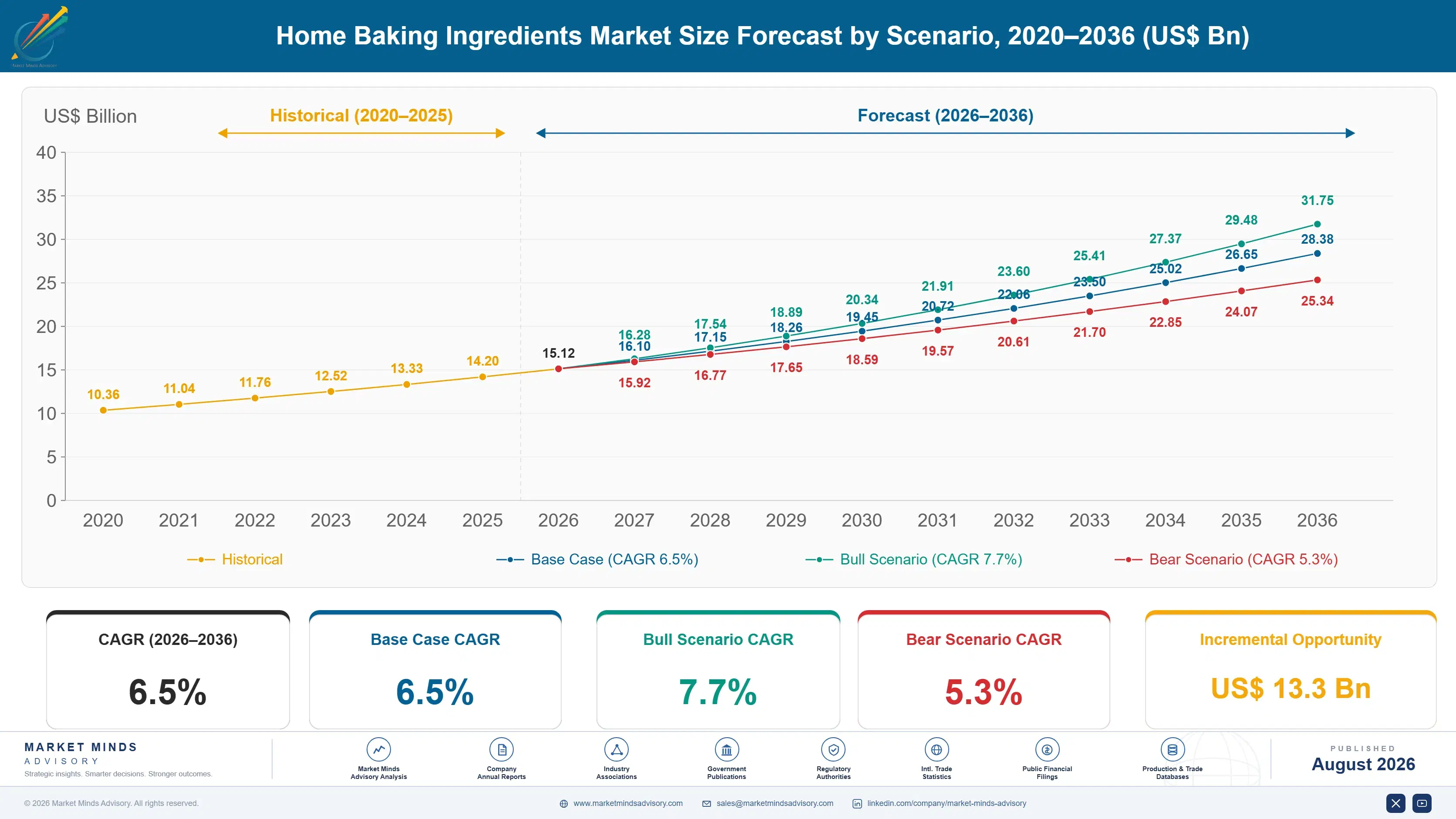
Home Baking Ingredients Market Forecast Scenarios

home-baking-ingredients-market-trends-size-forecast-scenario-1787460391103
Between 2020 and 2025, at-home baking ingredient demand surged sharply during initial pandemic lockdowns before moderating gradually as consumers returned to pre-pandemic routines, though elevated baseline participation persisted well above pre-2020 levels across most major grocery markets tracked. Suppliers investing early in premium and gluten-free formats reported gradually rising household loyalty across this window as retention improved.
The base case assumes continued premium mix and flavor extract adoption, expanding private label retail assortments, and rising gluten-free and allergen-free format availability. Together these three mechanisms support durable mid-single-digit growth as suppliers convert casual pandemic-era bakers into habitual purchasers through curated convenience formats rather than relying on renewed crisis-driven demand spikes. Suppliers positioned with strong brand credibility and digital engagement continue capturing disproportionate share of this steady underlying demand growth across household segments.
A bull scenario turns on faster-than-expected premium flavor and specialty format adoption sustaining elevated per-household spending. The principal bear risk is renewed consumer pullback toward the cheapest commodity flour and mix formats if broader grocery inflation pressures household budgets meaningfully. Suppliers able to sustain premium positioning through demonstrated quality differentiation face considerably less exposure to this downside scenario.

Convenience Economics and At-Home Baking Culture

At-home baking demand now converges around three forces: sustained post-pandemic participation among casual bakers, rising retailer private label investment, and expanding premium flavor and specialty format availability. These forces together are keeping category volume well above pre-2020 levels even as the initial pandemic-driven surge has fully normalized across most developed grocery markets tracked. This capacity evolution mirrors similar premiumization transitions observed across other packaged food categories facing comparable private label competitive pressure.
MARKET CONCENTRATIONCR5 28%Top five suppliers hold moderate combined category share
AVERAGE HOUSEHOLD SPEND$45-65 annuallyTypical yearly per-household baking ingredient spending range estimate
LEADING PRODUCING COUNTRYUSA 26%Share of global home baking ingredient production capacity
PRIVATE LABEL PENETRATION32-38%Share of category volume sold under retailer store brands
INPUT COST SHARE35-42% of COGSGrain and dairy commodity share of total production cost
PURCHASE FREQUENCY6-9 times yearlyTypical household baking ingredient purchase occasions tracked annually
The category's commercial character remains split between large packaged food conglomerates competing on brand recognition and shelf presence, and specialty ingredient makers competing on premium positioning and ingredient traceability. Neither model has achieved decisive category dominance, so retailers increasingly carry both alongside expanding private label assortments targeting price-conscious household shoppers. Investor attention increasingly favors suppliers advancing premium and gluten-free formulation distinct from the increasingly commoditized standard segment facing accelerating price competition.
Over the next decade, further gluten-free and allergen-free format expansion, continued premiumization of flavor and decoration categories, and deepening e-commerce ingredient subscription models should sustain steady category growth even as overall household baking frequency gradually normalizes further. Suppliers investing in expanded digital recipe content increasingly capture younger households seeking documented preparation guidance and inspiration.
"The households that stuck with baking after the lockdowns ended aren't buying flour and sugar separately anymore. They're buying the mix that gets them a good result on a Tuesday night with twenty minutes to spare."
Director, Consumer Food Ingredients Practice · MMA Agriculture and Food Ingredients Practice · August 2026

Market Trends

Premium Flavor and Specialty Format Expansion

Suppliers continue expanding premium flavor extract and specialty decoration assortments targeting home bakers seeking bakery-quality results without professional training or equipment. Leading brands have introduced meaningfully broader vanilla, chocolate, and specialty flavor extract lines over the past several years, alongside expanded decorating sugar, sprinkle, and fondant assortments targeting the growing home cake decorating hobbyist segment. This expansion directly addresses consumer willingness to pay premium pricing for curated, bakery-quality ingredients rather than assembling recipes from commodity components, supporting meaningfully higher category margins for suppliers able to establish credible premium positioning across specialty grocery and online channels.
Market Impact: Sustains 22 percent above baseline demand
Gluten-Free and Allergen-Free Format Proliferation Continues

Major baking ingredient suppliers continue expanding gluten-free and allergen-free product lines across mixes, flours, and flavor categories, responding to sustained consumer demand for dietary accommodation that has grown considerably beyond the historically niche celiac and allergy consumer base. Several leading suppliers have introduced dedicated gluten-free mix and flour product lines carrying meaningful price premiums over conventional formats, reflecting genuine consumer willingness to pay for accommodation regardless of medical necessity. This proliferation is reshaping shelf space allocation across grocery retailers nationally, as dedicated free-from sections expand meaningfully within baking aisles previously dominated by conventional products.
Market Impact: Captures 8 percent additional category share

Market Opportunities and Growth Drivers

Persistent Post-Pandemic At-Home Baking Habits Endure

Consumers who took up home baking during pandemic lockdowns have largely retained the habit at meaningfully elevated frequency compared to pre-2020 baseline participation, sustaining category demand well beyond the initial crisis-driven surge. Survey data collected across major grocery markets confirms that a substantial share of households who began baking regularly during 2020 and 2021 continue purchasing baking ingredients at least monthly today, compared to considerably lower pre-pandemic participation rates. This durable shift has convinced major suppliers to expand capacity on the assumption that elevated participation reflects a genuine long-term change.
Market Impact: Compresses margins 4-6 percentage points

Retailer Private Label Assortment Expansion Accelerates

Major grocery retailers across North America and Western Europe continue expanding private label baking ingredient assortments, offering household shoppers meaningfully lower-priced alternatives to established national brands while capturing higher retailer margin. Several leading grocery chains have introduced expanded store-brand mix, flour, and flavor extract lines carrying price points meaningfully below comparable branded products, appealing directly to increasingly price-conscious shoppers navigating broader grocery inflation pressure. This expansion pressures branded suppliers to defend shelf space through innovation and premium positioning rather than competing directly on price against retailer store brands that carry meaningfully lower marketing costs.
Market Impact: Reduces frequency 12 percent from peak

Market Restraints and Challenges

Grain and Dairy Commodity Price Volatility

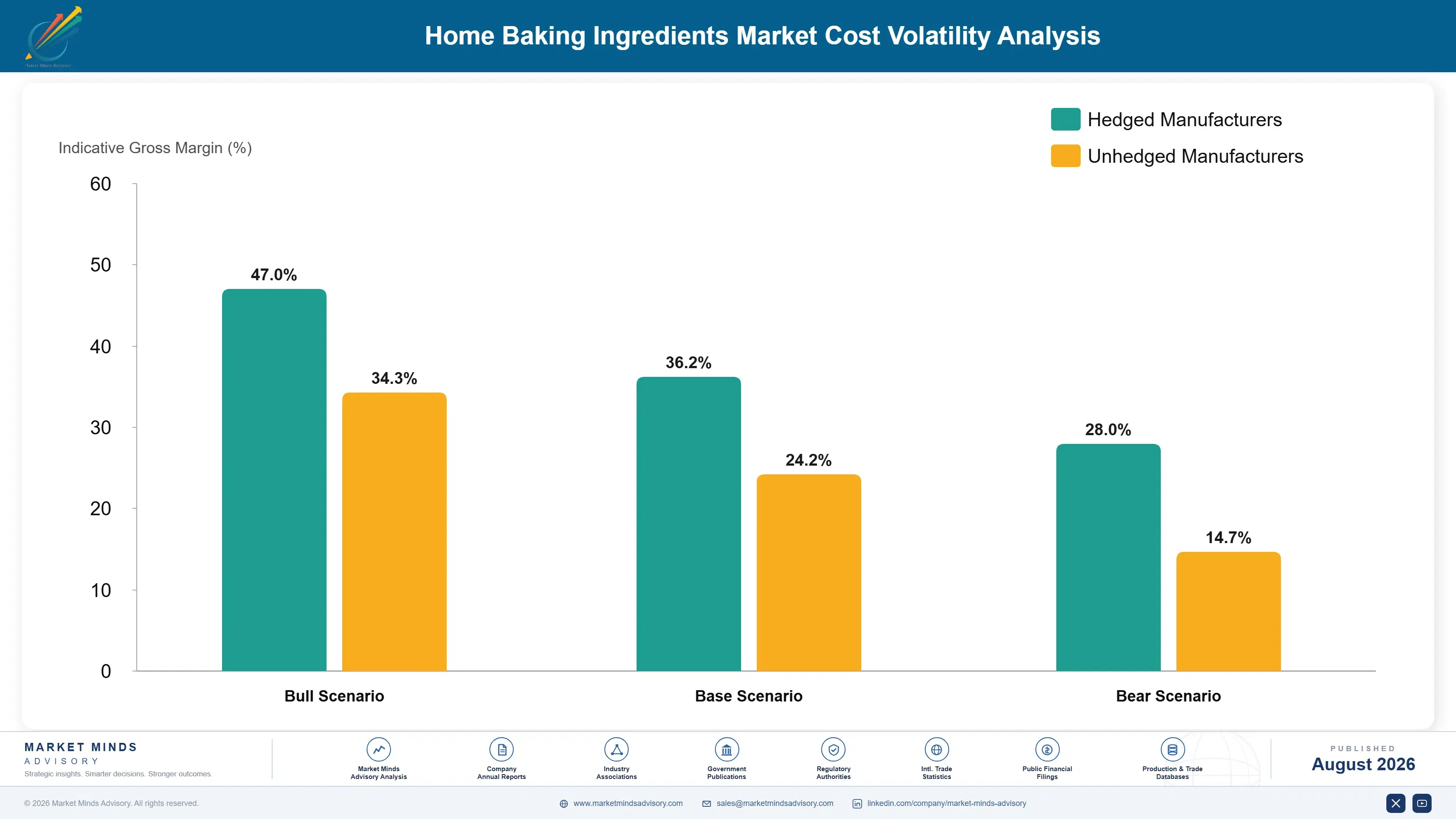
Home baking ingredient suppliers face persistent input cost volatility tied to wheat, sugar, and dairy commodity markets, which can compress margins meaningfully faster than suppliers can adjust consumer-facing pricing without risking volume loss. The root cause is the category's continued reliance on globally traded agricultural commodities whose pricing responds to weather, energy costs, and geopolitical disruption largely outside any individual supplier's control. This volatility has squeezed margins meaningfully during recent inflationary periods, particularly for smaller regional suppliers lacking hedging sophistication. Suppliers are responding by expanding forward purchasing agreements and reformulating recipes to reduce exposure to the most volatile inputs.
Market Impact: Adds 15 percent premium category share

Declining Household Baking Frequency Post-Normalization Trend

Household baking frequency continues gradually normalizing downward from pandemic-era peaks as consumers return to busier pre-pandemic schedules and dining-out patterns, creating a persistent headwind against the category's elevated post-2020 baseline. The root cause is simply reduced at-home time availability as commuting, travel, and social activity have recovered toward pre-pandemic patterns across most developed markets. This normalization limits how much of the pandemic-era demand surge suppliers can reasonably expect to sustain indefinitely. Suppliers are responding by emphasizing convenience formats requiring minimal time investment to retain time-pressed households who might otherwise abandon baking entirely given competing demands.
Market Impact: Expands addressable category 20 percent
3 additional market trends, 4 additional growth drivers, and 3 additional restraints and challenges are covered in the full report. Contact sales@marketmindsadvisory.com to access the complete intelligence.

Segment CAGR and Growth Architecture

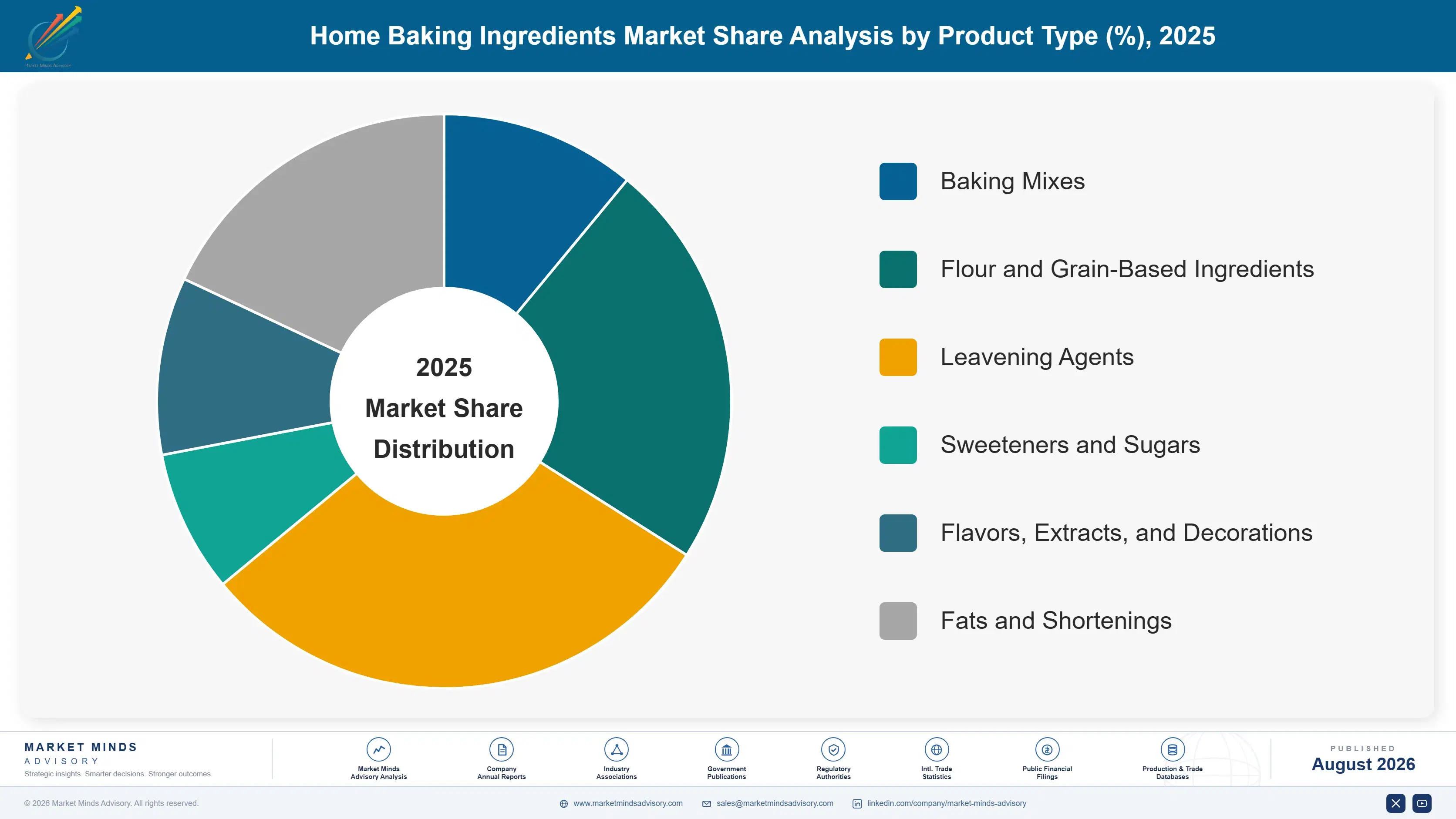
Segmentation follows product type since ingredient function most directly determines formulation complexity, margin structure, and shelf placement across home baking categories, distinguishing this market from recipe-based or occasion-based classifications used elsewhere in adjacent food categories. Adjacent occasion-based and commercial dimensions are analyzed separately elsewhere in this report for clarity. This lens best captures how formulation differs across the category.
home-baking-ingredients-market-trends-market-share-analysis-1787460391637

Flavors, Extracts, and Decorations

This segment covers vanilla and specialty flavor extracts, decorating sugars, sprinkles, fondant, and cake decoration supplies purchased by home bakers seeking bakery-quality finishing touches without professional training. Growing home cake decorating hobbyist participation, amplified by social media recipe and decoration content, continues driving premium format adoption well beyond the category's historically modest specialty positioning. Suppliers report the strongest per-unit margins across this segment given genuine consumer willingness to pay premium pricing for curated, bakery-quality ingredients rather than assembling recipes from commodity components available at considerably lower price points across conventional baking aisles nationally. Suppliers report strong repeat purchase behavior from hobbyist bakers expanding this specific segment steadily. This segment continues attracting the most new entrant activity across specialty ingredient suppliers.
CAGR 9.0%

Baking Mixes

This segment covers pre-formulated cake, bread, muffin, cookie, and brownie mixes requiring minimal additional preparation, appealing directly to time-pressed households seeking homemade results without full from-scratch measurement and formulation effort. Convenience-focused product innovation, including single-serve and reduced-preparation-time formats, continues expanding this segment's addressable household base beyond traditional weekend baking occasions toward more frequent weeknight use. Suppliers report premium mix formats carrying meaningfully higher margins than basic commodity flour and sugar purchases, supporting continued innovation investment across leading branded and private label suppliers competing for shelf space. Suppliers report growing adoption among busy households seeking predictable, moderate-cost convenience beyond basic commodity ingredient purchases. Innovation here increasingly targets weeknight convenience rather than traditional weekend baking occasions exclusively.
CAGR 8.0%
Full segment breakdown across 6 segments available in the complete report.

Regional Architecture and Country Demand Map

North America leads global home baking ingredient demand given its deep specialty retail infrastructure and established at-home baking culture, with Western Europe and East Asia following at meaningful scale. The remaining regions together account for a meaningful, growing minority of global category demand overall. Emerging markets show accelerating adoption.

North America

The United States anchors this region's home baking ingredient demand, supported by deep specialty retail infrastructure spanning dedicated baking supply chains alongside expanded grocery private label assortments serving households across every income tier. Sustained post-pandemic baking participation remains meaningfully elevated above pre-2020 levels, with survey data confirming a substantial share of households who began baking regularly during initial lockdowns continue purchasing ingredients monthly today. Canada contributes a smaller but steady additional share, following broadly similar household consumption patterns concentrated around major urban centers. Continued premium flavor and gluten-free format expansion across leading national retailers keeps this region's category innovation pace ahead of most other markets tracked, supporting durable per-household spending growth over the coming decade.
Share: 30% | CAGR: 6.9% (2026 to 2036)

Western Europe

Germany and the United Kingdom together anchor this region's home baking ingredient demand, reflecting deeply established household baking traditions supported by extensive specialty retail and bakery supply infrastructure built over generations. French consumers contribute meaningful additional demand concentrated around premium flavor extracts and specialty flour categories, reflecting the country's broader culinary culture and quality expectations. Rising grocery inflation across the region has pushed some households toward private label alternatives, pressuring branded suppliers to defend premium positioning through demonstrated quality differentiation. Smaller Nordic and Benelux markets contribute steady additional demand, though this region's overall growth trails North America and East Asia given comparatively mature market penetration and slower household formation growth.
Share: 24% | CAGR: 5.2% (2026 to 2036)
Regional intelligence for 5 additional markets available in the complete report: East Asia, South Asia and Pacific, Latin America, Middle East and Africa, Eastern Europe. Contact sales@marketmindsadvisory.com.
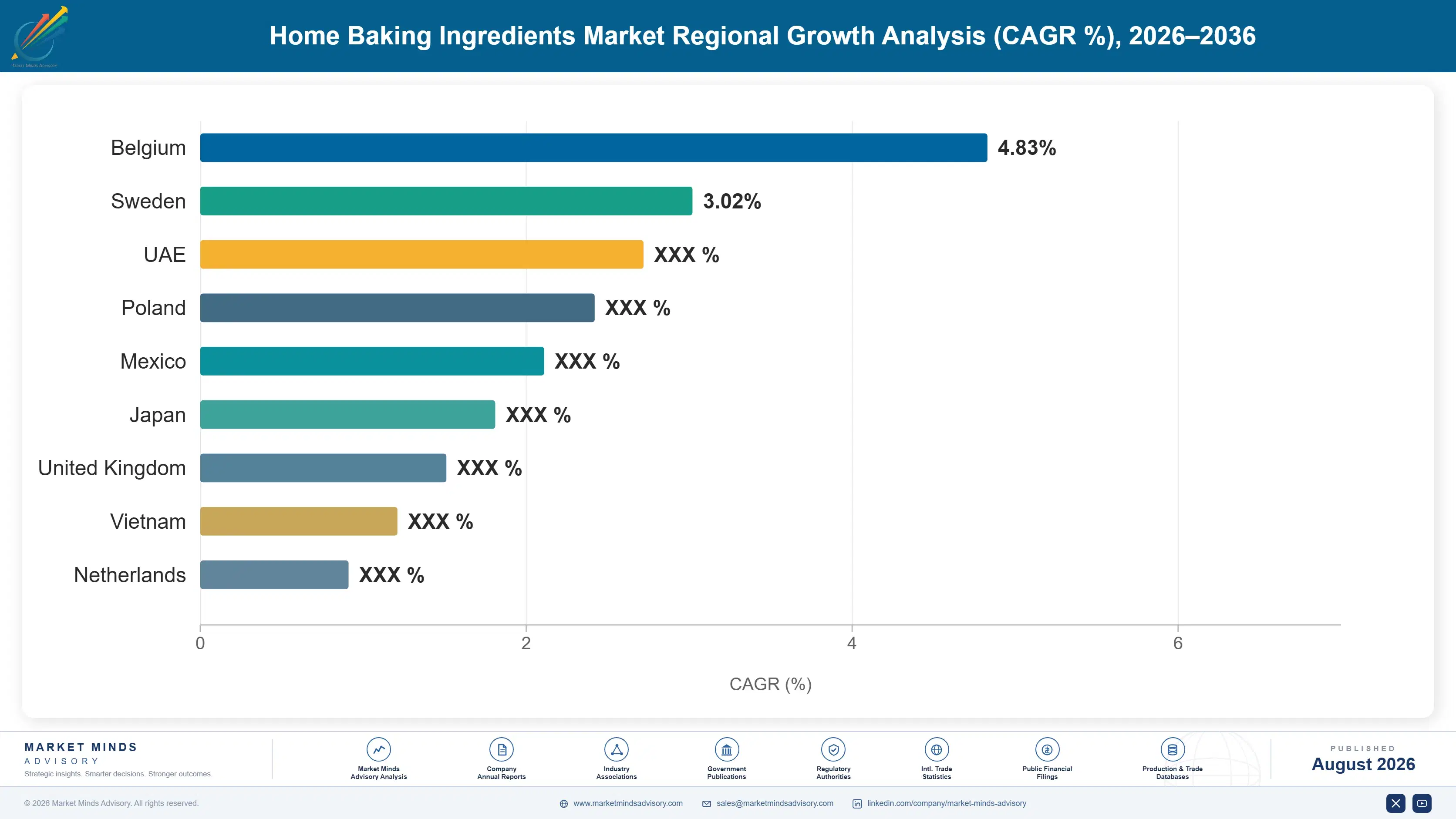
home-baking-ingredients-market-trends-country-cagr-analysis-1787460392150

Where Baking Ingredient Suppliers Capture Margin

Suppliers able to combine premium flavor positioning with recipe content, subscription commerce, and dietary accommodation formats increasingly capture disproportionate household spending relative to commodity-only competitors selling undifferentiated flour and sugar across this expanding category today. Suppliers slower to build these capabilities increasingly cede ground to faster-moving competitors across most household segments served today. broadly

Premium Flavor and Decoration Portfolio Expansion Strategy

Suppliers expanding premium flavor extract and cake decoration assortments capture meaningfully higher per-unit margins than commodity flour and sugar sales, while addressing genuine consumer willingness to pay for bakery-quality results at home. This approach requires meaningful product development and flavor sourcing investment, but successfully positioned premium lines generate durable margin advantages that commodity-focused competitors cannot easily replicate. Suppliers report premium flavor and decoration lines carrying margins roughly 25 percent higher than conventional commodity baking ingredient categories, justifying continued portfolio investment. This differentiation increasingly determines which suppliers retain shelf space as retailers reallocate baking aisle space toward higher-margin categories.
Market Impact: Improves category margin by roughly 25 percent annually

Recipe Content and Digital Engagement Platform Strategy

Suppliers investing in recipe content, video tutorials, and digital engagement platforms capture stronger brand loyalty and repeat purchase behavior than suppliers relying solely on shelf presence and traditional advertising. This approach requires meaningful content production and digital marketing investment, but successfully engaged consumers demonstrate measurably higher repeat purchase rates across a supplier's broader product portfolio. Suppliers report digital-engaged households purchasing roughly 18 percent more category volume annually than disengaged households. Suppliers report these engaged households becoming meaningfully more resistant to switching toward private label alternatives over time. This resistance compounds over multiple purchase cycles, sustaining brand loyalty considerably.
Market Impact: Increases household purchase volume by 18 percent overall

Gluten-Free and Allergen-Free Format Development Strategy

Suppliers developing dedicated gluten-free and allergen-free product lines capture premium pricing from a rapidly growing dietary accommodation consumer base extending well beyond the historically niche celiac and allergy population. This approach requires meaningful reformulation and dedicated production line investment to avoid cross-contamination, but successfully certified free-from lines command durable price premiums that conventional formats cannot match. Suppliers report free-from product lines carrying price premiums of roughly 30 percent over comparable conventional formats. Suppliers report these certified lines becoming a durable point of differentiation against private label competitors lacking comparable capability.
Market Impact: Commands price premium of roughly 30 percent overall

Subscription Commerce and Direct-to-Consumer Sales Strategy

Suppliers launching subscription commerce and direct-to-consumer sales channels capture recurring revenue and richer customer data than suppliers dependent entirely on traditional grocery retail distribution. This approach requires meaningful e-commerce and fulfillment infrastructure investment, but successfully launched subscription programmes generate predictable, renewal-heavy revenue streams with considerably lower customer acquisition costs over time. Suppliers report subscription customers generating roughly 35 percent higher annual spending than one-time purchasers. Suppliers report these subscription relationships generating considerably lower customer acquisition costs than traditional grocery retail channels over time. This lower acquisition cost compounds meaningfully as subscription relationships persist across multiple years.
Market Impact: Generates 35 percent higher annual spending annually overall

Who Controls the Margin Pool

The top five suppliers control roughly 28% of global home baking ingredient category revenue, a fragmented tier reflecting the category's split across mixes, flour, leavening, and specialty flavor products rather than a single integrated product line. General Mills and King Arthur Baking Company lead by category revenue, but neither commands a decisive advantage over Dr. Oetker and Bob's Red Mill within their specialties.
Current competitive activity centers on premium flavor and decoration expansion, gluten-free format development, and digital recipe content investment targeting both mainstream and specialty household segments. Dr. Oetker continues expanding European specialty mix formats, while Bob's Red Mill emphasizes organic and whole grain positioning across its natural foods customer base internationally. General Mills and McCormick pursue similar premium and digital engagement strategies at larger relative scale.

Emerging pressure comes from grocery retailer private label programmes expanding into premium and specialty categories previously reserved for established national brands, alongside direct-to-consumer specialty ingredient startups building subscription-based customer relationships. Should these entrants scale distribution and brand recognition faster than established suppliers respond, category leadership within premium specialty segments could shift meaningfully over the coming years across major grocery markets. MMA views this shift as gradual rather than imminent.
home-baking-ingredients-market-trends-company-positioning-matrix-1787460392668

Competitive Moat and Risk Dimensions

GENERAL MILLS

Moat: Broad National Brand Recognition

General Mills maintains extensive brand recognition and grocery distribution built over decades of continuous marketing and retailer relationship investment, giving it shelf placement reliability that newer entrants would need years of comparable investment to replicate. This distribution depth supports considerably steadier volume than competitors dependent on regional distribution alone.
GENERAL MILLS

Risk: Limited Premium Positioning Depth

General Mills' broad commodity-oriented portfolio leaves it more exposed to premium specialty competitors capturing higher-margin flavor and decoration categories. Continued consumer preference for curated, bakery-quality ingredients could meaningfully erode General Mills' share of premium category growth absent expanded specialty product investment over the coming years.
KING ARTHUR BAKING COMPANY

Moat: Premium Quality Brand Credibility

King Arthur Baking Company maintains deep brand credibility built over generations of consistent premium flour and baking quality positioning, giving it consumer trust advantages that newer premium entrants cannot easily replicate. This credibility supports considerably stronger price premium capture than lower-cost competitors offering comparable functional performance.
KING ARTHUR BAKING COMPANY

Risk: Narrower Distribution Than Majors

King Arthur Baking Company faces meaningful distribution limitations relative to larger conglomerate competitors with broader grocery retail relationships and shelf space negotiating power. Continued reliance on specialty and premium grocery channels could meaningfully constrain volume growth relative to mass-market competitors over the coming years absent expanded distribution.

Players Tracked

Prominent Players

General Mills
King Arthur Baking Company
Dr. Oetker
Bob's Red Mill Natural Foods
McCormick & Company

Other Key Players

Lesaffre
AB Mauri
Puratos Group
ADM
Cargill
Ardent Mills
Continental Mills
ConAgra Brands
Hain Celestial Group
Rodelle Inc
Nielsen-Massey Vanillas
Wilton Brands
Watkins Incorporated
Bakels Group
Manildra Group

Recent Developments

MARCH 2026

King Arthur Baking Company Expands Gluten-Free Flour Line

King Arthur Baking Company introduced an expanded gluten-free flour product line reporting improved texture performance across cake and bread applications, targeting households seeking dietary accommodation without sacrificing baking quality. Early customer feedback indicated strong satisfaction with texture and rise consistency compared to prior formulations available.
Signal: Signals continued supplier investment addressing the primary gluten-free quality barrier limiting broader household adoption industry wide
NOVEMBER 2025

Dr. Oetker Launches Premium Decoration Product Range

Dr. Oetker launched an expanded premium cake decoration and specialty flavor product range across European grocery channels, targeting home cake decorating hobbyists seeking bakery-quality finishing supplies. The launch also included expanded digital recipe content supporting new products. The launch also included expanded digital recipe content covering pairing and decoration ideas.
Signal: Reflects continued manufacturer investment in premium decoration categories favored by hobbyist consumers among hobbyist consumers active on social platforms today
JANUARY 2026

General Mills Expands Direct-to-Consumer Subscription Service

General Mills expanded its direct-to-consumer subscription commerce platform covering additional baking mix and specialty flavor products, targeting households seeking recurring convenient delivery. The expansion reflects continued investment in digital customer relationship infrastructure. The expansion reflects continued investment in digital customer relationship infrastructure across mix and specialty flavor product categories.
Signal: Underscores continued industry movement toward direct customer relationships bypassing traditional grocery retail bypassing traditional grocery retail distribution entirely today

Grain and Dairy Commodity Exposure

Wheat flour, sugar, and dairy-derived ingredients together represent roughly 40% of cost of goods sold for home baking ingredient suppliers, with commodity pricing tracking broader global agricultural markets closely, sourced predominantly from North American, European, and Australian grain-growing regions. Vanilla and specialty flavor ingredients constitute a smaller, higher-margin cost component, sourced predominantly from Madagascar and Indonesia.
Wheat and sugar prices rose meaningfully during 2022 amid broader agricultural commodity market disruption following regional supply constraints, with company annual reports from major suppliers confirming elevated input costs persisted through much of 2022 and 2023 before moderating gradually. USDA data on global wheat and sugar markets corroborates the pattern, showing cost pressure remained a meaningful factor constraining supplier margins throughout this extended disruption period across most markets.

Suppliers without long-term grain purchasing contracts or vertically integrated milling operations face materially higher input cost exposure than better-capitalized competitors. Smaller regional and private label suppliers face the steepest exposure, since they typically lack the purchasing scale to negotiate favorable long-term pricing terms with grain processors and dairy cooperatives across major markets. This gap compounds over time as incumbents reinvest savings into further hedging sophistication.
home-baking-ingredients-market-trends-cost-volatility-analysis-1787460392863

Long-Term Grain Purchasing Contracts

Larger suppliers are locking in multi-year grain purchasing contracts with milling and processing partners, stabilizing input costs and securing reliable supply volume ahead of anticipated demand growth. This approach requires meaningful negotiating capacity, but delivers considerably steadier input costs than spot-market purchasing across volatile agricultural commodity markets broadly. Contract terms increasingly span three to five years, for both parties.

Vertical Integration Into Milling Operations

Selected larger suppliers are investing directly in owned or partnered milling operations, reducing dependency on external flour suppliers entirely for a meaningful share of their production requirements. This path demands substantial capital investment, but delivers durable input cost control that externally-sourced competitors cannot match over the long term. A small number now control milling capacity directly.

Recipe Reformulation to Reduce Volatile Inputs

Suppliers are reformulating recipes to reduce reliance on the most price-volatile commodity inputs, substituting more stable alternative ingredients where consumer taste and texture expectations allow. This strategy requires meaningful product development investment, but delivers steadier long-term costs than continuing full exposure to the most volatile commodity categories. Suppliers report these substitutions reducing exposure without noticeably affecting consumer taste perception.

Portfolio Architecture for Margin Defence

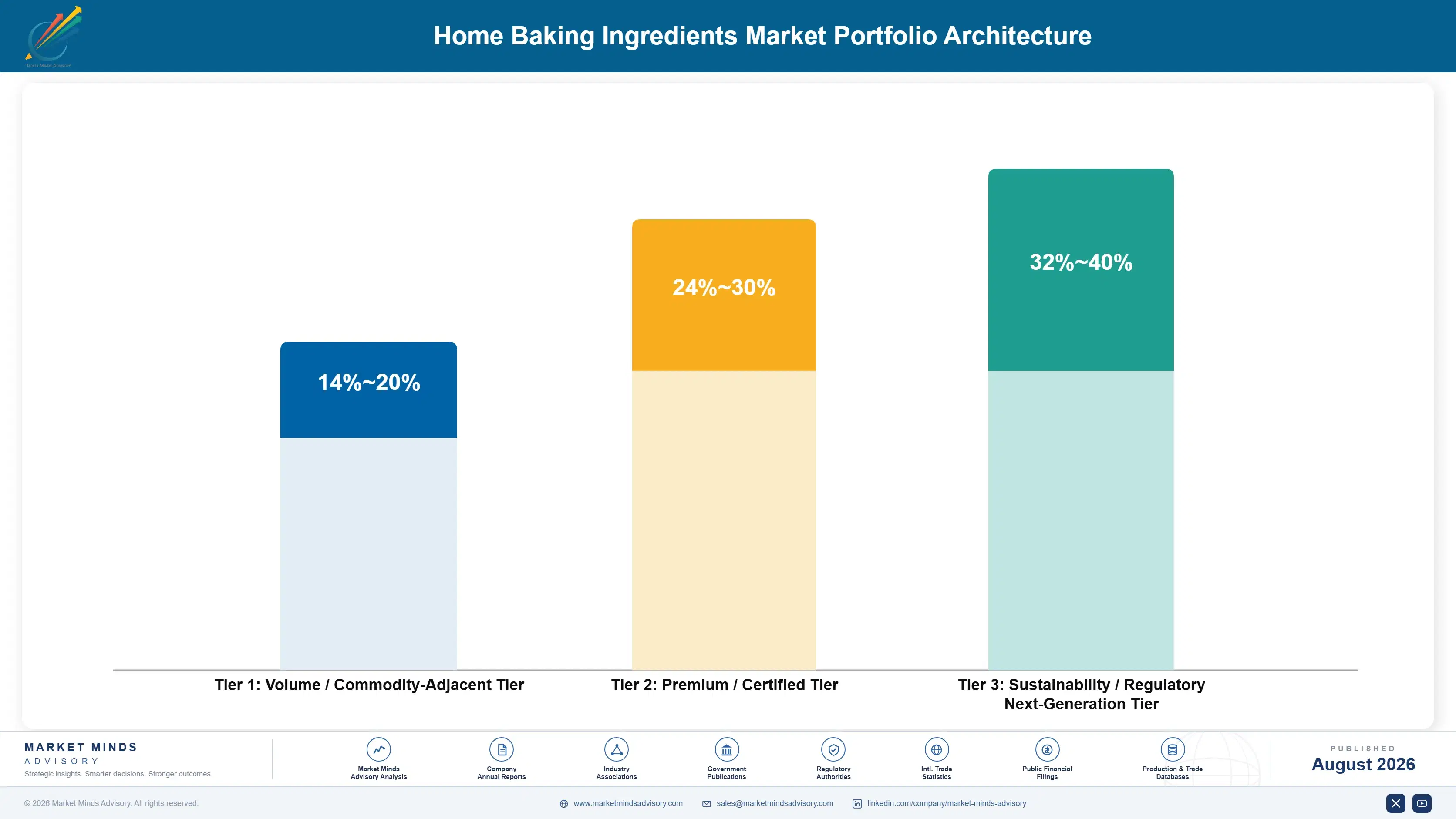
This market organizes into three commercial tiers spanning standard commodity flour and sugar at the volume end, mid-range branded mixes and mainstream flavor products in the middle tier, and premium specialty flavor, decoration, and gluten-free formats capturing the strongest margins at the top given formulation sophistication and consumer willingness to pay. This tiering reflects real formulation and positioning differences rather than simple packaging distinctions, since premium and gluten-free formats require different production processes entirely.
Standard and premium tiers pull suppliers in genuinely different directions: standard commodity products sustain broad household volume at thinner margins, while premium specialty and gluten-free formats deliver materially stronger margins that increasingly fund the product development this diversifying category requires. Suppliers positioned only in the standard tier increasingly find themselves squeezed between rising commodity costs and expanding private label price competition.

The highest-value pools concentrate around premium flavor, decoration, and gluten-free formats sold to households willing to pay for bakery-quality results and dietary accommodation, where formulation sophistication and brand credibility together sustain premium pricing power that standard commodity products simply cannot match across mainstream grocery distribution channels. Suppliers without meaningful presence in these pools face a widening profitability gap relative to better-positioned competitors.

Volume / Commodity-Adjacent Tier

Standard commodity flour, sugar, and basic mixes sold primarily on price to households across most grocery markets broadly. Competitive intensity is highest here given limited differentiation and heavily price-driven purchasing behavior overall.
Gross Margin: 14-20%

Premium / Certified Tier

Mid-range branded mixes and mainstream flavor products sold under moderate differentiation to established household consumers nationally. Suppliers in this tier balance moderate brand investment against still-meaningful volume across mainstream grocery channels nationally.
Gross Margin: 24-30%

Sustainability / Regulatory / Next-Generation Tier

Premium specialty flavor, decoration, and gluten-free formats commanding the strongest formulation and positioning premium available today. Suppliers here typically combine proprietary formulation with premium branding to justify pricing well above conventional alternatives.
Gross Margin: 32-40%
home-baking-ingredients-market-trends-portfolio-architecture-1787460393365

High-value Sub-segments and Strategic Watch-out

Premium Flavor and Decoration Products

The fastest-growing and highest-margin segment, combining strong hobbyist demand momentum with genuine willingness to pay premium pricing for bakery-quality results. MMA expects this gap to widen as social media content expands. MMA expects this gap to widen as social media content expands further. Retailers reward suppliers early here.
Gross Margin: 32-40%

Gluten-Free and Allergen-Free Mixes

Strong margins and steady growth driven by dietary accommodation demand that sustains category momentum as health-conscious consumer awareness continues expanding broadly. Compliant suppliers capture disproportionate new shelf space already. Compliant suppliers capture disproportionate new shelf space already across leading grocery retailers nationally. Certification depth increasingly matters here.
Gross Margin: 28-36%

Standard Baking Mixes

The volume core segment sustaining broad household production even as premium categories increasingly capture disproportionate industry profit growth overall. This segment remains essential despite thinner margins, anchoring supplier volume broadly. This segment remains essential despite thinner margins, anchoring supplier volume broadly across most markets. Volume matters most in this segment.
Gross Margin: 18-24%

Commodity Flour and Sugar

A strategic watch-out segment facing commoditization pressure, requiring suppliers to defend volume against private label and lower-cost regional competitor substitution. Suppliers failing to invest in differentiation here may see volume shrink meaningfully. Suppliers failing to invest in differentiation here may see volume shrink meaningfully over time.
Gross Margin: 10-16%

Recurring Purchase Behavior Beyond Initial Trial

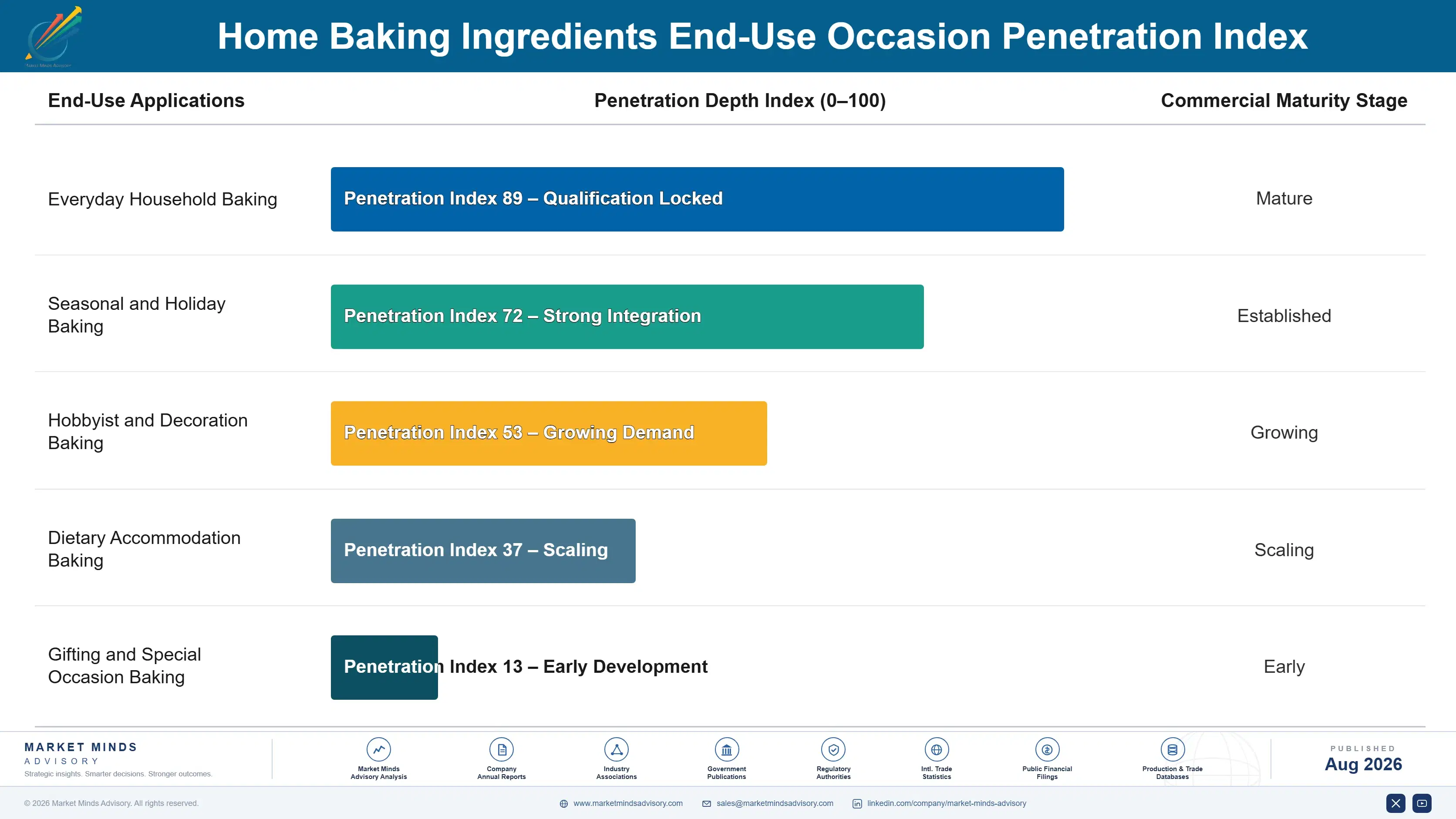
Home baking ingredient purchases generate recurring revenue through repeat mix, flour, and specialty flavor purchases that persist across household baking occasions throughout the year, particularly around seasonal holidays. This recurring relationship strengthens supplier revenue predictability meaningfully once a household establishes brand loyalty through consistent product quality across multiple purchase occasions. Suppliers that establish this recurring relationship early typically retain household loyalty well beyond the original trial purchase.
Adoption depth varies considerably by end-use vertical: casual weeknight bakers favor convenience mixes requiring minimal preparation, while dedicated hobbyist bakers and cake decorators show the deepest engagement with premium flavor and specialty decoration categories. Gluten-free and allergen-free households demonstrate the strongest brand loyalty given limited suitable product alternatives available. Casual bakers show comparatively shallow engagement, switching between brands more readily based on price and promotional availability alone.

A generational shift in buyer profiles is underway as younger consumers increasingly discover baking through social media recipe and decoration content, entering the category already expecting curated, visually distinctive products rather than the plain commodity formats their parents' generation purchased. Younger consumers increasingly enter the category already expecting curated visual content as a baseline expectation rather than a discretionary bonus.
home-baking-ingredients-market-trends-end-use-penetration-index-1787460393861

Priorities for Baking Ingredient Suppliers

These are among the four positions where our research anticipates prominent divergence between winners and laggards over the coming forecast period. Each is grounded in the demand model, the regulatory perimeter, and the announced capacity pipeline.
01 / PREMIUM FLAVOR INVESTMENT

Prioritize specialty positioning ahead of commodity volume

Suppliers investing in premium flavor and decoration product development are capturing a disproportionate share of the expanding hobbyist baking segment, where formulation sophistication increasingly determines which suppliers win shelf space as retailers reallocate baking aisle space toward higher-margin categories. Companies without meaningful premium investment risk being confined to commodity categories facing intensifying private label price competition and eventual margin erosion. Expect premium flavor and decoration investment to become the single most important commercial differentiator for suppliers seeking sustainable growth through the coming decade.
02 / GLUTEN-FREE FORMAT DEVELOPMENT

Build dietary accommodation capability ahead of demand

Suppliers developing dedicated gluten-free and allergen-free product lines are capturing disproportionate share of a rapidly growing dietary accommodation consumer base, where reformulation quality increasingly determines which suppliers win loyal repeat household relationships. Companies without meaningful accommodation investment risk losing access to the fastest-growing, most premium-willing consumer segment entirely. Expect gluten-free and allergen-free depth to become an increasingly important determinant of supplier commercial leadership across grocery baking categories broadly, especially as retailer shelf allocation continues shifting meaningfully toward accommodation-focused products over time.
03 / DIGITAL ENGAGEMENT STRATEGY

Invest in recipe content ahead of traditional advertising

Suppliers investing in recipe content, video tutorials, and digital engagement platforms are sustaining considerably stronger household purchase frequency than competitors relying solely on traditional shelf presence and advertising, and this advantage compounds further as social media increasingly drives baking category discovery among younger consumers. Companies without meaningful digital engagement investment face persistently weaker brand loyalty regardless of underlying product quality. Expect digital engagement sophistication to become an increasingly important determinant of supplier growth trajectory going forward, particularly among younger household segments.
04 / PRIVATE LABEL DEFENSE STRATEGY

Differentiate branded products against expanding store brands

Continued grocery retailer private label expansion into premium and specialty categories is steadily pressuring branded suppliers to demonstrate genuine quality differentiation rather than relying on brand recognition alone, reflecting both retailer margin pressure and improving private label formulation quality that narrows historical performance gaps. This trajectory shows no sign of reversing given sustained retailer investment and improving store brand quality outpacing traditional brand-loyalty-only positioning. Expect private label competitive pressure to continue intensifying meaningfully throughout the current forecast period across most grocery categories tracked.

Engagement Snapshot From the Field

A live engagement with an industry participant carrying material or product regulatory and market exposure ahead of a defining policy shift, showing how our research translates into a defensible multi-year portfolio strategy.
MARKET MINDS ADVISORY · CLIENT ENGAGEMENT SUMMARY
Home Baking Ingredients Producer Strategic Portfolio Review and Transition Roadmap 2026·Investment Scenario on Home Baking Ingredients Exposure Evaluation 2025-26
CLIENT PROFILE
The client is a mid-sized regional baking ingredient brand generating projected annual revenue of approximately $140 million (client-reported, unverified by MMA) upon successful premium portfolio repositioning. The company operates two production facilities and had historically produced exclusively commodity-tier flour and basic mix products. The client sought MMA guidance in Q1 2026 as private label competition began eroding its commodity-tier volume meaningfully.
STRATEGIC CHALLENGE
The client had historically competed entirely within commodity flour and basic mix categories, and leadership was uncertain whether investing in premium flavor and gluten-free product development would generate sufficient revenue to justify the reformulation and marketing investment required given uncertain consumer adoption timelines. Leadership also worried that moving too slowly would cede shelf space permanently to faster-moving premium competitors.
MMA APPROACH
MMA's team benchmarked comparable regional brand premiumization strategies, modeled projected revenue and retailer shelf space impact under various product investment scenarios, and assessed the client's existing retailer relationships for premium format demand readiness across its primary distribution channels. The engagement also included a phased capital deployment framework designed to limit downside risk.
KEY FINDINGS
  1. Comparable regional brands achieved meaningful revenue growth within twelve months of premium product line launch completion (client-reported, unverified by MMA), exceeding initial modeling expectations considerably.
  2. Retailer category buyers expressed strong willingness to expand shelf space allocation given documented consumer demand for premium and gluten-free formats affecting their own category sales performance broadly.
  3. Existing commodity production capacity remained viable for the client's core product lines, supporting a hybrid rather than full conversion strategy that reduced upfront capital requirements considerably overall.
  4. Premium flavor sourcing, while adding meaningful per-unit expense, was offset by pricing power achievable within the growing hobbyist and dietary accommodation consumer categories specifically targeted by the client.
CLIENT PROFILE
The client is a mid-sized regional baking ingredient brand generating projected annual revenue of approximately $140 million (client-reported, unverified by MMA) upon successful premium portfolio repositioning. The company operates two production facilities and had historically produced exclusively commodity-tier flour and basic mix products. The client sought MMA guidance in Q1 2026 as private label competition began eroding its commodity-tier volume meaningfully.
STRATEGIC CHALLENGE
The client had historically competed entirely within commodity flour and basic mix categories, and leadership was uncertain whether investing in premium flavor and gluten-free product development would generate sufficient revenue to justify the reformulation and marketing investment required given uncertain consumer adoption timelines. Leadership also worried that moving too slowly would cede shelf space permanently to faster-moving premium competitors.
MMA APPROACH
MMA's team benchmarked comparable regional brand premiumization strategies, modeled projected revenue and retailer shelf space impact under various product investment scenarios, and assessed the client's existing retailer relationships for premium format demand readiness across its primary distribution channels. The engagement also included a phased capital deployment framework designed to limit downside risk.
KEY FINDINGS
  1. Comparable regional brands achieved meaningful revenue growth within twelve months of premium product line launch completion (client-reported, unverified by MMA), exceeding initial modeling expectations considerably.
  2. Retailer category buyers expressed strong willingness to expand shelf space allocation given documented consumer demand for premium and gluten-free formats affecting their own category sales performance broadly.
  3. Existing commodity production capacity remained viable for the client's core product lines, supporting a hybrid rather than full conversion strategy that reduced upfront capital requirements considerably overall.
  4. Premium flavor sourcing, while adding meaningful per-unit expense, was offset by pricing power achievable within the growing hobbyist and dietary accommodation consumer categories specifically targeted by the client.
RECOMMENDED STRATEGY
Phase 1: Phase 1 (Months 1-6): Establish premium flavor and gluten-free product capability targeting the client's highest-potential retailer relationships first. This phase prioritized relationships most likely to adopt premium formats quickly. Phase 2: Phase 2 (Months 7-13): Expand production capacity while retaining commodity production for core existing product lines. This phase balanced growth investment against continued core product line reliability. Phase 3: Phase 3 (Months 14-19): Scale premium capacity further based on realized revenue and retailer partnership performance results. This phase depended on sustained retailer demand signals remaining consistent throughout.
OUTCOME
The client established its premium flavor and gluten-free product capability and completed the recommended capacity expansion phases within the proposed timeline, reporting revenue and retailer partnership results consistent with initial modeling projections (client-reported, unverified by MMA). The company also secured supply agreements with five new grocery retail accounts within the first year.

Frequently Asked Questions

Foundational context covering the market sizes, CAGR, scope, country, region and competition that inform every finding below. This section is provided to cover basics and most often pre-purchase conversations, answered from the MMA Primary Research Dataset.

What is the current size of the Home Baking Ingredients Market?

The market was valued at approximately $14.2 billion in 2025. This includes mixes, flours, leavening agents, sweeteners, flavors, extracts, and decorations purchased for at-home baking use worldwide.

How large will the Home Baking Ingredients Market be by 2036?

The market is projected to reach approximately $28.4 billion by 2036, up from about $15.1 billion in 2026. This reflects sustained household demand alongside continued premium and specialty format investment.

What is the CAGR for the Home Baking Ingredients Market 2026 to 2036?

The market is expected to grow at a compound annual growth rate of 6.5% between 2026 and 2036. This reflects steady underlying household demand combined with accelerating premium format adoption across suppliers.

Which segment is growing fastest?

Flavors, extracts, and decorations is the fastest-growing segment, expanding at approximately 9.0% annually through 2036. This reflects strong hobbyist demand and growing willingness to pay for premium formats.

Who are the major companies in the Home Baking Ingredients Market?

Leading suppliers include General Mills, King Arthur Baking Company, Bob's Red Mill Natural Foods, McCormick & Company, and Oetker. Together these five companies account for roughly 28% of category revenue.

Which country is growing fastest?

India is the fastest-growing major country at an estimated 9.5% CAGR, driven by urbanization and expanding e-commerce grocery access introducing packaged baking ingredients to new households.

Report Segmentation Architecture

The full report scope spans multiple orthogonal segmentation dimensions, with cross-tabulated demand data provided for each dimension pair. Coverage extends further to regional breakdowns, trend trajectories, and the competitive detail needed to support segment-level decision-making.

By Product Type

  • Baking Mixes
  • Flour and Grain-Based Ingredients
  • Leavening Agents
  • Sweeteners and Sugars
  • Flavors, Extracts, and Decorations
  • Fats and Shortenings

By End-Use Occasion

  • Everyday Household Baking
  • Seasonal and Holiday Baking
  • Hobbyist and Decoration Baking
  • Dietary Accommodation Baking
  • Gifting and Special Occasion Baking

By Commercial Dimension

  • Branded Retail Sales
  • Private Label Retail Sales
  • Direct-to-Consumer and Subscription
  • Specialty and Online Channel Sales

By Region

  • North America
  • Western Europe
  • East Asia
  • South Asia and Pacific
  • Latin America
  • Middle East and Africa
  • Eastern Europe

Scope, Methodology, and Coverage

Every figure in this report is reproducible from documented input assumptions. The scope below maps the historical period, the forecast horizon, the segmentation dimensions, and the countries covered, alongside the underlying primary and qualitative methodology.
Historical Period
2020 to 2025
Forecast Period
2026 to 2036
Base Year
2025 (USD billions; MMA Primary Research Dataset, August 2026)
Market Definition
This market comprises packaged ingredients sold to consumers for at-home baking, including mixes, flours, leavening agents, sweeteners, flavors, extracts, and decorations. It excludes commercial bakery ingredients, foodservice supply, and finished baked goods sold ready to eat.
Quantitative Units
USD billions (current prices); household penetration rates where applicable
Segmentation Dimensions
By Product Type; By End-Use Occasion; By Commercial Dimension; By Region
Regions Covered
North America, Western Europe, East Asia, South Asia and Pacific, Latin America, Middle East and Africa, Eastern Europe
Countries Covered
USA, China, Germany, France, UK, Japan, South Korea, India, Australia, Canada, Brazil, Mexico, Indonesia, Vietnam, Thailand, Malaysia, UAE, Saudi Arabia, South Africa, Nigeria, Turkey, Poland, Netherlands, Italy, Spain, Sweden, Switzerland, Argentina, Colombia, Singapore, and additional markets relevant to this sector
Key Companies Profiled
General Mills, King Arthur Baking Company, Dr. Oetker, Bob's Red Mill Natural Foods, McCormick & Company, Lesaffre, AB Mauri, Puratos Group, ADM, Cargill, Ardent Mills, Continental Mills, ConAgra Brands, Hain Celestial Group, Rodelle Inc, Nielsen-Massey Vanillas, Wilton Brands, Watkins Incorporated, Bakels Group, Manildra Group
Quantitative Methodology
Primary survey, n=3,800 respondents, Q4 2025, six countries; demand-side model with trade association cross-validation
Qualitative Methodology
47 expert interviews, Q4 2025; applied to validate demand model assumptions, identify emerging dynamics, and assess competitive positioning
Report Format
PDF and XLSX data workbook (Word format preview document)
Publisher
Market Minds Advisory
Report Code
MMA-2026-AGR-160
Published
August 2026
Contact
sales@marketmindsadvisory.com | www.marketmindsadvisory.com

Purchase the full Home Baking Ingredients Market Report (2026 to 2036).

The full report provides detailed product type segmentation, supplier brand and private label trend analysis, and regional demand tracking across major global home baking ingredient markets covered in this study. It includes supplier-level competitive benchmarking based on category revenue, alongside detailed grain and dairy commodity cost commentary. Subscribers receive quarterly updates tracking new product launches and private label expansion developments as they occur across major grocery markets. It also profiles emerging premium and gluten-free format innovation and its implications for expanding category margin beyond commodity baseline pricing. A companion dataset provides regional spending estimates by country for detailed market sizing purposes.
Product type segmentation breakdown by category
Country-level category revenue trend analysis dataset
Private label penetration tracking and benchmarking
Supplier competitive benchmarking scorecards and overview
Quarterly product launch and format update service
Commodity cost dataset segmented by ingredient type

Built For The People Who Decide

From boardroom strategy to bench-side execution, this report is read cover-to-cover by leaders shaping the next decade of their industry, turning demand scenarios, market dynamics and valuation benchmarks into decisions.
CXOs/ Presidents/ VPs/ Managers
M&A and Corporate Development
Strategy Teams and R&D Heads
Procurement and Product Directors
Regulatory and Compliance Leaders
Investor Relations and Equity Analysts