Market Minds Advisory
Holographic and Multichrome Effect Pigment Systems for Eye Makeup Market

Holographic and Multichrome Effect Pigment Systems for Eye Makeup Market: Holographic and Multichrome Effect Pigments: Color-Shift Innovation Reshapes the Eye Makeup Ingredient Shelf

Viral duochrome eyeshadow trends are pushing formulators to demand brighter, more precisely engineered color-shift pigments, forcing legacy mica suppliers to invest in synthetic substrate technology they long treated as a niche curiosity.

Lead Analyst

Published

September 2026

Make Smarter Decisions with Customized Research Insights

Request a free sample report and evaluate market opportunities, growth trends, and competitive dynamics relevant to your business needs.

2025 MARKET VALUE$0.7BMarket Size 2025
2036 FORECAST VALUE$1.5BBase Case , 2026 to 2036
CAGR 2026 TO 20367.2 %Bull 8.5% / Bear 5.9%
INCREMENTAL OPPORTUNITY$0.7BNet 10- year value creation
EXPANSION MULTIPLE2.00x2036 value over 2026 base
Strategic Levers
M&A Pipeline
Regional Outlook
Country Rankings
Competitive Intelligence
Segmental Deep-dive
Call-Us : 91 93563 13602

Executive Snapshot and Market Trajectory.

Eyeshadow and highlighter formulators are chasing ever more dramatic color-shift effects that natural mica simply cannot deliver with consistent reliability across every production batch, and that gap is now the clearest signal of which pigment suppliers will still matter to prestige and mass beauty brands a few years from now.
Liquid crystal interference pigments are pulling formulation budget away from traditional natural mica systems, and East Asian pigment manufacturers are moving fastest, backed by the deepest concentration of K-beauty-driven color innovation and cosmetics manufacturing capacity anywhere in the world, while North American indie brands add a second, rapidly scaling pool of demand for novel color-shift effects that formulators can readily market as brand new.
Competitive character is shifting from a natural mica processing business toward a synthetic substrate engineering one, and legacy pigment suppliers that built moats around mica sourcing relationships are racing to acquire synthetic fluorphlogopite and liquid crystal capability before specialty chemical challengers with no mica legacy win the next generation of prestige brand formulation contracts outright, a shift that ethical mica-sourcing scrutiny and rapid social media trend cycles are both accelerating considerably.
Market Definition
The holographic and multichrome effect pigment systems market covers specialty color-shift pigments, including synthetic fluorphlogopite, natural mica, borosilicate, and liquid crystal interference systems, formulated specifically for eye makeup applications such as eyeshadow, eyeliner, and highlighter. It excludes general-purpose cosmetic colorants without color-shift or interference properties and effect pigments formulated exclusively for non-cosmetic industrial coatings.
Base Year Value
$0.7B in 2025 (MMA Primary Research Dataset, September 2026)
Forecast Period
2026 to 2036, eleven discrete annual values
CAGR
7.2% base case. Bull 8.5%. Bear 5.9%.
Fastest Growth Segment
Liquid Crystal Interference Pigments: 10.5% CAGR
Fastest Growth Country
South Korea: 9.8% CAGR
Fastest Growth Region
South Asia and Pacific: 9.2% CAGR
Largest Region
East Asia: 29% of 2025 global value
Market Leaders
Merck KGaA, BASF, Sun Chemical, Sensient Technologies, and Kobo Products lead the market. Source: MMA Primary Research Dataset, July 2026.
Primary Survey
n=3,800 procurement and R&D decision-makers, Q4 2025, six countries
Methodology
Demand-side build-up, cross-validated against public data, 47 expert interviews

Holographic and Multichrome Effect Pigment Systems for Eye Makeup Market Forecast Scenarios

holographic-and-multichrome-effect-pigment-systems-size-forecast-scenario-1790013341832
Between 2020 and 2025 the market grew at an estimated 6.2 percent annual clip as duochrome and color-shift eyeshadow trends spread from prestige launches into mass-market formulations across most major beauty retail channels worldwide and beyond, though most brands at that time still relied almost entirely on natural mica-based effect pigments rather than synthetic alternatives.
The base case assumes 7.2 percent annual growth through 2036, driven by three mechanisms: social media trend cycles rewarding increasingly dramatic color-shift makeup effects that natural mica cannot consistently deliver across every production batch, ethical sourcing scrutiny pushing brands toward synthetic fluorphlogopite substrates that avoid mica mining supply-chain concerns entirely and reputational risk, and indie and prestige brands differentiating through proprietary pigment effects rather than shared formulation platforms common across the industry.
The bull case turns on viral social media beauty trends accelerating color-shift pigment adoption faster than current formulator roadmaps assume, pulling forward reformulation cycles industry-wide well ahead of typical product development timelines and launch calendars this year. The bear case centers on economic pressure on discretionary cosmetics spending slowing premium pigment adoption in favor of cheaper conventional alternatives.

From Natural Mica to Engineered Color-Shift Effects

Formulators that spent a decade layering natural mica pigments into increasingly complex eyeshadow palettes are now confronting the harder problem of delivering color-shift effects vivid enough to go viral on social media platforms overnight, and suppliers that can deliver synthetic substrate consistency at scale are capturing the largest share of new formulation contracts across nearly every major beauty brand tier.
TOP-FIVE VENDOR CONCENTRATION42%Combined revenue share held by the leading global suppliers
AVERAGE PIGMENT PRICE$85 per kgBlended selling price across standard color-shift pigment grades
LEADING MANUFACTURING HUB SHARE38%Share of global pigment processing concentrated in one country
SYNTHETIC SUBSTRATE ADOPTION46%Share of new formulations using synthetic rather than natural substrates
REFORMULATION CYCLE LENGTH18 monthsTypical interval between major eye makeup color palette refreshes
ETHICAL MICA CERTIFICATION RATE64%Share of natural mica supply verified under responsible sourcing programs
Commercial activity concentrates around large, multi-year supply agreements with global beauty conglomerates rather than smaller indie brand orders, since a pigment supplier relationship typically locks a brand into a specific color-shift effect and supply chain for the entire life of a product line given the cost of reformulating an entire palette from scratch and requalifying every single finished shade ever produced.
Over the next decade, the decisive forces will be synthetic fluorphlogopite substrates that reduce dependence on ethically fraught natural mica mining, liquid crystal interference technology that delivers effects natural mica simply cannot replicate at any comparable price point, and social media trend cycles that compress the window brands have to capture a viral color-shift moment before consumer attention moves on to something else entirely.
"The suppliers losing formulation briefs aren't the ones with duller pigments. They're the ones who can't guarantee the same shift from batch to batch."
Director, Cosmetic Ingredients and Color Innovation Practice · MMA Chemicals and Materials Practice · September 2026

Market Trends

Liquid Crystal Interference Pigments Redefining Color-Shift Intensity

Liquid crystal interference pigments deliver angle-dependent color transitions dramatically more vivid than anything natural mica or standard synthetic fluorphlogopite can achieve, and prestige brands are increasingly specifying these pigments for hero product launches designed to generate social media attention instantly. This technology commands a substantial price premium over conventional effect pigments, since the manufacturing process requires precise layer-thickness control that few suppliers have mastered at commercial scale. Brands that secure early access to liquid crystal pigment capacity are differentiating meaningfully ahead of competitors still relying on conventional mica-based color-shift effects.
Market Impact: Cuts development cycles by 40 percent
Ethical Mica Sourcing Scrutiny Accelerating Synthetic Substitution

Investigative reporting on child labor and unsafe conditions in natural mica mining regions has pushed major beauty conglomerates to commit publicly to fully traceable or synthetic pigment substrates, accelerating a shift that was already underway for purely technical performance reasons. Brands unable to demonstrate verified ethical sourcing for natural mica increasingly face retailer delisting risk and consumer boycotts organized on social media. Synthetic fluorphlogopite substrate suppliers are capturing this displaced demand directly, since the material sidesteps the ethical sourcing question entirely while matching most of natural mica's optical performance characteristics.
Market Impact: Expands South Korean demand 28 percent

Market Opportunities and Growth Drivers

Social Media Virality Compressing Product Development Cycles

Beauty brands are compressing traditional multi-year product development timelines into months to capitalize on viral color-shift makeup trends before consumer attention shifts elsewhere, and pigment suppliers that can deliver samples and production quantities on compressed timelines are winning disproportionate share of hero-product briefs across the industry. This urgency is reshaping supplier relationships toward those offering rapid prototyping and flexible minimum order quantities rather than the traditional long lead times that characterized natural mica sourcing. Suppliers unable to match this compressed pace are increasingly relegated to supporting core, non-trend-driven product lines only.
Market Impact: Adds 35 percent cost premium overall

K-Beauty Innovation Driving South Korean Pigment Demand

South Korean beauty brands have built a strong global reputation for pioneering novel eye makeup textures and finishes over the past decade or more, and that innovation culture is driving some of the most aggressive experimentation with color-shift pigment technology found anywhere in the world today. Domestic Korean cosmetics manufacturers are increasingly co-developing proprietary pigment effects directly with specialty suppliers rather than purchasing off-the-shelf pigment lines available to every competitor, creating exclusive formulation advantages that global brands are racing hard to replicate through their own supplier partnerships and joint development agreements.
Market Impact: Adds 6 months to launch timelines

Market Restraints and Challenges

Synthetic Substrate Cost Premium Slowing Mass-Market Adoption

Synthetic fluorphlogopite and liquid crystal pigment substrates cost meaningfully more to produce than natural mica, and mass-market brands operating on thin per-unit margins have been slower to adopt these alternatives despite the ethical sourcing and performance advantages they offer. The root cause is that synthetic substrate manufacturing requires specialized high-temperature crystal growth processes that remain more capital-intensive than natural mica mining and processing at comparable volumes. Suppliers are mitigating the cost gap by scaling synthetic production capacity to capture manufacturing efficiencies and by offering blended natural-synthetic formulations that reduce cost while still improving traceability.
Market Impact: Adds $84 million in segment spend

Regulatory Fragmentation Across Cosmetic Ingredient Markets

Pigment suppliers must navigate different cosmetic ingredient approval and labeling regimes across major markets including the European Union, United States, and China, each with distinct requirements for particle size, purity, and permitted color additive lists that a single global formulation cannot always satisfy simultaneously. The root cause is that cosmetic ingredient regulation developed independently across jurisdictions with no coordinated international standard for novel effect pigments specifically. Suppliers are mitigating the friction by maintaining region-specific product variants and investing in regulatory affairs expertise that shortens approval timelines for new pigment launches.
Market Impact: Shifts 22 percent volume to synthetic
3 additional market trends, 2 additional growth drivers, and 4 additional restraints and challenges are covered in the full report. Contact sales@marketmindsadvisory.com to access the complete intelligence.

Segment CAGR and Growth Architecture

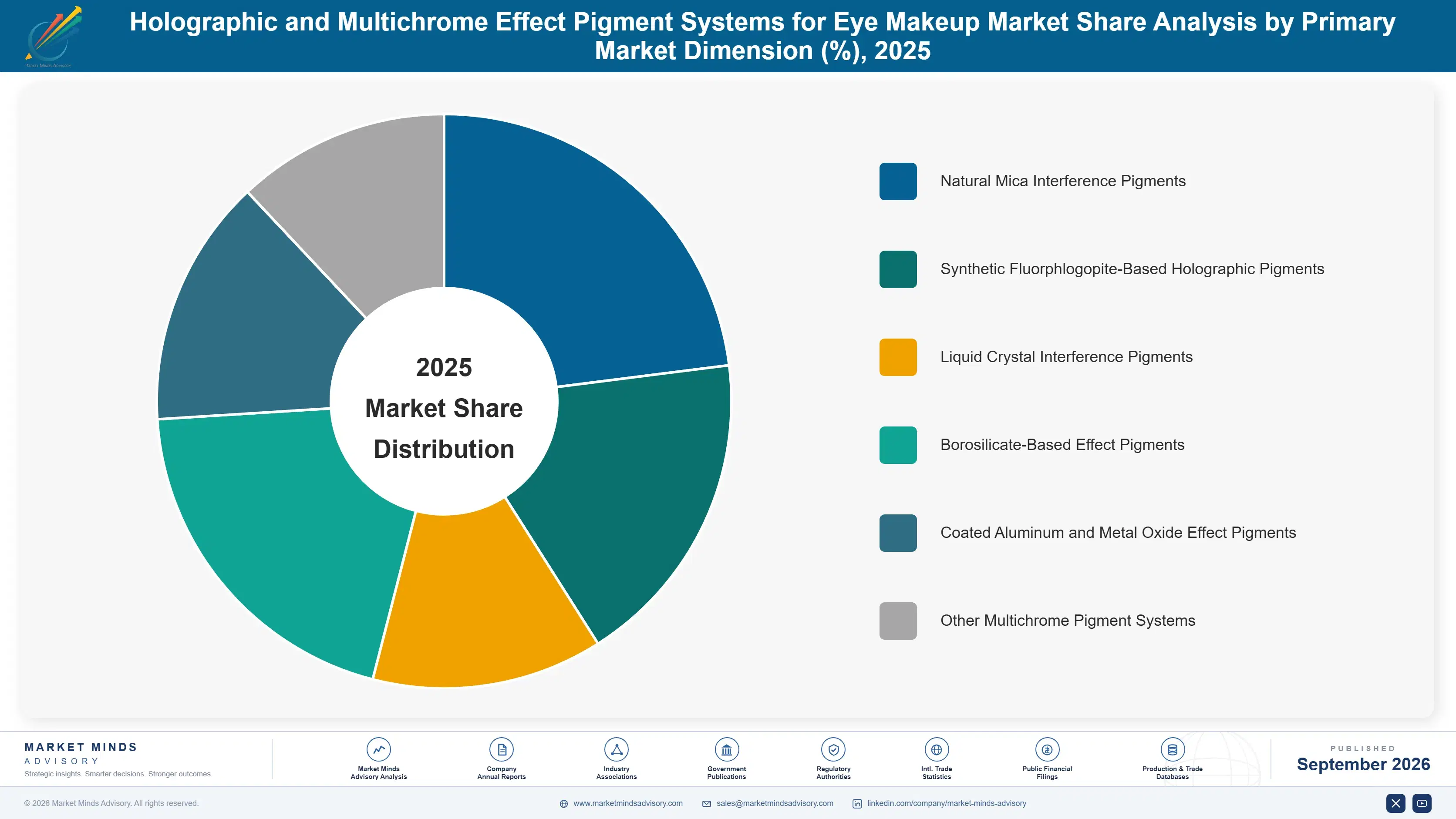
This report segments the market by pigment substrate and optical technology rather than by end product category, since the same underlying pigment chemistry typically serves eyeshadow, eyeliner, and highlighter formulations interchangeably across very different price tiers and brand positioning strategies worldwide. Six substrate segments capture how suppliers differentiate on optical effect and manufacturing complexity.
holographic-and-multichrome-effect-pigment-systems-market-share-analysis-1790013342824

Liquid Crystal Interference Pigments

Liquid crystal interference pigments are growing fastest because they deliver angle-dependent color transitions dramatically more vivid than anything natural mica or standard synthetic fluorphlogopite can achieve, making them the preferred choice for hero product launches designed to capture social media attention instantly and repeatedly across every major launch cycle. Suppliers that already offer mature liquid crystal manufacturing capability are winning premium formulation briefs against competitors still limited to conventional mica-based effects, and the segment commands substantial pricing power given the specialized layer-thickness control the manufacturing process requires at commercial scale. Prestige brands are increasingly willing to pay this premium for a genuinely differentiated color-shift effect that competitors cannot easily replicate.
CAGR 10.5%

Synthetic Fluorphlogopite-Based Holographic Pigments

Synthetic fluorphlogopite-based holographic pigments are the second-fastest-growing segment as brands seek a substrate that sidesteps the ethical sourcing concerns attached to natural mica mining while still delivering strong holographic optical performance across most standard formulations and price points sold today across the entire global market and every regional retail channel. This segment appeals particularly to mass-market and mid-tier brands that need traceability assurances for retailer and consumer scrutiny without paying the full premium liquid crystal pigments command from suppliers. Suppliers that already produce natural mica pigments are extending their manufacturing capability toward synthetic substrates rather than ceding this segment entirely to newer, synthetic-only specialists with no existing brand relationships to build on.
CAGR 9.0%
Full segment breakdown across 6 segments available in the complete report.

Regional Architecture and Country Demand Map

East Asia leads on cosmetics manufacturing scale and K-beauty color innovation, while North America and Western Europe follow with steady prestige brand demand across mature beauty markets worldwide today. South Asia and Pacific is expanding fastest as cosmetics manufacturing capacity grows rapidly across the region.

North America

North America's demand centers on prestige and indie beauty brands that use color-shift pigments as a primary product differentiation strategy, with viral social media trends originating on American platforms driving rapid reformulation cycles across the entire industry and every product category and price point available today. United States brands dominate regional volume, and ethical sourcing scrutiny from American consumers and retailers is pushing faster adoption of synthetic substrates than in some other regions worldwide today. Canada's smaller indie beauty sector follows a similar pattern at somewhat reduced scale, though still meaningfully contributing to overall regional demand, innovation, and formulation experimentation. Retail buyers increasingly request exclusive finishes tied to single launches, rewarding formulators with flexible small-batch capability.
Share: 24% | CAGR: 7.8% (2026 to 2036)

Western Europe

Western Europe's growth trails East Asia and North America because established prestige beauty houses there have historically relied on long-standing natural mica supplier relationships that are only gradually shifting toward synthetic alternatives at meaningful commercial scale today across the wider industry. France and the United Kingdom remain the region's largest buyers, and European Union cosmetic ingredient regulation is separately pushing suppliers toward more rigorous documentation of pigment sourcing and safety data across every formulation submitted for approval. Vendors that can demonstrate EU regulatory compliance are winning disproportionate share of new European formulation contracts each year across every major national market. Independent formulation houses in Italy and Germany are gaining contract work as prestige brands outsource development to specialist labs.
Share: 22% | CAGR: 5.7% (2026 to 2036)
Regional intelligence for 5 additional markets available in the complete report: East Asia, South Asia and Pacific, Latin America, Middle East and Africa, Eastern Europe. Contact sales@marketmindsadvisory.com.
holographic-and-multichrome-effect-pigment-systems-country-cagr-analysis-1790013343636

Where Pigment Suppliers Can Capture More Value

Suppliers that only sell raw pigment powder compete purely on price and color performance in a crowded field of similar producers worldwide. The larger margin pools sit in formulation support, custom shade development, and regulatory documentation services that prestige and indie brands increasingly outsource rather than build in-house given tightening product launch timelines and shrinking internal technical teams.

Offering Custom Shade Development and Matching Services

Brands launching seasonal eyeshadow collections need bespoke color-shift effects matched to specific marketing briefs, and suppliers that maintain in-house optical engineering teams can charge premium fees for custom shade development rather than selling only standard catalog pigments at commodity prices. This service layer already generates an estimated 18 percent of revenue for leading formulators such as Sensient and Kobo Products, and demand is rising as brands compress product development cycles from eighteen months to under six months to match viral social media trend cycles across every major retail channel worldwide.
Market Impact: Adds an estimated 18 percent revenue contribution from services

Providing Regulatory Documentation and Safety Dossier Support

European Union cosmetic ingredient regulation requires detailed safety data files for every pigment used in eye area products, and many indie brands lack the technical staff to compile these dossiers themselves internally. Suppliers that bundle regulatory documentation support alongside pigment supply contracts win disproportionate share of new formulation business, particularly among smaller brands entering the European market for the first time without established compliance infrastructure. This service commands a fee premium of roughly 12 percent above standard pigment pricing and strengthens customer retention by embedding suppliers directly into brand compliance workflows and long-term planning cycles.
Market Impact: Commands a 12 percent premium over standard pigment pricing

Expanding Small-Batch and Rapid Sampling Production Lines

Viral beauty trends now compress the window between concept and shelf to a matter of weeks, and brands need pigment samples in small quantities before committing to full production runs. Suppliers investing in dedicated rapid sampling lines can turn around custom pigment batches in under two weeks compared with the industry standard of six to eight weeks, capturing a growing share of the roughly 22 percent of formulation projects that never advance past the sampling stage under conventional lead times. This capability increasingly determines which suppliers make it onto initial brand shortlists for new eye makeup launches.
Market Impact: Captures share of the 22 percent sampling-stage project pool

Building Direct Traceability Programs for Ethical Sourcing

Retailers and consumers increasingly demand documented mica sourcing free from child labor risk, and suppliers that can trace pigment inputs back to certified mines command preferential placement on approved vendor lists at major retailers. Building a verifiable traceability program requires meaningful upfront investment, but it is increasingly a condition of doing business rather than a differentiator, with an estimated 35 percent of major prestige brands now requiring documented chain of custody before approving new pigment suppliers for eye makeup formulations. Suppliers without traceability increasingly lose access to premium accounts entirely.
Market Impact: Required by 35 percent of major prestige brand accounts

Who Controls the Margin Pool

Ranked on global revenue from eye makeup grade pigment sales, the supply base is moderately concentrated, with a CR5 near 42 percent reflecting technical barriers around consistent interference effects. Merck KGaA leads on synthetic substrate technology and color library depth, while BASF and Sun Chemical hold strong positions built on decades of mica processing relationships with major beauty houses. The gap between the top tier and mid-sized challengers such as Kobo Products is widening as smaller suppliers struggle to match batch consistency at scale.
Current competitive activity centers on synthetic substrate capacity expansion, ethical mica traceability programs, and custom shade development partnerships with prestige beauty houses. Several suppliers announced liquid crystal pigment production lines in the past year, responding to demand for stronger, more reliable color-shift effects than conventional mica pigments deliver at comparable price.

Emerging pressure comes from Chinese pigment processors scaling synthetic substrate production at lower cost, threatening to compress margins for suppliers whose advantage rests on legacy mica supply relationships rather than proprietary optical technology. Rankings are most likely to shift among mid-tier players over the next several years as smaller formulators either invest in synthetic capability or cede share to processors who already have.
holographic-and-multichrome-effect-pigment-systems-company-positioning-matrix-1790013344156

Competitive Moat and Risk Dimensions

MERCK KGAA

Moat: Synthetic Substrate Technology Depth

Merck KGaA holds the deepest portfolio of synthetic fluorphlogopite and liquid crystal interference technology in the industry, built on decades of optical coatings research originally developed for automotive and electronics applications. This technical depth lets it guarantee color-shift consistency that mica-based competitors struggle to match batch to batch, which keeps it embedded in premium formulation briefs.
MERCK KGAA

Risk: Premium Pricing Vulnerability

Merck's synthetic pigments carry a substantial price premium over natural mica alternatives, which leaves it exposed if mid-tier competitors close the consistency gap at lower cost. Indie brands operating on tighter margins increasingly explore cheaper synthetic suppliers from China, and defending share may eventually require Merck to compete more directly on price rather than technology alone.
BASF

Moat: Established Mica Supply Network

BASF's decades-long relationships with mica mining and processing operations give it reliable, large-volume supply that newer synthetic-focused entrants cannot easily replicate. This scale advantage keeps BASF competitive on cost for mainstream eyeshadow formulations even as premium demand shifts toward synthetic alternatives, preserving its position across both value and mid-tier product segments.
BASF

Risk: Natural Mica Sourcing Exposure

BASF's reliance on natural mica leaves it more exposed to ethical sourcing scrutiny and supply variability than synthetic-focused rivals, particularly as retailers tighten traceability requirements. Building out synthetic substrate capacity to match Merck requires significant capital investment, and BASF risks losing premium formulation briefs if it moves too slowly relative to competitors already scaling synthetic lines.

Players Tracked

Prominent Players

Merck KGaA
BASF
Sun Chemical
Sensient Technologies
Kobo Products

Other Key Players

ECKART
Geotech International
KMR Ingredients
Sudarshan Chemical Industries
Kolortek
Guangdong Baolinbao Biotechnology
Nubiola
Fujian Kuncai Material Technology
Yantai Zhenghai Sci-Tech
Yipin Pigment Chemical
Innospec Performance Chemicals
Miyoshi Kasei
Kel Chemicals
Emerald Performance Materials
Fujian Wonderful Pigments

Recent Developments

MARCH 2026

Merck Expands German Synthetic Pigment Capacity

Merck KGaA opened a new synthetic fluorphlogopite production line in Germany dedicated to eye makeup grade pigments, expanding capacity by an estimated 30 percent to meet rising demand from prestige beauty brands seeking guaranteed color-shift consistency across large seasonal collection launches without relying on natural mica sourcing constraints.
Signal: Signals synthetic pigment capacity is becoming the primary growth lever across the industry rather than mica expansion
NOVEMBER 2025

BASF Takes Equity Stake in Korean Pigment Startup

BASF acquired a minority equity stake in a South Korean liquid crystal pigment startup to accelerate access to next-generation color-shift technology rather than developing it entirely in-house, a faster route given how quickly K-beauty brands are pushing formulation innovation cycles across the broader eye makeup category.
Signal: Signals established players increasingly prefer buying access to emerging technology over building comparable capability from scratch internally
JUNE 2026

Sun Chemical Launches Mica Traceability Program

Sun Chemical launched a certified ethical mica traceability program covering its full eye makeup pigment line, responding to retailer pressure for documented chain of custody. The program covers mines across India and Madagascar and positions Sun Chemical ahead of peers still finalizing similar documentation efforts.
Signal: Signals ethical sourcing traceability documentation is shifting from a competitive differentiator to a baseline market requirement

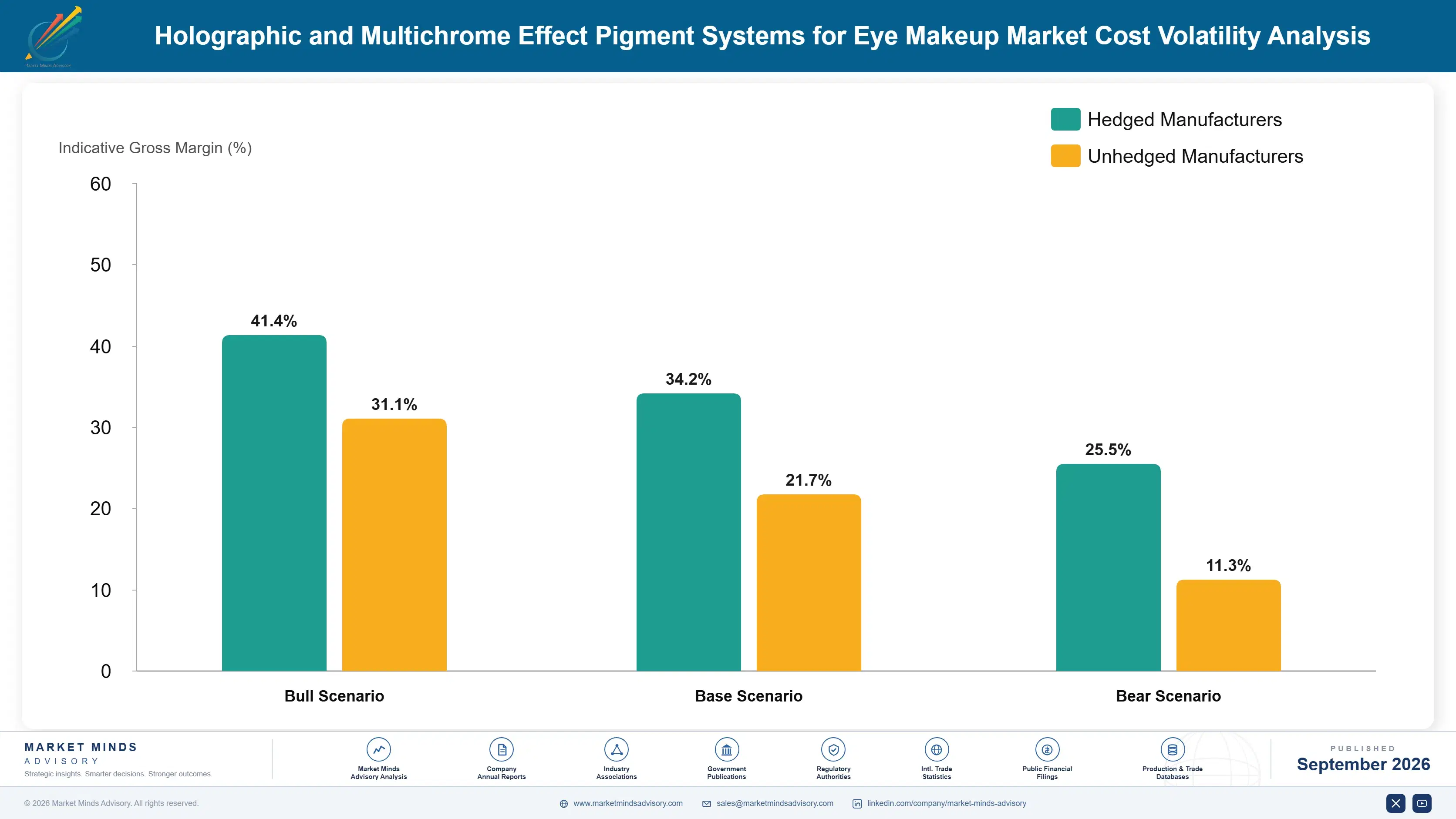
Mica Volatility and Synthetic Substrate Cost

Natural mica accounts for roughly 45 percent of cost of goods sold for mica-based pigment producers, sourced primarily from India, Madagascar, and Brazil, where mining operations range from large certified industrial concessions to smaller artisanal sites. Synthetic fluorphlogopite substrates, used increasingly in premium color-shift pigments, carry higher raw input costs tied to specialty glass and ceramic precursor pricing, sourced mainly from suppliers in Germany, Japan, and China.
Indian mica export restrictions tightened in 2024 following renewed scrutiny of unregulated small-scale mining operations linked to child labor, disrupting supply for processors dependent on that corridor. According to IEA commentary on critical mineral supply chains, similar documentation requirements are spreading to other specialty mineral inputs, and several formulators reported input cost increases of eight to twelve percent through 2025 as they shifted toward certified supply.

Smaller pigment processors without the balance sheet to invest in synthetic substrate capacity face a widening cost disadvantage against larger rivals who can absorb higher input costs and pass through smaller price increases to brand customers. Suppliers concentrated in regions with weaker mica traceability infrastructure, particularly smaller Indian and Malagasy processors, face the steepest exposure as retailer documentation requirements continue tightening across every major export market.
holographic-and-multichrome-effect-pigment-systems-cost-volatility-analysis-1790013344355

Diversifying Toward Synthetic Substrate Production

Suppliers are accelerating investment in synthetic fluorphlogopite and liquid crystal production lines to reduce dependence on natural mica supply variability entirely. This shift requires meaningful upfront capital but stabilizes input costs over the medium term and insulates margins from mica-specific supply disruptions, export restrictions, and the ethical sourcing scrutiny that increasingly accompanies natural mica procurement.

Building Direct Certified Mine Relationships

Rather than sourcing mica through intermediaries directly, leading suppliers are establishing direct long-term contracts with certified mines across India and Madagascar. This improves traceability documentation for retailer compliance while giving suppliers more predictable, negotiated pricing than reliance on volatile intermediary spot markets, and it shortens the audit trail regulators and retail buyers increasingly demand.

Portfolio Architecture for Margin Defence

The market splits into three commercial tiers with meaningfully different margin economics. Volume commodity-adjacent mica pigments sold into mass-market eyeshadow formulations carry the thinnest margins, while premium certified pigments with documented ethical sourcing and consistent color-shift performance command substantially higher pricing across every major retail channel. The sustainability and next-generation synthetic tier, though smallest in volume today, already captures a disproportionate share of gross profit across the industry.
Volume producers compete almost entirely on price and reliable large-batch supply, leaving little room to absorb rising mica input costs without losing mass-market accounts to lower-cost competitors. Premium and next-generation suppliers instead compete on formulation consistency, documented traceability, and technical support, which lets them pass through higher input costs while still expanding margin as brands prioritize guaranteed performance over unit price.

High-value margin pools concentrate in liquid crystal interference pigments and synthetic substrates purchased by prestige beauty houses launching limited collections, where suppliers can charge premium pricing for guaranteed batch consistency. Indie and mass-market brands remain more price-sensitive, keeping volume-tier demand large but persistently lower-margin, and that gap is widening rather than narrowing as premium formulation requirements continue to rise across the industry.

Volume / Commodity-Adjacent Tier

Standard mica and synthetic pigments sold in bulk for mass-market eyeshadow, blush, and highlighter formulations, competing primarily on price and reliable large-batch supply consistency rather than color-shift sophistication or documented traceability.
Gross Margin: 18-26%

Premium / Certified Tier

Certified ethical-sourced mica and synthetic pigments with documented traceability and guaranteed batch-to-batch color consistency, sold to prestige and mid-tier beauty brands seeking defensible sourcing claims for retail and marketing purposes.
Gross Margin: 30-40%

Sustainability / Regulatory / Next-Generation Tier

Liquid crystal interference pigments and next-generation synthetic substrates offering the strongest color-shift performance, sold into limited prestige collections and innovation-led product launches where formulation performance outweighs unit cost considerations across every major brand tier.
Gross Margin: 42-52%
holographic-and-multichrome-effect-pigment-systems-portfolio-architecture-1790013344853

High-value Sub-segments and Strategic Watch-out

Liquid Crystal Interference Pigments

Liquid Crystal Interference Pigments: the fastest-growing, highest-margin segment as prestige brands chase stronger color-shift effects and pay premium pricing for guaranteed formulation consistency across every seasonal launch, limited-edition collection, and flagship product line introduced worldwide each year across every major beauty retail channel and price tier available.
Gross Margin: 48-58%

Synthetic Fluorphlogopite Pigments

Synthetic Fluorphlogopite Pigments: strong growth and healthy margins as brands shift away from natural mica toward documented, traceable substrates that satisfy tightening retailer sourcing requirements industry-wide, reduce ethical sourcing scrutiny risk, and support faster regulatory approval timelines across major export markets globally and domestically within key manufacturing hubs.
Gross Margin: 38-46%

Natural Mica Interference Pigments

Natural Mica Interference Pigments: the largest volume base today, generating steady but thinner margins as mass-market brands continue relying on established, lower-cost mica supply relationships across most regions despite gradual synthetic substitution pressure building over the medium term across every price tier and distribution channel available worldwide.
Gross Margin: 20-28%

Regulatory-Driven Traceability Compliance

Regulatory-Driven Traceability Compliance: a segment to watch as EU and retailer documentation requirements tighten further, potentially forcing smaller suppliers without certified mica sourcing entirely out of premium contracts within the next several years and reshaping vendor shortlists across every major beauty market and formulation category worldwide.
Gross Margin: 30-40%

The Economics of Repeat Formulation Demand

Pigment supply relationships behave more like annuities than one-off transactions once a formulation is locked into a brand's approved ingredient list. Reformulating an eyeshadow line around a new pigment supplier requires re-running stability and safety testing, which brands avoid unless a supplier fails on consistency or price becomes uncompetitive, giving incumbent suppliers durable, multi-year revenue visibility across successive product cycles and repeat seasonal collection launches.
Adoption stickiness varies meaningfully by end-use vertical. Prestige eyeshadow and highlighter lines exhibit the deepest lock-in, since brand teams invest heavily in matching exact color-shift signatures to marketing campaigns and rarely risk disrupting that match. Mass-market eyeliner and lower-cost eyeshadow lines show weaker stickiness, with private label manufacturers more willing to switch suppliers for modest cost savings when supply contracts renew.

Buyer profiles are shifting generationally as indie and direct-to-consumer beauty brands, often founded by younger entrepreneurs with strong social media followings, take formulation decisions in-house rather than delegating them to established private-label manufacturers. These buyers move faster, demand more customization, and are more willing to switch suppliers based on trend responsiveness and social proof than legacy prestige houses ever were.
holographic-and-multichrome-effect-pigment-systems-end-use-penetration-index-1790013345362

Where MMA Sees the Real Advantage

These are among the four positions where our research anticipates prominent divergence between winners and laggards over the coming forecast period. Each is grounded in the demand model, the regulatory perimeter, and the announced capacity pipeline.
01 / SUBSTRATE TECHNOLOGY INVESTMENT

Prioritize synthetic substrate capacity over mica volume expansion

Suppliers still expanding natural mica processing capacity today are optimizing for a shrinking share of premium formulation demand rather than where the market is actually heading. Brands increasingly treat synthetic and liquid crystal substrates as the baseline expectation for premium collections, not a differentiator, which means capital committed to mica-only expansion faces a shortening useful life and weaker long-term return. The suppliers gaining premium formulation briefs today are the ones who shifted capital toward synthetic lines years ago, well ahead of this shift.
02 / TRACEABILITY AS BASELINE

Build certified sourcing documentation before retailers make it mandatory

Ethical mica sourcing documentation is moving from a marketing advantage to a contractual requirement across major retail accounts faster than most suppliers currently anticipate, particularly in the European market. Suppliers who wait until retailers formally mandate certified chain of custody will be scrambling to catch up while competitors who invested early already hold preferred vendor status and stronger negotiating leverage. Early documentation investment costs meaningfully less than emergency compliance scrambles do later, once retailer deadlines are already fixed and negotiating room has narrowed.
03 / SERVICE LAYER EXPANSION

Bundle formulation and regulatory services rather than sell pigment alone

Pure pigment suppliers are increasingly commoditized on price alone, while suppliers bundling custom shade development and regulatory documentation support capture materially higher margins from the same customer relationships. Brands under pressure to launch faster are outsourcing more of the formulation process itself, not just the raw material, and this trend shows no sign of reversing over the next several years. Suppliers unwilling to build that capability will watch competitors capture the higher-margin work instead, and lose formulation influence in the process.
04 / CHINA SUBSTITUTION RISK

Watch Chinese synthetic pigment processors erode premium pricing power

Chinese processors are scaling synthetic substrate production at costs Western suppliers cannot easily match, and their consistency is improving faster than most incumbents expected just a few years ago across the broader industry. Suppliers whose advantage rests purely on proprietary optical technology, rather than brand relationships or regulatory documentation depth, face the most direct pricing pressure as this substitution accelerates. The winners will be suppliers who pair technology with defensible service relationships and traceability documentation that price alone cannot easily displace.

Engagement Snapshot From the Field

A live engagement with an industry participant carrying material or product regulatory and market exposure ahead of a defining policy shift, showing how our research translates into a defensible multi-year portfolio strategy.
MARKET MINDS ADVISORY · CLIENT ENGAGEMENT SUMMARY
Holographic and Multichrome Effect Pigment Systems for Eye Makeup Producer Strategic Portfolio Review and Transition Roadmap 2026·Investment Scenario on Holographic and Multichrome Effect Pigment Systems for Eye Makeup Exposure Evaluation 2025-26
CLIENT PROFILE
The client is a mid-sized prestige eye makeup brand headquartered in Western Europe, selling premium eyeshadow and highlighter lines through department stores and specialty beauty retailers across North America and Europe. The brand had relied on a single legacy mica pigment supplier for over a decade and faced growing pressure from retail buyers to demonstrate documented, ethical pigment sourcing across its full eye makeup portfolio ahead of upcoming compliance deadlines.
STRATEGIC CHALLENGE
Reformulating around a new pigment supplier risked disrupting signature shade matches central to the brand's identity, yet its incumbent supplier could not provide the certified traceability documentation major retailers were beginning to require. The brand needed a sourcing strategy that preserved color consistency while closing the compliance gap within an eighteen-month window before retailer deadlines took effect.
MMA APPROACH
MMA benchmarked five certified pigment suppliers against the brand's existing color library, evaluating traceability documentation depth, synthetic substrate capability, and formulation support capacity. The engagement combined primary interviews with supplier technical teams and comparative cost modeling to identify which suppliers could replicate exact shade signatures while meeting new documentation standards without disrupting production timelines.
KEY FINDINGS
  1. Two of five evaluated suppliers could replicate the brand's signature shades within an acceptable tolerance using certified synthetic substrates rather than legacy natural mica formulations.
  2. Switching suppliers would raise per-kilogram pigment cost by approximately 15 percent (client-reported, unverified by MMA), offset partly by materially reduced retailer compliance risk exposure.
  3. The incumbent supplier's traceability documentation gap posed greater retail delisting risk than the brand's internal estimates had assumed going into the sourcing review process.
  4. A phased dual-sourcing transition preserved production continuity while the brand validated the new supplier's consistency across three consecutive seasonal launches before full commitment.
CLIENT PROFILE
The client is a mid-sized prestige eye makeup brand headquartered in Western Europe, selling premium eyeshadow and highlighter lines through department stores and specialty beauty retailers across North America and Europe. The brand had relied on a single legacy mica pigment supplier for over a decade and faced growing pressure from retail buyers to demonstrate documented, ethical pigment sourcing across its full eye makeup portfolio ahead of upcoming compliance deadlines.
STRATEGIC CHALLENGE
Reformulating around a new pigment supplier risked disrupting signature shade matches central to the brand's identity, yet its incumbent supplier could not provide the certified traceability documentation major retailers were beginning to require. The brand needed a sourcing strategy that preserved color consistency while closing the compliance gap within an eighteen-month window before retailer deadlines took effect.
MMA APPROACH
MMA benchmarked five certified pigment suppliers against the brand's existing color library, evaluating traceability documentation depth, synthetic substrate capability, and formulation support capacity. The engagement combined primary interviews with supplier technical teams and comparative cost modeling to identify which suppliers could replicate exact shade signatures while meeting new documentation standards without disrupting production timelines.
KEY FINDINGS
  1. Two of five evaluated suppliers could replicate the brand's signature shades within an acceptable tolerance using certified synthetic substrates rather than legacy natural mica formulations.
  2. Switching suppliers would raise per-kilogram pigment cost by approximately 15 percent (client-reported, unverified by MMA), offset partly by materially reduced retailer compliance risk exposure.
  3. The incumbent supplier's traceability documentation gap posed greater retail delisting risk than the brand's internal estimates had assumed going into the sourcing review process.
  4. A phased dual-sourcing transition preserved production continuity while the brand validated the new supplier's consistency across three consecutive seasonal launches before full commitment.
RECOMMENDED STRATEGY
Phase 1: Phase one: qualify a second certified supplier alongside the incumbent, running parallel small-batch trials across two full seasonal collections before wider rollout. Phase 2: Phase two: shift signature shade production to the new certified supplier once consistency was validated across successive production runs and quality audits. Phase 3: Phase three: formalize the incumbent as a secondary backup source, preserving supply resilience without full ongoing dependence on either single vendor.
OUTCOME
The brand completed its supplier transition within the eighteen-month compliance window, avoiding retail delisting risk flagged during the review. Reported per-unit cost increases stayed within the fifteen percent range modeled during the engagement (client-reported, unverified by MMA), and retail buyers confirmed the brand's revised sourcing documentation met updated requirements ahead of the deadline.

Frequently Asked Questions

Foundational context covering the market sizes, CAGR, scope, country, region and competition that inform every finding below. This section is provided to cover basics and most often pre-purchase conversations, answered from the MMA Primary Research Dataset.

What is the current size of the Holographic and Multichrome Effect Pigment Systems for Eye Makeup Market?

The market reached $0.68 billion globally in 2025. This figure covers eye makeup grade color-shift pigment sales across mica, synthetic, and liquid crystal systems worldwide.

How large will the Holographic and Multichrome Effect Pigment Systems for Eye Makeup Market be by 2036?

MMA projects the market will reach $1.46 billion by 2036 under the base case scenario. That represents roughly double the 2026 starting value over the ten-year forecast window.

What is the CAGR for the Holographic and Multichrome Effect Pigment Systems for Eye Makeup Market 2026 to 2036?

The base case CAGR is 7.2 percent annually through 2036. Bull and bear scenarios range from 5.9 to 8.5 percent depending on synthetic substrate adoption speed.

Which segment is growing fastest?

Liquid crystal interference pigments lead at a 10.5 percent CAGR, roughly 1.46 times the overall market rate. Synthetic fluorphlogopite pigments follow closely as the second-fastest segment.

Who are the major companies in the Holographic and Multichrome Effect Pigment Systems for Eye Makeup Market?

Merck KGaA, BASF, Sun Chemical, Sensient Technologies, and Kobo Products lead the market on global pigment revenue. Together they hold an estimated CR5 near 42 percent.

Which country is growing fastest?

South Korea leads at an estimated 9.8 percent CAGR, driven by K-beauty color innovation and concentrated cosmetics manufacturing capacity. China and India follow as manufacturing scale expands.

Report Segmentation Architecture

The full report scope spans multiple orthogonal segmentation dimensions, with cross-tabulated demand data provided for each dimension pair. Coverage extends further to regional breakdowns, trend trajectories, and the competitive detail needed to support segment-level decision-making.

By Primary Market Dimension

  • Natural Mica Interference Pigments
  • Synthetic Fluorphlogopite-Based Holographic Pigments
  • Liquid Crystal Interference Pigments
  • Borosilicate-Based Effect Pigments
  • Coated Aluminum and Metal Oxide Effect Pigments
  • Other Multichrome Pigment Systems

By End-Use Industry

  • Prestige and Luxury Beauty Brands
  • Mass-Market and Drugstore Beauty Brands
  • Indie and Direct-to-Consumer Beauty Brands
  • Private Label Manufacturers
  • Special Effects and Theatrical Makeup Producers

By Commercial Dimension

  • Eyeshadow Formulations
  • Eyeliner Formulations
  • Highlighter and Multichrome Topper Formulations
  • Pressed and Loose Powder Formats

By Region

  • East Asia
  • North America
  • Western Europe
  • South Asia and Pacific
  • Latin America
  • Middle East and Africa
  • Eastern Europe

Scope, Methodology, and Coverage

Every figure in this report is reproducible from documented input assumptions. The scope below maps the historical period, the forecast horizon, the segmentation dimensions, and the countries covered, alongside the underlying primary and qualitative methodology.
Historical Period
2020 to 2025
Forecast Period
2026 to 2036
Base Year
2025 (USD billions; MMA Primary Research Dataset, September 2026)
Market Definition
The holographic and multichrome effect pigment systems market covers specialty color-shift pigments, including synthetic fluorphlogopite, natural mica, borosilicate, and liquid crystal interference systems, formulated specifically for eye makeup applications such as eyeshadow, eyeliner, and highlighter. It excludes general-purpose cosmetic colorants without color-shift or interference properties and effect pigments formulated exclusively for non-cosmetic industrial coatings.
Quantitative Units
USD billions (current prices); metric tons of pigment volume where applicable
Segmentation Dimensions
By Primary Market Dimension; By End-Use Industry; By Commercial Dimension; By Region
Regions Covered
East Asia, North America, Western Europe, South Asia and Pacific, Latin America, Middle East and Africa, Eastern Europe
Countries Covered
USA, China, Germany, France, UK, Japan, South Korea, India, Australia, Canada, Brazil, Mexico, Indonesia, Vietnam, Thailand, Malaysia, UAE, Saudi Arabia, South Africa, Nigeria, Turkey, Poland, Netherlands, Italy, Spain, Sweden, Switzerland, Argentina, Colombia, Singapore, and additional markets relevant to this sector
Key Companies Profiled
Merck KGaA, BASF, Sun Chemical, Sensient Technologies, Kobo Products, ECKART, Geotech International, KMR Ingredients, Sudarshan Chemical Industries, Kolortek, Guangdong Baolinbao Biotechnology, Nubiola, Fujian Kuncai Material Technology, Yantai Zhenghai Sci-Tech, Yipin Pigment Chemical, Innospec Performance Chemicals, Miyoshi Kasei, Kel Chemicals, Emerald Performance Materials, Fujian Wonderful Pigments
Quantitative Methodology
Primary survey, n=3,800 respondents, Q4 2025, six countries; demand-side model with trade association cross-validation
Qualitative Methodology
47 expert interviews, Q4 2025; applied to validate demand model assumptions, identify emerging dynamics, and assess competitive positioning
Report Format
PDF and XLSX data workbook (Word format preview document)
Publisher
Market Minds Advisory
Report Code
MMA-2026-CHM-689
Published
September 2026
Contact
sales@marketmindsadvisory.com | www.marketmindsadvisory.com

Purchase the full Holographic and Multichrome Effect Pigment Systems for Eye Makeup Market Report (2026 to 2036).

This report delivers a comprehensive assessment of the holographic and multichrome effect pigment systems market for eye makeup applications, covering market sizing, segmentation, and regional demand through 2036. It profiles the twenty leading pigment suppliers, benchmarking competitive positioning, moat durability, and emerging risk across the top two players in depth. The analysis includes detailed input cost exposure, portfolio margin architecture, and revenue diversification opportunities specific to color-shift pigment formulators. A dedicated case study illustrates how a prestige beauty brand navigated a live supplier sourcing transition successfully.
Ten-year market sizing and forecast to 2036
Six-segment MECE segmentation framework with detailed subsegments
Seven-region demand, share, and growth rate analysis
Twenty-company competitive benchmarking with moat and risk assessment
Input cost exposure and mitigation pathways
Anonymized prestige brand supplier sourcing case study

Built For The People Who Decide

From boardroom strategy to bench-side execution, this report is read cover-to-cover by leaders shaping the next decade of their industry, turning demand scenarios, market dynamics and valuation benchmarks into decisions.
CXOs/ Presidents/ VPs/ Managers
M&A and Corporate Development
Strategy Teams and R&D Heads
Procurement and Product Directors
Regulatory and Compliance Leaders
Investor Relations and Equity Analysts