Market Minds Advisory
Hob Market

Hob Market: Hob Market: The Cookware Barrier, Hidden Circuit Costs and A Health Argument Nobody Selling Will Make, 2026 to 2036

Induction wins on every measure that matters and loses on the two nobody mentions until the fitter arrives at the door, which are the pans and the wiring behind the wall.

Lead Analyst

Published

September 2026

Make Smarter Decisions with Customized Research Insights

Request a free sample report and evaluate market opportunities, growth trends, and competitive dynamics relevant to your business needs.

2025 MARKET VALUE$12.6BMarket Size 2025
2036 FORECAST VALUE$20.3BBase Case , 2026 to 2036
CAGR 2026 TO 20364.4 %Bull 5.6% / Bear 3.2%
INCREMENTAL OPPORTUNITY$7.1BNet 10- year value creation
EXPANSION MULTIPLE1.54x2036 value over 2026 base
Strategic Levers
M&A Pipeline
Regional Outlook
Country Rankings
Competitive Intelligence
Segmental Deep-dive
Call-Us : 91 93563 13602

Executive Snapshot and Market Trajectory.

Induction delivers about 2.4 times the energy into a pan that an equivalent gas burner manages. It also requires 63% of switching households to replace cookware, and roughly 12% of retail listings mention that before anybody buys. That gap between performance and disclosure defines the whole category.
Induction hobs grow at 6.6%, half again the market rate of 4.4%, and the constraint on that growth has never been performance or price. It is the pans and the wiring. Domino and modular formats follow at 5.8% by letting a household add induction alongside gas rather than committing to a full switch in a single decision. Gas volumes decline steadily and solid plate has effectively disappeared.
Around 38% of installations need electrical work beyond the appliance, adding roughly USD 410 to a typical switch. Retail pricing never includes it, which is why purchases collapse at the installation stage and the appliance takes the blame for a wiring problem it did not create. The strongest argument for switching, on combustion products in kitchen air, comes from public health researchers rather than from anybody with an alternative appliance to sell.
Market Definition
This market covers built-in domestic cooking hobs, including induction hobs, radiant and ceramic electric hobs, gas hobs, domino and modular hobs, downdraft integrated hobs, and solid plate electric hobs. It excludes freestanding cookers and ranges with integrated ovens, built-in ovens sold separately, commercial catering ranges, outdoor grills and barbecues, portable single-ring cooking appliances, and extraction hoods supplied independently of the hob.
Base Year Value
$12.6B in 2025 (MMA Primary Research Dataset, September 2026)
Forecast Period
2026 to 2036, eleven discrete annual values
CAGR
4.4% base case. Bull 5.6%. Bear 3.2%.
Fastest Growth Segment
Induction Hobs: 6.6% CAGR
Fastest Growth Country
India: 8.6% CAGR
Fastest Growth Region
South Asia and Pacific: 6.4% CAGR
Largest Region
East Asia: 34% of 2025 global value
Market Leaders
BSH Home Appliances, Electrolux Group, Whirlpool Corporation, Haier Smart Home, and Midea Group lead the field. Source: MMA Primary Research Dataset, July 2026.
Primary Survey
n=3,800 procurement and R&D decision-makers, Q4 2025, six countries
Methodology
Demand-side build-up, cross-validated against public data, 47 expert interviews

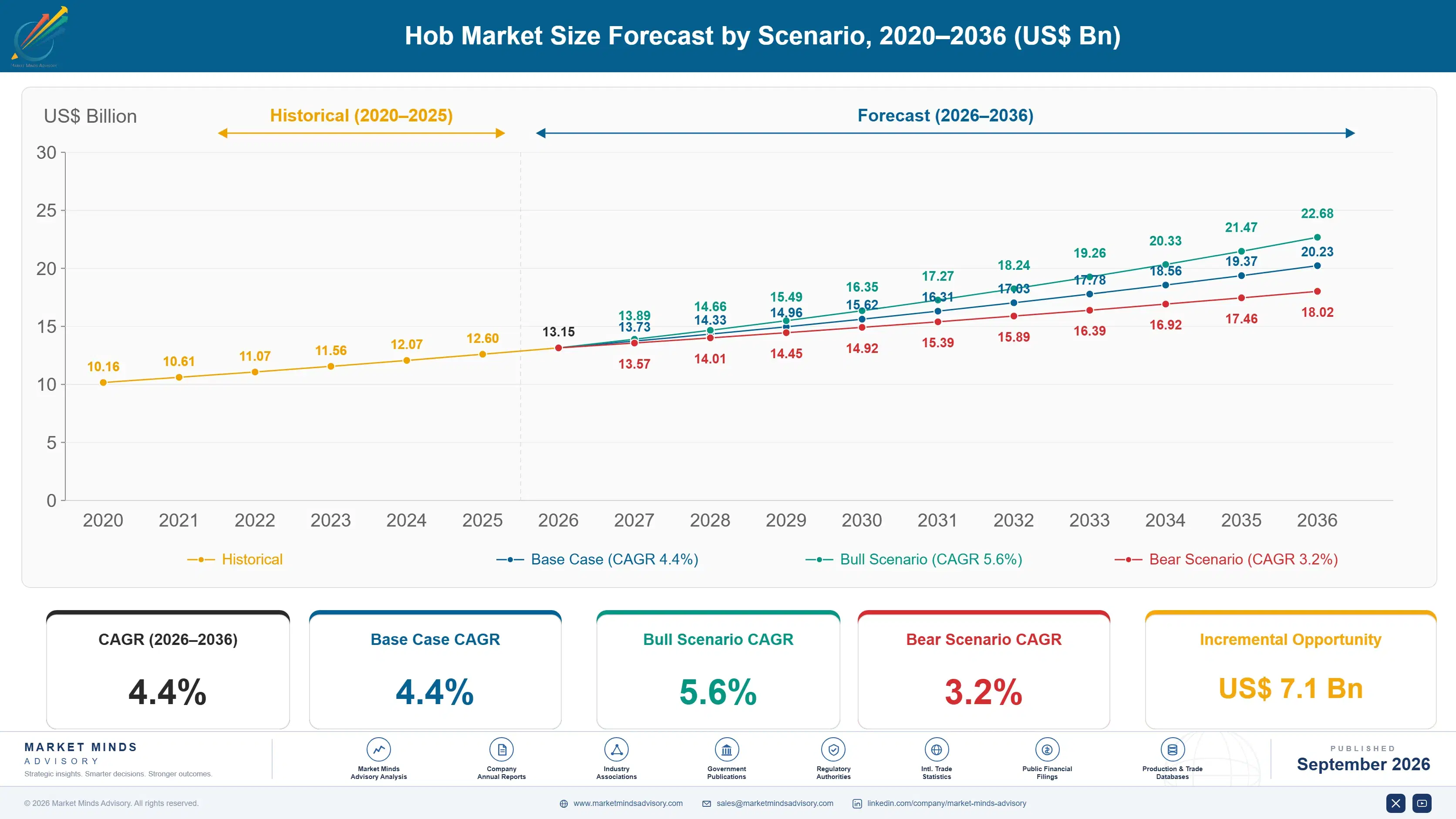
Hob Market Forecast Scenarios

hobs-market-size-forecast-scenario-1790014423793
Between 2020 and 2025 the category grew at 3.4% while its composition shifted considerably underneath. Induction took share steadily from radiant and gas across every mature market, solid plate volumes fell close to nothing, and a wave of proposed gas connection restrictions arrived and then partly reversed in several jurisdictions. Kitchen renovation cycles rather than new construction carried most of the volume throughout.
The base case at 4.4% rests on three mechanisms. Induction continues taking share on performance and efficiency wherever the cookware and circuit obstacles are addressed at the point of sale. Indian and wider Asian kitchen modernisation adds built-in hob demand where freestanding appliances previously dominated. And domino formats let households adopt induction incrementally rather than committing to a full replacement in one step. None of the three requires gas connection bans to survive legal challenge.
The bull case at 5.6% depends on retailers and manufacturers solving the installation disclosure problem, since purchases that collapse at the fitting stage are the largest avoidable loss in this market. The bear case at 3.2% is regulatory reversal: proposed gas restrictions have been struck down in several jurisdictions already, and manufacturers hedging across both fuels invest less decisively in either.

What Stops People Switching

On the measures that a cook would care about, induction is not a close contest. It boils water in a fraction of the time, holds a low simmer more precisely than any gas flame, and delivers roughly 2.4 times the energy into the pan rather than into the room around it. Adoption nonetheless lags well behind what that performance gap would predict in almost every mature market.
TOP FIVE CONCENTRATION41%Share of category revenue held by the leading manufacturers
COOKWARE REPLACEMENT REQUIREMENT63%Households needing new pans when switching to induction
CIRCUIT UPGRADE INCIDENCE38%Installations requiring electrical work beyond the appliance itself
INDUCTION EFFICIENCY ADVANTAGE2.4 timesEnergy reaching the pan against an equivalent gas burner
RETAIL DISCLOSURE RATE12%Listings mentioning cookware or wiring needs before purchase
AVERAGE INSTALLED COST GAPUSD 410Additional spend beyond appliance price on a typical switch
The reason is a pan drawer. Induction requires ferrous cookware, and 63% of switching households discover that some or all of what they own will not work. The replacement cost frequently exceeds the difference between an induction hob and a radiant one, and about 12% of retail listings mention any of it before the purchase is made rather than after the appliance is delivered.
The wiring is the second obstacle and the more expensive one. A full induction hob draws current that many older properties cannot supply on an existing circuit, and 38% of installations require electrical work adding around USD 410 beyond the appliance. Retail pricing excludes it entirely, so the sale collapses at the fitting stage and the customer concludes that induction is difficult rather than that the listing was incomplete.
"Nobody abandons induction because it cooks badly. They abandon it because a fitter arrives, looks at the consumer unit, and quotes for a new circuit that nobody warned them about. We sell the appliance and let somebody else deliver the bad news."
Practice Director, Domestic Appliances and Kitchen Equipment · MMA Construction and Industrial Equipment Practice · September 2026

Market Trends

Domino Formats Let Households Switch Incrementally

Domino and modular hobs grow at 5.8% by removing the all-or-nothing decision that a full replacement forces on a household. A cook can install an induction module alongside a retained gas section, keep the pans that only work on flame, and discover the performance difference without replacing a kitchen. The format costs more per cooking zone and sells to exactly the buyer most likely to abandon a full switch when the cookware question arrives. It also suits properties where electrical capacity supports partial induction load but not a full replacement.
Market Impact: Country grows at 8.6%

Air Quality Evidence Comes From Outside The Industry

Peer-reviewed work on nitrogen dioxide and combustion products in kitchens with gas cooking has built steadily, and the argument reaches consumers through public health researchers rather than through anybody selling an alternative. Manufacturers producing both gas and induction have no commercial reason to raise it and consistently do not. That leaves the strongest available case for switching being made by people with no product to sell and no marketing budget behind them. Manufacturers selling both fuels have no commercial reason to amplify the evidence, and consistently do not, which leaves the case being made without any marketing budget behind it.
Market Impact: Delivers 2.4 times efficiency

Market Opportunities and Growth Drivers

Indian Kitchen Modernisation Builds Built-In Demand

Indian growth of 8.6% leads every country covered, driven by modular kitchen installation replacing freestanding cooking arrangements across urban households at a pace no other market approaches. Built-in hobs are a new category for many of those buyers rather than a replacement, which means no existing cookware assumption and no legacy circuit to work around. Domestic manufacturers and international brands both compete hard for that greenfield demand. Those buyers arrive without legacy cookware or an existing circuit to work around, which removes both obstacles that slow adoption across mature markets considerably.
Market Impact: Affects 63% of households

Efficiency Regulation Favours Induction Without Banning Gas

Energy labelling and efficiency requirements across major markets increasingly disadvantage gas without prohibiting it, which shifts the commercial calculation gradually rather than forcing a single decision point. Induction delivers roughly 2.4 times the energy into a pan, so it performs well under any measurement regime based on delivered rather than input energy. That regulatory direction has proved considerably more durable than outright connection bans have. Connection bans have been enacted and then struck down in several jurisdictions, which makes labelling and efficiency requirements the more reliable regulatory route by a wide margin.
Market Impact: Adds USD 410 typically

Market Restraints and Challenges

Cookware Replacement Is Discovered Too Late

About 63% of households switching to induction find that some or all of their cookware will not work, and the root cause is that only ferrous pans couple with an induction field. Commercially the replacement cost frequently exceeds the price difference between hob technologies. Manufacturers respond with cookware bundles, with magnet test guidance in listings, and with in-store compatibility checking, though roughly 12% of listings currently disclose the requirement at all. Discovery after delivery converts an enthusiastic buyer into a return, which is the most expensive outcome available to anybody in this trade.
Market Impact: Segment grows at 5.8%

Electrical Capacity Stops Installations After Purchase

Around 38% of induction installations require circuit work beyond the appliance, adding roughly USD 410 to a typical switch, and the root cause is that older properties were wired before high-current cooking loads were common. Commercially it produces cancelled installations and returned appliances. Manufacturers respond with lower-current models, with pre-purchase electrical surveys, and with fitted installation pricing that includes the circuit rather than discovering it. A customer who learns the real cost before deciding either proceeds or chooses differently, and both outcomes beat a cancellation on the fitting day. Both beat a cancellation on the day.
Market Impact: Covers 2 combustion pollutants
4 additional market trends, 3 additional growth drivers, and 2 additional restraints and challenges are covered in the full report. Contact sales@marketmindsadvisory.com to access the complete intelligence.

Segment CAGR and Growth Architecture

Segmentation follows heating technology across six categories: induction hobs, domino and modular hobs, downdraft integrated hobs, radiant and ceramic electric hobs, gas hobs, and solid plate electric hobs. Installation format, control interface, and distribution channel are treated as separate dimensions rather than mixed into this hierarchy. Installation and cookware support are counted within the technology they accompany.
hobs-market-market-share-analysis-1790014424350

Induction Hobs

Induction grows at 6.6%, half again the market rate of 4.4%, and the barriers to faster adoption have nothing to do with the appliance. Performance is better on every measure a cook would test, delivering roughly 2.4 times the energy into a pan and holding a simmer more precisely than any flame. What limits growth is that 63% of switching households need new cookware and 38% need electrical work, and about 12% of listings mention either before purchase. Manufacturers addressing both at the point of sale convert considerably better than those competing on zone count and control design. Nothing about the appliance itself is holding this segment back. The obstacles all sit outside it entirely.
CAGR 6.6%

Domino And Modular Hobs

Domino formats grow at 5.8% by dismantling the single decision that stops most households switching. A cook installs an induction module beside a retained gas section, keeps whatever cookware only works on a flame, and experiences the performance difference without committing to a full kitchen change. Cost per cooking zone is higher than an equivalent full hob, and buyers accept that readily because the alternative is a decision they have already declined once. The format also suits kitchens where electrical capacity supports partial rather than full induction load. Range coherence matters enormously, since a module only sells if the buyer can extend the same system in two or three years without replacing what they already fitted.
CAGR 5.8%
Full segment breakdown across 6 segments available in the complete report.

Regional Architecture and Country Demand Map

Regional shares here reflect where built-in hobs are actually being purchased by households rather than where they are manufactured, since Chinese production supplies buyers across every region. Four regions sit outside the standard bands, for reasons named in their paragraphs and summarised for operator review.

East Asia

At 34% this sits above the standard band, and the justification runs both ways: Chinese factories manufacture the overwhelming majority of world hob output, and Chinese domestic demand is the largest of any market by unit count. Domestic brands lead on induction and integrated downdraft designs that Western manufacturers adopted considerably later. Growth of 5.4% exceeds the world rate. Japanese and Korean households adopted induction earlier than Western ones and cookware compatibility is correspondingly less of an obstacle. Chinese manufacturers have closed most of the performance gap on mainstream models and now compete into Western markets on price with technology few households would distinguish in normal use. Downdraft designs originated here too.
Share: 34% | CAGR: 5.4% (2026 to 2036)

Western Europe

Induction penetration is the highest of any region, supported by efficiency labelling that disadvantages gas without prohibiting it and by kitchen renovation cycles that replace hobs regularly. Growth of 2.9% is the slowest of the seven regions, reflecting a saturated installed base where replacement rather than first purchase carries the volume. German and Italian manufacturers hold premium positions built on control precision and design that mass producers have not displaced. Kitchen renovation channels rather than appliance retail carry most premium volume here, and specification through a designer resolves both the circuit and cookware questions long before anybody orders anything. Renovation cycles replace hobs regularly, which keeps the installed base moving toward induction faster than any single regulatory measure has managed.
Share: 26% | CAGR: 2.9% (2026 to 2036)
Regional intelligence for 5 additional markets available in the complete report: North America, South Asia and Pacific, Latin America, Middle East and Africa, Eastern Europe. Contact sales@marketmindsadvisory.com.
hobs-market-country-cagr-analysis-1790014424867

Where Manufacturers Convert Rather Than Lose

Four commercial moves separate manufacturers converting induction interest into installed appliances from those losing sales at the fitting stage to obstacles nobody disclosed. Each addresses something this industry knows and does not say: the pans, the wiring, the health evidence, and the all-or-nothing switch. Three of the four cost nothing beyond a change in what happens before the sale.

Check Cookware Before The Sale Completes

About 63% of switching households discover their cookware will not work, and roughly 12% of listings mention the requirement before purchase. Manufacturers and retailers offering compatibility checking at the point of sale report cancellation rates 3.3 times lower and materially better satisfaction. A magnet test takes seconds, a bundled pan set removes the objection entirely, and neither costs anything approaching what a cancelled installation does. Discovery after delivery turns an enthusiastic buyer into a return instead. A bundled pan set removes the objection entirely at modest cost. Nobody checks a pan drawer before ordering.
Market Impact: Cuts order cancellation rates to 3.3 times lower

Price The Circuit Into The Quoted Installation

Around 38% of induction installations need electrical work adding roughly USD 410 that no retail price includes. Manufacturers offering pre-purchase electrical surveys and fitted pricing report completed installation rates 2.6 times higher than those quoting the appliance alone. The customer who learns the true cost before deciding either proceeds or chooses differently, and both outcomes are considerably better than a fitter delivering the news on the day. The fitter should never be the one delivering that news to anybody. Older housing stock is where this problem concentrates most heavily. Retail pricing excludes it entirely.
Market Impact: Raises installation completion rates to 2.6 times higher

Lead With Delivered Energy Not Zone Count

Induction puts roughly 2.4 times the energy into a pan that an equivalent gas burner manages, and marketing across the category still competes on zone counts, bridging functions, and touch control design. Manufacturers leading on delivered energy and boil times report premium model conversion 1.9 times higher than feature-led positioning achieves. The performance difference is genuine, demonstrable in a showroom, and almost entirely absent from how these products are sold. A showroom demonstration settles the comparison in under a minute. Feature lists persuade nobody who has watched water boil. The demonstration is trivially easy.
Market Impact: Raises premium model conversion to 1.9 times higher

Build Ranges Around Partial Switching Deliberately

Domino and modular formats grow at 5.8% because they let a household adopt induction without replacing cookware or upgrading a circuit in one decision. Manufacturers offering coherent modular ranges report repeat purchase within three years 2.8 times higher, as satisfied buyers extend rather than replace. Selling half a hob today and the other half later converts a customer who would otherwise have declined the whole proposition outright. A module only sells if the same system can be extended later. Selling half a hob today converts a customer who declined a whole one.
Market Impact: Raises repeat purchase rates to 2.8 times higher

Who Controls the Margin Pool

Concentration is moderate. Five manufacturers hold 41% of category revenue, measured consistently on that basis across all participants, and the gap between the global appliance groups and premium European specialists is wide in scale while considerably narrower in control precision and design credibility with renovation buyers. Barriers to entry sit in power electronics rather than in assembly, which is why the field has not widened despite low manufacturing barriers elsewhere.
Competition currently turns on three dimensions: induction power electronics and control precision, where premium manufacturers still hold genuine advantage; installation and cookware support at the point of sale, which decides whether interest becomes an installed appliance; and modular range coherence for partial switching. Installation service capability has become a fourth dimension entirely, and it decides how many quoted sales actually reach a fitted appliance.

Pressure builds from two directions. Chinese manufacturers compete on price with induction technology that has largely closed the performance gap. Meanwhile regulatory direction remains genuinely uncertain across fuels. Rankings will shift toward manufacturers solving installation friction, since that is where sales are actually being lost. Installation service capability is becoming a competitive dimension rather than a retail afterthought.
hobs-market-company-positioning-matrix-1790014425394

Competitive Moat and Risk Dimensions

BSH HOME APPLIANCES

Moat: Induction Control Precision

Power electronics and control algorithms developed over many generations of induction products deliver simmer stability and responsiveness that lower-cost competitors have not matched, and renovation buyers comparing hobs in a showroom can feel the difference immediately. That capability took decades and is difficult to compress into a product cycle.
BSH HOME APPLIANCES

Risk: Installation Friction Left Unaddressed

Superior appliances still lose sales when a fitter quotes for a circuit nobody mentioned, and the business relies on retail partners to handle a disclosure problem it could solve itself. Competitors offering surveyed and fitted pricing capture buyers who never reach a comparison of control precision at all.
MIDEA GROUP

Moat: Manufacturing Scale And Cost

Production scale across induction components and finished hobs supports pricing that European manufacturers cannot approach, and the performance gap on mainstream models has narrowed to a point most households would not detect in normal cooking. Vertical integration into power electronics compounds that cost position considerably.
MIDEA GROUP

Risk: Premium Renovation Channel Absence

Kitchen renovation buyers working through designers and specialist retailers rarely encounter the brand, and that channel carries the highest margins in the category. Building specifier relationships takes years of showroom presence and design credibility that manufacturing cost advantage does not purchase. Showroom presence takes years to establish anywhere.

Players Tracked

Prominent Players

BSH Home Appliances
Electrolux Group
Whirlpool Corporation
Haier Smart Home
Midea Group

Other Key Players

Arcelik
Miele
Samsung Electronics
LG Electronics
Panasonic
Robam Appliances
Vatti Corporation
Fotile
Smeg
Franke
Gorenje
Elica
V-Zug
Bertazzoni
Rinnai

Recent Developments

JANUARY 2026

BSH Introduces Point Of Sale Cookware Compatibility Checking

BSH Home Appliances rolled out cookware compatibility checking across retail partners, allowing a household to establish before purchase which of its existing pans will work rather than discovering the answer after delivery. Bundled cookware options were introduced alongside the checking service across the same retail partners.
Signal: Disclosure before purchase is finally being treated as a conversion tool. Competitors leaving the discovery until delivery lose those buyers.
SEPTEMBER 2025

Midea Expands Induction Hob Production Capacity In China

Midea Group completed an organic capacity expansion for induction hob manufacture, funded internally with no partner involved, after domestic demand and export orders for induction formats together outran available power electronics assembly throughput. Inverter assembly rather than glass panel supply had been the binding constraint.
Signal: Induction assembly capacity is being built while gas volumes decline steadily. Induction capacity is being built while gas declines.
MAY 2025

Electrolux Acquires Downdraft Integrated Hob Specialist

Electrolux Group completed an acquisition of a downdraft integrated hob specialist, adding extraction engineering and island installation competence to a portfolio built around conventional hobs paired with separate overhead extraction units. Island kitchen layouts drove the acquisition rationale rather than any extraction technology gap. Extraction competence came with it.
Signal: Island kitchen layouts are pulling extraction into the hob itself. Kitchen layout preferences now reshape appliance architecture.

What A Hob Costs To Build

Three input groups dominate cost. Induction coils, power electronics, and control systems run 30% to 38% of cost of goods sold, and the eight-point range separates basic single-frequency designs from multi-zone bridging systems with precise power modulation. Glass ceramic panels take 26% to 34%. Frame, wiring harness, and packaging add 22% to 30%, which is substantial for a product of this size.
Power semiconductor pricing moved through 2024 and 2025 as automotive and industrial demand competed for the same device families, and SEMI industry statistics documented the underlying capacity movements across both years. Several manufacturers described the resulting margin pressure in their annual reports. Glass ceramic pricing followed energy costs at the melting stage on an entirely separate path throughout. Steel and wiring harness costs followed general industrial markets separately again.

The competitive disadvantage mechanism runs through power electronics integration rather than through assembly cost. A manufacturer buying complete inverter modules pays a margin to somebody else on the most expensive part of the appliance, while one designing and producing its own controls captures that value and tunes performance alongside. Exposure varies sharply by integration depth rather than by manufacturing scale or purchasing skill.
hobs-market-cost-volatility-analysis-1790014425592

Integrate Power Electronics Rather Than Buying Modules

Coils, inverters, and control systems together represent the largest cost block in an induction hob, and buying complete modules surrenders both the margin and the ability to tune performance. Manufacturers designing their own power stage capture value on the most expensive component and differentiate on simmer control at the same time. Simmer control can then be tuned rather than accepted.

Contract Semiconductors Against Automotive Demand

Power device pricing follows automotive and industrial demand across markets far larger than domestic appliances, and this category has no influence over any of it. Contracting against those cycles rather than reacting to them removes most of the exposure and secures allocation when device supply tightens unexpectedly. Allocation matters more than price when device supply tightens unexpectedly.

Reduce Installation Cost Not Appliance Cost

Around 38% of installations need circuit work adding roughly USD 410, which frequently exceeds any saving a manufacturer could extract from the appliance itself. Designing lower current draw models and offering surveyed fitted pricing addresses a far larger number than component cost reduction ever reaches. Component cost reduction reaches a far smaller number than installation cost does.

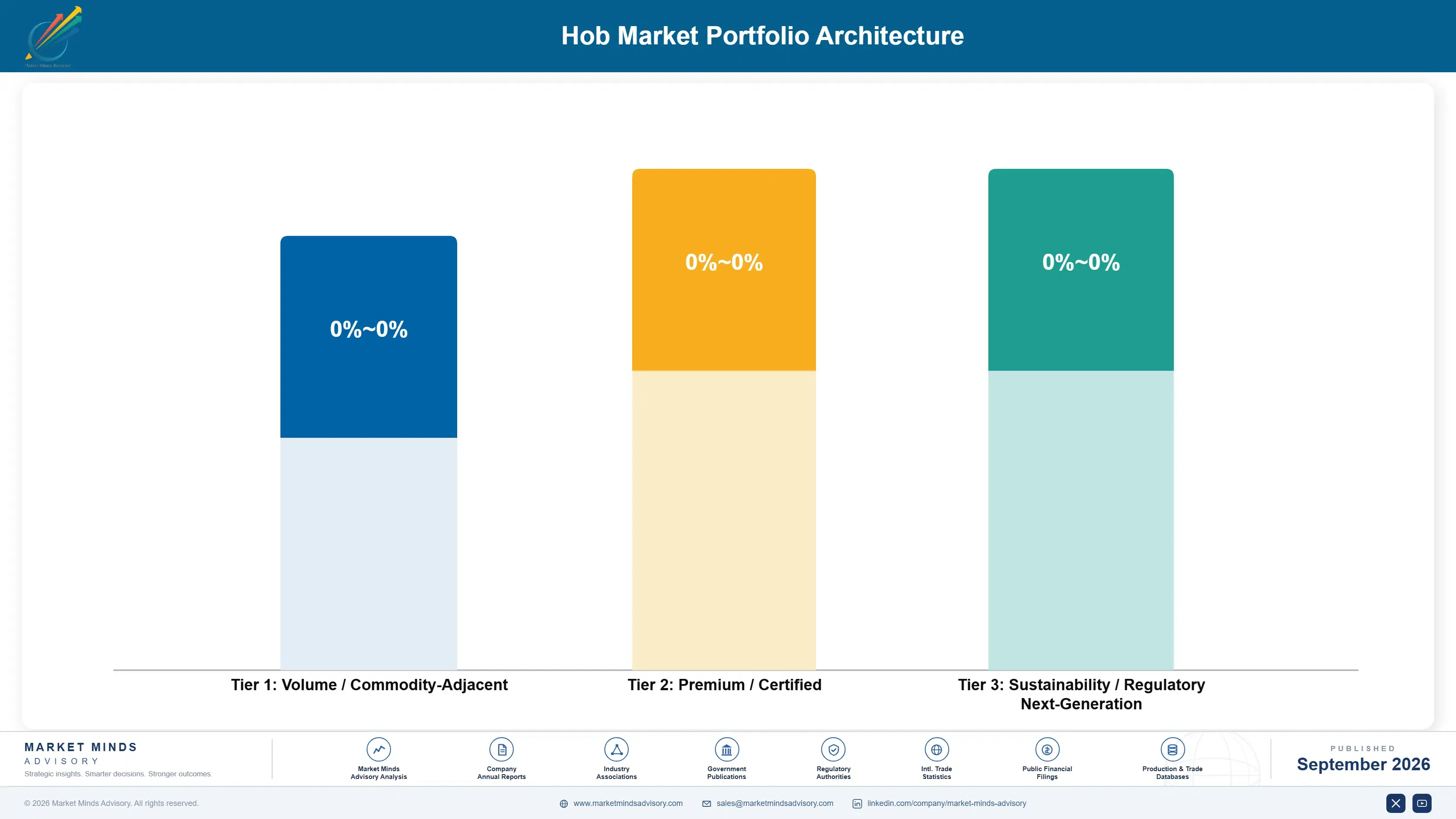
Portfolio Architecture for Margin Defence

Margin follows control sophistication and installation support together. Solid plate and basic radiant hobs compete close to commodity terms and are disappearing from most markets. Gas hobs earn moderately on familiarity into a declining base. Mainstream induction earns better, and premium induction with genuine control precision and fitted installation earns most, because both are difficult to copy at a price point. The margin spread across those groups is wide for a built-in appliance.
The tension between volume and premium runs through the purchase route. A hob bought as a like-for-like replacement online competes on price and specification list, and installation problems become the customer's discovery. A hob specified through a kitchen designer arrives with the circuit already planned and the cookware discussed, and it commands several times the price accordingly.

High-value pools concentrate where installation is designed rather than retrofitted: full kitchen renovations, island layouts requiring downdraft extraction, and new build specification where circuits are provisioned before anything is fitted. Where the purchase replaces a broken hob in an existing cutout, price and dimensions decide and nothing else enters the conversation at all. That divide follows the purchase route rather than the household income.

Volume / Commodity-Adjacent

Solid plate, basic radiant, and entry gas hobs sold on price into like-for-like replacement where dimensions decide the purchase. The ten-point range reflects manufacturing scale and component purchasing rather than any capability a household would notice.
Gross Margin: 18% to 28%

Premium / Certified

Mainstream induction and quality gas hobs sold through appliance retail with standard installation arrangements. The twelve-point range separates manufacturers with integrated power electronics from those assembling bought-in inverter modules into a glass panel.
Gross Margin: 32% to 44%

Sustainability / Regulatory / Next-Generation

Premium induction, downdraft integrated, and modular systems specified through kitchen design channels with surveyed installation. The fourteen-point range reflects control precision and whether the circuit and cookware questions are resolved before purchase.
Gross Margin: 46% to 60%
hobs-market-portfolio-architecture-1790014426097

High-value Sub-segments and Strategic Watch-out

Downdraft Integrated Systems

Highest value in the category, since island kitchen layouts require extraction and an overhead unit disrupts the sightline entirely. The fourteen-point range reflects extraction engineering, which is genuinely difficult and where several entrants underperform badly. Overhead units disrupt the sightline entirely. Extraction engineering is genuinely hard.
Gross Margin: 48% to 62%

Premium Induction With Fitted Installation

High value where the circuit survey and cookware check happen before purchase rather than after delivery. The twelve-point range reflects control precision alongside whether installation is genuinely managed or simply subcontracted and forgotten. Most manufacturers subcontract and forget it. Control precision separates the field. Survey work decides completion.
Gross Margin: 42% to 54%

Domino And Modular Formats

Volume core growing at 5.8% by letting households adopt induction without replacing every pan or upgrading a circuit. The twelve-point range reflects range coherence, since modules only sell if the buyer can extend the system later. Partial switching converts buyers who declined a full one.
Gross Margin: 36% to 48%

Entry Radiant And Gas Hobs

The strategic watch-out. Replacement purchases decided on dimensions and price, with Chinese production matching Western quality at considerably lower cost. The ten-point range reflects manufacturing scale and component purchasing and nothing else. Dimensions and price settle the purchase. Chinese production matches the quality. Cost alone decides the outcome.
Gross Margin: 16% to 26%

How Hob Demand Recurs

Replacement drives almost all volume in mature markets, and it happens on two very different triggers. A hob that fails is replaced within days on whatever fits the existing cutout, with price and dimensions deciding everything. A hob replaced during a kitchen renovation is chosen months in advance alongside cabinetry and worktops, and that purchase carries several times the value and none of the same constraints.
Attachment depth is close to absent in the first case and considerable in the second. Nobody researches hob brands before theirs breaks. A renovation buyer, by contrast, sees the appliance in a showroom, compares control precision directly, and frequently specifies a matching oven and extraction unit alongside it. Brand loyalty in this category is really designer and retailer loyalty operating one step removed.

The buyer profile has shifted toward the renovation route across mature markets as housing stock ages and kitchens are refitted rather than repaired. That shift favours manufacturers with showroom presence and design channel relationships over those competing on retail shelf price, and it makes the installation questions solvable in advance rather than discovered on a fitting day.
hobs-market-end-use-penetration-index-1790014426589

Where This Market Rewards

These are among the four positions where our research anticipates prominent divergence between winners and laggards over the coming forecast period. Each is grounded in the demand model, the regulatory perimeter, and the announced capacity pipeline.
01 / COOKWARE DISCLOSURE TIMING

Tell them about the pans first

Roughly 63% of households switching to induction find that some or all of their existing cookware will not work on it. Manufacturers and retailers offering compatibility checking at the point of sale report cancellation rates 3.3 times lower alongside materially better satisfaction scores afterwards. A magnet test takes seconds and a bundled pan set removes the objection entirely, and neither costs anything close to a cancelled installation, and discovery after delivery turns an enthusiastic buyer into an expensive return instead.
02 / INSTALLATION COST TRANSPARENCY

The fitter should not deliver the news

About 38% of all induction installations require electrical work adding roughly USD 410 that no retail price anywhere in this category currently includes. Manufacturers who offer pre-purchase electrical surveys alongside fitted pricing now report completed installation rates 2.6 times higher than competitors quoting for the appliance alone. A customer who learns the real cost before deciding either proceeds or chooses differently, and both beat a cancellation, and the fitter should never be the person delivering that news on the day.
03 / PERFORMANCE LED POSITIONING

Zone counts are not the argument

Induction delivers roughly 2.4 times the energy into a pan that an equivalent gas burner manages, and category marketing still competes on bridging zones and touch control layouts instead. Manufacturers leading on delivered energy and measured boil times report premium model conversion 1.9 times higher than feature-led positioning manages to achieve. The difference is genuine, demonstrable in any showroom, and almost entirely absent from how these appliances get sold, and a showroom demonstration settles the whole comparison in under a minute.
04 / PARTIAL SWITCH ENABLEMENT

Sell half a hob and wait

Domino and modular formats grow at 5.8% precisely because they remove the single all-or-nothing decision that stops most households from switching at all. Manufacturers who offer coherent modular ranges now report repeat purchase within three years 2.8 times higher, since satisfied buyers extend an existing system rather than replacing it outright. Selling half a hob today converts a customer who would otherwise have declined the entire proposition outright, provided the range is coherent enough for the system to be extended later.

Engagement Snapshot From the Field

A live engagement with an industry participant carrying material or product regulatory and market exposure ahead of a defining policy shift, showing how our research translates into a defensible multi-year portfolio strategy.
MARKET MINDS ADVISORY · CLIENT ENGAGEMENT SUMMARY
Hob Producer Strategic Portfolio Review and Transition Roadmap 2026·Investment Scenario on Hob Exposure Evaluation 2025-26
CLIENT PROFILE
A European appliance manufacturer with hob revenue near EUR 340 million (client-reported, unverified by MMA), selling induction, radiant, and gas hobs across seventeen markets. Induction units quoted at retail converted to completed installations at barely half the rate of radiant models, and returns had risen for three consecutive years. The board wanted the conversion gap explained before committing development spend to anything.
STRATEGIC CHALLENGE
Product management attributed the conversion gap to price sensitivity and had proposed a lower-priced induction range. Nobody had established at what point in the purchase the sale was being lost, or whether the customers abandoning induction had ever compared it against radiant on price at all. Price and friction explanations imply entirely different remedies.
MMA APPROACH
MMA traced abandoned purchases through retail partners to the stage at which each collapsed, surveyed customers who cancelled after ordering, compared return reasons against installation records, and modelled outcomes under price reduction, disclosure improvement, and fitted installation pricing. Property age was matched against cancellation records, since no retail listing has any mechanism to identify circuit capacity in advance.
KEY FINDINGS
  1. Around 58% of abandoned induction purchases collapsed after order and before installation, with electrical circuit cost cited as the reason in the large majority of them.
  2. A further quarter of cancellations came from cookware discovery, and almost none of those customers had seen any compatibility information before ordering the appliance.
  3. Returns concentrated on properties built before high-current cooking circuits became standard, which retail listings had no mechanism whatsoever to identify in advance.
  4. A lower-priced induction range would have addressed an objection that under a tenth of abandoning customers had actually raised in any form.
CLIENT PROFILE
A European appliance manufacturer with hob revenue near EUR 340 million (client-reported, unverified by MMA), selling induction, radiant, and gas hobs across seventeen markets. Induction units quoted at retail converted to completed installations at barely half the rate of radiant models, and returns had risen for three consecutive years. The board wanted the conversion gap explained before committing development spend to anything.
STRATEGIC CHALLENGE
Product management attributed the conversion gap to price sensitivity and had proposed a lower-priced induction range. Nobody had established at what point in the purchase the sale was being lost, or whether the customers abandoning induction had ever compared it against radiant on price at all. Price and friction explanations imply entirely different remedies.
MMA APPROACH
MMA traced abandoned purchases through retail partners to the stage at which each collapsed, surveyed customers who cancelled after ordering, compared return reasons against installation records, and modelled outcomes under price reduction, disclosure improvement, and fitted installation pricing. Property age was matched against cancellation records, since no retail listing has any mechanism to identify circuit capacity in advance.
KEY FINDINGS
  1. Around 58% of abandoned induction purchases collapsed after order and before installation, with electrical circuit cost cited as the reason in the large majority of them.
  2. A further quarter of cancellations came from cookware discovery, and almost none of those customers had seen any compatibility information before ordering the appliance.
  3. Returns concentrated on properties built before high-current cooking circuits became standard, which retail listings had no mechanism whatsoever to identify in advance.
  4. A lower-priced induction range would have addressed an objection that under a tenth of abandoning customers had actually raised in any form.
RECOMMENDED STRATEGY
Phase 1: Phase one: halt the lower-priced range and introduce a pre-purchase electrical survey with fitted installation pricing across all induction models. Phase 2: Phase two: add cookware compatibility checking and a bundled pan option to every induction listing and showroom display. Almost nobody currently sees that information beforehand. Phase 3: Phase three: develop lower current draw models specifically for older housing stock where circuit upgrades are prohibitive. Circuit upgrades frequently exceed the appliance price.
OUTCOME
Induction installation completion rose to within six points of radiant within four quarters (client-reported, unverified by MMA). Returns fell by roughly half across the same period. The lower-priced range was cancelled before any development spend was committed. Survey and fitted pricing is now standard across every induction listing the business operates.

Frequently Asked Questions

Foundational context covering the market sizes, CAGR, scope, country, region and competition that inform every finding below. This section is provided to cover basics and most often pre-purchase conversations, answered from the MMA Primary Research Dataset.

What is the current size of the Hob Market?

The market was worth USD 12.6 billion in 2025 and reaches USD 13.2 billion in 2026. Value covers built-in domestic hobs across all heating technologies.

How large will the Hob Market be by 2036?

MMA forecasts USD 20.3 billion by 2036, an increase of USD 7.1 billion across the forecast period. That represents 1.54 times the 2026 base of USD 13.2 billion.

What is the CAGR for the Hob Market 2026 to 2036?

The base case compound annual growth rate is 4.4%, with a bull case at 5.6% and a bear case at 3.2%. Historical growth from 2020 to 2025 ran at 3.4%.

Which segment is growing fastest?

Induction hobs grow at 6.6%, half again the market rate of 4.4%. The constraints on faster adoption are cookware and wiring rather than performance or price.

Who are the major companies in the Hob Market?

BSH Home Appliances, Electrolux Group, Whirlpool Corporation, Haier Smart Home, and Midea Group lead the category. Together they hold 41% of revenue, with premium European specialists competing on control precision.

Which country is growing fastest?

India grows at 8.6%, the fastest of any country covered here. Modular kitchen installation is replacing freestanding cooking arrangements across urban households at a pace no other market approaches.

Report Segmentation Architecture

The full report scope spans multiple orthogonal segmentation dimensions, with cross-tabulated demand data provided for each dimension pair. Coverage extends further to regional breakdowns, trend trajectories, and the competitive detail needed to support segment-level decision-making.

By Heating Technology

  • Induction Hobs
  • Domino and Modular Hobs
  • Downdraft Integrated Hobs
  • Radiant and Ceramic Electric Hobs
  • Gas Hobs
  • Solid Plate Electric Hobs

By End-Use Industry

  • Kitchen Renovation and Refit
  • New Residential Construction
  • Rental and Multi-Family Housing
  • Serviced Apartments and Hospitality
  • Student and Institutional Accommodation
  • Replacement of Failed Appliances

By Commercial Dimension

  • Kitchen Design and Specification Channels
  • Appliance Retail Chains
  • Online Retail and Marketplaces
  • Housebuilder and Developer Supply
  • Independent Appliance Dealers
  • Fitted Installation Service Contracts

By Region

  • East Asia
  • Western Europe
  • North America
  • South Asia and Pacific
  • Latin America
  • Middle East and Africa
  • Eastern Europe

Scope, Methodology, and Coverage

Every figure in this report is reproducible from documented input assumptions. The scope below maps the historical period, the forecast horizon, the segmentation dimensions, and the countries covered, alongside the underlying primary and qualitative methodology.
Historical Period
2020 to 2025
Forecast Period
2026 to 2036
Base Year
2025 (USD billions; MMA Primary Research Dataset, September 2026)
Market Definition
This market covers built-in domestic cooking hobs, across induction hobs, domino and modular hobs, downdraft integrated hobs, radiant and ceramic electric hobs, gas hobs, and solid plate electric hobs. It excludes freestanding cookers and ranges with integrated ovens, built-in ovens sold separately, commercial catering ranges, outdoor grills and barbecues, portable single-ring appliances, and extraction hoods supplied independently of the hob.
Quantitative Units
USD billions, retail value at manufacturer selling price
Segmentation Dimensions
Heating technology, end-use application, commercial dimension, region
Regions Covered
East Asia, Western Europe, North America, South Asia and Pacific, Latin America, Middle East and Africa, Eastern Europe
Countries Covered
China, Japan, South Korea, Taiwan, Germany, Italy, France, United Kingdom, Spain, Netherlands, Sweden, Switzerland, Poland, Czechia, United States, Canada, Mexico, India, Australia, Indonesia, Thailand, Vietnam, Brazil, Colombia, Chile, Argentina, Saudi Arabia, United Arab Emirates, Egypt, South Africa
Key Companies Profiled
BSH Home Appliances, Electrolux Group, Whirlpool Corporation, Haier Smart Home, Midea Group, Arcelik, Miele, Samsung Electronics, LG Electronics, Panasonic, Robam Appliances, Vatti Corporation, Fotile, Smeg, Franke, Gorenje, Elica, V-Zug, Bertazzoni, Rinnai
Quantitative Methodology
Primary survey, n=3,800 respondents, Q4 2025, six countries; demand-side model with trade association cross-validation
Qualitative Methodology
47 expert interviews, Q4 2025; applied to validate demand model assumptions, identify emerging dynamics, and assess competitive positioning
Report Format
PDF and XLSX data workbook (Word format preview document)
Publisher
Market Minds Advisory
Report Code
MMA-2026-CON-351
Published
September 2026
Contact
sales@marketmindsadvisory.com | www.marketmindsadvisory.com

Purchase the full Hob Market Report (2026 to 2036).

The full report sizes the hob market across six heating technologies, seven regions, and thirty countries, with forecasts to 2036 under base, bull, and bear cases. It quantifies how often cookware and electrical circuit obstacles stop induction purchases after the order is placed, measures how rarely either is disclosed before sale, and traces the regulatory direction across markets where gas restrictions have been enacted and reversed. Competitive analysis covers twenty participants evaluated consistently on category revenue, with detailed treatment of power electronics integration depth. Cost structure, installation economics, and channel margin architecture are analysed throughout. Primary research includes 3,800 survey responses and 47 expert interviews.
Six heating technologies sized and forecast separately
Twenty participants evaluated on category revenue consistently
Cookware and circuit obstacles quantified against abandoned purchases
Retail disclosure practice measured across listings and showrooms
Regulatory direction tracked across enacted and reversed gas restrictions
Power electronics integration depth assessed by manufacturer

Built For The People Who Decide

From boardroom strategy to bench-side execution, this report is read cover-to-cover by leaders shaping the next decade of their industry, turning demand scenarios, market dynamics and valuation benchmarks into decisions.
CXOs/ Presidents/ VPs/ Managers
M&A and Corporate Development
Strategy Teams and R&D Heads
Procurement and Product Directors
Regulatory and Compliance Leaders
Investor Relations and Equity Analysts