Market Minds Advisory
HIV/HBV/HCV Test Kits Market

HIV/HBV/HCV Test Kits Market: Bloodborne Virus Testing: Three Diseases, Three Completely Different Businesses

Hepatitis C has been curable for a decade and hepatitis B is carried unknowingly by roughly nine in ten of those infected. Diagnosis, not treatment, is now what limits both.

Lead Analyst

Alice Ballenger

Published

September 2026

Make Smarter Decisions with Customized Research Insights

Request a free sample report and evaluate market opportunities, growth trends, and competitive dynamics relevant to your business needs.

2025 MARKET VALUE$4.6BMarket Size 2025
2036 FORECAST VALUE$9.5BBase Case , 2026 to 2036
CAGR 2026 TO 20366.8 %Bull 8.0% / Bear 5.6%
INCREMENTAL OPPORTUNITY$4.6BNet 10- year value creation
EXPANSION MULTIPLE1.93x2036 value over 2026 base
Strategic Levers
M&A Pipeline
Regional Outlook
Country Rankings
Competitive Intelligence
Segmental Deep-dive
Call-Us : 91 93563 13602

Executive Snapshot and Market Trajectory

These three viruses get sold as a single market and behave nothing alike. HIV testing is a donor-funded commodity at under a dollar a test. Hepatitis C is curable and undiagnosed. Hepatitis B is carried unknowingly by around 90% of those infected. The market reaches USD 4.6 billion in 2025.
Point-of-care molecular testing grows fastest at 10.2%, exactly 1.50 times the market rate, because a result delivered during the visit prevents the loss to follow-up that wrecks every programme relying on a distant laboratory. East Asia holds 29% of value on the sheer scale of Chinese hepatitis B screening alone. Middle East and Africa takes 12%, above the band this framework applies, on donor-funded HIV testing volume.
Concentration reaches 62% across the top five, though that figure describes laboratory platforms far better than it describes the rapid formats, where regional manufacturers compete extremely hard on tendered price alone. Competition turns on cost per result inside donor programmes and on clinical workflow integration everywhere else. A test that finds an infection nobody then goes on to treat is simply a cost, and several funders have started saying so openly.
Market Definition
The HIV, hepatitis B, and hepatitis C test kits market covers assays and consumables used to screen for, diagnose, and monitor these three bloodborne viral infections, spanning laboratory immunoassays, laboratory nucleic acid testing, point-of-care molecular testing, rapid lateral flow tests, and self-testing kits. Analysers and instruments sold as capital equipment, antiviral therapies, blood collection consumables, general microbiology testing, and other infectious disease assays are excluded.
Base Year Value
$4.6B in 2025 (MMA Primary Research Dataset, August 2026)
Forecast Period
2026 to 2036, eleven discrete annual values
CAGR
6.8% base case. Bull 8.0%. Bear 5.6%.
Fastest Growth Segment
Point-of-Care Molecular Testing: 10.2% CAGR
Fastest Growth Country
India: 10.4% CAGR
Fastest Growth Region
South Asia and Pacific: 8.8% CAGR
Largest Region
East Asia: 29% of 2025 global value
Market Leaders
Abbott, Roche Diagnostics, Bio-Rad Laboratories, Cepheid, Grifols. Source: MMA Primary Research Dataset, July 2026.
Primary Survey
n=3,800 procurement and R&D decision-makers, Q4 2025, six countries
Methodology
Demand-side build-up, cross-validated against public data, 47 expert interviews

HIV/HBV/HCV Test Kits Market Forecast Scenarios

hiv-hbv-hcv-test-kits-market-size-forecast-scenario-1787297656623
Between 2020 and 2025 testing infrastructure expanded and then had to find new work for itself. Molecular capacity built for the pandemic sat underused from 2022 and was progressively redeployed toward hepatitis and HIV programmes that had lost ground. Donor funding held broadly steady in nominal terms while unit prices fell. A 5.7% historical CAGR reflects rising volume against pricing that eroded underneath it.
Three mechanisms carry the 6.8% base case. Hepatitis B case finding is the largest in principle, since roughly 90% of chronically infected people remain undiagnosed and elimination targets require finding them. Point-of-care molecular adoption is the second, driven by loss to follow-up that laboratory referral cannot solve. And blood donor screening volume grows steadily with transfusion demand in middle income countries expanding their supply. Only one of those three depends on anybody choosing to fund it.
The 8.0% bull case rests on hepatitis elimination programmes actually being funded rather than only adopted as targets, which would require case finding at a scale nobody currently pays for. The 5.6% bear case is donor funding contraction, since much HIV testing volume depends on external financing that has already come under political pressure in more than one contributing country.

Three Viruses, Three Different Problems

Bundling these three viruses into one market hides more than it explains. HIV testing is mature, enormous in volume, funded largely by external donors, and priced at around sixty-five cents a rapid test after two decades of tendering. That business rewards manufacturing cost above almost everything else, and the companies that win it look nothing like diagnostics companies elsewhere.
TOP FIVE CONCENTRATION62%Global platforms dominate laboratory testing while rapid formats stay fragmented
RAPID TEST PRICEUSD 0.65Tendered cost of a lateral flow screening test
UNDIAGNOSED HEPATITIS SHARE90%People living with chronic hepatitis B who do not know
BLOOD SCREENING VOLUME120 millionDonations screened annually for all three viruses worldwide
CONFIRMATORY TEST RATE4%Screen-positive samples proceeding to molecular confirmation and staging
SELF-TEST SHARE11%Testing delivered outside any clinical facility or laboratory setting
Hepatitis C is the opposite problem. Direct-acting antivirals cure it in eight to twelve weeks, which moved the bottleneck from treatment to finding people, and the elimination arithmetic now fails on diagnosis rather than on drugs. A test in this setting is not competing with another test. It is the rate-limiting step for a public health programme with an end date attached.
Hepatitis B is larger and considerably harder than either of them. Something like 90% of chronically infected people worldwide do not know, most of them across East Asia and Africa, and there is no cure to make finding them urgent in the way that a curable disease does. Screening exists where it is legally mandated and largely does not exist where it is merely recommended.
"We keep hearing that these markets converge because the same blood sample gets tested for all three. Commercially they diverge completely. One is a tender, one is a race against an elimination deadline, and one is a public health problem nobody has agreed to pay for."
Director, Infectious Disease Diagnostics Practice · MMA Medical Devices Practice

Market Trends

Point-Of-Care Molecular Solves Loss To Follow-Up

A patient screened reactive at a clinic and sent to a laboratory for confirmation frequently never returns, and programmes across Africa and South Asia lose a very large share of diagnosed people at exactly that step. Point-of-care molecular testing gives a confirmed result and a viral load during the same visit, which allows treatment to start before anybody walks out. That converts a diagnostic yield problem into a solved one, and it explains why the segment grows at 10.2% while cheaper laboratory testing grows at less than three quarters of that rate.
Market Impact: Targets set for 2030 elimination

Self-Testing Reaches Populations Clinics Never Will

HIV self-testing moved from pilot to policy across more than one hundred countries, and hepatitis self-tests are following the same regulatory path behind it. The people these kits reach, men who avoid clinics, key populations facing criminalisation, and anybody unwilling to be seen entering a testing site, are precisely the populations conventional programmes fail to cover. Distribution runs through pharmacies, vending, online, and community networks rather than through health facilities. It now carries around 11% of testing and it grows wherever a regulator permits it. Linkage to confirmation remains the unresolved weakness of the format.
Market Impact: 120 million donations screened yearly

Market Opportunities and Growth Drivers

Hepatitis Elimination Targets Require Finding The Undiagnosed

The World Health Organization has set 2030 elimination targets for viral hepatitis, and every country that adopted them faces the same arithmetic: treatment capacity is adequate and diagnosis is not. Around 90% of people with chronic hepatitis B and a majority of those with hepatitis C do not know they are infected. Reaching the targets requires case finding at a scale that no health system currently runs, which is a diagnostics problem rather than a therapeutic one. Whether it gets funded is the open question. Nobody has yet costed what finding them would take.
Market Impact: Donors fund 70% of testing

Blood Supply Expansion Drives Mandatory Screening Volume

Every unit of donated blood is screened for all three viruses in any system meeting international standards, and transfusion volumes are rising steadily across middle income countries building out surgical and oncology capacity. That demand is regulatory rather than clinical: nobody chooses whether to screen a donation. Nucleic acid testing is progressively replacing serology in blood banks as window period risk becomes unacceptable, which raises cost per donation substantially. Around 120 million donations are screened annually and the figure grows with health system capacity. This is the one part of the market entirely insulated from funding politics.
Market Impact: Only 30% reach treatment

Market Restraints and Challenges

Donor Funding Concentration Creates Political Exposure

A very large share of HIV testing in the highest burden countries is paid for by a small number of external funders, and procurement runs through centralised tenders that set global reference prices. The root cause is that the countries with the greatest need have the least fiscal capacity to meet it. Commercially this exposes suppliers to political decisions taken in donor capitals rather than to any demand signal. Participants are mitigating by diversifying into domestically funded markets, into hepatitis where donor dependence is lower, and into blood screening driven by regulation.
Market Impact: Follow-up loss reaches 40% of patients

Finding Cases Without Treatment Creates Little Value

Several health systems have concluded that screening programmes generating diagnoses that never reach treatment simply move cost around without improving outcomes. The root cause is that testing budgets and treatment budgets sit in different places and are rarely planned together. Commercially this restrains screening expansion regardless of how cheap tests become, since the barrier is downstream capacity rather than assay price. Suppliers are mitigating by supporting linkage-to-care programmes, bundling testing with treatment initiation pathways, and demonstrating cost per patient treated rather than per test performed. Assay price stopped being the barrier some time ago.
Market Impact: Self-tests carry 11% of testing
3 additional market trends, 2 additional growth drivers, and 4 additional restraints and challenges are covered in the full report. Contact sales@marketmindsadvisory.com to access the complete intelligence.

Segment CAGR and Growth Architecture

Segmentation follows test format, because where a test is performed determines who pays for it, what result it can deliver, whether the patient is still present when it arrives, and how it gets procured. Virus, care setting, and funding source are handled in the framework and commentary rather than being treated as segments here.
hiv-hbv-hcv-test-kits-market-market-share-analysis-1787297657162

Point-of-Care Molecular Testing

Point-of-care molecular grows fastest at 10.2%, exactly 1.50 times the market rate, and it solves a problem that no amount of cheaper laboratory testing ever could. A reactive screening result sent away for confirmation loses a very large share of patients before they return, and in high burden settings that attrition is what caps programme performance rather than test availability. A confirmed result and viral load delivered during the same visit lets treatment start immediately. Cost per test is far higher than laboratory equivalents and cost per patient actually treated is considerably lower, which is the comparison funders have begun making. Funders comparing unit price alone will always reach the wrong answer here.
CAGR 10.2%

Self-Testing Kits

Self-testing grows at 9.1%, distributed through pharmacies, vending machines, online channels, and community networks rather than through any health facility. It reaches the populations conventional programmes consistently miss: men who will not attend clinics, key populations facing criminalisation, and anybody who does not want to be seen entering a testing site. HIV self-testing is now policy in more than one hundred countries and hepatitis products are following the same regulatory path. Linkage to confirmatory testing and care remains the unresolved weakness, and it is the reason some health systems still hesitate. Distribution runs through channels that diagnostics organisations were never built to serve. Retail turnover matters more than clinical evidence in that setting.
CAGR 9.1%
Full segment breakdown across 5 segments available in the complete report.

Regional Architecture and Country Demand Map

Regional shares here reflect a direct collision between disease burden and ability to pay. The regions carrying most of the infection generate only a fraction of the value, because testing there is tendered at commodity prices while high income systems pay many times more for each result.

East Asia

East Asia takes 29% of value, at the ceiling of the band this framework applies, and Chinese hepatitis B screening accounts for most of it. China carries the largest chronic hepatitis B population in the world, and screening is embedded in antenatal care, pre-surgical workup, and employment medicals at enormous volume. Domestic manufacturers supply the bulk of that testing at prices imported platforms cannot approach, while tertiary hospitals run international systems for confirmation and viral load. Japanese and Korean blood screening is comprehensive and technically demanding. Growth at 7.4% exceeds the global rate on hepatitis case finding widening. Domestic pricing and international pricing coexist inside one country. Very little of that volume reaches global suppliers.
Share: 29% | CAGR: 7.4% (2026 to 2036)

Middle East and Africa

Middle East and Africa holds 12% of value against a 6% ceiling in this framework, and HIV burden explains the breach entirely. Sub-Saharan Africa carries the majority of people living with HIV worldwide, and testing volumes there are among the largest anywhere, funded almost entirely through external donor programmes and procured through centralised tenders at commodity prices. Egyptian hepatitis C screening demonstrated what a funded national programme can achieve at scale. Value per test is a small fraction of high income markets, which is why an enormous burden converts into a modest share. Growth at 7.2% exceeds the global rate. Burden and value diverge more sharply here than anywhere else on the map.
Share: 12% | CAGR: 7.2% (2026 to 2036)
Regional intelligence for 5 additional markets available in the complete report: North America, Western Europe, South Asia and Pacific, Latin America, Eastern Europe. Contact sales@marketmindsadvisory.com.
hiv-hbv-hcv-test-kits-market-country-cagr-analysis-1787297657680

Where Test Kit Suppliers Actually Earn

Winning a donor tender at sixty-five cents a test is a manufacturing achievement rather than a commercial one. Margin comes from results delivered while the patient is still present, from bundling diagnosis with treatment initiation so funders can actually see an outcome, and from the mandatory blood screening that nobody ever tenders down to nothing.

Price Against Patients Treated, Not Tests Performed

Funders comparing tests on unit price will always choose the cheapest, and a large share of those results never reach anybody who acts on them. Point-of-care molecular costs USD 12 to USD 20 against under a dollar for a rapid test, and it delivers a treated patient at lower total cost because nobody is lost between screening and confirmation. Suppliers who present cost per patient initiated on treatment rather than cost per test change the comparison entirely and reach programme directors rather than procurement. Procurement will never make that comparison unprompted.
Market Impact: Point-of-care costs 12 to 20 dollars per test

Attach Diagnosis To Treatment Initiation Pathways

Health systems increasingly refuse to fund screening that produces diagnoses nobody treats, since finding infection without acting on it moves cost around without improving any outcome. Suppliers who work with treatment programmes to build linkage pathways, rather than simply delivering results, defend testing budgets that are otherwise the first line cut when money tightens. Around 30% of diagnosed patients currently reach treatment, and it produces the outcome data a funder needs to renew a programme. Very few diagnostics companies have organised themselves to have that conversation at all. Testing budgets are always the first line cut.
Market Impact: Only 30 percent currently reach any actual treatment

Build Position In Mandatory Blood Screening

Every donated unit is screened for all three viruses wherever international standards apply, which makes roughly 120 million tests a year that nobody chooses to buy or not. Blood banks migrating from serology to nucleic acid testing raise cost per donation several times over, and the switch is driven by window period risk rather than by price. Revenue here is regulatory, predictable, and entirely insulated from the donor funding politics that governs HIV programme testing. No tender in this market behaves the way that one does. Regulation rather than budget decides it.
Market Impact: Screening covers 120 million donations every single year

Who Controls the Margin Pool

Concentration reaches 62% across the top five measured on test kit revenue, though that single figure describes two very different competitive situations sitting side by side. Abbott and Roche dominate laboratory immunoassay and molecular platforms across high income systems and blood screening worldwide. Cepheid holds the point-of-care molecular position, Bio-Rad a strong blood screening franchise, and Grifols the transfusion medicine channel. Rapid lateral flow is considerably more fragmented.
Competition currently turns on cost per result wherever donors procure, and on platform consolidation everywhere else, since a laboratory wants these assays running on analysers it already operates and maintains. Regulatory prequalification is the gate on donor-funded business and takes years to pass. Nothing about analytical performance separates the major platforms meaningfully any more.

Pressure comes from Chinese, Indian, and Korean manufacturers who have secured prequalification and now compete directly on tendered rapid testing at prices Western suppliers simply cannot match. Self-testing is opening a consumer channel that traditional diagnostics organisations are poorly built to serve. Rankings will shift wherever funders start buying outcomes rather than tests, because that single change alters what is actually being compared.
hiv-hbv-hcv-test-kits-market-company-positioning-matrix-1787297658212

Competitive Moat and Risk Dimensions

ABBOTT

Moat: Platform breadth across every setting

Abbott supplies laboratory immunoassay, molecular, point-of-care, and rapid testing for all three viruses, which lets a health system source its entire bloodborne virus programme from one relationship across settings that range from a reference laboratory to a rural clinic. That breadth is difficult to assemble and it matters most in exactly the national programmes that buy at the largest scale.
ABBOTT

Risk: Donor tender pricing exposure

A meaningful share of volume sits in donor-funded rapid testing procured through centralised tenders where price is close to the only criterion and prequalified Asian manufacturers now compete directly. Defending that volume means matching costs built on very different manufacturing bases, and losing it removes scale that supports the rest of the portfolio.
ROCHE DIAGNOSTICS

Moat: Blood screening and molecular depth

Roche holds a very strong position in transfusion screening and high-throughput molecular testing, where regulatory validation, throughput, and traceability matter far more than unit price does. Blood banks change platforms rarely because revalidating a screening system against national regulation is a long and unforgiving exercise nobody undertakes for a modest saving.
ROCHE DIAGNOSTICS

Risk: Limited decentralised testing presence

Roche's strength is concentrated in centralised laboratory and blood bank settings while the growth is in point-of-care and self-testing formats reaching patients who never enter a laboratory. Building credibility in decentralised settings requires a different service model and a different cost structure, and competitors established there are not standing still.

Players Tracked

Prominent Players

Abbott
Roche Diagnostics
Bio-Rad Laboratories
Cepheid
Grifols

Other Key Players

Hologic
bioMerieux
Siemens Healthineers
OraSure Technologies
Chembio Diagnostics
SD Biosensor
Beijing Wantai
Trinity Biotech
Fujirebio
InTec Products
Premier Medical Corporation
Mylab Discovery Solutions
Zhuhai Livzon Diagnostics
Bioneer
Meridian Bioscience

Recent Developments

MARCH 2025

National programme adopted point-of-care testing to cut follow-up loss

A national hepatitis programme adopted point-of-care molecular testing at screening sites after audit showed a large share of reactive patients never returned for laboratory confirmation. Cost per test rose considerably while cost per patient actually started on treatment fell against the previous laboratory referral model.
Signal: Funders are beginning to compare cost per patient treated rather than simple cost per test performed.
SEPTEMBER 2024

Regulator approved hepatitis self-test for pharmacy distribution

A national regulator approved a hepatitis self-test for sale through retail pharmacies without any prescription at all, following the same regulatory pathway that HIV self-testing established across more than one hundred countries. Linkage to confirmatory testing remained the outstanding concern raised during the approval process itself.
Signal: Consumer channels reach exactly the populations that clinic-based programmes have consistently failed to cover at all.
DECEMBER 2024

Asian manufacturer secured prequalification for rapid HIV testing

An Asian diagnostics manufacturer secured full international prequalification for a rapid HIV test, opening up access to the centralised donor tenders that had previously been served by a small group of established suppliers. Tendered prices in the subsequent round fell measurably across the whole category.
Signal: Prequalification is the gate, and once an Asian manufacturer passes it the tendered price falls immediately.

Antigens, Antibodies, Enzymes, And Nitrocellulose

Recombinant viral antigens and monoclonal antibodies carry roughly 32% to 42% of cost of goods, produced through fermentation and cell culture at a small number of qualified facilities. Nitrocellulose membrane, conjugate pads, and cassette plastics add 14% to 20% on rapid formats, while molecular assays substitute enzymes, primers, and probes at similar cost share. Quality release testing and regulatory documentation account for most of the remainder.
Nitrocellulose membrane supply became a genuine constraint through 2021 as pandemic lateral flow demand consumed global capacity, and prices held elevated well into 2023. Enzyme and oligonucleotide pricing followed the same pattern for molecular assays. European Commission energy statistics record industrial electricity roughly doubling at the 2022 peak. Abbott and bioMérieux both reported input and logistics cost pressure across that period, and suppliers holding tendered prices absorbed it entirely.

Exposure divides by whether a supplier produces its own biological reagents. Companies with internal antigen and antibody production carry the cost in their own base and control both supply and specification. Those buying reagents in face a narrow supplier field with considerable pricing power. Tendered donor business makes that exposure worse, since prices are fixed for a contract period nobody reopens.
hiv-hbv-hcv-test-kits-market-cost-volatility-analysis-1787297658416

Bring critical viral antigen production in house

Recombinant antigens for these three viruses come from a narrow group of suppliers who understand exactly how few alternatives exist anywhere. Internal production costs real capital and years of qualification, and it removes both the pricing exposure and the specification dependency at once. Very few suppliers anywhere have the volume to justify doing it.

Qualify multiple nitrocellulose membrane sources

The pandemic demonstrated that membrane supply can disappear entirely when a larger market bids for it, and a lateral flow line with no membrane produces nothing at all. Qualifying alternative membranes requires revalidating assay performance on each, which takes months and has to be completed before the shortage rather than during it. Nobody validates a second membrane during a crisis.

Attach index provisions to multi-year tender pricing

Donor tenders fix prices across contract periods measured in years while reagent and freight costs continue moving, which is a risk that suppliers absorb entirely by default. Index provisions are unusual in this procurement model and increasingly discussed as tendered prices approach genuine manufacturing cost. Establishing the principle matters considerably more than the mechanism chosen.

Portfolio Architecture for Margin Defence

Margin here tracks who is paying and against what standard. Donor-tendered rapid testing is a manufacturing business where the winner is whoever has the lowest cost base and prequalification, and pricing has been ground down for twenty years. High income laboratory testing, blood screening, and point-of-care molecular are clinical businesses where regulatory validation and workflow integration matter far more than unit price ever does.
The volume tension is between scale and margin, and the two sit in different places. Donor-funded volume is enormous, supports manufacturing scale that lowers cost across the whole portfolio, and earns very little. High income and blood screening business is smaller in units, generates most of the profit, and depends on validation work that tendered volume helps fund. Suppliers holding only one half compete badly in the other.

High-value pools sit in three places. Blood donor screening, where regulation rather than economics dictates the method and nucleic acid migration keeps raising cost per donation. Point-of-care molecular, priced against patients treated rather than tests run. And hepatitis B case finding, which is the largest undiagnosed population in infectious disease and remains almost entirely unfunded.

Volume / Commodity-Adjacent Tier

Rapid lateral flow screening tests supplied into donor-funded tenders and public programmes. Prequalified Asian manufacturers compete directly, and the range reflects how differently established and low-cost manufacturing bases carry an equivalent test.
Gross Margin: 18-30%

Premium / Certified Tier

Laboratory immunoassay and molecular testing on validated platforms in reimbursed health systems. Regulatory validation and consolidation onto analysers a laboratory already runs sustain the margin rather than any analytical differentiation.
Gross Margin: 48-62%

Sustainability / Regulatory / Next-Generation Tier

Blood donor nucleic acid screening, point-of-care molecular testing, and self-test consumer formats. The wide range reflects genuinely different economics between mandated blood screening and consumer products sold through retail channels.
Gross Margin: 56-72%
hiv-hbv-hcv-test-kits-market-portfolio-architecture-1787297658920

High-value Sub-segments and Strategic Watch-out

Blood Donor Nucleic Acid Screening

Mandated everywhere international standards apply, migrating from serology on window period risk rather than on cost, and covering roughly 120 million donations annually. Nobody tenders this down to nothing, because the decision was never an economic one. Migration to molecular methods keeps raising cost per donation.
Gross Margin: 58-72%

Point-of-Care Molecular Testing

Growing at 10.2% because a confirmed result during the visit prevents the follow-up loss that caps every programme relying on laboratory referral. Priced against patients actually treated it wins comfortably, and against tests performed it loses badly. Programme directors buy this; procurement officers never do.
Gross Margin: 52-66%

Donor-Tendered Rapid Testing

Enormous volume at roughly sixty-five cents a test after two decades of tendering, now contested directly by prequalified Asian manufacturers. It funds manufacturing scale that lowers cost across everything else, which is the only reason to defend it. Scale here subsidises the cost base of everything else.
Gross Margin: 18-30%

Hepatitis B Case Finding

Around 90% of chronically infected people worldwide remain undiagnosed, which is the largest undiagnosed population in infectious disease anywhere. The watch-out is that no cure exists to create urgency, so almost nobody has agreed to fund the finding. Positioning for it takes years nobody wants to spend.
Gross Margin: 40-56%

What Sustains Testing Volume Over Time

Screening is recurring by design rather than by commercial engineering. Blood donations are tested every time, antenatal screening happens with every pregnancy, key populations are retested at intervals, and treated hepatitis C patients require confirmation of cure. That produces volume that does not depend on winning a new customer each year. What it does depend on is a funder continuing to pay, which is a different kind of fragility from competitive loss.
Stickiness varies enormously by setting. Blood screening is close to permanent, because revalidating a system against national transfusion regulation is a long exercise nobody undertakes for a modest saving. Laboratory platforms are sticky through consolidation onto shared analysers. Donor-tendered rapid testing is not sticky at all and changes supplier at every tender round on price alone, whatever the incumbent has delivered.

Buyer profiles could hardly differ more across this market. A blood service medical director buys risk reduction and does not discuss price. A donor procurement agency buys the lowest compliant cost per test at very large volume. A pharmacy buyer stocking self-tests buys shelf turnover. Suppliers built for one of those three consistently misjudge the others, and most are built for exactly one.
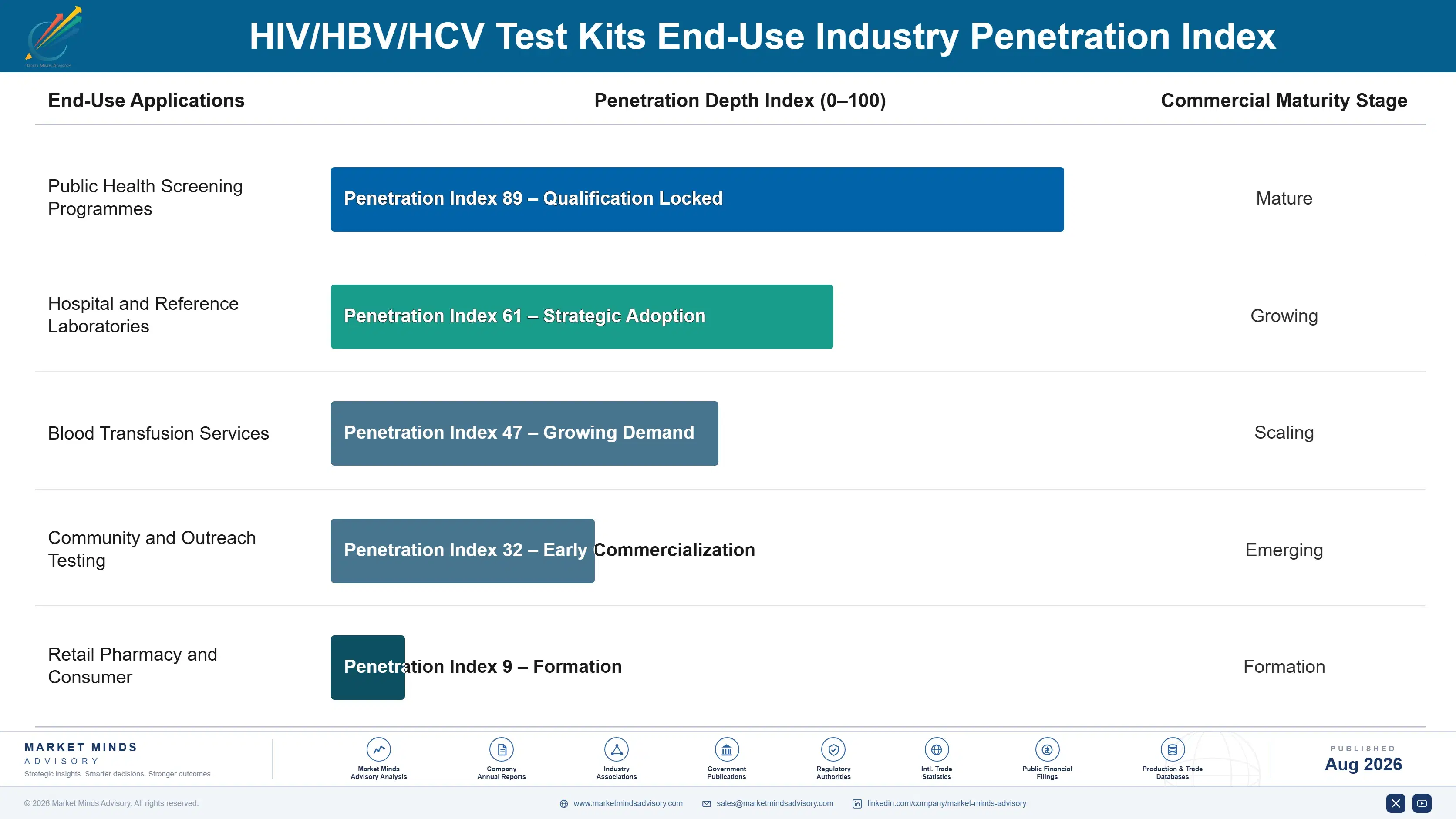
hiv-hbv-hcv-test-kits-market-end-use-penetration-index-1787297659413

Where To Compete Here

These are among the four positions where our research anticipates prominent divergence between winners and laggards over the coming forecast period. Each is grounded in the demand model, the regulatory perimeter, and the announced capacity pipeline.
01 / OUTCOME BASED PRICING

Sell patients treated, not tests supplied

A funder comparing tests on unit price will always take the cheapest one, and a very large share of those results never reach anybody who acts on them because patients are lost between screening and confirmation. Point-of-care molecular costs many times a rapid test and still delivers a treated patient more cheaply once that attrition is counted properly. Suppliers presenting cost per patient actually initiated on treatment reach programme directors rather than procurement officers, and the comparison then reverses completely.
02 / BLOOD SCREENING POSITION

Own the testing nobody negotiates down

Every single donated unit is screened for all three viruses wherever international standards apply, which makes roughly 120 million tests a year that nobody chooses either to buy or to skip. Migration from serology to nucleic acid testing raises cost per donation several times over, and it is decided entirely on window period risk rather than on price at all. Revenue there is regulatory, predictable, and completely insulated from the donor funding politics that governs almost everything else in this market.
03 / HEPATITIS B CASE FINDING

Prepare for the largest undiagnosed population

Roughly 90% of the people living with chronic hepatitis B worldwide do not know it, which is the biggest undiagnosed pool in infectious disease and sits mostly across East Asia and Africa. No cure exists to create the urgency that direct-acting antivirals gave to hepatitis C, so almost nobody is funding the case finding today. Suppliers already positioned when that changes will meet demand at a scale nothing in current testing volume resembles, and getting positioned takes years rather than months.
04 / TENDER EXPOSURE MANAGEMENT

Decide what donor volume is actually worth

Prequalified Asian manufacturers now compete directly in the centralised tenders where price is close to the only criterion applied, and every successive round moves the global reference price downward again. That volume funds the manufacturing scale which lowers cost across an entire portfolio, so abandoning it is expensive in ways the tender margin itself never shows at all. Suppliers need an explicit board-level view of what that scale is genuinely worth, rather than defending or exiting the business by reflex.

Engagement Snapshot From the Field

A live engagement with an industry participant carrying material or product regulatory and market exposure ahead of a defining policy shift, showing how our research translates into a defensible multi-year portfolio strategy.
MARKET MINDS ADVISORY · CLIENT ENGAGEMENT SUMMARY
HIV/HBV/HCV Test Kits Producer Strategic Portfolio Review and Transition Roadmap 2026·Investment Scenario on HIV/HBV/HCV Test Kits Exposure Evaluation 2025-26
CLIENT PROFILE
A national viral hepatitis control programme in a middle income country with an estimated chronically infected population above two million people and annual programme funding near USD 90 million (client-reported, unverified by MMA). Screening volumes had risen steadily for three consecutive years while the number of patients actually starting treatment had barely moved at all.
STRATEGIC CHALLENGE
The programme had procured rapid screening tests at very low unit cost and expanded testing sites aggressively, on the assumption that finding more infections would translate into treating more people. It had not, and the ministry wanted to understand whether the problem was testing, treatment capacity, or something between the two.
MMA APPROACH
MMA tracked a cohort of reactive screening results through confirmation, staging, and treatment initiation, measuring attrition at each step rather than counting tests performed. Site-level variation was then examined against distance to the confirming laboratory. Point-of-care molecular deployment was modelled on cost per patient treated rather than on cost per test.
KEY FINDINGS
  1. Around 58% of patients with a reactive screening result never returned for laboratory confirmation, and attrition rose sharply with distance to the confirming site (client-reported, unverified by MMA).
  2. Treatment capacity was not the constraint, since existing clinics were running well below the patient volume they had been resourced to handle.
  3. Point-of-care molecular testing cost roughly eighteen times a rapid test and produced a treated patient at approximately 40% lower total programme cost.
  4. Sites within reach of a same-day confirming laboratory showed attrition comparable to the modelled point-of-care scenario, which narrowed where deployment was actually needed.
CLIENT PROFILE
A national viral hepatitis control programme in a middle income country with an estimated chronically infected population above two million people and annual programme funding near USD 90 million (client-reported, unverified by MMA). Screening volumes had risen steadily for three consecutive years while the number of patients actually starting treatment had barely moved at all.
STRATEGIC CHALLENGE
The programme had procured rapid screening tests at very low unit cost and expanded testing sites aggressively, on the assumption that finding more infections would translate into treating more people. It had not, and the ministry wanted to understand whether the problem was testing, treatment capacity, or something between the two.
MMA APPROACH
MMA tracked a cohort of reactive screening results through confirmation, staging, and treatment initiation, measuring attrition at each step rather than counting tests performed. Site-level variation was then examined against distance to the confirming laboratory. Point-of-care molecular deployment was modelled on cost per patient treated rather than on cost per test.
KEY FINDINGS
  1. Around 58% of patients with a reactive screening result never returned for laboratory confirmation, and attrition rose sharply with distance to the confirming site (client-reported, unverified by MMA).
  2. Treatment capacity was not the constraint, since existing clinics were running well below the patient volume they had been resourced to handle.
  3. Point-of-care molecular testing cost roughly eighteen times a rapid test and produced a treated patient at approximately 40% lower total programme cost.
  4. Sites within reach of a same-day confirming laboratory showed attrition comparable to the modelled point-of-care scenario, which narrowed where deployment was actually needed.
RECOMMENDED STRATEGY
Phase 1: Phase one: deploy point-of-care molecular testing at the screening sites furthest from a confirming laboratory, where measured attrition was highest. Phase 2: Phase two: stop expanding the number of screening sites until confirmation and linkage capacity matches the reactive volume already being generated. Phase 3: Phase three: report programme performance on patients started on treatment rather than on tests performed, so procurement decisions optimise the right number.
OUTCOME
The programme redeployed part of its testing budget from screening volume into point-of-care confirmation at remote sites and reported treatment initiations rising roughly 2.3 times within a year, on fewer total tests performed (client-reported, unverified by MMA). Programme reporting moved to treatment initiation as the headline measure during the same period.

Frequently Asked Questions

Foundational context covering the market sizes, CAGR, scope, country, region and competition that inform every finding below. This section is provided to cover basics and most often pre-purchase conversations, answered from the MMA Primary Research Dataset.

What is the current size of the HIV/HBV/HCV Test Kits Market?

The market reached USD 4.6 billion in 2025 and is forecast at USD 4.91 billion for 2026. The three viruses are bundled commercially and behave as three quite different businesses.

How large will the HIV/HBV/HCV Test Kits Market be by 2036?

MMA forecasts USD 9.49 billion by 2036, an increase of USD 4.57 billion over 2026. That represents an expansion multiple of 1.93 times across the forecast period.

What is the CAGR for the HIV/HBV/HCV Test Kits Market 2026 to 2036?

The base case CAGR is 6.8%, with a bull case at 8.0% and a bear case at 5.6%. The bear case reflects donor funding contraction, which has already come under political pressure.

Which segment is growing fastest?

Point-of-care molecular testing grows fastest at 10.2%, exactly 1.50 times the market rate. A confirmed result during the same visit prevents the follow-up loss that caps programme performance everywhere.

Who are the major companies in the HIV/HBV/HCV Test Kits Market?

Abbott, Roche Diagnostics, Bio-Rad Laboratories, Cepheid, and Grifols lead the market. The top five hold roughly 62% of test kit revenue, though rapid lateral flow testing is considerably more fragmented than that figure suggests.

Which country is growing fastest?

India grows fastest at 10.4%, driven by the national viral hepatitis control programme scaling case finding well beyond previous levels. Domestic manufacturing makes population screening arithmetically possible there.

Report Segmentation Architecture

The full report scope spans multiple orthogonal segmentation dimensions, with cross-tabulated demand data provided for each dimension pair. Coverage extends further to regional breakdowns, trend trajectories, and the competitive detail needed to support segment-level decision-making.

By Test Format

  • Point-of-Care Molecular Testing
  • Self-Testing Kits
  • Laboratory Nucleic Acid Testing
  • Rapid Lateral Flow Tests
  • Laboratory Immunoassays

By End-Use Industry

  • Public Health Screening Programmes
  • Hospital and Reference Laboratories
  • Blood Transfusion Services
  • Community and Outreach Testing
  • Retail Pharmacy and Consumer

By Commercial Dimension

  • Centralised Donor Tender Procurement
  • National Programme Direct Supply
  • Reimbursed Laboratory Contracts
  • Retail and Consumer Channel
  • Distributor and Dealer Supply

By Region

  • East Asia
  • Middle East and Africa
  • North America
  • Western Europe
  • South Asia and Pacific
  • Latin America
  • Eastern Europe

Scope, Methodology, and Coverage

Every figure in this report is reproducible from documented input assumptions. The scope below maps the historical period, the forecast horizon, the segmentation dimensions, and the countries covered, alongside the underlying primary and qualitative methodology.
Historical Period
2020 to 2025
Forecast Period
2026 to 2036
Base Year
2025 (USD billions; MMA Primary Research Dataset, August 2026)
Market Definition
The HIV, hepatitis B, and hepatitis C test kits market comprises assays, reagents, and consumables used to screen for, diagnose, confirm, and monitor these three bloodborne viral infections, valued at supplier selling prices to public health programmes, hospital and reference laboratories, blood transfusion services, community testing providers, retail pharmacy, and centralised donor procurement agencies. It spans laboratory immunoassays for antigen and antibody detection, laboratory nucleic acid testing including viral load and genotyping, point-of-care molecular testing, rapid lateral flow tests, and self-testing kits, together with controls, calibrators, and confirmatory assays supplied alongside them. Analysers and instruments sold as capital equipment, antiretroviral and antiviral therapies, vaccines, blood collection devices and consumables, liver fibrosis staging equipment, general microbiology and other infectious disease assays, and laboratory information systems are excluded.
Quantitative Units
USD billions (current prices); volume in millions of tests supplied
Segmentation Dimensions
By Test Format; By End-Use Industry; By Commercial Dimension; By Region
Regions Covered
East Asia, Middle East and Africa, North America, Western Europe, South Asia and Pacific, Latin America, Eastern Europe
Countries Covered
China, Japan, South Korea, Taiwan, Vietnam, India, Indonesia, Pakistan, Bangladesh, Thailand, Philippines, Australia, South Africa, Nigeria, Kenya, Tanzania, Uganda, Ethiopia, Mozambique, Egypt, Saudi Arabia, USA, Canada, Mexico, Brazil, Argentina, Colombia, Peru, Germany, France, UK, Italy, Spain, Netherlands, Poland, Romania, Ukraine, Georgia, and additional markets relevant to this sector
Key Companies Profiled
Abbott, Roche Diagnostics, Bio-Rad Laboratories, Cepheid, Grifols, Hologic, bioMerieux, Siemens Healthineers, OraSure Technologies, Chembio Diagnostics, SD Biosensor, Beijing Wantai, Trinity Biotech, Fujirebio, InTec Products, Premier Medical Corporation, Mylab Discovery Solutions, Zhuhai Livzon Diagnostics, Bioneer, Meridian Bioscience
Quantitative Methodology
Primary survey, n=3,800 respondents, Q4 2025, six countries; demand-side model with trade association cross-validation
Qualitative Methodology
47 expert interviews, Q4 2025; applied to validate demand model assumptions, identify emerging dynamics, and assess competitive positioning
Report Format
PDF and XLSX data workbook (Word format preview document)
Publisher
Market Minds Advisory
Report Code
MMA-2026-MED-701
Published
August 2026
Contact
sales@marketmindsadvisory.com | www.marketmindsadvisory.com

Purchase the full HIV/HBV/HCV Test Kits Market Report (2026 to 2036).

The full report examines bloodborne virus test kit demand across seven regions and five test formats, separating three diseases that are bundled commercially and behave nothing alike in practice. It quantifies loss to follow-up between screening and treatment and models where point-of-care molecular testing pays for itself on cost per patient treated. Competitive analysis covers twenty participants assessed on test kit revenue, including how prequalification of Asian manufacturers has reset tendered pricing. Regional chapters map disease burden against ability to pay, which diverge more here than in any comparable market.
Seven-region burden against ability to pay analysis
Five test format segmentation with growth rates
Twenty participant competitive assessment and tender positioning
Loss to follow-up attrition modelling by care pathway step
Cost per patient treated against cost per test comparison
Hepatitis B undiagnosed population sizing by country

Built For The People Who Decide

From boardroom strategy to bench-side execution, this report is read cover-to-cover by leaders shaping the next decade of their industry, turning demand scenarios, market dynamics and valuation benchmarks into decisions.
CXOs/ Presidents/ VPs/ Managers
M&A and Corporate Development
Strategy Teams and R&D Heads
Procurement and Product Directors
Regulatory and Compliance Leaders
Investor Relations and Equity Analysts