Market Minds Advisory
Hindered Amine Light Stabilizers Market

Hindered Amine Light Stabilizers Market: Polymer Durability Demand Across Automotive and Agriculture

Outdoor plastics fail from ultraviolet exposure long before they fail from any other cause, and hindered amine light stabilizers remain the additive chemistry that keeps automotive and agricultural polymers usable for years instead of months.

Lead Analyst

Bilal Shaikh

Published

September 2026

Make Smarter Decisions with Customized Research Insights

Request a free sample report and evaluate market opportunities, growth trends, and competitive dynamics relevant to your business needs.

2025 MARKET VALUE$1.4BMarket Size 2025
2036 FORECAST VALUE$2.6BBase Case , 2026 to 2036
CAGR 2026 TO 20365.5 %Bull 6.7% / Bear 4.3%
INCREMENTAL OPPORTUNITY$1.1BNet 10- year value creation
EXPANSION MULTIPLE1.71x2036 value over 2026 base
Strategic Levers
M&A Pipeline
Regional Outlook
Country Rankings
Competitive Intelligence
Segmental Deep-dive
Call-Us : 91 93563 13602

Executive Snapshot and Market Trajectory

Hindered amine light stabilizers work by a chemical trick that sounds almost too simple to matter: they regenerate themselves after neutralizing damaging free radicals, which is exactly why they outlast every other UV protection additive tried before them in the marketplace today and going forward.
BASF and Clariant continue supplying established monomeric HALS formulations across mainstream automotive and packaging applications, since that chemistry remains cost effective and broadly compatible with most polymer systems across the industry and supply chain worldwide today and for the foreseeable future. Oligomeric and polymeric HALS are capturing disproportionate growth as agricultural film and automotive exterior applications demand better resistance to extraction and volatilization over extended outdoor exposure periods.
Songwon and Everlight Chemical are investing in expanded high-molecular-weight HALS production capacity, betting that demand for extraction-resistant stabilizers will keep growing as polymer applications extend further into demanding outdoor environments across most regions worldwide today and well into tomorrow and even beyond that distant horizon of continued expansion. Producers without diverse molecular weight offerings increasingly find themselves confined to commodity monomeric contracts as premium applications shift toward larger molecules and higher-value chemistry.
Market Definition
The hindered amine light stabilizers market covers monomeric HALS, oligomeric and polymeric HALS, NOR-HALS for agricultural film applications, reactive HALS, HALS blends and synergist formulations, and masterbatch-incorporated HALS sold as polymer additives for plastics, coatings, and rubber applications. It excludes ultraviolet absorbers sold as a standalone additive class and antioxidants sold for thermal rather than photo-oxidative stabilization.
Base Year Value
$1.4B in 2025 (MMA Primary Research Dataset, August 2026)
Forecast Period
2026 to 2036, eleven discrete annual values
CAGR
5.5% base case. Bull 6.7%. Bear 4.3%.
Fastest Growth Segment
Oligomeric and Polymeric HALS: 7.5% CAGR
Fastest Growth Country
India: 7.0% CAGR
Fastest Growth Region
South Asia and Pacific: 7.0% CAGR
Largest Region
East Asia: 28% of 2025 global value
Market Leaders
BASF, Clariant, Songwon, Everlight Chemical, Adeka Corporation. Source: MMA Analysis based on company annual reports.
Primary Survey
n=3,800 procurement and R&D decision-makers, Q4 2025, six countries
Methodology
Demand-side build-up, cross-validated against public data, 47 expert interviews

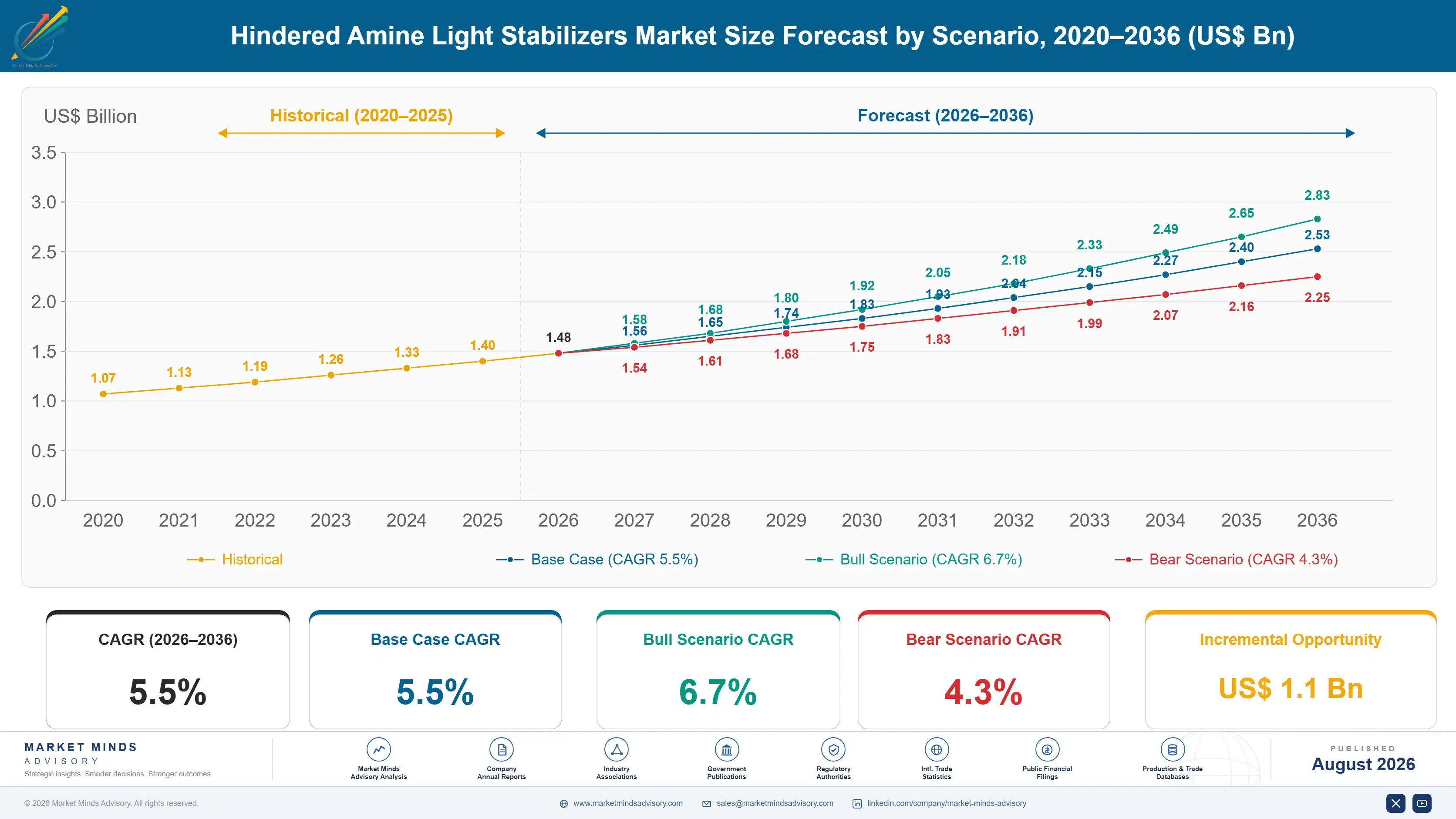
Hindered Amine Light Stabilizers Market Forecast Scenarios

hindered-amine-light-stabilizers-market-size-forecast-scenario-1787552441025
Between 2020 and 2025 the market grew at roughly 4.5 percent a year, as automotive production recovered from pandemic-era disruption and agricultural film consumption continued climbing across major greenhouse and mulch film producing regions worldwide, supported by continued investment and rising demand across every producing country and region during that entire stretch of recent years and well beyond it too.
The base case assumes 5.5 percent annual growth to 2036, built on three mechanisms: automotive exterior and interior applications demanding longer service life warranties that require better UV protection chemistry, agricultural film consumption growing alongside expanding protected cultivation area globally, and oligomeric and polymeric HALS capturing incremental share as extraction resistance becomes a more common specification requirement across demanding applications and end markets worldwide over the coming decade of continued expansion.
A bull case near 6.7 percent depends on automotive lightweighting trends accelerating plastic substitution for metal components faster than currently planned across most vehicle segments worldwide and beyond. The bear case near 4.3 percent assumes automotive production growth slows enough that HALS demand growth tracks closer to simple polymer volume trends without premium chemistry gains.

The Additive That Buys Polymers Extra Years

Hindered amine light stabilizers protect polymers from ultraviolet degradation through a regenerative radical-scavenging mechanism that outperforms simpler UV absorbers over extended outdoor exposure periods and repeated weathering cycles across many years of continuous service life. The category spans molecular weights from small monomeric molecules to large oligomeric and polymeric structures, each suited to different balances of cost, compatibility, and extraction resistance across varied applications.
MARKET CONCENTRATIONCR5 52%Moderate to high concentration among established specialty chemical producers
AVERAGE SELLING PRICE$9.50 per kilogramPrice rises sharply with molecular weight and reactive functionality
TOP PRODUCING COUNTRY SHAREChina 28%Largest base tied to domestic specialty chemical manufacturing scale
CAPACITY UTILIZATION72%Reflects steady but not fully saturated production demand
TRADE INTENSITY34% cross-borderMeaningful volume ships from Asia to global polymer compounders
FEEDSTOCK COST SHARE48%Piperidine derivatives dominate the total production cost structure
Demand tracks polymer production volume in outdoor-exposed applications rather than total plastics output broadly, since indoor and short-lived plastic products rarely justify HALS inclusion given the added cost involved across most manufacturing decisions and formulation choices. Automotive exterior components and agricultural films represent the two largest demand pools, each driven by genuinely different performance requirements around extraction resistance and processing temperature tolerance.
Production concentrates in regions with established specialty chemical manufacturing infrastructure, with China holding the largest single-country share given its scale advantage in intermediate chemical production across multiple provinces and major coastal export hubs nationwide and reliably. Germany follows given its deep specialty additive chemistry heritage now applied across the HALS product range at growing scale each successive year of investment.
"Nobody notices a stabilizer working. They only notice a bumper that cracked five years too early. That asymmetry is exactly why automakers pay up for the molecules that actually hold their molecular structure together."
Practice Lead, Polymer Additives and Specialty Chemicals · MMA Chemicals and Materials Practice · August 2026

Market Trends

Oligomeric HALS Displace Monomeric Grades in Demanding Uses

Oligomeric and polymeric HALS are steadily displacing monomeric grades in applications where extended outdoor exposure or high processing temperatures cause smaller molecules to migrate out of the polymer matrix over time, reducing protection effectiveness years before the product's intended service life ends. Automotive exterior components and long-life agricultural films have led this migration toward larger molecules, since warranty periods and multi-season film reuse both demand extraction resistance that monomeric HALS cannot reliably deliver. Songwon and Everlight Chemical have both expanded oligomeric production capacity specifically to serve this shift, even though larger molecules cost meaningfully more to manufacture than simpler alternatives.
Market Impact: Adds 5 percent annual demand growth
NOR-HALS Chemistry Solves Pesticide Interaction Problems

Standard HALS chemistry loses effectiveness when it interacts chemically with certain sulfur-based agricultural pesticides commonly applied to crops grown under greenhouse and mulch film, a genuine performance gap that NOR-HALS chemistry specifically addresses through a different stabilization mechanism resistant to that interaction. This has made NOR-HALS the preferred choice for agricultural film applications in regions with heavy pesticide use, even though it commands a meaningful price premium over standard HALS grades. BASF and Adeka Corporation have both expanded NOR-HALS production specifically to serve greenhouse film producers in intensive agricultural regions facing this chemical interaction challenge directly.
Market Impact: Adds 6 percent from film demand

Market Opportunities and Growth Drivers

Automotive Plastic Content Growth Sustains Baseline Demand

Automakers continue replacing metal components with plastic across exterior and under-hood applications to reduce vehicle weight and meet fuel economy targets, and every additional plastic component exposed to sunlight requires HALS protection to meet warranty expectations. This substitution trend has proven remarkably durable across multiple vehicle generations, since the weight and cost advantages of plastic over metal remain consistently favorable regardless of broader automotive market cyclicality. Extended vehicle warranty periods offered by manufacturers competing on durability claims further raise the bar for stabilizer performance, since a warranty claim tied to UV degradation carries real reputational and financial cost.
Market Impact: Adds 15 percent to film cost

Protected Agriculture Expansion Drives Film Consumption

Greenhouse and mulch film usage continues expanding globally as farmers adopt protected cultivation techniques to extend growing seasons and improve crop yields, and every square meter of film installed requires UV stabilization to survive multiple growing seasons of outdoor sun exposure. This agricultural modernization trend is particularly pronounced in emerging markets where protected cultivation adoption remains well below levels seen in mature agricultural economies, leaving substantial room for continued expansion. Film manufacturers increasingly specify NOR-HALS or oligomeric grades specifically to extend film service life across multiple growing seasons rather than requiring annual replacement.
Market Impact: Compliance costs add 10 percent

Market Restraints and Challenges

Pesticide Interaction Limits Standard HALS Applications

Standard HALS chemistry loses meaningful protective effectiveness when exposed to certain sulfur-based pesticides commonly applied in intensive agriculture, forcing growers and film manufacturers toward more expensive NOR-HALS alternatives in affected regions. The root cause is a genuine chemical interaction where pesticide sulfur compounds interfere with the stabilizer's radical-scavenging cycle, permanently reducing its effectiveness rather than merely delaying it. This restraint particularly affects cost-sensitive agricultural markets where the NOR-HALS price premium meaningfully affects film affordability for smallholder farmers. Producers are mitigating this restraint by developing lower-cost NOR-HALS formulations specifically targeted at price-sensitive agricultural markets.
Market Impact: Oligomeric HALS reach 35 percent share

Regulatory Scrutiny of Certain HALS Compounds Increases

Regulatory bodies in several jurisdictions have increased scrutiny of certain specific HALS compounds over persistence and bioaccumulation concerns, creating compliance uncertainty for producers and downstream polymer manufacturers alike. The root cause is growing regulatory attention to chemical persistence broadly across the specialty chemical industry, not specific evidence of harm unique to HALS chemistry itself. This has pushed some manufacturers toward reformulating products with alternative HALS structures to preempt potential future restrictions before they materialize. Producers are mitigating this restraint by investing in toxicology data generation and proactive regulatory engagement to demonstrate safety.
Market Impact: NOR-HALS adoption grows 20 percent yearly
3 additional market trends, 2 additional growth drivers, and 4 additional restraints and challenges are covered in the full report. Contact sales@marketmindsadvisory.com to access the complete intelligence.

Segment CAGR and Growth Architecture

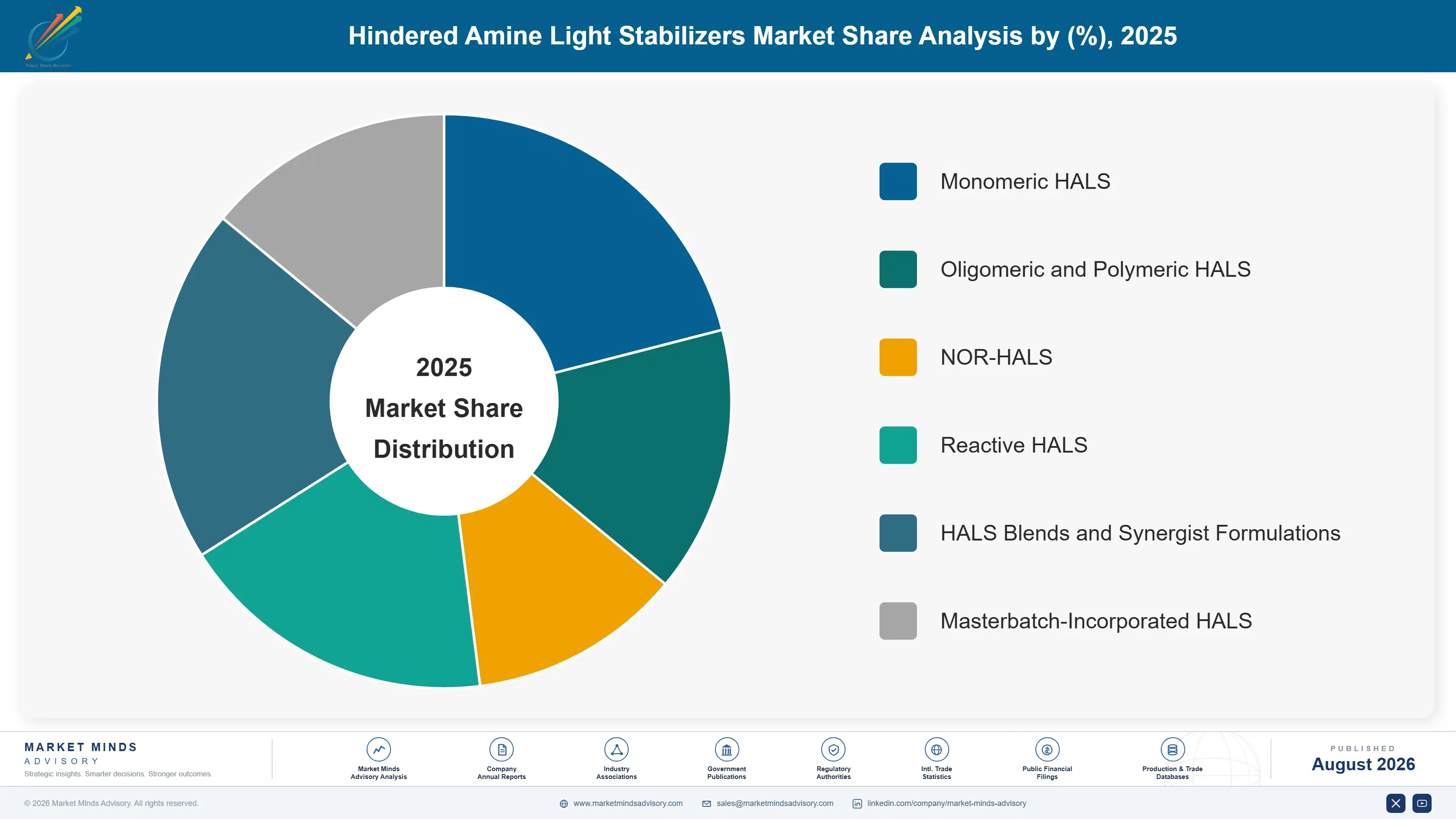
The market splits by molecular structure into six segments, since molecular weight and reactivity drive most of the cost and performance variation formulators actually evaluate. Monomeric HALS hold the largest installed base across mainstream applications, while oligomeric, polymeric, and NOR-HALS grades grow fastest as extraction resistance and pesticide compatibility become more common specification requirements.
hindered-amine-light-stabilizers-market-market-share-analysis-1787552441605

Oligomeric and Polymeric HALS

Oligomeric and polymeric HALS are growing faster than any other segment as automotive exterior and long-life agricultural film applications demand extraction resistance that smaller monomeric molecules cannot reliably provide over extended outdoor exposure periods and repeated weathering cycles. Songwon and Everlight Chemical have both expanded production capacity for these larger molecules specifically to serve this shift, even though manufacturing them costs meaningfully more than simpler monomeric alternatives given the more complex synthesis route required at scale. Warranty periods extending across multiple vehicle model years have made extraction resistance a genuine specification requirement rather than a nice-to-have feature, particularly for exterior trim and bumper applications facing direct sun exposure every day.
CAGR 7.5%

NOR-HALS

NOR-HALS addresses a genuine chemical limitation of standard HALS chemistry: interaction with sulfur-based pesticides commonly applied in intensive agriculture that otherwise permanently reduces stabilizer effectiveness partway through a growing season and full harvest cycle each and every successive year. BASF and Adeka Corporation have both expanded NOR-HALS production specifically to serve greenhouse and mulch film producers in regions with heavy pesticide application, recognizing that standard HALS simply fails to perform adequately in these specific agricultural conditions and climates worldwide. The segment commands a meaningful price premium over standard HALS grades, reflecting both the specialized chemistry involved and the smaller number of producers capable of manufacturing it reliably at commercial scale.
CAGR 7.0%
Full segment breakdown across 7 segments available in the complete report.

Regional Architecture and Country Demand Map

Regional demand concentrates wherever automotive manufacturing and protected agriculture intersect at scale worldwide. East Asia holds the largest share given China's dominant polymer compounding and automotive production base, while South Asia and Pacific posts the fastest regional growth as both major demand drivers expand rapidly.

North America

Automotive manufacturing scale and established polymer compounding infrastructure anchor demand here, with domestic automakers specifying increasingly stringent UV protection standards as warranty periods extend across successive model years and vehicle platforms nationwide and beyond. BASF and Clariant both maintain significant production and technical service capacity close to major automotive and compounding customers, reflecting decades of built relationships across the entire industry supply chain. Agricultural film consumption remains meaningful but smaller relative to automotive demand compared with regions with larger protected cultivation footprints elsewhere in the world. Canada contributes modest additional volume tied to its own automotive parts manufacturing sector and cross-border supply chains with the United States and beyond its borders.
Share: 24% | CAGR: 5.5% (2026 to 2036)

East Asia

China's massive polymer compounding and automotive manufacturing base makes it the largest single regional market, supplying both domestic consumption and meaningful export volume to global polymer processors across multiple continents and end markets simultaneously. Japanese and South Korean producers concentrate more heavily on high-purity, technically demanding grades serving premium automotive and electronics applications across the region. Domestic Chinese HALS manufacturing has scaled significantly, competing increasingly on price against established international suppliers in commodity monomeric grades sold at volume. Regional growth continues outpacing the global average as both automotive production and agricultural film consumption keep expanding across most provinces and manufacturing hubs nationwide each and every single calendar year without fail.
Share: 28% | CAGR: 6.0% (2026 to 2036)
Regional intelligence for 5 additional markets available in the complete report: Western Europe, South Asia and Pacific, Latin America, Middle East and Africa, Eastern Europe. Contact sales@marketmindsadvisory.com.
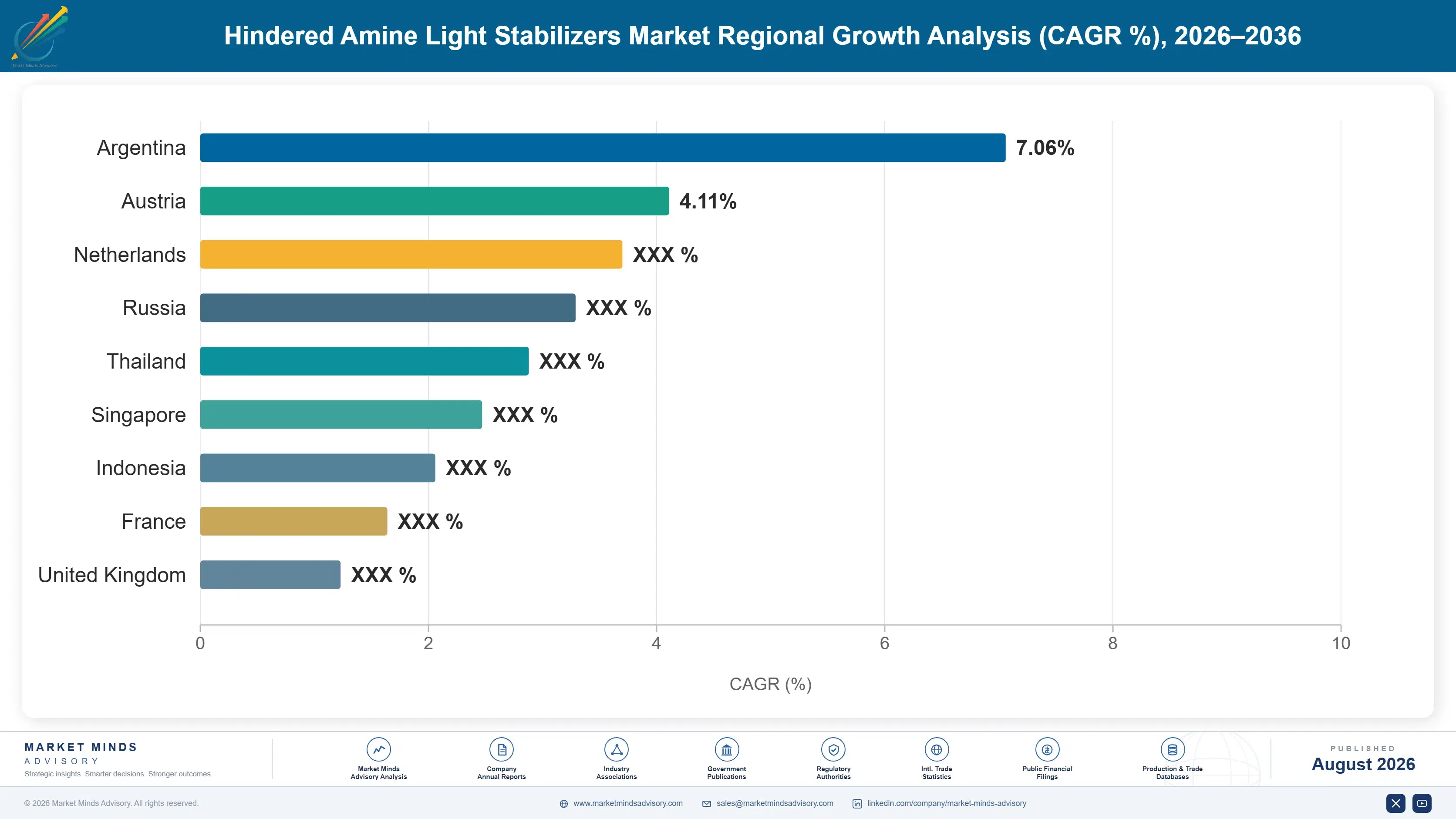
hindered-amine-light-stabilizers-market-country-cagr-analysis-1787552442123

Molecular Weight and Chemistry Set the Ceiling

Standard monomeric HALS compete largely on price once a formulation is qualified, leaving modest margins for pure commodity producers. The stronger revenue opportunities sit in oligomeric molecular weight expansion, NOR-HALS specialty chemistry, and long-term automotive qualification, categories where technical differentiation and validated performance still command meaningfully better pricing than commodity monomeric grades typically achieve at scale.

Expanding Into Higher Molecular Weight Grades

Producers who expand into oligomeric and polymeric molecular weight grades capture pricing roughly 45 percent above standard monomeric HALS sold into commodity applications with less demanding extraction resistance requirements across most markets and end uses. This requires meaningful investment in polymerization chemistry expertise beyond standard monomeric synthesis capability that most commodity producers do not possess or maintain at scale. Songwon and Everlight Chemical both pursued this expansion years before broader demand fully materialized, positioning them to capture premium contracts as automotive and agricultural customers finalize their own extraction resistance specifications.
Market Impact: Captures a full 45 percent molecular weight premium

Building Out NOR-HALS Specialty Chemistry Capability

Producers who develop NOR-HALS specialty chemistry capture pricing roughly 35 percent above standard HALS grades, since this chemistry solves a genuine pesticide interaction problem that standard formulations cannot address in intensive agricultural regions worldwide and across most climates and growing seasons. Winning this business requires specialized synthesis expertise and agricultural market relationships beyond standard polymer additive sales channels that most producers lack entirely today. BASF and Adeka Corporation have both invested early in this capability, capturing greenhouse film customers who increasingly specify NOR-HALS over standard grades despite the added cost involved.
Market Impact: Commands a full 35 percent specialty chemistry premium

Locking In Long-Term Automotive Supplier Qualification

Producers who secure long-term automotive supplier qualification capture recurring contract revenue running roughly 30 percent above spot market sales, since automakers rarely requalify additive suppliers once a formulation passes their extensive warranty validation testing process successfully and thoroughly the very first time it is submitted. Winning these qualifications requires demonstrating consistent performance across multiple production batches over an extended testing period lasting many months or longer still before final approval is granted. Producers who invest early in this qualification process capture multi-year platform contracts that competitors cannot easily displace once established.
Market Impact: Locks in a 30 percent contract revenue premium

Who Controls the Margin Pool

Concentration sits moderate to high at a CR5 near 52 percent, calculated on shipment volume across all molecular structures. BASF holds the clearest leadership position given its scale across monomeric, oligomeric, and NOR-HALS chemistry and its established relationships with major automotive and agricultural customers. The gap to challengers like Clariant is narrower in commodity monomeric segments than in specialty NOR-HALS and high molecular weight tiers, where fewer producers compete credibly.
Current competitive activity centers on oligomeric capacity expansion and NOR-HALS specialty chemistry development, as producers race to capture premium pricing beyond commodity monomeric sales alone across most end markets worldwide. Songwon and Everlight Chemical have both expanded oligomeric production, while Adeka Corporation continues developing NOR-HALS capability to differentiate from producers confined to standard monomeric grades.

Emerging pressure comes from Chinese domestic producers scaling specialty chemistry capability within their large home market, a trajectory that could eventually support competition beyond commodity monomeric grades into oligomeric and NOR-HALS segments currently dominated by established multinational suppliers. Rankings could shift meaningfully over the next decade if these producers close the remaining synthesis expertise and automotive qualification capability gap that currently protects incumbents.
hindered-amine-light-stabilizers-market-company-positioning-matrix-1787552442641

Competitive Moat and Risk Dimensions

BASF

Moat: Broad Chemistry Portfolio Scale

BASF's presence across monomeric, oligomeric, and NOR-HALS chemistry lets it serve automotive and agricultural customers from a shared technical service base, reducing per-program development cost compared with narrower specialist competitors focused on a single chemistry type across their entire product line and customer base globally.
BASF

Risk: Exposure to Commodity Price Pressure

BASF's revenue base still includes meaningful monomeric HALS volume exposed to price competition from Chinese domestic producers scaling commodity chemistry capability within their large home market at increasingly competitive cost levels across the entire industry and well beyond it each and every single passing year.
CLARIANT

Moat: Deep Automotive Technical Service

Clariant has invested for decades in technical service relationships with automotive compounders, positioning it favorably as automakers demand progressively tighter warranty performance that rewards suppliers with proven formulation support capability built over many years of shared engineering work, close collaboration, and mutual trust across programs.
CLARIANT

Risk: Limited NOR-HALS Product Presence

Clariant's relative focus on automotive and industrial applications potentially limits its exposure to the faster-growing NOR-HALS agricultural segment that BASF and Adeka Corporation increasingly capture across intensive farming regions worldwide and over the coming several years still further and even further out ahead than expected.

Players Tracked

Prominent Players

BASF
Clariant
Songwon
Everlight Chemical
Adeka Corporation

Other Key Players

SI Group
Sabo S.p.A.
Solvay
Lanxess
Cytec Industries
Chitec Technology
Sudarshan Chemical Industries
Jiangsu Liyang Chemical
Beijing Additive Chemicals
Rianlon Corporation
Nanjing Union Chemical
Sichuan Tianhe Chemical
Zhejiang Kailin Chemical
Kingswell Group
Milliken Chemical

Recent Developments

MAY 2025

BASF announced an expansion of its oligomeric HALS production capacity at its European facility, adding capacity specifically to serve automotive compounders scaling extended-warranty exterior component production ahead of continued demand growth over the following several years across the wider region and well beyond it entirely.
Signal: Signals supplier confidence that oligomeric demand will sustain long-term capacity utilization broadly across most global regions
NOVEMBER 2025

Adeka Corporation entered a multi-year supply agreement with a major greenhouse film manufacturer to provide NOR-HALS across several production facilities, reinforcing its position in a category increasingly valued for pesticide interaction resistance and reliable performance nationwide and increasingly abroad as well today and well into tomorrow.
Signal: Confirms major film manufacturers increasingly commit to multi-year supply contracts over spot purchasing decisions today overall
FEBRUARY 2026

Songwon launched an expanded polymerization research laboratory aimed at accelerating development of next-generation high molecular weight HALS structures entering commercial evaluation ahead of upcoming automotive qualification cycles scheduled for the following two years across several major global markets and manufacturing regions worldwide as well as domestically.
Signal: Signals a competitive shift toward molecular weight innovation rather than pure production scale alone here today

Piperidine Chemistry Drives Cost

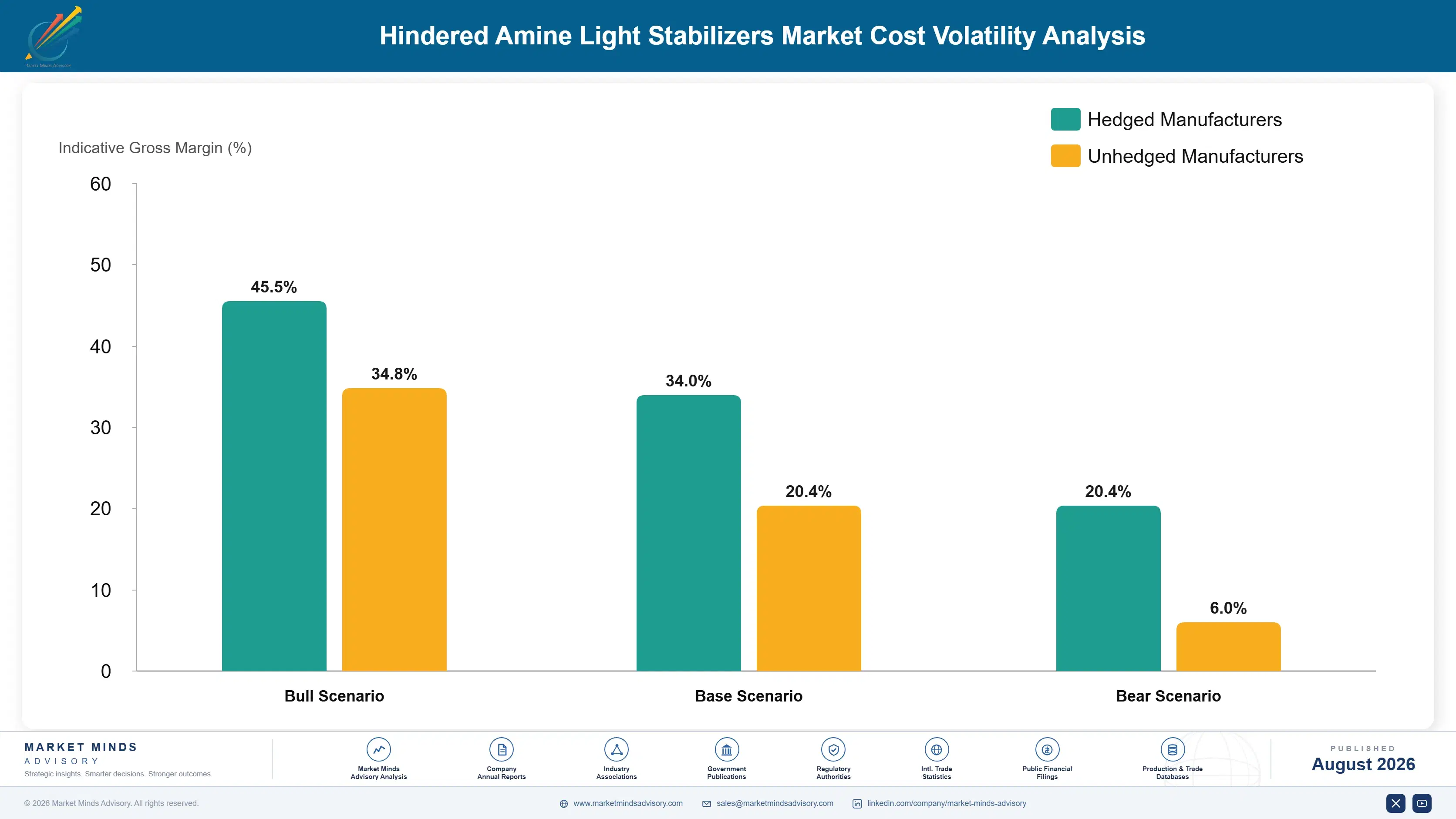
Piperidine derivatives account for roughly 48 percent of total HALS production cost, the core building block from which nearly all hindered amine structures are synthesized regardless of final molecular weight or intended application. Piperidine intermediates trace back to specialty chemical facilities concentrated in China, Germany, and Japan, while downstream synthesis capacity spans a broader set of producing countries worldwide.
Piperidine intermediate prices spiked meaningfully during 2022 as supply chain disruption coincided with rising demand from multiple specialty chemical sectors competing for the same intermediate feedstock, according to industry and company annual report disclosures. HALS manufacturers locked into annual automotive and agricultural supply contracts could not pass that increase through immediately, compressing margins for several quarters until contract renewal cycles allowed repricing closer to current feedstock cost levels.

Smaller regional producers without diversified piperidine sourcing face proportionally larger margin swings than large multinational producers who can shift purchasing across multiple intermediate suppliers depending on relative input cost and availability. This creates a durable cost advantage for scale players, since geographic and supplier diversification functions as a hedge unavailable to single-source regional competitors operating on thinner margins.
hindered-amine-light-stabilizers-market-cost-volatility-analysis-1787552442836

Index-Linked Piperidine Pricing in Contracts

Larger producers are negotiating index-linked pricing clauses tied to published piperidine intermediate benchmarks directly into annual automotive and agricultural supply contracts, letting cost pass-through occur quarterly rather than waiting for full contract renewal. This reduces the multi-quarter margin compression smaller producers without comparable negotiating leverage continue to experience during intermediate price spikes across most regions.

Backward Integration Into Piperidine Synthesis

Larger producers are investing in backward integration into piperidine intermediate synthesis specifically to reduce dependence on merchant feedstock purchases during periods of price volatility or supply disruption. This integration strategy requires substantial upfront capital investment but pays off during exactly the volatility periods when merchant-dependent competitors face the largest margin pressure and cost exposure.

Portfolio Architecture for Margin Defence

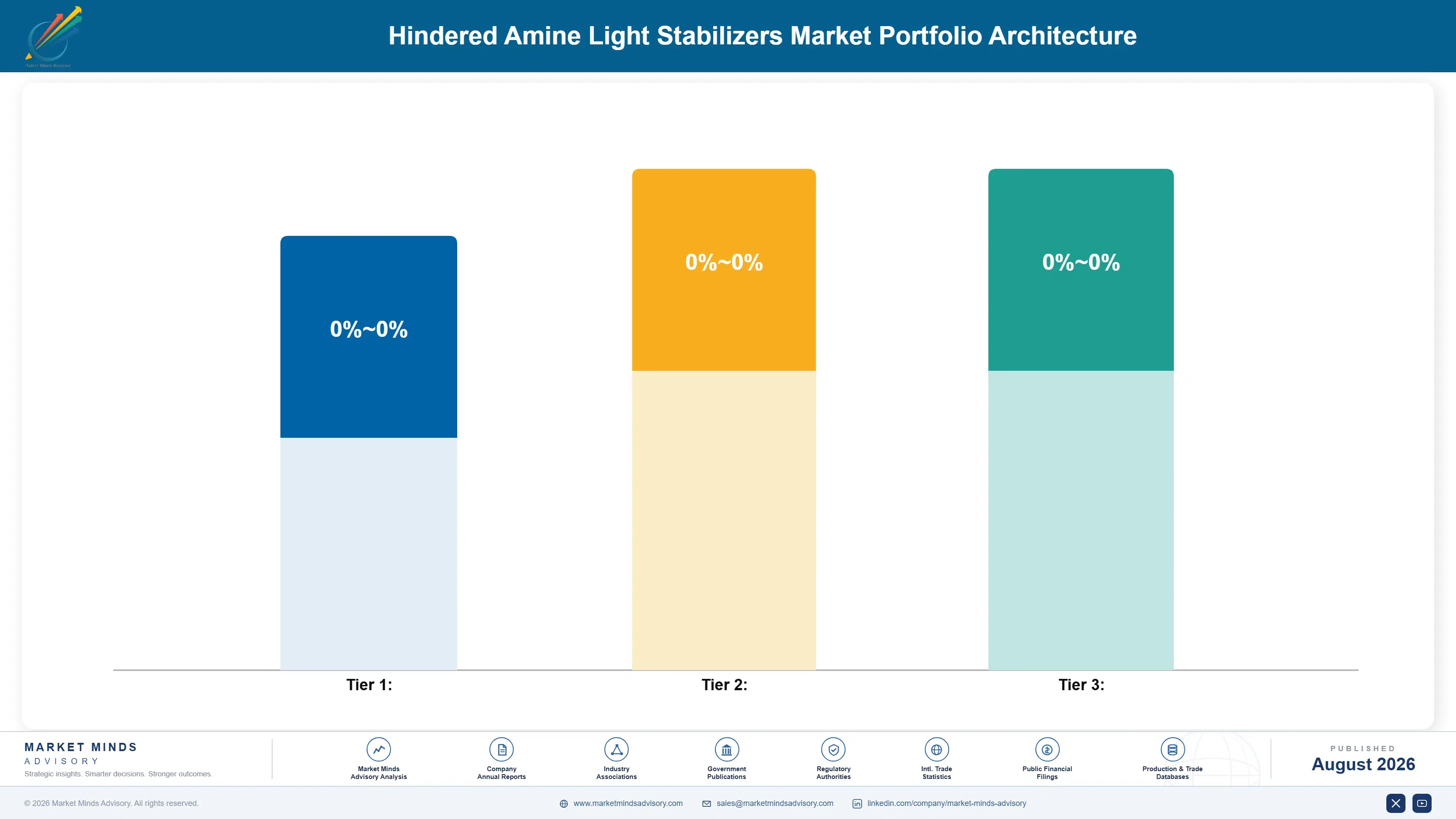
Three margin tiers define this category. Volume and commodity-adjacent products, mostly standard monomeric HALS, compete on price with gross margins around 18 to 25 percent. Premium and certified products including oligomeric and reactive grades command 28 to 36 percent margins across most transactions. Sustainability and next-generation NOR-HALS and polymeric structures sit highest, reflecting both synthesis complexity and buyer willingness to pay for validated extraction resistance.
The volume versus premium tension shows up clearest in production line allocation decisions, since converting capacity to oligomeric or NOR-HALS synthesis reduces available capacity for lower-margin monomeric material that still represents meaningful revenue in cost-sensitive applications worldwide. Producers balancing this tradeoff carefully tend to outperform those chasing premium categories too aggressively before customer qualification cycles complete, particularly when capital commitments run ahead of confirmed demand signals.

High-value margin pools concentrate specifically around NOR-HALS specialty chemistry and automotive-qualified oligomeric grades, both categories where synthesis expertise and validation depth support pricing well above commodity monomeric levels sustainably, even as overall category volume growth moderates toward the middle of the forecast period and customers consolidate sourcing toward fewer qualified producers with proven track records.

Standard monomeric HALS sold primarily on price to mainstream polymer compounders, with limited differentiation between suppliers beyond delivery reliability, basic cost competitiveness, and modest volume discount structures offered to the largest recurring accounts each contract cycle.
Gross Margin

Oligomeric and reactive HALS sold to automotive and demanding outdoor applications where extraction resistance justifies meaningfully higher unit prices than standard monomeric alternatives, with certification testing creating a real barrier smaller producers rarely clear on their own.
Gross Margin

NOR-HALS and high molecular weight polymeric structures sold to customers requiring specialty performance, commanding the category's highest margins given constrained synthesis capacity relative to demand and continued capability lag among smaller producers industry-wide today.
Gross Margin
hindered-amine-light-stabilizers-market-portfolio-architecture-1787552443333

High-value Sub-segments and Strategic Watch-out

Oligomeric and Polymeric HALS

Oligomeric and polymeric HALS combine premium pricing with the fastest content growth in the category, as automotive and agricultural customers increasingly demand extraction resistance that monomeric grades cannot reliably provide, a shift accelerating faster than overall category volume growth would suggest across most tracked applications and markets.

NOR-HALS

NOR-HALS carries strong margins and steady adoption momentum among greenhouse film producers, though growth has moderated slightly as the segment matures beyond its initial pesticide-resistance adoption wave into broader use cases requiring somewhat different specifications and formulation approaches across more crop types and growing regions.

Monomeric HALS

Monomeric HALS remains the volume backbone of the category, generating the largest absolute revenue even as its relative share slowly declines against faster-growing oligomeric and NOR-HALS alternatives across most regions and application segments worldwide each and every single successive production year without any exception whatsoever.

Masterbatch-Incorporated HALS

Masterbatch-incorporated HALS remains a smaller niche today but warrants close monitoring, since compounders seeking simplified processing could shift meaningful demand toward pre-blended masterbatch formats over standard powder addition, reshaping category economics for powder-focused producers gradually and rather unpredictably over the coming several years still further ahead.

Formulation Lock-In Anchors Repeat Purchase

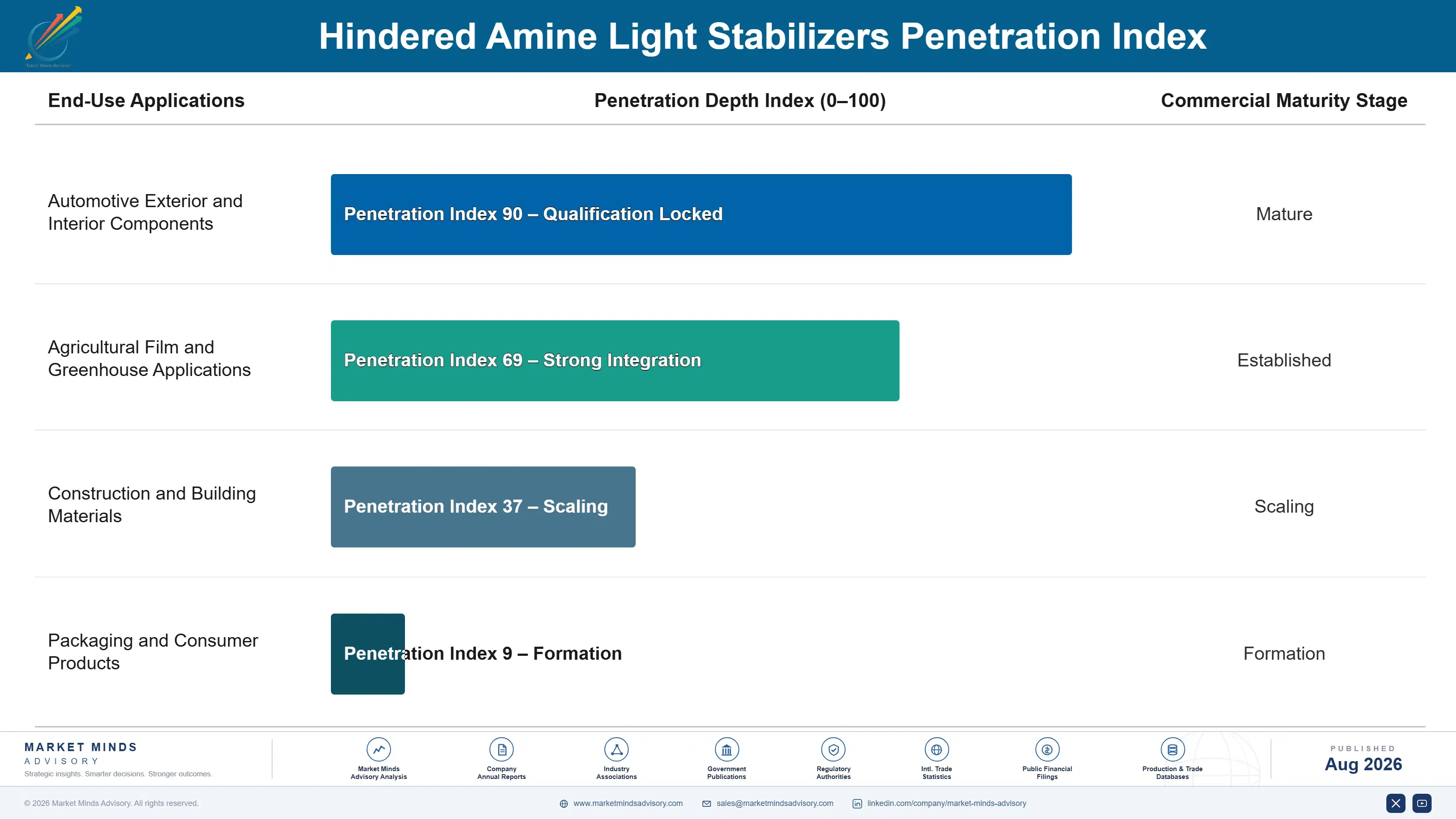
HALS demand behaves like a recurring consumable tied to ongoing polymer production rather than a one-time capital purchase, since every batch of exterior automotive plastic or agricultural film requires fresh stabilizer incorporated during compounding. Once a formulation passes automotive warranty validation or agricultural performance testing, switching suppliers requires repeating that validation process, creating a meaningful switching cost that favors incumbent suppliers over new entrants offering marginally lower prices alone.
Adoption stickiness varies meaningfully by end-use vertical. Automotive customers show the deepest lock-in, given formal warranty validation requirements that make switching suppliers mid-platform costly and slow across an entire vehicle generation. Commodity packaging and industrial applications show shallower stickiness, since those uses carry fewer differentiating specifications and buyers can shift suppliers more easily when price competition intensifies.

Buyer profiles are shifting generationally as polymer formulation teams increasingly recruit from materials science backgrounds emphasizing long-term durability testing rather than pure cost-focused procurement expertise, changing how supplier evaluation criteria get weighted. Younger formulators entering these roles show more comfort evaluating molecular weight and extraction resistance tradeoffs in depth, accelerating oligomeric and NOR-HALS adoption faster than pure cost economics alone would predict.
hindered-amine-light-stabilizers-market-end-use-penetration-index-1787552443813

What Determines Winners in HALS

These are among the four positions where our research anticipates prominent divergence between winners and laggards over the coming forecast period. Each is grounded in the demand model, the regulatory perimeter, and the announced capacity pipeline.
01 / MOLECULAR WEIGHT DIVERSIFICATION

Build Oligomeric Capability Before Demand Peaks

Producers who invest in oligomeric and polymeric synthesis capability before automotive and agricultural demand fully materializes capture premium contracts more easily than those entering after customers have already qualified established suppliers and locked in long-term agreements. Building that capability after demand is visible means competing against producers who established documented performance track records years earlier through sustained investment and patient testing work. The qualification cycle itself takes long enough that late movers effectively concede the category's highest-margin segment to whoever invested first.
02 / NOR-HALS CHEMISTRY INVESTMENT

Develop Pesticide-Resistant Formulations Ahead of Rivals

Producers who develop NOR-HALS specialty chemistry before broader agricultural demand materializes capture premium greenhouse film contracts more easily than those entering after competitors have already built customer relationships and locked in long-term supply agreements. This works best for producers who can demonstrate documented performance in regions with heavy pesticide use where standard HALS chemistry genuinely fails to perform adequately. Producers pursuing this strategy should prioritize the most intensive agricultural regions first, since those relationships prove hardest for competitors to displace afterward.
03 / AUTOMOTIVE WARRANTY QUALIFICATION

Secure Automaker Contracts Before Platform Cycles Lock

Producers who secure automotive warranty qualification before platform sourcing decisions lock in capture multi-year contracts that competitors cannot easily displace once a vehicle generation enters full production across multiple plants. This works best for producers who invest early in extended validation testing that automakers increasingly require as warranty periods lengthen across the industry and across model years. Producers pursuing this strategy should prioritize automakers planning the longest warranty commitments first, since those relationships prove hardest to win back once lost.
04 / GEOGRAPHIC CAPACITY REBALANCING

Weight New Capacity Toward South Asia and Pacific

Producers concentrated in Western Europe and North America should weight incremental capacity investment toward South Asia and Pacific, where automotive manufacturing and protected agriculture growth are creating the fastest addressable demand growth globally by a clear margin. Waiting for demand to fully materialize before investing risks ceding early relationships to regional producers who move faster despite weaker synthesis capability and thinner technical service infrastructure overall. Early capacity commitment there compounds into durable customer relationships as regional production volume keeps climbing.

Engagement Snapshot From the Field

A live engagement with an industry participant carrying material or product regulatory and market exposure ahead of a defining policy shift, showing how our research translates into a defensible multi-year portfolio strategy.
MARKET MINDS ADVISORY · CLIENT ENGAGEMENT SUMMARY
Hindered Amine Light Stabilizers Producer Strategic Portfolio Review and Transition Roadmap 2026·Investment Scenario on Hindered Amine Light Stabilizers Exposure Evaluation 2025-26
CLIENT PROFILE
The client is a European automotive exterior component supplier producing bumpers and trim parts for several major automakers, each specifying different warranty periods and UV protection requirements across their vehicle platforms. Facing pressure to standardize its stabilizer formulation across multiple customer specifications while managing raw material cost, the materials engineering team needed to determine whether a single higher-performance HALS grade could satisfy every warranty requirement without maintaining separate formulations.
STRATEGIC CHALLENGE
The client needed to determine whether upgrading to a single oligomeric HALS grade across all customer platforms would genuinely meet the longest warranty requirements without over-engineering components for automakers with much shorter warranty periods and correspondingly much lower cost tolerance across their entire product lines and various vehicle platforms overall.
MMA APPROACH
MMA conducted a structured comparison of HALS grades against each customer's specific warranty and UV exposure requirements, supplemented by primary interviews with materials engineers at comparable component suppliers who had already standardized across multiple automaker platforms. The analysis modeled performance margin and total cost tradeoffs across several formulation approaches and supplier strategies.
KEY FINDINGS
  1. A single oligomeric HALS grade could meet the longest warranty requirement across all customer platforms without requiring separate formulations per automaker or program.
  2. Standardizing on the higher-performance grade increased material cost modestly but reduced formulation management complexity and inventory carrying costs quite substantially overall today.
  3. Competitors who maintained separate formulations per platform reported meaningfully higher quality control costs than those who had already standardized their formulation approach.
  4. Customers with shorter warranty periods showed no measurable cost sensitivity to receiving components formulated with the higher-performance stabilizer grade instead of the standard one.
CLIENT PROFILE
The client is a European automotive exterior component supplier producing bumpers and trim parts for several major automakers, each specifying different warranty periods and UV protection requirements across their vehicle platforms. Facing pressure to standardize its stabilizer formulation across multiple customer specifications while managing raw material cost, the materials engineering team needed to determine whether a single higher-performance HALS grade could satisfy every warranty requirement without maintaining separate formulations.
STRATEGIC CHALLENGE
The client needed to determine whether upgrading to a single oligomeric HALS grade across all customer platforms would genuinely meet the longest warranty requirements without over-engineering components for automakers with much shorter warranty periods and correspondingly much lower cost tolerance across their entire product lines and various vehicle platforms overall.
MMA APPROACH
MMA conducted a structured comparison of HALS grades against each customer's specific warranty and UV exposure requirements, supplemented by primary interviews with materials engineers at comparable component suppliers who had already standardized across multiple automaker platforms. The analysis modeled performance margin and total cost tradeoffs across several formulation approaches and supplier strategies.
KEY FINDINGS
  1. A single oligomeric HALS grade could meet the longest warranty requirement across all customer platforms without requiring separate formulations per automaker or program.
  2. Standardizing on the higher-performance grade increased material cost modestly but reduced formulation management complexity and inventory carrying costs quite substantially overall today.
  3. Competitors who maintained separate formulations per platform reported meaningfully higher quality control costs than those who had already standardized their formulation approach.
  4. Customers with shorter warranty periods showed no measurable cost sensitivity to receiving components formulated with the higher-performance stabilizer grade instead of the standard one.
RECOMMENDED STRATEGY
Phase 1: Phase one: standardize on the oligomeric HALS grade for all new platform programs entering development going forward starting right away. Phase 2: Phase two: transition existing platform programs to the standardized formulation during their next scheduled material qualification cycle and full review. Phase 3: Phase three: retire legacy monomeric formulations entirely once all active platforms have fully transitioned to the newly standardized grade completely.
OUTCOME
The client adopted the standardized oligomeric formulation across new platform programs, reducing formulation management complexity meaningfully (client-reported, unverified by MMA) while meeting every customer's warranty requirement with a single grade, according to the client's own internal engineering data shared throughout the entire engagement process overall.

Frequently Asked Questions

Foundational context covering the market sizes, CAGR, scope, country, region and competition that inform every finding below. This section is provided to cover basics and most often pre-purchase conversations, answered from the MMA Primary Research Dataset.

What is the current size of the Hindered Amine Light Stabilizers Market?

The global hindered amine light stabilizers market reached approximately 1.45 billion dollars in 2025. Growth is driven by rising automotive plastic content and expanding protected agriculture worldwide.

How large will the Hindered Amine Light Stabilizers Market be by 2036?

MMA projects the market will reach approximately 2.61 billion dollars by 2036, roughly 1.71 times its 2026 value. Oligomeric and polymeric HALS will drive most of that expansion.

What is the CAGR for the Hindered Amine Light Stabilizers Market 2026 to 2036?

The market is projected to grow at a 5.5 percent compound annual rate between 2026 and 2036. Bull and bear scenarios range from 4.3 to 6.7 percent depending on automotive lightweighting speed.

Which segment is growing fastest?

Oligomeric and polymeric HALS are growing fastest at a 7.5 percent CAGR, roughly 1.36 times the overall market rate. Automotive and agricultural extraction resistance demand drives this outperformance.

Who are the major companies in the Hindered Amine Light Stabilizers Market?

BASF, Clariant, Songwon, Everlight Chemical, and Adeka Corporation lead the market today. Together they hold roughly 52 percent combined share on a shipment volume basis.

Which country is growing fastest?

India leads regional growth at a 7.0 percent CAGR, supported by its expanding automotive manufacturing sector and rapidly growing protected agriculture. Southeast Asian markets follow closely behind.

Report Segmentation Architecture

The full report scope spans multiple orthogonal segmentation dimensions, with cross-tabulated demand data provided for each dimension pair. Coverage extends further to regional breakdowns, trend trajectories, and the competitive detail needed to support segment-level decision-making.
  • Monomeric HALS
  • Oligomeric and Polymeric HALS
  • NOR-HALS
  • Reactive HALS
  • HALS Blends and Synergist Formulations
  • Masterbatch-Incorporated HALS
  • Automotive Exterior and Interior Components
  • Agricultural Film and Greenhouse Applications
  • Construction and Building Materials
  • Packaging and Consumer Products
  • Direct Producer-to-Compounder Contracts
  • Distributor and Specialty Chemical Reseller Sales
  • Long-Term Automotive Supply Agreements

By Region

  • North America
  • East Asia
  • Western Europe
  • South Asia and Pacific
  • Latin America
  • Middle East and Africa
  • Eastern Europe

Scope, Methodology, and Coverage

Every figure in this report is reproducible from documented input assumptions. The scope below maps the historical period, the forecast horizon, the segmentation dimensions, and the countries covered, alongside the underlying primary and qualitative methodology.
Historical Period
2020 to 2025
Forecast Period
2026 to 2036
Base Year
2025 (USD billions; MMA Primary Research Dataset, August 2026)
Market Definition
The hindered amine light stabilizers market covers monomeric, oligomeric and polymeric, NOR-HALS, reactive, blend and synergist, and masterbatch-incorporated HALS products sold as polymer additives for plastics, coatings, and rubber applications. It excludes ultraviolet absorbers sold as a standalone additive class and antioxidants sold for thermal rather than photo-oxidative stabilization.
Quantitative Units
USD billions
Segmentation Dimensions
Regions Covered
North America, East Asia, Western Europe, South Asia and Pacific, Latin America, Middle East and Africa, Eastern Europe
Countries Covered
Key Companies Profiled
BASF, Clariant, Songwon, Everlight Chemical, Adeka Corporation, SI Group, Sabo S.p.A., Solvay, Lanxess, Cytec Industries, Chitec Technology, Sudarshan Chemical Industries, Jiangsu Liyang Chemical, Beijing Additive Chemicals, Rianlon Corporation, Nanjing Union Chemical, Sichuan Tianhe Chemical, Zhejiang Kailin Chemical, Kingswell Group, Milliken Chemical
Quantitative Methodology
Primary survey, n=3,800 respondents, Q4 2025, six countries; demand-side model with trade association cross-validation
Qualitative Methodology
47 expert interviews, Q4 2025; applied to validate demand model assumptions, identify emerging dynamics, and assess competitive positioning
Report Format
PDF and XLSX data workbook (Word format preview document)
Publisher
Market Minds Advisory
Report Code
MMA-2026-CHM-110
Published
August 2026
Contact
sales@marketmindsadvisory.com | www.marketmindsadvisory.com

Purchase the full Hindered Amine Light Stabilizers Market Report (2026 to 2036).

This report provides a comprehensive assessment of the global hindered amine light stabilizers market. It covers sizing, segmentation, competitive dynamics, and regional demand through 2036. The analysis examines the shift from standard monomeric grades toward oligomeric, polymeric, and NOR-HALS formats driven by automotive warranty extension and agricultural pesticide interaction challenges across major producing and consuming regions worldwide today. It includes detailed competitive profiling of leading producers, feedstock cost exposure across the piperidine intermediate supply chain, and a phased case study on automotive stabilizer standardization strategy.
Ten-year market sizing and forecast scenarios
Six-segment MECE molecular structure classification framework
Seven-region demand and growth rate analysis
Competitive profiling of five leading producers
Feedstock cost exposure across piperidine supply chains
Anonymized client case study on standardization strategy

Built For The People Who Decide

From boardroom strategy to bench-side execution, this report is read cover-to-cover by leaders shaping the next decade of their industry, turning demand scenarios, market dynamics and valuation benchmarks into decisions.
CXOs/ Presidents/ VPs/ Managers
M&A and Corporate Development
Strategy Teams and R&D Heads
Procurement and Product Directors
Regulatory and Compliance Leaders
Investor Relations and Equity Analysts