Market Minds Advisory
High Voltage Switchboard Market

High Voltage Switchboard Market: Trends and Forecast 2026 to 2036

Grid modernization spending and renewable interconnection projects are pulling switchboard demand toward gas-insulated and digitally monitored designs, even as China's state-backed transmission buildout scales manufacturing capacity faster than most competing regions can match.

Lead Analyst

David Horsley

Published

September 2026

Make Smarter Decisions with Customized Research Insights

Request a free sample report and evaluate market opportunities, growth trends, and competitive dynamics relevant to your business needs.

2025 MARKET VALUE$8.5BMarket Size 2025
2036 FORECAST VALUE$16.1BBase Case , 2026 to 2036
CAGR 2026 TO 20366.0 %Bull 7.2% / Bear 4.8%
INCREMENTAL OPPORTUNITY$7.1BNet 10- year value creation
EXPANSION MULTIPLE1.79x2036 value over 2026 base
Strategic Levers
M&A Pipeline
Regional Outlook
Country Rankings
Competitive Intelligence
Segmental Deep-dive
Call-Us : 91 93563 13602

Executive Snapshot and Market Trajectory

High voltage switchboard demand is shifting toward gas-insulated and digitally monitored designs as grid operators pursue space-constrained urban substations and remote diagnostic capability, even as conventional air-insulated switchgear continues anchoring most utility and industrial replacement demand across established grid infrastructure worldwide today and quite consistently.
Commercial forces now split the market between utilities modernizing aging transmission infrastructure and industrial buyers installing new switchgear for data center, manufacturing, and renewable interconnection projects. Digital and smart monitoring systems are the fastest-growing segment, expanding as grid operators seek remote diagnostic capability and predictive maintenance data across increasingly complex distribution networks. East Asia and North America together account for most global demand, split between China's transmission buildout and mature US grid replacement cycles.
Competitive intensity concentrates among a handful of global electrical equipment majors holding the manufacturing scale and certification portfolios required to serve utility-grade procurement, leaving lower-voltage industrial segments more fragmented across regional manufacturers and smaller specialists. Long utility qualification cycles add a further layer of complexity, since utilities rarely switch suppliers mid-contract given the multi-decade service life expectations attached to transmission-grade equipment across most established grid networks.
Market Definition
The High Voltage Switchboard Market covers metal-enclosed switchgear assemblies rated above 1 kV used for power distribution, protection, and control in utility, industrial, and commercial power systems. It excludes low-voltage panelboards, standalone transformers, and cabling products sold separately from a switchgear assembly.
Base Year Value
$8.5B in 2025 (MMA Primary Research Dataset, August 2026)
Forecast Period
2026 to 2036, eleven discrete annual values
CAGR
6.0% base case. Bull 7.2%. Bear 4.8%.
Fastest Growth Segment
Digital and Smart Switchgear Monitoring Systems: 8.5% CAGR
Fastest Growth Country
India: 8.3% CAGR
Fastest Growth Region
South Asia and Pacific: 8.0% CAGR
Largest Region
East Asia: 34% of 2025 global value
Market Leaders
ABB, Siemens Energy, Schneider Electric, GE Vernova, Mitsubishi Electric (MMA Analysis, 2025).
Primary Survey
n=3,800 procurement and R&D decision-makers, Q4 2025, six countries
Methodology
Demand-side build-up, cross-validated against public data, 47 expert interviews

High Voltage Switchboard Market Forecast Scenarios

high-voltage-switchboard-market-size-forecast-scenario-1787553036803
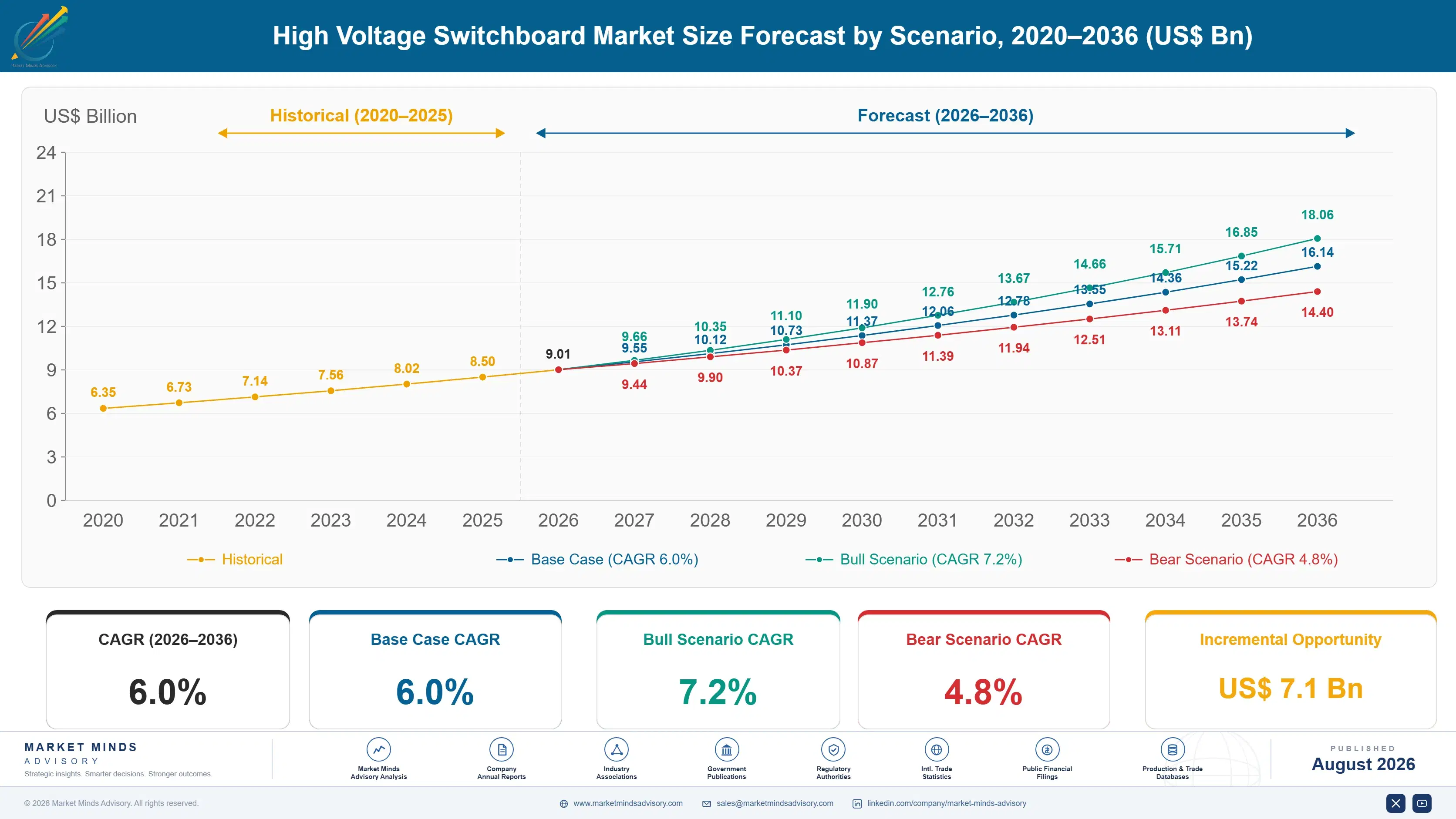
The high voltage switchboard market grew at an estimated 5.3% annually between 2020 and 2025, supported by steady utility grid replacement cycles and gradually expanding data center and renewable interconnection demand. Growth accelerated toward the end of the period as grid operators began prioritizing digital monitoring retrofits alongside traditional switchgear replacement programmes across major transmission networks.
The base case assumes 6.0% annual growth through 2036, driven by three commercial mechanisms: expanding renewable energy interconnection projects requiring new substation switchgear capacity, growing data center construction demanding reliable high voltage power distribution infrastructure, and continued Chinese state-backed transmission grid investment sustaining regional manufacturing scale. Digital monitoring retrofit demand is also accelerating as utilities pursue predictive maintenance capability, favoring manufacturers who already integrate smart sensor technology over legacy equipment suppliers.
The bull case, at 7.2%, assumes accelerated data center construction and renewable interconnection spending drives faster switchgear replacement across multiple regions simultaneously, particularly in North America and East Asia. The bear case, at 4.8%, assumes utility capital spending constraints and extended qualification cycles slow new switchgear adoption beyond routine replacement demand longer than currently expected across most established grid networks.

Grid Modernization Reshapes Switchgear Specification

The High Voltage Switchboard Market serves as critical infrastructure connecting power generation, transmission, and distribution networks, making it one of the more conservative procurement categories in industrial equipment given the multi-decade service life utilities expect from installed assets across most grid systems. Grid modernization and renewable interconnection are gradually shifting specification preferences toward gas-insulated and digitally monitored designs.
MARKET CONCENTRATION48%Top five producers hold combined global market share
AVERAGE SELLING PRICE$85,000 per unitReflects blended pricing across voltage classes and configurations
TOP PRODUCER SHARE30%China leads global manufacturing capacity for this equipment
CAPACITY UTILIZATION72%Producers run plants below typical mature industry ceiling
FEEDSTOCK SHARE OF COGS38%Copper and steel material inputs dominate production costs
REPLACEMENT CYCLE25 to 30 yearsInstalled equipment serves utilities for multiple decades reliably
Production requires substantial capital investment in testing and certification infrastructure, since utility-grade switchgear must pass extensive type testing before qualifying for grid deployment, concentrating utility-grade manufacturing among a handful of established global equipment majors. Lower-voltage industrial switchgear production is comparatively less concentrated, with regional manufacturers across East Asia and elsewhere serving commercial and light industrial demand at lower price points and shorter qualification cycles than utility buyers require.
Capacity utilization runs below typical mature industry levels, reflecting substantial manufacturing capacity built during periods of anticipated grid investment that has not always materialized on the originally projected timeline. Copper and steel material costs represent a meaningful share of total cost of goods sold, leaving certification portfolio breadth and installed base reputation as key differentiators between manufacturers competing for utility contracts.
"Utilities buy switchgear the way most people buy a house, expecting to live with the decision for thirty years, which is exactly why the qualification process takes so long and why incumbents rarely get displaced. The real competitive battle is happening in the digital retrofit market, not in new equipment sales."
Senior Analyst, Electrical Equipment and Grid Infrastructure Practice · MMA Construction and Industrial Equipment Practice · August 2026

Market Trends

Digital Monitoring Retrofit Demand Accelerates Across Utility Networks

Utilities are retrofitting existing switchgear installations with digital sensor and remote diagnostic capability at an accelerating pace since 2023, seeking predictive maintenance data that reduces unplanned outage risk across aging transmission and distribution infrastructure. This retrofit demand represents a distinct commercial opportunity from new equipment sales, since it applies to the much larger installed base of switchgear already in service rather than only new construction projects. Manufacturers offering retrofit-compatible sensor packages are capturing recurring service revenue that traditional equipment-only suppliers cannot access without developing comparable digital capability of their own.
Market Impact: Data center demand accelerated since 2023
Gas-Insulated Switchgear Adoption Expands In Urban Substations

Gas-insulated switchgear adoption has expanded steadily since 2022 as utilities and industrial buyers site new substations in space-constrained urban and offshore locations where traditional air-insulated equipment's larger footprint becomes impractical or prohibitively expensive to accommodate across most dense metropolitan areas worldwide. This shift favors manufacturers with established gas-insulated switchgear manufacturing capability and certification portfolios over competitors offering only conventional air-insulated designs. Urban substation projects increasingly specify gas-insulated equipment by default rather than evaluating both technologies, reflecting how thoroughly the space-efficiency advantage has become standard practice in dense metropolitan grid planning.
Market Impact: State Grid investment sustained since 2022

Market Opportunities and Growth Drivers

Data Center Construction Boom Drives Power Infrastructure Demand

Data center construction has accelerated sharply since 2023, driven by cloud computing and artificial intelligence workload growth requiring substantial dedicated power infrastructure at each new facility site across most major metropolitan markets. Every hyperscale data center campus requires dedicated high voltage switchgear to manage power distribution reliably at the scale these facilities demand, creating a large and growing addressable market segment that barely existed at comparable scale five years ago. Manufacturers with established relationships among data center developers and utility interconnection teams are capturing disproportionate share of this rapidly expanding demand category.
Market Impact: Qualification takes 3 to 5 years

Chinese State Grid Investment Sustains Regional Manufacturing Scale

China's State Grid Corporation has maintained substantial annual transmission and distribution infrastructure investment since 2022, sustaining domestic switchgear manufacturing capacity at a scale that dwarfs comparable investment programmes in most other regions worldwide by a genuinely wide and sustained margin overall. This sustained investment gives Chinese manufacturers cost and volume advantages that support both domestic supply and growing export competitiveness in international markets. Manufacturers positioned within China's domestic supply chain are capturing consistent, predictable order volume that manufacturers dependent on more cyclical Western utility capital spending programmes cannot always match.
Market Impact: Metal prices swung significantly through 2022

Market Restraints and Challenges

Long Utility Qualification Cycles Slow New Entrant Access

Utilities require extensive type testing and multi-year field qualification history before approving a new switchgear supplier, a process that routinely takes three to five years for manufacturers without existing utility relationships to complete successfully. The root cause is the extreme reliability requirements utilities place on transmission-grade equipment, where a single failure can cause widespread outage and safety risk across an entire regional grid. The commercial impact locks in incumbent suppliers for decades, and new entrants are responding by partnering with established manufacturers or targeting less conservative industrial and commercial customers first.
Market Impact: Retrofit demand accelerated since 2023

Copper And Steel Price Volatility Compresses Margins

Copper and steel prices swung significantly through 2022 and 2023 as broader industrial commodity markets experienced volatility tied to global supply chain disruption and shifting demand patterns across multiple manufacturing sectors simultaneously worldwide and quite consistently. The root cause is switchgear's heavy reliance on these two commodity metals for conductors, enclosures, and structural components, leaving manufacturers directly exposed to commodity price cycles largely outside their control. The commercial impact falls hardest on manufacturers without long-term supply contracts, and companies are responding by negotiating hedged pricing arrangements with metal suppliers directly.
Market Impact: GIS adoption expanded since 2022
2 additional market trends, 2 additional growth drivers, and 2 additional restraints and challenges are covered in the full report. Contact sales@marketmindsadvisory.com to access the complete intelligence.

Segment CAGR and Growth Architecture

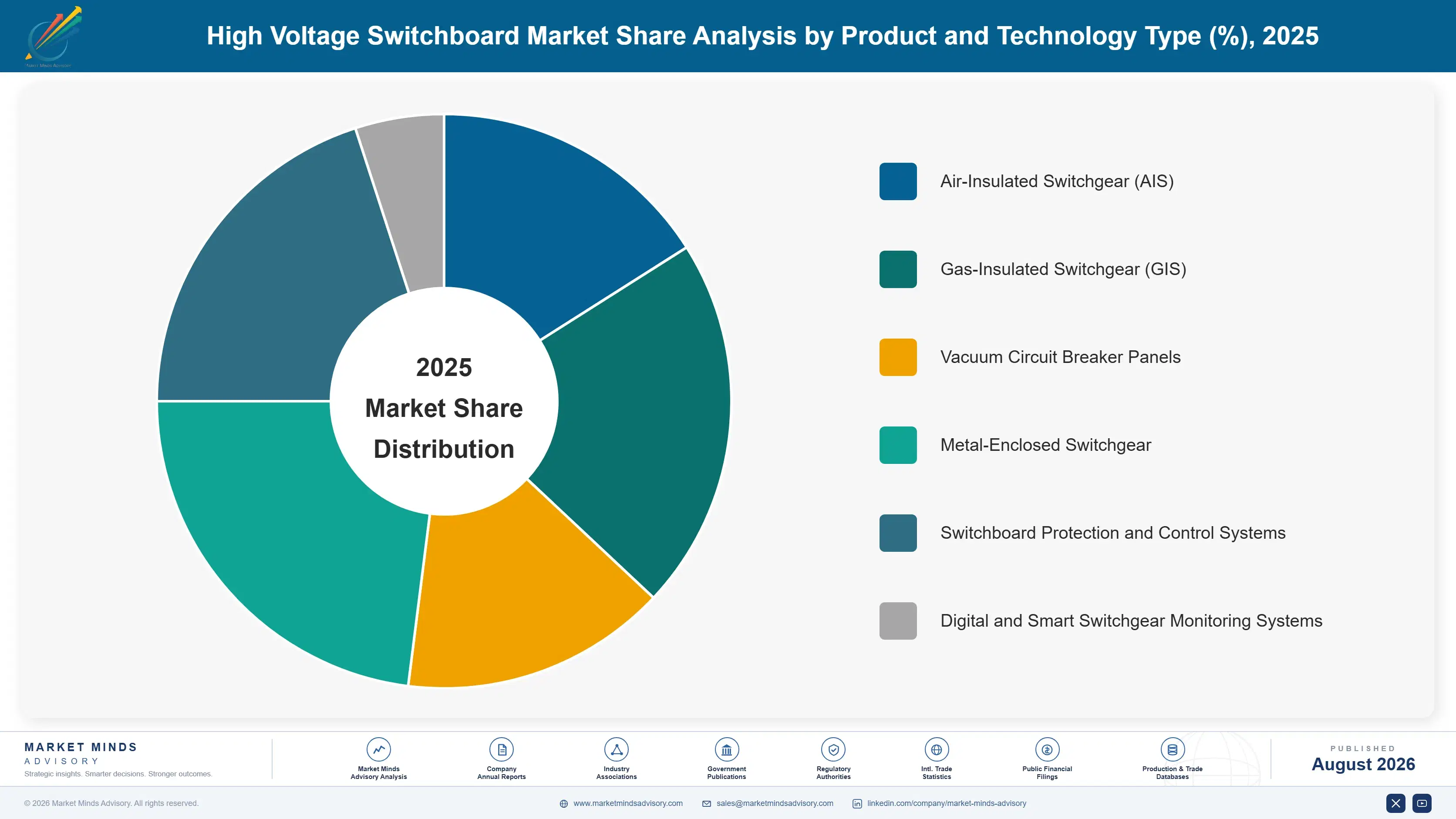
Segmentation follows product and technology type, the classification utility and industrial buyers use when specifying switchgear procurement requirements, since each category serves a distinct installation environment through different insulation and construction methods rather than a shared manufacturing pathway, and each typically involves its own separate certification testing process across all six categories examined here.
high-voltage-switchboard-market-market-share-analysis-1787553038344

Digital and Smart Switchgear Monitoring Systems

Digital and smart switchgear monitoring systems are the fastest-growing segment, expanding at 8.5% annually as utilities retrofit existing installations and specify new equipment with integrated sensor and remote diagnostic capability that reduces unplanned outage risk across aging transmission and distribution networks currently under modernization pressure worldwide and consistently across most major grid operators and utility service territories nationwide and internationally today and reliably. This segment benefits from both new equipment sales and a much larger retrofit addressable market spanning decades of previously installed conventional switchgear across most established grid systems globally. Demand concentrates heavily in regions pursuing active grid modernization programmes, particularly North America and East Asia, where funding remains strongest.
CAGR 8.5%

Gas-Insulated Switchgear (GIS)

Gas-insulated switchgear, the second-fastest segment at 7.8% annually, serves space-constrained urban and offshore substation applications where the smaller footprint compared to conventional air-insulated equipment justifies materially higher upfront equipment cost for grid operators facing real estate or platform space constraints across dense metropolitan and offshore project sites worldwide and consistently across most regions and jurisdictions today, reliably tomorrow, and for many years well beyond. This segment commands meaningfully higher pricing than conventional air-insulated switchgear, reflecting the specialized sealed enclosure manufacturing and testing requirements gas-insulated equipment demands from certified suppliers. Growth concentrates most heavily in regions with dense urban substation construction and offshore wind interconnection projects underway currently and expanding steadily.
CAGR 7.8%
Full segment breakdown across 6 segments available in the complete report.

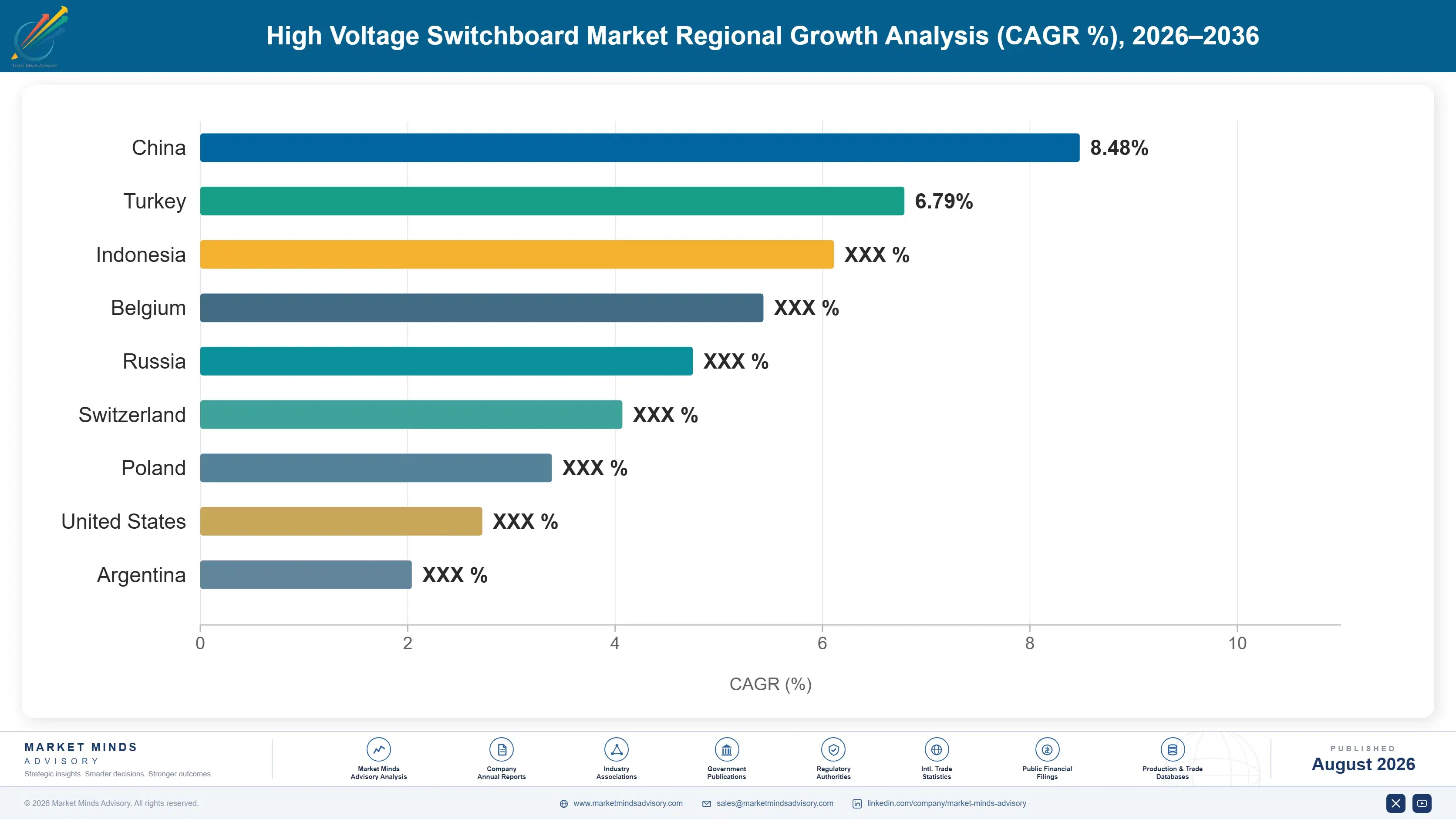
Regional Architecture and Country Demand Map

East Asia leads regional demand given China's massive state-backed transmission grid investment and manufacturing scale. North America follows closely on data center and grid modernization spending, while Western Europe's mature, slower-replacement grid infrastructure keeps regional demand comparatively modest relative to faster-growing newer-build markets elsewhere globally.

North America

North America's demand centers on data center construction and grid modernization spending, with hyperscale campus developers and utilities both driving substantial new switchgear orders across most major metropolitan markets and interconnection queues nationwide and consistently and reliably every single year without exception at all. Utilities are simultaneously retrofitting aging transmission infrastructure with digital monitoring capability, creating a second demand channel layered on top of new construction volume across most service territories. Canada contributes smaller but steady demand tied to its own grid modernization and renewable interconnection programmes. Registration and certification standards remain rigorous across the region, favoring established manufacturers with long utility relationship histories over newer entrants lacking comparable track records.
Share: 24% | CAGR: 5.7% (2026 to 2036)

Western Europe

Western Europe's demand has grown more slowly than other major regions as the region's grid infrastructure is comparatively mature, requiring steady replacement rather than the large-scale new build activity characterizing East Asian and North American markets, pushing the region's share meaningfully below MMA's standard band, a deliberate house-rule deviation reflecting genuine demand suppression from slower replacement cycles rather than any underlying decline in grid reliability requirements or investment priority across the region and its member states. Germany and France still anchor most regional volume tied to renewable interconnection and industrial power distribution upgrades. Manufacturers increasingly focus European sales on digital retrofit rather than new equipment given the mature installed base.
Share: 17% | CAGR: 4.5% (2026 to 2036)
Regional intelligence for 5 additional markets available in the complete report: East Asia, South Asia and Pacific, Latin America, Middle East and Africa, Eastern Europe. Contact sales@marketmindsadvisory.com.
high-voltage-switchboard-market-country-cagr-analysis-1787553039845

Where Switchgear Manufacturers Can Capture Margin

Margin expansion in this market concentrates around digital retrofit service offerings, gas-insulated switchgear capacity, data center relationship building, and Chinese manufacturing scale access, four distinct commercial moves that convert existing certification and manufacturing capability into premium pricing rather than requiring entirely new product categories, each accessible to established manufacturers holding existing utility relationships today.

Build Digital Retrofit Service Offerings For Installed Base

Manufacturers offering only new equipment sales are leaving the much larger installed base retrofit opportunity entirely to competitors who have developed sensor and remote diagnostic retrofit packages compatible with existing switchgear across most voltage classes and configurations currently in service. Developing retrofit-compatible sensor technology typically takes twelve to eighteen months, but manufacturers with retrofit capability are capturing recurring service revenue worth 20% to 25% of comparable new equipment sales value annually. Manufacturers with existing switchgear manufacturing scale are best positioned to develop retrofit capability profitably and quickly across their installed customer base.
Market Impact: Retrofit revenue reaches 20% to 25% of sales

Expand Gas-Insulated Switchgear Manufacturing Capacity Proactively

Urban and offshore substation projects increasingly specify gas-insulated switchgear by default given its smaller footprint, and manufacturers without established gas-insulated manufacturing capability are missing this growing premium segment entirely across most major metropolitan markets today and consistently and reliably every year. Expanding gas-insulated manufacturing capacity now, ahead of continued urban substation construction growth, positions manufacturers to capture pricing roughly 35% above conventional air-insulated equipment on comparable voltage class orders. Manufacturers with existing certification infrastructure for utility-grade equipment are best positioned to add gas-insulated capability profitably and quickly across their portfolio.
Market Impact: Gas-insulated pricing runs 35% above conventional equipment orders

Build Direct Relationships With Data Center Developers

Hyperscale data center developers increasingly specify switchgear suppliers directly rather than leaving the decision entirely to general contractors, creating a genuine relationship-building opportunity for manufacturers willing to invest in dedicated data center vertical sales teams and account managers across major metropolitan markets and interconnection zones nationwide and internationally. Manufacturers with established data center developer relationships are capturing order volume growing roughly 40% faster than manufacturers relying solely on traditional utility and industrial channels. Early relationship investment compounds as developers standardize on a preferred supplier across their entire multi-site campus portfolio.
Market Impact: Data center relationships grew orders roughly 40% faster overall

Access Chinese Manufacturing Scale Through Partnership Arrangements

Manufacturers without domestic Chinese manufacturing presence face a meaningful cost disadvantage relative to competitors benefiting from State Grid-scale production volume and lower per-unit manufacturing costs achieved through sustained high-volume output across most product categories and voltage classes currently in production and active development. Manufacturers who establish joint venture or licensing partnerships with Chinese producers can access this cost structure without the multi-year timeline required to build comparable domestic manufacturing scale independently. Partnership arrangements have historically delivered cost reductions of roughly 18% compared to standalone Western manufacturing operations of comparable output volume.
Market Impact: Partnerships delivered cost reductions of roughly 18% overall

Who Controls the Margin Pool

The High Voltage Switchboard Market shows moderate concentration with a CR5 of 48%, evaluated on a revenue basis across both utility-grade transmission equipment and lower-voltage industrial switchgear. ABB and Siemens Energy lead the utility-grade segment specifically, while the gap between these two leaders and the third-ranked challenger widens further once industrial-grade revenue is excluded from the comparison entirely.
Current competitive activity centers on digital monitoring integration, with several mid-tier manufacturers investing in sensor and remote diagnostic technology to access the growing retrofit market previously served only by equipment-only suppliers. Capacity investment is also concentrated in gas-insulated switchgear production rather than conventional air-insulated designs, reflecting where margin and demand growth both point. Chinese domestic manufacturers are simultaneously scaling capacity to reduce reliance on imported utility-grade equipment.

Emerging pressure comes from data center developers increasingly specifying switchgear suppliers directly, which could shift order volume toward manufacturers with dedicated data center vertical sales teams and away from those relying solely on traditional utility channels. Rankings could shift meaningfully if a mid-tier manufacturer secures a major hyperscale data center relationship faster than incumbents expect, since developer relationships increasingly determine access to this rapidly growing demand category.
high-voltage-switchboard-market-company-positioning-matrix-1787553040805

Competitive Moat and Risk Dimensions

ABB

Moat: Broadest Global Certification Portfolio

ABB holds certification and type-approval status across the widest range of utility jurisdictions worldwide, built up over decades of programme-specific testing and qualification renewal. This breadth lets the company bid on nearly every major utility procurement opportunity globally, while narrower competitors remain locked out of jurisdictions requiring qualification history they simply do not yet hold.
ABB

Risk: Slower Digital Retrofit Rollout

ABB's digital retrofit product rollout has moved more slowly than some smaller, more focused competitors who built dedicated sensor retrofit businesses earlier, leaving the company playing catch-up in a segment it should arguably lead given its installed base scale. Slower rollout risks ceding recurring retrofit service revenue to faster-moving specialist competitors permanently.
SIEMENS ENERGY

Moat: Grid Digitalization Technology Leadership

Siemens Energy has invested heavily in grid digitalization technology, building sensor and analytics capability that integrates directly into new equipment and retrofit packages alike, ahead of most competitors still treating digital monitoring as an add-on feature. This technology leadership positions Siemens Energy well for the recurring retrofit revenue opportunity across the industry's much larger installed base.
SIEMENS ENERGY

Risk: Exposure To Volatile Order Backlog

Siemens Energy's order backlog includes substantial exposure to large, multi-year grid infrastructure projects whose timing and completion depend on customer capital spending decisions that can shift unpredictably with broader economic conditions. This backlog volatility creates less predictable near-term revenue recognition than competitors with a higher share of smaller, faster-cycle industrial orders.

Players Tracked

Prominent Players

ABB
Siemens Energy
Schneider Electric
GE Vernova
Mitsubishi Electric

Other Key Players

Hitachi Energy
Eaton Corporation
Toshiba
TBEA
XD Group
Pinggao Electric
Chint Group
CG Power and Industrial Solutions
Larsen and Toubro
Hyosung Heavy Industries
Hyundai Electric
Meidensha Corporation
Fuji Electric
Nissin Electric
Efacec

Recent Developments

MARCH 2025

ABB announced completion of expanded gas-insulated switchgear production capacity at its European manufacturing facility, adding dedicated line capacity for urban and offshore substation applications. The expansion responds directly to rising demand from utilities and offshore wind developers seeking space-efficient substation equipment for increasingly constrained project sites.
Signal: Confirms incumbents are investing ahead of confirmed urban substation demand growth across multiple regions and jurisdictions
JULY 2025

Siemens Energy signed a multi-year supply agreement with a major hyperscale data center developer for high voltage switchgear across the developer's expanding North American campus portfolio, securing recurring volume tied to planned facility construction. The agreement reflects the broader industry shift toward direct data center developer relationships.
Signal: Signals data center developers are increasingly specifying switchgear suppliers directly rather than delegating that decision entirely
NOVEMBER 2025

A Chinese state-affiliated manufacturer commissioned a new switchgear production facility designed to expand domestic transmission equipment manufacturing capacity, part of a broader strategy to serve both State Grid procurement and growing export markets. The facility adds meaningful qualified capacity to the East Asian regional supply base.
Signal: Indicates China is scaling switchgear export capacity ahead of broader international market expansion efforts worldwide today

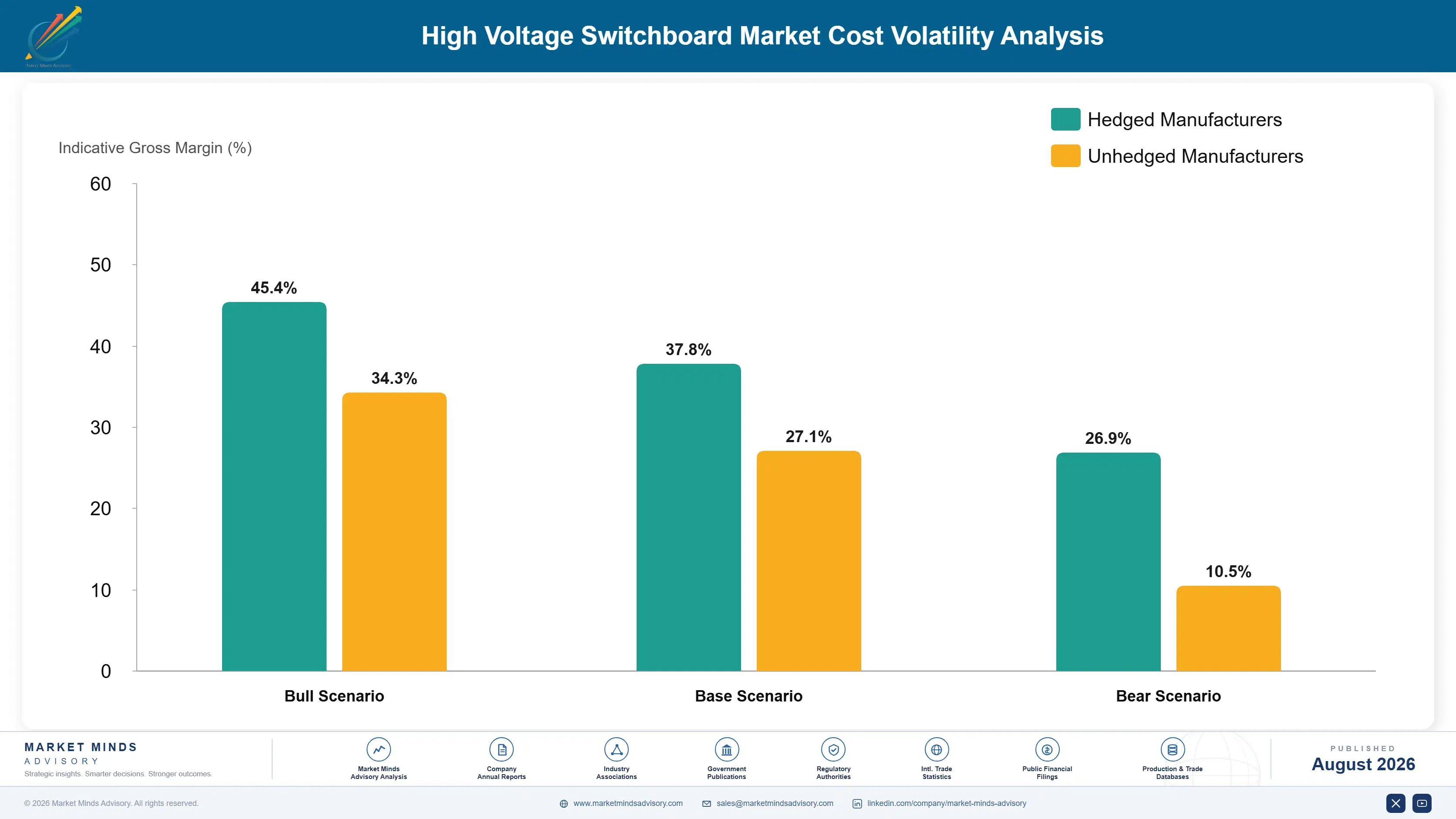
Copper and Steel Cost Exposure

Copper and steel inputs together represent 35% to 42% of cost of goods sold for switchgear manufacturers, with copper sourced primarily from Chilean, Peruvian, and Chinese mining operations rather than diversified regional supply chains across most producing countries worldwide today. Insulation materials, including SF6 gas and alternative dielectric compounds for gas-insulated equipment, add a meaningful secondary cost component.
Copper prices rose sharply through 2023 and into 2024 as global demand from electric vehicle and grid infrastructure investment simultaneously strained available supply, according to US Census Bureau trade data on refined copper imports and shipments. Manufacturers without long-term copper supply contracts absorbed most of this cost increase directly, compressing margins meaningfully during the peak of the price surge before pricing gradually stabilized as mining supply expanded through 2025.

This copper cost exposure creates a genuine competitive disadvantage for manufacturers without hedged supply positions relative to larger competitors who negotiate multi-year pricing agreements directly with mining companies and refiners. Smaller regional manufacturers without hedging infrastructure face the sharpest exposure, since large diversified majors can absorb short-term price volatility more easily across broader production volumes and geographies worldwide.
high-voltage-switchboard-market-cost-volatility-analysis-1787553041112

Secure Multi-Year Copper Supply Contracts

Negotiating multi-year fixed-price or banded-price copper supply agreements directly with mining companies protects margin against the kind of volatility that hit prices hard through 2023 and 2024. This gives manufacturers predictable input costs to plan production scheduling and customer pricing around well in advance, rather than absorbing spot-market swings directly into gross margin unpredictably.

Diversify Copper Sourcing Across Multiple Mining Regions

Sourcing copper from multiple geographic origins, rather than depending on a single supplier relationship, reduces exposure to any one region's mining disruption or export policy shift affecting delivery schedules and lead times. Manufacturers already diversifying copper sourcing reported smoother cost management during the 2023 to 2024 volatility spike than peers dependent on a single feedstock source.

Invest in Aluminum Conductor Substitution Research

Investing in aluminum conductor substitution research for applications where copper's superior conductivity is not strictly required reduces exposure to copper price volatility while offering meaningful weight savings for certain equipment configurations. Manufacturers who have already qualified aluminum alternatives for select product lines report reduced material cost exposure without meaningfully compromising equipment performance or certification status.

Portfolio Architecture for Margin Defence

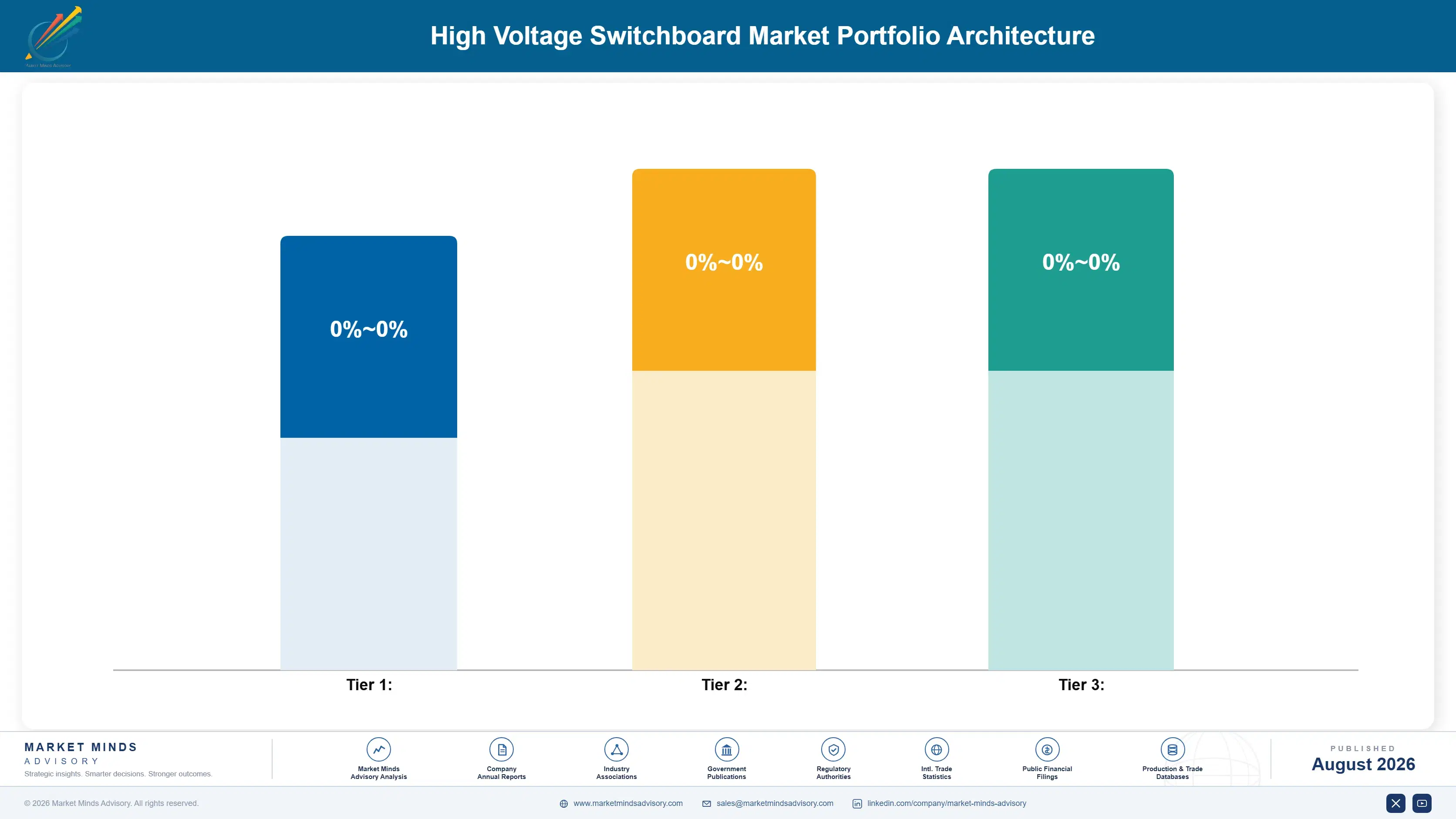
High voltage switchboard margins split sharply by technology tier. Conventional air-insulated switchgear competes largely on price, with gross margins near 18% to 25%, while gas-insulated and digitally monitored equipment command materially higher pricing across most comparable voltage classes. Gas-insulated and smart monitoring systems sit in a premium tier where certification breadth and sensor technology justify gross margins between 32% and 42% depending on customer relationship depth.
Conventional air-insulated equipment still anchors most manufacturers' revenue base given steady utility replacement demand across established grid infrastructure worldwide, but the margin tension is real. Manufacturers chasing conventional volume alone see margins compressed by copper cost volatility discussed earlier, while manufacturers who shift mix toward gas-insulated and digital monitoring systems convert flat unit growth into meaningfully expanding profit pools instead.

High-value margin pools concentrate specifically around data center and offshore wind interconnection programmes requiring gas-insulated, space-efficient switchgear, where certification status locks in premium pricing for the full duration of a multi-year infrastructure programme and beyond. Digital retrofit services represent a growing secondary pool, as utilities increasingly specify remote diagnostic capability across their much larger installed base of previously conventional equipment.

Conventional air-insulated switchgear sold into utility and industrial replacement markets worldwide today, with gross margins near 18% to 25% and limited differentiation between regional manufacturers beyond delivery reliability and cost.
Gross Margin

Gas-insulated switchgear sold to urban and offshore substation projects with certification and technical service support, commanding gross margins between 32% and 40% through space-efficient design and quite strong manufacturing scale.
Gross Margin

Digital and smart switchgear monitoring systems tied to grid modernization and predictive maintenance programmes, commanding the highest margins near 40% to 48% given limited qualified competition currently in the market.
Gross Margin
high-voltage-switchboard-market-portfolio-architecture-1787553042187

High-value Sub-segments and Strategic Watch-out

Digital and Smart Switchgear Monitoring Systems

Digital and smart monitoring systems combine the fastest visible-segment growth with strong margin economics, driven by grid modernization and predictive maintenance demand across new equipment and the larger retrofit base. Manufacturers with established sensor technology are positioned to convert this growth and margin combination into disproportionate profit expansion through 2036.

Gas-Insulated Switchgear (GIS)

Gas-insulated switchgear already anchors a growing revenue pool tied to urban and offshore substation construction requiring space-efficient equipment designs. The segment offers strong margin economics given certification barriers protecting established manufacturers, though capacity expansion investment is required to fully capture the growing urban and offshore project pipeline.

Conventional Air-Insulated Switchgear

Conventional air-insulated switchgear remains the volume core of the market, supplying utility and industrial replacement demand that prioritizes proven reliability and cost over space efficiency or digital capability. Growth here tracks general grid replacement cycles closely rather than outpacing it, and margins stay compressed by copper volatility and price competition.

Utility Capital Spending Volatility Risk

Utility capital spending volatility is a genuine strategic watch-out because large infrastructure programme timing depends on customer budget cycles that can shift unpredictably with broader economic conditions and political priorities. Manufacturers overly dependent on a small number of large utility contracts risk revenue volatility that more diversified competitors avoid entirely.

Utility Qualification-Locked Replacement Demand

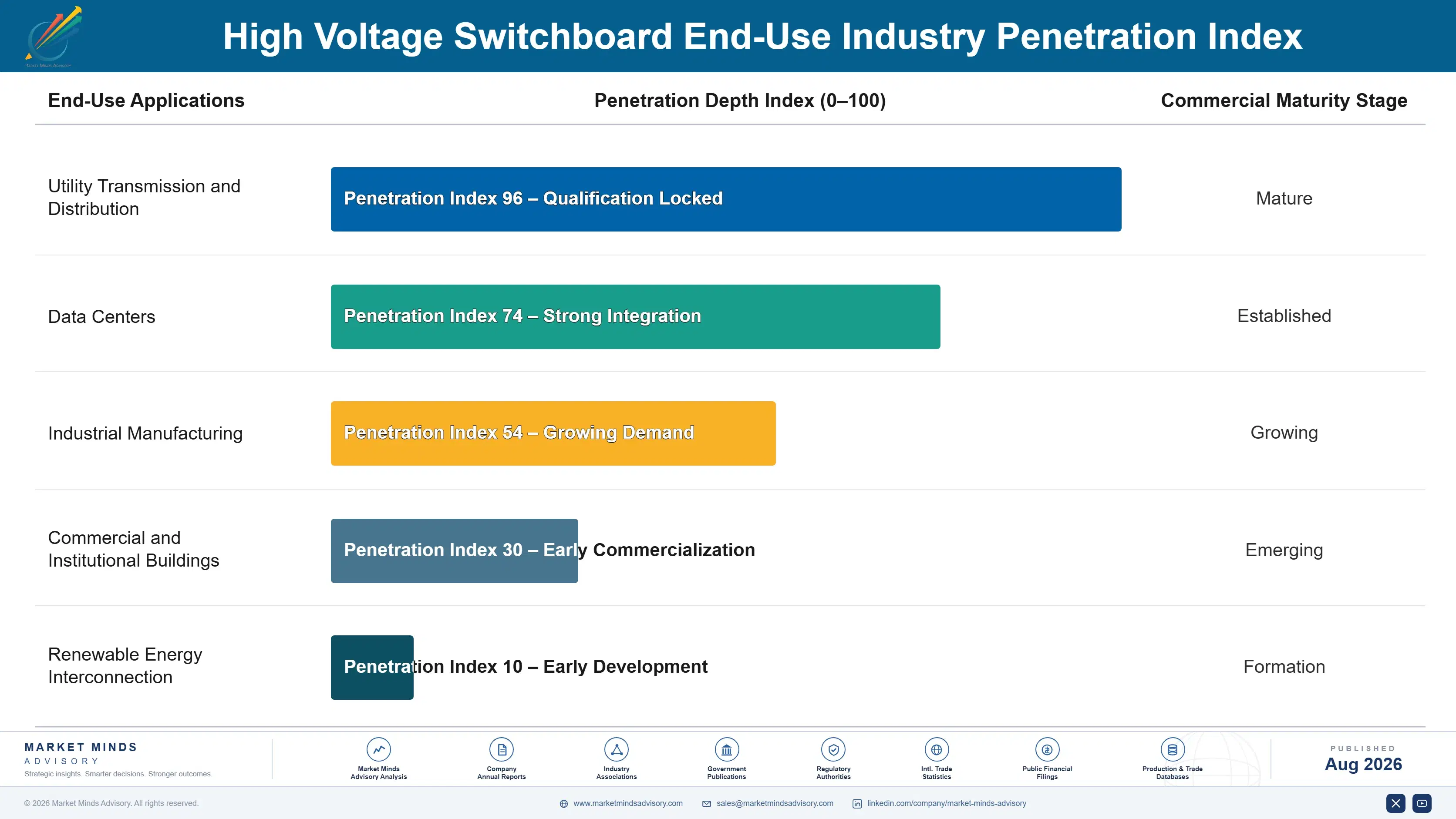
High voltage switchboard demand behaves like an annuity business once a manufacturer earns utility qualification, because requalifying a new supplier for transmission-grade equipment carries meaningful reliability and safety risk that utilities rarely accept without extensive justification and review. This locks in recurring purchasing across the multi-decade service life of installed switchgear and the utility's ongoing replacement and expansion programmes.
Adoption stickiness varies meaningfully by end-use vertical. Utility transmission buyers show the deepest stickiness because qualification cycles run three to five years and rarely get repeated once a supplier is certified, while industrial and commercial buyers switch suppliers more readily based on short-term pricing. Data center developers sit between the two, with moderate switching costs tied to project-specific specification rather than full utility-grade qualification requirements.

Buyer profiles are shifting generationally as utility procurement moves from individual engineers making informal supplier choices toward centralized asset management teams applying formal, data-driven replacement planning across entire grid networks and service territories simultaneously. Younger engineers entering these procurement functions also carry stronger familiarity with digital monitoring technology, pushing smart switchgear specifications into replacement conversations earlier than the previous generation typically allowed.
high-voltage-switchboard-market-end-use-penetration-index-1787553043653

Where Switchgear Strategy Wins

These are among the four positions where our research anticipates prominent divergence between winners and laggards over the coming forecast period. Each is grounded in the demand model, the regulatory perimeter, and the announced capacity pipeline.
01 / DIGITAL RETROFIT STRATEGY

Build Digital Retrofit Capability Ahead Of Market Saturation

Manufacturers with retrofit capability are already capturing recurring service revenue worth 20% to 25% of comparable new equipment sales, and this opportunity spans the much larger installed base rather than only new construction volume across most established grid networks. Developing retrofit-compatible sensor technology now, before competitors saturate this emerging service category, gives manufacturers a head start that latecomers cannot recover through equipment sales alone. Manufacturers with existing switchgear manufacturing scale should treat retrofit capability as their single highest-priority near-term investment.
02 / GAS-INSULATED CAPACITY INVESTMENT

Expand Gas-Insulated Capacity Ahead Of Urban Demand Peak

Gas-insulated switchgear already commands pricing roughly 35% above conventional air-insulated equipment, and urban and offshore substation projects increasingly specify it by default given genuine space constraints most metropolitan and offshore sites face today and increasingly across most comparable markets worldwide today. Expanding gas-insulated manufacturing capacity now, ahead of continued urban substation construction growth, positions manufacturers to capture this premium segment before competitors without comparable certification catch up. Waiting until urban demand becomes universally obvious erases the capacity-building head start entirely.
03 / DATA CENTER RELATIONSHIP BUILDING

Build Direct Data Center Developer Relationships Now

Manufacturers with established data center developer relationships are capturing order volume growing roughly 40% faster than competitors relying solely on traditional utility and industrial sales channels alone across most comparable markets and geographies worldwide today. Building dedicated data center vertical sales teams now, before this channel becomes as competitive as traditional utility procurement, lets manufacturers establish preferred-supplier status across a developer's entire multi-site campus portfolio. Early relationship investment compounds meaningfully as hyperscale developers standardize equipment specifications across future facility construction.
04 / CHINESE MANUFACTURING PARTNERSHIP

Pursue Chinese Manufacturing Partnerships For Cost Advantage

Partnership arrangements with Chinese manufacturers have historically delivered cost reductions of roughly 18% compared to standalone Western manufacturing operations of comparable output volume and product complexity across most equipment categories and voltage classes today. Manufacturers without domestic Chinese manufacturing presence face a real and growing cost disadvantage relative to competitors benefiting from State Grid-scale production economics that take years to replicate independently through organic capacity investment. Pursuing partnership arrangements now captures this cost advantage faster than building comparable scale alone.

Engagement Snapshot From the Field

A live engagement with an industry participant carrying material or product regulatory and market exposure ahead of a defining policy shift, showing how our research translates into a defensible multi-year portfolio strategy.
MARKET MINDS ADVISORY · CLIENT ENGAGEMENT SUMMARY
High Voltage Switchboard Producer Strategic Portfolio Review and Transition Roadmap 2026·Investment Scenario on High Voltage Switchboard Exposure Evaluation 2025-26
CLIENT PROFILE
The client is a mid-sized regional switchgear manufacturer serving industrial and commercial customers across two continents, with annual revenue in the low hundreds of millions of dollars. The company had built its position entirely on conventional air-insulated equipment but had never developed digital monitoring retrofit capability despite holding manufacturing scale technically comparable to competitors already serving the growing retrofit market.
STRATEGIC CHALLENGE
Conventional equipment margins had compressed as copper costs rose and regional competitors added capacity, while the client lacked visibility into what retrofit sensor development would actually require, how long it would take, and whether the investment would pay back within a reasonable timeframe. Leadership needed a credible, data-backed case before committing capital to a digital capability build with an uncertain outcome.
MMA APPROACH
MMA conducted primary interviews with the client's engineering team, two utility asset management officials, and three competitors already offering retrofit sensor packages to map the realistic development timeline and revenue potential. The engagement combined this qualitative work with a financial model comparing retrofit service versus conventional equipment margins, quantifying the payback period under conservative and optimistic development scenarios.
KEY FINDINGS
  1. Retrofit sensor development timelines averaged fifteen months across the interviewed competitors, longer than the client's initial internal estimate of eight months by a meaningful margin.
  2. Competitors already offering retrofit services priced recurring service revenue at 20 to 25 percentage points above comparable conventional equipment sales margins, confirming a substantial opportunity.
  3. Two of three utility officials interviewed identified remote diagnostic reliability, not sensor cost, as the deciding factor utilities weighed when selecting a retrofit technology partner.
  4. The client's existing engineering team already held roughly 60% of the sensor integration expertise required, needing only incremental hiring and development investment to close the remaining gap.
CLIENT PROFILE
The client is a mid-sized regional switchgear manufacturer serving industrial and commercial customers across two continents, with annual revenue in the low hundreds of millions of dollars. The company had built its position entirely on conventional air-insulated equipment but had never developed digital monitoring retrofit capability despite holding manufacturing scale technically comparable to competitors already serving the growing retrofit market.
STRATEGIC CHALLENGE
Conventional equipment margins had compressed as copper costs rose and regional competitors added capacity, while the client lacked visibility into what retrofit sensor development would actually require, how long it would take, and whether the investment would pay back within a reasonable timeframe. Leadership needed a credible, data-backed case before committing capital to a digital capability build with an uncertain outcome.
MMA APPROACH
MMA conducted primary interviews with the client's engineering team, two utility asset management officials, and three competitors already offering retrofit sensor packages to map the realistic development timeline and revenue potential. The engagement combined this qualitative work with a financial model comparing retrofit service versus conventional equipment margins, quantifying the payback period under conservative and optimistic development scenarios.
KEY FINDINGS
  1. Retrofit sensor development timelines averaged fifteen months across the interviewed competitors, longer than the client's initial internal estimate of eight months by a meaningful margin.
  2. Competitors already offering retrofit services priced recurring service revenue at 20 to 25 percentage points above comparable conventional equipment sales margins, confirming a substantial opportunity.
  3. Two of three utility officials interviewed identified remote diagnostic reliability, not sensor cost, as the deciding factor utilities weighed when selecting a retrofit technology partner.
  4. The client's existing engineering team already held roughly 60% of the sensor integration expertise required, needing only incremental hiring and development investment to close the remaining gap.
RECOMMENDED STRATEGY
Phase 1: Hire additional sensor integration engineers immediately, closing the identified 40% capability gap before beginning formal retrofit product development and utility pilot programmes. Phase 2: Launch a pilot retrofit programme with the utility showing the strongest existing relationship, while continuing conventional equipment production to fund development during the process. Phase 3: Scale retrofit service offerings across the broader installed customer base upon pilot completion, targeting the interviewed utility contacts as anchor customers for initial deployment.
OUTCOME
Within seventeen months of the engagement, the client launched its retrofit sensor product and signed its first commercial deployment agreement with a regional utility asset management team. Retrofit service revenue reached 10% of total sales within the first year of launch, with gross margin on that line reported at 36%, figures client-reported and unverified by MMA.

Frequently Asked Questions

Foundational context covering the market sizes, CAGR, scope, country, region and competition that inform every finding below. This section is provided to cover basics and most often pre-purchase conversations, answered from the MMA Primary Research Dataset.

What is the current size of the High Voltage Switchboard Market?

The High Voltage Switchboard Market reached an estimated $8.5 billion in global value during 2025, the base year for this report. Growth is driven by grid modernization and data center power infrastructure demand alongside China's transmission buildout.

How large will the High Voltage Switchboard Market be by 2036?

MMA projects the market will reach approximately $16.1 billion by 2036, nearly doubling from its 2025 base value. This expansion reflects a compound annual growth rate of 6.0% sustained across the full forecast period.

What is the CAGR for the High Voltage Switchboard Market 2026 to 2036?

The base case compound annual growth rate is 6.0% across the 2026 to 2036 forecast window. Bull and bear scenarios range from 7.2% to 4.8%, depending on data center construction and utility capital spending.

Which segment is growing fastest?

Digital and smart switchgear monitoring systems are the fastest-growing segment, expanding at 8.5% annually, roughly 1.4 times the overall market rate. Gas-insulated switchgear follows closely as the second-fastest segment given urban substation demand.

Who are the major companies in the High Voltage Switchboard Market?

Leading suppliers include ABB, Siemens Energy, Schneider Electric, GE Vernova, and Mitsubishi Electric, together holding an estimated 48% combined share. Competition is evaluated on a revenue basis across utility-grade and industrial segments.

Which country is growing fastest?

India is the fastest-growing major market, expanding at approximately 8.3% annually as its national grid infrastructure and rural electrification programmes accelerate. This outpaces the global average meaningfully across both utility and industrial demand.

Report Segmentation Architecture

The full report scope spans multiple orthogonal segmentation dimensions, with cross-tabulated demand data provided for each dimension pair. Coverage extends further to regional breakdowns, trend trajectories, and the competitive detail needed to support segment-level decision-making.

By Product and Technology Type

  • Air-Insulated Switchgear (AIS)
  • Gas-Insulated Switchgear (GIS)
  • Vacuum Circuit Breaker Panels
  • Metal-Enclosed Switchgear
  • Switchboard Protection and Control Systems
  • Digital and Smart Switchgear Monitoring Systems

By End-Use Industry

  • Utility Transmission and Distribution
  • Data Centers
  • Industrial Manufacturing
  • Commercial and Institutional Buildings
  • Renewable Energy Interconnection

By Commercial Dimension

  • Direct Utility Procurement Contracts
  • EPC and General Contractor Sales
  • OEM Panel Builder Integration
  • Aftermarket Retrofit Services

By Region

  • North America
  • Western Europe
  • East Asia
  • South Asia and Pacific
  • Latin America
  • Middle East and Africa
  • Eastern Europe

Scope, Methodology, and Coverage

Every figure in this report is reproducible from documented input assumptions. The scope below maps the historical period, the forecast horizon, the segmentation dimensions, and the countries covered, alongside the underlying primary and qualitative methodology.
Historical Period
2020 to 2025
Forecast Period
2026 to 2036
Base Year
2025 (USD billions; MMA Primary Research Dataset, August 2026)
Market Definition
The High Voltage Switchboard Market covers metal-enclosed switchgear assemblies rated above 1 kV used for power distribution, protection, and control in utility, industrial, and commercial power systems. It excludes low-voltage panelboards, standalone transformers, and cabling products sold separately from a switchgear assembly.
Quantitative Units
USD billions (current prices); installed unit counts for volume-referenced segment discussion where applicable
Segmentation Dimensions
By Product and Technology Type; By End-Use Industry; By Commercial Dimension; By Region
Regions Covered
North America, Western Europe, East Asia, South Asia and Pacific, Latin America, Middle East and Africa, Eastern Europe
Countries Covered
USA, China, Germany, France, UK, Japan, South Korea, India, Australia, Canada, Brazil, Mexico, Indonesia, Vietnam, Thailand, Malaysia, UAE, Saudi Arabia, South Africa, Nigeria, Turkey, Poland, Netherlands, Italy, Spain, Sweden, Switzerland, Argentina, Colombia, Singapore, and additional markets relevant to this sector
Key Companies Profiled
ABB, Siemens Energy, Schneider Electric, GE Vernova, Mitsubishi Electric, Hitachi Energy, Eaton Corporation, Toshiba, TBEA, XD Group, Pinggao Electric, Chint Group, CG Power and Industrial Solutions, Larsen and Toubro, Hyosung Heavy Industries, Hyundai Electric, Meidensha Corporation, Fuji Electric, Nissin Electric, Efacec
Quantitative Methodology
Primary survey, n=3,800 respondents, Q4 2025, six countries; demand-side model with trade association cross-validation
Qualitative Methodology
47 expert interviews, Q4 2025; applied to validate demand model assumptions, identify emerging dynamics, and assess competitive positioning
Report Format
PDF and XLSX data workbook (Word format preview document)
Publisher
Market Minds Advisory
Report Code
MMA-2026-CON-220
Published
August 2026
Contact
sales@marketmindsadvisory.com | www.marketmindsadvisory.com

Purchase the full High Voltage Switchboard Market Report (2026 to 2036).

This report provides a comprehensive, ten-year forecast of the global High Voltage Switchboard Market. Coverage spans air-insulated, gas-insulated, and digitally monitored switchgear across all seven world regions. Deliverables include segment-level and regional sizing to 2036, competitive benchmarking of twenty profiled companies on a consistent revenue basis, and copper cost exposure analysis. A strategic verdict identifies where manufacturers should concentrate capital and digital retrofit investment over the coming decade. The report is built from primary survey data, expert interviews, and company disclosures rather than secondary aggregation.
Ten-year sizing and CAGR forecasts across seven global regions
Segment-level analysis of air-insulated, gas-insulated, and digital systems
Competitive benchmarking of twenty profiled switchgear manufacturers
Copper and steel cost exposure and mitigation strategy analysis
Digital retrofit and gas-insulated adoption tracking by region
Strategic verdict on capital allocation and technology investment priorities

Built For The People Who Decide

From boardroom strategy to bench-side execution, this report is read cover-to-cover by leaders shaping the next decade of their industry, turning demand scenarios, market dynamics and valuation benchmarks into decisions.
CXOs/ Presidents/ VPs/ Managers
M&A and Corporate Development
Strategy Teams and R&D Heads
Procurement and Product Directors
Regulatory and Compliance Leaders
Investor Relations and Equity Analysts