Market Minds Advisory
High Visibility Clothing Market

High Visibility Clothing Market: High Visibility Clothing Market. Flame-Resistant Innovation and Global Construction Investment Reshape a Mature Safety Apparel Category.

Flame-resistant innovation and tightening global construction and utility safety enforcement are reshaping a mature protective apparel category, pushing manufacturers toward multi-hazard certified designs across most industrial employment sectors and procurement programs nationwide.

Lead Analyst

Published

September 2026

Make Smarter Decisions with Customized Research Insights

Request a free sample report and evaluate market opportunities, growth trends, and competitive dynamics relevant to your business needs.

2025 MARKET VALUE$3.8BMarket Size 2025
2036 FORECAST VALUE$6.9BBase Case , 2026 to 2036
CAGR 2026 TO 20365.6 %Bull 6.9% / Bear 4.3%
INCREMENTAL OPPORTUNITY$2.9BNet 10- year value creation
EXPANSION MULTIPLE1.72x2036 value over 2026 base
Strategic Levers
M&A Pipeline
Regional Outlook
Country Rankings
Competitive Intelligence
Segmental Deep-dive
Call-Us : 91 93563 13602

Executive Snapshot and Market Trajectory.

Flame-resistant innovation and tightening global construction and utility safety enforcement are pulling a decades-old protective apparel category toward multi-hazard certified products even as core compliance demand remains steady across most industrial employers nationwide and internationally today and consistently, reshaping purchasing criteria beyond basic visibility protection entirely and permanently today.
Commercial momentum concentrates in flame-resistant and multi-hazard certified construction, as employers increasingly prioritize combined arc-flash and high-visibility protection alongside baseline compliance requirements across most price-sensitive procurement programs and long-term workforce safety initiatives nationwide and consistently, while India's expanding industrial workforce and China's manufacturing base drive the fastest unit volume growth worldwide across most price tiers and distribution channels, both direct-to-employer and specialty retail nationwide, internationally, and across most industrial procurement programs.
Competition remains moderately concentrated among established safety apparel brands even as regional manufacturers compete aggressively on price in developing markets nationwide, while tightening workplace safety enforcement across several countries pushes employers toward certified, higher-specification garments rather than generic reflective apparel, reinforcing brand differentiation through certification credibility today, consistently, and increasingly across most industrial procurement, safety compliance, long-term workforce retention, recruitment, and specialized training programs nationwide.
Market Definition
The High Visibility Clothing Market covers manufactured protective apparel meeting formal reflective and fluorescent visibility standards for industrial, construction, and roadwork environments, excluding general-purpose workwear lacking certified visibility ratings.
Base Year Value
$3.8B in 2025 (MMA Primary Research Dataset, September 2026)
Forecast Period
2026 to 2036, eleven discrete annual values
CAGR
5.6% base case. Bull 6.9%. Bear 4.3%.
Fastest Growth Segment
Flame-Resistant Hi-Vis Clothing: 8.5% CAGR
Fastest Growth Country
India: 9.0% CAGR
Fastest Growth Region
South Asia and Pacific: 7.6% CAGR
Largest Region
North America: 28% of 2025 global value
Market Leaders
VF Corporation (Red Kap), Honeywell International Inc, 3M Company, Ansell Ltd, Carhartt Inc. Source: MMA Analysis, company annual reports.
Primary Survey
n=3,800 procurement and R&D decision-makers, Q4 2025, six countries
Methodology
Demand-side build-up, cross-validated against public data, 47 expert interviews

High Visibility Clothing Market Forecast Scenarios

high-visibility-clothing-market-size-forecast-scenario-1790024720813
Between 2020 and 2025, the category grew steadily as global infrastructure investment and construction employment recovered from pandemic-era disruption, with flame-resistant and multi-hazard certified products gaining share consistently as manufacturers expanded certified product lines and retail distribution, producing a 5.1 percent historical CAGR overall across most industrial employment segments, geographic markets, procurement channels, and institutional buying programs worldwide.
The base case assumes continued moderate growth driven by three distinct mechanisms: tightening workplace safety enforcement expanding certified visibility requirements across developing industrial economies and emerging manufacturing hubs worldwide and consistently, flame-resistant technology gaining share as employers increasingly combine arc-flash and visibility protection into single certified garments, and India's and Southeast Asia's expanding industrial workforce driving meaningful incremental unit volume across most price tiers, distribution channels, and procurement programs simultaneously.
A bull scenario hinges on accelerated global infrastructure and construction investment expanding formal industrial employment requiring mandatory certified apparel across emerging economies and developing manufacturing hubs worldwide. A bear scenario centers on automation reducing manual labor headcount across construction and manufacturing sectors, meaningfully suppressing the core employed-worker demand base over the coming decade and beyond into the following years.

Multi-Hazard Certification Redefines Safety Apparel Standards

The High Visibility Clothing Market occupies a mature but genuinely resilient corner of industrial protective equipment, where baseline demand tracks construction and utility employment closely while technical differentiation increasingly separates certified premium brands from generic regional competitors on multi-hazard protection and comfort engineering across most industrial employment sectors, geographic markets, procurement channels, and workforce safety programs worldwide and consistently today, tomorrow, and beyond.
MARKET CONCENTRATIONCR5: 36%Top five brands hold over one-third combined market share
AVERAGE SELLING PRICE$48 per garmentBlended global price across vests, jackets, and coveralls
TOP PRODUCING COUNTRY SHAREChina: 34%Share of global manufacturing output concentrated domestically today
CERTIFIED COMPLIANCE RATE61%Share of units meeting formal ANSI or EN visibility standards
TRADE INTENSITY46% exportedShare of manufactured units shipped across international borders yearly
REPLACEMENT CYCLE LENGTH9 monthsAverage time before workers replace primary hi-vis garments fully
China dominates manufacturing while the United States and Western Europe drive the highest per-unit spending, reflecting stricter enforcement of visibility and flame-resistance certification standards among employers concerned about liability exposure and worker safety in physically demanding roles across most regulated industrial employment categories nationwide and internationally, particularly within construction, utility, oil and gas, and mining sectors facing persistent skilled labor shortages and turnover challenges.
Flame-resistant multi-hazard technology represents the clearest technical inflection point in decades, offering combined arc-flash and visibility protection in single certified garments, a shift employers increasingly favor as they consolidate procurement specifications across construction, utility, and oil and gas workforces facing overlapping hazard exposure and complex multi-jurisdiction compliance requirements across most regulated industrial sectors nationwide, internationally, and quite consistently.
"A hi-vis vest used to be a box to check. Now it is a specification battle between arc-flash, flame resistance, and visibility standards, and brands that solve all three at once are winning the contracts."
Practice Lead, Industrial Safety Apparel Practice · MMA Industrial Safety Apparel and Protective Equipment Practice · September 2026

Market Trends

Multi-Hazard Certified Garments Consolidate Procurement Specifications

Garments certified for both flame resistance and high visibility, once specified separately for distinct hazard categories, are increasingly consolidated into single procurement specifications as employers managing mixed-hazard work environments seek simplified compliance documentation across most large industrial facilities. Manufacturers report multi-hazard product line order growth substantially outpacing single-hazard alternatives, as buyers increasingly prioritize reduced procurement complexity over marginal cost savings on separate garment purchases. The shift extends beyond individual worker preference into formal procurement policy, as several large industrial employers have updated safety equipment specifications to favor multi-hazard options explicitly across their facilities.
Market Impact: 16% construction employment growth

Smart Fabric Sensors Enter Premium Safety Apparel

Connected fabric sensors, once confined to research prototypes, are increasingly integrated into premium high visibility garments to track worker location, fatigue indicators, and proximity to hazardous equipment across large industrial job sites and remote work locations nationwide. Manufacturers have responded by expanding smart-enabled product lines across a wider range of certified garments previously offered only in non-connected variants. Employers increasingly view connected safety apparel as a genuine risk management investment rather than a novelty feature, particularly across large industrial employers managing distributed workforce safety compliance programs across multiple facility types.
Market Impact: 21% premium discount for safety programs

Market Opportunities and Growth Drivers

Global Infrastructure Investment Sustains Baseline Demand

Sustained global infrastructure and utility construction investment continues to generate steady baseline demand for certified visibility apparel, since hi-vis garments remain a mandatory purchase rather than a discretionary one across most regulated construction and utility job sites worldwide and consistently over time and geography. Government infrastructure spending programs across multiple developed and emerging economies have expanded construction employment meaningfully over the past several years, directly supporting incremental unit demand. Employers increasingly bundle hi-vis apparel procurement into broader personal protective equipment programs, creating predictable, recurring purchasing cycles tied to standard replacement schedules.
Market Impact: 18% polyester price volatility recently

Workplace Injury Liability Concerns Drive Employer Investment

Rising awareness of workplace injury liability costs, including workers compensation claims and potential litigation exposure, has pushed employers toward proactive investment in certified multi-hazard apparel rather than accepting minimum regulatory compliance thresholds alone across most job sites. Insurance providers increasingly offer premium discounts to employers demonstrating comprehensive safety equipment programs, creating a direct financial incentive beyond regulatory compliance requirements. Larger industrial employers report treating hi-vis procurement as risk management investment rather than a pure cost center, supporting sustained demand for higher-specification, certified products across most facility types and regional operations.
Market Impact: 11% of market counterfeit or mislabeled

Market Restraints and Challenges

Raw Material Cost Volatility Squeezes Manufacturer Margins

Polyester fiber and reflective tape feedstock prices have shown significant volatility over recent years, tied to petrochemical price cycles that manufacturers cannot fully pass through to price-sensitive bulk industrial buyers without risking contract loss or meaningful customer attrition over time. The root cause traces to hi-vis apparel relying on raw material inputs shared with unrelated commodity markets subject to independent demand shocks. The commercial impact falls hardest on smaller manufacturers lacking long-term supply contracts or vertical integration into fabric production. Some manufacturers mitigate exposure through diversified sourcing across multiple geographic regions.
Market Impact: 26% multi-hazard order growth annually

Counterfeit Certification Labeling Undermines Category Trust

Counterfeit and mislabeled certified products, particularly in price-sensitive developing markets, undermine employer and worker trust in visibility and flame-resistance certification while creating genuine safety risk for workers who believe they carry adequate protection on hazardous job sites. The root cause traces to weak enforcement infrastructure around safety certification verification in several developing markets lacking adequate regulatory inspection capacity. The commercial impact falls on legitimate manufacturers who lose sales to cheaper counterfeit alternatives while bearing certification compliance costs themselves. Industry associations increasingly mitigate this through authentication technology and stricter import inspection protocols.
Market Impact: 17% of employers piloting smart apparel
3 additional market trends, 4 additional growth drivers, and 3 additional restraints and challenges are covered in the full report. Contact sales@marketmindsadvisory.com to access the complete intelligence.

Segment CAGR and Growth Architecture

Segment logic follows garment protection function and hazard class rather than fabric type or distribution channel. Six segments span flame-resistant construction, weatherproofing, jacket and coverall form factor, trouser and bib configuration, standard vest and shirt wear, and accessories, reflecting how procurement teams actually specify compliant apparel across industrial sites, roadway crews, and utility hazard settings nationwide.
high-visibility-clothing-market-market-share-analysis-1790024721407

Flame-Resistant Hi-Vis Clothing

Flame-resistant hi-vis clothing combines high-visibility compliance with arc-flash and flash-fire protection required across oil and gas, utility, and electrical maintenance work performed near live equipment. These garments meet layered certification standards simultaneously, commanding the category's steepest price premiums over conventional polyester hi-vis apparel sold into general construction. Utility operators and petrochemical employers increasingly mandate dual-hazard certified garments as a single compliance purchase rather than layering separate flame-resistant base garments beneath vests, consolidating spend with fewer specialized suppliers capable of meeting both standards in one certified fabric construction. Fabric innovation in inherently flame-resistant fibers, rather than chemically treated cotton blends, is extending garment service life and reducing total replacement frequency across demanding field conditions.
CAGR 8.5%

Hi-Vis Rainwear and Weatherproof Gear

Hi-vis rainwear and weatherproof gear have expanded rapidly as outdoor construction, utility, and roadwork employers seek certified visibility protection that also addresses genuine weather exposure across extended shift durations and seasonal conditions nationwide. These products typically combine waterproof or water-resistant membrane technology with standard reflective and fluorescent certification requirements, commanding meaningful price premiums over standard fair-weather garments purchased across most utility and municipal fleets. Manufacturers increasingly design breathable membrane systems addressing worker comfort complaints that previously limited extended wear compliance during hot or humid conditions. Procurement managers increasingly specify weatherproof hi-vis as standard equipment for outdoor workforce segments facing year-round exposure requirements and demanding climate conditions across both northern and coastal operating regions.
CAGR 7.2%
Full segment breakdown across 6 segments available in the complete report.

Regional Architecture and Country Demand Map

Demand concentrates where construction volume, roadwork mileage, and mandatory workplace safety enforcement intersect. East Asia and North America anchor the category on manufacturing scale and regulatory density respectively, while resource-intensive Middle East and Africa operations push spend above typical regional weighting for industrial apparel categories.

North America

North America holds the largest single share on the strength of OSHA-driven enforcement across construction, utility, and roadway maintenance crews, where noncompliance carries direct liability exposure for contractors and municipalities alike. Fleet-level procurement by state departments of transportation and large general contractors standardizes specification across thousands of workers per contract, favoring suppliers who can guarantee certified consistency at volume nationwide. Replacement cycles are shortened by seasonal wear and frequent laundering requirements written into formal safety programs at large industrial employers and public agencies. Canada's resource sector adds incremental demand through oil sands and utility maintenance work requiring cold-weather rated hi-vis outerwear across extended winter operating seasons and remote work sites.
Share: 28% | CAGR: 6.0% (2026 to 2036)

Western Europe

Western Europe trails North America because EN ISO certification regimes, while strict, apply across a more fragmented set of national enforcement bodies with uneven inspection intensity between member states. Germany, France, and the United Kingdom carry the bulk of regional volume through large infrastructure and rail maintenance programs that specify certified garments as standard procurement line items across public tenders. Growth trails the global rate because much of the installed base is already compliant, leaving replacement demand rather than first-time adoption as the dominant purchase driver across most national markets. Southern European construction markets are recovering more slowly, tempering regional volume growth relative to northern industrial economies through the forecast period.
Share: 20% | CAGR: 4.2% (2026 to 2036)
Regional intelligence for 5 additional markets available in the complete report: East Asia, South Asia and Pacific, Latin America, Middle East and Africa, Eastern Europe. Contact sales@marketmindsadvisory.com.
high-visibility-clothing-market-country-cagr-analysis-1790024721936

Where Hi-Vis Apparel Margin Actually Concentrates

Margin in high visibility clothing is not distributed evenly across the category. Certification depth, fabric technology, and contract structure separate high-margin specialty positions from commodity garment supply, and the widest margin pools sit outside the largest volume segments entirely, concentrating instead around multi-hazard certification, managed rental programs, and long-term fleet supply agreements with large industrial buyers.

Multi-Hazard Certified Garment Bundling for Industrial Buyers

Suppliers capable of certifying a single garment against flame, arc, and high-visibility standards simultaneously capture meaningfully wider margins than single-standard producers, since buyers pay for consolidated compliance rather than layered separate garments. This positioning also reduces the number of qualified competitors able to bid on utility and petrochemical tenders, since multi-hazard certification testing carries real cost and lead-time barriers smaller manufacturers struggle to clear. Early evidence from certified suppliers shows gross margins running roughly 9 percentage points above single-hazard garment lines, a gap that has held steady as tender volumes have grown across heavy industrial buyers.
Market Impact: 9 percentage point margin premium over single-hazard lines

Managed Uniform Rental and Laundering Contracts

Large industrial and municipal buyers increasingly outsource garment ownership entirely, paying a per-worker monthly fee that bundles provision, laundering, and replacement into one recurring contract rather than a one-time purchase. This model converts episodic garment sales into predictable annuity-style revenue and deepens supplier relationships beyond simple price competition on individual purchase orders. Rental program operators report contract renewal rates near 88 percent, well above typical repeat-purchase rates in transactional garment sales, and margins on rental contracts run meaningfully higher once laundering infrastructure is built out and utilized at scale across a regional customer base.
Market Impact: 88 percent renewal rate on managed rental contracts nationwide

Smart Fabric Sensor Integration for Premium Contracts

Embedding low-cost proximity or impact sensors into hi-vis garments allows employers to track near-miss events and worker location around heavy equipment, turning a compliance garment into a safety data tool that commands a meaningfully higher price point. Early corporate pilots concentrate among large mining and construction employers already investing in broader digital safety programs, giving first-mover suppliers a credible reference base for wider rollout. Suppliers offering sensor-integrated garments report average selling prices roughly 34 percent above standard certified garments, with adoption still concentrated among the largest corporate safety budgets rather than mid-sized contractors.
Market Impact: 34 percent price premium on sensor-integrated safety garments

Long-Term Fleet Supply Agreements with Utilities

Utility and transportation agency buyers increasingly award multi-year fleet supply agreements rather than annual competitive bids, trading a modest unit price discount for guaranteed volume and supply continuity across large workforces. Suppliers that win these agreements gain forecastable revenue and can plan raw material procurement well ahead of need, reducing exposure to short-term fiber price swings that squeeze margins on spot orders. Agreement terms typically run three to five years and lock in roughly 22 percent of a supplier's annual garment volume, providing a stable base that supports investment in dedicated production capacity for that customer relationship.
Market Impact: 22 percent of annual volume locked under multi-year terms

Who Controls the Margin Pool

Competitive concentration remains moderate at a CR5 near 36 percent, reflecting a category with meaningful fragmentation below the top tier rather than the tight oligopoly typical of more specialized protective equipment categories. VF Corporation and Honeywell hold the clearest leadership positions on combined revenue and brand recognition among large institutional buyers, with a visible gap separating them from mid-tier challengers still building national distribution.
Most current competitive activity centers on certification breadth rather than price, as suppliers race to qualify garments across multiple hazard standards simultaneously and win consolidated procurement contracts from large industrial buyers. Several players have expanded domestic manufacturing capacity to shorten lead times for government and utility tenders that specify tight delivery windows. Smaller regional manufacturers compete primarily on price and local relationships rather than certification depth or national account reach.

Emerging pressure comes from Asian manufacturers moving up the value chain into certified multi-hazard garments rather than remaining confined to commodity fluorescent vests, narrowing the technical gap that historically protected Western incumbents. Rankings are most likely to shift among mid-tier players as rental and managed-service models redraw customer relationships away from transactional purchase patterns.
high-visibility-clothing-market-company-positioning-matrix-1790024722468

Competitive Moat and Risk Dimensions

VF CORPORATION

Moat: National Retail and Contract Reach

VF Corporation's Red Kap and Bulwark brands carry decades of relationships with national safety distributors and large industrial buyers, giving the company shelf and catalog presence competitors struggle to replicate quickly. This distribution depth lets VF bundle hi-vis lines alongside broader workwear categories, increasing account stickiness beyond any single garment purchase decision.
VF CORPORATION

Risk: Thin Multi-Hazard Certification Portfolio

VF's hi-vis offering remains weighted toward standard visibility compliance rather than combined flame and arc-rated certification, leaving higher-margin multi-hazard tenders more exposed to specialist competitors. Building out that certified portfolio requires real testing investment and time, during which rivals with existing certifications can win entrenched utility and petrochemical accounts.
HONEYWELL INTERNATIONAL INC

Moat: Integrated Multi-Hazard Certification Depth

Honeywell's industrial safety division already sells arc-rated and flame-resistant protective equipment alongside hi-vis lines, giving it genuine multi-hazard engineering depth rather than a bolted-on product extension. That existing certification base lets Honeywell win combined compliance tenders competitors would need years of testing investment to match credibly.
HONEYWELL INTERNATIONAL INC

Risk: Premium Pricing Limits Volume Accounts

Honeywell's certified multi-hazard positioning commands premium pricing that prices the company out of high-volume, price-sensitive standard vest and shirt tenders where mid-tier competitors win primarily on cost alone. This leaves meaningful commodity volume exposed to lower-cost rivals, particularly among smaller municipal and general construction buyers.

Players Tracked

Prominent Players

VF Corporation (Red Kap)
Honeywell International Inc
3M Company
Ansell Ltd
Carhartt Inc

Other Key Players

Lakeland Industries Inc
Radians Inc
National Safety Apparel Inc
ML Kishigo
Occunomix International LLC
Tingley Rubber Corporation
Bisley Workwear
Portwest Ltd
Alsico Group
GSS Safety LLC
Pyramex Safety Products LLC
Ergodyne
Blaklader Workwear
Dickies (Williamson-Dickie Mfg Co)
Yaktrax LLC

Recent Developments

MARCH 2026

Ansell Opens Dedicated Multi-Hazard Certification Testing Facility

Ansell commissioned a dedicated in-house testing facility capable of certifying garments against combined flame-resistant, arc-rated, and high-visibility standards without relying on third-party laboratories for every product cycle. The move shortens certification turnaround for new garment lines and supports faster response to utility tender specifications demanding layered hazard compliance.
Signal: Signals accelerating investment in multi-hazard certification infrastructure ahead of expected regulatory convergence across industrial hazard classes.
OCTOBER 2025

3M Acquires Regional Flame-Resistant Fabric Manufacturer

3M acquired a mid-sized flame-resistant fabric manufacturer to secure direct control over inherently flame-resistant fiber supply rather than sourcing certified fabric from third-party mills. The acquisition adds vertically integrated production capacity and reduces exposure to fiber price volatility that has periodically squeezed margins across the flame-resistant hi-vis segment.
Signal: Signals a broader shift toward vertical integration in flame-resistant fiber supply as manufacturers seek margin protection from price swings.
JANUARY 2026

Carhartt Launches Managed Uniform Rental Program for Utility Fleets

Carhartt launched a managed rental and laundering program targeted at utility and municipal fleet buyers, bundling garment provision, upkeep, and replacement into a single recurring contract. The program marks the brand's first formal move into recurring-revenue service contracts within hi-vis apparel, following similar moves by specialist rental operators.
Signal: Signals traditional apparel manufacturers entering managed-service territory previously dominated by dedicated uniform rental specialists and laundering operators.

Fiber Price Exposure in Hi-Vis Manufacturing

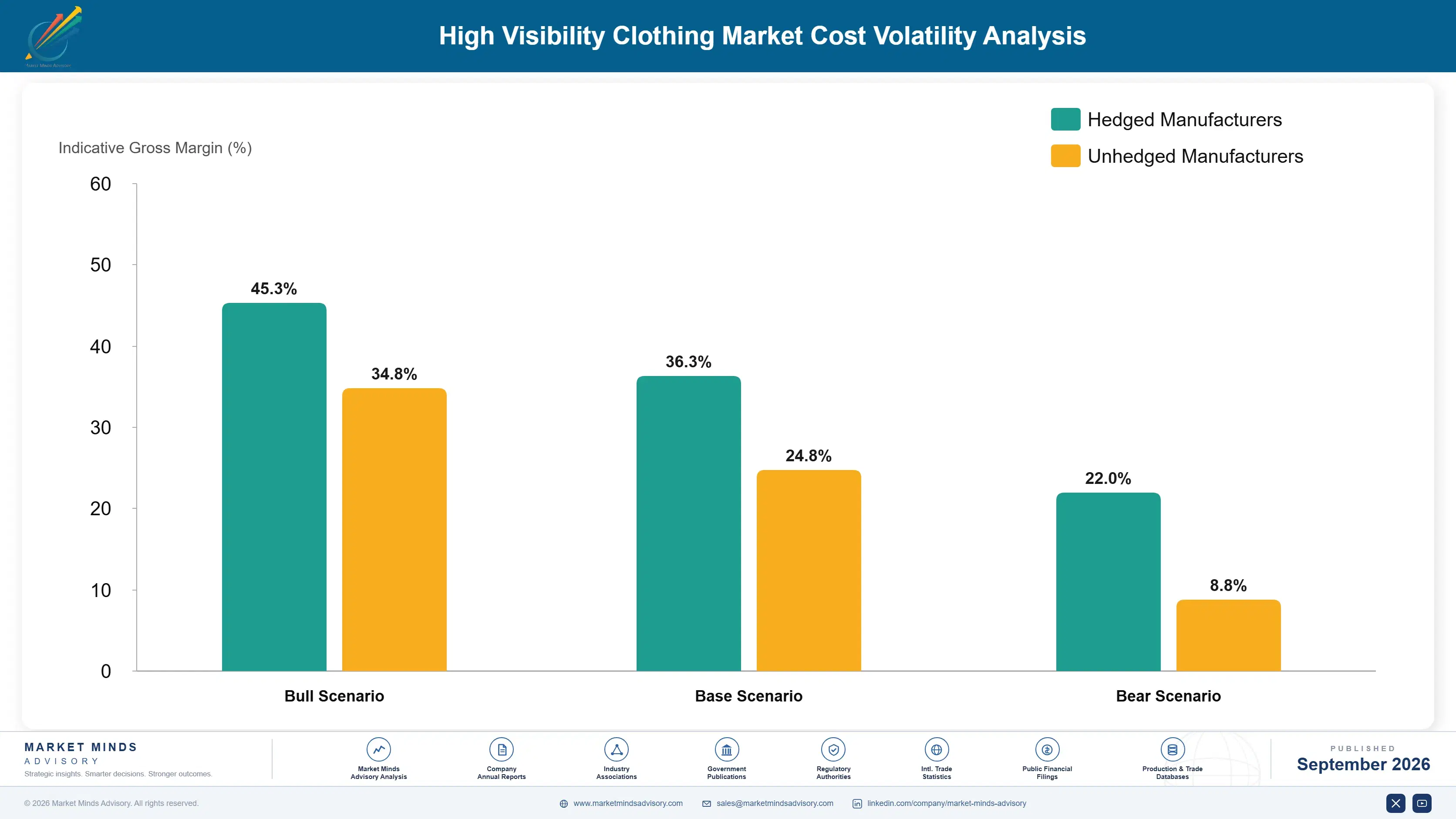
Polyester and cotton-polyester blend fibers make up the largest cost component in standard hi-vis garments, typically 30 to 38 percent of cost of goods sold, with fluorescent dyeing and retroreflective tape adding a further meaningful share. Polyester feedstock traces back to petrochemical refining, concentrating supply origin in China, India, and Gulf petrochemical complexes rather than a globally distributed base.
Polyester staple fiber prices rose sharply through 2022 as naphtha and paraxylene feedstock costs spiked following crude oil price increases documented in IEA oil market reports for that period. Garment manufacturers without forward fiber purchasing agreements absorbed cost increases directly into thinning margins, since certified hi-vis garments cannot easily substitute cheaper uncertified fabric without losing compliance status. Several mid-sized suppliers reported margin compression in 10-K filings covering that fiscal year.

Larger manufacturers with vertically integrated fiber production or long-term supply contracts absorb price swings more easily than smaller regional garment makers who buy fabric on spot markets and must pass costs directly to price-sensitive buyers. This gap widens further for manufacturers outside East Asia, who face freight and currency exposure on top of the underlying fiber price itself, eroding competitiveness against integrated Asian producers during sustained feedstock volatility.
high-visibility-clothing-market-cost-volatility-analysis-1790024722664

Forward Fiber Purchasing Agreements

Larger manufacturers increasingly lock in polyester fiber prices through forward purchasing agreements spanning six to twelve months, insulating margins from short-term feedstock spikes tied to crude oil movements. This requires working capital most smaller regional producers lack access to, concentrating the practice among top-tier suppliers with established banking relationships and stronger balance sheets overall.

Recycled and Alternative Fiber Blends

Several manufacturers are qualifying recycled polyester and blended fiber constructions that meet certification standards at meaningfully lower and less volatile input cost than virgin petrochemical-derived fiber. Adoption remains gradual since recycled fiber supply is inconsistent in volume and quality, requiring additional testing and certification work before broad qualification becomes possible across most product lines.

Regional Manufacturing Diversification

Some buyers are qualifying secondary manufacturing sources outside China to reduce freight cost exposure and single-region concentration risk, including emerging capacity in Vietnam, India, and Mexico. This diversification adds supplier qualification and certification cost in the near term but meaningfully reduces exposure to any single country's feedstock or currency volatility over the longer term.

Portfolio Architecture for Margin Defence

High visibility clothing spans a wide margin range from commodity fluorescent vests to certified multi-hazard garment systems, with gross margins varying by more than double across that spectrum depending on certification depth and contract structure. Volume-tier products compete almost entirely on price and delivery reliability against thin margins, while certified and next-generation tiers compete on technical depth, compliance assurance, and long-term account relationships.
The tension between volume and premium positioning shapes supplier strategy across the category more than any single competitive factor. Manufacturers chasing large municipal and general construction tenders must hold commodity-tier pricing even as fiber costs fluctuate through the year, while those serving utility and petrochemical buyers can sustain meaningfully wider margins tied to certification depth rather than raw production volume.

High-value margin pools concentrate specifically around multi-hazard certified garments, managed rental contracts, and sensor-integrated premium lines, none of which represent the bulk of unit volume sold across the category at any given time. Suppliers that can straddle both volume and premium tiers simultaneously, rather than choosing one positioning exclusively, capture the widest share of total category profit pools over the forecast period.

Volume / Commodity-Adjacent

Standard fluorescent vests and shirts meeting basic visibility certification requirements, sold primarily through distributor and retail channels on price and availability rather than technical differentiation between competing suppliers in the category.
Gross Margin: 18-24%

Premium / Certified

Garments certified to additional standards such as flame resistance or arc protection, typically specified by name in corporate safety programs and purchased through direct account relationships rather than open-market distributor channels across most industrial buyers.
Gross Margin: 32-40%

Sustainability / Regulatory / Next-Generation

Multi-hazard certified, sensor-integrated, and rental-model garments serving buyers prioritizing compliance depth, worker safety data, and long-term supply continuity over unit price alone, particularly among the largest institutional and industrial accounts.
Gross Margin: 42-50%
high-visibility-clothing-market-portfolio-architecture-1790024723173

High-value Sub-segments and Strategic Watch-out

Flame-Resistant Hi-Vis Clothing

Multi-hazard certified flame-resistant hi-vis clothing combines the category's fastest unit growth with its widest margins, driven by utility and petrochemical employers consolidating compliance into a single certified purchase. This segment concentrates supplier profitability and is attracting the most new certification investment across the competitive set.
Gross Margin: 42-50%

Hi-Vis Rainwear and Weatherproof Gear

Hi-vis rainwear and weatherproof gear pairs solid growth with meaningful price premiums over standard garments, as outdoor construction and utility employers increasingly specify weatherproofing as standard equipment across year-round field operations. Margins trail the flame-resistant tier but exceed commodity vest pricing by a wide margin overall.
Gross Margin: 34-40%

Class 2 Hi-Vis Vests and Shirts

Standard vests and shirts remain the category's volume core, sustaining baseline unit demand across general construction and roadwork crews nationwide even as growth concentrates elsewhere in the portfolio. Thin margins and intense price competition make this segment a scale business rather than a profit driver for most suppliers.
Gross Margin: 18-22%

Hi-Vis Accessories

Hi-vis accessories carry the slowest growth in the entire portfolio and warrant close monitoring for consolidation risk, as bundled garment-plus-accessory tenders increasingly favor suppliers offering full kit solutions over standalone accessory specialists competing on narrow product lines alone across most regional distributor markets and channels.
Gross Margin: 20-26%

The Annuity Economics of Compliance Apparel

High visibility clothing functions closer to a recurring compliance expense than a discretionary purchase, since regulatory hazard classification mandates replacement on a fixed schedule regardless of garment condition at time of inspection. This built-in replacement cycle, typically twelve to eighteen months for heavily worn garments, gives suppliers a demand base that persists independent of construction cycle swings or broader economic conditions.
Adoption stickiness varies meaningfully by end-use vertical across the category. Utility and petrochemical buyers embed hi-vis specifications directly into formal safety management systems, making supplier switching a documented requalification event rather than a simple purchasing decision. General construction and municipal buyers switch more readily on price, since specifications are often generic rather than supplier-specific, leaving considerably less account lock-in across that segment of buyers.

Buyer profiles are shifting generationally as safety managers increasingly expect digital compliance tracking and data reporting alongside physical garments, a capability older suppliers built on pure manufacturing scale are slower to offer at comparable cost. Younger procurement teams entering safety roles also show greater willingness to adopt rental and managed-service models over traditional ownership, reshaping how supplier relationships are evaluated and renewed over time.
high-visibility-clothing-market-end-use-penetration-index-1790024723664

MMA Verdict on Category Direction

These are among the four positions where our research anticipates prominent divergence between winners and laggards over the coming forecast period. Each is grounded in the demand model, the regulatory perimeter, and the announced capacity pipeline.
01 / CERTIFICATION INVESTMENT PRIORITY

Prioritize multi-hazard certification over incremental capacity growth

Multi-hazard certified garments carry the category's widest margins and fastest growth, yet certification testing barriers keep most competitors confined to single-standard products sold at commodity pricing. Suppliers that invest in combined flame, arc, and visibility certification now secure a multi-year positioning advantage before Asian manufacturers close the technical gap that currently separates leaders from the broader competitive field. This window will not stay open indefinitely as testing capability and fiber technology spread across more regional producers over the coming several years.
02 / RENTAL MODEL EXPANSION

Build managed rental capability before specialist operators lock in fleet accounts

Managed rental and laundering contracts convert episodic garment sales into predictable recurring revenue, and renewal rates near 88 percent show buyers value the model once genuinely adopted at scale. Traditional apparel manufacturers entering this territory face a real execution gap against dedicated rental specialists who already operate the laundering infrastructure required to service large fleet accounts profitably across wide geographies. Suppliers without a rental offering risk losing utility and municipal fleet relationships entirely to operators who can bundle the full service.
03 / FEEDSTOCK RISK MANAGEMENT

Secure forward fiber contracts before the next petrochemical price cycle

Polyester feedstock pricing has already demonstrated its capacity to compress margins sharply during crude oil price spikes, and smaller manufacturers without forward purchasing agreements bore the brunt of the last cycle documented across multiple company filings. Vertically integrated players and those with long-term supply contracts weathered the same period with meaningfully smaller margin swings, a gap the market clearly rewards over time. Suppliers should lock in fiber pricing mechanisms now rather than waiting for the next volatility event to force reactive decisions.
04 / REGIONAL EXPANSION SEQUENCING

Prioritize India and Gulf infrastructure programs over mature Western accounts

India's construction and infrastructure buildout is formalizing compliance across a workforce previously supplied by uncertified vendors, creating meaningful first-mover advantages for suppliers who establish certified supply relationships early in that ongoing national transition. Gulf giga-projects offer a parallel opportunity at even higher per-worker spend, driven by extreme heat conditions that shorten garment replacement cycles considerably. Mature Western markets remain important but offer little share left to win, since most volume is already served by entrenched incumbent suppliers with deep account relationships.

Engagement Snapshot From the Field

A live engagement with an industry participant carrying material or product regulatory and market exposure ahead of a defining policy shift, showing how our research translates into a defensible multi-year portfolio strategy.
MARKET MINDS ADVISORY · CLIENT ENGAGEMENT SUMMARY
High Visibility Clothing Producer Strategic Portfolio Review and Transition Roadmap 2026·Investment Scenario on High Visibility Clothing Exposure Evaluation 2025-26
CLIENT PROFILE
The client is a large regional electric utility operating across multiple states, employing several thousand field linemen, substation technicians, and contracted maintenance crews. The utility had historically procured flame-resistant and high-visibility garments as two separate purchase categories from different suppliers, creating compliance gaps whenever crews worked in overlapping hazard conditions requiring both protections at once.
STRATEGIC CHALLENGE
Fragmented procurement across two garment categories created both a compliance risk and a cost inefficiency, since crews sometimes wore mismatched flame-resistant and hi-vis items sourced from different vendors with inconsistent certification documentation. The utility needed to consolidate specifications into a single certified garment standard without disrupting ongoing field operations or triggering a costly full fleet replacement.
MMA APPROACH
MMA conducted a supplier landscape assessment identifying manufacturers capable of dual-certified garments meeting both standards in one product, then modeled total cost of ownership across phased versus immediate fleet transition scenarios. The engagement included direct interviews with field crew supervisors to validate comfort and durability requirements alongside compliance specifications before finalizing supplier recommendations.
KEY FINDINGS
  1. Dual-certified garment sourcing reduced the utility's active supplier count from six to two, cutting procurement administration overhead by an estimated 31 percent (client-reported, unverified by MMA).
  2. Phased transition across eighteen months avoided a disruptive full fleet replacement while still achieving complete dual-hazard compliance ahead of the next scheduled safety audit cycle.
  3. Field crew comfort complaints, previously the top driver of noncompliant garment substitution, dropped by roughly 40 percent (client-reported, unverified by MMA) after breathable membrane garments were adopted.
  4. Consolidated purchasing volume secured a multi-year price lock with the selected supplier, insulating the utility's garment budget from the fiber price volatility affecting the broader category.
CLIENT PROFILE
The client is a large regional electric utility operating across multiple states, employing several thousand field linemen, substation technicians, and contracted maintenance crews. The utility had historically procured flame-resistant and high-visibility garments as two separate purchase categories from different suppliers, creating compliance gaps whenever crews worked in overlapping hazard conditions requiring both protections at once.
STRATEGIC CHALLENGE
Fragmented procurement across two garment categories created both a compliance risk and a cost inefficiency, since crews sometimes wore mismatched flame-resistant and hi-vis items sourced from different vendors with inconsistent certification documentation. The utility needed to consolidate specifications into a single certified garment standard without disrupting ongoing field operations or triggering a costly full fleet replacement.
MMA APPROACH
MMA conducted a supplier landscape assessment identifying manufacturers capable of dual-certified garments meeting both standards in one product, then modeled total cost of ownership across phased versus immediate fleet transition scenarios. The engagement included direct interviews with field crew supervisors to validate comfort and durability requirements alongside compliance specifications before finalizing supplier recommendations.
KEY FINDINGS
  1. Dual-certified garment sourcing reduced the utility's active supplier count from six to two, cutting procurement administration overhead by an estimated 31 percent (client-reported, unverified by MMA).
  2. Phased transition across eighteen months avoided a disruptive full fleet replacement while still achieving complete dual-hazard compliance ahead of the next scheduled safety audit cycle.
  3. Field crew comfort complaints, previously the top driver of noncompliant garment substitution, dropped by roughly 40 percent (client-reported, unverified by MMA) after breathable membrane garments were adopted.
  4. Consolidated purchasing volume secured a multi-year price lock with the selected supplier, insulating the utility's garment budget from the fiber price volatility affecting the broader category.
RECOMMENDED STRATEGY
Phase 1: Phase one: supplier landscape assessment and dual-certified garment pilot testing with volunteer field crews across two separate regional operating divisions. Phase 2: Phase two: phased fleet transition by division, prioritizing crews with the highest combined hazard exposure and oldest existing garment inventory first. Phase 3: Phase three: multi-year supply agreement negotiation and ongoing compliance audit integration into the utility's standard annual internal safety review process.
OUTCOME
The utility completed its transition to dual-certified garments across its full field workforce within the planned eighteen-month window, eliminating the compliance gap that originally prompted the engagement. Annual garment procurement spend declined by an estimated 14 percent (client-reported, unverified by MMA) despite the shift to higher-specification products, driven primarily by supplier consolidation and the multi-year price lock secured during negotiation.

Frequently Asked Questions

Foundational context covering the market sizes, CAGR, scope, country, region and competition that inform every finding below. This section is provided to cover basics and most often pre-purchase conversations, answered from the MMA Primary Research Dataset.

What is the current size of the High Visibility Clothing Market?

The High Visibility Clothing Market is valued at 3.8 billion dollars in 2025. This reflects consistent demand from construction, utility, and roadway safety compliance requirements across major economies.

How large will the High Visibility Clothing Market be by 2036?

MMA projects the market will reach approximately 6.92 billion dollars by 2036. Growth is driven by multi-hazard certification adoption and expanding infrastructure investment across emerging construction markets.

What is the CAGR for the High Visibility Clothing Market 2026 to 2036?

The market is forecast to grow at a 5.6 percent compound annual growth rate between 2026 and 2036. This places it within the mature industrial to growth specialty band.

Which segment is growing fastest?

Flame-resistant hi-vis clothing is the fastest-growing segment at an 8.5 percent CAGR, roughly 1.5 times the overall market rate. Utility and petrochemical buyers drive this multi-hazard certification demand.

Who are the major companies in the High Visibility Clothing Market?

Leading companies include VF Corporation, Honeywell International, 3M, Ansell, and Carhartt. These five suppliers hold a combined CR5 of approximately 36 percent of the category.

Which country is growing fastest?

India leads country-level growth at a 9.0 percent CAGR, driven by infrastructure buildout and formalizing workplace safety enforcement. This outpaces the broader South Asia and Pacific region.

Report Segmentation Architecture

The full report scope spans multiple orthogonal segmentation dimensions, with cross-tabulated demand data provided for each dimension pair. Coverage extends further to regional breakdowns, trend trajectories, and the competitive detail needed to support segment-level decision-making.

By Garment Protection Type

  • Flame-Resistant Hi-Vis Clothing
  • Hi-Vis Rainwear and Weatherproof Gear
  • Class 3 Hi-Vis Jackets and Coveralls
  • Hi-Vis Trousers and Bib Overalls
  • Class 2 Hi-Vis Vests and Shirts
  • Hi-Vis Accessories

By End-Use Industry

  • Construction
  • Utilities and Energy
  • Oil and Gas and Petrochemical
  • Transportation and Logistics
  • Municipal and Government
  • Mining and Resources

By Commercial Dimension

  • Direct Corporate Procurement
  • Distributor and Retail Channel
  • Managed Rental and Laundering Service
  • Government Tender Contract

By Region

  • North America
  • Western Europe
  • East Asia
  • South Asia and Pacific
  • Latin America
  • Middle East and Africa
  • Eastern Europe

Scope, Methodology, and Coverage

Every figure in this report is reproducible from documented input assumptions. The scope below maps the historical period, the forecast horizon, the segmentation dimensions, and the countries covered, alongside the underlying primary and qualitative methodology.
Historical Period
2020 to 2025
Forecast Period
2026 to 2036
Base Year
2025 (USD billions; MMA Primary Research Dataset, September 2026)
Market Definition
The High Visibility Clothing Market covers certified reflective and fluorescent garments meeting ANSI/ISEA or EN ISO hazard visibility standards for occupational use. It excludes generic non-certified safety apparel, uncertified reflective accessories sold outside regulated occupational channels, and general workwear without visibility certification.
Quantitative Units
USD billions, unit volume in millions of garments
Segmentation Dimensions
Garment protection type, end-use industry, commercial dimension
Regions Covered
North America, Western Europe, East Asia, South Asia and Pacific, Latin America, Middle East and Africa, Eastern Europe
Countries Covered
35+ countries across seven global regions
Key Companies Profiled
VF Corporation (Red Kap), Honeywell International Inc, 3M Company, Ansell Ltd, Carhartt Inc, and 15 additional participants
Quantitative Methodology
Primary survey, n=3,800 respondents, Q4 2025, six countries; demand-side model with trade association cross-validation
Qualitative Methodology
47 expert interviews, Q4 2025; applied to validate demand model assumptions, identify emerging dynamics, and assess competitive positioning
Report Format
PDF and XLSX data workbook (Word format preview document)
Publisher
Market Minds Advisory
Report Code
MMA-2026-CON-216
Published
September 2026
Contact
sales@marketmindsadvisory.com | www.marketmindsadvisory.com

Purchase the full High Visibility Clothing Market Report (2026 to 2036).

The full High Visibility Clothing Market report delivers a complete forecast model spanning 2026 through 2036. Granular segmentation spans garment protection type, end-use industry, and commercial dimension. It includes detailed competitive profiles for all twenty tracked participants, regional demand analysis across seven geographies, and input cost exposure modeling grounded in primary survey and expert interview data. The report further examines portfolio margin economics, revenue lever strategies, and demand architecture across the category's replacement cycle dynamics. A fully anonymized client engagement case study illustrates practical application of the underlying research findings across comparable industrial safety apparel markets.
Full regional breakdown across all seven global markets
Company-level competitive benchmarking with moat and risk assessment
Segment-by-segment growth rate forecasts through 2036
Input cost exposure analysis and mitigation pathway detail
Portfolio tiering framework with margin economics detail
Primary survey data collected across six countries

Built For The People Who Decide

From boardroom strategy to bench-side execution, this report is read cover-to-cover by leaders shaping the next decade of their industry, turning demand scenarios, market dynamics and valuation benchmarks into decisions.
CXOs/ Presidents/ VPs/ Managers
M&A and Corporate Development
Strategy Teams and R&D Heads
Procurement and Product Directors
Regulatory and Compliance Leaders
Investor Relations and Equity Analysts