Market Minds Advisory
High Temperature Adhesive Market

High Temperature Adhesive Market: Semiconductor Packaging, Aerospace Bonding, and EV Power Electronics

Semiconductor packaging density and EV power electronics are pushing formulators toward polyimide and cyanate ester chemistries over standard epoxy, even as silver filler cost swings and qualification bottlenecks squeeze margins across every major bonding application.

Lead Analyst

Bilal Shaikh

Published

September 2026

Make Smarter Decisions with Customized Research Insights

Request a free sample report and evaluate market opportunities, growth trends, and competitive dynamics relevant to your business needs.

2025 MARKET VALUE$3.4BMarket Size 2025
2036 FORECAST VALUE$8.3BBase Case , 2026 to 2036
CAGR 2026 TO 20368.4 %Bull 9.7% / Bear 7.1%
INCREMENTAL OPPORTUNITY$4.6BNet 10- year value creation
EXPANSION MULTIPLE2.24x2036 value over 2026 base
Strategic Levers
M&A Pipeline
Regional Outlook
Country Rankings
Competitive Intelligence
Segmental Deep-dive
Call-Us : 91 93563 13602

Executive Snapshot and Market Trajectory

Formulators are shifting specification toward polyimide and cyanate ester adhesives as semiconductor packaging density and EV power module operating temperatures climb, even where those chemistries cost several times more per kilogram than standard high-temperature epoxy, and buyers are absorbing that premium because reliability failure costs more than any material saved.
Semiconductor die-attach and advanced packaging are driving the fastest-growing demand pool, while polyimide adhesives grow fastest at roughly twelve percent annually as chip stacking and power electronics push continuous service temperatures past levels epoxy can reliably hold. East Asia holds the largest share of global demand on its semiconductor and EV battery manufacturing base, and South Korea now posts the fastest national growth of any country tracked in this report.
Competitive intensity centers on formulation chemistry and qualification depth rather than raw resin supply, since aerospace and semiconductor customers require lengthy approval cycles that lock in incumbents for years. Tightening thermal performance requirements across silicon carbide and gallium nitride power modules are accelerating demand for higher-temperature die-attach systems, and several producers are now qualifying silver-alternative conductive fillers to reduce exposure to precious metal price volatility.
Market Definition
The high temperature adhesive market covers adhesives formulated for continuous service above 150 degrees Celsius, spanning silicone, epoxy, polyimide, cyanate ester, bismaleimide, and ceramic or inorganic chemistries, used in structural bonding, die-attach, and thermal interface applications. It includes formulation, manufacturing, and technical qualification support sold together. General-purpose adhesives rated below 150 degrees Celsius and mechanical fasteners are excluded.
Base Year Value
$3.4B in 2025 (MMA Primary Research Dataset, August 2026)
Forecast Period
2026 to 2036, eleven discrete annual values
CAGR
8.4% base case. Bull 9.7%. Bear 7.1%.
Fastest Growth Segment
Polyimide Adhesives: 11.8% CAGR
Fastest Growth Country
South Korea: 12.6% CAGR
Fastest Growth Region
South Asia and Pacific: 10.4% CAGR
Largest Region
East Asia: 30% of 2025 global value
Market Leaders
Henkel AG & Co. KGaA, 3M Company, H.B. Fuller Company, Master Bond Inc., DuPont de Nemours Inc. Source: MMA Analysis based on company annual reports.
Primary Survey
n=3,800 procurement and R&D decision-makers, Q4 2025, six countries
Methodology
Demand-side build-up, cross-validated against public data, 47 expert interviews

High Temperature Adhesive Market Forecast Scenarios

high-temperature-adhesive-market-size-forecast-scenario-1787553829492
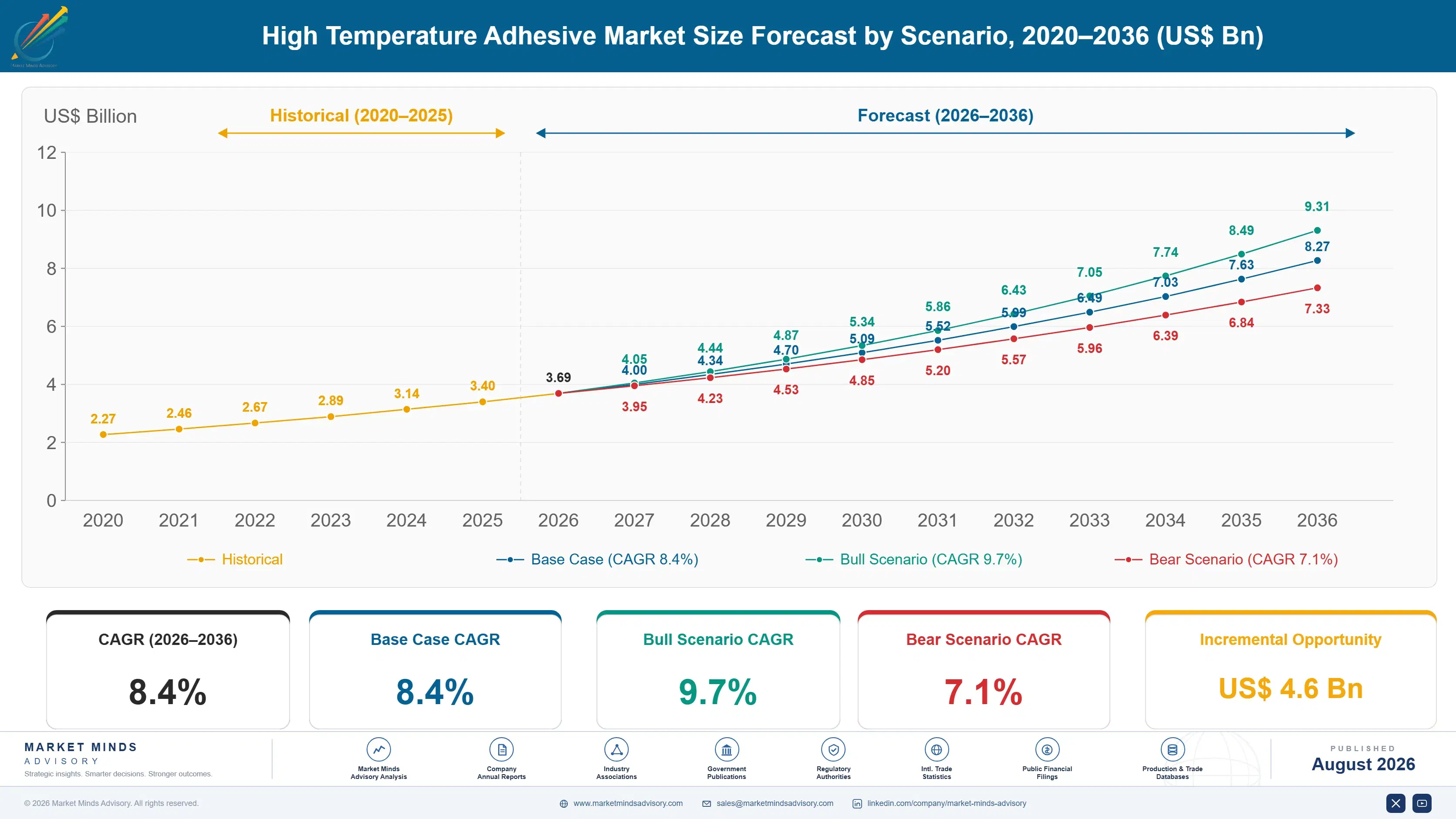
High temperature adhesive demand grew at a 7.3% historical rate between 2020 and 2025, held back early by pandemic-driven semiconductor fabrication delays and later by a slower-than-expected aerospace production recovery. Recovery accelerated from 2022 as semiconductor packaging investment surged and electric vehicle power electronics production scaled rapidly across East Asia. Both trends reinforced each other as chip demand and vehicle electrification advanced together through the second half of the period.
Three mechanisms carry the base case to 8.4%. First, advanced semiconductor packaging keeps generating polyimide and cyanate ester specification volume independent of broader chip demand cycles. Second, silicon carbide power module adoption in electric vehicles pushes continuous operating temperatures beyond what standard epoxy can sustain. Third, aerospace structural bonding programmes are qualifying cyanate ester systems for weight and thermal performance even where the material costs more than legacy epoxy adhesive.
The bull case at 9.7% assumes semiconductor packaging investment accelerates faster than currently scheduled and silicon carbide power module adoption in electric vehicles outpaces current industry roadmaps. The bear case at 7.1% assumes a slower semiconductor capital spending cycle and delayed aerospace production ramps, stretching qualification timelines and pushing adhesive specification decisions later into the forecast period.

Thermal Performance Economics and Qualification Depth

Three forces converge on the high temperature adhesive market. Semiconductor packaging density needs higher-temperature bonding faster than incumbent epoxy chemistries can reliably deliver, EV power electronics adoption needs first-fit specification at a pace unmatched by any other end use, and tightening thermal performance requirements are pushing formulators toward chemistries that cost more upfront but survive far longer in continuous high-temperature service. Buyers increasingly treat adhesive selection as a reliability decision rather than a routine procurement choice.
MARKET CONCENTRATIONCR5 44%Moderately concentrated field led by global specialty majors
PRICE PREMIUM OVER EPOXY3x to 6xPolyimide and cyanate ester command a steep formulation premium
TOP PRODUCING COUNTRY SHARESouth Korea 17%Domestic semiconductor and battery manufacturing anchor national output
CAPACITY UTILISATION78%Producers run near ceiling through most qualification cycles
FEEDSTOCK SHARE OF COGS48% to 60%Specialty resin and conductive filler dominate finished cost
TYPICAL QUALIFICATION CYCLE LENGTH12 to 30 monthsApproval timelines vary sharply by end-use application type
Commercially, the market behaves like a specialty technical qualification business rather than a commodity material trade. Buyers select on thermal cycling performance, long-term reliability data, and technical support depth more than on unit price, and switching a qualified adhesive on a critical semiconductor or aerospace application is rare once a customer has validated a supplier's reliability data against its own accelerated life testing protocol.
Over the next decade the defining forces are qualification cycle speed, conductive filler cost exposure, and the pace at which polyimide and cyanate ester systems displace epoxy in applications where epoxy has historically dominated on installed cost alone. Suppliers that solve both the chemistry and the qualification-speed problem simultaneously will set the pace of the market's next decade.
"A qualification failure on a single semiconductor packaging line can cost more than a year of adhesive purchases. Nobody switches suppliers here to save a few dollars per kilogram."
Director, Advanced Materials and Electronic Bonding Practice · MMA Chemicals and Materials Practice · August 2026

Market Trends

Chip Stacking Pushes Polyimide Past Epoxy Thermal Limits

Advanced semiconductor packaging, including 2.5D and 3D chip stacking, increasingly specifies polyimide die-attach adhesive over epoxy, since stacked die assemblies generate localised heat that standard epoxy formulations cannot reliably withstand across repeated thermal cycling. Taiwan Semiconductor Manufacturing Company and Samsung Electronics have both expanded advanced packaging capacity since 2023, each new production line requiring qualified polyimide systems rated for continuous service well above conventional epoxy limits. 3M and DuPont have both expanded polyimide adhesive production capacity since 2024 to meet a widening order backlog tied directly to advanced packaging capital spending committed through the decade.
Market Impact: Adds USD 190 million demand

Silicon Carbide Power Modules Demand Higher-Temperature Die-Attach

Electric vehicle power electronics built around silicon carbide and gallium nitride semiconductors operate at continuous temperatures meaningfully above legacy silicon-based modules, forcing tier-one automotive suppliers to qualify cyanate ester and high-temperature silicone die-attach systems in place of standard epoxy. Infineon, STMicroelectronics, and Wolfspeed have all expanded silicon carbide production since 2023, each qualification cycle pulling forward adhesive specification volume years ahead of typical automotive replacement timelines. Henkel and Master Bond have both opened dedicated automotive power electronics technical centres since 2024 to support these qualification programmes directly. reflecting how central this end use has become to overall demand.
Market Impact: Lifts cyanate ester by 5 points

Market Opportunities and Growth Drivers

Advanced Packaging Investment Outpaces Broader Chip Demand Cycles

Global semiconductor capital spending on advanced packaging capacity has grown considerably faster than overall chip demand in recent years, as heterogeneous integration and chiplet architectures become standard practice across leading-edge and increasingly mature-node production alike. Every new advanced packaging line requires qualified high-temperature adhesive from first commissioning, since standard epoxy cannot meet the thermal cycling reliability specifications advanced packaging demands. This creates specification demand largely independent of broader semiconductor cyclicality, and adhesive suppliers report qualification requests continuing to rise even during periods when broader chip demand has softened across the wider industry.
Market Impact: Delays entry 12 to 30 months

Aerospace Structural Bonding Programmes Qualify Cyanate Ester

Boeing, Airbus, and major defence contractors have expanded cyanate ester adhesive qualification across structural composite bonding applications, since cyanate ester offers a favourable combination of low outgassing, high thermal stability, and weight savings over mechanical fastening that legacy epoxy adhesive cannot fully match. NASA and the European Space Agency have also driven cyanate ester adoption in satellite structures, where thermal cycling in orbit demands adhesive stability standard epoxy struggles to guarantee across a multi-year mission life. Compliance and qualification costs fall hardest on smaller aerospace suppliers lacking testing infrastructure, accelerating consolidation toward larger qualified formulators.
Market Impact: Raises silver-filled adhesive cost by 18%

Market Restraints and Challenges

Lengthy Qualification Cycles Slow New Supplier Entry

Aerospace and semiconductor customers typically require twelve to thirty months of accelerated life testing and reliability validation before qualifying a new adhesive formulation, and this lengthy cycle locks in incumbent suppliers regardless of a challenger's underlying material performance. The root cause sits in the cost of qualification failure itself: a bonding failure in a semiconductor package or aircraft structure carries consequences far exceeding any adhesive cost saved by switching suppliers. Some producers are responding by offering co-development partnerships that share qualification cost and risk with customers directly, shortening the effective time to a locked-in specification relationship for both parties.
Market Impact: Adds 2.8 points to polyimide CAGR

Silver Filler Price Volatility Squeezes Die-Attach Margins

Silver-filled conductive die-attach adhesive cost tracks precious metal pricing closely, since silver flake or powder makes up a meaningful share of formulated material by weight, and producers cannot pass through sudden price spikes to customers locked into fixed-price supply agreements. The root cause is silver's dual role as both an industrial input and an investment asset, meaning price moves independently of adhesive demand fundamentals. The commercial impact falls hardest on smaller formulators without hedging programmes or long-term metal supply contracts. Several larger producers are now qualifying copper and alternative conductive fillers that reduce silver content without sacrificing electrical performance.
Market Impact: Lifts EV demand by 6 points
3 additional market trends, 4 additional growth drivers, and 3 additional restraints and challenges are covered in the full report. Contact sales@marketmindsadvisory.com to access the complete intelligence.

Segment CAGR and Growth Architecture

Segmentation follows adhesive chemistry, a single technical and commercial logic, since thermal stability, outgassing behaviour, and cure mechanism vary by resin family rather than by the end-use application a bond serves or the substrate materials it joins together. Every chemistry below competes on a shared thermal performance benchmark. so classification stays grounded in polymer chemistry rather than application context.
high-temperature-adhesive-market-market-share-analysis-1787553830025

Polyimide Adhesives

Polyimide adhesives grow fastest at 11.8%, about 1.40 times the overall 8.4% rate, as advanced semiconductor packaging and power electronics push continuous service temperatures beyond what epoxy or standard silicone can reliably sustain across repeated thermal cycling. Film and paste polyimide formulations each serve slightly different die-attach and structural bonding applications, but both compete for the same limited qualified production base. Demand concentrates in East Asian semiconductor packaging hubs, particularly Taiwan and South Korea, where advanced packaging capital spending has been heaviest through the current investment cycle. DuPont, 3M, and Henkel supply the bulk of qualified polyimide systems, and order backlogs now stretch past ten months at several major converters.
CAGR 11.8%

Cyanate Ester Adhesives

Cyanate ester adhesives grow at 10.2%, the second-fastest chemistry, as aerospace and satellite structural bonding programmes specify its combination of low outgassing, high thermal stability, and weight savings over mechanical fastening that legacy epoxy adhesive cannot fully match. Toughened and untoughened cyanate ester grades serve different structural applications, with toughened grades commanding a premium for high-load bonding. North America and Western Europe drive the bulk of specification as major aerospace primes and their tier-one suppliers qualify cyanate ester across new aircraft and satellite programmes. Solvay and Huntsman both expanded cyanate ester production capacity during 2024 and 2025 to meet rising qualification demand across their largest aerospace accounts. Technical service intensity remains high throughout each multi-year qualification programme.
CAGR 10.2%
Full segment breakdown across 6 segments available in the complete report.

Regional Architecture and Country Demand Map

East Asia leads on semiconductor packaging and EV battery manufacturing scale, North America follows on aerospace and defence structural bonding demand, and South Asia and Pacific posts the fastest growth as regional electronics manufacturing expands from a smaller base. while Western Europe holds a steady aerospace-anchored base.

North America

United States aerospace and defence structural bonding anchors North American demand, where Boeing, major defence contractors, and their tier-one suppliers qualify cyanate ester and polyimide systems across new aircraft and satellite programmes on multi-year development cycles. Domestic semiconductor packaging investment tied to the CHIPS Act is adding a second, faster-growing demand pool as new advanced packaging capacity comes online across several states. The region's 26% share and 8.0% growth rate reflect a mature but technically demanding qualification base rather than volume-driven demand, since aerospace programmes alone can sustain specialty adhesive suppliers for years once qualified. Automotive silicon carbide power electronics adoption is adding a third demand pool as domestic EV manufacturing scales.
Share: 26% | CAGR: 8.0% (2026 to 2036)

Western Europe

Aerospace structural bonding, anchored by Airbus and its extensive tier-one supplier network across France and Germany, defines demand across Western Europe, where cyanate ester and toughened epoxy qualification programmes run on multi-year development cycles tied to new aircraft platforms. Germany also contributes steady industrial and automotive power electronics demand as European automakers qualify silicon carbide systems for next-generation EV platforms. The region's 19% share sits below East Asia's despite a comparable aerospace qualification base, because Western Europe lacks meaningful semiconductor packaging capacity relative to Asian hubs. Growth of 6.9%, among the slower regions, reflects a qualification-driven rather than volume-driven demand base that expands gradually. Aerospace platform lifecycles run for decades, which smooths demand even during periods of broader industrial softness.
Share: 19% | CAGR: 6.9% (2026 to 2036)
Regional intelligence for 5 additional markets available in the complete report: East Asia, South Asia and Pacific, Latin America, Middle East and Africa, Eastern Europe. Contact sales@marketmindsadvisory.com.
high-temperature-adhesive-market-country-cagr-analysis-1787553830529

Where Adhesive Suppliers Can Defend Margin

Four moves separate high temperature adhesive suppliers earning premium margin from those competing purely on price per kilogram, each targeting a point where buyers pay for qualification certainty rather than material alone, since a bonding failure in a critical application costs far more than any adhesive saved on the original purchase. Suppliers that internalise this arithmetic price accordingly.

Co-Develop Formulations Directly With Anchor Customers

Suppliers that co-develop adhesive formulations directly with major semiconductor or aerospace customers, sharing qualification cost and risk rather than selling from a standard catalogue, convert a one-time material sale into a locked-in, multi-year specification relationship that competitors struggle to displace. Early movers report qualification-to-revenue conversion rates well above suppliers selling standard catalogue chemistry alone, since a customer that co-invested in development rarely switches away afterward. Henkel and DuPont have both expanded co-development programmes since 2024, tying formulation roadmaps directly to named customer technology platforms. deepening account entrenchment well beyond what catalogue selling alone could achieve.
Market Impact: Lifts co-developed contract margin by 8 to 13 points

Qualify Silver-Alternative Conductive Fillers Well Ahead of Need

Suppliers that qualify copper, nickel, or other alternative conductive fillers ahead of silver price spikes reduce exposure to precious metal volatility while offering customers a documented cost stability story that increasingly matters during multi-year supply negotiations. This also addresses a genuine technical challenge directly, since alternative fillers require reformulation to maintain electrical and thermal performance equivalent to silver. 3M and Master Bond have both disclosed alternative filler qualification progress in their 2024 technical communications, targeting reduced silver dependence across their die-attach product lines. a shift that increasingly matters to customers managing their own supply chain risk.
Market Impact: Cuts silver dependence by roughly 30% by 2028

Build Regional Technical Support Near Packaging Hubs

Suppliers that place application engineers and testing laboratories directly at Taiwanese, Korean, and Chinese semiconductor packaging hubs, rather than serving them remotely, can offer customers faster qualification support that commands a premium during new production line ramp-up, when adhesive performance issues carry the highest cost. Building this local presence takes years of relationship development and technical credibility, creating a durable advantage once established. Henkel and Shin-Etsu have both disclosed regional technical centre investments since 2024 targeting East Asian packaging accounts directly. a commitment competitors serving the region remotely will find increasingly difficult to match on responsiveness.
Market Impact: Commands a 5 to 9% technical service premium

Offer Combined Die-Attach and Encapsulant Product Bundles

Suppliers that bundle die-attach adhesive with compatible encapsulant and underfill materials on a single qualified system capture more of the total packaging materials budget than suppliers offering die-attach alone, since customers increasingly prefer a single accountable supplier for chemically compatible materials across the whole assembly process. This also deepens the technical relationship, since bundled qualification requires close collaboration on thermal expansion matching between materials. Henkel and DuPont have both expanded bundled product lines since 2024, reporting order values meaningfully higher than single-product agreements. a pattern that is likely to keep strengthening as packaging complexity increases further.
Market Impact: Raises average contract value by about 22% per bundle

Who Controls the Margin Pool

Concentration sits at a moderate CR5 of 44%, with the gap between Henkel and 3M, the two largest suppliers, and smaller specialty formulators measured in qualification depth and application-specific reliability data rather than manufacturing scale alone. All participants here are assessed on one basis, annual high-temperature adhesive and technical qualification services revenue.
Competitive activity runs along three lines. Formulation chemistry and reliability data depth remain the primary differentiator, since qualification cycles reward suppliers with the longest track record on a specific application. Conductive filler cost management is becoming a genuine competitive advantage as silver price volatility persists. And co-development partnerships are shifting several suppliers from catalogue material sales toward long-term technical relationships that lock in customer accounts for the life of a product platform.

Pressure is building from specialty formulators who lack the manufacturing scale of global majors but compete aggressively on responsiveness and application-specific customisation, particularly in aerospace niches where a fast technical response matters more than brand recognition. Rankings will shift toward suppliers who combine reliability data depth with regional technical presence, since both are becoming harder to build from a standing start as qualification requirements tighten across every major end-use application.
high-temperature-adhesive-market-company-positioning-matrix-1787553831053

Competitive Moat and Risk Dimensions

HENKEL AG & CO. KGAA

Moat: Broadest multi-chemistry qualification portfolio

Henkel manufactures across silicone, epoxy, polyimide, and cyanate ester chemistries and maintains qualified formulations across aerospace, semiconductor, and automotive applications simultaneously, letting it win specification regardless of which chemistry a customer ultimately requires. Its global technical service network and decades of reliability data give it credibility newer entrants struggle to match on complex qualification programmes.
HENKEL AG & CO. KGAA

Risk: Consumer adhesives segment margin drag

Henkel's broader corporate performance ties partly to its larger consumer and general industrial adhesives businesses, which face different competitive dynamics and lower margin than high-temperature specialty chemistry, and sustained weakness there could constrain capital available for specialty segment investment even though the two businesses serve entirely different markets and customers.
3M COMPANY

Moat: Deep polyimide film heritage

3M holds one of the industry's deepest polyimide film and adhesive tape manufacturing heritages, and semiconductor packaging customers frequently specify 3M formulations by name in qualification documentation built up over years of joint development. That heritage and application-specific reliability data give it pricing power newer entrants cannot replicate quickly on advanced packaging applications.
3M COMPANY

Risk: Broader litigation and restructuring overhang

3M's corporate performance has faced pressure from unrelated litigation and restructuring costs across other business segments in recent years, and the associated financial strain could constrain capital available for specialty adhesive research investment even though the high-temperature adhesive business itself performs well on its own merits.

Players Tracked

Prominent Players

Henkel AG & Co. KGaA
3M Company
H.B. Fuller Company
Master Bond Inc.
DuPont de Nemours Inc.

Other Key Players

Dow Inc.
Momentive Performance Materials
Permabond LLC
Panacol-Elosol GmbH
Aremco Products Inc.
Solvay SA
Huntsman Corporation
Hexion Inc.
Wacker Chemie AG
Shin-Etsu Chemical Co Ltd
Elantas (Altana AG)
LORD Corporation
Delo Industrial Adhesives
Threebond Holdings Co Ltd
Epoxies Etc.

Recent Developments

FEBRUARY 2025

3M Expands Polyimide Adhesive Capacity in South Korea

3M commissioned expanded polyimide adhesive tape manufacturing capacity at its South Korean facility, adding dedicated production lines to serve advanced semiconductor packaging customers across the region. The expansion reduces lead times for Korean and Taiwanese customers who previously drew allocation from 3M's American manufacturing network.
Signal: Building polyimide capacity in Korea, not the United States, confirms where advanced packaging demand actually concentrates.
JULY 2025

Henkel Acquires Specialty Aerospace Epoxy Formulator

Henkel acquired a specialty formulator of high-temperature epoxy and toughened adhesive systems serving aerospace structural bonding applications. The acquisition brings qualified aerospace formulations and existing customer relationships rather than new manufacturing capacity, strengthening Henkel's position against Solvay and Huntsman in structural bonding. across multiple aircraft programmes.
Signal: Buying qualified aerospace formulations rather than building them from scratch shows how long qualification cycles have become.
NOVEMBER 2025

DuPont Signs Taiwan Polyimide Supply Agreement

DuPont signed a multi-year supply agreement with a Taiwanese semiconductor packaging firm for polyimide die-attach adhesive tied to expanding advanced packaging capacity. The agreement was a commercial supply contract, not a joint venture or equity arrangement, and includes committed volume through the customer's capacity expansion programme.
Signal: Long-term supply agreements tied to single packaging customers show how concentrated advanced packaging demand has become.

Resin, Filler, and Qualification Cost Exposure

Specialty resin and monomer inputs, including polyimide precursors and cyanate ester monomers, run 35% to 45% of finished cost across premium chemistries. Conductive fillers, particularly silver flake and powder used in die-attach formulations, account for 20% to 30% of cost depending on filler loading, while curing agents and specialty additives add 10% to 15% across most formulations.
The clearest recent volatility event came in 2024, when industrial and investment demand pushed silver prices to multi-year highs, lifting cost for every silver-filled die-attach formulation across the industry. Henkel's 2024 Annual Report disclosed higher conductive filler input costs following the price surge, and several formulators reported delivery delays stretching past six weeks as suppliers rationed allocation during the peak of the disruption. Smaller formulators without hedging programmes felt the disruption hardest across the industry.

Exposure varies sharply by player type. Vertically integrated formulators with long-term precious metal hedging programmes absorbed the 2024 disruption with far less margin damage than smaller specialty producers buying silver on the spot market. Formulation mix compounds the gap further, since producers weighted toward silver-filled die-attach chemistry face materially higher exposure than producers focused on structural bonding applications that use little or no conductive filler.
high-temperature-adhesive-market-cost-volatility-analysis-1787553831248

Qualify Copper and Alternative Conductive Fillers

Producers that reformulate die-attach adhesive with copper, nickel, or other alternative conductive fillers reduce direct precious metal exposure while often maintaining acceptable electrical and thermal performance for many applications. Reformulation takes time to requalify against customer reliability standards, but once complete it becomes a durable cost advantage competitors dependent on silver cannot replicate quickly.

Lock Multi-Year Precious Metal Supply Agreements

Fixed-formula, multi-year silver supply agreements protect formulators from spot-price spikes during precious metal disruptions at the cost of some pricing flexibility during periods of price weakness. Buyers with committed volume also receive priority allocation when total available silver tightens across the industry during a supply shock. That trade-off favours formulators serving customers who cannot tolerate an unplanned filler shortage.

Shift Toward Lower-Filler-Loading Formulations Where Possible

Formulators developing adhesive systems that achieve required electrical and thermal performance at lower conductive filler loading reduce their overall precious metal exposure per unit sold. This shift also lowers finished product weight, giving formulators a second commercial reason to pursue the same reformulation across applicable applications. Several major formulators now report these lower-loading systems gaining share steadily.

Portfolio Architecture for Margin Defence

The portfolio splits into three tiers with real margin separation. Standard high-temperature epoxy for general industrial bonding competes on price per kilogram and earns modest but steady margin. Polyimide and cyanate ester systems earn considerably more, since customers pay for thermal performance and qualification depth rather than material alone. Co-developed and alternative-filler premium formulations sit in a growing third tier where documented reliability and supply security, not material cost, set the price.
The tension between volume and premium work is real. Standard epoxy generates the steadiest cash flow and funds the qualification infrastructure that premium polyimide work later depends on, yet it offers limited margin upside as competition intensifies among regional formulators. Polyimide and cyanate ester premium work carries far better margin but requires proprietary qualification data that takes years to build and cannot be replicated quickly by new entrants.

High-value margin pools concentrate in semiconductor advanced packaging polyimide specification, where thermal cycling requirements rule out cheaper alternatives entirely, and in aerospace cyanate ester structural bonding, where multi-year qualification cycles lock customers into their original formulator for the life of an aircraft or satellite programme.

Volume / Commodity-Adjacent Tier

Standard high-temperature epoxy for general industrial bonding, priced on cost per kilogram against many qualified regional and global suppliers competing on price., where margin stays thin because epoxy chemistry is well understood and widely available across many qualified producers worldwide.
Gross Margin: 22-32%

Premium / Certified Tier

Polyimide and cyanate ester systems for semiconductor packaging and aerospace structural bonding, priced on thermal performance and multi-year qualification depth., commanding a durable premium wherever thermal cycling reliability matters more to the customer than material cost alone.
Gross Margin: 40-54%

Sustainability / Regulatory / Next-Generation Tier

Alternative-filler and co-developed formulations sold against supply security and customer-specific reliability requirements, commanding relationship-based pricing. that rewards documented reliability data and supply chain traceability over raw material cost, particularly among customers managing their own geopolitical exposure.
Gross Margin: 34-48%
high-temperature-adhesive-market-portfolio-architecture-1787553831741

High-value Sub-segments and Strategic Watch-out

Polyimide Adhesives

High value and the fastest-growing segment at 11.8%, driven by advanced semiconductor packaging demand for thermal cycling performance that epoxy cannot reliably deliver. Margin runs highest here, and order backlogs already stretch past ten months at several converters. Committed packaging capital budgets give suppliers unusually long demand visibility.
Gross Margin: 42-54%

Cyanate Ester Adhesives

High value with strong growth near 10.2%, anchored in aerospace and satellite structural bonding where multi-year qualification cycles lock customers to their original formulator for the life of a programme. Toughened grades increasingly win share as structural load requirements tighten across new commercial aircraft platforms.
Gross Margin: 38-50%

Silicone High-Temperature Adhesives

The volume core, covering general industrial and automotive bonding across every region. Steady but thin margin, competing on price per kilogram against a fragmented field of regional and global formulators. Volume stays resilient because general bonding demand rarely pauses, even as premium chemistries gain share in electronics and aerospace.
Gross Margin: 24-34%

Ceramic and Inorganic Adhesives

The strategic watch-out. A mature, niche chemistry facing steady share erosion to polyimide in extreme-temperature applications, with growth slowing to 5.2% as customers favour more versatile organic chemistries. Producers still leaning on ceramic adhesive volume should diversify toward polyimide or cyanate ester chemistry before erosion accelerates further.
Gross Margin: 20-30%

Why Qualification Locks In Suppliers

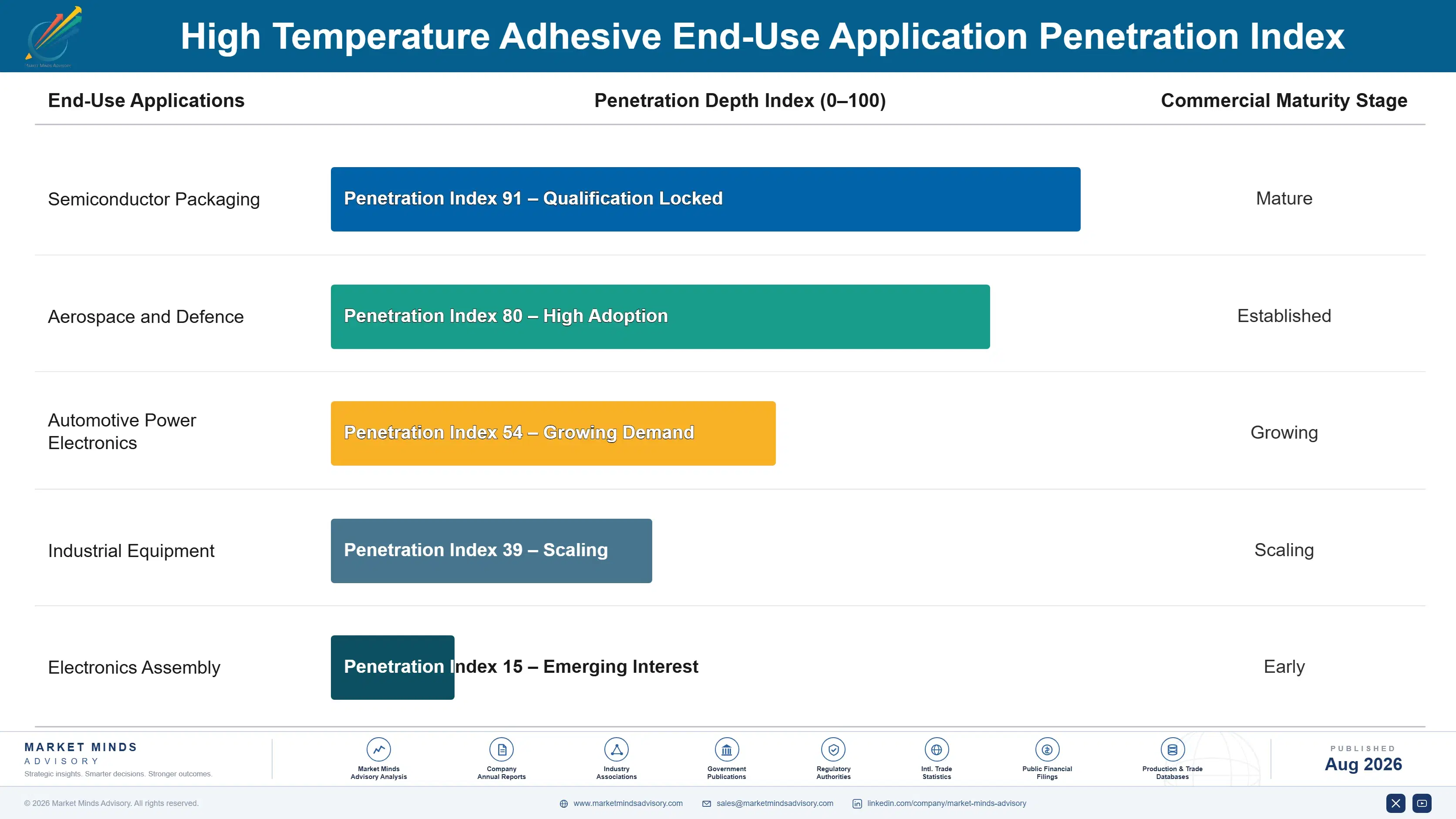
Adhesive demand behaves like an annuity once a customer validates a formulation against its own reliability standard, since requalifying an alternate supplier means repeating costly accelerated life testing that most customers avoid unless the incumbent's performance deteriorates. A semiconductor packaging line or aircraft programme running a validated adhesive formulation will keep sourcing from the same supplier for the life of the platform, even as volumes fluctuate with production rates.
Adoption depth varies sharply by end-use vertical. Aerospace and semiconductor buyers show almost total loyalty to their qualified supplier, since switching after qualification means repeating extensive reliability validation that programme managers avoid whenever possible. General industrial and automotive buyers show more willingness to switch suppliers between product generations, since adhesive performance is judged mainly on delivered reliability and price rather than any regulatory qualification requirement.

Buyer profiles are shifting generationally as procurement moves from materials engineers who select on long-standing supplier relationships toward centralised corporate procurement functions that weigh total qualification cost and supply security more heavily. Younger reliability engineers increasingly push for documented accelerated life testing data before committing to a formulation change, a habit less common among the retiring generation of materials specialists.
high-temperature-adhesive-market-end-use-penetration-index-1787553832233

Where the Next Decade Gets Decided

These are among the four positions where our research anticipates prominent divergence between winners and laggards over the coming forecast period. Each is grounded in the demand model, the regulatory perimeter, and the announced capacity pipeline.
01 / POLYIMIDE CAPACITY POSITIONING

Build polyimide production capacity ahead of advanced packaging demand

Polyimide adhesive is growing at 11.8%, well above every other chemistry, and order backlogs already stretch past ten months at several major converters serving semiconductor packaging customers. Suppliers that expand polyimide capacity now will capture disproportionate share as advanced packaging capital spending keeps converting into new production lines across East Asia. Waiting for demand to fully materialise before investing in capacity means arriving after qualification programmes are already awarded to competitors who moved first and locked in multi-year specification relationships.
02 / SILVER DEPENDENCE REDUCTION

Qualify alternative conductive fillers before the next price shock

The 2024 silver price surge showed how directly precious metal exposure can damage die-attach formulator margin industry-wide, and silver price volatility has not meaningfully declined since then given continued industrial and investment demand pressure. Formulators that qualify alternative conductive fillers now will hold a durable cost advantage during the next disruption, while competitors still dependent on silver face renewed margin risk. Reformulation and requalification take time, so the window to begin is now, not after the next spike forces a costly scramble.
03 / CO-DEVELOPMENT RELATIONSHIP BUILDING

Shift toward co-development before commodity competitors close the gap

Customers increasingly value formulators willing to share qualification cost and risk directly, and suppliers still selling purely from a standard catalogue are leaving margin on the table that co-development relationships could capture instead. Early movers including Henkel and DuPont are already tying formulation roadmaps to named customer technology platforms, deepening relationships that catalogue-only competitors cannot replicate. Suppliers that delay this shift risk losing their most sophisticated accounts to competitors already offering shared-risk development partnerships backed by documented multi-year reliability data.
04 / EAST ASIA MARKET COMMITMENT

Prioritise East Asian technical presence despite qualification complexity

East Asia holds 30% of global high-temperature adhesive value and grows at 9.5%, ahead of every other region, driven by semiconductor packaging and EV power electronics investment that shows no sign of slowing through the forecast period. Suppliers without meaningful East Asian technical presence are ceding the largest and fastest-growing regional pool to competitors who already hold packaging customer relationships. Qualification complexity is real, but the alternative is permanent exclusion from the market's highest-value growth pool for a decade or more.

Engagement Snapshot From the Field

A live engagement with an industry participant carrying material or product regulatory and market exposure ahead of a defining policy shift, showing how our research translates into a defensible multi-year portfolio strategy.
MARKET MINDS ADVISORY · CLIENT ENGAGEMENT SUMMARY
High Temperature Adhesive Producer Strategic Portfolio Review and Transition Roadmap 2026·Investment Scenario on High Temperature Adhesive Exposure Evaluation 2025-26
CLIENT PROFILE
A tier-one automotive power electronics supplier manufacturing inverter modules for several major electric vehicle programmes approached MMA while evaluating a shift from silicon to silicon carbide semiconductors. The client reported annual power module revenue near USD 640 million, with adhesive and thermal interface materials representing a small but rapidly rising share of module bill of materials cost (client-reported, unverified by MMA).
STRATEGIC CHALLENGE
Engineering wanted to stay with the incumbent epoxy die-attach adhesive that had served silicon-based modules for years, while the product team pushed for a silicon carbide transition without fully costing the adhesive requalification this would require. Nobody had modelled the actual reliability risk of running silicon carbide modules on adhesive not rated for their higher continuous operating temperature.
MMA APPROACH
MMA built a thermal-performance-to-reliability model comparing incumbent epoxy against cyanate ester and high-temperature silicone die-attach options for the client's proposed silicon carbide module design, weighted by expected continuous operating temperature and thermal cycling frequency. We benchmarked qualification timelines across candidate suppliers and modelled warranty risk exposure using the client's own field reliability data to make the comparison concrete for the board.
KEY FINDINGS
  1. The incumbent epoxy adhesive showed a meaningfully elevated failure probability under silicon carbide operating temperatures within the vehicle's expected warranty period based on accelerated life testing projections.
  2. A high-temperature silicone alternative matched cyanate ester reliability performance at a materially lower material cost, though with a longer cure cycle that required minor production line adjustments.
  3. Qualification timelines across candidate suppliers ranged from ten to nineteen months, meaning the client's original production timeline required immediate supplier selection to stay on schedule.
  4. Warranty risk modelling showed the incumbent adhesive's failure exposure alone could exceed the entire cost of requalifying a new supplier within the first two years of field deployment (client-reported, unverified by MMA).
CLIENT PROFILE
A tier-one automotive power electronics supplier manufacturing inverter modules for several major electric vehicle programmes approached MMA while evaluating a shift from silicon to silicon carbide semiconductors. The client reported annual power module revenue near USD 640 million, with adhesive and thermal interface materials representing a small but rapidly rising share of module bill of materials cost (client-reported, unverified by MMA).
STRATEGIC CHALLENGE
Engineering wanted to stay with the incumbent epoxy die-attach adhesive that had served silicon-based modules for years, while the product team pushed for a silicon carbide transition without fully costing the adhesive requalification this would require. Nobody had modelled the actual reliability risk of running silicon carbide modules on adhesive not rated for their higher continuous operating temperature.
MMA APPROACH
MMA built a thermal-performance-to-reliability model comparing incumbent epoxy against cyanate ester and high-temperature silicone die-attach options for the client's proposed silicon carbide module design, weighted by expected continuous operating temperature and thermal cycling frequency. We benchmarked qualification timelines across candidate suppliers and modelled warranty risk exposure using the client's own field reliability data to make the comparison concrete for the board.
KEY FINDINGS
  1. The incumbent epoxy adhesive showed a meaningfully elevated failure probability under silicon carbide operating temperatures within the vehicle's expected warranty period based on accelerated life testing projections.
  2. A high-temperature silicone alternative matched cyanate ester reliability performance at a materially lower material cost, though with a longer cure cycle that required minor production line adjustments.
  3. Qualification timelines across candidate suppliers ranged from ten to nineteen months, meaning the client's original production timeline required immediate supplier selection to stay on schedule.
  4. Warranty risk modelling showed the incumbent adhesive's failure exposure alone could exceed the entire cost of requalifying a new supplier within the first two years of field deployment (client-reported, unverified by MMA).
RECOMMENDED STRATEGY
Phase 1: Phase 1 (0 to 6 months): Begin parallel qualification of the high-temperature silicone alternative alongside continued incumbent epoxy production. at the primary facility. Phase 2: Phase 2 (6 to 18 months): Transition new silicon carbide module production lines fully to the qualified silicone alternative. across all applicable plants. Phase 3: Phase 3 (18 to 36 months): Extend the qualified silicone formulation across remaining legacy silicon module lines as adhesive inventory cycles through.
OUTCOME
The client completed silicone adhesive qualification within the modelled timeline and launched its first silicon carbide module programme without a single adhesive-related field failure reported through the following eighteen months. Adhesive cost per module rose by a reported low single-digit percentage, well below the double-digit increase cyanate ester would have required (client-reported, unverified by MMA).

Frequently Asked Questions

Foundational context covering the market sizes, CAGR, scope, country, region and competition that inform every finding below. This section is provided to cover basics and most often pre-purchase conversations, answered from the MMA Primary Research Dataset.

What is the current size of the High Temperature Adhesive Market?

The high temperature adhesive market reached USD 3.4 billion in 2025, spanning silicone, epoxy, polyimide, cyanate ester, bismaleimide, and ceramic chemistries used across semiconductor, aerospace, and automotive applications.

How large will the High Temperature Adhesive Market be by 2036?

MMA forecasts the market will reach roughly USD 8.5 billion by 2036, up from about USD 3.7 billion in 2026, as semiconductor packaging and EV power electronics demand continue driving specification.

What is the CAGR for the High Temperature Adhesive Market 2026 to 2036?

The base case CAGR is 8.4% for 2026 to 2036, with a bull case of 9.7% and a bear case of 7.1% depending on semiconductor capital spending and EV adoption timing.

Which segment is growing fastest?

Polyimide adhesives grow fastest at 11.8% CAGR, about 1.40 times the overall market rate, driven by advanced semiconductor packaging demand. Cyanate ester adhesives follow close behind at 10.2%.

Who are the major companies in the High Temperature Adhesive Market?

Henkel, 3M, HB Fuller, Master Bond, and DuPont lead the field, assessed on combined adhesive manufacturing and technical qualification services revenue. Fifteen additional players compete across regional and chemistry-specific niches.

Which country is growing fastest?

South Korea posts the fastest national growth at 12.6% CAGR, driven by combined semiconductor advanced packaging and EV battery and power module manufacturing investment. China follows as the second-fastest major market.

Report Segmentation Architecture

The full report scope spans multiple orthogonal segmentation dimensions, with cross-tabulated demand data provided for each dimension pair. Coverage extends further to regional breakdowns, trend trajectories, and the competitive detail needed to support segment-level decision-making.

By Adhesive Chemistry

  • Polyimide Adhesives
  • Cyanate Ester Adhesives
  • Bismaleimide Adhesives
  • Silicone High-Temperature Adhesives
  • Epoxy High-Temperature Adhesives
  • Ceramic and Inorganic Adhesives

By End-Use Application

  • Semiconductor Packaging
  • Aerospace and Defence
  • Automotive Power Electronics
  • Industrial Equipment
  • Electronics Assembly

By Commercial Dimension

  • Standard Catalogue Formulation Supply
  • Co-Developed Custom Formulation Contracts
  • Bundled Multi-Material Product Systems
  • Technical Qualification Support Services

By Region

  • North America
  • Western Europe
  • East Asia
  • South Asia and Pacific
  • Latin America
  • Middle East and Africa
  • Eastern Europe

Scope, Methodology, and Coverage

Every figure in this report is reproducible from documented input assumptions. The scope below maps the historical period, the forecast horizon, the segmentation dimensions, and the countries covered, alongside the underlying primary and qualitative methodology.
Historical Period
2020 to 2025
Forecast Period
2026 to 2036
Base Year
2025 (USD billions; MMA Primary Research Dataset, August 2026)
Market Definition
The high temperature adhesive market comprises adhesive materials and technical qualification services formulated for continuous service above 150 degrees Celsius, used in structural bonding, die-attach, and thermal interface applications. It spans silicone, epoxy, polyimide, cyanate ester, bismaleimide, and ceramic or inorganic chemistries. General-purpose adhesives rated below 150 degrees Celsius, mechanical fasteners, and standalone thermal interface materials without adhesive function are excluded.
Quantitative Units
USD billions (current prices); metric tonnes of adhesive supplied where applicable
Segmentation Dimensions
By Adhesive Chemistry; By End-Use Application; By Commercial Dimension; By Region
Regions Covered
North America, Western Europe, East Asia, South Asia and Pacific, Latin America, Middle East and Africa, Eastern Europe
Countries Covered
USA, China, Germany, France, UK, Japan, South Korea, India, Australia, Canada, Brazil, Mexico, Indonesia, Vietnam, Thailand, Malaysia, UAE, Saudi Arabia, South Africa, Nigeria, Turkey, Poland, Netherlands, Italy, Spain, Sweden, Switzerland, Argentina, Colombia, Singapore, and additional markets relevant to this sector
Key Companies Profiled
Henkel AG & Co. KGaA, 3M Company, H.B. Fuller Company, Master Bond Inc., DuPont de Nemours Inc., Dow Inc., Momentive Performance Materials, Permabond LLC, Panacol-Elosol GmbH, Aremco Products Inc., Solvay SA, Huntsman Corporation, Hexion Inc., Wacker Chemie AG, Shin-Etsu Chemical Co Ltd, Elantas (Altana AG), LORD Corporation, Delo Industrial Adhesives, Threebond Holdings Co Ltd, Epoxies Etc.
Quantitative Methodology
Primary survey, n=3,800 respondents, Q4 2025, six countries; demand-side model with trade association cross-validation
Qualitative Methodology
47 expert interviews, Q4 2025; applied to validate demand model assumptions, identify emerging dynamics, and assess competitive positioning
Report Format
PDF and XLSX data workbook (Word format preview document)
Publisher
Market Minds Advisory
Report Code
MMA-2026-CHM-103
Published
August 2026
Contact
sales@marketmindsadvisory.com | www.marketmindsadvisory.com

Purchase the full High Temperature Adhesive Market Report (2026 to 2036).

The full MMA High Temperature Adhesive Market report sizes demand across six adhesive chemistries, five end-use applications, four commercial dimensions, and seven regions through 2036. It profiles twenty participants on a consistent basis of annual adhesive manufacturing and technical qualification services revenue, scoring each on formulation breadth, reliability data depth, and regional technical presence. Scenario models quantify how advanced packaging investment, silicon carbide power module adoption, and silver price volatility move both demand and realised pricing. The report also includes delivered-cost modelling by chemistry, a conductive filler exposure screen, and a qualification cycle benchmarking tool built for procurement, strategy, and investment teams.
Six-chemistry demand and margin model across the forecast
Seven-region growth, share, and demand breakdown for 2036
Twenty-company competitive benchmarking across chemistry and application
Silver and conductive filler exposure screen
Qualification cycle benchmarking by application type
Ten-year revenue, margin, and volume forecast

Built For The People Who Decide

From boardroom strategy to bench-side execution, this report is read cover-to-cover by leaders shaping the next decade of their industry, turning demand scenarios, market dynamics and valuation benchmarks into decisions.
CXOs/ Presidents/ VPs/ Managers
M&A and Corporate Development
Strategy Teams and R&D Heads
Procurement and Product Directors
Regulatory and Compliance Leaders
Investor Relations and Equity Analysts