

Market Minds Advisory
High Silica Zeolite Market

High Silica Zeolite Market: Template economics, emissions certification and framework supply to 2036

A copper chabazite catalyst costs more in template than in silica, and the two suppliers who can make the template at scale know exactly what that is worth to everybody else.

Lead Analyst

Bilal Shaikh

Published

September 2026

Make Smarter Decisions with Customized Research Insights

Request a free sample report and evaluate market opportunities, growth trends, and competitive dynamics relevant to your business needs.

2025 MARKET VALUE$2.9BMarket Size 2025
2036 FORECAST VALUE$6.1BBase Case , 2026 to 2036
CAGR 2026 TO 20367.0 %Bull 8.3% / Bear 5.7%
INCREMENTAL OPPORTUNITY$3.0BNet 10- year value creation
EXPANSION MULTIPLE1.97x2036 value over 2026 base
Strategic Levers
M&A Pipeline
Regional Outlook
Country Rankings
Competitive Intelligence
Segmental Deep-dive
Call-Us : 91 93563 13602

Executive Snapshot and Market Trajectory

Nitrogen oxide limits are what move this market now, not refining. The United States heavy-duty rule taking effect from 2027 and Euro 7 both demand conversion efficiency that only copper-exchanged small-pore frameworks deliver, and the industry making those frameworks is very small indeed. Nobody outside it has noticed.
Chabazite and small-pore frameworks grow at 10.5%, half again the market rate of 7.0%, against a high-silica Y business tied to refinery runs that are falling in Europe and flat in North America. East Asia holds 30% of value on Chinese refining capacity, methanol-to-olefins plants and China VI enforcement arriving together. The two halves of this market have almost nothing in common commercially.
Five producers hold 56% of supply and the concentration is higher than that number suggests, because the organic template needed for small-pore synthesis comes from a handful of fine chemical producers and accounts for 47% of framework cost. Zeolite makers who do not control template supply are running a business whose largest input is priced by somebody else entirely. Very few of them have addressed it. That looks like a considerable oversight in hindsight.
Market Definition
This report covers crystalline aluminosilicate zeolites with framework silica to alumina ratios above ten, supplied as powder or bound product into catalyst and adsorbent manufacture. Frameworks covered include MFI, chabazite, faujasite, beta, mordenite, ferrierite and all-silica types. Excluded are low-silica zeolites for detergent and water softening, synthetic amorphous silica-alumina, natural zeolite minerals, and finished catalyst systems sold as assembled units.
Base Year Value
$2.9B in 2025 (MMA Primary Research Dataset, August 2026)
Forecast Period
2026 to 2036, eleven discrete annual values
CAGR
7.0% base case. Bull 8.3%. Bear 5.7%.
Fastest Growth Segment
Chabazite and Small-Pore Frameworks: 10.5% CAGR
Fastest Growth Country
India: 9.6% CAGR
Fastest Growth Region
South Asia and Pacific: 9.0% CAGR
Largest Region
East Asia: 30% of 2025 global value
Market Leaders
BASF, W. R. Grace, Honeywell UOP, Tosoh Corporation and Clariant lead the market. Source: MMA Primary Research Dataset, July 2026.
Primary Survey
n=3,800 procurement and R&D decision-makers, Q4 2025, six countries
Methodology
Demand-side build-up, cross-validated against public data, 47 expert interviews

High Silica Zeolite Market Forecast Scenarios

high-silica-zeolite-market-trends-size-forecast-scenario-1787553241267
The period from 2020 to 2025 compounded at 5.8% and the average conceals two opposite movements. Refinery catalyst demand fell through 2020 on collapsed fuel consumption and never fully recovered in Europe, where several sites closed permanently. Small-pore framework demand rose steadily across the same years as China VI enforcement reached heavy-duty fleets and European aftertreatment content increased. The net looked stable and nothing underneath it was.
The 7.0% base case rests on three mechanisms. The United States heavy-duty nitrogen oxide rule takes effect from 2027 and requires conversion performance that pulls copper chabazite content onto every certified engine family. Chinese methanol-to-olefins capacity keeps consuming small-pore framework at volumes no other application matches. And hydrophobic all-silica frameworks are moving into volatile organic compound abatement and industrial gas separation, applications that barely existed as commercial markets a decade ago.
The 8.3% bull case is battery-electric heavy-duty adoption running slower than policy assumes, which would keep diesel aftertreatment demand in the system a decade longer than current forecasts allow. The 5.7% bear case is refinery rationalisation accelerating: every European site that closes takes fluid catalytic cracking catalyst demand with it permanently, and 43% of total consumption sits in that application.

Where Framework Value Actually Sits

High-silica zeolite is a commodity and a specialty at the same time, depending entirely on which framework you mean. High-silica Y for fluid catalytic cracking is made at enormous scale by several producers and competes on price against tonnage. Copper-exchanged chabazite for nitrogen oxide reduction is made by very few, sells at multiples of the price, and is written into an engine certification that nobody reopens casually.
TOP-FIVE CONCENTRATION56%Combined position across high-silica zeolite supply held by leaders
TEMPLATE COST SHARE47%Portion of small-pore framework cost from organic directing agents
SILICA TO ALUMINA RATIO32Median framework ratio across grades qualified for automotive catalysis
CATALYST REQUALIFICATION TIME18 monthsTypical period from sample supply to engine family certification
HYDROTHERMAL AGEING THRESHOLD850 degrees CTemperature at which conventional frameworks lose crystallinity during regeneration
REFINERY CONSUMPTION SHARE43%Portion of total demand attributable to fluid catalytic cracking
The synthesis economics explain most of that gap. Small-pore frameworks need an organic structure directing agent to form at all, and that template accounts for around 47% of framework cost, which is a strange position for a material made mostly of silica and alumina. Median silica to alumina ratio across automotive-qualified grades runs near 32, and hitting that consistently while keeping crystallinity is harder than the specification makes it look.
Refining still takes 43% of total volume and that share falls every year. Hydrothermal stability is the other constraint worth naming: conventional frameworks start losing crystallinity around 850 degrees Celsius, which is precisely where a regenerating diesel particulate filter operates. Certification takes 18 months and nobody wants to do it twice.
"The interesting question in zeolites is not who can crystallise a framework. It is who can buy the template, and the answer to that has more to do with fine chemical capacity in two countries than with anything happening in catalysis."
Director, Catalysts and Process Materials Practice · MMA Chemicals and Materials Practice · August 2026

Market Trends

Nitrogen oxide limits pull copper chabazite onto every engine

The United States heavy-duty rule taking effect from 2027 cuts permitted nitrogen oxide to a fraction of current limits, and it demands that performance across low-load cycles where an exhaust system barely reaches operating temperature. Copper-exchanged chabazite is the only framework that converts efficiently in that window while surviving filter regeneration above 850 degrees Celsius. Euro 7 pushes the same direction on a different timetable. Growth at 10.5% follows regulation rather than vehicle volume, which makes it forecastable in a way most catalyst demand is not. Engine families certify once and the framework stays for the programme life.
Market Impact: Adds 30% of global value

Hydrophobic all-silica frameworks enter volatile organic compound abatement

Activated carbon has handled industrial solvent capture for a century and it has two problems: it adsorbs water preferentially in humid streams, and it burns. All-silica frameworks do neither, and they regenerate thermally without degrading. Growth at 9.5% reflects semiconductor fabrication, pharmaceutical manufacture and printing operations facing tighter emission limits and discovering that carbon cannot meet them in humid conditions. The material costs considerably more per kilogramme and lasts long enough that the comparison favours it. Suppliers have been slow to sell against carbon because the sales channel runs through environmental engineering firms rather than catalyst distributors.
Market Impact: Lifts beta frameworks 8.4% annually

Market Opportunities and Growth Drivers

Chinese methanol-to-olefins capacity consumes framework at unmatched volume

China built methanol-to-olefins capacity on coal feedstock to reduce dependence on imported naphtha, and those units consume small-pore molecular sieve catalyst at rates no refinery application approaches. Catalyst attrition in a fluidised bed means replacement demand is continuous rather than periodic, which turns a one-time plant investment into a recurring materials order. Domestic producers supply most of it and have improved quality considerably over a decade. The commercial effect on global framework demand is larger than most Western producers acknowledge, because very little of that volume is visible in Western catalyst company reporting at all.
Market Impact: Sets 47% of framework cost

Renewable fuel processing needs frameworks conventional refining never required

Hydrotreating vegetable oil and used cooking oil into renewable diesel presents a feed nothing in a conventional refinery was designed for: high oxygen content, free fatty acids, and trace contaminants that poison standard catalyst. Isomerisation to meet cold flow specification needs beta and mordenite frameworks in configurations refiners had no reason to buy before. Growth at 8.4% in beta frameworks comes substantially from this. Renewable diesel capacity has expanded fast in North America and more slowly in Europe, and every unit represents a new catalyst position rather than a replacement of an existing one.
Market Impact: Locks supply for 18 months

Market Restraints and Challenges

Organic template supply concentrates in very few fine chemical producers

Small-pore frameworks will not crystallise without an organic structure directing agent, and the quaternary ammonium compounds come from a handful of fine chemical plants. That template accounts for around 47% of framework cost, which means a zeolite producer's largest input is priced by suppliers it cannot replace. The root cause is that these molecules serve no other market, so nobody builds capacity speculatively. Commercially this caps how aggressively a producer can bid for automotive volume. Some have begun backward integrating into template synthesis, and others are pursuing template-free or recycled-template routes that work in the laboratory but not at scale.
Market Impact: Effective from 2027 onward

Engine certification locks framework choice for a programme life

A catalyst formulation written into a certified engine family cannot change without recertification, and that runs around 18 months of durability testing and regulatory submission. The root problem is that emissions certification covers the whole aftertreatment system rather than the vehicle, so a framework substitution reopens work nobody budgeted for. Commercially this means an incumbent supplier holds the position for the engine family's commercial life and prices with that knowledge. Engine makers increasingly qualify two framework sources during initial development, which costs more upfront and preserves a negotiating position for the years afterwards.
Market Impact: Segment compounding at 9.5%
3 additional market trends, 4 additional growth drivers, and 2 additional restraints and challenges are covered in the full report. Contact sales@marketmindsadvisory.com to access the complete intelligence.

Segment CAGR and Growth Architecture

Zeolites are classified here by crystalline framework type, since pore geometry determines what a material can do and which applications will accept it. Application, exchanged metal and bound form are handled separately in the framework, because a single framework type serves several applications and most applications draw on more than one framework. Pore geometry decides everything downstream.
high-silica-zeolite-market-trends-market-share-analysis-1787553242001

Chabazite and Small-Pore Frameworks

Growing at 10.5%, half again the market rate, this is where nitrogen oxide regulation lands. Copper-exchanged chabazite converts efficiently at the low exhaust temperatures that modern test cycles emphasise, and it survives the hydrothermal excursion above 850 degrees Celsius that a regenerating particulate filter produces. No other framework does both. The synthesis requires an organic template that accounts for roughly 47% of cost, which keeps the supplier base narrow and makes backward integration into fine chemicals a genuine competitive question rather than a procurement one. Chinese methanol-to-olefins units consume related small-pore material at volumes that dwarf automotive demand and are almost invisible in Western reporting. That invisibility distorts a great many forecasts.
CAGR 10.5%

Silicalite and All-Silica Frameworks

Take the aluminium out of a framework entirely and the material stops caring about water, which turns out to be commercially valuable in ways nobody anticipated when silicalite was first synthesised. Growth at 9.5% comes from volatile organic compound abatement, where activated carbon fails in humid streams and presents a fire risk that insurers have started to price. Semiconductor fabrication, pharmaceutical manufacture and printing operations all face tighter emission limits and all run humid exhaust. Gas separation and drying add further volume. The commercial obstacle is channel rather than technical: this material sells through environmental engineering contractors who have never bought a zeolite and do not know the argument. Nobody has taught them it yet.
CAGR 9.5%
Full segment breakdown across 6 segments available in the complete report.

Regional Architecture and Country Demand Map

East Asia holds 30% of value on refining capacity, methanol-to-olefins consumption and China VI enforcement arriving in the same decade. North America follows at 25% on renewable diesel expansion and the 2027 heavy-duty rule. Refining explains less of this map every year. Emissions regulation explains rather more.

North America

Renewable diesel capacity expanded here faster than anywhere else, and every one of those units represents a new framework position rather than a replacement of an existing one. That is what separates this region from Western Europe. The heavy-duty nitrogen oxide rule taking effect from 2027 adds copper chabazite content across certified engine families on a timetable engine makers have been working toward for years. Conventional refining consumption is flat rather than falling, since American refineries have largely avoided the closures Europe has seen. Growth at 6.8% mixes a declining application with two expanding ones, and the mix shift is the story rather than the total. Very few forecasts separate the three properly.
Share: 25% | CAGR: 6.8% (2026 to 2036)

Western Europe

Refinery closures have taken framework demand out of this region permanently, and nothing about the sites that shut suggests they come back. That single fact explains most of why growth here runs at 5.4%, the weakest of the seven regions. Euro 7 adds aftertreatment content on a timetable slower than the American equivalent, which limits how much the automotive side offsets the refining decline. German and Dutch producers hold the deepest synthesis and characterisation capability anywhere and increasingly sell it into markets outside the region. Renewable fuel capacity is growing here too, more slowly than in North America and from a position with better feedstock logistics. Capability is now the export rather than the material.
Share: 20% | CAGR: 5.4% (2026 to 2036)
Regional intelligence for 5 additional markets available in the complete report: East Asia, South Asia and Pacific, Latin America, Middle East and Africa, Eastern Europe. Contact sales@marketmindsadvisory.com.
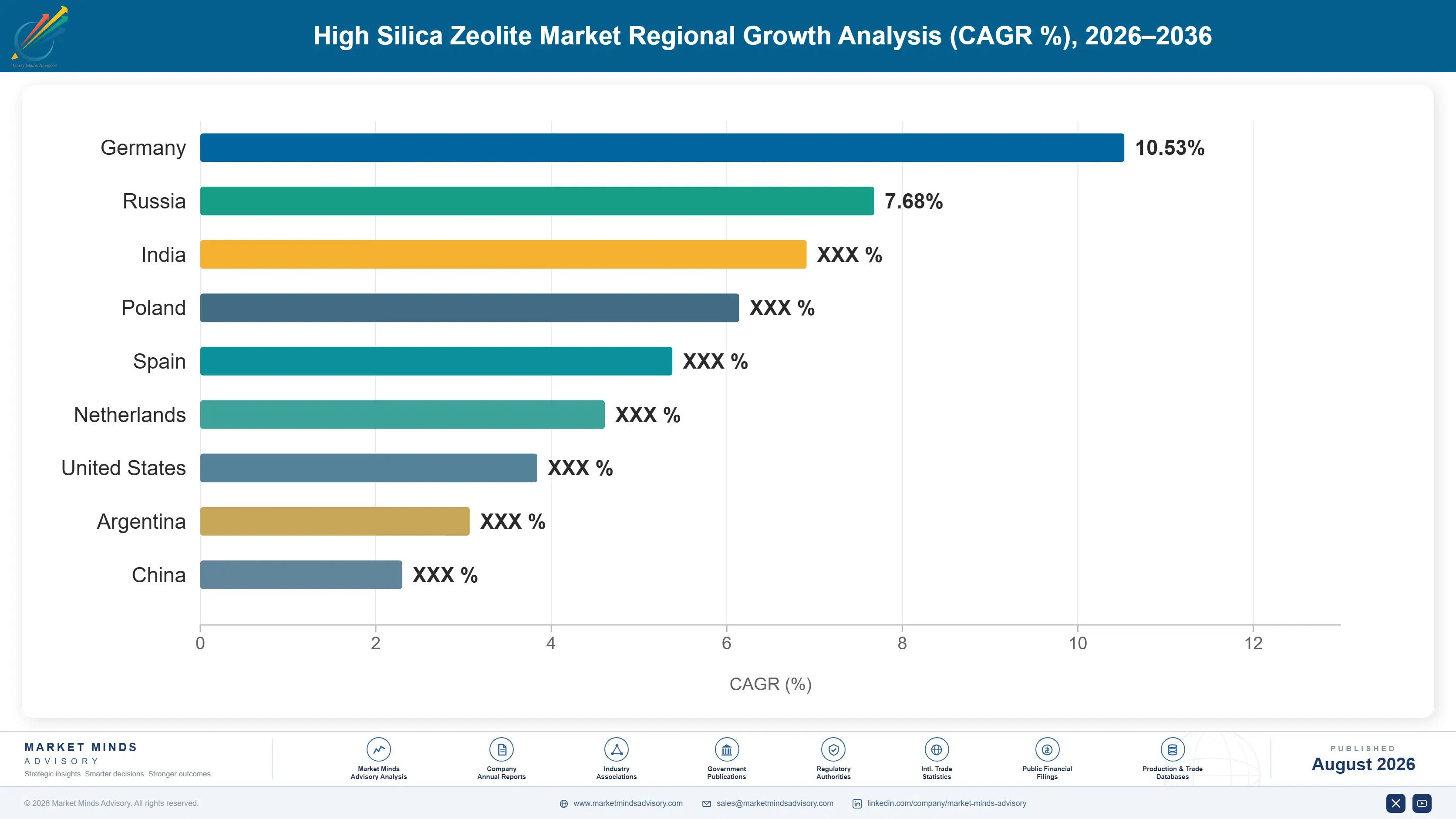
high-silica-zeolite-market-trends-country-cagr-analysis-1787553242671

Where Framework Margin Is Available

Four moves matter in a business where the largest input is bought from somebody who has no reason to help. Two of them are about controlling that input and two are about selling the frameworks that regulation makes unavoidable. Defending refinery tonnage is not among them and has not been for some years now.

Integrate backward into structure directing agent synthesis

The organic template accounts for around 47% of small-pore framework cost and comes from fine chemical producers who serve almost no other market and price accordingly. A zeolite producer holding its own template synthesis controls the majority of its cost base and can bid for automotive volume that competitors cannot approach profitably. The capital involved is modest against the exposure it removes. Very few producers have done it, mostly because quaternary ammonium chemistry sits outside what a catalyst business considers its own competence, which is an organisational objection rather than a commercial one.
Market Impact: Controls the full 47% of small-pore framework cost

Qualify into engine families ahead of 2027

The United States heavy-duty rule takes effect from 2027 and engine makers are certifying now, which means framework selection for the next generation of engine families is being decided in this window and not again for years. Certification takes 18 months and nobody reopens it casually. A supplier qualified into an engine family holds that position for the programme life at pricing set by scarcity rather than competition. Suppliers approaching this as a normal sales cycle are misreading how permanent these decisions are once made. The window closes within about two years.
Market Impact: Locks positions well before the 2027 certification deadline

Sell hydrophobic frameworks through environmental engineering contractors

All-silica frameworks compound at 9.5% and the barrier is not technical performance. It is that the buyer is an environmental engineering contractor specifying an abatement system, not a catalyst purchaser, and that person has never bought a zeolite and does not know activated carbon fails in humid streams. A supplier that builds a channel into those contractors and arms them with the comparison is creating demand rather than competing for it. The material costs more per kilogramme and lasts long enough that whole-life comparison favours it decisively. Nobody has built that channel properly yet.
Market Impact: Opens a new segment compounding at 9.5% annually

Configure frameworks for renewable feed, not crude

Renewable diesel units process a feed with high oxygen content and free fatty acids that nothing in conventional refining was designed for, and isomerisation to meet cold flow specification needs beta and mordenite configurations refiners had no reason to buy before. Beta frameworks grow at 8.4% substantially on this. Every renewable unit is a new catalyst position rather than a replacement, which means the incumbent relationship at a refinery counts for considerably less than usual. That is an opening for anybody who arrives with data on the actual feed. Very few suppliers have generated that data.
Market Impact: Enters a new segment growing at 8.4% annually

Who Controls the Margin Pool

Five producers hold 56% of high-silica zeolite supply, measured on volume shipped into catalyst and adsorbent manufacture, the basis used throughout this section. Concentration is high and the real position is tighter still, because template supply narrows the small-pore field to producers who can secure it. The gap between the leaders and the next tier is synthesis control at scale: making a framework reproducibly at the specified ratio is considerably harder than making it once.
Competition currently runs along three lines. Template access, which decides who can bid for small-pore volume at all. Application development capability, since a framework sold without formulation support is a powder rather than a solution. And qualification position inside engine certifications and refinery unit designs, which is where incumbency actually lives. Price argument sits almost entirely in the refining applications.

Rankings shift where Chinese producers move from domestic supply into export markets. Framework quality has improved enough over a decade that the applications closed to them are fewer every year, and methanol-to-olefins volume gave them scale nobody outside China matched. Automotive qualification holds longer, because certification exposure makes engine makers conservative about unfamiliar suppliers in a way refiners are not.
high-silica-zeolite-market-trends-company-positioning-matrix-1787553243235

Competitive Moat and Risk Dimensions

BASF

Moat: Automotive catalyst integration

BASF makes the framework and the finished emissions catalyst, which puts it inside engine certification programmes rather than supplying somebody who is. That position means framework development happens against a real application requirement rather than a specification handed down, and the customer relationship sits with the engine maker directly rather than through an intermediary who owns it.
BASF

Risk: Diesel exposure concentration

A large part of the emissions catalyst business depends on diesel powertrains, and heavy-duty electrification arriving faster than expected would reach that position directly. The framework business alone would survive it comfortably. The integrated position that provides the advantage also concentrates the exposure, which is the usual arrangement with integration.
W. R. GRACE

Moat: Refinery catalyst incumbency

Grace holds fluid catalytic cracking positions at a large share of the world's refineries, and those relationships involve unit-specific formulation work accumulated over decades that a competitor cannot simply quote against. Refiners change catalyst supplier reluctantly because a poor performing charge costs far more in yield than any procurement saving recovers.
W. R. GRACE

Risk: Refining decline exposure

Fluid catalytic cracking accounts for 43% of total framework consumption and that share falls every year as refineries close in Europe and transport fuel demand plateaus elsewhere. A business built on incumbency in a shrinking application faces a long-term problem that incumbency does not solve.

Players Tracked

Prominent Players

BASF
W. R. Grace
Honeywell UOP
Tosoh Corporation
Clariant

Other Key Players

Zeolyst International
Albemarle
Arkema
Johnson Matthey
Umicore
Zeochem
Ecovyst
Sinopec Catalyst Company
JGC Catalysts and Chemicals
Mitsubishi Chemical Group
Union Showa
Chemiewerk Bad Köstritz
KNT Group
Nankai Chemical
Sorbead India

Recent Developments

FEBRUARY 2025

BASF expanded copper chabazite production capacity in the United States

BASF commissioned additional copper chabazite capacity at a United States site, aimed at heavy-duty emissions catalyst demand ahead of the 2027 nitrogen oxide rule. The investment was organic and funded internally, with no partner or acquisition involved, and it followed engine maker certification programmes already under way.
Signal: Capacity is being built against certification timetables rather than order books, which tells you how binding those dates are
JULY 2025

Tosoh Corporation signed a multi-year framework supply agreement with a European catalyst manufacturer

Tosoh Corporation entered a multi-year supply agreement covering specialty zeolite frameworks for a European emissions catalyst manufacturer. The arrangement was a supply agreement rather than a joint venture or equity investment, and it covers several engine family certification programmes running through the decade. Certification timing drove the contract length.
Signal: Framework supply is being contracted against certification life rather than annual volume, which changes the negotiating dynamic entirely
NOVEMBER 2025

Clariant acquired a European structure directing agent producer

Clariant completed the acquisition of a European fine chemical producer supplying quaternary ammonium structure directing agents used in small-pore zeolite synthesis. The transaction was an acquisition rather than a joint venture, with full ownership transferring at completion, and it secures template supply for the company's own framework production.
Signal: Backward integration into template supply has started, which suggests producers have concluded the exposure cannot be managed contractually

What Moves Framework Cost

Organic structure directing agents account for around 47% of small-pore framework cost, with sodium silicate, aluminium source, caustic soda and the energy for hydrothermal crystallisation making up the balance. Template chemistry comes from fine chemical producers concentrated in Europe, Japan and increasingly China. Energy is the variable that separates producers with efficient crystallisation cycles from those without.
European gas and electricity prices through 2022 raised hydrothermal crystallisation costs sharply, and IEA data show European industrial gas running several times American levels. Clariant's Annual Report 2022 records energy and raw material cost pressure across its catalysts business. Producers on annual catalyst contracts absorbed most of it, because a refinery charge is priced at agreement and a qualified automotive framework cannot be reformulated to a cheaper synthesis route without reopening certification work nobody will fund.

The certification lock is what makes this exposure asymmetric. A producer supplying qualified automotive frameworks cannot change synthesis route, feedstock or plant without triggering recertification. Refinery catalyst producers face no such constraint. Producers holding their own template synthesis carry a smaller exposure than those buying it, which is the single largest cost difference between competitors. Asian producers gain further from energy costs European operations cannot match.
high-silica-zeolite-market-trends-cost-volatility-analysis-1787553243455

Contract template supply on multi-year terms with volume commitment

Template producers serve almost no market other than zeolite synthesis, which means their capacity planning depends entirely on what framework makers tell them. A multi-year agreement with committed volume gives the supplier a reason to build and the buyer a price that reflects that commitment. Spot purchasing in a market this narrow is expensive and occasionally impossible.

Recover and recycle template from crystallisation mother liquor

Most structure directing agent ends up in the mother liquor or is burned off during calcination, which means the largest cost input is largely destroyed by design. Recovery from mother liquor works technically and adds process steps that producers have historically judged not worth the complication. At 47% of cost that judgement deserves revisiting properly.

Site new crystallisation capacity against reliable low-cost power

Hydrothermal crystallisation runs long cycles at temperature and pressure, which makes electricity and steam a larger part of framework cost than most producers acknowledge in their planning. Locating new capacity where industrial power is cheap and reliable is a decision made once and paid for over thirty years. European producers have generally not had that option available.

Portfolio Architecture for Margin Defence

Margin in high-silica zeolite tracks how hard the framework is to make reproducibly and how locked the application is. High-silica Y for fluid catalytic cracking runs at gross margins in the high teens, made at scale by several producers and bought on price against tonnage. Beta and specialty configurations run higher. Copper chabazite for certified engine families runs higher again, because the supplier base is narrow, the template is expensive and the customer cannot change without recertifying.
The tension is that refinery tonnage fills the crystallisation capacity and specialty frameworks earn the return, and the two need different plants as well as different organisations. A reactor optimised for large batches of faujasite handles small specialty campaigns badly, and switching between them wastes cycles nobody counts properly. Producers running both from one asset base have generally found the tonnage work crowded out the specialty campaigns whenever refinery demand picked up.

High-value pools sit in copper chabazite for emissions certification, all-silica frameworks for abatement and beta configurations for renewable feed processing. None of the three is large in tonnage terms. Crystallisation capacity by itself defends nothing at all.

Volume / Commodity-Adjacent

High-silica Y and standard MFI grades for fluid catalytic cracking and bulk petrochemical use, made at scale by several producers and bought against tonnage. The seven-point range separates producers with efficient crystallisation cycles and cheap power from those carrying European energy costs.
Gross Margin: 16%-23%

Premium / Certified

Beta, mordenite and specialty MFI configurations engineered for particular unit conditions, including renewable feed processing. The eight-point spread reflects how much application development the producer contributes against how much the refiner works out alone.
Gross Margin: 28%-36%

Sustainability / Regulatory / Next-Generation

Copper chabazite for emissions certification and all-silica frameworks for abatement and separation. The fourteen-point range is wide because pricing reflects template access and qualification scarcity rather than any settled cost structure anybody could benchmark.
Gross Margin: 38%-52%
high-silica-zeolite-market-trends-portfolio-architecture-1787553243971

High-value Sub-segments and Strategic Watch-out

Copper Chabazite For Certification

Compounding at 10.5% on nitrogen oxide rules that take effect from 2027, and defended by template access rather than crystallisation capability. Engine families certify once and hold the framework for the programme life. The window for qualifying into the next generation is open now. It closes shortly.
Gross Margin: 40%-52%

All-Silica Abatement Frameworks

Growing at 9.5% because activated carbon fails in humid streams and burns, and insurers have started pricing that. The technical case is settled and the channel is not, since the buyer is an environmental contractor who has never purchased a zeolite before. Somebody will build it.
Gross Margin: 38%-50%

High-Silica Y For Refining

The tonnage that fills crystallisation capacity, taking 43% of total volume and losing share every year as European refineries close. Priced against tonnage by several capable producers. Manage it for asset utilisation and expect nothing else from it. The decline here is not reversible anywhere.
Gross Margin: 16%-23%

Template Supply Exposure

Structure directing agents set 47% of small-pore framework cost and come from producers serving almost no other market, which leaves the largest input priced by somebody with no reason to help. Backward integration has started. Whoever completes it first bids differently from everybody else. Very few have started.
Gross Margin: 38%-52%

How Framework Demand Renews

Framework demand is replacement revenue. Catalyst deactivates, gets regenerated a fixed number of times and is eventually replaced, and that cycle runs continuously across a refinery's operating life without any purchasing decision in between. Fluidised bed units consume catalyst by attrition daily rather than in campaigns. Emissions catalyst is the exception: fitted once at vehicle build and replaced almost never, which makes that demand track production rather than consumption.
Stickiness varies enormously by vertical. Emissions catalyst positions inside certified engine families are close to permanent, since recertification costs 18 months nobody will fund. Refinery positions are sticky through performance rather than regulation: a poor charge costs more in yield than any saving recovers, so refiners change supplier reluctantly. Adsorbent and abatement applications change readily, because qualification is light and several producers can meet the specification.

The buyer has changed and most framework sales organisations have not followed. Catalyst selection once sat with refinery process engineers weighing yield and cycle length. It increasingly sits with emissions certification teams at engine makers and with environmental engineering contractors specifying abatement systems, neither of whom has ever met a catalyst salesman and neither of whom thinks about tonnage at all.
high-silica-zeolite-market-trends-end-use-penetration-index-1787553244489

Where To Place The Bet

These are among the four positions where our research anticipates prominent divergence between winners and laggards over the coming forecast period. Each is grounded in the demand model, the regulatory perimeter, and the announced capacity pipeline.
01 / TEMPLATE SUPPLY CONTROL

Integrate backward before competitors close the option

Structure directing agents set around 47% of small-pore framework cost and come from fine chemical producers serving almost no other market, which leaves a zeolite maker's largest input priced by somebody with no commercial reason to help. Controlling that synthesis changes what a producer can profitably bid for automotive volume, and backward integration has already started among several competitors. The capital involved is modest against an exposure that no supply contract genuinely manages, and the window on acquiring that capability is narrowing.
02 / CERTIFICATION WINDOW ENTRY

Qualify into engine families while the window stays open

The United States heavy-duty nitrogen oxide rule takes effect from 2027 and engine makers are running certification programmes now, which means framework selection for the next generation of engine families is being settled in this window rather than negotiated later. Certification takes 18 months and nobody reopens it casually, so a supplier qualified into a family holds that position for the programme life at pricing scarcity sets. Treating this as a normal sales cycle badly misreads how permanent these decisions are.
03 / ABATEMENT CHANNEL BUILD

Reach the contractor who specifies the abatement system

All-silica frameworks compound at 9.5% and the obstacle is not performance, since activated carbon genuinely fails in humid streams and carries a fire risk that insurers have started pricing into industrial cover premiums. The obstacle is that the buyer is an environmental engineering contractor who has never purchased a zeolite and does not know the comparison exists at all yet. Building a channel into those contractors creates demand rather than competing for it, which is a considerably different commercial proposition entirely.
04 / RENEWABLE FEED CONFIGURATION

Chase new units, not incumbent refinery relationships

Renewable diesel units process oxygenated feed that nothing in conventional refining was designed for, and isomerisation to meet cold flow specification needs beta and mordenite configurations refiners had no prior reason to buy at all. Beta frameworks grow at 8.4% substantially on that, and every renewable unit represents a new catalyst position rather than a replacement of an existing charge. Incumbency at the refinery counts for considerably less than usual, which is exactly the opening a challenger should be working right now.

Engagement Snapshot From the Field

A live engagement with an industry participant carrying material or product regulatory and market exposure ahead of a defining policy shift, showing how our research translates into a defensible multi-year portfolio strategy.
MARKET MINDS ADVISORY · CLIENT ENGAGEMENT SUMMARY
High Silica Zeolite Producer Strategic Portfolio Review and Transition Roadmap 2026·Investment Scenario on High Silica Zeolite Exposure Evaluation 2025-26
CLIENT PROFILE
A European specialty catalyst producer with annual revenue around EUR 620 million (client-reported, unverified by MMA), of which zeolite framework supply accounted for roughly 40%. The business held strong positions in refinery and petrochemical frameworks and almost none in automotive emissions. Template was bought entirely on the open market from two suppliers. Nobody in the business had modelled that exposure.
STRATEGIC CHALLENGE
Refinery framework volume was forecast to fall by roughly 25% across the European customer base by 2032 (client-reported, unverified by MMA), and the board had approved no replacement. Entering automotive emissions frameworks had been discussed for years and never funded, partly because template pricing made the economics look marginal. The question was whether the economics were actually marginal or simply badly understood.
MMA APPROACH
MMA modelled the client's small-pore framework economics with and without captive template synthesis, benchmarking template pricing against what integrated competitors achieve through the expert interview programme. Engine maker certification timetables across the client's addressable customer base were mapped against realistic qualification lead times. Available template producers in Europe were screened on capability and ownership rather than revenue.
KEY FINDINGS
  1. Bought template made small-pore economics genuinely marginal, and captive synthesis moved the same product into the client's best-returning category by a wide margin.
  2. The certification window for the next generation of European engine families closes within roughly two years, after which the opportunity does not recur until the following programme cycle.
  3. Three European template producers were realistically acquirable, and two of them already supplied the client under agreements it had never treated as a position worth owning.
  4. Refinery volume decline was running roughly two years ahead of the client's own planning assumption, which compressed the timeline for any replacement considerably.
CLIENT PROFILE
A European specialty catalyst producer with annual revenue around EUR 620 million (client-reported, unverified by MMA), of which zeolite framework supply accounted for roughly 40%. The business held strong positions in refinery and petrochemical frameworks and almost none in automotive emissions. Template was bought entirely on the open market from two suppliers. Nobody in the business had modelled that exposure.
STRATEGIC CHALLENGE
Refinery framework volume was forecast to fall by roughly 25% across the European customer base by 2032 (client-reported, unverified by MMA), and the board had approved no replacement. Entering automotive emissions frameworks had been discussed for years and never funded, partly because template pricing made the economics look marginal. The question was whether the economics were actually marginal or simply badly understood.
MMA APPROACH
MMA modelled the client's small-pore framework economics with and without captive template synthesis, benchmarking template pricing against what integrated competitors achieve through the expert interview programme. Engine maker certification timetables across the client's addressable customer base were mapped against realistic qualification lead times. Available template producers in Europe were screened on capability and ownership rather than revenue.
KEY FINDINGS
  1. Bought template made small-pore economics genuinely marginal, and captive synthesis moved the same product into the client's best-returning category by a wide margin.
  2. The certification window for the next generation of European engine families closes within roughly two years, after which the opportunity does not recur until the following programme cycle.
  3. Three European template producers were realistically acquirable, and two of them already supplied the client under agreements it had never treated as a position worth owning.
  4. Refinery volume decline was running roughly two years ahead of the client's own planning assumption, which compressed the timeline for any replacement considerably.
RECOMMENDED STRATEGY
Phase 1: Phase one: acquire template synthesis capability rather than negotiating supply, prioritising the producer already serving the client's existing small-pore campaigns. Phase 2: Phase two: open qualification discussions with two European engine makers immediately, accepting that samples must ship before the acquisition completes. Phase 3: Phase three: plan crystallisation capacity conversion from faujasite tonnage toward small-pore campaigns on a 2029 timetable rather than reacting later.
OUTCOME
The client acquired one of the three identified template producers in 2025 at a price it reported as roughly EUR 74 million (client-reported, unverified by MMA). Qualification discussions opened with both target engine makers and samples are in durability testing. Capacity conversion planning is under way ahead of the original timetable.

Frequently Asked Questions

Foundational context covering the market sizes, CAGR, scope, country, region and competition that inform every finding below. This section is provided to cover basics and most often pre-purchase conversations, answered from the MMA Primary Research Dataset.

What is the current size of the High Silica Zeolite Market?

The market was valued at USD 2.9 billion in 2025, rising to an estimated USD 3.1 billion in 2026. East Asia holds the largest regional share at 30% of value.

How large will the High Silica Zeolite Market be by 2036?

MMA forecasts USD 6.1 billion by 2036 under the base case, an expansion multiple of 1.97 times the 2026 value. That represents USD 3.0 billion of incremental value.

What is the CAGR for the High Silica Zeolite Market 2026 to 2036?

The base case runs at 7.0% compound annual growth between 2026 and 2036, with a bull case at 8.3% and a bear case at 5.7%. Historical growth from 2020 to 2025 was 5.8%.

Which segment is growing fastest?

Chabazite and small-pore frameworks lead at 10.5%, half again the market rate, driven by nitrogen oxide limits taking effect from 2027. All-silica frameworks follow at 9.5%.

Who are the major companies in the High Silica Zeolite Market?

BASF, Grace, Honeywell UOP, Tosoh Corporation and Clariant hold 56% between them. Template access and synthesis control at scale sustain those positions rather than crystallisation capacity.

Which country is growing fastest?

India leads at 9.6%, driven by refining capacity expansion configured for heavy crude and Bharat Stage VI enforcement across heavy-duty vehicles. Both arrived on compressed timetables.

Report Segmentation Architecture

The full report scope spans multiple orthogonal segmentation dimensions, with cross-tabulated demand data provided for each dimension pair. Coverage extends further to regional breakdowns, trend trajectories, and the competitive detail needed to support segment-level decision-making.

By Framework Type

  • ZSM-5 and MFI Framework Zeolites
  • Chabazite and Small-Pore Frameworks
  • High-Silica Y and Faujasite Frameworks
  • Beta Framework Zeolites
  • Mordenite and Ferrierite Frameworks
  • Silicalite and All-Silica Frameworks

By End-Use Industry

  • Petroleum Refining
  • Petrochemical Production
  • Automotive Emissions Control
  • Industrial Gas Separation
  • Environmental Abatement
  • Renewable Fuel Processing

By Sales Model

  • Direct Producer Supply
  • Catalyst Manufacturer Supply
  • Distributor Supply
  • Toll Synthesis Service
  • Licensed Technology Package

By Region

  • North America
  • Western Europe
  • East Asia
  • South Asia and Pacific
  • Latin America
  • Middle East and Africa
  • Eastern Europe

Scope, Methodology, and Coverage

Every figure in this report is reproducible from documented input assumptions. The scope below maps the historical period, the forecast horizon, the segmentation dimensions, and the countries covered, alongside the underlying primary and qualitative methodology.
Historical Period
2020 to 2025
Forecast Period
2026 to 2036
Base Year
2025 (USD billions; MMA Primary Research Dataset, August 2026)
Market Definition
The market comprises crystalline aluminosilicate zeolites with framework silica to alumina ratios above ten, supplied as powder, spray-dried microsphere or bound extrudate into catalyst and adsorbent manufacture. Frameworks covered include MFI, chabazite, faujasite, beta, mordenite, ferrierite and all-silica types across refining, petrochemical, emissions control, separation and abatement applications. Low-silica zeolites for detergent and water softening, amorphous silica-alumina, natural zeolite minerals, non-zeolitic molecular sieves, and finished catalyst systems sold as assembled units fall outside scope.
Quantitative Units
USD billions (current prices); thousand tonnes of framework supplied annually; USD per kilogramme by framework type
Segmentation Dimensions
By Framework Type; By End-Use Industry; By Sales Model; By Region
Regions Covered
North America, Western Europe, East Asia, South Asia and Pacific, Latin America, Middle East and Africa, Eastern Europe
Countries Covered
China, Japan, South Korea, Taiwan, India, Singapore, Thailand, Indonesia, Australia, United States, Canada, Mexico, Germany, Netherlands, France, United Kingdom, Italy, Spain, Belgium, Sweden, Poland, Czechia, Hungary, Romania, Brazil, Argentina, Saudi Arabia, United Arab Emirates, Egypt, South Africa
Key Companies Profiled
BASF, W. R. Grace, Honeywell UOP, Tosoh Corporation, Clariant, Zeolyst International, Albemarle, Arkema, Johnson Matthey, Umicore, Zeochem, Ecovyst, Sinopec Catalyst Company, JGC Catalysts and Chemicals, Mitsubishi Chemical Group, Union Showa, Chemiewerk Bad Köstritz, KNT Group, Nankai Chemical, Sorbead India
Quantitative Methodology
Primary survey, n=3,800 respondents, Q4 2025, six countries; demand-side model with trade association cross-validation
Qualitative Methodology
47 expert interviews, Q4 2025; applied to validate demand model assumptions, identify emerging dynamics, and assess competitive positioning
Report Format
PDF and XLSX data workbook (Word format preview document)
Publisher
Market Minds Advisory
Report Code
MMA-2026-CHM-514
Published
August 2026
Contact
sales@marketmindsadvisory.com | www.marketmindsadvisory.com

Purchase the full High Silica Zeolite Market Report (2026 to 2036).

The full report sizes the global high-silica zeolite market to 2036 across six framework types and seven regions, measured at volume shipped into catalyst and adsorbent manufacture. It maps nitrogen oxide requirements under the 2027 United States heavy-duty rule, Euro 7 and China VI against producer capability, and traces where organic template supply constrains who can bid at all. Competitive analysis covers 20 participants evaluated on framework volume supplied, with moat and risk assessment for the two leaders. Input cost exposure runs from structure directing agent supply through to certification-locked contract structure. Four quantified revenue levers close the analysis.
Six-framework segment sizing with segment-level growth rates
Seven-region share and growth breakdown to 2036
Twenty-participant competitive map on one supply basis
Template supply concentration mapped across small-pore framework synthesis
Input cost exposure traced to structure directing agents
Four quantified revenue levers with commercial impact ranges

Built For The People Who Decide

From boardroom strategy to bench-side execution, this report is read cover-to-cover by leaders shaping the next decade of their industry, turning demand scenarios, market dynamics and valuation benchmarks into decisions.
CXOs/ Presidents/ VPs/ Managers
M&A and Corporate Development
Strategy Teams and R&D Heads
Procurement and Product Directors
Regulatory and Compliance Leaders
Investor Relations and Equity Analysts