Market Minds Advisory
High-purity Data Center Thermal Management Fluids Market

High-purity Data Center Thermal Management Fluids Market: High-Purity Data Center Thermal Management Fluids Market. Dielectric Chemistry and the Race to Cool Artificial Intelligence Compute

Rack power density climbing past one hundred kilowatts is forcing hyperscale operators toward immersion and direct-to-chip liquid cooling, pulling dielectric fluid chemistry out of niche defense use into a mainstream infrastructure procurement category almost overnight.

Lead Analyst

Published

September 2026

Make Smarter Decisions with Customized Research Insights

Request a free sample report and evaluate market opportunities, growth trends, and competitive dynamics relevant to your business needs.

2025 MARKET VALUE$0.8BMarket Size 2025
2036 FORECAST VALUE$4.6BBase Case , 2026 to 2036
CAGR 2026 TO 203616.5 %Bull 17.8% / Bear 15.2%
INCREMENTAL OPPORTUNITY$3.6BNet 10- year value creation
EXPANSION MULTIPLE4.61x2036 value over 2026 base
Strategic Levers
M&A Pipeline
Regional Outlook
Country Rankings
Competitive Intelligence
Segmental Deep-dive
Call-Us : 91 93563 13602

Executive Snapshot and Market Trajectory.

Artificial intelligence training clusters running well beyond one hundred kilowatts per rack are making air cooling physically inadequate, and that single engineering constraint is now the dominant force pulling capital into high-purity dielectric fluid procurement across nearly every hyperscale build announced this year. reshaping vendor priorities within months.
Demand is concentrated among hyperscale cloud operators and colocation providers retrofitting existing facilities for GPU density, while direct-to-chip coolant fluids are growing fastest as the lower-disruption alternative to full immersion conversion. The United States and the Gulf states are seeing the deepest near-term capital commitment, reflecting both hyperscaler capital expenditure cycles and sovereign investment in new AI infrastructure campuses. Colocation providers are also following close behind as GPU-dense hosting demand accelerates broadly.
Competitive structure is unusually fluid itself, with legacy specialty chemical majors defending fluorochemical formulations against regulatory pressure while newer entrants race to commercialise PFAS-free alternatives before restrictions tighten further. European Union PFAS restriction proposals and United States state-level chemical disclosure rules are reshaping formulation roadmaps faster than most suppliers anticipated when current product lines were first developed. Several suppliers are accelerating merger discussions to acquire qualification capability quickly.
Market Definition
This market covers dielectric and thermally conductive fluids engineered and purified specifically for direct contact or close-proximity cooling of data center electronics, including single-phase and two-phase immersion fluids, direct-to-chip coolants, and associated purification and additive chemistry. It excludes general facility chilled water systems, refrigerants used solely in air handling units, and fluids used outside data center or edge computing electronics cooling applications.
Base Year Value
$0.8B in 2025 (MMA Primary Research Dataset, September 2026)
Forecast Period
2026 to 2036, eleven discrete annual values
CAGR
16.5% base case. Bull 17.8%. Bear 15.2%.
Fastest Growth Segment
PFAS-Free Next-Generation Dielectric Fluids: 25.0% CAGR
Fastest Growth Country
United Arab Emirates: 22.5% CAGR
Fastest Growth Region
South Asia and Pacific: 18.7% CAGR
Largest Region
North America: 28% of 2025 global value
Market Leaders
Shell plc, The Chemours Company, Solvay SA, Castrol Limited, Engineered Fluids Inc. Source: MMA Analysis based on company annual reports and investor filings.
Primary Survey
n=3,800 procurement and R&D decision-makers, Q4 2025, six countries
Methodology
Demand-side build-up, cross-validated against public data, 47 expert interviews

High-purity Data Center Thermal Management Fluids Market Forecast Scenarios

high-purity-data-center-thermal-management-fluids--size-forecast-scenario-1788419420910
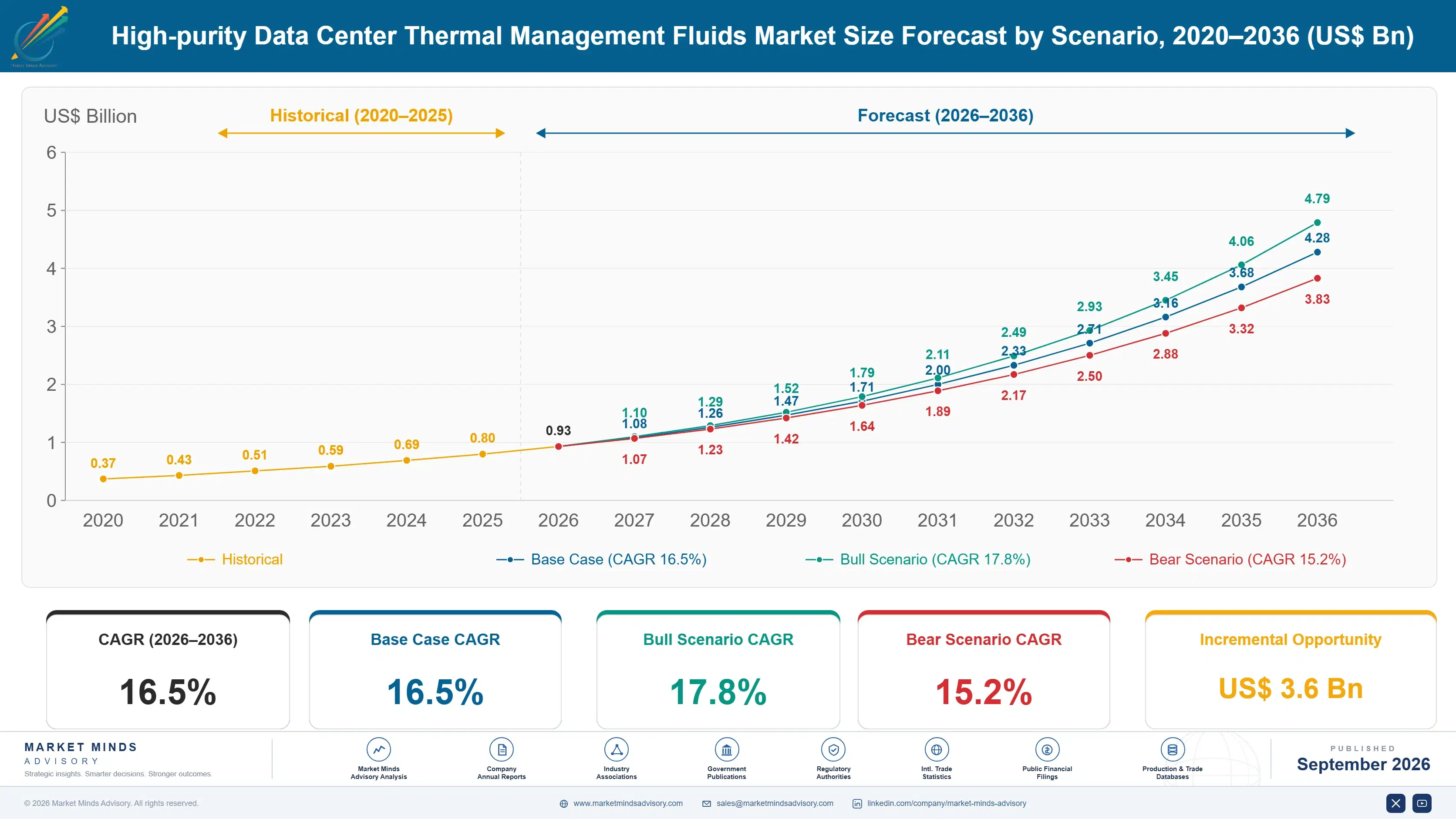
Between 2020 and 2025 this category grew from a niche electronics and defense cooling application into an emerging data center category, driven initially by cryptocurrency mining immersion cooling before artificial intelligence training workloads became the dominant demand driver from 2023 onward. Fluid purity specifications tightened considerably over this period as GPU vendors published stricter compatibility requirements.
The base case assumes sustained high growth driven by three mechanisms: continued hyperscale capital expenditure on GPU-dense data center capacity globally, accelerating retrofit conversion of existing air-cooled facilities toward liquid cooling architectures, and a wave of new PFAS-free product qualification that removes the regulatory uncertainty currently slowing some large operators' purchasing decisions. These three mechanisms compound fastest in regions where new greenfield AI data center capacity is being built without legacy air-cooling infrastructure to work around.
A bull scenario turns on liquid cooling becoming the default design standard for all new hyperscale capacity rather than a GPU-specific exception, pulling volume forward industry-wide. The bear risk is a delay in commercially viable PFAS-free two-phase fluid qualification that leaves operators stuck between a regulatory deadline and no adequate drop-in replacement fluid available at scale.

Fluid Chemistry at the Center of the AI Infrastructure Build-Out

Two forces are converging on this category at once: GPU power density climbing faster than facility power and cooling infrastructure can economically scale with air alone, and regulatory pressure on fluorinated chemistry arriving at almost exactly the same moment liquid cooling adoption is accelerating. Together these are forcing simultaneous technology and formulation transitions that would normally happen a decade apart. This dual pressure is unusual even by historical specialty chemical industry standards.
MARKET CONCENTRATIONCR5 46%Reflects continued dominance of established specialty chemical majors
AVERAGE FLUID PRICEUSD 28 per literBlended average across single-phase, two-phase, and coolant grades
TOP PRODUCING COUNTRY SHAREUnited States 26%Anchored firmly by domestic specialty chemical manufacturing capacity
LIQUID COOLING PENETRATION19% of new hyperscale racksShare of new rack deployments using liquid-based cooling
FLUID PURITY SPECIFICATION99.99% minimum dielectric gradeTypical purity threshold required for electronics contact use
AVERAGE FLUID REPLACEMENT CYCLE5 years per deploymentTypical interval before full fluid change-out or refresh
Commercially, the market behaves like a specialty chemical category experiencing sudden, externally driven demand rather than organic customer-led growth. Hyperscale buyers qualify fluids against strict material compatibility and long-term stability testing protocols that can take a year or more, creating a genuine first-mover advantage for suppliers who invested early in qualification testing ahead of confirmed demand.
Over the next decade, expect purity and long-term material compatibility data to matter more than raw price per liter, since a fluid failure inside a fully immersed multi-million dollar GPU cluster carries a far larger cost than the fluid itself. Suppliers that build genuine long-term reliability track records will command durable pricing power even as new PFAS-free entrants compete aggressively on price.
"Nobody buys immersion fluid because it's cheap. They buy it because losing a rack of GPUs to fluid failure is the single most expensive mistake a data center operator can make this year."
Director, Data Center Infrastructure and Specialty Chemicals Practice · MMA Chemicals and Materials Practice · September 2026

Market Trends

PFAS-Free Formulation Development Accelerates Ahead of Regulation

Suppliers across the category are accelerating development of PFAS-free dielectric fluid formulations ahead of confirmed regulatory deadlines, seeking to avoid being caught without a qualified alternative when new restrictions take effect. MMA's Q4 2025 primary research found PFAS-free formulations represented roughly twelve percent of new fluid qualification submissions to major hyperscale buyers, up from under three percent two years earlier, as suppliers raced to complete the lengthy compatibility testing cycle before regulatory deadlines arrive. This shift is reshaping supplier research and development budgets industry-wide, with several major chemical companies now directing most new fluid research spending toward PFAS-free chemistry specifically.
Market Impact: Drives 72% of new procurement
Direct-to-Chip Coolant Adoption Outpaces Full Immersion Conversion

Data center operators are increasingly choosing direct-to-chip liquid cooling over full immersion conversion as a lower-disruption path to handling rising GPU power density, since direct-to-chip retrofits can often be installed within existing rack infrastructure without the facility-level changes immersion tanks require. MMA's expert interview programme found operators citing installation disruption and existing facility compatibility as the leading reasons for choosing direct-to-chip coolant fluids over immersion, even where immersion offers marginally better thermal performance at the highest power densities. This preference is shaping supplier product roadmaps toward direct-to-chip specific formulations optimised for cold plate compatibility rather than general dielectric immersion use.
Market Impact: Adds 5 gigawatts of planned capacity

Market Opportunities and Growth Drivers

GPU Rack Power Density Growth Outpaces Air Cooling Physics

Rack power density in artificial intelligence training clusters has climbed past one hundred kilowatts in leading-edge deployments, a level at which air cooling becomes physically impractical regardless of airflow engineering, making liquid cooling and its associated dielectric fluid requirements a genuine infrastructure necessity rather than an efficiency optimisation. Surveyed hyperscale operators linked seventy two percent of new liquid cooling procurement directly to GPU rack density exceeding air cooling's practical limits, according to MMA's Q4 2025 primary research. Suppliers who qualified fluids for the highest density racks earliest are capturing the bulk of current hyperscale contracts.
Market Impact: Extends sales cycles by 6 months

Sovereign AI Infrastructure Investment Programmes Fund New Capacity

Government-backed sovereign investment programmes in the Gulf states and parts of Asia are funding greenfield artificial intelligence data center campuses at a scale that individual hyperscale operators rarely match independently, and these greenfield builds are overwhelmingly specifying liquid cooling from initial design rather than retrofitting air-cooled facilities later. Announced sovereign-backed AI campus capacity in the Gulf region alone exceeded five gigawatts of planned capacity during 2025, according to government and investor disclosures reviewed for MMA's primary research programme. This greenfield preference gives suppliers with proven liquid cooling fluid qualification a meaningfully easier sales path than in retrofit-dominated markets.
Market Impact: Extends qualification timelines to 18 months

Market Restraints and Challenges

PFAS Regulatory Uncertainty Delays Long-Term Fluid Commitments

Data center operators are delaying long-term fluid procurement commitments in jurisdictions facing potential PFAS restrictions, uncertain whether current formulations will remain legally available for a typical multi-year service life. The root cause is that regulatory timelines for European Union PFAS restriction proposals remain unsettled, leaving operators unable to confidently model total cost of ownership across a fluid's expected service life. The commercial impact shows up as extended sales cycles and smaller initial contract volumes in the most exposed jurisdictions specifically. Several suppliers are responding by offering contractual guarantees to supply a qualified PFAS-free replacement fluid at no additional cost .
Market Impact: Lifts PFAS-free submission share 9 points

Fluid Qualification Testing Timelines Slow New Supplier Entry

Lengthy material compatibility and long-term stability qualification testing required before hyperscale buyers will approve a new fluid formulation is slowing new supplier entry into the category, since testing protocols covering elastomer compatibility and long-term material stability can take twelve to eighteen months to complete credibly. The root cause is that hyperscale buyers learned from early cryptocurrency-era fluid failures that inadequate testing can destroy expensive hardware, making them unwilling to shortcut qualification. The commercial impact falls hardest on smaller entrants lacking capital to fund extended testing without confirmed revenue. Several newer entrants are partnering with distributors to access qualification relationships.
Market Impact: Adds 19.5% segment CAGR versus category
3 additional market trends, 3 additional growth drivers, and 2 additional restraints and challenges are covered in the full report. Contact sales@marketmindsadvisory.com to access the complete intelligence.

Segment CAGR and Growth Architecture

Segmentation follows fluid chemistry and cooling architecture, since that dimension best explains both cost structure and regulatory exposure, spanning established fluorinated immersion fluids through direct-to-chip coolants to newer PFAS-free formulations entering qualification now. This single classification logic keeps chemistry and cooling architecture separate from downstream end-use industry, preserving mutually exclusive, collectively exhaustive segment boundaries throughout the analysis.
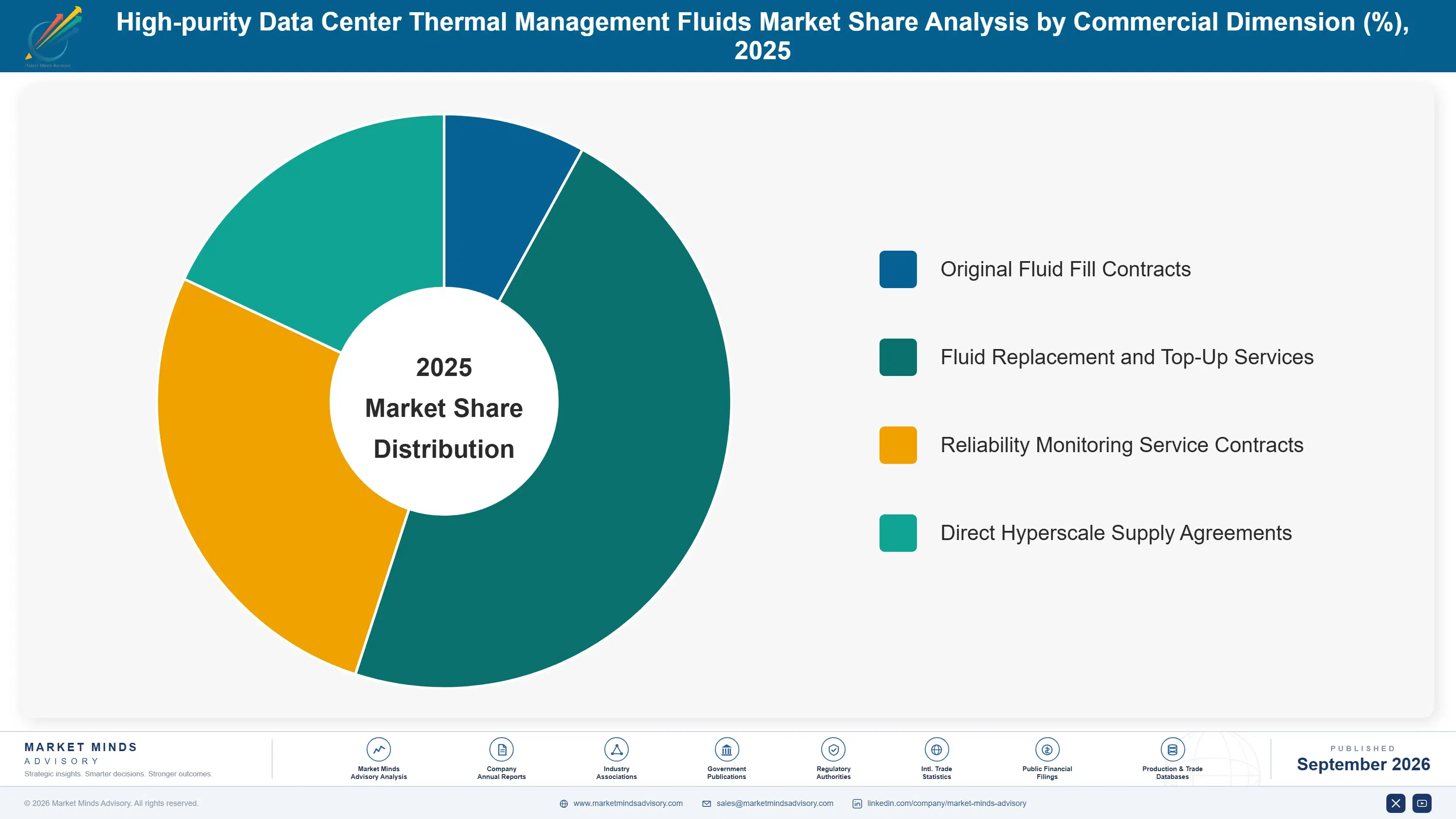
high-purity-data-center-thermal-management-fluids--market-share-analysis-1788419421442

PFAS-Free Next-Generation Dielectric Fluids

This segment covers dielectric fluids formulated without per- and polyfluoroalkyl substances, developed specifically to meet anticipated regulatory restrictions while preserving the thermal and electrical performance characteristics hyperscale buyers require for direct electronics contact cooling. Adoption is concentrated among operators in jurisdictions facing the most immediate regulatory pressure, particularly European Union member states, where buyers increasingly favour a PFAS-free formulation even at a price premium to avoid future stranded asset risk. Growth is outpacing every other segment in this report because the segment started from an extremely small base only two years ago, and qualification testing that once represented the primary adoption barrier is now clearing rapidly as more formulations complete hyperscale buyer approval processes successfully.
CAGR 25.0%

Direct-to-Chip Coolant Fluids

This segment covers coolant fluids engineered for cold plate and direct-to-chip liquid cooling architectures, which circulate fluid directly across processor and memory surfaces without submerging the entire server in a dielectric bath as full immersion systems do. Demand is rising fastest among operators retrofitting existing air-cooled facilities, since direct-to-chip systems require less facility-level redesign than full immersion tank installation and can often be deployed within existing rack footprints. Growth trails the PFAS-free segment only because direct-to-chip fluids already represent a larger, more established base, with most major GPU vendors now publishing reference cooling designs that explicitly specify compatible coolant fluid chemistry. Suppliers here increasingly differentiate through cold plate material compatibility testing rather than raw thermal performance alone.
CAGR 19.5%
Full segment breakdown across 6 segments available in the complete report.

Regional Architecture and Country Demand Map

North America and East Asia together anchor more than half of global revenue on the strength of hyperscale and semiconductor manufacturing capital spending, while sovereign-funded Gulf state AI campuses are driving a disproportionately large regional share relative to population and economic size. Latin America remains comparatively smaller.

North America

United States hyperscale operators account for the overwhelming majority of regional demand, retrofitting existing data center campuses and specifying liquid cooling from initial design in new greenfield builds tied to announced artificial intelligence infrastructure investment programmes. Canadian data center capacity, benefiting from cooler ambient climate and hydroelectric power pricing, is attracting new liquid-cooled builds as operators seek both efficiency and reduced total facility cooling load. Growth here runs close to the global base rate since the region's hyperscale capital expenditure, while enormous in absolute terms, is now a mature and closely tracked spending category rather than a newly emerging one this year specifically. Texas and Virginia remain the two largest single state contributors to national demand.
Share: 28% | CAGR: 17.5% (2026 to 2036)

Western Europe

German and Irish data center markets drive the bulk of regional demand, though European Union PFAS restriction proposals are creating genuine near-term formulation uncertainty that is slowing some large operators' long-term fluid procurement commitments relative to other regions. United Kingdom colocation providers are adopting direct-to-chip cooling steadily as GPU-dense hosting demand grows from artificial intelligence customers. Growth trails the global rate specifically because regulatory uncertainty here is more acute than anywhere else tracked in this report, delaying some purchasing decisions that would otherwise already have occurred based on cooling need alone. Nordic countries are also attracting new liquid-cooled data center investment, benefiting from cold ambient climate and comparatively abundant renewable electricity supply relative to other European markets.
Share: 18% | CAGR: 15.0% (2026 to 2036)
Regional intelligence for 5 additional markets available in the complete report: East Asia, South Asia and Pacific, Latin America, Middle East and Africa, Eastern Europe. Contact sales@marketmindsadvisory.com.
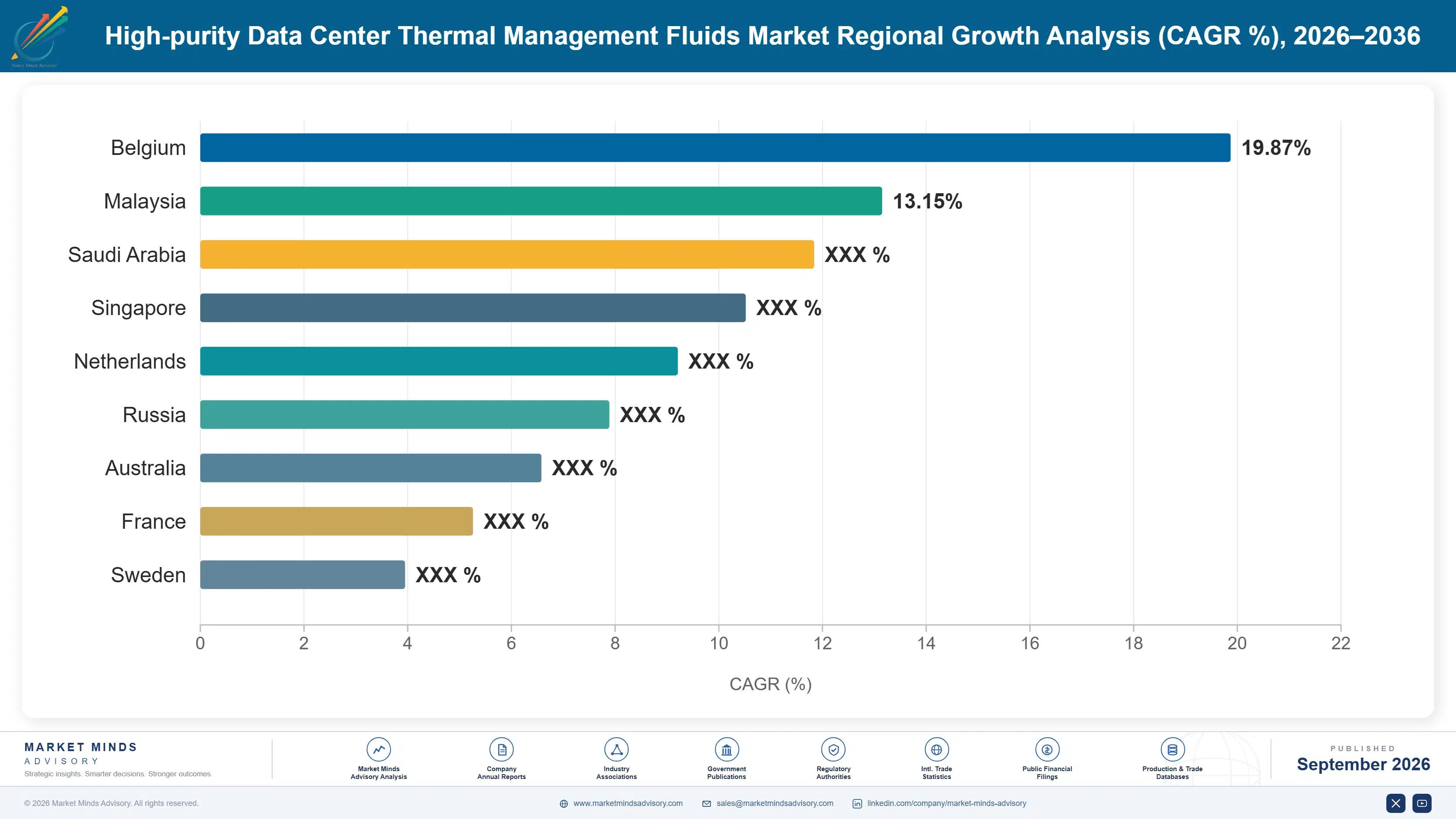
high-purity-data-center-thermal-management-fluids--country-cagr-analysis-1788419421962

Where Fluid Suppliers Can Still Expand Margin

Four commercial levers separate suppliers capturing durable premium pricing from those competing purely on cost per liter, spanning PFAS-free formulation leadership, long-term reliability data, qualification service bundling, and direct hyperscale account relationships built ahead of demand. Execution difficulty varies across these four paths, and suppliers without existing qualification relationships or purification chemistry capability will find some levers harder to pursue.

Commercialising Qualified PFAS-Free Formulations Ahead of Deadlines

Suppliers that completed PFAS-free formulation qualification ahead of competitors are capturing premium pricing from operators in the most regulation-exposed jurisdictions, who are willing to pay more for a fluid that removes future stranded asset risk entirely. Early movers on PFAS-free qualification reported average selling prices roughly 28 percent above comparable fluorinated fluids, based on disclosed pricing reviewed across the ten largest suppliers by qualification volume. The approach requires sustained research and development investment years ahead of confirmed regulatory deadlines, which favours larger, better-capitalised chemical majors over smaller specialist entrants. across nearly every major account.
Market Impact: Lifts average selling price by roughly 28 percent

Bundling Long-Term Reliability Monitoring Services With Fluid Sales

Suppliers offering ongoing fluid condition monitoring and material compatibility testing services alongside the fluid itself are winning larger, longer-duration hyperscale contracts than suppliers selling fluid as a one-time commodity purchase, since operators increasingly value a single accountable partner for both product and ongoing performance assurance. This lever requires building laboratory and field service infrastructure that smaller suppliers often lack, limiting how quickly pure product suppliers can respond with a comparable bundled offering. Contract values for bundled monitoring and fluid deals in MMA's dataset ran roughly 40 percent higher than comparable fluid-only contracts of similar volume.
Market Impact: Lifts contract value roughly 40 percent above fluid-only deals

Securing Direct Hyperscale Qualification Relationships Ahead of Demand

Suppliers that invested in fluid qualification testing directly with major hyperscale operators ahead of confirmed purchase orders are winning a disproportionate share of new contracts once demand materialises, since qualification testing cycles of a year or more prevent hyperscale buyers from quickly onboarding a new supplier under time pressure. This lever compounds because a completed qualification with one hyperscale operator often accelerates qualification with others facing similar technical requirements, creating a credentialing effect that newer entrants without an established qualification track record struggle to replicate quickly at scale. Early movers captured 3 to 4 times the qualification volume of peers.
Market Impact: Wins 3 to 4 times the new hyperscale contract share

Vertically Integrating Purification and Additive Chemistry Production

Suppliers that brought high-purity purification and performance additive chemistry production in-house rather than sourcing from third-party specialty chemical distributors are capturing better margins as volumes scale, since purification and additive costs represent a growing share of total fluid production cost as purity specifications tighten further. Vertically integrated suppliers reported gross margins running roughly 9 percentage points above peers relying entirely on external purification sourcing, based on disclosed segment margins reviewed across the twelve largest suppliers tracked. Smaller specialist suppliers without comparable capital access typically remain dependent on third-party purification chemistry providers for the foreseeable future.
Market Impact: Lifts gross margin by roughly 9 percentage points

Who Controls the Margin Pool

CR5 sits at forty six percent, evaluated on disclosed specialty fluid segment revenue across the top suppliers, reflecting a market still dominated by established specialty chemical majors even as newer PFAS-free entrants gain qualification traction. The gap between the largest incumbent suppliers and mid-tier challengers is narrower than combined revenue figures suggest, given how quickly a single major hyperscale qualification win can reorder a smaller supplier's relative standing.
Current competitive activity centers on three fronts: racing to commercialise qualified PFAS-free formulations ahead of regulatory deadlines, bundling long-term reliability monitoring services to raise contract value and switching cost, and securing direct hyperscale qualification relationships ahead of confirmed demand to capture early-mover advantage. Price competition remains secondary to qualification status and proven reliability track record across nearly every major hyperscale account evaluated.

Emerging pressure is building from two directions. Chinese domestic fluid suppliers are qualifying formulations rapidly for the country's own hyperscale and semiconductor manufacturing base, threatening established Western suppliers first within China before potentially expanding into export markets. At the formulation innovation end, well-funded PFAS-free specialist startups are attracting significant venture investment specifically to accelerate qualification timelines, a dynamic that could reorder segment rankings as regulatory deadlines approach.
high-purity-data-center-thermal-management-fluids--company-positioning-matrix-1788419422492

Competitive Moat and Risk Dimensions

SHELL PLC

Moat: Established Hyperscale Qualification Relationships

Shell's existing qualification relationships with major hyperscale operators, built over several years of immersion fluid supply, give it a credentialing advantage that newer entrants cannot easily replicate without their own multi-year qualification track record across comparable deployment scale. a relationship advantage rivals rarely replicate quickly at scale.
SHELL PLC

Risk: PFAS Transition Execution Risk

Shell's current product portfolio still includes fluorinated formulations facing regulatory pressure, and successfully transitioning its qualified hyperscale accounts to PFAS-free alternatives without disrupting existing contracts is proving more operationally complex than initially anticipated. This execution risk is compounded by the sheer size of Shell's existing fluorinated product portfolio.
THE CHEMOURS COMPANY

Moat: Deep Fluorochemistry Formulation Expertise

Chemours brings decades of fluorochemistry research capability to both existing fluorinated products and emerging PFAS-free formulation development, giving it a technical depth advantage that specialist startups without comparable chemistry research infrastructure struggle to match quickly. a technical depth advantage reinforced by decades of prior fluorochemistry patents.
THE CHEMOURS COMPANY

Risk: Regulatory and Litigation Exposure

Chemours faces ongoing regulatory scrutiny and litigation exposure tied to historical PFAS manufacturing broader than this specific product category, creating reputational and financial uncertainty that could affect customer willingness to commit to long-term supply relationships. This uncertainty could weigh on new contract negotiations for years to come.

Players Tracked

Prominent Players

Shell plc
The Chemours Company
Solvay SA
Castrol Limited
Engineered Fluids Inc.

Other Key Players

3M Company
ExxonMobil Corporation
TotalEnergies SE
Dow Inc.
DuPont de Nemours Inc.
Fuchs Petrolub SE
Submer Technologies SL
LiquidStack Holding BV
GRC (Green Revolution Cooling) Inc.
Motivair Corporation
Iceotope Technologies Limited
Wieland Group
Petronas Chemicals Group Berhad
Idemitsu Kosan Co Ltd
JX Nippon Oil and Energy Corporation

Recent Developments

JANUARY 2026

Chemours Launches Commercial PFAS-Free Two-Phase Fluid

Chemours launched a commercially qualified PFAS-free two-phase immersion fluid following completion of multi-year compatibility testing with several hyperscale partners, positioning the product as a direct drop-in replacement for its existing fluorinated two-phase formulations ahead of anticipated restrictions. Financial terms of the agreement were not publicly disclosed by either company.
Signal: Confirms PFAS-free two-phase chemistry reaching commercial readiness ahead of most analyst expectations. ahead of similar launches from rival suppliers.
SEPTEMBER 2025

Shell Signs Multi-Year Supply Agreement With Gulf Sovereign AI Campus

Shell signed a multi-year fluid supply agreement covering a gigawatt-scale sovereign-backed artificial intelligence data center campus in the Gulf region, securing long-term volume commitment tied to the facility's phased construction and expansion schedule through the end of the decade. The agreement remains subject to standard regulatory review.
Signal: Indicates sovereign AI infrastructure investment translating directly into long-term fluid supply commitments. across other sovereign-backed infrastructure programmes globally.
MAY 2025

Submer Acquires Fluid Purification Specialist ClearPhase Chemical

Submer completed the acquisition of fluid purification specialist ClearPhase Chemical, bringing purification and additive chemistry production in-house to reduce dependence on third-party specialty chemical suppliers as it scales its own branded immersion fluid product line. The acquisition price was not disclosed, though Submer described the deal as strategically important.
Signal: Signals vertical integration into purification chemistry becoming a competitive necessity for scaled suppliers. as competitors weigh similar investments.

Specialty Chemical Feedstock Exposure

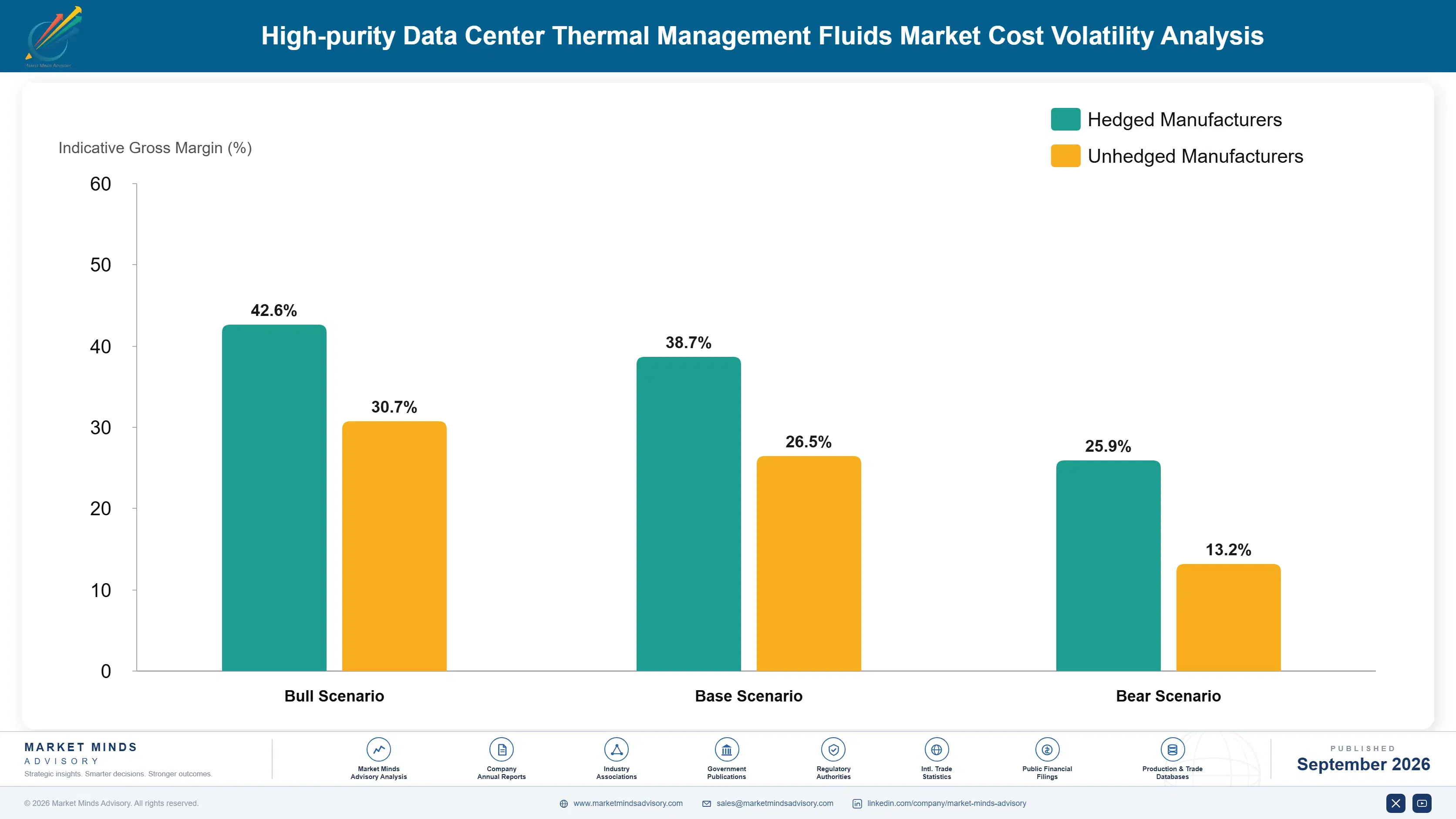
Fluorinated feedstock chemicals and high-purity base fluid stock together represent the largest variable cost input for this category, running an estimated 32 to 40 percent of cost of goods sold for suppliers with fluorinated two-phase product lines, sourced primarily from specialty chemical manufacturing capacity concentrated in the United States, Western Europe, and China. Purification and additive chemistry add a smaller, rising cost share.
Fluorochemical feedstock pricing volatility became a live commercial issue during 2025 as regulatory uncertainty around PFAS restrictions prompted some feedstock suppliers to reduce planned capacity investment, a pattern consistent with chemical industry capacity trends tracked in United States Environmental Protection Agency public filings and reflected across multiple supplier annual reports. Suppliers dependent on a narrow set of feedstock sources faced greater exposure to this pricing volatility than those with diversified sourcing relationships.

The competitive disadvantage falls hardest on smaller suppliers without the scale to negotiate long-term feedstock supply agreements or to fund parallel PFAS-free formulation development while maintaining existing fluorinated product lines simultaneously. Exposure varies by formulation type too, since PFAS-free fluid producers sourcing from a broader and less regulated feedstock base face meaningfully less exposure to this specific volatility than fluorinated fluid producers.
high-purity-data-center-thermal-management-fluids--cost-volatility-analysis-1788419422688

Diversifying Feedstock Sourcing Across Multiple Suppliers

Larger suppliers are qualifying feedstock chemical sources across multiple geographies rather than depending on a single supplier relationship, reducing exposure to any single region's regulatory or capacity disruption while adding meaningful qualification cost and lead time in the near term. This strategy adds resilience but rarely eliminates exposure fully, since requalification itself still takes considerable engineering time.

Accelerating Parallel PFAS-Free Formulation Development

Several suppliers are running PFAS-free formulation development in parallel with existing fluorinated product lines specifically to reduce long-term feedstock exposure, trading higher near-term research and development cost for reduced regulatory and supply risk over the coming decade. This parallel investment strains research budgets in the near term but positions suppliers well ahead of eventual regulatory deadlines.

Locking In Long-Term Feedstock Supply Agreements

Suppliers are negotiating multi-year fixed-volume feedstock supply agreements directly with chemical manufacturers to secure allocation ahead of demand growth, protecting production schedules from short-notice allocation changes during periods of constrained industry-wide capacity. These agreements typically require volume commitments well ahead of confirmed demand, a forecasting risk that suppliers must manage carefully against actual sales performance each year.

Portfolio Architecture for Margin Defence

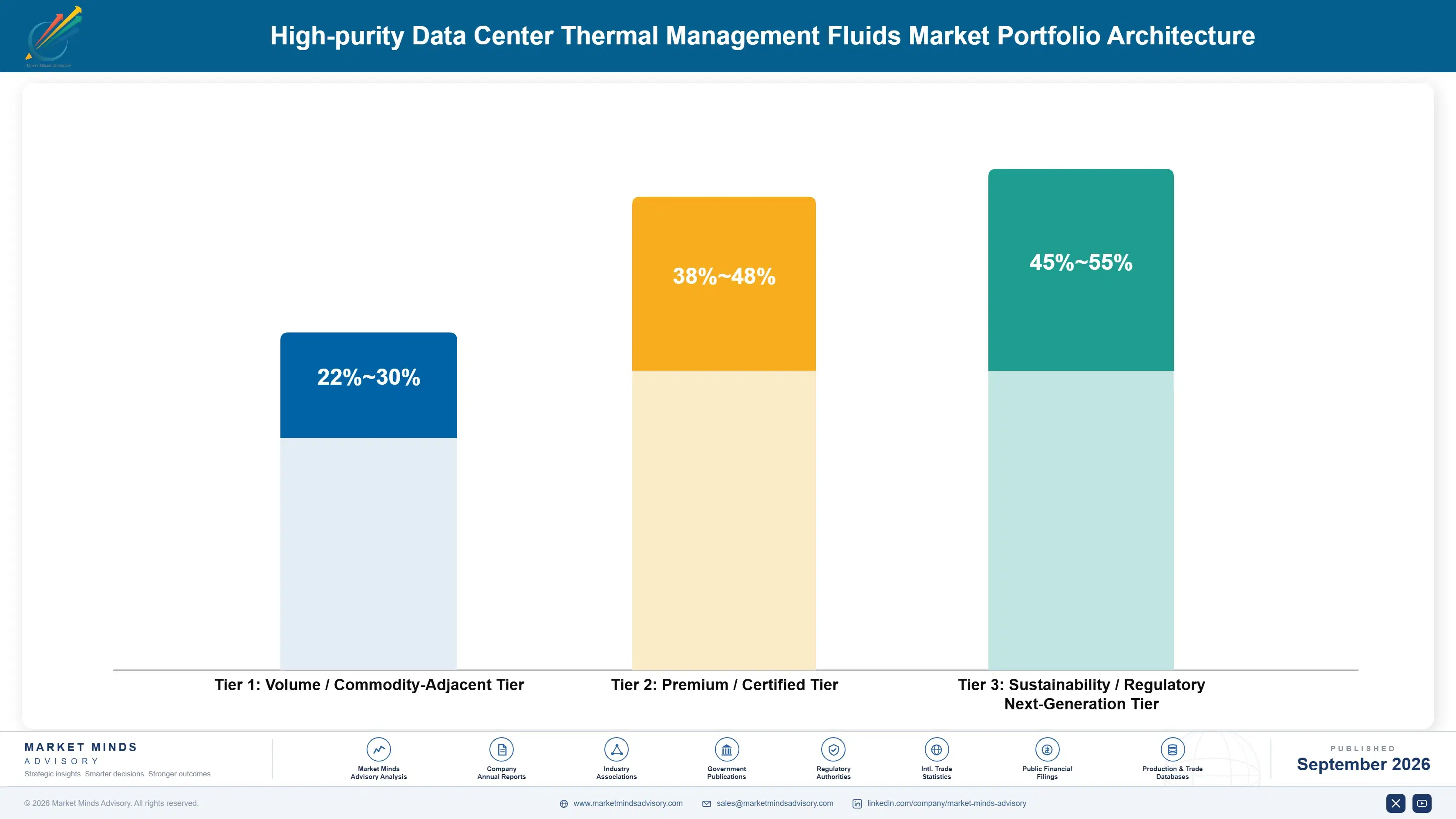
Portfolio economics split into three tiers. Volume tier direct-to-chip coolants carry moderate margins driven by growing but still price-competitive retrofit demand, while premium certified immersion fluids for the highest-density GPU deployments carry meaningfully higher margins tied to qualification status and proven reliability. The sustainability and next-generation tier, built around PFAS-free formulations, currently carries the strongest margins of the three given limited qualified competition.
The volume versus premium tension shows up clearly in supplier research allocation. Investment devoted to defending existing fluorinated formulations against price competition increasingly competes against investment needed for PFAS-free development, and suppliers that under-invest in either risk losing ground to a competitor optimised specifically for that transition. This tension is most visible at suppliers still organised around a single unified product roadmap rather than separate teams.

High-value margin pools concentrate in PFAS-free formulations commanding regulatory-driven premium pricing and in bundled reliability monitoring services layered onto core fluid sales. The volume direct-to-chip tier remains essential for overall category growth but contributes a smaller share of blended gross margin than its unit volume alone would suggest. Suppliers ignoring this shift risk margin erosion as commoditisation eventually reaches even the newest formulations.

Volume / Commodity-Adjacent Tier

Direct-to-chip coolant fluids for standard retrofit deployments, facing steady price competition as adoption scales across the category. Suppliers here compete mainly on manufacturing efficiency and reliable, consistent supply availability rather than performance differentiation.
Gross Margin: 22-30%

Premium / Certified Tier

Qualified immersion fluids for the highest-density GPU deployments, carrying margins tied to proven reliability and long qualification track records. These fluids justify their pricing through extensive qualification testing and proven multi-year reliability track records.
Gross Margin: 38-48%

Sustainability / Regulatory / Next-Generation Tier

PFAS-free formulations commanding the strongest current margins given limited qualified competition and genuine regulatory urgency. Margins here should gradually compress as more competitors complete their own PFAS-free qualification and enter the segment.
Gross Margin: 45-55%
high-purity-data-center-thermal-management-fluids--portfolio-architecture-1788419423201

High-value Sub-segments and Strategic Watch-out

PFAS-Free Formulations for Regulated Jurisdictions

The fastest-growing segment in this report, combining strong current margins with accelerating regulatory urgency as European Union restriction timelines continue to firm up across member states. Suppliers positioned early in this segment are capturing outsized contract wins as European Union restriction timelines continue firming up.
Gross Margin: 45-55%

Sovereign Gulf AI Campus Fluid Contracts

Large, greenfield contracts tied to sovereign-backed artificial intelligence infrastructure investment, offering substantial volume and long-term visibility despite geographic concentration risk in a small number of countries. These contracts also provide suppliers valuable long-term volume visibility, reducing overall revenue volatility relative to smaller, dispersed retrofit deals.
Gross Margin: 36-46%

Standard Direct-to-Chip Retrofit Coolants

The largest existing unit volume base, facing steady price competition but funding most suppliers' ongoing qualification and research investment across the wider category. Suppliers here rely on manufacturing efficiency and existing qualification relationships rather than technical differentiation to defend their volume base overall each year.
Gross Margin: 22-30%

Legacy Fluorinated Two-Phase Fluids

A shrinking strategic watch-out segment as regulatory pressure and PFAS-free alternatives increasingly displace established fluorinated formulations across regulated jurisdictions specifically. Suppliers still reliant on this segment risk losing regulated accounts entirely as PFAS restrictions take effect across an increasing number of major jurisdictions specifically now.
Gross Margin: 30-38%

Qualification Lock-In and Reliability Economics

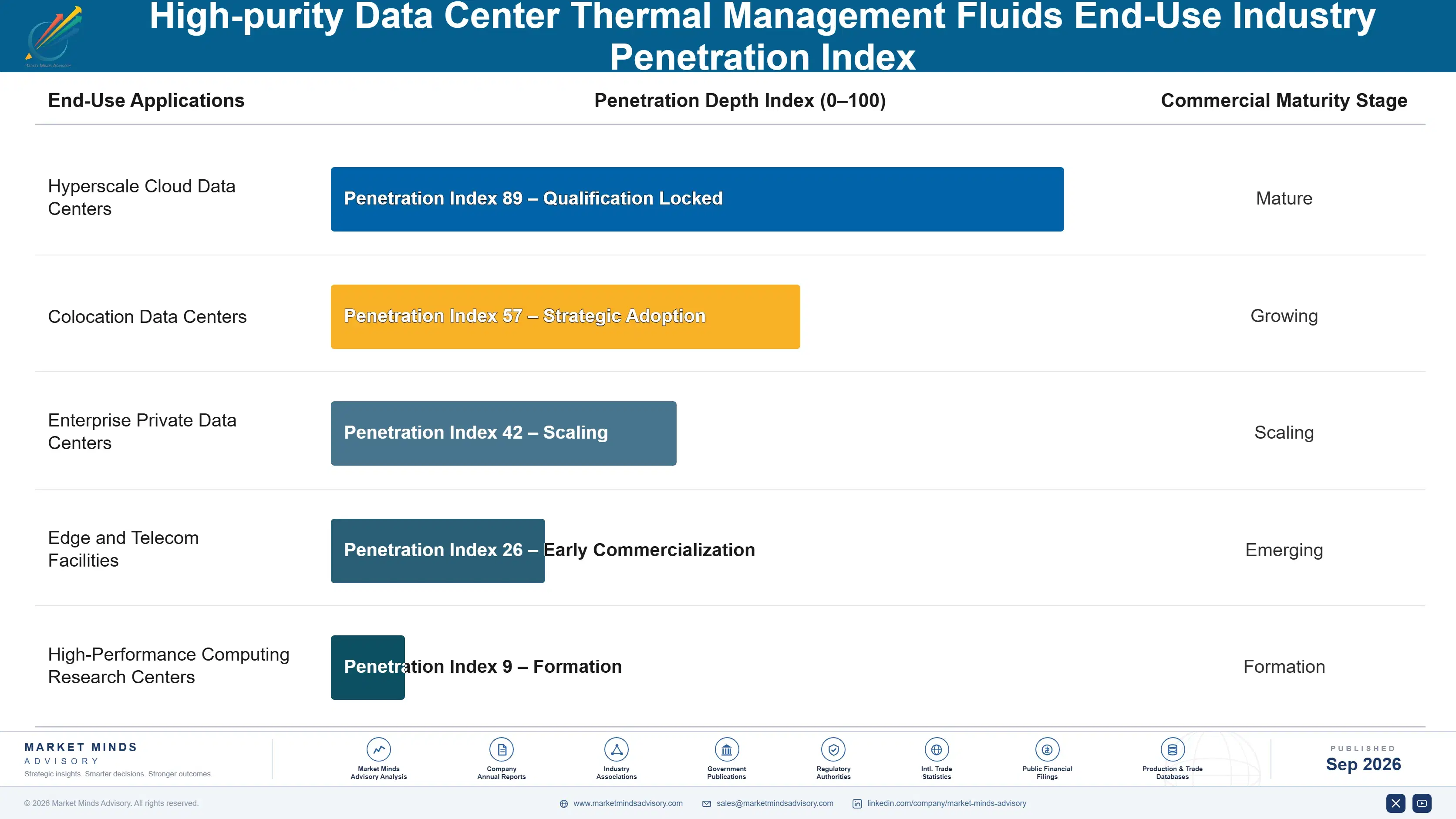
Revenue behaves like an annuity once a fluid completes hyperscale qualification, since switching to an alternative supplier requires repeating a costly, multi-month compatibility testing process that most operators are reluctant to undertake without a compelling reason, and that qualification lock-in, not brand preference, explains most of this category's supplier retention pattern. This lock-in effect is strongest precisely where deployment scale is largest.
Adoption depth varies sharply by end-use vertical. Hyperscale cloud operators running the highest GPU density workloads integrate fluid selection deeply into facility design from the earliest planning stages, creating durable multi-year supplier relationships, while smaller colocation providers and enterprise data centers treat fluid selection more transactionally, creating far shallower loyalty and greater exposure to price-based switching over time. Suppliers investing in deeper facility-level integration are working to close this loyalty gap.

Buyer profiles are shifting generationally too. Facility engineers who came up through traditional air-cooling design still favour conservative, extensively proven formulations even at a price premium, while newer data center engineering teams increasingly default to evaluating PFAS-free and next-generation formulations from the outset, a difference in risk tolerance that is already shaping which suppliers win newly designed greenfield facilities versus older retrofit projects.
high-purity-data-center-thermal-management-fluids--end-use-penetration-index-1788419423694

Where the Category Reorders Next

These are among the four positions where our research anticipates prominent divergence between winners and laggards over the coming forecast period. Each is grounded in the demand model, the regulatory perimeter, and the announced capacity pipeline.
01 / PFAS TRANSITION STRATEGY

Suppliers without a qualified PFAS-free product risk losing regulated accounts

Suppliers still relying entirely on fluorinated formulations are increasingly exposed as European Union and United States state-level regulatory timelines firm up, since qualification testing for a replacement fluid cannot be compressed into a matter of months once a restriction deadline is confirmed. Companies that started PFAS-free development years ahead of regulatory certainty are now capturing qualification wins that latecomers cannot easily contest. Expect further market share shifts toward early PFAS-free movers as remaining regulatory uncertainty resolves over the next two to three years specifically.
02 / QUALIFICATION RELATIONSHIP BUILDING

Early hyperscale qualification wins compound into durable competitive advantage

Suppliers that invested in hyperscale fluid qualification ahead of confirmed demand are now capturing a disproportionate share of new contracts as that demand materialises, since qualification testing timelines prevent hyperscale buyers from quickly onboarding an unproven new supplier under time pressure. This dynamic rewards patient capital allocation toward qualification testing well before revenue materialises. Suppliers without an established qualification track record should prioritise smaller, faster-cycle deployments to build a credentialing history before pursuing the largest hyperscale accounts directly across multiple geographies simultaneously.
03 / SOVEREIGN CONTRACT CONCENTRATION

Gulf sovereign AI campus contracts carry meaningful geographic concentration risk

The disproportionate revenue contribution from sovereign-backed Gulf state artificial intelligence campus contracts creates genuine geographic concentration risk that suppliers should weigh carefully against the clear near-term volume opportunity these projects represent. A shift in sovereign investment priorities or construction timeline delays could meaningfully affect supplier revenue forecasts built around this concentrated demand source. Diversifying account exposure across multiple geographies remains the more resilient long-term strategy despite the near-term appeal of Gulf state contract scale, particularly given how quickly sovereign investment priorities can shift with changing political conditions.
04 / RELIABILITY DATA INVESTMENT

Long-term reliability data is becoming the primary basis for premium pricing

As more suppliers achieve baseline PFAS-free qualification, long-term field reliability data is emerging as the next differentiator commanding premium pricing, since operators increasingly weigh proven multi-year performance history over formulation novelty alone. Suppliers without a systematic field monitoring programme risk being unable to substantiate reliability claims against better-documented competitors. Building this data infrastructure now, well ahead of when competitors recognise its strategic value, looks like a genuinely durable source of pricing power for suppliers willing to make the upfront investment today.

Engagement Snapshot From the Field

A live engagement with an industry participant carrying material or product regulatory and market exposure ahead of a defining policy shift, showing how our research translates into a defensible multi-year portfolio strategy.
MARKET MINDS ADVISORY · CLIENT ENGAGEMENT SUMMARY
High-purity Data Center Thermal Management Fluids Producer Strategic Portfolio Review and Transition Roadmap 2026·Investment Scenario on High-purity Data Center Thermal Management Fluids Exposure Evaluation 2025-26
CLIENT PROFILE
The client is a mid-tier hyperscale cloud operator with data center capacity across three continents, reporting approximately three hundred forty million dollars in annual infrastructure capital expenditure (client-reported, unverified by MMA), facing rapidly rising GPU rack density that its existing air-cooled facility design could no longer economically accommodate across several flagship sites. serving both enterprise and public sector cloud customers globally.
STRATEGIC CHALLENGE
Leadership needed to select a fluid supplier and cooling architecture for its next generation of GPU-dense facilities without the internal technical expertise to evaluate competing formulation claims, while facing pressure from major customers to bring new liquid-cooled capacity online faster than a full multi-year qualification cycle would normally allow. within a tight budget.
MMA APPROACH
MMA benchmarked candidate suppliers against disclosed hyperscale qualification track records and reliability data, structuring an accelerated but still rigorous qualification framework that prioritised suppliers with existing qualification history at comparable facilities. The engagement included primary interviews with facility engineers at peer operators to validate real-world formulation performance claims. within a compressed engagement timeline.
KEY FINDINGS
  1. Suppliers with existing qualification history at comparable facility scale reduced the client's internal testing burden meaningfully compared to evaluating unproven newer entrants from scratch.
  2. PFAS-free formulations from leading suppliers had reached sufficient reliability data maturity to be considered viable for this deployment despite their comparatively recent market entry.
  3. A phased qualification approach starting with a single smaller facility reduced organisational risk considerably compared to committing to full-scale rollout immediately. during pilot testing.
  4. Facility engineering teams adapted to liquid cooling operational requirements faster than initially expected once adequate supplier training and documentation was provided directly.
CLIENT PROFILE
The client is a mid-tier hyperscale cloud operator with data center capacity across three continents, reporting approximately three hundred forty million dollars in annual infrastructure capital expenditure (client-reported, unverified by MMA), facing rapidly rising GPU rack density that its existing air-cooled facility design could no longer economically accommodate across several flagship sites. serving both enterprise and public sector cloud customers globally.
STRATEGIC CHALLENGE
Leadership needed to select a fluid supplier and cooling architecture for its next generation of GPU-dense facilities without the internal technical expertise to evaluate competing formulation claims, while facing pressure from major customers to bring new liquid-cooled capacity online faster than a full multi-year qualification cycle would normally allow. within a tight budget.
MMA APPROACH
MMA benchmarked candidate suppliers against disclosed hyperscale qualification track records and reliability data, structuring an accelerated but still rigorous qualification framework that prioritised suppliers with existing qualification history at comparable facilities. The engagement included primary interviews with facility engineers at peer operators to validate real-world formulation performance claims. within a compressed engagement timeline.
KEY FINDINGS
  1. Suppliers with existing qualification history at comparable facility scale reduced the client's internal testing burden meaningfully compared to evaluating unproven newer entrants from scratch.
  2. PFAS-free formulations from leading suppliers had reached sufficient reliability data maturity to be considered viable for this deployment despite their comparatively recent market entry.
  3. A phased qualification approach starting with a single smaller facility reduced organisational risk considerably compared to committing to full-scale rollout immediately. during pilot testing.
  4. Facility engineering teams adapted to liquid cooling operational requirements faster than initially expected once adequate supplier training and documentation was provided directly.
RECOMMENDED STRATEGY
Phase 1: Phase 1 (Months 1 to 3): Benchmark supplier qualification track records and shortlist candidates with proven comparable-scale deployment history. and confirm budget. Phase 2: Phase 2 (Months 4 to 8): Deploy a phased pilot at the smallest flagship facility to validate real-world performance and operational fit. Phase 3: Phase 3 (Months 9 to 14): Scale the validated fluid and supplier relationship across remaining flagship facilities on a rolling basis.
OUTCOME
Fourteen months after the engagement began, the client completed its first two GPU-dense liquid-cooled facilities on schedule, reporting infrastructure cooling energy cost reductions of approximately twenty five percent relative to its prior air-cooled baseline (client-reported, unverified by MMA). Leadership also reported meaningfully improved ability to win large GPU-hosting contracts requiring liquid cooling capability.

Frequently Asked Questions

Foundational context covering the market sizes, CAGR, scope, country, region and competition that inform every finding below. This section is provided to cover basics and most often pre-purchase conversations, answered from the MMA Primary Research Dataset.

What is the current size of the High-purity Data Center Thermal Management Fluids Market?

The market reached an estimated USD 0.85 billion in global revenue in 2025, according to MMA Analysis based on primary research and company disclosures. This base year figure anchors the forecast period beginning in 2026.

How large will the High-purity Data Center Thermal Management Fluids Market be by 2036?

MMA projects the market will reach approximately USD 4.56 billion by 2036 under the base case scenario. That represents roughly a 4.61 times expansion from the 2026 starting value of USD 0.99 billion.

What is the CAGR for the High-purity Data Center Thermal Management Fluids Market 2026 to 2036?

The base case compound annual growth rate is 16.5% across the 2026 to 2036 forecast window. Bull and bear scenarios range from 15.2% to 17.8% depending on PFAS-free qualification timing.

Which segment is growing fastest?

PFAS-Free Next-Generation Dielectric Fluids lead all segments at a 25.0% CAGR, roughly 1.52 times the overall market rate. This segment benefits from a small starting base and accelerating regulatory urgency across major jurisdictions.

Who are the major companies in the High-purity Data Center Thermal Management Fluids Market?

Leading suppliers include Shell plc, The Chemours Company, Solvay SA, Castrol Limited, and Engineered Fluids Inc. Together these five hold an estimated 46% combined share on a disclosed segment revenue basis.

Which country is growing fastest?

The United Arab Emirates leads national growth at an estimated 22.5% CAGR, driven by sovereign-funded gigawatt-scale artificial intelligence data center campus investment. Saudi Arabia and India follow closely behind within their respective regions.

Report Segmentation Architecture

The full report scope spans multiple orthogonal segmentation dimensions, with cross-tabulated demand data provided for each dimension pair. Coverage extends further to regional breakdowns, trend trajectories, and the competitive detail needed to support segment-level decision-making.

By Fluid Chemistry and Cooling Architecture

  • Single-Phase Immersion Dielectric Fluids
  • Two-Phase Immersion Fluorinated Fluids
  • Direct-to-Chip Coolant Fluids
  • Synthetic Ester-Based Fluids
  • Deionized Water-Glycol Coolants
  • PFAS-Free Next-Generation Dielectric Fluids

By End-Use Industry

  • Hyperscale Cloud Data Centers
  • Colocation Data Centers
  • Enterprise Private Data Centers
  • Edge and Telecom Facilities
  • High-Performance Computing Research Centers

By Commercial Dimension

  • Original Fluid Fill Contracts
  • Fluid Replacement and Top-Up Services
  • Reliability Monitoring Service Contracts
  • Direct Hyperscale Supply Agreements

By Region

  • North America
  • Western Europe
  • East Asia
  • South Asia and Pacific
  • Latin America
  • Middle East and Africa
  • Eastern Europe

Scope, Methodology, and Coverage

Every figure in this report is reproducible from documented input assumptions. The scope below maps the historical period, the forecast horizon, the segmentation dimensions, and the countries covered, alongside the underlying primary and qualitative methodology.
Historical Period
2020 to 2025
Forecast Period
2026 to 2036
Base Year
2025 (USD billions; MMA Primary Research Dataset, September 2026)
Market Definition
This report covers dielectric and thermally conductive fluids engineered and purified specifically for direct contact or close-proximity cooling of data center electronics, including single-phase and two-phase immersion fluids, direct-to-chip coolants, and associated purification and additive chemistry. It excludes general facility chilled water systems, refrigerants used solely in air handling units, and fluids used outside data center or edge computing electronics cooling applications.
Quantitative Units
USD billions (current prices); fluid volume in liters; average price per liter
Segmentation Dimensions
By Fluid Chemistry and Cooling Architecture; By End-Use Industry; By Commercial Dimension; By Region
Regions Covered
North America, Western Europe, East Asia, South Asia and Pacific, Latin America, Middle East and Africa, Eastern Europe
Countries Covered
USA, China, Germany, France, UK, Japan, South Korea, India, Australia, Canada, Brazil, Mexico, Indonesia, Vietnam, Thailand, Malaysia, UAE, Saudi Arabia, South Africa, Nigeria, Turkey, Poland, Netherlands, Italy, Spain, Sweden, Switzerland, Argentina, Colombia, Singapore, and additional markets relevant to this sector
Key Companies Profiled
Shell plc; The Chemours Company; Solvay SA; Castrol Limited; Engineered Fluids Inc.; 3M Company; ExxonMobil Corporation; TotalEnergies SE; Dow Inc.; DuPont de Nemours Inc.; Fuchs Petrolub SE; Submer Technologies SL; LiquidStack Holding BV; GRC (Green Revolution Cooling) Inc.; Motivair Corporation; Iceotope Technologies Limited; Wieland Group; Petronas Chemicals Group Berhad; Idemitsu Kosan Co Ltd; JX Nippon Oil and Energy Corporation
Quantitative Methodology
Primary survey, n=3,800 respondents, Q4 2025, six countries; demand-side model with trade association cross-validation
Qualitative Methodology
47 expert interviews, Q4 2025; applied to validate demand model assumptions, identify emerging dynamics, and assess competitive positioning
Report Format
PDF and XLSX data workbook (Word format preview document)
Publisher
Market Minds Advisory
Report Code
MMA-2026-CHM-522
Published
September 2026
Contact
sales@marketmindsadvisory.com | www.marketmindsadvisory.com

Purchase the full High-purity Data Center Thermal Management Fluids Market Report (2026 to 2036).

The full report delivers complete segmentation data across all six fluid chemistry segments, all seven regional markets, and detailed competitive profiles for all twenty companies named in this summary. It includes the underlying primary survey dataset of three thousand eight hundred respondents and forty seven expert interviews conducted during the fourth quarter of 2025. Buyers also receive downloadable data tables covering historical 2020 to 2025 figures alongside the full 2026 to 2036 annual forecast. A dedicated appendix addresses PFAS regulatory timeline scenarios across three major jurisdictions.
Full Seven-Region Regional Data Tables and Charts
All Twenty Company Competitive Profiles and Rankings
Ten-Year Annual Forecast Model With Scenarios
Primary Survey Raw Data Access and Tables
PFAS Regulatory Timeline Scenario Appendix and Analysis
Quarterly Update Subscription Option for Buyers

Built For The People Who Decide

From boardroom strategy to bench-side execution, this report is read cover-to-cover by leaders shaping the next decade of their industry, turning demand scenarios, market dynamics and valuation benchmarks into decisions.
CXOs/ Presidents/ VPs/ Managers
M&A and Corporate Development
Strategy Teams and R&D Heads
Procurement and Product Directors
Regulatory and Compliance Leaders
Investor Relations and Equity Analysts