Market Minds Advisory
High Pressure Seal Market

High Pressure Seal Market: Elastomer, Polymer and Metal Sealing Across Energy, Hydraulic and Process Equipment, 2026 to 2036

Sealing components are 2% of what a piece of high pressure equipment costs and cause 68% of the hydraulic failures that stop it, which is a ratio no procurement process has ever handled sensibly.

Lead Analyst

Bilal Shaikh

Published

September 2026

Make Smarter Decisions with Customized Research Insights

Request a free sample report and evaluate market opportunities, growth trends, and competitive dynamics relevant to your business needs.

2025 MARKET VALUE$4.6BMarket Size 2025
2036 FORECAST VALUE$9.5BBase Case , 2026 to 2036
CAGR 2026 TO 20366.8 %Bull 8.1% / Bear 5.6%
INCREMENTAL OPPORTUNITY$4.6BNet 10- year value creation
EXPANSION MULTIPLE1.93x2036 value over 2026 base
Strategic Levers
M&A Pipeline
Regional Outlook
Country Rankings
Competitive Intelligence
Segmental Deep-dive
Call-Us : 91 93563 13602

Executive Snapshot and Market Trajectory

The commercial arithmetic in high pressure sealing is uncomfortable. Sealing components represent roughly 2% of what a piece of high pressure equipment costs, and 68% of hydraulic system failures trace back to them, so the cheapest item on the bill of materials causes most of the expensive stoppages.
Growth concentrates in perfluoroelastomer seals, expanding at 10.2%, where full fluorination delivers chemical and thermal resistance that fluoroelastomers cannot reach, and where semiconductor process equipment, aggressive chemical service and hydrogen systems all now demand it. East Asia holds 30% of value, the largest regional share, because semiconductor equipment manufacture, industrial hydraulics production and general machinery assembly are all concentrated there at a scale that no other region comes close to approaching.
The supplier base is moderately concentrated, with the top five holding 42% of sealing revenue, and it splits between global systems suppliers and specialist material houses serving demanding service conditions. Competition runs on qualified service life under real pressure and temperature rather than on unit price. Proposed restrictions on fluorinated polymers are the single regulatory question now hanging over the fastest growing part of this whole market.
Market Definition
The market comprises sealing components engineered for high pressure service, spanning perfluoroelastomer seals, spring-energised polytetrafluoroethylene and polymer seals, high-performance thermoplastic seals, metal and metal-to-metal seals, hydrogenated nitrile and fluoroelastomer seals, and conventional elastomer seals rated for elevated pressure duty. Sizing captures component revenue at realised delivered price across oil and gas production, subsea and wellhead systems, industrial hydraulics, chemical and process equipment, semiconductor manufacturing tools, hydrogen and carbon dioxide systems, and aerospace applications. Low pressure gaskets and static flange sealing, mechanical seal assemblies for rotating pumps, sealing compounds and adhesives, and the equipment the seals are installed into fall outside scope.
Base Year Value
$4.6B in 2025 (MMA Primary Research Dataset, August 2026)
Forecast Period
2026 to 2036, eleven discrete annual values
CAGR
6.8% base case. Bull 8.1%. Bear 5.6%.
Fastest Growth Segment
Perfluoroelastomer Seals: 10.2% CAGR
Fastest Growth Country
India: 9.4% CAGR
Fastest Growth Region
South Asia and Pacific: 8.9% CAGR
Largest Region
East Asia: 30% of 2025 global value
Market Leaders
Trelleborg Sealing Solutions, Freudenberg Sealing Technologies, Parker Hannifin, SKF, John Crane. Source: MMA Analysis based on company annual reports.
Primary Survey
n=3,800 procurement and R&D decision-makers, Q4 2025, six countries
Methodology
Demand-side build-up, cross-validated against public data, 47 expert interviews

High Pressure Seal Market Forecast Scenarios

high-pressure-seal-market-trends-size-forecast-scenario-1787310652552
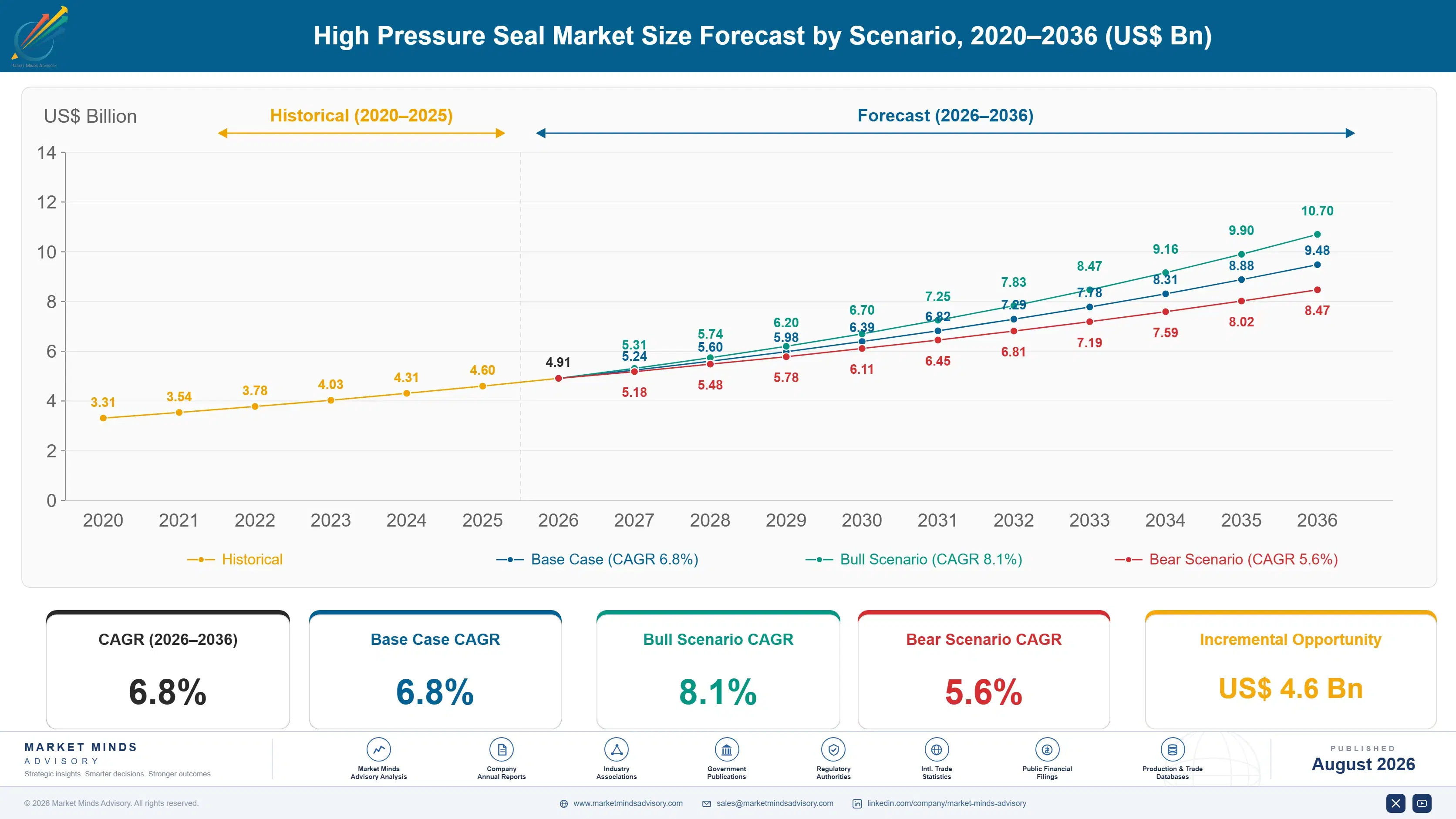
Growth of 5.4% across 2020 to 2025 combined a weak start with a strong finish. Oil and gas capital spending collapsed through 2020 and took subsea sealing demand with it, industrial machinery output fell alongside, and both recovered from 2022 as energy prices rose and manufacturing restocked. Semiconductor equipment demand ran to records and then fell sharply, which disguised steady growth in the more demanding material grades.
The base case at 6.8% rests on three mechanisms. Hydrogen and carbon dioxide handling equipment requires sealing at pressures and permeation resistance conventional elastomers were never designed for, and every project specifies it new. Semiconductor equipment installation keeps expanding across four regions, consuming perfluoroelastomer components that must survive plasma and aggressive process chemistry. And oil and gas equipment replacement continues on an ageing installed base regardless of where prices sit.
The bull case at 8.1% turns on hydrogen infrastructure moving from announcement into construction faster than currently modelled, since sealing content per unit of hydrogen equipment is unusually high. The bear case at 5.6% turns on regulation. Broad restriction of fluorinated polymers would remove the material class underpinning the fastest growing segments, and no alternative currently matches perfluoroelastomer performance where it is specified.

What Actually Determines Sealing Value

Nothing about this market makes sense until the cost ratio is understood. Sealing components account for roughly 2% of installed equipment cost while causing 68% of hydraulic system failures, which means a seal that fails early destroys value many multiples of what the entire sealing package cost in the first place. Operators who understand this specify on qualified service life. Procurement departments measured on purchase price keep buying the cheapest part meeting the drawing, and keep being
TOP FIVE SHARE42%Concentration of sealing component revenue across the largest suppliers
WORKING PRESSURE RATING15,000 psiPressure that subsea and wellhead sealing systems must withstand
SEAL COST SHARE2%Sealing components share of total installed equipment cost
SEAL RELATED FAILURE SHARE68%Share of hydraulic system failures traced back to sealing components
PERFLUOROELASTOMER MATERIAL COSTUSD 940 per kgCompound cost per kilogram before moulding and finishing operations
SUBSEA QUALIFICATION CYCLE18 monthsTime from material submission to subsea equipment approval release
Material cost explains the segment structure. Perfluoroelastomer compound runs near USD 940 per kilogram against a small fraction of that for conventional nitrile, which is why nobody specifies it unless the service genuinely demands it. Where it does, in semiconductor plasma chambers, aggressive chemical service and hydrogen systems, there is no adequate alternative at any price, and suppliers price accordingly.
Qualification separates the profitable business from the rest. Subsea equipment approval takes around 18 months from material submission, involves pressure cycling, rapid gas decompression testing and chemical compatibility work, and results in a seal being named in an equipment specification that stays fixed for the platform's life. Industrial hydraulic seals face nothing comparable, which is exactly why they earn so much less.
"Every operator will tell you that unplanned downtime is their biggest cost and then buy seals from whoever quoted lowest against the drawing. I have seen a two hundred dollar seal take a subsea tree out of service for a month, and the procurement file showed a very careful negotiation that saved forty dollars on the original order."
Director, Sealing Systems and Industrial Components Practice · MMA Construction

Market Trends

Hydrogen Systems Demand Sealing Nobody Previously Specified

Hydrogen at pressure permeates elastomers, embrittles some metals and causes explosive decompression damage when pressure drops rapidly, which makes sealing a genuinely difficult engineering problem rather than a component selection exercise. Roughly 1,400 hydrogen production, compression and refuelling projects are under construction or committed globally. Each one specifies sealing materials qualified for hydrogen service, and the qualification base is thin because the application barely existed a decade ago. Sealing content per unit of hydrogen equipment runs well above conventional gas handling, which makes this demand unusually valuable to whoever holds the qualification.
Market Impact: Covers 42 fabs under construction
Fluoropolymer Restriction Threatens The Premium Material Class

Proposed European restrictions on per- and polyfluoroalkyl substances reach fluoroelastomers and perfluoroelastomers, which are the materials that make the most demanding high pressure sealing possible in the first place. Around 34% of high pressure sealing revenue depends on fluorinated polymer chemistry. Industry submissions argue that sealed industrial applications with long service life present a different exposure profile from dispersive uses, and equipment makers are simultaneously funding alternative chemistry development that has so far matched neither the temperature range nor the chemical resistance of what it would replace. Nobody has a satisfactory answer yet.
Market Impact: Replacement reaches 61% of revenue

Market Opportunities and Growth Drivers

Semiconductor Equipment Consumes Perfluoroelastomer At Scale

Plasma etch and deposition chambers subject sealing components to aggressive process chemistry, plasma exposure and thermal cycling that only fully fluorinated elastomers survive with acceptable particle generation and service life. Roughly 42 new semiconductor fabrication plants are currently under construction worldwide, each carrying thousands of sealing components across its tool set. Chamber seals are replaced on preventive maintenance schedules rather than on failure, which creates recurring consumption tied to installed tool count rather than to new equipment purchases alone. Particle generation matters as much as service life in these applications.
Market Impact: Seals cause 68% of failures

Ageing Energy Equipment Sustains Replacement Sealing Demand

Wellhead equipment, subsea trees, valves and hydraulic systems installed decades ago continue operating and continue requiring sealing replacement on maintenance intervals, quite independently of whether anybody is sanctioning any new field development at all. Around 61% of all oil and gas sealing revenue now comes from replacement rather than from original equipment supply at build. That aftermarket demand is considerably less cyclical than capital spending, and it carries better margins because urgency reduces price sensitivity sharply, and it strongly favours suppliers whose components were named in the original equipment specification decades earlier.
Market Impact: Material carries 34% of revenue

Market Restraints and Challenges

Procurement Buys Price Where Failure Costs Availability

Sealing at 2% of equipment cost sits far below the threshold that attracts management attention, so purchasing decisions default to the lowest quotation meeting the drawing, while 68% of hydraulic failures trace back to those same components. The root cause is organisational: the purchase saving lands in a procurement budget and the failure cost lands in operations. Commercially this caps what better sealing can ever earn in the market. Participants are responding with total cost modelling, service life guarantees written into supply agreements, and condition monitoring that attributes downtime to sealing components accurately.
Market Impact: Covers 1,400 hydrogen projects comm

Fluoropolymer Regulation Threatens Premium Material Availability

Perfluoroelastomer and fluoroelastomer chemistry underpins 34% of high pressure sealing revenue, and proposed restrictions on fluorinated substances reach both. The root cause is that the properties making these polymers exceptional seals, chemical inertness and thermal stability, are precisely the properties that make them persist. Commercially it leaves equipment makers designing around materials whose availability is uncertain. Mitigation runs through regulatory engagement arguing sealed long-life industrial use, alternative polymer development, and metal sealing designs that avoid elastomer chemistry entirely wherever the geometry permits it. None of those routes is a complete answer.
Market Impact: Affects 34% of sealing revenue
4 additional market trends, 3 additional growth drivers, and 2 additional restraints and challenges are covered in the full report. Contact sales@marketmindsadvisory.com to access the complete intelligence.

Segment CAGR and Growth Architecture

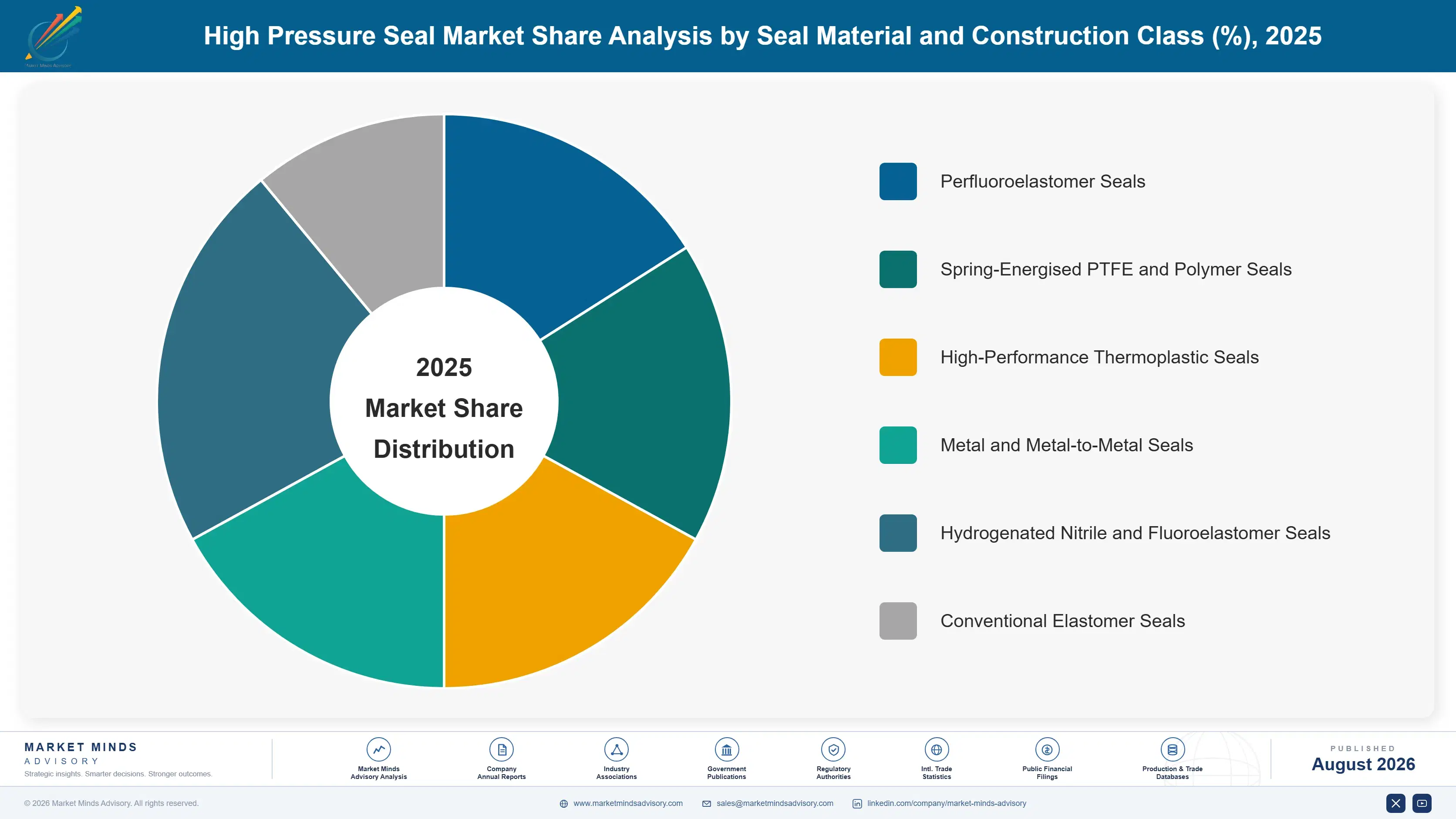
Segmentation follows seal material and construction class, which is the dimension determining achievable pressure and temperature envelope, chemical compatibility, qualification burden and realised price together. End-use industry cuts across most material classes without separating them commercially, since the same perfluoroelastomer serves semiconductor and chemical service alike, so application belongs in demand analysis rather than in this hierarchy.
high-pressure-seal-market-trends-market-share-analysis-1787310653086

Perfluoroelastomer Seals

Growing at 10.2%, exactly 1.50 times the market rate, and the material class with no adequate substitute in the applications that specify it. Full fluorination delivers chemical inertness and thermal stability that fluoroelastomers cannot approach, which matters enormously in semiconductor plasma chambers, aggressive chemical service and increasingly in hydrogen systems, where permeation and decompression damage govern material selection entirely. Compound cost near USD 940 per kilogram means nobody specifies this material casually or without good reason. The commercial question hanging over the segment is regulatory rather than technical, since proposed fluorinated substance restrictions reach exactly this chemistry, and no alternative material currently matches it across temperature and chemical resistance together.
CAGR 10.2%

Spring-Energised PTFE and Polymer Seals

Expanding at 8.4% on applications where a metal spring loads a polytetrafluoroethylene or polymer jacket against the sealing surface, maintaining contact force independently of system pressure and across temperature extremes that elastomers cannot survive. Cryogenic service, hydrogen systems and aggressive chemical duty all favour this construction, since the polymer resists almost everything chemically while the spring supplies the mechanical function the polymer lacks. Design here is genuinely engineering work rather than catalogue selection, matching spring geometry, jacket thickness and surface finish to each specific application, which makes qualified positions genuinely durable once established. Hydrogen and cryogenic applications are currently pulling this construction into service faster than any other end use anywhere.
CAGR 8.4%
Full segment breakdown across 6 segments available in the complete report.

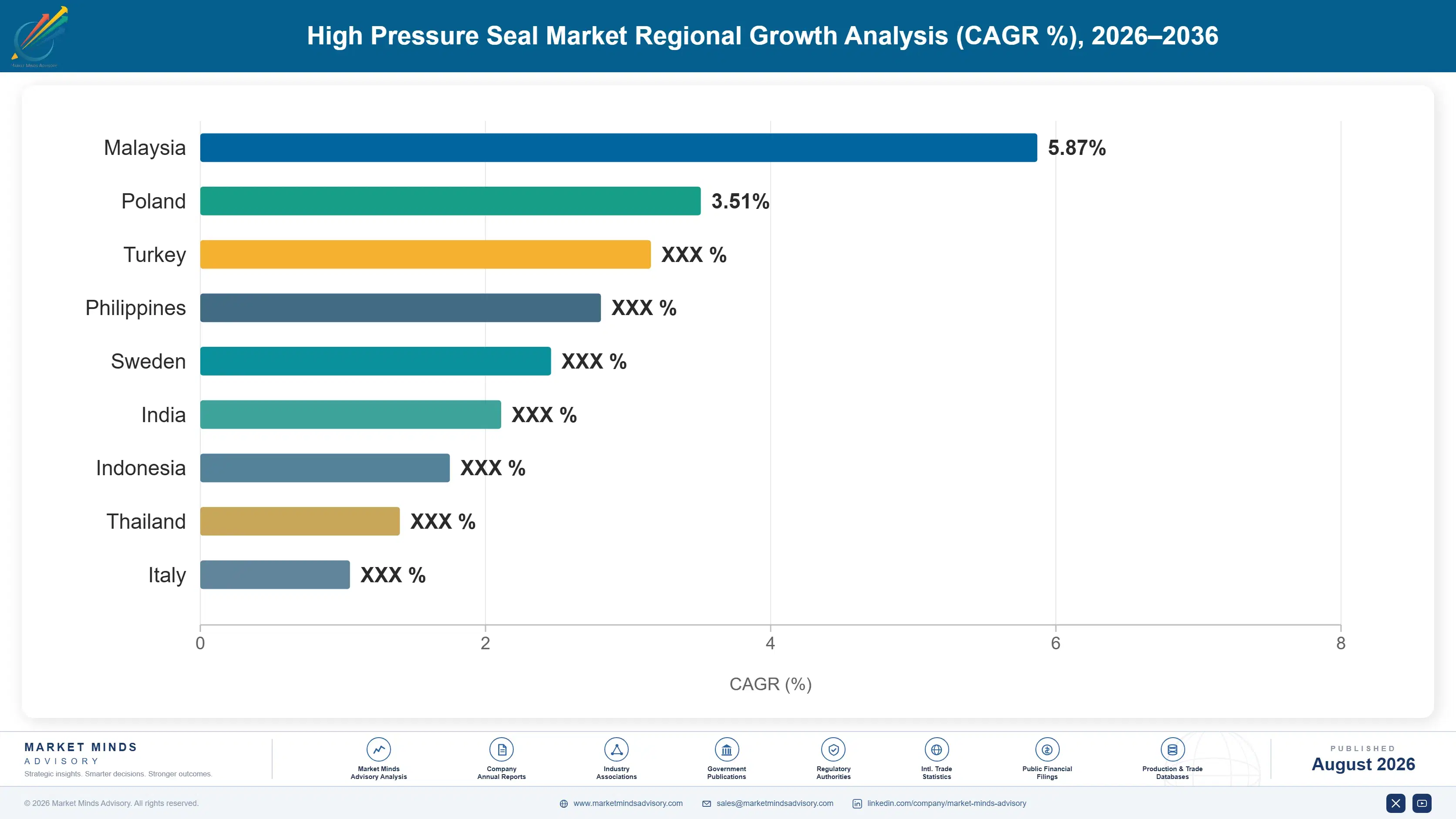
Regional Architecture and Country Demand Map

Regional value follows equipment manufacture and the installed base requiring replacement, which sit in quite different places and grow at quite different rates. Machinery and semiconductor tool assembly concentrates in Asia, while the energy aftermarket concentrates wherever production equipment happened to be installed decades ago.

East Asia

Thirty percent of value, the largest regional share, resting on manufacturing concentration rather than on any single application. Semiconductor equipment assembly in Japan and Korea consumes perfluoroelastomer components at demanding specifications, Chinese industrial hydraulics and machinery production is the largest anywhere and consumes sealing across every pressure class, and Japanese sealing manufacturers hold genuine technical positions in the most demanding material grades. Chinese domestic sealing producers have improved considerably over the past decade and now compete credibly across mid-range applications, though not yet in the most demanding grades. Growth of 7.8% runs above the global rate, supported by semiconductor capacity additions and by machinery output together right across the region.
Share: 30% | CAGR: 7.8% (2026 to 2036)

North America

Twenty-six percent of global value, weighted heavily toward oil and gas sealing where the installed base of wellhead, subsea and pressure control equipment is enormous and generates replacement demand independently of drilling activity. Gulf of Mexico subsea equipment carries the most demanding qualification requirements found anywhere, and suppliers named in those specifications hold commercial positions lasting decades. Industrial hydraulics, aerospace and semiconductor equipment manufacture add substantial further demand across the region, and domestic sealing capability in both compounding and machining remains genuinely strong. Growth of 6.4% reflects steady aftermarket consumption alongside hydrogen and carbon dioxide handling projects that are now beginning to specify sealing qualified properly for those particular services.
Share: 26% | CAGR: 6.4% (2026 to 2036)
Regional intelligence for 5 additional markets available in the complete report: Western Europe, South Asia and Pacific, Latin America, Middle East and Africa, Eastern Europe. Contact sales@marketmindsadvisory.com.
high-pressure-seal-market-trends-country-cagr-analysis-1787310653606

Where Sealing Suppliers Can Earn More

Quoting against a drawing to a procurement department measuring itself on purchase price is a race that the cheapest moulder always wins. The value available sits in avoided downtime, in original equipment specification, in the material classes with no substitute, and in the aftermarket revenue that specification positions go on generating for decades afterwards.

Sell Avoided Downtime Rather Than Component Price

Sealing represents 2% of equipment cost and causes 68% of hydraulic failures, so a seal delivering twice the service life saves an operator far more than the entire sealing package costs. Suppliers who model total cost using maintenance data, and who contract against achieved service life rather than quoting against a drawing, realise roughly 40% above price-quoting competitors. The evidence needed is failure history the operator already collects and rarely analyses. Most suppliers never reach the maintenance engineers who actually hold that data, because the commercial relationship stops at procurement.
Market Impact: Realises roughly 40% above competit

Win Original Equipment Specification, Not Replacement Orders

Around 61% of energy sealing revenue is replacement business, and the component named in the original equipment specification captures most of it for the asset's whole life. Suppliers engaging equipment designers during development, rather than bidding for aftermarket orders long afterwards, secure roughly 5 times the lifetime revenue per platform served. Qualification takes a full 18 months in subsea service, which means the engagement has to begin years before anybody issues a purchase order at all. Most suppliers are still watching for tenders to appear instead of doing that work.
Market Impact: Secures roughly 5 times the lifetim

Build Hydrogen Service Qualification Ahead Of Demand

Roughly 1,400 hydrogen projects are under construction or committed, and the qualification base for hydrogen sealing is thin because the application barely existed a decade ago. Suppliers completing rapid gas decompression, permeation and embrittlement qualification now command roughly 55% above conventional gas service pricing, because project engineers currently have very few qualified options available to them at all. Testing capability costs considerably less to establish than a single moulding line does. The window closes permanently as project specifications settle and qualified supplier lists get written down for the decade ahead.
Market Impact: Commands roughly 55% above conventi

Develop Alternatives Before Fluoropolymer Restriction Lands

Fluorinated polymer chemistry carries 34% of high pressure sealing revenue and faces restriction proposals that would remove it from applications with no ready substitute. Suppliers investing in alternative polymer systems and metal sealing designs hold roughly 3 times the addressable position of competitors relying entirely on fluoroelastomer chemistry under an adverse ruling. Nothing available today matches perfluoroelastomer across temperature and chemical resistance together, which is exactly why the development work has to start well before anybody considers it urgent. Qualification cycles here run to years rather than to months, which removes the option of waiting.
Market Impact: Holds roughly 3 times the addressab

Who Controls the Margin Pool

Concentration is moderate and reflects two quite different business models. The top five participants hold 42% of high pressure sealing revenue, the basis used throughout this section, and the gap between Trelleborg and the challenger group comes from breadth across material classes and applications rather than dominance in any single one. Below the leaders sit specialist houses like Greene Tweed and James Walker holding demanding positions, alongside a long tail of regional moulders competing o
Competition currently runs on three dimensions and unit price is the least of them wherever service is demanding. Qualification status decides which supplier can be specified into subsea, semiconductor or hydrogen equipment at all. Material capability decides who can serve the applications with no substitute. Application engineering decides who gets designed into equipment rather than quoted against somebody else's drawing afterwards.

Pressure is building from two directions. Fluoropolymer restriction proposals threaten the material class underpinning the most profitable positions anybody holds. Chinese and Indian moulders are moving upward from conventional elastomers into mid-range material classes. Rankings shift first in hydrogen service, where qualification is being established now and incumbency counts for very little indeed.
high-pressure-seal-market-trends-company-positioning-matrix-1787310654122

Competitive Moat and Risk Dimensions

TRELLEBORG SEALING SOLUTIONS

Moat: Material breadth and engineering depth

Capability spanning elastomer, thermoplastic, polytetrafluoroethylene and metal sealing lets the company solve an application rather than sell a component, and the engineering organisation works alongside equipment designers during development rather than quoting against finished drawings. Qualification positions accumulated across subsea, semiconductor and aerospace applications take competitors many years to assemble.
TRELLEBORG SEALING SOLUTIONS

Risk: Fluoropolymer regulatory exposure

A substantial share of the most profitable positions rests on fluoroelastomer and perfluoroelastomer chemistry facing restriction proposals with no adequate substitute currently available. Developing alternatives is expensive and slow, and a broad ruling would strand qualification work accumulated over decades in exactly the applications that pay best.
FREUDENBERG SEALING TECHNOLOGIES

Moat: Compound development and testing

In-house elastomer compound development supported by extensive testing capability lets the company qualify materials for service conditions that catalogue suppliers cannot address, and that capability transfers across automotive, industrial and energy applications simultaneously. Long-standing positions with equipment manufacturers create specification incumbency that survives aggressive aftermarket pricing.
FREUDENBERG SEALING TECHNOLOGIES

Risk: Automotive exposure and transition

A large adjacent automotive sealing business faces electrification that removes engine and transmission sealing content faster than electric drivetrains replace it, which absorbs management attention and capital that the high pressure industrial business also needs. Competing for hydrogen and semiconductor qualification requires sustained focus that a portfolio under transition pressure does not always permit.

Players Tracked

Prominent Players

Trelleborg Sealing Solutions
Freudenberg Sealing Technologies
Parker Hannifin
SKF
John Crane

Other Key Players

Saint-Gobain
Greene Tweed
James Walker
IDEX Corporation
NOK Corporation
EnPro Industries
A.W. Chesterton
Datwyler
Bal Seal Engineering
Hallite Seals
ERIKS
Daikin Industries
DuPont
Syensqo
AGC

Recent Developments

MARCH 2025

Hydrogen service sealing qualification completed at pressure

A sealing supplier completed full qualification of a range of elastomer and polymer sealing systems for high pressure hydrogen service, covering rapid gas decompression resistance, permeation performance and extended pressure cycling endurance across the full temperature range that refuelling and compression equipment actually encounters across normal service.
Signal: Hydrogen qualification is being establishe
AUGUST 2025

Fluorinated substance restriction consultation covers sealing materials

Regulatory consultation on restricting per- and polyfluoroalkyl substances explicitly considered fluoroelastomer and perfluoroelastomer sealing materials within its scope, with detailed industry submissions arguing that long-life sealed industrial applications present an exposure profile entirely different in kind from the dispersive consumer uses of the same underlying chemistry.
Signal: Whether sealed industrial use earns an exe
NOVEMBER 2025

Subsea operator contracts sealing on service life terms

An offshore operator awarded its subsea sealing supply on contract terms tied directly to achieved service life and intervention avoidance rather than to component price, following detailed internal analysis of the intervention costs attributable to sealing failures right across its whole installed subsea equipment base.
Signal: Contracting on service life rather than un

What Sits Inside Sealing Component Cost

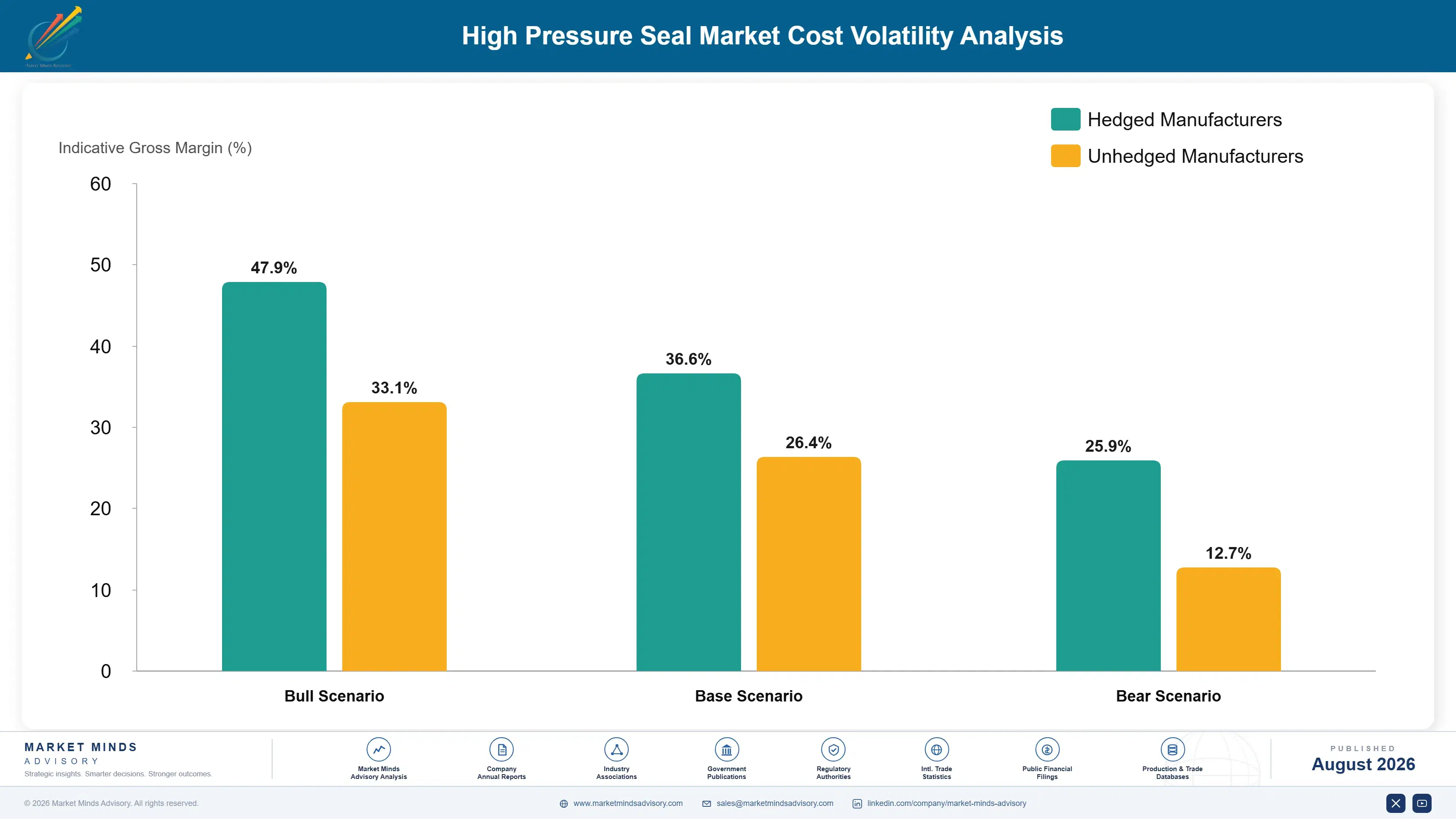
Polymer and elastomer compound accounts for roughly 38% of finished sealing component cost, and the range within that figure is enormous, from conventional nitrile to perfluoroelastomer compound near USD 940 per kilogram. Machining and finishing adds around 18%, moulding and curing energy about 12%, tooling amortisation 11%, testing and qualification 10%, and packaging and logistics the remaining 11% of delivered cost.
Fluoropolymer input costs and availability both moved sharply through the history. Fluorspar supply constraints and Chinese provincial power rationing during late 2021 tightened fluorochemical intermediates, and European industrial energy prices through 2022 reached levels the IEA documented as unprecedented for the sector. Daikin Industries Annual Report 2023 recorded fluoropolymer raw material and energy cost pressure, and Trelleborg Annual Report 2022 noted input cost recovery lagging across several product lines.

The competitive disadvantage mechanism runs through compound access and testing capability rather than through moulding efficiency. Suppliers without in-house compound development buy formulations from competitors or accept catalogue grades that may not suit the service. Those without qualification testing capability cannot enter subsea, semiconductor or hydrogen applications at all. Regional moulders typically carry both limitations, which confines them to conventional elastomer components where price is the only variable.
high-pressure-seal-market-trends-cost-volatility-analysis-1787310654320

Develop compound formulation capability in house

Buying catalogue compounds from suppliers who also compete downstream caps both the cost position and any ability to match a material properly to an unusual service condition. In-house compounding costs considerably less than most suppliers assume, and it is the foundation on which every qualification position in genuinely demanding applications eventually comes to rest.

Build qualification testing rather than outsourcing it

Rapid gas decompression, permeation and extended pressure cycling testing together decide which supplier can be specified into demanding service, and outsourcing that work slows development considerably while revealing it to competitors. The capital involved is genuinely modest measured against the value of even a single subsea or semiconductor qualification position won and then held.

Qualify alternative polymer chemistry ahead of restriction

Fluorinated polymers carry a third of sealing revenue and face restriction proposals with no ready substitute available. Beginning alternative polymer and metal sealing development now costs a fraction of what scrambling after an adverse ruling would, and the qualification cycles involved run to years rather than to months, which removes any option of waiting.

Portfolio Architecture for Margin Defence

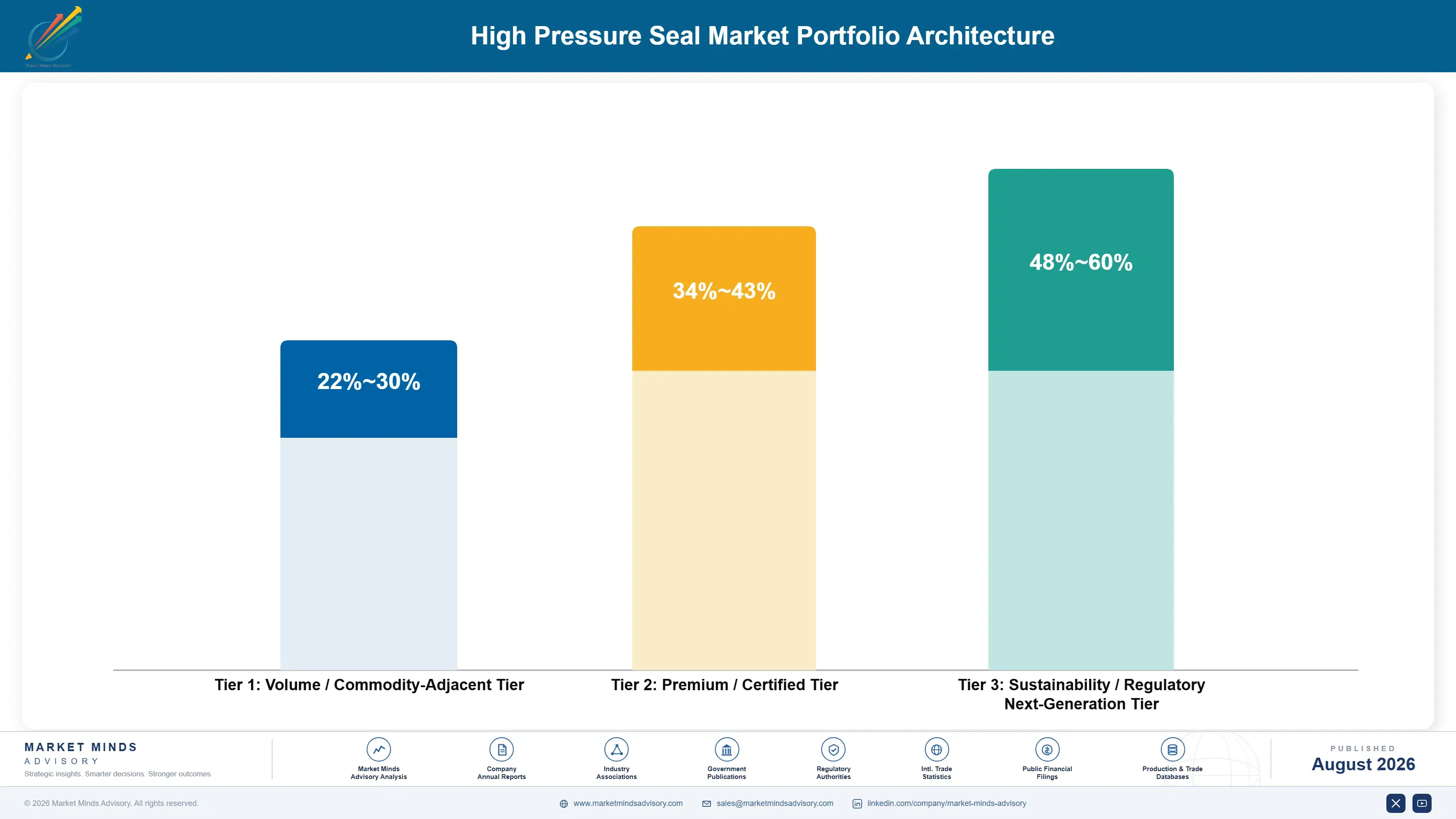
Margin architecture separates by qualification barrier rather than by material sophistication, which is not quite the same thing. Conventional elastomer seals for industrial hydraulics earn what regional moulding competition allows, regardless of how carefully they are made, because any competent moulder can supply an equivalent part against the same drawing. Value rises steeply where a component has been qualified into an equipment specification and where the service condition eliminates most a
The volume versus premium tension runs through the moulding shop. Conventional and mid-range elastomer components carry the volume that keeps presses loaded and distribution relationships worth maintaining, at prices that regional competition compresses continuously. Perfluoroelastomer, spring-energised and metal sealing earn several times better on far smaller volumes. Suppliers chasing hydraulic volume fund an engineering and testing organisation from margins that hydraulic distribution will never support.

High-value pools concentrate in three places. Perfluoroelastomer components command price because the applications specifying them have no adequate alternative at any cost. Subsea and semiconductor qualified positions earn on specification incumbency that lasts for an asset's life. And hydrogen service sealing earns on a qualification base that is thin now and will be closed within a few years.

Volume / Commodity-Adjacent Tier

Conventional elastomer seals and standard hydraulic sealing supplied against drawings through distribution, where any competent regional moulder can produce an equivalent component and where price alone decides the outcome every time.
Gross Margin: 22-30%

Premium / Certified Tier

Hydrogenated nitrile, fluoroelastomer and high-performance thermoplastic seals qualified for demanding pressure and chemical service. Material capability and application engineering defend pricing here. The nine-point range reflects catalogue against engineered application economics.
Gross Margin: 34-43%

Sustainability / Regulatory / Next-Generation Tier

Perfluoroelastomer, spring-energised and hydrogen-qualified sealing specified into subsea, semiconductor and hydrogen equipment. Qualification barriers and absent substitutes defend pricing strongly. Absent substitutes reinforce it. The twelve-point range reflects established against emerging qualification positions.
Gross Margin: 48-60%
high-pressure-seal-market-trends-portfolio-architecture-1787310654819

High-value Sub-segments and Strategic Watch-out

Perfluoroelastomer components for demanding service

High value and high growth together here, because semiconductor plasma chambers, aggressive chemical duty and hydrogen systems have no adequate alternative at any price. Compound cost near USD 940 per kilogram means the specification only ever gets written where the service condition genuinely demands it.
Gross Margin: 48-60%

Hydrogen service qualified sealing systems

Strong realised value on the fastest emerging growth, because roughly 1,400 committed projects need sealing qualified for permeation and decompression resistance and very few suppliers anywhere hold that qualification today. The window for entry closes permanently as project specifications settle over the next few years.
Gross Margin: 44-56%

Conventional hydraulic elastomer sealing

The volume core here, keeping moulding presses loaded and distribution relationships intact while earning whatever regional moulding competition permits against a drawing that almost anybody can make to. Necessary for basic manufacturing scale, but this tier will never fund qualification testing or serious compound development work.
Gross Margin: 22-30%

Fluoropolymer restriction exposure across the portfolio

The strategic watch-out, given that fluorinated chemistry carries fully 34% of sealing revenue and faces restriction proposals that no alternative material currently answers anywhere. Suppliers relying entirely on fluoroelastomer positions have concentrated their whole regulatory exposure precisely where their best margins happen to sit today.
Gross Margin: 30-58%

How Sealing Demand Actually Behaves

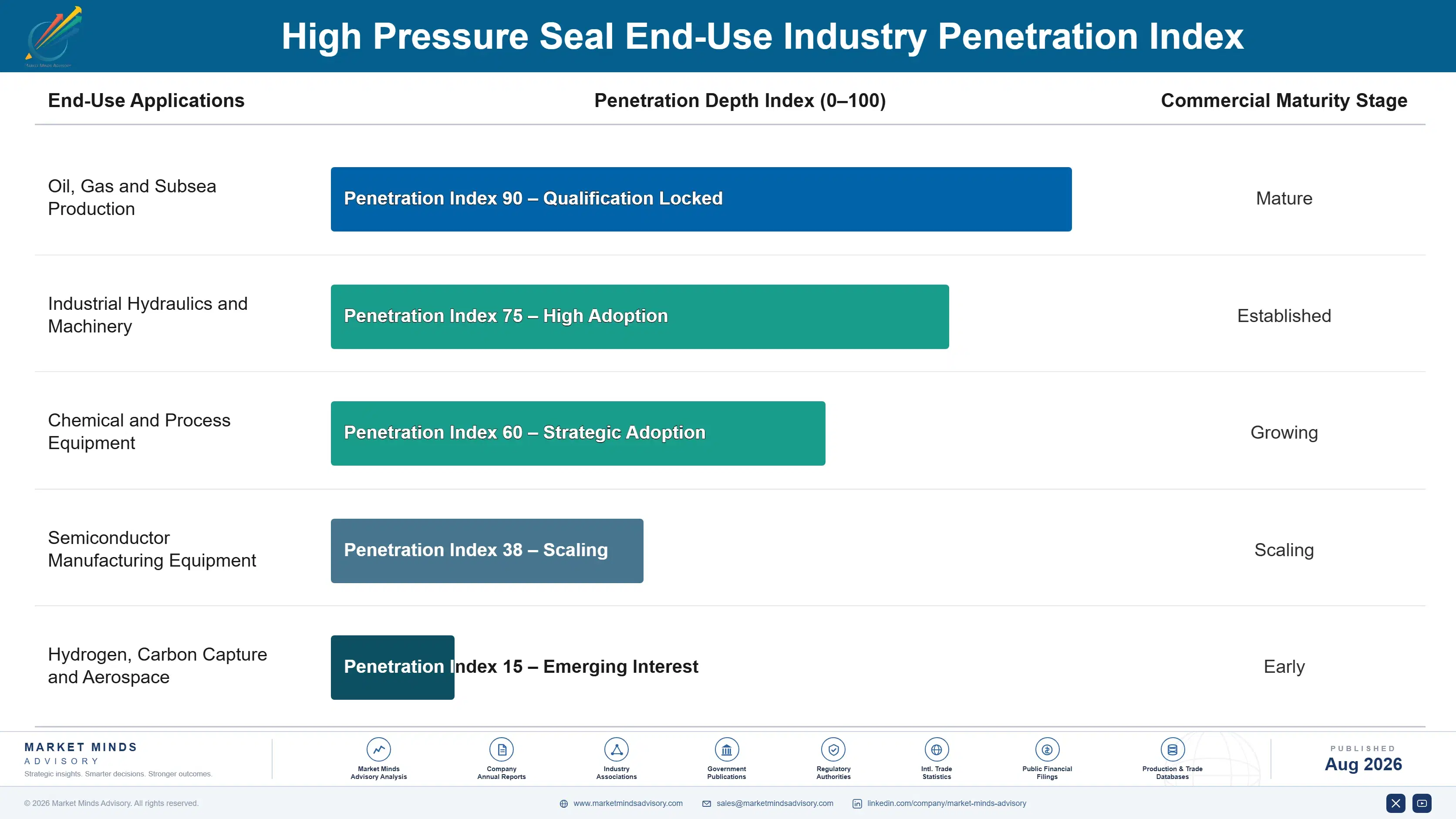
Demand is specification-locked with an unusually long tail. A seal designed into a piece of equipment is consumed at build, then replaced on maintenance intervals for the asset's entire operating life, which in energy equipment runs to decades. Roughly 61% of energy sealing revenue is that replacement stream, and the supplier named in the original specification captures most of it. Winning a design-in is slow and technical; holding the aftermarket costs little beyond availability.
Stickiness varies enormously with qualification burden. Conventional hydraulic sealing is loosest, bought against a drawing from whichever distributor quotes best, with nothing preventing substitution. Fluoroelastomer and thermoplastic components sit tighter, because material behaviour under a service condition takes time to demonstrate. Subsea and semiconductor sealing is stickiest of all, where qualification runs eighteen months and a substitution requires the equipment owner to accept technical risk nobody wants to sign for.

The buyer profile splits by application in a way that defeats single commercial models. Industrial hydraulic sealing is bought by procurement and distribution against price and availability. Subsea, semiconductor and hydrogen sealing is specified by equipment engineers evaluating qualification data long before commercial discussion begins, and reaching them requires technical people who discuss decompression damage credibly.
high-pressure-seal-market-trends-end-use-penetration-index-1787310655305

Where We Land On This

These are among the four positions where our research anticipates prominent divergence between winners and laggards over the coming forecast period. Each is grounded in the demand model, the regulatory perimeter, and the announced capacity pipeline.
01 / DOWNTIME VALUE SELLING

Sell avoided downtime rather than quoting against drawings

Sealing components represent 2% of installed equipment cost and cause 68% of hydraulic system failures, so a seal delivering twice the service life saves an operator many times what the entire sealing package cost originally. Suppliers modelling total cost from maintenance history, and then contracting against achieved service life, realise roughly 40% above competitors who simply quote against a drawing. The evidence needed already sits inside the operator's own failure records, and it is almost never analysed properly by anybody.
02 / ORIGINAL EQUIPMENT DESIGN-IN

Win the specification, then own the aftermarket for decades

Around 61% of energy sealing revenue is replacement business, and the component named in the original equipment specification captures the great majority of it across an asset life measured in decades. Suppliers engaging equipment designers during the development phase secure roughly 5 times the lifetime revenue per platform that aftermarket bidders ever manage to achieve. Subsea qualification runs a full eighteen months, which means the commercial engagement has to begin years before any purchase order exists anywhere in the process.
03 / HYDROGEN QUALIFICATION TIMING

Qualify hydrogen sealing before specifications close permanently

Roughly 1,400 hydrogen projects are under construction or committed, and the qualification base for hydrogen sealing remains thin because the application barely existed a decade ago anywhere. Suppliers completing decompression, permeation and embrittlement qualification now command roughly 55% above conventional gas service pricing, since project engineers currently have very few qualified options open to them. Testing capability costs less to establish than a moulding line, and the window closes permanently as qualified supplier lists get written down for a decade ahead.
04 / FLUOROPOLYMER RISK HEDGING

Develop alternatives before restriction removes the option

Fluorinated polymer chemistry carries 34% of high pressure sealing revenue and faces restriction proposals covering exactly the materials that make demanding sealing possible in the first place. Suppliers investing now in alternative polymer systems and metal sealing designs would hold roughly 3 times the addressable position of those relying wholly on fluoroelastomer chemistry under an adverse ruling. Nothing currently matches perfluoroelastomer across temperature and chemical resistance together, which is precisely why the development work cannot sensibly wait for the ruling itself.

Engagement Snapshot From the Field

A live engagement with an industry participant carrying material or product regulatory and market exposure ahead of a defining policy shift, showing how our research translates into a defensible multi-year portfolio strategy.
MARKET MINDS ADVISORY · CLIENT ENGAGEMENT SUMMARY
High Pressure Seal Producer Strategic Portfolio Review and Transition Roadmap 2026·Investment Scenario on High Pressure Seal Exposure Evaluation 2025-26
CLIENT PROFILE
An industrial sealing manufacturer operating moulding and machining capacity across Western Europe and South Asia, supplying hydraulic, process and energy sealing through distribution alongside a smaller engineered products business. Sealing revenue approached EUR 220 million annually (client-reported, unverified by MMA), roughly three quarters of it in conventional and mid-range elastomer components sold against customer drawings through distributors.
STRATEGIC CHALLENGE
Margins had eroded for four years and management attributed the decline to Asian moulding competition, responding with automation investment at both European sites. Energy and semiconductor opportunities were being lost without anybody establishing why. A proposed capacity expansion assumed distribution volume would recover once the cost position had improved sufficiently to compete.
MMA APPROACH
MMA interviewed forty-seven equipment manufacturers, maintenance engineers, offshore operators and distributors across six markets, reconstructing how sealing specifications are actually written and by whom. We separated aftermarket from original equipment revenue across the portfolio, benchmarked the client's qualification positions against competitors, and quantified downtime attributable to sealing at eleven customer sites.
KEY FINDINGS
  1. Every lost energy and semiconductor opportunity had required qualification testing the client could not perform, and in most cases the client had never been invited to quote at all.
  2. Downtime analysis at eleven customer sites showed sealing failures costing operators many multiples of the annual sealing spend, and no customer had ever been shown that calculation by anybody.
  3. The client bought all fluoroelastomer compound from suppliers who also competed downstream, which capped cost position and prevented matching material to unusual service conditions.
  4. Engineered products earned substantially better margins than drawing-quoted distribution business (client-reported, unverified by MMA) on under a quarter of volume, and received almost no commercial resource.
CLIENT PROFILE
An industrial sealing manufacturer operating moulding and machining capacity across Western Europe and South Asia, supplying hydraulic, process and energy sealing through distribution alongside a smaller engineered products business. Sealing revenue approached EUR 220 million annually (client-reported, unverified by MMA), roughly three quarters of it in conventional and mid-range elastomer components sold against customer drawings through distributors.
STRATEGIC CHALLENGE
Margins had eroded for four years and management attributed the decline to Asian moulding competition, responding with automation investment at both European sites. Energy and semiconductor opportunities were being lost without anybody establishing why. A proposed capacity expansion assumed distribution volume would recover once the cost position had improved sufficiently to compete.
MMA APPROACH
MMA interviewed forty-seven equipment manufacturers, maintenance engineers, offshore operators and distributors across six markets, reconstructing how sealing specifications are actually written and by whom. We separated aftermarket from original equipment revenue across the portfolio, benchmarked the client's qualification positions against competitors, and quantified downtime attributable to sealing at eleven customer sites.
KEY FINDINGS
  1. Every lost energy and semiconductor opportunity had required qualification testing the client could not perform, and in most cases the client had never been invited to quote at all.
  2. Downtime analysis at eleven customer sites showed sealing failures costing operators many multiples of the annual sealing spend, and no customer had ever been shown that calculation by anybody.
  3. The client bought all fluoroelastomer compound from suppliers who also competed downstream, which capped cost position and prevented matching material to unusual service conditions.
  4. Engineered products earned substantially better margins than drawing-quoted distribution business (client-reported, unverified by MMA) on under a quarter of volume, and received almost no commercial resource.
RECOMMENDED STRATEGY
Phase 1: Phase 1 (0 to 9 months): Halt the capacity expansion and build qualification testing capability covering decompression, permeation and pressure cycling. Phase 2: Phase 2 (9 to 24 months): Develop in-house compound formulation and rebuild commercial coverage around equipment designers rather than distributors. Phase 3: Phase 3 (24 to 42 months): Pursue hydrogen service qualification deliberately, and begin alternative polymer development against fluoropolymer restriction risk.
OUTCOME
The client deferred roughly EUR 30 million of automation capital (client-reported, unverified by MMA) and built qualification testing capability for a fraction of that. Two hydrogen equipment qualifications opened within eighteen months, in-house compounding began at the European site, and the first downtime-based commercial proposal was accepted at a premium.

Frequently Asked Questions

Foundational context covering the market sizes, CAGR, scope, country, region and competition that inform every finding below. This section is provided to cover basics and most often pre-purchase conversations, answered from the MMA Primary Research Dataset.

What is the current size of the High Pressure Seal Market?

The market reached USD 4.6 billion in 2025, measured as component revenue at realised delivered price. Replacement demand accounts for the majority of energy sealing consumption across the installed base.

How large will the High Pressure Seal Market be by 2036?

MMA forecasts USD 9.48 billion by 2036, an expansion of 1.93 times the 2026 level. Incremental value across the forecast period reaches USD 4.57 billion.

What is the CAGR for the High Pressure Seal Market 2026 to 2036?

The base case compound annual growth rate is 6.8%, with a bull case of 8.1% and a bear case of 5.6%. Hydrogen infrastructure pace and fluoropolymer restriction separate those scenarios.

Which segment is growing fastest?

Perfluoroelastomer seals grow fastest at 10.2%, exactly 1.50 times the overall market rate. Semiconductor plasma chambers and hydrogen systems have no adequate alternative material available.

Who are the major companies in the High Pressure Seal Market?

Trelleborg Sealing Solutions, Freudenberg Sealing Technologies, Parker Hannifin, SKF and John Crane lead, holding 42% of sealing revenue between them. Qualification breadth rather than moulding scale explains those positions.

Which country is growing fastest?

India grows fastest at 9.4%, driven by industrial machinery, hydraulics and process equipment manufacture expanding rapidly alongside semiconductor assembly investment. Highest specification materials remain substantially imported.

Report Segmentation Architecture

The full report scope spans multiple orthogonal segmentation dimensions, with cross-tabulated demand data provided for each dimension pair. Coverage extends further to regional breakdowns, trend trajectories, and the competitive detail needed to support segment-level decision-making.

By Seal Material and Construction Class

  • Perfluoroelastomer Seals
  • Spring-Energised PTFE and Polymer Seals
  • High-Performance Thermoplastic Seals
  • Metal and Metal-to-Metal Seals
  • Hydrogenated Nitrile and Fluoroelastomer Seals
  • Conventional Elastomer Seals

By End-Use Industry

  • Oil, Gas and Subsea Production
  • Industrial Hydraulics and Machinery
  • Chemical and Process Equipment
  • Semiconductor Manufacturing Equipment
  • Hydrogen, Carbon Capture and Aerospace

By Customer Type and Channel

  • Original Equipment Manufacturers
  • Energy Operators and Asset Owners
  • Maintenance and Service Contractors
  • Industrial Distributors
  • Engineering and Project Contractors

By Region

  • North America
  • Western Europe
  • East Asia
  • South Asia and Pacific
  • Latin America
  • Middle East and Africa
  • Eastern Europe

Scope, Methodology, and Coverage

Every figure in this report is reproducible from documented input assumptions. The scope below maps the historical period, the forecast horizon, the segmentation dimensions, and the countries covered, alongside the underlying primary and qualitative methodology.
Historical Period
2020 to 2025
Forecast Period
2026 to 2036
Base Year
2025 (USD billions; MMA Primary Research Dataset, August 2026)
Market Definition
The market comprises sealing components engineered for high pressure service, spanning perfluoroelastomer seals, spring-energised polytetrafluoroethylene and polymer seals, high-performance thermoplastic seals, metal and metal-to-metal seals, hydrogenated nitrile and fluoroelastomer seals, and conventional elastomer seals rated for elevated pressure duty. Sizing captures component revenue at realised delivered price across oil, gas and subsea production, industrial hydraulics and machinery, chemical and process equipment, semiconductor manufacturing tools, hydrogen and carbon capture systems, and aerospace applications, covering both original equipment supply and replacement consumption. Low pressure gaskets and static flange sealing, mechanical seal assemblies for rotating pumps, sealing compounds and adhesives, and the equipment into which seals are installed fall outside scope.
Quantitative Units
USD billions (current prices); sealing components supplied annually in millions of units; USD per component at realised delivered price
Segmentation Dimensions
By Seal Material and Construction Class; By End-Use Industry; By Customer Type and Channel; By Region
Regions Covered
North America, Western Europe, East Asia, South Asia and Pacific, Latin America, Middle East and Africa, Eastern Europe
Countries Covered
USA, Canada, Mexico, UK, Norway, Germany, France, Italy, Sweden, Netherlands, Switzerland, Poland, Czech Republic, Slovakia, Turkey, China, Japan, South Korea, Taiwan, India, Singapore, Malaysia, Indonesia, Vietnam, Australia, Brazil, Argentina, Saudi Arabia, UAE, Qatar, Nigeria, Angola, South Africa, and additional markets relevant to this sector
Key Companies Profiled
Trelleborg Sealing Solutions, Freudenberg Sealing Technologies, Parker Hannifin, SKF, John Crane, Saint-Gobain, Greene Tweed, James Walker, IDEX Corporation, NOK Corporation, EnPro Industries, A.W. Chesterton, Datwyler, Bal Seal Engineering, Hallite Seals, ERIKS, Daikin Industries, DuPont, Syensqo, AGC.
Quantitative Methodology
Primary survey, n=3,800 respondents, Q4 2025, six countries; demand-side model with trade association cross-validation
Qualitative Methodology
47 expert interviews, Q4 2025; applied to validate demand model assumptions, identify emerging dynamics, and assess competitive positioning
Report Format
PDF and XLSX data workbook (Word format preview document)
Publisher
Market Minds Advisory
Report Code
MMA-2026-CON-529
Published
August 2026
Contact
sales@marketmindsadvisory.com | www.marketmindsadvisory.com

Purchase the full High Pressure Seal Market Report (2026 to 2036).

The full report sizes the high pressure seal market across six material and construction classes, five end-use industries, five customer channels and seven regions, with annual forecasts to 2036 in revenue and components supplied. It quantifies downtime attributable to sealing failures across representative equipment types, which is the analysis that establishes what better sealing is genuinely worth to an operator. Twenty participants are assessed on a consistent sealing revenue basis, with qualification positions mapped separately from moulding capacity. Fluoropolymer restriction exposure is quantified material class by material class across every supplier.
Six material and construction classes sized and forecast annually
Downtime attributable to sealing quantified by equipment type
Twenty participants on consistent sealing revenue basis
Qualification positions mapped separately from moulding capacity
Fluoropolymer restriction exposure quantified by material class
Hydrogen service qualification tracked supplier by supplier

Built For The People Who Decide

From boardroom strategy to bench-side execution, this report is read cover-to-cover by leaders shaping the next decade of their industry, turning demand scenarios, market dynamics and valuation benchmarks into decisions.
CXOs/ Presidents/ VPs/ Managers
M&A and Corporate Development
Strategy Teams and R&D Heads
Procurement and Product Directors
Regulatory and Compliance Leaders
Investor Relations and Equity Analysts