Market Minds Advisory
High-Pressure Pumps Market

High-Pressure Pumps Market: Desalination and Hydrogen Infrastructure Reshape a Mature Equipment Category

Desalination expansion and hydrogen refueling networks are pulling pump manufacturers away from legacy oil and gas order books, forcing capacity and engineering investment toward duty cycles nobody budgeted for five years ago.

Lead Analyst

David Horsley

Published

August 2026

Make Smarter Decisions with Customized Research Insights

Request a free sample report and evaluate market opportunities, growth trends, and competitive dynamics relevant to your business needs.

2025 MARKET VALUE$8.6BMarket Size 2025
2036 FORECAST VALUE$17.7BBase Case , 2026 to 2036
CAGR 2026 TO 20366.8 %Bull 8.0% / Bear 5.6%
INCREMENTAL OPPORTUNITY$8.6BNet 10- year value creation
EXPANSION MULTIPLE1.93x2036 value over 2026 base
Strategic Levers
M&A Pipeline
Regional Outlook
Country Rankings
Competitive Intelligence
Segmental Deep-dive
Call-Us : 91 93563 13602

Executive Snapshot and Market Trajectory

High-pressure pump demand is decoupling from its historical oil and gas anchor as desalination and hydrogen refueling infrastructure absorb a rapidly growing share of new orders, a shift manufacturers are still restructuring engineering and qualification teams around even now, mid-cycle, faster than most planned for.
Reverse osmosis desalination pumps are pulling capital investment toward the Middle East and East Asia fastest, where national water security programs are commissioning plants at a pace that outstrips supplier lead times. Reciprocating and centrifugal multistage designs still anchor the largest installed base across oil and gas well intervention and municipal water utilities, but hydrogen refueling compression duty is now the category commanding the steepest engineering premium.
Five manufacturers hold under half the market on a revenue basis, leaving meaningful share open to specialists who qualify fastest against API 674 and API 675 standards. Regulatory pressure on aging municipal infrastructure and a technology transition toward higher-pressure hydrogen compression are both reshaping which suppliers win the next generation of long-cycle contracts across the largest and most demanding end markets.
Market Definition
The market comprises pumps engineered to generate discharge pressures above the conventional centrifugal range, including reciprocating plunger pumps, multistage centrifugal pumps, diaphragm pumps, and rotary screw pumps used in oil and gas, desalination, hydrogen refueling, municipal water, and industrial cleaning applications. It excludes low-pressure circulation pumps and pump accessories such as seals and couplings sold separately.
Base Year Value
$8.6B in 2025 (MMA Primary Research Dataset, August 2026)
Forecast Period
2026 to 2036, eleven discrete annual values
CAGR
6.8% base case. Bull 8.0%. Bear 5.6%.
Fastest Growth Segment
Hydrogen Refueling Compression Pumps: 14.5% CAGR
Fastest Growth Country
Saudi Arabia: 10.8% CAGR
Fastest Growth Region
South Asia and Pacific: 8.9% CAGR
Largest Region
East Asia: 29% of 2025 global value
Market Leaders
Flowserve, KSB, Sulzer, Grundfos, Xylem. Source: MMA Analysis based on company annual reports.
Primary Survey
n=3,800 procurement and R&D decision-makers, Q4 2025, six countries
Methodology
Demand-side build-up, cross-validated against public data, 47 expert interviews

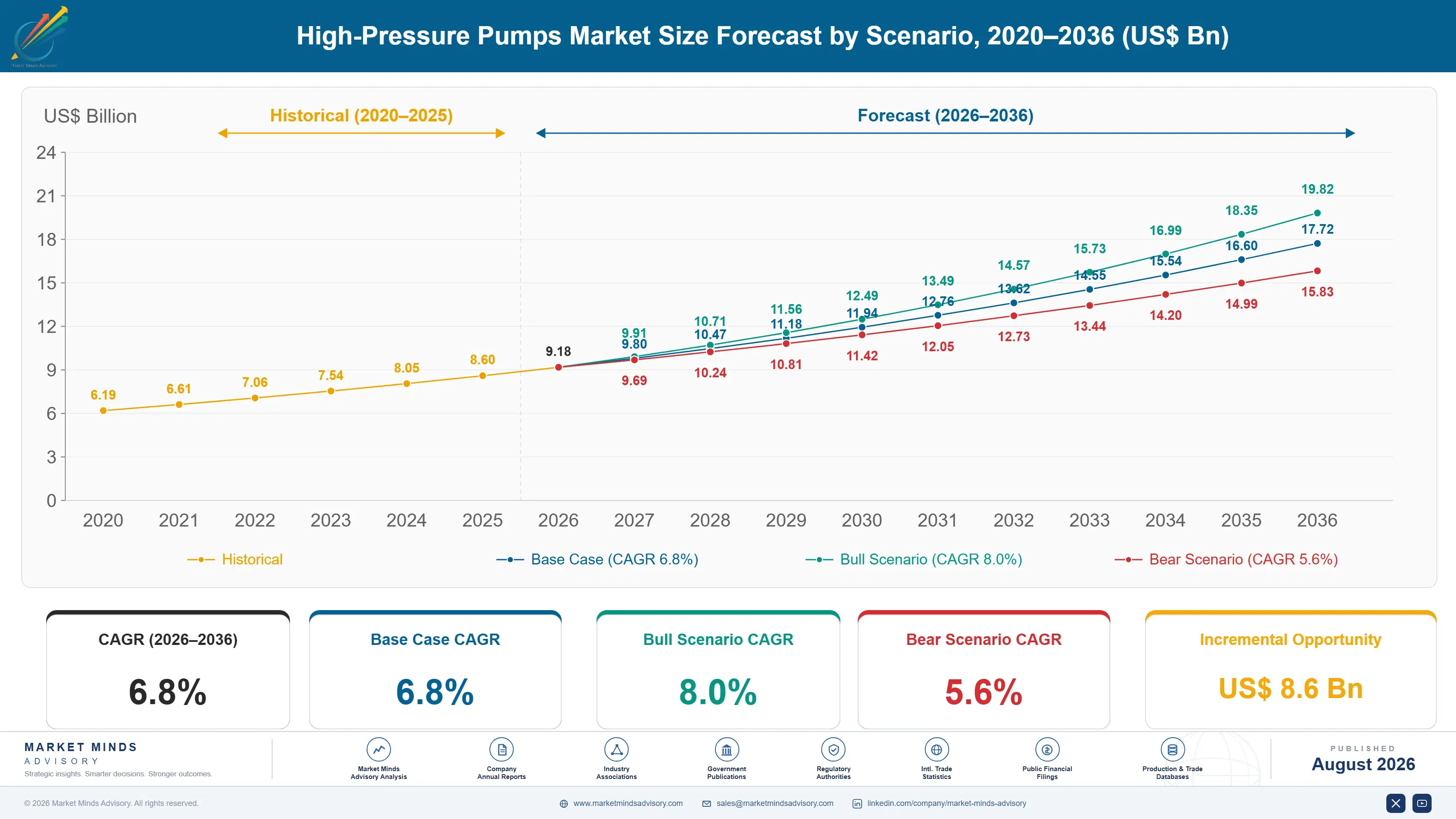
High-Pressure Pumps Market Forecast Scenarios

high-pressure-pumps-market-size-forecast-scenario-1787300101911
Between 2020 and 2025 the market grew at a historical pace of 5.8 percent as oil and gas capital spending recovered unevenly from the pandemic downturn while early desalination and hydrogen pilot orders began building a new demand base that suppliers had not previously planned capacity around at meaningful scale, setting up a broader foundation for the coming decade's growth.
The base case rests on three commercial mechanisms holding together over the decade: sustained desalination plant commissioning across the Middle East and East Asia funded by national water security programs, expanding hydrogen refueling station buildout requiring specialized high-pressure compression pumps qualified to new safety standards, and steady municipal water infrastructure replacement spending in North America and Western Europe tied to aging asset bases nearing the end of their originally designed service life.
A bull scenario hinges on hydrogen refueling networks scaling faster than current government targets suggest, pulling forward compression pump orders years ahead of schedule. The bear case centers on a prolonged oil and gas capital spending slowdown that removes the largest single application from supplier order books faster than desalination and hydrogen demand can offset the resulting revenue gap.

Duty-Cycle Diversification Across a Maturing Equipment Base

Three forces are converging on this equipment category at once: a maturing oil and gas order book that still anchors the largest installed base, a fast-scaling desalination buildout concentrated in water-stressed regions, and an emerging hydrogen refueling duty cycle that demands pressures and materials specifications no legacy pump platform was originally engineered to handle.
MARKET CONCENTRATIONCR5 42%top five manufacturers hold under half of total revenue
AVERAGE UNIT PRICE$48,000/unitblended average selling price across all pump classes
LEADING PRODUCING COUNTRYChina, 26% sharelargest single-country manufacturing base by total production volume
DESALINATION ORDER SHARE19% of revenueproportion of category revenue tied to reverse osmosis plants
REPLACEMENT CYCLE LENGTH12 to 15 yearstypical service life before major overhaul or replacement
FORGED STEEL INPUT SHARE34% of COGSalloy steel and casting cost proportion of goods sold
Commercially, the market increasingly splits along application lines rather than pure product-class lines. Oil and gas buyers still purchase largely on total lifecycle cost and long-standing supplier relationships, while desalination and hydrogen buyers evaluate suppliers more on qualification speed against new technical standards and delivered engineering support than on installed base or brand history alone.
Over the next decade, qualification speed against evolving technical standards will matter as much as raw manufacturing capacity. Suppliers who move fastest through API 675 hydrogen-compatible certification and desalination-specific corrosion testing will capture a disproportionate share of the newest order categories before the broader supplier base catches up to matching specifications.
"Everyone still talks about this as an oil and gas category because that's where the revenue history lives. It isn't anymore. The order book five years from now looks like a water and hydrogen business wearing an old label."
Director, Industrial Equipment Practice · MMA Construction and Industrial Equipm

Market Trends

Desalination Capacity Buildout Accelerates RO Pump Orders

Saudi Arabia's Saline Water Conversion Corporation and the broader Gulf Cooperation Council desalination pipeline are commissioning reverse osmosis capacity at a pace that has outstripped supplier lead times for high-pressure energy recovery and feed pumps across the past two procurement cycles. China's coastal desalination buildout is expanding in parallel, driven by regional water stress in its northern industrial provinces. Combined, these two programs account for a growing share of global RO pump order value, and suppliers report backlog extending eighteen to twenty-four months on the largest multistage centrifugal units specified for these plants, a lead time considerably longer than the category average.
Market Impact: Directs over $50B toward replacement
Hydrogen Refueling Networks Require New Pump Classes

Government-backed hydrogen refueling station rollouts across Germany, Japan, South Korea, and California require compression pumps capable of sustained duty at pressures well above traditional industrial specifications, a technical requirement few legacy platforms meet without redesign. More than 1,200 hydrogen refueling stations are now operating or under construction globally, each requiring dedicated high-pressure compression equipment engineered specifically for hydrogen's unique material compatibility demands. Manufacturers that have already qualified platforms against API 675 hydrogen-compatible standards are winning a disproportionate share of these early contracts, while competitors still validating designs are missing the current wave of station buildout entirely.
Market Impact: Lifts electric-drive share to 40%

Market Opportunities and Growth Drivers

Aging Municipal Water Infrastructure Spurs Replacement Demand

The United States Bipartisan Infrastructure Law allocated tens of billions of dollars toward water system modernization, a meaningful share of which flows into pump replacement at municipal treatment and distribution facilities operating well past their designed service life. Similar renewal programs are underway across Western Europe, where several national water agencies have flagged aging pump fleets as a priority capital replacement category over the current planning cycle. Municipal buyers increasingly specify higher-efficiency multistage designs during replacement rather than like-for-like swaps, which is lifting average selling prices even where unit volume growth remains modest across most developed markets tracked in this report.
Market Impact: Swings input costs over 20% annually

Well Intervention Activity Sustains Reciprocating Pump Orders

Global well intervention and hydraulic fracturing activity, while below its prior peak, remains a durable order source for reciprocating plunger pumps rated for the highest pressure classes in the category. Operators are increasingly favoring higher-horsepower, electric-drive units over legacy diesel-powered fleets, a transition that is lifting average unit value even as total rig counts stay roughly flat across the major North American and Middle Eastern basins. Roughly 40 percent of new reciprocating pump orders in North America now specify electric drive configurations, up sharply from a small minority just several years earlier, reshaping supplier product roadmaps industry-wide.
Market Impact: Extends supplier switching cycles 18 months

Market Restraints and Challenges

Alloy Steel Cost Volatility Squeezes Manufacturing Margins

High-pressure pump castings and forgings rely heavily on specialty alloy steels and nickel-based materials whose prices have swung sharply over the past several years on global supply disruptions and tariff actions affecting major producing regions. The root cause is a concentrated global forging and casting supplier base that cannot flex capacity quickly when demand spikes across multiple end markets at once. The commercial impact shows up directly in quoted lead times and periodic price surcharges passed to customers mid-contract. Manufacturers are mitigating exposure through longer-term alloy supply agreements and, in several cases, backward integration into captive casting capacity to insulate margins.
Market Impact: Adds 19% of category revenue

Lengthy Qualification Cycles Slow New Entrant Penetration

Oil and gas and desalination buyers require extensive qualification testing against API 674, API 675, and plant-specific corrosion and material standards before approving a new pump supplier, a process that commonly takes eighteen months to complete. The root cause is the extremely high cost of unplanned downtime in these applications, which makes buyers deeply conservative about switching suppliers even when a new entrant offers a meaningfully lower price. The commercial impact is that incumbent suppliers retain pricing power on qualified platforms well beyond what pure product competitiveness would otherwise support. Newer entrants are mitigating this by targeting less regulated municipal applications first to build a track record.
Market Impact: Serves over 1,200 refueling stations globally
3 additional market trends, 4 additional growth drivers, and 2 additional restraints and challenges are covered in the full report. Contact sales@marketmindsadvisory.com to access the complete intelligence.

Segment CAGR and Growth Architecture

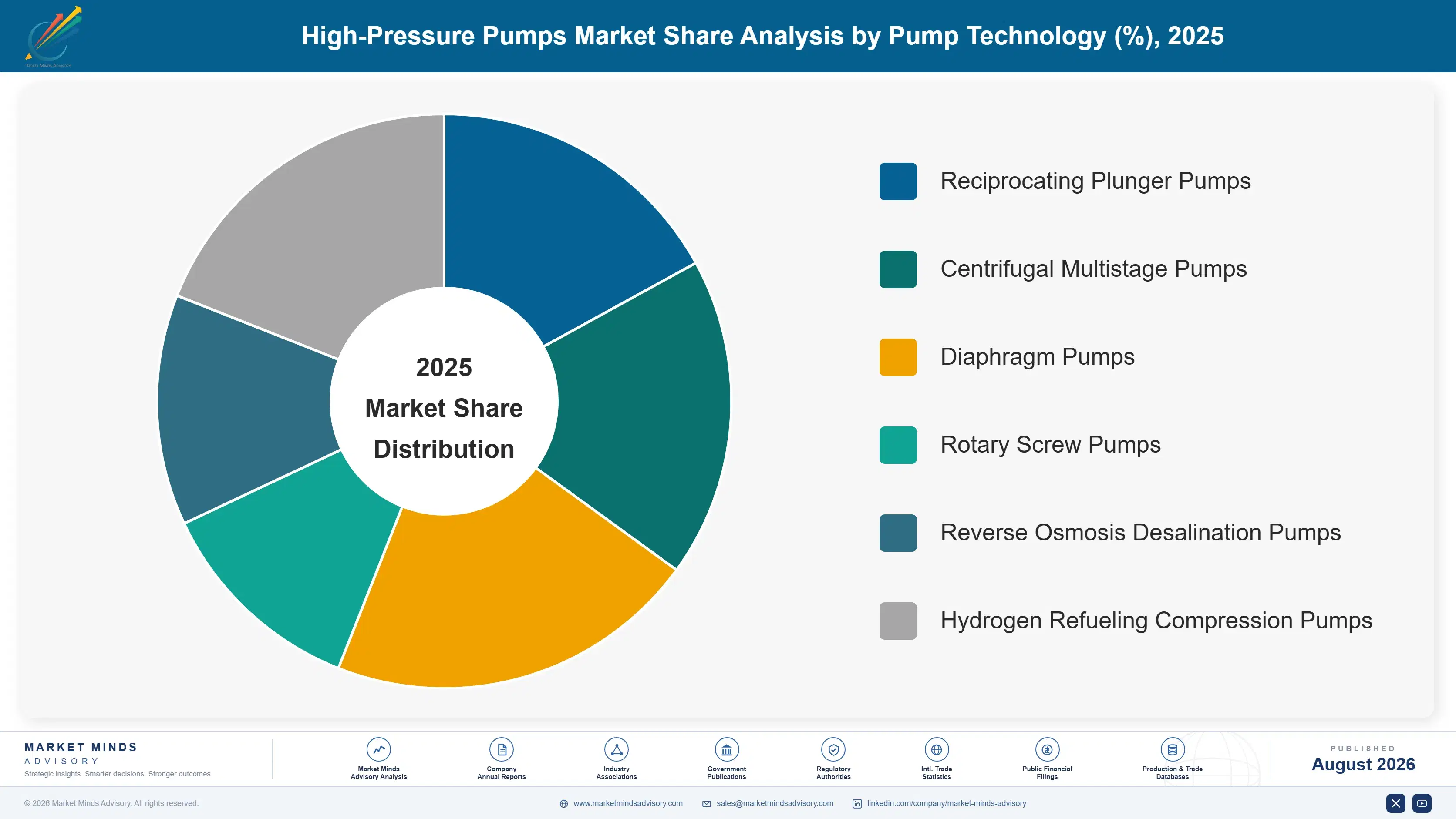
Segmentation follows pump technology and product type, the dimension buyers and engineering specifiers use to select equipment for a given duty cycle across this market. Hydrogen refueling compression pumps are treated as a distinct category given their unique material and pressure specifications relative to conventional industrial duty classes and requirements.
high-pressure-pumps-market-market-share-analysis-1787300102599

Hydrogen Refueling Compression Pumps

This is the newest and fastest-growing product category, purpose-built to move gaseous or liquid hydrogen at the extreme pressures refueling stations require, often well above what conventional industrial pump platforms are rated to handle safely. Demand is concentrated in Germany, Japan, South Korea, and California, where government-backed rollouts underwrite most current order volume rather than pure commercial demand. Manufacturers are racing to qualify designs against API 675 hydrogen-compatible material standards, since compatibility failures carry safety consequences far more severe than a conventional pump fault. Growth is currently constrained more by station buildout pace than by supplier manufacturing capacity, though that balance should shift as more manufacturers complete qualification.
CAGR 14.5%

Reverse Osmosis Desalination Pumps

High-pressure feed and energy recovery pumps used in reverse osmosis desalination plants form the second-fastest-growing category, tracking national water security investment far more closely than general industrial capital spending cycles. The Middle East, led by Saudi Arabia and the United Arab Emirates, remains the largest demand center, though China's coastal desalination buildout is expanding the addressable market meaningfully beyond its traditional geographic base. These pumps require specialized corrosion-resistant materials to withstand continuous seawater exposure, which keeps average selling prices well above conventional multistage centrifugal units used in less corrosive applications. Suppliers with proven long-duty-cycle reliability data at existing large-scale plants hold a durable qualification advantage over newer entrants still building that operating track record with major utility customers.
CAGR 9.5%
Full segment breakdown across 6 segments available in the complete report.

Regional Architecture and Country Demand Map

East Asia leads on manufacturing scale and expanding desalination demand, the Middle East and Africa punch well above their revenue share on desalination intensity alone, and North America anchors the largest combined oil and gas and municipal replacement order base globally.

North America

Oil and gas well intervention activity across the Permian and Bakken basins remains the single largest demand source for reciprocating plunger pumps in the region, even as operators shift toward higher-value electric-drive units that lift average selling prices per order. The United States Bipartisan Infrastructure Law is directing substantial municipal water funding toward aging pump fleet replacement across hundreds of utilities nationwide, a multi-year program still in its early disbursement phase. Canada's oil sands and mining sector sustains a steady base of heavy-duty slurry and high-pressure process pump demand. California's hydrogen refueling station rollout, though modest in absolute unit count today, commands outsized supplier attention given its role as an early qualification proving ground for compression pump platforms.
Share: 24% | CAGR: 6.2% (2026 to 2036)

Western Europe

Germany's hydrogen refueling infrastructure buildout is the most advanced in the region, anchoring early compression pump demand tied directly to national hydrogen strategy targets set by the federal government several years ago. The United Kingdom and France are both running multi-year municipal water infrastructure renewal programs that specify higher-efficiency multistage pumps during fleet replacement rather than simple like-for-like equipment swaps at end of life. Norway's offshore oil and gas sector sustains steady demand for high-pressure injection pumps used in enhanced recovery operations across its continental shelf fields. Regional manufacturers headquartered in Germany and Switzerland continue to command a premium engineering reputation that supports pricing well above the broader category average across most application segments served.
Share: 19% | CAGR: 5.3% (2026 to 2036)
Regional intelligence for 5 additional markets available in the complete report: East Asia, South Asia and Pacific, Latin America, Middle East and Africa, Eastern Europe. Contact sales@marketmindsadvisory.com.
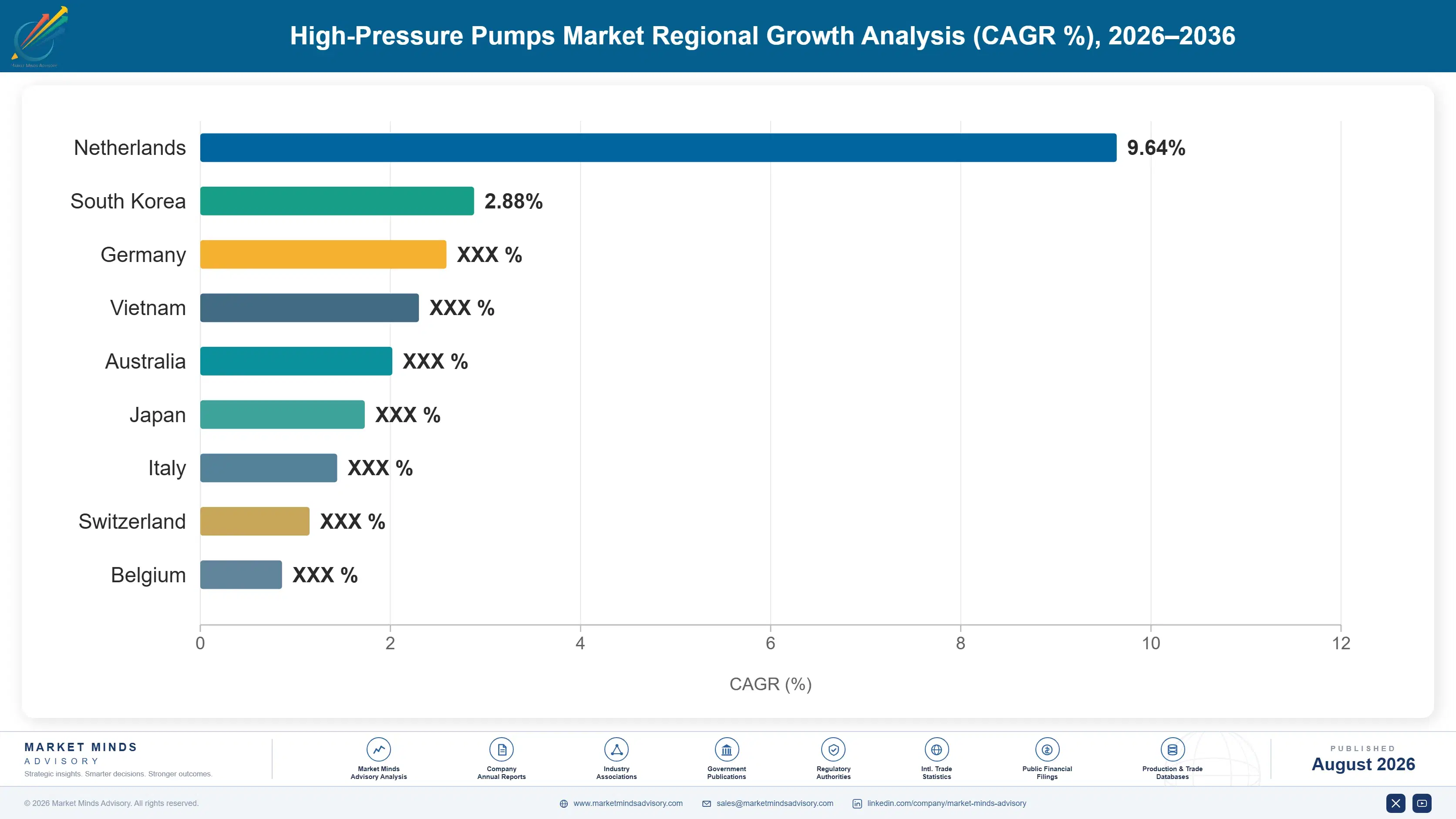
high-pressure-pumps-market-country-cagr-analysis-1787300103129

Where Suppliers Can Defend Pricing Power

As oil and gas order growth flattens, suppliers are shifting commercial strategy toward faster qualification against hydrogen and desalination standards, deeper service contract attachment, and electrification of legacy product lines to defend margin across the category over the coming decade.

Accelerate Hydrogen Standard Qualification Across Lines

Manufacturers who complete API 675 hydrogen-compatible qualification ahead of competitors are winning a disproportionate share of early refueling station contracts, since station developers strongly prefer already-qualified platforms over unproven designs given the safety stakes involved. Suppliers that invested early in dedicated hydrogen testing infrastructure have cut qualification timelines by roughly nine months relative to competitors starting from scratch on each new customer program. This early-mover advantage compounds because reference installations at operating stations become the qualification evidence needed to win the next round of contracts, creating a widening gap between early qualifiers and late entrants still validating designs.
Market Impact: Cuts qualification timelines by roughly 9 months industry-wide

Attach Long-Term Service Contracts to Equipment Sales

Desalination and hydrogen refueling operators increasingly prefer bundled equipment-plus-maintenance contracts that guarantee uptime over the equipment's operating life, shifting revenue from a single capital sale toward a recurring service relationship worth considerably more over time. Suppliers offering multi-year service agreements report attach rates now exceeding 55 percent on new desalination pump orders, up meaningfully from a smaller share just several years ago. This lever converts a cyclical capital equipment business into a partially recurring revenue stream, which is increasingly how investors and lenders are valuing the leading suppliers in this category.
Market Impact: Lifts service attach rate above 55 percent

Electrify Legacy Reciprocating Pump Platforms Fleetwide

Oil and gas operators are shifting well intervention fleets from diesel-powered to electric-drive reciprocating pumps at a pace that is reshaping supplier product roadmaps across the category, driven by both emissions regulation and meaningfully lower operating costs per pumped barrel. Suppliers offering electric-drive platforms are commanding roughly 15 to 20 percent price premiums over comparable diesel units, reflecting both the higher component cost and the operating savings customers capture over the equipment's service life. Manufacturers still reliant on diesel-only product lines risk losing share as operators standardize procurement specifications around electric-drive requirements across their fleets.
Market Impact: Commands a 15 to 20 percent price premium

Build Regional Manufacturing Inside the Gulf States

Establishing local manufacturing or final assembly capacity inside Saudi Arabia and the United Arab Emirates qualifies suppliers for preferential local-content procurement rules tied to national industrialization programs, an increasingly important qualification criterion for the region's largest desalination and hydrogen tenders. Suppliers with Gulf-based manufacturing presence have won meaningfully higher shares, sometimes over 60 percent, of recent giga-project tenders versus import-only competitors bidding the same specifications. This lever requires significant upfront capital commitment but converts into a durable procurement advantage on the fastest-growing demand pool in the entire market over the coming decade ahead.
Market Impact: Wins over 60 percent of giga-project tenders

Who Controls the Margin Pool

The top five manufacturers hold roughly 42 percent of revenue on a company-revenue basis, a meaningfully more fragmented structure than most mature industrial equipment categories, reflecting how many regional and application specialists still compete successfully for share. The gap between the leading players and the broader field is narrower here than in most comparable categories, with Flowserve and Sulzer holding the largest but far from dominant positions across the combined product range.
Current competitive activity centers on three fronts: qualification races against new hydrogen and desalination technical standards, service contract attachment strategies designed to build recurring revenue, and regional manufacturing investment inside the Gulf states to capture local-content procurement preference on the largest current tenders.

Pressure is building from Asian manufacturers, particularly in China and South Korea, who are investing aggressively in premium engineered platforms that historically only Western specialists could supply reliably. Several have already won reference installations at major desalination plants, evidence that could accelerate their move into higher-margin segments faster than incumbents currently expect across the remainder of the forecast period.
high-pressure-pumps-market-company-positioning-matrix-1787300103654

Competitive Moat and Risk Dimensions

FLOWSERVE CORPORATION

Moat: Broadest Qualified Product Range

Flowserve holds qualified platforms across nearly every major application segment in this market, from oil and gas reciprocating pumps to desalination multistage units, giving it a breadth of reference installations that smaller specialists cannot match across as many end markets or geographies simultaneously.
FLOWSERVE CORPORATION

Risk: Slower Hydrogen Platform Rollout

Flowserve has been slower than several specialist competitors to complete API 675 hydrogen-compatible qualification on its compression pump platforms, risking meaningful share loss in the fastest-growing segment of the market to faster-moving rivals during this critical early-adoption window across major economies.
SULZER LTD

Moat: Desalination Engineering Reputation

Sulzer's decades of reference installations at large-scale Middle Eastern desalination plants give it a qualification advantage that newer entrants, including well-funded Asian competitors, still need years of comparable operating data to credibly match against incumbent reliability records at similar plant scale.
SULZER LTD

Risk: High Exposure To Gulf Concentration

A large share of Sulzer's desalination pump revenue concentrates in a small number of Gulf state mega-projects, meaning any delay or cancellation among a handful of large customers could disproportionately affect near-term order intake relative to more geographically diversified competitors elsewhere in the market.

Players Tracked

Prominent Players

Flowserve Corporation
KSB SE & Co. KGaA
Sulzer Ltd
Grundfos Holding A/S
Xylem Inc.

Other Key Players

Weir Group PLC
Ebara Corporation
Wilo SE
IDEX Corporation
ITT Inc.
CIRCOR International
Danfoss A/S
Ingersoll Rand Inc.
National Oilwell Varco Inc.
Cat Pumps Corporation
Hammelmann GmbH
Speck Pumpen
Torishima Pump Mfg. Co., Ltd.
SPX FLOW Inc.
PSG Dover

Recent Developments

APRIL 2025

Flowserve Completes Acquisition of Specialty Hydrogen Pump Manufacturer

Flowserve completed the acquisition of a specialty compression pump manufacturer with existing API 675 hydrogen-compatible qualified platforms, adding immediate reference installations and engineering talent rather than building hydrogen capability organically from scratch over several additional years of development work.
Signal: Incumbents are increasingly choosing acquisition over slower organic development to close the hydrogen qualification gap faster.
OCTOBER 2025

KSB Signs Multi-Year Supply Agreement for Gulf Desalination Program

KSB signed a multi-year supply agreement, not an acquisition or joint venture, to provide high-pressure feed pumps for a major Saudi Arabian desalination expansion program, securing several years of committed order volume ahead of the plant's phased commissioning schedule across multiple sites.
Signal: Long-term supply agreements are becoming the preferred deal structure for securing giga-project order visibility years ahead.
FEBRUARY 2026

Sulzer Opens New Manufacturing Facility in India

Sulzer opened a new organic manufacturing facility in western India dedicated to multistage centrifugal pump production, expanding regional capacity to serve India's growing refining and petrochemical sector without relying entirely on imports from its existing European manufacturing facilities.
Signal: Manufacturers are localizing production capacity in South Asia ahead of anticipated refining capacity expansion there.

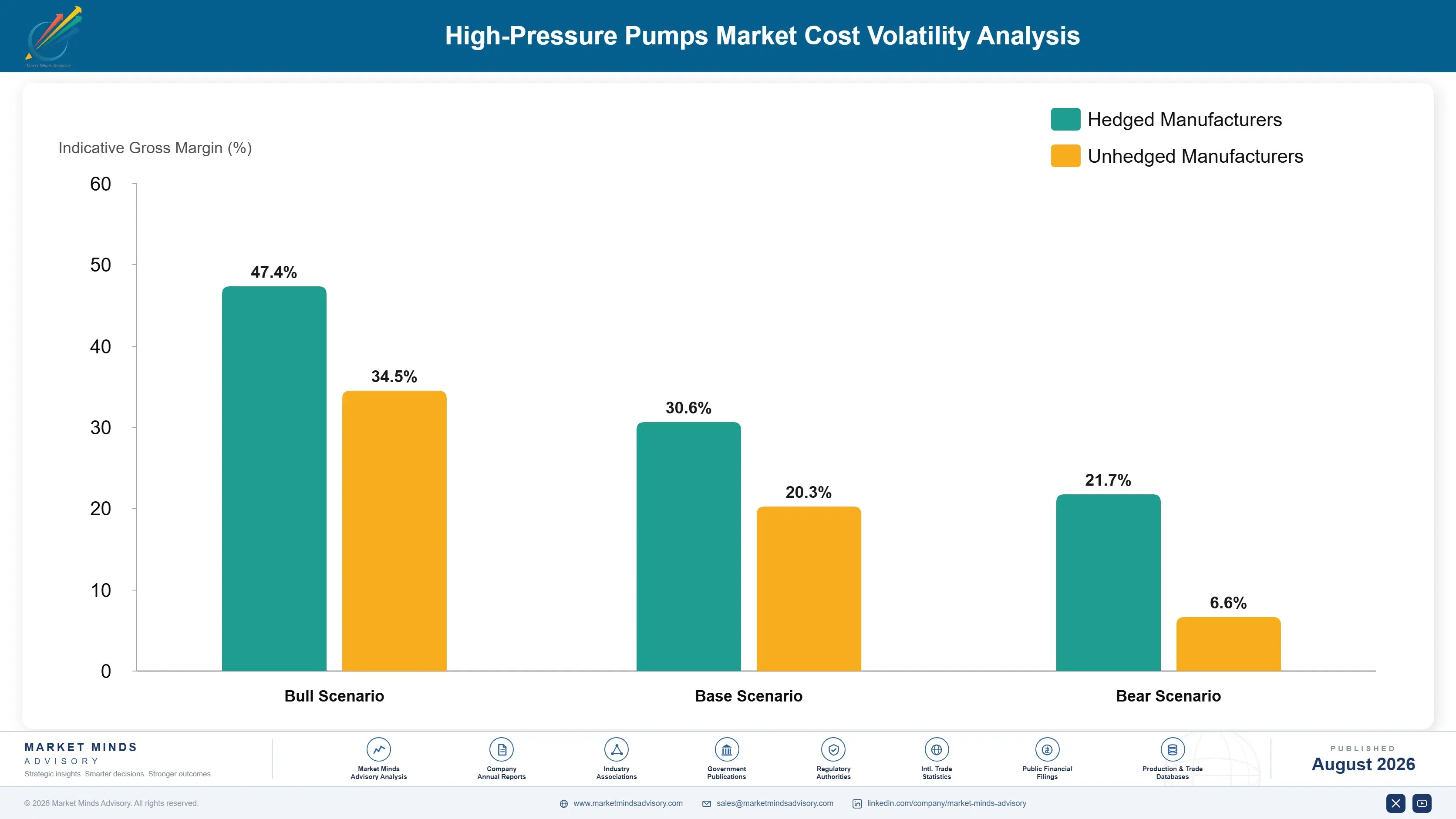
Alloy Steel and Casting Supply Exposure

Forged and cast alloy steel components, including specialty stainless and duplex steel grades required for corrosive desalination and hydrogen service, account for roughly 34 percent of cost of goods sold across the category, with precision machining and assembly labor making up most of the remainder. Casting capacity for these specialty grades concentrates among a relatively small number of global foundries.
Nickel and chromium alloy prices spiked sharply during 2022 and 2023 amid supply disruptions tied to geopolitical conflict and export restrictions, a period the United States Energy Information Administration's industrial materials commentary described as among the most volatile stretches for specialty metals pricing in over a decade. Several pump manufacturers disclosed multi-quarter margin compression in earnings materials directly attributable to this volatility, particularly among smaller specialty producers.

Exposure varies by company scale and integration. Larger manufacturers with long-term forging supply agreements or partial backward integration into casting capacity absorbed the volatility with comparatively limited disruption, while smaller specialists reliant entirely on spot-market alloy purchasing faced sharper cost swings and, in some cases, order fulfillment delays that opened share for better-hedged competitors during the tightest quarters.
high-pressure-pumps-market-cost-volatility-analysis-1787300103852

Lock In Multi-Year Alloy Supply Agreements

Leading manufacturers are increasingly securing multi-year fixed-volume agreements directly with specialty steel producers, trading some pricing flexibility for supply certainty and materially reduced exposure to short-term spot-market volatility during periods of tight global forging and casting capacity across multiple regions.

Invest In Captive Casting Capacity

Several of the largest suppliers have acquired or built captive foundry capacity for their highest-volume alloy grades, insulating a meaningful share of production from third-party casting bottlenecks and pricing pressure during periods of constrained global capacity across the wider forging sector.

Qualify Alternative Alloy Formulations

Engineering teams are qualifying alternative corrosion-resistant alloy formulations with more diversified global supply bases, reducing dependence on the narrowest, most supply-constrained specialty grades without compromising the performance customers require in demanding continuous service applications.

Portfolio Architecture for Margin Defence

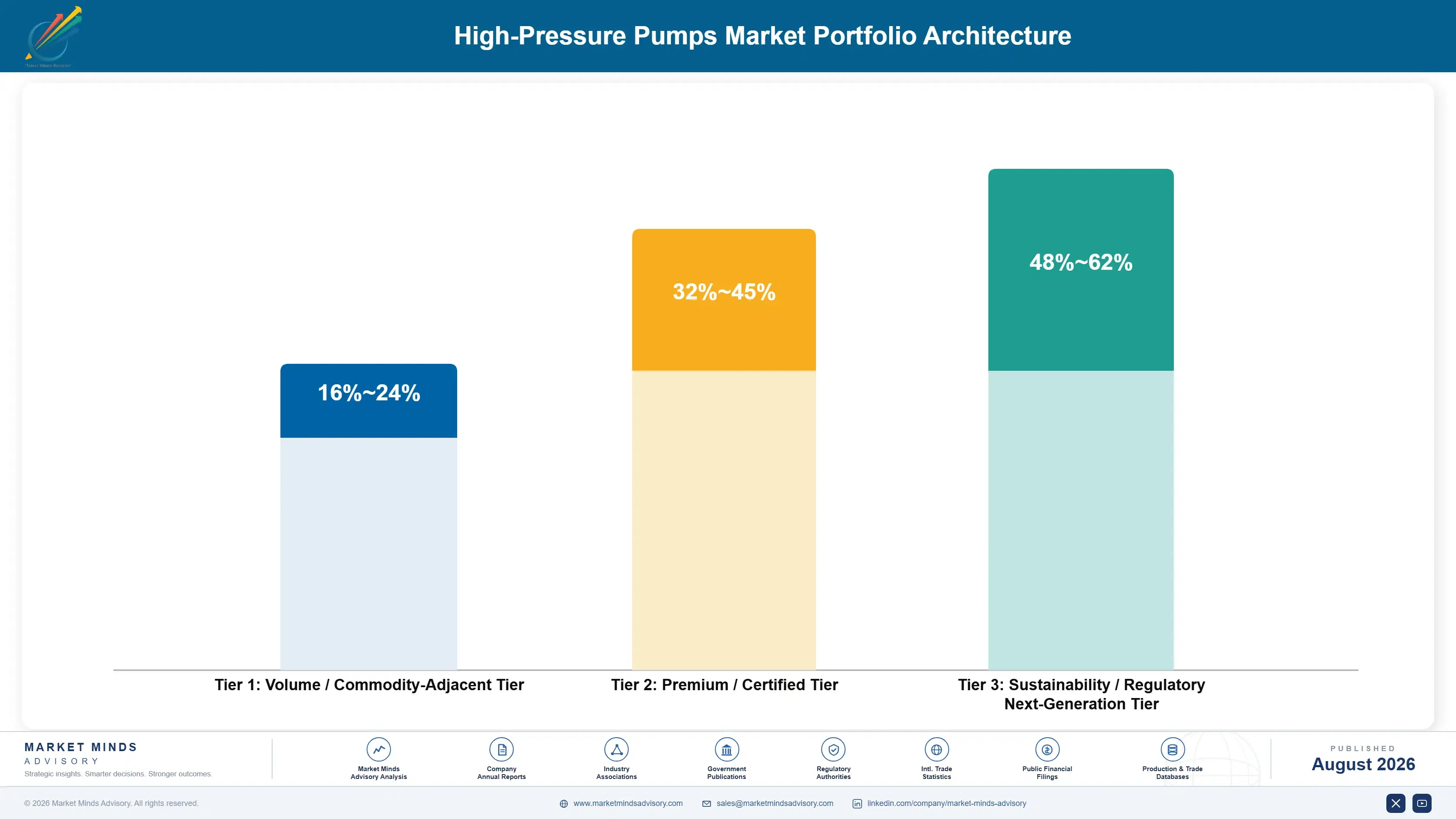
The market splits into three commercial tiers with distinct margin economics. Standard industrial and municipal pumps compete largely on manufacturing cost and delivery lead time, engineered oil and gas and desalination platforms carry meaningfully higher margin on qualification barriers, and emerging hydrogen compression pumps command the highest margin of all given their limited qualified supplier base.
The tension between volume and premium positioning shapes capital allocation across the category: standard industrial pumps still represent the largest unit volume by a wide margin, but nearly all incremental profit growth over the forecast period is concentrated in desalination and hydrogen platforms, which is where the leading manufacturers are directing engineering and qualification spending.

High-value margin pools concentrate specifically in hydrogen compression pumps during their current limited-supplier-base window and in desalination platforms with proven large-scale reliability records. Both pools reward suppliers who invest ahead of demand in qualification and reference installations rather than those who wait for markets to mature before committing capital.

Volume / Commodity-Adjacent Tier

Standard industrial and municipal water pumps sold largely on manufacturing cost, delivery lead time, and established long-standing distributor relationships across most mature developed markets covered in this report.
Gross Margin: 16-24%

Premium / Certified Tier

Oil and gas and desalination pumps qualified against API 674, API 675, and plant-specific corrosion standards, commanding meaningful premiums tied directly to reliability track record and qualification barriers to entry.
Gross Margin: 32-45%

Sustainability / Regulatory / Next-Generation Tier

Hydrogen refueling compression pumps and next-generation electric-drive platforms, carrying the category's highest margins given the currently limited qualified supplier base worldwide across major economies.
Gross Margin: 48-62%
high-pressure-pumps-market-portfolio-architecture-1787300104355

High-value Sub-segments and Strategic Watch-out

Hydrogen Refueling Compression Pumps

Highest current margin and fastest volume growth in the category, constrained mainly by refueling station buildout pace and the small number of suppliers with completed API 675 qualification today across major economies.
Gross Margin: 50-62%

Reverse Osmosis Desalination Pumps

Steady high-value growth tracking national water security investment closely, increasingly favoring suppliers with proven large-scale reliability data over newer entrants still building reference installations at comparable plant scale.
Gross Margin: 34-45%

Standard Industrial and Municipal Pumps

The volume core of the market by unit count, competing primarily on manufacturing cost and delivery lead time rather than deep engineering differentiation between qualified suppliers across most applications.
Gross Margin: 16-22%

Legacy Oil and Gas Reciprocating Pumps

A strategic watch-out segment as electric-drive platforms displace diesel-powered legacy units, threatening a substantial share of currently installed base revenue over the coming decade across major basins.
Gross Margin: 24-34%

Capital Equipment Meets Recurring Service Revenue

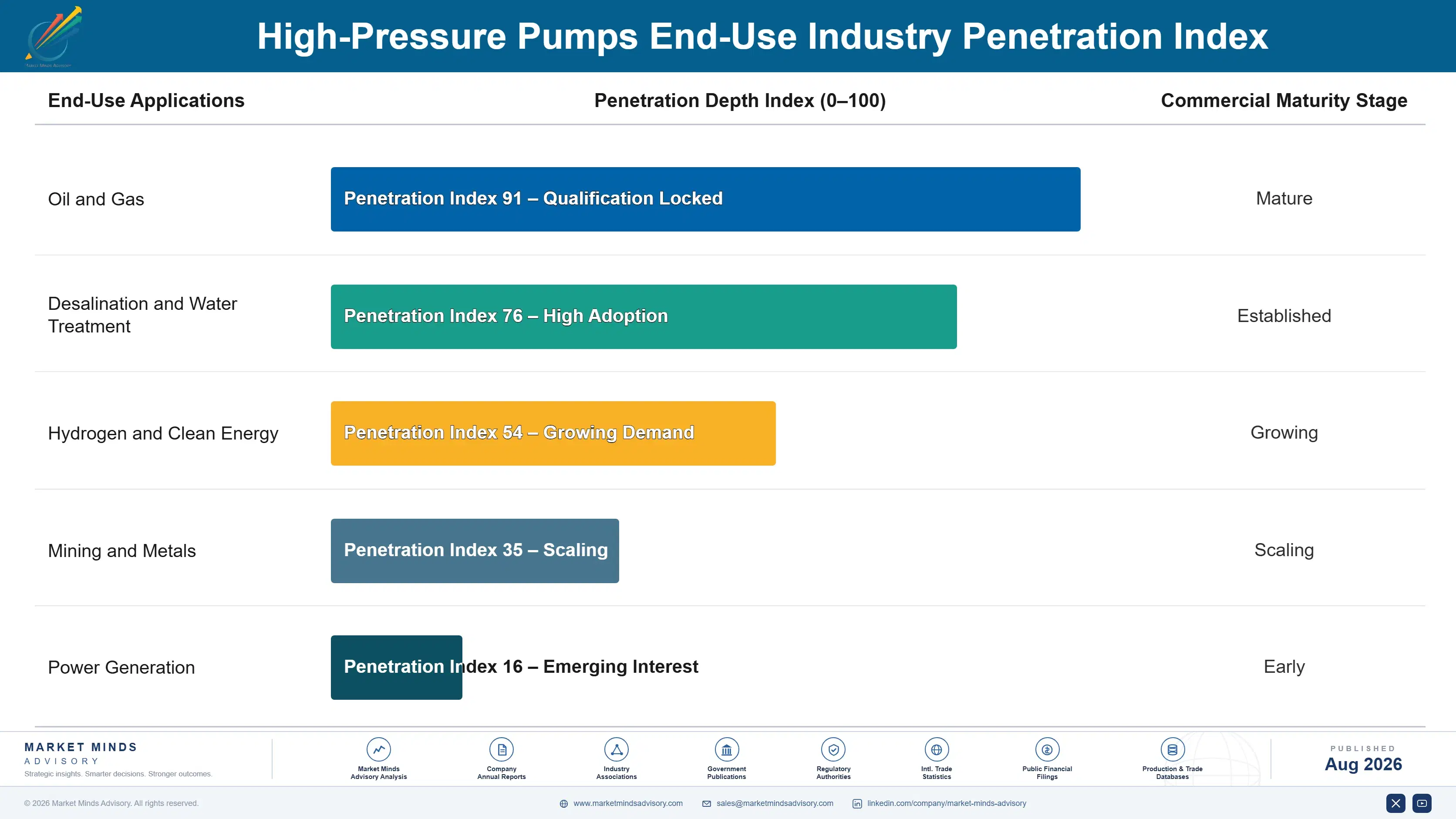
High-pressure pumps have historically behaved as a pure capital equipment business, generating a large upfront sale followed by intermittent aftermarket parts revenue, but the category is shifting toward a partially annuity-like model as desalination and hydrogen operators increasingly demand bundled long-term service and uptime guarantee contracts alongside the initial equipment purchase itself.
Adoption depth varies sharply by end-use vertical. Desalination and hydrogen refueling operators show the deepest service-contract attachment given the extreme cost of unplanned downtime in these applications, oil and gas buyers remain more transactional despite long qualification relationships, and municipal utilities adopt bundled service slowest of all, constrained mainly by public procurement rules that favor lowest-bid purchasing structures.

A generational shift in buyer profile is underway as engineering procurement teams increasingly include dedicated reliability and lifecycle-cost specialists rather than pure capital-cost evaluators trained under an older purchasing model. Desalination and hydrogen project developers, many staffed by teams new to the category entirely, are also reshaping how suppliers must present qualification evidence and total cost of ownership data during the bidding process.
high-pressure-pumps-market-end-use-penetration-index-1787300104855

Where This Market Goes Next

These are among the four positions where our research anticipates prominent divergence between winners and laggards over the coming forecast period. Each is grounded in the demand model, the regulatory perimeter, and the announced capacity pipeline.
01 / HYDROGEN QUALIFICATION SPEED

Early API 675 qualifiers will lock in a durable lead

The hydrogen refueling compression segment rewards suppliers who complete technical qualification first, because reference installations at operating stations become the evidence needed to win the next contract cycle across every developed market. Manufacturers still validating designs are already missing early station buildout waves in Germany, Japan, and South Korea specifically. This gap is likely to widen rather than narrow as qualified suppliers accumulate operating data that unqualified competitors simply cannot replicate quickly, regardless of how much capital they commit to catching up.
02 / DESALINATION RELIABILITY REPUTATION

Track record still beats price in Gulf state tenders

Desalination plant operators weigh proven large-scale reliability data more heavily than acquisition price when selecting suppliers, because unplanned downtime at a major plant carries costs far exceeding any pump price difference between competing bids. Suppliers like Sulzer with decades of Gulf state reference installations retain a durable qualification advantage that well-funded newer entrants cannot close purely through aggressive pricing. This dynamic should keep the segment's premium margins intact well through the current forecast period, even as competitive intensity rises elsewhere.
03 / SERVICE REVENUE TRANSITION

Bundled service contracts are becoming the real margin driver

Suppliers attaching long-term service and uptime guarantee contracts to equipment sales are converting a historically cyclical capital business into a partially recurring revenue stream that investors increasingly reward with meaningfully higher valuation multiples across the sector. Desalination and hydrogen operators are driving this shift fastest given how costly unplanned downtime is in their applications specifically. Manufacturers still selling pure capital equipment without service attachment risk losing share to competitors who can offer a lower total cost of ownership across the full multi-year contract life.
04 / GULF MANUFACTURING LOCALIZATION

Local content rules are reshaping who wins giga-projects

Saudi Arabia and the United Arab Emirates increasingly favor suppliers with local manufacturing or final assembly presence when awarding the largest desalination and hydrogen tenders tied to national industrialization strategy across their economies. Suppliers without Gulf-based capacity are already losing share on recent giga-project awards to competitors who invested earlier in regional manufacturing capacity. This lever requires meaningful upfront capital commitment but is increasingly a prerequisite for competing seriously on the fastest-growing demand pool in the entire market.

Engagement Snapshot From the Field

A live engagement with an industry participant carrying material or product regulatory and market exposure ahead of a defining policy shift, showing how our research translates into a defensible multi-year portfolio strategy.
MARKET MINDS ADVISORY · CLIENT ENGAGEMENT SUMMARY
High-Pressure Pumps Producer Strategic Portfolio Review and Transition Roadmap 2026·Investment Scenario on High-Pressure Pumps Exposure Evaluation 2025-26
CLIENT PROFILE
The client is a national water utility operating multiple large-scale reverse osmosis desalination plants along a Gulf coastline, serving several million residential and industrial customers (client-reported, unverified by MMA) across a rapidly growing urban service territory. Much of its high-pressure feed pump fleet was approaching thirty years of continuous service, well beyond typical replacement planning horizons for this equipment class and duty cycle.
STRATEGIC CHALLENGE
Unplanned pump failures had begun increasing at a rate leadership found concerning, threatening water supply reliability across a service area with no meaningful backup capacity available. The utility needed a fleet-wide modernization business case that balanced replacement urgency against a capital budget already committed to several other competing infrastructure priorities across the organization.
MMA APPROACH
MMA benchmarked the utility's fleet age and failure rate against comparable desalination operators globally, modeled expected reliability improvement and energy efficiency gains from modern multistage pump designs, and prioritized a phased replacement sequence targeting the highest-risk units first across the utility's several treatment plants and pumping stations serving different districts.
KEY FINDINGS
  1. Roughly 35 percent of the utility's high-pressure pump fleet exceeded twenty-five years of continuous service, well past typical original equipment design life expectations for this class.
  2. Modern multistage pump designs offered a modeled energy efficiency improvement of 12 to 15 percent versus the existing fleet's decades-old legacy technology base.
  3. Unplanned failure incidents had risen an estimated 40 percent over the prior three years (client-reported, unverified by MMA), concentrated heavily among the oldest fleet units.
  4. A phased twelve-plant replacement sequence could be completed within the existing multi-year capital budget if resequenced by measured failure risk rather than simple chronological age.
CLIENT PROFILE
The client is a national water utility operating multiple large-scale reverse osmosis desalination plants along a Gulf coastline, serving several million residential and industrial customers (client-reported, unverified by MMA) across a rapidly growing urban service territory. Much of its high-pressure feed pump fleet was approaching thirty years of continuous service, well beyond typical replacement planning horizons for this equipment class and duty cycle.
STRATEGIC CHALLENGE
Unplanned pump failures had begun increasing at a rate leadership found concerning, threatening water supply reliability across a service area with no meaningful backup capacity available. The utility needed a fleet-wide modernization business case that balanced replacement urgency against a capital budget already committed to several other competing infrastructure priorities across the organization.
MMA APPROACH
MMA benchmarked the utility's fleet age and failure rate against comparable desalination operators globally, modeled expected reliability improvement and energy efficiency gains from modern multistage pump designs, and prioritized a phased replacement sequence targeting the highest-risk units first across the utility's several treatment plants and pumping stations serving different districts.
KEY FINDINGS
  1. Roughly 35 percent of the utility's high-pressure pump fleet exceeded twenty-five years of continuous service, well past typical original equipment design life expectations for this class.
  2. Modern multistage pump designs offered a modeled energy efficiency improvement of 12 to 15 percent versus the existing fleet's decades-old legacy technology base.
  3. Unplanned failure incidents had risen an estimated 40 percent over the prior three years (client-reported, unverified by MMA), concentrated heavily among the oldest fleet units.
  4. A phased twelve-plant replacement sequence could be completed within the existing multi-year capital budget if resequenced by measured failure risk rather than simple chronological age.
RECOMMENDED STRATEGY
Phase 1: Phase 1 (Months 1-6): Complete fleet-wide condition assessment and finalize a risk-ranked replacement sequence across all twelve treatment plants nationwide. Phase 2: Phase 2 (Months 7-18): Replace the highest-risk pump units at the three plants showing the greatest recent failure rate increase. Phase 3: Phase 3 (Months 19-36): Complete remaining fleet replacement and establish a rolling long-term capital modernization budget cycle.
OUTCOME
Eighteen months into the program, the utility reported unplanned failure incidents down an estimated 30 percent and measured energy consumption per unit of water produced down roughly 11 percent across replaced units (client-reported, unverified by MMA), tracking closely to MMA's modeled efficiency projections across every plant.

Frequently Asked Questions

Foundational context covering the market sizes, CAGR, scope, country, region and competition that inform every finding below. This section is provided to cover basics and most often pre-purchase conversations, answered from the MMA Primary Research Dataset.

What is the current size of the High-Pressure Pumps Market?

The market is valued at approximately 8.6 billion dollars in 2025, expanding to roughly 9.18 billion dollars in 2026 as desalination and hydrogen refueling demand continue building on top of the legacy oil and gas order base.

How large will the High-Pressure Pumps Market be by 2036?

MMA forecasts the market reaching approximately 17.73 billion dollars by 2036, roughly 1.93 times its 2026 value, driven primarily by desalination capacity expansion and emerging hydrogen refueling infrastructure buildout.

What is the CAGR for the High-Pressure Pumps Market 2026 to 2036?

The base-case compound annual growth rate is 6.8 percent, with a bull scenario of 8.0 percent and a bear scenario of 5.6 percent depending on hydrogen buildout pace and oil and gas capital spending.

Which segment is growing fastest?

Hydrogen refueling compression pumps are growing fastest at a 14.5 percent CAGR, roughly 2.13 times the overall market rate, driven by government-backed refueling station rollouts across several major economies.

Who are the major companies in the High-Pressure Pumps Market?

Flowserve, KSB, Sulzer, Grundfos, and Xylem lead the market, together holding roughly 42 percent of revenue on a company-revenue basis across the combined product range.

Which country is growing fastest?

Saudi Arabia is the fastest-growing country at a 10.8 percent CAGR, driven by the world's most concentrated desalination plant buildout and emerging green hydrogen export infrastructure investment.

Report Segmentation Architecture

The full report scope spans multiple orthogonal segmentation dimensions, with cross-tabulated demand data provided for each dimension pair. Coverage extends further to regional breakdowns, trend trajectories, and the competitive detail needed to support segment-level decision-making.

By Pump Technology

  • Reciprocating Plunger Pumps
  • Centrifugal Multistage Pumps
  • Diaphragm Pumps
  • Rotary Screw Pumps
  • Reverse Osmosis Desalination Pumps
  • Hydrogen Refueling Compression Pumps

By End-Use Industry

  • Oil and Gas
  • Desalination and Water Treatment
  • Hydrogen and Clean Energy
  • Mining and Metals
  • Power Generation

By Commercial Dimension

  • Original Equipment Sales
  • Aftermarket Parts and Service
  • Long-Term Service Contracts
  • Direct and Distributor Channel

By Region

  • North America
  • Western Europe
  • East Asia
  • South Asia and Pacific
  • Latin America
  • Middle East and Africa
  • Eastern Europe

Scope, Methodology, and Coverage

Every figure in this report is reproducible from documented input assumptions. The scope below maps the historical period, the forecast horizon, the segmentation dimensions, and the countries covered, alongside the underlying primary and qualitative methodology.
Historical Period
2020 to 2025
Forecast Period
2026 to 2036
Base Year
2025 (USD billions; MMA Primary Research Dataset, August 2026)
Market Definition
The market covers pumps engineered to generate discharge pressures above the conventional centrifugal range, including reciprocating plunger pumps, multistage centrifugal pumps, diaphragm pumps, and rotary screw pumps used in oil and gas, desalination, hydrogen refueling, municipal water, and industrial cleaning applications. Low-pressure circulation pumps and standalone pump accessories are excluded.
Quantitative Units
USD billions (current prices); unit shipments where cited
Segmentation Dimensions
By Pump Technology; By End-Use Industry; By Commercial Dimension; By Region
Regions Covered
North America, Western Europe, East Asia, South Asia and Pacific, Latin America, Middle East and Africa, Eastern Europe
Countries Covered
USA, China, Germany, France, UK, Japan, South Korea, India, Australia, Canada, Brazil, Mexico, Indonesia, Vietnam, Thailand, Malaysia, UAE, Saudi Arabia, South Africa, Nigeria, Turkey, Poland, Netherlands, Italy, Spain, Sweden, Switzerland, Argentina, Colombia, Singapore, and additional markets relevant to this sector
Key Companies Profiled
Flowserve Corporation, KSB SE & Co. KGaA, Sulzer Ltd, Grundfos Holding A/S, Xylem Inc., Weir Group PLC, Ebara Corporation, Wilo SE, IDEX Corporation, ITT Inc., CIRCOR International, Danfoss A/S, Ingersoll Rand Inc., National Oilwell Varco Inc., Cat Pumps Corporation, Hammelmann GmbH, Speck Pumpen, Torishima Pump Mfg. Co., Ltd., SPX FLOW Inc., PSG Dover
Quantitative Methodology
Primary survey, n=3,800 respondents, Q4 2025, six countries; demand-side model with trade association cross-validation
Qualitative Methodology
47 expert interviews, Q4 2025; applied to validate demand model assumptions, identify emerging dynamics, and assess competitive positioning
Report Format
PDF and XLSX data workbook (Word format preview document)
Publisher
Market Minds Advisory
Report Code
MMA-2026-CON-318
Published
August 2026
Contact
sales@marketmindsadvisory.com | www.marketmindsadvisory.com

Purchase the full High-Pressure Pumps Market Report (2026 to 2036).

The full report delivers a complete quantitative and strategic assessment of the high-pressure pumps market across all seven regions and more than thirty countries covered in this study. It includes detailed segment-level forecasts through 2036, competitive benchmarking across twenty profiled manufacturers, and primary research drawn from 3,800 survey respondents and 47 expert interviews conducted in Q4 2025. Buyers receive editable data tables and full regional narrative detail beyond the two regions previewed in this summary document. A dedicated appendix covers hydrogen qualification standards and desalination procurement economics by country.
Fully editable Excel data tables included
All seven full regional narratives included
Twenty-company competitive profiles included
Hydrogen qualification standards appendix included
Segment-level 2026-2036 detailed forecasts
Primary survey and interview data included

Built For The People Who Decide

From boardroom strategy to bench-side execution, this report is read cover-to-cover by leaders shaping the next decade of their industry, turning demand scenarios, market dynamics and valuation benchmarks into decisions.
CXOs/ Presidents/ VPs/ Managers
M&A and Corporate Development
Strategy Teams and R&D Heads
Procurement and Product Directors
Regulatory and Compliance Leaders
Investor Relations and Equity Analysts