Market Minds Advisory
High-Potency API Contract Manufacturing Market

High-Potency API Contract Manufacturing Market: Antibody-Drug Conjugate Capacity Buildout

Antibody-drug conjugate pipeline growth is pulling contract manufacturers into a specialized containment and conjugation capacity race, as pharmaceutical sponsors outsource high-potency production rather than build the dedicated isolator infrastructure themselves.

Lead Analyst

Alice Ballenger

Published

September 2026

Make Smarter Decisions with Customized Research Insights

Request a free sample report and evaluate market opportunities, growth trends, and competitive dynamics relevant to your business needs.

2025 MARKET VALUE$8.2BMarket Size 2025
2036 FORECAST VALUE$27.1BBase Case , 2026 to 2036
CAGR 2026 TO 203611.5 %Bull 12.8% / Bear 10.2%
INCREMENTAL OPPORTUNITY$18.0BNet 10- year value creation
EXPANSION MULTIPLE2.97x2036 value over 2026 base
Strategic Levers
M&A Pipeline
Regional Outlook
Country Rankings
Competitive Intelligence
Segmental Deep-dive
Call-Us : 91 93563 13602

Executive Snapshot and Market Trajectory

High-potency API contract manufacturing is converting from a specialized niche service into core oncology development infrastructure, as antibody-drug conjugate pipeline growth pulls sponsors toward outsourced conjugation and containment capacity rather than building dedicated internal facilities. That shift is reshaping how sponsors evaluate manufacturing partner selection decisions.
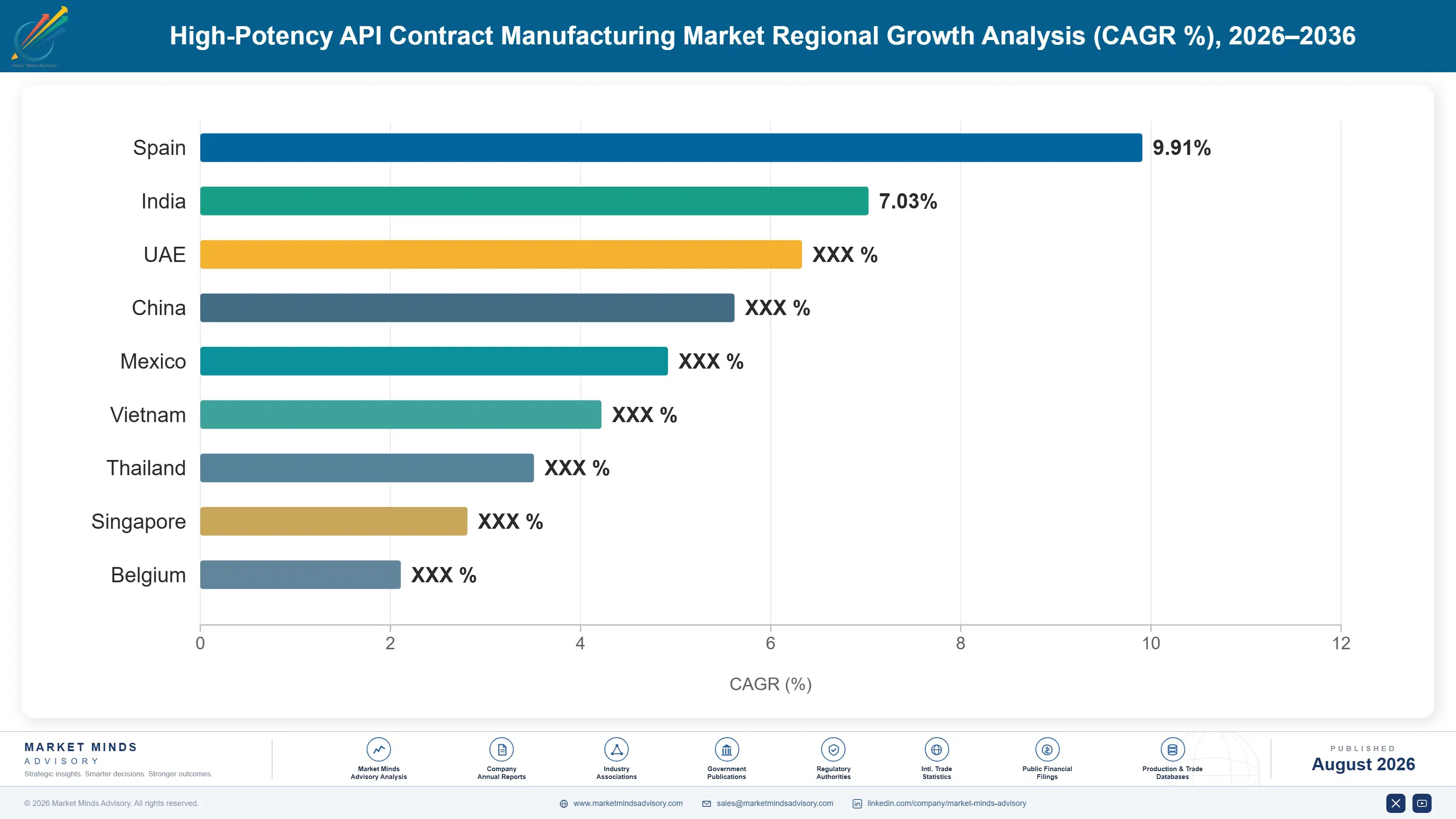
ADC conjugation and linker-payload services lead every other category on growth as sponsors chase specialized capacity few companies can build economically. India has become the fastest-growing single country, anchored by rapid CDMO capacity expansion and government manufacturing incentive programs, while Western Europe still commands a leading share of total spending given its Swiss, German, and Italian manufacturing expertise. Drug substance manufacturing remains the largest service category by revenue across nearly every market tracked here.
Competitive character remains fragmented among a handful of large diversified contract manufacturers and a broader field of specialized high-potency and ADC-focused providers competing on containment technology depth. Regulatory pressure cuts in the industry's favor here: tightening occupational exposure limits and containment validation requirements are pushing sponsors toward providers with proven regulatory track records well ahead of typical vendor qualification timelines. Vendors slow to align risk losing momentum across cycles entirely.
Market Definition
The high-potency API contract manufacturing market covers outsourced manufacturing, formulation, fill-finish, and analytical testing services for active pharmaceutical ingredients classified as highly potent based on occupational exposure limits, including cytotoxic oncology compounds and antibody-drug conjugate payloads. It excludes standard-potency API manufacturing services and excludes finished dosage form manufacturing performed independently of high-potency drug substance production.
Base Year Value
$8.2B in 2025 (MMA Primary Research Dataset, August 2026)
Forecast Period
2026 to 2036, eleven discrete annual values
CAGR
11.5% base case. Bull 12.8%. Bear 10.2%.
Fastest Growth Segment
ADC Conjugation and Linker-Payload Services: 19.8% CAGR
Fastest Growth Country
India: 14.2% CAGR
Fastest Growth Region
South Asia and Pacific: 13.6% CAGR
Largest Region
North America: 29% of 2025 global value
Market Leaders
Lonza Group AG, CordenPharma International GmbH, Catalent, Inc., Piramal Pharma Limited, Novasep Holding SAS. Source: MMA Analysis based on company annual reports.
Primary Survey
n=3,800 procurement and R&D decision-makers, Q4 2025, six countries
Methodology
Demand-side build-up, cross-validated against public data, 47 expert interviews

High-Potency API Contract Manufacturing Market Forecast Scenarios

high-potency-api-contract-manufacturing-market-size-forecast-scenario-1787303173103
High-potency API contract manufacturing demand grew unevenly between 2020 and 2025. Pandemic-era capital spending caution briefly slowed containment facility investment through 2021, then accelerating antibody-drug conjugate approvals and pipeline expansion drove a sustained capacity investment wave, lifting historical growth to an estimated 10.0% compound rate. That capacity investment wave took longer to translate into available commercial capacity than sponsors initially expected.
The base case assumes 11.5% annual growth through 2036, anchored on three mechanisms. First, antibody-drug conjugate pipeline expansion keeps pulling sponsors toward specialized conjugation capacity that few companies can economically build in-house. Second, tightening occupational exposure and containment validation requirements keep pushing sponsors toward providers with proven regulatory track records rather than newer, unproven capacity. Third, oncology drug development volume keeps expanding across both large pharmaceutical sponsors and smaller biotech companies lacking internal high-potency manufacturing capability entirely.
A bull case builds if antibody-drug conjugate approvals accelerate faster than currently expected, pushing growth toward 12.8%. The bear risk is capacity oversupply: if contract manufacturers collectively overbuild containment capacity ahead of confirmed pipeline demand, utilization rates and pricing could soften, capping growth near 10.2% across the forecast period. Either outcome depends heavily on how quickly capacity utilization trends normalize.

From Niche Containment Service to Oncology Infrastructure

High-potency API contract manufacturing remains a specialized fraction of the broader pharmaceutical contract manufacturing category by current revenue, but the market is undergoing a genuine, lasting shift as antibody-drug conjugate pipeline growth converts what was once a niche cytotoxic manufacturing service into core oncology development infrastructure. Containment capability still matters enormously, but conjugation expertise and regulatory track record increasingly decide which provider a
MARKET CONCENTRATION38% CR5Five providers hold well under half of total category revenue
AVERAGE CONTRACT VALUE$8.4 million per programBlended value across drug substance and conjugation contracts
LEADING SERVICE CATEGORY SHAREDrug substance manufacturing, 44%One service category still dominates total contracted revenue
FACILITY UTILISATION RATE71%Containment facilities run near typical specialty manufacturing norms
ADC PROGRAM GROWTH RATE38% annual increaseConjugation program volume is expanding faster than any category
INPUT COST SHARE33% of contract COGSSpecialized containment equipment and validated raw materials dominate cost
Providers compete less on raw capacity alone than on demonstrated regulatory compliance and containment validation depth: sponsors specify providers with documented occupational exposure control and consistent batch quality rather than switching for marginal cost advantages on unproven capacity. Manufacturing remains concentrated in Switzerland, Germany, Italy, and the United States, while India's domestic CDMO capacity is expanding rapidly to serve its own growing pharmaceutical manufacturing base.
The next decade will be shaped by two forces pulling in the same direction: expanding antibody-drug conjugate pipeline volume and tightening occupational exposure regulation favoring providers with proven containment track records. Both push investment toward validated, specialized capacity even as newer entrants without established regulatory history struggle to displace incumbents on major sponsor qualification decisions.
"Every large pharma company thought about building its own high-potency plant. Then they priced out the containment engineering and called a CDMO instead."
Director, Specialty Pharmaceutical Manufacturing Practice · MMA Chemicals and Ma

Market Trends

Antibody-Drug Conjugate Pipeline Growth Drives Capacity Investment

The rapidly expanding antibody-drug conjugate clinical pipeline, spanning dozens of programs across major oncology sponsors, is converting conjugation and linker-payload manufacturing from a specialized niche service into one of the fastest-growing categories in pharmaceutical contract manufacturing entirely. This is pushing contract manufacturers to invest heavily in dedicated conjugation suites and specialized containment infrastructure years ahead of confirmed long-term demand, betting that current pipeline momentum will translate into sustained commercial manufacturing contracts. Providers with early-mover conjugation capacity are capturing disproportionate share of new program awards as sponsors increasingly qualify vendors years before a program reaches commercial scale.
Market Impact: Adds 2.8 billion in outsourced spen

Tightening Occupational Exposure Limits Raise Containment Standards

Regulatory bodies and industry occupational health groups are tightening permissible exposure limits for high-potency compounds, pushing contract manufacturers to invest in next-generation isolator and containment technology capable of meeting increasingly stringent workplace safety thresholds. This is converting containment technology from a competitive differentiator into a baseline compliance requirement, raising the capital bar for new entrants seeking to compete for sponsor qualification against established providers with proven track records. Providers with validated next-generation containment technology are capturing disproportionate share of new sponsor qualification decisions as this compliance bar continues rising across the industry.
Market Impact: Adds 1,900 new oncology development

Market Opportunities and Growth Drivers

Outsourcing Economics Favor Specialized Contract Manufacturing

Building dedicated high-potency containment infrastructure requires capital investment and specialized engineering expertise that few pharmaceutical sponsors can justify for a single program, particularly smaller biotech companies with concentrated pipelines, making outsourcing to specialized contract manufacturers the default economic choice across nearly every sponsor size tracked here. This outsourcing economics case strengthens further for antibody-drug conjugate programs specifically, since conjugation infrastructure carries even higher specialization requirements than standard API manufacturing. Providers offering flexible capacity scaling from clinical through commercial volume are capturing disproportionate share of sponsor manufacturing relationships as this outsourcing preference continues strengthening across the industry.
Market Impact: Delays new capacity entry 34 months

Oncology Pipeline Expansion Sustains Base Demand Growth

Continued expansion of the broader oncology drug development pipeline, spanning both traditional cytotoxic compounds and newer targeted and conjugate therapies, keeps high-potency manufacturing demand growing across a base that extends well beyond antibody-drug conjugates specifically. This broader pipeline growth gives the category a demand foundation less dependent on any single therapeutic modality succeeding, since cytotoxic small molecule programs continue advancing alongside newer conjugate and targeted therapy approaches simultaneously. Providers with capability spanning both traditional cytotoxic and newer conjugate manufacturing are capturing disproportionate share of this diversified oncology pipeline demand as sponsors increasingly prefer single-vendor relationships spanning multiple program types.
Market Impact: Risks utilization decline of 19 poi

Market Restraints and Challenges

High Capital Barriers Limit New Entrant Competition

Building validated high-potency and conjugation manufacturing capacity requires substantial capital investment in specialized containment infrastructure and multi-year regulatory qualification processes, creating a meaningful barrier that limits how quickly new capacity can enter the category regardless of underlying demand growth. The root cause is that containment validation and regulatory qualification cannot be meaningfully compressed below certain minimum timelines regardless of capital available, since sponsors require documented operational history before committing large programs to a new facility. Some providers are mitigating this by pursuing phased capacity expansion at existing qualified sites rather than building entirely new facilities requiring fresh regulatory qualification.
Market Impact: Adds 38% to conjugation program vol

Capacity Overbuild Risk Threatens Pricing Stability

Multiple contract manufacturers are simultaneously investing in expanded conjugation and containment capacity based on similar antibody-drug conjugate pipeline growth assumptions, creating genuine risk that aggregate industry capacity could outpace confirmed commercial demand if a meaningful share of pipeline programs fail to reach approval. The underlying cause is that individual providers cannot easily observe competitors' capacity investment decisions, leading to correlated expansion bets across the industry that collectively risk overshooting actual demand. Providers are mitigating this by securing longer-term capacity reservation agreements with sponsors before committing to major expansion investment. That correlated risk narrows only gradually as coordination improves.
Market Impact: Raises containment capital requirem
3 additional market trends, 4 additional growth drivers, and 2 additional restraints and challenges are covered in the full report. Contact sales@marketmindsadvisory.com to access the complete intelligence.

Segment CAGR and Growth Architecture

MMA segments the market by service and technology type, the classification sponsors use when specifying manufacturing capability and comparing provider capacity across competing outsourcing decisions. This avoids blending upstream containment engineering technology with the downstream service categories that define how a given manufacturing contract is actually structured across every major sponsor procurement decision made today.
high-potency-api-contract-manufacturing-market-market-share-analysis-1787303173678

ADC Conjugation and Linker-Payload Services

ADC conjugation and linker-payload services, the specialized processes joining cytotoxic payloads to monoclonal antibodies through validated linker chemistry, remain the fastest-growing category as sponsors chase specialized capacity few contract manufacturers can economically build. Growth concentrates wherever conjugation expertise intersects with proven containment track record, particularly across Western Europe's established specialty manufacturing base and increasingly Asian providers building comparable capability. Lonza and CordenPharma have each expanded conjugation suite capacity substantially, recognizing that validated regulatory track record, not raw conjugation capacity alone, decides which provider captures a sponsor's long-term manufacturing relationship. At a 19.8% forecast CAGR, roughly 1.7 times the market average, this segment is pulling capital investment toward conjugation capability faster than any other category.
CAGR 19.8%

HPAPI Drug Substance Manufacturing

HPAPI drug substance manufacturing, producing the underlying high-potency active pharmaceutical ingredients before formulation or conjugation, tracks broader oncology pipeline expansion more directly than any other segment, making regulatory qualification depth a disproportionate growth driver for this category specifically. Piramal and Novasep lead on drug substance manufacturing scale, while newer entrants increasingly compete on flexible batch sizing and rapid technology transfer rather than raw capacity alone. Demand here is tied more closely to overall oncology development pipeline volume than to any single therapeutic modality, since drug substance manufacturing spans both traditional cytotoxic and newer conjugate payload production. This segment's growth trajectory now depends heavily on how quickly sponsors advance early-stage oncology programs toward later development phases.
CAGR 12.5%
Full segment breakdown across 6 segments available in the complete report.

Regional Architecture and Country Demand Map

Western Europe commands a leading share of total spending given its concentration of established Swiss, German, and Italian high-potency manufacturing expertise, while India's rapid CDMO capacity expansion and East Asia's growing pharmaceutical investment anchor the fastest-growing regional pipelines. North America and East Asia add substantial capacity of their own.

North America

The United States anchors regional demand through its concentration of major oncology sponsors and a deep bench of contract manufacturers with established high-potency and conjugation capability serving both domestic and international programs. Canada contributes a smaller, steadily growing demand base benefiting from proximity to the same sponsor relationships and a favorable environment for specialized manufacturing investment. Higher sponsor concentration and deeper capital markets for manufacturing capacity expansion give the region durable spending power even as unit growth moderates relative to faster-growing emerging markets. Growth stays healthy but trails East Asia and South Asia and Pacific because the region's largest providers have already completed much of their initial conjugation capacity build-out.
Share: 29% | CAGR: 11.0% (2026 to 2036)

Western Europe

Switzerland anchors both regional manufacturing expertise depth and equipment demand, home to Lonza and a dense cluster of specialized high-potency manufacturers whose containment engineering expertise supplies sponsors across the broader European and global market. Germany and Italy follow with steady demand tied to established specialty pharmaceutical manufacturing clusters increasingly favoring conjugation capability investment. Regulatory pressure compounds adoption directly: European Medicines Agency containment and occupational exposure requirements are pushing sponsors toward validated compliant providers regardless of any cost premium involved relative to less-established alternatives. Growth trails East Asia and South Asia and Pacific because the region's mature manufacturing base is expanding fleet capacity more slowly than newer market entrants. Belgium and Ireland add smaller, steady manufacturing demand of their own.
Share: 26% | CAGR: 9.8% (2026 to 2036)
Regional intelligence for 5 additional markets available in the complete report: East Asia, South Asia and Pacific, Latin America, Middle East and Africa, Eastern Europe. Contact sales@marketmindsadvisory.com.
high-potency-api-contract-manufacturing-market-country-cagr-analysis-1787303174194

Where Contract Manufacturers Actually Capture Margin

Standard drug substance manufacturing increasingly competes on price alone as more providers enter the category, so the manufacturers protecting margin monetize specialized capability: conjugation expertise, regulatory track record, and long-term capacity reservation agreements. The four levers below reflect where MMA's interviews with sponsor outsourcing teams show real, sustained willingness to pay a premium across every major outsourcing decision.

Validated Conjugation Expertise and Technology Transfer Support

Sponsors increasingly require documented conjugation process expertise and rapid technology transfer capability before awarding antibody-drug conjugate manufacturing contracts, and providers that invest in specialized conjugation technical teams are converting what used to be a purely capacity-based procurement decision into an expertise-driven relationship commanding meaningful premium pricing over generalist manufacturers. This is becoming the primary differentiator in ADC manufacturing procurement, where sponsors increasingly select providers based on demonstrated conjugation expertise rather than raw containment capacity alone, and MMA interviews suggest providers with strong conjugation expertise capture roughly 34% higher contract pricing than generalist manufacturers across the category overall.
Market Impact: Adds 34 percent higher conjugation

Long-Term Capacity Reservation and Planning Agreements

Sponsors increasingly sign multi-year capacity reservation agreements guaranteeing manufacturing slot availability for anticipated commercial-scale production, converting what used to be a series of individual project engagements into predictable recurring revenue worth roughly 26% of a provider's forward capacity book across an extended manufacturing relationship. Providers offering these agreements gain visibility into future capacity demand that supports continued facility investment, while sponsors gain protection against capacity shortages during commercial launch, a combination increasingly standard in large sponsor manufacturing relationships active across the industry today. Adoption of these reservation agreements continues accelerating as more sponsors prioritize supply chain certainty.
Market Impact: Locks in capacity demand for 5 to 1

Integrated Analytical and Quality Control Services

Providers offering integrated analytical testing and quality control services bundled directly into manufacturing contracts rather than requiring sponsors to coordinate separate testing vendor relationships capture meaningfully higher contract value than manufacturing-only providers, since integration reduces sponsor coordination burden and regulatory submission complexity. Providers offering integrated analytical capability capture higher lifetime account value than standalone manufacturers, worth roughly 21% more per sponsor relationship over a program's full development lifecycle, since integration commands premium pricing sponsors readily accept given the reduced coordination risk delivered. Adoption of integrated analytical capability continues expanding as sponsors seek reduced coordination burden across programs.
Market Impact: Adds 21 percent higher integrated c

Regulatory Support and Filing Assistance Programs

Providers offering embedded regulatory support and filing assistance, helping sponsors navigate complex high-potency manufacturing documentation requirements, capture recurring engagement value while simultaneously deepening customer relationships that make competitive displacement more difficult for rivals without comparable regulatory infrastructure available today. For smaller biotech sponsors lacking dedicated regulatory affairs staff, the value proposition is faster, more reliable filing support that reduces program timeline risk considerably. Early adopters report regulatory support attach rates approaching 27% among first-time sponsor engagements, growing steadily each year. Adoption continues expanding as sponsors increasingly prioritize regulatory support depth over pure manufacturing capacity alone.
Market Impact: Reaches nearly 27 percent regulator

Who Controls the Margin Pool

CR5 sits at 38%, reflecting a category fragmented among a handful of large diversified contract manufacturers and a broader field of specialized high-potency providers, evaluated here on a revenue basis across manufacturing, formulation, and analytical services combined. Lonza and CordenPharma lead on high-potency manufacturing scale, with a meaningful gap separating them from smaller challengers, including Catalent and Piramal, each strong in specific service categories rather than across the b
Current activity centers on three dimensions: validated conjugation expertise and technology transfer capability, long-term capacity reservation agreement structuring, and integrated analytical and regulatory support depth for major sponsor customers. Providers lacking conjugation-specific capability are increasingly partnering with specialized technology licensors rather than losing ADC manufacturing contracts on missing-capability grounds alone. Smaller providers increasingly struggle to match the capacity investment budgets larger competitors now commit.

Emerging pressure comes from Asian contract manufacturers expanding aggressively into high-potency and conjugation capability historically dominated by Western European and North American providers. If Asian manufacturers continue converting domestic scale into export competitiveness, expect rankings among the next several challengers to shift by 2030, as newly capable entrants displace slower-moving incumbents across specific service categories worldwide. Established leaders have limited time to respond.
high-potency-api-contract-manufacturing-market-company-positioning-matrix-1787303174721

Competitive Moat and Risk Dimensions

LONZA GROUP AG

Moat: Broadest Conjugation Capacity Network

Lonza's globally distributed network of conjugation and high-potency manufacturing facilities gives it capacity flexibility and geographic redundancy that narrower, single-site competitors cannot easily replicate for large sponsors requiring supply chain resilience. That combined network breadth makes Lonza the default vendor for sponsors seeking a single global manufacturing relationship across multiple program stages.
LONZA GROUP AG

Risk: Premium Pricing Competitive Exposure

Lonza's premium pricing position leaves it more exposed than lower-cost competitors to sponsor budget pressure, particularly among smaller biotech companies evaluating manufacturing costs against constrained development budgets. Managing this requires balancing continued premium positioning against broader market accessibility across the full range of sponsor sizes.
CORDENPHARMA INTERNATIONAL GMBH

Moat: Deep European Regulatory Track Record

CordenPharma's extensive European regulatory qualification history and established containment validation track record give it credibility with risk-averse sponsors that newer entrants cannot quickly replicate regardless of technical capability invested. That accumulated regulatory history increasingly functions as a competitive moat in its own right for sponsor vendor qualification decisions.
CORDENPHARMA INTERNATIONAL GMBH

Risk: Geographic Concentration Risk

CordenPharma's manufacturing footprint remains concentrated in Europe relative to more geographically diversified competitors, leaving it more exposed than global rivals to any single regional disruption affecting its core facility network specifically. Diversifying requires sustained capital investment in new-region facilities competing directly with continued European capacity expansion.

Players Tracked

Prominent Players

Lonza Group AG
CordenPharma International GmbH
Catalent, Inc.
Piramal Pharma Limited
Novasep Holding SAS

Other Key Players

Curia Global, Inc.
Bachem Holding AG
Recipharm AB
Siegfried Holding AG
Cambrex Corporation
Almac Group Limited
WuXi STA
Samsung Biologics Co., Ltd.
Avid Bioservices, Inc.
Fareva SAS
Ajinomoto Bio-Pharma Services
Sterling Pharma Solutions
PCI Pharma Services
Metrics Contract Services
Syngene International Limited

Recent Developments

FEBRUARY 2025

Lonza Expands Conjugation Suite Capacity in Switzerland

Lonza announced an expansion of its antibody-drug conjugate conjugation suite capacity at its Swiss manufacturing facility, addressing backlog tied to growing sponsor demand following favorable early clinical pipeline data. The expansion targets consistent supply for both established and emerging oncology sponsor customers globally this year.
Signal: Signals Lonza prioritizing conjugation cap
JUNE 2025

CordenPharma Secures Expanded Regulatory Certification

CordenPharma announced expanded regulatory certification for its high-potency manufacturing facility, broadening its addressable compound classification range ahead of anticipated sponsor demand for newer containment categories across its full global facility network. The expansion targets sponsors evaluating vendors for next-generation highly potent compound classes specifically this year.
Signal: Signals CordenPharma prioritizing regulato
OCTOBER 2025

Piramal Pharma Signs Capacity Reservation Agreement With Major Sponsor

Piramal Pharma signed a multi-year capacity reservation agreement with a major oncology sponsor, securing dedicated manufacturing slots ahead of anticipated commercial-scale production requirements for the sponsor's lead antibody-drug conjugate program across multiple therapeutic areas. The agreement covers manufacturing capacity across multiple facility locations specifically nationwide.
Signal: Signals sponsors increasingly committing t

Specialized Containment Equipment and Materials Costs

Specialized containment equipment and validated raw materials together account for roughly 33% of high-potency manufacturing contract cost of goods sold, making these inputs the dominant cost driver in the category ahead of general facility overhead and labor. Containment isolators and validated linker chemistry components require specialized engineering and testing, with cost structure varying by required containment level and the underlying specialized equipment sourcing availability.
Specialized isolator equipment and linker chemistry component costs spiked through 2023 as broader biopharmaceutical industry demand absorbed available specialized fabrication capacity faster than new capacity could be added, according to company disclosures citing constrained equipment supplier availability. Providers without long-term equipment supply agreements or in-house engineering capability saw costs rise faster than they could pass through to existing sponsor contract pricing signed before the spike occurred.

Smaller providers without established equipment supplier relationships or long-term component supply agreements absorb input cost volatility directly into thin margins, while larger players like Lonza and CordenPharma use existing engineering and supply chain scale to insulate margins from specialized equipment price swings. Providers newly entering the category without comparable established supply relationships carry meaningfully greater cost exposure than incumbents who capture more of the equipment value chain themselves.
high-potency-api-contract-manufacturing-market-cost-volatility-analysis-1787303174916

Long-Term Equipment Supply Agreements

The largest providers are locking multi-year specialized containment equipment supply agreements directly with fabrication partners rather than competing for spot capacity, securing priority access and more predictable pricing across major build programs and forecast cycles ahead, reinforcing scale advantages already present. This requires sustained capital commitment smaller providers cannot easily match over time each year.

Vertical Integration Into Equipment Engineering

Larger providers are investing directly in in-house containment equipment engineering capability rather than relying entirely on third-party equipment suppliers, capturing more of the value chain and reducing exposure to specialty equipment price swings across the category's highest-volume facility build programs currently underway. This trend continues strengthening as demand grows steadily across the category each year.

Component Sourcing Diversification Strategies

Providers are diversifying containment equipment and linker chemistry component sourcing across multiple fabrication partners rather than depending on a single supplier, reducing exposure to specific fabrication capacity disruptions that have affected particular component categories during recent volatility episodes across multiple markets simultaneously. This diversification strategy has become increasingly common among the largest providers operating across multiple production regions simultaneously.

Portfolio Architecture for Margin Defence

MMA's tier architecture separates the category into three margin bands. Volume and commodity-adjacent standard cytotoxic drug substance manufacturing competes on price against widely available generalist capacity and carries thin margin, premium and certified conjugation and specialized high-potency manufacturing carries higher margin on documented regulatory track record and technical expertise, and sustainability-linked next-generation capability, including next-generation containment and nove
The tension between volume and premium plays out most visibly among smaller biotech sponsors, who want conjugation-grade capability at closer to standard manufacturing pricing, and providers want to move these sponsors up-tier through technology transfer support and long-term capacity bundling over time. That up-tier migration remains slow given how cautiously smaller sponsors evaluate manufacturing partner selection. Providers that fail to bundle these services risk losing share to more capable rivals.

High-value margin pools concentrate in large sponsor manufacturing relationships bundled with conjugation expertise, regulatory support, and long-term capacity reservation agreements, where partnership and compliance-attach revenue increasingly outweighs the margin earned on any individual manufacturing batch alone. That concentration is pulling investment steadily toward specialized capability and regulatory support rather than incremental commodity manufacturing capacity expansion alone.

Volume / Commodity-Adjacent Tier

Standard cytotoxic drug substance manufacturing sold primarily on price against widely available generalist capacity, serving cost-sensitive sponsors and earlier-stage programs where gross margin stays thin and competition is driven almost entirely by landed cost.
Gross Margin: 14%-18%

Premium / Certified Tier

Conjugation and specialized high-potency manufacturing specified by sponsors requiring documented regulatory track record, technical expertise, and long-term capacity agreements, commanding meaningfully higher margin on demonstrated performance achieved across the category's fastest-growing certified segment.
Gross Margin: 28%-34%

Sustainability / Regulatory / Next-Generation Tier

Next-generation containment and novel linker chemistry services positioned for sponsors chasing regulatory advantage and manufacturing differentiation, where certification depth supports the category's highest margin overall across most major markets today.
Gross Margin: 36%-42%
high-potency-api-contract-manufacturing-market-portfolio-architecture-1787303175413

Sponsor Qualification and Capacity Reservation Economics

A manufacturing contract is rarely a single transaction for the largest sponsor accounts. Regulatory support, technology transfer assistance, and long-term capacity reservation agreements convert what used to be a one-time engagement into a relationship spanning a program's full development and commercial lifecycle. Providers that capture the regulatory and capacity attachment at first program qualification retain more lifetime value per sponsor than those competing on manufacturing price.
Adoption depth varies sharply by sponsor type. Large pharmaceutical sponsors running multi-program oncology pipelines convert fastest and most completely, standardizing an entire manufacturing relationship onto certified, qualified providers once a pilot program proves out, making them the highest-value account type despite competitive large-order pricing. Smaller biotech sponsors convert more slowly and partially, often relying on shorter-term project engagements for years before adopting integrated long-term manufacturing relationships.

A generational shift in sponsor procurement is compounding the certification-driven shift. Younger development and manufacturing professionals entering sponsor organizations increasingly expect documented regulatory track record and capacity flexibility as standard vendor evaluation criteria, a purchasing expectation an older generation of buyers, who selected primarily on price, rarely required as rigorously. That shift is accelerating premium-tier adoption even among sponsors that have not faced competitive pressure from faster-moving rivals.
high-potency-api-contract-manufacturing-market-end-use-penetration-index-1787303175901

What Matters Most Through 2036

These are among the four positions where our research anticipates prominent divergence between winners and laggards over the coming forecast period. Each is grounded in the demand model, the regulatory perimeter, and the announced capacity pipeline.
01 / CONJUGATION CAPACITY INVESTMENT

Build validated conjugation capability before demand fully peaks

Antibody-drug conjugate pipeline growth is converting conjugation manufacturing from a niche capability into a mainstream sponsor requirement, and providers with established validated conjugation capacity are already capturing disproportionate share of new program awards ahead of broader market maturation. Providers that invest in conjugation capability now will secure preferred-vendor status with major sponsors before competitors catch up on the technical and regulatory investment required. Continuing to treat conjugation capability as a future concern risks ceding the fastest-growing, most differentiated segment to competitors already building validated capacity.
02 / REGULATORY TRACK RECORD DEPTH

Deepen regulatory qualification history ahead of the next expansion wave

Regulatory track record depth increasingly decides which provider captures a sponsor's long-term manufacturing relationship, and providers that deepen validated compliance history will capture disproportionate share of sponsor qualification decisions as containment standards continue tightening. Providers that invest in regulatory infrastructure now will build switching costs that protect sponsor relationships better than competitors relying on capacity alone. This regulatory investment requires sustained compliance spending years before any single qualification cycle fully rewards that patient positioning across every major sponsor segment and geography.
03 / CAPACITY RESERVATION REVENUE CAPTURE

Bundle capacity reservation into every large sponsor manufacturing agreement

Long-term capacity reservation agreements already generate meaningfully higher recurring revenue than standard project-based manufacturing sales, yet many providers still sell these as separate negotiations rather than a default part of every quote presented to large sponsor buyers. Providers that make capacity reservation the default, requiring buyers to actively opt out rather than opt in, will capture materially more lifetime value per sponsor than competitors treating these arrangements as an afterthought. This remains underexploited by every provider outside the two largest players currently active in the category.
04 / CAPACITY OVERBUILD RISK MANAGEMENT

Secure demand commitments ahead of continued industry-wide capacity expansion

Contract manufacturers across the industry continue expanding conjugation and containment capacity based on similar pipeline growth assumptions, and providers overly dependent on speculative capacity investment face real utilization risk across the forecast period covered in this report if pipeline attrition exceeds current expectations. Providers that secure long-term demand commitments before committing to major capacity expansion will protect utilization better than competitors continuing to build capacity primarily on optimistic pipeline projections alone. This risk management requires sustained discipline in capital allocation well before oversupply pressure fully materializes in the category.

Engagement Snapshot From the Field

A live engagement with an industry participant carrying material or product regulatory and market exposure ahead of a defining policy shift, showing how our research translates into a defensible multi-year portfolio strategy.
MARKET MINDS ADVISORY · CLIENT ENGAGEMENT SUMMARY
High-Potency API Contract Manufacturing Producer Strategic Portfolio Review and Transition Roadmap 2026·Investment Scenario on High-Potency API Contract Manufacturing Exposure Evaluation 2025-26
CLIENT PROFILE
The client is a mid-sized oncology-focused biotech sponsor advancing two antibody-drug conjugate programs toward Phase 2 and Phase 3 trials, with a stated goal of securing long-term commercial manufacturing capacity ahead of anticipated regulatory approval. Annual manufacturing procurement spend exceeds $16 million (client-reported, unverified by MMA), concentrated primarily across conjugation services and drug substance manufacturing. The company had limited prior experience evaluating commercial-scale manufacturing partner capability at the engagement's outset.
STRATEGIC CHALLENGE
The client faced a critical manufacturing partner selection decision with limited internal expertise to evaluate competing provider claims about conjugation capacity, regulatory track record, and commercial-scale readiness. Leadership needed a structured evaluation framework balancing near-term clinical manufacturing needs against long-term commercial capacity commitments given the program's approaching pivotal trial readout.
MMA APPROACH
MMA conducted a structured evaluation of four candidate manufacturing partners against the client's specific conjugation chemistry and projected commercial volume requirements, benchmarked vendor-reported capacity and regulatory claims against MMA's proprietary contract manufacturing performance database, and facilitated reference site visits with comparable sponsor deployments. The engagement combined primary interviews with manufacturing technical teams alongside independent capacity verification.
KEY FINDINGS
  1. Two of four evaluated providers could not confirm sufficient dedicated conjugation capacity to meet the client's projected commercial launch timeline without additional facility investment.
  2. The client's specific linker chemistry requirements meaningfully narrowed the realistic provider shortlist compared to initial broader vendor consideration across the full candidate pool evaluated.
  3. Securing an early capacity reservation agreement reduced projected commercial launch supply risk by an estimated 29% relative to waiting until regulatory approval.
  4. Provider regulatory track record depth emerged as a more decisive selection factor than initial cost comparisons had suggested during early evaluation discussions.
CLIENT PROFILE
The client is a mid-sized oncology-focused biotech sponsor advancing two antibody-drug conjugate programs toward Phase 2 and Phase 3 trials, with a stated goal of securing long-term commercial manufacturing capacity ahead of anticipated regulatory approval. Annual manufacturing procurement spend exceeds $16 million (client-reported, unverified by MMA), concentrated primarily across conjugation services and drug substance manufacturing. The company had limited prior experience evaluating commercial-scale manufacturing partner capability at the engagement's outset.
STRATEGIC CHALLENGE
The client faced a critical manufacturing partner selection decision with limited internal expertise to evaluate competing provider claims about conjugation capacity, regulatory track record, and commercial-scale readiness. Leadership needed a structured evaluation framework balancing near-term clinical manufacturing needs against long-term commercial capacity commitments given the program's approaching pivotal trial readout.
MMA APPROACH
MMA conducted a structured evaluation of four candidate manufacturing partners against the client's specific conjugation chemistry and projected commercial volume requirements, benchmarked vendor-reported capacity and regulatory claims against MMA's proprietary contract manufacturing performance database, and facilitated reference site visits with comparable sponsor deployments. The engagement combined primary interviews with manufacturing technical teams alongside independent capacity verification.
KEY FINDINGS
  1. Two of four evaluated providers could not confirm sufficient dedicated conjugation capacity to meet the client's projected commercial launch timeline without additional facility investment.
  2. The client's specific linker chemistry requirements meaningfully narrowed the realistic provider shortlist compared to initial broader vendor consideration across the full candidate pool evaluated.
  3. Securing an early capacity reservation agreement reduced projected commercial launch supply risk by an estimated 29% relative to waiting until regulatory approval.
  4. Provider regulatory track record depth emerged as a more decisive selection factor than initial cost comparisons had suggested during early evaluation discussions.
RECOMMENDED STRATEGY
Phase 1: Phase 1 (Months 1 to 4): Complete structured provider evaluation and select a manufacturing partner with validated conjugation capacity and regulatory track record. Phase 2: Phase 2 (Months 5 to 10): Execute technology transfer and secure an early capacity reservation agreement ahead of pivotal trial readout. Phase 3: Phase 3 (Months 11 to 18): Scale toward commercial-ready manufacturing validation pending pivotal trial results and regulatory submission timing decisions.
OUTCOME
The client secured a capacity reservation agreement with its selected manufacturing partner within ten months of engagement completion (client-reported, unverified by MMA), positioning it with confirmed commercial-scale manufacturing access ahead of its anticipated regulatory approval timeline. The second program is scheduled to begin technology transfer within the following two quarters.

Frequently Asked Questions

Foundational context covering the market sizes, CAGR, scope, country, region and competition that inform every finding below. This section is provided to cover basics and most often pre-purchase conversations, answered from the MMA Primary Research Dataset.

What is the current size of the High-Potency API Contract Manufacturing Market?

MMA estimates the global high-potency API contract manufacturing market at $8.2 billion in 2025. Growth concentrates in ADC conjugation services, driven by antibody-drug conjugate pipeline expansion and outsourcing economics.

How large will the High-Potency API Contract Manufacturing Market be by 2036?

MMA forecasts the market reaching $27.15 billion by 2036, up from $9.14 billion in 2026. That represents roughly a 2.97 times expansion over the full ten-year forecast period covered.

What is the CAGR for the High-Potency API Contract Manufacturing Market 2026 to 2036?

MMA's base case forecasts an 11.5% compound annual growth rate, with a bull case of 12.8% and a bear case of 10.2% depending on antibody-drug conjugate approval timing.

Which segment is growing fastest?

ADC conjugation and linker-payload services lead at a 19.8% CAGR, roughly 1.7 times the overall market rate, as sponsors chase specialized capacity few providers can economically build.

Who are the major companies in the High-Potency API Contract Manufacturing Market?

Lonza, CordenPharma, Catalent, Piramal Pharma, and Novasep lead the category, together holding an estimated 38% combined share on a revenue basis across manufacturing and analytical services.

Which country is growing fastest?

India leads at an estimated 14.2% CAGR, outpacing the global average as government manufacturing incentive programs continue attracting capacity investment faster than any comparable economy.

Report Segmentation Architecture

The full report scope spans multiple orthogonal segmentation dimensions, with cross-tabulated demand data provided for each dimension pair. Coverage extends further to regional breakdowns, trend trajectories, and the competitive detail needed to support segment-level decision-making.

By Service and Technology Type

  • HPAPI Drug Substance Manufacturing
  • ADC Conjugation and Linker-Payload Services
  • Formulation and Fill-Finish Services
  • Analytical and Quality Control Services
  • Containment and Isolator Technology
  • Packaging and Secondary Manufacturing Services

By End-Use Application

  • Oncology and Cytotoxic Compounds
  • Antibody-Drug Conjugates
  • Hormonal and Steroid Compounds
  • Other Highly Potent Therapeutics

By Commercial Dimension

  • Clinical-Stage Manufacturing Contracts
  • Commercial-Scale Manufacturing Agreements
  • Long-Term Capacity Reservation Contracts
  • Integrated Development and Manufacturing Services

By Region

  • North America
  • Western Europe
  • East Asia
  • South Asia and Pacific
  • Latin America
  • Middle East and Africa
  • Eastern Europe

Scope, Methodology, and Coverage

Every figure in this report is reproducible from documented input assumptions. The scope below maps the historical period, the forecast horizon, the segmentation dimensions, and the countries covered, alongside the underlying primary and qualitative methodology.
Historical Period
2020 to 2025
Forecast Period
2026 to 2036
Base Year
2025 (USD billions; MMA Primary Research Dataset, August 2026)
Market Definition
The high-potency API contract manufacturing market covers outsourced manufacturing, formulation, fill-finish, and analytical testing services for active pharmaceutical ingredients classified as highly potent based on occupational exposure limits, including cytotoxic oncology compounds and antibody-drug conjugate payloads. It excludes standard-potency API manufacturing services and excludes finished dosage form manufacturing performed independently of high-potency drug substance production.
Quantitative Units
USD billions (current prices); manufacturing contract count and facility capacity volume where applicable
Segmentation Dimensions
By Service and Technology Type; By End-Use Application; By Commercial Dimension; By Region
Regions Covered
North America, Western Europe, East Asia, South Asia and Pacific, Latin America, Middle East and Africa, Eastern Europe
Countries Covered
USA, China, Germany, France, UK, Japan, South Korea, India, Australia, Canada, Brazil, Mexico, Indonesia, Vietnam, Thailand, Malaysia, UAE, Saudi Arabia, South Africa, Nigeria, Turkey, Poland, Netherlands, Italy, Spain, Sweden, Switzerland, Argentina, Colombia, Singapore, and additional markets relevant to this sector
Key Companies Profiled
Lonza Group AG, CordenPharma International GmbH, Catalent, Inc., Piramal Pharma Limited, Novasep Holding SAS, Curia Global, Inc., Bachem Holding AG, Recipharm AB, Siegfried Holding AG, Cambrex Corporation, Almac Group Limited, WuXi STA, Samsung Biologics Co., Ltd., Avid Bioservices, Inc., Fareva SAS, Ajinomoto Bio-Pharma Services, Sterling Pharma Solutions, PCI Pharma Services, Metrics Contract Services, Syngene International Limited
Quantitative Methodology
Primary survey, n=3,800 respondents, Q4 2025, six countries; demand-side model with trade association cross-validation
Qualitative Methodology
47 expert interviews, Q4 2025; applied to validate demand model assumptions, identify emerging dynamics, and assess competitive positioning
Report Format
PDF and XLSX data workbook (Word format preview document)
Publisher
Market Minds Advisory
Report Code
MMA-2026-CHM-401
Published
August 2026
Contact
sales@marketmindsadvisory.com | www.marketmindsadvisory.com

Purchase the full High-Potency API Contract Manufacturing Market Report (2026 to 2036).

The full High-Potency API Contract Manufacturing Market report delivers granular five-year and ten-year forecasts across all six service segments, regulatory qualification tracking by region, and provider benchmarking drawn from MMA's proprietary contract manufacturing performance database. It includes detailed profiles of all twenty companies covered here, extended regional analysis across every major manufacturing market, and a capacity investment tracker spanning major conjugation and containment facility announcements. Subscribers receive quarterly data refreshes through the full forecast period. Buyers also gain direct analyst access for engagement-specific questions throughout the subscription term.
Regulatory qualification tracker by region and agency
Ten-year segment-level forecasts across all services
Provider benchmarking data across manufacturing and analytics
Capacity investment tracking module for major facilities
Twenty-company competitive profiles with moat analysis
Quarterly data refresh access throughout subscription

Built For The People Who Decide

From boardroom strategy to bench-side execution, this report is read cover-to-cover by leaders shaping the next decade of their industry, turning demand scenarios, market dynamics and valuation benchmarks into decisions.
CXOs/ Presidents/ VPs/ Managers
M&A and Corporate Development
Strategy Teams and R&D Heads
Procurement and Product Directors
Regulatory and Compliance Leaders
Investor Relations and Equity Analysts