Market Minds Advisory
High-Performance Polymers Market

High-Performance Polymers Market: Qualification Lock-In, Electrification Volume, and Fluoropolymer Risk

A commercial reading of high-performance polymers, where multi-year qualification locks material share for a decade at a time, electrification pulls high-temperature grades into volume, and PFAS restriction hangs over the largest family.

Lead Analyst

Bilal Shaikh

Published

September 2026

Make Smarter Decisions with Customized Research Insights

Request a free sample report and evaluate market opportunities, growth trends, and competitive dynamics relevant to your business needs.

2025 MARKET VALUE$28.5BMarket Size 2025
2036 FORECAST VALUE$62.5BBase Case , 2026 to 2036
CAGR 2026 TO 20367.4 %Bull 8.7% / Bear 6.1%
INCREMENTAL OPPORTUNITY$31.9BNet 10- year value creation
EXPANSION MULTIPLE2.04x2036 value over 2026 base
Strategic Levers
M&A Pipeline
Regional Outlook
Country Rankings
Competitive Intelligence
Segmental Deep-dive
Call-Us : 91 93563 13602

Executive Snapshot and Market Trajectory

These are the polymers you reach for when metal is too heavy and ordinary plastic simply melts. That narrow brief explains both the pricing, which runs many times commodity resin, and the commercial rhythm: qualification takes years, and an approved grade then stays put for the whole product's life.
The market stands at USD 28.5 billion in 2025 and reaches USD 62.5 billion by 2036 at a 7.4% CAGR. Liquid crystal polymers and polyphenylene sulfide grow fastest at 9.8%, about 1.32 times the overall rate, pulled by electric drivetrains and high-frequency connectors into applications that were specialty a decade ago. East Asia holds 40% of value on electronics and battery manufacturing, while India posts the quickest national growth at 12.6%.
Concentration sits at 44% among specialty chemical majors, because the barrier here is monomer access and accumulated qualification history rather than plant scale alone. The defining commercial question is regulatory rather than technical. Fluoropolymers are the largest family by value and the one facing a universal European PFAS restriction proposal, which puts roughly two-fifths of this market under a rule nobody has finished writing yet.
Market Definition
The high-performance polymers market covers thermoplastic resins engineered for continuous service above roughly 150 degrees Celsius or for chemical, electrical, and mechanical performance beyond engineering plastics, spanning fluoropolymers, polyaryletherketones, high-performance polyamides, sulfone polymers and polyimides, and liquid crystal polymers and polyphenylene sulfide. Commodity and standard engineering thermoplastics, thermosets, elastomers, high-performance fibres, and finished components are excluded from the market definition.
Base Year Value
$28.5B in 2025 (MMA Primary Research Dataset, August 2026)
Forecast Period
2026 to 2036, eleven discrete annual values
CAGR
7.4% base case. Bull 8.7%. Bear 6.1%.
Fastest Growth Segment
Liquid Crystal Polymers and Polyphenylene Sulfide: 9.8% CAGR
Fastest Growth Country
India: 12.6% CAGR
Fastest Growth Region
South Asia and Pacific: 9.6% CAGR
Largest Region
East Asia: 40% of 2025 global value
Market Leaders
Syensqo, Chemours, Daikin Industries, Victrex, Celanese. Source: MMA Analysis based on company annual reports.
Primary Survey
n=3,800 procurement and R&D decision-makers, Q4 2025, six countries
Methodology
Demand-side build-up, cross-validated against public data, 47 expert interviews

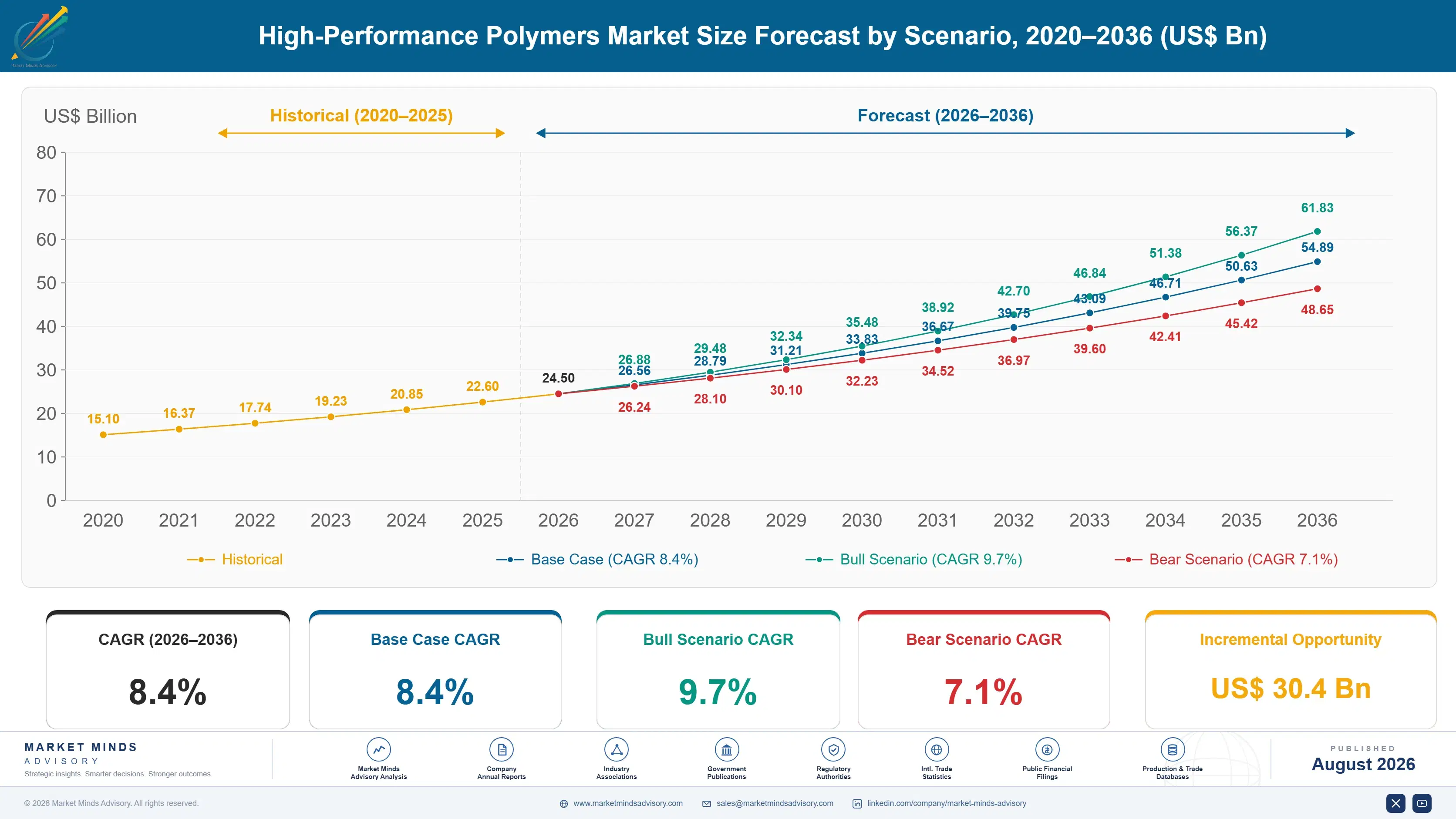
High-Performance Polymers Market Forecast Scenarios

high-performance-polymers-market-size-forecast-scenario-1787324320981
Growth from 2020 to 2025 compounded near 7.4%, held back early by pandemic aerospace order cancellations before semiconductor and EV demand more than offset the shortfall from 2022 onward. Electronics-grade qualification volumes grew considerably faster than any single producer had capacity planned for, straining supply chains badly during the steepest part of the multi-year ramp.
Three mechanisms carry the base case to 8.4%. First, EV battery components: PEEK and PPS increasingly replace metal in battery pack seals, connectors, and thermal management parts where weight and chemical resistance both matter. Second, semiconductor wafer handling, where high-purity PEEK and PAEK components must survive repeated cleaning cycles that would degrade standard engineering plastics quickly. Third, medical device miniaturisation, as implantable and surgical devices increasingly specify biocompatible high-performance resin over metal alternatives.
The bull case at 9.7% assumes semiconductor capacity expansion continues at its recent pace and EV production volumes hold through the coming decade despite near-term demand softness in some markets. The bear case at 7.1% assumes semiconductor capital spending cycles down meaningfully and aerospace order books, still recovering, fail to absorb capacity that electronics-grade expansion added faster than aerospace demand could offset.

Why Qualification Matters More Than Chemistry

Three forces set demand. Electrification is the largest, since electric drivetrains, battery packs, and charging hardware all demand sustained high-temperature and dielectric performance across parts that number in the hundreds per vehicle. Metal replacement continues wherever weight compounds, particularly aerospace and transport. And semiconductor fabrication keeps raising purity and chemical resistance requirements, on a qualified supplier list that stays deliberately short.
MARKET CONCENTRATIONCR5: 44%Specialty chemical majors dominate a technically demanding field
PRICE PER KILOGRAMUSD 15 to 200Resin pricing far above commodity engineering plastic ranges
QUALIFICATION LEAD TIME2 to 5 yearsTime from material selection to approved production part
CONTINUOUS USE TEMPERATURE150 to 300 CSustained service temperature these polymers withstand without degrading
METAL REPLACEMENT SHAREAbout 30%Portion of demand displacing machined or cast metal parts
FLUOROPOLYMER SHARE OF MARKETAbout 38%Largest family by value and by far the most regulated
The commercial character is qualification-bound and unusually sticky. Getting a grade approved into a production part takes two to five years of testing, and once approved it is rarely changed because requalification costs more than the material ever will. That makes the design-in moment decisive and everything afterwards a matter of holding position. It also means a producer losing a design loses it for the product's life, not for a purchasing cycle.
The next decade turns on regulation more than technology. The European universal PFAS restriction proposal covers fluoropolymers, which are the largest family by value here, and the outcome ranges from workable derogation to broad prohibition. Producers, formulators, and their customers are all making capital decisions against a rule that does not yet exist in final form.
"Everyone in this market talks about PFAS as a cost problem. It is not. It is a qualification problem. If a fluoropolymer grade goes away, the customer does not switch supplier, they redesign the part and requalify for three years. That is the actual exposure."
Director, Specialty Polymers and Advanced Materials Practice · MMA Chemicals and

Market Trends

PFAS Restriction Proposals Threaten Fluoropolymer Supply Chains

Five European national authorities submitted a universal PFAS restriction proposal to the European Chemicals Agency in February 2023, covering a class of substances that includes the fluoropolymers used across semiconductor, chemical processing, automotive, and medical applications. Industry bodies have argued strongly for derogation on polymers of low concern, but the eventual outcome remains genuinely unsettled after two years of consultation. The commercial consequence is already visible regardless of where the rule lands: customers are qualifying alternatives defensively, and producers are reluctant to commit capital to fluoropolymer capacity whose regulatory future nobody can price with confidence.
Market Impact: Weight savings reach 50% versus met
Electric Vehicles Pull High-Temperature Polymers Into Volume

An electric drivetrain runs hotter, at higher voltage, and with more electronic content than the combustion powertrain it replaces, which pulls polyphenylene sulfide, liquid crystal polymers, and high-performance polyamides into applications that previously used metal or lower-grade plastic. Battery module housings, busbar insulation, connectors, and thermal management components all demand sustained temperature and dielectric performance together. The commercially important shift is volume rather than chemistry: these were specialty applications measured in tonnes, and electrification is turning several of them into genuinely high-volume automotive parts with entirely different supply expectations. Supply security now matters as much as performance.
Market Impact: Purity specified below 1 ppb

Market Opportunities and Growth Drivers

Metal Replacement Cuts Weight In Aerospace And Transport

Polyaryletherketones and high-performance polyamides replace aluminium and steel in brackets, bearings, housings, and fluid handling components, delivering weight reduction that compounds across an aircraft or vehicle's entire service life. A commercial aircraft carries thousands of polymer parts that were metal a generation ago, and each kilogram removed saves fuel every flight hour for decades. The economics improve further with part consolidation: a single injection moulded component can replace an assembly of several machined pieces, removing fasteners, tolerances, inspection steps, and assembly labour all at once. That saving often exceeds the material premium.
Market Impact: Qualification runs 2 to 5 years

Semiconductor Purity Requirements Keep Tightening Continuously

Wafer fabrication demands materials that will not shed particles, outgas, or leach ionic contamination into ultra-pure chemicals, and each process node generation tightens those thresholds further. Fluoropolymers and high-purity sulfone grades line wet benches, tubing, valves, and wafer carriers throughout the fab. The commercially significant feature is the qualified supplier list, which stays deliberately short because a contamination excursion costs a fab far more than any material saving could justify. Semiconductor capacity expansion across the United States, Taiwan, Japan, and Europe pulls this demand directly into new fabrication sites, each of which qualifies its material suppliers afresh.
Market Impact: Some monomers have 2 producers

Market Restraints and Challenges

Qualification Cycles Lock Material Choices For Years

Approving a grade into a production part takes two to five years of testing across mechanical, thermal, chemical, and regulatory dimensions, and in medical or aerospace applications considerably longer. The root cause is consequence: these polymers sit in parts where failure is expensive or dangerous, so nobody accepts a substitution on datasheet equivalence alone. The commercial impact cuts both ways, protecting incumbents while making new entry brutally slow. Producers respond by targeting new development programmes rather than attempting conversions, and by funding application engineering years ahead of any revenue appearing at all.
Market Impact: Proposal covers over 10,000 substan

Monomer Supply Concentrates In Very Few Plants

The specialty monomers behind polyaryletherketones, sulfone polymers, and liquid crystal polymers are made in a handful of plants worldwide, several of them single-source. The root cause is scale economics: monomer demand is too small to support many producers, so capacity concentrates and stays concentrated. The commercial impact is that a single plant outage moves availability and pricing across an entire polymer family within weeks. Producers respond through backward integration where volume justifies the capital, multi-year take-or-pay supply agreements, and strategic inventory that ties up considerable working capital indefinitely. Customers with genuine scale increasingly demand dual-source qualification before committing a design.
Market Impact: Content rises 3 times per vehicle
3 additional market trends, 4 additional growth drivers, and 2 additional restraints and challenges are covered in the full report. Contact sales@marketmindsadvisory.com to access the complete intelligence.

Segment CAGR and Growth Architecture

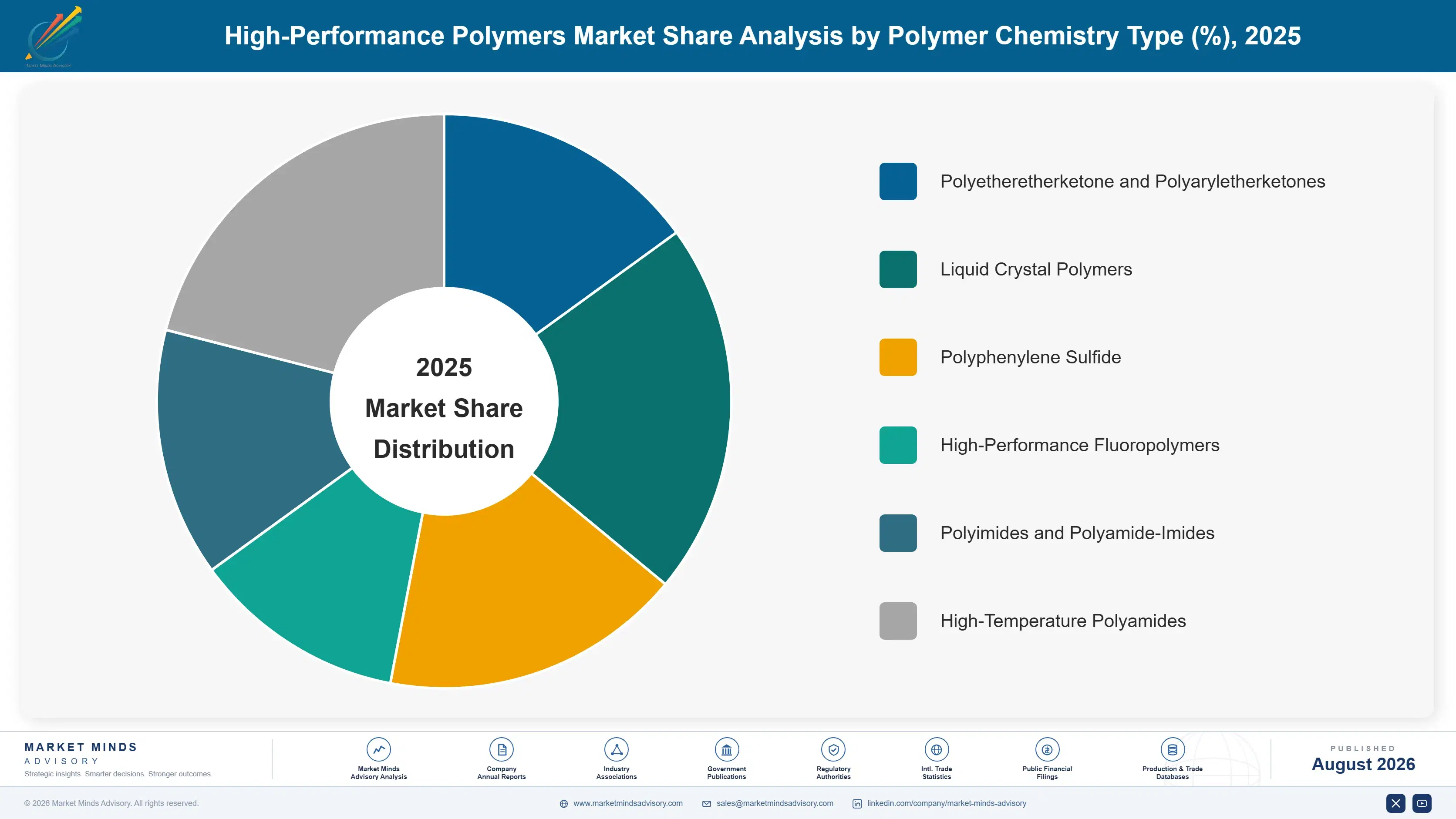
Segmentation follows polymer family, a single chemical logic grouping resins by their backbone structure. Each family carries its own temperature ceiling, monomer supply chain, regulatory exposure, and qualified application set, so commercial position tracks the chemistry rather than the part it eventually becomes. End-use industry and the processing route each appear separately within the framework.
high-performance-polymers-market-market-share-analysis-1787324321515

Liquid Crystal Polymers and Polyphenylene Sulfide

Liquid crystal polymers and polyphenylene sulfide grow fastest at 9.8%, about 1.32 times the overall 7.4% rate, on the back of electrification and high-frequency electronics simultaneously. Liquid crystal polymers combine dimensional stability with dielectric properties that suit high-frequency connectors and antenna components, which has made them central to advanced wireless hardware. Polyphenylene sulfide handles under-bonnet and battery pack temperatures with chemical resistance that lower grades cannot match, and an electric drivetrain uses considerably more of it than a combustion one. Polyplastics, Celanese, Toray, and Solvay's successor Syensqo lead a category where automotive qualification depth matters considerably more than headline material properties do. Chinese producers have built genuine polyphenylene sulfide capability and now compete on price in less demanding applications.
CAGR 9.8%

Polyaryletherketones

Polyaryletherketones grow at 8.6%, the second-fastest family, covering PEEK and PEKK resins that combine the highest continuous service temperatures in the thermoplastic range with genuine chemical inertness and biocompatibility. Three end markets drive the category: medical implants, where PEEK replaced metal in spinal and trauma devices; aerospace, where it replaces aluminium in brackets and interior structures; and semiconductor handling, where purity and dimensional stability both matter. Victrex holds an unusually strong position built over decades of qualification history, with Solvay's successor and Evonik competing. Pricing runs at the very top of the market, and monomer supply is genuinely concentrated across only a few producers worldwide, which makes the family unusually exposed to any single plant outage.
CAGR 8.6%
Full segment breakdown across 5 segments available in the complete report.

Regional Architecture and Country Demand Map

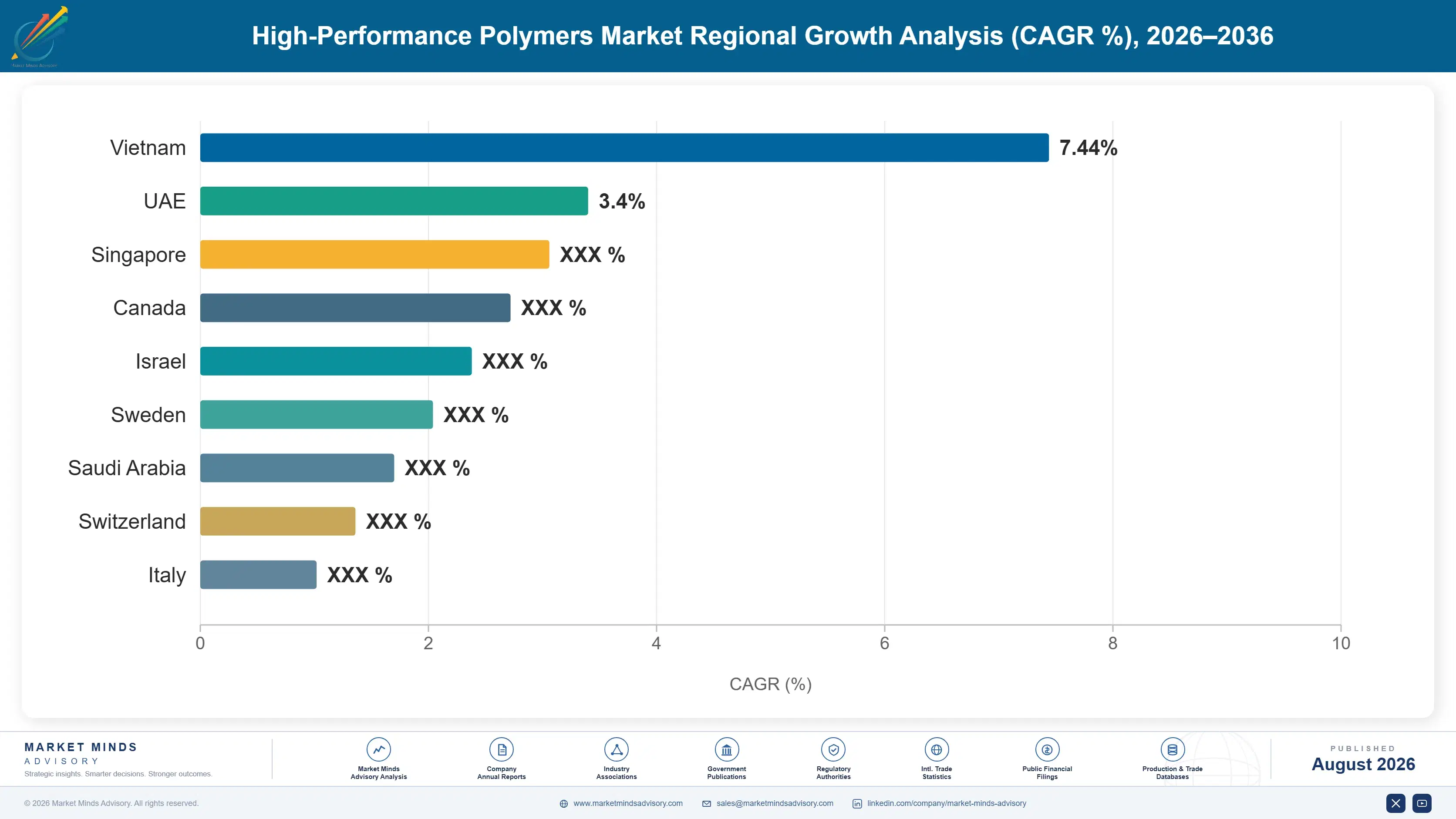
East Asia dominates on electronics, battery, and semiconductor manufacturing concentration, taking a share of value no other region comes close to approaching. North America and Western Europe follow on aerospace, medical, and semiconductor demand, while South Asia and Pacific grows fastest as Indian manufacturing scales.

North America

Aerospace, medical, and semiconductor demand together anchor North America's 22% share, inside the 22 to 32% band. American aerospace consumes polyaryletherketones and high-performance polyamides at volumes few markets match, and the medical device industry drives implant-grade PEEK demand that carries the highest pricing in the market. CHIPS Act funded fabrication capacity is pulling high-purity fluoropolymer and sulfone demand into new domestic sites. Chemours and Celanese both headquarter here with substantial production. Growth of 6.8% reflects steady aerospace recovery and semiconductor construction, tempered by automotive electrification that has advanced more slowly than in China or Europe. Medical device manufacturers in Minnesota, Massachusetts, and California anchor implant-grade demand that carries the highest pricing anywhere in the market.
Share: 22% | CAGR: 6.8% (2026 to 2036)

Western Europe

Automotive engineering depth and chemical manufacturing history give Western Europe 20% of value, inside the 18 to 26% band, with Germany the largest single national market. The region hosts Syensqo, Evonik, Arkema, and Victrex production, and its automotive tier suppliers qualify materials to standards that then propagate globally. Working against it, the universal PFAS restriction proposal originated here and European fluoropolymer producers face the earliest regulatory pressure anywhere. Energy costs have also weighed on European polymer production since 2022. Growth of 5.9% is the slowest of the seven, reflecting regulatory uncertainty and a manufacturing base under sustained cost pressure. Its tier one automotive suppliers also qualify materials to standards that then propagate into vehicle programmes built elsewhere entirely.
Share: 20% | CAGR: 5.9% (2026 to 2036)
Regional intelligence for 5 additional markets available in the complete report: East Asia, South Asia and Pacific, Latin America, Middle East and Africa, Eastern Europe. Contact sales@marketmindsadvisory.com.
high-performance-polymers-market-country-cagr-analysis-1787324322025

Where Polymer Producers Actually Defend Margin

Competing on resin price against a qualified incumbent is a contest the challenger loses before it even begins, because requalification costs the customer far more than the material ever will. The four moves below concentrate on what actually decides share here: the design-in, the compound rather than the pellet, regulatory positioning, and technical service.

Qualify Into The Design Before Competitors Arrive

Approval into a production part takes two to five years, and once a grade is qualified it typically stays for the product's entire life because requalification costs far more than any material saving. That makes the design-in moment worth more than every subsequent purchasing negotiation combined. Producers should fund application engineering against customer development programmes years before revenue appears, targeting new platforms rather than attempting conversions. A single automotive platform qualification can carry 7 to 10 years of volume, which is why the economics justify the wait. Conversions of existing parts almost never repay the effort involved.
Market Impact: One platform carries 7 to 10 years

Sell Compounds, Not Base Resin Alone

Base resin is comparatively substitutable once a family is specified; a glass-filled, carbon-filled, or lubricated compound tuned to a specific application is not, because the compound itself becomes the qualified material on the approval record. Producers who compound capture the formulation know-how, the qualification history, and considerably better margin than pellet supply delivers. Compounded grades typically earn 30% to 45% more per kilogram than the base resin they contain. Selling only base resin cedes both margin and relationship to whichever compounder does that work. Compounding also keeps the technical conversation with the converter rather than ceding it entirely.
Market Impact: Compounds earn 30% to 45% more per

Position Non-Fluorinated Grades Ahead Of Restriction

The European universal PFAS restriction proposal covers fluoropolymers representing roughly 38% of this market by value, and customers are already qualifying alternatives defensively regardless of where the rule finally lands. Producers offering qualified non-fluorinated grades for applications where performance permits capture that defensive qualification activity now, at the customer's expense rather than their own. Waiting for regulatory certainty means arriving after the requalification work has been completed with somebody else's material, which in this market means arriving far too late. Defensive qualification is happening now, whether or not producers choose to participate in it.
Market Impact: Restriction touches 38% of total ma

Attach Technical Service To Processing Difficulty

These polymers process at temperatures and pressures that destroy tooling and scrap parts when handled wrongly, and most moulders lack the experience to run them well without help. Producers who provide processing parameters, tool design support, and on-site commissioning make themselves necessary to the converter rather than merely supplying it. That service also generates the application data feeding the next qualification. Producers offering full processing support report scrap rates 20% to 40% lower at customer sites, which customers value far more than a small resin discount. Processing support is also the cheapest route into a new converter account.
Market Impact: Support cuts converter scrap by 20%

Who Controls the Margin Pool

Concentration sits at 44%, and the barrier is not plant scale but monomer access and accumulated qualification history that no amount of capital shortens. Specialty chemical majors hold most families, while a handful of focused specialists dominate individual chemistries outright. All participants here are assessed on one basis, revenue from high-performance polymer resins and compounds, excluding standard engineering thermoplastics and finished components.
Competition runs along three lines. First, qualification portfolio depth, since an approved grade sitting in a production part is effectively unassailable for that product's remaining life. Second, monomer position, because several specialty monomers come from very few plants and backward integration is a genuine, durable advantage. Third, regulatory positioning on fluoropolymers, where producers are judged on whether they hold credible non-fluorinated alternatives already qualified and available today.

Pressure is building from two directions. Chinese producers have built real capability in polyphenylene sulfide and fluoropolymers, competing on price in applications where qualification barriers are lower. Meanwhile the portfolio reshuffling continues, with Celanese absorbing DuPont's Mobility and Materials business and Solvay separating into Syensqo and Solvay. Rankings should favour producers holding both deep qualification records and credible non-fluorinated positions.
high-performance-polymers-market-company-positioning-matrix-1787324322545

Competitive Moat and Risk Dimensions

SYENSQO

Moat: Broadest qualified family portfolio

Syensqo spans polyaryletherketones, sulfone polymers, high-performance polyamides, and fluoropolymers, giving it a portfolio breadth that lets it serve a customer across several material families from one technical relationship. Decades of qualification records in aerospace, medical, and semiconductor applications cannot be replicated quickly by any challenger. Its application engineering depth supports design-in work years ahead of revenue.
SYENSQO

Risk: Fluoropolymer regulatory exposure

A meaningful share of Syensqo's portfolio sits in fluoropolymers facing the European universal PFAS restriction proposal, and the company is headquartered in exactly the jurisdiction driving that proposal. Separating from Solvay also left it carrying standalone costs while establishing an independent identity with customers. European energy costs weigh on its production base relative to Asian and American competitors.
CHEMOURS

Moat: Fluoropolymer scale and integration

Chemours holds the largest fluoropolymer position in the market with backward integration into fluorspar-derived intermediates, which matters because that supply chain is concentrated. Its Teflon brand carries recognition and qualification history across semiconductor, chemical processing, and industrial applications spanning decades. Scale in a family representing roughly 38% of market value gives it genuine pricing influence.
CHEMOURS

Risk: Concentrated PFAS litigation and regulation

Chemours carries both regulatory exposure to the PFAS restriction proposal and substantial legacy environmental litigation liability inherited at separation from DuPont. Its concentration in fluoropolymers means it lacks the portfolio breadth to redirect customers toward non-fluorinated alternatives that competitors can offer. Any restrictive regulatory outcome hits its core franchise directly rather than one segment among several.

Players Tracked

Prominent Players

Syensqo
Chemours
Daikin Industries
Victrex
Celanese

Other Key Players

DuPont
Evonik Industries
Arkema
Toray Industries
Mitsui Chemicals
BASF
SABIC
Kuraray
Sumitomo Chemical
Polyplastics
AGC Inc.
Ensinger
RTP Company
Rochling Group
Kureha Corporation

Recent Developments

NOVEMBER 2022

Celanese completes acquisition of DuPont Mobility and Materials

Celanese completed its acquisition of the majority of DuPont's Mobility and Materials business for approximately USD 11 billion. This was an outright acquisition rather than a joint venture or merger, and it added substantial engineering and high-performance polymer capability including established automotive qualification portfolios. Automotive approvals came with it.
Signal: A commodity acetyl producer paying heavily
FEBRUARY 2023

European Chemicals Agency publishes universal PFAS restriction proposal

Five national authorities submitted a universal restriction proposal covering per- and polyfluoroalkyl substances to the European Chemicals Agency, which published it for consultation. This was a regulatory proposal rather than an enacted restriction, and its scope includes the fluoropolymers used across semiconductor, automotive, and chemical processing applications.
Signal: A proposal, not a rule, is already redirec
DECEMBER 2023

Solvay separates into Syensqo and Solvay

Solvay completed its separation into two independent listed companies, with Syensqo taking the specialty materials portfolio including high-performance polymers. This was a demerger creating two separate entities rather than any sale, acquisition, or joint venture, and both companies began trading independently on Euronext Brussels. Both listed on Euronext Brussels.
Signal: Separating specialty polymers from commodi

Monomers, Fluorspar, Energy, And Purification

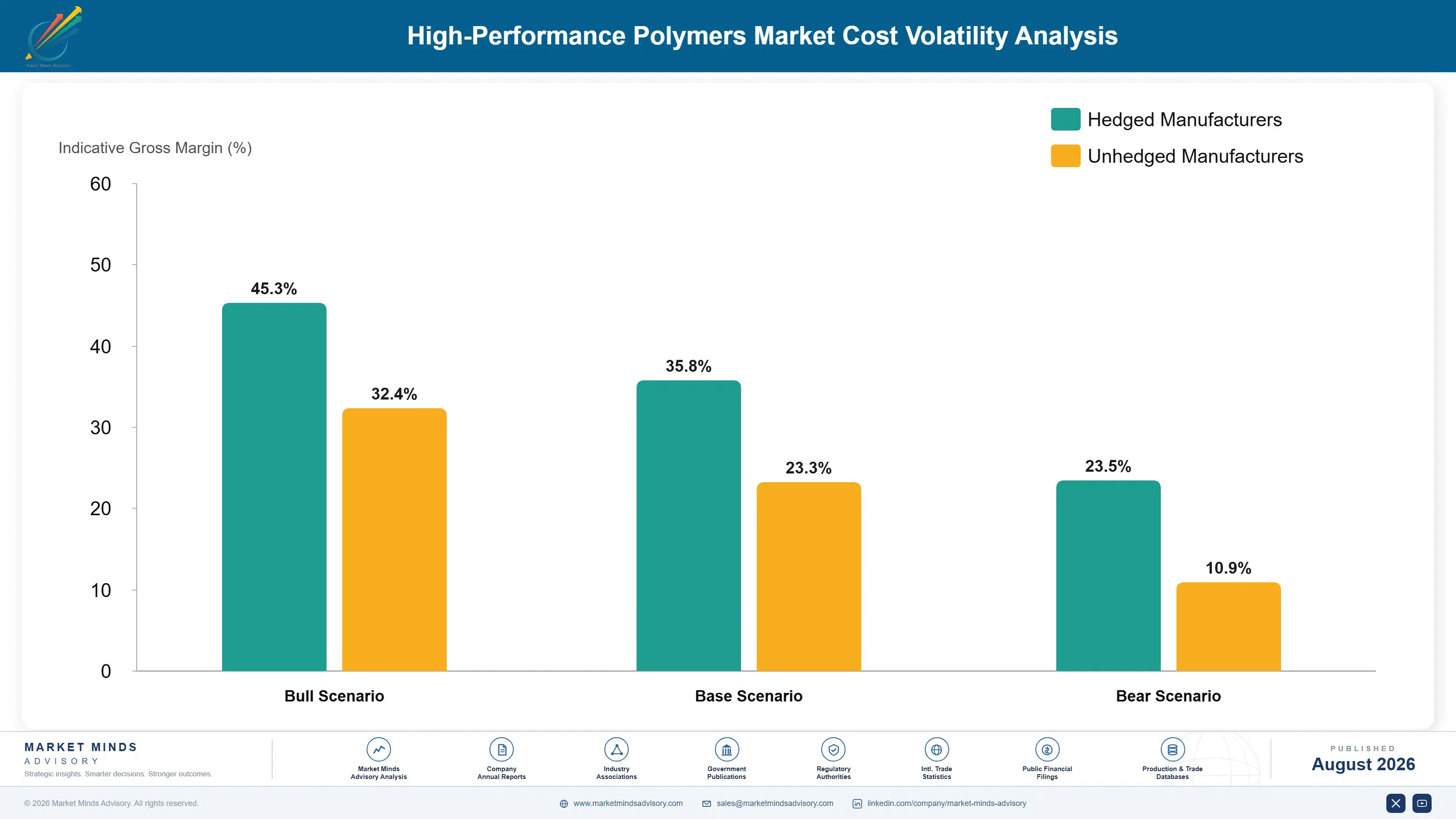
Specialty monomers dominate the cost base. Purpose-made monomers for polyaryletherketones, sulfone polymers, and liquid crystal polymers run 35% to 45% of COGS, and several come from very few plants worldwide. Fluorspar and hydrogen fluoride derivatives add 12% to 20% on fluoropolymer lines, with China holding much of world fluorspar supply. Energy takes 12% to 18% given high polymerisation temperatures, and purification and compounding absorb the remainder.
The 2021 and 2022 energy shock hit European producers hardest of anyone. Natural gas prices spiked while these polymers require sustained high-temperature processing, and EIA data recorded the parallel move in petroleum feedstocks. Syensqo's predecessor and Victrex both disclosed material energy and raw material inflation in their 2022 annual reporting. Fluorspar concentration in China has separately made that input a strategic exposure. Producers outside Europe gained a real cost advantage that has persisted since.

Exposure separates the integrated from the dependent. Producers with captive monomer capacity absorb specialty feedstock movement far more comfortably than those buying from a single-source supplier who also serves their competitors. Fluoropolymer producers carry the additional fluorspar concentration risk on top. The hardest position is a mid-sized producer buying monomer on contract while competing against integrated majors.
high-performance-polymers-market-cost-volatility-analysis-1787324322741

Integrate backward into specialty monomer production where volume justifies

Several key monomers come from one or two plants globally, and no purchasing term protects against an outage at a single-source supplier. Backward integration is capital-intensive and justified only at real volume, but it converts a critical dependency into an owned asset. Where integration is impractical, long-term take-or-pay agreements at least secure allocation ahead of competitors.

Diversify fluorspar sourcing beyond concentrated Chinese supply

China holds a large share of world fluorspar production, and export policy or domestic demand shifts move availability for every fluoropolymer producer simultaneously. Qualifying Mexican, South African, and Mongolian sources costs more per tonne and requires process validation, but it removes a single-country dependency on the input underpinning the largest family in this market. Strategic inventory bridges shorter disruptions.

Shift polymerisation energy load toward lower-cost qualified sites

These polymers need sustained high-temperature processing, so energy cost differences between regions translate directly into margin differences on identical product. Concentrating energy-intensive polymerisation at sites with competitive industrial power, while keeping compounding and finishing close to customers, protects margin without compromising service. Requalification of production sites is required for regulated applications, which makes this a multi-year programme.

Portfolio Architecture for Margin Defence

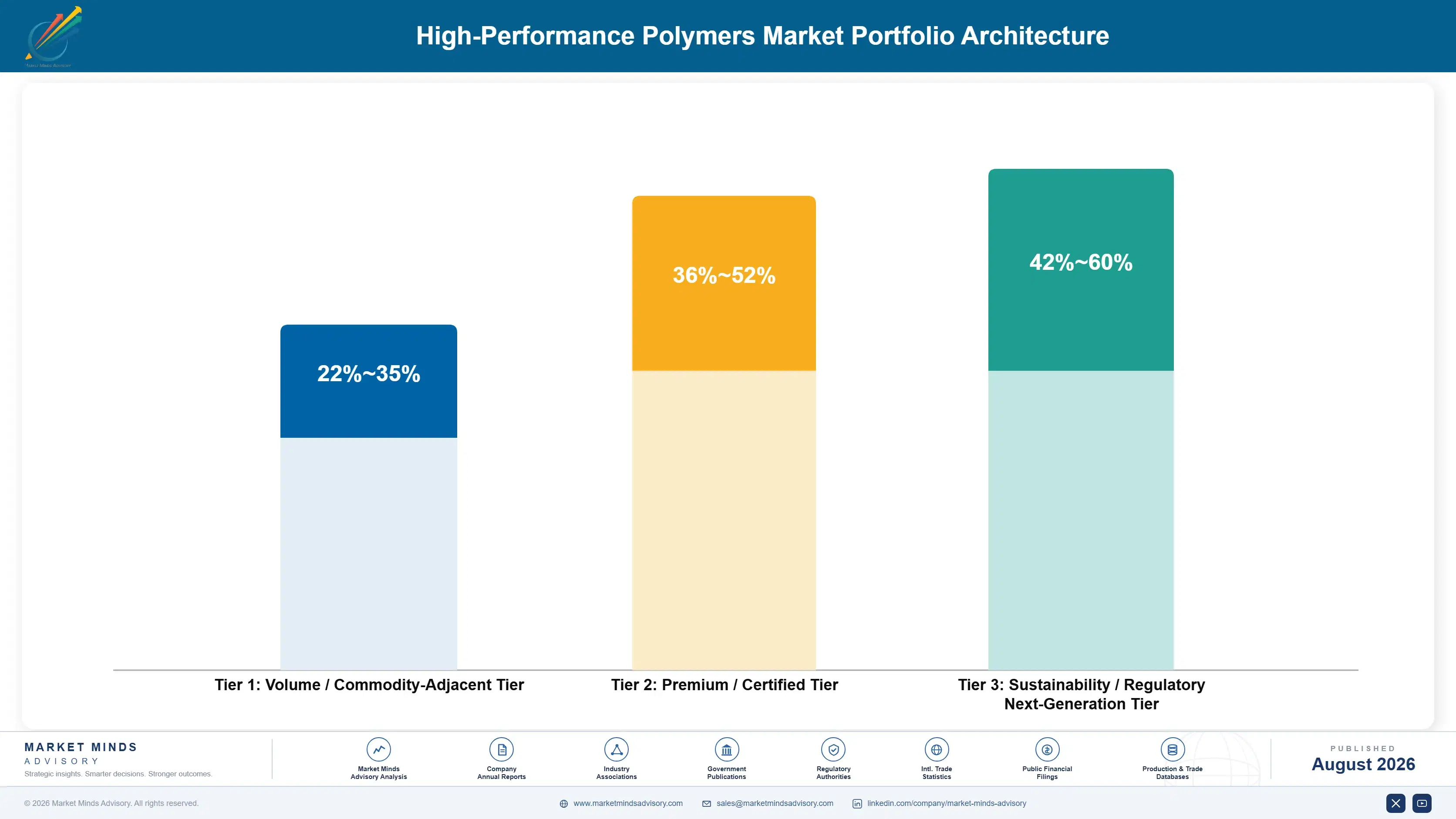
The portfolio splits into three tiers with clearly separated economics. Volume grades, standard polytetrafluoroethylene and general polyphenylene sulfide compounds, compete on price against Chinese producers in applications where qualification barriers are lowest. Certified premium grades, meaning medical-implant, aerospace, and semiconductor-qualified materials, earn materially more because the approval record itself is the barrier. Non-fluorinated substitutes and next-generation grades sit dif
The tension runs between volume that fills polymerisation capacity and qualification work that generates the returns. Standard grades keep expensive plants loaded and maintain converter relationships that also handle premium material, so abandoning them cedes the processing channel. Yet each commodity kilogram dilutes blended margin against producers with lower cost bases. The strongest participants use volume grades to hold capacity utilisation while directing technical resources entirely at qualification.

High-value pools concentrate where the approval record cannot be circumvented: implant-grade polyaryletherketone with clinical history, semiconductor-qualified high-purity grades on short approved supplier lists, and aerospace materials carrying decades of test data. All three resist substitution because the buyer is purchasing a qualification file as much as a polymer. Material sold on datasheet properties alone competes with every producer holding an equivalent specification.

Volume / Commodity-Adjacent Tier

Standard polytetrafluoroethylene, general polyphenylene sulfide compounds, and unfilled grades sold into applications with low qualification barriers. The range is wide because Chinese producers price aggressively while established suppliers hold a premium on consistency and documentation.
Gross Margin: 22-32%

Premium / Certified Tier

Medical-implant, aerospace-qualified, and semiconductor high-purity grades carrying extensive approval records. The range is wide because implant and semiconductor grades command exceptional pricing while aerospace materials face more competitive qualification against several approved alternatives.
Gross Margin: 35-48%

Sustainability / Regulatory / Next-Generation Tier

Non-fluorinated substitutes for restricted applications, recycled high-performance grades, and bio-based backbone chemistries. The range is wide because early substitution grades command scarcity pricing while recycled materials still carry qualification cost against limited volume.
Gross Margin: 30-50%
high-performance-polymers-market-portfolio-architecture-1787324323248

High-value Sub-segments and Strategic Watch-out

Liquid Crystal Polymers and Polyphenylene Sulfide

High value and high growth at 9.8%, the fastest family of all, pulled simultaneously by electric drivetrains and by high-frequency electronic hardware into genuinely high-volume automotive applications. Early design-in engineering is therefore the single most valuable commercial activity available anywhere in this particular polymer family.
Gross Margin: 32-44%

Polyaryletherketones

High value with strong growth at 8.6%, carrying the highest pricing anywhere in the market across medical implant, aerospace, and semiconductor applications. Decades of accumulated qualification history make incumbent positions genuinely difficult for any challenger to attack from outside. Monomer supply nonetheless remains concentrated across very few producers worldwide.
Gross Margin: 38-52%

High-Performance Polyamides

The volume core at 7.2%, serving under-bonnet automotive, electrical, and general industrial applications at scale across every major market. Steady and broadly specified, but the most exposed of all to competitive pricing from producers holding equivalent automotive approvals. Differentiation rests on compound formulation rather than on the base polymer itself.
Gross Margin: 26-38%

Fluoropolymers

The strategic watch-out at 5.8%, the largest family by value and the one facing the European universal PFAS restriction proposal head on. Customers are already qualifying alternatives defensively, regardless of where the final rule actually lands when it is written. Performance is genuinely irreplaceable in a handful of sealing applications.
Gross Margin: 28-42%

How Polymer Specification Commits

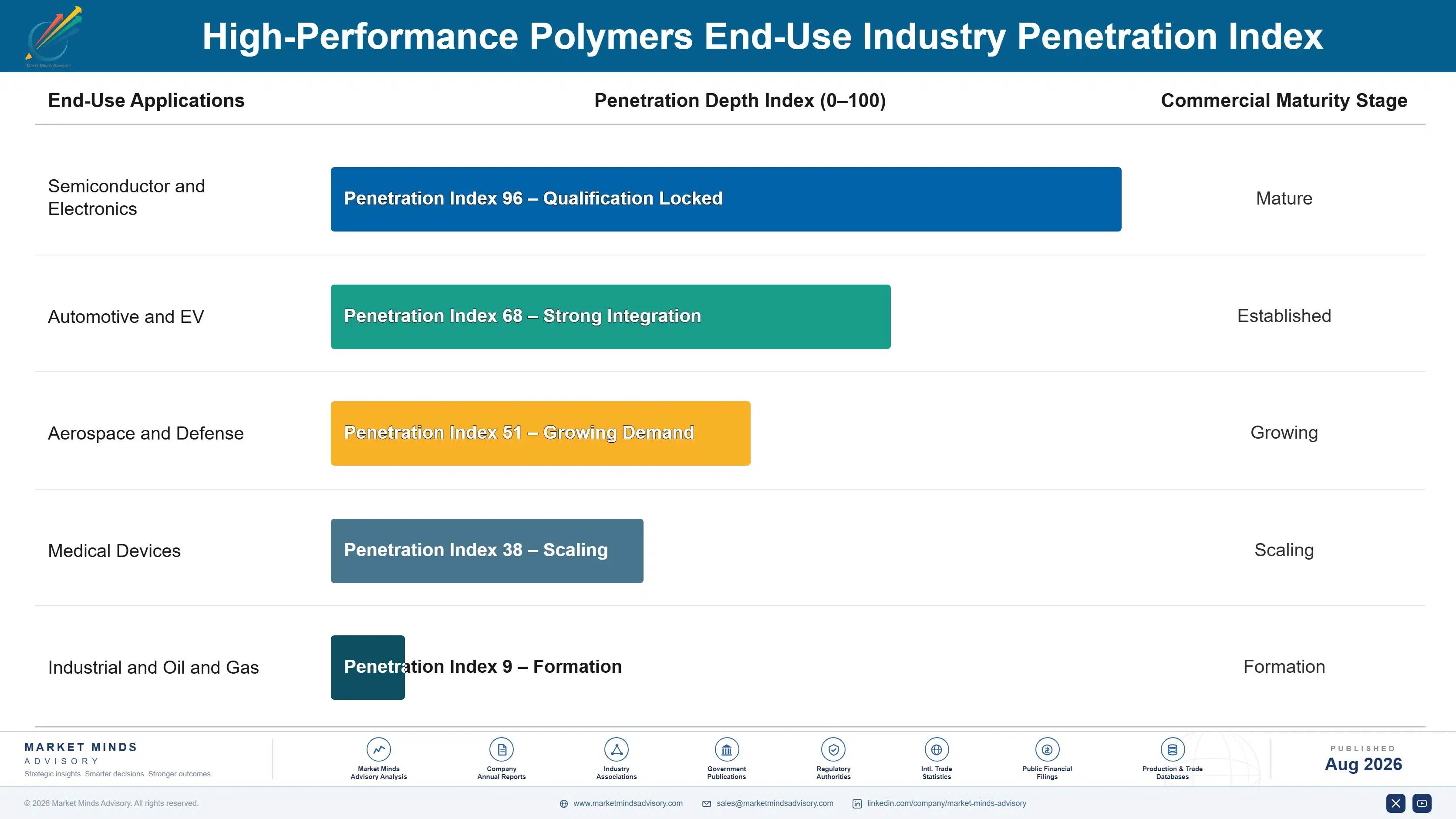
Demand commits at qualification and holds for the product's life. Getting a grade approved into a production part takes two to five years of testing, and once approved it is rarely changed because requalification costs far more than the material. That approval behaves like an annuity across every unit built on that platform. Producers therefore fight hardest during customer development programmes, years before any revenue appears, because that is when the decision is genuinely open.
Adoption depth varies sharply by end-use industry. Medical implants commit deepest, with clinical history and regulatory filings making substitution nearly unthinkable once approved. Aerospace follows on decades-long qualification records and airworthiness documentation. Semiconductor fabrication maintains short approved supplier lists that change rarely. Automotive commits firmly per platform but reopens at each model generation. Industrial and general engineering applications are shallowest, switching on price where specifications permit.

Buyer profiles have shifted from materials engineers toward joint decisions with regulatory and sustainability functions. Material selection was once purely technical; PFAS exposure now brings compliance teams into a choice that used to be settled in a laboratory. Younger design engineers also screen for regulatory durability before performance, having watched programmes disrupted by substances restricted after qualification was complete.
high-performance-polymers-market-end-use-penetration-index-1787324323738

Our Call On High-Performance Polymers

These are among the four positions where our research anticipates prominent divergence between winners and laggards over the coming forecast period. Each is grounded in the demand model, the regulatory perimeter, and the announced capacity pipeline.
01 / PFAS REPRICES FLUOROPOLYMERS

A proposal nobody has finalised is already redirecting qualification

The European universal PFAS restriction proposal covers fluoropolymers representing roughly 38% of this market by value, and customers are qualifying alternatives defensively rather than waiting for the rule to be settled. The exposure is not cost but requalification, which takes years and happens whether or not restriction lands. Producers should therefore bring credible non-fluorinated grades to market now and capture that defensive qualification activity, because waiting for certainty means arriving after the work was done with somebody else's material, and conversions of existing qualified parts rarely repay the effort.
02 / QUALIFICATION LOCKS SHARE

The design-in decides a decade of volume, not the price list

Approval into a production part takes two to five years, and once qualified a grade typically stays for the product's entire life because requalification costs far more than any material saving could recover. A single automotive platform can carry seven to ten years of volume on one decision. Producers should therefore fund application engineering against customer development programmes years ahead of revenue, targeting new platforms rather than attempting conversions where the incumbent's position is effectively unassailable, and ceding that work hands a competitor the customer relationship entirely.
03 / ELECTRIFICATION PULLS VOLUME

Specialty applications are becoming genuinely high-volume automotive parts

An electric drivetrain runs hotter, at higher voltage, and with far more electronic content than the combustion powertrain it replaces, pulling polyphenylene sulfide, liquid crystal polymers, and high-performance polyamides into battery housings, busbar insulation, and connectors. These were specialty applications measured in tonnes. Producers should therefore build automotive-scale qualification and supply capability deliberately, because the commercial requirements of a high-volume vehicle programme differ sharply from those of the aerospace and medical work these materials were built around, and automotive supply expectations differ sharply from aerospace ones.
04 / COMPOUNDS BEAT RESIN

The qualified material is the compound, not the base polymer

Base resin is comparatively substitutable once a polymer family is specified, but a filled or lubricated compound tuned to a specific application becomes the qualified material in its own right, and that is what the approval record actually covers. Compounded grades earn 30% to 45% more per kilogram than the resin they contain. Producers selling only base pellets cede both that margin and the customer technical relationship to whichever compounder performs the formulation work instead of them, and the approval record covers the compound, never the base pellet.

Engagement Snapshot From the Field

A live engagement with an industry participant carrying material or product regulatory and market exposure ahead of a defining policy shift, showing how our research translates into a defensible multi-year portfolio strategy.
MARKET MINDS ADVISORY · CLIENT ENGAGEMENT SUMMARY
High-Performance Polymers Producer Strategic Portfolio Review and Transition Roadmap 2026·Investment Scenario on High-Performance Polymers Exposure Evaluation 2025-26
CLIENT PROFILE
A tier-one automotive component manufacturer supplying electrical and thermal management parts to European and North American assemblers engaged MMA as PFAS restriction proposals advanced. The client reported annual revenue near USD 2.9 billion, with fluoropolymers appearing in roughly 340 qualified part numbers and its customers beginning to request substitution roadmaps (client-reported, unverified by MMA). Roughly 40% of group revenue passed through affected components.
STRATEGIC CHALLENGE
Assemblers were asking for PFAS-free commitments the client could not yet make, and requalifying every affected part would take years and cost more than the components earned. Engineering wanted to wait for regulatory clarity; the commercial team wanted to promise substitution to protect customer relationships. Nobody had established which parts genuinely required fluoropolymers and which used them by inheritance.
MMA APPROACH
MMA screened all 340 affected part numbers against actual service requirements rather than against the original specification, separating parts where fluoropolymer performance was genuinely necessary from those where it had been carried forward unexamined. We assessed qualified non-fluorinated alternatives for each substitutable case. We then sequenced requalification against customer platform renewal dates, so the work landed when parts were being reopened anyway.
KEY FINDINGS
  1. Only about 40% of the affected part numbers genuinely required fluoropolymer performance; the remainder had inherited the specification from predecessor parts without technical review (client-reported, unverified by MMA).
  2. Sequencing requalification against platform renewal dates removed most of the cost, since those parts were being reopened for other engineering reasons regardless.
  3. Qualified non-fluorinated alternatives already existed for the majority of substitutable applications, though at higher material cost that the client could pass through.
  4. Three high-temperature sealing applications had no viable substitute at any price, requiring a derogation argument rather than a substitution plan (client-reported, unverified by MMA).
CLIENT PROFILE
A tier-one automotive component manufacturer supplying electrical and thermal management parts to European and North American assemblers engaged MMA as PFAS restriction proposals advanced. The client reported annual revenue near USD 2.9 billion, with fluoropolymers appearing in roughly 340 qualified part numbers and its customers beginning to request substitution roadmaps (client-reported, unverified by MMA). Roughly 40% of group revenue passed through affected components.
STRATEGIC CHALLENGE
Assemblers were asking for PFAS-free commitments the client could not yet make, and requalifying every affected part would take years and cost more than the components earned. Engineering wanted to wait for regulatory clarity; the commercial team wanted to promise substitution to protect customer relationships. Nobody had established which parts genuinely required fluoropolymers and which used them by inheritance.
MMA APPROACH
MMA screened all 340 affected part numbers against actual service requirements rather than against the original specification, separating parts where fluoropolymer performance was genuinely necessary from those where it had been carried forward unexamined. We assessed qualified non-fluorinated alternatives for each substitutable case. We then sequenced requalification against customer platform renewal dates, so the work landed when parts were being reopened anyway.
KEY FINDINGS
  1. Only about 40% of the affected part numbers genuinely required fluoropolymer performance; the remainder had inherited the specification from predecessor parts without technical review (client-reported, unverified by MMA).
  2. Sequencing requalification against platform renewal dates removed most of the cost, since those parts were being reopened for other engineering reasons regardless.
  3. Qualified non-fluorinated alternatives already existed for the majority of substitutable applications, though at higher material cost that the client could pass through.
  4. Three high-temperature sealing applications had no viable substitute at any price, requiring a derogation argument rather than a substitution plan (client-reported, unverified by MMA).
RECOMMENDED STRATEGY
Phase 1: Phase 1 (0 to 9 months): Screen every fluoropolymer part against genuine service requirements, separating technical necessity from inherited specification before committing to anything. Phase 2: Phase 2 (9 to 30 months): Requalify substitutable parts against customer platform renewal dates, so requalification cost is absorbed by work already scheduled. Phase 3: Phase 3 (30 to 48 months): Build a documented derogation case for the applications with no viable substitute, supported by service data rather than assertion.
OUTCOME
The client committed to a substitution roadmap covering the majority of affected parts without accelerating any requalification ahead of platform renewal, which contained the cost almost entirely. Customer relationships were protected by a credible plan rather than an unachievable promise, and the three genuinely irreplaceable applications were separated early for a documented derogation argument (client-reported, unverified by MMA).

Frequently Asked Questions

Foundational context covering the market sizes, CAGR, scope, country, region and competition that inform every finding below. This section is provided to cover basics and most often pre-purchase conversations, answered from the MMA Primary Research Dataset.

What is the current size of the High-Performance Polymers Market?

The global high-performance polymers market is valued at USD 28.5 billion in 2025, covering fluoropolymers, polyaryletherketones, high-performance polyamides, sulfone polymers and polyimides, and liquid crystal polymers and polyphenylene sulfide. Standard engineering thermoplastics, thermosets, and finished components are excluded.

How large will the High-Performance Polymers Market be by 2036?

The market is forecast to reach USD 62.5 billion by 2036 in the base case, about 2.04 times the 2026 level. That represents incremental value of roughly USD 31.89 billion across the decade.

What is the CAGR for the High-Performance Polymers Market 2026 to 2036?

The market grows at a 7.4% CAGR in the base case, with bull and bear scenarios at 8.7% and 6.1%. The spread turns mainly on how the European PFAS restriction proposal is finally scoped for industrial fluoropolymers.

Which segment is growing fastest?

Liquid crystal polymers and polyphenylene sulfide grow fastest at 9.8%, about 1.32 times the overall rate, pulled by electric drivetrains and high-frequency connectors. Polyaryletherketones follow at 8.6% on medical, aerospace, and semiconductor demand.

Who are the major companies in the High-Performance Polymers Market?

Leading producers include Syensqo, Chemours, Daikin Industries, Victrex, and Celanese. The top five hold roughly 44% of revenue, with the barrier resting on monomer access and qualification history rather than plant scale.

Which country is growing fastest?

India grows fastest at a 12.6% CAGR, as production-linked incentive schemes pull electronics, automotive component, and pharmaceutical manufacturing into domestic plants. China remains by far the largest single national market on electronics and electric vehicle production.

Report Segmentation Architecture

The full report scope spans multiple orthogonal segmentation dimensions, with cross-tabulated demand data provided for each dimension pair. Coverage extends further to regional breakdowns, trend trajectories, and the competitive detail needed to support segment-level decision-making.

By Polymer Family

  • Fluoropolymers
  • Polyaryletherketones
  • High-Performance Polyamides
  • Sulfone Polymers and Polyimides
  • Liquid Crystal Polymers and Polyphenylene Sulfide

By End-Use Industry

  • Automotive and Electric Mobility
  • Electrical, Electronics, and Semiconductor
  • Aerospace and Defence
  • Medical Devices and Healthcare
  • Industrial, Energy, and Chemical Processing

By Processing Route

  • Injection Moulding Grades
  • Extrusion and Film Grades
  • Compounded and Filled Grades
  • Semi-Finished Stock Shapes and Additive Feedstock

By Region

  • North America
  • Western Europe
  • East Asia
  • South Asia and Pacific
  • Latin America
  • Middle East and Africa
  • Eastern Europe

Scope, Methodology, and Coverage

Every figure in this report is reproducible from documented input assumptions. The scope below maps the historical period, the forecast horizon, the segmentation dimensions, and the countries covered, alongside the underlying primary and qualitative methodology.
Historical Period
2020 to 2025
Forecast Period
2026 to 2036
Base Year
2025 (USD billions; MMA Primary Research Dataset, August 2026)
Market Definition
The high-performance polymers market comprises thermoplastic resins and their compounds engineered for continuous service temperatures above roughly 150 degrees Celsius, or for chemical, electrical, tribological, or mechanical performance materially beyond standard engineering thermoplastics, valued at producer selling prices. It spans fluoropolymers, polyaryletherketones, high-performance polyamides, sulfone polymers and polyimides, and liquid crystal polymers and polyphenylene sulfide, in unfilled and compounded forms. Commodity and standard engineering thermoplastics, thermosetting resins, elastomers and rubbers, high-performance fibres and composites, and finished moulded or machined components are excluded.
Quantitative Units
USD billions (current prices); resin volume in kilotonnes and price per kilogram where applicable
Segmentation Dimensions
By Polymer Family; By End-Use Industry; By Processing Route; By Region
Regions Covered
North America, Western Europe, East Asia, South Asia and Pacific, Latin America, Middle East and Africa, Eastern Europe
Countries Covered
USA, China, Germany, France, UK, Japan, South Korea, India, Australia, Canada, Brazil, Mexico, Indonesia, Vietnam, Thailand, Malaysia, UAE, Saudi Arabia, South Africa, Nigeria, Turkey, Poland, Netherlands, Italy, Spain, Sweden, Switzerland, Argentina, Colombia, Singapore, and additional markets relevant to this sector
Key Companies Profiled
Syensqo, Chemours, Daikin Industries, Victrex, Celanese, DuPont, Evonik Industries, Arkema, Toray Industries, Mitsui Chemicals, BASF, SABIC, Kuraray, Sumitomo Chemical, Polyplastics, AGC Inc., Ensinger, RTP Company, Rochling Group, Kureha Corporation
Quantitative Methodology
Primary survey, n=3,800 respondents, Q4 2025, six countries; demand-side model with trade association cross-validation
Qualitative Methodology
47 expert interviews, Q4 2025; applied to validate demand model assumptions, identify emerging dynamics, and assess competitive positioning
Report Format
PDF and XLSX data workbook (Word format preview document)
Publisher
Market Minds Advisory
Report Code
MMA-2026-CHM-131
Published
August 2026
Contact
sales@marketmindsadvisory.com | www.marketmindsadvisory.com

Purchase the full High-Performance Polymers Market Report (2026 to 2036).

The full MMA High-Performance Polymers report sizes the market across five polymer families, five end-use industries, four processing routes, and seven regions through 2036. It profiles 20 producers on a consistent basis of high-performance resin and compound revenue, scoring each on qualification portfolio depth, monomer integration, fluoropolymer exposure, and substitute grade readiness. Scenario models quantify how PFAS restriction scope, electrification build rates, and semiconductor capacity investment move both volume and achievable price by family. The report also includes qualification cycle benchmarking by end-use, monomer supply concentration mapping, PFAS substitution feasibility screening by application, and compound margin analysis for commercial and technical teams.
Five-family and four-route market sizing to 2036
Twenty-producer benchmark on consistent resin and compound revenue
Qualification cycle benchmarking across major end-use industries
Monomer supply concentration mapping by polymer family
PFAS substitution feasibility screening by application type
Compound versus base resin margin analysis by grade

Built For The People Who Decide

From boardroom strategy to bench-side execution, this report is read cover-to-cover by leaders shaping the next decade of their industry, turning demand scenarios, market dynamics and valuation benchmarks into decisions.
CXOs/ Presidents/ VPs/ Managers
M&A and Corporate Development
Strategy Teams and R&D Heads
Procurement and Product Directors
Regulatory and Compliance Leaders
Investor Relations and Equity Analysts