Market Minds Advisory
High Performance Medical Plastics Market

High Performance Medical Plastics Market: Qualification lock, regulatory exposure and supplier position to 2036

Suppliers walked away from implant materials once before when litigation arrived, and device makers who spent 22 months qualifying a resin have not forgotten what that felt like at all.

Lead Analyst

Bilal Shaikh

Published

September 2026

Make Smarter Decisions with Customized Research Insights

Request a free sample report and evaluate market opportunities, growth trends, and competitive dynamics relevant to your business needs.

2025 MARKET VALUE$4.8BMarket Size 2025
2036 FORECAST VALUE$10.7BBase Case , 2026 to 2036
CAGR 2026 TO 20367.6 %Bull 8.8% / Bear 6.4%
INCREMENTAL OPPORTUNITY$5.6BNet 10- year value creation
EXPANSION MULTIPLE2.08x2036 value over 2026 base
Strategic Levers
M&A Pipeline
Regional Outlook
Country Rankings
Competitive Intelligence
Segmental Deep-dive
Call-Us : 91 93563 13602

Executive Snapshot and Market Trajectory

The polymer in a spinal cage is chemically identical to the one in an industrial bearing. What costs 4.2 times more is the dossier: biocompatibility testing, lot traceability, a master file the device maker can reference, and a written commitment not to change anything without warning.
Cyclic olefin polymers grow at 11.4%, half again the market rate of 7.6%, pulled by biologics moving into prefilled syringes where glass delaminates and silicone oil aggregates protein. North America holds 30% of value because device manufacture and implant production concentrate there, with East Asia close behind at 26% on diagnostic consumable volume and Japanese olefin polymer capacity. That gap narrows every year and nobody in the industry expects it to stop.
Five producers hold 38% of medical-grade resin supply and the concentration understates how few real choices a device maker has, because qualification locks a programme to one grade from one supplier for the life of the product. The pressure now is regulatory rather than competitive: the European PFAS restriction proposal reaches fluoropolymers half the catheter industry depends on, and nobody knows what the medical derogation will cover.
Market Definition
This report covers high-performance thermoplastic and thermoset polymers supplied in medical grade for device manufacture and pharmaceutical primary packaging, spanning polyaryletherketones, sulfone polymers, cyclic olefin polymers, medical fluoropolymers, medical silicones and high-performance elastomers. Value is measured at resin supply into medical manufacture. Excluded are commodity medical plastics such as polyvinyl chloride, polyethylene and polypropylene, finished devices, packaging films, and the same polymers sold into industrial applications.
Base Year Value
$4.8B in 2025 (MMA Primary Research Dataset, August 2026)
Forecast Period
2026 to 2036, eleven discrete annual values
CAGR
7.6% base case. Bull 8.8%. Bear 6.4%.
Fastest Growth Segment
Cyclic Olefin Polymers: 11.4% CAGR
Fastest Growth Country
India: 10.4% CAGR
Fastest Growth Region
South Asia and Pacific: 9.8% CAGR
Largest Region
North America: 30% of 2025 global value
Market Leaders
Solvay, Evonik Industries, Victrex, SABIC and Celanese lead the market. Source: MMA Primary Research Dataset, July 2026.
Primary Survey
n=3,800 procurement and R&D decision-makers, Q4 2025, six countries
Methodology
Demand-side build-up, cross-validated against public data, 47 expert interviews

High Performance Medical Plastics Market Forecast Scenarios

high-performance-medical-plastics-market-size-forecast-scenario-1787553222887
Growth ran at 6.4% between 2020 and 2025 with a pandemic distortion in the middle of it that nobody has fully unwound. Diagnostic consumable demand spiked through 2020 and 2021 on testing volume, then fell away. Elective surgery deferral cut implant polymer demand hard in the same period and it recovered late. Underneath both, prefilled syringe conversion ran steadily and barely noticed either event.
The 7.6% base case rests on three mechanisms. Biologic drug approvals keep pushing formulations into prefilled syringes and autoinjectors where glass causes problems, which pulls cyclic olefin volume at 11.4%. Metal replacement in orthopaedic and spinal implants continues at a steady rate, since radiolucency and modulus matching are clinical arguments rather than cost ones. And single-use bioprocessing equipment keeps displacing stainless steel across biopharmaceutical manufacture, consuming high-performance film and tubing polymer in the process.
The 8.8% bull case turns on the European PFAS restriction landing with a narrow medical derogation, which would force wholesale reformulation away from fluoropolymers and into sulfone and olefin chemistries at considerable volume. The 6.4% bear case is the same regulation landing broadly enough that device makers simply hold existing designs and defer new programme launches while they wait for clarity.

What The Premium Actually Buys

Nothing about a medical grade polymer is chemically special. Take an industrial PEEK and a medical PEEK and an analytical laboratory will struggle to tell them apart. What separates them is a regulatory file, controlled lot traceability, biocompatibility testing under ISO 10993, and a supplier commitment not to change the formulation or the plant without notice. That package sells for 4.2 times the industrial grade and the buyers consider it cheap.
TOP-FIVE CONCENTRATION38%Combined position across medical-grade resin supply held by leaders
MEDICAL GRADE PRICE PREMIUM4.2 timesMultiple over industrial grade of the same polymer
MASTER FILE QUALIFICATION TIME22 monthsTypical period from resin selection to device regulatory acceptance
METAL REPLACEMENT PENETRATION27%Share of spinal fusion cages now using polymer construction
GRADE DISCONTINUATION NOTICE24 monthsMinimum warning suppliers give before withdrawing a medical grade
RESIN COST SHARE12%Portion of finished device cost attributable to polymer material
They consider it cheap because resin is only about 12% of finished device cost and the alternative is unthinkable. Qualifying a new grade into an approved device runs around 22 months of testing and regulatory work, and that clock does not start until somebody notices the problem. Suppliers give 24 months of notice before withdrawing a grade, which sounds generous until you set it against the qualification period and realise how little margin that leaves anybody.
Metal replacement continues quietly underneath all of this. Around 27% of spinal fusion cages now use polymer rather than titanium, on radiolucency and modulus arguments that surgeons make rather than procurement. That number moves by two or three points a year and has done for a decade.
"Device makers think they are buying polymer and they are actually buying an insurance policy against their supplier leaving. Anybody who lived through the biomaterials withdrawals of the nineties prices that risk differently from everybody else."
Principal, Medical Materials and Regulatory Practice · MMA Chemicals and Materials Practice · August 2026

Market Trends

Biologics push prefilled syringes from glass into polymer

Glass is an excellent container until the drug inside it is a protein. Delamination flakes into solution, silicone oil lubricant aggregates monoclonal antibodies, and tungsten residue from needle forming does the same. Cyclic olefin polymer barrels remove all three problems at once and take a break resistance advantage into the bargain. Growth at 11.4% reflects biologic approvals rather than any push from the polymer industry. The qualification burden is heavy because a container closure system is part of the drug filing, which means the resin supplier ends up inside a pharmaceutical submission rather than a device one.
Market Impact: Reaches 27% of spinal cages
PFAS restriction proposals reach medical fluoropolymer supply

The European universal PFAS restriction proposal covers fluoropolymers as a class, and catheters, guidewire coatings, filtration membranes and sterile barriers all depend on them. A medical derogation is under discussion and its scope remains genuinely unsettled. Device makers cannot wait for the answer because reformulating a catheter takes years, so several have started qualifying sulfone and olefin alternatives in parallel with existing designs. That doubles development cost on programmes that may never need the alternative. Suppliers report enquiry volumes on non-fluorinated grades running well above what actual orders would justify.
Market Impact: Displaces stainless across 15 years

Market Opportunities and Growth Drivers

Metal replacement in orthopaedics follows clinical rather than cost logic

Titanium is stiffer than bone by a wide margin, and that mismatch shields the bone from load and weakens it over time. PEEK sits far closer to cortical bone modulus and it does not obscure the fusion site on imaging, which lets a surgeon actually see whether the graft has taken. Around 27% of spinal fusion cages now use polymer construction and the figure climbs a couple of points annually. Trauma plates and cranial implants follow the same argument more slowly. None of this is a price decision, which is why it has never reversed during any procurement squeeze.
Market Impact: Leaves 2 months of margin

Single-use bioprocessing displaces stainless steel across biopharmaceutical manufacture

A stainless bioreactor needs cleaning validation, sterilisation validation and the documentation that goes with both, every single batch. A single-use bag arrives sterile and leaves as waste. The economics favour disposables at almost every scale below commercial blockbuster volume, and the industry has moved accordingly over fifteen years. That consumes high-performance film, tubing and connector polymer at volumes the device side of this market cannot match. Extractables and leachables testing on those materials is now more demanding than on many implants, which pushes buyers toward suppliers holding the data already.
Market Impact: Locks supply for 22 months

Market Restraints and Challenges

Supplier withdrawal risk remains the buyer's largest unpriced exposure

Resin suppliers exited implant materials in the 1990s when liability litigation reached them through their customers, and the United States passed the Biomaterials Access Assurance Act in 1998 specifically to bring them back. The root cause has not gone away: a supplier earning modest revenue on a grade can face litigation exposure far exceeding it. Commercially this means device makers carry a risk they cannot quantify, since 24 months of withdrawal notice sits against 22 months of requalification. Some now negotiate contractual supply guarantees with indemnity provisions, and larger manufacturers hold strategic resin inventory measured in years rather than weeks.
Market Impact: Segment compounding at 11.4%

Qualification lock removes the buyer's negotiating position entirely

Once a grade is written into a device master file and referenced in a regulatory submission, changing it means 22 months of testing and a regulatory filing. The root problem is that the polymer is not treated as a material at all but as a component of the approved device. Commercially the supplier knows the customer will absorb any increase short of absurd, and pricing behaves accordingly. Larger device makers now qualify two grades from the outset where the application permits it, and some have pushed suppliers into multi-year price agreements as the condition of the original qualification.
Market Impact: Threatens 27 member state markets
3 additional market trends, 4 additional growth drivers, and 2 additional restraints and challenges are covered in the full report. Contact sales@marketmindsadvisory.com to access the complete intelligence.

Segment CAGR and Growth Architecture

Polymers are classified here by chemistry family, because that is what determines performance envelope, regulatory history and which suppliers can actually make the grade. Device application, processing route and sterilisation compatibility are handled separately in the framework, since a single chemistry serves several applications and most applications draw on more than one. The distinction holds up commercially.
high-performance-medical-plastics-market-market-share-analysis-1787553223430

Cyclic Olefin Polymers

Growing at 11.4%, half again the market rate, this is the fastest chemistry in medical polymers and the one with the narrowest supplier base. Cyclic olefin copolymer and cyclic olefin polymer both offer glass-like clarity, very low water absorption and no extractable ions, which is exactly what a biologic formulation needs and exactly what glass fails to deliver. Prefilled syringe barrels, vials and diagnostic cuvettes take most of the volume. Japanese producers hold the deepest capability and capacity, built over decades of optical polymer work that transferred across almost by accident. Qualification runs through pharmaceutical filings rather than device ones, which makes it slower and considerably stickier once complete. Nobody displaces an approved container closure system.
CAGR 11.4%

Polyaryletherketones

PEEK and its relatives grew up in aerospace and found their commercial home in the spine. Growth at 9.8% comes from metal replacement rather than market expansion: around 27% of spinal fusion cages now use polymer construction, and every point of that came out of titanium. The clinical argument is modulus matching and imaging clarity, both of which surgeons care about and neither of which shows up in a procurement comparison. Supply is genuinely narrow, with implantable grades held by a small number of producers carrying the regulatory files and the liability exposure that comes with them. Price sits well above industrial PEEK and the buyers do not seriously argue about it.
CAGR 9.8%
Full segment breakdown across 6 segments available in the complete report.

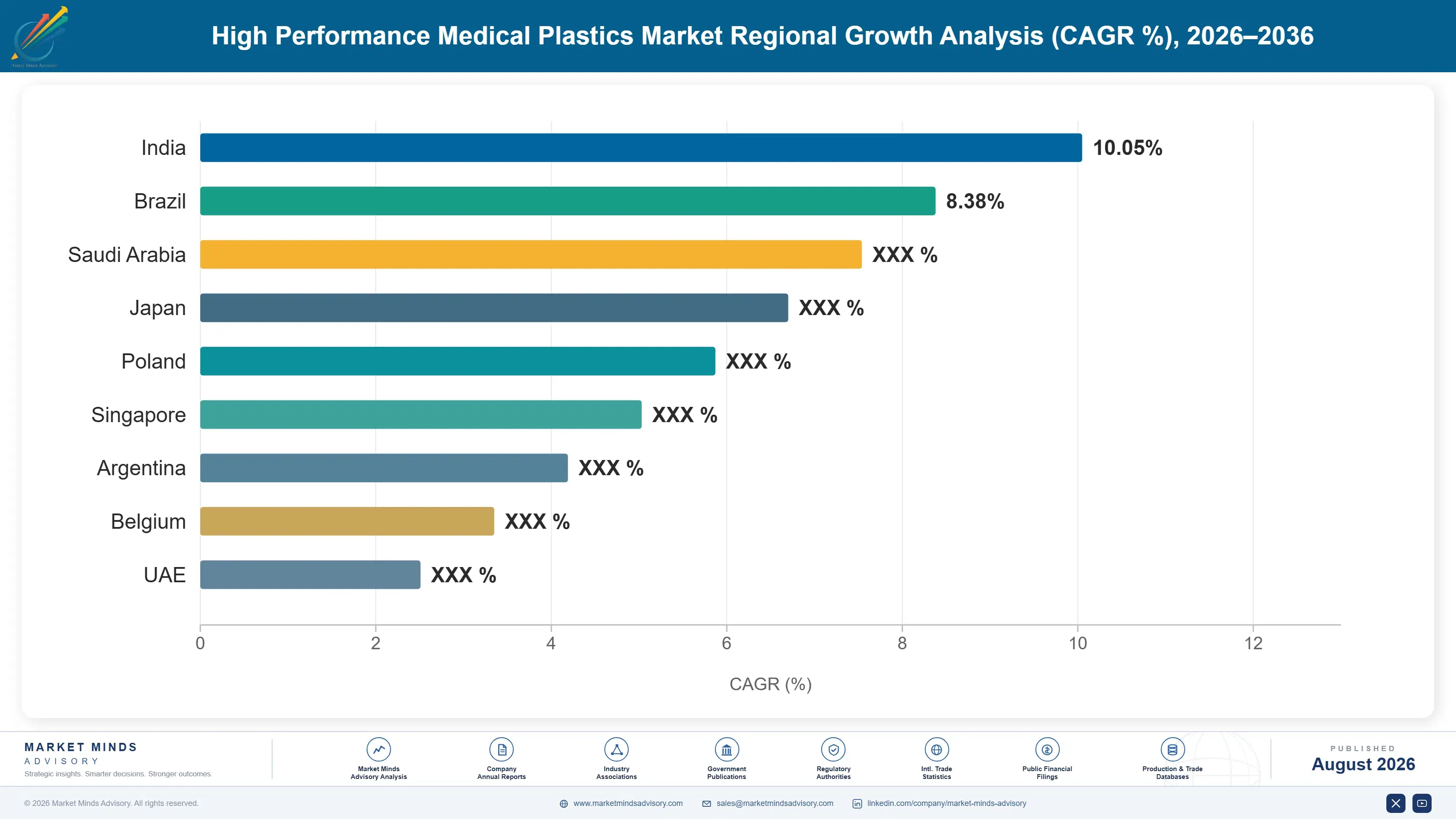
Regional Architecture and Country Demand Map

North America holds 30% of value because device manufacture, implant production and the regulatory regime that governs both concentrate there. East Asia follows at 26% on diagnostic consumable volume and Japanese olefin polymer capacity. Manufacturing location explains this map almost entirely. Patient population explains almost none of it.

North America

Orthopaedic and spinal implant manufacture concentrates in Indiana, Massachusetts and Minnesota to a degree that has no parallel anywhere else, and those plants consume implantable polymer at volumes that set global pricing. FDA device master file practice means a resin supplier holding a US file has effectively pre-qualified itself for every American customer. Contract manufacturers in Costa Rica and Puerto Rico serve the same programmes under the same specifications. Growth at 7.4% tracks procedure volume and metal replacement rather than any manufacturing expansion. The regulatory infrastructure here is the reason this region holds the share it does, and none of it is moving. Nobody has seriously tried to move it either.
Share: 30% | CAGR: 7.4% (2026 to 2036)

Western Europe

MDR turned every material choice into a documentation exercise, and resin suppliers now find themselves inside technical files they never used to see. German and Swiss device manufacture consumes most of the regional volume, with Irish contract manufacturing adding a substantial share on behalf of American customers. The PFAS restriction proposal originates here and lands hardest here, since a manufacturer selling into the European market must comply regardless of where the device is made. Growth at 6.0% is the slowest of the seven regions and reflects a mature device industry rather than any loss of position. Suppliers here hold the deepest regulatory capability in the market. That capability is increasingly an export product.
Share: 24% | CAGR: 6.0% (2026 to 2036)
Regional intelligence for 5 additional markets available in the complete report: East Asia, South Asia and Pacific, Latin America, Middle East and Africa, Eastern Europe. Contact sales@marketmindsadvisory.com.
high-performance-medical-plastics-market-country-cagr-analysis-1787553223948

Where Resin Margin Actually Sits

Four moves generate returns in medical polymer that volume growth does not. Every one of them turns on regulatory work rather than chemistry, which is uncomfortable for businesses run by polymer scientists and it is also where the money has been for twenty years. Making more resin earns very little. It never earned much at all.

Price the supply guarantee alongside the polymer

Device makers carry an unquantified exposure to supplier withdrawal, and 24 months of notice against 22 months of requalification leaves almost nothing. A supplier offering contractual continuity commitments with defined notice periods and indemnity provisions is selling insurance rather than resin, and buyers price insurance differently from material. The medical grade already carries a 4.2 times premium over industrial and this is what justifies extending it further. Very few suppliers offer this formally, mostly because the legal department has never been asked to think about it as a product. That is a conversation worth having internally.
Market Impact: Extends the existing 4.2 times premium considerably further

Qualify non-fluorinated alternatives ahead of the restriction

The European PFAS restriction proposal has device makers qualifying sulfone and olefin alternatives in parallel with existing fluoropolymer designs, and enquiry volumes on non-fluorinated grades run well above what orders justify. A supplier arriving with data packages already assembled captures that work at the point the customer is anxious rather than the point they are comparing prices. The cost is testing and documentation. The return is a position on programmes that will run for 10 years or longer, at a premium reflecting scarcity of qualified alternatives rather than any cost of goods.
Market Impact: Covers all 27 member state markets at risk

Enter the container closure filing, not the device one

Cyclic olefin qualification runs through pharmaceutical submissions rather than device master files, which makes it slower and considerably stickier once complete. A resin named inside an approved container closure system is effectively permanent, because changing it reopens a drug filing rather than a device technical file. Growth at 11.4% means this window is open now on programmes that will run for decades. Suppliers treating pharmaceutical customers as a variant of device customers are using the wrong sales model and the wrong documentation package entirely. The two functions rarely even talk to each other.
Market Impact: Locks a position into an 11.4% growth segment

Sell into bioprocessing extractables data, not tubing

Single-use bioprocessing consumes high-performance film, tubing and connector polymer at volumes the device side cannot match, and extractables and leachables testing on those materials is now more demanding than on many implants. Suppliers holding complete data packages win specifications outright because the alternative is the customer generating them, which costs money and 12 months nobody has. The material itself is close to commodity in some of these applications. The data is not, and pricing should reflect which of the two the customer is actually buying. Very few suppliers price it that way.
Market Impact: Saves the customer 12 months of testing work

Who Controls the Margin Pool

Five producers hold 38% of medical-grade resin supply, measured on volume shipped into device and pharmaceutical packaging manufacture, the basis used throughout this section. That is moderate concentration and it badly understates the real position, because a device maker locked into one qualified grade has a choice of exactly one supplier. The gap between leaders and everybody else is regulatory infrastructure: master files, biocompatibility data and the willingness to carry implant liability.
Competition runs on three dimensions and price is not one of them. Regulatory file depth, meaning what a supplier can hand a customer on day one. Continuity commitment, which is the promise not to exit. And application engineering, since a polymer scientist who understands sterilisation and implant loading is worth more than a datasheet. Chemistry is table stakes.

Rankings shift where Chinese producers build regulatory capability to serve their own device industry and then find they can sell it abroad. That is happening first in sulfone polymers for sterilisable housings, where the requirement is standardised and the price gap is wide. Implantable grades hold considerably longer, because nobody wants to be the first Western device maker to qualify an unfamiliar supplier for a spinal cage.
high-performance-medical-plastics-market-company-positioning-matrix-1787553224478

Competitive Moat and Risk Dimensions

SOLVAY

Moat: Specialty polymer portfolio breadth

Solvay holds implantable and non-implantable grades across sulfone polymers, polyaryletherketones and high-performance polyamides, which lets a device maker source several chemistries under one quality agreement and one set of regulatory files. Assembling that breadth would take a competitor decades of testing rather than capital, and the customer relationships come with it.
SOLVAY

Risk: Fluoropolymer restriction exposure

A meaningful part of the specialty portfolio sits in fluorinated chemistry that the European restriction proposal reaches directly, and the scope of any medical derogation remains unsettled. Competitors weighted toward sulfone and olefin chemistries face none of that uncertainty and are using it in customer conversations right now.
EVONIK INDUSTRIES

Moat: Implant liability willingness

Evonik supplies implantable polyaryletherketone and resorbable polymer grades, and carrying that liability is a commercial decision most chemical companies have declined to make. The willingness is the barrier rather than the chemistry, since the exposure can exceed the revenue by a wide margin and boards have historically preferred to avoid it entirely.
EVONIK INDUSTRIES

Risk: Narrow application concentration

The implantable position concentrates heavily in orthopaedic and spinal applications, which ties growth to procedure volumes and to metal replacement rates in a small number of surgical categories. A shift in clinical practice or reimbursement in spinal fusion would reach this business faster than it would reach a broader portfolio.

Players Tracked

Prominent Players

Solvay
Evonik Industries
Victrex
SABIC
Celanese

Other Key Players

Zeon Corporation
Mitsui Chemicals
Daikin Industries
Chemours
Arkema
Dow
Wacker Chemie
Elkem
Envalior
Röhm
Trinseo
Eastman Chemical
Covestro
Lubrizol
Foster Corporation

Recent Developments

APRIL 2025

Evonik expanded implantable polymer production capacity in Germany

Evonik commissioned additional capacity for implantable polyaryletherketone grades at a German site, converting existing plant rather than building new. The investment was organic and funded internally, with no partner involved, and it followed customer qualification requests that the existing capacity could not absorb comfortably. Metal replacement demand had outrun it.
Signal: Implantable capacity is being added quietly by the few suppliers willing to carry the liability at all
AUGUST 2025

Zeon Corporation signed a multi-year cyclic olefin supply agreement with a European pharmaceutical packaging manufacturer

Zeon Corporation entered a multi-year supply agreement covering cyclic olefin polymer for prefilled syringe barrel production at a European pharmaceutical packaging manufacturer. The arrangement was a supply agreement rather than a joint venture or equity investment, and it covers several biologic container closure programmes through the decade.
Signal: Olefin capacity is being contracted against drug filings rather than device programmes, which locks positions for far longer
JANUARY 2026

Solvay expanded non-fluorinated medical grade development capacity

Solvay increased development and application testing capacity for non-fluorinated medical polymer grades, responding to device maker enquiries generated by the European PFAS restriction proposal. This was an organic expansion of existing technical service resource rather than an acquisition or partnership of any kind. Enquiries had run well ahead of orders.
Signal: Suppliers are staffing for a regulation that has not landed, which tells you how seriously the industry takes it

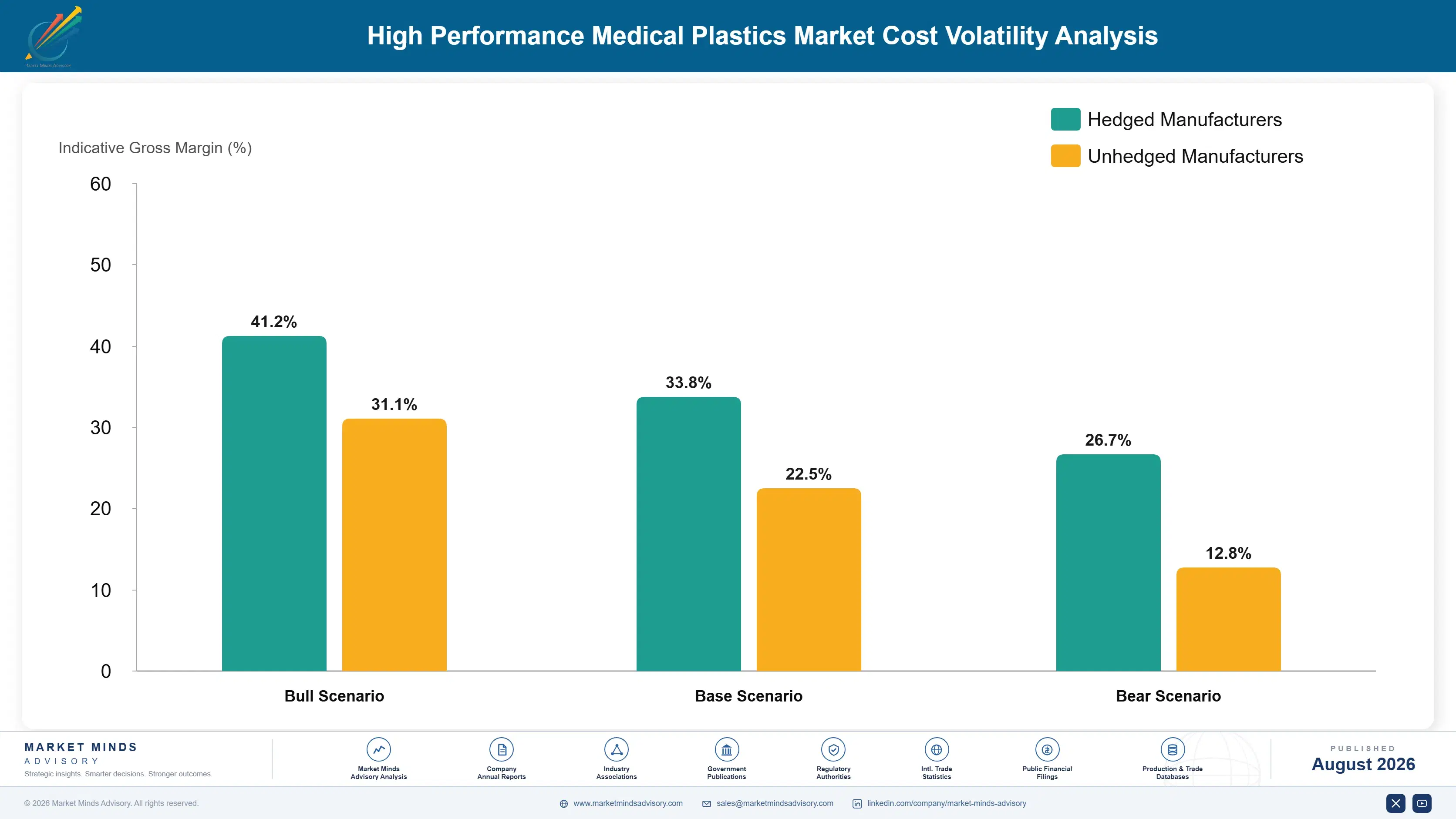
What Moves Medical Resin Cost

Monomer and intermediate feedstock accounts for around 34% of medical grade cost of goods, with regulatory and quality overhead, batch testing, controlled manufacturing and technical service making up an unusually large balance. Bisphenol and difluorobenzophenone intermediates for sulfone and ketone polymers come from a small number of European and Asian producers. Fluorspar for fluoropolymer chains originates overwhelmingly in China and Mexico.
European energy prices through 2022 raised costs across specialty polymer production, and IEA data show European industrial gas running several times American levels. Solvay's Annual Report 2022 records the energy and raw material pressure across its specialty polymers segment. Medical grade producers passed less of it through than industrial ones did, because a device customer cannot switch grades and the supplier has to weigh a price increase against a relationship measured in decades.

That decades-long relationship is the disadvantage mechanism working in reverse, and it cuts unevenly. A producer with implantable grades cannot raise price aggressively without damaging a position built over twenty years. Suppliers with broad portfolios absorb a single chemistry's cost movement across others; single-chemistry specialists carry it alone. Asian producers benefit from feedstock proximity that European operations simply do not have.
high-performance-medical-plastics-market-cost-volatility-analysis-1787553224678

Qualify a second monomer source before the grade is locked

Intermediate supply for sulfone and ketone chemistries concentrates in very few producers, and a disruption reaches every downstream medical grade at once. Qualifying an alternative intermediate during initial grade development costs testing time and removes an exposure that becomes unfixable afterwards, since any change to a qualified grade reopens the customer's regulatory file. Almost nobody plans this far ahead.

Structure multi-year pricing into the qualification agreement

A device maker qualifying a grade has maximum leverage before the qualification completes and none afterwards, which is exactly backwards from how most procurement teams manage the timeline. Negotiating a multi-year price framework as a condition of starting qualification transfers that leverage to when it exists. Suppliers accept it more readily than buyers expect, because it secures the position too.

Hold strategic resin inventory sized against requalification time

Twenty-four months of withdrawal notice against twenty-two months of requalification leaves no room for anything going wrong, and something usually does. Holding inventory sized against the qualification period rather than against normal consumption converts an unmanageable risk into a working capital cost. High-performance resin stores well and the carrying cost is small against the alternative.

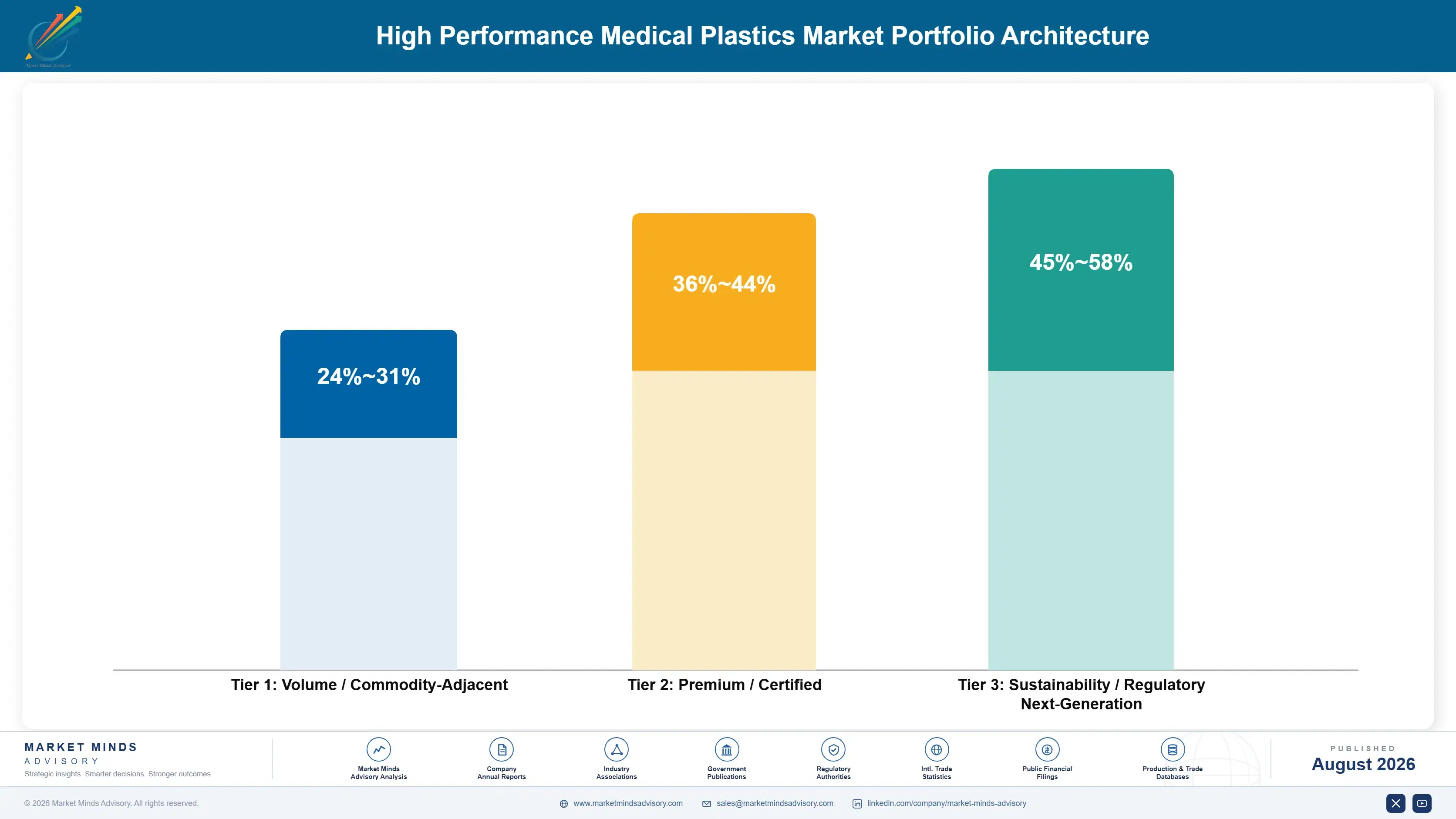
Portfolio Architecture for Margin Defence

Margin in medical polymer tracks regulatory burden and liability exposure rather than manufacturing difficulty. Sterilisable housing grades run at gross margins in the high twenties, competing on documentation completeness against several capable suppliers. Implantable grades run considerably higher, because the number of producers willing to carry the liability is small and the customer has nowhere else to go once qualified. Bioprocessing consumable grades sit between the two, priced on extractables data rather than on polymer.
The tension is that volume and value sit in different chemistries and different organisations. Diagnostic consumable and housing grades move real tonnage and keep reactors loaded. Implantable grades move almost none and earn most of the profit, and they need a regulatory affairs function larger than the business justifies on revenue alone. Several producers have tried running both under one commercial structure and found the volume side consistently starved the implantable one of technical resource.

High-value pools concentrate in implantable polyaryletherketone, cyclic olefin for biologic containers and non-fluorinated alternatives being qualified against the PFAS restriction. None of the three is large in tonnage. All three are defended by regulatory position rather than by any manufacturing advantage at all.

Volume / Commodity-Adjacent

Sterilisable housing grades, standard tubing polymer and diagnostic consumable resin where several suppliers hold adequate documentation and competition runs on completeness rather than chemistry. The seven-point range separates suppliers with full application engineering support from those shipping resin against a datasheet.
Gross Margin: 24%-31%

Premium / Certified

Grades carrying full biocompatibility packages and device master file references for non-implantable applications. The eight-point spread reflects how much regulatory work the supplier absorbs versus how much the customer still has to generate, which varies considerably between producers.
Gross Margin: 36%-44%

Sustainability / Regulatory / Next-Generation

Implantable grades, biologic container closure polymer and qualified non-fluorinated alternatives. The thirteen-point range is genuinely wide because pricing reflects liability willingness and scarcity of qualified suppliers rather than any cost structure anybody could calculate.
Gross Margin: 45%-58%
high-performance-medical-plastics-market-portfolio-architecture-1787553225190

High-value Sub-segments and Strategic Watch-out

Cyclic Olefin Container Polymer

Compounding at 11.4% and qualified through pharmaceutical filings rather than device master files, which makes the position effectively permanent once granted. Biologic approvals drive it and the supplier base is narrow enough that capacity gets contracted years ahead. Japanese producers hold most of it. Nobody is displacing them.
Gross Margin: 44%-56%

Implantable Polyaryletherketone

Growing at 9.8% on metal replacement that runs on clinical argument rather than cost, which is why it has never reversed in a procurement squeeze. Around 27% of spinal cages now use polymer construction. The barrier is willingness to carry implant liability, not chemistry. Most boards decline it.
Gross Margin: 48%-58%

Sterilisable Housing Grades

The tonnage that keeps reactors loaded, growing with device output and competing on documentation completeness against several capable suppliers. Chinese producers building regulatory capability for their own device industry are the immediate threat, because the requirement is standardised and the price gap is wide. That gap will hold.
Gross Margin: 24%-31%

Fluoropolymer Restriction Exposure

The European PFAS proposal reaches catheters, guidewire coatings, membranes and sterile barriers, and the medical derogation scope remains genuinely unsettled. Device makers are qualifying alternatives in parallel at doubled development cost. Whoever holds the data packages when this lands captures a decade of programmes. Very few are ready.
Gross Margin: 30%-44%

How This Demand Renews

Medical polymer demand is annuity revenue with an unusually long tail. A grade qualified into an approved device stays there for the commercial life of the product, which in orthopaedics can run twenty years or more, and volume tracks procedure or production rate continuously across it. There is no reordering decision and no competitive review. The supplier holds the position until the device is discontinued or the supplier walks away.
Stickiness varies sharply by vertical. Implantable applications are close to permanent, since requalification means biocompatibility testing and a regulatory filing nobody undertakes voluntarily. Container closure positions inside drug filings are stickier still. Diagnostic consumables and single-use bioprocessing change supplier more readily, because qualification is lighter and several producers hold adequate data. Depth follows the same line: implant customers consolidate onto one supplier across several chemistries while consumable buyers spread widely.

The buyer has moved upstream. Material selection once sat with design engineers choosing on datasheet properties. It now sits with regulatory affairs and quality functions weighing documentation completeness and supply continuity, and increasingly with legal reviewing indemnity language. A sales organisation calling on design engineering is presenting tensile strength to somebody who stopped deciding this years ago.
high-performance-medical-plastics-market-end-use-penetration-index-1787553225692

Where To Place The Bet

These are among the four positions where our research anticipates prominent divergence between winners and laggards over the coming forecast period. Each is grounded in the demand model, the regulatory perimeter, and the announced capacity pipeline.
01 / CONTINUITY COMMITMENT PRICING

Sell the promise not to exit

Device makers carry an exposure they cannot quantify, because 24 months of withdrawal notice sits against 22 months of requalification and the industry remembers what happened when suppliers left in the nineties entirely. A formal continuity commitment with defined notice periods and indemnity language is a product rather than a contract clause, and buyers value an insurance product on a completely different basis from raw material. The 4.2 times premium over industrial grade already exists and this is what extends it further still.
02 / PFAS ALTERNATIVE POSITIONING

Hold the data before the restriction lands

The European PFAS restriction proposal reaches catheters, guidewire coatings, membranes and sterile barriers, and device makers are qualifying sulfone and olefin alternatives in parallel at doubled development cost while the derogation scope stays genuinely unsettled. A supplier arriving with data packages already assembled captures that work at the moment the customer is anxious rather than the moment they are comparing quotations. Reformulating a catheter takes years, so whoever is qualified when this lands holds programmes running 10 years or considerably longer.
03 / CONTAINER CLOSURE ENTRY

Qualify through drug filings, not device files

Cyclic olefin polymer compounds at 11.4% against a market at 7.6%, and its qualification runs through pharmaceutical submissions rather than device master files, which makes entry slower and the resulting position considerably harder to dislodge. A resin named inside an approved container closure system is effectively permanent, because displacing it means reopening a drug filing that nobody will do voluntarily at all. Suppliers treating pharmaceutical customers as a variant of device customers are using the wrong documentation package and the wrong sales model entirely.
04 / BIOPROCESSING DATA OWNERSHIP

Own the extractables package, not the tubing

Single-use bioprocessing consumes high-performance film, tubing and connector polymer at volumes the device side of this market cannot match, and extractables and leachables testing on those materials is now more demanding than on many implants. Suppliers holding complete data packages win specifications outright, because the alternative is the customer generating them at real cost and 12 months nobody in biopharmaceutical development has to spare. The material is close to commodity and the data is not, and pricing should reflect which of the two is actually being bought.

Engagement Snapshot From the Field

A live engagement with an industry participant carrying material or product regulatory and market exposure ahead of a defining policy shift, showing how our research translates into a defensible multi-year portfolio strategy.
MARKET MINDS ADVISORY · CLIENT ENGAGEMENT SUMMARY
High Performance Medical Plastics Producer Strategic Portfolio Review and Transition Roadmap 2026·Investment Scenario on High Performance Medical Plastics Exposure Evaluation 2025-26
CLIENT PROFILE
A global orthopaedic device manufacturer with annual revenue around USD 2.6 billion (client-reported, unverified by MMA), of which spinal implants accounted for roughly a third. The company sourced implantable polyaryletherketone from a single qualified supplier across eleven product families. No alternative grade had ever been qualified, and nobody currently in the business had been there when the original decision was made.
STRATEGIC CHALLENGE
Resin pricing had risen 31% across three years (client-reported, unverified by MMA) with no alternative to reference, and the supplier had recently restructured its medical business in a way the client found difficult to read. The board asked whether the single-source position was normal industry practice or a risk that had simply never been examined properly.
MMA APPROACH
MMA benchmarked the client's resin pricing and qualification arrangements against comparable orthopaedic manufacturers through the expert interview programme, then established which producers hold implantable polyaryletherketone grades and which carry the liability willingly. Contract terms were reviewed against sector practice on continuity commitments and indemnity. Historical supplier withdrawal cases in medical materials were examined for what actually triggered them.
KEY FINDINGS
  1. The 31% increase sat within normal range for implantable grades over the period, so pricing itself was not the exposure the board had assumed it to be.
  2. Single sourcing across all eleven product families was the actual risk, and it had accumulated by default rather than through any decision anybody could point to.
  3. Two other producers hold implantable grades suitable for the client's applications, which nobody internally had established because procurement had never asked the question.
  4. None of the client's supply agreements contained continuity commitments or indemnity provisions, which is below current sector practice among manufacturers of comparable scale.
CLIENT PROFILE
A global orthopaedic device manufacturer with annual revenue around USD 2.6 billion (client-reported, unverified by MMA), of which spinal implants accounted for roughly a third. The company sourced implantable polyaryletherketone from a single qualified supplier across eleven product families. No alternative grade had ever been qualified, and nobody currently in the business had been there when the original decision was made.
STRATEGIC CHALLENGE
Resin pricing had risen 31% across three years (client-reported, unverified by MMA) with no alternative to reference, and the supplier had recently restructured its medical business in a way the client found difficult to read. The board asked whether the single-source position was normal industry practice or a risk that had simply never been examined properly.
MMA APPROACH
MMA benchmarked the client's resin pricing and qualification arrangements against comparable orthopaedic manufacturers through the expert interview programme, then established which producers hold implantable polyaryletherketone grades and which carry the liability willingly. Contract terms were reviewed against sector practice on continuity commitments and indemnity. Historical supplier withdrawal cases in medical materials were examined for what actually triggered them.
KEY FINDINGS
  1. The 31% increase sat within normal range for implantable grades over the period, so pricing itself was not the exposure the board had assumed it to be.
  2. Single sourcing across all eleven product families was the actual risk, and it had accumulated by default rather than through any decision anybody could point to.
  3. Two other producers hold implantable grades suitable for the client's applications, which nobody internally had established because procurement had never asked the question.
  4. None of the client's supply agreements contained continuity commitments or indemnity provisions, which is below current sector practice among manufacturers of comparable scale.
RECOMMENDED STRATEGY
Phase 1: Phase one: qualify a second implantable grade on the three highest-volume product families first, accepting the testing cost to establish a genuine alternative. Phase 2: Phase two: renegotiate the incumbent agreement to include continuity commitments and indemnity language, using the second qualification as the leverage it creates. Phase 3: Phase three: hold strategic resin inventory sized against the requalification period rather than normal consumption across the remaining single-sourced families.
OUTCOME
Second-source qualification is complete on two product families and running on the third, at a testing cost the client reported as roughly USD 4.1 million (client-reported, unverified by MMA). Continuity language was accepted at the incumbent's next renewal. Strategic inventory is in place and the client reports the pricing conversation has changed materially.

Frequently Asked Questions

Foundational context covering the market sizes, CAGR, scope, country, region and competition that inform every finding below. This section is provided to cover basics and most often pre-purchase conversations, answered from the MMA Primary Research Dataset.

What is the current size of the High Performance Medical Plastics Market?

The market was valued at USD 4.8 billion in 2025, rising to an estimated USD 5.16 billion in 2026. North America holds the largest regional share at 30% of value.

How large will the High Performance Medical Plastics Market be by 2036?

MMA forecasts USD 10.74 billion by 2036 under the base case, an expansion multiple of 2.08 times the 2026 value. That represents USD 5.58 billion of incremental value.

What is the CAGR for the High Performance Medical Plastics Market 2026 to 2036?

The base case runs at 7.6% compound annual growth between 2026 and 2036, with a bull case at 8.8% and a bear case at 6.4%. Historical growth from 2020 to 2025 was 6.4%.

Which segment is growing fastest?

Cyclic olefin polymers lead at 11.4%, half again the market rate, pulled by biologic formulations moving from glass into polymer containers. Polyaryletherketones follow at 9.8% on orthopaedic metal replacement.

Who are the major companies in the High Performance Medical Plastics Market?

Solvay, Evonik Industries, Victrex, SABIC and Celanese hold 38% between them. Regulatory file depth and willingness to carry implant liability sustain those positions rather than production scale.

Which country is growing fastest?

India leads at 10.4%, driven by pharmaceutical export manufacture that carries destination-market container closure requirements. Indian converters have qualified grades they barely sell in their own domestic market.

Report Segmentation Architecture

The full report scope spans multiple orthogonal segmentation dimensions, with cross-tabulated demand data provided for each dimension pair. Coverage extends further to regional breakdowns, trend trajectories, and the competitive detail needed to support segment-level decision-making.

By Polymer Chemistry

  • Polyaryletherketones
  • Sulfone Polymers
  • Cyclic Olefin Polymers
  • Medical Fluoropolymers
  • Medical-Grade Silicones
  • High-Performance Elastomers

By End-Use Industry

  • Orthopaedic and Spinal Implants
  • Surgical Instruments and Devices
  • Drug Delivery and Primary Packaging
  • Diagnostic and Laboratory Consumables
  • Single-Use Bioprocessing
  • Cardiovascular and Interventional Devices

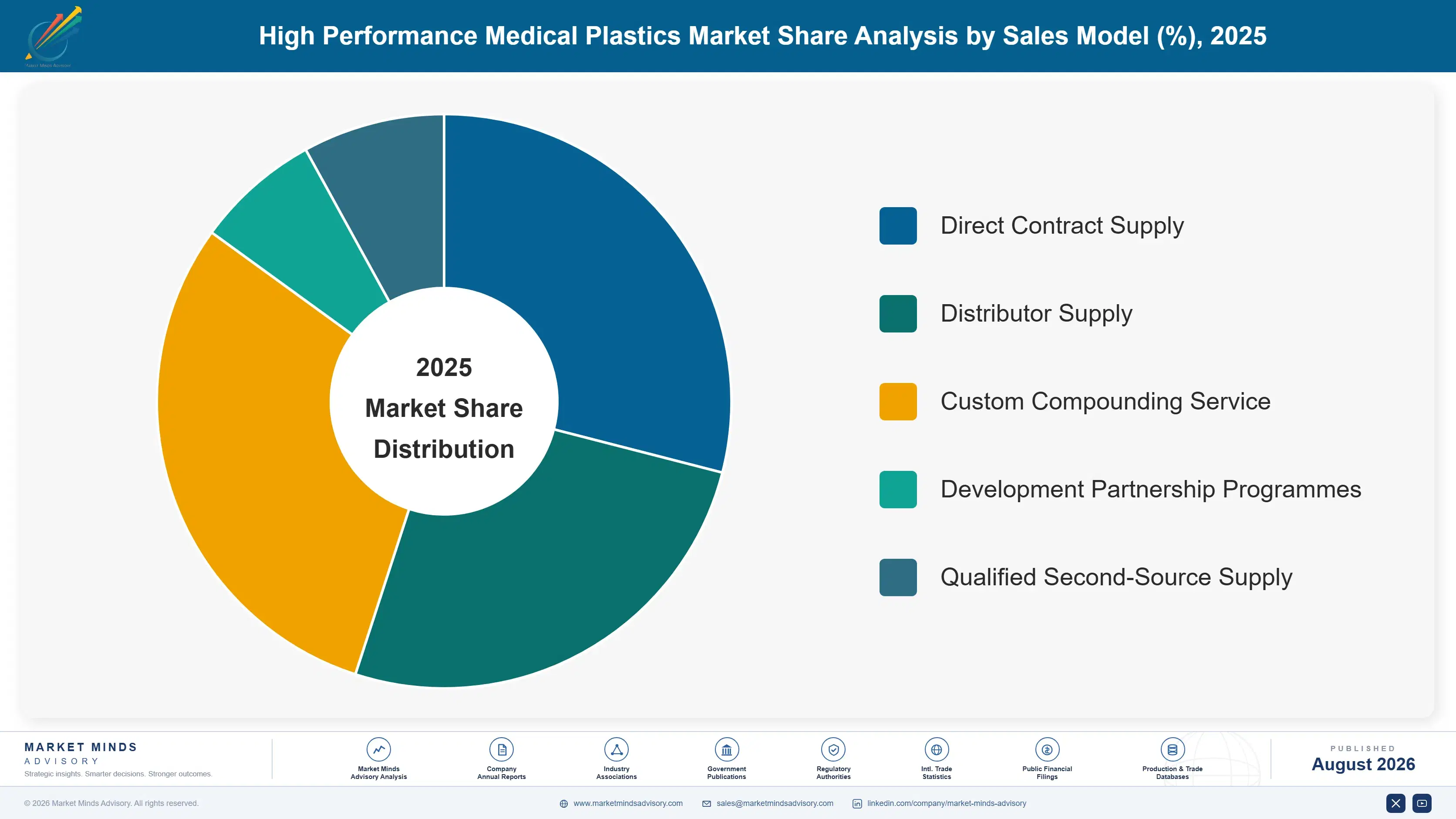
By Sales Model

  • Direct Contract Supply
  • Distributor Supply
  • Custom Compounding Service
  • Development Partnership Programmes
  • Qualified Second-Source Supply

By Region

  • North America
  • Western Europe
  • East Asia
  • South Asia and Pacific
  • Latin America
  • Middle East and Africa
  • Eastern Europe

Scope, Methodology, and Coverage

Every figure in this report is reproducible from documented input assumptions. The scope below maps the historical period, the forecast horizon, the segmentation dimensions, and the countries covered, alongside the underlying primary and qualitative methodology.
Historical Period
2020 to 2025
Forecast Period
2026 to 2036
Base Year
2025 (USD billions; MMA Primary Research Dataset, August 2026)
Market Definition
The market comprises high-performance polymers supplied in medical grade for device manufacture and pharmaceutical primary packaging, covering polyaryletherketones, sulfone polymers, cyclic olefin polymers, medical fluoropolymers, medical-grade silicones and high-performance elastomers. Value is measured at resin supply into medical manufacture, including the regulatory documentation and biocompatibility packages that accompany it. Commodity medical plastics including polyvinyl chloride, polyethylene and polypropylene, finished medical devices, converted packaging films, laboratory equipment, and identical polymers sold into industrial or aerospace applications fall outside scope.
Quantitative Units
USD billions (current prices); thousand tonnes of medical-grade resin supplied annually; USD per kilogramme by chemistry
Segmentation Dimensions
By Polymer Chemistry; By End-Use Industry; By Sales Model; By Region
Regions Covered
North America, Western Europe, East Asia, South Asia and Pacific, Latin America, Middle East and Africa, Eastern Europe
Countries Covered
United States, Canada, Mexico, Costa Rica, Germany, Switzerland, Ireland, France, United Kingdom, Italy, Spain, Sweden, Belgium, Poland, Czechia, Hungary, China, Japan, South Korea, Taiwan, India, Singapore, Australia, Brazil, Argentina, Colombia, Saudi Arabia, United Arab Emirates, Egypt, South Africa
Key Companies Profiled
Solvay, Evonik Industries, Victrex, SABIC, Celanese, Zeon Corporation, Mitsui Chemicals, Daikin Industries, Chemours, Arkema, Dow, Wacker Chemie, Elkem, Envalior, Röhm, Trinseo, Eastman Chemical, Covestro, Lubrizol, Foster Corporation
Quantitative Methodology
Primary survey, n=3,800 respondents, Q4 2025, six countries; demand-side model with trade association cross-validation
Qualitative Methodology
47 expert interviews, Q4 2025; applied to validate demand model assumptions, identify emerging dynamics, and assess competitive positioning
Report Format
PDF and XLSX data workbook (Word format preview document)
Publisher
Market Minds Advisory
Report Code
MMA-2026-CHM-503
Published
August 2026
Contact
sales@marketmindsadvisory.com | www.marketmindsadvisory.com

Purchase the full High Performance Medical Plastics Market Report (2026 to 2036).

The full report sizes the global high-performance medical plastics market to 2036 across six polymer chemistry segments and seven regions, measured at resin supply into device and pharmaceutical packaging manufacture. It maps qualification requirements under FDA master file practice, MDR and pharmaceutical container closure filings against supplier regulatory capability, and traces where the European PFAS restriction proposal reaches existing designs. Competitive analysis covers 20 participants evaluated on medical-grade volume supplied, with moat and risk assessment for the two leaders. Input cost exposure runs from monomer and fluorspar supply through to qualification-locked contract structure. Four quantified revenue levers close the analysis.
Six-chemistry segment sizing with segment-level growth rates
Seven-region share and growth breakdown to 2036
Twenty-participant competitive map on one supply basis
PFAS restriction exposure mapped across affected device categories
Input cost exposure traced to monomer and fluorspar
Four quantified revenue levers with commercial impact ranges

Built For The People Who Decide

From boardroom strategy to bench-side execution, this report is read cover-to-cover by leaders shaping the next decade of their industry, turning demand scenarios, market dynamics and valuation benchmarks into decisions.
CXOs/ Presidents/ VPs/ Managers
M&A and Corporate Development
Strategy Teams and R&D Heads
Procurement and Product Directors
Regulatory and Compliance Leaders
Investor Relations and Equity Analysts