Market Minds Advisory
High Performance Barrier Films Market

High Performance Barrier Films Market: Mono-Material Recyclability Meets Oxygen and Moisture Protection

Brand owners are pushing flexible packaging toward mono-material recyclability just as food safety and pharmaceutical shelf-life requirements demand tighter oxygen and moisture barriers, forcing film producers to replace multilayer laminates with transparent coated alternatives.

Lead Analyst

Bilal Shaikh

Published

September 2026

Make Smarter Decisions with Customized Research Insights

Request a free sample report and evaluate market opportunities, growth trends, and competitive dynamics relevant to your business needs.

2025 MARKET VALUE$9.6BMarket Size 2025
2036 FORECAST VALUE$19.9BBase Case , 2026 to 2036
CAGR 2026 TO 20366.8 %Bull 8.1% / Bear 5.5%
INCREMENTAL OPPORTUNITY$9.6BNet 10- year value creation
EXPANSION MULTIPLE1.93x2036 value over 2026 base
Strategic Levers
M&A Pipeline
Regional Outlook
Country Rankings
Competitive Intelligence
Segmental Deep-dive
Call-Us : 91 93563 13602

Executive Snapshot and Market Trajectory

Recyclability rules are colliding with barrier performance requirements, pushing film producers to replace foil and multilayer laminates with transparent oxide-coated mono-material structures that still block oxygen and moisture well enough for extended food and pharmaceutical shelf life claims. That collision now drives most sector capital spending.
Demand concentrates in flexible food packaging, where extended shelf life reduces retailer waste, and in pharmaceutical blister and pouch packaging, where moisture ingress directly threatens drug stability. SiOx and AlOx transparent coatings, still a minority of installed capacity, are growing fastest as EU and California extended producer responsibility rules penalize non-recyclable multilayer structures. East Asia now produces more barrier film capacity than any other region, anchored by Chinese and Japanese converters.
Competitive intensity splits between diversified packaging groups running global coating and lamination networks and specialist film producers competing on coating chemistry IP. Amcor's completed 2025 merger with Berry Global reset the competitive map, while regulatory pressure from the EU Packaging and Packaging Waste Regulation is forcing every producer to prove recyclability alongside barrier performance before 2030 compliance deadlines arrive. Smaller converters without coating depth face pressure to exit. Those exits will concentrate share further still.
Market Definition
The high performance barrier films market covers flexible plastic and coated films engineered to restrict oxygen, moisture, aroma, or light transmission for food, pharmaceutical, and industrial packaging applications, including metallized, EVOH, PVDC, and oxide-coated structures. It excludes rigid barrier packaging, standard commodity films without engineered barrier properties, and downstream pouch or bag conversion services sold separately from film supply.
Base Year Value
$9.6B in 2025 (MMA Primary Research Dataset, August 2026)
Forecast Period
2026 to 2036, eleven discrete annual values
CAGR
6.8% base case. Bull 8.1%. Bear 5.5%.
Fastest Growth Segment
SiOx and AlOx Transparent Coated Films: 11.0% CAGR
Fastest Growth Country
India: 12.5% CAGR
Fastest Growth Region
South Asia and Pacific: 8.8% CAGR
Largest Region
East Asia: 29% of 2025 global value
Market Leaders
Amcor plc, Toray Industries, Jindal Films, UFlex Limited, Mitsubishi Chemical Group. Source: MMA Analysis based on company annual reports.
Primary Survey
n=3,800 procurement and R&D decision-makers, Q4 2025, six countries
Methodology
Demand-side build-up, cross-validated against public data, 47 expert interviews

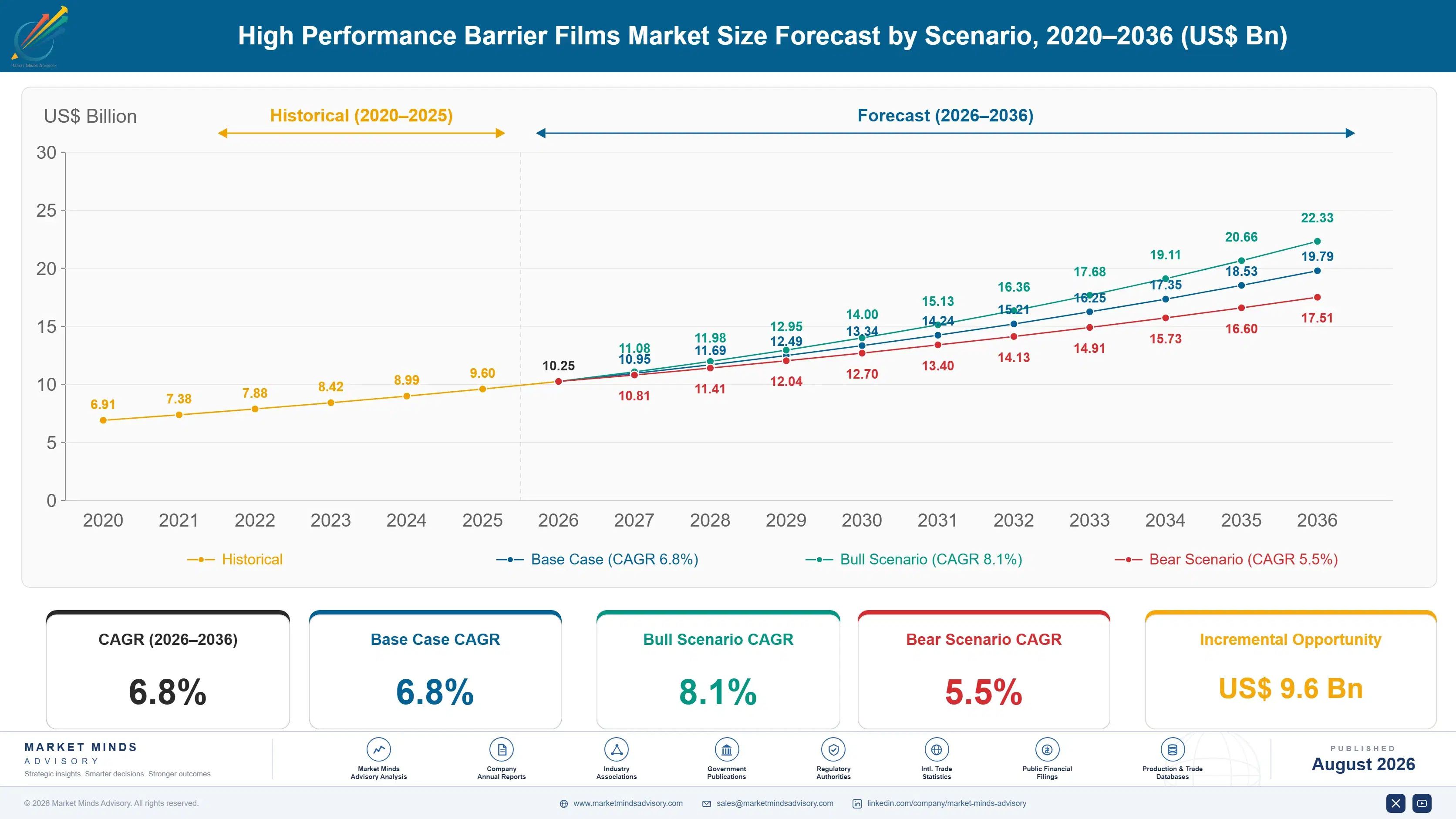
High Performance Barrier Films Market Forecast Scenarios

high-performance-barrier-films-market-size-forecast-scenario-1787305476954
Between 2020 and 2025 the market grew at roughly 6.0% a year, steady rather than volatile, as flexible packaging kept displacing rigid formats across food categories while pharmaceutical packaging demand held constant through pandemic-era supply disruption. Recyclability regulation was still emerging through most of this period rather than actively reshaping material choice. That set a stable foundation for the sharper regulatory-driven shift now underway.
The base case carries the market to a 6.8% CAGR on three mechanisms. First, extended producer responsibility fees in the European Union and a growing number of American states raise the cost of non-recyclable multilayer film enough to accelerate mono-material conversion. Second, pharmaceutical blister packaging demand keeps rising as generic drug volumes expand across emerging markets. Third, e-commerce packaging adoption keeps favoring flexible formats over rigid alternatives on shipping cost and material efficiency grounds industry-wide.
The bull case reaches 8.1% if major consumer goods companies accelerate mono-material commitments ahead of their stated 2030 targets, pulling coated film demand forward faster than modeled. The bear case falls to 5.5% if recycling infrastructure investment lags regulatory deadlines badly enough that brand owners delay conversion rather than adopt unproven barrier alternatives at scale.

Recyclability Regulation Is Rewriting Barrier Film Chemistry

Three forces converge on this market at once. Recyclability regulation keeps raising the cost of non-compliant multilayer structures, food safety standards keep tightening oxygen transmission rate requirements for fresh and processed food, and pharmaceutical packaging keeps demanding moisture barriers precise enough to satisfy stability testing across longer shelf lives. Producers unable to satisfy all three risk losing accounts entirely. Producers unable to satisfy all three risk losing bids ou
MARKET CONCENTRATION (CR5)38%Top five producers hold well under half share
AVERAGE FILM PRICE$3.20/kgCoated barrier films command premium over standard laminates
TOP PRODUCING COUNTRY SHARE24%China leads installed barrier film production capacity globally
CAPACITY UTILISATION79%Coating lines run near full continuous operating schedules
TRADE INTENSITY34%Over a third of film volume crosses national borders
RESIN COST SHARE58% of COGSPolyolefin and polyester resin inputs dominate production cost
Commercially, the market splits between legacy metallized and PVDC-coated multilayer laminates, priced competitively but increasingly penalized under extended producer responsibility fee schedules, and newer SiOx and AlOx transparent coatings that cost more per unit but qualify for mono-material recycling streams brand owners now require. Pharmaceutical-grade films sit in a smaller, higher-margin category defined by stricter regulatory qualification. That gap is widening as compliance deadlines approach across major consumer markets.
Over the next decade the defining question is whether transparent coated films can match multilayer barrier performance closely enough to satisfy the most demanding food and pharmaceutical applications, or whether some categories will keep relying on non-recyclable structures despite mounting regulatory and retailer pressure to convert. Producers positioned on both sides face very different capital choices ahead.
"Every producer now claims a recyclable barrier solution, but the honest ones will tell you SiOx coatings still cannot match PVDC on oxygen transmission for the toughest pharmaceutical applications, and pretending otherwise just delays the reformulation work that actually needs to happen."
Director, Packaging and Flexible Materials Practice · MMA Packaging / Flexible M

Market Trends

Transparent Oxide Coatings Displace Metallized Foil Layers

SiOx and AlOx vacuum-deposited transparent coatings have moved from niche premium applications into mainstream food packaging since 2023, as brand owners including Nestle and Mars commit publicly to mono-material recyclable packaging by 2030. Unlike aluminum-metallized layers, oxide coatings allow the finished film to pass through standard polyolefin recycling streams while still delivering meaningful oxygen and moisture barrier performance. Coating equipment suppliers report capacity bookings extending well into 2027 as converters race to retrofit existing lines, though oxide coatings still command a real cost premium over metallized alternatives that not every category can absorb.
Market Impact: Adds 5 to 10 shelf-life days

EU Packaging and Packaging Waste Regulation Sets Binding Recyclability Targets

The regulation, which entered into force in 2025, requires nearly all packaging placed on the European Union market to be recyclable by 2030, with specific design-for-recycling criteria that penalize multilayer barrier structures combining incompatible polymer types. Extended producer responsibility fees already scale with recyclability performance in several member states, directly raising the cost of legacy PVDC-coated films relative to mono-material alternatives. Converters serving European accounts are reformulating film structures well ahead of the formal deadline, since retailer procurement teams have begun screening for compliance years in advance of enforcement. That anticipatory screening already reshapes which converters win new accounts.
Market Impact: India exports exceed 20% of volume

Market Opportunities and Growth Drivers

Extended Shelf Life Claims Drive Food Waste Reduction Programs

Retailers including Walmart and Tesco have publicly committed to food waste reduction targets under the UN Sustainable Development Goals framework, and extending packaged food shelf life through better oxygen and moisture barriers is one of the few interventions retailers can influence directly through packaging specification. A film upgrade that adds several days of shelf life to fresh-cut produce or dairy products measurably reduces store-level waste and markdown losses, giving retailers a direct commercial incentive to specify higher-performance barrier films even at a per-unit cost premium over standard packaging materials. Several retailers now specify barrier minimums directly in supplier contracts.
Market Impact: Leaves 15% of volume non-convertibl

Generic Pharmaceutical Volume Growth Expands Blister Packaging Demand

Generic drug volumes continue expanding across India, China, and emerging markets as patent cliffs open branded pharmaceutical categories to generic competition, and nearly all solid oral dose generics ship in blister packaging requiring precise moisture barrier performance to satisfy stability testing under International Council for Harmonisation guidelines. India's generic pharmaceutical export volume alone has grown steadily for a decade, and each new manufacturing line commissioned represents recurring, multi-year barrier film demand tied directly to drug production volume rather than to any single packaging design cycle. That recurring demand gives qualified film suppliers unusually stable multi-year revenue visibility.
Market Impact: Under 10% of film recycled

Market Restraints and Challenges

Transparent Coatings Still Trail PVDC on Extreme Barrier Applications

SiOx and AlOx coatings cannot yet match PVDC or EVOH on oxygen transmission rate for the most demanding applications, including certain oxygen-sensitive pharmaceuticals and long-shelf-life processed meat products, and the root cause is physical: vacuum-deposited oxide layers are thinner and more prone to microscopic cracking during flexing and converting than continuous polymer barrier layers. Converters serving these categories continue specifying legacy multilayer structures despite recycling penalties, accepting the compliance cost rather than risk product failure. Coating suppliers are mitigating the gap with multi-layer oxide deposition and hybrid coating chemistries that narrow, though do not yet close, the barrier performance difference.
Market Impact: Coating capacity bookings extend in

Recycling Infrastructure Lags Regulatory Recyclability Requirements

Mono-material films are only genuinely recyclable where collection and sorting infrastructure exists to capture and process them, and the root cause is that most municipal recycling systems worldwide were built around rigid packaging rather than flexible film, leaving even compliant mono-material pouches without a real recycling pathway in most markets. This creates a credibility gap between what brand owners can claim on-pack and what actually happens to the material after disposal, drawing regulatory and advocacy scrutiny. Industry consortia are mitigating the gap by funding dedicated flexible film collection pilots in several major markets ahead of full infrastructure buildout.
Market Impact: Covers 27 EU member states
3 additional market trends, 4 additional growth drivers, and 3 additional restraints and challenges are covered in the full report. Contact sales@marketmindsadvisory.com to access the complete intelligence.

Segment CAGR and Growth Architecture

Segmentation follows barrier material and coating technology, a single method-based logic distinguishing how each film achieves its oxygen and moisture protection. Application-specific converting and downstream pouch fabrication are treated as separate commercial dimensions, not parallel segments within this technology-based framework. Each technology carries its own cost curve and achievable barrier level, so commercial position tracks chemistry rather than application.
high-performance-barrier-films-market-market-share-analysis-1787305477486

SiOx and AlOx Transparent Coated Films

Transparent oxide-coated films grow fastest at 11.0%, about 1.62 times the overall rate, as brand owner recyclability commitments and EU regulatory deadlines pull volume away from legacy multilayer structures. The technology vacuum-deposits an ultra-thin silicon or aluminum oxide layer onto a mono-material polyolefin or polyester substrate, preserving recyclability while delivering meaningful oxygen and moisture barrier performance. Adoption is fastest in fresh food and snack packaging, where barrier requirements are demanding but not extreme. Pharmaceutical and long-shelf-life processed food applications adopt more slowly, since oxide coatings still trail PVDC and EVOH on the toughest transmission rate specifications, keeping legacy technology entrenched in those categories for now. Pharmaceutical qualification for oxide coatings is progressing but remains behind food packaging adoption timelines industry-wide.
CAGR 11.0%

Nanocomposite Barrier Films

Nanocomposite films, which disperse clay or other nanoscale platelet materials through a polymer matrix to create a tortuous diffusion path for gas molecules, grow at 9.5%, the second-fastest technology, from a small commercial base concentrated among specialty converters. The approach can be engineered into a mono-material substrate more easily than multilayer coating structures, appealing to brand owners chasing both recyclability and barrier performance simultaneously. Commercial scale-up has been slower than coating technologies because nanomaterial dispersion consistency remains harder to control at high production line speeds, but several producers have moved from pilot to commercial-scale output since 2023 as processing techniques matured. Producers investing early in nanocomposite scale-up are positioning for a technology transition still several years from full maturity.
CAGR 9.5%
Full segment breakdown across 6 segments available in the complete report.

Regional Architecture and Country Demand Map

East Asia leads on concentrated Chinese and Japanese production capacity, South Asia and Pacific grows fastest on Indian pharmaceutical and food packaging expansion, and North America and Western Europe hold steady shares on mature converting infrastructure and regulatory pressure. Latin America and the Middle East add smaller demand pools.

North America

United States food and pharmaceutical converters anchor demand here, with Amcor's expanded North American footprint following the 2025 Berry Global merger now running one of the region's largest coating and lamination networks. California's extended producer responsibility law and a growing number of state-level packaging recyclability mandates are pushing converters to qualify mono-material structures faster than federal policy alone would require. Pharmaceutical blister packaging demand stays steady on generic drug manufacturing concentrated in the Midwest and Puerto Rico. Growth trails East Asia and South Asia and Pacific because the region's converting base is already heavily invested in legacy multilayer capacity, slowing the pace of full mono-material conversion despite regulatory pressure building steadily each year.
Share: 22% | CAGR: 6.0% (2026 to 2036)

Western Europe

Germany and France host the region's deepest packaging engineering base, with the EU Packaging and Packaging Waste Regulation, in force since 2025, forcing converters across the bloc to demonstrate design-for-recycling compliance well ahead of the 2030 enforcement deadline. Klockner Pentaplast and Taghleef Industries both run major European coating operations serving food and pharmaceutical accounts across the continent. Retailer-driven sustainability commitments from groups including Tesco and Carrefour add commercial pressure beyond regulatory minimums, accelerating mono-material adoption faster than in most other mature markets. Growth trails East Asia and South Asia and Pacific because the region's converting capacity is already largely built out, leaving less room for volume expansion even as material mix shifts.
Share: 19% | CAGR: 5.3% (2026 to 2036)
Regional intelligence for 5 additional markets available in the complete report: East Asia, South Asia and Pacific, Latin America, Middle East and Africa, Eastern Europe. Contact sales@marketmindsadvisory.com.
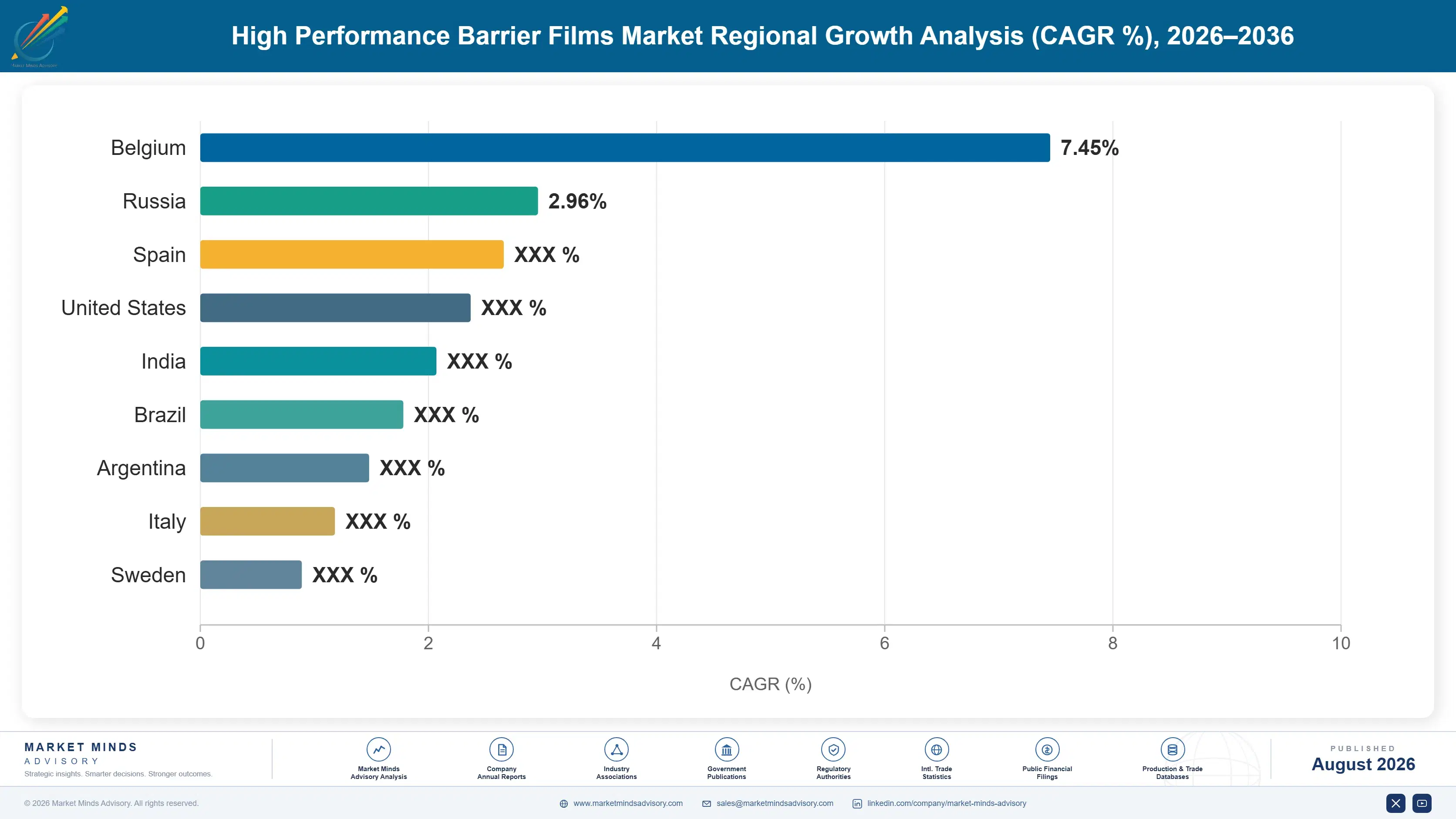
high-performance-barrier-films-market-country-cagr-analysis-1787305477998

Where Barrier Film Producers Can Defend Margin

Four commercial moves separate producers gaining share from those losing it to commodity pricing pressure: mono-material reformulation services, pharmaceutical-grade qualification, recyclability certification, and regional capacity localization near fast-growing converting hubs. Each move converts a compliance or logistics cost into a defensible revenue line competitors without matching technical depth or geographic footprint cannot easily replicate.

Sell Mono-Material Reformulation as a Design Service

Brand owners racing 2030 recyclability deadlines need technical partners who can reformulate an existing multilayer structure into a mono-material equivalent without sacrificing shelf life performance, and few converters have the coating chemistry depth to do this reliably. Producers offering paid reformulation and testing services ahead of a full production commitment capture design-stage revenue while locking in the eventual production order. Early movers report reformulation service fees running 10% to 15% of the resulting film order value, a meaningful new revenue line layered on top of standard per-kilogram film pricing. That fee structure is becoming standard industry practice.
Market Impact: Adds 10% to 15% of order value as s

Pursue Pharmaceutical-Grade Regulatory Qualification for Durable Accounts

Pharmaceutical blister and pouch film requires formal qualification against drug master files and stability testing protocols that take 18 to 24 months to complete but, once achieved, create durable switching costs since a qualified film cannot be swapped without re-testing the drug product itself. Producers who invest early in pharmaceutical qualification, as UFlex has done across multiple generic manufacturing accounts in India, earn a multi-year revenue stream largely insulated from the price competition affecting standard food packaging film. That insulation is worth more than the qualification cost within two to three years of first commercial volume.
Market Impact: Locks in 3 to 5 year account relati

Offer Third-Party Recyclability Certification Alongside Film Supply

Retailers and brand owners increasingly require independent verification that a film structure genuinely qualifies for mono-material recycling streams, not just a producer's own claim, and few film suppliers currently bundle this certification into their commercial offering. Producers partnering with recognized certification bodies to pre-certify film structures before sale reduce the brand owner's compliance burden and capture a 2% to 4% documentation fee alongside the film order itself. This also builds account stickiness, since a certified structure becomes the reference point a brand owner is reluctant to disturb once packaging artwork and regulatory filings reference it.
Market Impact: Adds a 3% to 6% certification servi

Localize Coating Capacity Near Fastest-Growing Converting Hubs

Shipping coated film long distances erodes margin on a relatively low-value-density product, and producers building coating capacity directly within India and Southeast Asian converting hubs capture freight savings while cutting lead times that matter to fast-moving food and pharmaceutical accounts. UFlex and Cosmo Films have both expanded Indian coating capacity substantially since 2023 rather than exporting from established Western facilities. Localized capacity also insulates producers from currency and tariff volatility affecting cross-border film trade, a real and growing consideration as regional trade policy shifts more frequently than in past decades.
Market Impact: Cuts freight and lead-time cost by

Who Controls the Margin Pool

Concentration sits at a moderate CR5 of 38%, with a gap separating global diversified packaging groups from specialist regional film producers. Amcor and Toray Industries compete on coating technology breadth and global manufacturing reach, while Jindal Films and UFlex anchor strong positions in South Asian markets. Smaller regional converters compete mainly on price.
Current competitive activity runs along three lines: mono-material coating technology development, where Toray and Mitsubishi Chemical race to close the barrier gap with legacy PVDC; pharmaceutical qualification depth, where UFlex has built durable accounts; and consolidation, following Amcor's 2025 merger with Berry Global. All participants are assessed on one consistent basis, annual revenue from barrier film products. Consolidation pressure is reshaping supplier lists at multinational accounts industry-wide.

Pressure is building from two directions. Regional Asian converters are scaling coating capacity fast enough to challenge Western producers on price and increasingly on technology. Meanwhile recyclability regulation is forcing every producer to prove compliance regardless of scale, a burden smaller producers without dedicated technical teams are struggling to absorb. Rankings over the next five years will likely shift toward producers combining coating depth with genuine regional manufacturing presence. Smaller producers without either advantage face a genuinely difficult decade ahead.
high-performance-barrier-films-market-company-positioning-matrix-1787305478510

Competitive Moat and Risk Dimensions

AMCOR PLC

Moat: Global lamination and coating scale

Amcor's manufacturing footprint, substantially expanded through its 2025 merger with Berry Global, gives it coating and lamination capacity across more regions than any competitor, letting it serve multinational food and pharmaceutical accounts from local facilities everywhere they operate. That breadth is difficult for any regional specialist to replicate without years of capital investment and technical qualification work across multiple jurisdictions.
AMCOR PLC

Risk: Petrochemical resin cost exposure

Amcor's cost base remains heavily tied to polyolefin and polyester resin pricing, which tracks volatile crude oil and naphtha markets outside its control. Post-merger integration with Berry Global also carries execution risk across overlapping facilities, and any stumble in realizing projected cost savings could pressure margins just as recyclability reformulation demands additional capital investment.
TORAY INDUSTRIES

Moat: Proprietary transparent barrier coating IP

Toray holds some of the industry's most advanced transparent oxide coating patents, developed over decades of materials science investment, giving it a genuine technical edge in the fastest-growing SiOx and AlOx segment. That IP depth lets Toray command premium pricing on coated film that competitors without comparable coating chemistry cannot easily match, particularly for demanding food and electronics packaging applications.
TORAY INDUSTRIES

Risk: Heavy R&D capital intensity

Sustaining Toray's coating technology lead requires continuous, capital-intensive research investment that smaller competitors can skip in the short term while free-riding on published patent literature and reverse engineering. Should transparent coating technology mature and commoditize faster than expected, Toray's premium pricing position could erode before the next generation of proprietary technology is ready to defend it.

Players Tracked

Prominent Players

Amcor plc
Toray Industries
Jindal Films
UFlex Limited
Mitsubishi Chemical Group

Other Key Players

Toppan Inc.
Dai Nippon Printing
Kloeckner Pentaplast
Sealed Air Corporation
Berry Global
Winpak Ltd.
Taghleef Industries
Coveris
Cosmo Films
Treofan Group
Innovia Films
Vibac Group
Polyplex Corporation
SRF Limited
ProAmpac

Recent Developments

APRIL 2025

Amcor completes merger with Berry Global

Amcor completed its previously announced all-stock merger with Berry Global, creating one of the largest global packaging groups by revenue. This was structured and completed as a merger, not an acquisition or joint venture, combining both companies' coating and lamination networks under a single ownership structure spanning multiple continents.
Signal: A full merger, not a partnership, resets t
NOVEMBER 2024

Toray Industries commissions new SiOx coating line in Japan

Toray brought a new transparent oxide coating line online at its Japanese facility, expanding capacity for mono-material recyclable barrier film. This was an organic capacity expansion funded from existing capital, not an acquisition or partnership, and management cited accelerating brand owner recyclability commitments as the primary driver.
Signal: Organic capacity investment ahead of firm
JUNE 2025

UFlex signs multi-year supply agreement with global snack food manufacturer

UFlex Limited signed a multi-year film supply agreement with a major global snack food manufacturer covering multiple manufacturing regions. This was a commercial supply agreement, not a joint venture or acquisition, and secures recurring volume for UFlex across the customer's Asian and Middle Eastern production facilities.
Signal: A multi-region supply deal shows Asian pro

Resin Pricing Still Drives Barrier Film Cost

Polyolefin and polyester resins together account for roughly 58% of production COGS, sourced from global petrochemical producers concentrated in the United States Gulf Coast, the Middle East, and increasingly China, where new cracker capacity has come online steadily since 2021. Coating materials, including vacuum-deposition metals and specialty barrier chemistries, add a smaller but rising cost share as mono-material conversion accelerates.
The clearest recent volatility event traces to 2022, when the EIA recorded sharp naphtha and ethylene price spikes following Russian energy supply disruption, feeding directly into polyolefin resin pricing across Europe and Asia. Several European converters reported multi-month lag in passing resin cost increases through to customers under existing supply contracts, compressing margins meaningfully during the worst of the spike before pricing mechanisms caught up with underlying input costs.

Exposure varies by producer scale and contract structure. Large diversified producers with resin purchasing agreements and geographic sourcing flexibility absorb volatility more smoothly than regional converters dependent on spot market resin purchases. Producers serving pharmaceutical accounts under long-term qualified contracts often carry less pricing flexibility than food packaging suppliers, since switching resin grades can require costly requalification against drug stability testing protocols already on file.
high-performance-barrier-films-market-cost-volatility-analysis-1787305478706

Diversify Resin Sourcing Across Regions and Suppliers

Producers are qualifying multiple resin suppliers across different geographic regions rather than relying on single-source contracts, reducing exposure to any one facility disruption, regional feedstock shortage, or trade policy change affecting a concentrated petrochemical supply base. This mirrors sourcing discipline already standard in automotive and electronics manufacturing, where single-supplier dependency has caused costly, well-documented production disruptions in past years.

Index Long-Term Customer Contracts to Resin Benchmarks

More producers now write resin price pass-through clauses directly into multi-year supply agreements, tying film pricing to published polyolefin or polyester benchmark indices rather than negotiating each adjustment separately, which cuts the margin-compressing lag that hurt converters during the 2022 spike. Customers generally accept these clauses now, having watched competitors absorb painful losses when producers lacked this protection.

Shift Formulation Toward Lower-Resin-Intensity Coated Structures

Some producers are directing development investment toward thinner, coating-heavy mono-material structures that use less bulk resin per unit of barrier performance, reducing raw material exposure per kilogram of film sold even as coating input costs rise modestly in relative share. That tradeoff increasingly favors producers with strong coating chemistry expertise over those relying purely on bulk resin formulation skill.

Portfolio Architecture for Margin Defence

The portfolio splits into three tiers with real margin separation. Volume multilayer laminate films compete largely on price against a backdrop of tightening recyclability penalties, earning modest margins defended through production scale. Certified mono-material coated films earn substantially more because brand owners pay a premium for verified recyclability compliance ahead of binding regulatory deadlines across major markets. That gap widens further as compliance deadlines compress the time
The tension between volume and premium shapes capital allocation directly: legacy laminate lines still generate the cash that funds new coating line investment, but producers that let legacy volume crowd out coating capacity risk losing the fastest-growing, highest-margin accounts to competitors moving faster on mono-material conversion. Producers that manage this balance well retain both revenue streams through the multi-year transition period underway.

High-value pools concentrate in pharmaceutical-qualified films and certified mono-material structures serving brand owners under binding sustainability commitments, where technical difficulty and regulatory stakes justify premium pricing few smaller competitors can match. The emerging next-generation nanocomposite and hybrid coating tier currently earns unevenly as producers absorb development cost against still-scaling commercial volume. That unevenness should ease as nanocomposite processing techniques continue maturing across the supplier base.

Volume / Commodity-Adjacent Tier

Standard multilayer laminate films sold on price to food packaging converters facing rising extended producer responsibility compliance fees., where production scale and operational efficiency determine which producers can still sustain acceptable margin under mounting regulatory cost pressure.
Gross Margin: 15-28%

Premium / Certified Tier

Mono-material coated films with third-party recyclability certification and pharmaceutical-grade qualification for brand owners under binding sustainability commitments., who pay a durable premium for verified compliance rather than risk regulatory penalties or lost retailer shelf space entirely.
Gross Margin: 35-50%

Sustainability / Regulatory / Next-Generation Tier

Nanocomposite and hybrid oxide coating structures still absorbing development investment against developing commercial-scale production volume., where producers are betting today's capital on technology they expect brand owners to demand as a standard specification within a few years.
Gross Margin: 20-45%
high-performance-barrier-films-market-portfolio-architecture-1787305479210

How Barrier Film Demand Actually Recurs

Demand here runs on continuous production-line consumption rather than discrete purchase events. A food or pharmaceutical converter running a packaging line consumes barrier film every operating day across the life of that packaging format, making a single design win worth years of recurring volume rather than a one-time transaction. That continuous consumption pattern gives suppliers unusually predictable, multi-year revenue visibility once a design wins a line.
Adoption depth varies sharply by vertical. Pharmaceutical customers integrate qualified film deeply into regulatory filings and stability testing records, making supplier switching costly and rare once a structure clears qualification. Food and consumer goods customers, by contrast, revisit packaging specifications more frequently as sustainability commitments and retailer requirements evolve, creating more frequent, though still meaningful, switching opportunities for competing producers. That difference forces suppliers to split strategy between depth and flexibility.

Buyer profiles are shifting generationally as sustainability officers gain real authority over packaging specification decisions once made almost entirely by procurement and operations teams focused on cost and line speed. Younger packaging engineers trained on lifecycle assessment tools now weigh recyclability alongside barrier performance as a first-order specification criterion, not an afterthought layered on at the end of material selection.
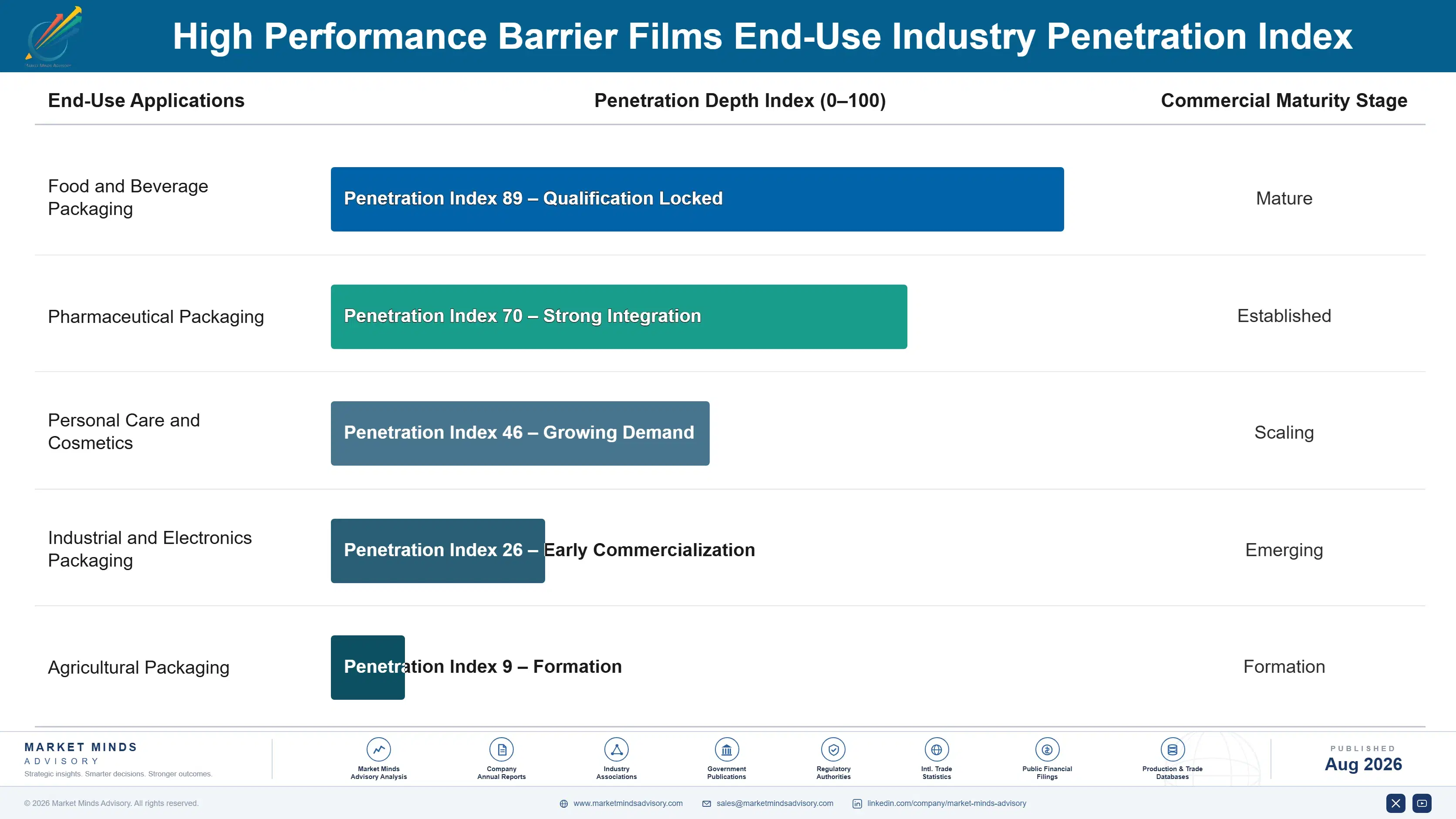
high-performance-barrier-films-market-end-use-penetration-index-1787305479698

Where Barrier Film Value Concentrates Next

These are among the four positions where our research anticipates prominent divergence between winners and laggards over the coming forecast period. Each is grounded in the demand model, the regulatory perimeter, and the announced capacity pipeline.
01 / MONO-MATERIAL CONVERSION TIMING

Prioritize coating capacity investment ahead of 2030 deadlines

Recyclability regulation across the European Union and a growing number of American states is not a distant risk, it is already reshaping procurement decisions years ahead of formal enforcement deadlines. Producers who delay coating capacity investment risk losing brand owner accounts to competitors who can already deliver certified mono-material structures at commercial scale. Capacity committed now, ahead of the sharpest demand curve, will capture disproportionate share as compliance deadlines force conversion industry-wide over the next several years., a dynamic that rewards early movers far more than laggards.
02 / PHARMACEUTICAL QUALIFICATION DEPTH

Treat drug master file qualification as a durable moat

Pharmaceutical film qualification takes 18 to 24 months and meaningful capital, which is exactly why it creates switching costs few competitors can dislodge once a structure is on file against an approved drug product. Producers investing in this qualification early capture multi-year revenue streams substantially insulated from the price competition affecting standard food packaging film. That insulation compounds as each additional qualified product extends the relationship well beyond the typical 2 to 3 year tenure of a standard food packaging supply contract.
03 / ASIAN CAPACITY EXPANSION

Expect Asian converters to keep closing the technology gap

Chinese and Indian producers are no longer competing only on price; they are investing in coating technology fast enough to challenge Western incumbents on performance within specific application categories. That shift is reshaping how the competitive map will look within a decade, not a temporary cost arbitrage that reverses when currencies move. Western producers should expect continued share pressure in standard categories and should concentrate defensible value in qualification-heavy, technically demanding tiers., where scale advantages built in China and India will not simply disappear if trade policy shifts again.
04 / RECYCLING INFRASTRUCTURE GAP

Treat the collection gap as the sector's real credibility risk

A mono-material film that cannot actually be collected and recycled in most markets is a compliance answer without a genuine environmental one, and that gap is drawing sharper regulatory and advocacy scrutiny each year. Producers who fund collection infrastructure pilots alongside film sales build credibility that pure material substitution cannot on its own. Those who treat recyclability as a labeling exercise rather than a systems problem risk reputational exposure once the gap becomes impossible to ignore publicly., a risk that grows sharper as scrutiny of packaging claims increases.

Engagement Snapshot From the Field

A live engagement with an industry participant carrying material or product regulatory and market exposure ahead of a defining policy shift, showing how our research translates into a defensible multi-year portfolio strategy.
MARKET MINDS ADVISORY · CLIENT ENGAGEMENT SUMMARY
High Performance Barrier Films Producer Strategic Portfolio Review and Transition Roadmap 2026·Investment Scenario on High Performance Barrier Films Exposure Evaluation 2025-26
CLIENT PROFILE
A multinational snack food manufacturer operating packaging lines across 12 countries approached MMA ahead of finalizing its 2030 packaging sustainability roadmap. The client reported annual packaging film spend of roughly USD 340 million across its global manufacturing network, with fewer than a fifth of its current structures qualifying as mono-material recyclable (client-reported, unverified by MMA).
STRATEGIC CHALLENGE
Corporate sustainability commitments required a defined mono-material conversion timeline, but the packaging engineering team lacked confidence that transparent coated films could match existing multilayer barrier performance across the client's full product range without triggering costly reformulation and shelf life retesting across dozens of stock-keeping units. Leadership needed a credible roadmap before the next investor sustainability disclosure cycle, not another internal study shelved without action.
MMA APPROACH
MMA benchmarked barrier performance data across six coating technology suppliers against the client's actual shelf life requirements by product category, modeled total conversion cost including line retrofit and retesting expense, and sequenced a phased rollout prioritizing categories where oxide coatings already matched legacy performance closely enough for immediate conversion without added technical risk.
KEY FINDINGS
  1. Roughly 60% of the client's product portfolio could convert to certified mono-material film immediately with no measurable shelf life reduction, far more than internal teams had assumed before the review.
  2. The remaining product categories, mostly extended-shelf-life savory snacks, required either hybrid coating chemistry or continued legacy structure use for another two to three years pending technology maturation.
  3. Sequencing conversion by category rather than attempting a single global changeover reduced projected retooling capital expenditure by an estimated 30% against the client's original all-at-once roadmap draft.
  4. Two of six benchmarked coating suppliers could not yet document third-party recyclability certification suitable for the client's target European markets, narrowing the credible near-term supplier shortlist meaningfully (client-reported, unverified by MMA).
CLIENT PROFILE
A multinational snack food manufacturer operating packaging lines across 12 countries approached MMA ahead of finalizing its 2030 packaging sustainability roadmap. The client reported annual packaging film spend of roughly USD 340 million across its global manufacturing network, with fewer than a fifth of its current structures qualifying as mono-material recyclable (client-reported, unverified by MMA).
STRATEGIC CHALLENGE
Corporate sustainability commitments required a defined mono-material conversion timeline, but the packaging engineering team lacked confidence that transparent coated films could match existing multilayer barrier performance across the client's full product range without triggering costly reformulation and shelf life retesting across dozens of stock-keeping units. Leadership needed a credible roadmap before the next investor sustainability disclosure cycle, not another internal study shelved without action.
MMA APPROACH
MMA benchmarked barrier performance data across six coating technology suppliers against the client's actual shelf life requirements by product category, modeled total conversion cost including line retrofit and retesting expense, and sequenced a phased rollout prioritizing categories where oxide coatings already matched legacy performance closely enough for immediate conversion without added technical risk.
KEY FINDINGS
  1. Roughly 60% of the client's product portfolio could convert to certified mono-material film immediately with no measurable shelf life reduction, far more than internal teams had assumed before the review.
  2. The remaining product categories, mostly extended-shelf-life savory snacks, required either hybrid coating chemistry or continued legacy structure use for another two to three years pending technology maturation.
  3. Sequencing conversion by category rather than attempting a single global changeover reduced projected retooling capital expenditure by an estimated 30% against the client's original all-at-once roadmap draft.
  4. Two of six benchmarked coating suppliers could not yet document third-party recyclability certification suitable for the client's target European markets, narrowing the credible near-term supplier shortlist meaningfully (client-reported, unverified by MMA).
RECOMMENDED STRATEGY
Phase 1: Phase 1 (0 to 9 months): Convert the sixty percent of immediately eligible product lines to certified mono-material film across all twelve manufacturing countries. Phase 2: Phase 2 (9 to 24 months): Pilot hybrid coating chemistry on extended-shelf-life categories with two qualified suppliers before committing to full-line retooling. Phase 3: Phase 3 (24 to 42 months): Complete remaining category conversion as coating technology matures, retiring legacy multilayer lines on a rolling schedule.
OUTCOME
The client began Phase 1 conversion on schedule, reporting an estimated USD 40 million reduction in projected total conversion capital expenditure against its original roadmap through the phased sequencing approach. Two supplier relationships from the benchmarking exercise were converted into multi-year regional supply agreements (client-reported, unverified by MMA).

Frequently Asked Questions

Foundational context covering the market sizes, CAGR, scope, country, region and competition that inform every finding below. This section is provided to cover basics and most often pre-purchase conversations, answered from the MMA Primary Research Dataset.

What is the current size of the High Performance Barrier Films Market?

The high performance barrier films market was valued at USD 9.6 billion in 2025. Growth is driven by recyclability regulation, extended food shelf life demand, and expanding pharmaceutical blister packaging volume.

How large will the High Performance Barrier Films Market be by 2036?

The market is projected to reach USD 19.9 billion by 2036 under the base case scenario. That reflects an expansion multiple of roughly 1.93 times the 2026 value.

What is the CAGR for the High Performance Barrier Films Market 2026 to 2036?

The base case CAGR is 6.8%, with a bull case of 8.1% and a bear case of 5.5%. Mono-material conversion speed is the main factor separating the scenarios.

Which segment is growing fastest?

SiOx and AlOx transparent coated films grow fastest at 11.0% CAGR, roughly 1.62 times the overall market rate. Nanocomposite barrier films follow as the second-fastest segment at 9.5%.

Who are the major companies in the High Performance Barrier Films Market?

Leading producers include Amcor plc, Toray Industries, Jindal Films, UFlex Limited, and Mitsubishi Chemical Group. The top five hold a combined 38% of the market.

Which country is growing fastest?

India is the fastest-growing country at 12.5% CAGR, driven by generic pharmaceutical export growth and expanding organized food retail. UFlex and Cosmo Films anchor that capacity buildout.

Report Segmentation Architecture

The full report scope spans multiple orthogonal segmentation dimensions, with cross-tabulated demand data provided for each dimension pair. Coverage extends further to regional breakdowns, trend trajectories, and the competitive detail needed to support segment-level decision-making.

By Barrier Material and Coating Technology

  • Metallized Barrier Films
  • EVOH Multilayer Films
  • PVDC Coated Films
  • SiOx and AlOx Transparent Coated Films
  • Nanocomposite Barrier Films
  • PET and BOPP Laminate Films

By End-Use Industry

  • Food and Beverage Packaging
  • Pharmaceutical Packaging
  • Personal Care and Cosmetics
  • Industrial and Electronics Packaging
  • Agricultural Packaging

By Commercial Dimension

  • Direct Converter Supply
  • Distributor and Trading Channel
  • Private Label Film Programs
  • Contract Coating Services

By Region

  • North America
  • Western Europe
  • East Asia
  • South Asia and Pacific
  • Latin America
  • Middle East and Africa
  • Eastern Europe

Scope, Methodology, and Coverage

Every figure in this report is reproducible from documented input assumptions. The scope below maps the historical period, the forecast horizon, the segmentation dimensions, and the countries covered, alongside the underlying primary and qualitative methodology.
Historical Period
2020 to 2025
Forecast Period
2026 to 2036
Base Year
2025 (USD billions; MMA Primary Research Dataset, August 2026)
Market Definition
The high performance barrier films market comprises flexible plastic and coated films engineered to restrict oxygen, moisture, aroma, or light transmission for food, pharmaceutical, and industrial packaging applications, including metallized, EVOH, PVDC, and oxide-coated mono-material structures. Rigid barrier packaging, standard commodity films without engineered barrier properties, and downstream pouch or bag conversion services sold separately from film supply are excluded.
Quantitative Units
USD billions (current prices); metric tonnes of film produced where applicable
Segmentation Dimensions
By Barrier Material and Coating Technology; By End-Use Industry; By Commercial Dimension; By Region
Regions Covered
North America, Western Europe, East Asia, South Asia and Pacific, Latin America, Middle East and Africa, Eastern Europe
Countries Covered
USA, China, Germany, France, UK, Japan, South Korea, India, Australia, Canada, Brazil, Mexico, Indonesia, Vietnam, Thailand, Malaysia, UAE, Saudi Arabia, South Africa, Nigeria, Turkey, Poland, Netherlands, Italy, Spain, Sweden, Switzerland, Argentina, Colombia, Singapore, and additional markets relevant to this sector
Key Companies Profiled
Amcor plc, Toray Industries, Jindal Films, UFlex Limited, Mitsubishi Chemical Group, Toppan Inc., Dai Nippon Printing, Kloeckner Pentaplast, Sealed Air Corporation, Berry Global, Winpak Ltd., Taghleef Industries, Coveris, Cosmo Films, Treofan Group, Innovia Films, Vibac Group, Polyplex Corporation, SRF Limited, ProAmpac
Quantitative Methodology
Primary survey, n=3,800 respondents, Q4 2025, six countries; demand-side model with trade association cross-validation
Qualitative Methodology
47 expert interviews, Q4 2025; applied to validate demand model assumptions, identify emerging dynamics, and assess competitive positioning
Report Format
PDF and XLSX data workbook (Word format preview document)
Publisher
Market Minds Advisory
Report Code
MMA-2026-PAC-201
Published
August 2026
Contact
sales@marketmindsadvisory.com | www.marketmindsadvisory.com

Purchase the full High Performance Barrier Films Market Report (2026 to 2036).

The full MMA High Performance Barrier Films Market report sizes demand across six barrier technologies, five end-use industries, four commercial dimensions, and seven regions through 2036. It profiles twenty participants on a consistent revenue basis, scoring each on coating technology depth, recyclability certification readiness, and pharmaceutical qualification breadth. Scenario models quantify how mono-material conversion speed and regulatory deadline enforcement move both demand and realizable pricing. The report includes delivered-cost modeling by barrier technology and a supplier recyclability-readiness screen built for procurement and sustainability strategy teams.
Barrier technology cost-curve modeling across all major coatings
Recyclability certification readiness scoring by producer
Pharmaceutical qualification depth benchmarks across suppliers
Regional coating capacity investment tracking through 2036
Resin cost exposure modeling by producer scale
Mono-material conversion timeline scenarios under bull and bear cases

Built For The People Who Decide

From boardroom strategy to bench-side execution, this report is read cover-to-cover by leaders shaping the next decade of their industry, turning demand scenarios, market dynamics and valuation benchmarks into decisions.
CXOs/ Presidents/ VPs/ Managers
M&A and Corporate Development
Strategy Teams and R&D Heads
Procurement and Product Directors
Regulatory and Compliance Leaders
Investor Relations and Equity Analysts