Market Minds Advisory
High-Aspect-Ratio 3D NAND Metrology Equipment Market

High-Aspect-Ratio 3D NAND Metrology Equipment Market: High-Aspect-Ratio 3D NAND Metrology Equipment Market. Precision Measurement Systems for Advanced Memory Fabrication

NAND fabricators pushing past three hundred vertical layers are running into optical metrology's physical limits, forcing equipment suppliers to qualify X-ray and electron-beam systems that most fabs had never budgeted for before.

Lead Analyst

Published

September 2026

Make Smarter Decisions with Customized Research Insights

Request a free sample report and evaluate market opportunities, growth trends, and competitive dynamics relevant to your business needs.

2025 MARKET VALUE$1.9BMarket Size 2025
2036 FORECAST VALUE$5.8BBase Case , 2026 to 2036
CAGR 2026 TO 203611.0 %Bull 12.3% / Bear 9.8%
INCREMENTAL OPPORTUNITY$3.8BNet 10- year value creation
EXPANSION MULTIPLE2.84x2036 value over 2026 base
Strategic Levers
M&A Pipeline
Regional Outlook
Country Rankings
Competitive Intelligence
Segmental Deep-dive
Call-Us : 91 93563 13602

Executive Snapshot and Market Trajectory.

Optical metrology is hitting a genuine physical wall as NAND vertical layer counts push well past three hundred layers, forcing fabs to qualify X-ray and electron-beam alternatives years earlier than their capital equipment roadmaps originally planned for this disruptive transition period now sweeping the industry.
Samsung, SK Hynix, Kioxia, and Micron are all racing to qualify non-optical metrology tools capable of resolving channel hole geometry through structures that optical scatterometry simply cannot penetrate reliably anymore at these extreme aspect ratios now entering volume production across multiple fabrication sites worldwide today. South Korea concentrates the fastest-growing procurement volume as its two largest NAND producers commit capital ahead of most global competitors currently active in the broader memory market.
Five equipment suppliers hold 68 percent combined share, reflecting a concentrated market where qualification cycles on a single fab's process of record can lock out competitors for several years at a time without meaningful opportunity to re-compete for that business. Rising X-ray metrology adoption and expanding AI-driven yield analytics software are reshaping which suppliers win the next generation of fab qualification slots across every major memory manufacturer worldwide.
Market Definition
This report covers metrology equipment used to measure critical dimensions, channel hole geometry, and layer uniformity in high-aspect-ratio 3D NAND flash memory fabrication. It excludes lithography, deposition, and etch process equipment, as well as metrology systems designed solely for planar or DRAM device architectures.
Base Year Value
$1.9B in 2025 (MMA Primary Research Dataset, September 2026)
Forecast Period
2026 to 2036, eleven discrete annual values
CAGR
11.0% base case. Bull 12.3%. Bear 9.8%.
Fastest Growth Segment
X-Ray Metrology Systems: 18.0% CAGR
Fastest Growth Country
South Korea: 15.5% CAGR
Fastest Growth Region
South Asia and Pacific: 13.0% CAGR
Largest Region
East Asia: 34% of 2025 global value
Market Leaders
KLA Corporation, Applied Materials Inc, Onto Innovation Inc, Nova Ltd, Thermo Fisher Scientific Inc. Source: MMA Primary Research Dataset, July 2026.
Primary Survey
n=3,800 procurement and R&D decision-makers, Q4 2025, six countries
Methodology
Demand-side build-up, cross-validated against public data, 47 expert interviews

High-Aspect-Ratio 3D NAND Metrology Equipment Market Forecast Scenarios

high-aspect-ratio-3d-nand-metrology-equipment-mark-size-forecast-scenario-1788423106069
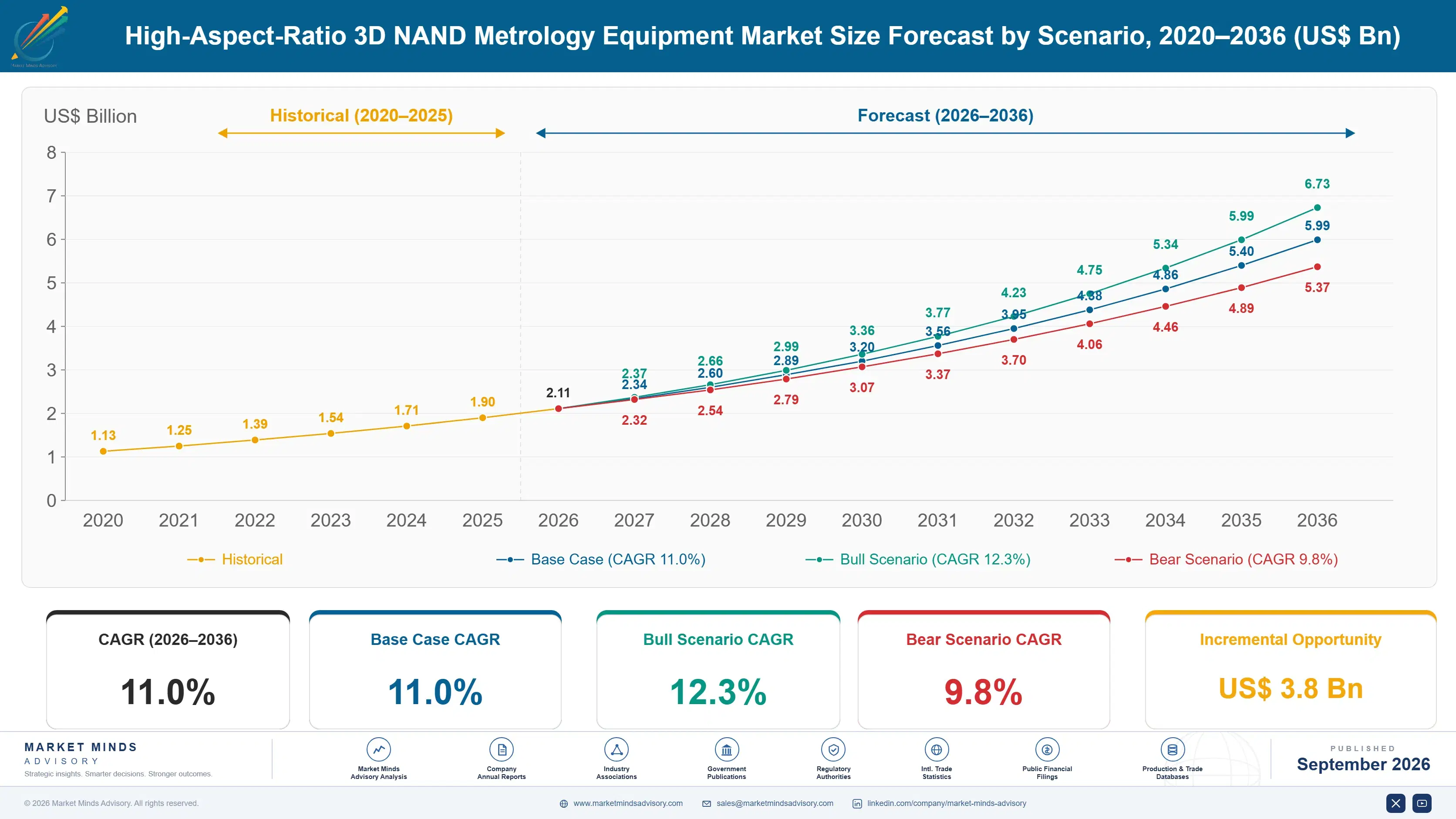
The market grew steadily between 2020 and 2025 at a 10.0 percent historical rate, expanding as NAND producers scaled layer counts past one hundred and seventy while optical metrology remained sufficient for most process control needs during this earlier development window before the current aspect-ratio physical wall emerged across the industry, prompting the first serious non-optical qualification efforts among leading producers.
MMA's base case assumes 11.0 percent annual growth through 2036, anchored on three mechanisms: accelerating adoption of X-ray metrology as layer counts exceed the physical limits of optical systems entirely, expanding AI-driven yield analytics software attached to existing tool fleets across multiple fab sites, and rising capital expenditure from memory producers racing to defend margin through node transitions requiring tighter process control than prior generations ever demanded from their equipment suppliers.
A bull scenario built around accelerated NAND capital expenditure and faster X-ray tool qualification cycles across leading fabs could push growth toward 12.3 percent, while a bear case tied to a broader memory pricing downturn or delayed fab investment decisions could compress growth toward 9.8 percent across the coming decade as capital budgets tighten and qualification timelines stretch out considerably.

Where Physics Meets Fab Economics

Metrology demand is converging on a single physical constraint: optical wavelengths cannot resolve features buried beneath three hundred stacked layers of alternating oxide and nitride material, forcing fabs toward X-ray and electron-beam systems that were niche research tools until quite recently in this industry's development history, a shift few equipment roadmaps anticipated even five years ago at the height of planar scaling.
MARKET CONCENTRATIONCR5 68%top five suppliers hold a strong combined majority
AVERAGE SELLING PRICE$4.2M per systemreflects multi-modal sensor integration and added software licensing costs
TOP PRODUCING COUNTRYUSA 41% shareconcentrated among legacy equipment makers based domestically for decades
CAPACITY UTILIZATION76%reflects lengthy qualification cycles ahead of full deployment
TRADE INTENSITY70% export sharemost systems ship across borders to fab customers
FEEDSTOCK COST SHARE22% of COGSdriven by precision optics and detector component inputs
Commercially, this remains a relationship-driven, qualification-heavy business where suppliers negotiate multi-year process-of-record agreements tied to specific fab nodes rather than competing on catalog specifications alone. Switching suppliers mid-node is rare, since requalification risks disrupting yield ramps that memory producers simply cannot afford to interrupt, a dynamic that rewards incumbent suppliers considerably over new challengers entering the field at any stage of the qualification cycle.
The next decade brings gradual commoditization pressure from Chinese domestic equipment makers gaining ground on legacy Western suppliers, balanced against export control restrictions on advanced metrology technology that limit how freely that capacity can serve customers building next-generation memory fabrication capacity outside restricted markets, a tension that will likely persist across most of the forecast period and shape supplier strategy considerably.
"Every fab we've talked to says the same thing: they didn't budget for X-ray metrology two years ago. Now it's the line item nobody can cut without stalling the whole yield ramp."
Director, Semiconductor Equipment and Metrology Practice · MMA Technology Practice · September 2026

Market Trends

X-Ray Metrology Displaces Optical Systems at Extreme Layers

Small-angle X-ray scattering systems are moving from research curiosity to production-line necessity as NAND layer counts exceed three hundred, since X-rays penetrate depths optical scatterometry simply cannot reach without destructive cross-sectioning of the wafer itself. Samsung and SK Hynix both qualified X-ray metrology tools for high-volume manufacturing across 2025 as their most advanced fabrication lines moved into production ramp. This shift is forcing metrology suppliers without X-ray capability to either acquire it or risk losing process-of-record positions on the industry's most advanced nodes to competitors who invested earlier in this measurement technology.
Market Impact: Capex commitments rose 24 percent
AI-Driven Yield Analytics Software Attaches to Tool Fleets

Metrology suppliers increasingly bundle machine-learning-based defect classification and yield prediction software with their hardware, turning a one-time equipment sale into a recurring software licensing relationship that extends across a tool's entire operational lifetime and beyond. Fabs report meaningfully faster root-cause identification when metrology data feeds directly into these analytics platforms rather than requiring manual engineer review of raw measurement output data. This software layer is becoming a genuine competitive differentiator, since switching hardware suppliers now risks losing accumulated historical yield data and trained analytics models tied to the incumbent's platform.
Market Impact: Capacity grants exceeded 200 million

Market Opportunities and Growth Drivers

Rising Memory Capital Expenditure Drives Tool Orders

NAND producers are increasing capital expenditure to expand advanced-node capacity as data center and AI training workloads drive persistent demand for higher-density storage, and metrology equipment represents a meaningful share of every new fabrication line's process control budget. Micron and Kioxia both announced expanded fabrication capacity plans across 2025 that specifically referenced advanced 3D NAND architectures requiring next-generation metrology capability from the very outset of construction. This capital cycle is pulling equipment orders forward as producers race to secure tool delivery slots ahead of qualification deadlines tied to customer supply commitments.
Market Impact: Qualification delays add 14 months

Export Incentives Favor Domestic Equipment Manufacturing Capacity

Government incentive programs across the United States and allied nations aimed at reshoring critical semiconductor equipment manufacturing capacity are prompting several suppliers to expand domestic production of advanced metrology systems rather than relying entirely on offshore component sourcing and third-party assembly operations. These programs frame metrology equipment as strategically important technology relevant to national semiconductor supply chain resilience, opening grant funding that smaller specialist suppliers previously could not access on their own initiative. This shift is gradually reducing the industry's historical dependence on a small number of legacy manufacturing sites.
Market Impact: Component lead times extended 9 weeks

Market Restraints and Challenges

Long Qualification Cycles Delay Revenue Recognition

New metrology systems require twelve to eighteen months of joint testing with a fab's process engineering team before winning process-of-record status, delaying revenue recognition considerably and creating genuine cash flow strain for smaller suppliers competing against established incumbents. The root cause is that any measurement error propagates directly into yield loss across an entire wafer lot, so fabs demand extensive statistical validation before trusting a new tool with production decisions. Suppliers are mitigating this through parallel testing programs that run new systems alongside proven tools before full production cutover, shortening the validation window somewhat.
Market Impact: X-ray orders grew 28 percent

X-Ray Source Components Face Concentrated Supply

X-ray metrology systems depend on specialized tube and detector components manufactured by a small number of specialized suppliers, creating a genuine bottleneck risk if demand accelerates faster than that narrow supplier base can expand production capacity to meet growing equipment maker orders. The root cause is that these components require specialized manufacturing expertise that took decades to develop and cannot be replicated quickly by new entrants seeking to capture this emerging opportunity. Suppliers are mitigating this through long-term supply agreements and, in some cases, vertical integration into component manufacturing to secure reliable access.
Market Impact: Software licensing revenue rose 19 percent
3 additional market trends, 4 additional growth drivers, and 2 additional restraints and challenges are covered in the full report. Contact sales@marketmindsadvisory.com to access the complete intelligence.

Segment CAGR and Growth Architecture

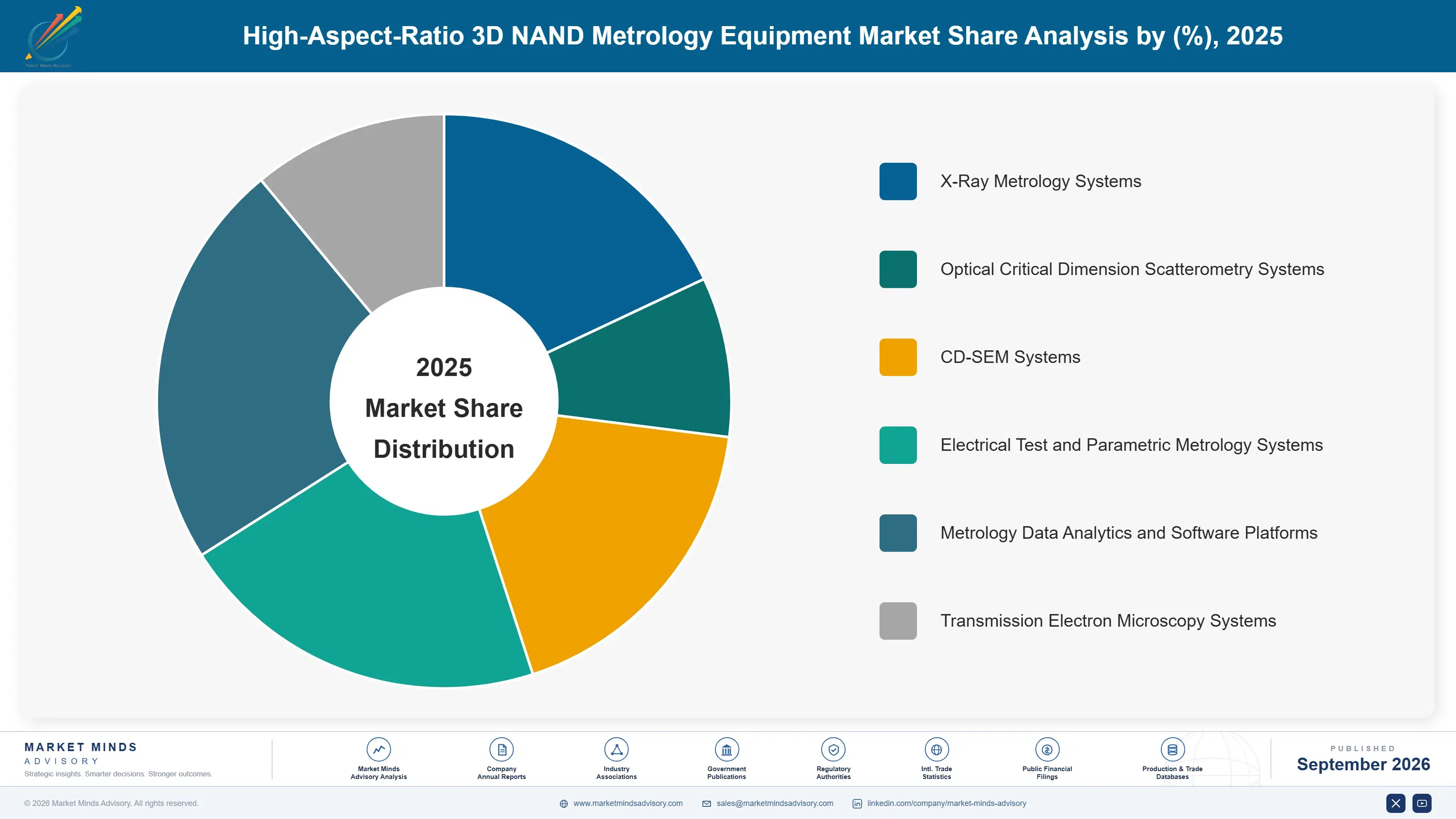
Segmentation follows measurement technology rather than fab customer type or device architecture, since optical, X-ray, electron-beam, electrical, and software-based approaches each solve fundamentally different physical measurement problems and each compete for entirely distinct qualification slots within a fab's overall process control equipment fleet and annual capital budget allocation process across every major memory producer worldwide.
high-aspect-ratio-3d-nand-metrology-equipment-mark-market-share-analysis-1788423106607

X-Ray Metrology Systems

X-ray metrology has become the fastest-growing category as small-angle X-ray scattering systems move from research curiosity to production necessity for measuring channel hole geometry buried beneath three hundred or more stacked layers that optical wavelengths simply cannot penetrate reliably anymore. Component suppliers face genuine engineering challenges scaling X-ray source brightness and detector sensitivity to production-line throughput requirements, since research-grade systems historically prioritized measurement precision over speed. Samsung and SK Hynix both qualified X-ray systems for high-volume manufacturing across 2025, validating the technology's readiness for mainstream fab deployment beyond earlier pilot-line testing. Suppliers who complete this qualification gain multi-year process-of-record positions that competitors entering later will find extremely difficult to displace.
CAGR 18.0%

Metrology Data Analytics and Software Platforms

Software platforms that apply machine learning to defect classification and yield prediction represent the second-fastest-growing category, as fabs increasingly value software capability as much as the underlying measurement hardware itself. This category benefits from a genuine network effect, since accumulated historical yield data trains increasingly accurate predictive models that become more valuable the longer a fab uses a particular supplier's platform continuously and consistently. Suppliers who bundle analytics software with hardware sales are building recurring licensing revenue streams that persist even after the initial equipment sale, a commercial structure this market historically lacked entirely. Switching suppliers now risks losing years of accumulated model training data tied to a specific platform.
CAGR 15.0%
Full segment breakdown across 6 segments available in the complete report.

Regional Architecture and Country Demand Map

East Asia holds the largest share, since South Korea, Japan, China, and Taiwan concentrate nearly all NAND fabrication capacity that generates metrology equipment demand directly. North America follows closely behind, anchored by legacy equipment suppliers headquartered domestically and Micron's advanced fabrication investment across multiple sites nationwide.

East Asia

South Korea, Japan, China, and Taiwan together host nearly all global 3D NAND fabrication capacity, a concentration meaningfully above typical technology-equipment market patterns because memory production itself is so geographically concentrated in this region compared to other semiconductor device categories. Samsung and SK Hynix drive the fastest-growing procurement volume within the region as their most advanced fabrication lines push past three hundred layers ahead of most global competitors. This out-of-band concentration reflects genuine fabrication capacity geography rather than a default regional assumption, and it is reinforced by Kioxia's domestic Japanese production and China's expanding YMTC capacity adding further regional demand layered on top of the Korean base and its established fabrication footprint across the region.
Share: 34% | CAGR: 12.3% (2026 to 2036)

North America

The United States hosts the majority of the world's specialist metrology equipment manufacturing capacity, led by KLA Corporation, Applied Materials, and Onto Innovation, all headquartered domestically with decades of accumulated process-control expertise built alongside the broader US semiconductor equipment industry over multiple technology generations and product development cycles spanning several decades of continuous innovation. Micron's advanced fabrication investment under federal manufacturing incentive programs is adding a meaningful domestic demand pool layered on top of this established equipment-supplier base. Growth here tracks near the top of its regional band as both domestic memory fabrication capacity and equipment export volume to Asian customers continue expanding steadily year over year across multiple contract cycles.
Share: 29% | CAGR: 12.4% (2026 to 2036)
Regional intelligence for 5 additional markets available in the complete report: Western Europe, South Asia and Pacific, Latin America, Middle East and Africa, Eastern Europe. Contact sales@marketmindsadvisory.com.
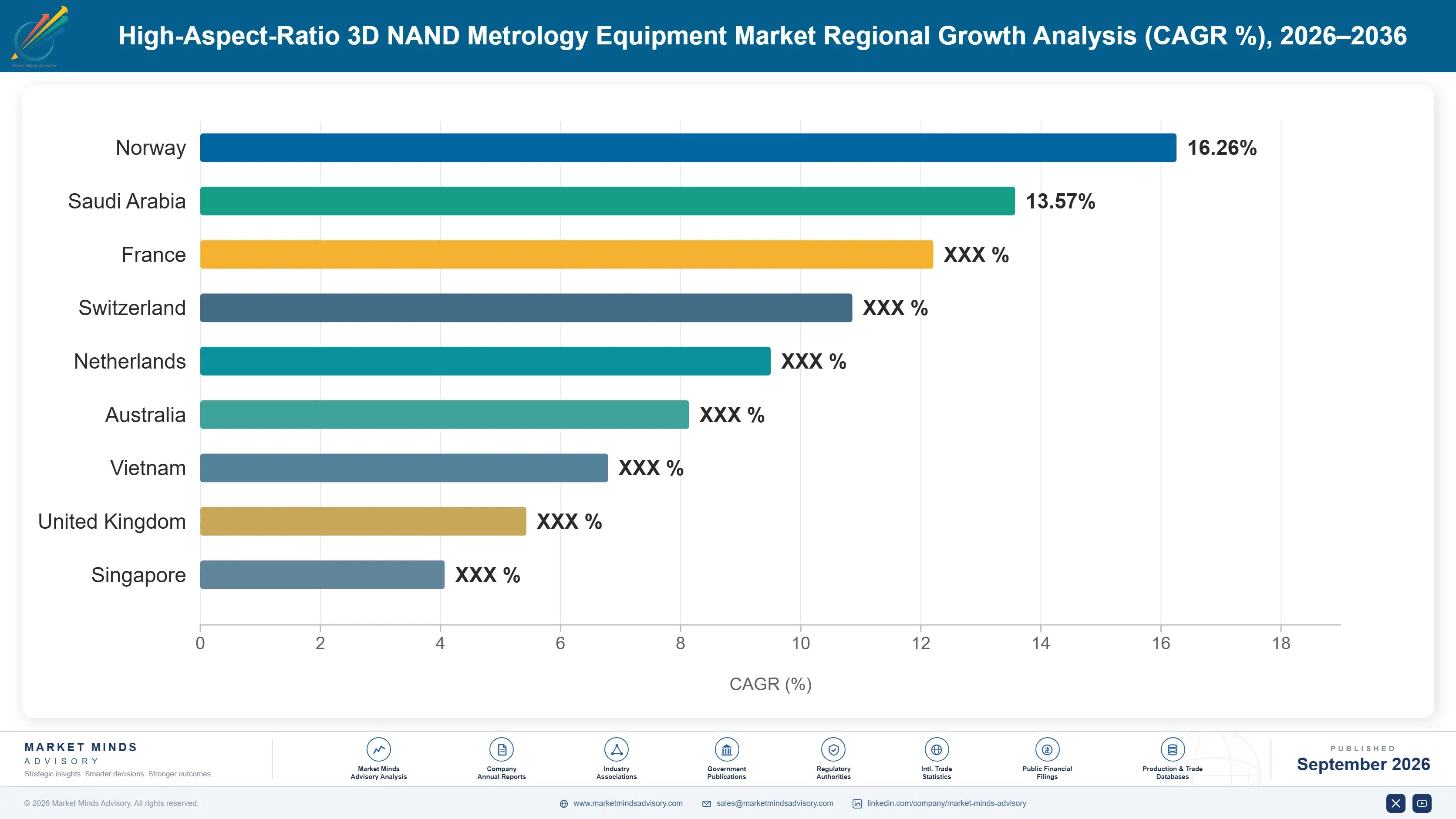
high-aspect-ratio-3d-nand-metrology-equipment-mark-country-cagr-analysis-1788423107126

Paths to Margin Beyond Hardware Sales

Suppliers face compressed pricing on legacy optical systems, but four distinct commercial paths let differentiated suppliers capture meaningful margin above traditional equipment-sale levels across the entire industry today and well into the future ahead of most global rivals and challengers: X-ray technology depth, bundled analytics software, process-of-record lock-in, and export-controlled component manufacturing capability built domestically.

X-Ray Technology as a Pricing Advantage

Suppliers who complete X-ray metrology qualification for leading-edge NAND fabs command roughly 35 percent higher prices than suppliers offering only legacy optical systems, since fabs pay a premium for measurement capability that reaches depths optical wavelengths simply cannot penetrate. Qualification typically requires eighteen months of joint testing with a fab's process engineering team before reaching production status, a barrier that keeps new entrants from undercutting established suppliers quickly. Suppliers who complete this once can resell the validated design across multiple fab customers, spreading that investment across far greater production volume.
Market Impact: X-ray qualified systems command roughly 35 percent premium

Bundled Analytics Software Creating Recurring Revenue

Suppliers who bundle machine-learning-based yield analytics software with hardware sales convert a one-time equipment purchase into a recurring licensing relationship worth roughly 15 to 20 percent of the original hardware price annually across the tool's entire operational lifetime and beyond. This shift moves suppliers up the value chain from commodity hardware sales toward system-level value that fabs increasingly prefer, since it reduces the integration burden on the customer's own data science teams considerably. Suppliers investing in this capability are building customer relationships that extend well beyond the original equipment sale.
Market Impact: Adds roughly 15 to 20 percent annual revenue

Process-of-Record Status Locking In Multi-Year Revenue

Suppliers who win process-of-record status on a fab's most advanced node secure multi-year purchase commitments worth roughly 70 percent of that node's total metrology spend, covering spare parts, calibration services, and future tool generations tied to that same qualified platform. Displacing an incumbent supplier requires a fab to accept meaningful yield risk during requalification, a switching cost that protects incumbent revenue streams for years after the initial equipment sale closes out. Suppliers who secure this status early in a node's life capture the largest share of that node's total equipment spending.
Market Impact: Process-of-record wins secure roughly 70 percent of node spend

Export-Controlled Component Manufacturing as a Barrier

Suppliers who manufacture X-ray source and detector components domestically under export control frameworks can serve defense-adjacent and allied-nation customers that competitors dependent on offshore component sourcing simply cannot access as reliably or quickly given regulatory constraints and licensing delays. This capability requires upfront investment worth roughly 20 percent of annual revenue in domestic manufacturing infrastructure that smaller suppliers often avoid, creating a genuine barrier that protects the pricing power of suppliers willing to make that investment early. Suppliers who establish this capability also gain government incentive funding unavailable to import-dependent competitors.
Market Impact: Domestic manufacturers access 40 percent more grant funding

Who Controls the Margin Pool

Sixty-eight percent combined revenue share among the top five suppliers signals a genuinely concentrated equipment market rather than fragmented competition, with a meaningful gap separating the two established leaders from smaller specialist rivals across the wider competitive field. Revenue is the evaluation basis used consistently throughout this section, since unit shipment figures are not uniformly disclosed across privately held suppliers.
Competitive activity currently centers on X-ray metrology qualification programs, as suppliers race to secure design wins on next-generation fabrication nodes before rivals lock in multi-year process-of-record relationships. Several suppliers have expanded domestic component manufacturing capacity to reduce reliance on offshore sourcing, while others pursue analytics software acquisitions to bundle machine-learning capability with existing hardware platforms. Price competition remains intense on legacy optical systems.

Emerging pressure comes from Chinese domestic equipment makers expanding capability, a shift that could reshape rankings if China's memory producers continue scaling domestic fabrication capacity independent of Western suppliers. Suppliers with strong bundled analytics software are gaining share against rivals still selling standalone hardware without integrated yield-prediction capability. Smaller suppliers investing early in X-ray technology stand the best chance of climbing past larger but underexposed incumbent rivals.
high-aspect-ratio-3d-nand-metrology-equipment-mark-company-positioning-matrix-1788423107655

Competitive Moat and Risk Dimensions

KLA CORPORATION

Moat: Deep Process-of-Record Incumbency

KLA holds process-of-record positions across most leading NAND fabs built over decades of accumulated qualification history, since displacing an incumbent requires a fab to accept meaningful yield risk during requalification that most producers simply refuse to accept without an overwhelming reason to switch suppliers entirely.
KLA CORPORATION

Risk: X-Ray Technology Catch-Up Risk

KLA's historical strength in optical metrology leaves it exposed if rivals with earlier X-ray technology investment lock in process-of-record status on the newest, most advanced fabrication nodes before KLA completes its own X-ray qualification across leading customer accounts and their most demanding fabrication lines currently in production.
APPLIED MATERIALS INC

Moat: Broad Equipment Portfolio Bundling

Applied Materials pairs metrology equipment sales with its much broader deposition and etch equipment portfolio, giving customers a single-vendor relationship across multiple process steps that standalone metrology specialists cannot match, creating switching costs that extend well beyond metrology alone into the fab's entire equipment fleet.
APPLIED MATERIALS INC

Risk: Specialist Suppliers Erode Metrology Share

Applied Materials' broad portfolio focus means metrology-specific innovation sometimes lags behind pure-play specialists like KLA and Onto Innovation, who dedicate their entire engineering budget to measurement technology rather than splitting resources across deposition, etch, and metrology simultaneously across an already broad and diverse product line.

Players Tracked

Prominent Players

KLA Corporation
Applied Materials Inc
Onto Innovation Inc
Nova Ltd
Thermo Fisher Scientific Inc

Other Key Players

Hitachi High-Tech Corporation
Bruker Corporation
Carl Zeiss SMT GmbH
Rigaku Corporation
Xenocs SAS
Camtek Ltd
Advantest Corporation
FormFactor Inc
Veeco Instruments Inc
PDF Solutions Inc
ASML Holding NV
Tokyo Electron Limited
Screen Semiconductor Solutions
Nikon Corporation
Park Systems Corp

Recent Developments

MAY 2026

KLA Expands X-Ray Metrology Qualification Program

KLA Corporation announced completion of an expanded X-ray metrology qualification program targeting three-hundred-plus layer NAND architectures, expanding its addressable design-in opportunities across upcoming fabrication nodes from multiple global memory producers seeking non-optical measurement capability ahead of most competing equipment suppliers currently active in the field.
Signal: Signals accelerating X-ray qualification competition ahead of the next major NAND layer-count transition across leading fabs.
MARCH 2026

Applied Materials Expands Domestic Metrology Capacity

Applied Materials completed an organic capacity expansion at its domestic manufacturing facility dedicated to advanced metrology component production, adding meaningful new manufacturing capacity to support anticipated fabrication demand growth without pursuing any acquisition or joint venture structure for this particular capacity expansion project now underway.
Signal: Reflects organic capacity investment rather than inorganic consolidation activity across the broader equipment industry landscape overall.
JANUARY 2026

Onto Innovation Secures Multi-Year Supply Agreement

Onto Innovation entered a multi-year supply agreement with a major memory producer covering next-generation metrology systems for upcoming fabrication node transitions across several newly planned facilities located nationwide, securing predictable production volume without any equity stake or acquisition changing hands between the two companies involved.
Signal: Demonstrates multi-year supply agreement structures increasingly displacing spot-market equipment purchasing patterns across the wider global industry.

Precision Optics and X-Ray Source Exposure

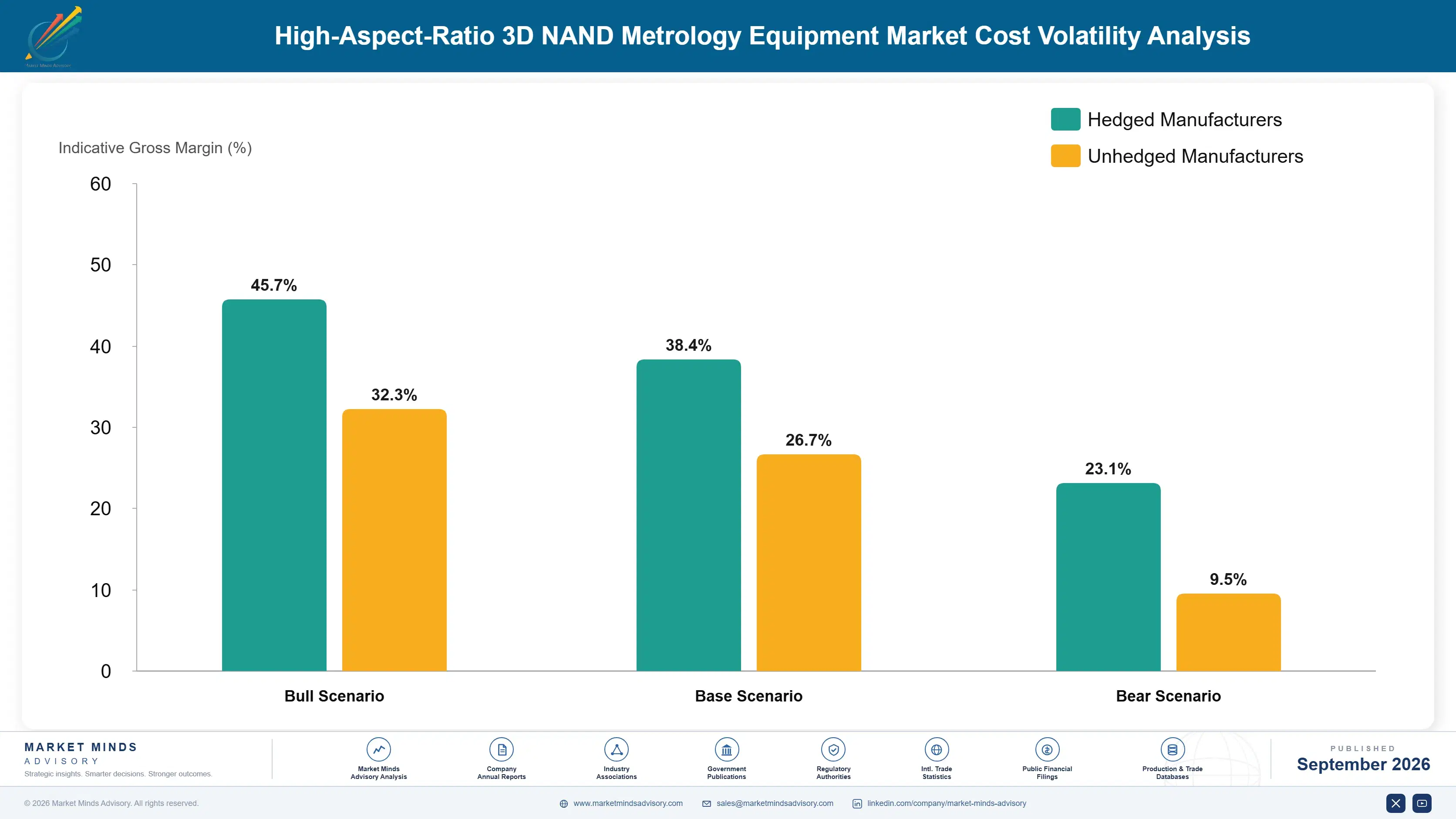
Precision optical components and X-ray tube and detector modules together represent roughly 32 percent of finished system cost of goods sold, with specialized semiconductor sensors contributing smaller additional shares depending on the specific measurement modality a system integrates. Japan and Germany supply the majority of high-precision optical components feeding metrology system assembly globally, concentrating upstream sourcing risk within a small number of specialized suppliers.
Global semiconductor equipment supply chains tightened in 2023 following broad export control expansion, and the IEA's Critical Minerals Market Review 2024 documented rare earth and specialty material price increases of roughly 22 percent within the year as equipment makers competed for constrained available supply of precision-grade materials. Several suppliers drew down existing component inventory reserves while qualifying alternative sourcing channels outside the most affected supply routes.

Suppliers without long-term precision component supply contracts face materially higher spot-market exposure than those with locked-in agreements, a genuine competitive disadvantage during tightening supply since spot buyers absorb price spikes immediately while contracted buyers do not feel the same pressure. Larger suppliers with diversified sourcing and stronger balance sheets absorb volatility more easily than smaller specialist suppliers dependent on a single component source, widening the cost gap.
high-aspect-ratio-3d-nand-metrology-equipment-mark-cost-volatility-analysis-1788423107851

Diversify Precision Optics Sourcing Geographically

Leading suppliers are qualifying precision optical component sources beyond their traditional Japanese and German supplier base, including emerging capacity in the United States, to reduce single-region dependency. This diversification effort typically takes several years to fully qualify at production-grade precision, but suppliers who start early gain meaningful negotiating position over customers still dependent on single-source components.

Long-Term Contracts With Built-In Price Ceilings

Some equipment makers are negotiating multi-year precision component supply agreements that include price ceiling provisions, trading away potential downside benefit from falling prices for protection against the kind of sudden spike the 2023 export tightening caused. This approach suits larger suppliers with balance sheet capacity to commit to volume guarantees smaller regional competitors cannot easily match.

Portfolio Architecture for Margin Defence

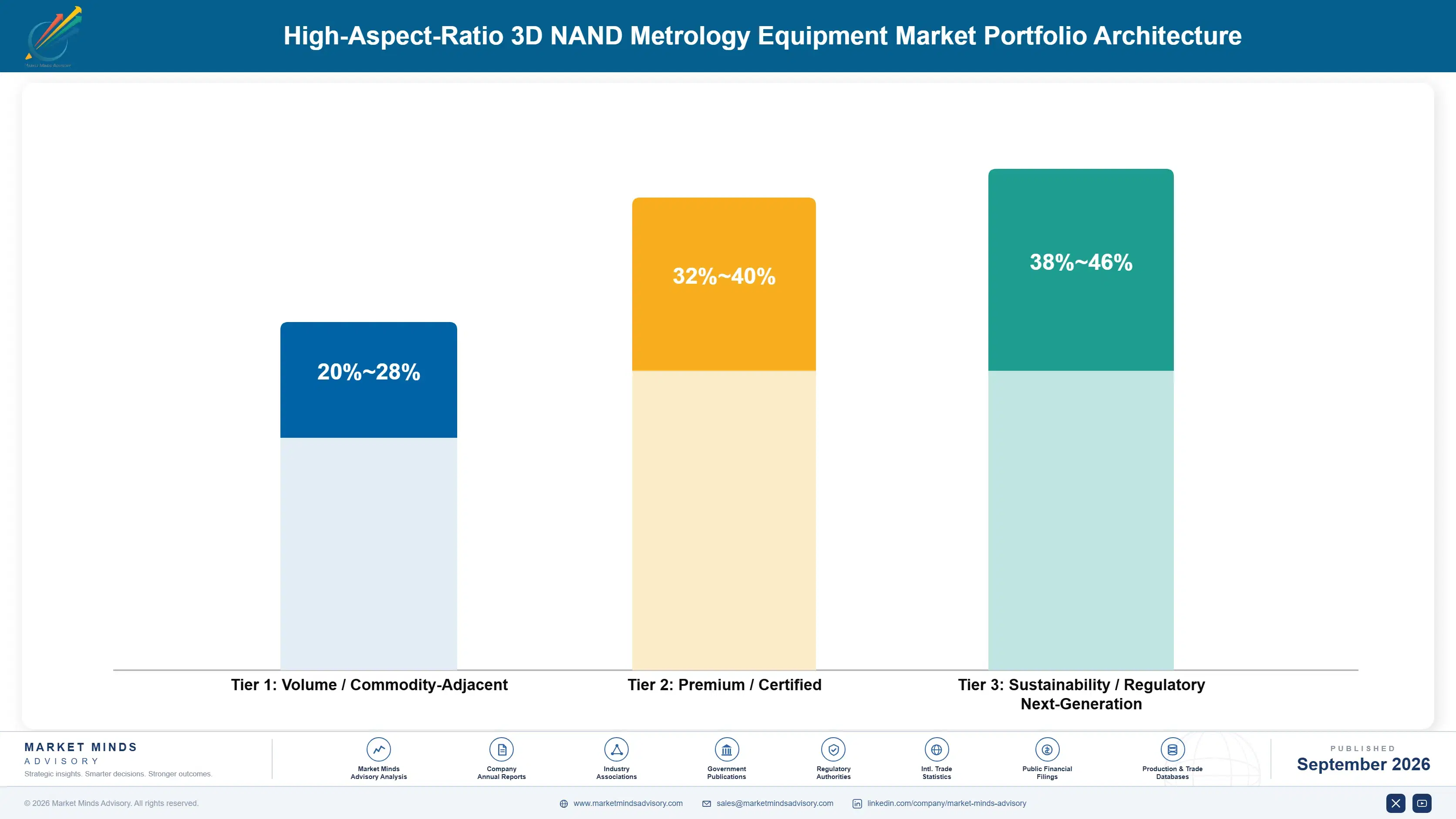
Three commercial tiers separate this market by margin profile rather than by application alone: commodity-adjacent legacy optical systems, certified X-ray and electron-beam premium tools, and next-generation software-bundled platforms still scaling toward meaningful volume today across the whole industry. Gross margins widen considerably moving up this ladder, since qualification barriers and process-of-record incumbency protect pricing far more effectively than raw hardware specifications ever could alone.
Legacy optical systems compete almost entirely on price and delivery reliability, leaving thin margins for suppliers without meaningful manufacturing scale advantages over smaller regional rivals competing in the same declining segment. Premium X-ray and electron-beam systems command meaningfully better economics, rewarding suppliers who invested early in non-optical qualification programs years before competitors recognized the coming aspect-ratio physical limitation affecting the entire industry.

The most attractive margin pools concentrate in systems pairing precision X-ray hardware with bundled analytics software, since this combination commands premium pricing while creating switching costs that protect incumbent suppliers from price-only competition. Suppliers still selling undifferentiated optical hardware face the steepest long-term margin pressure as fabs increasingly favor integrated, software-enabled solutions over standalone measurement equipment sold purely on optical specifications.

Volume / Commodity-Adjacent

Legacy optical metrology systems sold primarily on price and delivery performance, competing against a wide field of regional suppliers with limited X-ray or electron-beam qualification investment behind their product lines.
Gross Margin: 20-28%

Premium / Certified

X-ray and electron-beam certified systems that have completed extensive fab qualification testing, commanding meaningfully higher prices that reflect the reliability documentation and multi-year process-of-record relationships built with leading memory producers.
Gross Margin: 32-40%

Sustainability / Regulatory / Next-Generation

Systems pairing precision measurement hardware with bundled machine-learning analytics software, still scaling toward meaningful production volume but commanding the strongest margins as fabs increasingly value integrated, software-enabled solutions over standalone hardware alone.
Gross Margin: 38-46%
high-aspect-ratio-3d-nand-metrology-equipment-mark-portfolio-architecture-1788423108356

High-value Sub-segments and Strategic Watch-out

X-Ray Metrology Systems

X-ray metrology systems combine the fastest growth rate in the entire market with premium qualification-driven pricing, making it the clearest high-value high-growth opportunity for suppliers with qualification capability and patient multi-year investment capacity to fund lengthy design-in cycles before meaningful production revenue materializes across the industry.
Gross Margin: 42-52%

AI-Driven Yield Analytics Software

AI-driven yield analytics software carries solid margins from recurring licensing revenue but grows more moderately than X-ray hardware, reflecting the gradual pace at which fabs integrate new software platforms into established data infrastructure across multiple production lines and legacy IT systems already firmly in place.
Gross Margin: 38-46%

Legacy Optical Metrology Systems

Legacy optical metrology systems anchor overall market volume through continued deployment on trailing-edge and mature fabrication nodes, but competitive pricing pressure keeps margins considerably thinner than in certified X-ray or electron-beam applications more broadly across the wider global equipment industry landscape and its customer base.
Gross Margin: 22-28%

CD-SEM Systems

CD-SEM systems face a genuine long-term decline as X-ray and advanced optical hybrid approaches displace legacy electron-beam measurement in high-aspect-ratio applications, making this segment a clear strategic watch-out for suppliers still heavily dependent on it for meaningful ongoing revenue and long-term customer relationships going forward.
Gross Margin: 16-22%

Qualification Cycles Create Durable Revenue

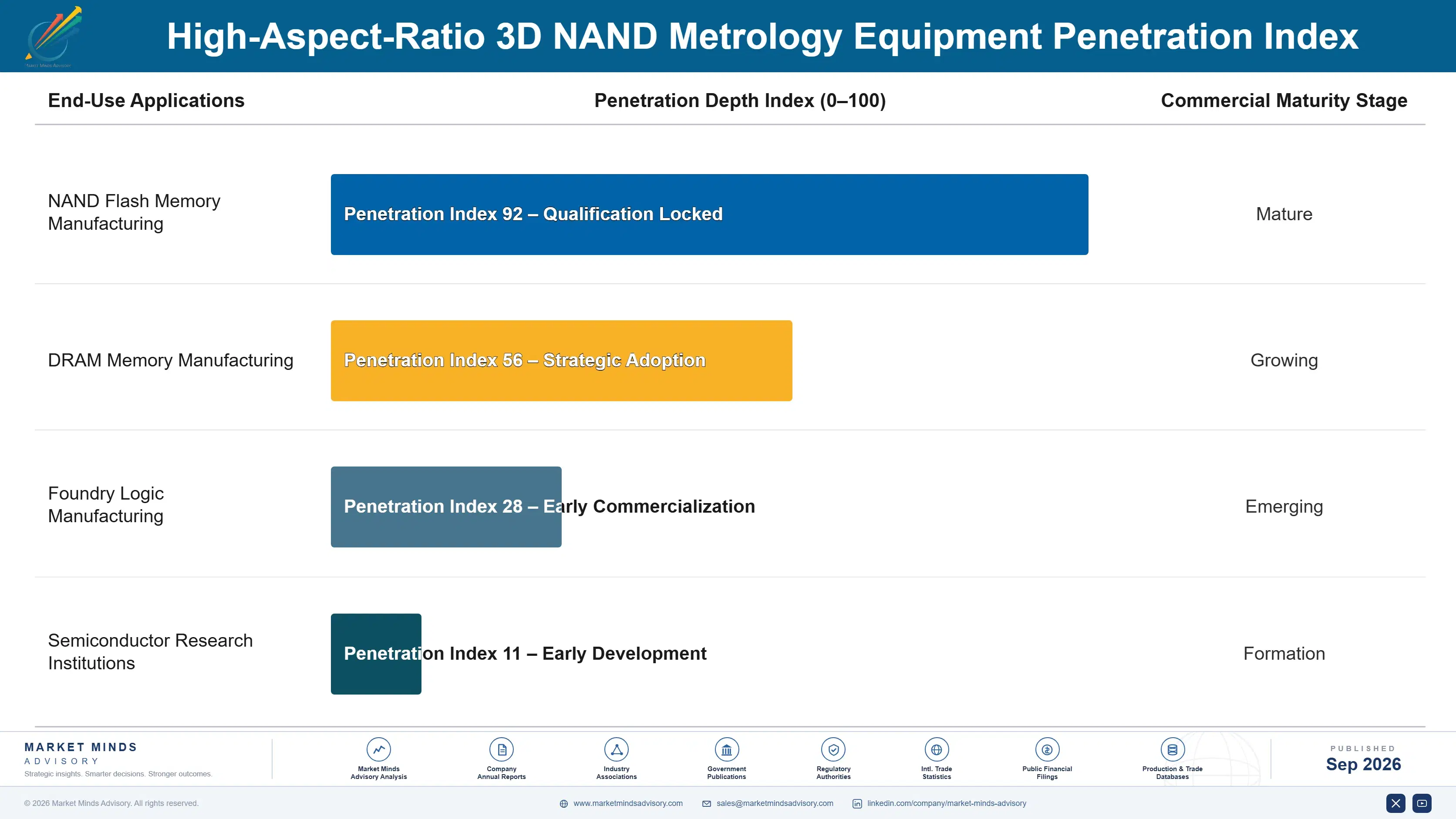
Metrology equipment revenue behaves more like an annuity than a one-time capital sale once a system wins process-of-record status, since fabs continue purchasing spare parts, calibration services, and software licenses across the full multi-year life of a fabrication node before any replacement decision even gets seriously considered by procurement teams overseeing multi-year capital budgets and equipment refresh cycles.
Adoption stickiness varies meaningfully by end-use vertical: leading-edge NAND fabs requalify metrology tools rigorously before switching suppliers, creating multi-year lock-in once a system wins a node's process of record, while smaller or trailing-edge fabs switch suppliers more readily based on price given their less aggressive layer-count roadmaps and lower qualification stakes. Foundry logic customers sit somewhere between these two extremes depending on device complexity and node maturity.

A generational shift in buyer profiles is underway as procurement authority moves from individual process engineers evaluating tool performance toward centralized fab-wide capital planning committees that weigh total cost of ownership across entire equipment fleets rather than single-tool specifications alone, a change favoring suppliers who can demonstrate fleet-wide software integration and predictable long-term service economics over standalone hardware performance claims by themselves.
high-aspect-ratio-3d-nand-metrology-equipment-mark-end-use-penetration-index-1788423108850

Where MMA Sees This Market Heading

These are among the four positions where our research anticipates prominent divergence between winners and laggards over the coming forecast period. Each is grounded in the demand model, the regulatory perimeter, and the announced capacity pipeline.
01 / X-RAY QUALIFICATION PRIORITY

Prioritize X-ray metrology qualification investment immediately

Suppliers without completed X-ray qualification will find themselves locked out of the fastest-growing segment in this market within two to three years, as process-of-record decisions close early and incumbent suppliers extend existing fab relationships across successive node generations. Qualification investment made today pays back across multiple fabrication nodes rather than a single design win, since validated systems carry forward once approved. Suppliers that delay this investment risk permanent exclusion from the segment growing at nearly double the overall market rate.
02 / SOFTWARE BUNDLING STRATEGY

Build analytics software capability alongside hardware sales

Pure hardware suppliers face a widening competitive gap against rivals who bundle sensing hardware with machine-learning yield analytics software, since fabs increasingly value integrated solutions that reduce their own data science engineering burden considerably across every major production line they operate. This shift rewards suppliers willing to invest in software talent that traditional equipment manufacturers rarely employed historically at any meaningful scale or budget priority. Suppliers who build this capability now will capture recurring licensing revenue well before competitors catch up to the same position.
03 / PRECISION COMPONENT DIVERSIFICATION

Diversify precision optics sourcing beyond concentrated suppliers

Concentrated upstream sourcing of precision optical components and X-ray source parts demonstrated genuine cost volatility risk during the 2023 export tightening episode, and suppliers who have not diversified remain exposed to a repeat disruption at any point going forward. Qualifying alternative component sources domestically takes several years, meaning suppliers must start this process well before the next disruption arrives rather than reacting once prices spike again unexpectedly. Early movers on diversification will gain negotiating position over rivals still dependent on single-source components.
04 / PROCESS-OF-RECORD DEFENSE STRATEGY

Defend process-of-record positions against emerging challengers

Incumbent suppliers holding process-of-record status on leading fabrication nodes face growing pressure from challengers investing early in X-ray and software-bundled capability that could eventually justify a fab's requalification risk despite the switching cost involved in changing suppliers. Suppliers who continuously invest in incremental performance improvements and expand software capability protect their incumbency far more effectively than suppliers who treat process-of-record status as a permanent, uncontested advantage requiring no further defense. The suppliers who invest earliest will retain the largest share of future equipment spending.

Engagement Snapshot From the Field

A live engagement with an industry participant carrying material or product regulatory and market exposure ahead of a defining policy shift, showing how our research translates into a defensible multi-year portfolio strategy.
MARKET MINDS ADVISORY · CLIENT ENGAGEMENT SUMMARY
High-Aspect-Ratio 3D NAND Metrology Equipment Producer Strategic Portfolio Review and Transition Roadmap 2026·Investment Scenario on High-Aspect-Ratio 3D NAND Metrology Equipment Exposure Evaluation 2025-26
CLIENT PROFILE
The client is a leading NAND memory producer headquartered in East Asia, operating multiple advanced fabrication facilities pushing past three hundred vertical layers across its most current process node. The company had historically relied on a single optical metrology supplier for process control, leaving it with limited visibility into X-ray alternatives as its own layer-count roadmap approached the physical limits of optical measurement technology within the coming product generation.
STRATEGIC CHALLENGE
The client needed to identify and qualify an X-ray metrology supplier capable of meeting continuous-duty production reliability standards for its next-generation fabrication node, without disrupting existing yield ramps tied to its incumbent optical supplier relationship or compromising the measurement accuracy its own engineering teams had long come to rely on for every process decision.
MMA APPROACH
MMA conducted a comparative assessment across three X-ray metrology suppliers with relevant qualification history, evaluating each on measurement throughput, detector sensitivity, and software integration capability using primary interview data and proprietary competitive benchmarking developed specifically for this fab-customer sourcing engagement over several weeks of structured analysis and follow-up validation calls.
KEY FINDINGS
  1. Two of three candidate suppliers already held partial X-ray qualification history on comparable fabrication nodes, meaningfully reducing the client's own validation timeline (client-reported, unverified by MMA) compared to starting entirely from scratch.
  2. Suppliers offering bundled yield analytics software quoted implementation timelines roughly 25 percent shorter (client-reported, unverified by MMA) than suppliers requiring separate software integration work afterward.
  3. Adopting a second qualified supplier would have reduced the client's exposure to an estimated 18 percent cost increase (client-reported, unverified by MMA) during a hypothetical single-supplier disruption event.
  4. One candidate supplier lacked sufficient production-line throughput documentation to meet the client's fabrication-floor volume requirements without additional validation testing and extended qualification lead time.
CLIENT PROFILE
The client is a leading NAND memory producer headquartered in East Asia, operating multiple advanced fabrication facilities pushing past three hundred vertical layers across its most current process node. The company had historically relied on a single optical metrology supplier for process control, leaving it with limited visibility into X-ray alternatives as its own layer-count roadmap approached the physical limits of optical measurement technology within the coming product generation.
STRATEGIC CHALLENGE
The client needed to identify and qualify an X-ray metrology supplier capable of meeting continuous-duty production reliability standards for its next-generation fabrication node, without disrupting existing yield ramps tied to its incumbent optical supplier relationship or compromising the measurement accuracy its own engineering teams had long come to rely on for every process decision.
MMA APPROACH
MMA conducted a comparative assessment across three X-ray metrology suppliers with relevant qualification history, evaluating each on measurement throughput, detector sensitivity, and software integration capability using primary interview data and proprietary competitive benchmarking developed specifically for this fab-customer sourcing engagement over several weeks of structured analysis and follow-up validation calls.
KEY FINDINGS
  1. Two of three candidate suppliers already held partial X-ray qualification history on comparable fabrication nodes, meaningfully reducing the client's own validation timeline (client-reported, unverified by MMA) compared to starting entirely from scratch.
  2. Suppliers offering bundled yield analytics software quoted implementation timelines roughly 25 percent shorter (client-reported, unverified by MMA) than suppliers requiring separate software integration work afterward.
  3. Adopting a second qualified supplier would have reduced the client's exposure to an estimated 18 percent cost increase (client-reported, unverified by MMA) during a hypothetical single-supplier disruption event.
  4. One candidate supplier lacked sufficient production-line throughput documentation to meet the client's fabrication-floor volume requirements without additional validation testing and extended qualification lead time.
RECOMMENDED STRATEGY
Phase 1: Phase one: initiate parallel qualification testing with the two strongest candidate X-ray suppliers alongside the existing incumbent optical relationship within two quarters. Phase 2: Phase two: negotiate dual-sourcing volume commitments once qualification completes, preserving incumbent relationship continuity while building genuine supply redundancy across both suppliers. Phase 3: Phase three: require bundled analytics software capability as a qualification criterion for all future metrology sourcing decisions across fabrication node transitions.
OUTCOME
The client completed qualification of a second X-ray supplier within the following year, reporting improved sourcing resilience across its next two fabrication node generations (client-reported, unverified by MMA). Implementation timelines reportedly shortened, and the client avoided a costly single-supplier disruption during a subsequent minor component supply tightening episode.

Frequently Asked Questions

Foundational context covering the market sizes, CAGR, scope, country, region and competition that inform every finding below. This section is provided to cover basics and most often pre-purchase conversations, answered from the MMA Primary Research Dataset.

What is the current size of the High-Aspect-Ratio 3D NAND Metrology Equipment market?

The global market reached 1.85 billion US dollars in 2025, driven primarily by NAND producers scaling layer counts past three hundred and adopting non-optical measurement systems. East Asia holds the largest regional share given its concentrated fabrication capacity.

How large will the High-Aspect-Ratio 3D NAND Metrology Equipment market be by 2036?

MMA projects the market will reach 5.83 billion US dollars by 2036, nearly three times its 2026 value. Sustained X-ray metrology adoption and rising fabrication capital expenditure drive this expansion.

What is the CAGR for the High-Aspect-Ratio 3D NAND Metrology Equipment market 2026 to 2036?

The market is forecast to grow at an 11.0 percent compound annual rate between 2026 and 2036. Bull and bear scenarios range from 9.8 to 12.3 percent depending on memory capital expenditure cycles.

Which segment is growing fastest?

X-ray metrology systems lead growth at 18.0 percent CAGR, roughly 1.64 times the overall market rate. Extreme layer counts beyond optical measurement capability drive this acceleration.

Who are the major companies in the High-Aspect-Ratio 3D NAND Metrology Equipment market?

KLA Corporation, Applied Materials, Onto Innovation, Nova Ltd, and Thermo Fisher Scientific lead the competitive field. Together the top five suppliers hold 68 percent combined revenue share.

Which country is growing fastest?

South Korea leads country-level growth at 15.5 percent CAGR, driven by Samsung and SK Hynix advancing layer counts ahead of most global competitors. This outpaces most other producing countries.

Report Segmentation Architecture

The full report scope spans multiple orthogonal segmentation dimensions, with cross-tabulated demand data provided for each dimension pair. Coverage extends further to regional breakdowns, trend trajectories, and the competitive detail needed to support segment-level decision-making.
  • X-Ray Metrology Systems
  • Optical Critical Dimension Scatterometry Systems
  • CD-SEM Systems
  • Electrical Test and Parametric Metrology Systems
  • Metrology Data Analytics and Software Platforms
  • Transmission Electron Microscopy Systems
  • NAND Flash Memory Manufacturing
  • DRAM Memory Manufacturing
  • Foundry Logic Manufacturing
  • Semiconductor Research Institutions
  • OEM Direct Sales
  • Process-of-Record Contract Channel
  • Software Licensing and Analytics Channel
  • Spare Parts and Service Channel

By Region

  • East Asia
  • North America
  • Western Europe
  • South Asia and Pacific
  • Latin America
  • Middle East and Africa
  • Eastern Europe

Scope, Methodology, and Coverage

Every figure in this report is reproducible from documented input assumptions. The scope below maps the historical period, the forecast horizon, the segmentation dimensions, and the countries covered, alongside the underlying primary and qualitative methodology.
Historical Period
2020 to 2025
Forecast Period
2026 to 2036
Base Year
2025 (USD billions; MMA Primary Research Dataset, September 2026)
Market Definition
The High-Aspect-Ratio 3D NAND Metrology Equipment market covers systems used to measure critical dimensions, channel hole geometry, and layer uniformity in high-aspect-ratio 3D NAND flash memory fabrication. It excludes lithography, deposition, and etch process equipment, as well as metrology systems designed solely for planar or DRAM device architectures.
Quantitative Units
USD billions (current prices)
Segmentation Dimensions
By Measurement Technology Type; By End-Use Industry; By Commercial Dimension; By Region
Regions Covered
East Asia, North America, Western Europe, South Asia and Pacific, Latin America, Middle East and Africa, Eastern Europe
Countries Covered
USA, China, Germany, France, UK, Japan, South Korea, India, Australia, Canada, Brazil, Mexico, Indonesia, Vietnam, Thailand, Malaysia, UAE, Saudi Arabia, South Africa, Nigeria, Turkey, Poland, Netherlands, Italy, Spain, Sweden, Switzerland, Argentina, Colombia, Singapore, and additional markets relevant to this sector
Key Companies Profiled
KLA Corporation, Applied Materials Inc, Onto Innovation Inc, Nova Ltd, Thermo Fisher Scientific Inc, Hitachi High-Tech Corporation, Bruker Corporation, Carl Zeiss SMT GmbH, Rigaku Corporation, Xenocs SAS, Camtek Ltd, Advantest Corporation, FormFactor Inc, Veeco Instruments Inc, PDF Solutions Inc, ASML Holding NV, Tokyo Electron Limited, Screen Semiconductor Solutions, Nikon Corporation, Park Systems Corp
Quantitative Methodology
Primary survey, n=3,800 respondents, Q4 2025, six countries; demand-side model with trade association cross-validation
Qualitative Methodology
47 expert interviews, Q4 2025; applied to validate demand model assumptions, identify emerging dynamics, and assess competitive positioning
Report Format
PDF and XLSX data workbook (Word format preview document)
Publisher
Market Minds Advisory
Report Code
MMA-2026-TEC-708
Published
September 2026
Contact
sales@marketmindsadvisory.com | www.marketmindsadvisory.com

Purchase the full High-Aspect-Ratio 3D NAND Metrology Equipment Market Report (2026 to 2036).

This report delivers a complete assessment of the global high-aspect-ratio 3D NAND metrology equipment market, covering demand drivers across X-ray, optical, electron-beam, and software-based measurement technologies through 2036. It quantifies segment-level growth rates, regional demand concentration, and competitive positioning among the twenty leading equipment suppliers. The analysis draws on primary survey data from 3,800 respondents and 47 expert interviews conducted in the fourth quarter of 2025. Readers gain a clear view of where margin pools concentrate and which suppliers are best positioned to capture emerging X-ray and analytics demand.
Ten-year market sizing and growth forecasts
Segment-level CAGR and demand growth analysis
Competitive benchmarking of twenty leading suppliers
Regional demand architecture across seven regions
Input cost and supply chain risk assessment
Strategic revenue lever identification for suppliers

Built For The People Who Decide

From boardroom strategy to bench-side execution, this report is read cover-to-cover by leaders shaping the next decade of their industry, turning demand scenarios, market dynamics and valuation benchmarks into decisions.
CXOs/ Presidents/ VPs/ Managers
M&A and Corporate Development
Strategy Teams and R&D Heads
Procurement and Product Directors
Regulatory and Compliance Leaders
Investor Relations and Equity Analysts