Market Minds Advisory
Hi-Fi Systems Market

Hi-Fi Systems Market: Hi-Fi Systems Market: Product Classes, Buyer Demographics and Channel Economics 2026 to 2036

The people buying loudspeakers are getting older every year and the replacement cycle runs over a decade. Everything growing in this market is worn on the head rather than placed in a room.

Lead Analyst

Published

September 2026

Make Smarter Decisions with Customized Research Insights

Request a free sample report and evaluate market opportunities, growth trends, and competitive dynamics relevant to your business needs.

2025 MARKET VALUE$9.6BMarket Size 2025
2036 FORECAST VALUE$17.1BBase Case , 2026 to 2036
CAGR 2026 TO 20365.4 %Bull 6.6% / Bear 4.2%
INCREMENTAL OPPORTUNITY$7.0BNet 10- year value creation
EXPANSION MULTIPLE1.69x2036 value over 2026 base
Strategic Levers
M&A Pipeline
Regional Outlook
Country Rankings
Competitive Intelligence
Segmental Deep-dive
Call-Us : 91 93563 13602

Executive Snapshot and Market Trajectory.

The median specialist hi-fi buyer is 54 years old and replaces a system about every 12 years. Both numbers are known inside the industry and rarely discussed in public, because together they describe a shrinking addressable population buying infrequently. That is the whole problem underneath this market.
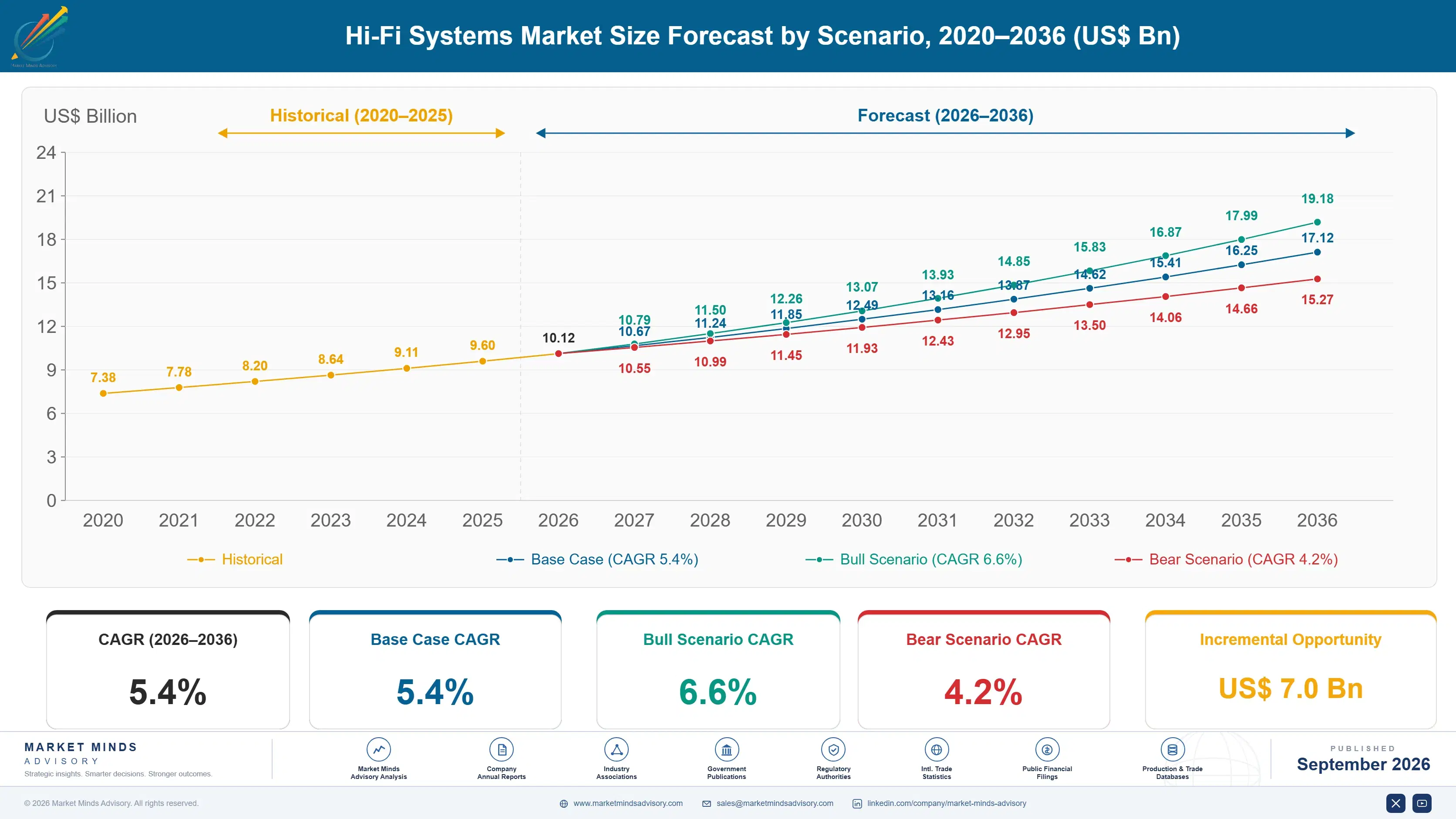
The market reaches USD 10.12 billion in 2026 and USD 17.12 billion by 2036, a 1.69 times expansion at 5.4%. Headphone amplification and high-end headphones grow at 8.1%, half again the market rate of 5.4%, because that is how anybody under forty actually listens to music seriously. East Asia holds 34% of revenue on manufacturing and rising Chinese consumption together, and China grows fastest at 9.2%. Nothing else in this market grows properly.
Five manufacturers hold 24% of hi-fi equipment revenue, the most fragmented concentration in consumer electronics and a direct result of hundreds of small specialist brands with loyal followings. Harman consolidated a large portfolio through acquisition. Yamaha and Sonos come from different traditions entirely. Chinese manufacturers including FiiO, Topping and HiFiMan took the headphone and converter segments almost completely on price and genuine quality. The incumbents never saw them coming.
Market Definition
This report covers consumer high-fidelity audio equipment sold for dedicated music listening: network streamers and digital sources, headphone amplification and high-end headphones, turntables and analogue playback, integrated amplifiers and separates, passive and active loudspeakers, and all-in-one lifestyle systems. It excludes soundbars and home cinema surround systems, portable and wireless earbuds, professional studio monitoring and recording equipment, automotive audio, and music streaming subscriptions.
Base Year Value
$9.6B in 2025 (MMA Primary Research Dataset, September 2026)
Forecast Period
2026 to 2036, eleven discrete annual values
CAGR
5.4% base case. Bull 6.6%. Bear 4.2%.
Fastest Growth Segment
Headphone Amplification and High-End Headphones: 8.1% CAGR
Fastest Growth Country
China: 9.2% CAGR
Fastest Growth Region
South Asia and Pacific: 7.4% CAGR
Largest Region
East Asia: 34% of 2025 global value
Market Leaders
Harman International, Yamaha, Sonos, Sennheiser and Focal lead on hi-fi audio equipment manufacturer revenue. Source: MMA Analysis.
Primary Survey
n=3,800 procurement and R&D decision-makers, Q4 2025, six countries
Methodology
Demand-side build-up, cross-validated against public data, 47 expert interviews

Hi-Fi Systems Market Forecast Scenarios

hi-fi-systems-market-size-forecast-scenario-1789985090387
Between 2020 and 2025 the category compounded at 4.4% and the pandemic flattered it badly. People confined at home spent on audio at a rate nobody had seen in twenty years, and the industry read that as a revival rather than as pulled-forward demand. The correction through 2023 and 2024 was sharp, and several brands that expanded capacity found out why.
The base case holds 5.4% on three mechanisms. Headphone listening keeps growing because it is how anybody under forty listens seriously, and it needs no room, no partner's agreement and no furniture. Streaming hardware keeps replacing disc players and outboard converters on a technology cycle rather than a wear cycle. And Chinese domestic consumption is rising from a low base at a rate nothing in the West approaches, on products they make themselves.
The bull case at 6.6% assumes headphone attach rates keep rising and the segment pulls buyers into higher-value amplification alongside it. The bear case at 4.2% is demographic and arithmetic rather than economic: a median buyer age of 54 and a replacement cycle over a decade means the established Western customer base shrinks measurably every year, and nothing currently replaces it at the same spending level.

The Buyers Are Getting Older

Two numbers describe this industry more accurately than any product comparison. The median buyer at a specialist dealer in an established Western market is 54 years old. The interval between complete system purchases runs about 12 years. Together those mean the customer base ages faster than it recruits, and every year of that compounds against a business that depends on infrequent large purchases.
TOP FIVE CONCENTRATION24%The most fragmented category in consumer electronics hardware
SPECIALIST DEALER SHARE38%Portion of value sold through independent audio retailers
AVERAGE SYSTEM REPLACEMENT CYCLE12 yearsInterval between complete system purchases by committed buyers
MEDIAN BUYER AGE54 yearsAcross specialist dealer purchases in established Western markets
LOUDSPEAKER CABINET COST SHARE41%Enclosure and finishing against total loudspeaker build cost
HEADPHONE SEGMENT ATTACH RATE63%Buyers acquiring headphones alongside or instead of speakers
Headphones are the answer the market found rather than the one it chose. A young listener with a shared flat, a partner and no dedicated room can spend meaningfully on audio only if the audio goes on their head, and the attach rate now runs 63% across buyers acquiring headphones alongside or instead of loudspeakers. Chinese manufacturers understood this earlier than the established brands and took most of the segment.
The retail structure makes everything harder. Specialist dealers still carry 38% of value and remain the only place most people can hear equipment before buying, but their numbers have fallen steadily for two decades and each closure removes a recruitment point rather than merely a sales channel. Online sales work for headphones and converters and work poorly for loudspeakers, which need a room.
"The industry keeps producing better loudspeakers for people who already own loudspeakers. Nobody under thirty-five has a room to put them in, and the brands who worked that out ten years ago are the only ones growing."
Principal Analyst, Consumer Audio and Entertainment Hardware Practice · MMA Technology Practice · September 2026

Market Trends

Chinese Manufacturers Took The Headphone And Converter Segments

Twenty years ago a serious headphone amplifier or digital converter came from Europe, America or Japan and cost accordingly. Chinese manufacturers including FiiO, Topping, SMSL and HiFiMan now supply most of the volume at price points the established brands cannot approach, and the measured performance is genuinely competitive rather than merely adequate. Enthusiast communities publish measurements, which removed the information advantage brand reputation used to carry. China grows at 9.2%, faster than any other country in this market, on domestic consumption as well as export. The incumbents lost this segment before most of them noticed it existed.
Market Impact: Attach rate reaches 63%

Streaming Hardware Replaced Disc Players On Technology Cycles

A compact disc player lasted until the laser failed, which took fifteen years or more, and produced almost no replacement demand in between. A network streamer becomes obsolete when a service changes its interface, a codec appears or the processor stops handling higher resolution files, which happens on something closer to a five year cycle. That converts a wear-out replacement into a technology replacement, which is a far better business for anybody selling hardware. Network streamers and digital sources compound at 7.0% against 5.4% for the market on exactly that shift.
Market Impact: China compounds at 9.2% annually

Market Opportunities and Growth Drivers

Headphones Remove Every Practical Barrier To Spending

A loudspeaker system needs a room, a partner who accepts it, furniture to put it on and neighbours who tolerate it. A pair of headphones needs none of those things, which is why a young listener in a shared flat can spend seriously on audio and a young listener with loudspeakers mostly cannot. Attach rates run 63% across buyers acquiring headphones alongside or instead of speakers. That is not a fashion, it is the removal of four constraints at once, and the segment compounds at 8.1% because of it. Nobody in this industry disputes the arithmetic.
Market Impact: Median buyer age reaches 54

Chinese Domestic Consumption Rises From A Low Base

Chinese consumers have begun buying serious audio equipment at scale for the first time, and they buy differently from Western ones. Purchases skew toward headphones and desktop systems rather than room-based loudspeakers, since urban apartment living makes the same argument headphones make everywhere. Domestic brands hold most of that spending because they are trusted, present and considerably cheaper. China grows at 9.2%, faster than any other country in this market. Western brands entering are competing on heritage in a market where heritage carries less weight than measured performance does. That is an uncomfortable discovery for several of them.
Market Impact: Dealers still carry 38%

Market Restraints and Challenges

The Established Buyer Base Ages Faster Than Replacement

The median buyer at a specialist dealer in an established Western market is 54 years old and buys a complete system about every 12 years. The root cause is that the loudspeaker-based listening room, which is what the industry sells, requires domestic space and domestic authority that people acquire late and increasingly do not acquire at all. Commercially this shrinks the Western addressable population measurably each year. Mitigation runs through headphones and desktop systems, which reach a younger buyer at a lower price point and considerably higher frequency, and every brand knows it.
Market Impact: China compounds at 9.2% yearly

Specialist Dealer Closures Remove Recruitment Points Permanently

Specialist dealers still carry 38% of value and are the only place most people ever hear serious audio equipment before buying it. The root cause of their decline is straightforward retail economics: high inventory value, low turnover, expensive floor space and online price transparency that removed the margin the model depended on. Commercially each closure removes a recruitment point rather than merely a sales channel, since nobody becomes an audio buyer without hearing something first. Mitigation runs through brand-operated listening rooms and event demonstrations, which several manufacturers now fund directly out of necessity.
Market Impact: Cycles shorten to 5 years
3 additional market trends, 4 additional growth drivers, and 2 additional restraints and challenges are covered in the full report. Contact sales@marketmindsadvisory.com to access the complete intelligence.

Segment CAGR and Growth Architecture

Segmentation follows product class, since each one reaches a different buyer at a different price and on a different replacement cycle. Six classes cover the market: headphone amplification and high-end headphones, network streamers and digital sources, turntables and analogue playback, all-in-one lifestyle systems, passive and active loudspeakers, and integrated amplifiers and separates. Channel and price tier are separate dimensions.
hi-fi-systems-market-market-share-analysis-1789985090979

Headphone Amplification and High-End Headphones

Headphone equipment grows at 8.1%, half again the market rate of 5.4%, and it is the only part of this market with a demographic future. A loudspeaker system needs a room, a partner who accepts it, furniture and tolerant neighbours; headphones need none of them, which is why the attach rate now runs 63% and why anybody under forty who spends seriously on audio spends it here. Chinese manufacturers including FiiO, Topping and HiFiMan supply most of the volume at prices the established brands cannot match, on measured performance that enthusiast communities publish and verify. The heritage brands entering late are competing on reputation in the one segment where reputation counts least.
CAGR 8.1%

Network Streamers and Digital Sources

Network streamers and digital sources grow at 7.0% because the replacement logic changed underneath the product. A compact disc player lasted until the laser failed, which took fifteen years and generated almost nothing in between. A streamer becomes obsolete when a service changes its interface, a codec appears or the processor stops handling higher resolution files, and that happens on something closer to five years. Manufacturers who spent decades selling durable objects now sell devices that age like computers, which is commercially far better and requires software capability most of them never had to build. Several brands have discovered that the hard way, through firmware nobody wanted to maintain properly.
CAGR 7.0%
Full segment breakdown across 6 segments available in the complete report.

Regional Architecture and Country Demand Map

East Asia leads at 34%, above the standard band, on manufacturing concentration and Chinese consumption rising together. North America and Western Europe are roughly level at 24% each and both carry the demographic problem this market has been avoiding discussing for a decade. Nobody says it out loud.

East Asia

East Asia holds 34% of revenue, above the 30% band ceiling, and both manufacturing and consumption put it there. Chinese factories build most of the world's headphones, converters and amplification, and Chinese brands increasingly sell them under their own names rather than for somebody else. Domestic consumption is rising from a low base as urban buyers acquire serious equipment for the first time, skewed toward headphones and desktop systems because apartment living makes the same argument everywhere. China grows at 9.2%, faster than any other country here. Japan remains the deepest per-capita market in the world, with a dealer culture and a buyer age profile that both look like Europe's.
Share: 34% | CAGR: 6.6% (2026 to 2036)

North America

Headphone and desktop audio account for most of North America's growth while loudspeaker sales carry most of its revenue, which is the tension this region illustrates most clearly. American specialist dealers have closed at a faster rate than European ones, leaving whole metropolitan areas without anywhere to hear equipment before buying it. Online retail replaced the transaction and not the demonstration. Harman consolidated a substantial portfolio of heritage brands here through acquisition. Growth at 4.6% sits below the global rate on a demographic profile that is older than anywhere except Japan. Brand-operated listening rooms are appearing because the dealer network no longer performs that function. That substitution has been expensive and incomplete.
Share: 24% | CAGR: 4.6% (2026 to 2036)
Regional intelligence for 5 additional markets available in the complete report: Western Europe, South Asia and Pacific, Latin America, Middle East and Africa, Eastern Europe. Contact sales@marketmindsadvisory.com.
hi-fi-systems-market-country-cagr-analysis-1789985091506

How To Reach A Younger Buyer

This industry sells beautifully to people who already own equipment and badly to anybody else, which is a fine position until the arithmetic catches up. What separates a brand that grows from one that does not is whether it reaches somebody without a listening room, and whether it competes on evidence rather than on reputation. The levers below cover that.

Build For People Without A Listening Room

A loudspeaker system requires a room, a partner who accepts it, furniture and neighbours who tolerate it, and each of those excludes a large part of the population under forty. Headphones and desktop systems require none of them, which is why headphone attach rates run 63% and why the segment compounds at 8.1% against 5.4% for the market. A brand whose entire range assumes a dedicated room is addressing a shrinking population that buys about every 12 years. The product engineering is different, the price points are lower, and the volume is where the future sits.
Market Impact: Headphone attach rates already run at 63% today

Publish Measurements Before The Community Does

Enthusiast communities measure equipment and publish the results, which removed the information advantage brand reputation carried for fifty years. Chinese manufacturers embraced that immediately because measured performance was their strongest argument, and they took most of the volume in a segment compounding at 8.1%. A heritage brand that declines to publish specifications looks like it has something to hide, whatever the actual reason. Publishing first frames the conversation and publishing late concedes it, and the cost of doing so is a measurement programme rather than anything commercially significant. Very few heritage brands have accepted this yet.
Market Impact: Silence concedes share in the 8.1% growth segment

Fund Demonstration Where Dealers Have Closed

Specialist dealers still carry 38% of value and are the only place most people ever hear equipment before buying, and their numbers have fallen for two decades. Each closure removes a recruitment point rather than merely a sales channel, because nobody becomes an audio buyer without hearing something first. Brands funding listening rooms, travelling demonstrations and dealer support directly are paying for customer acquisition that the retail network used to provide free. It is an unwelcome cost line and the alternative is a market with no entry point at all.
Market Impact: Dealers still carry 38% of value and keep closing

Sell Into Chinese And Indian Urban Apartments

Chinese and Indian urban buyers are entering this market at headphone and desktop price points and skipping the loudspeaker stage entirely, compressing a progression that took Western buyers thirty years into a single decision. China grows at 9.2% and India at comparable rates, both from bases that are still small. Domestic brands hold most of that spending because they are present, trusted and cheaper. A Western brand entering on heritage is competing on the one attribute those buyers weight least, and the product range most of them lead with assumes a room nobody has.
Market Impact: China compounds at 9.2% from a small base

Who Controls the Margin Pool

Five manufacturers hold 24% of hi-fi equipment revenue, the most fragmented concentration in consumer electronics and a direct consequence of hundreds of small brands with genuinely loyal followings. Harman consolidated a large heritage portfolio through acquisition. Yamaha spans instrument and audio manufacturing at scale. Sonos arrived from a networking rather than an audio tradition. Sennheiser and Focal hold specialist positions built on engineering reputation. All participants are assessed on hi-fi equipment manufacturer revenue.
Competition splits by segment far more sharply than by brand. In loudspeakers and amplification, heritage reputation and dealer relationships still decide most purchases among an older buyer base. In headphones and converters, Chinese manufacturers compete on published measurement and price and have taken most of the volume. Almost nobody competes seriously in both, and those attempting it are losing the second contest.

Rankings shift through consolidation more than through competition. Heritage brands with ageing customer bases and no succession are being acquired rather than displaced, and the portfolios assembling around Harman and a few others are the visible result. The other pressure is generational: whoever reaches a buyer without a listening room takes the next thirty years, and the Chinese headphone manufacturers are ahead on that.
hi-fi-systems-market-company-positioning-matrix-1789985092036

Competitive Moat and Risk Dimensions

HARMAN INTERNATIONAL

Moat: Heritage Portfolio Breadth

Harman assembled a portfolio of established audio brands through acquisition, which gives it dealer relationships, shared manufacturing and a presence at almost every price point in a market too fragmented for anybody to reach organically. In a category where brand loyalty is unusually strong and unusually specific, owning several of them beats building one. Distribution scale matters most.
HARMAN INTERNATIONAL

Risk: Ageing Customer Inheritance

Acquiring heritage brands means acquiring their customer bases, and those buyers are older than anybody in this industry finds comfortable. A portfolio built on names that resonate with buyers over fifty inherits a demographic problem rather than solving one. The growth sits in headphones and desktop systems, where none of these brands carries much authority with the people actually buying.
SONOS

Moat: Software And Platform Capability

Sonos arrived from a networking tradition rather than an audio one and built software capability the heritage manufacturers never needed and now cannot easily acquire. As streaming hardware ages like a computer rather than wearing out like an amplifier, that capability decides whether a product remains useful. Competitors with better transducers keep shipping firmware nobody wants to maintain.
SONOS

Risk: Enthusiast Credibility Gap

The specialist buyer who spends most in this market treats convenience-led products with suspicion and reads brand heritage as evidence of engineering seriousness. Sonos reaches a broad audience and struggles at the price points where margin actually sits. A software advantage is worth less in a segment that judges equipment by listening and by published measurement instead.

Players Tracked

Prominent Players

Harman International
Yamaha
Sonos
Sennheiser
Focal

Other Key Players

Cambridge Audio
NAD Electronics
Rega Research
Pro-Ject Audio Systems
KEF
Dynaudio
Audio-Technica
HiFiMan
FiiO
Topping
Naim Audio
Linn Products
McIntosh Laboratory
Technics
Elac

Recent Developments

MARCH 2025

Harman Completes Acquisition Of Sound United Audio Portfolio

Harman International completed its acquisition of the Sound United audio portfolio from Masimo, an acquisition rather than a partnership or joint venture. The transaction brings several established heritage brands under one owner and continues a consolidation pattern driven by ageing customer bases and succession problems across the specialist audio industry.
Signal: Heritage brands are being bought rather than displaced, and the underlying demographic arithmetic is the reason why.
SEPTEMBER 2024

HiFiMan Expands Headphone Range Into Higher Price Tiers

HiFiMan expanded its headphone range further into price tiers historically held by European and American manufacturers, an organic product development rather than an acquisition. The move follows a pattern across Chinese audio manufacturers of building upward from value products once enthusiast communities have verified their measured performance publicly.
Signal: Chinese manufacturers are moving up price tiers, which is the pattern that eventually removes the incumbents entirely.
MAY 2025

Cambridge Audio Extends Streaming Platform Across Product Range

Cambridge Audio extended its streaming platform and software support across a wider product range, an organic development rather than a partnership or acquisition. The work reflects a category where hardware now ages on a technology cycle rather than a wear cycle, and where software maintenance has become a product requirement.
Signal: Audio manufacturers now carry a software obligation their business models were never really designed to fund.

What Building Hi-Fi Actually Costs

Loudspeaker cabinet and finishing work accounts for roughly 41% of loudspeaker build cost, produced by furniture-grade woodworking operations concentrated in Eastern Europe, China and Denmark. Drive units and crossover components add about 24%, from a small group of specialist suppliers. Electronics assembly and metalwork carry around 19% across amplification and sources, with packaging and freight taking the balance.
Harman International Annual Report 2024 records component costs and manufacturing capacity utilisation as the dominant variables across its consumer audio operations. Yamaha Annual Report 2024 notes comparable pressure on materials alongside currency exposure. Hardwood veneer and furniture-grade timber pricing rose sharply through 2021 and 2022 as construction demand competed for the same material, and loudspeaker manufacturers absorbed most of it because their dealer price lists had already been published for the season.

The competitive disadvantage mechanism is production volume rather than material pricing. A loudspeaker cabinet is a furniture item, and a manufacturer ordering a few hundred pays several times what one ordering tens of thousands does for identical work. That difference falls hardest on exactly the small specialist brands this market is full of, and it is invisible to a customer comparing two products on a dealer shelf.
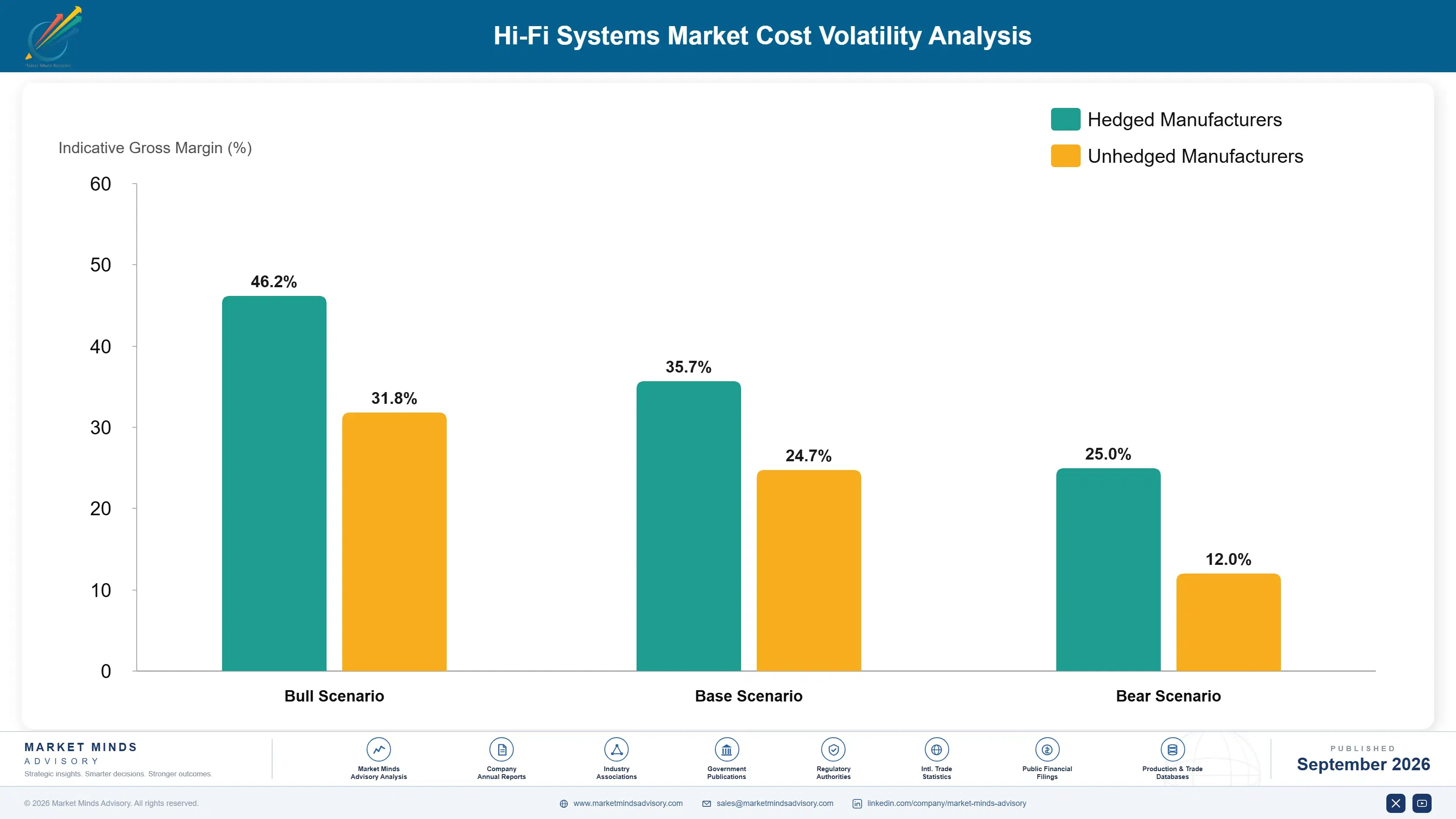
hi-fi-systems-market-cost-volatility-analysis-1789985092231

Pool Cabinet Manufacturing Across Small Specialist Brands

Cabinet and finishing work runs about 41% of loudspeaker build cost and pricing depends almost entirely on order volume rather than complexity. Small brands ordering a few hundred cabinets pay several times what a large one does for identical work. Shared manufacturing arrangements between non-competing brands are unglamorous and change the economics of an entire product line.

Publish Dealer Prices With Material Escalation Terms

Loudspeaker manufacturers publish dealer price lists for a season and then absorb whatever happens to timber and component costs, as the 2021 veneer price rise showed. Building an escalation provision into dealer terms is a straightforward negotiation that almost nobody in this industry attempts. Dealers dislike it and will accept it when the alternative is a supply interruption.

Standardise Drive Units Across Model Ranges

Drive units and crossover components run about 24% of build cost from a small group of specialist suppliers with real pricing power over small buyers. Designing several models around a shared driver set rather than a bespoke one per product improves purchasing volume substantially and cuts development time. The constraint is that specialist buyers value bespoke engineering.

Portfolio Architecture for Margin Defence

Margin architecture separates on how much of the product is furniture. All-in-one lifestyle systems earn least, competed against mainstream consumer electronics on price alone. Loudspeakers and integrated amplifiers sit in the middle, where cabinet cost and dealer margin between them consume most of the retail price. Headphones, streamers and converters earn most, because the bill of materials is small relative to what the product commands.
The volume versus premium tension runs through the dealer network rather than through manufacturing. A specialist dealer needs high-margin loudspeakers and amplification to survive on low turnover, and headphones sell online at prices that offer nobody a floor. A manufacturer growing its headphone business is growing the part its dealers cannot make money on, which is why several brands have moved cautiously in the segment their own numbers point at.

High-value pools sit in headphone equipment and in streaming hardware, and neither rewards what this industry historically valued. Headphones reward published measurement and price, which favours Chinese manufacturers. Streaming rewards software maintenance capability, which favours nobody with a woodworking heritage. The heritage brands hold the segments with the oldest buyers and the best dealer margins, which is a comfortable position for about another decade.

Volume / Commodity-Adjacent

All-in-one lifestyle systems competed against mainstream consumer electronics on price and convenience rather than on any audio argument. The eight point spread separates manufacturers with consumer electronics volume from specialists attempting the category occasionally.
Gross Margin: 22% to 30%

Premium / Certified

Loudspeakers, integrated amplifiers, separates and turntables sold through specialist dealers where cabinet cost and retail margin consume most of the price. The ten point spread tracks production volume, since cabinet pricing depends almost entirely on order size.
Gross Margin: 34% to 44%

Sustainability / Regulatory / Next-Generation

Headphone equipment, network streamers and digital converters, where the bill of materials is small relative to what the product commands. The twelve point spread reflects whether a manufacturer holds software capability and published measurement credibility or neither.
Gross Margin: 48% to 60%
hi-fi-systems-market-portfolio-architecture-1789985092734

High-value Sub-segments and Strategic Watch-out

Headphone Amplification And High-End Headphones

Grows at 8.1% and is the only part of this market with a demographic future, since headphones need no room, partner or furniture. The twelve point spread reflects measurement credibility and manufacturing scale. Chinese manufacturers hold most of the volume and are moving up price tiers.
Gross Margin: 48% to 60%

Network Streamers And Digital Sources

Grows at 7.0% because streaming hardware ages on a technology cycle rather than a wear cycle, which turns replacement into a five year event. The twelve point spread reflects software maintenance capability. Manufacturers who spent decades building durable objects find this genuinely difficult to fund.
Gross Margin: 48% to 60%

Passive And Active Loudspeakers

Grows at 3.8% and carries the largest share of revenue in this market, on a buyer base with a median age of 54 and a 12 year replacement cycle. The ten point spread tracks cabinet order volume. This is where the demographic problem is concentrated entirely.
Gross Margin: 34% to 44%

Integrated Amplifiers And Separates

Grows at 2.6%, slowest of the six classes, because a well-built amplifier lasts decades and there is no technology reason to replace one. The ten point spread reflects production volume. Manufacturers keep the range because dealers need it to complete a system on the floor.
Gross Margin: 34% to 44%

How Buyers Enter And Stay

The annuity is the buyer rather than the product. Somebody who enters this market at twenty-five and stays with it buys equipment for fifty years, upgrading a component at a time in a progression the industry understands very well. The replacement cycle for a complete system runs about 12 years, but the individual purchases inside that are frequent. Everything therefore depends on recruitment, and recruitment depends on somebody hearing equipment somewhere.
Adoption depth varies by living situation more than by income, which the industry consistently underestimates. Homeowners with a spare room adopt deeply and buy loudspeakers. Apartment dwellers adopt through headphones and desktop systems and may never buy a speaker at all. Shared accommodation rules out almost everything except headphones. Income matters, and having somewhere to put the equipment matters more, and the second condition is getting harder to satisfy.

The buyer has changed how they evaluate rather than what they want. An older buyer trusted a dealer's ear and a brand's reputation and listened before deciding. A younger one reads published measurements, watches a review, and buys online without hearing anything. That shift favours manufacturers who publish and disadvantages those whose argument requires a demonstration room.
hi-fi-systems-market-end-use-penetration-index-1789985093226

Where The Next Buyers Are

These are among the four positions where our research anticipates prominent divergence between winners and laggards over the coming forecast period. Each is grounded in the demand model, the regulatory perimeter, and the announced capacity pipeline.
01 / ROOM-FREE PRODUCT DESIGN

Design For People Without A Room

A loudspeaker system requires a room, a partner who accepts it, furniture and neighbours who tolerate it, and each of those conditions excludes a large part of the population under forty. Headphones and desktop systems require none of them, which is why attach rates run 63% and the segment compounds at 8.1% against 5.4% for the market as a whole. A brand whose entire range assumes a dedicated listening room is addressing a shrinking population with a median age of 54 that buys about every 12 years, and nothing changes.
02 / MEASUREMENT PUBLICATION PRACTICE

Publish The Numbers Before Somebody Else Does

Enthusiast communities measure equipment and publish the results, which removed the information advantage brand reputation carried for fifty years and is not coming back. Chinese manufacturers embraced that immediately because measured performance was their strongest argument, and they took most of the headphone and converter volume while the heritage brands were still deciding whether to respond. A brand that declines to publish specifications now looks like it has something to hide whatever the real reason, and the cost of publishing is a measurement programme rather than anything commercially significant.
03 / DEMONSTRATION FUNDING DECISION

Pay For Listening The Dealers Once Provided

Specialist dealers still carry 38% of value and remain the only place most people ever hear serious equipment before buying it, and their numbers have fallen steadily for two decades. Each closure removes a recruitment point rather than merely a sales channel, because nobody becomes an audio buyer without hearing something first that made them want to. Brands funding listening rooms, travelling demonstrations and direct dealer support are paying for customer acquisition the retail network used to provide free, which is an unwelcome cost line against no entry point.
04 / ASIAN URBAN TARGETING

Enter China And India Through Headphones

Chinese and Indian urban buyers are entering this market at headphone and desktop price points and skipping the loudspeaker stage entirely, compressing a progression that took Western buyers thirty years into one decision. China grows at 9.2%, faster than any other country here, and Indian urban consumption follows the same pattern from an even smaller base. Domestic brands hold most of that spending because they are present, trusted and cheaper, and a Western brand entering on heritage is competing on the single attribute those buyers weight least of all.

Engagement Snapshot From the Field

A live engagement with an industry participant carrying material or product regulatory and market exposure ahead of a defining policy shift, showing how our research translates into a defensible multi-year portfolio strategy.
MARKET MINDS ADVISORY · CLIENT ENGAGEMENT SUMMARY
Hi-Fi Systems Producer Strategic Portfolio Review and Transition Roadmap 2026·Investment Scenario on Hi-Fi Systems Exposure Evaluation 2025-26
CLIENT PROFILE
A European loudspeaker manufacturer with fifty years of heritage, a strong specialist dealer network across eight countries and no headphone or personal audio range at all. Revenue had been flat for four years while the segments the company did not compete in grew steadily. The founding family was approaching succession and wanted to understand what the business was actually worth.
STRATEGIC CHALLENGE
Management believed the answer was better loudspeakers and a wider dealer network. The dealer network was already the densest the company could support and the customer age profile had risen every year it had been measured. Nobody had modelled what happened to revenue if the existing buyer base simply continued ageing at its current rate, which turned out to be the only question that mattered.
MMA APPROACH
MMA built a cohort model of the client's registered owner base by age and purchase history, projected it forward against observed replacement intervals, and tested what product ranges would be needed to hold revenue flat. We benchmarked headphone entry economics against the client's manufacturing capability, and drew on 47 expert interviews conducted in Q4 2025 with dealers, competitors and contract manufacturers across the category.
KEY FINDINGS
  1. The registered owner base would fall by roughly 3 in 10 within a decade on observed ageing alone, before any competitive effect (client-reported, unverified by MMA).
  2. Owners under 40 accounted for under 1 in 10 registrations and had bought at the two lowest price points almost exclusively, in every year measured.
  3. The client's cabinet manufacturing capability transferred poorly to headphone production, making a contract manufacturing route substantially cheaper than building capacity from scratch.
  4. Dealers were actively hostile to a headphone range, since online pricing would offer them no margin, and 4 of the largest said so directly.
CLIENT PROFILE
A European loudspeaker manufacturer with fifty years of heritage, a strong specialist dealer network across eight countries and no headphone or personal audio range at all. Revenue had been flat for four years while the segments the company did not compete in grew steadily. The founding family was approaching succession and wanted to understand what the business was actually worth.
STRATEGIC CHALLENGE
Management believed the answer was better loudspeakers and a wider dealer network. The dealer network was already the densest the company could support and the customer age profile had risen every year it had been measured. Nobody had modelled what happened to revenue if the existing buyer base simply continued ageing at its current rate, which turned out to be the only question that mattered.
MMA APPROACH
MMA built a cohort model of the client's registered owner base by age and purchase history, projected it forward against observed replacement intervals, and tested what product ranges would be needed to hold revenue flat. We benchmarked headphone entry economics against the client's manufacturing capability, and drew on 47 expert interviews conducted in Q4 2025 with dealers, competitors and contract manufacturers across the category.
KEY FINDINGS
  1. The registered owner base would fall by roughly 3 in 10 within a decade on observed ageing alone, before any competitive effect (client-reported, unverified by MMA).
  2. Owners under 40 accounted for under 1 in 10 registrations and had bought at the two lowest price points almost exclusively, in every year measured.
  3. The client's cabinet manufacturing capability transferred poorly to headphone production, making a contract manufacturing route substantially cheaper than building capacity from scratch.
  4. Dealers were actively hostile to a headphone range, since online pricing would offer them no margin, and 4 of the largest said so directly.
RECOMMENDED STRATEGY
Phase 1: Phase one: accept the cohort projection as the planning baseline rather than the flat revenue assumption management had been using. Phase 2: Phase two: enter headphones through contract manufacturing under a separate brand, keeping the dealer relationship and the heritage name unaffected. Phase 3: Phase three: publish measured performance across the loudspeaker range, since younger buyers evaluate that way and the company had nothing to hide.
OUTCOME
The family adopted the cohort projection as its planning baseline and launched a separate headphone brand through contract manufacturing (client-reported, unverified by MMA). Dealer relationships held because the heritage name was never used on it. Measured performance now appears in the loudspeaker literature, which several dealers reported had changed the conversations they were having.

Frequently Asked Questions

Foundational context covering the market sizes, CAGR, scope, country, region and competition that inform every finding below. This section is provided to cover basics and most often pre-purchase conversations, answered from the MMA Primary Research Dataset.

What is the current size of the Hi-Fi Systems Market?

Global value reaches USD 10.12 billion in 2026, measured as manufacturer revenue across all hi-fi audio equipment classes. The 2025 base is USD 9.6 billion.

How large will the Hi-Fi Systems Market be by 2036?

Manufacturer revenue reaches USD 17.12 billion by 2036, an increase of USD 7.00 billion over the forecast period. That represents 1.69 times expansion from the 2026 base.

What is the CAGR for the Hi-Fi Systems Market 2026 to 2036?

The base case runs at 5.4% annually, with a bull case at 6.6% if headphone attach rates keep rising and a bear case at 4.2% on the demographic arithmetic alone.

Which segment is growing fastest?

Headphone amplification and high-end headphones grow at 8.1%, half again the market rate of 5.4%. Headphones need no room, no partner's agreement and no furniture, which removes every practical barrier.

Who are the major companies in the Hi-Fi Systems Market?

Harman International, Yamaha, Sonos, Sennheiser and Focal lead on hi-fi equipment manufacturer revenue, together holding 24%. Cambridge Audio, KEF, Audio-Technica and HiFiMan hold meaningful positions below them.

Which country is growing fastest?

China leads at 9.2%, on domestic consumption rising from a low base alongside a manufacturing position that supplies most of the world's headphones. India follows behind.

Report Segmentation Architecture

The full report scope spans multiple orthogonal segmentation dimensions, with cross-tabulated demand data provided for each dimension pair. Coverage extends further to regional breakdowns, trend trajectories, and the competitive detail needed to support segment-level decision-making.

By Product Class

  • Headphone Amplification And High-End Headphones
  • Network Streamers And Digital Sources
  • Turntables And Analogue Playback
  • All-In-One Lifestyle Systems
  • Passive And Active Loudspeakers
  • Integrated Amplifiers And Separates

By End-Use Industry

  • Residential Consumer Households
  • Custom Residential Installation
  • Hospitality And Leisure Venues
  • Retail And Commercial Spaces
  • Broadcast And Content Creation
  • Education And Institutional Listening

By Commercial Dimension

  • Specialist Audio Dealers
  • Consumer Electronics Retail
  • Direct To Consumer Online
  • Custom Installation Channel
  • Marketplace And Platform Sales
  • Second-Hand And Trade-In Programmes

By Region

  • North America
  • Western Europe
  • East Asia
  • South Asia and Pacific
  • Latin America
  • Middle East and Africa
  • Eastern Europe

Scope, Methodology, and Coverage

Every figure in this report is reproducible from documented input assumptions. The scope below maps the historical period, the forecast horizon, the segmentation dimensions, and the countries covered, alongside the underlying primary and qualitative methodology.
Historical Period
2020 to 2025
Forecast Period
2026 to 2036
Base Year
2025 (USD billions; MMA Primary Research Dataset, September 2026)
Market Definition
This report covers consumer high-fidelity audio equipment sold for dedicated music listening: network streamers and digital sources, headphone amplification and high-end headphones, turntables and analogue playback, integrated amplifiers and separates, passive and active loudspeakers, and all-in-one lifestyle systems. It excludes soundbars and home cinema surround systems, portable and wireless earbuds, professional studio monitoring and recording equipment, automotive audio, and music streaming subscriptions.
Quantitative Units
USD millions, manufacturer revenue basis; shipped units by product class; median buyer age in years; system replacement interval in years; average selling price in USD.
Segmentation Dimensions
Product class; end-use setting; commercial channel; geography across seven regions.
Regions Covered
North America, Western Europe, East Asia, South Asia and Pacific, Latin America, Middle East and Africa, Eastern Europe
Countries Covered
China, Japan, South Korea, Taiwan, India, Australia, Singapore, United States, Canada, Mexico, Brazil, United Kingdom, Germany, France, Denmark, Netherlands, Poland, Czechia, Saudi Arabia, South Africa.
Key Companies Profiled
Harman International, Yamaha, Sonos, Sennheiser, Focal, Cambridge Audio, NAD Electronics, Rega Research, Pro-Ject Audio Systems, KEF, Dynaudio, Audio-Technica, HiFiMan, FiiO, McIntosh Laboratory.
Quantitative Methodology
Primary survey, n=3,800 respondents, Q4 2025, six countries; demand-side model with trade association cross-validation
Qualitative Methodology
47 expert interviews, Q4 2025; applied to validate demand model assumptions, identify emerging dynamics, and assess competitive positioning
Report Format
PDF and XLSX data workbook (Word format preview document)
Publisher
Market Minds Advisory
Report Code
MMA-2026-TEC-391
Published
September 2026
Contact
sales@marketmindsadvisory.com | www.marketmindsadvisory.com

Purchase the full Hi-Fi Systems Market Report (2026 to 2036).

This report sizes the global hi-fi systems market from 2026 to 2036 across six product classes, six end-use settings and seven regions. It sets out the demographic arithmetic this industry has avoided discussing, with a median buyer age of 54 and a 12 year replacement cycle. Build cost composition is sourced to company annual reports, with loudspeaker cabinet and finishing work at 41% of build cost. Regional analysis explains why East Asia leads at 34% on manufacturing and rising Chinese consumption together. Competitive assessment covers 20 named manufacturers with four revenue lever analyses and an anonymised loudspeaker portfolio engagement.
Buyer cohort ageing modelled against replacement cycles
Six product classes sized through to 2036
Cabinet and component cost composition from filings
Twenty named manufacturers assessed on equipment revenue
Four revenue levers with quantified commercial impact
Anonymised loudspeaker portfolio strategy engagement included in full

Built For The People Who Decide

From boardroom strategy to bench-side execution, this report is read cover-to-cover by leaders shaping the next decade of their industry, turning demand scenarios, market dynamics and valuation benchmarks into decisions.
CXOs/ Presidents/ VPs/ Managers
M&A and Corporate Development
Strategy Teams and R&D Heads
Procurement and Product Directors
Regulatory and Compliance Leaders
Investor Relations and Equity Analysts