Market Minds Advisory
Heterogeneous Mobile Processing and Computing Market

Heterogeneous Mobile Processing and Computing Market: Heterogeneous Mobile Processing and Computing Market. AI-Accelerated Application Processor and Edge Inference Chipsets

On-device generative AI processing demand is pushing chipset designers toward heterogeneous architectures combining dedicated neural accelerators with traditional CPU and GPU cores as cloud-only inference proves too costly at scale.

Lead Analyst

Published

September 2026

Make Smarter Decisions with Customized Research Insights

Request a free sample report and evaluate market opportunities, growth trends, and competitive dynamics relevant to your business needs.

2025 MARKET VALUE$58.0BMarket Size 2025
2036 FORECAST VALUE$211.9BBase Case , 2026 to 2036
CAGR 2026 TO 203612.5 %Bull 13.8% / Bear 11.2%
INCREMENTAL OPPORTUNITY$146.6BNet 10- year value creation
EXPANSION MULTIPLE3.25x2036 value over 2026 base
Strategic Levers
M&A Pipeline
Regional Outlook
Country Rankings
Competitive Intelligence
Segmental Deep-dive
Call-Us : 91 93563 13602

Executive Snapshot and Market Trajectory.

On-device generative AI processing demand is pushing chipset designers toward heterogeneous architectures combining dedicated neural accelerators with traditional CPU and GPU cores as cloud-only inference proves too costly at scale currently. Device manufacturers now request quantified inference benchmarks before approving broader chipset sourcing decisions across most flagship programs.
Smartphone manufacturers increasingly specify chipsets with substantial dedicated neural processing unit capacity for on-device generative AI features, since cloud round-trip latency and per-query inference costs genuinely cannot scale to mass-market consumer usage patterns. East Asia and North America together host the majority of global heterogeneous mobile chipset design capacity. Suppliers increasingly qualify NPU designs against sustained thermal throttling standards rather than peak benchmark specifications alone.
Competitive dynamics favor established chipset vendors with existing foundry relationships over newer standalone accelerator-only entrants, since smartphone procurement cycles reward suppliers with proven multi-generation architecture integration track records. On-device AI privacy and cost advantages are reshaping near-term design specification priorities across most major device manufacturer programs globally. Suppliers investing early in dedicated accelerator architecture depth are positioned to capture disproportionate share as generative AI feature adoption continues expanding across most major device manufacturer programs globally.
Market Definition
The Heterogeneous Mobile Processing and Computing Market covers system-on-chip and discrete accelerator semiconductors combining CPU, GPU, NPU, and DSP processing units for mobile devices and edge computing applications. It excludes standalone data center AI accelerators and general-purpose desktop and server processors.
Base Year Value
$58.0B in 2025 (MMA Primary Research Dataset, September 2026)
Forecast Period
2026 to 2036, eleven discrete annual values
CAGR
12.5% base case. Bull 13.8%. Bear 11.2%.
Fastest Growth Segment
AI/NPU-Accelerated Mobile SoCs: 20.0% CAGR
Fastest Growth Country
India: 14.8% CAGR
Fastest Growth Region
South Asia and Pacific: 14.8% CAGR
Largest Region
East Asia: 31% of 2025 global value
Market Leaders
Qualcomm, MediaTek, Samsung Electronics, Apple, and Arm Holdings lead the market. Source: MMA Analysis, July 2026.
Primary Survey
n=3,800 procurement and R&D decision-makers, Q4 2025, six countries
Methodology
Demand-side build-up, cross-validated against public data, 47 expert interviews

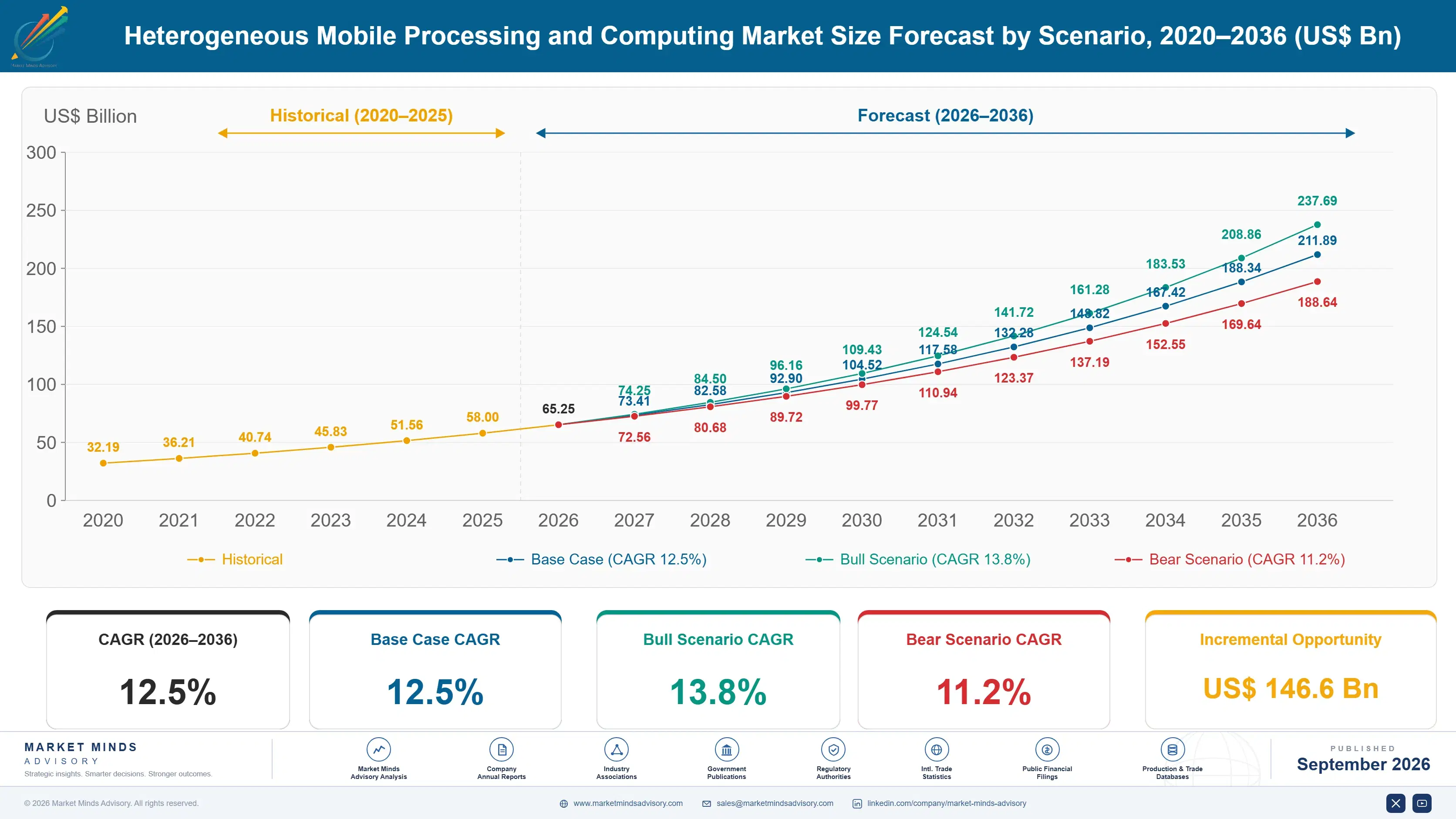
Heterogeneous Mobile Processing and Computing Market Forecast Scenarios

heterogeneous-mobile-processing-computing-market-size-forecast-scenario-1788424637716
Between 2020 and 2025, heterogeneous mobile processing demand grew steadily as smartphone manufacturers began integrating dedicated AI acceleration into flagship chipset designs and edge computing applications expanded, with a historical CAGR near 11.0 percent driven largely by early premium device NPU integration programs. Growth accelerated meaningfully after 2023 as several major chipset vendors formalized dedicated NPU roadmaps across new flagship product generations.
The base case assumes continued generative AI feature proliferation across mobile device tiers, expanding edge computing inference requirements tied to autonomous and industrial applications, and rising manufacturer demand for on-device processing cost efficiency across most major device categories globally. These three mechanisms together sustain rapid growth through 2036, reinforced by expanding foundry advanced node capacity. Vendors with strong foundry relationships capture a disproportionate share of this demand. Growing custom silicon adoption across most major technology markets adds further demand support.
A stronger bull case emerges if generative AI feature adoption accelerates industry-wide following continued consumer demand validation, pulling forward chipset upgrades meaningfully. The bear risk centers on semiconductor capital expenditure discipline, where a broader technology sector downturn would directly compress chipset orders across manufacturers dependent on discretionary device refresh budgets rather than committed multi-year contracts.

On-Device AI Reshapes Chipset Architecture Priorities

Chipset procurement increasingly favors vendors demonstrating multi-generation architecture integration track records over price alone, since device manufacturers weigh sustained thermal and performance reliability more heavily than initial unit cost. Suppliers without established device manufacturer relationships face meaningfully longer approval timelines than incumbents with prior program experience across comparable device tier categories, Program backlogs at established suppliers now stretch beyond one year, reflecting limited certified capacity industry-wide.
MARKET CONCENTRATIONCR5 71%top five vendors hold substantial global chipset revenue share
AVERAGE CHIPSET PRICE$42typical flagship-tier heterogeneous processor unit price range currently
NPU CONTENT SHARE31%share of chipset die area now allocated to dedicated processing
DESIGN CYCLE LENGTH18 monthstypical duration from architecture design to production shipment
ADVANCED NODE ADOPTION44%share of new chipsets manufactured on leading edge process nodes
FOUNDRY BACKLOG LENGTH1.6 yearsaverage foundry order backlog across major chipset programs
Dedicated neural processing capacity continues gaining die area allocation relative to traditional CPU and GPU cores, reflecting genuine on-device inference performance advantages that increasingly matter for generative AI feature responsiveness. Vendors investing early in NPU architecture efficiency are positioned to capture disproportionate share as generative AI feature complexity continues expanding across most major consumer device categories globally.
Custom silicon development is pulling investment toward vendors with proven advanced node design capability, a capability gap that favors established chipset vendors over newer entrants lacking comparable large-scale foundry relationships. This dynamic is expected to persist as advanced node manufacturing capacity remains genuinely constrained and design complexity tightens across both mobile and edge computing applications worldwide. Suppliers investing early in this capability are positioning themselves to capture a disproportionate share of upcoming design wins.
"Nobody buys a chipset for the CPU benchmark anymore. They buy it because the AI features actually run without draining the battery in an hour."
Practice Lead, Semiconductor and Mobile Computing Systems · MMA Mobile System-on-Chip and AI Accelerator Semiconductors Practice · September 2026

Market Trends

Generative AI Features Drive NPU Architecture Redesign

Chipset designers increasingly allocate substantially more die area to dedicated neural processing capacity rather than proportionally scaling traditional CPU and GPU cores, requiring meaningfully different architecture tradeoffs than prior chipset generations optimized primarily for general-purpose computing performance. Roughly 31 percent of chipset die area is now allocated to dedicated processing capacity, up meaningfully from levels reported just several years earlier as generative AI features proliferate. Vendors offering purpose-built NPU architectures increasingly win competitive design evaluations against suppliers still relying primarily on adapted general-purpose cores requiring substantial software optimization for acceptable on-device inference performance.
Market Impact: 49 percent report continued order growth

Advanced Node Manufacturing Constrains Design Capacity

Chipset manufacturers increasingly compete for limited leading-edge foundry manufacturing capacity as heterogeneous designs require the most advanced process nodes to achieve acceptable power efficiency for sustained AI workload processing, creating genuinely constrained design win opportunities distinct from prior generation planning cycles. Roughly 44 percent of new chipsets are now manufactured on leading edge process nodes, reflecting genuine adoption momentum rather than experimental pilot production alone. Vendors with established foundry capacity commitments increasingly capture this expanding demand, while smaller design houses struggle to compete credibly on manufacturing access and cost. today.
Market Impact: 34 percent cite edge AI driver

Market Opportunities and Growth Drivers

On-Device AI Cost Efficiency Sustains Chipset Investment

Device manufacturers increasingly favor on-device AI processing over cloud-dependent inference to avoid recurring per-query cloud computing costs, directly generating meaningful chipset upgrade orders as generative AI feature adoption expands across most consumer device categories entering production. Roughly 49 percent of surveyed device manufacturers report continued chipset order growth compared with prior-year figures, reflecting sustained rather than declining AI feature investment priorities. Vendors with proven NPU efficiency and rapid design support capability increasingly capture this expanding demand across most major consumer technology markets and device categories currently in active development. today.
Market Impact: 28 percent delayed on node cost

Edge Computing Expansion Drives Industrial Demand

Industrial and automotive applications increasingly deploy edge AI inference capability requiring embedded heterogeneous processing across connected equipment and autonomous systems, directly sustaining chipset order volume for vendors with proven edge computing reliability and qualification experience. Roughly 34 percent of surveyed industrial equipment suppliers report edge AI adoption as a primary technology investment driver behind recent chipset order growth, a meaningfully higher share than reported several years earlier. Vendors with established industrial procurement relationships increasingly win contracts among manufacturers pursuing formal edge computing expansion programs across underserved application categories. Growth continues.
Market Impact: 25 percent cite design cycle delays

Market Restraints and Challenges

Advanced Node Manufacturing Costs Constrain Adoption

Leading-edge process node manufacturing carries substantially higher per-wafer costs than prior generation nodes, creating genuine margin pressure for chipset vendors balancing performance requirements against escalating production costs that consumer device pricing cannot fully absorb. The root cause traces to genuine physics and equipment cost scaling at advanced nodes, not vendor pricing strategy alone. Roughly 28 percent of surveyed chipset vendors report advanced node cost pressure as a factor delaying planned architecture migration decisions in the past year. Some vendors are pursuing chiplet architectures to manage this cost escalation. Growth continues.
Market Impact: 31 percent of die area NPU

Long Design Cycles Delay Revenue Recognition

Heterogeneous chipset design programs routinely require extended architecture development and validation periods spanning eighteen months or longer before production shipment revenue materializes, genuinely straining supplier cash flow planning for smaller design houses lacking diversified revenue streams during the development period. This friction slows the very design innovation that smaller vendors increasingly pursue industry-wide. Roughly 25 percent of surveyed smaller vendors report design cycle length as a factor delaying planned market entry timelines. Some vendors are pursuing licensing partnership arrangements to shorten this effective path to market. Some vendors are also expanding co-design partnerships to shorten cycles further.
Market Impact: 44 percent use leading edge nodes
4 additional market trends, 3 additional growth drivers, and 3 additional restraints and challenges are covered in the full report. Contact sales@marketmindsadvisory.com to access the complete intelligence.

Segment CAGR and Growth Architecture

The market spans six chipset categories organized by processing function, from AI-accelerated application processors through custom silicon platforms. Adoption pace varies sharply by category as generative AI and edge computing reshape which segments see the fastest growth. Vendors increasingly design roadmaps around this functional divide rather than treating inference efficiency as a secondary specification decision.
Section default visual

AI/NPU-Accelerated Mobile SoCs

This segment covers system-on-chip designs with substantial dedicated neural processing unit capacity engineered specifically for on-device generative AI workloads, incorporating architecture tradeoffs that distinguish them from traditional general-purpose mobile processors. Adoption is concentrated among flagship and premium device manufacturers pursuing differentiated AI feature capability, where on-device inference performance genuinely exceeds what adapted general-purpose cores can reliably sustain within acceptable power budgets. Growth is outpacing every other segment as generative AI feature adoption continues expanding across most major consumer device categories and price tiers. Vendors here compete heavily on NPU efficiency and thermal sustainability rather than raw benchmark scores alone. Program backlogs at leading suppliers now extend beyond one year, reflecting constrained foundry manufacturing capacity relative to accelerating demand.
CAGR 20.0%

Edge AI Inference Accelerator Chips

This segment covers discrete accelerator chips engineered to deliver dedicated AI inference capability for industrial, automotive, and embedded applications requiring processing independent from central application processor architecture. Adoption is concentrated among manufacturers pursuing formal edge computing deployment programs, where real-time inference requirements genuinely exceed what centralized cloud processing can reliably deliver within acceptable latency budgets. Manufacturers increasingly treat edge inference capability as foundational infrastructure for broader automation strategies rather than a standalone component decision. Growth here trails only AI-accelerated mobile SoCs, reflecting similarly strong inference-driven demand momentum. Suppliers investing early in power efficiency and real-time latency engineering are positioned to capture disproportionate share as edge deployment continues expanding across most major industrial regions globally.
CAGR 16.5%
Full segment breakdown across 6 segments available in the complete report.

Regional Architecture and Country Demand Map

East Asia anchors global demand given concentrated chipset design and manufacturing scale and massive device production volume across major manufacturers. South Asia and Pacific expands fastest as regional device manufacturing investment accelerates across growing production hubs and export capacity. North America follows closely behind in overall component procurement.

North America

The United States accounts for the large majority of regional demand, reflecting concentrated chipset design activity and the presence of major vendors including Qualcomm and Apple within domestic headquarters and product development operations. Major device manufacturer AI feature programs and edge computing initiatives sustain steady demand across multiple large design win categories nationwide. Canada contributes a smaller but meaningful share through comparable semiconductor design investment and technology sector activity. Established foundry partnership relationships give United States vendors a durable advantage over newer international competitors seeking entry into premium device programs specifically. This certification advantage compounds over successive design win cycles nationally. Enterprise buyers also increasingly favor domestic vendor support networks.
Share: 26% | CAGR: 13.5% (2026 to 2036)

Western Europe

Germany, the United Kingdom, and France drive the bulk of regional demand, with Arm Holdings and other established semiconductor design firms pursuing heterogeneous computing development paralleling trends observed in other developed markets though device manufacturing scale trails North America and East Asia. Growth trails North America and East Asia somewhat, reflecting a more mature installed base with fewer new design win categories relative to expanding markets elsewhere globally. Nordic countries show disproportionately high per-capita adoption relative to technology output, reflecting strong digital infrastructure investment. European semiconductor design capability continues supporting regional architecture licensing broadly. This licensing framework benefits vendors with established European operations. Multinational designers standardize licensing across subsidiary operations broadly.
Share: 18% | CAGR: 11.0% (2026 to 2036)
Regional intelligence for 5 additional markets available in the complete report: East Asia, South Asia and Pacific, Latin America, Middle East and Africa, Eastern Europe. Contact sales@marketmindsadvisory.com.
heterogeneous-mobile-processing-computing-market-market-share-analysis-1788424638250

Where Chipset Vendors Can Defend Margin

Vendors face mounting pressure to prove inference efficiency as device manufacturers scrutinize chipset ROI more closely than in prior product cycles. Four commercial levers separate vendors sustaining premium pricing from those competing purely on unit cost and basic benchmark performance parity alone across most segments. Inference efficiency depth remains the biggest differentiator separating durable winners from commodity competitors.

Deepen NPU Architecture Efficiency Investment Now

Vendors investing in mature NPU architecture efficiency capture disproportionate share of the 31 percent of die area now allocated to dedicated processing, since sustained thermal performance directly addresses the throttling concerns dominating flagship device evaluations. This capability commands measurable pricing premiums over vendors offering only adapted general-purpose cores during competitive design bids. Vendors slow to build this depth risk losing large flagship design wins entirely to better-positioned competitors with proven efficiency track records across comparable device categories. Device manufacturers evaluating multiple vendors increasingly treat thermal sustainability as a baseline requirement rather than a differentiating premium feature.
Market Impact: Captures share of the 31 percent NPU area

Secure Advanced Node Foundry Capacity Commitments

Vendors securing advanced node foundry capacity commitments address the 44 percent of chipsets now manufactured on leading edge nodes, positioning ahead of expanding heterogeneous design power efficiency requirements across most major device categories. This differentiation increasingly determines which vendors win early-mover contracts before broader industry-wide capacity constraints intensify further. Vendors without secured foundry commitments struggle to match the manufacturing access of specialized competitors already qualified on multiple leading-edge process nodes currently in commercial production. Device manufacturers evaluating multiple vendors increasingly weight demonstrated foundry access heavily during formal multi-year contract negotiations.
Market Impact: Addresses the 44 percent using leading nodes now

Expand Edge Computing Design Support Capacity

Vendors expanding edge computing design support address the 34 percent of industrial suppliers citing edge AI adoption as a primary technology investment driver, capturing volume growth tied to accelerating automation and autonomous system deployment across most major markets. This positioning reduces dependence on any single consumer device cycle timing that otherwise drives order volume volatility across the broader supply chain. Vendors building this capacity expand addressable market meaningfully beyond traditional mobile accounts toward the larger industrial segment. Industrial program managers increasingly favor vendors already qualified on adjacent embedded categories for faster onboarding timelines.
Market Impact: Addresses the 34 percent citing edge AI now

Pursue Chiplet Architecture Development Broadly Now

Vendors pursuing chiplet architecture development address the 28 percent of vendors citing advanced node cost pressure as a factor delaying migration decisions, reducing the capital commitment barrier that otherwise slows full leading-edge transition. This approach reduces the multi-year capital investment otherwise required to build fully monolithic advanced node capability from the ground up. Vendors building these capabilities expand addressable market among device manufacturers seeking cost-efficient performance without relying entirely on the most expensive process nodes available. Device manufacturers increasingly favor vendors demonstrating this cost efficiency capability during initial platform relationship evaluations.
Market Impact: Addresses the 28 percent facing node cost now

Who Controls the Margin Pool

Market concentration sits at roughly 71 percent among the top five vendors on a revenue basis, reflecting a field where advanced node manufacturing access and architecture design barriers concentrate share among established chipset vendors far more than typical technology-driven markets. The gap between leaders and mid-tier challengers remains wide, since foundry relationships and design track record cannot be replicated quickly regardless of technical capability. New entrants face a genuine time disadvantage measured in years.
Current competitive activity centers on NPU architecture efficiency, advanced node foundry capacity, and edge computing design support, with most major vendors racing to expand capability in whichever dimension they trail competitors most visibly. Strategic licensing partnerships between architecture specialists and device manufacturers remain common as a faster path to design integration. NPU architecture design wins remain the single most contested battleground among the field's largest established suppliers currently.

Emerging pressure comes from device manufacturers pursuing in-house custom silicon development rather than purchasing merchant chipsets, gaining meaningful differentiation without depending entirely on external vendor roadmaps. Rankings could shift meaningfully if more device manufacturers successfully replicate this vertical integration approach at scale across multiple product categories. This vertical integration model could reshape which companies occupy the leading positions.
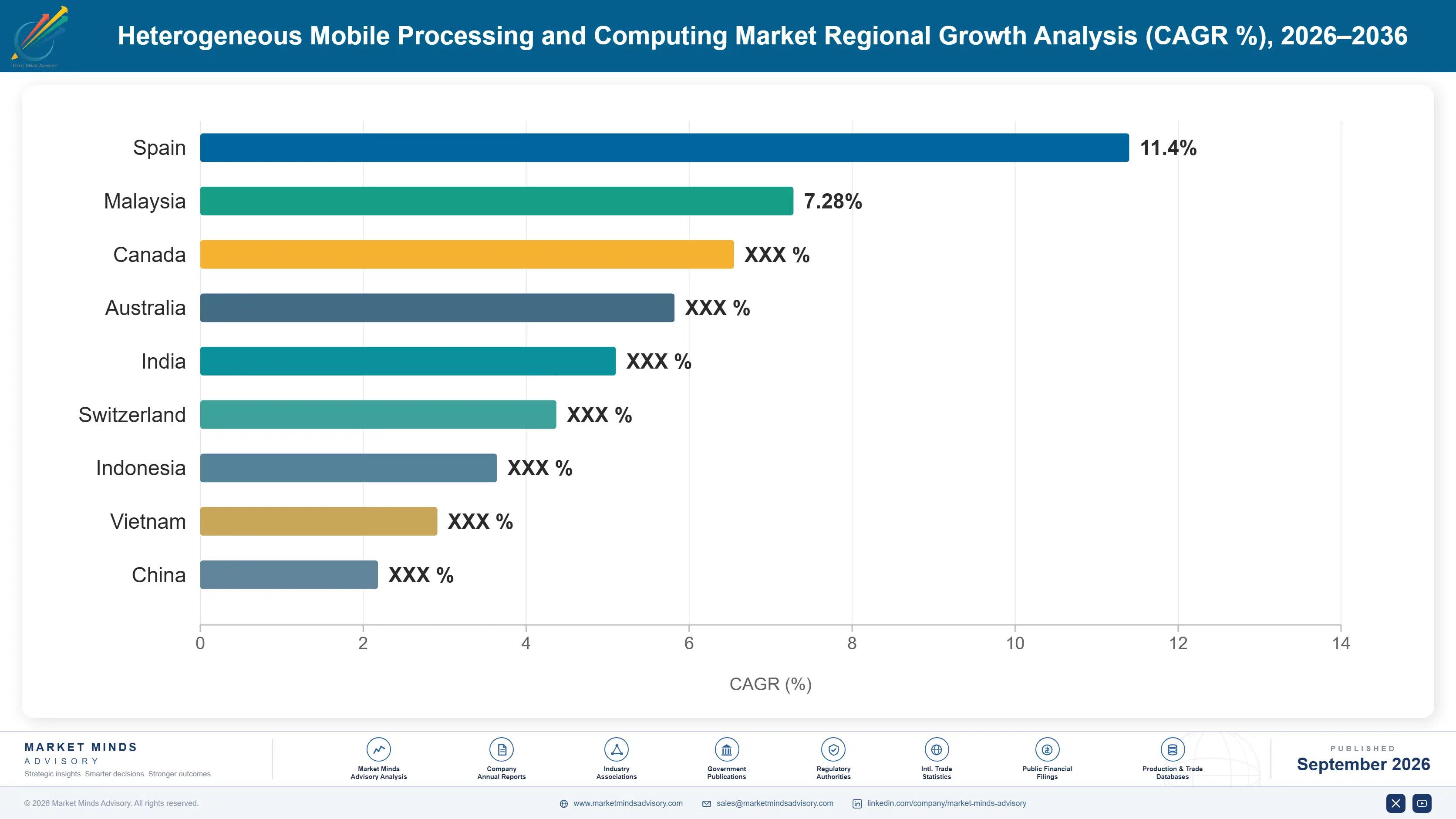
heterogeneous-mobile-processing-computing-market-country-cagr-analysis-1788424638775

Competitive Moat and Risk Dimensions

QUALCOMM

Moat: Deep Multi-Generation Design Leadership

Qualcomm holds certified chipset programs across both flagship and mid-tier device markets, built over decades of wireless and computing technology manufacturing experience that newer entrants cannot replicate on any reasonable timeline. This breadth of program experience compounds into a durable advantage that competitors cannot shortcut through capital investment alone.
QUALCOMM

Risk: Custom Silicon Competition Intensifies

Qualcomm's merchant chipset business faces genuine competitive pressure as major device manufacturers increasingly develop in-house custom silicon, reducing addressable market among the largest premium device accounts over time. Apple and Google's expanding silicon programs increasingly reduce Qualcomm's addressable premium market share meaningfully. Regulatory scrutiny remains a factor.
MEDIATEK

Moat: Strong Mid-Tier Value Positioning

MediaTek's sustained focus on cost-efficient mid-tier chipset design, built over years of volume manufacturing partnership development, gives it genuine positioning advantage among device manufacturers targeting broader market price points. This value positioning increasingly determines competitive outcomes as manufacturers targeting broader price points prioritize cost efficiency above nearly every other factor.
MEDIATEK

Risk: Premium Segment Presence Remains Limited

MediaTek's flagship-tier presence trails larger competitors, leaving it comparatively less positioned to capture the highest-margin premium device design wins that increasingly favor vendors with proven top-tier performance credentials. Premium-focused competitors increasingly win the highest-value design wins that carry the strongest margins. Margin pressure remains a genuine concern.

Players Tracked

Prominent Players

Qualcomm
MediaTek
Samsung Electronics
Apple
Arm Holdings

Other Key Players

Unisoc
HiSilicon
NVIDIA
Google
Intel
AMD
Imagination Technologies
Ceva Inc
Expedera
Hailo
SiFive
Andes Technology
Kneron
Synaptics
Ambarella

Recent Developments

FEBRUARY 2026

Qualcomm Expands NPU Architecture Platform

Qualcomm announced an expanded NPU architecture platform integrating deeper generative AI acceleration capability to help device manufacturers deliver sustained on-device inference performance across flagship product tiers. Observers view the expansion as reinforcing Qualcomm's position as the enterprise-preferred platform choice. Industry analysts confirmed the platform rollout timeline.
Signal: Signals NPU architecture depth continues determining which vendors win the largest design contracts. Rivals lacking comparable history face a gap.
OCTOBER 2025

MediaTek Expands Advanced Node Capacity

MediaTek secured expanded advanced node foundry capacity to address growing mid-tier chipset demand, building on its existing volume manufacturing partnership strength across multiple device manufacturer accounts. The expansion reflects continued investment in the fastest-growing chipset category currently. Analysts confirmed the expansion timeline. The expansion positions MediaTek favorably for anticipated demand.
Signal: Signals manufacturing capacity investment continues concentrating around the fastest-growing category. Rivals are expected to respond similarly soon.
JUNE 2025

Arm Holdings Launches Edge AI Architecture License

Arm Holdings introduced a new dedicated edge AI architecture licensing program targeting industrial and automotive chipset designers, positioning ahead of anticipated embedded inference demand growth across multiple industrial verticals and applications. The move reflects mounting industrial pressure on vendors to address embedded inference requirements directly.
Signal: Signals edge AI licensing is emerging as a genuine growth category industry-wide. Expect further architecture licensing innovation ahead.

Advanced Node Wafer and Design Talent Exposure

Leading-edge process node wafer costs and advanced packaging represent roughly 48 to 56 percent of platform COGS for heterogeneous chipset vendors, sourced primarily from advanced foundries concentrated in Taiwan, South Korea, and the United States. Skilled chip architecture and machine learning engineering talent represents a second major cost category concentrated in North American and East Asian labor markets.
Advanced node wafer pricing rose meaningfully during 2024 amid tightening leading-edge manufacturing capacity, an effect documented in several major foundry annual reports citing extended lead times and rising input costs. Vendors with older capacity commitments absorbed less of this cost increase. Analysts estimate the resulting increase added two to four points of margin pressure. Newer entrants without established capacity commitments faced the sharpest pricing exposure across the industry broadly this cycle.

Smaller vendors lacking negotiating scale with major foundries face a genuine cost disadvantage relative to larger incumbents able to negotiate volume-based wafer pricing agreements directly with foundry partners. This gap widens further as advanced node requirements climb, since next-generation heterogeneous designs increasingly depend on the most advanced process technology available. Vendors serving smaller design accounts feel this disadvantage most acutely, since limited order volume prevents comparable negotiating scale.
heterogeneous-mobile-processing-computing-market-company-positioning-matrix-1788424638969

Diversify Foundry Supplier Relationships

Vendors building relationships with multiple advanced foundries reduce single-source dependency risk, securing more resilient wafer pricing and availability even during periods of broader leading-edge manufacturing capacity constraint across the industry. Vendors locking in favorable terms early gain a durable cost advantage over competitors renegotiating during periods of rising wafer pricing. Costs stabilize meaningfully. Availability improves too.

Consolidate Design Verification Across Product Lines

Vendors standardizing design verification processes across multiple chipset product lines reduce per-unit development cost meaningfully through shared engineering investment, spreading fixed verification infrastructure across a broader base of qualified chipset architectures. Vendors locking in favorable terms early gain a durable cost advantage over competitors renegotiating during periods of verification cost volatility broadly. Margins improve steadily.

Portfolio Architecture for Margin Defence

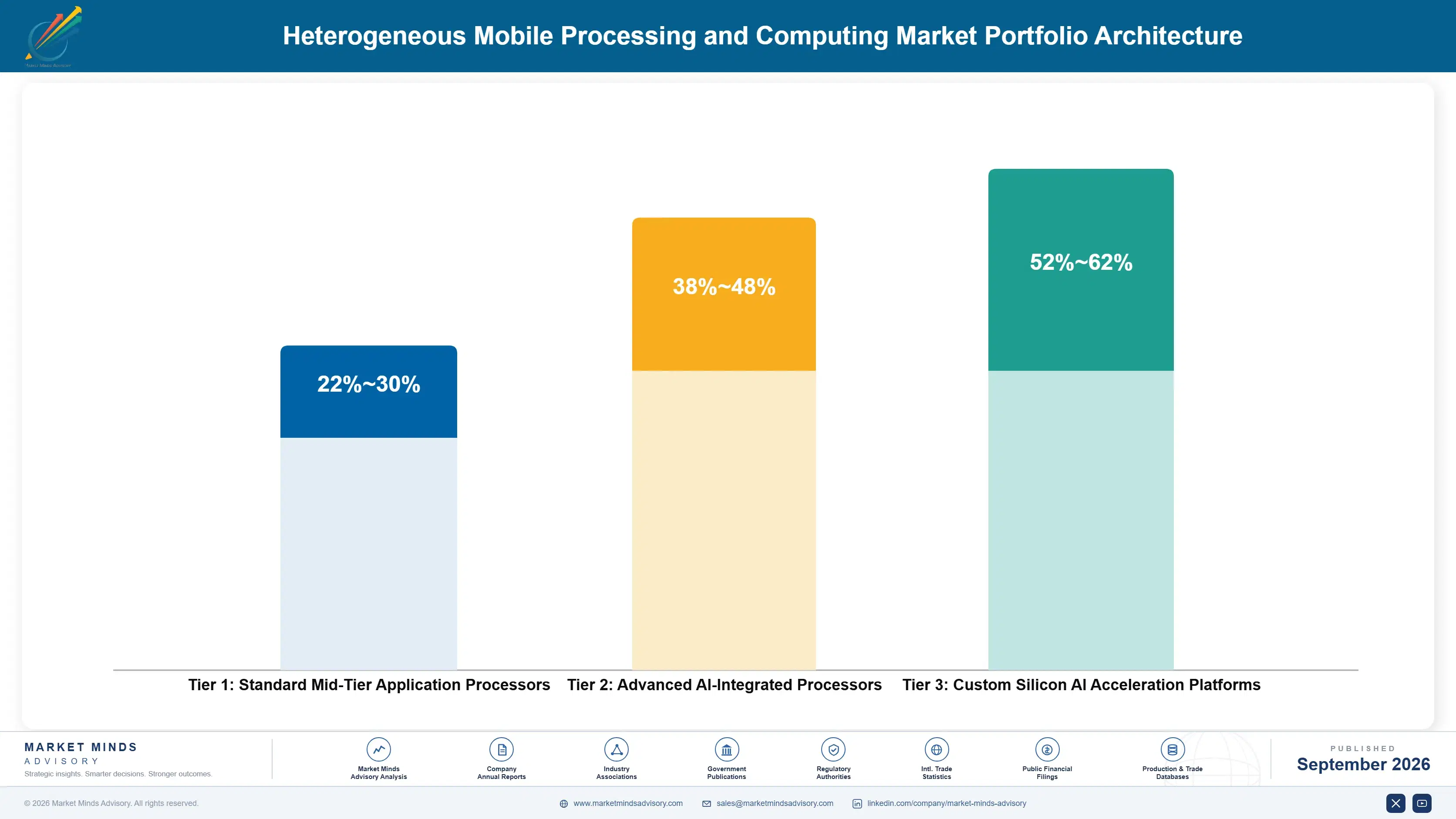
Vendors architect their portfolios around three distinct tiers separating commodity mid-tier processors from certified flagship and custom silicon systems commanding substantially higher margins tied to NPU efficiency and advanced node access across product lines. Tier boundaries increasingly reflect architecture complexity rather than raw core count, a shift favoring established vendors over newer commodity-focused entrants. This shift is reshaping vendor investment priorities industry-wide.
Volume tier products generate steady revenue at comparatively thin margins, while premium and next-generation certified tiers command substantially higher gross margins reflecting genuine design barriers rather than pure feature bundling alone across most vendor product lines currently offered. This tension between volume scale and premium margin defines much of current vendor investment strategy, since serving both segments simultaneously requires genuinely different design and manufacturing capability.

High-value margin pools concentrate heavily among device manufacturers requiring flagship NPU performance and advanced node access not offered within lower-priced commodity chipset product tiers across the broader vendor product catalog currently available. Vendors increasingly steer investment toward these programs specifically, since the margin differential between commodity and flagship tiers has widened considerably as AI capability matures. This trend is expected to continue through the forecast period.

Standard Mid-Tier Application Processors

Entry-level chipsets for budget and mid-tier devices with limited NPU capacity and standard general-purpose computing configurations already in service. These customers typically prioritize cost predictability over advanced feature depth or premium support arrangements.
Gross Margin: 22-30%

Advanced AI-Integrated Processors

NPU-integrated chipsets for mid-size to large flagship programs requiring standard generative AI feature and thermal performance documentation. These systems represent the largest volume category by unit count across most flagship programs.
Gross Margin: 38-48%

Custom Silicon AI Acceleration Platforms

Full-stack chipset platforms with mature NPU architecture and advanced node access for the most demanding flagship and edge computing requirements available. Demand here continues climbing as AI feature requirements expand across most device markets steadily.
Gross Margin: 52-62%
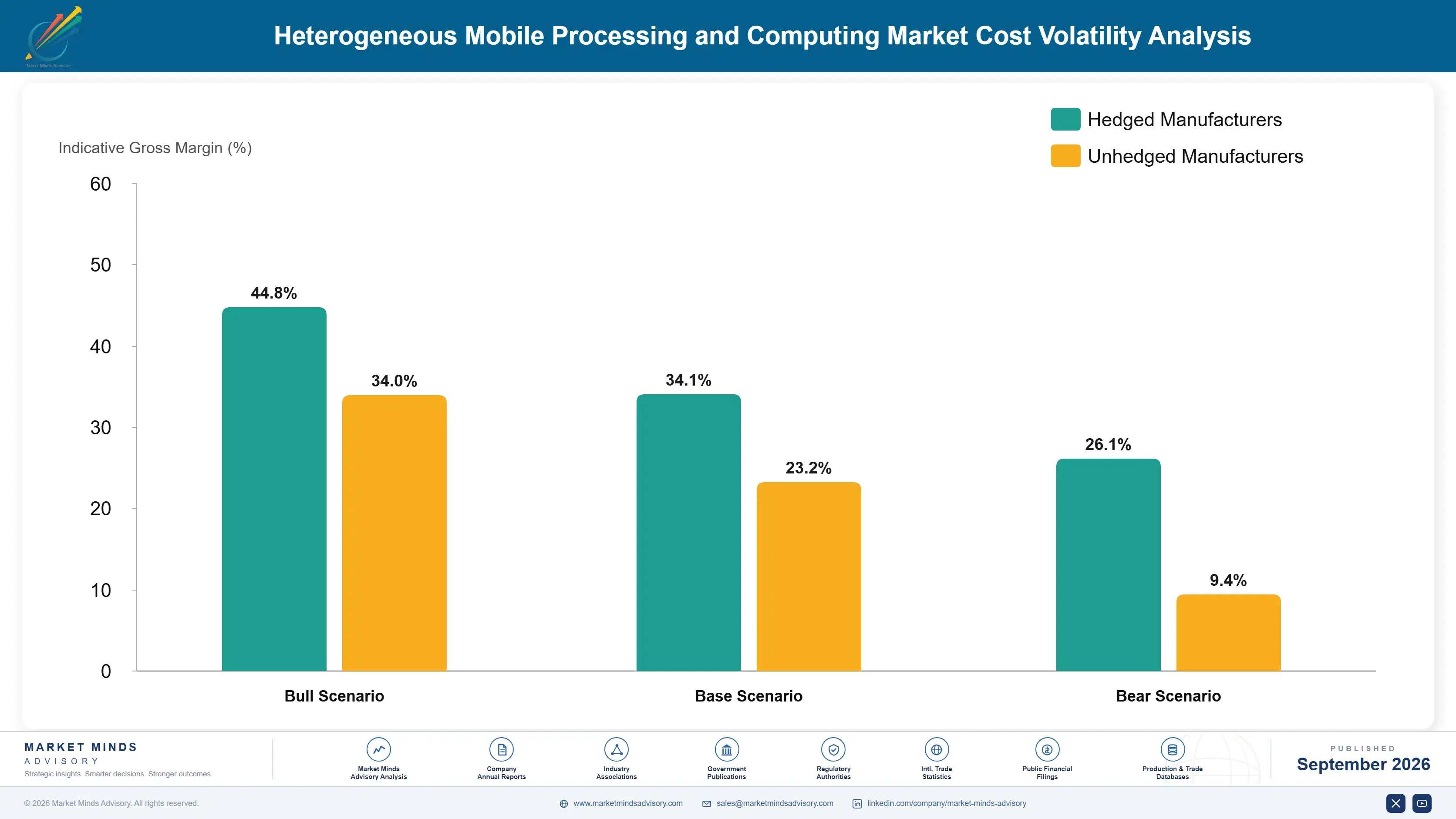
heterogeneous-mobile-processing-computing-market-cost-volatility-analysis-1788424639464

High-value Sub-segments and Strategic Watch-out

AI-Accelerated Mobile Processors

High-value and high-growth category as generative AI adoption expands, commanding premium pricing among vendors with proven NPU efficiency and thermal sustainability track record. This segment consistently outpaces every other product category in both revenue growth and new manufacturer adoption. Investment compounds quickly across most manufacturer segments and buyer categories.
Gross Margin: 48-58%

Edge AI Inference Accelerators

High-value with moderate growth as industrial deployment matures, commanding sustained premium pricing tied to demonstrated latency reliability and power efficiency outcomes. Vendors with mature latency engineering increasingly command meaningful renewal pricing power within this maturing category. This gap keeps widening steadily across most competitive evaluations and industrial segments.
Gross Margin: 44-54%

Standard Mid-Tier Application Processors

Volume core category generating steady revenue at thinner margins, remaining the entry point for smaller manufacturers before eventual platform upgrade paths emerge. Vendors increasingly view this segment as a customer relationship channel feeding eventual upgrades toward premium tiers. This funnel effect matters greatly for long-term vendor customer relationship value.
Gross Margin: 24-32%

Legacy Non-AI Application Processors

Strategic watch-out category facing steady decline as NPU-integrated alternatives displace older non-accelerated technology across most device modernization programs currently underway. Vendors are monitoring this segment closely for signs of accelerating decline as remaining holdout manufacturers eventually upgrade. This transition remains gradual though inevitable across most manufacturer segments nationally.
Gross Margin: 8-16%

Design Cycles Build Durable Program Revenue

Heterogeneous chipset programs generate genuine annuity economics once a vendor wins device manufacturer design integration, since switching vendors mid-generation requires re-optimizing the entire software and thermal environment, a process spanning years that manufacturers rarely pursue once a vendor is integrated. This dynamic keeps incumbent vendors embedded across a device manufacturer's full multi-generation product line, generating recurring licensing and upgrade revenue well beyond the original design win itself.
Adoption depth and stickiness vary meaningfully by end-use vertical: flagship device manufacturers with complex AI feature roadmaps embed vendor relationships deepest given genuine architecture complexity, while budget device makers show comparatively shallower integration, often switching vendors each generation based on current cost and performance requirements rather than prior vendor familiarity. Industrial embedded programs sit closest to flagship in adoption depth.

A generational shift in buyer profile is underway as device manufacturer AI research teams increasingly drive chipset specification decisions earlier in product design cycles, rather than treating processor selection as a late-stage sourcing consideration handled by separate procurement teams. This earlier engagement favors vendors with strong software co-design credentials over pure hardware manufacturers lacking comparable design-stage relationships. This shift carries implications for engineering team structure.
Section default visual

Where MMA Sees Heterogeneous Computing Heading

These are among the four positions where our research anticipates prominent divergence between winners and laggards over the coming forecast period. Each is grounded in the demand model, the regulatory perimeter, and the announced capacity pipeline.
01 / NPU INVESTMENT PRIORITY

NPU architecture efficiency deserves priority as AI features expand

Roughly 31 percent of chipset die area now goes to dedicated processing, making architecture efficiency a genuine competitive moat rather than an optional capability most vendors historically treated as secondary to raw benchmark scores. Vendors that build this depth now win the largest flagship design wins before slower competitors catch up, since replicating years of efficiency refinement is not something capital alone can shortcut. This gap widens further as generative AI feature adoption continues expanding across most major consumer device categories nationwide.
02 / FOUNDRY ACCESS STRATEGY

Advanced node capacity secures manufacturing scale advantage

Roughly 44 percent of new chipsets are now manufactured on leading edge process nodes, positioning vendors with secured foundry commitments well ahead of competitors lacking comparable manufacturing access arrangements. Vendors with this capability differentiate meaningfully from suppliers still relying on constrained spot capacity increasingly out of step with device manufacturer expectations. This positioning advantage increasingly determines which vendors win large flagship contract renewals across most consumer device segments and categories currently competing for premium market share and design win opportunities.
03 / EDGE COMPUTING FOCUS

Design support capacity captures industrial inference demand

Roughly 34 percent of industrial suppliers cite edge AI adoption as a primary technology investment driver, representing genuine opportunity for vendors with edge computing design support capacity over competitors offering only mobile-focused chipset portfolios. Vendors that deepen this capability capture disproportionate share of procurement decisions increasingly driven by automation and autonomous system leaders rather than consumer device teams alone. This capability increasingly separates vendors winning industrial accounts from those confined entirely to mobile-only chipset offerings lacking established industrial credibility and track record.
04 / CHIPLET ARCHITECTURE STRATEGY

Chiplet designs address advanced node cost pressure barriers

Roughly 28 percent of vendors cite advanced node cost pressure as a factor delaying migration decisions, reflecting genuine capital constraints that smaller design houses face when pursuing fully monolithic leading-edge architecture independently. Vendors developing chiplet architecture designs reduce this capital commitment barrier and expand addressable market among device manufacturers seeking cost-efficient performance without full node migration. This capability increasingly separates vendors capturing cost-sensitive accounts from those confined entirely to fully monolithic-only architecture offerings lacking meaningful cost and performance flexibility overall.

Engagement Snapshot From the Field

A live engagement with an industry participant carrying material or product regulatory and market exposure ahead of a defining policy shift, showing how our research translates into a defensible multi-year portfolio strategy.
MARKET MINDS ADVISORY · CLIENT ENGAGEMENT SUMMARY
Heterogeneous Mobile Processing and Computing Producer Strategic Portfolio Review and Transition Roadmap 2026·Investment Scenario on Heterogeneous Mobile Processing and Computing Exposure Evaluation 2025-26
CLIENT PROFILE
The client is a mid-tier smartphone manufacturer competing primarily on value pricing, facing pressure to add generative AI features after competitors began advertising on-device AI capability as a key differentiator in the same price segment. The engagement followed leadership concern that flagship-tier chipset pricing would erode the client's cost-competitive positioning. Annual chipset procurement spend reportedly exceeded sixty million dollars (client-reported, unverified by MMA) across the affected device lineup.
STRATEGIC CHALLENGE
The client needed generative AI capability to remain competitive but could not absorb flagship-tier chipset pricing without meaningfully compromising its value positioning, leaving leadership uncertain whether a mid-tier NPU-integrated chipset would deliver acceptable AI feature performance. Leadership needed a defensible cost-performance analysis before committing to a chipset tier decision for the next generation.
MMA APPROACH
MMA conducted primary interviews with the client's product engineering leadership and benchmarked three mid-tier chipset vendors against NPU performance, cost premium over non-AI alternatives, and expected feature parity with flagship devices based on comparable manufacturer deployments. The engagement also weighed consumer perception risk explicitly given the client's cost-sensitive value-segment positioning.
KEY FINDINGS
  1. Mid-tier NPU-integrated chipsets could plausibly deliver seventy percent of flagship-tier AI feature performance at roughly forty percent lower unit cost. This finding shaped the vendor selection process considerably.
  2. Two of the three benchmarked vendors offered mid-tier chipsets with software optimization support specifically tuned for value-segment device thermal constraints. This support reduced internal engineering burden meaningfully overall.
  3. Consumer perception testing across comparable value-segment devices showed acceptable AI feature satisfaction despite modest performance gaps versus flagship devices. This validation reduced perceived launch risk considerably overall.
  4. Vendor software support commitments reduced the client's internal engineering burden meaningfully compared with in-house optimization alone. This benefit further reinforced the mid-tier vendor decision considerably.
CLIENT PROFILE
The client is a mid-tier smartphone manufacturer competing primarily on value pricing, facing pressure to add generative AI features after competitors began advertising on-device AI capability as a key differentiator in the same price segment. The engagement followed leadership concern that flagship-tier chipset pricing would erode the client's cost-competitive positioning. Annual chipset procurement spend reportedly exceeded sixty million dollars (client-reported, unverified by MMA) across the affected device lineup.
STRATEGIC CHALLENGE
The client needed generative AI capability to remain competitive but could not absorb flagship-tier chipset pricing without meaningfully compromising its value positioning, leaving leadership uncertain whether a mid-tier NPU-integrated chipset would deliver acceptable AI feature performance. Leadership needed a defensible cost-performance analysis before committing to a chipset tier decision for the next generation.
MMA APPROACH
MMA conducted primary interviews with the client's product engineering leadership and benchmarked three mid-tier chipset vendors against NPU performance, cost premium over non-AI alternatives, and expected feature parity with flagship devices based on comparable manufacturer deployments. The engagement also weighed consumer perception risk explicitly given the client's cost-sensitive value-segment positioning.
KEY FINDINGS
  1. Mid-tier NPU-integrated chipsets could plausibly deliver seventy percent of flagship-tier AI feature performance at roughly forty percent lower unit cost. This finding shaped the vendor selection process considerably.
  2. Two of the three benchmarked vendors offered mid-tier chipsets with software optimization support specifically tuned for value-segment device thermal constraints. This support reduced internal engineering burden meaningfully overall.
  3. Consumer perception testing across comparable value-segment devices showed acceptable AI feature satisfaction despite modest performance gaps versus flagship devices. This validation reduced perceived launch risk considerably overall.
  4. Vendor software support commitments reduced the client's internal engineering burden meaningfully compared with in-house optimization alone. This benefit further reinforced the mid-tier vendor decision considerably.
RECOMMENDED STRATEGY
Phase 1: Phase one: select a mid-tier chipset vendor offering dedicated software optimization support for the client's next device generation. This selection balanced cost against feature performance requirements. Phase 2: Phase two: validate consumer AI feature satisfaction through limited market testing before finalizing the broader product lineup rollout. This validation reduced launch risk before full-scale rollout. Phase 3: Phase three: track feature performance and consumer satisfaction data to inform future chipset tier selection decisions. This tracking supports future chipset tier decisions directly.
OUTCOME
The client selected a mid-tier chipset vendor and launched its AI-enabled device lineup within six months of the engagement's conclusion. Early sales data suggests device unit sales grew by roughly twenty-four percent (client-reported, unverified by MMA) compared with the prior non-AI generation. Product leadership cited the phased validation approach as a model for future chipset tier decisions.

Frequently Asked Questions

Foundational context covering the market sizes, CAGR, scope, country, region and competition that inform every finding below. This section is provided to cover basics and most often pre-purchase conversations, answered from the MMA Primary Research Dataset.

What is the current size of the Heterogeneous Mobile Processing and Computing Market?

The global heterogeneous mobile processing and computing market reached approximately 58.0 billion dollars in 2025. On-device generative AI processing demand is the primary driver behind current market scale.

How large will the Heterogeneous Mobile Processing and Computing Market be by 2036?

MMA projects the market will reach approximately 211.89 billion dollars by 2036, expanding roughly 3.25 times from its 2026 base. AI-accelerated chipset adoption accounts for the largest share of this growth.

What is the CAGR for the Heterogeneous Mobile Processing and Computing Market 2026 to 2036?

The market is projected to grow at a compound annual growth rate of 12.5 percent between 2026 and 2036. Bull and bear scenarios range from 11.2 percent to 13.8 percent depending on adoption pace.

Which segment is growing fastest?

AI and NPU-accelerated mobile SoCs are the fastest-growing segment, projected at a 20.0 percent CAGR, roughly 1.60 times the overall market rate. Generative AI feature demand drives this pace.

Who are the major companies in the Heterogeneous Mobile Processing and Computing Market?

Leading vendors include Qualcomm, MediaTek, Samsung Electronics, Apple, and Arm Holdings. The top five vendors together hold approximately 71 percent of the market on a revenue basis.

Which country is growing fastest?

India is the fastest-growing country market, projected at a 14.8 percent CAGR through 2036. Its rapidly expanding device manufacturing base and electronics production pipeline underpin this pace of growth.

Report Segmentation Architecture

The full report scope spans multiple orthogonal segmentation dimensions, with cross-tabulated demand data provided for each dimension pair. Coverage extends further to regional breakdowns, trend trajectories, and the competitive detail needed to support segment-level decision-making.

By Processing Architecture Type

    By End-Use Application

      By Device Tier

        By Region

        • North America
        • Western Europe
        • East Asia
        • South Asia and Pacific
        • Latin America
        • Middle East and Africa
        • Eastern Europe

        Scope, Methodology, and Coverage

        Every figure in this report is reproducible from documented input assumptions. The scope below maps the historical period, the forecast horizon, the segmentation dimensions, and the countries covered, alongside the underlying primary and qualitative methodology.
        Historical Period
        2020 to 2025
        Forecast Period
        2026 to 2036
        Base Year
        2025 (USD billions; MMA Primary Research Dataset, September 2026)
        Market Definition
        The Heterogeneous Mobile Processing and Computing Market covers system-on-chip and discrete accelerator semiconductors combining CPU, GPU, NPU, and DSP processing units for mobile devices and edge computing applications. It excludes standalone data center AI accelerators, general-purpose desktop and server processors, and consumer graphics cards.
        Quantitative Units
        USD billions, market share in percent, CAGR in percent
        Segmentation Dimensions
        Processing architecture type, end-use application, device tier, region
        Regions Covered
        North America, Western Europe, East Asia, South Asia and Pacific, Latin America, Middle East and Africa, Eastern Europe
        Countries Covered
        United States, China, South Korea, India, Taiwan, Japan, and 18 additional countries across seven regions
        Key Companies Profiled
        Qualcomm, MediaTek, Samsung Electronics, Apple, Arm Holdings, and 15 additional participants
        Quantitative Methodology
        Primary survey, n=3,800 respondents, Q4 2025, six countries; demand-side model with trade association cross-validation
        Qualitative Methodology
        47 expert interviews, Q4 2025; applied to validate demand model assumptions, identify emerging dynamics, and assess competitive positioning
        Report Format
        PDF and XLSX data workbook (Word format preview document)
        Publisher
        Market Minds Advisory
        Report Code
        MMA-2026-TEC-556
        Published
        September 2026
        Contact
        sales@marketmindsadvisory.com | www.marketmindsadvisory.com

        Purchase the full Heterogeneous Mobile Processing and Computing Market Report (2026 to 2036).

        This report provides a comprehensive assessment of the global heterogeneous mobile processing and computing market, covering segmentation, regional dynamics, competitive positioning, and input cost exposure through 2036. It draws on primary survey data from 3,800 respondents and 47 expert interviews conducted across six countries in the fourth quarter of 2025. Analysts detail NPU architecture trends, advanced node foundry access strategies, and margin economics across three distinct product tiers. The report also includes a detailed client case study illustrating a real chipset strategy engagement and its measured outcomes.
        Segment-level CAGR and market share forecasts
        Seven-region demand and pricing trend analysis
        Competitive positioning across twenty profiled vendors
        Input cost exposure and mitigation pathways
        Portfolio tier margin economics and watch segments
        Anonymized client engagement case study review

        Built For The People Who Decide

        From boardroom strategy to bench-side execution, this report is read cover-to-cover by leaders shaping the next decade of their industry, turning demand scenarios, market dynamics and valuation benchmarks into decisions.
        CXOs/ Presidents/ VPs/ Managers
        M&A and Corporate Development
        Strategy Teams and R&D Heads
        Procurement and Product Directors
        Regulatory and Compliance Leaders
        Investor Relations and Equity Analysts