Market Minds Advisory
Hermetic Jars Market

Hermetic Jars Market: Gasket Economics, Furnace Constraints and the Preserving Demand That Rises When Food Prices Do

The glass body lasts decades and the rubber gasket lasts two seasons, which means the part nobody thinks about generates repeat revenue at margins the jar itself has never once delivered.

Lead Analyst

Bilal Shaikh

Published

September 2026

Make Smarter Decisions with Customized Research Insights

Request a free sample report and evaluate market opportunities, growth trends, and competitive dynamics relevant to your business needs.

2025 MARKET VALUE$2.3BMarket Size 2025
2036 FORECAST VALUE$4.2BBase Case , 2026 to 2036
CAGR 2026 TO 20365.6 %Bull 6.8% / Bear 4.4%
INCREMENTAL OPPORTUNITY$1.7BNet 10- year value creation
EXPANSION MULTIPLE1.72x2036 value over 2026 base
Strategic Levers
M&A Pipeline
Regional Outlook
Country Rankings
Competitive Intelligence
Segmental Deep-dive
Call-Us : 91 93563 13602

Executive Snapshot and Market Trajectory

A hermetic jar is a piece of commodity glass wrapped around a sealing system, and the seal is the only part that fails. Gaskets take a compression set, absorb odours and harden with heat cycling, which turns a durable good into something with a consumable attached.
Child-resistant hermetic containers compound at 8.4%, exactly 1.50 times the market, because regulated cannabis markets require certified closures that also preserve product, and no ordinary bail jar satisfies both. East Asia holds 27% of demand, led by Chinese preserved food storage and a Japanese plum wine season that moves millions of large jars in a matter of weeks each summer. That mismatch shapes everything commercial here.
Concentration is low, with the top five holding 34%. Glass is heavy, fragile and uneconomic to ship far, so production stays regional and national brands hold their home markets. Furnace economics reinforce that, since a glass tank runs continuously for a decade and cannot simply be turned down when demand softens. Regional production and national brands follow directly from those two constraints, and consolidation elsewhere in packaging has never reached this category at all.
Market Definition
The market covers glass jars incorporating a gasketed airtight closure system, including bail and clamp jars, gasketed screw-top jars, glass-lid clip jars, child-resistant hermetic containers, vacuum-pump storage jars and decorated presentation formats, together with replacement gaskets and sealing components. Plain glass jars without a sealing gasket, commercial food packaging filled at scale, plastic storage containers and ceramic fermentation vessels are excluded.
Base Year Value
$2.3B in 2025 (MMA Primary Research Dataset, August 2026)
Forecast Period
2026 to 2036, eleven discrete annual values
CAGR
5.6% base case. Bull 6.8%. Bear 4.4%.
Fastest Growth Segment
Child-Resistant Hermetic Containers: 8.4% CAGR
Fastest Growth Country
India: 8.2% CAGR
Fastest Growth Region
South Asia and Pacific: 7.6% CAGR
Largest Region
East Asia: 27% of 2025 global value
Market Leaders
Bormioli Rocco, Newell Brands, Rayware Group, Weck Glaswerke, Borgonovo. Source: MMA Analysis based on company annual reports.
Primary Survey
n=3,800 procurement and R&D decision-makers, Q4 2025, six countries
Methodology
Demand-side build-up, cross-validated against public data, 47 expert interviews

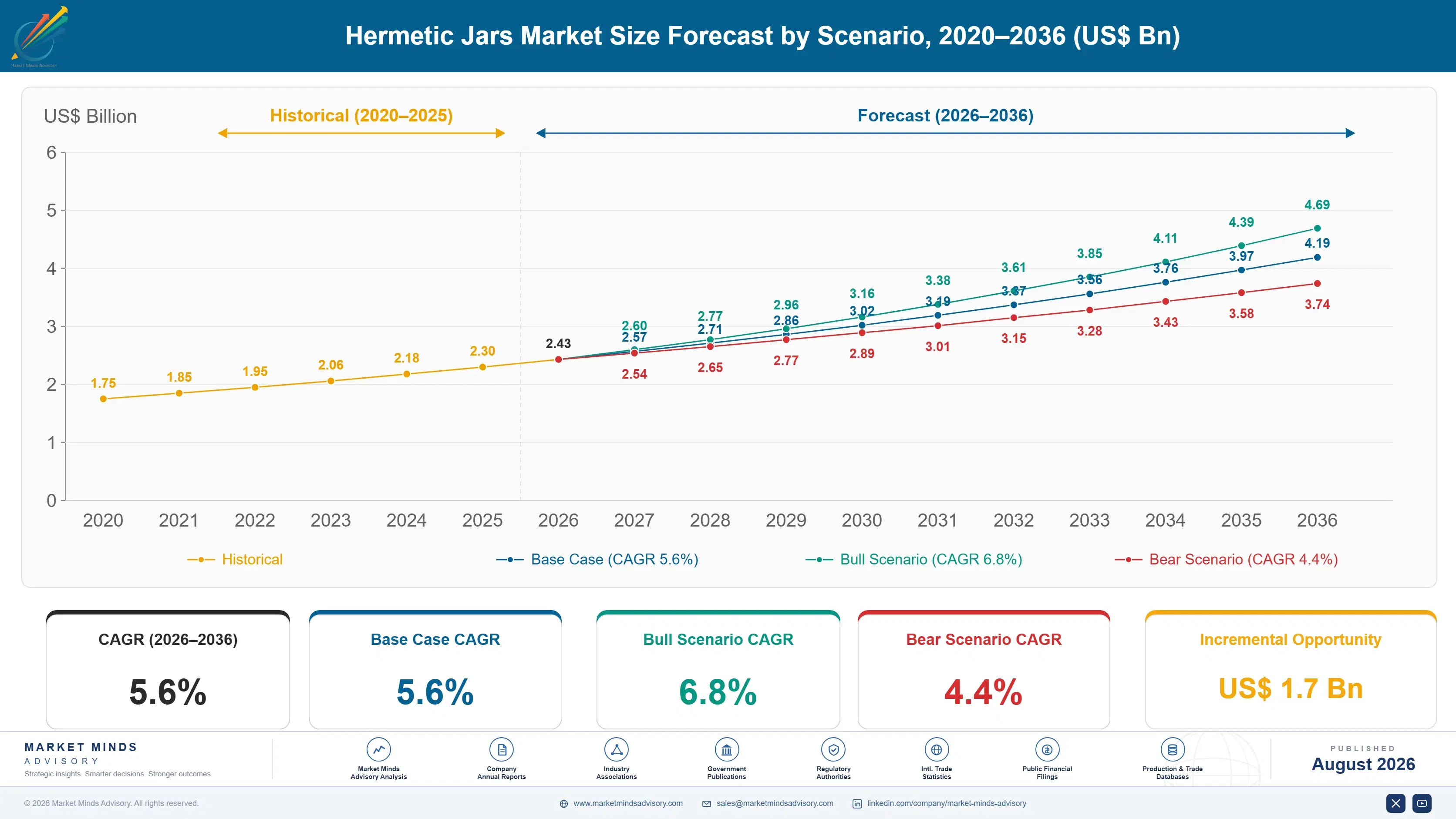
Hermetic Jars Market Forecast Scenarios

hermetic-jars-market-size-forecast-scenario-1787307929940
The implied 4.6% CAGR across 2020 to 2025 disguises two opposing swings. Lockdown home preserving and baking drove an extraordinary spike through 2020 and into 2021, with several producers on allocation, then demand fell back hard in 2022 as households returned to normal routines and retailers worked through inventory they had over-ordered at the peak.
The base case at 5.6% rests on three mechanisms. Food price pressure keeps pushing households toward home preserving, and that behaviour has proved stickier after each cost-of-living episode than producers expected. Regulated cannabis markets require child-resistant closures that also preserve product, creating a genuinely new demand pool. And premium kitchen presentation formats keep taking share from purely functional storage. Each mechanism operates on its own timetable, and none of them depends on the other two holding up.
The bull case at 6.8% assumes cannabis legalisation extends across further United States states and European markets, since those closures carry unit values several times a standard bail jar. The bear case at 4.4% follows from sustained energy costs keeping glass furnace operating expense elevated, which raises shelf prices against plastic and stainless alternatives that perform adequately for dry storage.

Why the Cheapest Component Decides Everything

Glass does not wear out. A hermetic jar bought in 1970 will still hold a seal today provided somebody replaced the gasket four or five times along the way, and that single fact defines the commercial structure of this market. The durable part is a commodity, and the perishable part is where the money sits. Replacement gaskets carry margins the jar body has never approached.
TOP FIVE CONCENTRATION34%Combined share held by the five largest global producers
GASKET REPLACEMENT INTERVAL2.4 yearsTypical service life before sealing performance degrades noticeably
ENERGY COST SHARE27% of COGSFurnace and forming energy as proportion of production cost
ECONOMIC SHIPPING RADIUS600 kmDistance beyond which freight and breakage overwhelm delivered value
FURNACE CAMPAIGN LENGTH12 yearsContinuous operating life of a glass tank between rebuilds
SEASONAL DEMAND CONCENTRATION58% of volumeShare of annual sales falling within the preserving season
Production economics push the other way. A glass furnace runs continuously for around twelve years and cannot be throttled when demand dips, so producers must keep pulling glass regardless of orders. Energy is 27% of cost, and the finished product is heavy and fragile enough that freight and breakage make anything beyond roughly 600 kilometres uneconomic. Regional production and national brands follow directly from those two constraints.
Demand is seasonal and it is emotional. Some 58% of volume falls in the preserving season, and it rises whenever food prices do. Each cost-of-living episode has left a residue of households who kept preserving afterwards, which is why the underlying trend line has been more resilient than the sharp post-pandemic correction suggested at the time.
"Producers spend their energy arguing about glass weight and furnace efficiency, and then hand the gasket business to whoever turns up. I have seen replacement seal margins run three times the jar they fit into, sold by nobody in particular to customers who would happily have bought them from the brand."
Director, Glass Containers and Consumer Housewares Practice · MMA Glass Containe

Market Trends

Regulated Cannabis Markets Require Certified Preserving Closures

United States state regulations and Canadian federal rules require child-resistant packaging for cannabis products, and the same product degrades badly with oxygen and humidity exposure. That combination rules out both an ordinary bail jar, which any child can open, and a standard child-resistant plastic container, which preserves poorly. Certified hermetic glass containers satisfy both requirements and price at several times a standard jar. The segment compounds at 8.4% against a market at 5.6%, and each new legalising jurisdiction adds a fresh compliance-driven demand pool. Housewares producers cannot serve it without certification.
Market Impact: Gasket margins running 3 times high
Food Price Pressure Leaves a Residue of Permanent Preservers

Home preserving demand rises sharply whenever grocery inflation does, which producers have always known. What is newer is the residue: each episode since 2008 has left a share of households continuing to preserve after prices stabilised, rather than reverting entirely. That has raised the underlying baseline in successive steps rather than producing a simple cycle. Roughly 58% of volume still falls within the preserving season, but the trough between seasons has become shallower with each cost-of-living episode in the past fifteen years. The baseline has stepped upward rather than cycling.
Market Impact: Presentation formats growing at 6.0

Market Opportunities and Growth Drivers

Replacement Gaskets Convert Durable Goods Into Recurring Revenue

A gasket loses sealing performance after roughly 2.4 years of use, hardening under heat cycling and taking a compression set that leaves it unable to recover. The glass body meanwhile lasts indefinitely. That mismatch creates a consumable attached to a durable good, and replacement seals carry gross margins roughly three times the jar they fit. Producers that supply them under their own brand capture that stream, and those that do not watch generic suppliers take it entirely, frequently with a poorer fit and the brand carrying the complaint. Nobody sells them the seal.
Market Impact: Campaigns locked for 12 years

Kitchen Presentation Demand Favours Glass Over Functional Storage

Open shelving, decanted pantries and visible storage have moved jars from the cupboard onto display, which changes what buyers will pay for. A jar that is looked at daily is judged on form, glass clarity and closure finish rather than only on whether it seals. Decorated and shaped presentation formats grow at 6.0% and carry unit prices well above functional equivalents. Plastic and stainless containers compete adequately on performance for dry goods and lose this comparison entirely, because nobody displays them deliberately. Design and mould investment rather than technology is what the format requires.
Market Impact: Freight uneconomic beyond 600 kilom

Market Restraints and Challenges

Furnace Economics Punish Producers When Demand Falls

A glass tank runs continuously for around twelve years and cannot be turned down or restarted cheaply, so a producer must keep pulling glass whether orders exist or not. The root cause is metallurgical rather than commercial: cooling and reheating a furnace destroys the refractory lining and ends the campaign early. The 2022 demand correction therefore hit margins far harder than the volume drop alone implied. Producers mitigate through export sales, contract filling work and building inventory, none of which fully absorbs a sharp fall. Planning around the season is the only real answer.
Market Impact: Certified closures compounding at 8

Freight and Breakage Cap the Addressable Selling Radius

Glass is heavy and it breaks, and both costs scale with distance. The root cause is physical rather than logistical: a hermetic jar cannot be lightweighted much further without compromising the sealing flange geometry the closure depends on. Beyond roughly 600 kilometres freight and breakage overwhelm delivered value entirely. Producers mitigate by holding regional production close to consuming markets and by concentrating longer-distance shipments on premium and certified formats where unit values justify the cost. Chinese and Turkish producers reach further only because their delivered cost base starts lower, not because the physics differ for them.
Market Impact: Season carrying 58% of volume
3 additional market trends, 4 additional growth drivers, and 2 additional restraints and challenges are covered in the full report. Contact sales@marketmindsadvisory.com to access the complete intelligence.

Segment CAGR and Growth Architecture

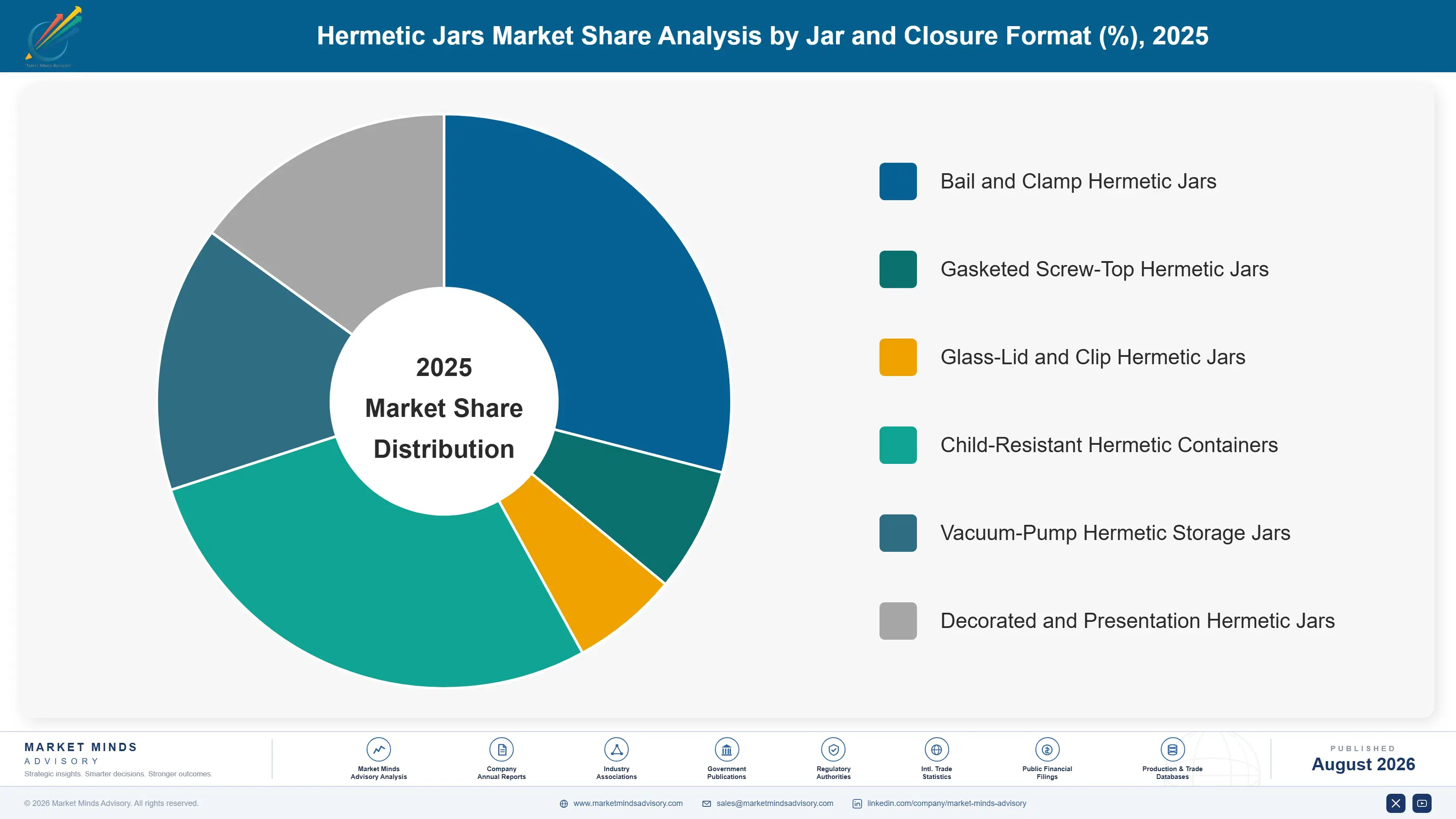
Segmentation follows jar and closure format, because the sealing system determines the price, the buyer and the application in a way the glass body never does. A bail jar and a certified child-resistant container may hold identical volumes of glass and sell into entirely unrelated commercial worlds at very different prices. The seal decides the buyer.
hermetic-jars-market-market-share-analysis-1787307930834

Child-Resistant Hermetic Containers

Certified child-resistant hermetic containers compound at 8.4%, exactly 1.50 times the market rate, on a requirement that only regulation could have created. Cannabis products degrade with oxygen and humidity exposure, so they need a genuine hermetic seal, and United States state rules and Canadian federal regulation simultaneously require child-resistant closure certification. Standard bail jars fail the second test and standard child-resistant plastic containers fail the first. Meeting both demands a closure engineered to defeat a determined toddler while still compressing a gasket evenly, which is a harder mechanical problem than either requirement alone. Unit values run several times a standard jar, certification testing is prescribed and unforgiving, and each newly legalising jurisdiction adds demand.
CAGR 8.4%

Vacuum-Pump Hermetic Storage Jars

Vacuum-pump formats grow at 7.6% by adding active air removal to a passive seal. A valve in the lid allows a hand or powered pump to draw down the headspace, which slows oxidation considerably for coffee, tea, spices, nuts and dried goods where staling rather than spoilage is the concern. Speciality coffee has been the clearest adoption driver, since freshly roasted beans degrade measurably within weeks and enthusiast buyers can taste the difference. The complication is that the valve is another failure point, and a jar that will not hold vacuum generates complaints a passive seal never would. Unit prices run well above bail equivalents, and the pump itself provides a further accessory line.
CAGR 7.6%
Full segment breakdown across 6 segments available in the complete report.

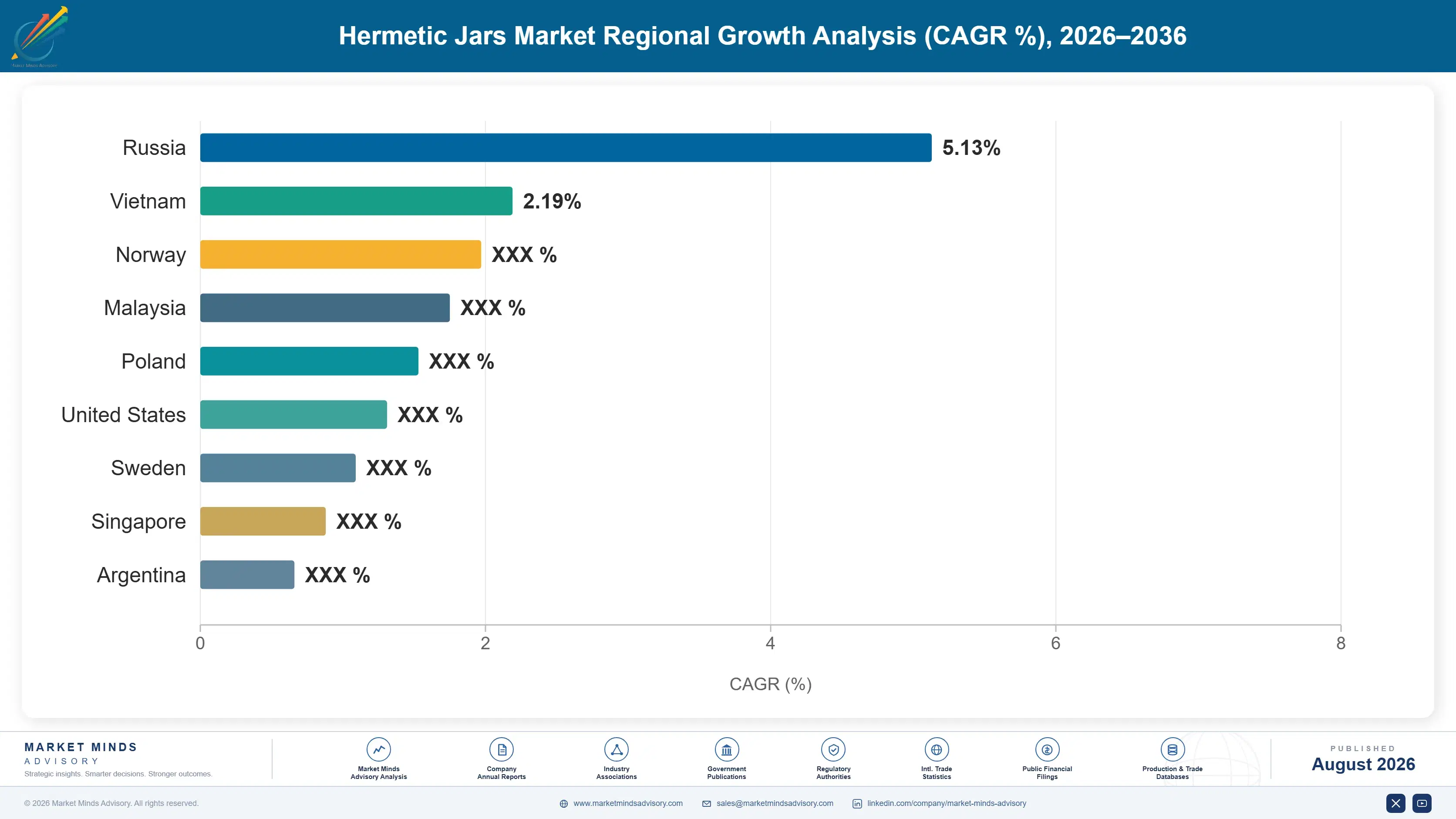
Regional Architecture and Country Demand Map

Production and consumption sit together because glass cannot travel far economically. Preserving and food storage traditions rather than income levels determine where demand concentrates, and those traditions differ enough between regions to produce quite distinct format preferences. Food culture rather than income is the map worth reading here.

East Asia

East Asia holds 27% of global demand, the largest regional share, built on preserved food traditions that predate the format itself. Chinese households store pickled vegetables, fermented bean pastes, dried goods and traditional medicine ingredients in glass at a scale no other region approaches, and domestic producers including Wuhan Sunshine Glassware and Xuzhou Ruisheng Glass supply that volume cheaply. Japan contributes an unusually concentrated seasonal spike: plum wine making moves millions of large hermetic jars within a few weeks each June, and that single application supports a dedicated product line. Korean fermentation practice adds further volume. Regional growth of 6.6% reflects rising disposable income moving households from plastic and ceramic storage into glass rather than any new application.
Share: 27% | CAGR: 6.6% (2026 to 2036)

Western Europe

Western Europe accounts for 25% of demand and is the format's historical home, which shows in both brand strength and consumer familiarity. The bail and clamp jar originated here, and Bormioli Rocco in Italy, Le Parfait in France and Weck in Germany hold home market positions built over generations rather than through marketing. Home preserving remains embedded in French, Italian and German food culture, and the season is genuinely observed rather than merely marketed. Growth of 4.2% is the slowest of the seven regions, reflecting a mature installed base of jars in households that already own them and where the recurring purchase is a gasket rather than a jar. Energy costs since 2022 have pressured regional furnace economics severely.
Share: 25% | CAGR: 4.2% (2026 to 2036)
Regional intelligence for 5 additional markets available in the complete report: North America, South Asia and Pacific, Latin America, Middle East and Africa, Eastern Europe. Contact sales@marketmindsadvisory.com.
hermetic-jars-market-country-cagr-analysis-1787307931797

Making Money From a Durable Product

Selling something that lasts fifty years is a poor business unless part of it wears out. The commercial positions worth holding here all attach a recurring purchase, a certification barrier or a presentation premium to what is otherwise a piece of commodity glass. Four do exactly that. None of them is about the glass.

Own the Replacement Gasket Stream Under Your Own Brand

Gaskets fail after roughly 2.4 years while the jar lasts indefinitely, and replacement seals carry gross margins near three times the jar itself. Most producers ignore this entirely, leaving generic suppliers to serve their own installed base with imperfect fits while the brand absorbs the resulting complaints. Branding, packaging and retailing gaskets against a producer's own jar catalogue converts a one-time durable sale into a purchase repeating every two or three years for decades. The investment is packaging and distribution rather than manufacturing, since the moulding itself is straightforward. Channel work is the whole requirement.
Market Impact: Gasket margins running 3 times the

Certify Child-Resistant Closures for Regulated Markets

Cannabis regulation demands both child-resistant certification and genuine preservation, and no standard product satisfies both requirements at once. Engineering a closure that defeats a determined toddler while compressing a gasket evenly is harder than either problem alone, and certification testing is prescribed and unforgiving of failure. That difficulty is the barrier. Certified containers compound at 8.4% and price at several times a standard jar, and each newly legalising jurisdiction opens a fresh compliance-driven pool that ordinary housewares producers cannot serve without completing the same certification work. Certification takes months to complete.
Market Impact: Certified formats now compounding a

Build Presentation Formats for Visible Kitchen Storage

Open shelving and decanted pantries moved jars from cupboard to display, and a jar looked at daily is judged on form and glass clarity rather than sealing performance alone. Decorated and shaped presentation formats grow at 6.0% and carry unit prices roughly 40 to 65% above functional equivalents. Plastic and stainless containers perform adequately for dry goods and lose this comparison completely, because nobody displays them by choice. The requirement is design and mould investment rather than any technical capability, which makes it accessible to producers already running the furnaces.
Market Impact: Presentation formats priced 40 to 6

Fill Furnace Capacity Through the Off-Season Deliberately

Some 58% of volume falls in the preserving season while the furnace runs continuously for twelve years and cannot be throttled. That mismatch is the defining problem of the business, and the 2022 correction showed how badly it punishes a producer caught with capacity and no orders. Contract filling work, export sales into counter-seasonal hemispheres and industrial jar production all absorb off-season pull. Producers managing this deliberately hold utilisation roughly 14 points above those treating the season as a given, which flows almost entirely to margin. Speculative inventory is the alternative, and it carries costs deliberate scheduling avoids.
Market Impact: Deliberate scheduling lifting utili

Who Controls the Margin Pool

The five largest producers hold 34% of the market measured on hermetic jar and closure revenue, the basis applied consistently through this section. Fragmentation reflects freight economics rather than any absence of scale advantage in manufacturing. Bormioli Rocco and Newell Brands lead, each dominant in its home region and comparatively weak outside it. Neither has meaningful presence in the other's home region.
Competition operates on three dimensions. Regional furnace proximity decides who can serve a market at all, since glass beyond 600 kilometres carries freight and breakage that erase the margin. Brand familiarity in home preserving carries unusual weight, because households buy the jar their family used. And closure engineering decides participation in certified and vacuum formats where the seal is the product. Manufacturing scale confers surprisingly little on its own.

Two pressures will reshape position. Chinese producers have built extensive capacity and compete aggressively wherever freight permits, particularly in Southeast Asia and the Middle East. Against that, certified child-resistant formats reward closure engineering that commodity glassmakers do not hold. Rankings will move toward whoever pairs regional furnace coverage with genuine sealing system capability. Very few hold both today.
hermetic-jars-market-company-positioning-matrix-1787307932694

Competitive Moat and Risk Dimensions

BORMIOLI ROCCO

Moat: Heritage brand and format origin

The company's Fido range is close to synonymous with the bail jar across southern Europe, and in home preserving that recognition carries genuine weight because households buy what their families used. Italian and wider European furnace coverage puts production inside the freight radius of the region where the format originated and where preserving practice is most deeply established.
BORMIOLI ROCCO

Risk: European energy cost exposure

Energy is 27% of production cost and European industrial gas prices have run well above other regions since 2022, with a furnace that cannot be throttled to manage the exposure. Competing against Chinese and Turkish producers in export markets has become considerably harder as a result, and the home market advantage does not extend to geographies reached by ship.
NEWELL BRANDS

Moat: Home canning category ownership

The Ball and Kerr brands hold a position in North American home canning that goes beyond market share into category definition, with recipes, guidance and generational familiarity attached to the names. That position is reinforced by retail distribution depth in a seasonal category where shelf presence during a short window determines much of the annual outcome.
NEWELL BRANDS

Risk: Limited hermetic format breadth

The strength sits in two-piece screw band canning rather than in gasketed bail, vacuum or certified child-resistant formats where growth is concentrated. Cannabis packaging and presentation storage both require closure engineering distinct from the canning heritage, and specialist competitors have moved into those segments while the core position remains tied to a mature application.

Players Tracked

Prominent Players

Bormioli Rocco
Newell Brands
Rayware Group
Weck Glaswerke
Borgonovo

Other Key Players

Ardagh Group
Verallia
O-I Glass
Vidrala
Anchor Hocking
Libbey
Ocean Glass
Wuhan Sunshine Glassware
Xuzhou Ruisheng Glass
Shandong Huapeng Glass
Pasabahce
Stolzle Glass Group
Nihon Yamamura Glass
Toyo Sasaki Glass
Cerve

Recent Developments

FEBRUARY 2025

Further cannabis jurisdictions adopt child-resistant packaging requirements

Additional United States states brought child-resistant packaging requirements into force for cannabis products, extending demand for certified hermetic containers that also preserve product quality. These were regulatory implementations rather than commercial developments, and each adds a compliance-driven pool ordinary housewares producers cannot serve. Certification testing is prescribed.
Signal: Regulation rather than consumer preference
JUNE 2025

European furnace rebuilds deferred against elevated energy costs

Several European glass container producers extended furnace campaigns beyond typical durations rather than committing capital to rebuilds at current energy prices. These were operating decisions rather than acquisitions or closures, and they reduce regional flexibility to respond to demand recovery when it arrives. The decision cannot be reversed quickly.
Signal: Deferring a rebuild trades future capacity
SEPTEMBER 2025

Speciality coffee retail expands vacuum storage jar distribution

Speciality coffee retailers widened distribution of vacuum-pump hermetic storage jars alongside bean sales, positioning them as a freshness accessory rather than a housewares purchase. This reflects channel strategy rather than any corporate transaction, and it reaches buyers who never enter a housewares aisle. Freshness rather than storage is the argument.
Signal: Selling a jar beside the product it protec

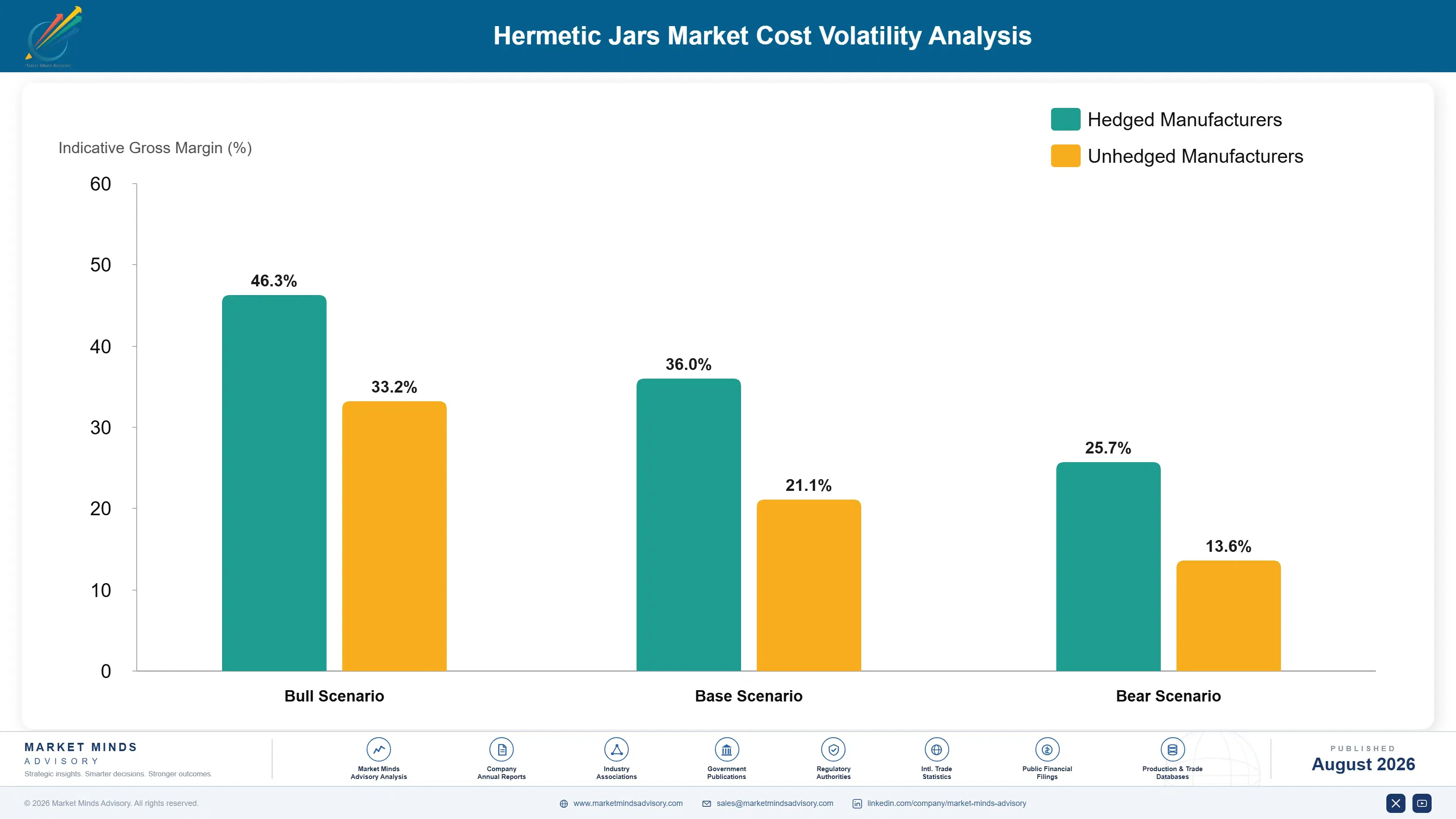
Sand, Energy and an Unstoppable Furnace

Energy dominates. Natural gas and electricity for melting and forming account for roughly 27% of cost of goods, purchased regionally and consumed continuously whether the furnace is producing to order or to stock. Raw batch materials including silica sand, soda ash and limestone run around 14%, sourced locally because they are bulky and cheap. Closure components, gaskets, packaging and labour make up the balance.
European natural gas disruption from 2022 raised melting costs sharply, and International Energy Agency reporting on that period documents the underlying movement. Glass container producers could not reduce consumption because a tank cannot be throttled without ending its campaign, so the increase flowed straight to cost. Company annual reports covering glass container segments disclose the resulting margin compression, and several producers deferred furnace rebuilds rather than commit capital at those prices.

Exposure varies sharply by energy source and region rather than by producer scale. A European producer on spot gas carried the full 2022 movement with no operational lever available. Turkish, Chinese and North American producers held materially lower energy costs through the same period and gained export competitiveness they had not previously enjoyed. Recycled cullet content is the one genuine mitigation available.
hermetic-jars-market-cost-volatility-analysis-1787307933117

Raise recycled cullet content in the batch mix

Cullet melts at lower temperature than raw batch, so each additional percentage point directly reduces furnace energy consumption. The constraint is supply of colour-sorted, contamination-free cullet at the quality clear hermetic jars require. Producers contracting directly with collection systems rather than buying on the open market secure both consistency and price stability, and the benefit compounds across a whole campaign.

Contract energy on multi-year terms across the furnace campaign

A furnace commits a producer to twelve years of continuous consumption, which is a genuinely unusual profile to take to an energy market and one that suits long-term contracting far better than spot purchasing. Producers that contracted ahead of 2022 fared dramatically better than those exposed to spot pricing, and the lesson has reshaped procurement practice across the industry.

Schedule off-season production against contract and export demand

The furnace runs continuously while 58% of demand falls in one season, so off-season output must go somewhere. Contract filling work, industrial jar production and counter-seasonal export sales all absorb it. Producers planning this deliberately rather than building speculative inventory avoid the working capital and obsolescence costs that inventory accumulation carries. Planning beats accumulation every time.

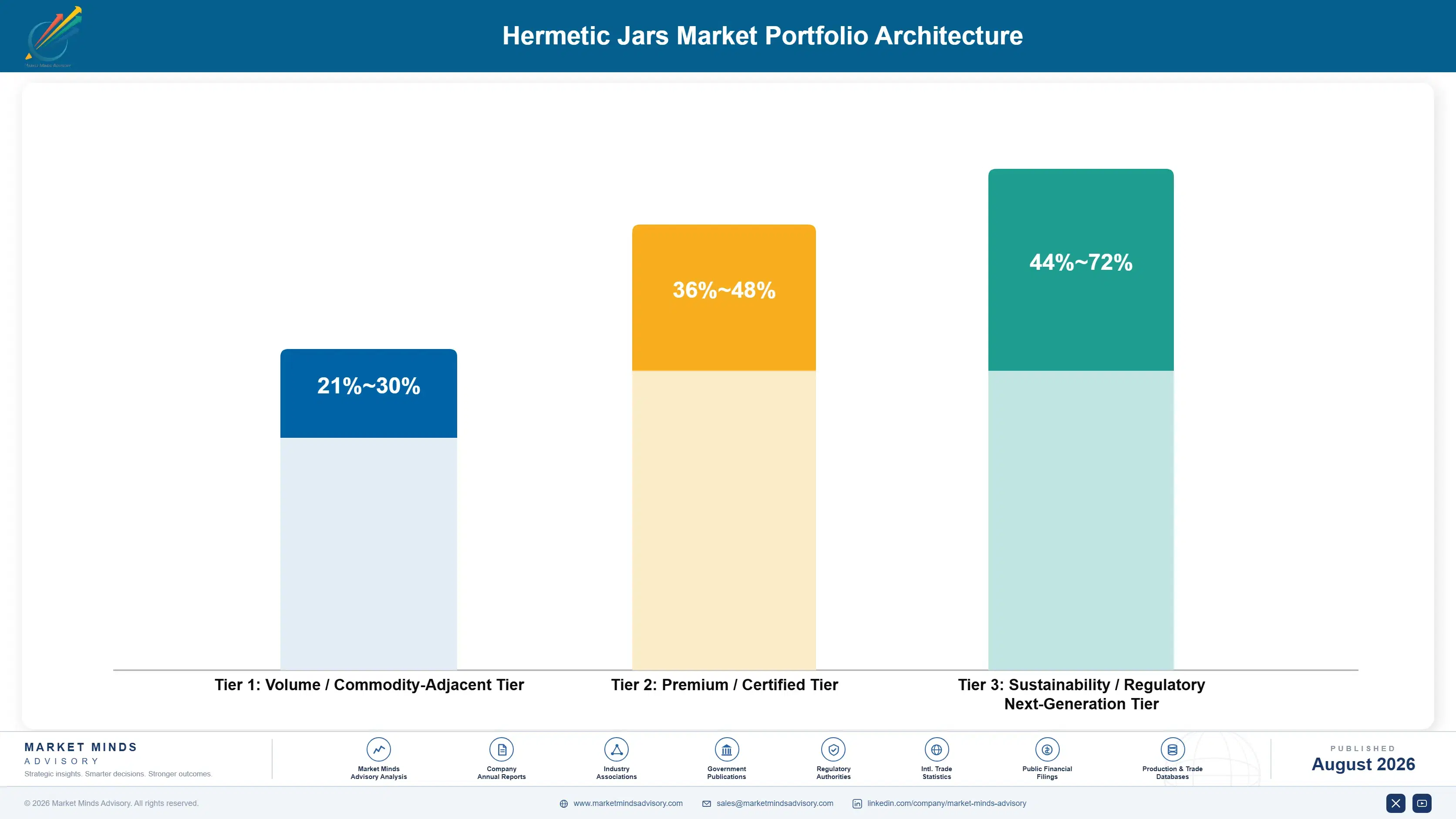
Portfolio Architecture for Margin Defence

The portfolio splits on whether the buyer is purchasing glass or purchasing a seal. Standard bail and screw-top jars are commodity glass sold on shelf price, and regional producers compete hard wherever freight permits. Vacuum and presentation formats add engineering or design content that raises the unit value materially. Certified child-resistant containers add a regulatory barrier that commodity glassmakers cannot cross without completing prescribed testing. What the buyer is purchasing draws
The tension is that commodity formats fill the furnace, and the furnace cannot be turned down. A producer that chases only premium and certified work finds itself pulling glass it has no orders for during eleven months of the year. The successful operators run commodity volume deliberately as furnace utilisation and treat the certified, vacuum and gasket streams as the margin layer sitting on top. Utilisation and margin are separate objectives here.

High-value pools concentrate where a regulation, a design brief or a wear cycle sets the purchase. Certified cannabis containers, presentation formats and replacement gaskets all qualify, and the gasket stream is the one most producers still leave entirely on the table. The gasket omission is the most striking thing about the category.

Volume / Commodity-Adjacent Tier

Standard bail and clamp jars and gasketed screw-top formats sold through housewares and grocery retail on shelf price. Regional producers compete hard wherever freight permits, and the glass body itself carries no meaningful differentiation between suppliers.
Gross Margin: 21-30%

Premium / Certified Tier

Vacuum-pump storage jars, glass-lid clip formats and decorated presentation ranges where closure engineering or design content raises unit value substantially above functional equivalents sold in the same aisle. Design and closure investment rather than glassmaking capability separates participants.
Gross Margin: 36-48%

Sustainability / Regulatory / Next-Generation Tier

Certified child-resistant hermetic containers for regulated cannabis markets, plus branded replacement gasket programmes. The wide margin range reflects the gap between certification-protected container pricing and the very high margins on moulded sealing components.
Gross Margin: 44-72%
hermetic-jars-market-portfolio-architecture-1787307934018

High-value Sub-segments and Strategic Watch-out

Certified Child-Resistant Containers

Compounding at 8.4% on a requirement combining child-resistant certification with genuine preservation, which no standard product satisfies. Prescribed certification testing and closure engineering keep commodity glassmakers out, and each newly legalising jurisdiction adds another demand pool entirely. Unit values run several times a standard jar.
Gross Margin: 48-66%

Branded Replacement Gaskets

The stream most producers ignore completely. Seals fail after roughly 2.4 years while jars last indefinitely, and replacement gaskets carry margins near three times the jar, currently served largely by generic suppliers with imperfect fits and no brand accountability. The brand absorbs the resulting complaints regardless.
Gross Margin: 58-72%

Standard Bail and Clamp Jars

The volume core at 5.2%, competing on shelf price against regional producers and carrying the furnace utilisation that everything else depends upon. Run deliberately for capacity absorption rather than for margin, which it has never reliably delivered. Abandoning it leaves the furnace with nothing to pull.
Gross Margin: 21-30%

Presentation and Decorated Formats

Growing at 6.0% as open shelving moves jars from cupboard to display, where form and glass clarity matter more than sealing performance. Unit prices run 40 to 65% above functional equivalents, and the investment is mould and design rather than technology. Plastic loses this comparison outright.
Gross Margin: 38-52%

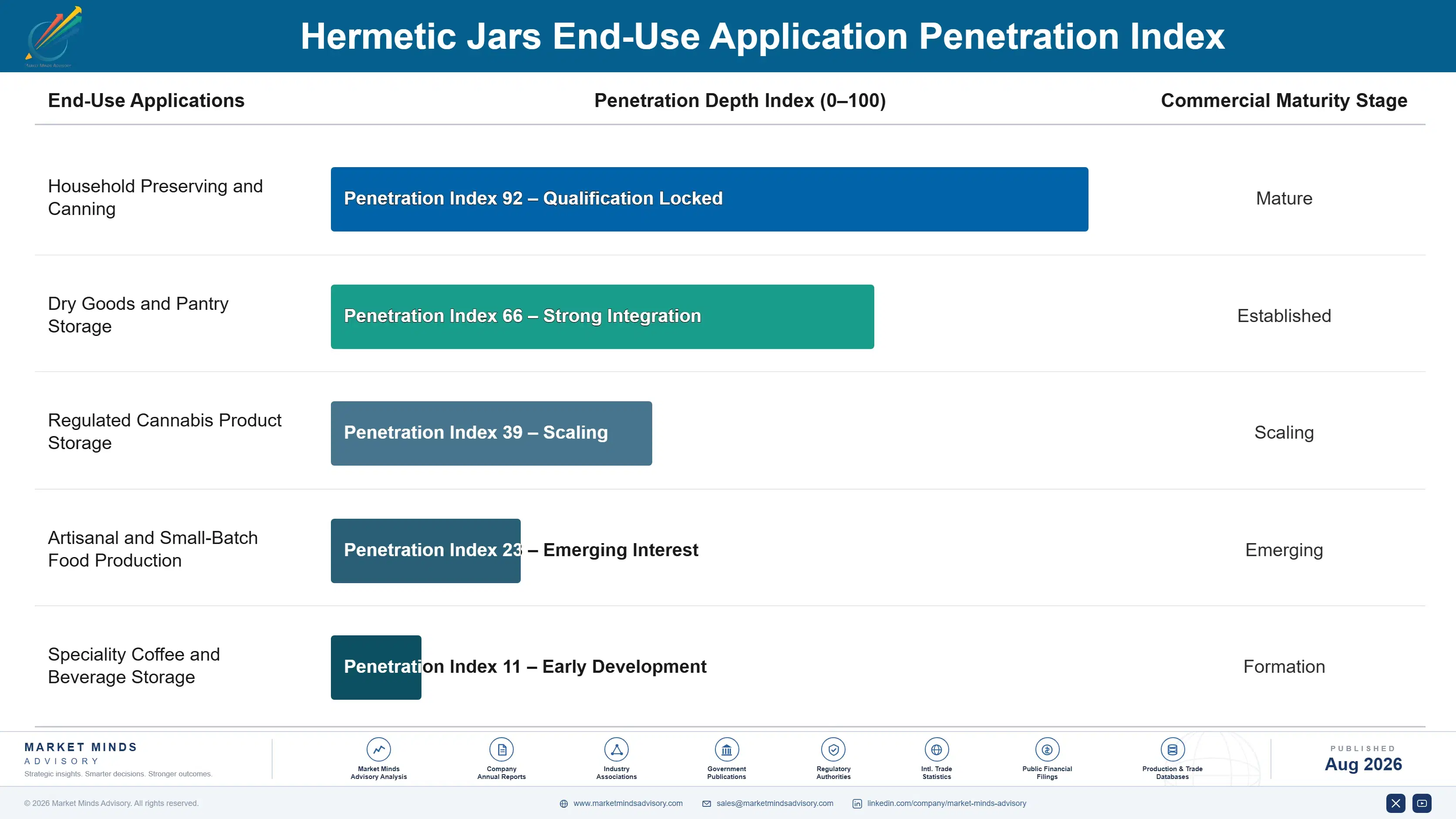
Selling Into a Season That Repeats

This is annuity revenue hidden inside a durable goods business, though most producers do not collect it. A household that buys hermetic jars keeps them for decades and returns every two or three years for gaskets, and the installed jar population across Europe alone represents an enormous replacement seal opportunity that generic suppliers currently serve. Producers who brand and distribute their own gaskets convert a single purchase into a relationship measured in decades rather than seasons.
Depth varies by household practice rather than by income. Committed preservers buy deepest and repeatedly, treating jars as equipment and replacing seals reliably. Cannabis operators buy on regulatory specification with no discretion at all. Presentation buyers purchase in sets, infrequently, and select on appearance. Occasional preservers, the largest group by count, buy in response to food price pressure and frequently never return.

The buyer profile has broadened. Preserving was once passed down within families and the purchase followed familiarity. Increasingly it is taken up through online instruction by households with no family tradition, and that buyer selects on reviews and appearance rather than on the brand a grandparent used.
hermetic-jars-market-end-use-penetration-index-1787307934858

Where Glass Producers Should Look

These are among the four positions where our research anticipates prominent divergence between winners and laggards over the coming forecast period. Each is grounded in the demand model, the regulatory perimeter, and the announced capacity pipeline.
01 / WEAR COMPONENT CAPTURE

The gasket is the only part generating repeat revenue

Seals lose performance after roughly 2.4 years while the glass body lasts indefinitely, and replacement gaskets carry margins near three times the jar they fit. Most producers ignore that stream entirely, leaving generic suppliers to serve their own installed base with imperfect fits while the brand quietly absorbs the resulting complaints. Branding and distributing gaskets requires packaging and channel work rather than any new manufacturing investment at all, and it converts a one-time durable sale into decades of repeat purchase.
02 / REGULATORY BARRIER POSITIONING

Cannabis certification created the only new demand pool in the category

Regulated cannabis markets require both child-resistant closure certification and genuine oxygen and humidity exclusion, and no standard product on the market satisfies both of those requirements simultaneously. Engineering a closure that defeats a determined toddler while still compressing a gasket evenly is harder than either problem taken alone, and the certification testing is prescribed and unforgiving of failure. Certified containers consequently compound at 8.4% and price at several times a standard jar, with each newly legalising jurisdiction adding a fresh pool of compliance-driven volume.
03 / FURNACE UTILISATION DISCIPLINE

A tank that cannot stop punishes anyone who plans around the season

Some 58% of annual demand falls inside the preserving season, while a glass furnace runs continuously for around twelve years and cannot be throttled without ending its campaign early. The 2022 demand correction showed exactly how badly that mismatch punishes a producer caught unprepared with capacity and no orders. Contract filling work, counter-seasonal export sales and industrial jar production all absorb off-season pull, and producers that manage all of this deliberately hold utilisation roughly 14 points above those who simply do not.
04 / DISPLAY VALUE CAPTURE

A jar on open shelving is judged on appearance, not on sealing

Open shelving and decanted pantries moved jars out of the cupboard and onto display, which changed the basis of the purchase entirely. A jar that is looked at every day gets assessed on form, glass clarity and closure finish rather than on whether it actually seals reliably. Decorated presentation formats grow at 6.0% and price roughly 40 to 65% above their functional equivalents, while plastic and stainless alternatives lose that comparison outright, because nobody ever chooses to put them on display.

Engagement Snapshot From the Field

A live engagement with an industry participant carrying material or product regulatory and market exposure ahead of a defining policy shift, showing how our research translates into a defensible multi-year portfolio strategy.
MARKET MINDS ADVISORY · CLIENT ENGAGEMENT SUMMARY
Hermetic Jars Producer Strategic Portfolio Review and Transition Roadmap 2026·Investment Scenario on Hermetic Jars Exposure Evaluation 2025-26
CLIENT PROFILE
A southern European glass container producer operating three furnaces with roughly EUR 310 million in revenue (client-reported, unverified by MMA), of which hermetic jars represented about 22% (client-reported, unverified by MMA). The remainder covered food and beverage containers filled by industrial customers. Hermetic jar sales ran through housewares retail across five national markets with a substantial installed household jar population built over decades.
STRATEGIC CHALLENGE
Energy costs had compressed margins for three consecutive years and the 2022 demand correction had left the furnaces pulling glass against weak orders. Management proposed cutting the hermetic jar range to its highest-volume formats. The commercial team argued that the range was not the problem and that the business had never sold anything to the households already owning its jars.
MMA APPROACH
MMA estimated the installed household population of the client's jars across the five markets from twenty years of shipment data and attrition assumptions, then sized the replacement gasket opportunity against observed seal service life. Off-season furnace utilisation was modelled against contract filling and counter-seasonal export options the client had not previously priced.
KEY FINDINGS
  1. The installed household population of the client's jars was large enough that replacement gaskets alone represented a revenue opportunity comparable to a fifth of current hermetic jar sales, entirely uncontested by the client.
  2. Generic gaskets sold through the same retailers fitted the client's jars imperfectly, and retailer complaint data attributed the resulting seal failures to the jar brand rather than to the seal supplier.
  3. Off-season furnace utilisation ran 19 points below season, and neither contract filling nor counter-seasonal export had ever been priced as a deliberate option by the commercial team.
  4. Presentation formats already in the range carried gross margins 17 points above standard bail jars but received no dedicated merchandising and were shelved alongside functional storage.
CLIENT PROFILE
A southern European glass container producer operating three furnaces with roughly EUR 310 million in revenue (client-reported, unverified by MMA), of which hermetic jars represented about 22% (client-reported, unverified by MMA). The remainder covered food and beverage containers filled by industrial customers. Hermetic jar sales ran through housewares retail across five national markets with a substantial installed household jar population built over decades.
STRATEGIC CHALLENGE
Energy costs had compressed margins for three consecutive years and the 2022 demand correction had left the furnaces pulling glass against weak orders. Management proposed cutting the hermetic jar range to its highest-volume formats. The commercial team argued that the range was not the problem and that the business had never sold anything to the households already owning its jars.
MMA APPROACH
MMA estimated the installed household population of the client's jars across the five markets from twenty years of shipment data and attrition assumptions, then sized the replacement gasket opportunity against observed seal service life. Off-season furnace utilisation was modelled against contract filling and counter-seasonal export options the client had not previously priced.
KEY FINDINGS
  1. The installed household population of the client's jars was large enough that replacement gaskets alone represented a revenue opportunity comparable to a fifth of current hermetic jar sales, entirely uncontested by the client.
  2. Generic gaskets sold through the same retailers fitted the client's jars imperfectly, and retailer complaint data attributed the resulting seal failures to the jar brand rather than to the seal supplier.
  3. Off-season furnace utilisation ran 19 points below season, and neither contract filling nor counter-seasonal export had ever been priced as a deliberate option by the commercial team.
  4. Presentation formats already in the range carried gross margins 17 points above standard bail jars but received no dedicated merchandising and were shelved alongside functional storage.
RECOMMENDED STRATEGY
Phase 1: Phase 1 (months 1 to 7): Launch a branded replacement gasket programme through existing housewares retail accounts covering the full installed jar catalogue. Phase 2: Phase 2 (months 7 to 18): Price and pursue off-season contract filling and counter-seasonal export to lift furnace utilisation outside the preserving window. Phase 3: Phase 3 (months 18 to 30): Merchandise presentation formats separately from functional storage and extend the decorated range across further sizes.
OUTCOME
The range reduction was cancelled. Branded gaskets reached roughly EUR 9 million of annual revenue within two years at gross margins near three times the jars themselves (client-reported, unverified by MMA). Off-season furnace utilisation rose by 12 points, and blended hermetic jar margin improved by approximately five points (client-reported, unverified by MMA).

Frequently Asked Questions

Foundational context covering the market sizes, CAGR, scope, country, region and competition that inform every finding below. This section is provided to cover basics and most often pre-purchase conversations, answered from the MMA Primary Research Dataset.

What is the current size of the Hermetic Jars Market?

The global market was worth USD 2.28 billion in 2025, reaching USD 2.41 billion in 2026. East Asia holds the largest regional share at 27% of demand.

How large will the Hermetic Jars Market be by 2036?

MMA forecasts USD 4.15 billion by 2036, an expansion multiple of 1.72 times the 2026 base. That represents roughly USD 1.74 billion of incremental value.

What is the CAGR for the Hermetic Jars Market 2026 to 2036?

The base case compounds at 5.6% annually, with a bull case of 6.8% and a bear case of 4.4%. Historical growth from 2020 to 2025 ran at 4.6%.

Which segment is growing fastest?

Child-resistant hermetic containers compound at 8.4%, exactly 1.50 times the market rate. Regulated cannabis markets need certified closures that simultaneously exclude oxygen and humidity from the product.

Who are the major companies in the Hermetic Jars Market?

Bormioli Rocco, Newell Brands, Rayware Group, Weck Glaswerke and Borgonovo hold a combined 34% of the market. Each is dominant in its home region and comparatively weak outside it.

Which country is growing fastest?

India compounds at 8.2%, ahead of every other national market. Household pickle and chutney preparation is shifting from traditional ceramic and plastic vessels into glass.

Report Segmentation Architecture

The full report scope spans multiple orthogonal segmentation dimensions, with cross-tabulated demand data provided for each dimension pair. Coverage extends further to regional breakdowns, trend trajectories, and the competitive detail needed to support segment-level decision-making.

By Jar and Closure Format

  • Bail and Clamp Hermetic Jars
  • Gasketed Screw-Top Hermetic Jars
  • Glass-Lid and Clip Hermetic Jars
  • Child-Resistant Hermetic Containers
  • Vacuum-Pump Hermetic Storage Jars
  • Decorated and Presentation Hermetic Jars

By End-Use Application

  • Household Preserving and Canning
  • Dry Goods and Pantry Storage
  • Regulated Cannabis Product Storage
  • Artisanal and Small-Batch Food Production
  • Speciality Coffee and Beverage Storage

By Commercial Dimension

  • Housewares and Grocery Retail
  • Direct-to-Consumer and Online Channels
  • Speciality and Category Retail
  • Business and Regulated Customer Supply

By Region

  • North America
  • Western Europe
  • East Asia
  • South Asia and Pacific
  • Latin America
  • Middle East and Africa
  • Eastern Europe

Scope, Methodology, and Coverage

Every figure in this report is reproducible from documented input assumptions. The scope below maps the historical period, the forecast horizon, the segmentation dimensions, and the countries covered, alongside the underlying primary and qualitative methodology.
Historical Period
2020 to 2025
Forecast Period
2026 to 2036
Base Year
2025 (USD billions; MMA Primary Research Dataset, August 2026)
Market Definition
The market covers glass jars incorporating a gasketed airtight closure system, spanning bail and clamp jars, gasketed screw-top formats, glass-lid clip jars, certified child-resistant hermetic containers, vacuum-pump storage jars and decorated presentation formats, together with replacement gaskets and sealing components sold for those jars. Plain glass jars without a sealing gasket, commercially filled food packaging, plastic storage containers, ceramic fermentation vessels and metal storage tins are excluded. Sizing is measured at producer revenue in current prices.
Quantitative Units
USD billions (current prices); jar units and replacement gasket units where applicable
Segmentation Dimensions
By Jar and Closure Format; By End-Use Application; By Commercial Dimension; By Region
Regions Covered
North America, Western Europe, East Asia, South Asia and Pacific, Latin America, Middle East and Africa, Eastern Europe
Countries Covered
USA, China, Germany, France, UK, Japan, South Korea, India, Australia, Canada, Brazil, Mexico, Indonesia, Vietnam, Thailand, Malaysia, UAE, Saudi Arabia, South Africa, Nigeria, Turkey, Poland, Netherlands, Italy, Spain, Sweden, Switzerland, Argentina, Colombia, Singapore, and additional markets relevant to this sector
Key Companies Profiled
Bormioli Rocco, Newell Brands, Rayware Group, Weck Glaswerke, Borgonovo, Ardagh Group, Verallia, O-I Glass, Vidrala, Anchor Hocking, Libbey, Ocean Glass, Wuhan Sunshine Glassware, Xuzhou Ruisheng Glass, Shandong Huapeng Glass, Pasabahce, Stolzle Glass Group, Nihon Yamamura Glass, Toyo Sasaki Glass, Cerve
Quantitative Methodology
Primary survey, n=3,800 respondents, Q4 2025, six countries; demand-side model with trade association cross-validation
Qualitative Methodology
47 expert interviews, Q4 2025; applied to validate demand model assumptions, identify emerging dynamics, and assess competitive positioning
Report Format
PDF and XLSX data workbook (Word format preview document)
Publisher
Market Minds Advisory
Report Code
MMA-2026-PAC-682
Published
August 2026
Contact
sales@marketmindsadvisory.com | www.marketmindsadvisory.com

Purchase the full Hermetic Jars Market Report (2026 to 2036).

The full report sizes hermetic jars across six formats, three commercial dimensions and seven regions, with annual forecasts to 2036 under base, bull and bear scenarios. Installed household jar populations are estimated by market from shipment history and attrition, producing a replacement gasket opportunity that most producers have never quantified for their own brands. Furnace utilisation economics are modelled against seasonal demand concentration and off-season absorption options. Cannabis packaging certification requirements are compared across jurisdictions. Twenty producers are profiled on a consistent hermetic jar and closure revenue basis.
Installed household jar populations estimated by market and brand
Replacement gasket opportunity sized against observed seal service life
Furnace utilisation modelled against seasonal demand concentration
Cannabis closure certification requirements compared across jurisdictions
Regional energy cost exposure quantified by producer and fuel source
Presentation format pricing benchmarked against functional equivalents

Built For The People Who Decide

From boardroom strategy to bench-side execution, this report is read cover-to-cover by leaders shaping the next decade of their industry, turning demand scenarios, market dynamics and valuation benchmarks into decisions.
CXOs/ Presidents/ VPs/ Managers
M&A and Corporate Development
Strategy Teams and R&D Heads
Procurement and Product Directors
Regulatory and Compliance Leaders
Investor Relations and Equity Analysts