Market Minds Advisory
Herbicides Market

Herbicides Market: Trends and Forecast 2026 to 2036

Herbicide-resistant weed populations and Brazil's expanding soybean-corn-cotton rotation are pushing growers toward auxin-type and HPPD-inhibitor chemistries, even as European regulatory restriction on legacy active ingredients reshapes registration pathways across major agricultural export markets.

Lead Analyst

Bilal Shaikh

Published

September 2026

Make Smarter Decisions with Customized Research Insights

Request a free sample report and evaluate market opportunities, growth trends, and competitive dynamics relevant to your business needs.

2025 MARKET VALUE$32.5BMarket Size 2025
2036 FORECAST VALUE$51.1BBase Case , 2026 to 2036
CAGR 2026 TO 20364.2 %Bull 5.3% / Bear 3.1%
INCREMENTAL OPPORTUNITY$17.2BNet 10- year value creation
EXPANSION MULTIPLE1.51x2036 value over 2026 base
Strategic Levers
M&A Pipeline
Regional Outlook
Country Rankings
Competitive Intelligence
Segmental Deep-dive
Call-Us : 91 93563 13602

Executive Snapshot and Market Trajectory

Herbicide demand is shifting toward auxin-type and HPPD-inhibitor chemistries as glyphosate-resistant weed populations spread across major row-crop growing regions worldwide, even as legacy glyphosate volume continues anchoring most growers' baseline weed control programmes across the vast majority of global cultivated acreage today.
Commercial forces now split the market between growers managing resistance through chemistry rotation and stacked herbicide-tolerant trait systems and growers in regions with slower trait adoption still relying primarily on conventional programmes. Auxin-type herbicides are the fastest-growing chemistry class, expanding as dicamba and 2,4-D-tolerant soybean and cotton varieties spread across major growing regions. Latin America and North America together account for most global demand, split between Brazil's row-crop expansion and mature US corn-soybean acreage.
Competitive intensity concentrates among a handful of large agrochemical majors holding the registration portfolios and active ingredient manufacturing scale required to serve global row-crop markets, leaving generic post-patent formulations more fragmented across smaller regional producers and formulators. Regulatory divergence between regions adds a further layer of complexity, as the European Union's restrictions on several active ingredients contrast sharply with continued registration renewal across the Americas and most of Asia.
Market Definition
The Herbicides Market covers synthetic and biological crop protection chemicals formulated to control weeds in row-crop, specialty crop, and turf and ornamental applications. It excludes fungicides, insecticides, and adjuvant or surfactant products sold separately from an active herbicidal ingredient.
Base Year Value
$32.5B in 2025 (MMA Primary Research Dataset, August 2026)
Forecast Period
2026 to 2036, eleven discrete annual values
CAGR
4.2% base case. Bull 5.3%. Bear 3.1%.
Fastest Growth Segment
Auxin-Type Herbicides (2,4-D, Dicamba): 5.8% CAGR
Fastest Growth Country
India: 6.5% CAGR
Fastest Growth Region
South Asia and Pacific: 6.2% CAGR
Largest Region
Latin America: 29% of 2025 global value
Market Leaders
Bayer Crop Science, Corteva Agriscience, Syngenta, BASF, FMC Corporation (MMA Analysis, 2025).
Primary Survey
n=3,800 procurement and R&D decision-makers, Q4 2025, six countries
Methodology
Demand-side build-up, cross-validated against public data, 47 expert interviews

Herbicides Market Forecast Scenarios

herbicides-market-size-forecast-scenario-1787553011729
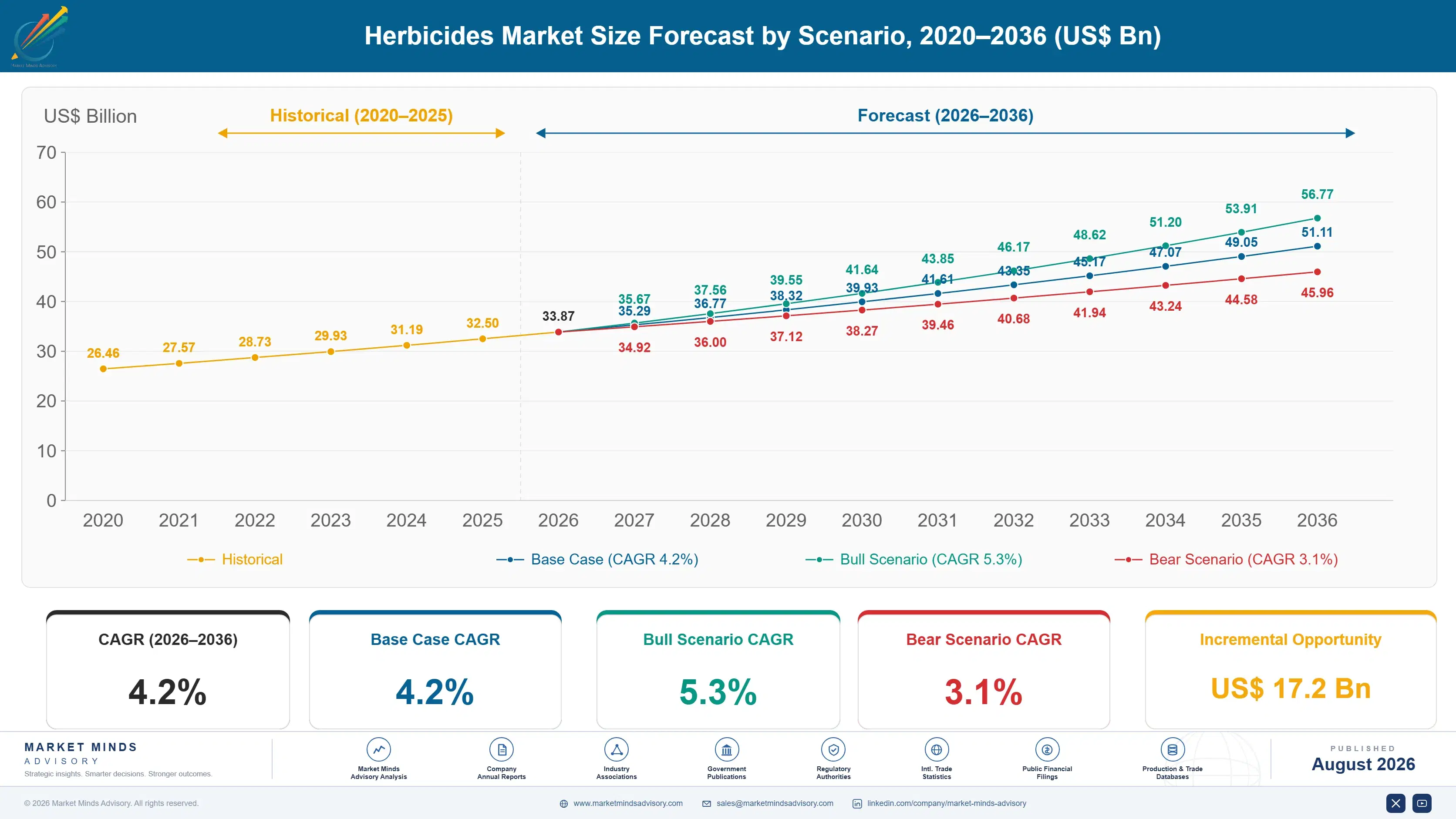
The herbicides market grew at an estimated 3.9% annually between 2020 and 2025, supported by steady row-crop planted acreage and gradually expanding herbicide-tolerant trait adoption across Latin America and North America. Growth remained modest as commodity crop prices softened in several years, tempering grower input spending despite continued weed resistance management pressure across most growing regions.
The base case assumes 4.2% annual growth through 2036, driven by three commercial mechanisms: expanding Brazilian and Argentine soybean and corn acreage requiring recurring herbicide application, growing adoption of stacked herbicide-tolerant trait systems that require newer auxin and HPPD-inhibitor chemistries, and continued glyphosate-resistant weed pressure forcing chemistry rotation across major growing regions. Regulatory tightening in Europe is also nudging registration and reformulation investment toward newer, more selective active ingredients favored by remaining registered markets.
The bull case, at 5.3%, assumes accelerated commodity crop price recovery drives higher grower input spending across major row-crop regions simultaneously, particularly in Brazil and the United States. The bear case, at 3.1%, assumes continued regulatory restriction and weed resistance management costs erode grower herbicide budgets faster than newer chemistry adoption can offset the decline before 2036.

Weed Resistance Reshapes Chemistry Rotation Strategy

The Herbicides Market remains one of the largest and most mature categories in crop protection chemistry, anchored by glyphosate's decades-long dominance in herbicide-tolerant row-crop systems across the Americas. Weed resistance to glyphosate and other established chemistries has become the defining commercial dynamic of the past decade, forcing growers and manufacturers alike toward chemistry rotation and stacked trait strategies.
MARKET CONCENTRATION62%Top five producers hold combined global market share
AVERAGE SELLING PRICE$12 per kgReflects blended pricing across generic and patented chemistries
TOP CONSUMER COUNTRY SHARE22%Brazil leads global consumption volume for this category
CAPACITY UTILIZATION75%Producers run plants near typical mature industry ceiling
FEEDSTOCK SHARE OF COGS40%Active ingredient and intermediate chemical inputs dominate costs
EXPORT TRADE INTENSITY30%Meaningful share of formulated product crosses borders regularly
Production spans a wide range from mature, largely generic active ingredients manufactured at massive scale to newer, patent-protected chemistries sold at premium pricing with technical service support. Large agrochemical majors control most of the registration portfolios and manufacturing scale required to serve global row-crop markets, while generic manufacturers, concentrated heavily in China and India, compete on post-patent active ingredient volume once patent protection expires across major jurisdictions.
Capacity utilization runs near typical mature industry levels, reflecting steady baseline demand from established row-crop growing regions even as newer chemistry adoption gradually shifts product mix over time. Active ingredient and intermediate chemical feedstock costs represent a substantial share of total cost of goods sold, leaving formulation expertise and registration portfolio breadth as key differentiators between producers competing for grower loyalty.
"Glyphosate resistance was supposed to kill this market's simplicity years ago, and instead it just made the registration portfolio the real competitive moat. Whoever owns the widest stack of complementary chemistries wins the rotation conversation with growers, not whoever has the cheapest single active ingredient."
Senior Analyst, Agricultural Inputs and Crop Protection Practice · MMA Agriculture Practice · August 2026

Market Trends

Stacked Herbicide-Tolerant Trait Adoption Accelerates Across Row Crops

Seed companies have expanded stacked herbicide-tolerant trait offerings combining glyphosate, dicamba, and 2,4-D tolerance into single soybean and cotton varieties, letting growers apply multiple herbicide chemistries without crop injury risk. Adoption of these stacked trait varieties has grown steadily since 2022 across major soybean and cotton growing regions in Brazil, Argentina, and the United States, as growers seek more flexible resistance management options. This trend directly benefits herbicide manufacturers holding broad registration portfolios across multiple chemistry classes, since growers using stacked traits typically purchase several complementary herbicide products rather than a single active ingredient.
Market Impact: Acreage expansion continued since 2022

Auxin and HPPD-Inhibitor Chemistry Rotation Gains Ground

Growers facing glyphosate-resistant weed populations are increasingly rotating in auxin-type and HPPD-inhibitor herbicides as part of structured resistance management programmes recommended by agronomists and extension services across major growing regions worldwide today and consistently. This chemistry rotation approach has become standard practice on a growing share of row-crop acreage since 2023, replacing the single-chemistry reliance that characterized weed control programmes for much of the previous two decades. Manufacturers with broad multi-chemistry registration portfolios are capturing disproportionate share of this rotation-driven demand compared to producers offering only a single herbicide chemistry class.
Market Impact: Resistant weed acreage spread since 2020

Market Opportunities and Growth Drivers

Brazilian and Argentine Soybean Acreage Expansion Continues

Brazil and Argentina have expanded soybean, corn, and cotton planted acreage steadily since 2022, driven by strong export demand from China and other major agricultural importing markets seeking reliable South American supply chains. Each additional hectare planted under herbicide-tolerant trait systems requires recurring herbicide application across the full growing season, creating direct linkage between acreage expansion and herbicide volume growth. Manufacturers with established distribution networks and registration portfolios across Brazil and Argentina are capturing a disproportionate share of this acreage-driven demand growth compared to competitors with weaker regional distribution presence.
Market Impact: EU restricted 3+ actives since 2019

Glyphosate-Resistant Weed Populations Force Chemistry Rotation

Glyphosate-resistant weed species have spread across a growing share of row-crop acreage in the Americas since 2020, forcing growers to adopt multi-chemistry rotation programmes rather than relying on a single herbicide active ingredient as they once did in previous decades. This resistance pressure directly drives demand for auxin-type, HPPD-inhibitor, and other complementary chemistry classes that growers now apply alongside or instead of glyphosate to maintain effective weed control. Manufacturers who can supply a full rotation programme across multiple chemistry classes are winning larger, more durable customer relationships than single-chemistry suppliers.
Market Impact: Per-acre costs rose over 2 seasons

Market Restraints and Challenges

European Union Regulatory Restriction Limits Registered Actives

The European Union has restricted or declined re-approval for several established herbicide active ingredients over the past several years, citing environmental and human health concerns raised during periodic regulatory review cycles across member states. The root cause is the EU's precautionary regulatory framework, which applies stricter evidentiary standards for pesticide approval than most other major agricultural markets globally. The commercial impact includes lost registered acreage and reformulation costs for manufacturers, and companies are responding by reformulating products around newer, more selective active ingredients that meet the tightening European approval standards.
Market Impact: Stacked trait adoption grew since 2022

Weed Resistance Management Costs Rise For Growers

Growers managing glyphosate-resistant and multi-resistant weed populations face rising per-acre herbicide costs as effective weed control increasingly requires multiple sequential applications and more expensive chemistry combinations than a single glyphosate pass previously required each season. The root cause is the weed populations' genetic adaptation to widely used chemistries after decades of concentrated selection pressure across enormous planted acreage. The commercial impact falls hardest on growers in regions with the most severe resistance, and manufacturers are responding by developing pre-mixed multi-chemistry formulations that simplify rotation programmes for growers facing this cost pressure.
Market Impact: Rotation became standard practice since 2023
2 additional market trends, 2 additional growth drivers, and 2 additional restraints and challenges are covered in the full report. Contact sales@marketmindsadvisory.com to access the complete intelligence.

Segment CAGR and Growth Architecture

Segmentation follows mode of action, the classification agronomists and registration bodies use when structuring weed resistance management programmes, since each chemistry class controls weeds through a distinct biochemical pathway rather than a shared formulation or application method, and rotation planning depends entirely on this important distinction across all six categories examined in this report.
herbicides-market-market-share-analysis-1787553013079

Auxin-Type Herbicides (2,4-D, Dicamba)

Auxin-type herbicides are the fastest-growing chemistry class, expanding at 5.8% annually as dicamba and 2,4-D-tolerant soybean and cotton varieties spread rapidly across Brazil, Argentina, and the United States, giving growers a mechanism to control glyphosate-resistant broadleaf weeds that conventional chemistry can no longer manage effectively on its own across most affected growing regions worldwide today and consistently every single season without fail whatsoever. This chemistry class benefits directly from stacked herbicide-tolerant trait adoption, since seed companies increasingly bundle auxin tolerance alongside glyphosate tolerance in a single variety sold to growers everywhere reliably. Demand concentrates heavily in regions with the most severe glyphosate resistance pressure, particularly Latin America and North America.
CAGR 5.8%

HPPD-Inhibitor Herbicides

HPPD-inhibitor herbicides, the second-fastest chemistry class at 5.5% annually, provide an additional mode of action for growers rotating away from glyphosate and auxin-only programmes, particularly effective against grass and broadleaf weed species that have developed resistance to other chemistry classes across major growing regions worldwide today and consistently and reliably every single season without fail whatsoever or any exception. This segment commands meaningfully higher pricing than older generic chemistries, reflecting the more recent patent protection and specialized formulation many HPPD-inhibitor products still carry in key markets globally today and reliably. Growth concentrates most heavily in regions with structured multi-chemistry resistance management programmes, particularly North America and parts of Latin America.
CAGR 5.5%
Full segment breakdown across 6 segments available in the complete report.

Regional Architecture and Country Demand Map

Latin America leads regional demand given Brazil and Argentina's massive herbicide-tolerant soybean, corn, and cotton acreage. North America follows closely on mature row-crop volume, while European demand stays comparatively subdued as regulatory restriction on several active ingredients continues limiting registered acreage across the broader region overall.

North America

North America's demand centers on mature herbicide-tolerant corn and soybean systems across the United States Midwest, where stacked trait adoption and chemistry rotation programmes are now standard practice on the vast majority of planted acreage across most major growing states and counties nationwide today and consistently. Glyphosate remains the volume anchor even as auxin-type and HPPD-inhibitor chemistries capture a growing share of total application as resistance management becomes more structured across major growing states and regions nationwide today. Canada contributes smaller but steady demand tied to its own canola and wheat production systems. Registration renewal continues steadily across the region even as European regulators restrict several of the same active ingredients.
Share: 24% | CAGR: 3.9% (2026 to 2036)

Western Europe

Western Europe's demand has declined steadily as the European Union has restricted or declined re-approval for several established active ingredients, including extended reviews affecting glyphosate and other widely used chemistries across member states and their national regulatory bodies and agencies nationwide today and consistently, pushing the region's share meaningfully below MMA's standard band, a deliberate house-rule deviation reflecting genuine regulatory-driven demand suppression rather than any underlying decline in cultivated acreage or grower weed control need. France and Germany still anchor most regional volume tied to wheat, barley, and rapeseed production. Manufacturers increasingly focus European registration investment on newer, more selective chemistries meeting tightening approval standards rather than defending legacy active ingredients.
Share: 11% | CAGR: 2.6% (2026 to 2036)
Regional intelligence for 5 additional markets available in the complete report: East Asia, South Asia and Pacific, Latin America, Middle East and Africa, Eastern Europe. Contact sales@marketmindsadvisory.com.
herbicides-market-country-cagr-analysis-1787553014368

Where Herbicide Manufacturers Can Capture Margin

Margin expansion in this market concentrates around multi-chemistry registration breadth, stacked trait licensing partnerships, Latin American distribution scale, and newer chemistry class development, four distinct commercial moves that convert existing registration and manufacturing capability into premium pricing rather than requiring entirely new active ingredient discovery, each accessible to established manufacturers holding existing registration portfolios today.

Expand Multi-Chemistry Registration Portfolio Breadth Deliberately

Manufacturers holding registration only for a single herbicide chemistry class are losing the rotation conversation to competitors offering complete multi-chemistry programmes that growers need for effective resistance management across most major growing regions. Expanding registration to cover auxin-type, HPPD-inhibitor, and other complementary chemistry classes typically takes two to four years per jurisdiction, but manufacturers with broad portfolios are capturing pricing 15% to 20% above single-chemistry competitors on comparable volume. Manufacturers with existing manufacturing scale in multiple chemistry classes are best positioned to expand registration profitably and quickly across additional jurisdictions and markets.
Market Impact: Broad portfolios command 15% to 20% price premium

Pursue Stacked Trait Licensing Partnerships With Seed Companies

Seed companies developing new stacked herbicide-tolerant trait varieties need herbicide manufacturers to co-develop and register companion products before a new trait can reach commercial launch, creating a genuine partnership opportunity for manufacturers with strong registration capability across multiple jurisdictions and crop types. Manufacturers who secure these licensing partnerships early gain guaranteed distribution through the seed company's existing grower relationships, capturing volume that would otherwise require years of independent market development and grower outreach efforts. Early partnership entrants have captured roughly 30% more new trait-linked volume than manufacturers entering after commercial launch.
Market Impact: Early partnerships captured roughly 30% more trait volume

Build Distribution Scale Across Brazil and Argentina

Latin America's outsized share of global herbicide demand means manufacturers without strong Brazilian and Argentine distribution networks are missing the single largest growth opportunity in the entire market today and for many years to come ahead of most competitors. Building direct distribution relationships with the large-scale commercial farming operations that dominate South American row-crop agriculture captures volume that smaller, fragmented distributor networks cannot efficiently serve across comparable geographies and customer segments. Manufacturers with established Latin American distribution scale report revenue growth roughly 25% faster than competitors relying on third-party distributors alone.
Market Impact: Direct distribution grew revenue roughly 25% faster overall

Develop Newer Chemistry Classes Ahead Of Resistance

Weed resistance to established chemistry classes eventually develops regardless of rotation discipline, and manufacturers who develop genuinely new modes of action ahead of widespread resistance capture premium pricing during the window before generic competition emerges across the broader market and customer base worldwide today and reliably. New chemistry class launches have historically commanded pricing 40% or more above mature, multi-generic chemistry classes during their first several years of commercial availability. Manufacturers investing in discovery research now are positioned to capture this premium window before competitors catch up with comparable offerings.
Market Impact: New chemistries command 40% premium pricing initially longer

Who Controls the Margin Pool

The Herbicides Market shows high concentration with a CR5 of 62%, evaluated on a revenue basis across both branded patent-protected chemistries and generic post-patent active ingredients. Bayer Crop Science and Corteva Agriscience lead the branded segment specifically, while the gap between these two leaders and the third-ranked challenger widens further once generic manufacturer revenue is excluded from the comparison.
Current competitive activity centers on stacked trait system integration, with seed and chemistry divisions increasingly co-developing herbicide-tolerant trait packages that bundle multiple complementary chemistries into a single grower offering. Registration investment is also concentrated in newer auxin and HPPD-inhibitor chemistries rather than legacy glyphosate defense, reflecting where growth and regulatory durability both point. Generic manufacturers, concentrated heavily in China and India, are simultaneously scaling post-patent active ingredient capacity to compete on price.

Emerging pressure comes from European regulatory restriction that continues narrowing the registered chemistry set available to manufacturers serving that market, which could accelerate reformulation investment if additional active ingredients lose approval. Rankings could shift meaningfully if a mid-tier producer secures a major stacked trait licensing partnership faster than incumbents expect, since trait system integration increasingly determines access to the highest-volume row-crop customer relationships.
herbicides-market-company-positioning-matrix-1787553015417

Competitive Moat and Risk Dimensions

BAYER CROP SCIENCE

Moat: Glyphosate Manufacturing Scale Advantage

Bayer operates the world's largest glyphosate manufacturing scale, giving the company cost advantages over competitors that few can match given the capital intensity of large-scale active ingredient production. This scale lets Bayer maintain competitive pricing even as generic manufacturers erode margin in mature glyphosate markets across most regions globally.
BAYER CROP SCIENCE

Risk: Ongoing Litigation Liability Exposure

Bayer continues facing substantial litigation liability related to Roundup glyphosate product safety claims in the United States, creating ongoing financial and reputational exposure that competitors without comparable legacy product history do not face. This litigation burden diverts management attention and capital that could otherwise fund new chemistry development or geographic expansion.
CORTEVA AGRISCIENCE

Moat: Enlist Trait System Integration

Corteva's Enlist trait system tightly integrates 2,4-D choline herbicide tolerance with proprietary seed genetics, creating a bundled offering that locks growers into Corteva's chemistry alongside its seed products. This integration advantage is difficult for standalone chemistry competitors lacking their own seed genetics business to replicate quickly.
CORTEVA AGRISCIENCE

Risk: Narrower Crop Portfolio Than Bayer

Corteva's crop portfolio remains narrower than Bayer's across some specialty and international row-crop segments, limiting the company's ability to cross-sell herbicide products into every growing region and crop type that Bayer's broader agricultural portfolio reaches. This narrower footprint could slow Corteva's expansion into faster-growing but less mature regional markets.

Players Tracked

Prominent Players

Bayer Crop Science
Corteva Agriscience
Syngenta
BASF
FMC Corporation

Other Key Players

UPL Limited
Nufarm
Sumitomo Chemical
ADAMA Agricultural Solutions
American Vanguard Corporation
Rotam CropSciences
Sinochem Agro
Isagro
Rainbow Agro Sciences
Jiangsu Yangnong Chemical
Zhejiang Wynca Chemical
Nutrichem Company
Nanjing Redsun
Anhui Huaxing Chemical
Willowood USA

Recent Developments

MARCH 2025

Bayer Crop Science announced expanded registration for a new HPPD-inhibitor herbicide formulation across several South American markets, adding a complementary chemistry class to its existing glyphosate and dicamba portfolio. The expansion responds directly to grower demand for broader rotation options amid intensifying glyphosate resistance across major soybean growing regions.
Signal: Confirms incumbents are expanding chemistry breadth ahead of resistance management pressure across major South American growing regions
JULY 2025

Corteva Agriscience signed a licensing agreement with a regional seed company to integrate its Enlist herbicide-tolerant trait system into additional soybean varieties across Latin America, expanding the trait's addressable planted acreage. The agreement reflects the broader industry shift toward bundled seed and chemistry trait system partnerships over standalone product sales.
Signal: Signals trait licensing partnerships are becoming the primary distribution channel for herbicide-tolerant seed varieties worldwide today
NOVEMBER 2025

A Chinese generic manufacturer commissioned a new active ingredient production facility designed to expand post-patent glyphosate and 2,4-D manufacturing capacity, part of a broader strategy to serve both domestic and export markets. The facility adds meaningful qualified capacity to the East Asian regional generic supply base.
Signal: Indicates Chinese generic producers are scaling capacity ahead of patent expirations across multiple active ingredient categories

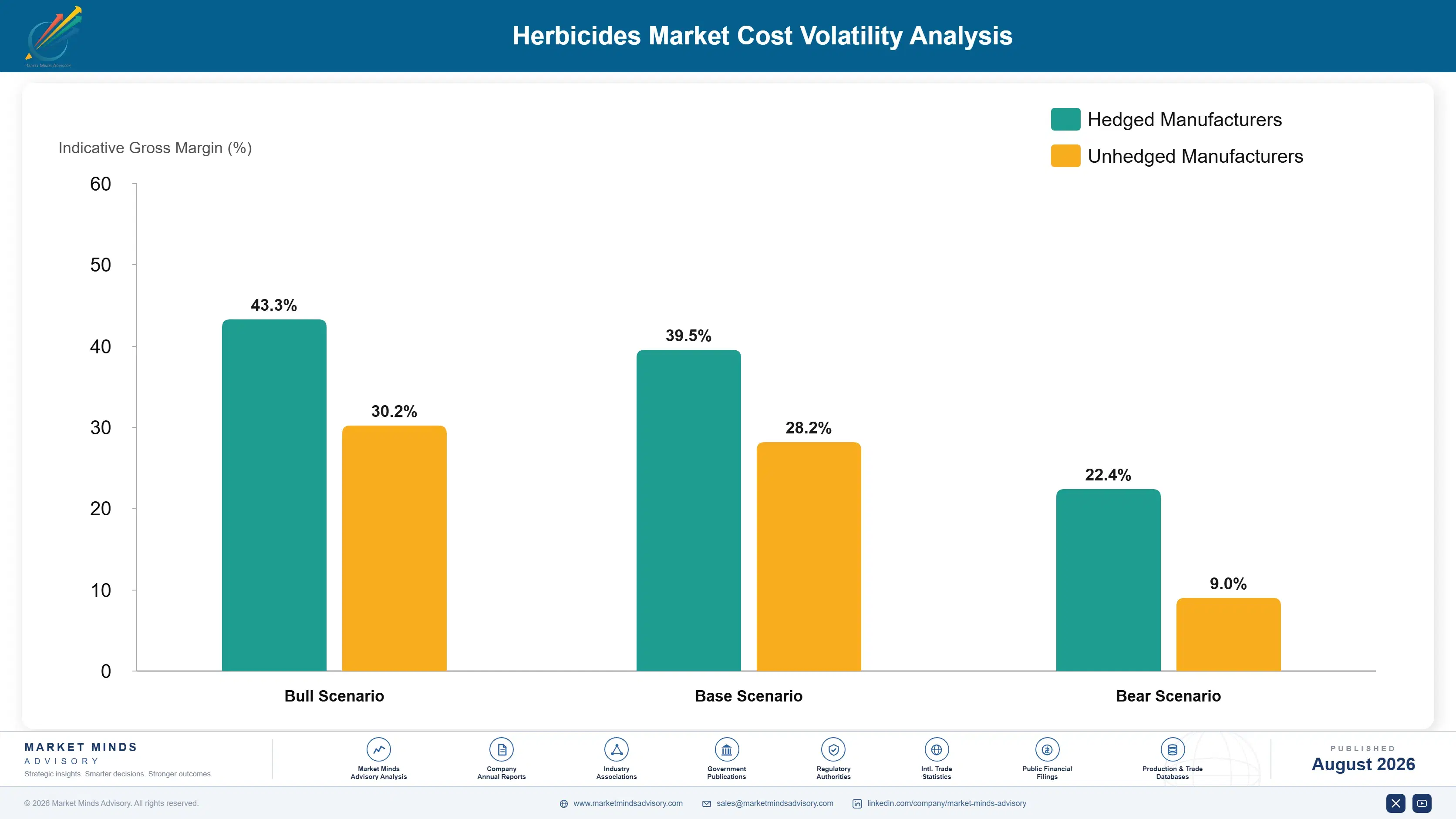
Active Ingredient Feedstock Cost Exposure

Active ingredient synthesis inputs, including phosphorus derivatives, glycine, and various chlorinated intermediates, together represent 38% to 48% of cost of goods sold for herbicide manufacturers, sourced primarily from Chinese and Middle Eastern chemical producers rather than diversified global supply chains across most producing regions worldwide. Energy costs for synthesis and formulation processing add a meaningful secondary cost component.
Phosphorus derivative prices rose sharply through 2022 and 2023 as Chinese export controls on phosphate products, implemented partly for domestic fertilizer supply security reasons, tightened global availability for herbicide manufacturers outside China according to China MIIT export policy announcements. Manufacturers without diversified feedstock sourcing absorbed most of this disruption directly, facing higher landed costs and longer lead times during the peak of the shortage before availability gradually improved through 2024.

This feedstock exposure creates a genuine competitive disadvantage for manufacturers outside China relative to Chinese competitors with direct access to domestic phosphorus and chlorinated intermediate production capacity. Smaller generic manufacturers without diversified sourcing face the sharpest exposure, since large diversified majors can absorb short-term supply disruption more easily across broader production bases and multiple feedstock origin countries.
herbicides-market-cost-volatility-analysis-1787553015714

Diversify Phosphorus Feedstock Sourcing Geographically

Sourcing phosphorus derivatives from multiple geographic origins, rather than relying primarily on Chinese supply, reduces exposure to export restrictions and trade policy shifts that disrupted global availability through 2022 and 2023. Manufacturers already diversifying toward Middle Eastern and North American phosphorus sources reported smoother supply continuity during the disruption than peers dependent entirely on Chinese feedstock imports.

Secure Long-Term Active Ingredient Supply Agreements

Negotiating multi-year supply agreements with phosphorus and chlorinated intermediate producers protects against the kind of export restriction disruption that hit availability hard through 2022 and 2023. This gives manufacturers predictable feedstock access to plan production scheduling around well in advance, rather than facing spot-market shortages and price spikes unpredictably during future policy shifts and disputes.

Pursue Backward Integration Into Key Intermediate Production

Larger manufacturers with sufficient balance sheet capacity can integrate backward into phosphorus and chlorinated intermediate production directly, capturing the margin that would otherwise flow entirely to third-party chemical suppliers while also gaining more reliable feedstock access during periods of tight raw material availability across the broader market and supply chain overall each production year.

Portfolio Architecture for Margin Defence

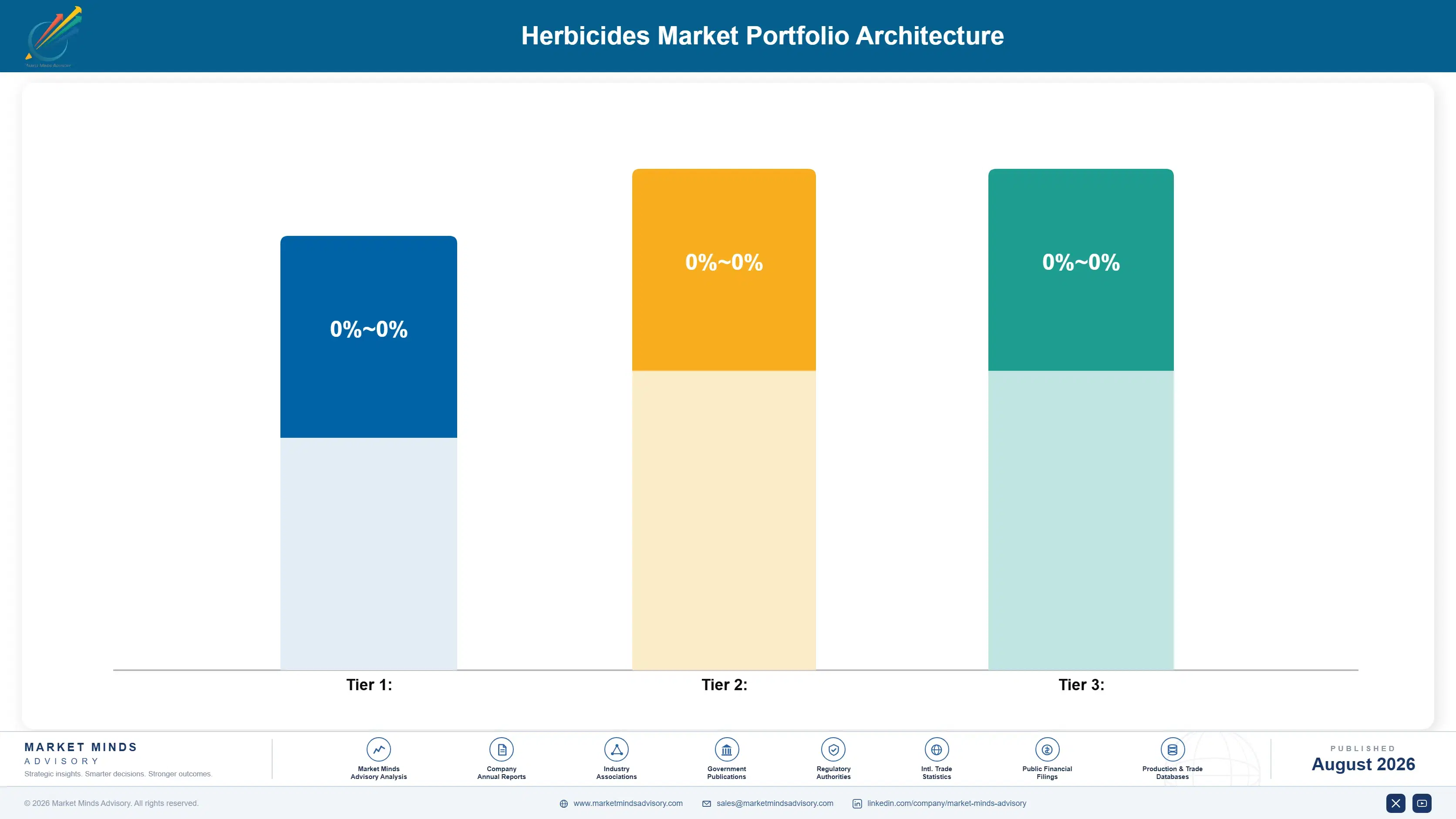
Herbicide margins split sharply by chemistry maturity and registration status. Generic post-patent glyphosate and older chemistries compete almost entirely on price, with gross margins near 15% to 22%, while branded auxin-type and HPPD-inhibitor chemistries with active trait integration command materially higher pricing. Branded chemistry sits in a premium tier where registration breadth and technical service justify gross margins between 30% and 40% depending on trait partnership depth.
Generic glyphosate volume still anchors most manufacturers' revenue base because row-crop growers purchase bulk herbicide in large standing quantities regardless of chemistry sophistication, but the margin tension is real. Manufacturers chasing generic volume alone see margins compressed by feedstock volatility discussed earlier, while manufacturers who shift mix toward branded, trait-integrated chemistries convert flat unit growth into meaningfully expanding profit pools instead.

High-value margin pools concentrate specifically around stacked herbicide-tolerant trait systems requiring branded, trait-compatible chemistry, where licensing partnerships lock in premium pricing for the full duration of a seed variety's commercial life. Newer, more selective chemistry classes meeting tightening European and North American regulatory standards represent a growing secondary pool, as manufacturers reformulate away from legacy actives facing registration pressure.

Generic post-patent glyphosate and older chemistries sold into row-crop markets worldwide on price competition, with gross margins near 15% to 22% and limited differentiation between regional manufacturers beyond delivery reliability.
Gross Margin

Branded auxin-type and HPPD-inhibitor chemistries sold with trait system integration and technical service support, commanding gross margins between 30% and 38% through registration breadth and much deeper grower relationship depth.
Gross Margin

Newer, more selective chemistries meeting tightening European and North American regulatory standards today and going forward, commanding the highest margins near 38% to 45% given limited registered competition and patent protection.
Gross Margin
herbicides-market-portfolio-architecture-1787553016512

High-value Sub-segments and Strategic Watch-out

Auxin-Type Herbicides (2,4-D, Dicamba)

Auxin-type herbicides combine fast visible-segment growth with strong margin economics, driven by dicamba and 2,4-D-tolerant trait adoption across Latin America and North America. Manufacturers with established trait licensing partnerships and registration breadth are positioned to convert this combination of growth and margin into disproportionate profit expansion through 2036.

HPPD-Inhibitor Herbicides

HPPD-inhibitor herbicides already anchor a growing revenue pool tied to structured resistance management programmes requiring an additional mode of action beyond glyphosate and auxin chemistries. The segment offers strong margin economics given remaining patent protection on several products, though generic competition will eventually compress pricing as key patents expire.

Generic Post-Patent Glyphosate

Generic post-patent glyphosate remains the volume core of the market, supplying row-crop growers who prioritize cost and proven efficacy over newer chemistry sophistication. Growth here tracks general row-crop planted acreage closely rather than outpacing it, and margins stay compressed by feedstock volatility and intense generic manufacturer price competition.

European Regulatory Restriction Risk

European regulatory restriction is a genuine strategic watch-out because continued active ingredient re-approval denials could further narrow the registered chemistry set available to manufacturers serving that market. Manufacturers overly dependent on legacy chemistries facing review risk losing registered acreage faster than reformulation investment can offset the resulting demand decline.

Rotation-Locked Multi-Chemistry Demand

Herbicide demand behaves like an annuity business once a manufacturer secures a trait licensing partnership or grower rotation programme relationship, because switching a multi-year weed management programme mid-season carries meaningful agronomic risk for the grower. This locks in recurring purchasing across the full duration of a seed variety's commercial life or a structured resistance management programme's multi-year rotation plan.
Adoption stickiness varies meaningfully by end-use vertical. Row-crop growers on structured rotation programmes show the deepest stickiness because switching chemistry mid-rotation risks resistance management failure, while turf and ornamental buyers switch suppliers more readily based on short-term pricing considerations. Specialty crop growers sit between the two, with moderate switching costs tied to crop-specific registration requirements rather than full rotation programme commitments.

Buyer profiles are shifting generationally as row-crop procurement moves from individual farm operators making informal chemistry choices toward centralized agronomy teams at large farming operations applying formal, data-driven rotation planning across multiple fields and growing seasons simultaneously. Younger agronomists entering these advisory roles also carry stronger familiarity with resistance management science, pushing structured multi-chemistry rotation programmes into grower conversations earlier than the previous generation typically allowed.
herbicides-market-end-use-penetration-index-1787553017476

Where Herbicide Strategy Wins

These are among the four positions where our research anticipates prominent divergence between winners and laggards over the coming forecast period. Each is grounded in the demand model, the regulatory perimeter, and the announced capacity pipeline.
01 / MULTI-CHEMISTRY REGISTRATION STRATEGY

Expand Registration Breadth Before Rotation Requirements Tighten

Manufacturers with broad multi-chemistry registration portfolios already command pricing 15% to 20% above single-chemistry competitors, and this gap will widen further as resistance management becomes more structured across major growing regions worldwide and consistently. Expanding registration to cover auxin-type and HPPD-inhibitor chemistries now, before rotation requirements tighten further, gives manufacturers a head start competitors starting later simply cannot recover through faster execution alone. Manufacturers with existing multi-chemistry manufacturing scale should treat registration expansion as their single highest-priority investment this coming decade.
02 / TRAIT LICENSING PARTNERSHIP PRIORITY

Secure Trait Licensing Partnerships Ahead Of Commercial Launch

Early trait licensing partnerships have captured roughly 30% more new trait-linked volume than manufacturers entering after commercial launch, confirming that partnership timing matters more than product quality alone in this specific distribution channel worldwide. Manufacturers who secure partnerships with seed companies developing new stacked herbicide-tolerant varieties now gain guaranteed distribution through existing grower relationships that would otherwise take years to build independently and expensively from scratch. Waiting until a trait reaches commercial launch erases this first-mover distribution advantage almost entirely.
03 / LATIN AMERICAN DISTRIBUTION INVESTMENT

Build Direct Distribution Scale In Brazil And Argentina

Latin America's outsized and still growing share of global herbicide demand means manufacturers without strong Brazilian and Argentine distribution networks are missing the single largest growth opportunity in the entire market today and tomorrow alike. Manufacturers with established direct distribution report revenue growth roughly 25% faster than competitors relying entirely on third-party distributors across comparable geographies and customer segments nationwide. Building distribution scale in Brazil and Argentina should now be treated as a core strategic priority, not a secondary market.
04 / NEXT-GENERATION CHEMISTRY DEVELOPMENT

Invest In New Chemistry Classes Ahead Of Resistance

New chemistry class launches have historically commanded pricing 40% or more above mature, multi-generic chemistry classes during their first several years of commercial availability, before generic competition inevitably emerges and compresses that premium significantly over time. Manufacturers investing in discovery research now are positioned to capture this premium window before competitors catch up with comparable offerings and erode the pricing advantage entirely over time. Weed resistance to established chemistries will keep creating this opportunity indefinitely, rewarding whoever moves first consistently.

Engagement Snapshot From the Field

A live engagement with an industry participant carrying material or product regulatory and market exposure ahead of a defining policy shift, showing how our research translates into a defensible multi-year portfolio strategy.
MARKET MINDS ADVISORY · CLIENT ENGAGEMENT SUMMARY
Herbicides Producer Strategic Portfolio Review and Transition Roadmap 2026·Investment Scenario on Herbicides Exposure Evaluation 2025-26
CLIENT PROFILE
The client is a mid-sized regional herbicide manufacturer serving row-crop growers across South America, with annual revenue in the low hundreds of millions of dollars. The company had built its position on generic post-patent glyphosate but had never pursued a trait licensing partnership despite holding registration capability across several complementary chemistry classes that growers increasingly need for resistance management.
STRATEGIC CHALLENGE
Generic glyphosate margins had compressed steadily as regional competitors added capacity and Chinese imports increased price pressure, while the client lacked visibility into which seed company partnership would offer the strongest return and how long a licensing negotiation would realistically take to close. Leadership needed a credible, data-backed case before committing management time to partnership negotiations.
MMA APPROACH
MMA conducted primary interviews with the client's registration team, two seed company business development officials, and three competitors already holding trait licensing partnerships to map the realistic partnership negotiation timeline and revenue potential. The engagement combined this qualitative work with a financial model comparing trait-linked versus generic glyphosate margins, quantifying the volume opportunity under conservative and optimistic partnership scenarios.
KEY FINDINGS
  1. Partnership negotiation timelines averaged eleven months across the interviewed seed company officials, longer than the client's initial internal estimate of six months by a meaningful margin.
  2. Competitors with existing trait licensing partnerships priced their chemistry at gross margins 18 to 24 percentage points above the client's generic glyphosate line, confirming a substantial margin opportunity.
  3. Two of three competitor representatives interviewed identified registration breadth across complementary chemistry classes, not manufacturing scale, as the deciding factor seed companies weighed when selecting a partner.
  4. The client's existing registration portfolio already covered two of the three chemistry classes most seed companies required, needing only incremental registration investment to close the remaining gap.
CLIENT PROFILE
The client is a mid-sized regional herbicide manufacturer serving row-crop growers across South America, with annual revenue in the low hundreds of millions of dollars. The company had built its position on generic post-patent glyphosate but had never pursued a trait licensing partnership despite holding registration capability across several complementary chemistry classes that growers increasingly need for resistance management.
STRATEGIC CHALLENGE
Generic glyphosate margins had compressed steadily as regional competitors added capacity and Chinese imports increased price pressure, while the client lacked visibility into which seed company partnership would offer the strongest return and how long a licensing negotiation would realistically take to close. Leadership needed a credible, data-backed case before committing management time to partnership negotiations.
MMA APPROACH
MMA conducted primary interviews with the client's registration team, two seed company business development officials, and three competitors already holding trait licensing partnerships to map the realistic partnership negotiation timeline and revenue potential. The engagement combined this qualitative work with a financial model comparing trait-linked versus generic glyphosate margins, quantifying the volume opportunity under conservative and optimistic partnership scenarios.
KEY FINDINGS
  1. Partnership negotiation timelines averaged eleven months across the interviewed seed company officials, longer than the client's initial internal estimate of six months by a meaningful margin.
  2. Competitors with existing trait licensing partnerships priced their chemistry at gross margins 18 to 24 percentage points above the client's generic glyphosate line, confirming a substantial margin opportunity.
  3. Two of three competitor representatives interviewed identified registration breadth across complementary chemistry classes, not manufacturing scale, as the deciding factor seed companies weighed when selecting a partner.
  4. The client's existing registration portfolio already covered two of the three chemistry classes most seed companies required, needing only incremental registration investment to close the remaining gap.
RECOMMENDED STRATEGY
Phase 1: Complete registration for the remaining chemistry class immediately, closing the identified gap before approaching seed companies with a complete multi-chemistry registration portfolio to offer. Phase 2: Begin partnership discussions with the seed company showing the strongest regional distribution overlap, while continuing generic glyphosate production to fund the registration investment during negotiations. Phase 3: Launch the trait-linked chemistry bundle upon partnership signing, targeting the interviewed seed company's existing grower network as the anchor customer base for initial volume.
OUTCOME
Within fourteen months of the engagement, the client signed a trait licensing partnership with a regional seed company and began supplying trait-linked chemistry across the partner's soybean variety network. Trait-linked product revenue reached 14% of total sales within the first year of launch, with gross margin on that line reported at 33%, figures client-reported and unverified by MMA.

Frequently Asked Questions

Foundational context covering the market sizes, CAGR, scope, country, region and competition that inform every finding below. This section is provided to cover basics and most often pre-purchase conversations, answered from the MMA Primary Research Dataset.

What is the current size of the Herbicides Market?

The Herbicides Market reached an estimated $32.5 billion in global value during 2025, the base year for this report. Growth is driven by resistance management chemistry rotation alongside sustained row-crop acreage expansion across Latin America.

How large will the Herbicides Market be by 2036?

MMA projects the market will reach approximately $51.1 billion by 2036, up meaningfully from its 2025 base value. This expansion reflects a compound annual growth rate of 4.2% sustained across the full forecast period.

What is the CAGR for the Herbicides Market 2026 to 2036?

The base case compound annual growth rate is 4.2% across the 2026 to 2036 forecast window. Bull and bear scenarios range from 5.3% to 3.1%, depending on commodity crop prices and regulatory restriction.

Which segment is growing fastest?

Auxin-type herbicides are the fastest-growing chemistry class, expanding at 5.8% annually, roughly 1.4 times the overall market rate. HPPD-inhibitor herbicides follow closely as the second-fastest class given structured resistance management adoption.

Who are the major companies in the Herbicides Market?

Leading suppliers include Bayer Crop Science, Corteva Agriscience, Syngenta, BASF, and FMC Corporation, together holding an estimated 62% combined share. Competition is evaluated on a revenue basis across branded and generic chemistry segments.

Which country is growing fastest?

India is the fastest-growing major market, expanding at approximately 6.5% annually as rising labor costs push growers toward herbicide adoption over manual weeding. This outpaces the global average meaningfully across most grain and cotton growing states.

Report Segmentation Architecture

The full report scope spans multiple orthogonal segmentation dimensions, with cross-tabulated demand data provided for each dimension pair. Coverage extends further to regional breakdowns, trend trajectories, and the competitive detail needed to support segment-level decision-making.

By Mode of Action

  • Glyphosate-Based Herbicides
  • Auxin-Type Herbicides (2,4-D, Dicamba)
  • ALS-Inhibitor Herbicides
  • HPPD-Inhibitor Herbicides
  • PPO-Inhibitor Herbicides
  • Pre-Emergent Soil-Applied Herbicides

By End-Use Crop Type

  • Row Crops (Soybean, Corn, Cotton)
  • Cereals and Grains
  • Specialty Crops
  • Turf and Ornamental
  • Pasture and Rangeland

By Commercial Dimension

  • Direct Trait Licensing Partnerships
  • Distributor and Retail Channel Sales
  • Generic Post-Patent Sales
  • Direct-to-Grower Contracts

By Region

  • North America
  • Western Europe
  • East Asia
  • South Asia and Pacific
  • Latin America
  • Middle East and Africa
  • Eastern Europe

Scope, Methodology, and Coverage

Every figure in this report is reproducible from documented input assumptions. The scope below maps the historical period, the forecast horizon, the segmentation dimensions, and the countries covered, alongside the underlying primary and qualitative methodology.
Historical Period
2020 to 2025
Forecast Period
2026 to 2036
Base Year
2025 (USD billions; MMA Primary Research Dataset, August 2026)
Market Definition
The Herbicides Market covers synthetic and biological crop protection chemicals formulated to control weeds in row-crop, specialty crop, and turf and ornamental applications. It excludes fungicides, insecticides, and adjuvant or surfactant products sold separately from an active herbicidal ingredient.
Quantitative Units
USD billions (current prices); metric tons of active ingredient for volume-referenced segment discussion where applicable
Segmentation Dimensions
By Mode of Action; By End-Use Crop Type; By Commercial Dimension; By Region
Regions Covered
North America, Western Europe, East Asia, South Asia and Pacific, Latin America, Middle East and Africa, Eastern Europe
Countries Covered
USA, China, Germany, France, UK, Japan, South Korea, India, Australia, Canada, Brazil, Mexico, Indonesia, Vietnam, Thailand, Malaysia, UAE, Saudi Arabia, South Africa, Nigeria, Turkey, Poland, Netherlands, Italy, Spain, Sweden, Switzerland, Argentina, Colombia, Singapore, and additional markets relevant to this sector
Key Companies Profiled
Bayer Crop Science, Corteva Agriscience, Syngenta, BASF, FMC Corporation, UPL Limited, Nufarm, Sumitomo Chemical, ADAMA Agricultural Solutions, American Vanguard Corporation, Rotam CropSciences, Sinochem Agro, Isagro, Rainbow Agro Sciences, Jiangsu Yangnong Chemical, Zhejiang Wynca Chemical, Nutrichem Company, Nanjing Redsun, Anhui Huaxing Chemical, Willowood USA
Quantitative Methodology
Primary survey, n=3,800 respondents, Q4 2025, six countries; demand-side model with trade association cross-validation
Qualitative Methodology
47 expert interviews, Q4 2025; applied to validate demand model assumptions, identify emerging dynamics, and assess competitive positioning
Report Format
PDF and XLSX data workbook (Word format preview document)
Publisher
Market Minds Advisory
Report Code
MMA-2026-AGR-219
Published
August 2026
Contact
sales@marketmindsadvisory.com | www.marketmindsadvisory.com

Purchase the full Herbicides Market Report (2026 to 2036).

This report provides a comprehensive, ten-year forecast of the global Herbicides Market. Coverage spans glyphosate, auxin-type, ALS-inhibitor, HPPD-inhibitor, and pre-emergent chemistry classes across all seven world regions. Deliverables include segment-level and regional sizing to 2036, competitive benchmarking of twenty profiled companies on a consistent revenue basis, and active ingredient feedstock cost exposure analysis. A strategic verdict identifies where manufacturers should concentrate capital and registration investment over the coming decade. The report is built from primary survey data, expert interviews, and company disclosures rather than secondary aggregation.
Ten-year sizing and CAGR forecasts across seven global regions
Segment-level analysis of glyphosate, auxin, and HPPD chemistries
Competitive benchmarking of twenty profiled herbicide manufacturers
Active ingredient feedstock cost exposure and mitigation analysis
Trait licensing and stacked chemistry adoption tracking by region
Strategic verdict on capital allocation and registration investment priorities

Built For The People Who Decide

From boardroom strategy to bench-side execution, this report is read cover-to-cover by leaders shaping the next decade of their industry, turning demand scenarios, market dynamics and valuation benchmarks into decisions.
CXOs/ Presidents/ VPs/ Managers
M&A and Corporate Development
Strategy Teams and R&D Heads
Procurement and Product Directors
Regulatory and Compliance Leaders
Investor Relations and Equity Analysts