Market Minds Advisory
Herb Oil Market

Herb Oil Market: Standardised Actives, Antioxidant Applications And Harvest Variability That Distillation Removes

Dried herb varies enormously with harvest, drying and storage while an oil can be specified precisely, and that consistency argument does more commercial work than any provenance story ever has.

Lead Analyst

Lisa Gevelber

Published

September 2026

Make Smarter Decisions with Customized Research Insights

Request a free sample report and evaluate market opportunities, growth trends, and competitive dynamics relevant to your business needs.

2025 MARKET VALUE$1.4BMarket Size 2025
2036 FORECAST VALUE$3.0BBase Case , 2026 to 2036
CAGR 2026 TO 20367.0 %Bull 8.2% / Bear 5.8%
INCREMENTAL OPPORTUNITY$1.4BNet 10- year value creation
EXPANSION MULTIPLE1.97x2036 value over 2026 base
Strategic Levers
M&A Pipeline
Regional Outlook
Country Rankings
Competitive Intelligence
Segmental Deep-dive
Call-Us : 91 93563 13602

Executive Snapshot and Market Trajectory

Dried herb varies enormously with harvest, drying and storage while an oil can be specified to a number. That consistency argument does more commercial work in this market than any provenance story ever has, and it is why flavour houses buy oils rather than leaves.
Standardised active extracts carry the growth on rosemary antioxidant applications where synthetic alternatives face label resistance and the performance is measurable rather than aromatic. Flavour and seasoning system supply grows nearly as fast on batch consistency that dried herb cannot deliver. Western Europe holds the largest share on Mediterranean growing, distillation capability and flavour house demand all sitting close together. Provenance stories do very little commercial work anywhere here.
Concentration reads at 38% for the top five, moderate because distillation sits near where herbs grow and that is dispersed across Mediterranean, Indian and North African production. Standardisation capability rather than distillation is what separates suppliers, since anybody can distil oregano and considerably fewer can guarantee a carnosic acid figure. Anybody with a still can produce oregano oil and considerably fewer can guarantee a carnosic acid figure batch after batch. Analytical capability decides who competes.
Market Definition
This market covers essential oils and extracts derived from culinary and aromatic herbs, spanning standardised active extracts, flavour and seasoning system supply, aromatherapy and personal care grades, food preservation and antioxidant applications, and herb oils for nutraceutical formulation. Spice oils from seeds and barks, citrus oils, floral oils used primarily in fragrance, dried herbs and herb powders, and synthetic aroma chemicals replicating herb notes are excluded.
Base Year Value
$1.4B in 2025 (MMA Primary Research Dataset, August 2026)
Forecast Period
2026 to 2036, eleven discrete annual values
CAGR
7.0% base case. Bull 8.2%. Bear 5.8%.
Fastest Growth Segment
Standardised Active Extracts: 10.5% CAGR
Fastest Growth Country
India: 9.8% CAGR
Fastest Growth Region
South Asia and Pacific: 9.3% CAGR
Largest Region
Western Europe: 29% of 2025 global value
Market Leaders
Kalsec, Naturex, Robertet Group, Ultra International and Berjé lead on herb oil and extract revenue. Source: MMA Primary Research Dataset, July 2026.
Primary Survey
n=3,800 procurement and R&D decision-makers, Q4 2025, six countries
Methodology
Demand-side build-up, cross-validated against public data, 47 expert interviews

Herb Oil Market Forecast Scenarios

herb-oil-market-report-trends-growth-insights-size-forecast-scenario-1787460118905
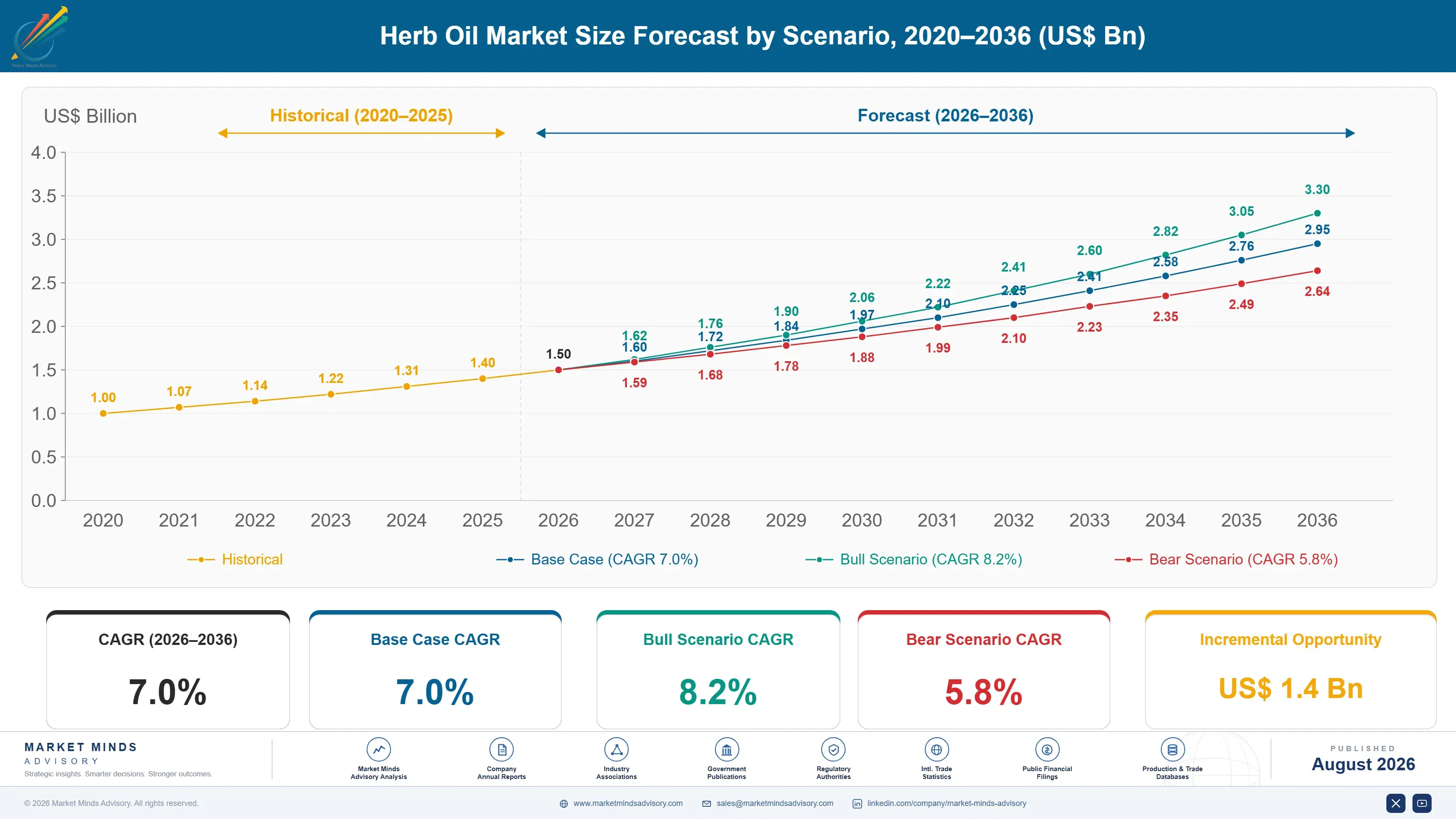
Growth ran at 6.0% annually between 2020 and 2025, and clean-label reformulation drove most of it rather than any aromatic trend. Food manufacturers replacing synthetic antioxidants with rosemary extract created demand that had nothing to do with flavour, and that application grew faster than everything else in the category combined across the period. That application grew faster than everything else in the category combined.
The base case at 7.0% rests on three mechanisms. Standardised rosemary extract keeps replacing synthetic antioxidants in food as label scrutiny continues and the performance case holds. Flavour and seasoning system demand grows on consistency that dried herb cannot match. And Indian and Southeast Asian production expands as extraction capability develops alongside herb cultivation that already exists at considerable scale across both regions. None of the three depends on any aromatic trend holding.
The bull case at 8.2% turns on synthetic antioxidant restriction tightening in major food markets, which would accelerate a substitution already underway. The bear case at 5.8% reflects harvest volatility raising input costs sharply, since herb oils depend entirely on agricultural output that weather can reduce without warning in any given season. Herbs are minor crops without futures markets anywhere.

Consistency Beats Provenance In Every Application

The commercial argument in herb oils is consistency rather than character, which surprises people who expect a botanical ingredient market to run on origin stories. Dried oregano varies enormously with harvest conditions, drying method and storage, while an oil can be specified to an intensity figure and delivered against it repeatedly. Flavour houses buy oils for exactly that reason. Provenance is a marketing argument rather than a purchasing criterion here.
TOP FIVE CONCENTRATION38%Moderate, since distillation sits close to dispersed herb growing areas
STANDARDISED GRADE SHARE44%Portion of value in extracts specified to defined active content
ANTIOXIDANT APPLICATION SHARE31%Portion of volume entering food preservation rather than flavour applications
HERB INPUT COST SHARE48% of COGSRaw herb material contribution to distilled oil manufactured cost
STANDARDISED GRADE PREMIUM67%Pricing advantage of standardised extracts over general distilled oils
QUALIFICATION CYCLE8 monthsTypical time to qualify an oil into a flavour system
Standardisation extends the same logic further. An extract specified to a defined carnosic acid content lets a food manufacturer dose to a study and document what is actually present, which general botanical description cannot support. Roughly 44% of category value now sits in standardised grades at pricing around 67% above general distilled oils, and that share keeps climbing. General botanical description cannot support that kind of documentation.
Rosemary antioxidant applications are where the growth concentrates. Replacing synthetic antioxidants in food with rosemary extract removes a declaration consumers dislike while delivering measurable oxidative protection, which is a technical rather than aromatic proposition. Roughly 31% of volume goes there, and the application buys on performance data rather than on anything resembling a provenance argument.
"People assume a herb oil market runs on Provence lavender fields and single-origin oregano. It runs on whether a formulator can dose to a carnosic acid number and get the same result in March that they got in September."
Director, Botanical Ingredients and Flavour Systems Practice · MMA Botanical Ingredients Practice · August 2026

Market Trends

Rosemary Extract Replaces Synthetic Antioxidants In Food

Food manufacturers replacing synthetic antioxidants with standardised rosemary extract remove a declaration consumers dislike while retaining measurable oxidative protection for fats and oils, which is a technical proposition rather than an aromatic one. That application now carries roughly 31% of category volume and grew faster than everything else combined. Buyers specify carnosic acid content and dose to published performance data, which favours suppliers with standardisation capability over anybody simply distilling herbs well. Synthetic alternatives face label resistance that has nothing to do with their technical performance. The substitution grew faster than everything else combined.
Market Impact: Qualification takes 8 months typically
Standardisation Separates Suppliers More Than Distillation Does

Anybody with a still can produce oregano oil and considerably fewer can guarantee a defined active content batch after batch, which is where commercial separation now happens in this category. Standardised grades carry roughly 67% pricing premium over general distilled oils and roughly 44% of category value. The capability requires analytical infrastructure and process control that a traditional distiller has never needed, and building it takes years rather than a single investment decision. A traditional distiller has never needed analytical infrastructure of that kind. Buyers who require a figure will not accept a description instead.
Market Impact: India grows at 9.8% annually

Market Opportunities and Growth Drivers

Flavour Systems Buy Consistency That Dried Herb Cannot Deliver

Dried oregano varies enormously with harvest, drying method and storage while an oil can be specified to an intensity figure and delivered against it repeatedly, which is why flavour houses formulate with oils rather than leaves. Consistency is the entire argument and it holds regardless of what any origin story claims. Qualification into a flavour system takes around eight months and the relationships that follow are long, because reformulating a seasoning system is work nobody undertakes casually. Origin stories carry no weight in that conversation at all. Sensory judgement no longer decides it.
Market Impact: Herb input is 48% of cost

Indian Extraction Capability Develops Alongside Existing Cultivation

India already grows herbs at considerable scale for domestic and export markets, and extraction capability is now developing alongside that cultivation rather than requiring it to be established first. Indian demand grows near 9.8% annually as a result, covering both domestic formulation and export supply. Standardisation capability is the gap rather than distillation, and several producers are building analytical infrastructure specifically to reach buyers who will not accept general botanical description. Cultivation already exists at scale, which lowers the barrier considerably. Export supply and domestic formulation both benefit. Standardisation is the remaining gap.
Market Impact: Testing adds 6% to supply cost

Market Restraints and Challenges

Harvest Variability Moves Input Costs Without Any Warning

Herb oils depend entirely on agricultural output that weather can reduce sharply in a single season, and raw herb represents roughly 48% of distilled oil manufactured cost with no hedging instrument available anywhere. The root cause is that these are minor crops without futures markets or meaningful stockholding. Commercially this exposes producers to swings they cannot manage financially. Participants are responding with multi-origin sourcing, forward grower contracts and inventory positions that carry their own working capital cost. Inventory positions carry their own working capital cost against that. Forward grower contracts help partially.
Market Impact: Application carries 31% of volume

Adulteration Undermines Trust Across Botanical Oil Categories

Herb oils are periodically adulterated with cheaper oils or synthetic compounds, and detection requires analytical capability that many buyers do not possess and many suppliers do not offer. The root cause is that a specified oil commands considerably more than a diluted one and testing is not universal. Commercially this damages trust across the whole category when it surfaces rather than only at the supplier involved. Participants are responding with authentication testing, origin documentation and third-party verification programmes. Testing is not universal and detection requires capability many buyers lack entirely.
Market Impact: Standardised grades carry 67% premium
3 additional market trends, 4 additional growth drivers, and 2 additional restraints and challenges are covered in the full report. Contact sales@marketmindsadvisory.com to access the complete intelligence.

Segment CAGR and Growth Architecture

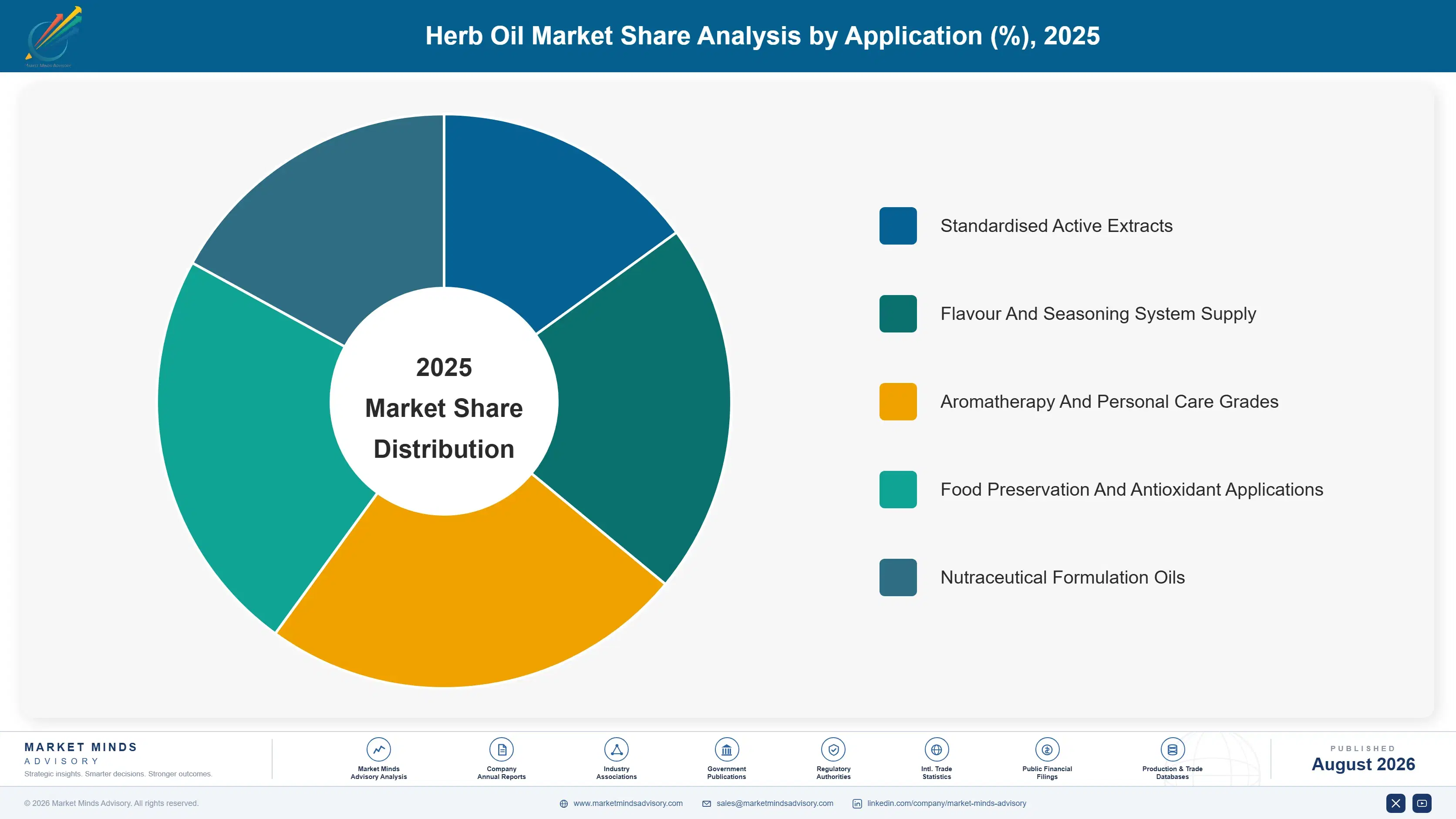
Five application categories divide this market on what the oil is bought to do rather than on which herb it came from. That reflects how buyers actually purchase, since a food manufacturer buying antioxidant performance and a flavour house buying aroma consistency apply entirely different specifications to material that may be distilled from the same plant.
herb-oil-market-report-trends-growth-insights-market-share-analysis-1787460119439

Standardised Active Extracts

Growing at 10.5% and the fastest part of this market. Standardised extracts specify a defined active content rather than a general botanical description, which is what lets a formulator dose to a study and a manufacturer document what is actually in a product. Rosemary extract standardised to carnosic acid dominates the volume, since it functions as a natural antioxidant preserving fats and oils in food where synthetic alternatives face label resistance. That application is technical rather than aromatic and buys on measured performance. Supply concentration among few producers with the extraction and standardisation capability keeps pricing considerably firmer than commodity essential oil markets. Supply concentration keeps pricing considerably firmer than commodity oil markets.
CAGR 10.5%

Flavour And Seasoning System Supply

Growing at 8.8% on herb oils supplied into flavour and seasoning systems rather than sold as standalone ingredients, principally oregano, thyme, basil and rosemary oils used in savoury applications where a distillate delivers consistent intensity that dried herb never can. Flavour houses buy on aroma profile and batch consistency rather than on origin story, and they blend rather than use single oils. Consistency is the whole argument, since dried herb varies enormously with harvest, drying and storage while an oil can be specified. Volumes are modest and the relationships are long, because reformulating a seasoning system is work nobody undertakes casually. Reformulating a seasoning system is work nobody undertakes casually.
CAGR 8.8%
Full segment breakdown across 5 segments available in the complete report.

Regional Architecture and Country Demand Map

Western Europe holds 29% of global value because Mediterranean growing, distillation capability and flavour house demand all sit close together. South Asia and Pacific follows at 19% on Indian cultivation and developing extraction, and grows fastest of any region. Standardisation separates suppliers everywhere else too.

Western Europe

Note: Western Europe sits above the standard share band because Mediterranean herb cultivation, established distillation capability and the flavour houses that buy the output all sit within a few hundred kilometres of each other, which no realistic allocation obscures. Spanish, French and Italian production covers rosemary, thyme, oregano and lavender at scale. Standardisation capability is furthest advanced here and European clean-label pressure drove the antioxidant substitution that now carries category growth. Flavour house demand is concentrated in France and Switzerland. Adulteration concerns have prompted authentication programmes that European buyers apply more rigorously than buyers elsewhere generally do. Authentication programmes are applied more rigorously here than anywhere. Clean-label pressure drove the substitution.
Share: 29% | CAGR: 5.6% (2026 to 2036)

South Asia and Pacific

Note: this region sits above the standard band because India grows culinary and aromatic herbs at a scale few countries approach and extraction capability is now developing alongside that existing cultivation rather than needing to be created first. Indian production covers mint, basil, lemongrass and increasingly rosemary and oregano. Growth runs fastest here at 9.3% annually. Standardisation rather than distillation is the capability gap, and several producers are building analytical infrastructure specifically to reach buyers who reject general botanical description. Australian and Southeast Asian production is smaller and generally serves regional flavour manufacturing rather than international export markets. Analytical infrastructure is being built specifically to reach demanding buyers. Growth runs fastest of any region here.
Share: 19% | CAGR: 9.3% (2026 to 2036)
Regional intelligence for 5 additional markets available in the complete report: North America, East Asia, Latin America, Middle East and Africa, Eastern Europe. Contact sales@marketmindsadvisory.com.
herb-oil-market-report-trends-growth-insights-country-cagr-analysis-1787460119985

Where Herb Oil Value Actually Concentrates

Four positions separate producers earning real returns from those selling distilled oil on aroma description: building standardisation and analytical capability, targeting antioxidant applications that buy on performance, qualifying into flavour systems, and holding authentication documentation that adulteration concerns have made a purchasing requirement. Only the first takes years rather than months to build. The rest are decisions.

Build Standardisation And Analytical Capability Properly

Anybody with a still can produce oregano oil and considerably fewer can guarantee a defined active content batch after batch, which is precisely where commercial separation now happens. Standardised grades carry roughly 67% pricing premium over general distilled oils and 44% of category value. The capability requires analytical infrastructure and process control that a traditional distiller never needed, and building it takes years rather than any single investment decision. Competing on a commodity basis is the alternative, in a category where the premium segment keeps taking share. Analytical infrastructure is the barrier.
Market Impact: Commands a 67% premium over general distilled oils

Target Antioxidant Applications Buying On Performance

Food manufacturers replacing synthetic antioxidants with standardised rosemary extract buy measurable oxidative protection rather than aroma, which is a technical purchase decided on published performance data. That application carries roughly 31% of category volume and grew faster than everything else combined. Suppliers positioned there compete on carnosic acid documentation rather than on any provenance argument, which advantages standardisers and disadvantages traditional distillers considerably. Roughly 31% of category volume sits there and it grew faster than everything else. Documentation rather than description is what these buyers accept. Shelf life validation locks positions in.
Market Impact: Reaches the 31% antioxidant application volume pool overall

Qualify Into Flavour Systems Before Competitors Do

Qualification into a flavour system takes around eight months of aroma profiling, consistency testing and formulation work, after which the relationship is long because reformulating a seasoning system is work nobody undertakes casually. Qualified suppliers realise 28% to 36% higher pricing than those quoting on general specification. Consistency across batches rather than any single sample is what wins these, which favours producers with real process control behind them. Reformulating a seasoning system is work nobody undertakes casually at all. A single impressive sample convinces nobody serious. Consistency rather than character wins these.
Market Impact: Realises 36% higher pricing once the formulation qualifies

Hold Authentication Documentation Buyers Now Require

Herb oils are periodically adulterated with cheaper oils or synthetic compounds, and when it surfaces the damage falls across the whole category rather than only on the supplier involved. Buyers increasingly require authentication testing and origin documentation before purchasing at all. Testing adds roughly 6% to supply cost and it is considerably cheaper than being excluded from serious accounts, which is what happens to suppliers who cannot document what they are selling. Exclusion happens quietly and suppliers frequently learn about it late. Documentation costs a fraction of a lost account. Origin records matter as much as testing does.
Market Impact: Testing adds roughly 6% to total supply cost

Who Controls the Margin Pool

Concentration reads at 38% for the top five measured on herb oil and extract revenue, the basis used throughout this section, and it is moderate because distillation sits close to dispersed growing areas. Kalsec holds the strongest standardised antioxidant position. Naturex and Robertet bring extraction and flavour capability, while Ultra International and Berjé operate substantial trading and supply networks across origins.
Competition runs on three fronts. Standardisation capability is the first and increasingly the decisive one, since it separates a specified extract from a distilled oil. Flavour system qualification is the second, where consistency rather than character wins positions. Authentication documentation is the third, and it determines which buyers will purchase at all. None of the three is a provenance argument.

Pressure arrives from two directions. Indian and Chinese producers are building standardisation capability alongside cultivation they already hold, which is a considerably more serious position than distilling at low cost. Separately, harvest volatility exposes everybody equally. Rankings will shift toward producers combining standardisation with authentication rather than those holding distillation capacity alone. Distillation capacity alone secures very little now. Standardisation with authentication is the durable combination.
herb-oil-market-report-trends-growth-insights-company-positioning-matrix-1787460120548

Competitive Moat and Risk Dimensions

KALSEC

Moat: Standardised antioxidant application depth

Specialisation in standardised herb extracts for food preservation rather than aromatic supply produced application knowledge and performance data that general botanical suppliers do not accumulate, and food manufacturers replacing synthetic antioxidants consult specialists first. Analytical and process control capability also delivers the batch consistency that a technical application genuinely requires rather than merely prefers.
KALSEC

Risk: Narrow application concentration

Concentration in antioxidant applications leaves the business exposed to any change in clean-label sentiment or in synthetic antioxidant regulation that currently favours the substitution. Raw herb harvest volatility also affects a business with limited ability to hedge, since these are minor crops without futures markets or meaningful stockholding anywhere.
ROBERTET GROUP

Moat: Origin network and extraction breadth

Long-established sourcing relationships across Mediterranean, African and Asian origins give the business supply security and authentication traceability that traders buying opportunistically cannot match. Breadth across natural extracts also means herb oils sit inside a wider flavour and fragrance conversation with customers rather than competing for attention as a standalone ingredient.
ROBERTET GROUP

Risk: Harvest exposure across many origins

Breadth across origins spreads harvest risk without removing it, since agricultural output can fall across several regions in the same season and no hedging instrument exists for minor herb crops. Standardisation capability also competes against specialists whose entire business is built on delivering a defined active figure rather than a broad portfolio.

Players Tracked

Prominent Players

Kalsec
Naturex
Robertet Group
Ultra International
Berjé

Other Key Players

Givaudan
Symrise
International Flavors and Fragrances
Firmenich
Takasago International
Synthite Industries
Kancor Ingredients
Plant Lipids
Indesso Aroma
Albert Vieille
Elixens
Treatt
Citrus and Allied Essences
Vigon International
Aromatic Flavours and Fragrances

Recent Developments

MARCH 2025

Standardised rosemary extract replaces synthetic antioxidant across product range

A food manufacturer completed reformulation replacing synthetic antioxidants with standardised rosemary extract across a substantial product range, dosing to published carnosic acid performance data rather than to any general botanical specification. Shelf life was validated against the specific extract before the reformulation was approved. Synthetic alternatives were removed.
Signal: Antioxidant substitution buys genuinely measurable performance rather than any aromatic or provenance argument at all whatsoever
JULY 2025

Indian producer commissions standardisation and analytical capability

An Indian botanical extraction business commissioned analytical and standardisation capability alongside existing distillation, targeting buyers who reject general botanical description and require a defined active content figure before purchasing anything. Distillation had never been the gap for this producer. Buyers had been rejecting general description.
Signal: Standardisation rather than distillation is now the capability gap that Indian producers have begun actively closing
NOVEMBER 2025

Authentication testing programme adopted across flavour house supply base

A flavour house introduced authentication testing requirements across its herb oil supply base following adulteration findings elsewhere in the industry, requiring origin documentation and analytical verification from every supplier it purchases from. Suppliers unable to document origin were removed from the approved list entirely. Verification is now routine.
Signal: Adulteration damages the whole category, so buyers now verify supply rather than trusting any supplier declaration

What Drives Herb Oil Production Cost

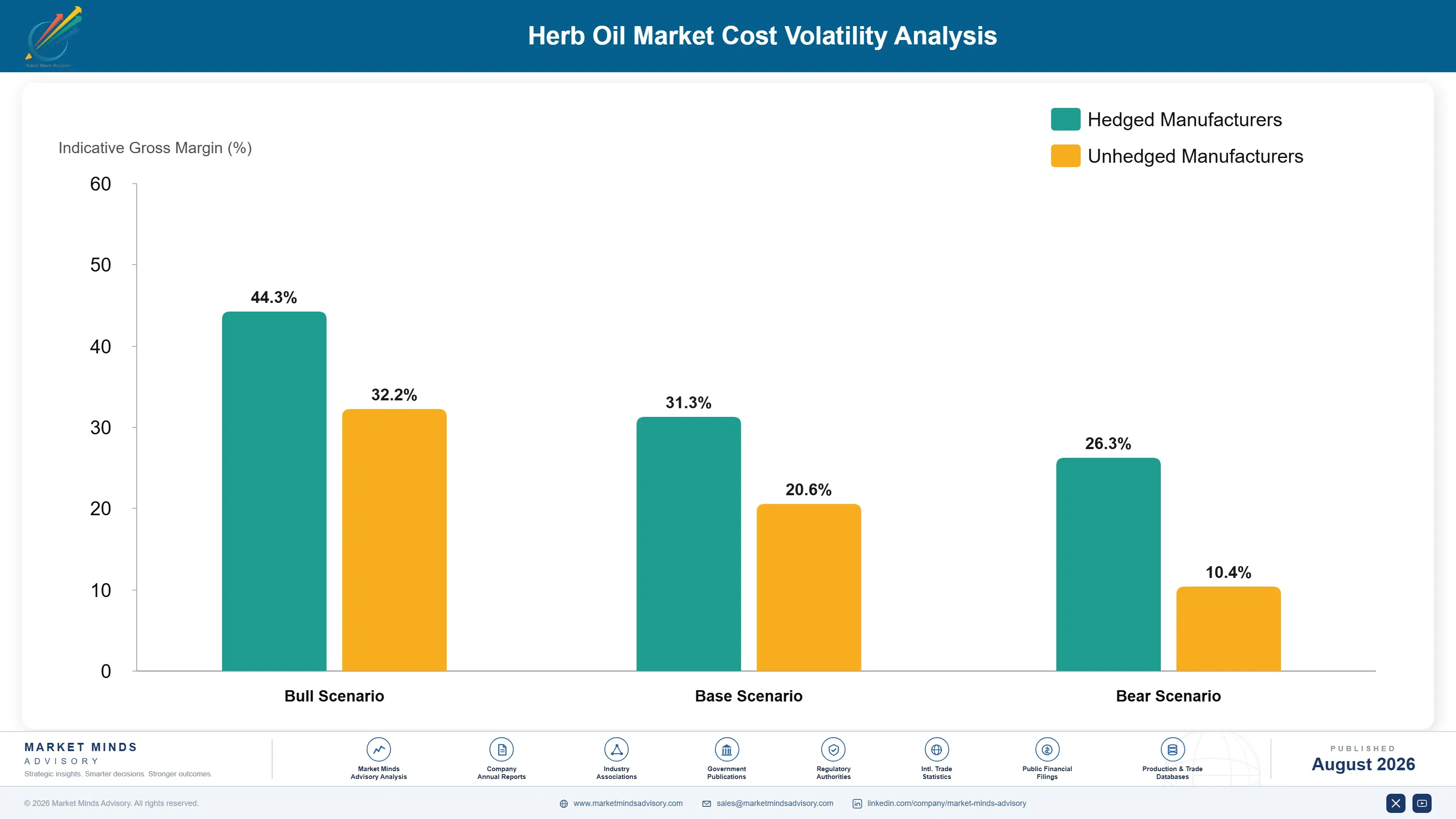
Raw herb material accounts for roughly 48% of distilled oil manufactured cost and varies with harvest conditions in ways no producer can influence or hedge against. Distillation energy contributes around 17%, since steam distillation is inherently demanding on a low-yield feedstock. Standardisation, extraction and analytical work add about 14% where applied, packaging and freight roughly 11%, and authentication testing close to 6%.
Mediterranean and North African herb harvests varied considerably through 2023 and 2024 on drought conditions, with national statistical office and United States Department of Agriculture agricultural data both showing the movement, while distillation energy costs stayed elevated across European operations according to International Energy Agency figures throughout the same period. Producers absorbed most of both movements because open trade buyers accept no pass-through at all.

The disadvantage mechanism is harvest exposure without any hedging instrument, and it falls on every producer regardless of scale or capability. Herbs are minor crops with no futures markets and little meaningful stockholding, so a poor season moves input cost sharply and immediately. Exposure varies by sourcing breadth rather than by size, since multi-origin buyers spread the risk while single-origin producers absorb it entirely.
herb-oil-market-report-trends-growth-insights-cost-volatility-analysis-1787460120747

Source across multiple origins and growing seasons

Herb crops fail regionally rather than globally in most seasons, so sourcing across Mediterranean, Indian, North African and South American origins spreads exposure that no financial instrument can hedge. Southern hemisphere production also offsets northern harvest timing. Each additional origin requires its own quality qualification and authentication work, which is where the real cost sits rather than in the material.

Contract grower acreage ahead of planting decisions

Herb growers plant against expected demand and switch crops when other options pay better, which means committed acreage secures both volume and a grower's continued interest in the crop. Forward contracts stabilise supply that spot buying leaves entirely exposed. The commitment carries volume risk when demand softens, and that risk is smaller than failing to supply a qualified customer.

Invest in analytical capability to reach standardised grades

General distilled oil competes on price against every other distiller while standardised extract commands roughly 67% more for material from the same plant, and the difference is analytical capability rather than agricultural or distillation skill. Building it takes years and sustained investment. The alternative is competing on a commodity basis while the premium segment takes share.

Portfolio Architecture for Margin Defence

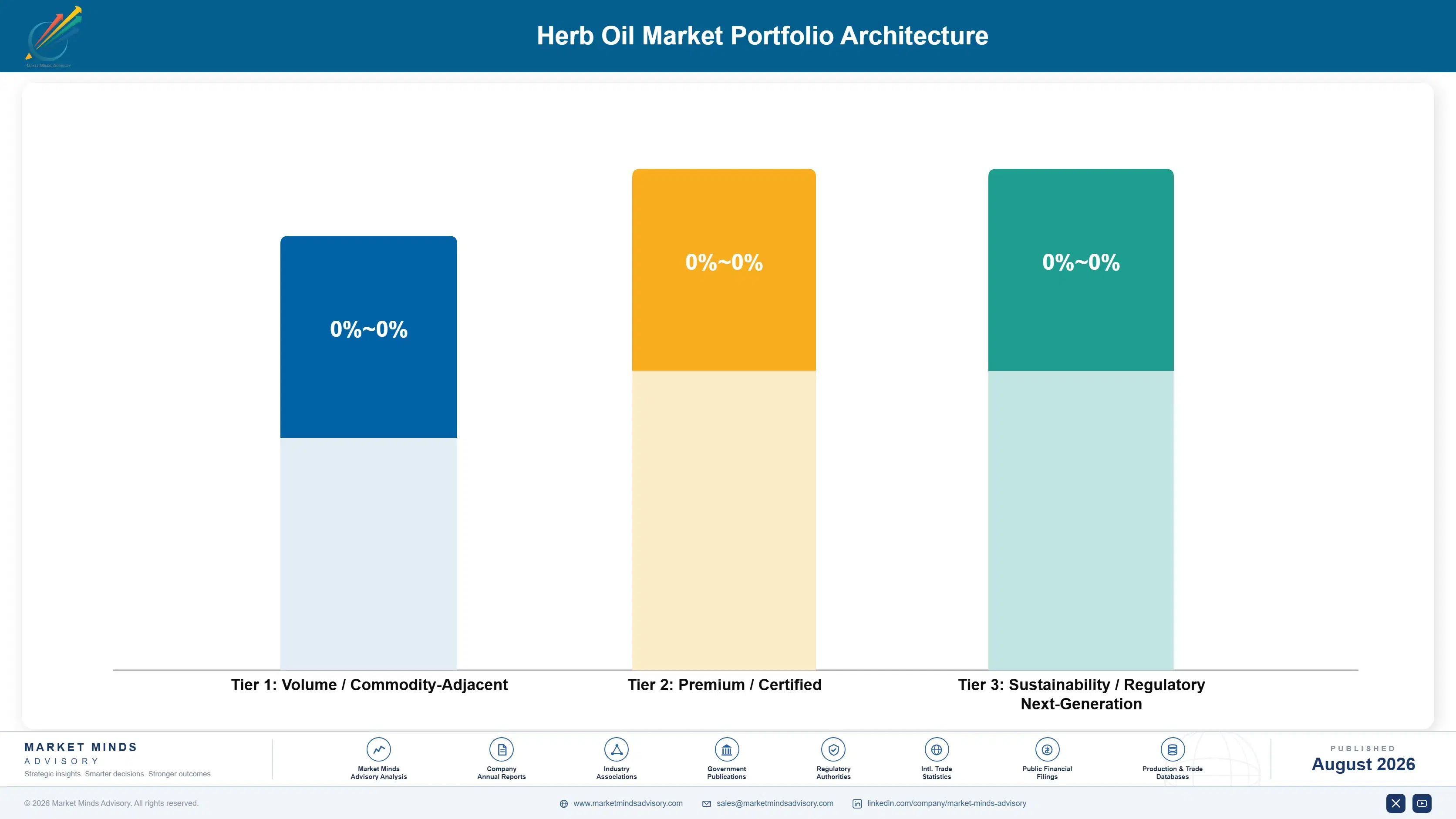
Portfolio economics here divide on specification capability rather than on which herb was distilled. General distilled oils sold on aroma description compete against every other distiller working from the same plant, and since the buyer cannot verify much beyond smell, price becomes the deciding variable by default. Adulteration concerns fall hardest on exactly that position.
The middle tier is qualified flavour system supply. Eight months of aroma profiling and consistency testing produce a position that lasts, because reformulating a seasoning system is work nobody undertakes casually. Margins reach the low thirties, and consistency across batches rather than any single impressive sample is what actually secures these relationships. Authentication documentation increasingly accompanies it. Consistency across batches is what secures it.

Above both sit standardised active extracts. A defined carnosic acid or comparable figure lets a manufacturer dose to published data and document what is present, commanding roughly 67% above general distilled oil, and antioxidant applications buy on performance rather than aroma. Margins reach the high forties. Analytical capability rather than distillation skill is what gates the position. Very few producers have built that capability. Distillation alone is not enough.

Volume / Commodity-Adjacent

General distilled oils sold on aroma description into open trade. The range reflects harvest conditions and distillation cost rather than commercial skill, and buyers cannot verify much beyond the smell.
Gross Margin: 16 to 24%

Premium / Certified

Qualified supply into named flavour and seasoning systems. The range reflects batch consistency and whether authentication documentation accompanies the material, which buyers increasingly require before purchasing. Relationships last for years.
Gross Margin: 28 to 37%

Sustainability / Regulatory / Next-Generation

Standardised active extracts specified to defined content figures. The wide range reflects analytical capability and whether performance data supports the technical applications that buy on measurement. Analytical capability gates it.
Gross Margin: 42 to 53%
herb-oil-market-report-trends-growth-insights-portfolio-architecture-1787460121269

High-value Sub-segments and Strategic Watch-out

Standardised Active Extract Supply

High value and high growth together, letting formulators dose to a number rather than to a description. The wide range reflects analytical capability and whether published performance data supports the technical applications buying on measurement. Distillation skill earns nothing here. Performance data supports it. Few reach it.
Gross Margin: 42 to 53%

Food Antioxidant Applications

High value on the fastest growth in the category, replacing synthetic antioxidants that consumers dislike on a declaration. The range reflects carnosic acid documentation depth and whether performance data accompanies the material supplied. Label resistance drives the substitution. Documentation depth decides it. Growth sits here.
Gross Margin: 38 to 48%

Qualified Flavour System Positions

The steady core of flavour demand where consistency rather than character wins and relationships last for years. The range reflects batch consistency and whether authentication documentation accompanies supply, which buyers now increasingly require. Eight months of qualification precedes it. Reformulation cost holds it. Consistency decides.
Gross Margin: 28 to 37%

General Distilled Oil Trade

The strategic watch-out. Volumes exist but buyers cannot verify much beyond smell, every distiller offers the same material, and adulteration concerns fall hardest here. The range reflects harvest conditions rather than any commercial decision. Price decides everything at this grade. Verification falls hardest here. Price rules it.
Gross Margin: 16 to 24%

How Herb Oil Demand Actually Repeats

Repeat behaviour divides on whether the oil sits inside a formulation or was bought as a material. An oil qualified into a flavour or seasoning system repeats for as long as that system is produced, because reformulating means aroma profiling and customer approval that nobody undertakes to save money on an ingredient. General oil bought on the open market repeats only until somebody quotes lower. Validation cost rather than loyalty holds those positions in place.
Stickiness varies sharply by application. Antioxidant positions hold best, since performance is documented and a food manufacturer has validated shelf life against a specific extract. Qualified flavour system positions hold nearly as well on reformulation cost. Nutraceutical and personal care positions hold moderately. General distilled oil trade holds worst, switching between suppliers and origins on delivered price without hesitation.

The buyer profile has shifted considerably. Herb oils were once bought largely by flavour and fragrance houses assessing aroma, with purchasing decisions resting on sensory judgement. Food manufacturers replacing synthetic antioxidants now buy on analytical specification and published performance instead, which is a different customer applying different criteria and rewarding entirely different supplier capabilities.
herb-oil-market-report-trends-growth-insights-end-use-penetration-index-1787460122149

Where To Compete And Why

These are among the four positions where our research anticipates prominent divergence between winners and laggards over the coming forecast period. Each is grounded in the demand model, the regulatory perimeter, and the announced capacity pipeline.
01 / STANDARDISATION CAPABILITY BUILDING

Anybody can distil, few can specify

Anybody with a still can produce oregano oil and considerably fewer can guarantee a defined active content batch after batch, which is exactly where commercial separation happens in this category now. Standardised grades carry roughly 67% pricing premium over general distilled oils and hold 44% of all category value between them. The capability needs the analytical infrastructure that a traditional distiller never once required, and building it takes years of sustained investment rather than any single investment decision taken once.
02 / ANTIOXIDANT APPLICATION TARGETING

Performance data beats provenance stories

Food manufacturers replacing synthetic antioxidants with standardised rosemary extract buy measurable oxidative protection rather than aroma, which makes it a technical purchase decided entirely on published performance data. That single application carries roughly 31% of category volume and grew faster than everything else in the category combined. Suppliers positioned there compete on carnosic acid documentation, which advantages standardisers considerably and disadvantages traditional distillers who cannot supply it at all, whatever the quality of their distillation happens to be in practice.
03 / FLAVOUR SYSTEM QUALIFICATION

Consistency wins, character rarely does

Qualification into a flavour system takes around eight months of aroma profiling, consistency testing and formulation work, after which the relationship lasts for years, because reformulating a seasoning system is work that nobody undertakes casually. Qualified suppliers realise 28% to 36% higher pricing than competitors quoting on general specification alone. Consistency across batches rather than any single impressive sample is what wins these, which favours producers with genuine process control behind them rather than those producing occasional good individual batches.
04 / AUTHENTICATION DOCUMENTATION HOLDING

Buyers verify rather than trust now

Herb oils are periodically adulterated with cheaper oils or with synthetic compounds, and when that surfaces the damage falls right across the whole category rather than only on the supplier responsible for it. Buyers now increasingly require authentication testing and full origin documentation before purchasing anything at all. Testing adds roughly 6% to total supply cost, which is considerably cheaper than exclusion from the serious accounts that now demand it as a straightforward and non-negotiable condition of doing any business.

Engagement Snapshot From the Field

A live engagement with an industry participant carrying material or product regulatory and market exposure ahead of a defining policy shift, showing how our research translates into a defensible multi-year portfolio strategy.
MARKET MINDS ADVISORY · CLIENT ENGAGEMENT SUMMARY
Herb Oil Producer Strategic Portfolio Review and Transition Roadmap 2026·Investment Scenario on Herb Oil Exposure Evaluation 2025-26
CLIENT PROFILE
A Mediterranean herb oil producer with annual revenue near $48 million (client-reported, unverified by MMA), distilling rosemary, thyme, oregano and sage from contracted and open market herb supply across two countries. Roughly 78% of output was sold as general distilled oil into open trade, with limited flavour house qualification and no standardisation capability at all.
STRATEGIC CHALLENGE
General distilled oil pricing had been squeezed by Indian and North African supply while harvest volatility moved input costs sharply in two consecutive seasons, and a major buyer had introduced authentication requirements the client could not fully satisfy. Management needed to decide between defending trade volume, building standardisation, or pursuing flavour house qualification.
MMA APPROACH
MMA modelled contribution by product grade and channel across four years of the client's own data, benchmarked standardised extract pricing against general distilled oil, and assessed analytical capability investment against realistic demand. Twenty expert interviews with flavour houses, food manufacturers and authentication laboratories tested each of the routes genuinely available to the business.
KEY FINDINGS
  1. General distilled oil delivered barely positive contribution in the poorer harvest season, and the client had absorbed input movements entirely because open trade buyers accepted no pass-through.
  2. Standardised rosemary extract realised roughly 61% higher pricing on material from the same crop, and the analytical investment required was smaller than management had assumed.
  3. The buyer introducing authentication requirements accounted for 19% of revenue and had told the client plainly that supply would end without documentation the business did not yet have.
  4. Flavour house qualification was achievable within eight months for two of the client's oils, and neither had ever been submitted because trade selling had always been easier.
CLIENT PROFILE
A Mediterranean herb oil producer with annual revenue near $48 million (client-reported, unverified by MMA), distilling rosemary, thyme, oregano and sage from contracted and open market herb supply across two countries. Roughly 78% of output was sold as general distilled oil into open trade, with limited flavour house qualification and no standardisation capability at all.
STRATEGIC CHALLENGE
General distilled oil pricing had been squeezed by Indian and North African supply while harvest volatility moved input costs sharply in two consecutive seasons, and a major buyer had introduced authentication requirements the client could not fully satisfy. Management needed to decide between defending trade volume, building standardisation, or pursuing flavour house qualification.
MMA APPROACH
MMA modelled contribution by product grade and channel across four years of the client's own data, benchmarked standardised extract pricing against general distilled oil, and assessed analytical capability investment against realistic demand. Twenty expert interviews with flavour houses, food manufacturers and authentication laboratories tested each of the routes genuinely available to the business.
KEY FINDINGS
  1. General distilled oil delivered barely positive contribution in the poorer harvest season, and the client had absorbed input movements entirely because open trade buyers accepted no pass-through.
  2. Standardised rosemary extract realised roughly 61% higher pricing on material from the same crop, and the analytical investment required was smaller than management had assumed.
  3. The buyer introducing authentication requirements accounted for 19% of revenue and had told the client plainly that supply would end without documentation the business did not yet have.
  4. Flavour house qualification was achievable within eight months for two of the client's oils, and neither had ever been submitted because trade selling had always been easier.
RECOMMENDED STRATEGY
Phase 1: Phase one: build authentication testing and origin documentation immediately, since a fifth of revenue depends on it and the work is records rather than capital investment. Phase 2: Phase two: invest in analytical and standardisation capability for rosemary, entering the grade band where the pricing genuinely sits rather than competing on trade. Phase 3: Phase three: submit two oils for flavour house qualification, converting trade volume into relationships that survive a poor harvest season intact.
OUTCOME
The client completed authentication documentation within five months and retained the at-risk buyer (client-reported, unverified by MMA). Standardised rosemary extract reached 22% of revenue within eighteen months, one flavour house qualification was won, and blended gross margin improved by roughly nine points despite a difficult harvest.

Frequently Asked Questions

Foundational context covering the market sizes, CAGR, scope, country, region and competition that inform every finding below. This section is provided to cover basics and most often pre-purchase conversations, answered from the MMA Primary Research Dataset.

What is the current size of the Herb Oil Market?

The global herb oil market was valued at $1.40 billion in 2025, reaching an estimated $1.50 billion in 2026. That covers essential oils and extracts derived from culinary and aromatic herbs across all applications.

How large will the Herb Oil Market be by 2036?

MMA forecasts the market reaching $2.95 billion by 2036, an increase of $1.45 billion over the 2026 base. That represents an expansion multiple of 1.97 times across the forecast period.

What is the CAGR for the Herb Oil Market 2026 to 2036?

The base case compound annual growth rate is 7.0%, with a bull case of 8.2% and a bear case of 5.8%. Historical growth between 2020 and 2025 ran at 6.0% annually.

Which segment is growing fastest?

Standardised active extracts grow at 10.5%, a full 1.50 times the market rate, letting formulators dose to a defined figure. Flavour and seasoning system supply follows at 8.8% annually.

Who are the major companies in the Herb Oil Market?

Kalsec, Naturex, Robertet Group, Ultra International and Berjé lead on herb oil and extract revenue. Together they account for roughly 38%, moderate for a botanical ingredient market.

Which country is growing fastest?

India grows fastest at 9.8% annually as extraction capability develops alongside herb cultivation that already exists at considerable scale. China follows on processing and export.

Report Segmentation Architecture

The full report scope spans multiple orthogonal segmentation dimensions, with cross-tabulated demand data provided for each dimension pair. Coverage extends further to regional breakdowns, trend trajectories, and the competitive detail needed to support segment-level decision-making.

By Application

  • Standardised Active Extracts
  • Flavour And Seasoning System Supply
  • Aromatherapy And Personal Care Grades
  • Food Preservation And Antioxidant Applications
  • Nutraceutical Formulation Oils

By End-Use Industry

  • Savoury Food And Seasoning Manufacturing
  • Meat, Fish And Prepared Foods
  • Bakery And Snack Production
  • Personal Care And Cosmetics
  • Dietary Supplements And Nutraceuticals
  • Household And Cleaning Products

By Commercial Dimension

  • Direct Supply To Flavour Houses
  • Food Manufacturer Direct Supply
  • Ingredient Distributor And Trading Channel
  • Contract Distillation And Toll Extraction
  • Private Label And Contract Manufacturer Supply

By Region

  • North America
  • Western Europe
  • East Asia
  • South Asia and Pacific
  • Latin America
  • Middle East and Africa
  • Eastern Europe

Scope, Methodology, and Coverage

Every figure in this report is reproducible from documented input assumptions. The scope below maps the historical period, the forecast horizon, the segmentation dimensions, and the countries covered, alongside the underlying primary and qualitative methodology.
Historical Period
2020 to 2025
Forecast Period
2026 to 2036
Base Year
2025 (USD billions; MMA Primary Research Dataset, August 2026)
Market Definition
This report covers essential oils and extracts derived from culinary and aromatic herbs, spanning standardised active extracts, flavour and seasoning system supply, aromatherapy and personal care grades, food preservation and antioxidant applications, and nutraceutical formulation oils, across direct flavour house, food manufacturer, distribution, contract distillation and private label channels. Spice oils derived from seeds, barks and roots, citrus oils, floral oils used primarily in fragrance, dried herbs and herb powders, and synthetic aroma chemicals replicating herb notes are excluded from the sizing.
Quantitative Units
USD billions at producer realised value; volume in tonnes; realised pricing in USD per kilogram.
Segmentation Dimensions
By application; by end-use industry; by commercial dimension; by region.
Regions Covered
North America, Western Europe, East Asia, South Asia and Pacific, Latin America, Middle East and Africa, Eastern Europe
Countries Covered
Spain, France, Italy, Greece, Bulgaria, Hungary, Poland, Turkey, Morocco, Egypt, India, China, Indonesia, Australia, United States, Canada, Mexico, Brazil, Argentina, South Africa.
Key Companies Profiled
Kalsec, Naturex, Robertet Group, Ultra International, Berjé, Givaudan, Symrise, International Flavors and Fragrances, Firmenich, Synthite Industries, Kancor Ingredients, Plant Lipids, Albert Vieille, Treatt and others.
Quantitative Methodology
Primary survey, n=3,800 respondents, Q4 2025, six countries; demand-side model with trade association cross-validation
Qualitative Methodology
47 expert interviews, Q4 2025; applied to validate demand model assumptions, identify emerging dynamics, and assess competitive positioning
Report Format
PDF and XLSX data workbook (Word format preview document)
Publisher
Market Minds Advisory
Report Code
MMA-2026-CHM-278
Published
August 2026
Contact
sales@marketmindsadvisory.com | www.marketmindsadvisory.com

Purchase the full Herb Oil Market Report (2026 to 2036).

The full report sizes the herb oil market across five applications, six end-use industries and seven regions, with tonnage and per kilogram pricing detail behind every value estimate. It profiles twenty companies on standardisation capability, origin network depth and authentication practice. Regional chapters cover cultivation geography, distillation capacity and buyer requirements by market. Cost analysis quantifies raw herb, distillation energy and testing exposure by production route. Authentication analysis maps adulteration findings, testing methods and the verification requirements that buyers across the industry now apply as standard.
Tonnage and per kilogram pricing by application
Standardised extract against general distilled oil pricing compared
Cultivation geography and harvest variability mapped by origin
Authentication testing requirements and adulteration findings assessed
Competitive position assessments across twenty companies
Antioxidant substitution progress tracked across food manufacturing categories

Built For The People Who Decide

From boardroom strategy to bench-side execution, this report is read cover-to-cover by leaders shaping the next decade of their industry, turning demand scenarios, market dynamics and valuation benchmarks into decisions.
CXOs/ Presidents/ VPs/ Managers
M&A and Corporate Development
Strategy Teams and R&D Heads
Procurement and Product Directors
Regulatory and Compliance Leaders
Investor Relations and Equity Analysts