Market Minds Advisory
Hemorrhage Control System Market

Hemorrhage Control System Market: Field Response Time as the Design Standard

Civilian Stop the Bleed programs now write bystander-usable hemostatic kits into public building codes, military procurement standardizes junctional tourniquets for non-extremity wounds, and suppliers without documented field outcome data lose institutional contracts outright.

Lead Analyst

Alice Ballenger

Published

September 2026

Make Smarter Decisions with Customized Research Insights

Request a free sample report and evaluate market opportunities, growth trends, and competitive dynamics relevant to your business needs.

2025 MARKET VALUE$1.9BMarket Size 2025
2036 FORECAST VALUE$4.8BBase Case , 2026 to 2036
CAGR 2026 TO 20368.8 %Bull 10.1% / Bear 7.5%
INCREMENTAL OPPORTUNITY$2.7BNet 10- year value creation
EXPANSION MULTIPLE2.32x2036 value over 2026 base
Strategic Levers
M&A Pipeline
Regional Outlook
Country Rankings
Competitive Intelligence
Segmental Deep-dive
Call-Us : 91 93563 13602

Executive Snapshot and Market Trajectory

Trauma systems increasingly treat hemorrhage control device placement as a survival-rate design decision rather than a supply procurement afterthought, since uncontrolled bleeding remains the leading cause of preventable death in both battlefield and civilian mass casualty settings, from combat zones to city streets.
Wound clamps and junctional devices lead growth at 11.5%, roughly 1.31 times the overall rate, as military and civilian trauma protocols expand beyond limb tourniquets toward controlling bleeding at the trunk and junctional zones tourniquets cannot reach. North America now holds the largest regional share at 31%, driven by sustained military procurement standards and expanding civilian Stop the Bleed program adoption across public buildings, schools, and transit systems nationwide.
Competitive intensity stays moderate at 48% held by five suppliers, since clinical validation requirements and military qualification standards fragment share across dozens of specialized manufacturers rather than concentrating around a handful of global platforms the way more capital-intensive device categories often do. Buyers increasingly select suppliers on documented field outcome data rather than laboratory efficacy claims alone across most institutional procurement decisions and multi-year supply contracts across the broader institutional trauma equipment sector.
Market Definition
Base Year Value
$1.9B in 2025 (MMA Primary Research Dataset, August 2026)
Forecast Period
2026 to 2036, eleven discrete annual values
CAGR
8.8% base case. Bull 10.1%. Bear 7.5%.
Fastest Growth Segment
Wound Clamps and Junctional Devices: 11.5% CAGR
Fastest Growth Country
India: 11.0% CAGR
Fastest Growth Region
South Asia and Pacific: 10.8% CAGR
Largest Region
North America: 31% of 2025 global value
Market Leaders
Primary Survey
n=3,800 procurement and R&D decision-makers, Q4 2025, six countries
Methodology
Demand-side build-up, cross-validated against public data, 47 expert interviews

Hemorrhage Control System Market Forecast Scenarios

hemorrhage-control-system-market-size-forecast-scenario-1787301148230
Between 2020 and 2025 the market grew at an estimated 7.8% annually, accelerating as civilian mass casualty events drove expanded Stop the Bleed program funding across public institutions and as sustained military modernization programs kept procurement volume elevated across major defense budgets worldwide, from NATO members to Indo-Pacific allies expanding their own defense procurement budgets.
Three mechanisms carry the base case to 8.8%. First, civilian trauma protocols keep expanding bystander-usable hemostatic kit placement across schools, workplaces, and public transit systems. Second, junctional and non-extremity hemorrhage control devices keep displacing simpler limb tourniquets as protocols address a broader range of wound locations. Third, emerging market trauma care infrastructure investment keeps expanding prehospital emergency response capacity requiring standardized hemorrhage control equipment across every level of the response chain.
The bull case at 10.1% assumes accelerating civilian mandate adoption across additional major markets pulls forward bystander kit placement faster than currently planned by most public institutions. The bear case at 7.5% assumes budget-constrained public institutions delay planned Stop the Bleed program expansion, slowing the pace of new civilian procurement growth across affected school, transit, and municipal systems nationwide.

Field Outcome Data as the Purchasing Standard

Hemorrhage control systems sit at the center of trauma survival economics for any organization responsible for emergency response, since device placement and training coverage directly determine whether life-threatening bleeding gets controlled before a victim reaches definitive care. Documented field outcome data, not laboratory efficacy claims, increasingly separates competing suppliers across most institutional procurement decisions and multi-year training contracts.
MARKET CONCENTRATION (CR5)48%Five suppliers hold moderate share across fragmented specialist field
AVERAGE TIME TO HEMOSTASIS1 to 3 minutesTypical bleeding control duration for qualified hemostatic products
TOP PRODUCING COUNTRY SHARE33%United States supplies largest share of installed device manufacturing capacity
KIT REPLACEMENT CYCLE3 to 5 yearsBystander trauma kits typically require replacement within this window
RAW MATERIAL COST SHARE20-28% of COGSSpecialty textiles and chitosan inputs weigh heavily on costs
TRADE INTENSITY29% cross-borderDevice components frequently cross borders before final kit assembly
Commercially, the category behaves like a specialized trauma equipment business wrapped inside a broader institutional emergency preparedness relationship. Suppliers bundle device hardware with training programs and kit replacement service contracts under multi-year institutional agreements, which locks buyers into a single primary vendor across an entire facility or jurisdiction rather than encouraging product-by-product shopping on price. Switching suppliers requires retraining staff across the entire response network.
Over the next decade, expect junctional and non-extremity hemorrhage control devices to keep expanding protocol coverage beyond traditional limb tourniquets, as both military and civilian trauma systems address a broader range of wound locations across the body. Bystander-usable, minimal-training designs will also keep gaining share as civilian mandate programs expand beyond trained first responders toward general public users nationwide and internationally as awareness spreads.
"The device that saves a life is rarely the one held by a paramedic. It's the one a stranger grabbed off a wall three minutes before anyone with a badge arrived."
Director, Trauma Care and Emergency Medicine Practice · MMA Medical Devices / Tr

Market Trends

Stop the Bleed Mandates Expand Public Building Coverage

State and municipal governments across the United States have increasingly written bystander hemorrhage control kit placement requirements directly into public building codes, mirroring the model already established for automated external defibrillators over the preceding decade. Several states have passed legislation requiring schools to maintain bleeding control kits and provide basic training to staff, creating mandatory procurement volume independent of voluntary adoption. The American College of Surgeons continues expanding its Stop the Bleed training program reach, having certified millions of bystanders since the program launched following a major mass casualty event. The shift is turning kit placement into a compliance requirement.
Market Impact: Sustains 4.5 million annual incidents

Military Modernization Sustains Junctional Device Procurement

Defense forces across NATO member states and allied nations continue modernizing individual first aid kits to include junctional tourniquets and hemostatic dressings addressing wound locations traditional limb tourniquets cannot reach, reflecting lessons learned from recent combat casualty care data. The United States Department of Defense has standardized expanded hemorrhage control kit contents across service branches, and allied nations increasingly procure comparable kit configurations to maintain interoperability during joint operations. North American Rescue and Teleflex have both expanded military-qualified product lines specifically to meet this sustained defense procurement demand across allied nations.
Market Impact: Adds 15,000 new ambulance units yearly

Market Opportunities and Growth Drivers

Rising Trauma Incidence Sustains Baseline Equipment Demand

Motor vehicle accidents, workplace injuries, and violent trauma incidents collectively sustain a large baseline demand for hemorrhage control equipment across emergency medical services, hospitals, and increasingly public institutions preparing for mass casualty scenarios. The World Health Organization estimates trauma remains among the leading causes of death for younger populations globally, with uncontrolled hemorrhage representing a meaningful share of preventable trauma deaths specifically. That sustained baseline incidence gives the market an annuity-like replacement demand independent of any single policy program, since emergency responders and institutions continuously replace expired or used hemostatic products regardless of broader civilian mandate activity.
Market Impact: Cuts bystander success rate 30%

Emerging Market Prehospital Care Expansion Drives Adoption

Governments across India, Brazil, and several Southeast Asian nations are investing in prehospital emergency medical response infrastructure, and each new ambulance service or trauma response program specifies standardized hemorrhage control equipment as core kit content. India's national road safety initiatives have specifically highlighted bleeding control as a preventable factor in road traffic fatalities, driving new procurement volume tied to expanding ambulance fleets. Suppliers with established regulatory approval and distribution relationships in these markets are capturing disproportionate share of this genuinely new infrastructure-driven demand rather than competing purely on replacement volume.
Market Impact: Delays adoption 2 to 4 years

Market Restraints and Challenges

Training Requirements Limit Bystander Adoption Effectiveness

Hemorrhage control devices require correct application technique to be effective, and untrained bystanders in genuine emergency situations often struggle to apply tourniquets or hemostatic dressings correctly under the stress of an actual traumatic event. The root cause is skill retention: even brief initial training decays measurably over time without periodic refresher practice, and most civilian kit placement programs do not mandate ongoing recertification the way professional emergency responder programs do. That gap creates real effectiveness uncertainty even where kit placement itself meets regulatory requirements. Suppliers are responding with simplified, more intuitive device designs requiring minimal training to operate correctly.
Market Impact: Mandates kits in 40% of schools

Reimbursement Fragmentation Slows Institutional Procurement Growth

Civilian hemorrhage control kit procurement often lacks a clear reimbursement pathway comparable to clinical medical devices, forcing institutions to fund placement through discretionary safety budgets that compete against other capital priorities each fiscal year. The root cause is classification ambiguity: many jurisdictions have not established dedicated public safety equipment funding streams specifically covering trauma kits, unlike more established categories such as fire extinguishers or defibrillators. That gap slows adoption in budget-constrained public institutions even where trauma risk clearly justifies the investment. Suppliers are responding by pursuing grant funding partnerships to subsidize institutional purchases.
Market Impact: Adds 500,000 junctional kits yearly
3 additional market trends, 4 additional growth drivers, and 2 additional restraints and challenges are covered in the full report. Contact sales@marketmindsadvisory.com to access the complete intelligence.

Segment CAGR and Growth Architecture

Segmentation follows device type, a single product-form logic spanning tourniquets, hemostatic dressings and gauze, hemostatic granules and powders, wound clamps and junctional devices, chest seals, and combat trauma first aid kits. Each device type carries distinct application method, wound location fit, and buyer group, so commercial position tracks the device form rather than the specific trauma scenario it addresses.
hemorrhage-control-system-market-market-share-analysis-1787301148825

Wound Clamps and Junctional Devices

Wound clamps and junctional devices grow fastest at 11.5%, about 1.31 times the overall market rate, as military and civilian trauma protocols expand beyond limb tourniquets toward controlling bleeding at the trunk, groin, and axilla where standard tourniquets cannot be applied effectively. Combat casualty care data has consistently highlighted junctional hemorrhage as a leading cause of preventable battlefield death, driving sustained defense procurement investment in these specialized devices. Innovative Trauma Care and SAM Medical have both expanded junctional device product lines, and civilian trauma centers increasingly stock these devices as protocols extend beyond extremity injuries toward comprehensive hemorrhage control coverage across all wound locations rather than just the extremities alone.
CAGR 11.5%

Combat and Trauma First Aid Kits

Combat and trauma first aid kits grow second-fastest at 10.0%, driven by both sustained military modernization procurement and expanding civilian Stop the Bleed program kit placement across public institutions nationwide. Standardized kit configurations bundling tourniquets, hemostatic dressings, and basic wound care supplies simplify procurement and training compared with sourcing individual components separately. North American Rescue has built a substantial business around standardized kit configurations for both military and civilian markets, and institutional buyers increasingly specify complete kit solutions rather than assembling individual components themselves given the training and logistics simplicity involved, particularly for organizations lacking dedicated medical staff on premises during the critical minutes before trained professional emergency responders finally arrive on scene.
CAGR 10.0%
Full segment breakdown across 6 segments available in the complete report.

Regional Architecture and Country Demand Map

North America leads at 31% of global value on sustained military procurement and expanding Stop the Bleed civilian programs, followed by East Asia at 24% and Western Europe at 19% on institutional trauma preparedness investment. Remaining regions together account for the balance of global demand today.

North America

United States military procurement and civilian Stop the Bleed programs together anchor North American demand, with the Department of Defense standardizing expanded hemorrhage control kit contents across service branches while state and municipal governments increasingly mandate bystander kit placement in public buildings. The American College of Surgeons has certified millions of civilian bystanders through its national training program, creating sustained demand for both initial kit placement and ongoing replacement volume. Canada's provincial emergency services follow comparable procurement standards at smaller absolute scale. Growth of 9.6% outpaces the global rate as both military modernization and civilian mandate expansion compound across an already substantial installed application base spanning military, civilian, and institutional users.
Share: 31% | CAGR: 9.6% (2026 to 2036)

Western Europe

Germany and France maintain substantial military and civilian emergency medical procurement, though the region's civilian bystander training culture trails the United States considerably given the absence of a comparable large-scale public mandate program. The United Kingdom's National Health Service and emergency services maintain steady procurement volume tied to institutional trauma preparedness standards rather than any broad civilian mandate legislation comparable to American state law. NATO member states across the region continue coordinating hemorrhage control kit standardization to maintain interoperability during joint military operations across allied defense forces. Growth of 7.3% trails the global average because the region lacks the civilian mandate momentum driving faster adoption elsewhere, particularly across North America.
Share: 19% | CAGR: 7.3% (2026 to 2036)
Regional intelligence for 5 additional markets available in the complete report: East Asia, South Asia and Pacific, Latin America, Middle East and Africa, Eastern Europe. Contact sales@marketmindsadvisory.com.
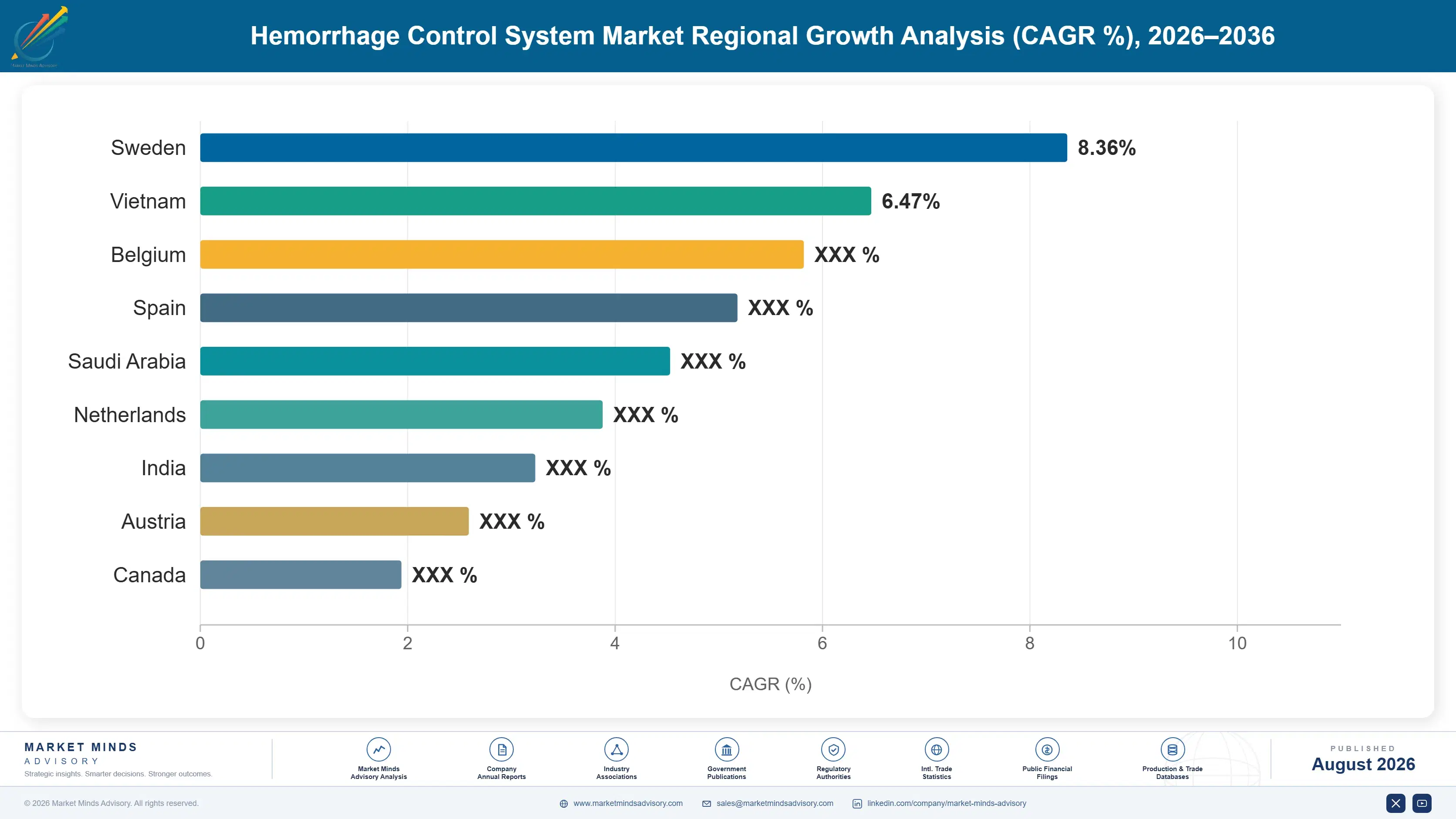
hemorrhage-control-system-market-country-cagr-analysis-1787301149386

Where Suppliers Can Defend Trauma Margin

Suppliers can defend margin against commoditized device pricing in several distinct ways beyond simply selling more units into a growing installed base. The four levers below identify genuine commercial advantage: field outcome documentation, training program bundling, military qualification depth, and manufacturing positioned ahead of civilian mandate rollouts across major regulated markets and their evolving compliance timelines worldwide.

Document Field Outcome Data From Real Incidents

Institutions increasingly demand documented field performance data before qualifying a supplier for large-scale kit placement contracts, not just laboratory efficacy testing under controlled conditions. Suppliers that collect and publish real-world outcome data from actual trauma incidents can charge premiums of 20% to 30% over competitors relying on laboratory data alone, since institutions value proven field performance more than the incremental cost difference involved. Teleflex's published field outcome studies have directly informed several institutional procurement decisions across major hospital systems and defense contracts spanning multiple successive procurement cycles across both military and civilian institutional buyers.
Market Impact: Commands a durable 20% to 30% price premium

Bundle Training Programs With Device Placement Sales

Selling bare devices alone commoditizes quickly, since correct application technique matters more to outcomes than the specific hardware used, and institutions know effectiveness depends heavily on training quality. Suppliers that bundle certified training programs with device placement, charging a recurring per-facility training fee of roughly 5,000 to 15,000 dollars annually, convert a one-time equipment sale into a recurring revenue relationship while also locking in institutional loyalty through the training relationship itself. North American Rescue has scaled this bundled strategy successfully across thousands of institutional accounts nationwide over the past several years.
Market Impact: Adds roughly 10,000 dollars in annual recurring revenue

Maintain Military Qualification Across Defense Programs

Winning military qualification for individual first aid kit inclusion creates a multi-year revenue relationship that smaller competitors cannot easily displace, since requalification requires costly testing against military specification standards that take years to complete and validate. Suppliers that secure these qualifications early, often locking in multi-year defense procurement contracts spanning multiple service branches, gain guaranteed volume independent of civilian market fluctuations entirely across the contract term. Teleflex and North American Rescue both hold long-standing military qualification relationships worth well over 50 million dollars annually across combined defense programs and their multi-year renewal cycles.
Market Impact: Secures durable multi-year contracts worth over 50 million

Position Manufacturing Ahead of Civilian Mandate Waves

Manufacturing capacity for bystander kits has repeatedly struggled to keep pace with sudden civilian mandate demand spikes when states pass new Stop the Bleed legislation, creating temporary shortages that reward suppliers who invested ahead of the legislative wave rather than reactively. Suppliers with pre-positioned manufacturing in newly mandating states can capture premium pricing of 15% to 25% during the transition scramble, since institutions facing hard compliance deadlines cannot wait for new capacity elsewhere. Cardinal Health has repeatedly timed capacity expansions to anticipate announced state legislation well ahead of formal enactment dates.
Market Impact: Captures a durable 15% to 25% price premium

Who Controls the Margin Pool

Concentration stays moderate at 48% held by the top five suppliers, evaluated on revenue from hemorrhage control device product lines specifically. Teleflex and Medtronic lead on scale and military relationship depth, while 3M, Cardinal Health, and North American Rescue compete across different application specialties and distribution channels. The gap between leader and challenger is meaningful but not decisive, since institutions often qualify multiple suppliers per device category.
Competitive activity currently runs along three dimensions. Field outcome documentation matters most, as suppliers race to collect and publish real-world performance data supporting institutional procurement decisions. Training program bundling runs a close second, converting device sales into recurring institutional relationships. Military qualification depth is the third, securing multi-year defense procurement volume independent of civilian market cycles.

Pressure is building from two directions. Specialty trauma device startups are commercializing novel junctional and hemostatic technologies that could challenge established suppliers on documented performance grounds. Meanwhile Chinese domestic manufacturers are scaling rapidly in emerging markets, narrowing the technology gap on conventional tourniquets and dressings despite lacking comparable field outcome data. Rankings will shift toward suppliers combining defensible clinical evidence with genuine training program depth.
hemorrhage-control-system-market-company-positioning-matrix-1787301149971

Competitive Moat and Risk Dimensions

TELEFLEX INCORPORATED

Moat: QuikClot Field Outcome Depth

Teleflex's QuikClot hemostatic product line carries one of the industry's deepest published field outcome data sets, accumulated across both military and civilian trauma settings over many years. That documentation depth gives Teleflex a credibility advantage that newer entrants cannot quickly replicate regardless of their underlying chemistry performance.
TELEFLEX INCORPORATED

Risk: Exposure to Defense Budget Cycles

Teleflex's military-weighted revenue mix makes it more exposed than civilian-focused competitors to swings in defense procurement budgets, which can pause during periods of fiscal constraint or shifting government priorities. That cyclicality creates revenue volatility competitors focused on steadier civilian institutional demand largely manage to avoid entirely.
MEDTRONIC PLC

Moat: Broad Surgical Hemostat Portfolio

Medtronic's surgical hemostat portfolio spans both trauma and operating room applications, giving it breadth that narrower trauma-only specialists cannot match while also embedding hemostasis products across its broader surgical relationship with major hospital systems and their affiliated purchasing networks spanning most major metropolitan regions nationwide.
MEDTRONIC PLC

Risk: Trauma a Smaller Portfolio Segment

Hemorrhage control represents a relatively small segment within Medtronic's much larger diversified medical device portfolio, meaning specialized trauma competitors sometimes out-innovate Medtronic on trauma-specific technology since their entire engineering focus concentrates there exclusively, without the competing internal capital priorities Medtronic's much broader device portfolio must constantly balance.

Key Players

Teleflex Incorporated
Medtronic plc
3M Company
Cardinal Health, Inc.
North American Rescue, LLC

Others

Tricol Biomedical, Inc.
HemCon Medical Technologies, Inc.
RevMedx, Inc.
SAM Medical
Delfi Medical Innovations Inc.
Compression Works, LLC
Becton, Dickinson and Company
Innovative Trauma Care, Inc.
PerSys Medical
TacMed Solutions, LLC
Ethicon, Inc.
Baxter International Inc.
CSL Behring
Chinook Medical Gear, Inc.
Combat Medical Systems, LLC

Recent Developments

APRIL 2025

Teleflex publishes expanded QuikClot combat casualty outcome study

Teleflex published an expanded field outcome study documenting QuikClot hemostatic performance across recent combat casualty care incidents, extending its previously published civilian trauma data set. This was a research publication, not a corporate transaction, extending Teleflex's documented performance record significantly across both military and civilian settings.
Signal: Shows leading suppliers continuing to invest in field outcome documentation to defend premium positioning industry-wide today.
OCTOBER 2024

North American Rescue expands civilian training program capacity

North American Rescue expanded its certified civilian bystander training program capacity to serve growing Stop the Bleed demand across newly mandating states. This was an organic capacity expansion, not a corporate transaction, reflecting direct investment in response to sustained civilian mandate growth across multiple states.
Signal: Indicates suppliers increasingly investing directly in training infrastructure to capture growing civilian mandate demand nationwide and beyond.
JANUARY 2025

3M signs supply agreement with major hospital purchasing organization

3M entered a multi-year supply agreement to provide hemorrhage control products across a major hospital group purchasing organization's member network. The arrangement was a supply agreement, not an acquisition or joint venture, extending 3M's institutional distribution reach meaningfully across the purchasing organization's entire network of member hospitals nationwide.
Signal: Signals hospital systems increasingly consolidate hemorrhage control procurement through centralized purchasing relationships and durable long-term contracts.

Specialty Textile and Chitosan Exposure

Specialty woven textiles, chitosan-based hemostatic agents, and elastic compression materials together account for roughly 20% to 28% of device system COGS, sourced primarily from specialty textile manufacturers in the United States and from chitosan processors concentrated in Asia. Buckles, straps, and application hardware add a further 8% to 12%, sourced from precision manufacturing suppliers across multiple qualified regions.
Chitosan and specialty textile prices rose meaningfully through 2024 as demand from both medical and broader industrial applications competed for the same raw material supply chain, according to trade data. Teleflex's 2024 annual report disclosed higher input costs attributable to specialty material inflation, noting that chitosan sourcing cost rose meaningfully faster than the company could pass through to institutional customers without meaningful margin compression across its hemorrhage control segment specifically.

Smaller specialty device manufacturers carry more exposure than the largest diversified suppliers, since they lack the purchasing scale to negotiate favorable long-term material contracts with primary suppliers. Suppliers sourcing chitosan from a concentrated set of Asian processors face additional exposure to export policy shifts, while those with diversified sourcing absorb volatility more predictably across their broader supply chain.
hemorrhage-control-system-market-cost-volatility-analysis-1787301150196

Lock Textile Pricing Through Multi-Year Contracts

Specialty textiles are the largest single volatile input across most device product lines and increasingly competed for by broader medical and industrial textile demand. Multi-year supply agreements with fixed or collared pricing, common practice among larger diversified suppliers, smooth quarter-to-quarter volatility and let commercial teams quote institutional contracts with genuine confidence rather than repricing constantly against volatile spot markets.

Diversify Chitosan Sourcing Across Regions

Reliance on a single chitosan processor concentrates both price and availability risk unnecessarily across an entire hemostatic product line. Qualifying secondary suppliers across multiple regions, even at modestly higher unit cost, protects continuity when any single processor faces export restriction, capacity constraint, or a sudden demand spike from competing medical and industrial application sectors simultaneously.

Vertically Integrate Textile Manufacturing Capacity

Suppliers that bring textile manufacturing in-house rather than purchasing finished materials capture manufacturing margin previously paid to a third party while gaining direct visibility into actual material consumption and lead times. That integration also shortens delivery timelines meaningfully during periods of tight global textile supply and rising raw material demand from competing industrial applications.

Portfolio Architecture for Margin Defence

The portfolio splits into three tiers with meaningful margin separation tied to clinical evidence and application complexity. Volume tier products carry standard tourniquets and basic gauze for conventional first aid applications, competing largely on price. Premium certified products carry hemostatic dressings and combination kits backed by documented field outcome data. Sustainability and next-generation products, meaning junctional and non-extremity devices, attract the sector's most active r
The tension between volume and premium runs through nearly every supplier's product roadmap. Volume products fund the manufacturing scale and distribution network premium products eventually depend on, yet volume margins keep compressing as regional manufacturers scale aggressively on conventional tourniquets. Suppliers that under-invest in premium junctional capability risk commoditization, while those chasing premium exclusively struggle to fund the manufacturing base for routine first aid demand.

High-value margin pools concentrate specifically in junctional devices and combat casualty kits where performance consequences carry the largest clinical and financial stakes, and where documented field outcome data commands genuine pricing power. Conventional tourniquets and basic gauze generate steadier volume but thinner margin, since that segment competes against a wider set of lower-cost regional suppliers with adequate but unremarkable clinical evidence.

Volume / Commodity-Adjacent Tier

Standard tourniquets and basic gauze for conventional first aid applications, competing largely on price against a crowded field of regional manufacturers offering broadly comparable specifications and material quality across the industry.
Gross Margin: 20-30%

Premium / Certified Tier

Hemostatic dressings and combination trauma kits backed by documented field outcome data and formal institutional qualification, commanding meaningful pricing premiums over conventional equivalents across most major military and civilian institutional markets.
Gross Margin: 35-48%

Sustainability / Regulatory / Next-Generation Tier

Junctional and non-extremity hemorrhage control devices still scaling across military and civilian protocols, targeting bleeding sites conventional tourniquets simply cannot address at any comparable level of clinical effectiveness or reliability.
Gross Margin: 40-55%
hemorrhage-control-system-market-portfolio-architecture-1787301150756

High-value Sub-segments and Strategic Watch-out

Junctional and Non-Extremity Devices

High value and high growth, driven by expanding military and civilian trauma protocols addressing wound locations beyond traditional limb tourniquets, with clinical evidence barriers protecting incumbent suppliers from new entrant price competition on the largest military and civilian institutional accounts worldwide across every major defense and civilian procurement program.
Gross Margin: 40-55%

Combat and Civilian Trauma Kits

High value with moderate growth, anchored by sustained military modernization and expanding Stop the Bleed civilian mandate programs, where documented kit configuration increasingly decides vendor qualification for large institutional procurement contracts across defense, public safety, and institutional healthcare sectors alike across most major regulated markets worldwide.
Gross Margin: 35-48%

Standard Tourniquets and Basic Gauze

The category's largest volume base by unit count, competing on price against a crowded field of regional suppliers, generating steady but thin margin as conventional first aid demand matures across most developed and increasingly price-sensitive emerging markets, from Latin America to Southeast Asia and beyond.
Gross Margin: 20-30%

Legacy Non-Hemostatic Dressing Formats

Strategic watch-out where advanced hemostatic dressings increasingly threaten to displace legacy non-hemostatic gauze across most trauma applications, creating genuine technology risk for suppliers slow to transition product lines toward advanced hemostatic formats quickly enough to retain institutional customers demanding proven, well-documented clinical outcomes consistently over time.
Gross Margin: 12-20%

Kit Placement Economics of Trauma Programs

Hemorrhage control demand behaves like an annuity once an institution establishes a kit placement program, since replacement cycles, expiration dating, and ongoing training requirements generate recurring purchase volume independent of any single initial procurement decision. That structure gives suppliers with strong institutional relationships a predictable revenue floor even during periods without active mandate expansion, since existing kit programs keep requiring replacement on a continuous
Adoption depth varies sharply by end-use vertical. Military and major trauma center deployments have adopted the newest hemostatic technologies almost immediately upon qualification, since clinical outcomes there carry severe consequences that justify premium investment. Smaller civilian institutions lag well behind, treating advanced devices as optional rather than standard, partly because trauma incidence is genuinely lower and partly because budget constraints favor basic kit configurations.

Buyer profiles have shifted generationally. Procurement decisions that once sat primarily with individual safety officers now route through centralized emergency preparedness and risk management committees at larger organizations, rewarding suppliers able to present integrated training and outcome data rather than relationship selling alone. Younger emergency management professionals entering leadership roles treat hemorrhage control kit placement as a baseline institutional expectation rather than a discretionary safety investment.
hemorrhage-control-system-market-end-use-penetration-index-1787301151297

MMA's Read on Trauma Response

These are among the four positions where our research anticipates prominent divergence between winners and laggards over the coming forecast period. Each is grounded in the demand model, the regulatory perimeter, and the announced capacity pipeline.
01 / FIELD EVIDENCE STRATEGY

Documented outcome data will separate winners from unproven challengers

Institutions increasingly demand documented field performance data before large-scale kit placement decisions, which means suppliers relying solely on laboratory testing rather than real-world outcome documentation will keep losing bids to competitors with proven track records, regardless of underlying device design. Field evidence addresses the exact credibility gap that slows institutional adoption in a category where failure carries severe consequences. Suppliers that build documentation now, before competitors establish comparable evidence bases, will hold institutional relationships rivals cannot quickly dislodge for years to come.
02 / CIVILIAN MANDATE POSITIONING

Early mover advantage will define share gains through 2036

Civilian Stop the Bleed mandates keep expanding across additional states and municipalities, and each new mandate creates a demand wave that rewards suppliers with established institutional relationships built ahead of formal legislative requirements. Suppliers without civilian market positioning increasingly cannot compete for this segment quickly, since institutions prioritize established, trusted vendors over unproven newcomers regardless of price offered. Those investing in civilian relationships now, ahead of competitors still focused purely on military accounts, will capture disproportionate share as mandate programs keep expanding.
03 / JUNCTIONAL DEVICE INVESTMENT

Non-extremity hemorrhage control will decide who wins the next protocol cycle

Combat casualty care data has consistently demonstrated that junctional and non-extremity hemorrhage represents a leading cause of preventable death that traditional limb tourniquets cannot address, creating sustained demand for specialized devices addressing this specific clinical gap. Suppliers without proven junctional technology increasingly lose bids for updated protocol adoption, regardless of reputation built in conventional tourniquet categories over decades. Those investing in junctional device capability now, ahead of competitors still focused on extremity-only solutions, will capture disproportionate share as protocols keep expanding.
04 / TRAINING INFRASTRUCTURE INVESTMENT

Bundled training programs will permanently reshape institutional purchasing decisions

Institutions increasingly recognize that device effectiveness depends as much on training quality as hardware specifications, permanently shifting procurement evaluation criteria beyond simple product comparison toward comprehensive program assessment including training delivery capability. That shift is simultaneously freeing device-only suppliers to lose ground against competitors offering integrated training and device bundles that institutions increasingly prefer for simplicity. The net effect redraws competitive geography in ways unlikely to reverse regardless of future device-only innovation from any single supplier in the category from any remaining device-only holdouts.

Engagement Snapshot From the Field

A live engagement with an industry participant carrying material or product regulatory and market exposure ahead of a defining policy shift, showing how our research translates into a defensible multi-year portfolio strategy.
MARKET MINDS ADVISORY · CLIENT ENGAGEMENT SUMMARY
Hemorrhage Control System Producer Strategic Portfolio Review and Transition Roadmap 2026·Investment Scenario on Hemorrhage Control System Exposure Evaluation 2025-26
CLIENT PROFILE
A regional school district operating 45 schools across a mid-sized metropolitan area, reporting an annual safety and security budget of roughly 8 million dollars, approached MMA after state legislation newly mandated bleeding control kit placement and staff training across all district facilities within eighteen months across the entire district, spanning elementary, middle, and high schools (client-reported, unverified by MMA).
STRATEGIC CHALLENGE
Leadership faced pressure to comply with the new state mandate across every facility without exceeding an already constrained safety budget competing against other capital priorities. Facilities staff wanted the simplest possible kit configuration to minimize training burden, while the district's legal counsel needed assurance that the chosen approach would satisfy the specific requirements written into the new state law.
MMA APPROACH
MMA benchmarked kit configurations and training program options across three candidate suppliers, modeled total program cost including initial placement, staff training, and ongoing replacement across the full eighteen-month compliance window, and assessed which suppliers offered the strongest documented training outcomes at comparable school districts that had already completed similar mandate compliance programs.
KEY FINDINGS
  1. Bundling training with kit placement from a single supplier reduced total program cost meaningfully compared with sourcing devices and training separately from different vendors.
  2. A phased rollout prioritizing the largest schools first allowed the district to demonstrate compliance progress well ahead of the full eighteen-month deadline.
  3. Staff retention of training content varied significantly by delivery format, with hands-on sessions outperforming video-only training substantially across every tested age and staff role group (client-reported, unverified by MMA).
  4. The district's insurance carrier offered a modest premium reduction once the bleeding control program was fully documented and implemented across all facilities.
CLIENT PROFILE
A regional school district operating 45 schools across a mid-sized metropolitan area, reporting an annual safety and security budget of roughly 8 million dollars, approached MMA after state legislation newly mandated bleeding control kit placement and staff training across all district facilities within eighteen months across the entire district, spanning elementary, middle, and high schools (client-reported, unverified by MMA).
STRATEGIC CHALLENGE
Leadership faced pressure to comply with the new state mandate across every facility without exceeding an already constrained safety budget competing against other capital priorities. Facilities staff wanted the simplest possible kit configuration to minimize training burden, while the district's legal counsel needed assurance that the chosen approach would satisfy the specific requirements written into the new state law.
MMA APPROACH
MMA benchmarked kit configurations and training program options across three candidate suppliers, modeled total program cost including initial placement, staff training, and ongoing replacement across the full eighteen-month compliance window, and assessed which suppliers offered the strongest documented training outcomes at comparable school districts that had already completed similar mandate compliance programs.
KEY FINDINGS
  1. Bundling training with kit placement from a single supplier reduced total program cost meaningfully compared with sourcing devices and training separately from different vendors.
  2. A phased rollout prioritizing the largest schools first allowed the district to demonstrate compliance progress well ahead of the full eighteen-month deadline.
  3. Staff retention of training content varied significantly by delivery format, with hands-on sessions outperforming video-only training substantially across every tested age and staff role group (client-reported, unverified by MMA).
  4. The district's insurance carrier offered a modest premium reduction once the bleeding control program was fully documented and implemented across all facilities.
RECOMMENDED STRATEGY
Phase 1: Phase 1 (0 to 6 months): Deploy kits and complete staff training at the ten largest schools first, prioritizing facilities with the highest enrollment. Phase 2: Phase 2 (6 to 15 months): Complete rollout across all remaining schools, maintaining the same bundled supplier and training approach throughout. Phase 3: Phase 3 (15 to 24 months): Establish an ongoing refresher training schedule and kit replacement tracking system for long-term program sustainability.
OUTCOME
The district achieved full compliance with the state mandate three months ahead of the legal deadline, and the documented program has since qualified the district for the insurance premium reduction it had not originally anticipated and improved staff confidence in emergency response readiness overall (client-reported, unverified by MMA).

Frequently Asked Questions

Foundational context covering the market sizes, CAGR, scope, country, region and competition that inform every finding below. This section is provided to cover basics and most often pre-purchase conversations, answered from the MMA Primary Research Dataset.

What is the current size of the Hemorrhage Control System Market?

The market reached an estimated 1.9 billion dollars in 2025. That figure reflects global revenue across tourniquets, hemostatic dressings, granules, wound clamps, chest seals, and trauma first aid kits.

How large will the Hemorrhage Control System Market be by 2036?

MMA projects the market will reach approximately 4.8 billion dollars by 2036 under the base case scenario. That represents roughly 2.32 times the 2026 market value.

What is the CAGR for the Hemorrhage Control System Market 2026 to 2036?

The base case CAGR is 8.8% annually across the full ten-year forecast period. Bull and bear scenarios run 10.1% and 7.5% respectively, reflecting civilian mandate timing uncertainty.

Which segment is growing fastest?

Wound clamps and junctional devices grow fastest at 11.5% CAGR, about 1.31 times the overall market rate. Expanding military and civilian protocols beyond limb tourniquets are the primary driver.

Who are the major companies in the Hemorrhage Control System Market?

Teleflex, Medtronic, 3M, Cardinal Health, and North American Rescue lead the category by a consistent revenue basis. Together they hold roughly 48% of device revenue.

Which country is growing fastest?

India leads national growth at an estimated 11.0% CAGR, driven by national road safety initiatives and expanding prehospital emergency response infrastructure. Ambulance fleet growth keeps intensifying.

Report Segmentation Architecture

The full report scope spans multiple orthogonal segmentation dimensions, with cross-tabulated demand data provided for each dimension pair. Coverage extends further to regional breakdowns, trend trajectories, and the competitive detail needed to support segment-level decision-making.

By Device Type

  • Tourniquets
  • Hemostatic Dressings and Gauze
  • Hemostatic Granules and Powders
  • Wound Clamps and Junctional Devices
  • Chest Seals and Sealants
  • Combat and Trauma First Aid Kits

By End-Use Industry

  • Military and Defense Forces
  • Hospitals and Trauma Centers
  • Emergency Medical Services
  • Schools and Public Institutions
  • Law Enforcement and Public Safety

By Commercial Dimension

  • Direct Institutional Contract Sales
  • Distributor and Wholesale Sales
  • Training Program Bundled Sales
  • Original Equipment Manufacturer Licensing

By Region

  • North America
  • Western Europe
  • East Asia
  • South Asia and Pacific
  • Latin America
  • Middle East and Africa
  • Eastern Europe

Scope, Methodology, and Coverage

Every figure in this report is reproducible from documented input assumptions. The scope below maps the historical period, the forecast horizon, the segmentation dimensions, and the countries covered, alongside the underlying primary and qualitative methodology.
Historical Period
2020 to 2025
Forecast Period
2026 to 2036
Base Year
2025 (USD billions; MMA Primary Research Dataset, August 2026)
Market Definition
The hemorrhage control system market covers tourniquets, hemostatic dressings and gauze, hemostatic granules, wound clamps, junctional devices, chest seals, and combination trauma first aid kits used to control life-threatening bleeding. It includes device hardware, associated training programs, and replacement kit sales. Surgical hemostats used exclusively in operating room settings and general first aid supplies unrelated to hemorrhage control are excluded.
Quantitative Units
USD billions (current prices); unit shipment volume where applicable
Segmentation Dimensions
By Device Type; By End-Use Industry; By Commercial Dimension; By Region
Regions Covered
North America, Western Europe, East Asia, South Asia and Pacific, Latin America, Middle East and Africa, Eastern Europe
Countries Covered
USA, China, Germany, France, UK, Japan, South Korea, India, Australia, Canada, Brazil, Mexico, Indonesia, Vietnam, Thailand, Malaysia, UAE, Saudi Arabia, South Africa, Nigeria, Turkey, Poland, Netherlands, Italy, Spain, Sweden, Switzerland, Argentina, Colombia, Singapore, and additional markets relevant to this sector
Key Companies Profiled
Teleflex Incorporated; Medtronic plc; 3M Company; Cardinal Health, Inc.; North American Rescue, LLC; Tricol Biomedical, Inc.; HemCon Medical Technologies, Inc.; RevMedx, Inc.; SAM Medical; Delfi Medical Innovations Inc.; Compression Works, LLC; Becton, Dickinson and Company; Innovative Trauma Care, Inc.; PerSys Medical; TacMed Solutions, LLC; Ethicon, Inc.; Baxter International Inc.; CSL Behring; Chinook Medical Gear, Inc.; Combat Medical Systems, LLC
Quantitative Methodology
Primary survey, n=3,800 respondents, Q4 2025, six countries; demand-side model with trade association cross-validation
Qualitative Methodology
47 expert interviews, Q4 2025; applied to validate demand model assumptions, identify emerging dynamics, and assess competitive positioning
Report Format
PDF and XLSX data workbook (Word format preview document)
Publisher
Market Minds Advisory
Report Code
MMA-2026-MED-204
Published
August 2026
Contact
sales@marketmindsadvisory.com | www.marketmindsadvisory.com

Purchase the full Hemorrhage Control System Market Report (2026 to 2036).

The full MMA Hemorrhage Control System report sizes the market across six device categories, five end-use industries, four commercial contracting models, and seven regions through 2036. It profiles twenty participants on a consistent basis of device revenue, scoring the top five on field outcome documentation, training program depth, and military qualification breadth. Scenario models quantify how civilian mandate expansion, military modernization, and specialty material price volatility move both demand and achievable pricing. The report also includes delivered cost modeling by device category, a civilian mandate tracker across major markets, and a supplier displacement risk assessment built for institutions, suppliers, and investors.
Six-segment device demand model through 2036
Civilian mandate and legislation tracker across states
Field outcome documentation competitive assessment tool
Training program bundling benchmarking dataset and analysis
Specialty textile and chitosan cost sensitivity model
Supplier displacement risk scoring by device type

Built For The People Who Decide

From boardroom strategy to bench-side execution, this report is read cover-to-cover by leaders shaping the next decade of their industry, turning demand scenarios, market dynamics and valuation benchmarks into decisions.
CXOs/ Presidents/ VPs/ Managers
M&A and Corporate Development
Strategy Teams and R&D Heads
Procurement and Product Directors
Regulatory and Compliance Leaders
Investor Relations and Equity Analysts