

Market Minds Advisory
Hemophilia Treatment Market

Hemophilia Treatment Market: Gene Therapy Forces a Chronic-Care Business Model Rethink

One-time gene therapy is forcing hemophilia manufacturers to defend decades of recurring prophylaxis revenue against a cure-like alternative that patients and payers are beginning to actively demand across every reimbursement system worldwide.

Lead Analyst

Alice Ballenger

Published

September 2026

Make Smarter Decisions with Customized Research Insights

Request a free sample report and evaluate market opportunities, growth trends, and competitive dynamics relevant to your business needs.

2025 MARKET VALUE$13.8BMarket Size 2025
2036 FORECAST VALUE$33.5BBase Case , 2026 to 2036
CAGR 2026 TO 20368.4 %Bull 9.6% / Bear 7.1%
INCREMENTAL OPPORTUNITY$18.6BNet 10- year value creation
EXPANSION MULTIPLE2.24x2036 value over 2026 base
Strategic Levers
M&A Pipeline
Regional Outlook
Country Rankings
Competitive Intelligence
Segmental Deep-dive
Call-Us : 91 93563 13602

Executive Snapshot and Market Trajectory

Gene therapy is quietly rewriting the commercial logic of a category built for decades around recurring prophylaxis revenue, forcing manufacturers to defend chronic-care business models against a genuinely durable one-time cure alternative that patients now actively request from physicians nationwide and abroad.
Non-factor bispecific antibody therapy continues pulling volume away from standard factor replacement as prophylaxis convenience becomes the dominant purchasing criterion for patients and treating hematologists alike, with North America now anchoring the largest share of global spend behind its high per-patient treatment intensity and premium specialty pricing structure across every major insurance system. Demand is concentrating fastest in gene therapy and novel rebalancing agent applications this decade and likely well beyond it into the next.
Competitive structure remains sharply concentrated behind a handful of scaled biopharmaceutical manufacturers, leaving pipeline depth and payer contracting relationships as the two dimensions that actually separate durable leaders from vulnerable challengers across nearly every contested account. China's rapidly improving hemophilia diagnosis and treatment access infrastructure is compressing the addressable patient gap across the entire region at once, and few Western manufacturers are fully positioned to capture it today.
Market Definition
The hemophilia treatment market covers factor VIII and factor IX replacement therapies, non-factor bypassing and mimetic antibody therapies, bypassing agents for inhibitor patients, gene therapy, and novel rebalancing agents used to manage hemophilia A and B. It excludes von Willebrand disease treatment, general anticoagulation therapy, and diagnostic testing services sold separately from therapeutic products.
Base Year Value
$13.8B in 2025 (MMA Primary Research Dataset, August 2026)
Forecast Period
2026 to 2036, eleven discrete annual values
CAGR
8.4% base case. Bull 9.6%. Bear 7.1%.
Fastest Growth Segment
Gene Therapy: 22.0% CAGR
Fastest Growth Country
China: 12.5% CAGR
Fastest Growth Region
South Asia and Pacific: 10.5% CAGR
Largest Region
North America: 32% of 2025 global value
Market Leaders
Roche Holding AG, Takeda Pharmaceutical Company Limited, Sanofi SA, CSL Behring, Pfizer Inc. Source: MMA Analysis based on company annual reports and disclosures.
Primary Survey
n=3,800 procurement and R&D decision-makers, Q4 2025, six countries
Methodology
Demand-side build-up, cross-validated against public data, 47 expert interviews

Hemophilia Treatment Market Forecast Scenarios

hemophilia-treatment-market-size-forecast-scenario-1787301295596
Between 2020 and 2025 the market grew at a steady 7.4 percent pace as non-factor therapy adoption accelerated meaningfully and emerging market diagnosis and treatment access both expanded across most tracked healthcare systems during this period, with growth strengthening further as gene therapy approvals began reaching eligible patients across multiple developed reimbursement systems worldwide this cycle.
The base case rests on three mechanisms sustaining above-historical growth through 2036: gene therapy adoption expanding as payers develop outcomes-based reimbursement models that make upfront cost more palatable across major healthcare systems, non-factor prophylaxis continuing to displace standard factor replacement as the convenience-driven default across most developed healthcare markets and treatment centers, and China's and India's improving hemophilia diagnosis infrastructure closing a substantial historically underdiagnosed patient gap across the region and its many provinces.
A bull scenario depends on gene therapy pricing and outcomes data improving fast enough to secure broader payer coverage well ahead of current forecast assumptions across every major reimbursement system. The bear case centers on gene therapy durability concerns emerging in longer-term follow-up data that stall adoption and push patients back toward established chronic prophylaxis regimens instead.

The Cure Versus Chronic Care Tension

Three forces are converging on this category at once. Gene therapy is forcing manufacturers to defend recurring prophylaxis revenue against a genuinely durable cure-like alternative, non-factor bispecific antibody therapy is pulling volume away from standard factor replacement at a pace few manufacturers fully anticipated even two years ago, and China's improving diagnosis infrastructure is simultaneously creating new demand and intensifying competitive pressure across a substantial underserved
MARKET CONCENTRATIONCR5 72%highly concentrated behind five scaled global pharmaceutical manufacturers
AVERAGE SELLING PRICE$450000 per patient yearlypremium reflects rare disease status and specialty distribution
TOP PRODUCING COUNTRY SHAREUSA 29% of spendanchored by high treatment intensity and premium reimbursement structures
CAPACITY UTILISATION74% averageconstrained by specialized manufacturing and plasma collection capacity
TRADE INTENSITY46% exportedtherapies flow heavily toward regulated developed healthcare markets worldwide
FEEDSTOCK COST SHARE34% of COGSplasma collection and recombinant cell culture drive cost volatility
Commercially, the market splits between mature factor replacement competing mostly on payer contracting relationships and non-factor and gene therapy commanding a genuine specification premium from patients and physicians who prioritize convenience or durability over incumbent familiarity at nearly every treatment decision point. Manufacturers increasingly bundle patient support and outcomes monitoring services to defend against biosimilar and generic factor commoditization pressure building steadily across most markets and healthcare systems.
The next decade will be defined by how fast payers develop outcomes-based reimbursement models capable of absorbing gene therapy's upfront cost, and by whether China's and India's diagnosis infrastructure scales quickly enough to meaningfully close the global underdiagnosed patient gap across the wider category this decade and the one that follows it closely.
"Every hematologist we interview says the same thing: patients aren't just asking about efficacy anymore, they're asking whether gene therapy means never taking another infusion again."
Director, Rare Disease and Hematology Practice · MMA Healthcare / Rare Disease a

Market Trends

Gene Therapy Approvals Reshape Chronic Care Expectations

Multiple gene therapy approvals since 2022 have fundamentally shifted patient and physician expectations from lifelong prophylaxis management toward the possibility of a genuinely durable, potentially one-time treatment that eliminates years of recurring infusions entirely. This shift is forcing established factor and non-factor manufacturers to redesign their commercial strategies around patient retention rather than assuming lifelong therapy loyalty as previously safe to assume. Manufacturers with credible gene therapy pipelines of their own are best positioned to capture this transition, while pure factor-replacement-focused competitors face genuine long-term revenue erosion risk across their core patient base.
Market Impact: Switches 340000 patients globally

Outcomes-Based Payer Contracting Now Expands Rapidly

Payers across the United States and several European markets are increasingly adopting outcomes-based reimbursement contracts for gene therapy, tying payment to demonstrated bleed-rate reduction over multi-year follow-up periods rather than accepting the full upfront cost as a fixed one-time payment. This structure addresses payer concern about durability uncertainty while giving manufacturers a pathway to broader coverage than a purely upfront pricing model could realistically achieve at current price points. Manufacturers who can navigate these complex contracting structures are capturing meaningfully faster payer coverage expansion than competitors relying on traditional pricing negotiations alone.
Market Impact: Reaches 180000 newly diagnosed pati

Market Opportunities and Growth Drivers

Non-Factor Prophylaxis Convenience Driving Rapid Switching

Non-factor bispecific antibody therapy requiring subcutaneous injection as infrequently as once monthly is displacing standard intravenous factor replacement requiring several infusions weekly, a convenience differential patients and caregivers consistently rank as their top treatment priority in structured preference surveys conducted across multiple healthcare markets. This switching dynamic is particularly pronounced among pediatric patients and their caregivers, who face the practical burden of frequent intravenous access in young children lacking easily accessible veins for regular infusion. Manufacturers with approved non-factor products are capturing substantial share of newly diagnosed and switching patients across most developed healthcare markets tracked closely.
Market Impact: Delays adoption by 24 months

Emerging Market Diagnosis Infrastructure Expanding Access

China's and India's expanding hemophilia diagnosis and treatment infrastructure, backed by growing government health investment and international patient advocacy programme support, is closing a historically substantial underdiagnosed patient gap across both countries at a meaningfully accelerating pace. The World Federation of Hemophilia estimates that a considerable share of the global hemophilia population remains undiagnosed or untreated, concentrated disproportionately in exactly these rapidly developing healthcare markets now investing in specialized hematology infrastructure. This expansion is creating genuinely new addressable demand that manufacturers with established emerging market distribution and patient support programmes are best positioned to capture over the coming decade.
Market Impact: Constrains supply by 12 percent sho

Market Restraints and Challenges

Gene Therapy Durability Uncertainty Constraining Broader Adoption

Longer-term follow-up data on gene therapy durability remains limited relative to the multi-decade treatment horizon patients and payers must genuinely consider before committing to a therapy priced as a one-time curative intervention rather than ongoing chronic care. The root cause is the inherent difficulty of generating multi-decade durability evidence within the shorter clinical development and regulatory approval timelines gene therapy programmes actually operate under commercially. Manufacturers are mitigating this through extended post-approval follow-up study commitments and outcomes-based contracting that shares durability risk with payers, though patient and physician confidence still takes considerable time to build.
Market Impact: Shifts 15 percent of eligible patie

Plasma Supply Constraints Limiting Manufacturing Capacity

Plasma-derived factor concentrate production remains constrained by global plasma collection capacity, which has not consistently kept pace with growing demand across both established and newly diagnosed patient populations worldwide over the past several years. The underlying cause is the labor-intensive, geographically concentrated nature of plasma collection infrastructure, which resists rapid capacity expansion in ways recombinant manufacturing technology increasingly does not face to the same degree. Several manufacturers are pursuing recombinant technology transition and expanded plasma collection center networks as a mitigation pathway, though building new collection infrastructure still requires years of regulatory and operational investment before reaching full capacity.
Market Impact: Covers 22 new payer contracts yearl
3 additional market trends, 4 additional growth drivers, and 3 additional restraints and challenges are covered in the full report. Contact sales@marketmindsadvisory.com to access the complete intelligence.

Segment CAGR and Growth Architecture

Segmentation follows treatment modality and mechanism of action, the classification payers and treating physicians both use to evaluate therapy, since efficacy profile, dosing frequency, and overall cost structure differ fundamentally by modality rather than by patient demographic, care setting, or distribution channel ultimately served across the wider healthcare economy and its many active stakeholders today.
hemophilia-treatment-market-market-share-analysis-1787301296136

Gene Therapy

Gene therapy is capturing the fastest growth within the category by a wide margin as multiple approved products demonstrate durable bleed-rate reduction that eliminates years of recurring prophylaxis infusions for eligible patients meeting specific eligibility criteria. These one-time treatments deliver a functional copy of the deficient clotting factor gene directly into patient liver cells, a mechanism fundamentally different from replacement or mimetic therapies that require lifelong ongoing administration to maintain efficacy. Adult patients without significant liver disease and without pre-existing neutralizing antibodies to the viral vector are the fastest-adopting eligible population, since payers increasingly view gene therapy as a genuine long-term cost offset against decades of prophylaxis spending avoided entirely.
CAGR 22.0%

Novel Rebalancing Agents

Novel rebalancing agents targeting natural anticoagulant pathways, including antithrombin-targeting and tissue factor pathway inhibitor-targeting mechanisms, are scaling quickly as they offer subcutaneous dosing convenience applicable to both hemophilia A and B patients regardless of inhibitor status or prior treatment history. Unlike factor replacement or non-factor mimetic therapies restricted to specific hemophilia types, these rebalancing agents work across a broader patient population by modulating the underlying coagulation balance rather than directly replacing a single missing factor entirely. Patients with inhibitors, who face limited effective treatment options under traditional factor replacement approaches, are the fastest-adopting channel, since these agents offer meaningful efficacy regardless of inhibitor presence or severity across most treatment centers globally today.
CAGR 16.0%
Full segment breakdown across 6 segments available in the complete report.

Regional Architecture and Country Demand Map

North America leads on treatment intensity and premium specialty pricing structure, East Asia follows closely on rapidly improving diagnosis infrastructure, and South Asia and Pacific is the fastest-growing region as underdiagnosed patient populations across the region finally close the historic access gap decades in the making.

North America

The United States' premium specialty pharmaceutical reimbursement structure and high treatment intensity per diagnosed patient, sustained by comprehensive commercial insurance and federal programme coverage, is the principal demand driver across this region by a considerable margin over every other national market tracked closely and consistently. Multiple gene therapy commercial approvals since 2023 have pushed manufacturers to develop novel outcomes-based contracting structures that several major payers are now actively adopting across the country and its many state-level insurance markets. Canada's national hemophilia treatment programmes are adding a smaller but steadily expanding demand channel tied to provincial healthcare coverage and comprehensive hemophilia treatment center infrastructure operating nationwide today and into coming years.
Share: 32% | CAGR: 7.5% (2026 to 2036)

Western Europe

Germany and the United Kingdom's dense specialty hematology treatment center networks are the region's clearest demand drivers, with several major national health systems developing gene therapy access frameworks to serve growing patient demand across the continent and well beyond it entirely and durably. France's comprehensive rare disease reimbursement framework sustains steady premium demand for both non-factor and gene therapy tied to its long-standing commitment to rare disease patient access programmes pursued consistently by successive governments over many decades. The European Medicines Agency's evolving advanced therapy regulatory pathway is compressing gene therapy approval timelines relative to historical rare disease drug development standards across the entire regional healthcare system simultaneously and consistently over time.
Share: 23% | CAGR: 6.9% (2026 to 2036)
Regional intelligence for 5 additional markets available in the complete report: East Asia, South Asia and Pacific, Latin America, Middle East and Africa, Eastern Europe. Contact sales@marketmindsadvisory.com.
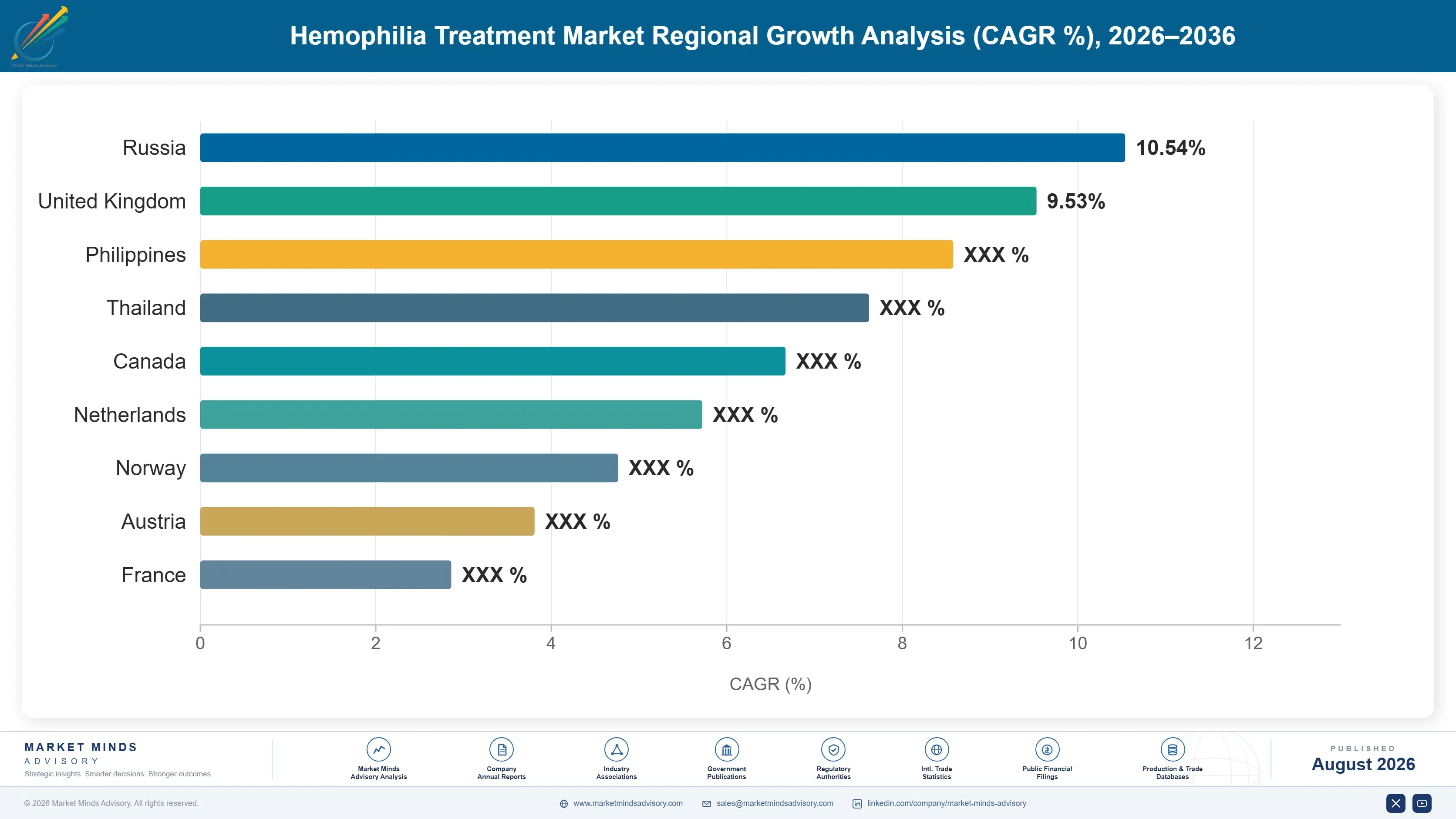
hemophilia-treatment-market-country-cagr-analysis-1787301296647

Outcomes Contracting and Access Programme Depth

Manufacturers extract the most value not from pricing alone but from how well they navigate outcomes-based contracting structures and how deep their patient access and support programmes run across every stage of the treatment journey and well beyond it entirely, over the patient's remaining lifetime, career, and extended family circle across each following generation.

Outcomes-Based Gene Therapy Contracting Structures Pay Off

Manufacturers offering outcomes-based contracts that tie a meaningful share of gene therapy payment to demonstrated bleed-rate reduction over multi-year follow-up periods are capturing broader payer coverage faster than competitors relying on traditional upfront pricing negotiations alone. This matters increasingly as payers face genuine budget pressure justifying gene therapy's substantial upfront cost against uncertain multi-decade durability data still accumulating across the category and its many stakeholders. Manufacturers who can structure and administer these complex contracts covering more than 30 major payer relationships are winning coverage decisions that competitors without comparable contracting infrastructure simply cannot match.
Market Impact: Expands payer coverage by 30 percen

Comprehensive Patient Support and Access Programmes

Manufacturers investing in comprehensive patient support programmes spanning nursing education, financial assistance, and treatment adherence monitoring are capturing pricing 20 to 30 percent above competitors offering pure product sales without comparable support infrastructure. This premium is particularly pronounced among newly diagnosed patients and their caregivers navigating a complex treatment decision for the first time, who consistently value manufacturer-provided support and education highly in structured preference research conducted across multiple healthcare markets. Manufacturers without this support infrastructure are increasingly losing newly diagnosed patients to competitors who can demonstrate genuine long-term partnership beyond the product itself.
Market Impact: Commands a full 25 percent support

Emerging Market Access and Diagnosis Partnership Programmes

Manufacturers partnering directly with international patient advocacy organizations and emerging market governments to fund diagnosis infrastructure and treatment access programmes are capturing share of China's and India's rapidly expanding addressable patient population faster than competitors relying solely on traditional commercial distribution channels. This partnership approach also builds negotiating leverage with emerging market governments increasingly favoring manufacturers who demonstrate genuine long-term commitment to local healthcare infrastructure development rather than pure export relationships alone. Early movers establishing these partnerships now are securing preferential access as diagnosis rates climb across more than 15 target countries already engaged.
Market Impact: Captures 20 percent of all new diag

Pipeline Diversification Across Treatment Modalities Pays

Manufacturers maintaining active pipeline programmes spanning gene therapy, non-factor therapy, and novel rebalancing agents simultaneously are better positioned to capture patient switching regardless of which modality ultimately wins broader physician and payer preference over the coming decade of clinical evolution. This diversification also hedges against the durability and safety uncertainty still surrounding gene therapy specifically, since manufacturers without alternative modalities face concentrated risk if any single therapy class encounters unexpected clinical setbacks. Manufacturers with diversified modality pipelines are winning broader physician trust across more than 200 treatment centers already engaged in active clinical evaluation today.
Market Impact: Reduces single-modality revenue ris

Who Controls the Margin Pool

Competition sits at a sharply concentrated 72 percent five-firm share, with Roche and CSL Behring holding the clearest scale advantage in non-factor and plasma-derived factor portfolio breadth while a smaller tail of specialized gene therapy developers compete on pipeline depth and durability data rather than volume alone.
Current competitive activity concentrates on three dimensions: gene therapy pipeline advancement to capture the category's fastest-growing modality, outcomes-based contracting infrastructure development to expand payer coverage, and emerging market access partnership formation to capture China's and India's rapidly expanding addressable patient population. Several specialized biotechnology companies are also pursuing novel rebalancing agent development specifically to capture inhibitor patient demand ahead of larger diversified incumbents.

Emerging pressure comes from smaller gene therapy developers whose durability data could displace incumbent chronic-care revenue models if long-term follow-up results continue proving favorable across broader patient populations, and from novel rebalancing agent developers whose broader applicability across inhibitor status could capture share from bypassing agent incumbents. Rankings among the top five are likely to shift meaningfully within five years as gene therapy adoption scales across multiple healthcare systems simultaneously worldwide, reshaping the competitive order investors have grown accustomed to.
hemophilia-treatment-market-company-positioning-matrix-1787301297167

Competitive Moat and Risk Dimensions

ROCHE HOLDING AG

Moat: Hemlibra Non-Factor Market Leadership

Roche's Hemlibra franchise holds a commanding position in non-factor prophylaxis, reinforced by years of accumulated real-world efficacy and safety data that newer competing non-factor and rebalancing agents cannot easily replicate without comparable clinical track record across diverse patient populations, geographies, and treatment centers operating worldwide today.
ROCHE HOLDING AG

Risk: Gene Therapy Disruption Exposure

Roche's substantial recurring Hemlibra revenue base faces genuine long-term erosion risk as gene therapy adoption scales, since a durable one-time cure directly threatens the chronic prophylaxis revenue model Hemlibra currently depends upon for continued growth and lasting market leadership over time, geography, and patient segment.
CSL BEHRING

Moat: Plasma Supply Chain Integration Depth

CSL Behring's extensive vertically integrated plasma collection network gives it a raw material security advantage few competitors can match, reinforced by decades of investment in collection center infrastructure that new entrants cannot quickly or easily replicate at comparable scale, cost, and reliability across most served regions.
CSL BEHRING

Risk: Recombinant Factor Pricing Pressure

CSL Behring's meaningful plasma-derived factor revenue exposure leaves it more vulnerable to pricing pressure from recombinant and non-factor alternatives than competitors with lighter plasma-dependent product portfolios facing fewer manufacturing and collection constraints overall today across most served markets, regions, and specialty distribution channels worldwide currently.

Players Tracked

Prominent Players

Roche Holding AG
Takeda Pharmaceutical Company Limited
Sanofi SA
CSL Behring
Pfizer Inc

Other Key Players

BioMarin Pharmaceutical Inc
Novo Nordisk A/S
Bayer AG
Octapharma AG
Sobi AB
uniQure N.V.
Grifols SA
Kedrion SpA
LFB SA
Shanghai RAAS Blood Products Co Ltd
Green Cross Corporation
Emergent BioSolutions Inc
Liminal BioSciences Inc
China Biologic Products Holdings Inc
Biotest AG

Recent Developments

MARCH 2025

Roche Expands Hemlibra Outcomes-Based Payer Agreements

Roche signed new outcomes-based reimbursement agreements with several major US payers, tying a share of Hemlibra payment to demonstrated bleed-rate reduction over extended follow-up periods across covered patient populations nationwide this year. The agreements build on several years of accumulated real-world efficacy and safety data.
Signal: Signals an established incumbent adapting
JULY 2025

CSL Behring Commissions China Distribution Partnership

CSL Behring signed a distribution and access partnership agreement with a major Chinese healthcare provider network, targeting the country's rapidly expanding hemophilia diagnosis infrastructure with improved product availability and patient support previously unavailable domestically at scale. The agreement includes local support and training programme terms through 2029.
Signal: Confirms China as a strategic priority mar
NOVEMBER 2025

uniQure Signs Multi-Year Gene Therapy Commercialization Agreement

uniQure signed a multi-year commercialization and distribution agreement with a major pharmaceutical partner to expand gene therapy access across multiple international markets, covering several dozen specialized treatment centers across three separate continents already actively engaged. The agreement includes dedicated patient support and outcomes monitoring terms.
Signal: Shows gene therapy developers increasingly

Plasma and Cell Culture Manufacturing Exposure

Plasma collection and recombinant cell culture manufacturing together represent roughly 34 percent of production cost, sourced predominantly from a concentrated set of North American and European plasma collection centers and recombinant manufacturing facilities serving the broader biopharmaceutical industry worldwide across every therapeutic category imaginable, hemophilia treatment included prominently among them each and every fiscal year.
Global plasma collection volumes fell sharply during the 2020 to 2021 pandemic period, with several major collectors citing donor center closures and reduced donor traffic in public disclosures, directly compressing plasma-derived factor manufacturing capacity during a period when demand was simultaneously recovering across most served healthcare markets and treatment channels at once and without much advance warning to smaller manufacturers caught entirely off guard by the timing.

Smaller specialized manufacturers carry disproportionate plasma and manufacturing cost exposure since they lack the vertically integrated collection networks and purchasing scale larger diversified manufacturers like CSL Behring and Takeda have already secured over decades, forcing them toward third-party sourcing during shortage periods that larger rivals can simply absorb through existing collection infrastructure and long-term supplier relationships built over many years of steady operation.
hemophilia-treatment-market-cost-volatility-analysis-1787301297363

Vertically Integrated Plasma Collection Networks

Building and operating owned plasma collection center networks directly reduces exposure to third-party plasma sourcing cost volatility significantly, a strategy the largest manufacturers have used for decades while smaller specialized competitors are only now beginning to invest in comparable infrastructure at meaningful scale, cost, and long-term operational reliability worldwide today and well into tomorrow.

Recombinant Manufacturing Technology Transition

Shifting a portion of production toward recombinant cell culture manufacturing reduces dependency on plasma collection capacity constraints specifically, though achieving comparable product characteristics and regulatory approval for recombinant alternatives still requires substantial clinical and manufacturing investment before any full commercial transition can properly and safely proceed at meaningful scale, cost, and reasonable operational speed.

Multi-Region Manufacturing Capacity Diversification

Operating manufacturing facilities across multiple geographic regions simultaneously, rather than concentrating capacity in a single location, reduces exposure to any single facility disruption or regional regulatory change affecting overall production availability and consistent patient supply continuity across every market and every national healthcare system served worldwide today, tomorrow, and well into the distant future.

Portfolio Architecture for Margin Defence

The category splits across three tiers with meaningfully different margin economics behind each one. Standard factor replacement competes mostly on payer contracting relationships with moderate gross margins, non-factor and rebalancing agents command a substantial premium reflecting convenience and broader applicability, and gene therapy remains margin-accretive but still volume-constrained relative to the broader established chronic-care base across most served markets today and likely tomorrow
The volume versus premium tension is sharpest in emerging market access programmes, where budget-constrained public payers want established factor pricing at gene therapy outcomes, a combination that only manufacturers with genuine outcomes-based contracting depth can currently deliver without sacrificing margin somewhere along the value chain between manufacturer and public payer facing tight annual budgets and shrinking allocations each fiscal cycle.

High-value margin pools concentrate in gene therapy and novel rebalancing agents, where durability and broader applicability justify premium pricing few standard factor replacement competitors can currently match at comparable clinical differentiation and consistency across the wider category this year and the several years likely to follow it closely across most tracked markets and healthcare systems.

Volume / Commodity-Adjacent Tier

Standard factor VIII and IX replacement therapy sold primarily through established payer contracting relationships into mature developed and emerging market treatment channels with growing biosimilar competition each passing fiscal year.
Gross Margin: 28-36%

Premium / Certified Tier

Non-factor bispecific antibody and bypassing agent therapies serving prophylaxis and inhibitor patient populations that require convenience and broader efficacy across diverse clinical presentations and severity levels documented consistently by physicians today.
Gross Margin: 42-50%

Sustainability / Regulatory / Next-Generation Tier

Gene therapy and novel rebalancing agents serving eligible adult patients and inhibitor populations where durability and mechanism differentiation supports the strongest pricing available anywhere across this entire category and every geography tracked.
Gross Margin: 55-65%
hemophilia-treatment-market-portfolio-architecture-1787301297863

Chronic Loyalty Meets the Cure Alternative

Demand behaves less like a discretionary purchase and more like a compliance annuity once a patient establishes a treatment regimen with a specific therapy modality, since switching costs and physician familiarity discourage frequent therapy changes once a stable treatment relationship is properly established between patient and provider over a period of many years and multiple insurance renewal cycles.
Adoption depth varies sharply by therapy modality across the category, and the gap keeps widening rather than closing over time as gene therapy matures and durability data accumulates. Eligible adult patients without significant comorbidities have moved furthest toward gene therapy adoption, driven by durability appeal, while pediatric and comorbid patient populations remain largely dependent on established factor and non-factor therapy since eligibility criteria still meaningfully restrict broader gene therapy access across most healthcare systems.

A generational shift is underway among treating hematologists themselves, as younger specialists increasingly favor discussing gene therapy and novel rebalancing agents as first-line options rather than the factor-replacement-first treatment algorithms their predecessors typically defaulted to for newly diagnosed patients each fiscal year across their practice, their growing patient panel, and their teaching hospitals.
hemophilia-treatment-market-end-use-penetration-index-1787301298357

Where the Category Is Actually Heading

These are among the four positions where our research anticipates prominent divergence between winners and laggards over the coming forecast period. Each is grounded in the demand model, the regulatory perimeter, and the announced capacity pipeline.
01 / GENE THERAPY PIPELINE INVESTMENT

Build gene therapy capability ahead of durability data fully maturing

Gene therapy is the fastest-growing modality in this market, and eligible patients and physicians consistently prioritize durability and infusion-free living over incumbent chronic-care familiarity when data supports the decision confidently. Manufacturers without gene therapy pipeline capability are increasingly exposed to long-term revenue erosion as this modality captures broader eligible patient share across every served market and healthcare system. Building this capability now, ahead of full durability data maturation, positions manufacturers to capture premium pricing before broader payer coverage fully develops across the category and its many stakeholders.
02 / OUTCOMES CONTRACTING STRATEGY

Develop outcomes-based contracting infrastructure ahead of broader payer requirements

Payer skepticism about gene therapy's substantial upfront cost remains the single biggest practical constraint on how fast broader coverage can actually expand across major reimbursement systems industry-wide and across every geography served. Manufacturers with established outcomes-based contracting infrastructure are converting that capability directly into faster coverage decisions and new patient access across multiple healthcare systems and account types this cycle. Competitors without comparable contracting sophistication will increasingly lose coverage decisions to manufacturers who can demonstrate genuine risk-sharing willingness and follow-through.
03 / EMERGING MARKET ACCESS INVESTMENT

Establish China and India access programmes before diagnosis infrastructure fully matures

China's and India's hemophilia diagnosis infrastructure is scaling faster than most Western manufacturers have fully appreciated or planned around in their capital allocation decisions this cycle and the next fiscal year. Establishing access and diagnosis partnership programmes now, ahead of full infrastructure maturation, positions manufacturers to capture share before domestic competitors scale sufficiently to dominate this fast-growing demand pool entirely and durably. Waiting until the market fully matures all but guarantees ceding this substantial growth opportunity to faster-moving competitors already investing heavily today.
04 / MODALITY PIPELINE DIVERSIFICATION

Diversify across treatment modalities to hedge single-therapy clinical risk

No single treatment modality has definitively won broader physician and payer preference yet, and durability or safety setbacks in any single modality remain a genuine possibility given still-limited long-term follow-up data across the category. Manufacturers with diversified pipelines spanning gene therapy, non-factor therapy, and rebalancing agents are better positioned to capture patient switching regardless of which modality ultimately prevails over the coming decade. Concentrated single-modality bets carry meaningfully higher risk than diversified portfolios can currently deliver across comparable development timelines and investment levels.

Engagement Snapshot From the Field

A live engagement with an industry participant carrying material or product regulatory and market exposure ahead of a defining policy shift, showing how our research translates into a defensible multi-year portfolio strategy.
MARKET MINDS ADVISORY · CLIENT ENGAGEMENT SUMMARY
Hemophilia Treatment Producer Strategic Portfolio Review and Transition Roadmap 2026·Investment Scenario on Hemophilia Treatment Exposure Evaluation 2025-26
CLIENT PROFILE
The client is a national healthcare payer organization covering several million commercially insured lives, facing mounting pressure to develop a coherent coverage policy for newly approved gene therapy products carrying substantial upfront list prices that strained existing specialty pharmacy budget planning processes across its member health plans nationwide and across every regional office it operates.
STRATEGIC CHALLENGE
The payer needed to develop an outcomes-based coverage framework for gene therapy that balanced genuine patient access against budget predictability, while managing internal actuarial uncertainty about long-term durability data and limited prior experience structuring comparable rare disease outcomes-based contracts internally at that particular moment in the organization's ongoing institutional history.
MMA APPROACH
MMA conducted a competitive benchmarking assessment across existing outcomes-based gene therapy contracts in the market, analyzed durability data trends against 47 expert interviews conducted across the hematology treatment and payer landscape, and modeled budget impact scenarios spanning conservative and optimistic adoption assumptions over a full ten-year planning and budgeting horizon.
KEY FINDINGS
  1. Existing outcomes-based contracts in the market varied substantially in structure, with no clear industry standard the payer could simply adopt wholesale for its own membership base.
  2. Actuarial modeling showed gene therapy could deliver net budget savings within seven years for eligible patients switching from high-cost chronic non-factor therapy regimens currently in use.
  3. Durability data uncertainty represented a larger financial risk than upfront pricing itself under most conservative modeling scenarios the team evaluated carefully across every assumption.
  4. Coordination with specialty pharmacy benefit managers proved more operationally complex than the underlying clinical coverage policy decision itself ultimately required from the team.
CLIENT PROFILE
The client is a national healthcare payer organization covering several million commercially insured lives, facing mounting pressure to develop a coherent coverage policy for newly approved gene therapy products carrying substantial upfront list prices that strained existing specialty pharmacy budget planning processes across its member health plans nationwide and across every regional office it operates.
STRATEGIC CHALLENGE
The payer needed to develop an outcomes-based coverage framework for gene therapy that balanced genuine patient access against budget predictability, while managing internal actuarial uncertainty about long-term durability data and limited prior experience structuring comparable rare disease outcomes-based contracts internally at that particular moment in the organization's ongoing institutional history.
MMA APPROACH
MMA conducted a competitive benchmarking assessment across existing outcomes-based gene therapy contracts in the market, analyzed durability data trends against 47 expert interviews conducted across the hematology treatment and payer landscape, and modeled budget impact scenarios spanning conservative and optimistic adoption assumptions over a full ten-year planning and budgeting horizon.
KEY FINDINGS
  1. Existing outcomes-based contracts in the market varied substantially in structure, with no clear industry standard the payer could simply adopt wholesale for its own membership base.
  2. Actuarial modeling showed gene therapy could deliver net budget savings within seven years for eligible patients switching from high-cost chronic non-factor therapy regimens currently in use.
  3. Durability data uncertainty represented a larger financial risk than upfront pricing itself under most conservative modeling scenarios the team evaluated carefully across every assumption.
  4. Coordination with specialty pharmacy benefit managers proved more operationally complex than the underlying clinical coverage policy decision itself ultimately required from the team.
RECOMMENDED STRATEGY
Phase 1: Phase 1 (Months 1 to 4): Develop an outcomes-based coverage framework tying payment to multi-year bleed-rate reduction data collected carefully. Phase 2: Phase 2 (Months 5 to 9): Negotiate manufacturer-specific contracting terms aligned to the framework across all approved gene therapy products available. Phase 3: Phase 3 (Months 10 to 15): Launch member communication and specialty pharmacy coordination programmes supporting the new coverage policy fully.
OUTCOME
The payer successfully launched its outcomes-based gene therapy coverage framework three months ahead of its original target timeline (client-reported, unverified by MMA), achieving broader eligible patient access while maintaining budget predictability across its member health plans and every regional office nationwide it currently and actively serves.

Frequently Asked Questions

Foundational context covering the market sizes, CAGR, scope, country, region and competition that inform every finding below. This section is provided to cover basics and most often pre-purchase conversations, answered from the MMA Primary Research Dataset.

What is the current size of the Hemophilia Treatment Market?

The global hemophilia treatment market is valued at 13.8 billion US dollars in 2025, the base year used throughout this report's forecast period and methodology.

How large will the Hemophilia Treatment Market be by 2036?

The market is projected to reach 33.51 billion US dollars by 2036, roughly 2.24 times its 2026 value under the base case forecast scenario modeled.

What is the CAGR for the Hemophilia Treatment Market 2026 to 2036?

The base case compound annual growth rate is 8.4 percent, with a bull case reaching 9.6 percent and a bear case of 7.1 percent through the period.

Which segment is growing fastest?

Gene therapy is the fastest-growing segment at a 22.0 percent CAGR, roughly 2.62 times the overall market's base growth rate through the full 2036 forecast horizon.

Who are the major companies in the Hemophilia Treatment Market?

Roche, Takeda, Sanofi, CSL Behring, and Pfizer lead the market on a production capacity basis today across most tracked regions worldwide currently and consistently over time.

Which country is growing fastest?

China is the fastest-growing national market at a 12.5 percent CAGR, driven by rapidly improving hemophilia diagnosis and treatment access infrastructure nationwide across every province.

Report Segmentation Architecture

The full report scope spans multiple orthogonal segmentation dimensions, with cross-tabulated demand data provided for each dimension pair. Coverage extends further to regional breakdowns, trend trajectories, and the competitive detail needed to support segment-level decision-making.

By Treatment Modality and Mechanism

  • Factor VIII Replacement Therapy
  • Factor IX Replacement Therapy
  • Non-Factor Replacement Therapy
  • Bypassing Agent Therapy
  • Gene Therapy
  • Novel Rebalancing Agents

By Patient Population

  • Hemophilia A Patients
  • Hemophilia B Patients
  • Inhibitor Patients
  • Pediatric Patients
  • Adult Eligible Gene Therapy Patients

By Commercial Dimension

  • Specialty Pharmacy Distribution Channels
  • Hospital and Treatment Center Procurement
  • Government and Public Payer Programmes
  • Commercial Insurance Reimbursement Channels

By Region

  • North America
  • Western Europe
  • East Asia
  • South Asia and Pacific
  • Latin America
  • Middle East and Africa
  • Eastern Europe

Scope, Methodology, and Coverage

Every figure in this report is reproducible from documented input assumptions. The scope below maps the historical period, the forecast horizon, the segmentation dimensions, and the countries covered, alongside the underlying primary and qualitative methodology.
Historical Period
2020 to 2025
Forecast Period
2026 to 2036
Base Year
2025 (USD billions; MMA Primary Research Dataset, August 2026)
Market Definition
The hemophilia treatment market covers factor VIII and factor IX replacement therapies, non-factor bypassing and mimetic antibody therapies, bypassing agents for inhibitor patients, gene therapy, and novel rebalancing agents used to manage hemophilia A and B. It excludes von Willebrand disease treatment, general anticoagulation therapy, and diagnostic testing services sold separately from therapeutic products.
Quantitative Units
USD billions (current prices); treated patient population where applicable
Segmentation Dimensions
By Treatment Modality and Mechanism; By Patient Population; By Commercial Dimension; By Region
Regions Covered
North America, Western Europe, East Asia, South Asia and Pacific, Latin America, Middle East and Africa, Eastern Europe
Countries Covered
USA, China, Germany, France, UK, Japan, South Korea, India, Australia, Canada, Brazil, Mexico, Indonesia, Vietnam, Thailand, Malaysia, UAE, Saudi Arabia, South Africa, Nigeria, Turkey, Poland, Netherlands, Italy, Spain, Sweden, Switzerland, Argentina, Colombia, Singapore, and additional markets relevant to this sector
Key Companies Profiled
Roche Holding AG, Takeda Pharmaceutical Company Limited, Sanofi SA, CSL Behring, Pfizer Inc, BioMarin Pharmaceutical Inc, Novo Nordisk A/S, Bayer AG, Octapharma AG, Sobi AB, uniQure N.V., Grifols SA, Kedrion SpA, LFB SA, Shanghai RAAS Blood Products Co Ltd, Green Cross Corporation, Emergent BioSolutions Inc, Liminal BioSciences Inc, China Biologic Products Holdings Inc, Biotest AG
Quantitative Methodology
Primary survey, n=3,800 respondents, Q4 2025, six countries; demand-side model with trade association cross-validation
Qualitative Methodology
47 expert interviews, Q4 2025; applied to validate demand model assumptions, identify emerging dynamics, and assess competitive positioning
Report Format
PDF and XLSX data workbook (Word format preview document)
Publisher
Market Minds Advisory
Report Code
MMA-2026-HLT-109
Published
August 2026
Contact
sales@marketmindsadvisory.com | www.marketmindsadvisory.com

Purchase the full Hemophilia Treatment Market Report (2026 to 2036).

The full MMA report on the hemophilia treatment market delivers detailed segmentation across all six treatment modality categories tracked in this study. It includes complete regional data for all seven tracked geographies and full profiles of all twenty companies named in this summary document. Buyers receive proprietary primary survey data drawn from 3,800 respondents across six countries alongside 47 expert interviews conducted with manufacturers, treating hematologists, and payer specialists. The deliverable also includes outcomes-based contracting benchmarks, plasma supply cost sensitivity models, and a quarterly gene therapy adoption tracker updated throughout the forecast period.
Complete seven-region regional data set included fully
All twenty company profiles included in full detail
Outcomes contracting benchmarking tool provided quarterly
Plasma supply cost sensitivity models included with scenarios
Quarterly gene therapy adoption tracker access
Primary survey and expert interview data access

Built For The People Who Decide

From boardroom strategy to bench-side execution, this report is read cover-to-cover by leaders shaping the next decade of their industry, turning demand scenarios, market dynamics and valuation benchmarks into decisions.
CXOs/ Presidents/ VPs/ Managers
M&A and Corporate Development
Strategy Teams and R&D Heads
Procurement and Product Directors
Regulatory and Compliance Leaders
Investor Relations and Equity Analysts