Market Minds Advisory
Hematopoietic Stem Cell Transplantation Market

Hematopoietic Stem Cell Transplantation Market: Widening the Donor Pool

Transplant centers are expanding haploidentical and post-transplant cyclophosphamide protocols to widen the eligible donor pool, forcing cell processing and cryopreservation suppliers to prove reliability across transplant volume growing faster than skilled apheresis staffing can scale.

Lead Analyst

Alice Ballenger

Published

September 2026

Make Smarter Decisions with Customized Research Insights

Request a free sample report and evaluate market opportunities, growth trends, and competitive dynamics relevant to your business needs.

2025 MARKET VALUE$2.4BMarket Size 2025
2036 FORECAST VALUE$5.9BBase Case , 2026 to 2036
CAGR 2026 TO 20368.5 %Bull 9.8% / Bear 7.2%
INCREMENTAL OPPORTUNITY$3.3BNet 10- year value creation
EXPANSION MULTIPLE2.26x2036 value over 2026 base
Strategic Levers
M&A Pipeline
Regional Outlook
Country Rankings
Competitive Intelligence
Segmental Deep-dive
Call-Us : 91 93563 13602

Executive Snapshot and Market Trajectory

Hematopoietic stem cell transplantation is shifting from a narrow, matched-donor procedure toward one built on haploidentical grafts and post-transplant cyclophosphamide, a shift that is expanding the eligible patient population faster than transplant centers can add trained apheresis and cell processing staff to support it.
Post-transplant cell therapy and graft engineering services are growing fastest at roughly 1.35 times the market average as centers seek better graft-versus-host disease control, while cryopreservation and cold chain storage follows closely on rising cord blood and peripheral blood stem cell banking volume. North America holds the largest share because the United States runs more transplant centers and procedures annually than any other country, and its protocols increasingly set the standard other regions adopt.
Terumo BCT, Haemonetics, Miltenyi Biotec, Fresenius Kabi, and Cryoport hold well under half of global revenue in a market fragmented across devices, pharmaceuticals, and diagnostics rather than concentrated the way finished cell therapy products are. Expanding haploidentical transplant protocols and donor registry digitization are reshaping which suppliers get specified into transplant center workflows, favoring those with proven cold chain and HLA typing reliability over legacy apheresis equipment alone.
Market Definition
The hematopoietic stem cell transplantation market covers cell processing and apheresis systems, cryopreservation and cold chain storage services, mobilization and conditioning regimen pharmaceuticals, HLA typing and donor matching services, transplant-related supportive care consumables, and post-transplant cell therapy and graft engineering services used in autologous and allogeneic hematopoietic stem cell transplant procedures. It excludes finished CAR-T and gene-modified cell therapy products, solid organ transplantation, and general oncology pharmaceuticals unrelated to the transplant procedure itself.
Base Year Value
$2.4B in 2025 (MMA Primary Research Dataset, August 2026)
Forecast Period
2026 to 2036, eleven discrete annual values
CAGR
8.5% base case. Bull 9.8%. Bear 7.2%.
Fastest Growth Segment
Post-Transplant Cell Therapy and Graft Engineering Services: 11.5% CAGR
Fastest Growth Country
China: 10.5% CAGR
Fastest Growth Region
South Asia and Pacific: 10.5% CAGR
Largest Region
North America: 30% of 2025 global value
Market Leaders
Terumo BCT, Haemonetics, Miltenyi Biotec, Fresenius Kabi, Cryoport. Source: MMA Analysis based on company annual reports.
Primary Survey
n=3,800 procurement and R&D decision-makers, Q4 2025, six countries
Methodology
Demand-side build-up, cross-validated against public data, 47 expert interviews

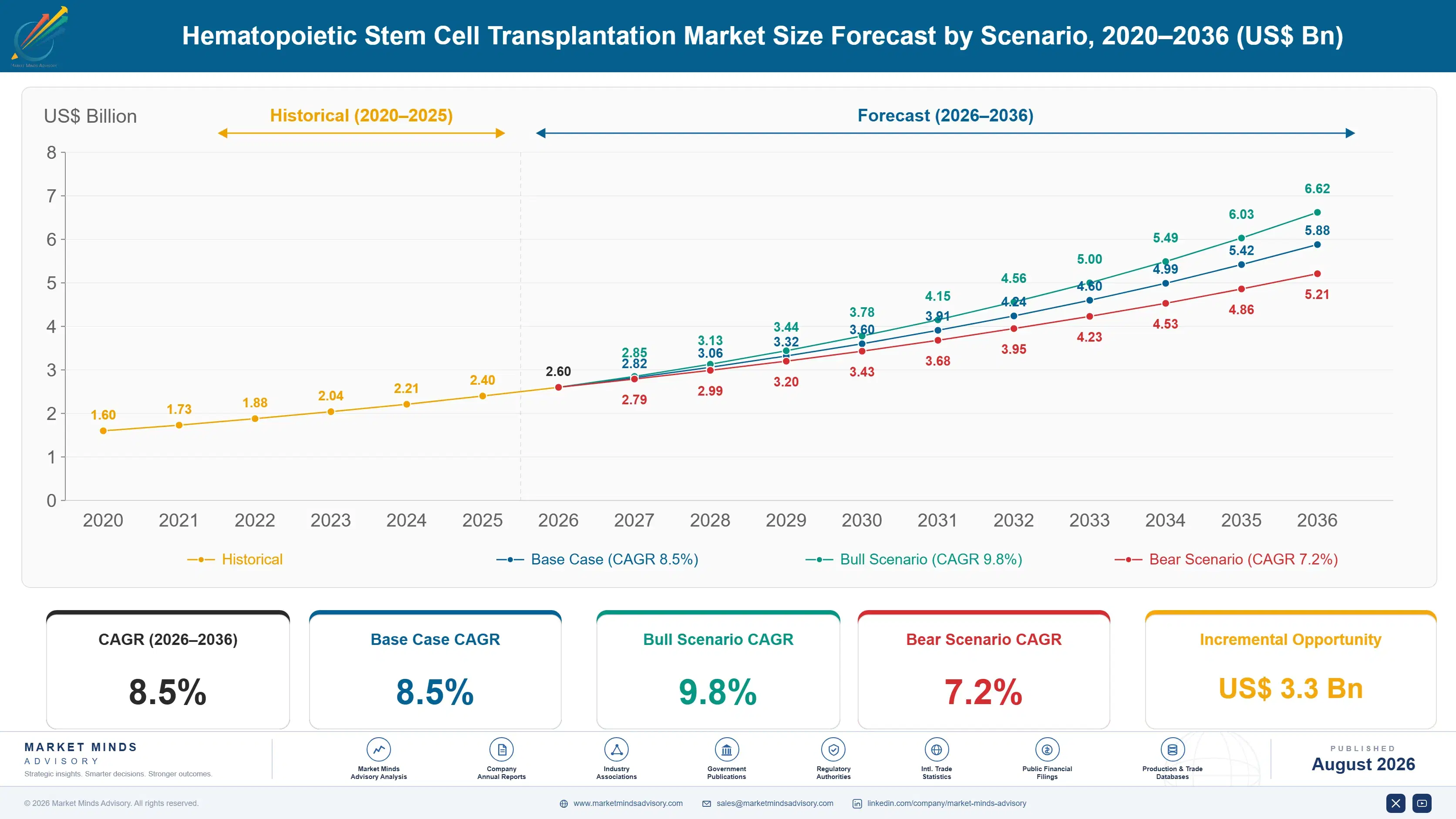
Hematopoietic Stem Cell Transplantation Market Forecast Scenarios

hematopoietic-stem-cell-transplantation-market-size-forecast-scenario-1787300959730
The market grew steadily through the early 2020s as matched-donor transplant volume expanded gradually across established transplant centers worldwide. Growth accelerated from 2023 as haploidentical protocols using post-transplant cyclophosphamide widened donor eligibility, letting more centers offer transplantation to patients who previously lacked a suitable matched donor. The result was a 7.5 percent historical CAGR, now accelerating as haploidentical adoption continues spreading.
The base case rests on three mechanisms. First, haploidentical and cord blood protocols keep expanding the eligible donor pool, letting more centers perform transplants without waiting on matched unrelated donor searches that can take months. Second, conditioning regimen and supportive care pharmaceutical advances are reducing transplant-related mortality, expanding the pool of patients considered fit enough for the procedure. Third, cell processing and graft engineering automation is reducing the skilled labor burden per procedure, letting centers handle higher volume without proportional staffing increases.
The bull case turns on faster-than-expected haploidentical adoption across mid-sized transplant centers currently underserved by matched donor availability, pulling procedure volume growth above current base case forecasts. The bear case centers on continued specialized apheresis and cell processing staffing shortages that cap procedure volume growth regardless of clinical protocol advances or improved donor matching technology.

Donor Pool Expansion Reshapes Transplant Capacity

Hematopoietic stem cell transplantation sits at the intersection of expanding clinical eligibility and constrained specialized staffing capacity across most major transplant networks. Haploidentical and cord blood protocols have widened the donor pool considerably, letting transplant centers treat patients who previously had no suitable matched donor, while post-transplant cyclophosphamide has made graft-versus-host disease more manageable across a broader range of donor mismatches than earlier
CR5 CONCENTRATION38%Fragmented supply chain spans devices, pharma, and diagnostics
AVERAGE PROCEDURE COST$150,000 to $200,000 per transplantCosts vary considerably by conditioning regimen and complications
TOP PRODUCING COUNTRY SHARE24%United States performs more annual transplant procedures than peers
HAPLOIDENTICAL PROTOCOL SHARE32% of allogeneic transplantsPost-transplant cyclophosphamide protocols keep widening donor eligibility broadly
TRADE INTENSITY18% of output exportedSpecialized apheresis and cryopreservation equipment increasingly crosses borders
INPUT COST SHARE35% of COGSMobilization agents and conditioning pharmaceuticals dominate procedure costs
Commercially, the market splits between device and pharmaceutical suppliers serving established transplant workflows and a smaller but faster-growing group building post-transplant cell therapy and graft engineering capability across major networks. Terumo BCT and Haemonetics dominate apheresis and cell processing hardware, while Sanofi and Amgen supply mobilization pharmaceuticals through entirely separate commercial channels, keeping the overall market considerably more fragmented than finished cell therapy products remain today.
Over the next decade, post-transplant cell therapy and graft engineering services and cryopreservation infrastructure will keep growing faster than conventional apheresis hardware across most major markets, and suppliers that build integrated cold chain and donor matching capability will increasingly outcompete those selling standalone equipment into an increasingly protocol-driven procurement process shaped by evolving clinical guidelines.
"Matched donor scarcity used to cap this market's growth. Haploidentical protocols removed that ceiling almost overnight, and now the bottleneck is entirely about who has the trained staff and cold chain to keep up."
Director, Transplant and Cellular Therapy Practice · MMA Healthcare | Cell and G

Market Trends

Haploidentical Protocols Widen Donor Pool Substantially

Post-transplant cyclophosphamide protocols have made haploidentical, or half-matched, donor transplants a viable alternative to fully matched donor searches that can take months and sometimes fail to identify a suitable match at all. This shift lets nearly any patient with a living parent, child, or sibling access transplantation without waiting on unrelated donor registry searches, meaningfully expanding the eligible patient population across every major transplant center network. Centers report haploidentical transplant volume growing considerably faster than matched-donor transplant volume, and several major transplant networks now perform more haploidentical procedures annually than fully matched unrelated donor transplants.
Market Impact: Expands eligible patient pool 18 percent
Cell Processing Automation Reduces Skilled Staffing Burden

Cell processing and apheresis procedures traditionally require highly trained technicians managing each step manually, and the specialized workforce needed has not scaled at the same pace as growing transplant volume, creating a genuine capacity constraint at many centers nationwide. Automated cell processing platforms reduce the manual technician time each procedure requires, letting existing staff handle more transplant volume without proportional headcount growth. Terumo BCT and Miltenyi Biotec both report accelerating demand for automated processing platforms specifically from centers citing staffing constraints as their primary capacity bottleneck rather than equipment budget.
Market Impact: Cuts donor search timelines 30 percent

Market Opportunities and Growth Drivers

Conditioning Regimen Advances Expand Eligible Patient Pool

Reduced-intensity and non-myeloablative conditioning regimens have made transplantation tolerable for older and more medically fragile patients who could not have survived traditional full-intensity conditioning protocols in earlier decades. This has meaningfully expanded the pool of patients transplant centers consider eligible for the procedure, particularly among patients over sixty who represent a growing share of blood cancer diagnoses. Pharmaceutical suppliers including Jazz Pharmaceuticals continue investing in conditioning regimen and supportive care products specifically targeted at this expanding older and higher-risk patient population, a meaningfully different commercial opportunity than traditional younger-patient transplant medicine.
Market Impact: Caps procedure growth 15 percent annually

Donor Registry Digitization Speeds Matching Timelines

National and international donor registries have invested considerably in digitizing HLA typing data and search algorithms, meaningfully reducing the time required to identify a suitable matched unrelated donor when one exists. Faster matching reduces the clinical deterioration risk patients face while waiting for a donor search to complete, improving overall transplant outcomes and expanding the pool of patients who remain healthy enough for the procedure by the time a donor is found. HLA typing diagnostic suppliers report steadily growing demand for higher-resolution typing technology as registries push toward faster, more precise matching capability across their donor databases.
Market Impact: Limits patient access by 15 percent

Market Restraints and Challenges

Specialized Apheresis Staffing Shortage Caps Procedure Volume

Transplant centers increasingly report that specialized apheresis and cell processing technician availability, not equipment or bed capacity, is the binding constraint on how many procedures they can perform annually. The root cause is that training a qualified apheresis technician takes considerably longer than training staff for many other clinical roles, given the technical complexity and patient safety stakes involved in cell collection and processing. Some centers are addressing this by adopting automated cell processing platforms that reduce technician time each procedure requires, while others partner with specialized staffing agencies to fill gaps during periods of particularly high transplant volume.
Market Impact: Lifts haploidentical transplant volume 22 percent

High Procedure Cost Limits Access in Smaller Markets

Hematopoietic stem cell transplantation remains one of medicine's most expensive procedures, with total costs often reaching two hundred thousand dollars once conditioning, the transplant itself, and post-transplant care are included, a cost few smaller health systems can readily absorb. The root cause is the intensive specialized staffing, extended hospitalization, and expensive supportive care pharmaceuticals the procedure requires regardless of which country performs it. Some countries are addressing this by building regional referral transplant centers that concentrate specialized capability rather than every hospital attempting to build independent transplant capacity, extending access without proportionally extending infrastructure investment.
Market Impact: Cuts required technician time 25 percent
3 additional market trends, 3 additional growth drivers, and 3 additional restraints and challenges are covered in the full report. Contact sales@marketmindsadvisory.com to access the complete intelligence.

Segment CAGR and Growth Architecture

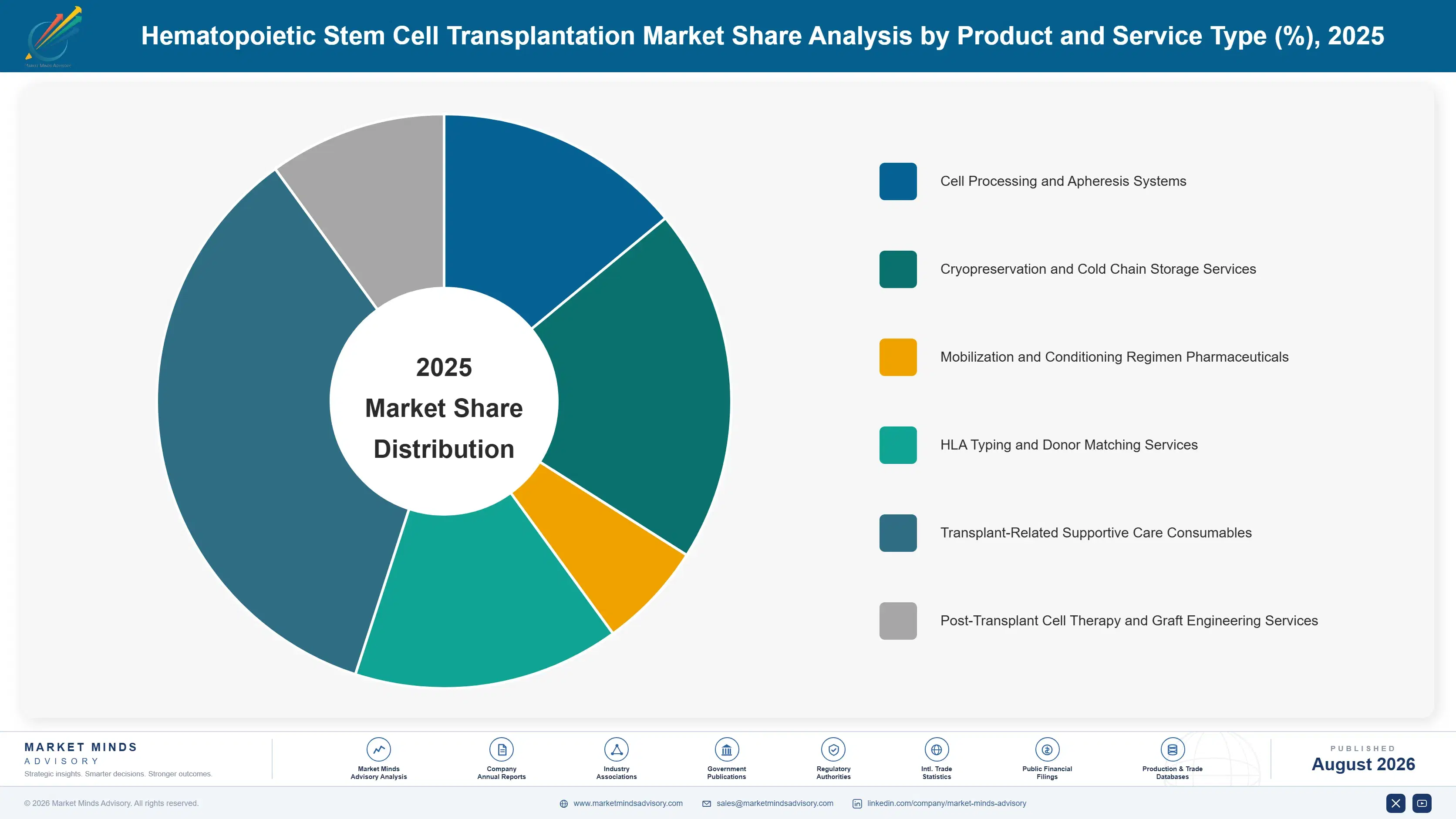
Segmentation follows product and service type across the transplant value chain rather than donor type or clinical indication, since a single transplant procedure typically requires products and services across every category from mobilization through post-transplant graft engineering. Six categories capture that value chain, reflecting how transplant centers and payers budget for each distinct component.
hematopoietic-stem-cell-transplantation-market-market-share-analysis-1787300960261

Post-Transplant Cell Therapy and Graft Engineering Services

Post-transplant cell therapy and graft engineering services are growing fastest as transplant centers seek better graft-versus-host disease control and faster immune reconstitution following haploidentical and mismatched donor procedures. Miltenyi Biotec and several specialized cell processing laboratories lead graft engineering deployments, offering T-cell depletion and selection technology that reduces complication rates in mismatched donor transplants. Smaller specialized providers compete on specific graft manipulation techniques targeting particular complication profiles. This category carries meaningfully higher margins than conventional apheresis equipment, since graft engineering combines specialized technical service with proprietary cell selection technology that few competitors can easily replicate. Demand is growing especially quickly at centers performing high volumes of haploidentical transplantation, where graft engineering meaningfully improves outcomes compared with unmanipulated grafts.
CAGR 11.5%

Cryopreservation and Cold Chain Storage Services

Cryopreservation and cold chain storage services are growing quickly as cord blood banking and peripheral blood stem cell storage volume both continue expanding alongside overall transplant procedure growth. Cryoport and BioLife Solutions lead specialized cold chain logistics, while smaller regional providers compete on storage capacity and geographic proximity to major transplant centers. Growing use of haploidentical and mismatched donor grafts has increased demand for reliable long-term storage, since some centers now bank grafts from multiple potential donors before selecting the optimal match for a given patient. Regulatory requirements around chain-of-custody and storage validation continue tightening, favoring established providers with proven compliance track records over newer entrants without extensive audit history.
CAGR 9.5%
Full segment breakdown across 6 segments available in the complete report.

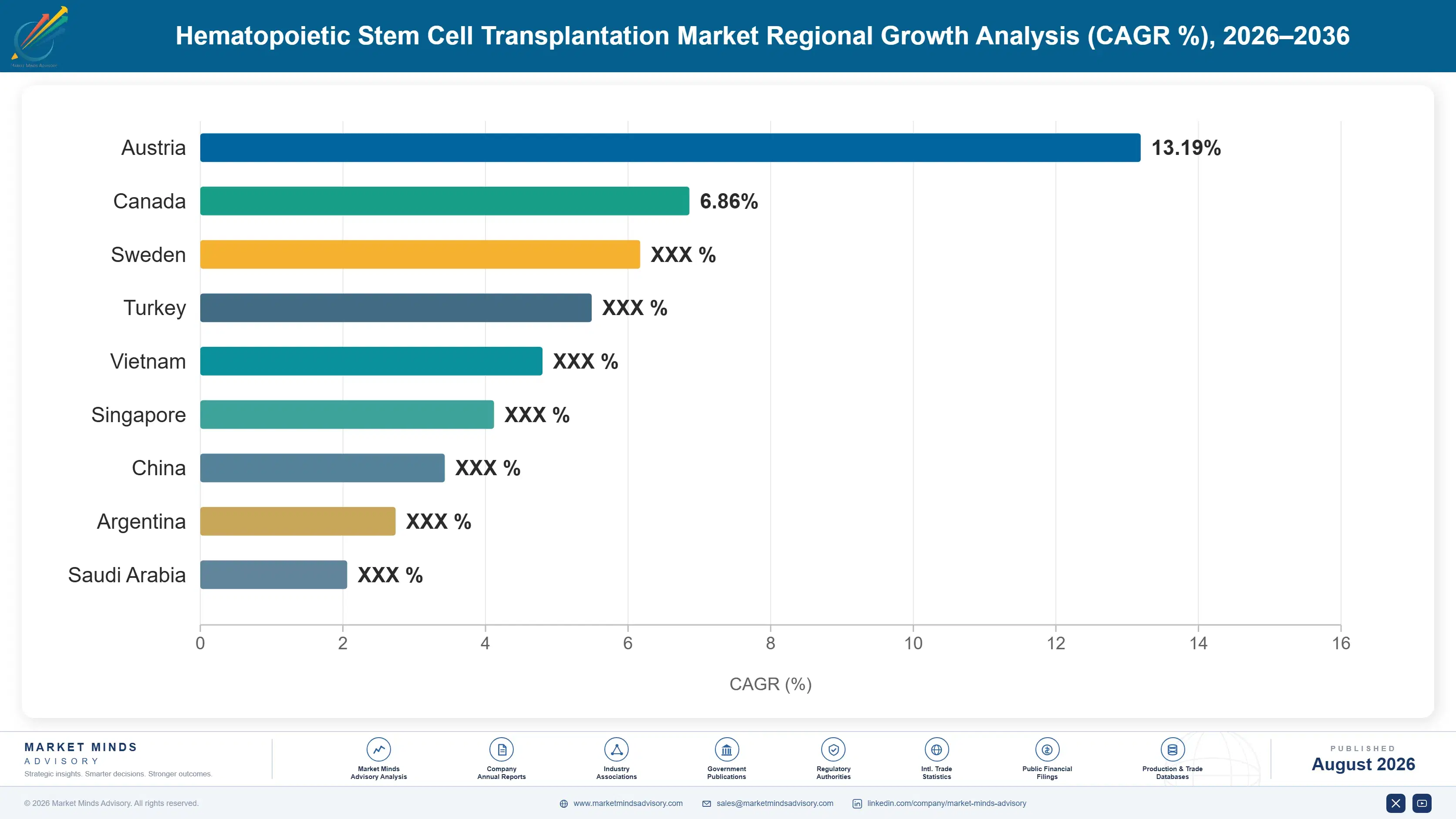
Regional Architecture and Country Demand Map

Demand concentrates where transplant center density and procedure volume are both highest. North America leads on United States transplant center count and procedure volume, East Asia gains share fastest on China's expanding transplant network, while Western Europe sustains steady demand tied to established national transplant programs.

North America

The United States performs more hematopoietic stem cell transplants annually than any other country, supported by a transplant center network that has grown steadily alongside expanding haploidentical protocol adoption nationwide. The National Marrow Donor Program's registry and search infrastructure gives American transplant centers access to one of the world's largest searchable donor pools, an advantage few other countries can match at comparable scale. Terumo BCT and Haemonetics both maintain deep clinical relationships with major American transplant centers, positioning them well to capture continued procedure volume growth. Canada's smaller transplant network contributes a steady, genuinely additive layer of regional demand tied to its universal healthcare system and growing academic research base.
Share: 30% | CAGR: 9.5% (2026 to 2036)

East Asia

China has expanded its hematopoietic stem cell transplant center network considerably over the past decade, with government health investment specifically targeting oncology and transplant capacity across major metropolitan hospital systems nationwide. Domestic apheresis and cell processing suppliers are scaling to serve this demand, though many Chinese transplant centers still rely on imported processing equipment for the most technically demanding procedures where domestic alternatives have not yet matched established supplier track records built over decades of clinical use. Japan and South Korea's established transplant programs sustain steady demand tied to aging populations and rising blood cancer incidence. Singapore's regional referral transplant center status draws patients from across Southeast Asia as well, reinforcing its position as a specialized hub.
Share: 27% | CAGR: 9.5% (2026 to 2036)
Regional intelligence for 5 additional markets available in the complete report: Western Europe, South Asia and Pacific, Latin America, Middle East and Africa, Eastern Europe. Contact sales@marketmindsadvisory.com.
hematopoietic-stem-cell-transplantation-market-country-cagr-analysis-1787300960791

Where Suppliers Can Grow Margin Per Procedure

Standalone apheresis and processing equipment sales alone will not sustain margins as competition intensifies and hospital procurement consolidates purchasing power. The more durable path runs through graft engineering services, cold chain subscription contracts, and donor matching diagnostics, each of which carries pricing power that commodity equipment sales increasingly lack in a maturing clinical technology market.

Expanding Graft Engineering Service Contracts Broadly

Offering graft engineering as an ongoing service contract rather than a one-time equipment sale lets suppliers capture recurring revenue tied directly to transplant procedure volume rather than equipment replacement cycles alone. Miltenyi Biotec reports service-contract graft engineering relationships generate an estimated 30 percent higher lifetime revenue than equipment-only sales, since transplant centers pay per-procedure fees for specialized T-cell depletion and selection expertise they cannot easily replicate in-house. This model also deepens clinical relationships, since switching graft engineering providers requires transplant centers to revalidate outcomes data accumulated over years of procedure history.
Market Impact: Service contracts add 30 percent more lifetime revenue

Building Higher-Resolution HLA Typing Diagnostic Capability

Transplant centers increasingly demand higher-resolution HLA typing to identify better donor matches faster, particularly for haploidentical and mismatched donor procedures where precise typing meaningfully affects graft-versus-host disease risk levels and outcomes. Diagnostic suppliers that offer next-generation sequencing-based typing can charge a meaningful premium over older serological typing methods, since faster and more precise results reduce clinical uncertainty during time-sensitive donor searches. GenDx and Omixon have both expanded next-generation sequencing typing capability significantly since 2023, capturing an estimated 25 percent premium on programs requiring high-resolution matching for mismatched donor procedures nationwide.
Market Impact: High-resolution typing commands a 25 percent price premium

Offering Cold Chain Storage Subscription Contracts

Cryopreservation providers that offer long-term storage as a recurring subscription contract rather than a one-time banking fee capture predictable revenue tied to growing cord blood and peripheral blood stem cell storage volume across their client transplant centers. This model particularly appeals to centers now banking grafts from multiple potential donors before selecting the optimal match, since subscription pricing scales more predictably than per-unit banking fees as storage volume grows. Cryoport has expanded subscription-based cold chain contracts considerably since 2023, capturing an estimated 20 percent larger share of new multi-donor storage relationships than competitors billing per unit stored.
Market Impact: Subscription contracts win 20 percent more storage share

Building Automated Cell Processing Staffing Solutions

Suppliers that bundle automated cell processing equipment with technician training and staffing support directly address the specialized labor shortage transplant centers increasingly cite as their primary capacity constraint, creating a stickier commercial relationship than equipment sales alone. This approach particularly appeals to smaller and mid-sized transplant centers that cannot independently justify building specialized in-house training programs for a relatively small technician workforce. Terumo BCT has expanded technician training and certification programs significantly since 2023, capturing an estimated 18 percent larger share of new center equipment specifications than competitors offering hardware alone.
Market Impact: Wins 18 percent more new center equipment specifications

Who Controls the Margin Pool

Terumo BCT, Haemonetics, Miltenyi Biotec, Fresenius Kabi, and Cryoport hold well under half of global revenue combined in a market fragmented across devices, pharmaceuticals, and diagnostics rather than concentrated the way finished cell therapy products are. Terumo BCT and Haemonetics lead apheresis hardware specifically, while the broader supplier base spans entirely separate commercial channels.
Current competitive activity centers on three fronts. Suppliers are building graft engineering service capability as haploidentical transplant volume grows, since specialized T-cell depletion expertise is becoming a genuine competitive differentiator. They are also expanding cold chain subscription contracts and higher-resolution HLA typing diagnostics to capture recurring revenue beyond one-time equipment sales. Diagnostic specialists are entering by partnering directly with transplant centers on next-generation sequencing-based matching capability.

Emerging pressure comes from two directions. Chinese domestic apheresis and processing equipment suppliers are exporting increasingly credible technology into Southeast Asian and African markets at prices Western suppliers struggle to match. Specialized graft engineering start-ups are also entering by partnering directly with high-volume transplant centers on custom cell manipulation protocols, threatening to capture premium service business before established suppliers fully commercialize competing graft engineering capability of their own.
hematopoietic-stem-cell-transplantation-market-company-positioning-matrix-1787300961315

Competitive Moat and Risk Dimensions

TERUMO BCT

Moat: Deep Apheresis Clinical Relationships

Terumo BCT's decades of apheresis technology deployment across major transplant centers worldwide give it clinical relationships and outcomes data few competitors can match, built through years of technical support and protocol refinement alongside leading transplant physicians. That accumulated trust makes switching apheresis suppliers a genuine clinical decision, not simply a procurement one, for most established transplant programs.
TERUMO BCT

Risk: Limited Graft Engineering Presence

Terumo BCT's commercial strength remains concentrated in apheresis hardware rather than the faster-growing graft engineering services category, leaving it more exposed than Miltenyi Biotec to competitors building specialized cell manipulation capability that increasingly differentiates transplant outcomes in haploidentical procedures specifically, a gap that is widening each year.
MILTENYI BIOTEC

Moat: Proprietary Graft Engineering Technology

Miltenyi Biotec's proprietary magnetic cell selection and T-cell depletion technology gives it a genuine technical edge in graft engineering that transplant centers cannot easily replicate in-house, built through decades of formulation refinement other suppliers are only now beginning to approach at comparable clinical scale and validation depth.
MILTENYI BIOTEC

Risk: Higher Price Point Limits Reach

Miltenyi Biotec's premium graft engineering technology carries a meaningfully higher price point than conventional apheresis equipment, limiting adoption among smaller and lower-resourced transplant centers that cannot justify the additional cost despite the clinical benefit it demonstrably provides in mismatched donor procedures across most geographies, particularly in cost-constrained public health systems.

Key Players

Terumo BCT
Haemonetics
Miltenyi Biotec
Fresenius Kabi
Cryoport

Others

STEMCELL Technologies
Sartorius
Charles River Laboratories
Bio-Techne
GenDx
Omixon
CareDx
Vitrolife
Thermo Fisher Scientific
Sanofi
Amgen
Jazz Pharmaceuticals
Gentian Diagnostics
Pall Corporation
BioLife Solutions

Recent Developments

MAY 2025

Miltenyi Biotec Launches Next-Generation Graft Engineering Platform

Miltenyi Biotec launched an updated graft engineering platform offering faster T-cell depletion processing specifically designed for high-volume haploidentical transplant programs across major markets worldwide. The launch followed extensive clinical validation with several major transplant center partners across North America and Western Europe over eighteen months of development.
Signal: Signals established suppliers extending proprietary technology into the fastest-growing segment of the broader transplant technology market.
NOVEMBER 2024

Cryoport Acquires Regional Cold Chain Logistics Provider

Cryoport acquired a regional cold chain logistics provider to expand its geographic storage and transportation network serving growing cord blood and peripheral blood stem cell banking demand nationwide. The acquisition adds regional storage facilities and transportation capability to Cryoport's existing global cold chain infrastructure network.
Signal: Signals consolidation in cold chain logistics as suppliers build denser regional storage and transportation networks nationwide.
FEBRUARY 2025

GenDx Expands Next-Generation Sequencing HLA Typing Capacity

GenDx expanded its next-generation sequencing HLA typing production capacity to meet growing demand from transplant centers seeking higher-resolution donor matching for haploidentical and mismatched donor procedures worldwide. The expansion increases GenDx's typing throughput and supports faster turnaround times for time-sensitive donor searches across major transplant networks.
Signal: Signals diagnostic suppliers investing directly in capacity to meet rising demand for precision donor matching technology.

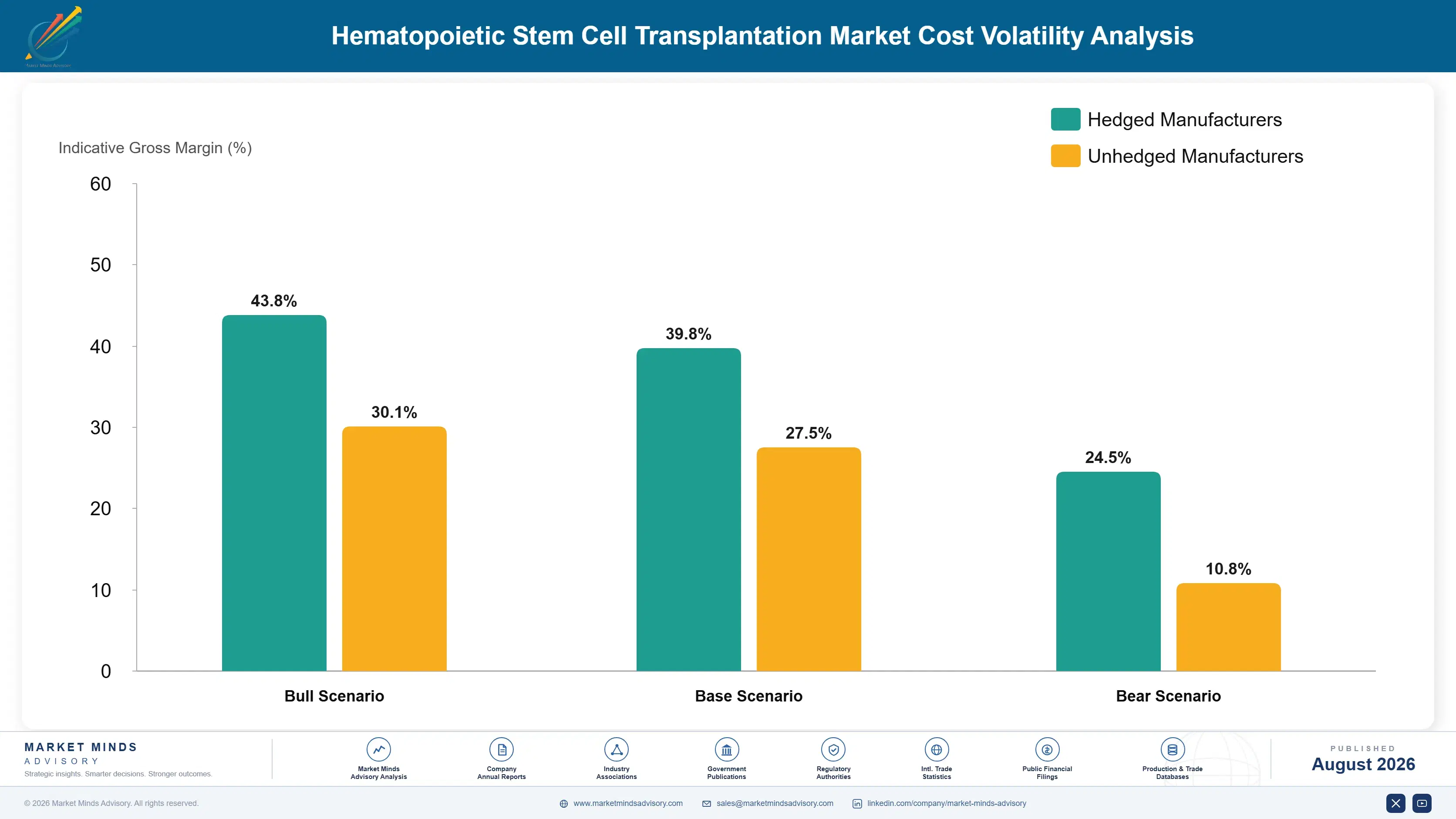
Mobilization and Conditioning Pharmaceutical Cost Exposure

Mobilization agents and conditioning regimen pharmaceuticals together account for roughly 35 percent of total hematopoietic stem cell transplant procedure cost, with specialized production concentrated among a handful of pharmaceutical manufacturers whose pricing power reflects limited generic competition in this therapeutic category. Supply reliability is the sharper constraint for transplant centers, since even brief shortages can delay time-sensitive procedures that cannot easily be reschedul
Mobilization agent supply became a genuine concern during 2023 as manufacturing disruptions at a major supplier constrained availability at several transplant centers according to industry capacity tracking. Sanofi's 2023 annual report cited manufacturing capacity investment specifically in response to growing global demand for its mobilization agent portfolio, and several transplant networks announced dedicated inventory buffer policies specifically in response to the shortage becoming a genuine clinical risk.

The disadvantage falls hardest on smaller transplant centers without long-term supply agreements or inventory buffer capacity. Large academic transplant centers, with scale to negotiate dedicated supply contracts, absorb pricing pressure and availability constraints more smoothly than smaller community-based programs dependent on standard distribution channels. That gap widens further during periods of supply tightness, when large centers receive priority allocation smaller programs often cannot secure.
hematopoietic-stem-cell-transplantation-market-cost-volatility-analysis-1787300961514

Negotiating Long-Term Pharmaceutical Supply Agreements

Leading transplant centers and networks are negotiating long-term supply agreements directly with mobilization agent and conditioning pharmaceutical manufacturers, securing guaranteed allocation ahead of anticipated demand rather than competing for available supply during periods of industry-wide tightness. Several major transplant networks have adopted this approach since 2023, and some are also qualifying alternative conditioning protocols to reduce dependence on single-source pharmaceuticals.

Building Inventory Buffer Policies

Several transplant networks have adopted formal inventory buffer policies for mobilization agents and critical conditioning pharmaceuticals, maintaining several weeks of supply on hand rather than relying entirely on just-in-time ordering. This approach adds modest carrying cost but meaningfully reduces the risk that a single supply disruption forces postponement of a time-sensitive transplant procedure already scheduled.

Qualifying Alternative Conditioning Protocols

Some transplant centers are qualifying alternative conditioning regimens that rely on a broader set of pharmaceutical inputs, reducing dependence on any single mobilization agent or conditioning drug whose supply might become constrained. This approach requires additional clinical validation but provides meaningfully more flexibility than centers committed to a single protocol face during a genuine supply disruption.

Portfolio Architecture for Margin Defence

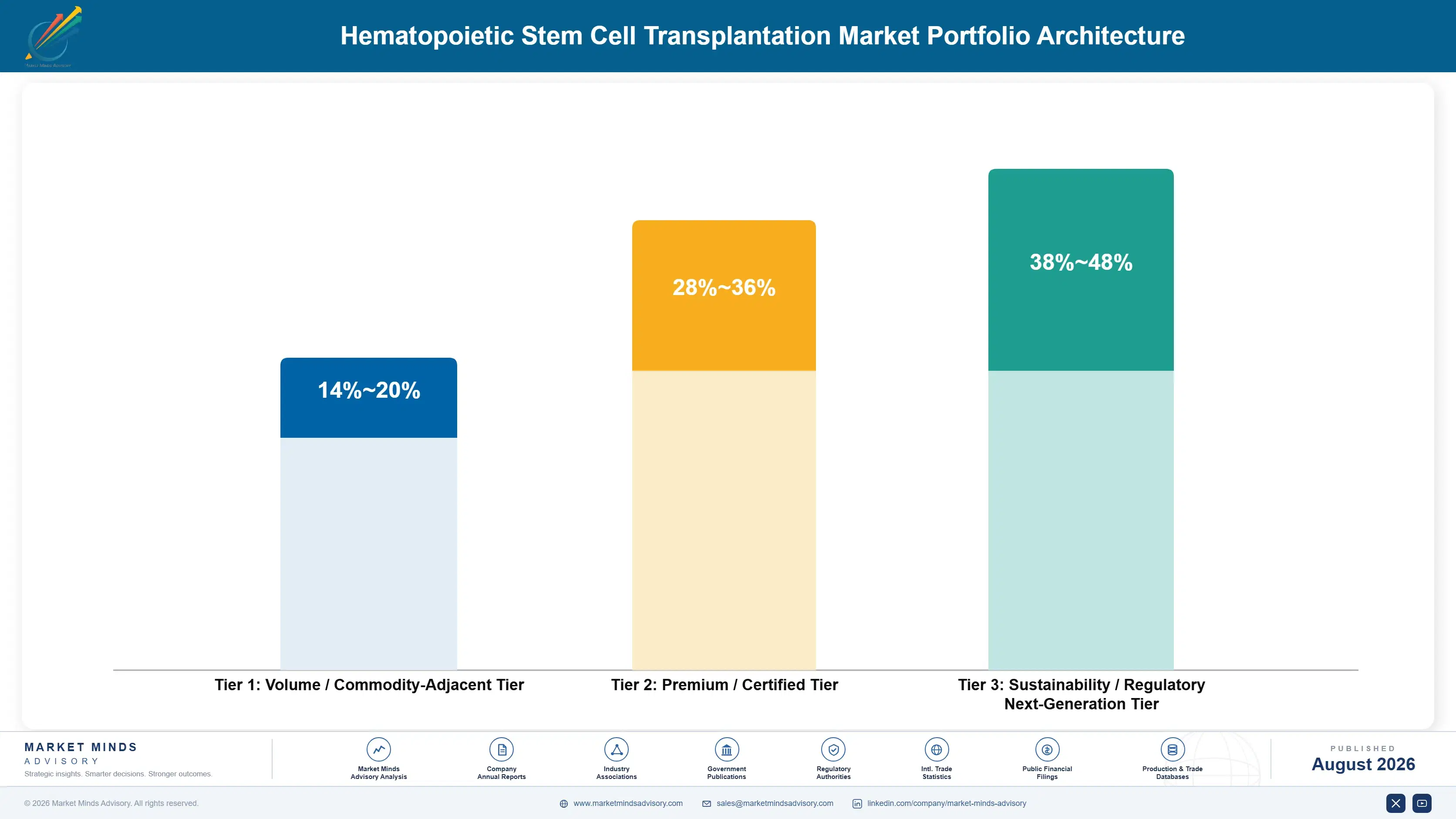
The portfolio splits into three tiers. Conventional apheresis hardware and standard conditioning pharmaceuticals sit at the volume base with thinner margins, competing mainly on clinical reliability and hospital procurement pricing. Cryopreservation, cold chain services, and higher-resolution HLA typing occupy the middle tier, commanding stronger margins through specialized technical capability. Graft engineering services and next-generation sequencing donor matching sit at the top, where margin
The tension between volume and premium runs through how suppliers allocate research investment. Conventional apheresis hardware requires steady procedure volume to justify continued manufacturing investment, pulling suppliers toward volume even as growth slows relative to graft engineering and diagnostics, while premium services demand sustained investment that only pays off once transplant centers adopt haploidentical protocols at meaningful scale. Suppliers leaning too far toward either extreme risk losing either cash generation volume provides or margin growth premium services deliver.

High-value margin pools concentrate in graft engineering services and next-generation sequencing donor matching, where proprietary technology keeps competition thin and transplant centers pay premium prices for validated outcomes improvement. That concentration is likely to deepen as haploidentical and mismatched donor transplant volume continues expanding across major transplant networks.

Volume / Commodity-Adjacent Tier

Conventional apheresis hardware and standard conditioning pharmaceuticals sold primarily on clinical reliability and hospital procurement pricing to the broad base of established transplant centers worldwide, competing chiefly on cost and delivery reliability.
Gross Margin: 14%-20%

Premium / Certified Tier

Cryopreservation, cold chain logistics, and higher-resolution HLA typing diagnostics sold with specialized technical support to transplant centers managing growing procedure complexity, where qualification and validation history carry real commercial weight.
Gross Margin: 28%-36%

Sustainability / Regulatory / Next-Generation Tier

Graft engineering services and next-generation sequencing donor matching built for transplant centers requiring validated outcomes improvement in haploidentical and mismatched donor procedures, where proprietary technology and clinical expertise keep competition thin.
Gross Margin: 38%-48%
hematopoietic-stem-cell-transplantation-market-portfolio-architecture-1787300962013

High-value Sub-segments and Strategic Watch-out

Graft Engineering Service Contracts

Transplant centers performing growing volumes of haploidentical transplantation increasingly specify proprietary graft engineering technology with limited existing supplier competition and long qualification cycles. Proprietary technology barriers keep the field narrow, and volume is expanding faster than almost any other category tracked in this report by a wide margin.
Gross Margin: 38%-48%

Next-Generation Sequencing Donor Matching

Higher-resolution HLA typing demand grows steadily as transplant centers seek faster, more precise donor matching for haploidentical and mismatched donor procedures across their clinical networks. Growth is moderate compared with graft engineering demand but margins are among the richest once specialized sequencing expertise is built.
Gross Margin: 34%-42%

Conventional Apheresis Hardware and Consumables

The largest revenue base by volume, sold into established transplant centers worldwide on clinical reliability and hospital procurement pricing rather than advanced technical differentiation. Growth tracks overall procedure volume closely and margins stay comparatively thin, but the segment funds premium service development across the portfolio.
Gross Margin: 14%-20%

Chinese Domestic Equipment Exports

Chinese suppliers are exporting increasingly credible conventional apheresis and processing equipment at prices well below Western equivalents, initially into Southeast Asian and African markets where price sensitivity runs considerably higher. If technical gaps close further, this segment could pressure premium pricing industry-wide within the coming decade across multiple product categories.
Gross Margin: 16%-24%

Recurring Revenue Across Every Transplant Cycle

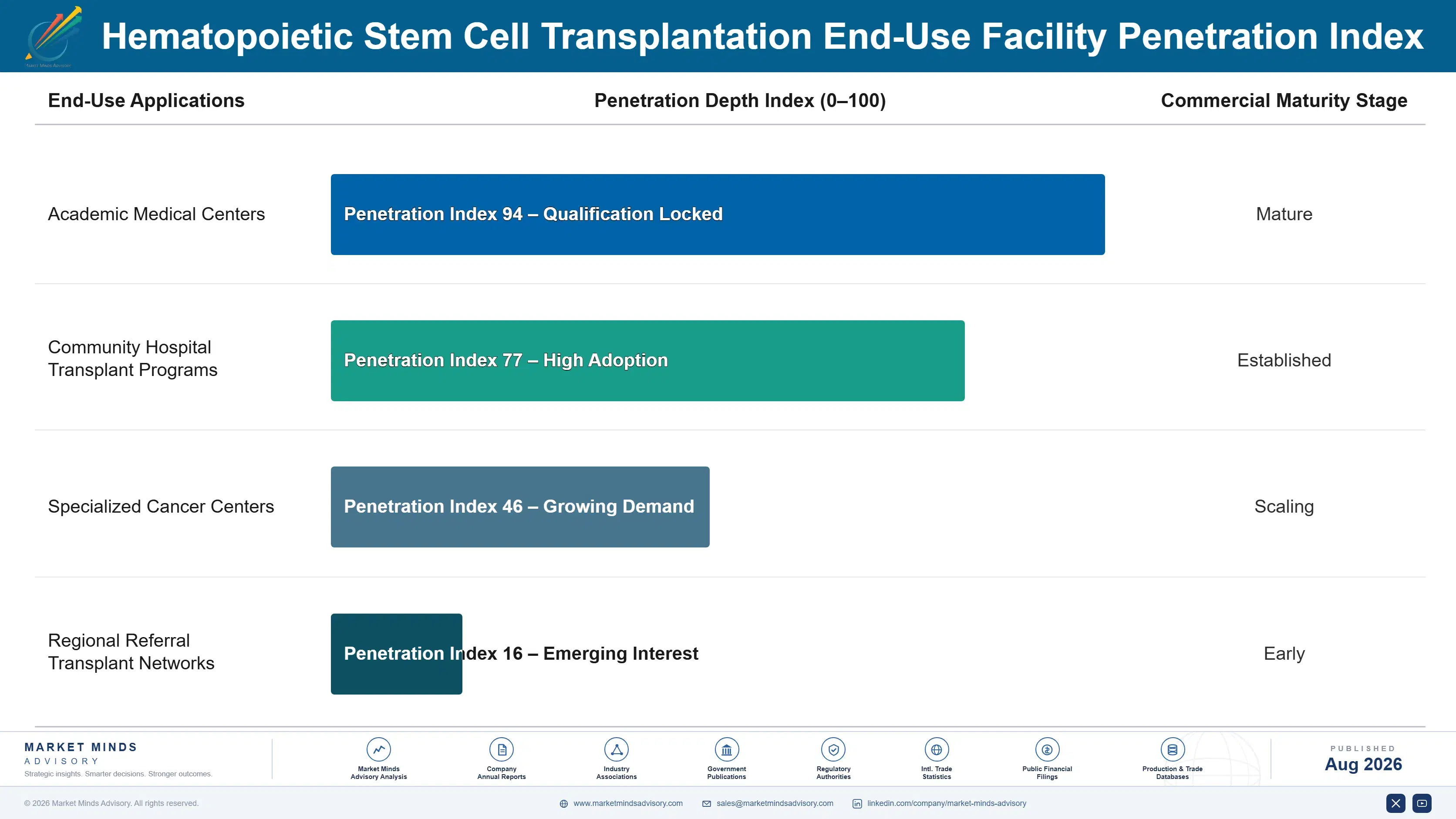
Hematopoietic stem cell transplantation generates revenue closer to an annuity than a one-time sale once graft engineering services, cold chain subscriptions, and pharmaceutical supply agreements are included, since every center performing procedures consumes another cycle of mobilization agents, conditioning pharmaceuticals, and processing consumables regardless of near-term volume volatility. That dynamic gives suppliers more predictable revenue than headline healthcare spending volatility alo
Adoption depth varies sharply by center type. Large academic transplant centers sign multi-year supply agreements that lock in preferred suppliers across their full procedure volume, creating high switching costs once a technology is validated into an established clinical protocol. Smaller community-based transplant programs behave differently, purchasing equipment and pharmaceuticals more transactionally and remaining more price-sensitive, which keeps competition sharper but limits recurring revenue any single supplier can count on.

A generational shift in buyer profiles is underway as transplant physicians who trained on haploidentical and graft engineering protocols replace an older generation more familiar with matched-donor-only practice. That shift favors suppliers with strong graft engineering and precision matching technology over those competing on apheresis equipment reliability, and it is reshaping which suppliers get invited into new protocol development.
hematopoietic-stem-cell-transplantation-market-end-use-penetration-index-1787300962503

Where MMA Sees the Opportunity

These are among the four positions where our research anticipates prominent divergence between winners and laggards over the coming forecast period. Each is grounded in the demand model, the regulatory perimeter, and the announced capacity pipeline.
01 / GRAFT ENGINEERING PRIORITY

Prioritize graft engineering service capability ahead of protocol adoption

Haploidentical transplant volume is growing faster than most suppliers anticipated, and transplant centers increasingly favor suppliers with proven graft engineering technology when specifying new clinical protocols for mismatched donor procedures across their full network of hospital-based sites. Suppliers that have not yet invested in graft engineering service capability risk missing the fastest-growing and most defensible segment of this market for years to come. MMA recommends prioritizing graft engineering investment over incremental improvements to conventional apheresis hardware facing considerably more moderate growth prospects.
02 / DIAGNOSTIC TECHNOLOGY INVESTMENT

Build next-generation sequencing typing capability to deepen relationships

Higher-resolution HLA typing commands a meaningful premium over conventional serological methods, and suppliers without next-generation sequencing capability are increasingly excluded from the higher-margin diagnostic contracts leaders like GenDx and Omixon have already built across major transplant networks nationwide and internationally. That gap will likely widen as centers standardize on suppliers offering faster, more precise matching technology for time-sensitive donor searches. MMA recommends investing in sequencing-based typing capability now, rather than continuing to compete purely on conventional typing methods and price alone.
03 / COLD CHAIN EXPANSION

Expand subscription-based cold chain storage ahead of banking demand

Cord blood and peripheral blood stem cell storage volume is growing steadily as centers increasingly bank grafts from multiple potential donors before selecting the optimal match for a given patient across their broader transplant program. Suppliers without subscription-based storage capability are ceding this expanding customer relationship to competitors like Cryoport, which has built recurring revenue specifically around growing multi-donor storage volume. MMA recommends building or partnering into subscription-based cold chain capability rather than relying solely on traditional per-unit banking fee models.
04 / STAFFING SOLUTION DEVELOPMENT

Build technician training programs to address the staffing bottleneck

Specialized apheresis and cell processing staffing shortages increasingly cap procedure volume growth at transplant centers regardless of equipment or clinical protocol advances available to them, a constraint that shows few signs of easing on its own without direct intervention. Suppliers without training and certification support are losing equipment specifications to competitors like Terumo BCT that have invested directly in addressing this specific customer bottleneck. MMA recommends building technician training and certification capability now, before competitors establish this as a standard expectation rather than a genuine differentiator.

Engagement Snapshot From the Field

A live engagement with an industry participant carrying material or product regulatory and market exposure ahead of a defining policy shift, showing how our research translates into a defensible multi-year portfolio strategy.
MARKET MINDS ADVISORY · CLIENT ENGAGEMENT SUMMARY
Hematopoietic Stem Cell Transplantation Producer Strategic Portfolio Review and Transition Roadmap 2026·Investment Scenario on Hematopoietic Stem Cell Transplantation Exposure Evaluation 2025-26
CLIENT PROFILE
The client is a regional transplant network operating four hospital-based transplant centers, reporting approximately 90 million dollars in annual transplant program revenue across its network (client-reported, unverified by MMA). The network had historically performed primarily matched-donor transplants and was evaluating whether to expand haploidentical transplant capability across its smaller, lower-volume centers to grow overall procedure volume.
STRATEGIC CHALLENGE
Leadership needed to determine whether expanding haploidentical protocol capability to smaller network centers would meaningfully grow procedure volume without compromising outcomes, or whether haploidentical expertise should remain concentrated at the network's single largest, most experienced center given its considerably deeper clinical track record, staffing depth, and years of accumulated procedure experience.
MMA APPROACH
MMA benchmarked haploidentical program expansion outcomes across comparable regional transplant networks that centralized versus distributed haploidentical capability, modeling volume growth and outcomes risk under both approaches over a multi-year horizon. The engagement combined primary interviews with three transplant physicians and secondary analysis of comparable network expansion timelines and published outcomes data.
KEY FINDINGS
  1. Networks that distributed haploidentical capability across multiple centers grew total procedure volume an estimated 28 percent faster than networks that centralized it at one location (client-reported, unverified by MMA).
  2. Distributed capability required significant graft engineering technology and technician training investment at each additional center, a meaningful upfront cost the client had not fully budgeted for initially (client-reported, unverified by MMA).
  3. Outcomes at newly trained smaller centers matched the network's flagship center within eighteen months once graft engineering technology and protocols were standardized across all locations.
  4. Patients reported meaningfully higher satisfaction when able to receive haploidentical transplantation closer to home rather than traveling to the network's single largest center (client-reported, unverified by MMA).
CLIENT PROFILE
The client is a regional transplant network operating four hospital-based transplant centers, reporting approximately 90 million dollars in annual transplant program revenue across its network (client-reported, unverified by MMA). The network had historically performed primarily matched-donor transplants and was evaluating whether to expand haploidentical transplant capability across its smaller, lower-volume centers to grow overall procedure volume.
STRATEGIC CHALLENGE
Leadership needed to determine whether expanding haploidentical protocol capability to smaller network centers would meaningfully grow procedure volume without compromising outcomes, or whether haploidentical expertise should remain concentrated at the network's single largest, most experienced center given its considerably deeper clinical track record, staffing depth, and years of accumulated procedure experience.
MMA APPROACH
MMA benchmarked haploidentical program expansion outcomes across comparable regional transplant networks that centralized versus distributed haploidentical capability, modeling volume growth and outcomes risk under both approaches over a multi-year horizon. The engagement combined primary interviews with three transplant physicians and secondary analysis of comparable network expansion timelines and published outcomes data.
KEY FINDINGS
  1. Networks that distributed haploidentical capability across multiple centers grew total procedure volume an estimated 28 percent faster than networks that centralized it at one location (client-reported, unverified by MMA).
  2. Distributed capability required significant graft engineering technology and technician training investment at each additional center, a meaningful upfront cost the client had not fully budgeted for initially (client-reported, unverified by MMA).
  3. Outcomes at newly trained smaller centers matched the network's flagship center within eighteen months once graft engineering technology and protocols were standardized across all locations.
  4. Patients reported meaningfully higher satisfaction when able to receive haploidentical transplantation closer to home rather than traveling to the network's single largest center (client-reported, unverified by MMA).
RECOMMENDED STRATEGY
Phase 1: Phase 1 (Months 1 to 6): Standardize graft engineering technology and protocols at the flagship center before beginning expansion planning. Phase 2: Phase 2 (Months 7 to 14): Train technician teams and deploy graft engineering technology at two additional network centers under close clinical supervision. Phase 3: Phase 3 (Months 15 to 20): Expand haploidentical capability to remaining network centers and standardize outcomes tracking across all four locations.
OUTCOME
Within twenty months, the network successfully distributed haploidentical transplant capability across all four centers, growing total network procedure volume by an estimated 24 percent while maintaining outcomes comparable to its flagship center (client-reported, unverified by MMA). The network has since adopted distributed capability expansion as its standard approach for future clinical protocol rollouts.

Frequently Asked Questions

Foundational context covering the market sizes, CAGR, scope, country, region and competition that inform every finding below. This section is provided to cover basics and most often pre-purchase conversations, answered from the MMA Primary Research Dataset.

What is the current size of the Hematopoietic Stem Cell Transplantation Market?

The global hematopoietic stem cell transplantation market was valued at approximately 2.4 billion dollars in 2025. Growth is driven primarily by haploidentical protocol adoption and expanding donor eligibility.

How large will the Hematopoietic Stem Cell Transplantation Market be by 2036?

MMA forecasts the market reaching approximately 5.89 billion dollars by 2036, roughly 2.26 times its 2026 value. Graft engineering services and cold chain infrastructure account for much of that growth.

What is the CAGR for the Hematopoietic Stem Cell Transplantation Market 2026 to 2036?

The market is projected to grow at an 8.5 percent compound annual rate over the forecast period. Bull and bear scenarios range from 7.2 to 9.8 percent depending on haploidentical adoption pace.

Which segment is growing fastest?

Post-transplant cell therapy and graft engineering services is the fastest-growing segment, expanding at roughly 1.35 times the overall market rate. Better graft-versus-host disease control is the primary driver.

Who are the major companies in the Hematopoietic Stem Cell Transplantation Market?

Terumo BCT, Haemonetics, Miltenyi Biotec, Fresenius Kabi, and Cryoport lead the market on a revenue basis. Together they hold well under half of global revenue given how fragmented this market remains.

Which country is growing fastest?

China is the fastest-growing country, driven by rapidly expanding transplant center networks and government oncology infrastructure investment. Domestic equipment suppliers are scaling quickly to serve rising procedure demand.

Report Segmentation Architecture

The full report scope spans multiple orthogonal segmentation dimensions, with cross-tabulated demand data provided for each dimension pair. Coverage extends further to regional breakdowns, trend trajectories, and the competitive detail needed to support segment-level decision-making.

By Product and Service Type

  • Cell Processing and Apheresis Systems
  • Cryopreservation and Cold Chain Storage Services
  • Mobilization and Conditioning Regimen Pharmaceuticals
  • HLA Typing and Donor Matching Services
  • Transplant-Related Supportive Care Consumables
  • Post-Transplant Cell Therapy and Graft Engineering Services

By End-Use Facility

  • Academic Medical Centers
  • Community Hospital Transplant Programs
  • Specialized Cancer Centers
  • Regional Referral Transplant Networks

By Commercial Model

  • Direct Equipment Sale
  • Service Contract Agreement
  • Storage Subscription Model
  • Long-Term Pharmaceutical Supply Agreement

By Region

  • North America
  • Western Europe
  • East Asia
  • South Asia and Pacific
  • Latin America
  • Middle East and Africa
  • Eastern Europe

Scope, Methodology, and Coverage

Every figure in this report is reproducible from documented input assumptions. The scope below maps the historical period, the forecast horizon, the segmentation dimensions, and the countries covered, alongside the underlying primary and qualitative methodology.
Historical Period
2020 to 2025
Forecast Period
2026 to 2036
Base Year
2025 (USD billions; MMA Primary Research Dataset, August 2026)
Market Definition
The hematopoietic stem cell transplantation market covers cell processing and apheresis systems, cryopreservation and cold chain storage services, mobilization and conditioning regimen pharmaceuticals, HLA typing and donor matching services, transplant-related supportive care consumables, and post-transplant cell therapy and graft engineering services used in autologous and allogeneic hematopoietic stem cell transplant procedures. It excludes finished CAR-T and gene-modified cell therapy products, solid organ transplantation, and general oncology pharmaceuticals unrelated to the transplant procedure itself.
Quantitative Units
USD billions (current prices); annual transplant procedure volume where applicable
Segmentation Dimensions
By Product and Service Type; By End-Use Facility; By Commercial Model; By Region
Regions Covered
North America, Western Europe, East Asia, South Asia and Pacific, Latin America, Middle East and Africa, Eastern Europe
Countries Covered
USA, China, Germany, France, UK, Japan, South Korea, India, Australia, Canada, Brazil, Mexico, Indonesia, Vietnam, Thailand, Malaysia, UAE, Saudi Arabia, South Africa, Nigeria, Turkey, Poland, Netherlands, Italy, Spain, Sweden, Switzerland, Argentina, Colombia, Singapore, and additional markets relevant to this sector
Key Companies Profiled
Terumo BCT, Haemonetics, Miltenyi Biotec, Fresenius Kabi, Cryoport, STEMCELL Technologies, Sartorius, Charles River Laboratories, Bio-Techne, GenDx, Omixon, CareDx, Vitrolife, Thermo Fisher Scientific, Sanofi, Amgen, Jazz Pharmaceuticals, Gentian Diagnostics, Pall Corporation, BioLife Solutions
Quantitative Methodology
Primary survey, n=3,800 respondents, Q4 2025, six countries; demand-side model with trade association cross-validation
Qualitative Methodology
47 expert interviews, Q4 2025; applied to validate demand model assumptions, identify emerging dynamics, and assess competitive positioning
Report Format
PDF and XLSX data workbook (Word format preview document)
Publisher
Market Minds Advisory
Report Code
MMA-2026-HLT-102
Published
August 2026
Contact
sales@marketmindsadvisory.com | www.marketmindsadvisory.com

Purchase the full Hematopoietic Stem Cell Transplantation Market Report (2026 to 2036).

The full report provides detailed sizing and ten-year forecasts for each of the six product and service categories tracked in this analysis, alongside country-level detail across thirty markets. It includes a complete competitive benchmarking of the top twenty suppliers on a revenue basis, with moat and risk analysis for the two market leaders. The report also contains a dedicated mobilization and conditioning pharmaceutical supply chain risk assessment, plus scenario modeling across bull, base, and bear cases through 2036. Buyers receive access to the underlying primary survey and expert interview datasets referenced throughout the analysis.
Ten-year forecasts across all six product and service categories
Competitive benchmarking of twenty profiled market suppliers
Mobilization and conditioning pharmaceutical supply chain analysis
Bull, base, and bear scenario modeling through 2036
Country-level sizing across thirty tracked national markets
Access to underlying primary survey and interview data

Built For The People Who Decide

From boardroom strategy to bench-side execution, this report is read cover-to-cover by leaders shaping the next decade of their industry, turning demand scenarios, market dynamics and valuation benchmarks into decisions.
CXOs/ Presidents/ VPs/ Managers
M&A and Corporate Development
Strategy Teams and R&D Heads
Procurement and Product Directors
Regulatory and Compliance Leaders
Investor Relations and Equity Analysts