Market Minds Advisory
Helicobacter Pylori Infections Treatment Market

Helicobacter Pylori Infections Treatment Market: Resistance Now Dictates the Regimen

A commercial reading of H. pylori treatment, where rising clarithromycin resistance pulls bismuth quadruple therapy forward, vonoprazan-based regimens displace older triple therapy, and generic competition compresses branded pricing considerably across most markets.

Lead Analyst

Alice Ballenger

Published

September 2026

Make Smarter Decisions with Customized Research Insights

Request a free sample report and evaluate market opportunities, growth trends, and competitive dynamics relevant to your business needs.

2025 MARKET VALUE$3.4BMarket Size 2025
2036 FORECAST VALUE$6.7BBase Case , 2026 to 2036
CAGR 2026 TO 20366.4 %Bull 7.6% / Bear 5.0%
INCREMENTAL OPPORTUNITY$3.1BNet 10- year value creation
EXPANSION MULTIPLE1.86x2036 value over 2026 base
Strategic Levers
M&A Pipeline
Regional Outlook
Country Rankings
Competitive Intelligence
Segmental Deep-dive
Call-Us : 91 93563 13602

Executive Snapshot and Market Trajectory

A physician prescribing standard triple therapy in a region with high clarithromycin resistance is not treating the infection, they are selecting for the resistant strain that survives it, and that specific clinical failure pattern has forced prescribing guidelines to change faster than most gastrointestinal therapeutic categories ever do.
The market stands at USD 3.4 billion in 2025 and reaches USD 6.73 billion by 2036 at a 6.4% CAGR. Vonoprazan-based therapy regimens grow fastest at 11.5%, about 1.80 times the overall rate, pulled forward by superior eradication rates against resistant strains documented globally. East Asia holds 36% of value given the region's exceptionally high infection prevalence, while China posts the fastest national growth at 8.9% on expanding diagnosed volume nationwide and steadily.
Concentration sits at a moderate 45% among the top five, led by Takeda's vonoprazan platform leadership and Phathom Pharmaceuticals' first-in-class regulatory positioning built over years of clinical evidence generation and physician trust. Two forces reshape the field now. Vonoprazan-based regimens are displacing proton pump inhibitor triple therapy as first-line treatment, and antibiotic resistance testing is increasingly guiding first-line regimen selection before a patient's first treatment attempt begins.
Market Definition
The H. pylori infections treatment market covers pharmaceutical regimens used to eradicate Helicobacter pylori infection, including standard triple therapy, bismuth quadruple therapy, vonoprazan-based regimens, sequential and concomitant therapy, and rescue therapy for treatment failures. Diagnostic testing products and treatments for unrelated gastrointestinal conditions are excluded.
Base Year Value
$3.4B in 2025 (MMA Primary Research Dataset, August 2026)
Forecast Period
2026 to 2036, eleven discrete annual values
CAGR
6.4% base case. Bull 7.6%. Bear 5.0%.
Fastest Growth Segment
Vonoprazan-Based Therapy Regimens: 11.5% CAGR
Fastest Growth Country
China: 8.9% CAGR
Fastest Growth Region
South Asia and Pacific: 8.5% CAGR
Largest Region
East Asia: 36% of 2025 global value
Market Leaders
Takeda Pharmaceutical, Phathom Pharmaceuticals, RedHill Biopharma, AbbVie, Otsuka Pharmaceutical. Source: MMA Analysis based on company annual reports and industry association data.
Primary Survey
n=3,800 procurement and R&D decision-makers, Q4 2025, six countries
Methodology
Demand-side build-up, cross-validated against public data, 47 expert interviews

Helicobacter Pylori Infections Treatment Market Forecast Scenarios

helicobacter-pylori-infections-treatment-market-size-forecast-scenario-1787332372673
Growth from 2020 to 2025 compounded near 5.6%, supported by steady diagnosed infection volume before accelerating from 2023 onward as rising clarithromycin resistance rates pushed prescribing guidelines toward bismuth quadruple and vonoprazan-based regimens more urgently than treatment guideline revision cycles alone would explain across most major healthcare systems tracked closely by analysts, physicians, and regulators.
Three mechanisms carry the base case to 6.4%. First, rising clarithromycin resistance, which drives adoption of bismuth quadruple therapy and vonoprazan-based regimens over older standard triple therapy across most major healthcare systems tracked. Second, expanding endoscopic screening programmes, which increase diagnosed infection volume across high-prevalence countries and populations tracked. Third, antibiotic resistance testing adoption, which is increasingly guiding first-line regimen selection before treatment begins across more clinical settings and practices.
The bull case at 7.6% assumes vonoprazan-based regimen adoption accelerates faster than current prescribing guideline updates suggest and resistance testing adoption spreads more quickly across primary care settings nationwide and internationally today. The bear case at 5.0% assumes patient treatment non-adherence continues undermining eradication success rates and generic competition keeps compressing branded regimen pricing across most major markets tracked closely.

Why Resistance Testing Now Precedes the Prescription

Three forces set demand. Diagnosed infection volume provides the steadiest layer, since endoscopic and non-invasive testing programmes continue identifying new patients requiring treatment across most healthcare systems. Rising antibiotic resistance adds a fast-growing second layer, pushing prescribers toward bismuth quadruple and vonoprazan-based regimens that maintain higher eradication rates. Rescue therapy demand adds a third layer, as treatment failures under first-line regimens require seq
MARKET CONCENTRATIONCR5: 45%Moderately fragmented across branded and generic regimen manufacturers
AVERAGE TREATMENT COSTUSD 15 to 450 per courseVaries considerably by regimen type and branded versus generic status
TOP CONSUMING REGIONEast Asia: 36% of global valueReflects exceptionally high regional H. pylori infection prevalence
CLARITHROMYCIN RESISTANCE RATERoughly 30% of strains globallyRising steadily across most major geographic regions and populations
STANDARD TREATMENT DURATION10 to 14 days typicalReflects multi-drug combination regimens requiring sustained patient adherence
FIRST-LINE ERADICATION RATEAbout 80 to 92% with current regimensVaries considerably by regimen type and local resistance prevalence
The commercial character rewards eradication rate evidence and resistance coverage breadth over price competition alone in high-resistance markets. A physician choosing a regimen increasingly weighs local resistance pattern data and published eradication rates as heavily as cost, since a failed first-line treatment costs the healthcare system a full second treatment course. Takeda's vonoprazan clinical evidence and Phathom's regulatory positioning give both a trust advantage newer entrants must earn.
The next decade turns on two things. Whether vonoprazan-based regimens can achieve broad reimbursement and guideline inclusion quickly enough to become the default first-line choice in high-resistance markets. And whether antibiotic resistance testing can become routine enough before first treatment to reduce the rescue therapy volume that resistance-driven treatment failures currently generate across most major healthcare systems.
"This used to be a simple, cheap, short-course infection to treat. Resistance changed that math entirely, and now the regimen a physician chooses depends as much on local resistance data as it does on the patient sitting in front of them."
Director, Gastrointestinal Infectious Disease Practice · MMA Healthcare / Gastro

Market Trends

Vonoprazan Regimens Displace PPI Triple Therapy

Vonoprazan-based regimens, using a potassium-competitive acid blocker instead of a conventional proton pump inhibitor, are increasingly displacing standard PPI triple therapy as first-line treatment given superior acid suppression that improves antibiotic efficacy against resistant strains considerably. This matters commercially because guideline bodies in multiple countries have begun recommending vonoprazan-based regimens specifically in populations with elevated clarithromycin resistance prevalence documented. Takeda and Phathom Pharmaceuticals have both invested heavily in clinical evidence and physician education supporting this treatment shift. Manufacturers without vonoprazan-based or comparable next-generation regimens increasingly lose specification in high-resistance markets.
Market Impact: Resistance reached roughly 30% of s
Resistance Testing Increasingly Guides Regimen Choice

Molecular and culture-based antibiotic resistance testing is increasingly performed before first-line treatment selection, allowing physicians to choose a regimen matched to a patient's specific resistance profile rather than prescribing empirically based on general population resistance estimates alone. This capability meaningfully improves first-attempt eradication rates by avoiding regimens compromised by known local resistance patterns before treatment even begins. Diagnostic companies have expanded resistance testing panel availability considerably across more clinical laboratory networks in recent years. The commercial consequence is that treatment regimen selection increasingly depends on diagnostic testing infrastructure availability rather than physician preference or cost considerations alone.
Market Impact: Screening volume rose 18% since 202

Market Opportunities and Growth Drivers

Rising Clarithromycin Resistance Drives Regimen Shift

Clarithromycin resistance rates have climbed to roughly 30 percent of strains globally, with considerably higher rates documented in several East Asian and Southern European countries, directly undermining the effectiveness of standard triple therapy regimens that depend on this antibiotic for eradication success. Physicians increasingly shift toward bismuth quadruple therapy and vonoprazan-based regimens that do not depend as heavily on clarithromycin susceptibility for treatment success. Treatment guideline bodies across multiple countries have revised first-line recommendations specifically in response to documented rising resistance prevalence data. This driver continues strengthening as resistance surveillance data accumulates further across more countries and healthcare systems globally.
Market Impact: Non-adherence cuts success rates 15

Expanding Screening Programmes Increase Diagnosed Volume

Government and hospital-sponsored endoscopic and non-invasive screening programmes continue expanding across high-prevalence countries, directly increasing the volume of diagnosed infections requiring treatment regardless of which specific regimen physicians ultimately select. China, Japan, and South Korea have all expanded population-level screening initiatives considerably given documented gastric cancer risk reduction associated with H. pylori eradication treatment. Every newly diagnosed infection requires treatment regardless of screening method used to identify it, directly sustaining regimen demand growth. This driver continues strengthening as screening programme coverage expands further across additional high-prevalence countries and populations tracked.
Market Impact: Generic pricing runs 60% below bran

Market Restraints and Challenges

Patient Non-Adherence Undermines Eradication Success Broadly

Multi-drug H. pylori regimens require patients to take multiple medications several times daily for 10 to 14 days, a regimen complexity that genuinely undermines patient adherence and directly compromises eradication success rates in real-world clinical practice. The root cause is that side effects, including gastrointestinal discomfort and taste disturbances from bismuth and certain antibiotics, discourage patients from completing the full prescribed course consistently. Commercially this creates rescue therapy demand and repeat physician visits that add cost beyond the initial treatment course. Manufacturers are responding with simplified fixed-dose combination formulations that reduce daily pill burden and improve completion rates.
Market Impact: Vonoprazan regimens reach 20% of sc

Generic Competition Compresses Branded Pricing Broadly

Patent expirations on established branded regimens have opened the category to generic competition, compressing pricing considerably for manufacturers that built their commercial position around branded proton pump inhibitor and antibiotic combination products specifically. The root cause is that most core H. pylori treatment components, including proton pump inhibitors and antibiotics, are well-established generic molecules with limited remaining patent protection across most major markets. Commercially this pressures branded manufacturers to differentiate through newer mechanisms like vonoprazan rather than competing on established drug combinations alone. Manufacturers are responding by shifting commercial focus toward next-generation regimens with genuine patent protection remaining.
Market Impact: Resistance testing use rose 25% yea
3 additional market trends, 4 additional growth drivers, and 3 additional restraints and challenges are covered in the full report. Contact sales@marketmindsadvisory.com to access the complete intelligence.

Segment CAGR and Growth Architecture

Segmentation follows treatment regimen type, a single therapeutic logic describing the specific drug combination and mechanism each regimen category uses across patient populations and diverse healthcare settings globally. Each regimen carries distinct eradication rates and resistance coverage, so commercial position tracks regimen type rather than patient population, which appears separately within the framework below.
helicobacter-pylori-infections-treatment-market-market-share-analysis-1787332373213

Vonoprazan-Based Therapy Regimens

Vonoprazan-based therapy regimens grow fastest at 11.5%, about 1.80 times the overall 6.4% rate, pulled forward by superior eradication rates against resistant strains compared with older proton pump inhibitor regimens across most documented clinical studies conducted. This category uses a potassium-competitive acid blocker mechanism that achieves more consistent acid suppression than conventional proton pump inhibitors, a technical distinction that favours manufacturers with genuine next-generation acid suppression chemistry over generic combination producers. Takeda and Phathom Pharmaceuticals have both invested heavily in clinical evidence generation and physician education supporting broader adoption across multiple healthcare systems. Treatment guideline bodies increasingly recommend this category first in populations with documented elevated antibiotic resistance prevalence tracked.
CAGR 11.5%

Rescue and Salvage Therapy Regimens

Rescue and salvage therapy regimens grow at 9.0%, the second-fastest category, as rising first-line treatment failure rates driven by antibiotic resistance require sequential retreatment with alternative drug combinations distinct from the initial regimen attempted originally and unsuccessfully. This category benefits directly from resistance trends elsewhere in the market, since every first-line treatment failure generates rescue therapy demand that would not otherwise exist under fully effective initial treatment protocols. AbbVie and Otsuka Pharmaceutical both maintain meaningful positions here given established bismuth-based combination products commonly used in rescue protocols across multiple healthcare systems. Physicians increasingly rely on culture-based resistance testing to select rescue regimens more precisely following an initial treatment failure specifically.
CAGR 9.0%
Full segment breakdown across 5 segments available in the complete report.

Regional Architecture and Country Demand Map

Infection prevalence and screening programme scale together set this distribution, since treatment demand tracks closely where diagnosed infection volume concentrates most heavily worldwide today and steadily. East Asia dominates on exceptional prevalence, while South Asia and Pacific posts the fastest regional growth of all seven.

North America

Established diagnostic infrastructure and vonoprazan regulatory leadership together anchor North American demand more than raw infection prevalence does across the region. North America holds 22% of value, with United States gastroenterology practices driving substantial vonoprazan-based regimen adoption following Phathom Pharmaceuticals' regulatory approval and commercial launch nationally and steadily each year. Resistance testing adoption has expanded considerably across major health systems given documented regional clarithromycin resistance variation and physician awareness. Canadian prescribing patterns follow similar treatment guideline adoption, though centralized formulary decisions differ meaningfully from the American model. Growth of 5.8% reflects mature market dynamics tempered by continued vonoprazan-based regimen adoption expansion. Regional generic competition remains substantial across most standard triple therapy components.
Share: 22% | CAGR: 5.8% (2026 to 2036)

Western Europe

National health system procurement and resistance surveillance infrastructure together define this market above raw prevalence considerations. Western Europe holds 18% of value, with German, British, and French national health systems funding treatment through centralized procurement processes that differ considerably from the more fragmented American commercial landscape. Clarithromycin resistance surveillance runs considerably more comprehensive here than in most other regions, informing earlier and more precise regimen guideline updates. Reimbursement frameworks here tend toward slower but more comprehensive national adoption decisions once new regimens gain approval. Growth of 4.8%, the slowest of the seven, reflects mature market penetration and lower underlying infection prevalence than East Asian markets specifically. Southern European countries show notably higher prevalence and resistance rates than Northern European counterparts.
Share: 18% | CAGR: 4.8% (2026 to 2036)
Regional intelligence for 5 additional markets available in the complete report: East Asia, South Asia and Pacific, Latin America, Middle East and Africa, Eastern Europe. Contact sales@marketmindsadvisory.com.
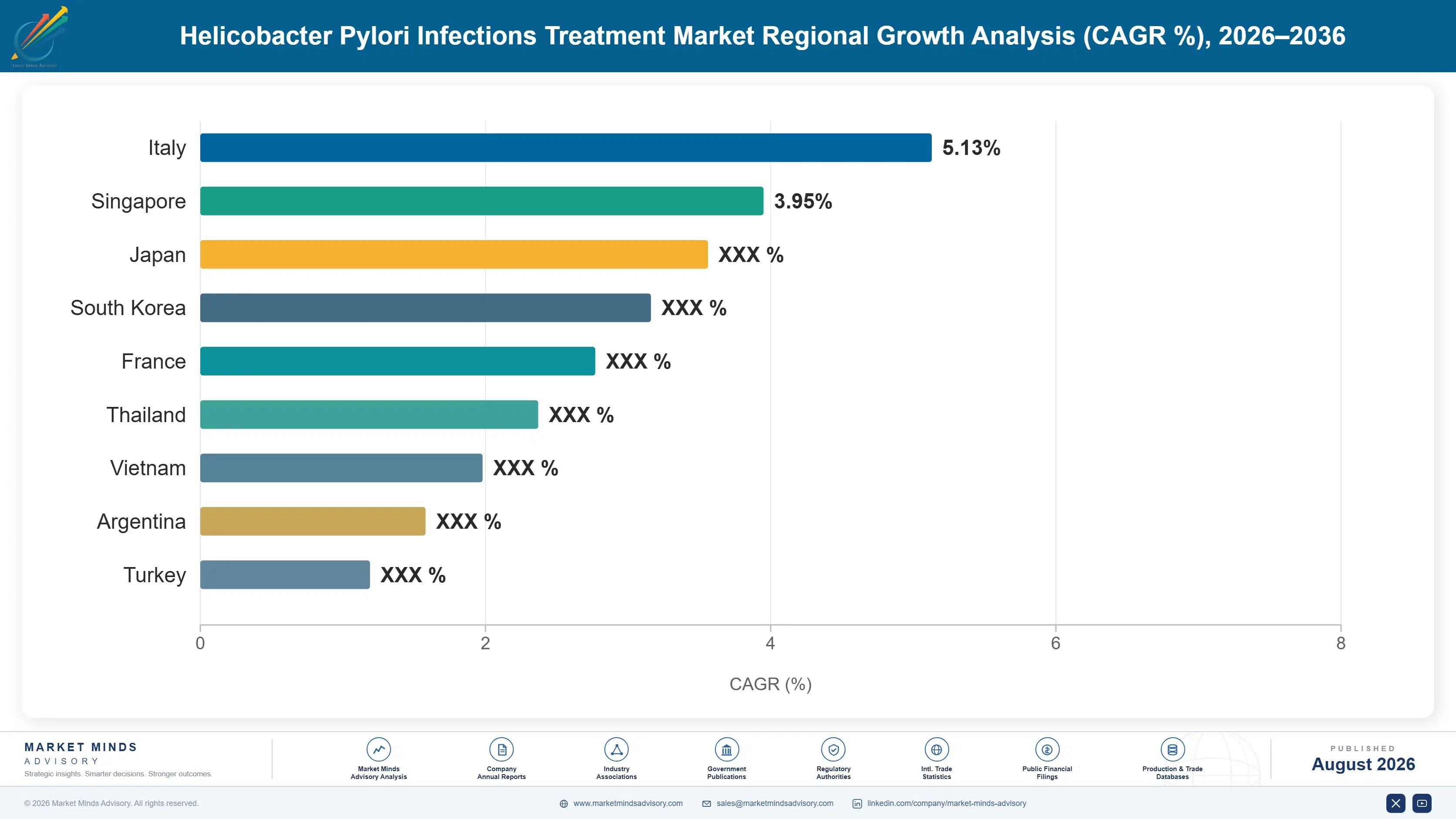
helicobacter-pylori-infections-treatment-market-country-cagr-analysis-1787332373722

Where H. Pylori Treatment Manufacturer Margin Concentrates

Competing purely on generic combination pricing concentrates margin in exactly the segment where established generic manufacturers now compete most aggressively and repeatedly worldwide across most institutional buyers. The four moves below shift value toward positions clinical evidence and regulatory positioning genuinely protect: vonoprazan platform investment, resistance testing partnership development, physician education programmes, and adherence-improving formulation design.

Invest in Vonoprazan Platform Development Directly

Vonoprazan-based regimens have reached roughly 20 percent of prescriptions in markets with regulatory approval, a share that has risen steadily as treatment guideline bodies increasingly recommend this category first in populations with documented elevated resistance prevalence and treatment failure rates observed consistently across most healthcare systems. Manufacturers with genuine next-generation acid suppression chemistry capture specification that generic combination producers increasingly cannot match as physicians prioritize eradication rate evidence over cost alone. Building this capability requires sustained clinical trial investment and regulatory engagement beyond conventional generic combination development entirely, a substantial multi-year commitment.
Market Impact: Vonoprazan regimens now reach rough

Develop Resistance Testing Partnership Programmes Now

Resistance testing use has risen roughly 25 percent annually as physicians increasingly test before selecting a first-line regimen to avoid prescribing treatments compromised by documented local resistance patterns across most major healthcare systems tracked closely and quite consistently each passing calendar year and quarter. Manufacturers partnering with diagnostic companies to bundle testing recommendations with treatment guidance capture physician trust and prescription volume that competitors offering treatment alone increasingly cannot access as precisely or reliably as before. This capability requires sustained investment in diagnostic partnership development beyond conventional pharmaceutical commercial models entirely.
Market Impact: Resistance testing use rose roughly

Build Physician Education Programmes at Scale

Treatment guideline updates recommending newer regimens over standard triple therapy require sustained physician education to translate into actual prescribing behaviour change, since many physicians continue defaulting to familiar standard regimens absent active outreach and clinical evidence communication across most practice settings. Manufacturers investing in comprehensive physician education capture prescribing share that competitors relying on guideline publication alone increasingly cannot convert into actual treatment volume, with educated prescribers switching regimens roughly 30 percent faster than uneducated peers. This capability compounds over time as educated physician networks continue prescribing newer regimens consistently.
Market Impact: Educated prescribers now switch abo

Design Adherence-Improving Fixed-Dose Formulations Broadly Now

Multi-drug regimens requiring patients to take several medications multiple times daily for 10 to 14 days genuinely undermine adherence, and non-adherence cuts real-world eradication success rates by roughly 15 percent compared with clinical trial results achieved under monitored conditions and close supervision throughout the entire treatment course. Manufacturers developing simplified fixed-dose combination formulations that reduce daily pill burden capture prescribing preference from physicians seeking to improve real-world treatment outcomes for their patients directly. This formulation investment requires sustained pharmaceutical development expertise in combination product design beyond simple generic manufacturing entirely.
Market Impact: Non-adherence cuts success rates by

Who Controls the Margin Pool

Concentration sits at a moderate 45% among the top five, led by Takeda's vonoprazan platform leadership and Phathom Pharmaceuticals' first-in-class regulatory positioning built over years of clinical evidence generation. The gap between leaders and challengers is clinical evidence depth and regulatory positioning rather than raw price, which generic manufacturers undercut easily in commodity categories. All participants are assessed on global prescription volume as disclosed in company reports,
Competition runs along four lines. First, vonoprazan and next-generation acid suppression platform depth, increasingly the fastest-growing purchase consideration among prescribers. Second, resistance testing partnership development that guides precise regimen selection. Third, physician education programme scale that converts guideline updates into prescribing behaviour. Fourth, adherence-improving formulation design that captures real-world outcome advantage.

Pressure is building from two directions. Generic manufacturers including Sun Pharmaceutical and Cipla have built substantial manufacturing scale and are converting cost advantages into meaningful share gains in price-sensitive standard triple therapy segments. Meanwhile established branded leaders continue defending position through sustained vonoprazan and resistance-testing partnership investment that generic competitors cannot easily replicate. Rankings should favour manufacturers combining clinical evidence depth with genuine next-generation capability over generic price alone.
helicobacter-pylori-infections-treatment-market-company-positioning-matrix-1787332374247

Competitive Moat and Risk Dimensions

TAKEDA PHARMACEUTICAL

Moat: Vonoprazan platform leadership

Takeda holds the originator position in vonoprazan development and maintains the deepest clinical evidence base supporting its use across multiple gastrointestinal indications including H. pylori eradication. Its global commercial infrastructure supports sustained physician education investment across multiple major markets simultaneously. Strong regulatory relationships built over years support faster approval timelines for expanded indications.
TAKEDA PHARMACEUTICAL

Risk: Regional licensing complexity persists

Takeda's vonoprazan commercialization involves regional licensing partnerships that create some complexity in coordinating global clinical evidence generation and physician education consistently. Generic manufacturers are increasingly developing competing acid suppression alternatives at lower price points in several markets. Newer entrants with narrower geographic focus can sometimes move faster on region-specific regulatory strategy.
PHATHOM PHARMACEUTICALS

Moat: First-in-class regulatory positioning

Phathom Pharmaceuticals secured first-in-class regulatory approval for vonoprazan-based H. pylori treatment in the United States, giving it a meaningful head start on physician education and formulary positioning domestically. Its focused commercial strategy concentrates resources entirely on gastrointestinal indications rather than diluting investment across a broader portfolio. Established relationships with leading gastroenterology practices provide considerable early-adopter specification advantage.
PHATHOM PHARMACEUTICALS

Risk: Narrow geographic and product focus

Phathom Pharmaceuticals' concentration in the United States market and narrow product portfolio expose it more directly to any single-market regulatory or reimbursement setback than more diversified competitors face. Capital constraints relative to larger diversified pharmaceutical competitors limit its international expansion pace somewhat. Takeda's broader global infrastructure could challenge its positioning as international expansion accelerates.

Players Tracked

Prominent Players

Takeda Pharmaceutical
Phathom Pharmaceuticals
RedHill Biopharma
AbbVie
Otsuka Pharmaceutical

Other Key Players

Sun Pharmaceutical
Cipla
Dr. Reddy's Laboratories
Teva Pharmaceutical
Viatris
Aptalis Pharma
Meiji Seika Pharma
Daewoong Pharmaceutical
HLB Life Science
Zhejiang Hisun Pharmaceutical
Jiangsu Hengrui Medicine
Fosun Pharma
Amneal Pharmaceuticals
Lupin Limited
Aurobindo Pharma

Recent Developments

MARCH 2025

Phathom Pharmaceuticals expands physician education programme

Phathom Pharmaceuticals expanded its physician education and clinical evidence dissemination programme to accelerate vonoprazan-based regimen adoption among gastroenterology and primary care prescribers nationally and consistently across most major regions tracked. This was a commercial programme expansion rather than any acquisition, targeting the fastest-growing regimen category directly.
Signal: Branded manufacturers are investing heavil
OCTOBER 2024

RedHill Biopharma signs distribution partnership for rescue therapy

RedHill Biopharma signed a distribution partnership with a regional pharmaceutical distributor to expand access to its rifabutin-based rescue therapy regimen across additional international markets and healthcare territories worldwide today. This was a distribution partnership rather than an acquisition, extending market reach without direct manufacturing investment.
Signal: Specialist rescue therapy manufacturers ar
JANUARY 2025

Takeda receives expanded regulatory approval in additional markets

Takeda received expanded regulatory approval for its vonoprazan-based H. pylori treatment regimen across several additional international markets with documented high clarithromycin resistance prevalence recorded recently and carefully. This was a regulatory approval rather than any acquisition, directly expanding the addressable prescriber base for its platform.
Signal: Regulatory approval expansion into high-re

Active Pharmaceutical Ingredients and Formulation

Active pharmaceutical ingredients, including proton pump inhibitors, antibiotics, and bismuth compounds, together account for 35% to 48% of cost of goods sold, reflecting the multi-component nature of most H. pylori treatment regimens across categories and formulations used. These ingredients are sourced predominantly from active pharmaceutical ingredient manufacturers concentrated in India and China directly and reliably.
Active pharmaceutical ingredient prices rose considerably through 2021 and 2022 amid broader global supply chain disruption, with several generic manufacturers disclosing meaningfully higher input costs during that period, per company annual report commentary and industry association data covering that cycle. Several manufacturers passed through a portion of this cost increase to healthcare system customers with a lag of several months, compressing margin temporarily during the transition. Prices have since moderated somewhat, though certain antibiotic components remain above pre-2021 levels.

Exposure separates clearly by manufacturer scale and ingredient sourcing strategy. Larger generic manufacturers with diversified active pharmaceutical ingredient supplier relationships absorbed less disruption than smaller competitors dependent on single-source suppliers during the tightest volatility periods specifically. Branded manufacturers with proprietary next-generation molecules like vonoprazan face different exposure than generic combination producers, since their input basket weights novel chemical synthesis rather than established generic ingredient sourcing.
helicobacter-pylori-infections-treatment-market-cost-volatility-analysis-1787332374446

Diversify active pharmaceutical ingredient sourcing

Single-source ingredient dependence exposed several smaller manufacturers to meaningful cost spikes during the 2021 and 2022 supply disruption specifically and repeatedly across the industry. Qualifying multiple ingredient suppliers reduces this concentration risk considerably across future disruption cycles ahead. The trade-off is additional regulatory qualification cost that smaller manufacturers sometimes cannot justify economically at current volumes.

Pursue vertical integration where feasible

Larger manufacturers with in-house active pharmaceutical ingredient production faced meaningfully less disruption than smaller competitors dependent on external suppliers during recent shortages and price spikes across the broader industry. Vertical integration reduces exposure to cross-border supply disruption considerably over time and across future cycles. This requires manufacturing investment that only larger, well-capitalized manufacturers can typically justify given current production volumes.

Shift commercial focus toward proprietary molecules

Generic ingredient cost pressure compresses margin regardless of manufacturer scale, while proprietary next-generation molecules like vonoprazan, once developed, carry meaningfully higher margin and genuine patent protection value over time across most therapeutic categories tracked closely. This shift moves manufacturer economics away from pure generic ingredient competition entirely and durably across successive product development cycles.

Portfolio Architecture for Margin Defence

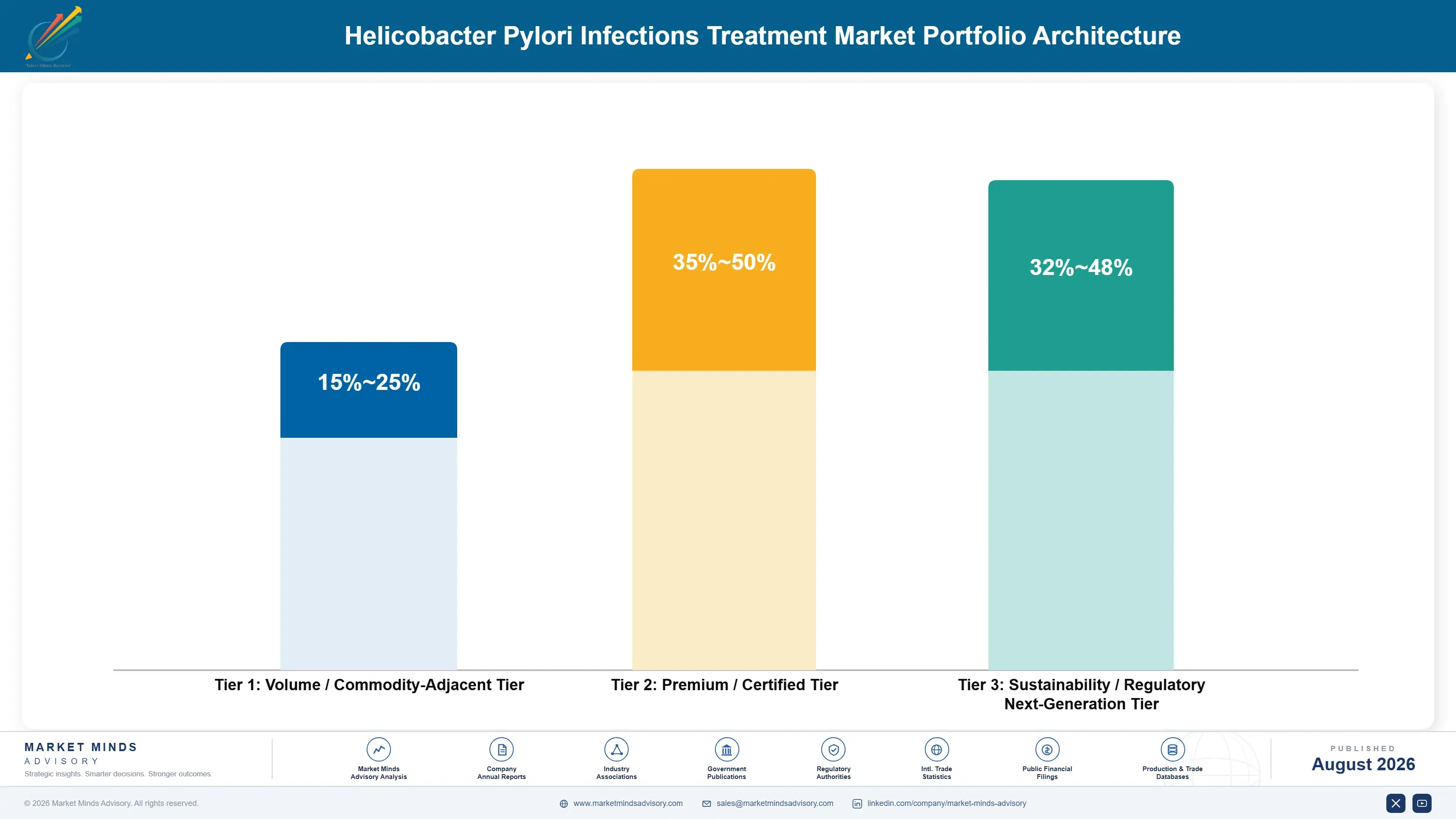
The portfolio splits into three tiers with distinct economics. Standard generic triple therapy combinations form the volume tier, competing increasingly on price against established generic manufacturers with margin set by ingredient cost and production efficiency. Vonoprazan-based and bismuth quadruple regimens earn considerably more since clinical evidence depth and regulatory positioning deter competitors lacking comparable investment. Physician education programmes and resistance testing par
The tension runs between standard generic revenue that funds the business today and vonoprazan and next-generation regimen investment that positions it for the next decade of resistance-driven demand. A manufacturer defending generic volume too aggressively against established competition cedes the highest-margin next-generation segments to competitors investing there directly. Companies managing this well use generic cash flow to fund clinical trial investment rather than treating them as competing priorities.

High-value pools concentrate where clinical evidence depth, regulatory positioning, or physician relationships limit competition: vonoprazan-based regimens, resistance-guided rescue therapy, and physician education programmes. Standard generic triple therapy sold without differentiated capability sits at the other end, competing almost entirely on price against every generic manufacturer now serving cost-sensitive institutional and public health system buyers.

Volume / Commodity-Adjacent Tier

Standard generic triple therapy combinations competing increasingly on price against established generic manufacturers, with margin set overwhelmingly by ingredient cost and production efficiency across most conventional categories tracked and monitored.
Gross Margin: 15-25%

Premium / Certified Tier

Vonoprazan-based and bismuth quadruple regimens supporting meaningfully stronger margin than standard generic production, reflecting genuine clinical evidence depth and regulatory positioning differentiation earned over years of trials, studies, and physician engagement.
Gross Margin: 35-50%

Sustainability / Regulatory / Next-Generation Tier

Resistance-guided rescue therapy platforms, physician education programmes, and next-generation fixed-dose formulations developed ahead of expanding antibiotic resistance surveillance across multiple jurisdictions currently reviewed and revised regularly by regulators and clinicians worldwide.
Gross Margin: 32-48%
helicobacter-pylori-infections-treatment-market-portfolio-architecture-1787332374954

High-value Sub-segments and Strategic Watch-out

Vonoprazan-Based Therapy Regimens

High value and high growth at 11.5%, the fastest category in the market, driven by superior eradication rates against resistant strains across most major healthcare systems and treatment guideline bodies currently updating first-line recommendations worldwide and consistently each year and quarter across most physician networks.
Gross Margin: 35-50%

Rescue and Salvage Therapy Regimens

High value with strong growth at 9.0%, the second-fastest category, driven by rising first-line treatment failure rates from antibiotic resistance requiring sequential retreatment across most major healthcare systems and prescriber networks tracked currently worldwide and increasingly across most regions, countries, treatment settings, and clinical guidelines.
Gross Margin: 32-48%

Bismuth Quadruple Therapy Regimens

The volume core by revenue, growing near 6.5% as this remains a well-established regimen category across nearly every major healthcare system tracked currently worldwide, though growth has moderated meaningfully as vonoprazan alternatives gain share steadily each year across most established markets, formularies, and prescriber networks.
Gross Margin: 20-30%

Standard Triple Therapy Regimens

The strategic watch-out, growing near 3.5% and facing sustained decline as rising resistance undermines eradication effectiveness across most standard treatment protocols currently prescribed in high-resistance markets globally today and increasingly elsewhere across most healthcare systems, prescriber networks, formularies, treatment guidelines, regulatory bodies, and public health agencies.
Gross Margin: 15-25%

How Guideline Trust Locks In Prescribing

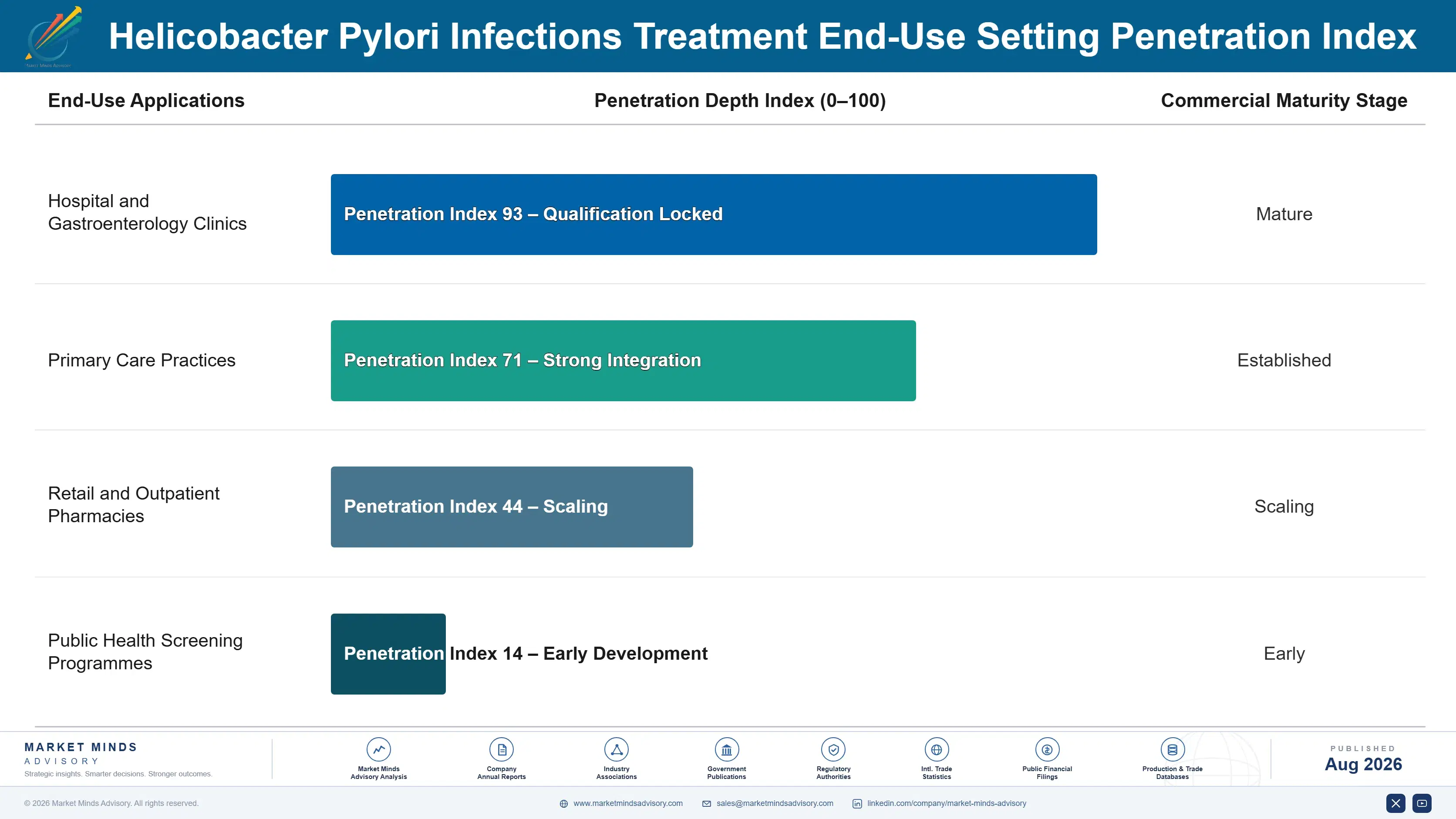
Revenue depends on treatment guideline inclusion and physician prescribing habit formation, and a manufacturer's default status within national treatment guidelines generates years of repeat prescription volume across every physician following that guidance. Switching prescribing patterns requires physicians to unlearn established habits and adopt new evidence, a cost that deters displacement even when a competitor offers marginally better pricing.
Adoption depth varies sharply by regimen category. Vonoprazan-based regimen prescribers commit hardest, given the clinical evidence review and formulary approval interdependence between the regimen and institutional prescribing protocols once adopted. Bismuth quadruple therapy prescribers sit in the middle, balancing established prescribing habits against periodic guideline updates recommending newer alternatives. Standard triple therapy prescribers switch most readily in high-resistance markets, since documented treatment failure rates create urgent pressure to change regardless of prescriber preference.

Buyer profiles have shifted from prescribers evaluating cost alone toward gastroenterologists and infectious disease specialists weighing eradication rate evidence, resistance pattern data, and patient adherence together. Resistance testing adoption has introduced a new prescriber consideration around diagnostic-guided treatment selection that empirical prescribing never required previously. Younger physicians trained during residency on resistance-guided protocols also weigh diagnostic integration more heavily than predecessors did.
helicobacter-pylori-infections-treatment-market-end-use-penetration-index-1787332375450

Our Call on H. Pylori Treatment

These are among the four positions where our research anticipates prominent divergence between winners and laggards over the coming forecast period. Each is grounded in the demand model, the regulatory perimeter, and the announced capacity pipeline.
01 / VONOPRAZAN PLATFORM DEPTH

Next-generation acid suppression decides guidelines

Vonoprazan-based regimens have reached roughly 20 percent of prescriptions in markets with regulatory approval, a share that has risen steadily as treatment guideline bodies increasingly recommend this category first in populations with documented elevated resistance prevalence and treatment failure rates. Manufacturers with genuine next-generation acid suppression chemistry capture specification that generic combination producers increasingly cannot match as physicians prioritize eradication rate evidence. Companies should build this capability now, since it increasingly gates access to the fastest-growing regimen category available worldwide.
02 / RESISTANCE TESTING INTEGRATION

Diagnostic partnerships guide precise prescribing

Resistance testing use has risen roughly 25 percent annually as physicians increasingly test before selecting a first-line regimen to avoid prescribing treatments compromised by documented local resistance patterns across most major healthcare systems tracked closely and consistently worldwide today. Manufacturers partnering with diagnostic companies to bundle testing recommendations with treatment guidance capture physician trust that competitors offering treatment alone increasingly cannot access as precisely. Companies should develop these partnerships deliberately, since diagnostic integration increasingly determines prescribing precision and physician trust.
03 / PHYSICIAN EDUCATION SCALE

Guideline updates require active prescriber outreach

Treatment guideline updates recommending newer regimens over standard triple therapy require sustained physician education to translate into actual prescribing behaviour change, since many physicians continue defaulting to familiar standard regimens absent active outreach and clinical evidence communication across most practice settings tracked closely today. Manufacturers investing in comprehensive physician education capture prescribing share that competitors relying on guideline publication alone increasingly cannot convert into volume. Companies should invest in education infrastructure deliberately, since it directly converts guidance into prescribing behaviour.
04 / ADHERENCE-FOCUSED FORMULATION DESIGN

Fixed-dose design improves real-world outcomes

Multi-drug regimens requiring patients to take several medications multiple times daily for 10 to 14 days genuinely undermine adherence, and non-adherence cuts real-world eradication success rates by roughly 15 percent compared with clinical trial results achieved under monitored conditions and supervision. Manufacturers developing simplified fixed-dose combination formulations that reduce daily pill burden capture prescribing preference from physicians seeking better real-world outcomes for patients. Companies should invest in formulation design deliberately, since adherence improvement directly determines eradication success and repeat prescribing volume.

Engagement Snapshot From the Field

A live engagement with an industry participant carrying material or product regulatory and market exposure ahead of a defining policy shift, showing how our research translates into a defensible multi-year portfolio strategy.
MARKET MINDS ADVISORY · CLIENT ENGAGEMENT SUMMARY
Helicobacter Pylori Infections Treatment Producer Strategic Portfolio Review and Transition Roadmap 2026·Investment Scenario on Helicobacter Pylori Infections Treatment Exposure Evaluation 2025-26
CLIENT PROFILE
A regional hospital gastroenterology network operating across nine facilities engaged MMA ahead of updating its standardized H. pylori treatment protocol given rising documented treatment failure rates across its patient population. The client reported that its existing standard triple therapy protocol was failing at rates considerably higher than historical benchmarks suggested it should (client-reported, unverified by MMA).
STRATEGIC CHALLENGE
Leadership faced a choice between updating its network-wide protocol to bismuth quadruple therapy, a well-established but more complex alternative, or adopting a newer vonoprazan-based regimen with stronger resistance coverage but less established institutional prescribing history. The board worried that a network-wide protocol change could create formulary and training complexity across nine facilities with varying pharmacy infrastructure and staff familiarity with newer regimens specifically.
MMA APPROACH
MMA benchmarked documented treatment failure rates and local resistance surveillance data across the network's nine facilities against both bismuth quadruple and vonoprazan-based regimen clinical evidence. We assessed formulary and pharmacy infrastructure readiness for each regimen option across all nine facilities individually. We then modelled physician education requirements and expected eradication rate improvement under each protocol update scenario considered.
KEY FINDINGS
  1. Documented treatment failure rates at six of nine facilities exceeded 25 percent, consistent with elevated clarithromycin resistance in the network's patient population.
  2. Vonoprazan-based regimen adoption was projected to improve first-attempt eradication rates by roughly 12 percentage points compared with continuing standard triple therapy protocols.
  3. Formulary approval for vonoprazan-based treatment could be completed within three months given existing regulatory clearance already established regionally and nationally across jurisdictions.
  4. Physician education requirements were manageable given the network's existing continuing education infrastructure already in place across all nine facilities and their departments.
CLIENT PROFILE
A regional hospital gastroenterology network operating across nine facilities engaged MMA ahead of updating its standardized H. pylori treatment protocol given rising documented treatment failure rates across its patient population. The client reported that its existing standard triple therapy protocol was failing at rates considerably higher than historical benchmarks suggested it should (client-reported, unverified by MMA).
STRATEGIC CHALLENGE
Leadership faced a choice between updating its network-wide protocol to bismuth quadruple therapy, a well-established but more complex alternative, or adopting a newer vonoprazan-based regimen with stronger resistance coverage but less established institutional prescribing history. The board worried that a network-wide protocol change could create formulary and training complexity across nine facilities with varying pharmacy infrastructure and staff familiarity with newer regimens specifically.
MMA APPROACH
MMA benchmarked documented treatment failure rates and local resistance surveillance data across the network's nine facilities against both bismuth quadruple and vonoprazan-based regimen clinical evidence. We assessed formulary and pharmacy infrastructure readiness for each regimen option across all nine facilities individually. We then modelled physician education requirements and expected eradication rate improvement under each protocol update scenario considered.
KEY FINDINGS
  1. Documented treatment failure rates at six of nine facilities exceeded 25 percent, consistent with elevated clarithromycin resistance in the network's patient population.
  2. Vonoprazan-based regimen adoption was projected to improve first-attempt eradication rates by roughly 12 percentage points compared with continuing standard triple therapy protocols.
  3. Formulary approval for vonoprazan-based treatment could be completed within three months given existing regulatory clearance already established regionally and nationally across jurisdictions.
  4. Physician education requirements were manageable given the network's existing continuing education infrastructure already in place across all nine facilities and their departments.
RECOMMENDED STRATEGY
Phase 1: Phase 1 (0 to 3 months): Complete formulary approval and initial physician education for vonoprazan-based regimen adoption fully and carefully. Phase 2: Phase 2 (3 to 9 months): Roll out the updated protocol across all nine facilities with ongoing outcome monitoring closely. Phase 3: Phase 3 (9 to 18 months): Evaluate network-wide eradication rate improvement and refine protocol based on observed clinical results carefully.
OUTCOME
The client updated its network-wide protocol to vonoprazan-based regimens, completing formulary approval and initial rollout within the planned timeline across all nine facilities nationwide and quite successfully overall throughout. First-attempt eradication rates improved meaningfully following the protocol update across the network (client-reported, unverified by MMA).

Frequently Asked Questions

Foundational context covering the market sizes, CAGR, scope, country, region and competition that inform every finding below. This section is provided to cover basics and most often pre-purchase conversations, answered from the MMA Primary Research Dataset.

What is the current size of the Helicobacter Pylori Infections Treatment Market?

The global H pylori infections treatment market is valued at USD 3.4 billion in 2025, covering standard triple therapy, bismuth quadruple therapy, vonoprazan-based regimens, and rescue therapy. Diagnostic testing products are excluded.

How large will the Helicobacter Pylori Infections Treatment Market be by 2036?

The market is forecast to reach USD 6.73 billion by 2036 in the base case, about 1.86 times the 2026 level. That represents incremental value of roughly USD 3.11 billion across the decade.

What is the CAGR for the Helicobacter Pylori Infections Treatment Market 2026 to 2036?

The market grows at a 6.4% CAGR in the base case, with bull and bear scenarios at 7.6% and 5.0%. The spread turns mainly on vonoprazan adoption pace and generic pricing pressure.

Which segment is growing fastest?

Vonoprazan-based therapy regimens grow fastest at 11.5%, about 1.80 times the overall rate, pulled forward by superior eradication rates against resistant strains. Rescue and salvage therapy regimens follow at 9.0%.

Who are the major companies in the Helicobacter Pylori Infections Treatment Market?

Leading companies include Takeda Pharmaceutical, Phathom Pharmaceuticals, RedHill Biopharma, AbbVie, and Otsuka Pharmaceutical. Concentration sits at a moderate 45%, led by Takeda's vonoprazan platform leadership.

Which country is growing fastest?

China grows fastest at an 8.9% CAGR, driven by expanding diagnosed infection volume and rising healthcare access nationally. India follows given its exceptionally high underlying infection prevalence.

Report Segmentation Architecture

The full report scope spans multiple orthogonal segmentation dimensions, with cross-tabulated demand data provided for each dimension pair. Coverage extends further to regional breakdowns, trend trajectories, and the competitive detail needed to support segment-level decision-making.

By Treatment Regimen Type

  • Standard Triple Therapy Regimens
  • Bismuth Quadruple Therapy Regimens
  • Vonoprazan-Based Therapy Regimens
  • Sequential and Concomitant Therapy Regimens
  • Rescue and Salvage Therapy Regimens

By End-Use Setting

  • Hospital and Gastroenterology Clinics
  • Primary Care Practices
  • Retail and Outpatient Pharmacies
  • Public Health Screening Programmes

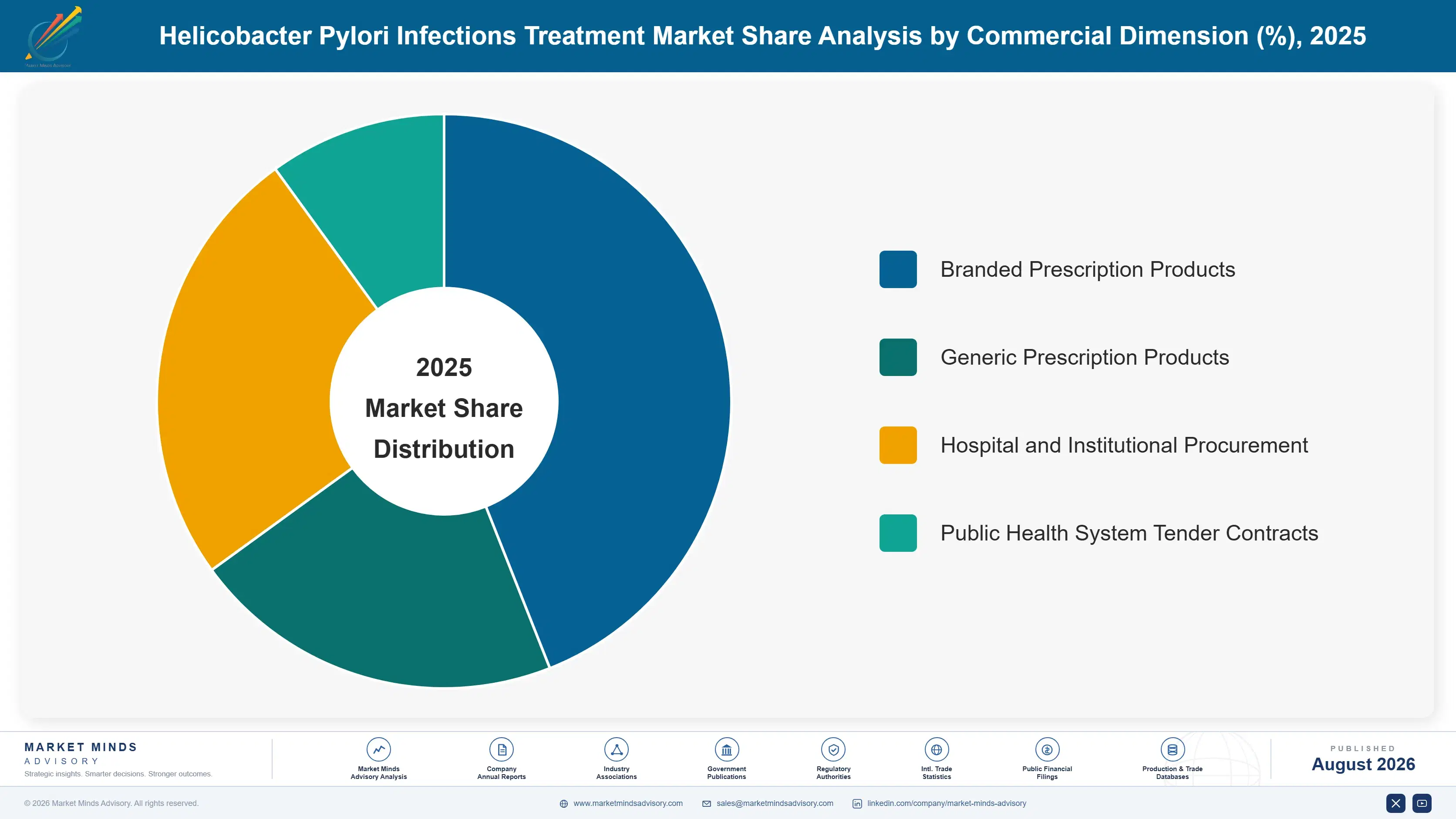
By Commercial Dimension

  • Branded Prescription Products
  • Generic Prescription Products
  • Hospital and Institutional Procurement
  • Public Health System Tender Contracts

By Region

  • North America
  • Western Europe
  • East Asia
  • South Asia and Pacific
  • Latin America
  • Middle East and Africa
  • Eastern Europe

Scope, Methodology, and Coverage

Every figure in this report is reproducible from documented input assumptions. The scope below maps the historical period, the forecast horizon, the segmentation dimensions, and the countries covered, alongside the underlying primary and qualitative methodology.
Historical Period
2020 to 2025
Forecast Period
2026 to 2036
Base Year
2025 (USD billions; MMA Primary Research Dataset, August 2026)
Market Definition
The H. pylori infections treatment market comprises pharmaceutical regimens used to eradicate Helicobacter pylori infection, valued at manufacturer revenue for standard triple therapy, bismuth quadruple therapy, vonoprazan-based regimens, sequential and concomitant therapy, and rescue therapy products. Diagnostic testing products and treatments for unrelated gastrointestinal conditions are excluded from this scope.
Quantitative Units
USD billions (current prices); prescription volume by regimen type where applicable
Segmentation Dimensions
By Treatment Regimen Type; By End-Use Setting; By Commercial Dimension; By Region
Regions Covered
North America, Western Europe, East Asia, South Asia and Pacific, Latin America, Middle East and Africa, Eastern Europe
Countries Covered
China, Japan, South Korea, India, USA, Canada, Germany, France, UK, Italy, Spain, Australia, Vietnam, Indonesia, Brazil, Mexico, Argentina, Saudi Arabia, UAE, Turkey, South Africa, Nigeria, Poland, Romania, Czech Republic, Thailand, Philippines, Sweden, Netherlands, Singapore, and additional markets relevant to this sector
Key Companies Profiled
Takeda Pharmaceutical, Phathom Pharmaceuticals, RedHill Biopharma, AbbVie, Otsuka Pharmaceutical, Sun Pharmaceutical, Cipla, Dr. Reddy's Laboratories, Teva Pharmaceutical, Viatris, Aptalis Pharma, Meiji Seika Pharma, Daewoong Pharmaceutical, HLB Life Science, Zhejiang Hisun Pharmaceutical, Jiangsu Hengrui Medicine, Fosun Pharma, Amneal Pharmaceuticals, Lupin Limited, Aurobindo Pharma
Quantitative Methodology
Primary survey, n=3,800 respondents, Q4 2025, six countries; demand-side model with trade association cross-validation
Qualitative Methodology
47 expert interviews, Q4 2025; applied to validate demand model assumptions, identify emerging dynamics, and assess competitive positioning
Report Format
PDF and XLSX data workbook (Word format preview document)
Publisher
Market Minds Advisory
Report Code
MMA-2026-HLT-303
Published
August 2026
Contact
sales@marketmindsadvisory.com | www.marketmindsadvisory.com

Purchase the full Helicobacter Pylori Infections Treatment Market Report (2026 to 2036).

The full MMA H. Pylori Infections Treatment report sizes the market across five treatment regimen types, four end-use settings, four commercial channels, and seven regions through 2036. It profiles 20 companies on a consistent prescription volume basis, scoring each on vonoprazan platform depth, resistance testing partnership development, physician education scale, and adherence-improving formulation design. Scenario models quantify how antibiotic resistance, screening programme expansion, and generic competition trends move both prescription volume and achievable margin by regimen. The report also includes resistance surveillance mapping and treatment guideline tracking for manufacturer and investor strategy teams.
Five-regimen and four-channel market sizing to 2036
Twenty-company benchmark on prescription volume basis
Vonoprazan platform competitive positioning analysis and review
Resistance testing partnership benchmarking and coverage review
Antibiotic resistance surveillance and guideline tracking
Physician education and formulary adoption analysis

Built For The People Who Decide

From boardroom strategy to bench-side execution, this report is read cover-to-cover by leaders shaping the next decade of their industry, turning demand scenarios, market dynamics and valuation benchmarks into decisions.
CXOs/ Presidents/ VPs/ Managers
M&A and Corporate Development
Strategy Teams and R&D Heads
Procurement and Product Directors
Regulatory and Compliance Leaders
Investor Relations and Equity Analysts