Market Minds Advisory
Heavy Oil Cracking Catalyst Market

Heavy Oil Cracking Catalyst Market: Bottom-of-Barrel Upgrading and Resid Conversion Economics

Heavier, more sour crude slates and tightening clean fuel specifications are pushing refiners toward resid FCC and ebullated-bed hydrocracking catalysts, even as China's grip on lanthanum supply and refining margin pressure squeeze catalyst producer economics.

Lead Analyst

Bilal Shaikh

Published

September 2026

Make Smarter Decisions with Customized Research Insights

Request a free sample report and evaluate market opportunities, growth trends, and competitive dynamics relevant to your business needs.

2025 MARKET VALUE$4.6BMarket Size 2025
2036 FORECAST VALUE$8.8BBase Case , 2026 to 2036
CAGR 2026 TO 20366.1 %Bull 7.3% / Bear 4.9%
INCREMENTAL OPPORTUNITY$3.9BNet 10- year value creation
EXPANSION MULTIPLE1.81x2036 value over 2026 base
Strategic Levers
M&A Pipeline
Regional Outlook
Country Rankings
Competitive Intelligence
Segmental Deep-dive
Call-Us : 91 93563 13602

Executive Snapshot and Market Trajectory

Refiners are shifting catalyst spend toward resid FCC and ebullated-bed hydrocracking formulations as crude slates grow heavier and sourer, even where those catalysts cost several times more per tonne than conventional FCC catalyst formulated for lighter feedstock, and refiners are absorbing that premium because the yield gain pays back quickly.
Middle Eastern bottom-of-barrel upgrading megaprojects are driving the fastest-growing demand pool, while ebullated-bed residue hydrocracking catalysts grow fastest at roughly nine percent annually as refiners chase maximum distillate yield over fuel oil. East Asia holds the largest share of global demand on China's refining capacity base, though the Middle East now consumes a share of global catalyst volume disproportionate to its refining capacity because of concentrated single-site megaproject investment. a pattern others are now studying.
Competitive intensity centers on zeolite and metals formulation chemistry rather than base material supply, since catalyst performance differences translate directly into refiner margin. Tightening clean fuel and marine bunker sulphur rules across the International Maritime Organization framework are accelerating demand for deep desulphurisation catalysts, and several producers are now qualifying rare earth recovery and recycling processes to reduce exposure to Chinese lanthanum export policy.
Market Definition
The heavy oil cracking catalyst market covers catalysts used to convert heavy and residual crude oil fractions into lighter, higher-value products, spanning fluid catalytic cracking, resid FCC, hydrocracking, ebullated-bed residue hydrocracking, delayed coking additives, and FCC performance additives. It includes catalyst manufacturing and regeneration services sold together. Petrochemical steam cracking catalysts, catalytic reforming catalysts, and licensing fees separate from catalyst supply are excluded.
Base Year Value
$4.6B in 2025 (MMA Primary Research Dataset, August 2026)
Forecast Period
2026 to 2036, eleven discrete annual values
CAGR
6.1% base case. Bull 7.3%. Bear 4.9%.
Fastest Growth Segment
Ebullated-Bed Residue Hydrocracking Catalysts: 9.4% CAGR
Fastest Growth Country
China: 10.5% CAGR
Fastest Growth Region
South Asia and Pacific: 8.2% CAGR
Largest Region
East Asia: 26% of 2025 global value
Market Leaders
Albemarle Corporation, W. R. Grace & Co., BASF SE, Honeywell UOP, Johnson Matthey plc. Source: MMA Analysis based on company annual reports.
Primary Survey
n=3,800 procurement and R&D decision-makers, Q4 2025, six countries
Methodology
Demand-side build-up, cross-validated against public data, 47 expert interviews

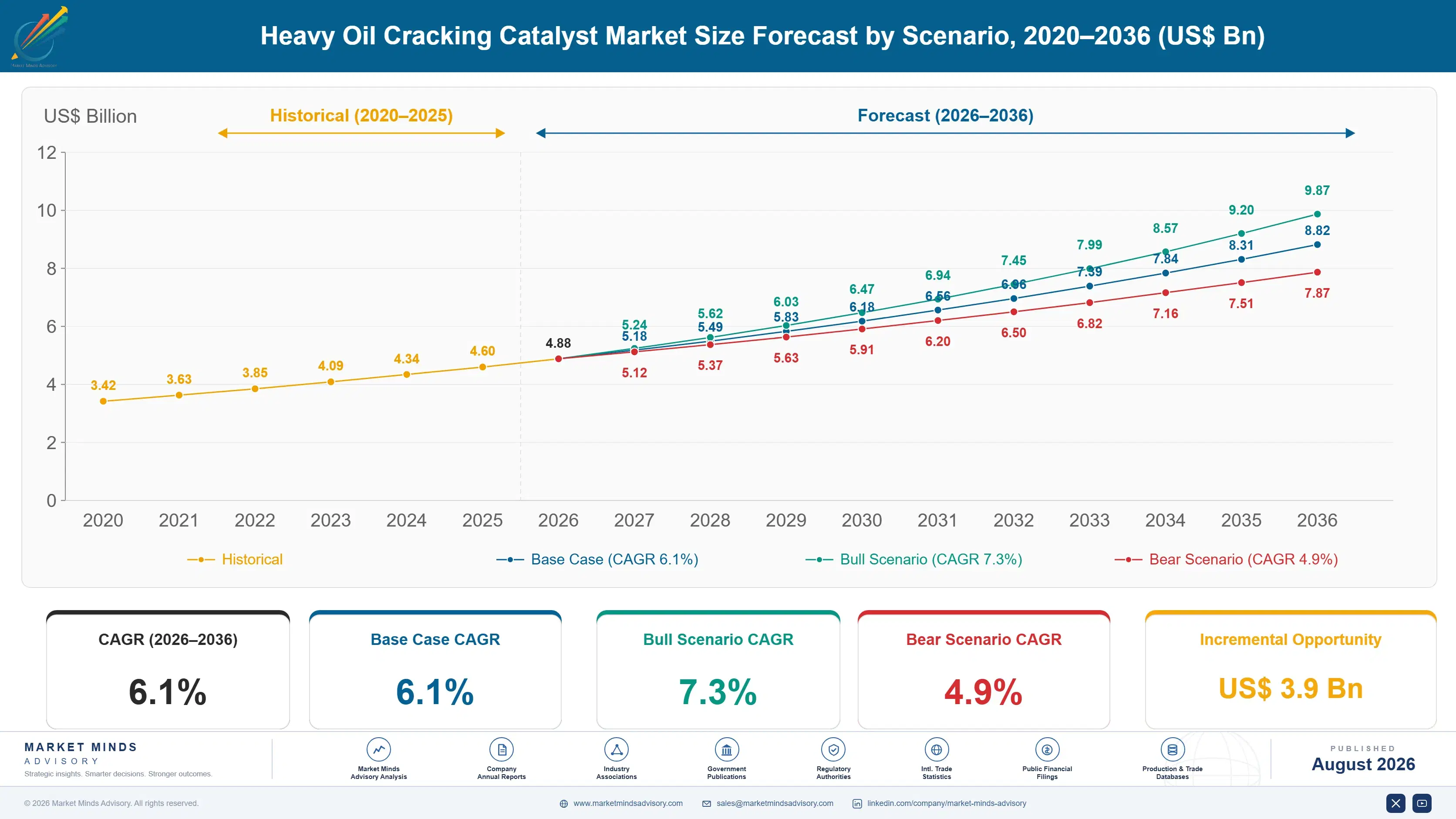
Heavy Oil Cracking Catalyst Market Forecast Scenarios

heavy-oil-cracking-catalyst-market-trends-size-forecast-scenario-1787553806485
Heavy oil cracking catalyst demand grew at a 5.3% historical rate between 2020 and 2025, held back early by pandemic-driven refinery run cuts and later by a slow recovery in jet fuel demand that delayed some catalyst reformulation decisions. Recovery accelerated from 2022 as refiners processing heavier crude grades pushed resid catalyst volumes back above pre-pandemic levels across most major refining regions.
Three mechanisms carry the base case to 6.1%. First, Middle Eastern bottom-of-barrel megaprojects keep generating first-fit catalyst specification for new residue upgrading complexes independent of existing refinery replacement cycles. Second, heavier and sourer crude slates across Asian and American refiners are shortening standard FCC catalyst life and pulling resid-grade replacement volume forward. Third, tightening marine bunker and clean fuel sulphur regulation is pushing refiners toward higher-cost deep hydrocracking catalyst systems even where conventional FCC formulations remain considerably cheaper per tonne.
The bull case at 7.3% assumes Middle Eastern megaproject catalyst orders accelerate faster than currently scheduled and Chinese independent refiners continue converting toward resid processing ahead of plan. The bear case at 4.9% assumes prolonged refining margin weakness delays catalyst upgrade decisions across mature markets, stretching replacement intervals and pushing capital spending later into the forecast period.

Refining Margin Economics and Catalyst Selection

Three forces converge on the heavy oil cracking catalyst market. Heavier and sourer crude slates across mature refining regions need catalyst reformulation faster than budgets assumed, new bottom-of-barrel megaprojects across the Middle East need first-fit specification at scale, and tightening clean fuel regulation is pushing refiners toward catalysts that cost more upfront but lift distillate yield. Refiners treat catalyst selection as a margin lever rather than a procurement decision.
MARKET CONCENTRATIONCR5 68%Concentrated field led by a handful of global specialists
AVERAGE CATALYST PRICE PREMIUM2.5x to 4xResid-grade catalyst commands a steep and durable formulation premium
TOP PRODUCING COUNTRY SHAREChina 19%Domestic refining and catalyst manufacturing anchor national output
CAPACITY UTILISATION81%Producers run near ceiling through most planning cycles
FEEDSTOCK SHARE OF COGS45% to 58%Rare earth and base zeolite materials dominate finished cost
TYPICAL CATALYST CHANGE-OUT INTERVAL1 to 3 yearsReplacement frequency varies sharply by unit operating severity
Commercially, the market behaves like a specialty technical service rather than a commodity material trade. Refiners select on yield uplift, catalyst life, and technical service depth more than on unit price, and switching a qualified catalyst formulation on a critical cracking unit is rare once a refiner has validated a supplier's performance data against its specific crude slate. Long qualification cycles reinforce that stickiness further across every major refining region.
Over the next decade the defining forces are rare earth supply security, the pace at which resid and ebullated-bed catalysts displace conventional FCC formulations, and how quickly refiners outside China qualify recycled rare earth content to reduce single-country dependence. Suppliers that solve both the chemistry and the supply security problem simultaneously will set the pace of the market's next decade.
"A one percent yield improvement on a large cracking unit is worth more to a refiner in a single quarter than the entire catalyst bill for the year. That is why nobody negotiates this line item on price alone."
Director, Refining Catalysts and Process Technology Practice · MMA Chemicals and Materials Practice · August 2026

Market Trends

Ebullated-Bed Hydrocracking Gains Share Over Delayed Coking

Refiners upgrading residue increasingly favour ebullated-bed hydrocracking over delayed coking, since hydrocracking converts residue directly into distillate rather than low-value petroleum coke, and rising coke inventories in several markets have compressed coking economics meaningfully. Saudi Aramco's Jazan refinery and several Chinese independent refiners have commissioned ebullated-bed units since 2023, each requiring continuous catalyst addition and withdrawal rather than the batch change-out cycle standard FCC units use. Chevron Lummus Global and Axens both report expanding order books for ebullated-bed catalyst systems tied to committed megaproject capacity coming online through the back half of the decade.
Market Impact: Adds USD 280 million reformulation demand
Middle East Megaprojects Concentrate Catalyst Demand

Saudi Arabia's Jazan and Jubail complexes, alongside UAE and Kuwaiti residue upgrading investment, are generating catalyst specification volume that did not exist a decade ago, each single complex consuming catalyst volumes comparable to several conventional refineries combined. Regional refiners report multi-year catalyst supply agreements tied directly to unit commissioning schedules, giving suppliers unusually long demand visibility. Albemarle and Honeywell UOP have both opened regional technical service centres in the Gulf since 2024 to support these megaproject accounts directly rather than serving them from European or American technical hubs. a shift refiners increasingly expect as standard practice.
Market Impact: Lifts hydrocracking share by 7 points

Market Opportunities and Growth Drivers

Heavier Crude Slates Force Catalyst Reformulation Industry-Wide

Global crude quality has grown heavier and sourer over the past decade as conventional light sweet fields decline and heavier grades from Canada, Venezuela, and the Middle East fill the gap, forcing refiners to reformulate catalyst systems to handle higher metals and sulphur content without sacrificing conversion. Standard FCC catalyst deactivates faster when exposed to nickel and vanadium contamination common in heavier feedstock, pushing refiners toward metals-tolerant resid formulations. This creates reformulation demand independent of any capacity expansion, and catalyst suppliers report technical service requests rising sharply across refiners processing increasingly heavy import slates.
Market Impact: Raises lanthanum cost by 22%

Marine Fuel Sulphur Rules Lift Deep Hydrocracking Demand

The International Maritime Organization's global sulphur cap, combined with tightening national clean fuel standards, has pushed refiners toward deep hydrocracking and hydrotreating catalyst systems capable of producing very low sulphur marine fuel and cleaner distillate simultaneously. China's Ministry of Ecology and Environment has also tightened domestic fuel sulphur limits, adding a second regulatory driver across the region's largest refining base. Compliance costs fall hardest on smaller regional refiners lacking capital for full catalyst system upgrades, accelerating consolidation as larger players qualify compliant technology first and capture disproportionate specification share. Suppliers report this is now the largest driver of new specification.
Market Impact: Delays upgrades 6 to 9 months

Market Restraints and Challenges

Chinese Rare Earth Export Controls Threaten Catalyst Supply

Lanthanum, essential to zeolite Y formulation in FCC catalyst, depends heavily on Chinese rare earth mining and separation capacity, giving Beijing effective influence over global catalyst input pricing and availability. The root cause is geological and processing concentration, and new export licensing requirements introduced through 2023 and 2024 disrupted shipments for extended periods across several producers. The commercial impact falls hardest on catalyst makers without long-term rare earth supply contracts, who face both higher input cost and delivery uncertainty. Several producers are now qualifying rare earth recovery from spent catalyst to reduce dependence on freshly mined Chinese material.
Market Impact: Adds 2.4 points to segment CAGR

Refining Margin Weakness Delays Catalyst Upgrade Decisions

Global refining margins have weakened in several recent years as new capacity additions across Asia and the Middle East outpaced demand growth, and refiners facing thin margins often delay premium catalyst upgrades in favour of cheaper conventional formulations even where the upgrade would pay back within a single operating cycle. The root cause sits in capital allocation discipline during margin downturns, when catalyst spend competes directly against other deferred maintenance priorities. The commercial impact falls hardest on catalyst suppliers selling premium resid and ebullated-bed formulations, whose sales cycles lengthen considerably during margin troughs across the industry.
Market Impact: Lifts Gulf demand by 5 points
3 additional market trends, 4 additional growth drivers, and 3 additional restraints and challenges are covered in the full report. Contact sales@marketmindsadvisory.com to access the complete intelligence.

Segment CAGR and Growth Architecture

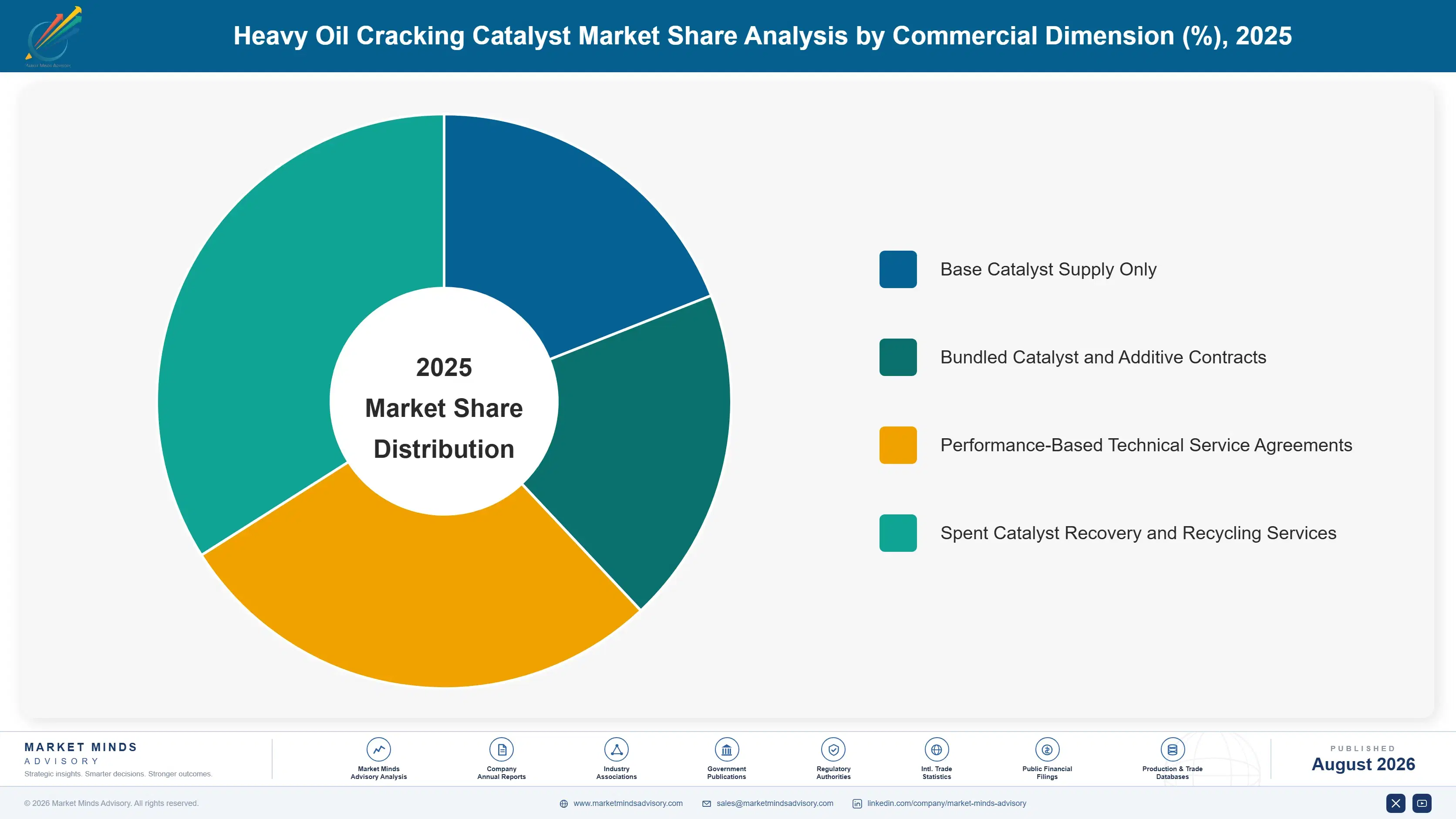
Segmentation follows catalyst type, a single technical and commercial logic, since zeolite structure, metals tolerance, and regeneration method vary by catalyst family rather than by the refinery configuration a unit sits within or the crude grade a refiner processes. Every catalyst family below competes for the same refiner budget line. and gets evaluated against a shared performance benchmark.
heavy-oil-cracking-catalyst-market-trends-market-share-analysis-1787553807037

Ebullated-Bed Residue Hydrocracking Catalysts

Ebullated-bed residue hydrocracking catalysts grow fastest at 9.4%, about 1.54 times the overall 6.1% rate, as refiners chase maximum distillate yield from residue rather than accepting lower-value fuel oil or petroleum coke as a byproduct. Continuous catalyst addition and withdrawal systems distinguish this segment from batch-cycle FCC catalyst, requiring different technical service and logistics relationships between supplier and refiner. Demand concentrates in Middle Eastern megaprojects and Chinese independent refiners converting toward maximum distillate configurations, where committed capital budgets extend catalyst supply visibility years ahead of typical FCC contracts. Chevron Lummus Global, Axens, and Honeywell UOP supply the bulk of qualified systems, and order backlogs now stretch past a year at several major suppliers.
CAGR 9.4%

Resid FCC Catalysts

Resid FCC catalysts grow at 8.0%, the second-fastest catalyst type, as refiners processing heavier and more contaminated feedstock specify metals-tolerant, high metal-trap formulations that conventional FCC catalyst cannot handle without rapid deactivation. Vanadium and nickel passivation additives are typically co-sold alongside base catalyst, giving suppliers a bundled revenue stream beyond the core zeolite product. North America and East Asia drive the bulk of specification as refiners in both regions increasingly process discounted heavy crude grades to protect margin. Albemarle and W. R. Grace both expanded resid catalyst production capacity during 2024 and 2025 to meet rising specification across their largest refining accounts. Technical service intensity runs higher for resid formulations, since refiners require ongoing performance monitoring against shifting crude slates.
CAGR 8.0%
Full segment breakdown across 6 segments available in the complete report.

Regional Architecture and Country Demand Map

East Asia leads on refining capacity scale anchored by China, North America follows on heavy crude processing along the Gulf Coast, and the Middle East and Africa consumes a share of catalyst volume well above its refining capacity share because of concentrated bottom-of-barrel megaproject investment.

North America

United States Gulf Coast refineries processing heavy Canadian and Latin American crude anchor North American demand, where resid FCC and hydrocracking catalyst volumes have grown steadily as light sweet domestic production increasingly displaces lighter imports rather than heavy grades. Canadian oil sands upgraders add a distinct demand pool tied to bitumen processing rather than conventional crude refining. The region's 23% share and 6.0% growth rate reflect a mature but heavy-crude-weighted refining base that keeps resid catalyst demand elevated relative to the region's overall refining capacity trend. Tightening federal clean fuel standards are pulling specification toward deeper hydrocracking systems even where conventional FCC catalyst would historically have sufficed for most units.
Share: 23% | CAGR: 6.0% (2026 to 2036)

Western Europe

A decade-long wave of refinery closures, not new investment, defines demand across Western Europe, where several older refineries have closed permanently over the past decade and the surviving base skews toward complex sites processing heavier import crude to remain competitive. Germany, France, and the Netherlands hold the largest surviving refining base, sustaining steady catalyst replacement volume for BASF, Clariant, and Axens on European soil. The region's 14% share sits well below East Asia's despite once holding comparable refining capacity, reflecting net capacity closures against Asian and Middle Eastern expansion. Growth of 4.6%, among the slowest of the seven regions, reflects an industry managing decline rather than expanding. This share sits below the standard band due to sustained refinery closures.
Share: 14% | CAGR: 4.6% (2026 to 2036)
Regional intelligence for 5 additional markets available in the complete report: East Asia, South Asia and Pacific, Latin America, Middle East and Africa, Eastern Europe. Contact sales@marketmindsadvisory.com.
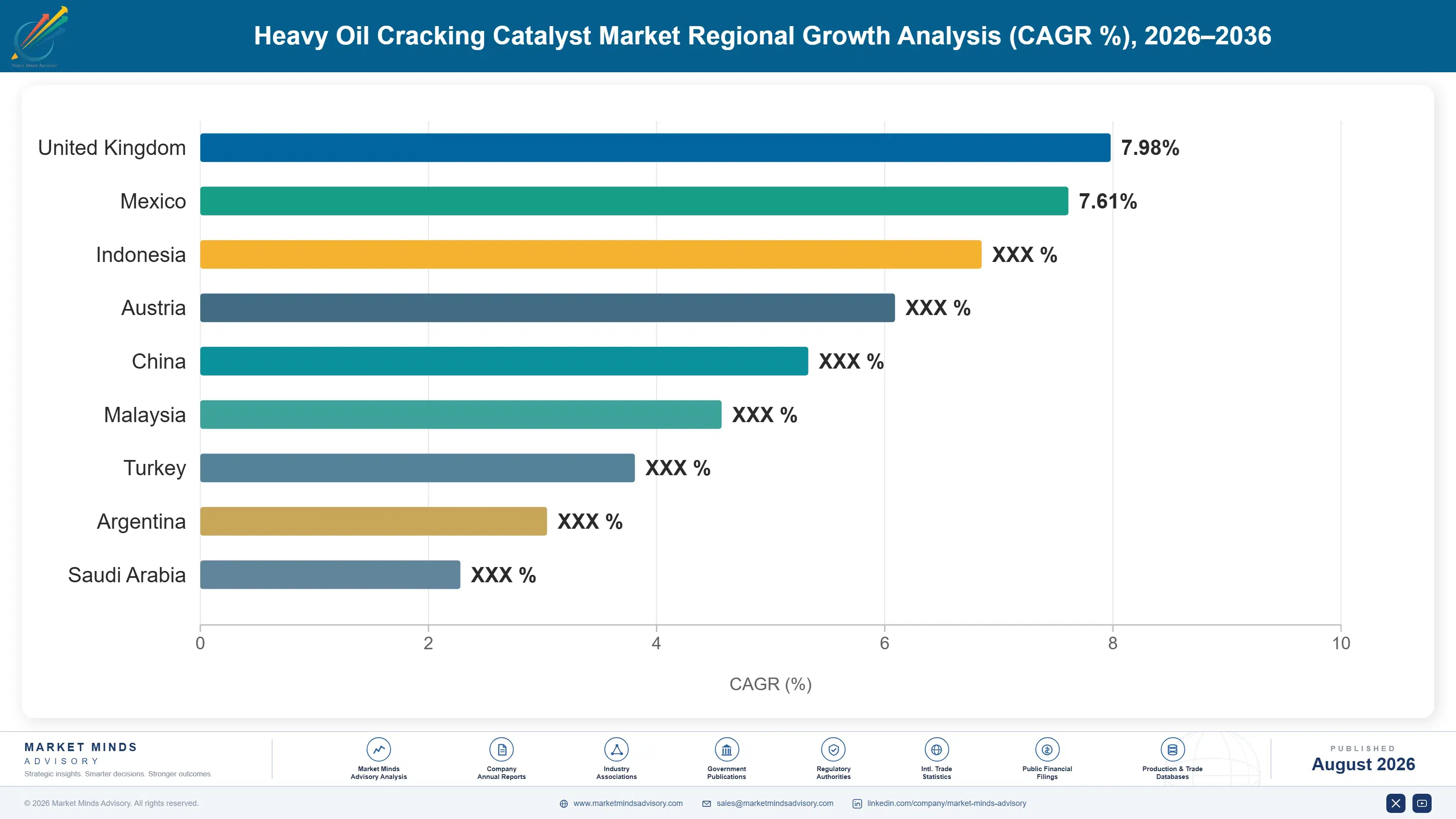
heavy-oil-cracking-catalyst-market-trends-country-cagr-analysis-1787553807547

Where Catalyst Suppliers Can Defend Margin

Four moves separate catalyst suppliers earning premium margin from those competing purely on price per tonne, each targeting a point where refiners pay for yield certainty rather than base material alone, since a poorly performing catalyst costs a refiner far more in lost margin than any amount saved on the original purchase. The strongest suppliers price around that asymmetry deliberately.

Bundle Technical Service With Performance-Based Pricing

Suppliers that price catalyst partly against delivered yield uplift, rather than purely on tonnage, convert a commodity material sale into a shared-risk technical partnership, and refiners pay a real premium for suppliers willing to stand behind performance guarantees. Early adopters report renewal rates well above suppliers selling catalyst alone, since switching away from a supplier with years of unit-specific performance data carries real technical risk. Albemarle and Honeywell UOP have both expanded performance-based contracts since 2024, tying a meaningful share of pricing to delivered conversion and yield metrics. reinforcing the shift industry-wide.
Market Impact: Lifts service contract margin by 6 to 10 points

Recover Rare Earth From Spent Catalyst Directly

Suppliers that build rare earth recovery capability from spent equilibrium catalyst reduce dependence on freshly mined Chinese lanthanum while offering refiners a documented circularity story that increasingly matters to their own sustainability reporting. This also addresses the industry's most binding input risk directly, since recovered rare earth content is not subject to the same export licensing constraints as newly mined material. W. R. Grace and BASF have both disclosed spent catalyst recovery investments in their 2024 annual reports, targeting a meaningful reduction in freshly mined lanthanum dependence by the end of the decade.
Market Impact: Cuts lanthanum dependence by roughly 25% within five years

Localise Technical Service Near Megaproject Sites

Suppliers that place technical service engineers and application laboratories directly at Gulf and Asian megaproject sites, rather than serving them remotely from European or American hubs, can offer refiners faster troubleshooting response that commands a premium during commissioning and early operating periods when catalyst performance issues carry the highest cost. Building this local presence takes years of relationship development and regulatory qualification, creating a durable advantage once established. Albemarle and Axens have both disclosed regional technical centre investments targeting Gulf megaproject accounts directly since 2024, reinforcing how central local presence has become to winning megaproject specification.
Market Impact: Commands a 4 to 8% technical service premium

Offer Combined FCC and Additive Bundled Contracts

Suppliers that bundle base FCC or resid catalyst with performance additives, including CO combustion promoters and metals passivators, on a single contract capture more of the total catalyst budget per refinery than suppliers offering base catalyst alone, since refiners increasingly prefer a single accountable supplier for the whole catalyst system rather than sourcing additives separately. This also deepens the technical relationship, since additive dosing requires close collaboration on unit-specific performance data. Grace and BASF have both expanded bundled contract offerings since 2024, reporting order values meaningfully higher than base-catalyst-only agreements.
Market Impact: Raises average contract value by about 15% per contract

Who Controls the Margin Pool

Concentration runs high at a CR5 of 68%, with the gap between Albemarle and W. R. Grace, the two largest suppliers, and smaller regional formulators measured in decades of proprietary zeolite and metals chemistry rather than manufacturing scale alone. All participants here are assessed on one basis, annual catalyst manufacturing and technical service revenue tied to heavy oil cracking applications specifically.
Competitive activity runs along three lines. Proprietary zeolite and metals formulation chemistry remains the primary differentiator, since performance differences translate directly into refiner margin worth paying a premium for. Rare earth supply security is becoming a competitive advantage as Chinese export policy tightens further. And performance-based pricing contracts are shifting several suppliers from one-time material sales toward long-term technical partnerships that lock in refiner accounts for years.

Pressure is building from Chinese domestic suppliers, including Sinopec Catalyst Company, who lack the global technical service reach of Western majors but compete aggressively on price within China's protected refining base. Rankings will shift toward suppliers who combine rare earth supply security with technical service capability, since both are becoming harder to build from a standing start as Chinese export policy and megaproject complexity increase together.
heavy-oil-cracking-catalyst-market-trends-company-positioning-matrix-1787553808071

Competitive Moat and Risk Dimensions

ALBEMARLE CORPORATION

Moat: Broadest catalyst technology portfolio

Albemarle, operating its catalyst business under the Ketjen brand, manufactures across the full range of FCC, resid FCC, and hydroprocessing catalyst chemistries, letting it win specification regardless of which technology a refiner ultimately requires. Its global technical service network and decades of proprietary zeolite chemistry give it credibility competitors struggle to match on complex resid applications.
ALBEMARLE CORPORATION

Risk: Lithium business volatility spillover risk

Albemarle's broader corporate performance ties heavily to its lithium business, which has experienced severe price volatility in recent years, and sustained weakness there could constrain capital available for catalyst segment investment even though the two businesses serve entirely different markets. Investors sometimes discount the stable catalyst business alongside lithium volatility regardless of segment performance.
W. R. GRACE & CO.

Moat: Deep FCC catalyst manufacturing heritage

Grace pioneered much of modern FCC catalyst technology and maintains one of the industry's deepest technical service relationships with refiners worldwide, and many refiners specify Grace formulations by name in capital planning documentation. That heritage and technical depth give it pricing power newer entrants cannot replicate easily on conventional and resid FCC applications.
W. R. GRACE & CO.

Risk: Ownership structure limits strategic flexibility

Grace operates under private equity and industrial ownership following its 2021 acquisition by Standard Industries, and the associated leverage could constrain capital available for the research investment needed to keep pace with rapidly evolving resid and ebullated-bed catalyst chemistry against better-capitalised competitors like Albemarle and BASF.

Players Tracked

Prominent Players

Albemarle Corporation
W. R. Grace & Co.
BASF SE
Honeywell UOP
Johnson Matthey plc

Other Key Players

Axens SA
Haldor Topsoe A/S
Clariant AG
Shell Catalysts & Technologies
ExxonMobil Catalysts and Licensing
Chevron Lummus Global
Sinopec Catalyst Company
PetroChina Company Limited
Zeolyst International
PQ Corporation
CDTECH (Catalytic Distillation Technologies)
KBR Inc.
Lummus Technology LLC
Indian Oil Corporation Limited
Reliance Industries Limited

Recent Developments

APRIL 2025

Ketjen Commissions Expanded Resid Catalyst Capacity in Louisiana

Albemarle's Ketjen catalyst business commissioned expanded resid FCC catalyst manufacturing capacity at its Louisiana facility, adding dedicated production lines to serve Gulf Coast refiners processing increasingly heavy crude slates. The expansion reduces lead times for North American customers who previously drew allocation from Ketjen's international manufacturing network.
Signal: Building resid capacity on the Gulf Coast confirms heavy crude processing is a durable trend, not a temporary discount play.
SEPTEMBER 2025

W. R. Grace Signs Gulf Megaproject Catalyst Supply Agreement

W. R. Grace signed a multi-year resid FCC catalyst supply agreement with a Middle Eastern national oil company tied to a newly commissioned residue upgrading complex. The agreement was a commercial supply contract, not a joint venture or equity arrangement, and includes committed volume through the unit's operating period.
Signal: Long-term supply agreements tied to single megaprojects show how concentrated catalyst demand has become in the Gulf.
JANUARY 2026

Honeywell UOP Signs China Hydrocracking Technology License

Honeywell UOP signed a technology license and catalyst supply agreement with a Chinese independent refiner for a new hydrocracking unit configured for maximum distillate yield. The agreement combines process technology licensing with an initial multi-year catalyst supply commitment, a common structure for first-of-a-kind unit configurations in China.
Signal: Independent Chinese refiners licensing Western hydrocracking technology signals state-owned suppliers have not yet closed the performance gap.

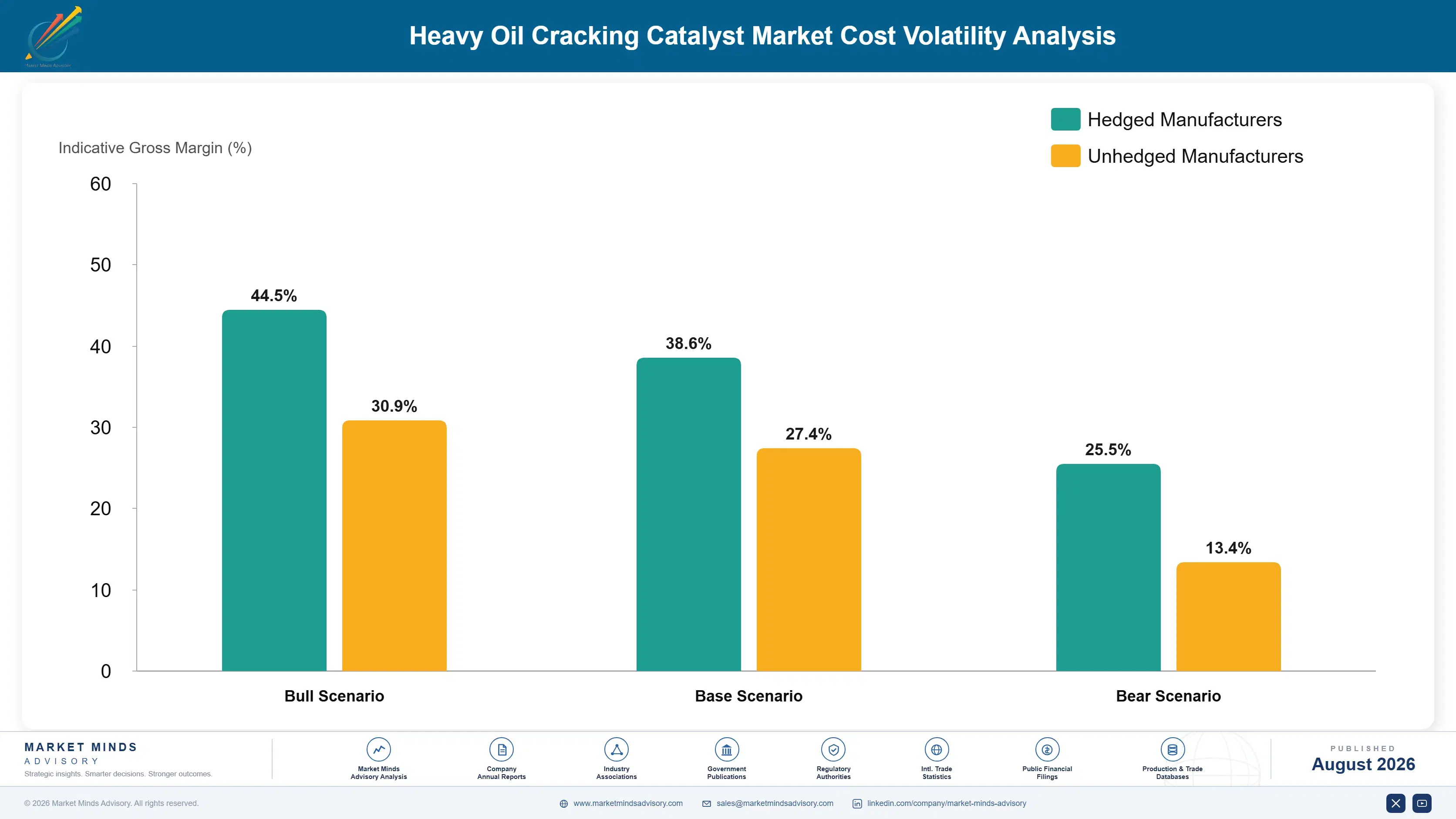
Rare Earth and Base Metal Exposure

Lanthanum and other rare earth elements run 20% to 28% of finished cost in FCC and resid FCC catalyst, tied directly to Chinese rare earth mining and separation capacity. Base zeolite, alumina, and silica matrix materials account for 25% to 35% of cost across all catalyst types, while nickel, molybdenum, and tungsten hydroprocessing metals add 15% to 25% depending on hydrocracking catalyst severity.
The clearest recent volatility event unfolded across 2023 and 2024, when China introduced new export licensing requirements on rare earth materials that disrupted lanthanum availability for catalyst producers worldwide. Albemarle's 2023 Annual Report disclosed higher rare earth input costs following the disruption, and several producers reported delivery delays stretching past ten weeks during the peak of the disruption before alternate sourcing routes were qualified across the industry.

Exposure varies sharply by player type. Vertically integrated producers with long-term rare earth supply contracts or spent catalyst recovery capability absorbed the disruption with far less margin damage than smaller regional formulators buying lanthanum on the spot market. Geography compounds the gap further, since Western producers without domestic rare earth processing face a persistently higher landed cost than Chinese competitors with direct access to domestic material.
heavy-oil-cracking-catalyst-market-trends-cost-volatility-analysis-1787553808267

Build Spent Catalyst Rare Earth Recovery Capability

Producers that recover lanthanum and other rare earths from spent equilibrium catalyst reduce dependence on freshly mined Chinese material while offering refiners a documented circularity story. Recovery infrastructure takes years to build at scale, but once established it becomes a durable cost advantage that spot-market competitors cannot replicate quickly during the next export disruption.

Lock Multi-Year Rare Earth Supply Agreements Ahead of Disruption

Fixed-volume, multi-year rare earth supply agreements protect producers from spot-price spikes during export disruptions at the cost of some pricing flexibility during periods of oversupply. Buyers with committed volume also receive priority allocation when total available lanthanum tightens industry-wide during the next licensing shock. That trade-off favours producers serving refiners who cannot tolerate an unplanned catalyst shortage mid-turnaround.

Qualify Non-Chinese Rare Earth Sources Where Available

Producers qualifying rare earth supply from Australian, American, or other non-Chinese sources reduce single-country dependence, even though these sources currently supply a small share of global volume. Qualification against catalyst performance specifications takes time, but early movers gain negotiating leverage well ahead of competitors still fully dependent on Chinese material. Several producers have already begun this qualification process.

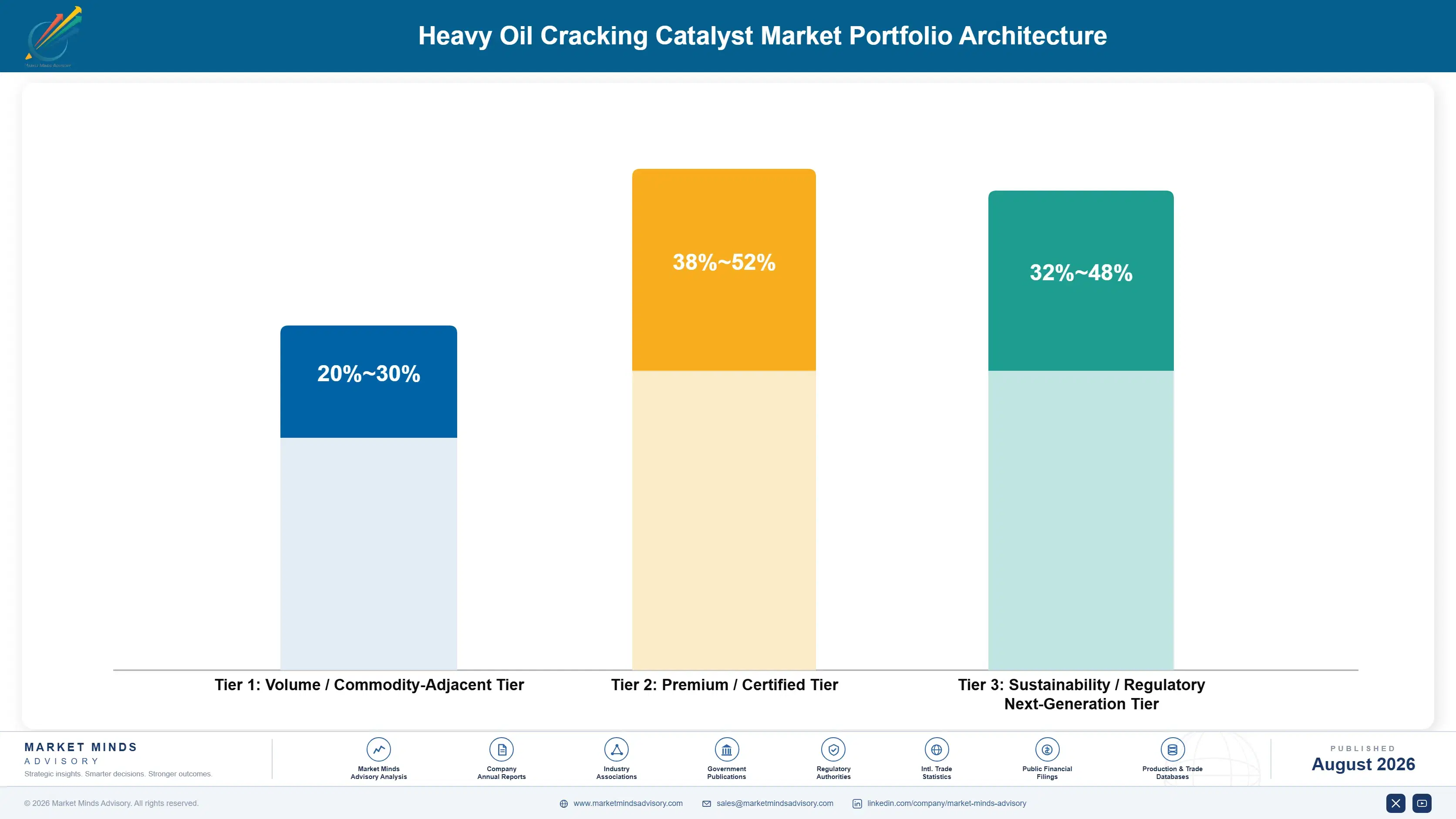
Portfolio Architecture for Margin Defence

The portfolio splits into three tiers with real margin separation. Conventional FCC catalyst for standard light-to-medium crude service competes on price per tonne and earns modest but steady margin. Resid FCC and hydrocracking catalyst earn considerably more, since refiners pay for metals tolerance and yield uplift rather than base material alone. Ebullated-bed and rare-earth-recycled premium formulations sit in a growing third tier where technical performance and supply security, not material cost, set the price.
The tension between volume and premium work is real. Conventional FCC catalyst generates the steadiest cash flow and funds the research pipeline that premium resid formulations later depend on, yet it offers limited margin upside as Chinese domestic suppliers compete aggressively on price within their own protected market. Resid and ebullated-bed premium work carries far better margin but requires proprietary chemistry that takes years to develop and cannot be replicated quickly by new entrants.

High-value margin pools concentrate in Middle Eastern ebullated-bed megaproject catalyst, where committed capital budgets and technical complexity rule out low-cost competition entirely, and in rare-earth-recycled resid formulations, where documented supply security increasingly matters to refiners managing their own sustainability and geopolitical risk reporting.

Volume / Commodity-Adjacent Tier

Conventional FCC catalyst for standard crude service, priced on cost per tonne against Chinese domestic and global suppliers competing mainly on price., where margin stays thin because base zeolite chemistry is well understood and widely replicated across many qualified producers.
Gross Margin: 20-30%

Premium / Certified Tier

Resid FCC and hydrocracking catalyst for heavy, contaminated crude service, priced on metals tolerance, yield uplift, and validated performance data., commanding a durable premium wherever a refiner's crude slate carries meaningful metals or sulphur contamination that conventional catalyst cannot tolerate.
Gross Margin: 38-52%

Sustainability / Regulatory / Next-Generation Tier

Ebullated-bed and rare-earth-recycled formulations sold against megaproject specification requirements and supply security needs, commanding technical-based pricing. that rewards documented performance data and supply chain traceability over raw material cost, particularly among refiners managing geopolitical exposure.
Gross Margin: 32-48%
heavy-oil-cracking-catalyst-market-trends-portfolio-architecture-1787553808775

High-value Sub-segments and Strategic Watch-out

Ebullated-Bed Residue Hydrocracking Catalysts

High value and the fastest-growing segment at 9.4%, driven by Middle Eastern megaproject demand for maximum distillate yield over fuel oil. Margin runs highest here, and order backlogs already stretch past a year at several major suppliers. Committed capital budgets give suppliers unusually long demand visibility here.
Gross Margin: 40-52%

Resid FCC Catalysts

High value with strong growth near 8.0%, anchored in North American and Asian refiners processing increasingly heavy and contaminated crude that conventional FCC catalyst cannot handle without rapid deactivation and yield loss. Metals passivation additives are typically bundled alongside base catalyst, adding a second revenue stream for suppliers.
Gross Margin: 36-48%

Standard FCC Catalysts

The volume core, covering conventional light-to-medium crude cracking across every refining region. Steady but thin margin, competing on price per tonne against Chinese domestic suppliers and global majors alike. Volume stays resilient because every refiner needs baseline FCC catalyst regardless of crude slate, even as premium formulations gain share.
Gross Margin: 18-28%

Delayed Coking Catalysts and Additives

The strategic watch-out. A mature technology facing steady share erosion to ebullated-bed hydrocracking as refiners chase distillate over petroleum coke, with growth slowing to 3.8% as coke economics weaken further. Suppliers still leaning on coking additive volume should diversify toward hydrocracking catalyst chemistry before erosion accelerates across core refining accounts.
Gross Margin: 16-26%

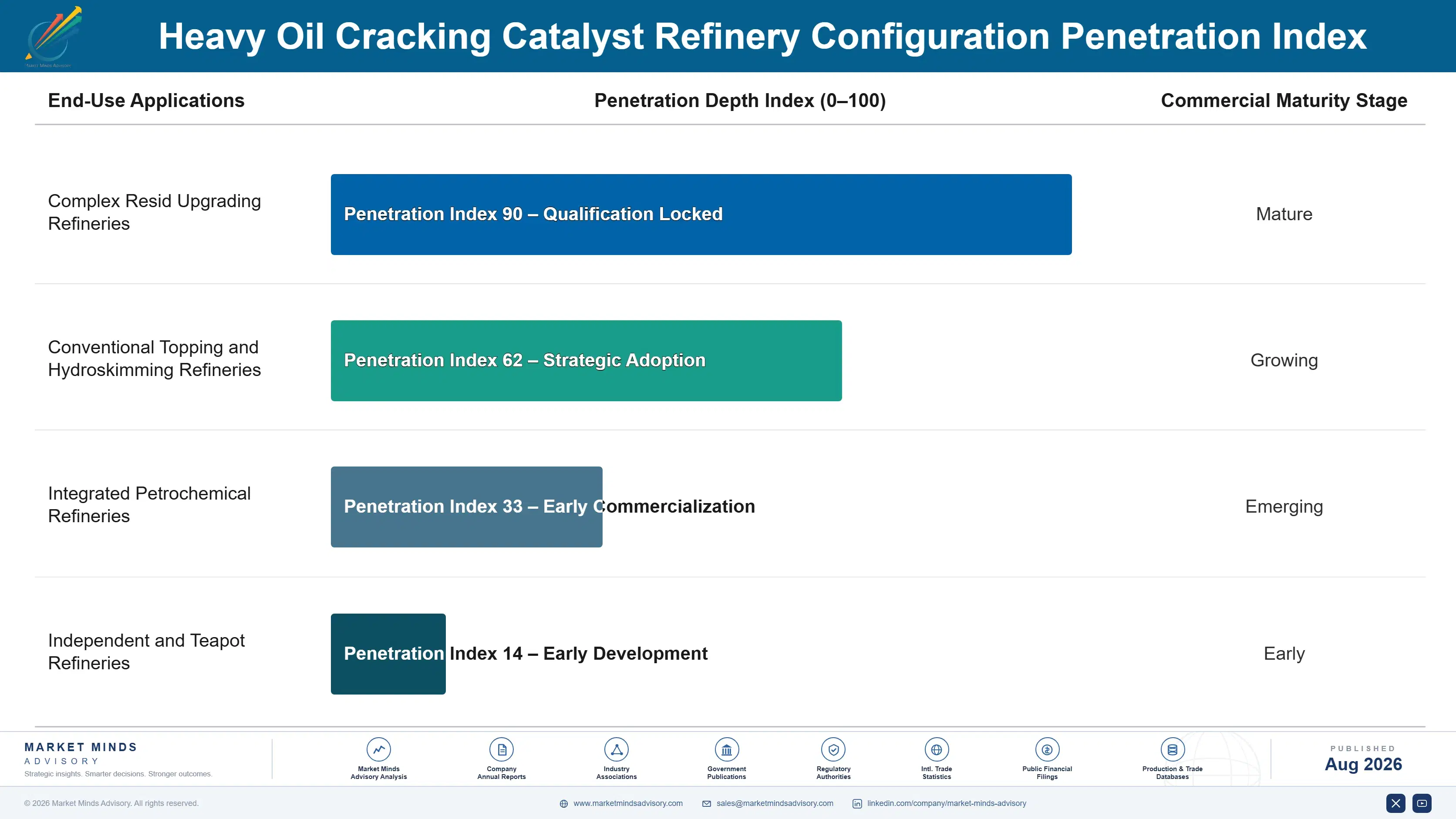
Why Catalyst Contracts Run for Years

Catalyst demand behaves like an annuity once a refiner validates a formulation against its specific crude slate and unit configuration, since requalifying an alternate supplier means repeating costly performance testing that most refiners avoid unless the incumbent's performance clearly deteriorates. A cracking unit running a validated catalyst formulation will typically keep sourcing from the same supplier for years, even as absolute volumes fluctuate with crude slate and run rate.
Adoption depth varies sharply by end-use vertical. Megaproject and new-build refiners show almost total loyalty to their commissioning-phase catalyst supplier, since switching after startup means repeating extensive unit-specific performance validation that operators avoid whenever possible. Mature refiners running established units show more willingness to switch suppliers between change-out cycles, since catalyst performance is judged mainly on delivered yield and price rather than any regulatory qualification requirement unique to a single supplier.

Buyer profiles are shifting generationally as procurement moves from refinery technical staff who select on long-standing supplier relationships toward centralised corporate procurement functions that weigh total delivered margin and supply security more heavily. Younger process engineers increasingly push for documented performance data before committing to a catalyst change, a habit less common among the retiring generation of refinery technical managers.
heavy-oil-cracking-catalyst-market-trends-end-use-penetration-index-1787553809270

Where the Next Decade Gets Decided

These are among the four positions where our research anticipates prominent divergence between winners and laggards over the coming forecast period. Each is grounded in the demand model, the regulatory perimeter, and the announced capacity pipeline.
01 / EBULLATED-BED CAPACITY POSITIONING

Build ebullated-bed catalyst capacity ahead of megaproject commissioning

Ebullated-bed residue hydrocracking catalyst is growing at 9.4%, well above every other catalyst type, and order backlogs already stretch past a year at several major suppliers serving Middle Eastern megaprojects. Suppliers that expand ebullated-bed catalyst capacity now will capture disproportionate share as committed capital budgets keep converting into commissioned units through the back half of the decade. Waiting for demand to fully materialise before investing in capacity means arriving after megaproject contracts are already awarded to competitors who moved first.
02 / RARE EARTH SUPPLY SECURITY

Build spent catalyst recovery capability before the next export shock

Chinese rare earth export licensing disruptions across 2023 and 2024 showed how directly lanthanum exposure can damage catalyst producer margin industry-wide, and China's share of global rare earth processing has not meaningfully declined since then. Producers that build spent catalyst recovery capability now will hold a durable cost advantage during the next disruption, while competitors still dependent on freshly mined Chinese material face renewed delivery and pricing risk. Recovery infrastructure takes years to build, so the window to begin is now, not after the next shock forces a costly scramble.
03 / PERFORMANCE-BASED PRICING ADOPTION

Shift toward performance-based pricing before commodity competitors do

Refiners increasingly value delivered yield uplift over base catalyst price, and suppliers still selling purely on tonnage are leaving margin on the table that performance-based pricing could capture directly from the refiner's own economics. Early adopters including Albemarle and Honeywell UOP are already tying meaningful pricing share to delivered conversion metrics, deepening customer relationships that pure commodity suppliers cannot replicate. Suppliers that delay this shift risk losing their most sophisticated accounts to competitors already offering shared-risk technical partnerships built around documented, unit-specific performance data.
04 / MIDDLE EAST MARKET COMMITMENT

Prioritise Middle East technical presence despite concentration risk

The Middle East and Africa region now consumes fourteen percent of global catalyst volume, well above what its refining capacity alone would suggest, driven by megaproject investment that shows no sign of slowing through the forecast period. Suppliers without meaningful Gulf technical presence are ceding a disproportionately valuable regional pool to competitors who already hold megaproject relationships and multi-year supply agreements. Concentration risk is real, since a small number of accounts drive outsized regional revenue, but the alternative is permanent exclusion from the market's highest-value growth pool.

Engagement Snapshot From the Field

A live engagement with an industry participant carrying material or product regulatory and market exposure ahead of a defining policy shift, showing how our research translates into a defensible multi-year portfolio strategy.
MARKET MINDS ADVISORY · CLIENT ENGAGEMENT SUMMARY
Heavy Oil Cracking Catalyst Producer Strategic Portfolio Review and Transition Roadmap 2026·Investment Scenario on Heavy Oil Cracking Catalyst Exposure Evaluation 2025-26
CLIENT PROFILE
An independent refiner operating multiple complex refining units across China and Southeast Asia approached MMA while evaluating a shift toward heavier, more discounted crude grades to protect margin. The client reported annual refining throughput near 480,000 barrels per day, with catalyst representing a meaningful and rising share of variable operating cost (client-reported, unverified by MMA).
STRATEGIC CHALLENGE
Technical staff wanted to stay with the incumbent conventional FCC catalyst supplier that had served the refinery for years, while the commercial team pushed to switch toward heavier crude without fully costing the catalyst reformulation this would require. Nobody had modelled the actual yield and catalyst cost impact of the proposed crude slate shift before committing to new crude purchase contracts.
MMA APPROACH
MMA built a crude-slate-to-catalyst-cost model comparing conventional, resid, and hybrid FCC catalyst options against the client's proposed heavier crude mix, weighted by expected metals contamination and sulphur content. We benchmarked technical service depth across incumbent and alternative suppliers and modelled delivered margin impact using the client's own unit performance data to make the comparison concrete for the board.
KEY FINDINGS
  1. The proposed heavier crude slate would have deactivated the incumbent conventional catalyst within roughly half its normal service life, erasing most of the crude discount captured through cheaper feedstock.
  2. A resid-grade catalyst formulation, though priced meaningfully higher per tonne, extended service life enough to preserve the large majority of the discounted crude's cost advantage on a fully costed basis.
  3. The incumbent supplier lacked resid-grade technical service depth locally, meaning a switch to an alternative supplier would likely be required regardless of the final crude slate decision made.
  4. Rare earth supply security emerged as a secondary consideration, since the client's preferred alternative supplier had already built meaningful spent catalyst recovery capability (client-reported, unverified by MMA).
CLIENT PROFILE
An independent refiner operating multiple complex refining units across China and Southeast Asia approached MMA while evaluating a shift toward heavier, more discounted crude grades to protect margin. The client reported annual refining throughput near 480,000 barrels per day, with catalyst representing a meaningful and rising share of variable operating cost (client-reported, unverified by MMA).
STRATEGIC CHALLENGE
Technical staff wanted to stay with the incumbent conventional FCC catalyst supplier that had served the refinery for years, while the commercial team pushed to switch toward heavier crude without fully costing the catalyst reformulation this would require. Nobody had modelled the actual yield and catalyst cost impact of the proposed crude slate shift before committing to new crude purchase contracts.
MMA APPROACH
MMA built a crude-slate-to-catalyst-cost model comparing conventional, resid, and hybrid FCC catalyst options against the client's proposed heavier crude mix, weighted by expected metals contamination and sulphur content. We benchmarked technical service depth across incumbent and alternative suppliers and modelled delivered margin impact using the client's own unit performance data to make the comparison concrete for the board.
KEY FINDINGS
  1. The proposed heavier crude slate would have deactivated the incumbent conventional catalyst within roughly half its normal service life, erasing most of the crude discount captured through cheaper feedstock.
  2. A resid-grade catalyst formulation, though priced meaningfully higher per tonne, extended service life enough to preserve the large majority of the discounted crude's cost advantage on a fully costed basis.
  3. The incumbent supplier lacked resid-grade technical service depth locally, meaning a switch to an alternative supplier would likely be required regardless of the final crude slate decision made.
  4. Rare earth supply security emerged as a secondary consideration, since the client's preferred alternative supplier had already built meaningful spent catalyst recovery capability (client-reported, unverified by MMA).
RECOMMENDED STRATEGY
Phase 1: Phase 1 (0 to 6 months): Trial resid-grade catalyst from an alternative supplier on one unit alongside the proposed heavier crude blend. Phase 2: Phase 2 (6 to 18 months): Expand the resid catalyst switch across remaining units if trial yield and life data confirm the initial modelling. Phase 3: Phase 3 (18 to 36 months): Negotiate a multi-year performance-based supply agreement with the new catalyst supplier tied to delivered yield.
OUTCOME
The client proceeded with the heavier crude slate shift alongside the resid catalyst switch and reported the combined move improved delivered margin meaningfully within the first full year of operation. Catalyst cost per barrel rose by a reported low double-digit percentage, but crude cost savings outweighed that increase by a wide margin (client-reported, unverified by MMA).

Frequently Asked Questions

Foundational context covering the market sizes, CAGR, scope, country, region and competition that inform every finding below. This section is provided to cover basics and most often pre-purchase conversations, answered from the MMA Primary Research Dataset.

What is the current size of the Heavy Oil Cracking Catalyst Market?

The heavy oil cracking catalyst market reached USD 4.6 billion in 2025, spanning FCC, resid FCC, hydrocracking, ebullated-bed, and delayed coking catalyst systems used across global refining.

How large will the Heavy Oil Cracking Catalyst Market be by 2036?

MMA forecasts the market will reach roughly USD 8.9 billion by 2036, up from about USD 4.9 billion in 2026, as heavier crude slates and megaproject investment continue driving specification.

What is the CAGR for the Heavy Oil Cracking Catalyst Market 2026 to 2036?

The base case CAGR is 6.1% for 2026 to 2036, with a bull case of 7.3% and a bear case of 4.9% depending on refining margin and megaproject timing.

Which segment is growing fastest?

Ebullated-bed residue hydrocracking catalysts grow fastest at 9.4% CAGR, about 1.54 times the overall market rate, driven by Middle Eastern megaproject demand for maximum distillate yield.

Who are the major companies in the Heavy Oil Cracking Catalyst Market?

Albemarle, Grace, BASF, Honeywell UOP, and Johnson Matthey lead the field, assessed on combined catalyst manufacturing and technical service revenue. Fifteen additional players compete across regional and technology-specific niches.

Which country is growing fastest?

China posts the fastest national growth at 10.5% CAGR, driven by independent refiners converting toward resid and maximum distillate configurations at unprecedented scale. India follows closely as its refiners expand heavy crude processing capacity.

Report Segmentation Architecture

The full report scope spans multiple orthogonal segmentation dimensions, with cross-tabulated demand data provided for each dimension pair. Coverage extends further to regional breakdowns, trend trajectories, and the competitive detail needed to support segment-level decision-making.

By Catalyst Type

  • Ebullated-Bed Residue Hydrocracking Catalysts
  • Resid FCC Catalysts
  • Standard FCC Catalysts
  • Hydrocracking Catalysts
  • Delayed Coking Catalysts and Additives
  • FCC Performance Additives

By Refinery Configuration

  • Complex Resid Upgrading Refineries
  • Conventional Topping and Hydroskimming Refineries
  • Integrated Petrochemical Refineries
  • Independent and Teapot Refineries

By Commercial Dimension

  • Base Catalyst Supply Only
  • Bundled Catalyst and Additive Contracts
  • Performance-Based Technical Service Agreements
  • Spent Catalyst Recovery and Recycling Services

By Region

  • North America
  • Western Europe
  • East Asia
  • South Asia and Pacific
  • Latin America
  • Middle East and Africa
  • Eastern Europe

Scope, Methodology, and Coverage

Every figure in this report is reproducible from documented input assumptions. The scope below maps the historical period, the forecast horizon, the segmentation dimensions, and the countries covered, alongside the underlying primary and qualitative methodology.
Historical Period
2020 to 2025
Forecast Period
2026 to 2036
Base Year
2025 (USD billions; MMA Primary Research Dataset, August 2026)
Market Definition
The heavy oil cracking catalyst market comprises catalysts, additives, and associated technical services used to convert heavy and residual crude oil fractions into lighter, higher-value products at refineries. It spans fluid catalytic cracking, resid FCC, hydrocracking, ebullated-bed residue hydrocracking, delayed coking additives, and FCC performance additives. Catalytic reforming catalysts, petrochemical steam cracking catalysts, and standalone process technology licensing fees are excluded.
Quantitative Units
USD billions (current prices); metric tonnes of catalyst supplied where applicable
Segmentation Dimensions
By Catalyst Type; By Refinery Configuration; By Commercial Dimension; By Region
Regions Covered
North America, Western Europe, East Asia, South Asia and Pacific, Latin America, Middle East and Africa, Eastern Europe
Countries Covered
USA, China, Germany, France, UK, Japan, South Korea, India, Australia, Canada, Brazil, Mexico, Indonesia, Vietnam, Thailand, Malaysia, UAE, Saudi Arabia, South Africa, Nigeria, Turkey, Poland, Netherlands, Italy, Spain, Sweden, Switzerland, Argentina, Colombia, Singapore, and additional markets relevant to this sector
Key Companies Profiled
Albemarle Corporation, W. R. Grace & Co., BASF SE, Honeywell UOP, Johnson Matthey plc, Axens SA, Haldor Topsoe A/S, Clariant AG, Shell Catalysts & Technologies, ExxonMobil Catalysts and Licensing, Chevron Lummus Global, Sinopec Catalyst Company, PetroChina Company Limited, Zeolyst International, PQ Corporation, CDTECH (Catalytic Distillation Technologies), KBR Inc., Lummus Technology LLC, Indian Oil Corporation Limited, Reliance Industries Limited
Quantitative Methodology
Primary survey, n=3,800 respondents, Q4 2025, six countries; demand-side model with trade association cross-validation
Qualitative Methodology
47 expert interviews, Q4 2025; applied to validate demand model assumptions, identify emerging dynamics, and assess competitive positioning
Report Format
PDF and XLSX data workbook (Word format preview document)
Publisher
Market Minds Advisory
Report Code
MMA-2026-CHM-102
Published
August 2026
Contact
sales@marketmindsadvisory.com | www.marketmindsadvisory.com

Purchase the full Heavy Oil Cracking Catalyst Market Report (2026 to 2036).

The full MMA Heavy Oil Cracking Catalyst Market report sizes demand across six catalyst types, four refinery configurations, four commercial dimensions, and seven regions through 2036. It profiles twenty participants on a consistent basis of annual catalyst manufacturing and technical service revenue, scoring each on formulation breadth, rare earth supply security, and technical service depth. Scenario models quantify how ebullated-bed conversion, Middle Eastern megaproject investment, and rare earth export policy move both demand and realised pricing. The report also includes delivered-cost modelling by catalyst type, a rare earth supply concentration risk screen, and a megaproject demand visibility assessment built for procurement, strategy, and investment teams.
Six-catalyst-type demand and margin model across the forecast
Seven-region growth, share, and demand breakdown for 2036
Twenty-company competitive benchmarking across catalyst type and region
Rare earth supply concentration risk screen
Megaproject demand visibility tracker by region and complex
Ten-year revenue, margin, and volume forecast

Built For The People Who Decide

From boardroom strategy to bench-side execution, this report is read cover-to-cover by leaders shaping the next decade of their industry, turning demand scenarios, market dynamics and valuation benchmarks into decisions.
CXOs/ Presidents/ VPs/ Managers
M&A and Corporate Development
Strategy Teams and R&D Heads
Procurement and Product Directors
Regulatory and Compliance Leaders
Investor Relations and Equity Analysts