Market Minds Advisory
Heavy-Duty Corrugated Packaging Market

Heavy-Duty Corrugated Packaging Market: Beating Timber at the Border and Losing to Humidity

The competitor is not another box, it is a wooden crate that needs heat treatment before it crosses a border. Corrugated wins on weight and paperwork, then loses almost half its strength in humid air.

Lead Analyst

Bilal Shaikh

Published

September 2026

Make Smarter Decisions with Customized Research Insights

Request a free sample report and evaluate market opportunities, growth trends, and competitive dynamics relevant to your business needs.

2025 MARKET VALUE$24.8BMarket Size 2025
2036 FORECAST VALUE$40.7BBase Case , 2026 to 2036
CAGR 2026 TO 20364.6 %Bull 5.8% / Bear 3.4%
INCREMENTAL OPPORTUNITY$14.7BNet 10- year value creation
EXPANSION MULTIPLE1.57x2036 value over 2026 base
Strategic Levers
M&A Pipeline
Regional Outlook
Country Rankings
Competitive Intelligence
Segmental Deep-dive
Call-Us : 91 93563 13602

Executive Snapshot and Market Trajectory

Heavy-duty corrugated does not compete with other boxes. It competes with timber crates and steel frames, and it wins on two things: it weighs a fraction of the alternative, and it crosses an international border without any phytosanitary treatment at all. That second advantage is worth more than the first.
Growth comes from substitution rather than from more goods shipping. Triple-wall board boxes and crates grow fastest at 6.9%, exactly 1.50 times the market rate, displacing wooden crates in export applications where treatment paperwork and freight weight both cost money. Bulk bins and pallet boxes follow at 5.8%. East Asia holds the largest share on industrial export manufacturing, and Vietnam is the fastest country at 8.2%.
Concentration reaches only 29% across the top five measured on annual heavy-duty tonnage, since board travels badly and regional producers serve customers within economic freight range. The category's one genuine weakness is water, with 44% of compression strength surrendered at high humidity, and the wax coating that solved it is being withdrawn on recyclability grounds. Aqueous coatings repulp properly but perform slightly worse, which is the trade everybody is now making.
Market Definition
This market covers corrugated fibreboard packaging engineered for heavy or bulk contents, spanning heavy double-wall and triple-wall board boxes and crates, bulk bins and pallet boxes, moisture-resistant coated constructions, reinforced composite systems, and heavy-duty sheet and interior fitments. Scope is measured at converter realised prices. Standard single-wall shipping cases, folding cartons, wooden crates and pallets, plastic bulk containers, protective void fill, and containerboard sold as reels are excluded.
Base Year Value
$24.8B in 2025 (MMA Primary Research Dataset, August 2026)
Forecast Period
2026 to 2036, eleven discrete annual values
CAGR
4.6% base case. Bull 5.8%. Bear 3.4%.
Fastest Growth Segment
Triple-Wall Board Boxes And Crates: 6.9% CAGR
Fastest Growth Country
Vietnam: 8.2% CAGR
Fastest Growth Region
South Asia and Pacific: 6.8% CAGR
Largest Region
East Asia: 30% of 2025 global value
Market Leaders
International Paper. Smurfit Westrock. Packaging Corporation of America. Mondi. Nine Dragons Paper. Source: MMA Analysis based on company annual reports.
Primary Survey
n=3,800 procurement and R&D decision-makers, Q4 2025, six countries
Methodology
Demand-side build-up, cross-validated against public data, 47 expert interviews

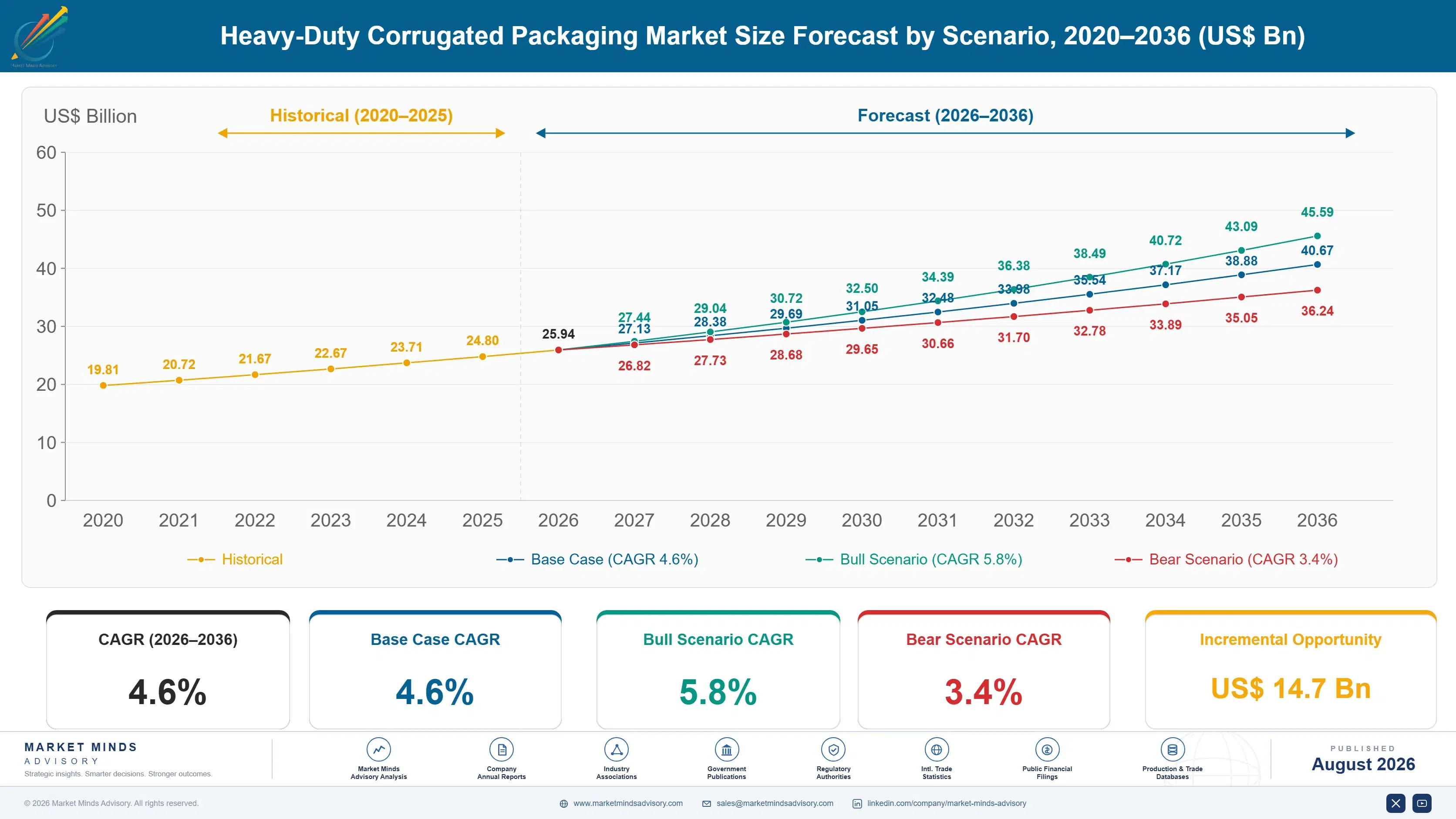
Heavy-Duty Corrugated Packaging Market Forecast Scenarios

heavy-duty-corrugated-packaging-market-size-forecast-scenario-1787299125961
The 2020 to 2025 period was dominated by containerboard pricing rather than by demand. Kraftliner and testliner prices swung violently, and because board is 63% of box cost the category's reported value moved with them regardless of tonnage. Industrial volumes were flat to modestly higher throughout. A 3.6% historical rate mostly measures paper price passing through the chain rather than any change in what customers actually shipped.
Three mechanisms carry the 4.6% base case. Timber crate substitution is the largest, driven by phytosanitary treatment requirements that corrugated avoids entirely and by air and sea freight priced on weight. Asian export manufacturing relocation is the second, particularly into Vietnam and India where new industrial capacity needs export packaging from scratch. And agricultural bulk bin conversion is the third, replacing wooden field bins across produce supply chains. None of the three requires industrial output to accelerate.
The 5.8% bull case rests on aqueous barrier coatings matching wax performance in humid conditions, which would remove the last technical objection in cold chain and tropical export applications. The 3.4% bear case is returnable plastic bulk containers taking agricultural and automotive volume where loops are short enough for trip economics to work in their favour.

Paper Against Timber, and Water Against Paper

The commercial case here is written against timber. A triple-wall corrugated crate weighs roughly 62% less than the wooden equivalent, which matters on air freight priced by kilogram and on container loads limited by weight. More decisively, wood packaging crossing an international border requires heat treatment or fumigation and a stamped certificate, while corrugated requires nothing whatsoever. That removes days from an export schedule and a whole compliance function with it.
TOP FIVE CONCENTRATION29%Regional producers dominate because finished board travels poorly
TRIPLE-WALL WEIGHT ADVANTAGE62%Lighter than an equivalent wooden crate of comparable capacity
HUMIDITY STRENGTH LOSS44%Compression strength surrendered under high relative humidity conditions
CONTAINERBOARD COST SHARE63%Kraftliner and testliner as a proportion of box cost
AVERAGE BOARD GRAMMAGE1,240 gsmCombined weight across all plies in triple-wall constructions
RECOVERED FIBRE CONTENT71%Recycled furnish share across heavy-duty board production today
The weakness is equally clear. Fibreboard loses around 44% of its compression strength at high relative humidity, which is precisely the condition inside a refrigerated container or a tropical warehouse. Curtain-coated wax solved this for decades and is now being withdrawn because waxed board cannot be recycled, leaving aqueous barrier coatings that perform respectably but not equivalently. Condensation is where the gap between them shows most.
Two forces shape the next decade. Specification practice is slowly moving from edge crush testing toward box compression testing, which actually predicts stack failure. And containerboard at 63% of cost keeps this category hostage to a paper cycle nobody in it controls. Neither force originates inside this industry at all, and neither can be influenced from within it.
"Every specification argument in this industry is about edge crush values, and edge crush has never put a single box on a truck successfully. What matters is whether the assembled box survives the stack at the humidity it will actually see. The two numbers diverge most on exactly the heavy-duty constructions where failure costs the most."
Director. Industrial Packaging and Fibre Containers Practice · MMA Packaging and

Market Trends

Timber Crate Substitution Accelerates On Border Treatment Rules

Wood packaging moving across international borders must be heat treated or fumigated and carry a stamped mark, which means scheduling, certification, and a compliance record for every shipment. Corrugated is exempt entirely. Combined with a weight advantage near 62% against an equivalent wooden crate, that turns a packaging comparison into a logistics one. Exporters shipping machinery, automotive assemblies, and electronics have converted steadily, and triple-wall constructions grow at 6.9% against a market rate of 4.6% largely on this substitution alone. Logistics functions rather than packaging buyers now make the call, and they evaluate landed cost instead.
Market Impact: Vietnam grows at 8.2% annually
Wax Withdrawal Forces Aqueous Barrier Requalification Everywhere

Curtain-coated and cascaded wax gave fibreboard genuine water resistance for decades and made it viable in produce, cold chain, and tropical export. Waxed board cannot be repulped, so recyclability commitments and recovered fibre targets have pushed it out across most major markets. Aqueous barrier coatings repulp acceptably and hold moisture back respectably, without quite matching wax under sustained condensation. Converters are requalifying construction by construction, and the ones that started early hold specifications competitors are still testing against. Requalification with a customer runs six to nine months, and cannot be compressed once a deadline arrives.
Market Impact: Bulk bins grow at 5.8% annually

Market Opportunities and Growth Drivers

Asian Export Manufacturing Relocation Creates Packaging From Scratch

Electronics, furniture, and machinery assembly relocating into Vietnam. India. Thailand, and Indonesia arrives without any established industrial packaging supply base, so every new export line specifies heavy-duty corrugated from the beginning rather than converting from something else. Vietnam contributes the fastest national growth rate in this forecast at 8.2%. Because these are export flows crossing borders, the phytosanitary exemption matters immediately rather than eventually. Local converting capacity has followed the manufacturing, which keeps freight economics workable in a category where board travels badly. Board freight is uneconomic beyond a few hundred kilometres.
Market Impact: Loses 44% of compression strength

Agricultural Bulk Bins Replace Wooden Field Containers Steadily

Potato, onion, melon, and citrus harvests move in bulk bins holding several hundred kilograms, and the traditional wooden field bin is heavy, hard to clean, and a genuine food safety concern because timber cannot be sanitised properly. Corrugated bulk bins are single-use, arrive flat, and eliminate the cleaning and storage burden entirely. Seasonality is extreme, with most volume moving in a few weeks, which suits converters who can schedule around it. Growth runs at 5.8% against a market rate of 4.6%. Food safety regulators increasingly dislike timber in produce contact, because it cannot be sanitised reliably.
Market Impact: Failures cluster above 1,240 gsm

Market Restraints and Challenges

Humidity Removes Nearly Half The Compression Strength

Fibreboard loses around 44% of its compression strength as relative humidity rises toward saturation, because water plasticises the fibre bonds that carry the load. The root cause is material physics rather than manufacturing quality, so no amount of process control fixes it. Commercial impact concentrates in refrigerated transport, tropical export, and produce handling, which are exactly the applications where a stack collapse destroys the contents too. Mitigation runs through aqueous barrier coatings, higher basis weight construction, moisture-resistant adhesives, and specifying against conditioned rather than ambient test data. A stack collapse destroys the contents as well.
Market Impact: Weighs 62% less than timber

Edge Crush Specification Predicts Field Failure Badly

The industry certifies board on edge crush test values because they are cheap and quick to obtain, while what actually determines whether a stack survives is box compression test performance on the assembled container. The root cause is a specification convention that suited single-wall shipping cases and was carried over to heavy-duty constructions where the two diverge sharply. Commercial impact is field failures nobody predicted from the paperwork. Converters are moving toward compression testing on finished boxes and toward conditioning samples at realistic humidity before testing them. Conditioning samples at realistic humidity changes the result.
Market Impact: Recovers part of 44% strength loss
3 additional market trends, 2 additional growth drivers, and 4 additional restraints and challenges are covered in the full report. Contact sales@marketmindsadvisory.com to access the complete intelligence.

Segment CAGR and Growth Architecture

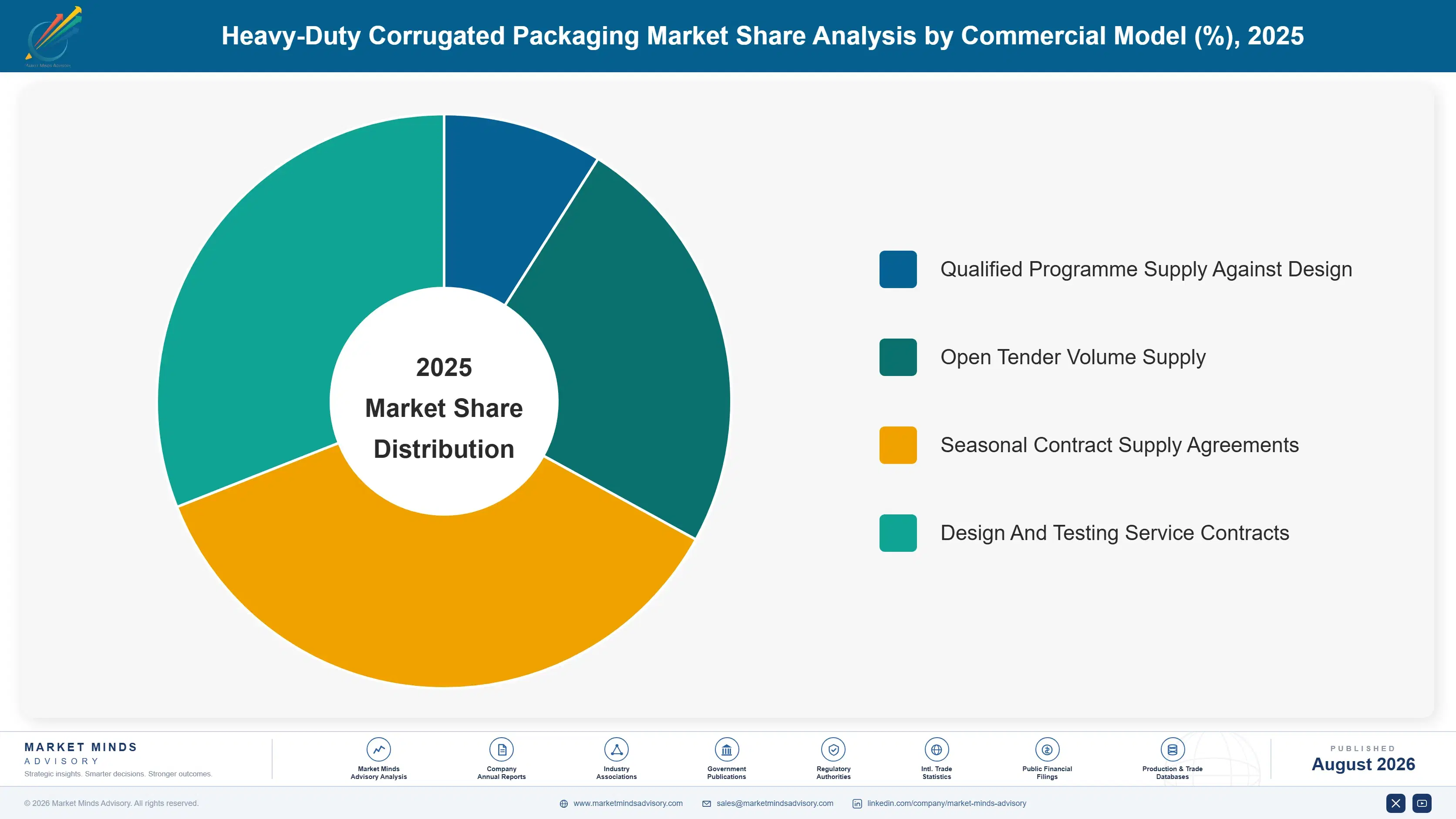
Segmentation follows board construction, because construction determines achievable compression strength, board cost per square metre, converting equipment required, and which alternative material the product actually competes against. End industry and load weight both cut across every construction rather than separating them, so neither works as a primary dimension here. Six constructions result, and they compete against different materials.
heavy-duty-corrugated-packaging-market-market-share-analysis-1787299126497

Triple-Wall Board Boxes And Crates

The fastest construction at 6.9%, exactly 1.50 times the market rate, and its growth comes almost entirely from displacing timber rather than from displacing other corrugated. Three flutes give compression strength approaching a light wooden crate at roughly 62% less weight, which pays directly on air freight and on weight-limited container loads. The decisive advantage is regulatory: wood crossing a border needs heat treatment, fumigation, and a stamped certificate, while corrugated needs none of it. Converting equipment for triple-wall is heavier and slower than standard corrugating lines, which limits how many producers can offer it and keeps competition thinner than tonnage would suggest. Competition here is thinner than tonnage figures suggest.
CAGR 6.9%

Bulk Bins And Pallet Boxes

Second fastest at 5.8%, driven by agricultural produce handling and by automotive component bulk movement. A corrugated bulk bin arrives flat, erects in seconds, holds several hundred kilograms, and is disposed of after use, which removes the cleaning, storage, and repair burden that wooden field bins impose on growers. Food safety regulators increasingly dislike timber in produce contact because it cannot be sanitised reliably. Seasonality is extreme, with much of the annual volume moving during a few harvest weeks, which rewards converters who can schedule capacity around it and punishes those who cannot commit stock in advance. Returnable plastic containers attack this volume wherever loops are short, and agricultural loops usually are.
CAGR 5.8%
Full segment breakdown across 6 segments available in the complete report.

Regional Architecture and Country Demand Map

Demand follows industrial and export manufacturing rather than consumption, and converting sits close to the customer because finished board is bulky and travels badly. All seven regions fall inside their framework bands, though growth rates diverge sharply on manufacturing relocation. Converting sits close to the customer for freight reasons.

East Asia

Thirty percent, the largest pool, and it follows industrial export manufacturing rather than domestic consumption. Chinese machinery, electronics, appliance, and furniture exports all move in heavy-duty corrugated because the phytosanitary exemption removes a compliance step on every border crossing. Domestic containerboard capacity is enormous and recovered fibre supply is well organised, though virgin kraftliner for high-strength constructions is largely imported. Japanese and Korean demand is smaller and technically exacting on dimensional tolerance. Growth at 5.5% runs above the global rate on continuing export volume and on triple-wall displacing timber crating across machinery shipments. Virgin kraftliner for high-strength grades is largely imported, which shapes the cost position considerably, Recovered fibre supply here is well organised and abundant.
Share: 30% | CAGR: 5.5% (2026 to 2036)

South Asia and Pacific

Twelve percent, at the top of its band, and Vietnam contributes the fastest national growth rate anywhere in this forecast at 8.2%. Electronics, furniture, and machinery assembly relocating from China arrives without an established industrial packaging base, so new export lines specify heavy-duty corrugated from the outset rather than converting from timber. Indian industrial and agricultural demand adds substantially on the same logic. Local converting capacity has followed manufacturing closely, which matters where finished board freight is uneconomic beyond a few hundred kilometres. Growth at 6.8% is the highest of any region. New export lines specify corrugated from the outset here, rather than converting away from timber later, Indian industrial and agricultural demand adds substantially alongside.
Share: 12% | CAGR: 6.8% (2026 to 2036)
Regional intelligence for 5 additional markets available in the complete report: North America, Western Europe, Latin America, Eastern Europe, Middle East and Africa. Contact sales@marketmindsadvisory.com.
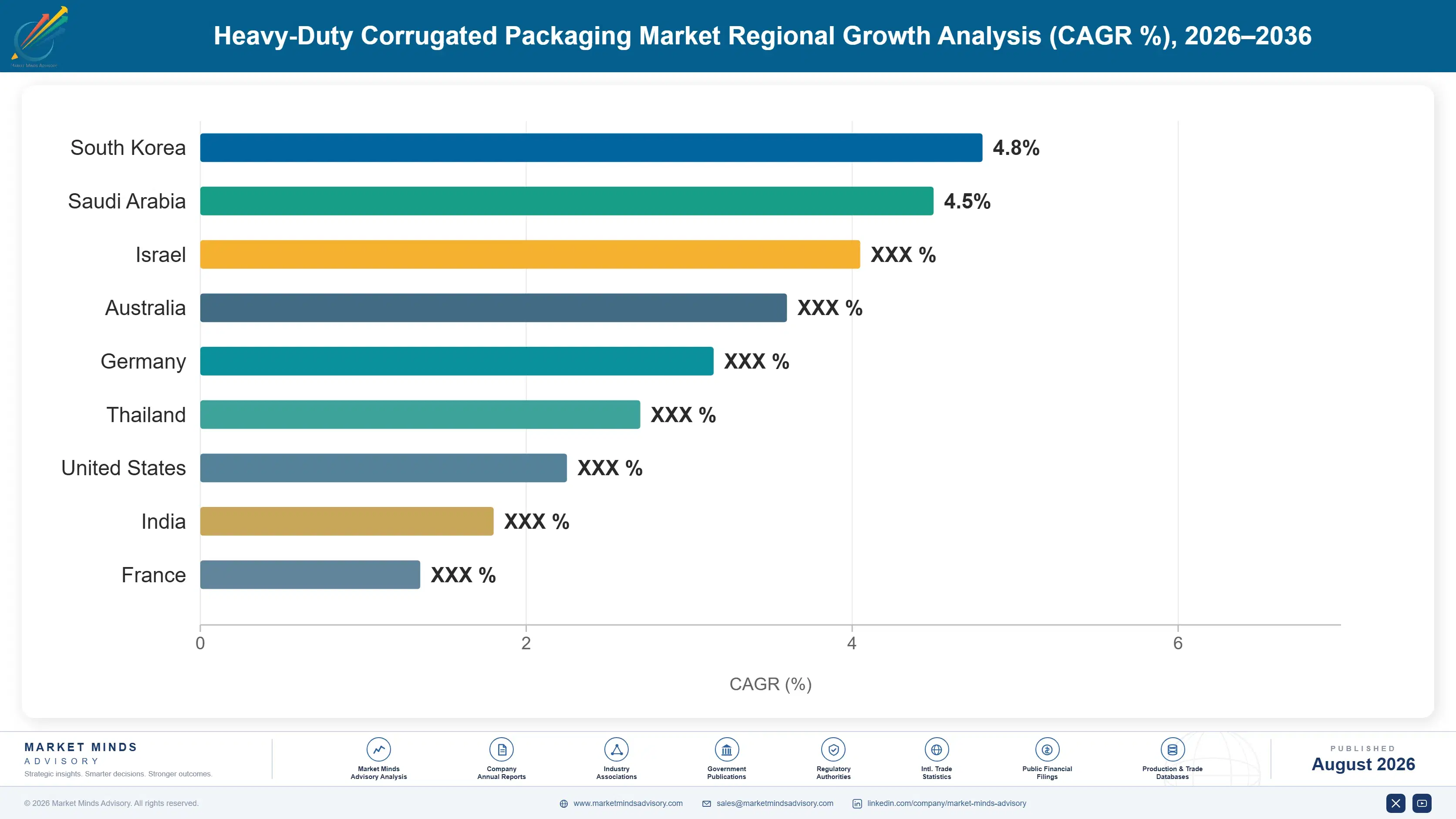
heavy-duty-corrugated-packaging-market-country-cagr-analysis-1787299127001

Where Heavy-Duty Converters Make Margin

Containerboard is 63% of cost and every converter buys it off the same published indices, so purchasing scale settles nothing. Margin comes from specifying on compression rather than edge crush, from qualifying barrier coatings early, from attacking timber on border economics, and from contracting virgin kraftliner separately. Four levers follow, and two of them are about what you test.

Specify On Box Compression Rather Than Edge Crush Values

The industry quotes edge crush because it is cheap to measure, while box compression on a conditioned assembled container is what predicts whether a stack survives. On heavy-duty constructions the two diverge sharply, and converters selling against a compression specification can often deliver the required performance at lower grammage than an edge crush specification demands. That saves 8 to 12% of board cost on the same job while improving field reliability. Testing capability costs around 400,000 dollars and reframes every technical conversation a converter has. Field reliability improves at the same time as cost falls.
Market Impact: Saves 8 to 12% of total board cost

Qualify Aqueous Barrier Constructions Ahead Of Wax Withdrawal

Waxed board cannot be repulped and is being withdrawn across markets on different timetables, which strands every produce and cold chain specification built on it. Converters who requalified aqueous barrier constructions early hold approved specifications while competitors are still running trials, and requalification with a customer takes six to nine months. The performance gap against wax under sustained condensation is real but narrowing, and it costs 3 to 5% more per square metre. Being first through that qualification with a major produce or cold chain account effectively locks the specification for the following three or four seasons.
Market Impact: Qualification runs 6 to 9 months per account

Sell Against Timber On Border Economics Not Board Price

A converter quoting against another corrugated supplier is competing on price per square metre. A converter quoting against a wooden crate is competing on freight weight, phytosanitary treatment cost, certification lead time, and the compliance function the exporter can dissolve. That is a completely different conversation and it supports pricing that corrugated-versus-corrugated tendering never will. Triple-wall at roughly 62% lighter than timber, with no treatment requirement whatsoever, wins on total landed cost even at a higher unit price. Certification lead time alone justifies the switch for many exporters, and the compliance function disappears entirely.
Market Impact: Wins on a 62% weight advantage over timber

Contract Virgin Kraftliner Separately From Recycled Furnish

Heavy-duty constructions need virgin softwood kraftliner for strength, which is the opposite direction from the recycled content targets driving the rest of packaging. Kraftliner and testliner trade on separate cycles and converters buying them as a single containerboard line item negotiate poorly on both. Splitting the contracts, with kraftliner secured on longer terms given its narrower supply base, protects the grades that heavy-duty performance actually depends on. Board is 63% of cost, so a few percent on the virgin line is material. Recovered fibre is widely available and confers little advantage.
Market Impact: Board is 63% of the total delivered cost

Who Controls the Margin Pool

Concentration reaches only 29% across the top five measured on annual heavy-duty tonnage, and freight is the reason. Finished corrugated is bulky, low in value density, and uneconomic to ship far, so regional converters serve customers within a few hundred kilometres and no producer achieves global scale in the way containerboard mills do. The leaders are integrated paper groups whose advantage sits upstream in board supply rather than in converting.
Competition runs on three fronts. Triple-wall converting capability is the first, since the equipment is heavier and slower and fewer producers offer it. Barrier coating qualification is the second, and early movers hold specifications competitors cannot yet bid against. Containerboard integration is the third, deciding who absorbs a paper cycle and who passes it on. Very few converters hold all three positions at once.

Pressure comes from two directions. Returnable plastic bulk containers attack agricultural and automotive volume wherever loops are short enough for trip economics to favour them. And recyclability rules keep narrowing which constructions are commercially acceptable, which advantages converters who qualified alternatives early. Both pressures reward preparation over any manufacturing advantage, which is unusual in a paper business.
heavy-duty-corrugated-packaging-market-company-positioning-matrix-1787299127523

Competitive Moat and Risk Dimensions

INTERNATIONAL PAPER

Moat: Integrated virgin kraftliner supply

Owning virgin softwood kraftliner mills matters more in heavy-duty than in any other corrugated segment, because high-strength constructions cannot be made from recovered fibre alone at workable grammage. Independent converters buy that grade from producers who also compete with them. Integration decides who absorbs a containerboard cycle.
INTERNATIONAL PAPER

Risk: Converting scale limited by freight

Upstream integration confers no advantage in converting, where finished board travels badly and a regional plant with two machines competes on equal terms inside its catchment. Scale in paper does not translate into scale in boxes. Integrated overhead shows up directly in quotations against local converters carrying none.
SMURFIT WESTROCK

Moat: Converting footprint density across regions

A dense network of converting plants puts the company inside economic freight range of far more customers than a competitor with fewer larger sites, which is decisive where finished board cannot travel. That density also lets heavy-duty capability concentrate at selected plants. Replicating the footprint means acquiring plants.
SMURFIT WESTROCK

Risk: Exposed to flat European industry

A substantial share of the converting footprint sits in Western European markets where industrial production is flat and heavy-duty demand grows slowest of any region. Growth is occurring in Vietnam. India, and Mexico, where the network is thinner and local converters are already established and entrenched.

Players Tracked

Prominent Players

International Paper
Smurfit Westrock
Packaging Corporation of America
Mondi
Nine Dragons Paper

Other Key Players

Georgia-Pacific
Cascades
Klabin
Oji Holdings
Nippon Paper Industries
Rengo
Lee and Man Paper
Shanying International
Prinzhorn Group
VPK Group
Saica
Stora Enso
Greif
Sonoco
Hood Container

Recent Developments

JANUARY 2025

European converter completes aqueous barrier qualification for produce bins

A European corrugated producer finished commercial qualification of aqueous barrier coated bulk bins with several fruit and vegetable exporters, replacing waxed constructions that recyclability rules had made untenable. The work was a technical qualification programme with customers rather than any joint venture or acquisition arrangement.
Signal: Whoever completes barrier requalification first holds specifications competitors will still be trialling for two more seasons
APRIL 2025

Vietnamese converter commissions triple-wall corrugating capacity

A Vietnamese packaging manufacturer commissioned heavy-duty corrugating capacity capable of triple-wall constructions, serving electronics and furniture exporters that had previously imported crating or used treated timber. The investment was organic capital expenditure funded internally rather than any partnership with an international converter. Capacity figures were not disclosed publicly.
Signal: Export manufacturing relocation pulls heavy-duty converting capacity behind it, because finished board cannot follow across long distances
AUGUST 2025

Automotive exporter converts machinery crating from timber to triple-wall

An industrial equipment manufacturer switched export crating for assembled machinery from heat-treated timber to triple-wall corrugated across its principal shipping lanes. The decision was an internal logistics and compliance choice rather than any commercial arrangement, citing freight weight and phytosanitary certification lead time. Shipping lane volumes were not published.
Signal: Substitution decisions are being made by logistics and compliance functions rather than by packaging procurement, which changes the sale

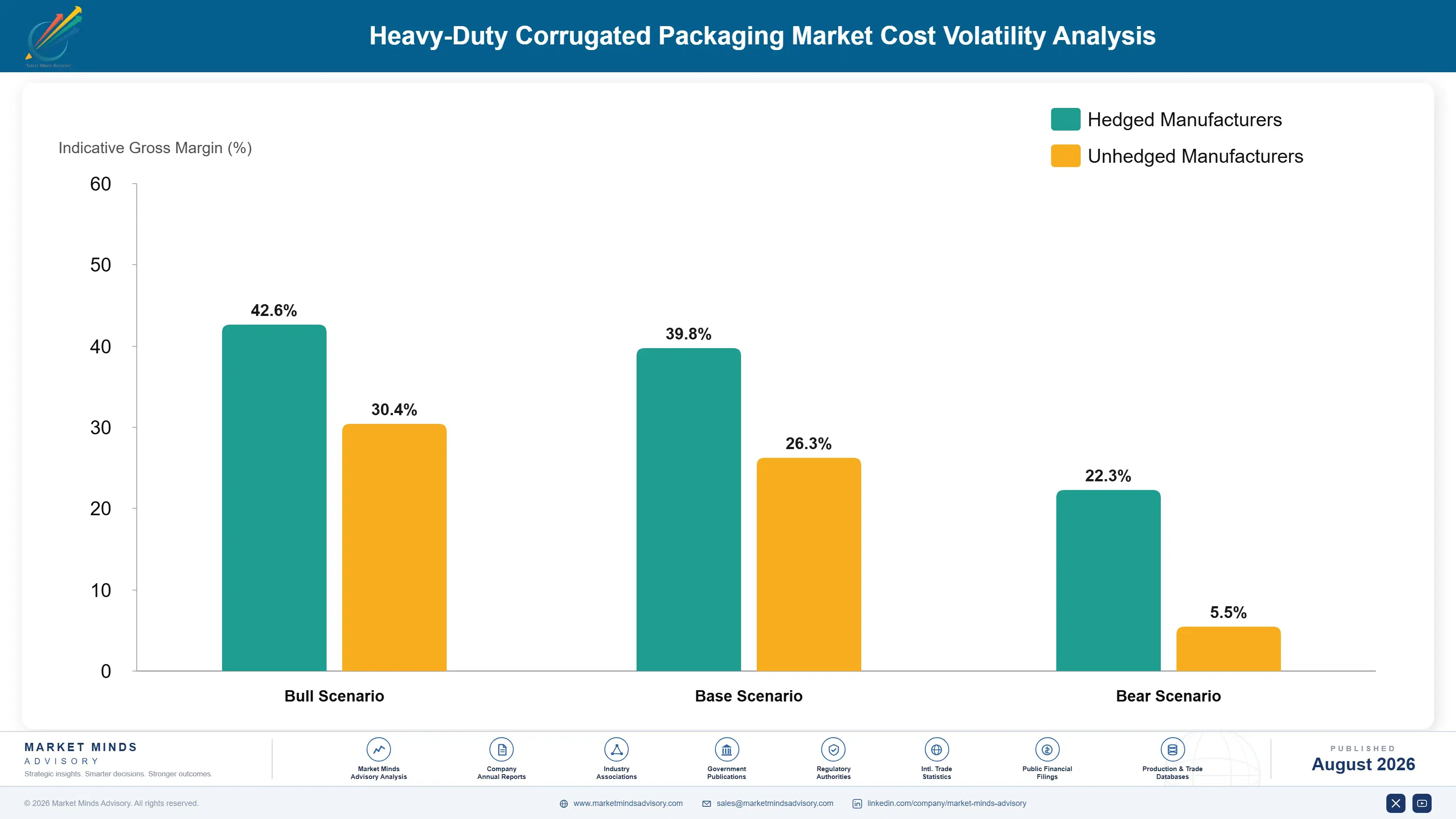
One Input. Two Very Different Grades

Containerboard dominates everything. Kraftliner, testliner, and fluting medium together run about 63% of box cost, and heavy-duty constructions skew toward virgin softwood kraftliner because recovered fibre cannot reach the same compression strength at workable grammage. Starch adhesive adds roughly seven percent, converting energy about nine percent, and labour, ink, and delivery make up the remainder.
Containerboard price volatility was the whole story of the recent period. Kraftliner and testliner prices moved sharply and often in opposite directions, since one tracks softwood pulp and the other tracks recovered paper collection. Company annual reports across the packaging sector describe the divergence consistently. Converters buying board as a single line item found themselves exposed on the virgin grades that heavy-duty performance depends on while enjoying no benefit from cheaper recovered furnish.

The competitive disadvantage mechanism runs through integration rather than purchasing skill. An integrated producer owning kraftliner mills absorbs the cycle internally, while an independent converter buys that grade from a competitor at whatever the index says. Recovered fibre is widely available and confers little advantage. Small independents buying spot kraftliner during a tight market carry the worst position of anyone, and several exited heavy-duty work entirely rather than absorb it.
heavy-duty-corrugated-packaging-market-cost-volatility-analysis-1787299127718

Contract virgin kraftliner separately on longer terms than testliner

Kraftliner and testliner trade on genuinely different cycles because their feedstocks are different, and buying them as one containerboard line item guarantees poor outcomes on both. Splitting the contracts and securing kraftliner on longer terms reflects its narrower supply base and its importance to heavy-duty strength. Converters who negotiate both together are optimising an average that matches neither grade.

Specify against compression to reduce grammage requirements

Edge crush specifications frequently demand more board than the application needs, because they were written for single-wall cases and carried over. Demonstrating equivalent box compression performance at lower grammage cuts board consumption on the same job, and board is 63% of cost. Testing capability pays for itself quickly, and the reliability improvement is a commercial argument in its own right.

Index customer pricing to published containerboard references

Heavy-duty programmes often run annually at fixed prices agreed when board was stable, which works until the paper cycle moves. Indexing the board content of programme pricing to published kraftliner and testliner references, while holding conversion fixed, protects margin without reopening the whole agreement. Industrial customers accept this considerably more readily than converters tend to expect.

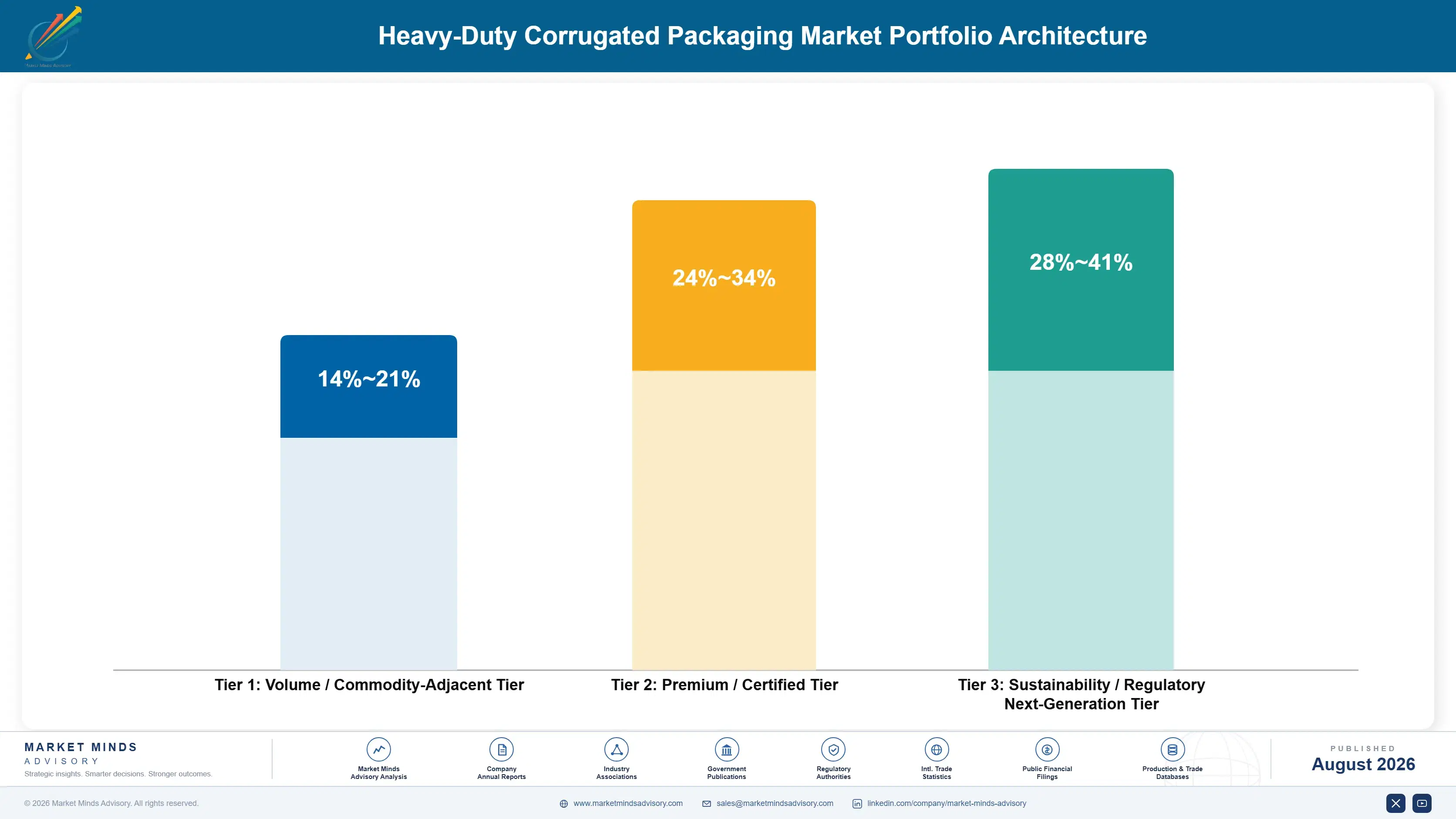
Portfolio Architecture for Margin Defence

Three tiers describe this business and the spread is narrower than most packaging categories because board dominates cost so heavily. Standard heavy double-wall boxes sold on price into open tenders sit at the bottom, competing against every converter inside freight range. Engineered triple-wall and compression-specified constructions sit meaningfully higher, protected by converting capability and testing evidence. And barrier-coated and food-contact qualified constructions occupy a third tier w
The tension is that heavy-duty work runs badly on standard corrugating lines and standard work runs uneconomically on heavy-duty ones. A converter needs both, which means capital in two directions and a scheduling problem that fragmented order books make worse. Several producers specialised into triple-wall exclusively and found their expensive lines idle between machinery export campaigns. Scheduling both on fragmented order books is genuinely hard.

High-value pools concentrate where a specification has been qualified and the customer will not casually requalify. Barrier constructions and compression-tested designs both carry that stickiness for several seasons at least. Requalification cost rather than loyalty is what holds them, which converters routinely underprice, and a produce specification typically holds three or four seasons.

Volume / Commodity-Adjacent Tier

Standard heavy double-wall boxes and sheet supplied on price into open tenders within freight range. Thin margin and constant local competition, but the volume that keeps corrugating lines loaded between engineered heavy-duty campaigns.
Gross Margin: 14-21%

Premium / Certified Tier

Triple-wall crates and compression-specified constructions engineered against verified box compression performance rather than edge crush values. Margin reflects converting capability and testing evidence that most regional competitors cannot supply at all.
Gross Margin: 24-34%

Sustainability / Regulatory / Next-Generation Tier

Aqueous barrier coated constructions, food contact qualified produce bins, and repulpable moisture-resistant systems replacing withdrawn wax. Best margin because customer qualification takes six to nine months and holds for several seasons afterwards.
Gross Margin: 28-41%
heavy-duty-corrugated-packaging-market-portfolio-architecture-1787299128211

High-value Sub-segments and Strategic Watch-out

Aqueous Barrier Coated Constructions

Best margin in the category because requalification with a customer takes six to nine months and locks the specification afterwards. Performance under sustained condensation still trails withdrawn wax, which is the technical gap converters are racing each other to close. Produce specifications hold for several seasons once set.
Gross Margin: 28-41%

Triple-Wall Export Crating

Strong margin and the fastest growth at 6.9%, competing against timber on freight weight and phytosanitary treatment rather than against other corrugated on price. Converting equipment is heavy and slow, which keeps the qualified producer set genuinely small. The genuine competition sits outside corrugated entirely.
Gross Margin: 24-34%

Standard Heavy Double-Wall Boxes

The volume core at thin margin under constant competition from every converter within freight range. It supplies the corrugating line loading that makes heavy-duty capability economic, and producers who specialised away from it found expensive lines standing idle. Corrugating line loading depends on this tier staying full.
Gross Margin: 14-21%

Agricultural Bulk Bin Programmes

The strategic watch-out, growing at 5.8% on timber displacement while returnable plastic containers attack the same volume wherever harvest loops are short. Extreme seasonality means most annual volume moves within a few weeks of demand. Converters must commit stock well ahead of harvest, which carries real working capital risk.
Gross Margin: 19-29%

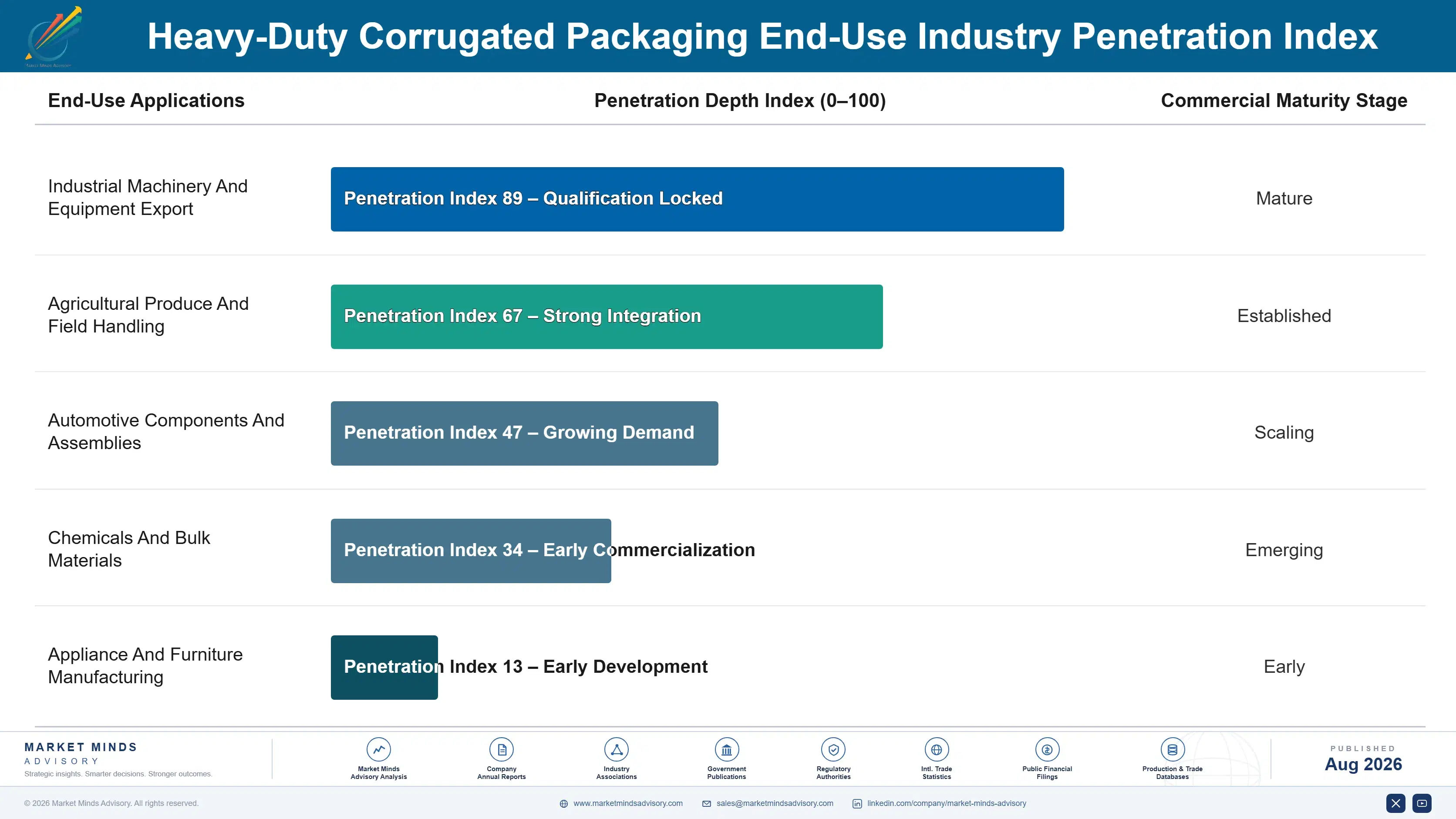
How Industrial Box Demand Repeats

Heavy-duty corrugated demand is programme-shaped and tied to a specific product being shipped. A machinery exporter qualifies a crate design against a particular assembly and reorders against production schedule for as long as that product ships, which can run many years. What ends the programme is a product change rather than a competitor, and requalification against a new geometry starts the cycle again. Converters who hold the design files hold considerable advantage at that moment.
Depth of relationship varies sharply by customer type. Industrial exporters qualify a design once and reorder predictably, with compliance and logistics functions involved alongside packaging. Agricultural users buy enormous volume across a few weeks and negotiate hard on price. Automotive component shippers sit between the two, running steady volume against specifications set centrally. Contract manufacturers are the most difficult, since their part mix changes with every customer win.

Buyer profiles are shifting as logistics and trade compliance functions gain influence over decisions packaging procurement used to own. Phytosanitary treatment and freight weight now appear in specifications that previously covered only protection. Packaging procurement no longer decides these programmes alone, and converter sales teams are slow to notice.
heavy-duty-corrugated-packaging-market-end-use-penetration-index-1787299128701

What We Would Tell a Board

These are among the four positions where our research anticipates prominent divergence between winners and laggards over the coming forecast period. Each is grounded in the demand model, the regulatory perimeter, and the announced capacity pipeline.
01 / SPECIFICATION TESTING DISCIPLINE

Quote box compression; edge crush ships nothing safely

The industry certifies board on edge crush because it is cheap to measure, while box compression on a conditioned assembled container is what actually predicts whether a stack survives transit. On heavy-duty constructions the two diverge sharply enough that a compression-based specification will often deliver the required performance using 8 to 12% less board. Testing capability costs around 400,000 dollars to establish, reframes every technical conversation a converter has, and improves field reliability at the same time as it reduces cost.
02 / BARRIER QUALIFICATION TIMING

Requalify before wax withdrawal, not afterwards

Waxed board cannot be repulped and is being withdrawn across markets on different timetables, stranding every produce and cold chain specification built on it. Requalifying an aqueous barrier construction with a customer takes six to nine months of trial work, which simply cannot be compressed once a withdrawal deadline has arrived. Converters through that qualification first hold approved specifications while competitors are still running their trials, and produce specifications tend to hold for three or four seasons once they are set.
03 / SUBSTITUTION SALES FRAMING

Compete against timber, not against the converter next door

Quoting against another corrugated supplier is a contest over price per square metre, and somebody always wins that by quietly cutting grammage. Quoting against a wooden crate is instead a contest over freight weight, phytosanitary treatment cost, certification lead time, and a whole compliance function the exporter can eliminate entirely. Triple-wall at roughly 62% lighter, with no border treatment requirement at all, wins on total landed cost even at a materially higher unit price than a corrugated competitor would quote.
04 / KRAFTLINER CONTRACTING SPLIT

Buy the virgin grade separately; it moves differently

Heavy-duty strength depends on virgin softwood kraftliner while the rest of packaging moves toward recovered fibre, and the two grades trade on genuinely different cycles because their underlying feedstocks are unrelated. Converters buying them as a single containerboard line item negotiate an average that matches neither grade and stay exposed on exactly the one their performance actually depends on. Board is 63% of total cost, so a few percentage points on the virgin grade line changes the whole commercial result.

Engagement Snapshot From the Field

A live engagement with an industry participant carrying material or product regulatory and market exposure ahead of a defining policy shift, showing how our research translates into a defensible multi-year portfolio strategy.
MARKET MINDS ADVISORY · CLIENT ENGAGEMENT SUMMARY
Heavy-Duty Corrugated Packaging Producer Strategic Portfolio Review and Transition Roadmap 2026·Investment Scenario on Heavy-Duty Corrugated Packaging Exposure Evaluation 2025-26
CLIENT PROFILE
An independent corrugated converter with approximately 240 million dollars in annual revenue (client-reported, unverified by MMA), operating two plants with triple-wall capability and serving industrial exporters and agricultural customers. The company quoted all work on edge crush specification, bought containerboard as a single line item, and had not begun aqueous barrier qualification despite serving produce customers on waxed constructions.
STRATEGIC CHALLENGE
Margin had compressed for two consecutive years despite volume growth, and the company was losing industrial tenders to regional competitors quoting lower prices on identical edge crush specifications. Produce customers were asking about wax alternatives the company could not supply. The board wanted a view before approving price reductions to defend volume.
MMA APPROACH
We tested the client's principal constructions for box compression at conditioned humidity against their edge crush certifications, benchmarked containerboard purchasing against integrated and independent comparables by grade, and reviewed the lost industrial tenders against what the winning bidders had actually been asked to quote. Produce customer wax transition timelines were mapped across the client's account base.
KEY FINDINGS
  1. Client constructions were over-specified against edge crush by an average of 11% in grammage terms, and equivalent compression performance was achievable with materially less board.
  2. Four of six lost tenders had been quoted against timber crates rather than against another converter, and none of the client's proposals had mentioned weight or phytosanitary treatment at all.
  3. Containerboard purchasing showed the client paying above independent comparables on kraftliner specifically, having negotiated a blended price across both grades in a single contract.
  4. Three produce customers had wax withdrawal deadlines inside eighteen months and no qualified alternative from the client, with two already trialling a competitor's barrier construction.
CLIENT PROFILE
An independent corrugated converter with approximately 240 million dollars in annual revenue (client-reported, unverified by MMA), operating two plants with triple-wall capability and serving industrial exporters and agricultural customers. The company quoted all work on edge crush specification, bought containerboard as a single line item, and had not begun aqueous barrier qualification despite serving produce customers on waxed constructions.
STRATEGIC CHALLENGE
Margin had compressed for two consecutive years despite volume growth, and the company was losing industrial tenders to regional competitors quoting lower prices on identical edge crush specifications. Produce customers were asking about wax alternatives the company could not supply. The board wanted a view before approving price reductions to defend volume.
MMA APPROACH
We tested the client's principal constructions for box compression at conditioned humidity against their edge crush certifications, benchmarked containerboard purchasing against integrated and independent comparables by grade, and reviewed the lost industrial tenders against what the winning bidders had actually been asked to quote. Produce customer wax transition timelines were mapped across the client's account base.
KEY FINDINGS
  1. Client constructions were over-specified against edge crush by an average of 11% in grammage terms, and equivalent compression performance was achievable with materially less board.
  2. Four of six lost tenders had been quoted against timber crates rather than against another converter, and none of the client's proposals had mentioned weight or phytosanitary treatment at all.
  3. Containerboard purchasing showed the client paying above independent comparables on kraftliner specifically, having negotiated a blended price across both grades in a single contract.
  4. Three produce customers had wax withdrawal deadlines inside eighteen months and no qualified alternative from the client, with two already trialling a competitor's barrier construction.
RECOMMENDED STRATEGY
Phase 1: Phase 1 (months one to six): install box compression testing capability and requote the active industrial portfolio against compression rather than edge crush. Phase 2: Phase 2 (months six to fifteen): begin aqueous barrier qualification with the three produce customers already facing wax withdrawal deadlines. Phase 3: Phase 3 (months fifteen to twenty-four): split containerboard contracting by grade and rebuild industrial proposals around timber substitution economics instead.
OUTCOME
The client installed compression testing and requoted its industrial book. Board consumption fell materially on requoted constructions while field performance improved, margin recovered above its prior level without price increases (client-reported, unverified by MMA), and barrier qualification retained two of the three produce accounts at risk.

Frequently Asked Questions

Foundational context covering the market sizes, CAGR, scope, country, region and competition that inform every finding below. This section is provided to cover basics and most often pre-purchase conversations, answered from the MMA Primary Research Dataset.

What is the current size of the Heavy-Duty Corrugated Packaging Market?

The market is valued at USD 24.8 billion in 2025, rising to USD 25.94 billion in 2026. Containerboard accounts for roughly 63% of box cost.

How large will the Heavy-Duty Corrugated Packaging Market be by 2036?

MMA forecasts USD 40.67 billion by 2036, an increase of USD 14.73 billion over the 2026 base. That represents an expansion multiple of 1.57 times.

What is the CAGR for the Heavy-Duty Corrugated Packaging Market 2026 to 2036?

The base case CAGR is 4.6%, with a bull case of 5.8% and a bear case of 3.4%. The historical rate from 2020 to 2025 was 3.6%.

Which segment is growing fastest?

Triple-wall board boxes and crates at 6.9%, exactly 1.50 times the market rate. They displace timber crating on freight weight and on phytosanitary treatment requirements.

Who are the major companies in the Heavy-Duty Corrugated Packaging Market?

International Paper, Smurfit Westrock, Packaging Corporation of America, Mondi, and Nine Dragons Paper lead on annual heavy-duty tonnage. The top five hold only 29% because finished board travels badly.

Which country is growing fastest?

Vietnam at 8.2%, driven by electronics, furniture, and machinery assembly relocating there and specifying heavy-duty corrugated export packaging from the outset. Local converting capacity has followed the manufacturing.

Report Segmentation Architecture

The full report scope spans multiple orthogonal segmentation dimensions, with cross-tabulated demand data provided for each dimension pair. Coverage extends further to regional breakdowns, trend trajectories, and the competitive detail needed to support segment-level decision-making.

By Board Construction

  • Heavy Double-Wall Board Boxes
  • Triple-Wall Board Boxes And Crates
  • Bulk Bins And Pallet Boxes
  • Moisture-Resistant Coated Constructions
  • Reinforced And Composite Corrugated Systems
  • Heavy-Duty Sheet And Interior Fitments

By End-Use Industry

  • Industrial Machinery And Equipment Export
  • Agricultural Produce And Field Handling
  • Automotive Components And Assemblies
  • Chemicals And Bulk Materials
  • Appliance And Furniture Manufacturing

By Commercial Model

  • Qualified Programme Supply Against Design
  • Open Tender Volume Supply
  • Seasonal Contract Supply Agreements
  • Design And Testing Service Contracts

By Region

  • East Asia
  • South Asia and Pacific
  • North America
  • Western Europe
  • Latin America
  • Eastern Europe
  • Middle East and Africa

Scope, Methodology, and Coverage

Every figure in this report is reproducible from documented input assumptions. The scope below maps the historical period, the forecast horizon, the segmentation dimensions, and the countries covered, alongside the underlying primary and qualitative methodology.
Historical Period
2020 to 2025
Forecast Period
2026 to 2036
Base Year
2025 (USD billions; MMA Primary Research Dataset, August 2026)
Market Definition
This market comprises corrugated fibreboard packaging engineered for heavy or bulk contents, measured at converter realised prices across all end-use industries. Construction coverage spans heavy double-wall and triple-wall board boxes and crates, bulk bins and pallet boxes, moisture-resistant and barrier coated constructions, reinforced and composite corrugated systems, and heavy-duty sheet and interior fitments. Standard single-wall shipping cases, folding cartons and retail packaging, wooden crates and pallets, plastic bulk containers and returnable systems, protective void fill and cushioning, and containerboard sold as reels to third-party converters fall outside scope.
Quantitative Units
USD billions (current prices); million tonnes of board converted; realised price per tonne
Segmentation Dimensions
By Board Construction; By End-Use Industry; By Commercial Model; By Region
Regions Covered
East Asia, South Asia and Pacific, North America, Western Europe, Latin America, Eastern Europe, Middle East and Africa
Countries Covered
China, Japan, South Korea, Taiwan, Vietnam, India, Thailand, Indonesia, Malaysia, Australia, USA, Canada, Mexico, Brazil, Chile, Argentina, Peru, Germany, Italy, Spain, France, UK, Netherlands, Poland, Czechia, Turkey, Morocco, Egypt, South Africa, and additional markets relevant to this sector
Key Companies Profiled
International Paper, Smurfit Westrock, Packaging Corporation of America, Mondi, Nine Dragons Paper, Georgia-Pacific, Cascades, Klabin, Oji Holdings, Nippon Paper Industries, Rengo, Lee and Man Paper, Shanying International, Prinzhorn Group, VPK Group, Saica, Stora Enso, Greif, Sonoco, Hood Container
Quantitative Methodology
Primary survey, n=3,800 respondents, Q4 2025, six countries; demand-side model with trade association cross-validation
Qualitative Methodology
47 expert interviews, Q4 2025; applied to validate demand model assumptions, identify emerging dynamics, and assess competitive positioning
Report Format
PDF and XLSX data workbook (Word format preview document)
Publisher
Market Minds Advisory
Report Code
MMA-2026-PAC-287
Published
August 2026
Contact
sales@marketmindsadvisory.com | www.marketmindsadvisory.com

Purchase the full Heavy-Duty Corrugated Packaging Market Report (2026 to 2036).

The full report sizes heavy-duty corrugated packaging across six board constructions, five end-use industries, four commercial models, and seven regions, with country detail for the twenty largest national markets. Timber and plastic substitution economics are modelled explicitly, since the genuine competition sits outside corrugated rather than within it. Box compression performance is benchmarked against edge crush certification across common constructions at conditioned humidity. Competitive profiling covers twenty companies on annual heavy-duty tonnage. Wax withdrawal timetables and aqueous barrier qualification status are tracked by market and by converter.
Timber and plastic substitution economics modelled explicitly
Box compression benchmarked against edge crush at conditioned humidity
Wax withdrawal timetables tracked by market and converter
Kraftliner and testliner price cycles analysed separately
Agricultural bulk bin seasonality mapped by crop and region
Phytosanitary treatment cost avoided by shipping lane

Built For The People Who Decide

From boardroom strategy to bench-side execution, this report is read cover-to-cover by leaders shaping the next decade of their industry, turning demand scenarios, market dynamics and valuation benchmarks into decisions.
CXOs/ Presidents/ VPs/ Managers
M&A and Corporate Development
Strategy Teams and R&D Heads
Procurement and Product Directors
Regulatory and Compliance Leaders
Investor Relations and Equity Analysts