Market Minds Advisory
Heated Windshield Market

Heated Windshield Market: Coated interlayer transition, sensor de-icing content and glazing supplier position to 2036

Electric vehicles lose real range to cabin defrost, and heating the glass directly costs a fraction of the energy, which is why a premium feature from the 1980s is arriving on volume platforms now.

Lead Analyst

David Horsley

Published

September 2026

Make Smarter Decisions with Customized Research Insights

Request a free sample report and evaluate market opportunities, growth trends, and competitive dynamics relevant to your business needs.

2025 MARKET VALUE$2.6BMarket Size 2025
2036 FORECAST VALUE$7.0BBase Case , 2026 to 2036
CAGR 2026 TO 20369.4 %Bull 10.6% / Bear 8.2%
INCREMENTAL OPPORTUNITY$4.2BNet 10- year value creation
EXPANSION MULTIPLE2.46x2036 value over 2026 base
Strategic Levers
M&A Pipeline
Regional Outlook
Country Rankings
Competitive Intelligence
Segmental Deep-dive
Call-Us : 91 93563 13602

Executive Snapshot and Market Trajectory

Range anxiety did what four decades of marketing could not. Cabin defrost on an electric vehicle draws enough power to cost meaningful winter range, and resistive glass heating clears a windshield for a fraction of it, which moved heated glazing from a comfort option to an efficiency component.
Silver-coated interlayer constructions grow at 14.1%, half again the market rate of 9.4%, displacing the visible tungsten wire designs that defined the category for thirty years. East Asia holds 28% of value on Chinese electric vehicle production and northern climate demand combined. Automotive glass is one of the more concentrated industries anywhere and this product concentrates it further. Coating capability is the reason why.
Five glassmakers hold 61% of supply and none of them is under any real threat. Laminating a coated interlayer without optical distortion is difficult and unforgiving, and the qualification cycle at a vehicle manufacturer runs years. The pressure is coming from somewhere else entirely: radio frequency attenuation through conductive coatings interferes with transponders, keyless entry and the ADAS sensors mounted behind the glass, and solving that is an engineering problem rather than a manufacturing one.
Market Definition
This report covers electrically heated laminated windshields for road vehicles, including embedded wire, coated interlayer, transparent conductive oxide and localised element constructions supplied to original equipment and replacement channels. Value is measured at glazing unit level. Excluded are heated rear windows and backlights, heated side glass, heated mirrors, heated wiper blades and washer systems, panoramic roof glazing, and non-automotive architectural or rail heated glass.
Base Year Value
$2.6B in 2025 (MMA Primary Research Dataset, August 2026)
Forecast Period
2026 to 2036, eleven discrete annual values
CAGR
9.4% base case. Bull 10.6%. Bear 8.2%.
Fastest Growth Segment
Silver-Coated Interlayer Windshields: 14.1% CAGR
Fastest Growth Country
China: 11.2% CAGR
Fastest Growth Region
South Asia and Pacific: 11.4% CAGR
Largest Region
East Asia: 28% of 2025 global value
Market Leaders
Saint-Gobain Sekurit, AGC Inc, Fuyao Glass Industry Group, Nippon Sheet Glass and Xinyi Glass lead the market. Source: MMA Primary Research Dataset, July 2026.
Primary Survey
n=3,800 procurement and R&D decision-makers, Q4 2025, six countries
Methodology
Demand-side build-up, cross-validated against public data, 47 expert interviews

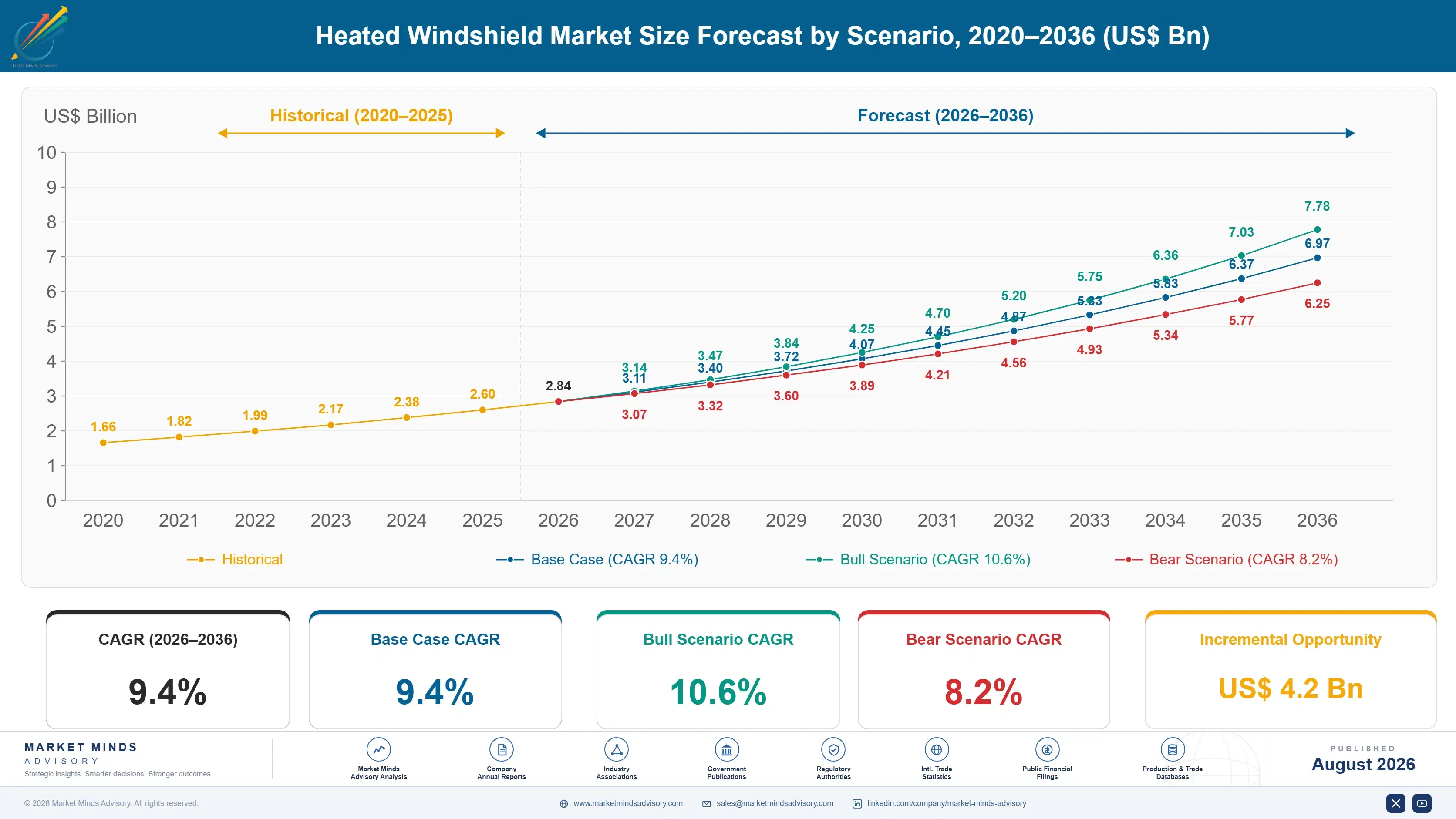
Heated Windshield Market Forecast Scenarios

heated-windshield-market-size-forecast-scenario-1787553199594
Growth ran at 8.0% between 2020 and 2025, and the character of it changed halfway through. The first two years were premium European and North American programmes. Then electric platform launches started specifying heated glass as an efficiency measure rather than a luxury one, and attach rates on cold-market electric vehicles rose faster than anybody in glazing had planned for.
The 9.4% base case rests on three mechanisms. Electric platform winter range targets keep pulling heated glazing onto vehicles where it would never have justified the cost on an internal combustion model. ADAS camera and sensor de-icing requirements push localised heating onto vehicles because a fogged camera window disables a safety system. And coated interlayer costs fall as volume rises, which brings the technology into segments where the price gap previously ruled it out.
The 10.6% bull case assumes ADAS sensor de-icing becomes a type approval expectation rather than a manufacturer choice, which would put localised heating on essentially every windshield sold. The 8.2% bear case is replacement economics: a heated windshield costs 3.4 times a conventional one at the glazier, insurers have noticed, and pressure on total cost of ownership can slow specification faster than any technical argument.

What Heated Glass Actually Costs

A heated windshield is not really a glass product. It is a resistive circuit laminated inside a safety glazing, and everything difficult about it happens at the interlayer: getting a silver coating thin enough to stay transparent, conductive enough to heat, and uniform enough that nobody sees a stripe when the sun catches it. Glass companies do this. Nobody else has tried seriously.
TOP-FIVE CONCENTRATION61%Combined share of heated windshield supply held by leaders
DEFROST ENERGY SAVING63%Reduction against cabin blower defrost on a cold start
COATING SIGNAL ATTENUATION22 dBLoss through conductive layers across common transponder frequency bands
REPLACEMENT PRICE PREMIUM3.4 timesMultiple over a conventional laminated windshield at the glazier
COLD-CLIMATE ATTACH RATE34%Share of new vehicles specified with heating in Nordic markets
CLEAR TIME TO VISION2.5 minutesTypical interval from activation to legally adequate forward visibility
The commercial case is energy. Clearing a windshield with cabin air costs an electric vehicle roughly three times what heating the glass directly does, a saving near 63% that shows up as winter range on a specification sheet. Vision comes back in about two and a half minutes rather than ten. Nordic markets already specify heating on 34% of new vehicles, and that figure is climbing in every cold market where electric share is rising.
The costs are less discussed. A conductive coating attenuates radio frequency by around 22 decibels across the bands transponders and keyless systems use, so every heated windshield needs a deliberately uncoated aperture and somebody has to decide where it goes. Replacement runs 3.4 times a conventional glazing, which insurers are starting to price.
"Everybody talks about the range saving and nobody talks about the aperture. Where you leave the coating off decides whether the toll transponder works, and that decision gets made by a glass engineer with no idea what the vehicle's connectivity package looks like."
Director, Vehicle Glazing and Comfort Systems Practice · MMA Automotive Practice · August 2026

Market Trends

Coated interlayers displace visible wire across premium platforms

Embedded tungsten wire worked and it was always a compromise, because the wires are visible in low sun and they interrupt the view in a way that customers notice on a car costing what these cars cost. Silver-coated interlayer constructions remove that objection completely and heat more evenly besides. Growth at 14.1% reflects premium platforms switching wholesale rather than gradually. Cost is the barrier holding it off volume vehicles, and that gap narrows every year as coating lines run fuller and yields improve. The wire designs will survive longest in commercial vehicles where nobody cares how it looks.
Market Impact: Saves 63% of defrost energy

Sensor zone heating spreads to warm climate markets

A forward camera behind the windshield stops working when the glass in front of it fogs or ices, and that disables lane keeping, emergency braking and adaptive cruise together. Manufacturers responded by heating a small zone around the sensor aperture rather than the whole screen, which costs a fraction of full heating and solves the safety problem. The interesting part is that condensation happens in humid warm climates too, so this content is appearing on vehicles sold in Southeast Asia and southern Europe where full heating would make no sense at all. Growth here runs at 12.2%.
Market Impact: Protects 12.2% growth segment

Market Opportunities and Growth Drivers

Electric platform winter range targets pull glazing content

Cabin defrost on a battery vehicle draws several kilowatts from the traction pack, and in a cold climate that is real range disappearing into warming air that mostly goes out of the vents. Heating the glass directly cuts roughly 63% of that energy and clears vision in around two and a half minutes rather than ten. Manufacturers publishing winter range figures have every reason to specify it. Nordic attach rates already reach 34% of new vehicles, and the calculation gets more favourable as heat pump systems shift the comparison further toward direct glazing heat.
Market Impact: Costs 22 dB of signal

Camera occlusion requirements make sensor heating close to mandatory

Euro NCAP and equivalent protocols award points for automatic emergency braking and lane support, and a manufacturer cannot claim those systems work if the camera behind the glass ices over on a February morning. That has quietly turned sensor zone heating from a nice detail into something engineering will not sign off without. The requirement applies regardless of market climate because humidity fogs a camera window as effectively as frost does. Content per vehicle is small, attach rates are rising fast, and the segment compounds at 12.2% on a base that barely existed five years ago.
Market Impact: Replacement runs 3.4 times higher

Market Restraints and Challenges

Conductive coatings attenuate the signals vehicles depend on

A silver coating that conducts heat also reflects radio frequency, and attenuation runs around 22 decibels across the bands toll transponders, keyless entry and satellite navigation use. The root cause is unavoidable physics: the property that makes the layer heat is the property that blocks the signal. Commercially this means every heated windshield carries a deliberately uncoated aperture, and getting its size and position wrong produces warranty claims that look like electronics faults and are not. Manufacturers now specify aperture geometry alongside heating performance, and some have moved antennas out of the glass entirely rather than fight it.
Market Impact: Segment growing at 14.1%

Replacement cost pushes back through insurance and fleet buyers

A heated windshield costs 3.4 times a conventional one to replace, and windshields get replaced often because stone chips are unavoidable. The root problem is that the heating element and the ADAS camera bracket both make the glazing a calibrated component rather than a consumable, so replacement means recalibration as well as glass. Insurers have started pricing that into premiums and fleet buyers into whole-life cost models, which reaches vehicle specification decisions eventually. Some manufacturers have responded by making heating a separately priced option rather than standard content, and aftermarket glaziers are building calibration capability to bring the total down.
Market Impact: Zone heating at 12.2% growth
3 additional market trends, 2 additional growth drivers, and 4 additional restraints and challenges are covered in the full report. Contact sales@marketmindsadvisory.com to access the complete intelligence.

Segment CAGR and Growth Architecture

Windshields are classified here by heating technology and the construction that delivers it, because that decides manufacturing capability, unit cost and which vehicles the product reaches. Vehicle class, climate market and sales channel are handled separately in the framework, since a single construction serves several vehicle segments and both original equipment and replacement demand at once.
heated-windshield-market-market-share-analysis-1787553200140

Silver-Coated Interlayer Windshields

Growing at 14.1%, half again the market rate, this construction is taking the premium end of the market outright. A silver layer sputtered onto the interlayer heats the entire viewing area evenly with nothing visible in low sun, which is what wire designs could never manage. The manufacturing barrier is genuine: coating uniformity across a curved laminate is difficult, yields punish anybody learning on production volume, and the capital sits in sputtering lines rather than glass furnaces. Radio frequency attenuation of around 22 decibels comes with it and gets solved through an uncoated aperture that has to be designed in from the start rather than added later. Adding it later is not actually possible.
CAGR 14.1%

Hybrid Sensor-Zone Heating Windshields

This is the segment nobody forecast because it solves a problem that did not exist ten years ago. A camera behind the glass needs a clear aperture, and heating a small zone around it costs a fraction of heating the whole screen while protecting the safety systems that depend on the image. Growth at 12.2% comes as much from warm markets as cold ones, since humidity fogs a camera window as reliably as frost. Content per vehicle is small and attach rates are climbing fast, which makes this the volume story rather than the value one. Manufacturers increasingly treat it as sensor hardware rather than glazing content, and that changes who specifies it.
CAGR 12.2%
Full segment breakdown across 6 segments available in the complete report.

Regional Architecture and Country Demand Map

East Asia holds 28% of value, ahead of North America at 26%, because Chinese electric vehicle production and northern climate demand arrive together on the same platforms. Western Europe follows on Nordic and German specification depth. Climate explains most of this map and manufacturing location explains the rest.

North America

Canadian and northern United States winters produce the most severe use case for this product anywhere in a high-income market, and heated glazing has been available on North American vehicles since the 1980s without ever becoming standard content. Electric adoption has changed that calculation. Pickup and full-size SUV platforms carry large glazed areas that cost a great deal to defrost conventionally, which makes the range argument stronger here than in Europe. Replacement economics push the other way: stone chip frequency on North American roads is high and 3.4 times replacement cost gets noticed. Growth at 9.8% balances those two forces against each other. Insurers are increasingly the third voice in it.
Share: 26% | CAGR: 9.8% (2026 to 2036)

Western Europe

Nordic markets specify heating on 34% of new vehicles, the highest attach rate anywhere, and that number sets expectations for the rest of the region. German premium manufacturers pioneered coated interlayer constructions and continue to push specification down through their model ranges. British and French volume platforms adopt more slowly because the climate argument is weaker and cost sensitivity is higher. Growth at 7.9% is the slowest of the seven regions and reflects a market already well penetrated rather than one losing interest. The technology transition from wire to coating happens here first and matters more than the volume number suggests. Specification decided here becomes specification everywhere within about four years.
Share: 25% | CAGR: 7.9% (2026 to 2036)
Regional intelligence for 5 additional markets available in the complete report: East Asia, South Asia and Pacific, Latin America, Middle East and Africa, Eastern Europe. Contact sales@marketmindsadvisory.com.
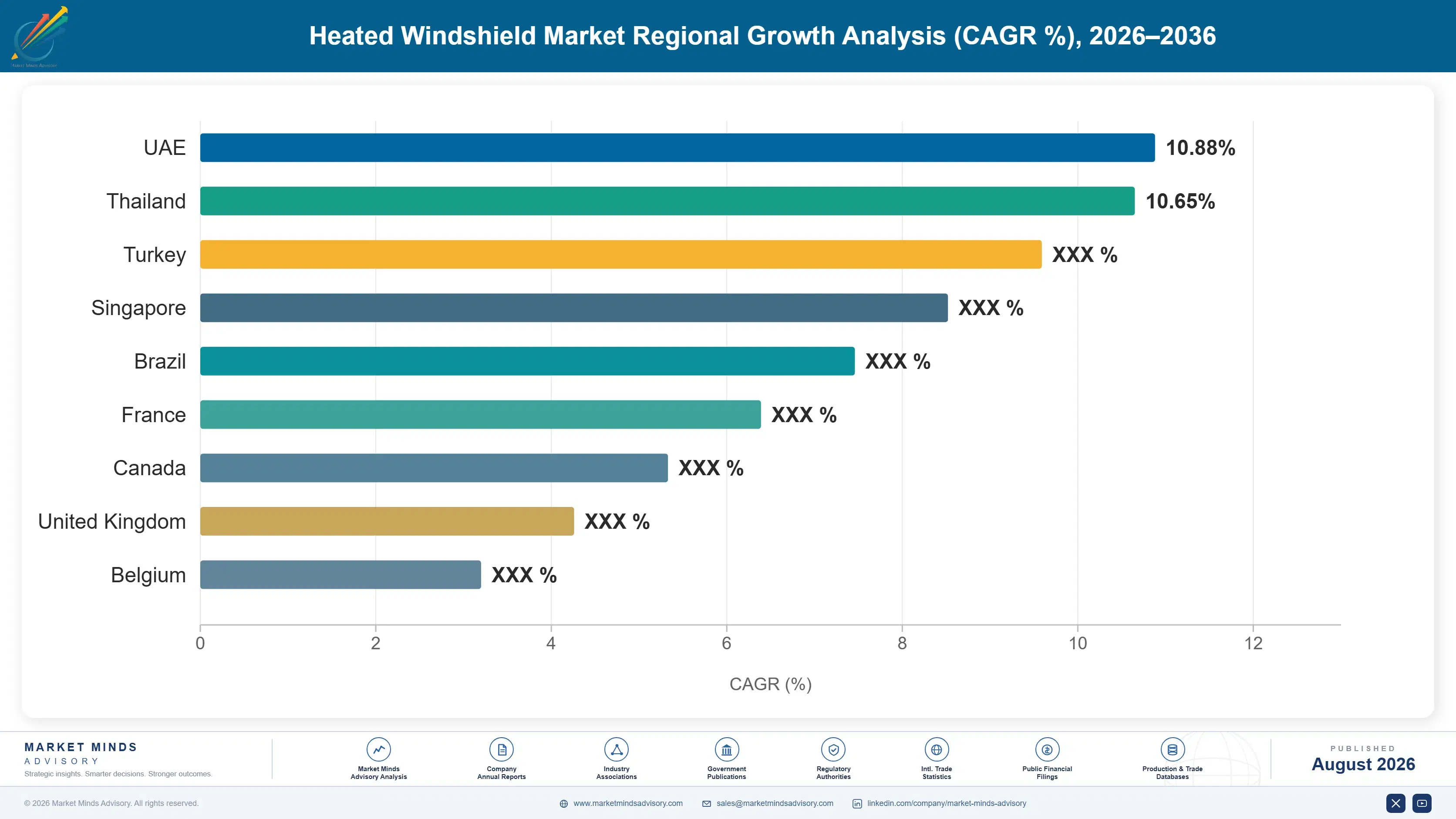
heated-windshield-market-country-cagr-analysis-1787553200666

Where Glazing Margin Is Available

Four moves matter here and none of them involves making more glass. Automotive glazing is a concentrated industry with high capital intensity and thin returns on conventional product, so the returns available sit in the constructions nobody else can laminate and the problems nobody else has solved. Volume alone earns very little. It never really did.

Own the aperture design problem, not just the glass

Radio frequency attenuation of around 22 decibels through a conductive coating is the single most common source of post-launch complaint on heated glazing, and it lands on the glass supplier regardless of who specified the antenna. A supplier arriving with aperture geometry already modelled against the vehicle's connectivity package is solving an integration problem rather than quoting a laminate. That conversation happens with electrical architecture engineering, which is not where glass sales organisations normally go. It also happens two years earlier in the programme, which is where specification actually gets decided.
Market Impact: Removes the 22 decibel attenuation complaint from launch

Sell sensor zone heating as safety hardware

Full heating is a comfort and efficiency argument that competes against every other cost on a vehicle. Sensor zone heating is a safety argument that competes against nothing, because a manufacturer claiming automatic emergency braking cannot have the camera ice over. The segment compounds at 12.2% and content per vehicle is small enough that purchasing rarely fights it. Positioning the product with ADAS engineering rather than glazing procurement changes both the decision maker and the budget it comes from, and suppliers that made that shift are winning content on vehicles in markets that never see frost.
Market Impact: Reaches a growing segment compounding at 12.2% annually

Build the replacement calibration business before insurers do

A heated windshield costs 3.4 times a conventional one to replace and much of that gap is recalibration rather than glass. Insurers are pricing it and fleet buyers are modelling it, and both are pressure that eventually reaches original equipment specification. A glassmaker that supplies calibration procedures, tooling and training into the aftermarket channel reduces the total replacement cost and removes an argument working against its own product. It also captures margin in a channel that glass companies have traditionally handed to distributors without much thought. That channel is worth considerably more than it looks.
Market Impact: Attacks the 3.4 times replacement cost gap directly

Price the winter range figure, not the part

Heated glazing saves roughly 63% of defrost energy and a manufacturer publishing winter range numbers can put that on a specification sheet where customers compare it. That is worth considerably more to the customer than the part costs, and glass suppliers quoting per square metre are capturing none of it. Presenting validated range data alongside the quotation moves the conversation from glazing procurement to vehicle attribute engineering, where the budget is larger and the comparison is against a heat pump rather than against a cheaper windshield. Very few glass suppliers have made that move.
Market Impact: Monetises the full 63% defrost energy saving properly

Who Controls the Margin Pool

Five glassmakers hold 61% of heated windshield supply, measured on unit shipments into original equipment and replacement channels, which is the basis used throughout. That is high concentration by any standard and it reflects an industry where a float line and a laminating plant cost more than most entrants can raise. The gap between the leaders and everybody else is coating capability, not glass capacity. Anybody can laminate. Very few can sputter silver onto an interlayer at automotive yields.
Competition runs on three dimensions. Coating yield, which decides unit cost more than anything else does. Integration engineering, particularly aperture design against a vehicle's connectivity package. And plant proximity, because a windshield is fragile, bulky and expensive to move any distance. Price competes on the conventional constructions and hardly at all on the coated ones.

Rankings will shift where Chinese producers follow their customers abroad. Fuyao and Xinyi built scale supplying domestic manufacturers and are now qualifying at European and North American plants on cost that Western operations struggle to match. The coated interlayer capability that once protected the incumbents is no longer exclusive to them, and that changes the arithmetic considerably within a few years.
heated-windshield-market-company-positioning-matrix-1787553201195

Competitive Moat and Risk Dimensions

SAINT-GOBAIN SEKURIT

Moat: Coated interlayer process depth

Saint-Gobain developed coated glazing across architectural and automotive applications over decades, and the coating science transfers between them in ways a purely automotive glassmaker cannot replicate. Yield on a curved laminated windshield is where money is made or lost, and that knowledge accumulates slowly and does not move between companies easily at all.
SAINT-GOBAIN SEKURIT

Risk: European cost base exposure

Manufacturing concentrated in high-cost European locations faces energy prices and labour costs that Chinese competitors do not carry, and glass production is energy-intensive enough that the gap is material rather than marginal. Qualifying a Chinese supplier takes a European manufacturer time and increasingly they are willing to spend it.
AGC INC

Moat: Global plant footprint

AGC operates automotive glazing plants across Asia, Europe and the Americas, which matters more in this product than in most because windshields are fragile and expensive to ship. A manufacturer launching a platform in three regions can source identical construction locally in each, and rebuilding that footprint would take a competitor a decade and considerable capital.
AGC INC

Risk: Architectural glass drag

A substantial part of the business sits in architectural and display glass, markets with their own cycles and capital demands that compete internally against automotive coating investment. Competitors focused purely on vehicle glazing can commit to a coating line without arguing it against a building products division first.

Players Tracked

Prominent Players

Saint-Gobain Sekurit
AGC Inc
Fuyao Glass Industry Group
Nippon Sheet Glass
Xinyi Glass

Other Key Players

Corning Incorporated
Central Glass
Guardian Glass
Vitro
ÅžiÅŸecam
Asahi India Glass
Taiwan Glass
Carlex Glass
Nordglass
CSG Holding
Kibing Group
Luoyang Glass
Hyundai Mobis
Webasto
Gentex Corporation

Recent Developments

JUNE 2025

Fuyao Glass commissioned additional coated glazing capacity in China

Fuyao Glass brought new coated automotive glazing capacity online at a Chinese site, targeting heated windshield production for domestic electric vehicle platforms. The investment was an organic capacity expansion funded internally, with no partner or acquisition involved, and it followed award volumes the existing lines could not absorb.
Signal: Chinese coating capacity is now being built ahead of demand rather than behind it, which changes the cost comparison
NOVEMBER 2025

Saint-Gobain Sekurit signed a multi-year heated glazing supply agreement with a European manufacturer

Saint-Gobain Sekurit entered a multi-year supply agreement covering coated interlayer heated windshields for a European vehicle manufacturer's electric platform range. The arrangement was a supply agreement rather than a joint venture or equity partnership, and it includes aperture design work alongside the glazing itself. Design work was the stated differentiator.
Signal: Bundling integration engineering with glass supply is how incumbents intend to defend against lower-cost coating capacity
MARCH 2026

AGC expanded sensor-zone heating production at a European plant

AGC commissioned additional production capability for localised sensor-zone heated windshields at a European facility, responding to camera de-icing content spreading across volume platforms. The expansion was organic rather than acquisitive and reflects content arriving on vehicles in markets with no cold-weather requirement at all. Climate has stopped predicting this demand.
Signal: Sensor heating is decoupling from climate entirely, which widens the addressable market far beyond what cold-weather forecasts assumed

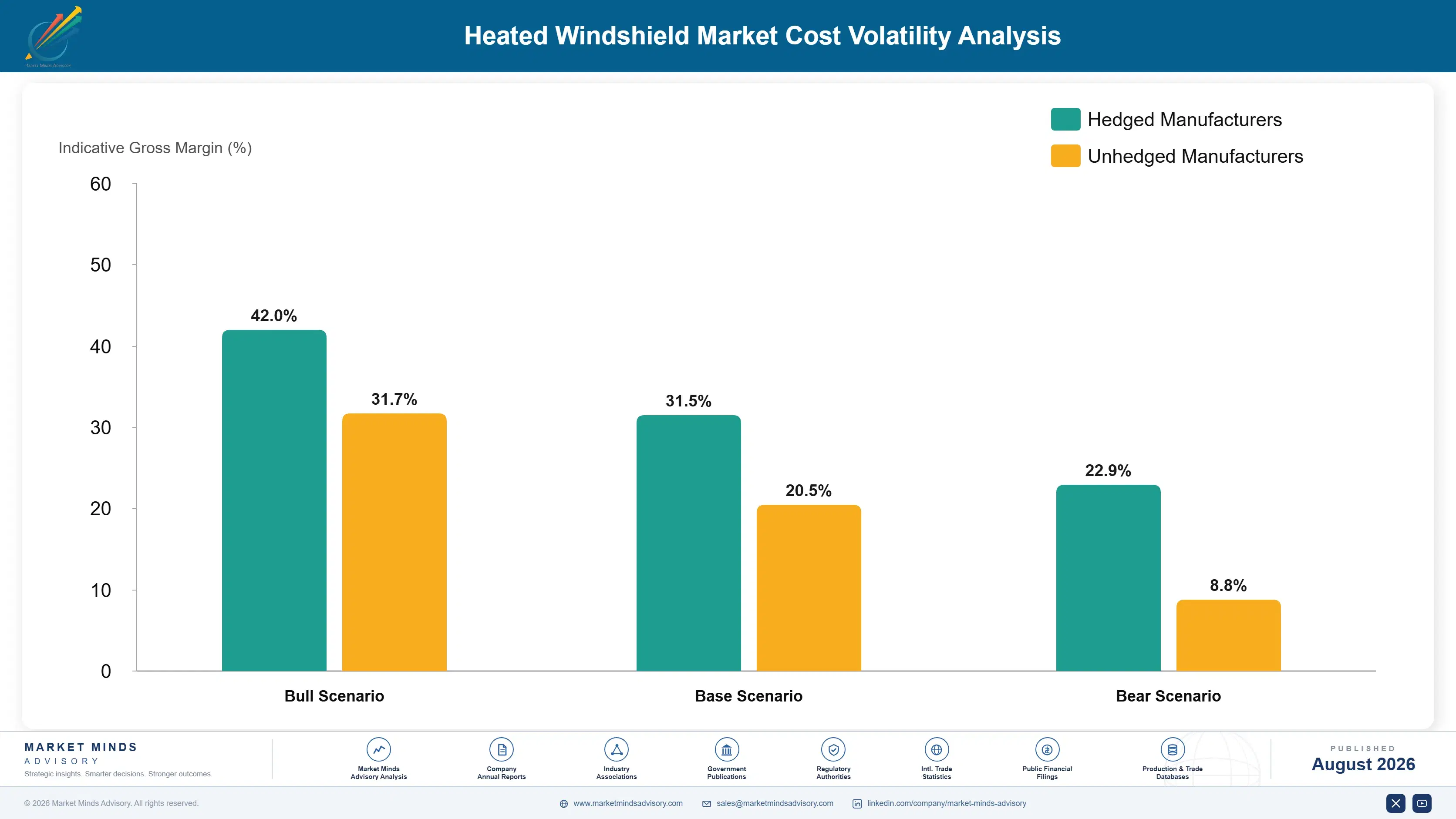
What Drives Glazing Cost

Energy is the dominant input in flat glass and runs around 29% of cost of goods for a heated windshield, with float glass itself, PVB interlayer, silver target material and lamination labour making up the balance. Gas comes from regional supply. PVB interlayer comes from a handful of chemical producers in the United States, Japan and China.
European gas prices through 2022 hit float glass harder than any other manufacturing process, because a furnace runs continuously and cannot be turned down. IEA data show European industrial gas costs at several times American levels then. Saint-Gobain's Annual Report 2022 records the energy cost impact across its glass operations. Producers on annual automotive contracts absorbed most of it, since programme price is fixed for a model year.

The furnace is what makes this exposure asymmetric. A float line cannot be idled without destroying it, so a producer facing high energy either runs and loses money or shuts permanently. That falls hardest on European operations and barely at all on Chinese ones, where energy costs less. Producers with architectural volume alongside automotive can shift furnace output toward whichever market is paying; pure automotive glaziers cannot.
heated-windshield-market-cost-volatility-analysis-1787553201393

Index automotive programme pricing to regional gas benchmarks

Automotive contracts fix price for a model year and leave the glassmaker carrying furnace energy risk that can move by multiples inside that period. Indexing to published regional gas benchmarks with quarterly reset transfers the volatility back to the party better able to absorb it. Vehicle manufacturers resist it and increasingly accept it once the alternative is explained clearly.

Run architectural volume alongside automotive on the same furnace

A float line that serves only automotive glazing has nowhere to send output when vehicle production slows, and idling is not an option because the furnace would be destroyed. Balancing architectural and automotive volume on the same asset gives a producer somewhere to put glass in a downturn. It requires different sales organisations and it is worth the complication.

Hedge silver exposure across the coating programme horizon

Silver target material is a small share of unit cost and it trades on an exchange with real volatility, which makes it the one input a glassmaker can genuinely hedge. Most do not, because the exposure looks small next to energy. Across a multi-year programme at fixed price the accumulated movement is larger than the annual figure suggests.

Portfolio Architecture for Margin Defence

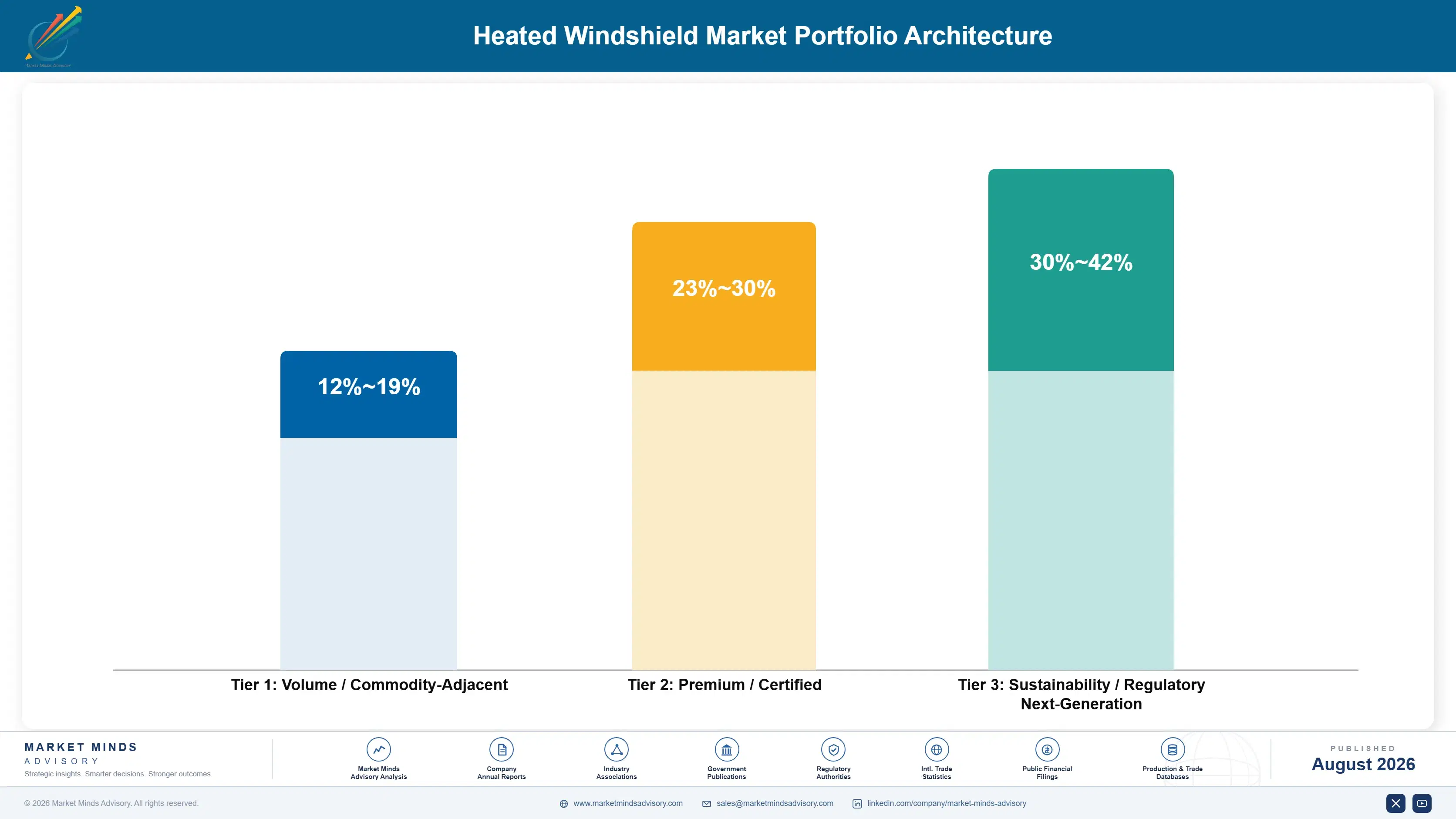
Margin in heated glazing follows coating capability rather than volume. Embedded wire constructions run at gross margins in the mid teens, because the process is well understood and any laminator with the tooling can make one. Coated interlayer windshields run considerably higher, since yield separates producers and the customer has few alternatives once a construction is qualified onto a platform. Sensor zone products sit somewhere between, cheap to make and priced against a safety requirement rather than a glass benchmark.
The tension in this business is furnace economics against product mix. A float line runs continuously whatever the order book looks like, which pushes producers to chase volume that earns nothing simply to keep the asset loaded. Coated automotive work earns the returns and cannot fill a furnace on its own. Every glassmaker in this market lives with that arithmetic and most of them handle it by running architectural volume alongside, which carries its own complications.

High-value pools sit in coated interlayer constructions, aperture integration engineering and the aftermarket calibration channel that glass companies have largely ignored. The first is defended by process capability, the second by relationships nobody else has built, the third by nothing at all yet.

Volume / Commodity-Adjacent

Embedded wire and busbar-printed constructions where the process is mature and any laminator with the tooling can compete on price. The seven-point range separates producers running loaded furnaces from those carrying underutilised capacity through a weak order book.
Gross Margin: 12%-19%

Premium / Certified

Coated interlayer and transparent conductive oxide constructions qualified onto specific vehicle platforms. The seven-point spread reflects coating yield, which is the single largest variable in unit cost and varies more between producers than anybody discusses publicly.
Gross Margin: 23%-30%

Sustainability / Regulatory / Next-Generation

Sensor zone heating sold against ADAS occlusion requirements, and aperture integration engineering sold as a service alongside the glass. The twelve-point range is wide because pricing follows safety requirement rather than material cost and no benchmark exists yet.
Gross Margin: 30%-42%
heated-windshield-market-portfolio-architecture-1787553201909

High-value Sub-segments and Strategic Watch-out

Coated Interlayer Constructions

Compounding at 14.1% and defended by a coating yield problem that takes years to solve rather than capital to buy. Premium platforms are switching wholesale rather than gradually, and the cost gap against wire designs narrows every year as lines run fuller. Volume vehicles are next.
Gross Margin: 25%-34%

Sensor Zone Heating Content

Growing at 12.2% with no climate requirement at all, because a fogged camera window disables emergency braking in Bangkok exactly as it does in Oslo. Content per vehicle is small and attach rates climb fast, which makes this a volume story rather than a value one.
Gross Margin: 30%-42%

Embedded Wire Constructions

The mature volume that keeps furnaces loaded, declining in passenger cars and surviving in commercial vehicles where nobody objects to visible wires. Any laminator can compete for it and most do, which is why the margin sits where it does. Manage it for utilisation. Nothing else defends it.
Gross Margin: 12%-19%

Replacement Channel Calibration

A heated windshield costs 3.4 times a conventional one to replace and much of the gap is recalibration that glass companies have handed to distributors without thought. Insurers are pricing it and that pressure reaches original equipment specification eventually. Somebody will capture this channel. Nobody has yet.
Gross Margin: 20%-34%

How Glazing Demand Renews

Windshield demand runs on two clocks at once. Original equipment supply is programme annuity revenue, awarded once and running the life of a platform at six to eight years with no reordering decision in between. Replacement demand is genuinely continuous, because stone chips happen and every vehicle on the road is a future order. The second clock is what makes glazing a more stable business than most automotive components.
Stickiness varies by construction. A coated interlayer windshield qualified onto a platform is close to immovable, because requalification means optical testing, aperture verification and ADAS recalibration across the whole programme. Wire constructions change supplier at programme boundaries without much difficulty. Replacement channel loyalty is weaker still, since a glazier fits whatever the distributor supplies and the original manufacturer rarely gets a say.

The buyer has changed and glass sales organisations have mostly not. Windshield specification once sat with body engineering, who cared about optical quality, mass and cost per square metre. It now sits with vehicle attribute teams weighing winter range, and with ADAS engineering weighing camera occlusion. Both of those functions are two years upstream of where glass procurement normally starts talking.
heated-windshield-market-end-use-penetration-index-1787553202400

Where To Place The Bet

These are among the four positions where our research anticipates prominent divergence between winners and laggards over the coming forecast period. Each is grounded in the demand model, the regulatory perimeter, and the announced capacity pipeline.
01 / COATING YIELD INVESTMENT

Fund coating yield before adding laminating capacity

Coated interlayer constructions compound at 14.1% against a market at 9.4%, and the thing separating producers in that segment is yield on a curved laminate rather than how many parts a plant can push through. A percentage point of yield is worth more than a percentage point of capacity at these volumes, and the knowledge accumulates slowly enough that competitors cannot simply buy their way past it. Any capital plan funding presses ahead of process engineering has the priority exactly inverted.
02 / APERTURE INTEGRATION OWNERSHIP

Own the signal problem the coating creates

Attenuation of around 22 decibels through a conductive coating is the most common post-launch complaint on heated glazing and it lands on the glass supplier whether or not the antenna was anybody else's decision to make. Arriving with aperture geometry already modelled against the vehicle's connectivity package turns a quotation into an engineering conversation, and that conversation happens two years earlier in the programme than glass procurement normally does anywhere. Whoever holds that conversation generally ends up holding the specification too.
03 / SENSOR CONTENT POSITIONING

Sell zone heating to ADAS, not procurement

Sensor zone heating compounds at 12.2% and it competes against nothing, because a manufacturer claiming automatic emergency braking cannot let the camera ice over or fog up at all. Positioning it with ADAS engineering rather than glazing procurement changes the decision maker, the budget it comes from and the argument being had, which is why this content appears on vehicles sold in markets that never see frost. Suppliers still quoting it per square metre are losing on the wrong criterion entirely.
04 / REPLACEMENT CHANNEL CAPTURE

Take the calibration business before somebody else does

A heated windshield costs 3.4 times a conventional one to replace and much of that gap is recalibration rather than glass, which insurers are now pricing into premiums and fleet buyers into whole-life models. That pressure reaches original equipment specification eventually and it works directly against the product. Supplying calibration procedures, tooling and training into the aftermarket lowers the total, removes the argument and captures margin in a channel glass companies have handed to distributors for decades without thinking about it.

Engagement Snapshot From the Field

A live engagement with an industry participant carrying material or product regulatory and market exposure ahead of a defining policy shift, showing how our research translates into a defensible multi-year portfolio strategy.
MARKET MINDS ADVISORY · CLIENT ENGAGEMENT SUMMARY
Heated Windshield Producer Strategic Portfolio Review and Transition Roadmap 2026·Investment Scenario on Heated Windshield Exposure Evaluation 2025-26
CLIENT PROFILE
A European volume vehicle manufacturer with annual production around 1.4 million units (client-reported, unverified by MMA), launching a dedicated electric platform across three body styles. Heated glazing was specified on the top two trim levels only, following the practice carried over from the internal combustion range it replaced. Nobody had revisited that decision since the platform brief was written.
STRATEGIC CHALLENGE
Winter range figures on the base trim were falling short of the competitive set by a margin the product team called unacceptable (client-reported, unverified by MMA), and the proposed fix was a larger battery. Glazing had not been considered. Separately, launch markets in the Nordics were forecasting a trim mix heavily weighted toward the two variants that already had heating.
MMA APPROACH
MMA modelled the defrost energy difference between cabin blower and direct glazing heating across the client's launch market climate profiles, then benchmarked heated glazing attach rates and pricing against the competitive set through the expert interview programme. Aperture and connectivity implications were reviewed with the client's electrical architecture team. Replacement cost exposure was checked against insurer pricing practice in each launch market.
KEY FINDINGS
  1. Standard-fitting heated glazing across all trims closed most of the winter range gap at a fraction of the cost of the larger battery the product team had proposed.
  2. Nordic trim mix forecasts meant the client was already paying for heating on the majority of units sold there, so the marginal cost of standard fitment was smaller than assumed.
  3. The proposed aperture position conflicted with the planned telematics antenna location, an issue that would have surfaced during validation rather than design had nobody looked.
  4. Replacement cost exposure was real in two launch markets where insurers price glazing separately, and the client had no aftermarket calibration provision arranged at all.
CLIENT PROFILE
A European volume vehicle manufacturer with annual production around 1.4 million units (client-reported, unverified by MMA), launching a dedicated electric platform across three body styles. Heated glazing was specified on the top two trim levels only, following the practice carried over from the internal combustion range it replaced. Nobody had revisited that decision since the platform brief was written.
STRATEGIC CHALLENGE
Winter range figures on the base trim were falling short of the competitive set by a margin the product team called unacceptable (client-reported, unverified by MMA), and the proposed fix was a larger battery. Glazing had not been considered. Separately, launch markets in the Nordics were forecasting a trim mix heavily weighted toward the two variants that already had heating.
MMA APPROACH
MMA modelled the defrost energy difference between cabin blower and direct glazing heating across the client's launch market climate profiles, then benchmarked heated glazing attach rates and pricing against the competitive set through the expert interview programme. Aperture and connectivity implications were reviewed with the client's electrical architecture team. Replacement cost exposure was checked against insurer pricing practice in each launch market.
KEY FINDINGS
  1. Standard-fitting heated glazing across all trims closed most of the winter range gap at a fraction of the cost of the larger battery the product team had proposed.
  2. Nordic trim mix forecasts meant the client was already paying for heating on the majority of units sold there, so the marginal cost of standard fitment was smaller than assumed.
  3. The proposed aperture position conflicted with the planned telematics antenna location, an issue that would have surfaced during validation rather than design had nobody looked.
  4. Replacement cost exposure was real in two launch markets where insurers price glazing separately, and the client had no aftermarket calibration provision arranged at all.
RECOMMENDED STRATEGY
Phase 1: Phase one: specify heated glazing as standard across all trims rather than as a top-level option, funding it from the battery capacity the change makes unnecessary. Phase 2: Phase two: relocate the telematics antenna out of the glass before design freeze, avoiding an aperture conflict that validation would find far too late. Phase 3: Phase three: arrange aftermarket calibration capability in the two exposed launch markets ahead of first customer deliveries rather than after the first claims.
OUTCOME
Heated glazing was specified as standard across the platform and the battery increase was dropped, a change the client reported as saving roughly EUR 260 per vehicle net (client-reported, unverified by MMA). The antenna was relocated before design freeze. Calibration arrangements are in place in both markets ahead of launch.

Frequently Asked Questions

Foundational context covering the market sizes, CAGR, scope, country, region and competition that inform every finding below. This section is provided to cover basics and most often pre-purchase conversations, answered from the MMA Primary Research Dataset.

What is the current size of the Heated Windshield Market?

The market was valued at USD 2.6 billion in 2025, rising to an estimated USD 2.84 billion in 2026. East Asia holds the largest regional share at 28% of value.

How large will the Heated Windshield Market be by 2036?

MMA forecasts USD 6.99 billion by 2036 under the base case, an expansion multiple of 2.46 times the 2026 value. That represents USD 4.15 billion of incremental value.

What is the CAGR for the Heated Windshield Market 2026 to 2036?

The base case runs at 9.4% compound annual growth between 2026 and 2036, with a bull case at 10.6% and a bear case at 8.2%. Historical growth from 2020 to 2025 was 8.0%.

Which segment is growing fastest?

Silver-coated interlayer windshields lead at 14.1%, half again the market rate, displacing visible tungsten wire designs across premium platforms. Hybrid sensor-zone heating constructions follow at 12.2%.

Who are the major companies in the Heated Windshield Market?

Saint-Gobain Sekurit, AGC Inc, Fuyao Glass Industry Group, Nippon Sheet Glass and Xinyi Glass hold 61% between them. Coating process depth and plant footprint sustain those positions rather than glass capacity.

Which country is growing fastest?

China leads at 11.2%, driven by electric vehicle production volume and severe northern winters arriving on the same platforms. Domestic coating capacity keeps the cost advantage in place.

Report Segmentation Architecture

The full report scope spans multiple orthogonal segmentation dimensions, with cross-tabulated demand data provided for each dimension pair. Coverage extends further to regional breakdowns, trend trajectories, and the competitive detail needed to support segment-level decision-making.

By Heating Technology

  • Embedded Tungsten Wire Windshields
  • Silver-Coated Interlayer Windshields
  • Hybrid Sensor-Zone Heating Windshields
  • Transparent Conductive Oxide Coated Windshields
  • Localised Wiper-Park Heating Elements
  • Busbar-Printed Edge Heating Windshields

By End-Use Industry

  • Passenger Cars
  • Light Commercial Vehicles
  • Heavy Commercial Vehicles
  • Buses and Coaches
  • Off-Highway and Agricultural Equipment
  • Emergency and Specialist Vehicles

By Sales Channel

  • Original Equipment Supply
  • Original Equipment Service Parts
  • Independent Aftermarket Distribution
  • Insurance-Directed Replacement Networks
  • Fleet Direct Supply

By Region

  • North America
  • Western Europe
  • East Asia
  • South Asia and Pacific
  • Latin America
  • Middle East and Africa
  • Eastern Europe

Scope, Methodology, and Coverage

Every figure in this report is reproducible from documented input assumptions. The scope below maps the historical period, the forecast horizon, the segmentation dimensions, and the countries covered, alongside the underlying primary and qualitative methodology.
Historical Period
2020 to 2025
Forecast Period
2026 to 2036
Base Year
2025 (USD billions; MMA Primary Research Dataset, August 2026)
Market Definition
The market comprises electrically heated laminated windshields supplied for road vehicle glazing, covering embedded tungsten wire, silver-coated interlayer, transparent conductive oxide, hybrid sensor-zone, localised wiper-park and busbar-printed edge constructions. Value is measured at glazing unit level across original equipment and replacement channels. Heated rear windows and backlights, heated side and quarter glass, heated mirrors, heated wiper and washer systems, panoramic roof glazing, unlaminated glass, and architectural or rail heated glazing fall outside scope.
Quantitative Units
USD billions (current prices); million heated windshield units shipped annually; USD content per vehicle by construction
Segmentation Dimensions
By Heating Technology; By End-Use Industry; By Sales Channel; By Region
Regions Covered
North America, Western Europe, East Asia, South Asia and Pacific, Latin America, Middle East and Africa, Eastern Europe
Countries Covered
China, Japan, South Korea, Taiwan, India, Thailand, Indonesia, Australia, New Zealand, United States, Canada, Mexico, Germany, France, United Kingdom, Italy, Spain, Sweden, Norway, Finland, Denmark, Poland, Czechia, Slovakia, Hungary, Romania, Brazil, Argentina, Chile, Turkey
Key Companies Profiled
Saint-Gobain Sekurit, AGC Inc, Fuyao Glass Industry Group, Nippon Sheet Glass, Xinyi Glass, Corning Incorporated, Central Glass, Guardian Glass, Vitro, ÅžiÅŸecam, Asahi India Glass, Taiwan Glass, Carlex Glass, Nordglass, CSG Holding, Kibing Group, Luoyang Glass, Hyundai Mobis, Webasto, Gentex Corporation
Quantitative Methodology
Primary survey, n=3,800 respondents, Q4 2025, six countries; demand-side model with trade association cross-validation
Qualitative Methodology
47 expert interviews, Q4 2025; applied to validate demand model assumptions, identify emerging dynamics, and assess competitive positioning
Report Format
PDF and XLSX data workbook (Word format preview document)
Publisher
Market Minds Advisory
Report Code
MMA-2026-AUT-294
Published
August 2026
Contact
sales@marketmindsadvisory.com | www.marketmindsadvisory.com

Purchase the full Heated Windshield Market Report (2026 to 2036).

The full report sizes the global heated windshield market to 2036 across six heating technology segments and seven regions, separating original equipment demand from replacement channel volume throughout. It maps the electric platform range argument, ADAS camera occlusion requirements and radio frequency attenuation constraints against producer capability, and identifies where coating yield creates defensible position. Competitive analysis covers 20 participants evaluated on unit shipments into original equipment and replacement channels, with moat and risk assessment for the two leaders. Input cost exposure is traced from furnace energy, PVB interlayer and silver supply through to programme contract structure. Four quantified revenue levers close the analysis.
Six-segment heating technology sizing with segment-level growth rates
Seven-region share and growth breakdown to 2036
Twenty-participant competitive map on one shipment basis
Aperture and attenuation analysis across connectivity system requirements
Input cost exposure traced to energy, interlayer and silver
Four quantified revenue levers with commercial impact ranges

Built For The People Who Decide

From boardroom strategy to bench-side execution, this report is read cover-to-cover by leaders shaping the next decade of their industry, turning demand scenarios, market dynamics and valuation benchmarks into decisions.
CXOs/ Presidents/ VPs/ Managers
M&A and Corporate Development
Strategy Teams and R&D Heads
Procurement and Product Directors
Regulatory and Compliance Leaders
Investor Relations and Equity Analysts