Market Minds Advisory
Heat Shield Market

Heat Shield Market: Exhaust shielding decline, battery propagation barriers and supplier repositioning to 2036

Exhaust shielding is a declining business and battery propagation barriers are a different product entirely, so suppliers built on stamped aluminised steel now compete against materials companies they have never met before.

Lead Analyst

David Horsley

Published

September 2026

Make Smarter Decisions with Customized Research Insights

Request a free sample report and evaluate market opportunities, growth trends, and competitive dynamics relevant to your business needs.

2025 MARKET VALUE$12.4BMarket Size 2025
2036 FORECAST VALUE$26.6BBase Case , 2026 to 2036
CAGR 2026 TO 20367.2 %Bull 8.5% / Bear 6.0%
INCREMENTAL OPPORTUNITY$13.3BNet 10- year value creation
EXPANSION MULTIPLE2.00x2036 value over 2026 base
Strategic Levers
M&A Pipeline
Regional Outlook
Country Rankings
Competitive Intelligence
Segmental Deep-dive
Call-Us : 91 93563 13602

Executive Snapshot and Market Trajectory

China's revised battery safety standard removes the escape clause. From July 2026 a pack must not catch fire or explode after a single cell fails, which turns thermal propagation barriers from a design preference into a homologation requirement across the largest vehicle market anywhere. Nobody was ready.
Mica and ceramic composite barriers grow at 10.8%, half again the market rate of 7.2%, while stamped exhaust shields decline with internal combustion volume. East Asia holds 30% of value on battery pack assembly concentration rather than vehicle output alone. The two halves of this market are moving in opposite directions and most suppliers still report them together. That reporting hides a great deal of divergence.
Five suppliers hold 46% of shield revenue and the ranking is unstable for the first time in twenty years. Stamping capability and proximity to exhaust assembly decided position historically. Neither matters for a mica barrier laminated between cells, where the competitive question is material formulation and dielectric performance. Materials companies with no automotive heritage are winning battery pack awards against tier one suppliers who have supplied those customers for decades without ever losing one.
Market Definition
This report covers thermal shields and barriers fitted to vehicles and powertrain systems, including exhaust and underbody heat shields, turbocharger and manifold shields, and thermal propagation barriers inside electric vehicle battery packs. Value is measured at component supply into vehicle and pack assembly. Excluded are acoustic-only insulation, engine bay sealing, cabin thermal management, aerospace ablative shielding, and raw insulation materials sold in sheet form.
Base Year Value
$12.4B in 2025 (MMA Primary Research Dataset, August 2026)
Forecast Period
2026 to 2036, eleven discrete annual values
CAGR
7.2% base case. Bull 8.5%. Bear 6.0%.
Fastest Growth Segment
Mica and Ceramic Composite Barriers: 10.8% CAGR
Fastest Growth Country
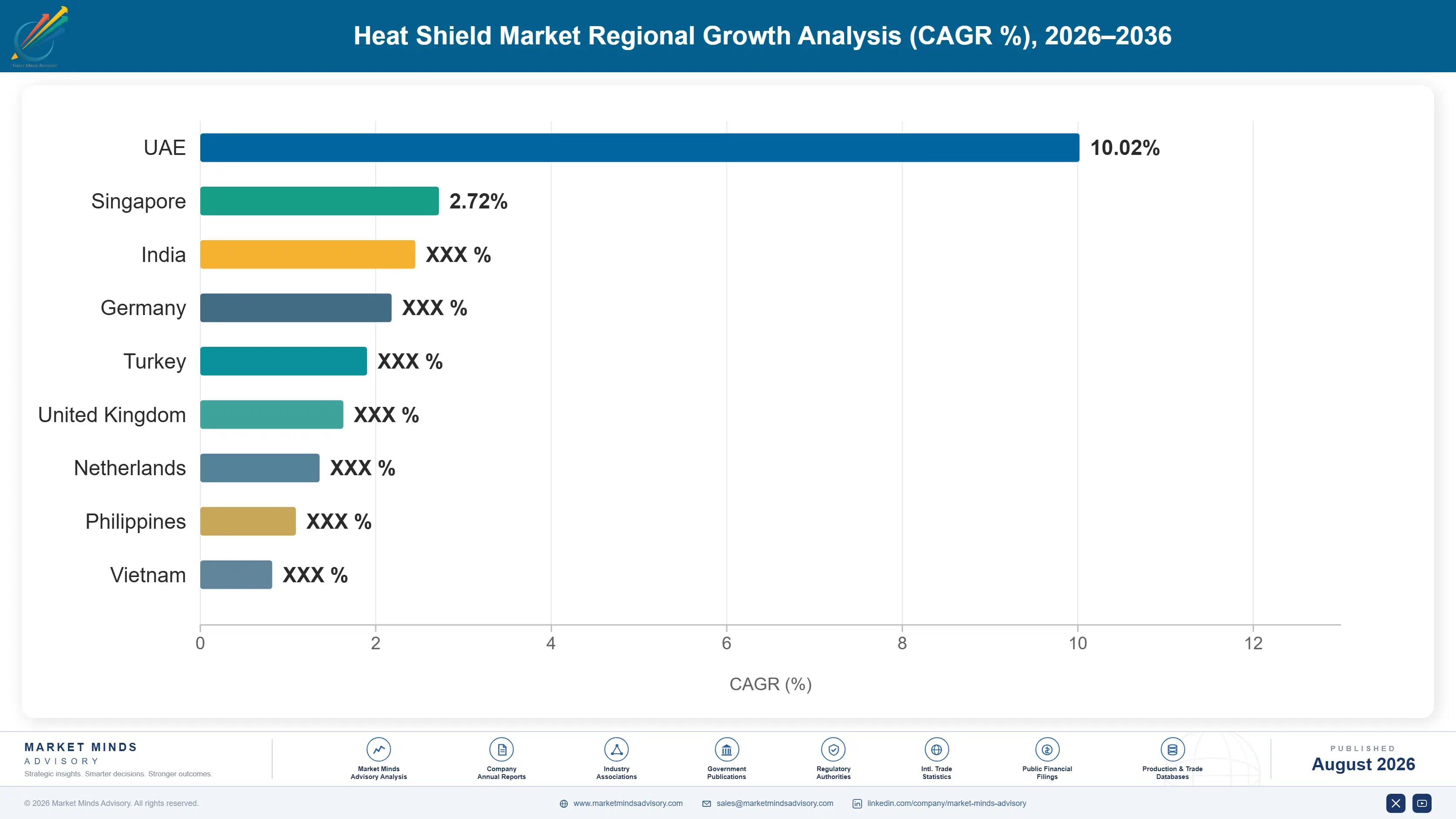
India: 10.1% CAGR
Fastest Growth Region
South Asia and Pacific: 9.3% CAGR
Largest Region
East Asia: 30% of 2025 global value
Market Leaders
Dana Incorporated, Autoneum, ElringKlinger, Tenneco and Alkegen lead the market. Source: MMA Primary Research Dataset, July 2026.
Primary Survey
n=3,800 procurement and R&D decision-makers, Q4 2025, six countries
Methodology
Demand-side build-up, cross-validated against public data, 47 expert interviews

Heat Shield Market Forecast Scenarios

heat-shield-market-size-forecast-scenario-1787553181060
Between 2020 and 2025 the market compounded at 6.0% and the composition changed more than the total did. Exhaust shield volume peaked around 2022 and has fallen since as internal combustion share declined in Europe and China. What held the number up was battery pack barrier content arriving on new electric platforms, at unit values several times an exhaust shield.
The 7.2% base case rests on three mechanisms. China's GB 38031 revision takes effect in July 2026 and makes propagation barriers mandatory rather than optional on every pack sold there. UNECE GTR 20 Phase 2 work pushes the same requirement toward European and Japanese homologation on a slower timetable. And battery pack energy density keeps rising, which shortens the margin for error and pushes designers toward thicker and more capable barrier materials rather than thinner ones.
The 8.5% bull case assumes European regulators adopt a no-fire requirement matching China's rather than a warning-time standard, which would put barrier content on every pack sold in the region quickly. The 6.0% bear case is cell chemistry: lithium iron phosphate propagates less violently than nickel-rich chemistry, and a broad shift toward it would let designers specify thinner barriers or fewer of them.

Two Businesses Reported As One

A heat shield used to be a stamped piece of aluminised steel that stopped an exhaust manifold from cooking the floor pan. That business still exists and it is shrinking. The product growing is a mica or ceramic laminate sitting between battery cells whose job is to buy several minutes before a thermal event reaches the pack next door, and nothing about making one prepares a supplier for the other.
TOP-FIVE CONCENTRATION46%Combined position held by the five largest shield suppliers
ALUMINISED STEEL COST SHARE41%Portion of shield cost of goods from coated steel
BATTERY BARRIER ATTACH RATE62%European electric platforms specifying propagation barriers between battery cells
SHIELDS PER VEHICLE9 unitsAverage count fitted across a mid-size passenger vehicle
TOOLING AMORTISATION PERIOD4 yearsTypical stamping die payback across a vehicle programme life
AVERAGE PROGRAMME VALUEUSD 41Mean shield content supplied per vehicle at assembly
The economics differ as much as the product. A mid-size passenger vehicle carries around nine shields worth roughly USD 41 in total, and stamping tooling amortises over about four years against a programme. Battery barrier content on the same vehicle can exceed that figure several times over, priced per pack rather than per part, with no stamping die to pay off and a material formulation the customer cannot easily second-source.
Around 62% of European electric platforms now specify propagation barriers between cells, and that figure was under a third three years ago. Aluminised steel still accounts for 41% of shield cost of goods across the industry, which shows how much of the installed business remains conventional.
"The interesting question is not whether battery barriers grow. It is whether the companies that stamped exhaust shields for thirty years end up supplying them, and on current award patterns the answer looks like no."
Principal, Automotive Systems and Materials Practice · MMA Automotive Practice · August 2026

Market Trends

Propagation barriers become homologation requirements rather than design choices

China's GB 38031 revision takes effect in July 2026 and requires that a battery pack neither catches fire nor explodes after a single cell enters thermal runaway. The previous standard demanded a five-minute warning, which designers met with venting and monitoring rather than material. The revision closes that route. Around 62% of European platforms already specify barriers voluntarily, but a homologation requirement removes the cost negotiation entirely: a pack that fails cannot be sold. Suppliers are being asked to demonstrate performance rather than quote a price against a target. That is an unfamiliar conversation for most.
Market Impact: Fitted on 62% of platforms

Aerogel content migrates from aerospace into volume automotive packs

Silica aerogel offers thermal conductivity no conventional material approaches, and until recently the cost put it in aerospace and industrial applications only. Volume manufacturing has brought pricing to a point where automotive pack designers will specify it where thickness is constrained, which on a skateboard platform it almost always is. Growth here runs at 9.9% and the supplier base is narrow because production is capital-intensive and the process is difficult. Several tier one suppliers have signed material supply agreements rather than attempting to make it themselves. That choice will look expensive within five years.
Market Impact: Lifts content across 9 shields

Market Opportunities and Growth Drivers

Rising pack energy density shortens the thermal margin for error

Cell energy density has risen steadily and shows no sign of stopping, which means more energy released faster when a cell fails. Designers responding to that have moved from thin ceramic paper to thicker multi-layer constructions, and barrier content per pack has risen even where the number of cells has not. Cell-to-pack architectures make it worse by removing the module walls that previously slowed propagation. Around 62% of European platforms now specify dedicated barriers, and the specification gets more demanding with each generation rather than less. Nobody expects that trend to reverse soon.
Market Impact: Strands 41% steel cost base

Turbocharged downsized engines raise underbonnet temperatures materially

The internal combustion side of this market is not simply declining. Downsized turbocharged engines run hotter in a tighter engine bay than the larger naturally aspirated units they replaced, and exhaust gas temperatures at the turbine housing have climbed accordingly. That pushes shield specification from single-layer aluminised steel toward multi-layer insulated constructions with considerably higher unit value. Commercial vehicles and hybrids extend the effect for another decade at least. A shrinking unit count at rising content per unit is a more forgiving decline than the volume numbers suggest. Very few forecasts model it that way.
Market Impact: Compresses into 3-year programmes

Market Restraints and Challenges

Stamping asset base has no application in barrier production

A heat shield supplier's capital sits in progressive stamping presses, tooling and the plants around them, and none of it makes a mica laminate. The root cause is that the two products share an application and nothing else: one is formed metal, the other is a converted material with dielectric and compression requirements. Commercially this leaves incumbents defending declining exhaust volume with assets they cannot redeploy. Some have responded by acquiring material converters outright, others by licensing formulations and converting in existing plants, and a few have accepted the decline and are managing it for cash.
Market Impact: Mandatory from July 2026

Barrier qualification runs long against compressed vehicle programme timing

Propagation testing means deliberately driving cells into runaway inside a full pack and measuring what happens, which is slow and destructive. The root problem is that results do not transfer between pack designs, so a barrier qualified on one platform proves little about the next. Vehicle programmes have compressed to around three years while this testing has not got faster, which squeezes the window for evaluating alternatives and favours whoever was specified last time. Some manufacturers now run barrier qualification in parallel with cell selection rather than after it, and simulation is improving enough to narrow the physical test matrix.
Market Impact: Segment compounding at 9.9%
4 additional market trends, 3 additional growth drivers, and 2 additional restraints and challenges are covered in the full report. Contact sales@marketmindsadvisory.com to access the complete intelligence.

Segment CAGR and Growth Architecture

Shields are classified here by construction and the material system that defines their thermal performance, because that is what determines who can make one and what it sells for. End-use vehicle type, powertrain and mounting location are handled separately in the framework, since a single construction serves several positions on a vehicle and several vehicle classes at once.
heat-shield-market-market-share-analysis-1787553181647

Mica and Ceramic Composite Barriers

Growing at 10.8%, half again the market rate, this is where battery pack thermal propagation is actually stopped. Mica offers dielectric strength alongside thermal resistance, which matters when the barrier sits directly against cell terminals, and ceramic fibre composites handle the peak temperatures that follow a runaway event. Value per pack runs several times conventional exhaust shield content. The competitive picture here bears no relation to the rest of the market: material formulation and compression behaviour under cell swelling decide awards, not stamping capability or plant proximity. China's July 2026 requirement turns this from a specification argument into a homologation gate, which changes the negotiation entirely. Very few incumbents have adjusted to it.
CAGR 10.8%

Aerogel-Based Insulation Shields

Silica aerogel does something no other material at automotive cost does: it delivers extreme thermal resistance in almost no thickness. On a skateboard battery platform where every millimetre between cells costs range, that is worth paying for, and growth at 9.9% reflects designers reaching the point where thickness rather than cost binds. Production is capital-intensive and difficult, so the supplier base stays narrow and pricing holds better than most automotive materials. Handling is the practical constraint: aerogel blankets shed dust and need careful lamination, which is why most automotive applications use composite constructions rather than the material alone. That lamination step is where a great deal of the value quietly accumulates.
CAGR 9.9%
Full segment breakdown across 6 segments available in the complete report.

Regional Architecture and Country Demand Map

East Asia holds 30% of value, ahead of North America at 24%, because battery pack assembly concentrates there regardless of where vehicles are eventually sold. Western Europe follows on regulatory specification depth rather than volume. The gap reflects pack location more than anything else. Nothing about vehicle output explains it.

North America

Light truck and full-size pickup volume keeps exhaust shield content per vehicle higher here than anywhere else, because larger engines and longer exhaust runs need more shielding regardless of what happens to passenger car mix. That cushions the internal combustion decline considerably. Battery pack assembly has expanded fast under domestic content incentives, and the pack plants going up across the southeastern states are specifying propagation barriers to standards set by their Korean and Japanese cell partners rather than by any American regulation. Mexican assembly serves both sides. Suppliers here compete on programme management and launch reliability as much as on material capability. Material capability is increasingly becoming much the harder half.
Share: 24% | CAGR: 7.0% (2026 to 2036)

Western Europe

Regulation has driven specification here further than volume would justify. German premium platforms adopted propagation barriers voluntarily well ahead of any requirement, partly on liability exposure and partly because pack energy densities in that segment left little margin. Around 62% of European electric platforms now carry dedicated barriers. The internal combustion side is declining faster than in any other region, which puts real pressure on suppliers whose plants were built around exhaust shield stamping for German and French assembly. Growth at 5.6% is the weakest of the seven regions and understates how much the product mix has changed underneath it. Several of those stamping plants will not survive the decade intact.
Share: 21% | CAGR: 5.6% (2026 to 2036)
Regional intelligence for 5 additional markets available in the complete report: East Asia, South Asia and Pacific, Latin America, Middle East and Africa, Eastern Europe. Contact sales@marketmindsadvisory.com.
heat-shield-market-country-cagr-analysis-1787553182231

Where Shield Margin Is Moving

Four moves matter in a market where the growing product and the declining one share almost nothing except a customer list. Three of them require capability an exhaust shield business does not currently hold, which is uncomfortable and also the point. Defending stamped volume is not among them at all. Cash from it funds everything else.

Buy barrier converting capability rather than building it

The mica and ceramic barrier segment compounds at 10.8% and the qualification cycle means a supplier entering now reaches volume production three to four years out at best. Acquiring an established converter with existing pack qualifications collapses that timeline to a single programme cycle. Several tier one suppliers have taken this route already and the available targets are thinning. The alternative is licensing a formulation and converting in existing plants, which is cheaper and leaves the supplier dependent on a material partner who also sells to competitors. Neither option is comfortable and one is worse.
Market Impact: Enters a segment compounding at 10.8% each year

Sell the qualification test data, not the part

Propagation testing is slow, destructive and does not transfer between pack designs, which makes a supplier holding validated data across multiple pack architectures genuinely valuable to a customer working inside a three-year programme. Suppliers that run their own test capability and present results rather than samples are winning awards ahead of cheaper competitors. The capital involved is real and it buys a position no price quotation reaches. Around 62% of European platforms now specify barriers and every one of those specifications came from somebody's test data. Very few suppliers have built that capability yet.
Market Impact: Supports specification on 62% of European electric platforms

Price multi-layer exhaust shields against rising turbine temperatures

Internal combustion volume is falling and content per vehicle is not. Downsized turbocharged engines push turbine housing temperatures beyond what single-layer aluminised steel handles comfortably, and a multi-layer insulated construction carries unit value often 30% or more above the single-layer part it replaces. Suppliers that treat the exhaust business as a managed decline and quote accordingly are leaving that upgrade on the table. The engineering argument belongs with powertrain rather than purchasing, because the driver is a thermal limit and not a cost target anybody set. Commercial vehicles extend that argument another full decade.
Market Impact: Upgrades unit content across all 9 shields fitted

Secure aerogel supply before pack thickness constraints bind

Aerogel production is capital-intensive and the supplier base is narrow, which means available capacity gets committed under long agreements rather than bought on order. The segment grows at 9.9% and pack designers reach for it whenever thickness rather than cost is the binding constraint, which on skateboard architectures is increasingly always. A supply agreement signed now costs little and secures a position that will be expensive to buy in four years. Several tier one suppliers have already done exactly this rather than attempting production themselves. The window on that arithmetic is closing steadily.
Market Impact: Locks capacity ahead of a 9.9% growth segment

Who Controls the Margin Pool

The five largest suppliers hold 46% of shield revenue, measured on component supply into vehicle and battery pack assembly, which is the basis used throughout. Concentration looks stable and the composition underneath it is not. The gap between the leaders and the next tier was stamping scale and plant proximity for thirty years. It is material capability now, and that is a different list of companies.
Competition runs on four dimensions at present. Validated propagation test data across multiple pack architectures. Material formulation depth, particularly in mica and ceramic composites. Access to aerogel capacity under agreement rather than on order. And conventional programme management on the exhaust side, where launch reliability still decides awards. Price matters least on the growing products and most on the declining ones.

Rankings shift first in battery pack barriers, where industrial insulation companies with no automotive heritage are taking awards from tier one suppliers who have served those customers for decades. Exhaust shielding holds its ordering longer because the assets and relationships are hard to displace. The uncomfortable position belongs to suppliers strong in the declining product and absent from the growing one.
heat-shield-market-company-positioning-matrix-1787553182779

Competitive Moat and Risk Dimensions

DANA INCORPORATED

Moat: Thermal management systems breadth

Dana supplies shielding alongside battery cooling plates and thermal management hardware, which puts it in the pack thermal conversation rather than only the shield one. That position lets it propose integrated solutions where a shield-only supplier quotes a part, and customers consolidating suppliers around pack thermal systems find the breadth genuinely useful.
DANA INCORPORATED

Risk: Heavy internal combustion exposure

A large part of the business remains tied to axles, driveshafts and conventional powertrain hardware, which carries the same decline as exhaust shielding does. Funding a barrier position while managing that decline is a capital allocation problem, and competitors without the legacy exposure face an easier version of it.
AUTONEUM

Moat: Multi-material converting capability

Autoneum built its business on converting textiles, felts and composite materials rather than stamping metal, which turns out to be closer to what a barrier laminate requires. The plants, the process knowledge and the material handling transfer across in a way a progressive stamping operation simply does not, and that was an accident of history rather than foresight.
AUTONEUM

Risk: Acoustic business dominates revenue

Most of the company's revenue comes from acoustic and noise insulation, where electric vehicles have reduced some content and changed the rest. Thermal shielding competes internally for attention and investment against a much larger business facing its own transition, which slows decisions that competitors focused solely on thermal can take quickly.

Players Tracked

Prominent Players

Dana Incorporated
Autoneum
ElringKlinger
Tenneco
Alkegen

Other Key Players

Morgan Advanced Materials
3M
Nichias Corporation
Sumitomo Riko
Zircotec
UGN Inc
Carcoustics
Talbros Automotive Components
Progress-Werk Oberkirch
Freudenberg Sealing Technologies
Toyota Boshoku
Howa Co
Aspen Aerogels
Von Roll Holding
Sanwa Packing Industry

Recent Developments

MAY 2025

ElringKlinger expanded battery thermal barrier production capacity in Germany

ElringKlinger commissioned additional capacity for battery pack thermal protection components at a German site, converting existing floor space rather than building new. The expansion was organic and followed customer awards on European electric platforms that the existing lines could not cover. No partner was involved in the investment.
Signal: Converting existing plant rather than buying capability suggests incumbents believe stamping footprints can be repurposed after all
OCTOBER 2025

Alkegen signed a multi-year mica barrier supply agreement with a North American pack manufacturer

Alkegen entered a multi-year supply agreement covering mica-based thermal propagation barriers for a North American battery pack manufacturer. The arrangement was a supply agreement rather than a joint venture, with no equity participation or shared governance, and it covers several platform programmes through the decade.
Signal: Materials companies are contracting directly with pack manufacturers, bypassing the tier one suppliers who historically held those relationships
FEBRUARY 2026

Aspen Aerogels commissioned additional automotive barrier capacity

Aspen Aerogels brought new production capacity online aimed at automotive thermal barrier applications, expanding output for battery pack customers. This was an organic capacity expansion funded internally rather than an acquisition or partnership, and it responded to committed volume under existing customer agreements. Capacity was committed before it was built.
Signal: Aerogel capacity is being committed under agreement before it exists, which tells you how tight the supply position is

What Actually Moves Shield Cost

Aluminised and stainless steel account for around 41% of shield cost of goods on the conventional side, with the balance in stamping labour, tooling amortisation and insulation infill. Steel comes from European and Asian mills on annual contracts. Mica originates almost entirely from India and Madagascar, and silica aerogel from a handful of producers in the United States and China.
European steel prices moved violently through 2021 and 2022 as energy costs pushed mill economics apart, and IEA data show European industrial gas running well above American levels then. ElringKlinger's Annual Report 2022 records material cost pressure across its shielding and sealing operations. Suppliers on annual vehicle programme pricing absorbed most of the movement, because automotive contracts rarely index and a stamped part cannot be redesigned to a cheaper material mid-programme without requalification.

That requalification lock is the disadvantage mechanism and it hits unevenly. Suppliers with heavy exhaust exposure carry the full steel swing across a declining revenue base. Barrier suppliers face a narrower but sharper problem: mica supply concentrates in two countries and aerogel in few producers, so a disruption has no alternative source. Eastern European stamping operations gain a labour cost offset that Western plants do not.
heat-shield-market-cost-volatility-analysis-1787553182978

Index vehicle programme pricing to published steel benchmarks

Automotive contracts traditionally fix price for a model year and leave the supplier carrying every input movement, which was tolerable when steel moved slowly and is not now. Indexing to published European hot-rolled benchmarks with quarterly reset removes the argument and manufacturers increasingly accept it. Resistance comes from purchasing rather than engineering. Engineering rarely objects at all.

Qualify a second mica source outside the dominant origins

Mica supply concentrates in India and Madagascar to a degree that leaves no practical alternative if either is disrupted, and the material also carries supply chain scrutiny over mining conditions. Qualifying synthetic mica or an alternative ceramic construction costs testing time and removes a genuine exposure. Few suppliers have done it because nothing has gone wrong yet.

Contract aerogel capacity ahead of programme awards

Aerogel producers commit capacity under long agreements rather than selling on order, and available volume gets allocated well before a vehicle programme reaches award. A supplier without a contracted position discovers the constraint at exactly the point it cannot be solved. Signing early costs a commitment fee and secures the ability to quote at all.

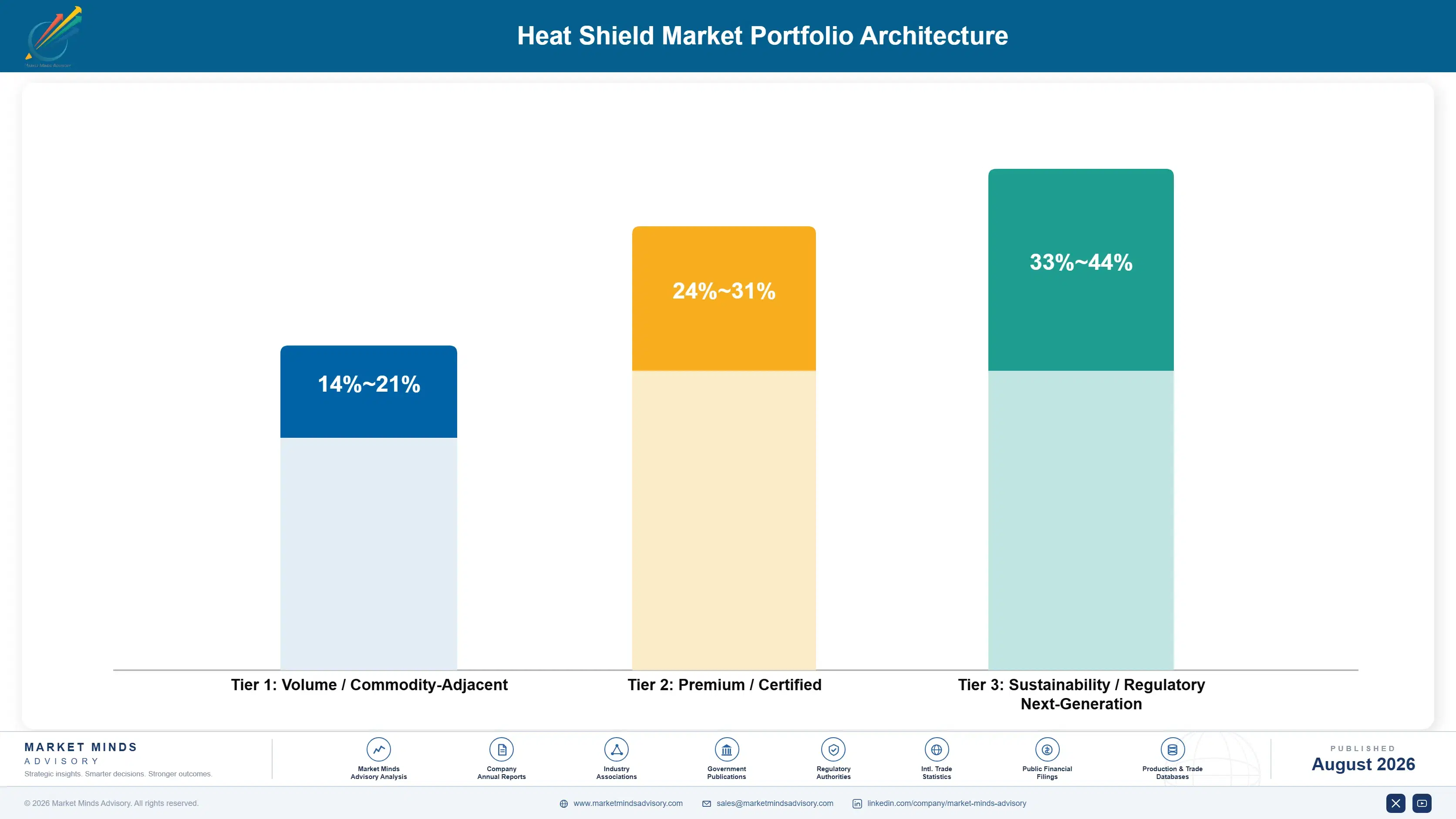
Portfolio Architecture for Margin Defence

Margin in shielding tracks how hard the part is to qualify rather than how hard it is to make. Stamped aluminised steel shields run at gross margins in the mid to high teens, competing against any press shop within delivery range. Multi-layer insulated constructions carrying real thermal specification run higher. Battery propagation barriers run higher again, because the customer cannot second-source a formulation quickly and the qualification cost is theirs as much as the supplier's.
The tension is that stamping volume pays for the plants and barrier work pays for the future, and the two need entirely different organisations. A press shop optimised for high-volume progressive dies handles material converting badly, and the engineering skills do not overlap either. Suppliers running both from one management structure have generally found the stamping business starved the barrier one of attention at precisely the wrong moment.

High-value pools sit in mica and ceramic barriers, aerogel constructions and multi-layer exhaust shields for high-temperature turbocharged applications. The first two are small and growing fast; the third is the only place conventional capability still earns a premium. Stamping capacity by itself defends nothing at all now.

Volume / Commodity-Adjacent

Single-layer stamped aluminised steel shields for exhaust and underbody positions, competing against any press shop inside a delivery radius. The seven-point range separates suppliers with amortised tooling from those still paying dies off across a programme.
Gross Margin: 14%-21%

Premium / Certified

Multi-layer insulated shields and textile constructions carrying validated thermal performance for turbocharger and manifold positions. The seven-point spread reflects how much of the specification is genuinely engineered versus inherited from a previous programme without review.
Gross Margin: 24%-31%

Sustainability / Regulatory / Next-Generation

Mica, ceramic and aerogel propagation barriers sold into battery pack assembly against homologation requirements. The eleven-point range is wide because pricing reflects scarcity of qualified suppliers and validated test data rather than any settled cost structure.
Gross Margin: 33%-44%
heat-shield-market-portfolio-architecture-1787553183489

High-value Sub-segments and Strategic Watch-out

Mica and Ceramic Propagation Barriers

Compounding at 10.8% with China's July 2026 homologation requirement turning specification into a gate nobody can negotiate around. Material formulation and validated test data decide awards rather than stamping scale, which is why industrial insulation companies keep beating tier one suppliers here. Heritage counts for nothing.
Gross Margin: 35%-44%

Multi-Layer High-Temperature Exhaust Shields

Internal combustion volume falls while turbine housing temperatures rise, which upgrades content on the same nine shields per vehicle. Growth is moderate and the margin holds because the specification is a thermal limit rather than a cost target anybody set. Commercial vehicles extend it further.
Gross Margin: 24%-31%

Stamped Aluminised Steel Shields

The volume that fills presses and pays for the plants, declining with internal combustion share and priced against any press shop in range. Steel at 41% of cost of goods leaves the margin exposed to mill pricing on contracts that rarely index. Manage it for cash.
Gross Margin: 14%-21%

Aerogel Supply Access

Production is capital-intensive and the producer base is narrow, so capacity gets committed under agreement well before programmes reach award. A supplier without a contracted position finds out at the point it cannot be fixed. The window on securing one is closing steadily right now.
Gross Margin: 30%-40%

How Shield Demand Renews

Shield demand is programme annuity revenue. An award covers a vehicle programme running six to eight years, and volume tracks build rate continuously across it with no reordering decision in between. Once tooling is cut and the part is validated, displacement mid-programme is close to unheard of. The renewal moment is the next programme, which arrives on a predictable calendar and decides several years of revenue at once.
Stickiness varies by position on the vehicle. Battery propagation barriers are the stickiest anything gets, because requalification means destructive pack testing nobody wants to repeat. Exhaust shields change supplier readily at programme boundaries, since the part is a stamping and any competent press shop can quote it. Depth follows the same line: pack customers consolidate onto one barrier supplier while exhaust content spreads across several.

The buyer has moved. Shield awards once sat with powertrain and exhaust system engineering, who cared about clearance, mass and cost per part. They now sit with battery pack safety teams who care about propagation test results and homologation exposure. A sales organisation still calling on exhaust engineering is talking to a function whose scope is shrinking every year.
heat-shield-market-end-use-penetration-index-1787553183978

Where To Place The Bet

These are among the four positions where our research anticipates prominent divergence between winners and laggards over the coming forecast period. Each is grounded in the demand model, the regulatory perimeter, and the announced capacity pipeline.
01 / BARRIER CAPABILITY ACQUISITION

Buy converting capability now while targets remain available

Mica and ceramic barriers compound at 10.8% against a market at 7.2%, and a supplier entering from a standing start reaches volume production three to four years out because qualification cannot be shortened by spending money on it. Acquiring an established converter with existing pack qualifications collapses that timeline to a single programme cycle, and the list of available targets is visibly thinning as competitors reach the same conclusion. Waiting another two years means paying considerably more for considerably less capability.
02 / PROPAGATION TEST INVESTMENT

Own the test data customers cannot generate themselves

Propagation testing is destructive, slow and does not transfer between pack designs, which means a customer working inside a three-year programme cannot generate the evidence it needs on its own timetable at all. A supplier arriving with validated results across several pack architectures is answering a question rather than quoting a price, and around 62% of European platforms now specify barriers on exactly that basis. The capital involved is substantial and it buys a position no competitive quotation can ever reach.
03 / EXHAUST CONTENT UPGRADE

Quote multi-layer constructions against rising turbine temperatures

Internal combustion volume is falling and thermal load per vehicle is not, because downsized turbocharged engines push turbine housing temperatures past what single-layer aluminised steel handles comfortably in a considerably tighter engine bay. Upgrading the same nine shields per vehicle to multi-layer insulated constructions lifts unit value materially on a declining unit count, which turns a managed decline into something considerably more forgiving than it looks. Suppliers quoting the exhaust business as commodity work are simply giving that away for nothing at all.
04 / AEROGEL SUPPLY POSITION

Contract capacity before thickness constraints make it unavailable

Aerogel production is capital-intensive and the producer base is narrow enough that available capacity gets committed under long agreements rather than sold on order when a programme needs it. The segment compounds at 9.9% because pack designers reach for it whenever thickness rather than cost is the binding constraint, which on skateboard architectures is increasingly every time. A supplier without a contracted position discovers the problem at exactly the point in a programme where it can no longer be solved at all.

Engagement Snapshot From the Field

A live engagement with an industry participant carrying material or product regulatory and market exposure ahead of a defining policy shift, showing how our research translates into a defensible multi-year portfolio strategy.
MARKET MINDS ADVISORY · CLIENT ENGAGEMENT SUMMARY
Heat Shield Producer Strategic Portfolio Review and Transition Roadmap 2026·Investment Scenario on Heat Shield Exposure Evaluation 2025-26
CLIENT PROFILE
A European tier one supplier with annual revenue around EUR 1.8 billion (client-reported, unverified by MMA), of which thermal shielding accounted for roughly a fifth. The business ran six stamping plants across Europe and North America supplying exhaust and underbody shields to volume vehicle manufacturers. It held no battery pack barrier awards and had no material converting capability anywhere in the group.
STRATEGIC CHALLENGE
Exhaust shield volume was forecast to fall by roughly 40% across the plants by 2032 (client-reported, unverified by MMA) and the board had approved no replacement. Engineering had proposed entering battery barriers organically, with volume production estimated at four years out. Competitors had already acquired converting capability. The question was whether organic entry was still viable.
MMA APPROACH
MMA mapped announced battery pack programmes across the client's customer base against barrier award timing, then established through the expert interview programme which suppliers held qualified positions on each. Available converting targets in Europe were screened on qualification status rather than revenue. Stamping plant utilisation was modelled against the declining exhaust forecast to establish what capacity would strand and when.
KEY FINDINGS
  1. Organic entry would miss the next award cycle at every major customer, arriving in production after the platform decisions that set barrier supply for the following seven years.
  2. Two of the six stamping plants would fall below viable utilisation by 2029 on the exhaust forecast alone, considerably earlier than the client's own planning assumed.
  3. Four European converting businesses held pack qualifications relevant to the client's customer base, and two were realistically acquirable at the time of the review.
  4. Multi-layer shield upgrades on turbocharged programmes could offset a meaningful share of the volume decline, and the client had not been quoting them proactively at all.
CLIENT PROFILE
A European tier one supplier with annual revenue around EUR 1.8 billion (client-reported, unverified by MMA), of which thermal shielding accounted for roughly a fifth. The business ran six stamping plants across Europe and North America supplying exhaust and underbody shields to volume vehicle manufacturers. It held no battery pack barrier awards and had no material converting capability anywhere in the group.
STRATEGIC CHALLENGE
Exhaust shield volume was forecast to fall by roughly 40% across the plants by 2032 (client-reported, unverified by MMA) and the board had approved no replacement. Engineering had proposed entering battery barriers organically, with volume production estimated at four years out. Competitors had already acquired converting capability. The question was whether organic entry was still viable.
MMA APPROACH
MMA mapped announced battery pack programmes across the client's customer base against barrier award timing, then established through the expert interview programme which suppliers held qualified positions on each. Available converting targets in Europe were screened on qualification status rather than revenue. Stamping plant utilisation was modelled against the declining exhaust forecast to establish what capacity would strand and when.
KEY FINDINGS
  1. Organic entry would miss the next award cycle at every major customer, arriving in production after the platform decisions that set barrier supply for the following seven years.
  2. Two of the six stamping plants would fall below viable utilisation by 2029 on the exhaust forecast alone, considerably earlier than the client's own planning assumed.
  3. Four European converting businesses held pack qualifications relevant to the client's customer base, and two were realistically acquirable at the time of the review.
  4. Multi-layer shield upgrades on turbocharged programmes could offset a meaningful share of the volume decline, and the client had not been quoting them proactively at all.
RECOMMENDED STRATEGY
Phase 1: Phase one: acquire converting capability rather than building it, prioritising the two targets holding qualifications with the client's largest existing pack customers. Phase 2: Phase two: quote multi-layer upgrades proactively on every turbocharged programme at renewal, taking the argument to powertrain engineering rather than purchasing. Phase 3: Phase three: plan consolidation of the two weakest stamping plants on a 2028 timetable rather than reacting when utilisation collapses.
OUTCOME
The client acquired one of the two identified converting businesses in 2025 at a price it reported as roughly EUR 95 million (client-reported, unverified by MMA). Multi-layer quoting has been adopted across the turbocharged portfolio. Plant consolidation planning is under way and the client reports the board conversation has changed entirely.

Frequently Asked Questions

Foundational context covering the market sizes, CAGR, scope, country, region and competition that inform every finding below. This section is provided to cover basics and most often pre-purchase conversations, answered from the MMA Primary Research Dataset.

What is the current size of the Heat Shield Market?

The market was valued at USD 12.4 billion in 2025, rising to an estimated USD 13.29 billion in 2026. East Asia holds the largest regional share at 30% of value.

How large will the Heat Shield Market be by 2036?

MMA forecasts USD 26.64 billion by 2036 under the base case, an expansion multiple of 2.00 times the 2026 value. That represents USD 13.35 billion of incremental value.

What is the CAGR for the Heat Shield Market 2026 to 2036?

The base case runs at 7.2% compound annual growth between 2026 and 2036, with a bull case at 8.5% and a bear case at 6.0%. Historical growth from 2020 to 2025 was 6.0%.

Which segment is growing fastest?

Mica and ceramic composite propagation barriers lead at 10.8%, half again the market rate, driven by battery pack homologation requirements. Aerogel-based shields follow at 9.9%.

Who are the major companies in the Heat Shield Market?

Dana Incorporated, Autoneum, ElringKlinger, Tenneco and Alkegen hold 46% between them. Thermal systems breadth and multi-material converting capability sustain those positions rather than stamping scale.

Which country is growing fastest?

India leads at 10.1%, driven by two and three-wheeler electrification and the AIS 156 propagation requirements that followed a run of fire incidents. Exhaust shield exports add further volume.

Report Segmentation Architecture

The full report scope spans multiple orthogonal segmentation dimensions, with cross-tabulated demand data provided for each dimension pair. Coverage extends further to regional breakdowns, trend trajectories, and the competitive detail needed to support segment-level decision-making.

By Shield Construction

  • Stamped Metallic Shields
  • Multi-Layer Insulated Metallic Shields
  • Textile and Fabric Thermal Shields
  • Mica and Ceramic Composite Barriers
  • Aerogel-Based Insulation Shields
  • Moulded Polymer Composite Shields

By End-Use Industry

  • Passenger Vehicles
  • Light Commercial Vehicles
  • Heavy Commercial Vehicles
  • Two and Three-Wheelers
  • Off-Highway Equipment
  • Marine and Stationary Power

By Sales Channel

  • Original Equipment Supply
  • Tier One Sub-Supply
  • Direct Battery Pack Manufacturer Supply
  • Aftermarket Replacement
  • Motorsport and Specialist Supply

By Region

  • North America
  • Western Europe
  • East Asia
  • South Asia and Pacific
  • Latin America
  • Middle East and Africa
  • Eastern Europe

Scope, Methodology, and Coverage

Every figure in this report is reproducible from documented input assumptions. The scope below maps the historical period, the forecast horizon, the segmentation dimensions, and the countries covered, alongside the underlying primary and qualitative methodology.
Historical Period
2020 to 2025
Forecast Period
2026 to 2036
Base Year
2025 (USD billions; MMA Primary Research Dataset, August 2026)
Market Definition
The market comprises thermal shields and barriers supplied for heat containment and thermal propagation control on vehicles and powertrain systems, covering stamped metallic, multi-layer insulated, textile, mica and ceramic composite, aerogel-based and moulded polymer constructions. Value is measured at component supply into vehicle assembly and battery pack assembly. Acoustic-only insulation, engine bay sealing components, cabin climate systems, aerospace ablative shielding, exhaust system hardware itself, and unconverted insulation materials sold in sheet or roll form fall outside scope.
Quantitative Units
USD billions (current prices); million shield units supplied annually; USD content per vehicle by powertrain
Segmentation Dimensions
By Shield Construction; By End-Use Industry; By Sales Channel; By Region
Regions Covered
North America, Western Europe, East Asia, South Asia and Pacific, Latin America, Middle East and Africa, Eastern Europe
Countries Covered
China, Japan, South Korea, Taiwan, India, Thailand, Indonesia, Vietnam, Australia, United States, Canada, Mexico, Germany, France, United Kingdom, Italy, Spain, Sweden, Belgium, Austria, Poland, Czechia, Slovakia, Hungary, Romania, Brazil, Argentina, Morocco, South Africa, Turkey
Key Companies Profiled
Dana Incorporated, Autoneum, ElringKlinger, Tenneco, Alkegen, Morgan Advanced Materials, 3M, Nichias Corporation, Sumitomo Riko, Zircotec, UGN Inc, Carcoustics, Talbros Automotive Components, Progress-Werk Oberkirch, Freudenberg Sealing Technologies, Toyota Boshoku, Howa Co, Aspen Aerogels, Von Roll Holding, Sanwa Packing Industry
Quantitative Methodology
Primary survey, n=3,800 respondents, Q4 2025, six countries; demand-side model with trade association cross-validation
Qualitative Methodology
47 expert interviews, Q4 2025; applied to validate demand model assumptions, identify emerging dynamics, and assess competitive positioning
Report Format
PDF and XLSX data workbook (Word format preview document)
Publisher
Market Minds Advisory
Report Code
MMA-2026-AUT-286
Published
August 2026
Contact
sales@marketmindsadvisory.com | www.marketmindsadvisory.com

Purchase the full Heat Shield Market Report (2026 to 2036).

The full report sizes the global heat shield market to 2036 across six construction segments and seven regions, separating the declining exhaust shielding business from the growing battery propagation barrier one throughout. It maps homologation requirements under China's GB 38031 revision, UNECE GTR 20 and AIS 156 against supplier capability, and identifies where qualification barriers create defensible position. Competitive analysis covers 20 participants evaluated on component supply into vehicle and pack assembly, with moat and risk assessment for the two leaders. Input cost exposure is traced from steel, mica and aerogel supply through to programme contract structure. Four quantified revenue levers close the analysis.
Six-segment construction sizing with segment-level growth rates
Seven-region share and growth breakdown to 2036
Twenty-participant competitive map on one supply basis
Homologation requirement analysis across China, Europe and India
Input cost exposure traced to steel, mica and aerogel
Four quantified revenue levers with commercial impact ranges

Built For The People Who Decide

From boardroom strategy to bench-side execution, this report is read cover-to-cover by leaders shaping the next decade of their industry, turning demand scenarios, market dynamics and valuation benchmarks into decisions.
CXOs/ Presidents/ VPs/ Managers
M&A and Corporate Development
Strategy Teams and R&D Heads
Procurement and Product Directors
Regulatory and Compliance Leaders
Investor Relations and Equity Analysts